• Trade
  • Markets
  • Copy
  • Contests
  • News
  • 24/7
  • Calendar
  • Q&A
  • Chats
Trending
Screeners
SYMBOL
LAST
BID
ASK
HIGH
LOW
NET CHG.
%CHG.
SPREAD
SPX
S&P 500 Index
6827.42
6827.42
6827.42
6899.86
6801.80
-73.58
-1.07%
--
DJI
Dow Jones Industrial Average
48458.04
48458.04
48458.04
48886.86
48334.10
-245.98
-0.51%
--
IXIC
NASDAQ Composite Index
23195.16
23195.16
23195.16
23554.89
23094.51
-398.69
-1.69%
--
USDX
US Dollar Index
97.950
98.030
97.950
98.500
97.950
-0.370
-0.38%
--
EURUSD
Euro / US Dollar
1.17394
1.17409
1.17394
1.17496
1.17192
+0.00011
+ 0.01%
--
GBPUSD
Pound Sterling / US Dollar
1.33707
1.33732
1.33707
1.33997
1.33419
-0.00148
-0.11%
--
XAUUSD
Gold / US Dollar
4299.39
4299.39
4299.39
4353.41
4257.10
+20.10
+ 0.47%
--
WTI
Light Sweet Crude Oil
57.233
57.485
57.233
58.011
56.969
-0.408
-0.71%
--

Community Accounts

Signal Accounts
--
Profit Accounts
--
Loss Accounts
--
View More

Become a signal provider

Sell trading signals to earn additional income

View More

Guide to Copy Trading

Get started with ease and confidence

View More

Signal Accounts for Members

All Signal Accounts

Best Return
  • Best Return
  • Best P/L
  • Best MDD
Past 1W
  • Past 1W
  • Past 1M
  • Past 1Y

All Contests

  • All
  • Trump Updates
  • Recommend
  • Stocks
  • Cryptocurrencies
  • Central Banks
  • Featured News
Top News Only
Share

USA Embassy In Lithuania: Maria Kalesnikava Is Not Going To Vilnius

Share

USA Embassy In Lithuania: Other Prisoners Are Being Sent From Belarus To Ukraine

Share

Ukraine President Zelenskiy: Five Ukrainians Released By Belarus In US-Brokered Deal

Share

USA Vilnius Embassy: USA Stands Ready For "Additional Engagement With Belarus That Advances USA Interests"

Share

USA Vilnius Embassy: Belarus, USA, Other Citizens Among The Prisoners Released Into Lithuania

Share

USA Vilnius Embassy: USA Will Continue Diplomatic Efforts To Free The Remaining Political Prisoners In Belarus

Share

USA Vilnius Embassy: Belarus Releases 123 Prisoners Following Meeting Of President Trump's Envoy Coale And Belarus President Lukashenko

Share

USA Vilnius Embassy: Masatoshi Nakanishi, Aliaksandr Syrytsa Are Among The Prisoners Released By Belarus

Share

USA Vilnius Embassy: Maria Kalesnikava And Viktor Babaryka Are Among The Prisoners Released By Belarus

Share

USA Vilnius Embassy: Nobel Peace Prize Laureate Ales Bialiatski Is Among The Prisoners Released By Belarus

Share

Belarusian Presidential Administration Telegram Channel: Lukashenko Has Pardoned 123 Prisoners As Part Of Deal With US

Share

Two Local Syrian Officials: Joint US-Syrian Military Patrol In Central Syria Came Under Fire From Unknown Assailants

Share

Israeli Military Says It Targeted 'Key Hamas Terrorist' In Gaza City

Share

Rwanda's Actions In Eastern Drc Are A Clear Violation Of Washington Accords Signed By President Trump - Secretary Of State Rubio

Share

Israeli Military Issues Evacuation Warning In Southern Lebanon Village Ahead Of Strike - Spokesperson On X

Share

Belarusian State Media Cites US Envoy Coale As Saying He Discussed Ukraine And Venezuela With Lukashenko

Share

Belarusian State Media Cites US Envoy Coale As Saying That US Removes Sanctions On Belarusian Potassium

Share

Thai Prime Minister: No Ceasefire Agreement With Cambodia

Share

US, Ukraine To Discuss Ceasefire In Berlin Ahead Of European Summit

Share

Incoming Czech Prime Minister Babis: Czech Republic Will Not Take On Guarantees For Ukraine Financing, European Commission Must Find Alternatives

TIME
ACT
FCST
PREV
U.K. Trade Balance Non-EU (SA) (Oct)

A:--

F: --

P: --

U.K. Trade Balance (Oct)

A:--

F: --

P: --

U.K. Services Index MoM

A:--

F: --

P: --

U.K. Construction Output MoM (SA) (Oct)

A:--

F: --

P: --

U.K. Industrial Output YoY (Oct)

A:--

F: --

P: --

U.K. Trade Balance (SA) (Oct)

A:--

F: --

P: --

U.K. Trade Balance EU (SA) (Oct)

A:--

F: --

P: --

U.K. Manufacturing Output YoY (Oct)

A:--

F: --

P: --

U.K. GDP MoM (Oct)

A:--

F: --

P: --

U.K. GDP YoY (SA) (Oct)

A:--

F: --

P: --

U.K. Industrial Output MoM (Oct)

A:--

F: --

P: --

U.K. Construction Output YoY (Oct)

A:--

F: --

P: --

France HICP Final MoM (Nov)

A:--

F: --

P: --

China, Mainland Outstanding Loans Growth YoY (Nov)

A:--

F: --

P: --

China, Mainland M2 Money Supply YoY (Nov)

A:--

F: --

P: --

China, Mainland M0 Money Supply YoY (Nov)

A:--

F: --

P: --

China, Mainland M1 Money Supply YoY (Nov)

A:--

F: --

P: --

India CPI YoY (Nov)

A:--

F: --

P: --

India Deposit Gowth YoY

A:--

F: --

P: --

Brazil Services Growth YoY (Oct)

A:--

F: --

P: --

Mexico Industrial Output YoY (Oct)

A:--

F: --

P: --

Russia Trade Balance (Oct)

A:--

F: --

P: --

Philadelphia Fed President Henry Paulson delivers a speech
Canada Building Permits MoM (SA) (Oct)

A:--

F: --

P: --

Canada Wholesale Sales YoY (Oct)

A:--

F: --

P: --

Canada Wholesale Inventory MoM (Oct)

A:--

F: --

P: --

Canada Wholesale Inventory YoY (Oct)

A:--

F: --

P: --

Canada Wholesale Sales MoM (SA) (Oct)

A:--

F: --

P: --

Germany Current Account (Not SA) (Oct)

A:--

F: --

P: --

U.S. Weekly Total Rig Count

A:--

F: --

P: --

U.S. Weekly Total Oil Rig Count

A:--

F: --

P: --

Japan Tankan Large Non-Manufacturing Diffusion Index (Q4)

--

F: --

P: --

Japan Tankan Small Manufacturing Outlook Index (Q4)

--

F: --

P: --

Japan Tankan Large Non-Manufacturing Outlook Index (Q4)

--

F: --

P: --

Japan Tankan Large Manufacturing Outlook Index (Q4)

--

F: --

P: --

Japan Tankan Small Manufacturing Diffusion Index (Q4)

--

F: --

P: --

Japan Tankan Large Manufacturing Diffusion Index (Q4)

--

F: --

P: --

Japan Tankan Large-Enterprise Capital Expenditure YoY (Q4)

--

F: --

P: --

U.K. Rightmove House Price Index YoY (Dec)

--

F: --

P: --

China, Mainland Industrial Output YoY (YTD) (Nov)

--

F: --

P: --

China, Mainland Urban Area Unemployment Rate (Nov)

--

F: --

P: --

Saudi Arabia CPI YoY (Nov)

--

F: --

P: --

Euro Zone Industrial Output YoY (Oct)

--

F: --

P: --

Euro Zone Industrial Output MoM (Oct)

--

F: --

P: --

Canada Existing Home Sales MoM (Nov)

--

F: --

P: --

Euro Zone Total Reserve Assets (Nov)

--

F: --

P: --

U.K. Inflation Rate Expectations

--

F: --

P: --

Canada National Economic Confidence Index

--

F: --

P: --

Canada New Housing Starts (Nov)

--

F: --

P: --

U.S. NY Fed Manufacturing Employment Index (Dec)

--

F: --

P: --

U.S. NY Fed Manufacturing Index (Dec)

--

F: --

P: --

Canada Core CPI YoY (Nov)

--

F: --

P: --

Canada Manufacturing Unfilled Orders MoM (Oct)

--

F: --

P: --

Canada Manufacturing New Orders MoM (Oct)

--

F: --

P: --

Canada Core CPI MoM (Nov)

--

F: --

P: --

Canada Manufacturing Inventory MoM (Oct)

--

F: --

P: --

Canada CPI YoY (Nov)

--

F: --

P: --

Canada CPI MoM (Nov)

--

F: --

P: --

Canada CPI YoY (SA) (Nov)

--

F: --

P: --

Canada Core CPI MoM (SA) (Nov)

--

F: --

P: --

Q&A with Experts
    • All
    • Chatrooms
    • Groups
    • Friends
    Connecting
    .
    .
    .
    Type here...
    Add Symbol or Code

      No matching data

      All
      Trump Updates
      Recommend
      Stocks
      Cryptocurrencies
      Central Banks
      Featured News
      • All
      • Russia-Ukraine Conflict
      • Middle East Flashpoint
      • All
      • Russia-Ukraine Conflict
      • Middle East Flashpoint
      Search
      Products

      Charts Free Forever

      Chats Q&A with Experts
      Screeners Economic Calendar Data Tools
      Membership Features
      Data Warehouse Market Trends Institutional Data Policy Rates Macro

      Market Trends

      Market Sentiment Order Book Forex Correlations

      Top Indicators

      Charts Free Forever
      Markets

      News

      News Analysis 24/7 Columns Education
      From Institutions From Analysts
      Topics Columnists

      Latest Views

      Latest Views

      Trending Topics

      Top Columnists

      Latest Update

      Signals

      Copy Rankings Latest Signals Become a signal provider AI Rating
      Contests
      Brokers

      Overview Brokers Assessment Rankings Regulators News Claims
      Broker listing Forex Brokers Comparison Tool Live Spread Comparison Scam
      Q&A Complaint Scam Alert Videos Tips to Detect Scam
      More

      Business
      Events
      Careers About Us Advertising Help Center

      White Label

      Data API

      Web Plug-ins

      Affiliate Program

      Awards Institution Evaluation IB Seminar Salon Event Exhibition
      Vietnam Thailand Singapore Dubai
      Fans Party Investment Sharing Session
      FastBull Summit BrokersView Expo
      Recent Searches
        Top Searches
          Markets
          News
          Analysis
          User
          24/7
          Economic Calendar
          Education
          Data
          • Names
          • Latest
          • Prev

          View All

          No data

          Scan to Download

          Faster Charts, Chat Faster!

          Download App
          English
          • English
          • Español
          • العربية
          • Bahasa Indonesia
          • Bahasa Melayu
          • Tiếng Việt
          • ภาษาไทย
          • Français
          • Italiano
          • Türkçe
          • Русский язык
          • 简中
          • 繁中
          Open Account
          Search
          Products
          Charts Free Forever
          Markets
          News
          Signals

          Copy Rankings Latest Signals Become a signal provider AI Rating
          Contests
          Brokers

          Overview Brokers Assessment Rankings Regulators News Claims
          Broker listing Forex Brokers Comparison Tool Live Spread Comparison Scam
          Q&A Complaint Scam Alert Videos Tips to Detect Scam
          More

          Business
          Events
          Careers About Us Advertising Help Center

          White Label

          Data API

          Web Plug-ins

          Affiliate Program

          Awards Institution Evaluation IB Seminar Salon Event Exhibition
          Vietnam Thailand Singapore Dubai
          Fans Party Investment Sharing Session
          FastBull Summit BrokersView Expo

          March 15th Financial News

          FastBull Featured

          Daily News

          Summary:

          U.S. February inflation data largely in line with expectations; Saudi energy minister: OPEC will stick to production cuts; OPEC monthly report says global economic growth has potential downside risks...

          【Quick Facts】
          1. U.S. inflation data in February was largely in line with expectations.
          2. Ray Dalio: Silicon Valley Bank collapse is the " Canary in the coal mine ", more " dominoes " will fall.
          3. Saudi Arabia's energy minister: OPEC will adhere to production cuts.
          4. The OPEC monthly report said global economic growth has potential downside risks.
          5. The Fed's probability of holding still in March fell to 20.3%.

          【News Details】

          1. U.S. inflation data in February was largely in line with expectations.
          U.S. data released on Tuesday showed that the monthly U.S. quarterly CPI rose 0.4% in February, in line with expectations, while the annual rate of inflation fell to 6% from 6.4%. Headline inflation also continued to fall at an annual rate as energy inflation slowed, but in addition to the improvement seen in these areas, core inflation remained at a disturbingly high level. With just over a week to go until the next Fed meeting, the likelihood of a 25 bps rate hike remains high if financial pressures ease.
          2. Ray Dalio: Silicon Valley Bank collapse is the " Canary in the coal mine ", more " dominoes " will fall.
          The collapse of Silicon Valley Bank marks a " Canary in the Coal Mine" moment that will have serious repercussions throughout the financial world, according to Ray Dalio, founder of Bridgewater Funds, who expressed his views on the collapse of Silicon Valley Bank on social media. According to Dalio, the banking turmoil is "a very typical event in the bubble-bursting phase of the short-term debt cycle.“ He also said that this cycle lasts about seven years, and in the current stage, inflation and credit growth slowdown will catalyze the debt contraction, spreading until the Fed resumes an accommodative monetary policy. Dalio said, given that the Fed may continue to raise interest rates in the future, it is expected that more "dominoes" will fall. According to Dalio's understanding, the bank's collapse is an early sign of the " Canary in the Coal Mine ", which will have a ripple effect in the venture capital field, and even far beyond the venture capital field.
          3. Saudi Arabia's energy minister: OPEC will adhere to production cuts.
          Saudi Energy Minister Prince Abdulaziz bin Salman said in an interview with Energy Intelligence on Tuesday that OPEC+ will stick to the production cut deal reached last October until the end of this year. He said, "Some people continue to think that we will adjust the agreement, but the uncertainty in the global economy has made OPEC's future uncertain, so we will stick to the production cut agreement until the end of this year."
          4. The OPEC monthly report said global economic growth has potential downside risks.
          The OPEC monthly report kept its 2023 global economic growth forecast at 2.6%; global oil demand growth is expected to be 2.32 million BPD in 2023, which is in line with previous forecasts. While accelerating demand growth in China could support the oil market, crude oil prices fell this week as the collapse of Silicon Valley Bank sparked fears of a new financial crisis. OPEC also said rising interest rates pose a potential downside risk to the world economy, leaving global oil demand growth forecasts unchanged.
          5. The Fed's probability of holding still in March fell to 20.3%.
          According to CME "Fed Watch": the probability of the Fed keeping interest rates unchanged in March is 20.3%, the probability of raising rates by 25 bps to the 4.75%-5.00% range is 79.7%, and the probability of raising rates by 50 bps to the 5.00%-5.25% range continues to remain at 0%; the cumulative probability of raising rates by 50 bps in May has dropped to 0%. The probability of a 50 bps rate hike by May fell to 0%.

          【Focus of the Day】

          UTC+8 10:00 China Jan-Feb total retail sales of consumer goods annual rate
          UTC+8 15:45 France February CPI monthly rate
          UTC+8 17:00 IEA releases monthly crude oil market report
          UTC+8 18:00 Eurozone January industrial output monthly rate
          UTC+8 20:00 The 33rd "CCTV 3.15 Gala" held in China
          UTC+8 20:30 U.S. February monthly retail sales rate
          UTC+8 20:30 U.S. February PPI annual rate
          UTC+8 20:30 UK Chancellor of the Exchequer Jeremy Hunt announces the Budget Report
          UTC+8 22:30 U.S. EIA crude oil inventories as of March 10 (million barrels)
          Risk Warnings and Disclaimers
          You understand and acknowledge that there is a high degree of risk involved in trading. Following any strategies or investment methods may lead to potential losses. The content on the site is provided by our contributors and analysts for information purposes only. You are solely responsible for determining whether any trading assets, securities, strategy, or any other product is suitable for investing based on your own investment objectives and financial situation.
          Comments
          Add to Favorites
          Share

          The Commodities Feed: Brent Falls

          Samantha Luan

          Commodity

          Energy - Further pressure on oil
          The oil market had yet another volatile day with ICE Brent settling more the 4% lower yesterday, which saw the market trade to its lowest level since December. Markets have had to grapple with the SVB collapse and its broader implications on the banking system. Financial markets are having to balance this with US core inflation for February coming in stronger than expected. This makes it increasingly difficult to second-guess what the Fed may decide to do at its FOMC meeting next week. Much will likely depend on whether calm is restored to financial markets.
          Inventory data from the API show that US crude oil inventories increased by 1.16MMbbls over the last week, while stocks at Cushing fell by 946Mbbls. Gasoline and distillates saw bigger moves. Inventories fell by 4.59MMbbls and 2.89MMbbls respectively. Overall the numbers are supportive. The crude build came in slightly lower than expected, whilst the draws in refined products were larger than the market was expecting.
          OPEC released its latest monthly market report yesterday, which reported that OPEC production in February increased by 117Mbbls/d to 28.92MMbbls/d. This increase was driven predominantly by Nigeria and Saudi Arabia - their output increased by 72Mbbls/d and 59Mbbls/d respectively. The group also left its non-OPEC oil supply growth estimate for 2023 unchanged at 1.44MMbbls/d, while global demand growth estimates for the year were also left unchanged at 2.32MMbbls/d. OECD oil demand is expected to grow by just 230Mbbls/d YoY, whilst non-OECD demand is forecast to grow by 2.09MMbbls/d. This is largely on the back of expectations of a strong demand recovery from China. The call for OPEC oil supply in 2Q23 is forecast at 28.62MMbbls/d, roughly 300Mbbls/d below current OPEC output. While for the full-year 2023, the call on OPEC production is estimated to be 29.26MMbbls/d. The IEA will release its latest monthly market report later today.
          Bloomberg reports that Estonia, Lithuania and Poland are pushing for the price cap on Russian crude oil to be lowered from US$60/bbl to US$51.45/bbl. This would put the cap below current market levels, at least prior to yesterday's sell-off. Urals are reportedly trading at a US$24 discount to dated Brent. The price cap is set for review this month.
          Metals – Peru's copper exports slump
          Peru's copper output fell 21% MoM to 198.6kt in January following a wave of social unrest, which also resulted in lower copper shipments for the month. Shipments of copper were down 25% from January last year, totalling $1.25 billion. Total mining exports were down 20% year-on-year. However, copper production was steadier, declining just 0.3% YoY. Zinc output declined 6.9% YoY in January.
          Miners in the Philippines are not in favour of Indonesia's plan to create an OPEC-like group to coordinate supply, the Philippine Nickel Industry Association said. The Philippines is the world's second-largest nickel producer. Indonesia has proposed a producer alliance, including Australia, Brazil and the Philippines, as part of the country's goal of adding more value domestically and becoming a key part of the battery supply chain. Nickel from the Philippines is of a lower quality than Indonesia's and it has smaller reserves, which would make it difficult to attract funds, the Philippine Nickel Industry Association said. Australia's major mining association and Canada's trade minister also rebuffed the idea.
          Agriculture – EU soft wheat shipments
          Negotiations for the Black Sea grain export deal continue, although talks are proving more difficult than expected. Russia continues to push for just a 60-day extension to the deal, while other parties involved, including obviously Ukraine, are pushing for an extension of 120 days, like previous deals. This has provided some support to wheat prices with CBOT wheat settling more than 2% higher yesterday.
          Weekly data from the European Commission show that soft wheat shipments from the EU rose 8.6% YoY to reach 21.5mt as of 12 March. Morocco, Algeria and Egypt were the top destinations for these shipments. Meanwhile, EU corn imports stand at 19mt, up from 11.8mt last year. These stronger inflows are a result of weaker domestic supply this season.

          Source: ING

          Risk Warnings and Disclaimers
          You understand and acknowledge that there is a high degree of risk involved in trading. Following any strategies or investment methods may lead to potential losses. The content on the site is provided by our contributors and analysts for information purposes only. You are solely responsible for determining whether any trading assets, securities, strategy, or any other product is suitable for investing based on your own investment objectives and financial situation.
          Comments
          Add to Favorites
          Share

          ECB Preview: 50bps Hike May Still Be on The Cards

          Devin

          Forex

          Central Bank

          The European Central Bank is set to decide on monetary policy on Thursday. Until just a few days ago, the market was fully confident that the central bank would hike interest rates by 50 basis points. After all, that’s precisely what the ECB President Christine Lagarde and several other members had strongly hinted. But things have changed dramatically in the last few days. However, will that be enough to discourage the ECB from hiking by 50 bps?
          Markets reprice ECB hikes rates lower
          With the bond market in a bit of turmoil due to the fallout after SVB’s denouement, investors are now expecting only a 25-bps increase at the conclusion of Thursday’s meeting. They assess the likelihood of a 0.5% increase lower than a coin-flip. In terms of terminal rates, they now see the benchmark deposit rate peaking at 3.40%, which would be some 80 basis points lower than just a week ago.
          Will SVB’s collapse discourage the hawks?
          The recent developments regarding SVB definitely warrants a discussion over a 25bp hike. Some of the doves at the ECB’s ranks would undoubtedly argue that more caution is warranted. However, it is likely that the hawkish members of the governing council, including the ECB President Lagarde, will argue that the risk of contagion is low and that the US government’s swift actions over the weekend means that there is reduced likelihood of more small banks failing. The latter group would not want the ECB to fall further behind the fight against inflation, which, many would agree, they are already losing. It was only last week that Lagarde said that a 50 basis-point hike was “very, very likely.” She added that “I can’t think of scenarios, unless they were quite extreme, where that would not happen.” Does the SVB’s collapse, a small-sized American bank, fall under that scenario?
          What do we expect the ECB will do?
          While some of the hawks at the ECB’s Governing Council would no doubt continue to push for an aggressive hike, due to high inflation, the doves are likely to provide stiff opposition in light of the collapse of two US banks, which has raised the risks of financial stability. That said, we believe that the risks still remain skewed towards a 50-basis point hike. We believe that stronger-than-expected inflation data is likely to outweigh concerns over financial stability, potentially leading the ECB to disappoint the market’s substantial re-pricing of policy rates.
          High inflation remains key concern for ECB
          The recently released Eurozone inflation data barely slowed in February. Headline CPI eased a tad to 8.5% annual pace but remained above expectations of a slowdown to 8.3%. Meanwhile core CPI accelerated to a fresh record high of 5.6% from 5.3%. Core inflation is the key focus for the ECB and the fact that it rose further warrants even more tightening.
          How will EUR/USD react to the ECB’s rate decision?
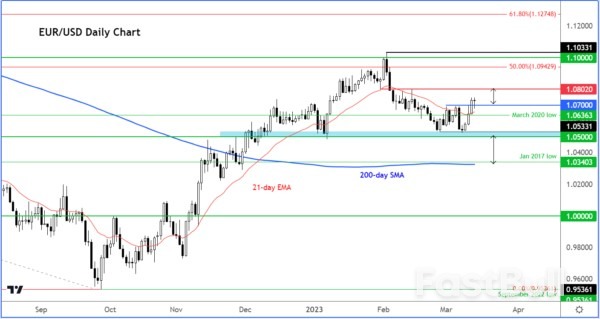
          The EUR/USD is likely to react positively to any hawkish surprise from the ECB given the increased financial stability risks in the US and the sharp repricing of yields lower over there. Thus, a 50-bps hike should send the EUR/USD higher, while a 25 bp hike could see rates drift back down to 1.0600.
          Ahead of the ECB rate decision, the EUR/USD has broken above the 1.0700 resistance level owing to expectations that the ECB might tighten its policy more than the Fed over the next few meetings. The breakout has potentially paved the way for a run towards the next resistance level around 1.08 area – and possibly even higher, depending on the outcome of the ECB meeting.
          ECB Preview: 50bps Hike May Still Be on The Cards_1The main risk for the EUR/USD right now is that if sentiment gets hurt so badly that the dollar finds support on haven flows. If the EUR/USD goes back below 1.0700 now and holds below this level, then this would put the bulls in a spot of bother.
          Even so, the downtrend will not fully resume unless rates go below key support around 1.0500 this week. But if that level gives way, then we would expect to see follow-up technical selling towards the 200-day average and old support around 1.0340 next.
          However, our base case assumption is that the EUR/USD will be able to climb higher as investors price out the risks of further aggressive rate increases from the Fed.
          Final words
          Given that inflation remains very high in the eurozone, we think that there is a good chance the ECB would not go against is strong guidance of a 50bp hike and thus disappoint market expectations for a lower increase.

          Source: Forex.Com

          Risk Warnings and Disclaimers
          You understand and acknowledge that there is a high degree of risk involved in trading. Following any strategies or investment methods may lead to potential losses. The content on the site is provided by our contributors and analysts for information purposes only. You are solely responsible for determining whether any trading assets, securities, strategy, or any other product is suitable for investing based on your own investment objectives and financial situation.
          Comments
          Add to Favorites
          Share

          Silicon Valley Bank Collapse Reverberates through Financial System

          Justin

          Central Bank

          Economic

          The collapse of Silicon Valley Bank and Signature Bank and the US federal government’s rescue of all depositors through the invocation of a systemic exemption will unleash a lasting torrent of recrimination, introspection and commentary, going well beyond the rescue itself. A plethora of issues will need to be assessed and those set out here will undoubtedly already be on the table.
          Outrage that the rescue is a bank bailout and will foment moral hazard are already being loudly heard. Up against bailout criticisms, the Federal Reserve and Treasury will feel compelled to defend their actions, reverting to the standard argument that shareholders will get wiped out and others hurt, so the rescue should not be seen as a bailout. But, of course, uninsured depositors are being protected.
          Authorities are quite mindful of moral hazard and the adverse incentives spawned by their actions. But just as has been the case, whether Republicans or Democrats were in power such as in 2008-09, the immediate need to protect the global and/or US economic and financial systems from severe harm and runs is rightly seen as far outweighing moral hazard concerns.
          Authorities can focus on corrective actions tomorrow. Today’s job is crisis management and stopping the run.
          Already, some analysts are recalibrating views on US monetary policy. An emerging consensus suggests the Fed will no longer consider hiking by 50 basis points in two weeks, but 25bp. Some are even suggesting there will be no hike in March. Yet inflation remains sticky, with some holding to an expected terminal rate above 5.5%. Meanwhile, Treasury rates – especially short-term rates – are plummeting and the yield curve’s inversion has been substantially reduced, largely reflecting a run to safety.
          For many years, Fed officials and leading practitioners have stated there should be separation between monetary and financial stability policies. Monetary policy should target the dual mandate, while financial stability should be tackled through sound micro- and macroprudential policy. The tools to implement that division were argued to be largely in place in the wake of the Dodd-Frank Wall Street Reform and Consumer Protection Act and post-2008 financial crisis measures.
          To listen to commentators and judging by market action, that view has been seemingly obliterated within a span of 48 hours.
          There are key issues for the US regulatory system. Under the US deposit insurance system, depositors are protected up to $250,000. But all SBV and Signature Bank depositors are being protected. Depositors were also heavily protected in the 2008 financial crisis, including money market funds.
          SVB was the US’s 16th largest bank. It was not seen as systemic. Yet, the financial contagion spawned by market fears and interconnectedness are obviously systemic. Bear Sterns and Lehman in and of themselves were not seen as systemic, and yet they were. A family fund, Archegos Capital Management, set off huge market ructions last year.
          Many US regional banks are enormous in terms of their assets. Legislation put forward in 2018 meant that banks under $250bn – not $50bn – in assets no longer needed to comply with enhanced prudential standards and associated supervisory rigour – stress testing and liquidity, for example.
          The US needs to consider whether the thresholds for what counts as systemic are appropriate. History clearly suggests that authorities have persistently underestimated contagion and that a much longer list of banks should be subjected to enhanced prudential standards. Inevitably, there should be an examination of whether tougher capital and liquidity standards are needed, especially for medium-sized and regional banks. The banks will continue their furious lobbying of Capitol Hill against doing so, but this week’s runs should be chastening.
          One fallout from SVB is that the concentration of the US banking system may further increase. Depositors in small- and medium-sized or regional banks are undoubtedly asking whether they should rethink their holdings. The largest banks, such as JP Morgan and Citi, will most likely seem safer and more attractive. Their portfolios are diverse. Their capital is stronger. They are too big to fail.
          Are on-the-ground regulators up to snuff? Analysts are already pointing to myriad flaws in SVB’s practices, even apart from the concentrated nature of its relationship with the valley’s venture capital and tech firms. Deposits soared at a much-faster-than-average pace. SVB relied enormously on funding from Federal Home Loan Banks. Its long-term bond holdings were relatively large and unhedged. These practices should have been red flags for regulators.
          Ahead of the 2008 financial crisis, US regulators missed red flags as well. They didn’t understand the complexity of structured products and risks building up on bank balance sheets.
          One can argue that SVB wouldn’t have been so badly hit if not for the Fed rate hiking cycle. But other financial institutions are being impacted and weathering the turbulence.
          Bank failures will always happen. But a serious investigation needs to be undertaken on why the regulators missed red flags, whether they were complacent and/or subject to regulatory capture and what needs to be overhauled.
          These are but a few issues to be spawned by the aftermath of SVB’s collapse. Undoubtedly, more will follow in the days ahead.

          Source:Mark Sobel

          To stay updated on all economic events of today, please check out our Economic calendar
          Risk Warnings and Disclaimers
          You understand and acknowledge that there is a high degree of risk involved in trading. Following any strategies or investment methods may lead to potential losses. The content on the site is provided by our contributors and analysts for information purposes only. You are solely responsible for determining whether any trading assets, securities, strategy, or any other product is suitable for investing based on your own investment objectives and financial situation.
          Comments
          Add to Favorites
          Share

          US Financial Stability Trumps Near-Term Inflation

          Justin

          Central Bank

          Economic

          Hot inflation lifts rate hike chances

          Headline US CPI rose 0.4% month-on-month in February, as expected, but core (ex food and energy) was up 0.5%, versus the 0.4% consensus. As a result, the annual rate of headline inflation slows to 6% from 6.4% while the annual rate of core inflation moderates to 5.5% from 5.6%. On the face of it this supports the case for a Federal Reserve rate hike next week (we are up to about 19bp priced now), but that is still contingent on market calm. Financial stability risks always trump near-term inflation worries.
          The details show shelter costs remain elevated, rising 0.8% MoM while airline fares jumped 6.4%, recreation increased 0.9% while apparel rose 0.8% MoM for the second month in a row. On the softer side, used car prices fell sharply again despite car auction prices suggesting the opposite while medical care costs continue to ease.

          But inflation to fall as economic conditions deteriorate

          Despite the strength in today’s core inflation measure, we expect inflation to slow rapidly through the second half of 2023 as the decline in house prices, which is leading to a flat lining in new rent agreements eventually feeds through into the CPI.
          This is not the only reason though. This has been the most aggressive monetary policy tightening cycle for 40 years and by going harder and faster into restrictive territory the Federal Reserve naturally has less control over the outcome. Higher borrowing costs have been accompanied by a rapid tightening in lending conditions, which will increasingly weigh on credit flow. Banks will become increasingly cautious on the back of the SVB/Signature fallout and regulators will be more watchful, which will in turn make banks even more cautious. This will restrict access to credit and put up its cost, further weighing on the economy and eroding corporate pricing power.

          Tight lending standards will get tighter, hitting the economy hardUS Financial Stability Trumps Near-Term Inflation_1

          Corporate profit margins will increasingly be squeezed

          This was again evident in today’s National Federation of Independent Businesses survey on the economy. The proportion of companies that said they raised prices over the previous three months dropped to 38% in February from 42% in January. This is the lowest reading since April 2021 (having hit 66% in March last year). More importantly, the proportion of companies looking to raise prices over the coming three months dropped back to 25% from 29% – close to the 24% figure hit in December. As the chart below shows, this has a good lead quality on core CPI and suggests sub 3% inflation by year-end.

          NFIB price plans series points to a rapid slowdown in core inflationUS Financial Stability Trumps Near-Term Inflation_2

          Companies, particularly in the small business sector "remain doubtful that business conditions will get better in coming months", according to the survey. Bank failures will not make them any more cheerful and intensifying competition is likely to mean profit margin squeezes and slower inflation.

          Fed probably still inclined to hike rates next week, but cuts are coming

          So where does this leave us with the Fed next week? We don’t see the need to hike rates. The tightening of lending conditions that will inevitably result from the fallout of the past few days heightens the risk of a hard economic landing and inflation returning to target by early next year. We do think there is an inclination for the Fed to hike if conditions allow.
          Longer term our view on the high chance of rate cuts before year-end has only been reinforced by recent developments.

          Source:XM

          To stay updated on all economic events of today, please check out our Economic calendar
          Risk Warnings and Disclaimers
          You understand and acknowledge that there is a high degree of risk involved in trading. Following any strategies or investment methods may lead to potential losses. The content on the site is provided by our contributors and analysts for information purposes only. You are solely responsible for determining whether any trading assets, securities, strategy, or any other product is suitable for investing based on your own investment objectives and financial situation.
          Comments
          Add to Favorites
          Share

          Inflation Pressures Continued to Moderate in the U.S. in February

          Justin

          Central Bank

          Economic

          February’s inflation report came slightly above consensus expectations, with headline CPI growth ticking lower to 6.5% year-over-year. Food inflation at 9.5% was still elevated but has also continued to moderate after peaking in August 2022. Energy CPI growth slowed to 5.2% year over year, the slowest pace in two years, thanks to declines in fuel oil and utility gas prices. Excluding those more volatile components, “core” inflation slowed to 5.5% year-over-year. The monthly increase however, reaccelerated to 0.5% from January on a seasonally adjusted basis again with 70% of the gain driven by an increase in rent costs. Offsetting some of that strength was weakness in used cars and medical services, both of which saw prices decline again in February.
          Inflation Pressures Continued to Moderate in the U.S. in February_1
          Details behind the CPI prints were firmer. Based on our diffusion measure, the breadth of inflation pressure in the U.S. widened in early 2023 after improving through much of last year. Powell’s preferred inflation gauge – core services ex-rent also grew at a faster 0.5% monthly pace, matching the increase in core CPI. Moving forward, the fact that most of the near-term strength in monthly CPI still reflects past increases in market rents suggests core readings should continue to come down. BLS estimated that the CPI rent measure lags market observed rents by roughly 4 quarters – yearly growth in those market rent measures has already peaked in February 2022.
          Inflation Pressures Continued to Moderate in the U.S. in February_2
          Strong labour market outturns since the beginning of 2023, alongside elevated wage gains and renewed strength in consumer spending have all been adding upward pressure to the outlook for inflation through this year and next. But much of the impact from monetary tightening to-date has just started to surface – the collapse of three U.S. regional banks over the weekend that rattled bond markets is a prime example. Market pricing after this morning’s report is leaning toward a 25 bp hike for next week’s Fed’s meeting.

          Source:RBC Financial Group

          To stay updated on all economic events of today, please check out our Economic calendar
          Risk Warnings and Disclaimers
          You understand and acknowledge that there is a high degree of risk involved in trading. Following any strategies or investment methods may lead to potential losses. The content on the site is provided by our contributors and analysts for information purposes only. You are solely responsible for determining whether any trading assets, securities, strategy, or any other product is suitable for investing based on your own investment objectives and financial situation.
          Comments
          Add to Favorites
          Share

          A New Intifada? Young Palestinian Fighters Rise as West Bank Boils

          Thomas

          Political

          Before a group of young men from Aqabat Jabr refugee camp mounted a botched attack on a restaurant in Jericho popular with Israeli settlers in January, they declared allegiance to Hamas.
          That was a surprise to their families - and to Hamas.
          "They weren't members of Al Qassam until that moment," said Wael Awdat, father of Ibrahim and Rafat, two members of the group, using the name of the armed wing of Hamas. "They had a normal life. This was something personal."
          Their story illustrates the complex mix of spontaneous action and association between established factions and new groups during an upsurge in violence in the occupied West Bank that has fuelled fears of a new Palestinian intifada to follow the uprisings of the 1980s and early 2000s.
          Alienated from mainstream Palestinian leadership and raised in an era of social media, a new generation of Palestinians has formed a clutch of militant groups, from the Lion's Den based in Nablus to the Jenin Brigade.
          Often with just a handful of fighters, the militant groups springing up across the West Bank over the past year have only loose ties to factions such as Hamas, Fatah or Islamic Jihad.
          With tight surveillance making it impossible to operate normally in the West Bank, Hamas, which runs the blockaded Gaza Strip, is relying on more flexible, informal networks to avoid detection, two Hamas officials told Reuters, speaking on condition of anonymity for fear of Israeli reprisals.
          A Hamas cadre in Jericho, normally a tranquil city, popular as a weekend getaway spot near the Dead Sea, told Reuters the movement had not known of the cell behind the restaurant attack but said: "Any faction would be happy to claim them as members."
          A few days after the attack, which failed when a gun jammed, the young men in the group were killed in an Israeli raid.
          "All the signs are that the intifada is coming," said the Hamas cadre, who declined to be named for fear of Israeli reprisals. "There is a new generation of people who believe the only solution is armed struggle."
          Tiktok, Posters and Songs
          Spontaneous offshoots of the established factions, such as the previously unknown Aqabat Jabr Battalion formed by the Awdat brothers and their friends, have proliferated.
          "Today we have a new generation that is aware of the resistance, and this is a generation that knows the ferocity of occupation," said one masked young fighter at a rally in Jenin this month, with the colours of Al Qassam around his head.
          "It does not fear arrest, injury or martyrdom. It is not afraid of anything," he told Reuters.
          With no central leadership, the groups get their message out though songs, TikTok videos and posters of fighters on walls, offering a model to young men angered by what they feel as repeated humiliations by Israeli soldiers and settlers.
          "The number of fighters is growing all the time and the enemy needs to know that violence against our people and our camps is increasing their number not reducing it," a masked gunman from the Jenin Brigade said.
          Over the past year, Israeli forces have carried out near-daily raids in the West Bank as part of a crackdown started in the wake of a spate of deadly attacks in Israel by Palestinians.
          More than 200 Palestinians, including both militants and civilians have been killed - about 80 this year alone - while over 40 Israelis and foreign nationals have been killed in attacks by Palestinians in Israel, the West Bank or around Jerusalem.
          As the Muslim holy month of Ramadan and the Jewish Passover approach, fears of more violence have grown, with a flood of weapons being smuggled in from Syria, Lebanon, Iraq, Lebanon, Jordan and Israel itself, Palestinian and Israeli officials say.
          "It's proper weapons, it's M16s, Kalashnikovs, it's pistols, it's ammunition, it's not weapons you can make at home, it's weapons that countries buy," said a senior Israeli officer, who spoke to Reuters on condition he would not be named.
          In addition, the officer said the new generation of militants were using social media effectively to mobilise.
          "We have the most lethal weapon there is, that nobody talks about, which is the telephone, so on social media networks very easily things pass from hand to hand over TikTok, etc," he said.
          Pleas For Calm
          While the lack of leadership has reduced the political focus of the new groups, Israeli officers say their fluid nature and the large number of lone attackers, with no known militant connections, has made them much harder to control.
          Incidents such as the Feb. 26 shooting of two Israelis in the West Bank by a Hamas gunman that triggered a revenge rampage by hundreds of settlers against the nearby Palestinian village of Huwara have shown the volatility of the situation.
          The violence has been constant, taking place amid a daily experience for Palestinians of confrontations with soldiers at checkpoints who have stepped up the search for "lone wolf" attackers, or with Israeli settlers, some of whom taunt and attack Palestinians with apparent impunity.
          As one killing succeeds another, there have been increasingly urgent pleas for calm from an alarmed international community. But neither Israel, now run by one of the most right-wing, nationalist religious governments in its history, nor the Palestinian fighters, appear ready to back down.
          "What do I fear? No, I carry my weapons and stand against the army," said Ahmed Ghoneim, whose two brothers were killed in an Israeli raid in January, at a parade in the Jenin refugee camp on March 3 to honour a founder of the Jenin Brigade.
          The rally was a classic display of force, with some 250 fighters from various factions parading in a courtyard, its walls plastered with pictures of their dead, posing with guns and the cropped hairstyles popular among young West Bank men.
          Four days later, Israeli security forces raided the camp, killing at least six gunmen, including the Hamas member behind the Feb. 26 Huwara shooting. Two days after that, three Islamic Jihad gunmen were killed in a raid nearby and on Sunday, three Lion's Den militants died in a shootout with Israeli forces.
          Bitterness Spreads
          Israeli officials often blame the surge in violence on a Palestinian Authority that nominally exercises a limited degree of rule in the West Bank but which is in reality effectively powerless in flashpoint areas such as Jenin.
          To make matters worse, the Authority has been preoccupied for months with the future of its 87-year-old President Mahmoud Abbas, whose eventual exit risks setting off a factional power struggle.
          For its part, the Palestinian Authority says its control is constantly undermined by Israeli actions, which both weaken its authority and fuel resentment among the young, already struggling with high unemployment and scarce prospects.
          The bitterness has now spread from radical fringes to affect even comparatively well-off Palestinians, such as the Awdat brothers, neither of whom fitted the classic profile of disaffected young men with no education or prospects.
          Speaking outside his house in Aqabat Jabr, a relatively calm area that resembles a rural village more than the crowded camps in Nablus or Jenin, their father, Wael Awdat, said his sons had appeared happy.
          Ibrahim, 27, operated a water tanker business in Aqabat Jabr and, like his 22-year-old brother Rafat, an electrician, had done two years of college. One member of their cell had a poultry business and drove a recent model BMW, Awdat said.
          "It's a good life here, it's like a family in the camp," he said. "But there is something bad happening every day. At some point, everyone reacts."

          Source: Reuters

          Risk Warnings and Disclaimers
          You understand and acknowledge that there is a high degree of risk involved in trading. Following any strategies or investment methods may lead to potential losses. The content on the site is provided by our contributors and analysts for information purposes only. You are solely responsible for determining whether any trading assets, securities, strategy, or any other product is suitable for investing based on your own investment objectives and financial situation.
          Comments
          Add to Favorites
          Share
          FastBull
          Copyright © 2025 FastBull Ltd

          728 RM B 7/F GEE LOK IND BLDG NO 34 HUNG TO RD KWUN TONG KLN HONG KONG

          TelegramInstagramTwitterfacebooklinkedin
          App Store Google Play Google Play
          Products
          Charts

          Chats

          Q&A with Experts
          Screeners
          Economic Calendar
          Data
          Tools
          Membership
          Features
          Function
          Markets
          Copy Trading
          Latest Signals
          Contests
          News
          Analysis
          24/7
          Columns
          Education
          Company
          Careers
          About Us
          Contact Us
          Advertising
          Help Center
          Feedback
          User Agreement
          Privacy Policy
          Business

          White Label

          Data API

          Web Plug-ins

          Poster Maker

          Affiliate Program

          Risk Disclosure

          The risk of loss in trading financial instruments such as stocks, FX, commodities, futures, bonds, ETFs and crypto can be substantial. You may sustain a total loss of the funds that you deposit with your broker. Therefore, you should carefully consider whether such trading is suitable for you in light of your circumstances and financial resources.

          No decision to invest should be made without thoroughly conducting due diligence by yourself or consulting with your financial advisors. Our web content might not suit you since we don't know your financial conditions and investment needs. Our financial information might have latency or contain inaccuracy, so you should be fully responsible for any of your trading and investment decisions. The company will not be responsible for your capital loss.

          Without getting permission from the website, you are not allowed to copy the website's graphics, texts, or trademarks. Intellectual property rights in the content or data incorporated into this website belong to its providers and exchange merchants.

          Not Logged In

          Log in to access more features

          FastBull Membership

          Not yet

          Purchase

          Become a signal provider
          Help Center
          Customer Service
          Dark Mode
          Price Up/Down Colors

          Log In

          Sign Up

          Position
          Layout
          Fullscreen
          Default to Chart
          The chart page opens by default when you visit fastbull.com