• Trade
  • Markets
  • Copy
  • Contests
  • News
  • 24/7
  • Calendar
  • Q&A
  • Chats
Trending
Screeners
SYMBOL
LAST
BID
ASK
HIGH
LOW
NET CHG.
%CHG.
SPREAD
SPX
S&P 500 Index
6850.57
6850.57
6850.57
6878.28
6841.15
-19.83
-0.29%
--
DJI
Dow Jones Industrial Average
47808.56
47808.56
47808.56
47971.51
47709.38
-146.42
-0.31%
--
IXIC
NASDAQ Composite Index
23542.11
23542.11
23542.11
23698.93
23505.52
-36.00
-0.15%
--
USDX
US Dollar Index
99.130
99.210
99.130
99.160
98.730
+0.180
+ 0.18%
--
EURUSD
Euro / US Dollar
1.16205
1.16213
1.16205
1.16717
1.16169
-0.00221
-0.19%
--
GBPUSD
Pound Sterling / US Dollar
1.33169
1.33178
1.33169
1.33462
1.33053
-0.00143
-0.11%
--
XAUUSD
Gold / US Dollar
4191.09
4191.52
4191.09
4218.85
4175.92
-6.82
-0.16%
--
WTI
Light Sweet Crude Oil
58.950
58.980
58.950
60.084
58.837
-0.859
-1.44%
--

Community Accounts

Signal Accounts
--
Profit Accounts
--
Loss Accounts
--
View More

Become a signal provider

Sell trading signals to earn additional income

View More

Guide to Copy Trading

Get started with ease and confidence

View More

Signal Accounts for Members

All Signal Accounts

Best Return
  • Best Return
  • Best P/L
  • Best MDD
Past 1W
  • Past 1W
  • Past 1M
  • Past 1Y

All Contests

  • All
  • Trump Updates
  • Recommend
  • Stocks
  • Cryptocurrencies
  • Central Banks
  • Featured News
Top News Only
Share

Moody's Affirmed Burberry's Long-term Rating Of Baa3 And Revised Its Outlook (from Negative) To Stable

Share

The Trump Administration Supports Iraq's Plan To Transfer Russian Oil Company Lukoil Pjsc's Assets In The West Qurna 2 Oil Field To An American Company

Share

JMA: Tsunami Of 70 Centimetres Observed In Japan's Kuji Port In Iwate Prefecture

Share

The U.S. Bureau Of Labor Statistics Plans To Release A Press Release On January 15, 2026, For November 2025, Along With Data For October

Share

Tiger Global Has Established A New Fund, Aiming To Raise $2 Billion To $3 Billion

Share

The U.S. Bureau Of Labor Statistics Announced That It Will Not Release A Press Release Regarding The U.S. Import And Export Price Index (MXP) For October 2025

Share

The U.S. Bureau Of Labor Statistics (BLS) Will Not Release U.S. October CPI Data

Share

Government Negotiator: Dutch Political Center And Center Right Parties D66,  Cda And Vvd Advised To Start Talks On Possible Government

Share

New York Fed: November Home Price Rise Expectation Steady At 3%

Share

New York Fed: US Households' Personal Finance Worries Grew In November

Share

New York Fed: November Five-Year-Ahead Expected Inflation Rate Unchanged At 3%

Share

New York Fed: Households More Pessimistic On Current, Future Financial Situations In November

Share

New York Fed Report: USA Households' Year-Ahead Expected Inflation Rate Unchanged At 3.2% In November

Share

New York Fed: November Year-Ahead Expected Rise In Medical Costs Highest Since January 2014

Share

New York Fed: Labor Market Expectations Improved In November

Share

New York Fed: November Three-Year-Ahead Expected Inflation Rate Unchanged At 3%

Share

Traders Expect The Federal Reserve To Have Less Than 75 Basis Points Of Room To Cut Interest Rates Before The End Of 2026

Share

African Stock Market Closing Report | On Monday (December 8), The South African FTSE/Jse Africa Leading 40 Traded Index Closed Down 1.57%, Nearing 103,000 Points. It Opened Roughly Flat At 15:00 Beijing Time And Then Continued To Decline

Share

Spot Gold Briefly Plunged From Above $4,210 To $4,176.42, Hitting A New Daily Low, With An Overall Intraday Decline Of Over 0.2%

Share

The Athens Stock Exchange Composite Index Closed Up 0.17% At 2108.30 Points

TIME
ACT
FCST
PREV
France Trade Balance (SA) (Oct)

A:--

F: --

P: --
Euro Zone Employment YoY (SA) (Q3)

A:--

F: --

P: --
Canada Part-Time Employment (SA) (Nov)

A:--

F: --

P: --

Canada Unemployment Rate (SA) (Nov)

A:--

F: --

P: --

Canada Full-time Employment (SA) (Nov)

A:--

F: --

P: --

Canada Labor Force Participation Rate (SA) (Nov)

A:--

F: --

P: --

Canada Employment (SA) (Nov)

A:--

F: --

P: --

U.S. PCE Price Index MoM (Sept)

A:--

F: --

P: --

U.S. Personal Income MoM (Sept)

A:--

F: --

P: --

U.S. Core PCE Price Index MoM (Sept)

A:--

F: --

P: --

U.S. PCE Price Index YoY (SA) (Sept)

A:--

F: --

P: --

U.S. Core PCE Price Index YoY (Sept)

A:--

F: --

P: --

U.S. Personal Outlays MoM (SA) (Sept)

A:--

F: --

P: --
U.S. 5-10 Year-Ahead Inflation Expectations (Dec)

A:--

F: --

P: --

U.S. Real Personal Consumption Expenditures MoM (Sept)

A:--

F: --

P: --
U.S. Weekly Total Rig Count

A:--

F: --

P: --

U.S. Weekly Total Oil Rig Count

A:--

F: --

P: --

U.S. Consumer Credit (SA) (Oct)

A:--

F: --

P: --
China, Mainland Foreign Exchange Reserves (Nov)

A:--

F: --

P: --

Japan Trade Balance (Oct)

A:--

F: --

P: --

Japan Nominal GDP Revised QoQ (Q3)

A:--

F: --

P: --

China, Mainland Imports YoY (CNH) (Nov)

A:--

F: --

P: --

China, Mainland Exports (Nov)

A:--

F: --

P: --

China, Mainland Imports (CNH) (Nov)

A:--

F: --

P: --

China, Mainland Trade Balance (CNH) (Nov)

A:--

F: --

P: --

China, Mainland Exports YoY (USD) (Nov)

A:--

F: --

P: --

China, Mainland Imports YoY (USD) (Nov)

A:--

F: --

P: --

Germany Industrial Output MoM (SA) (Oct)

A:--

F: --

P: --
Euro Zone Sentix Investor Confidence Index (Dec)

A:--

F: --

P: --

Canada National Economic Confidence Index

A:--

F: --

P: --

U.K. BRC Like-For-Like Retail Sales YoY (Nov)

--

F: --

P: --

U.K. BRC Overall Retail Sales YoY (Nov)

--

F: --

P: --

Australia Overnight (Borrowing) Key Rate

--

F: --

P: --

RBA Rate Statement
RBA Press Conference
Germany Exports MoM (SA) (Oct)

--

F: --

P: --

U.S. NFIB Small Business Optimism Index (SA) (Nov)

--

F: --

P: --

Mexico 12-Month Inflation (CPI) (Nov)

--

F: --

P: --

Mexico Core CPI YoY (Nov)

--

F: --

P: --

Mexico PPI YoY (Nov)

--

F: --

P: --

U.S. Weekly Redbook Index YoY

--

F: --

P: --

U.S. JOLTS Job Openings (SA) (Oct)

--

F: --

P: --

China, Mainland M1 Money Supply YoY (Nov)

--

F: --

P: --

China, Mainland M0 Money Supply YoY (Nov)

--

F: --

P: --

China, Mainland M2 Money Supply YoY (Nov)

--

F: --

P: --

U.S. EIA Short-Term Crude Production Forecast For The Year (Dec)

--

F: --

P: --

U.S. EIA Natural Gas Production Forecast For The Next Year (Dec)

--

F: --

P: --

U.S. EIA Short-Term Crude Production Forecast For The Next Year (Dec)

--

F: --

P: --

EIA Monthly Short-Term Energy Outlook
U.S. API Weekly Gasoline Stocks

--

F: --

P: --

U.S. API Weekly Cushing Crude Oil Stocks

--

F: --

P: --

U.S. API Weekly Crude Oil Stocks

--

F: --

P: --

U.S. API Weekly Refined Oil Stocks

--

F: --

P: --

South Korea Unemployment Rate (SA) (Nov)

--

F: --

P: --

Japan Reuters Tankan Non-Manufacturers Index (Dec)

--

F: --

P: --

Japan Reuters Tankan Manufacturers Index (Dec)

--

F: --

P: --

Japan Domestic Enterprise Commodity Price Index MoM (Nov)

--

F: --

P: --

Japan Domestic Enterprise Commodity Price Index YoY (Nov)

--

F: --

P: --

China, Mainland PPI YoY (Nov)

--

F: --

P: --

China, Mainland CPI MoM (Nov)

--

F: --

P: --

Q&A with Experts
    • All
    • Chatrooms
    • Groups
    • Friends
    Connecting
    .
    .
    .
    Type here...
    Add Symbol or Code

      No matching data

      All
      Trump Updates
      Recommend
      Stocks
      Cryptocurrencies
      Central Banks
      Featured News
      • All
      • Russia-Ukraine Conflict
      • Middle East Flashpoint
      • All
      • Russia-Ukraine Conflict
      • Middle East Flashpoint
      Search
      Products

      Charts Free Forever

      Chats Q&A with Experts
      Screeners Economic Calendar Data Tools
      Membership Features
      Data Warehouse Market Trends Institutional Data Policy Rates Macro

      Market Trends

      Market Sentiment Order Book Forex Correlations

      Top Indicators

      Charts Free Forever
      Markets

      News

      News Analysis 24/7 Columns Education
      From Institutions From Analysts
      Topics Columnists

      Latest Views

      Latest Views

      Trending Topics

      Top Columnists

      Latest Update

      Signals

      Copy Rankings Latest Signals Become a signal provider AI Rating
      Contests
      Brokers

      Overview Brokers Assessment Rankings Regulators News Claims
      Broker listing Forex Brokers Comparison Tool Live Spread Comparison Scam
      Q&A Complaint Scam Alert Videos Tips to Detect Scam
      More

      Business
      Events
      Careers About Us Advertising Help Center

      White Label

      Data API

      Web Plug-ins

      Affiliate Program

      Awards Institution Evaluation IB Seminar Salon Event Exhibition
      Vietnam Thailand Singapore Dubai
      Fans Party Investment Sharing Session
      FastBull Summit BrokersView Expo
      Recent Searches
        Top Searches
          Markets
          News
          Analysis
          User
          24/7
          Economic Calendar
          Education
          Data
          • Names
          • Latest
          • Prev

          View All

          No data

          Scan to Download

          Faster Charts, Chat Faster!

          Download App
          English
          • English
          • Español
          • العربية
          • Bahasa Indonesia
          • Bahasa Melayu
          • Tiếng Việt
          • ภาษาไทย
          • Français
          • Italiano
          • Türkçe
          • Русский язык
          • 简中
          • 繁中
          Open Account
          Search
          Products
          Charts Free Forever
          Markets
          News
          Signals

          Copy Rankings Latest Signals Become a signal provider AI Rating
          Contests
          Brokers

          Overview Brokers Assessment Rankings Regulators News Claims
          Broker listing Forex Brokers Comparison Tool Live Spread Comparison Scam
          Q&A Complaint Scam Alert Videos Tips to Detect Scam
          More

          Business
          Events
          Careers About Us Advertising Help Center

          White Label

          Data API

          Web Plug-ins

          Affiliate Program

          Awards Institution Evaluation IB Seminar Salon Event Exhibition
          Vietnam Thailand Singapore Dubai
          Fans Party Investment Sharing Session
          FastBull Summit BrokersView Expo

          In Search of that Curve-Steepening Optimism

          Alex

          Central Bank

          Summary:

          At this stage of the cycle, curve steepening tends to occur when short rates drop. This makes last week's bear-steepening all the more noticeable. We think the economic optimism required for long-end rates to catch up to the front-end is missing.
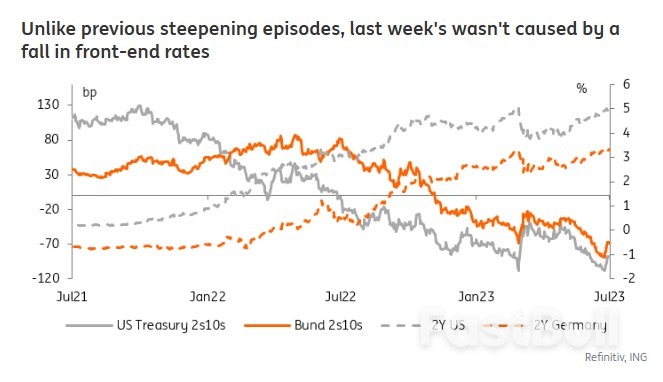
          Curve steepening in a hiking cycle is typically caused by falling front-end rates
          There was a pretty noticeable turnaround of the curve-flattening theme last week. Flattening has dominated interest rate markets since it became evident that central banks needed to tighten policy to fight the inflation surge. This is not the first time the curve has re-steepened in this cycle. The last such steepening, in March this year, as investors fretted about the risk of a banking crisis in the U.S., was caused by a reassessment of the near-term path for policy. In other words, it was caused by a plunge in short-term yields. Previous occurrences in this tightening cycle fit that mould and, each time, the move has been promptly reversed.
          Last week's curve steepening differs in that it was largely driven by higher long-end yields. If the move extends, it will be a departure from the trend in place since early 2021 in the U.S. and early 2022 in the eurozone. This would be more than a mere technicality. What rates specialists call a bear-steepening of the curve, put more simply is a rise in long-end yields. For instance, for the 2s10s U.S. Treasury curve to bear-steepen back to flat, from over 100bp inverted at the start of the month, the 10Y would need to rise to almost 5%, from just above 4% currently. This would be a significant improvement in the transmission of tighter monetary policy which has struggled to propagate fully to longer-dated forms of borrowing, and a sure drag on the economy.
          In Search of that Curve-Steepening Optimism_1An unlikely vote of confidence on the economy and central banks' stewardship
          Curve inversion is a very natural phenomenon when the front end rises. It reflects the fact that the market collectively forecasts rates to subsequently fall back towards their long-term average. There are a lot of assumptions in this reasoning. One is what is the correct long-term level for rates, another one is how long it takes for them to drop back to, or below, this level. For the curve to steepen near the peak of a hiking cycle, which we think will be reached in July and September for the U.S. and eurozone respectively, markets need to assume that no cut will follow, or indeed that there could be more hikes down the line. This, in other words, is a massive vote of confidence in both the economy's strength, and on central banks' ability to find exactly the right level of rates that slows inflation but not the economy, assuming such a thing exists.
          The recent resilience of the U.S. economy makes this narrative slightly less unlikely than thought earlier this year, but it remains a stretch. More likely, by pushing the expected start date of the Fed's cutting cycle further out in time, it makes bets on falling long-end rates less attractive for investors with a shorter investing horizon, especially into this week's long-end U.S. Treasury auctions.
          Today's Zew survey should, if consensus is any guide, confirm that no such optimism exists in Europe. To us, the risk of a protracted fight against inflation is real, but we doubt this is what has steepened yield curves since the start of the month. More likely, lower rates bets are losing in popularity and the very inverted yield curve levels a week ago made a snap back more likely. We reserve our judgement on a more macro-related bear-steepening, but we're sceptical that the necessary optimism exists.
          Today's events and market view
          The main economic releases of note this morning are Italy's industrial production and Germany's Zew sentiment survey. Regarding the latter, both the current conditions and expectations components are forecast to decline, in line with the general gloom in the eurozone, if Bloomberg consensus is any guide. The National Federation of Independent Business small business optimism in the U.S. completes the list.
          There will be plenty of 7Y core bonds on offer, with the Netherlands and Germany both issuing today. Greece has also mandated banks for the launch of a 15Y benchmark via syndication. This will coincide with a tender offer for 2Y and 3Y bonds.
          In the U.S., the treasury will begin this week's supply slate with a 3Y T-note auction.

          Source: ING

          Risk Warnings and Disclaimers
          You understand and acknowledge that there is a high degree of risk involved in trading. Following any strategies or investment methods may lead to potential losses. The content on the site is provided by our contributors and analysts for information purposes only. You are solely responsible for determining whether any trading assets, securities, strategy, or any other product is suitable for investing based on your own investment objectives and financial situation.
          Comments
          Add to Favorites
          Share

          China Hopes Lift the Complex

          Owen Li

          Commodity

          Energy: Gas prices decline
          The oil market continues to trade in a largely rangebound manner. Although clearly it is trading towards the top end of its recent range. News that China will likely implement further support measures for its property sector has provided a bit of further support to the commodities complex in early morning trading today. This comes at a time when we are also seeing quite a bit more strength in the Brent structure, so potentially we could start seeing sentiment in the oil market turning more constructive. However, much will also depend on US CPI data for June, which will be released tomorrow. This is important for markets, as it will shape expectations on monetary policy from the US Fed in the months ahead. A number above year-on-year consensus (3.1%) would likely put some pressure on risk assets.
          The European natural gas market came under significant pressure yesterday. TTF briefly traded below EUR30/MWh and settled almost 10% lower on the day – trading down to the lowest levels in almost a month. Norwegian gas flows have partially recovered from levels seen in late May and June, although they are still well below pre-maintenance levels. Despite these lower flows, EU storage continues to fill up at a good pace with storage almost 80% full already. We continue to believe that storage will be full well ahead of the next heating season, which suggests that we will see further downside in prices over the Northern Hemisphere over the summer months.
          Metals: Russian origin aluminium grows in LME sheds
          Rising concerns about deflation risks in China weighed on the metals complex yesterday. The latest data from the world's biggest consumer of industrial metals showed consumer inflation in China remained flat in June, indicating a weak post-reopening economic recovery. However, reports of further support measures for the property sector are pushing metal prices higher in early trading this morning.
          The share of Russian aluminium stocks in LME warehouses has increased to 80.3% (218,025 tonnes) of the total in June, compared to 68.2% reported a month earlier, indicating that consumers continue to avoid exposure to Russian metal. That proportion has gone up for a fifth month in a row since the bourse started releasing the data in January. Meanwhile, the share of Indian aluminium stocks in the exchange warehouses dropped to 18.2% in June from 30.3% in May.
          Yunnan Tin Co., China's biggest tin smelter, will halt production starting on 11 July for about 45 days for maintenance. However, the smelter believes the annual production target will remain unchanged as the scheduled maintenance was planned at the start of the year. Yunnan Tin produced around 45kt of tin ingot last year.
          The latest forecast from the Ministry of Economy, Trade and Industry (METI) shows that crude steel production in Japan is expected to rise by 2.2% YoY (the first increase in seven quarters) to 22.3mt in the third quarter, following a moderate recovery in automobile production and higher exports. The group expects demand for steel products (including those for exports) to rise by 1% YoY to 20.4mt in the third quarter.
          Agriculture: US soybean estimates expected to be cut
          The USDA's latest crop progress report shows that the US corn crop condition increased over the last week. The USDA rated 55% of the corn crop in good-to-excellent condition over the reporting week, up from 51% a week ago, but still below the 64% seen at the same stage last year. For soybeans, 51% of the soybean crop was rated good-to-excellent, up marginally from 50% the previous week, but below the 62% at the same time last year. All eyes in the grain market this week will be on the USDA's monthly WASDE report, which will be released on Wednesday. And expectations are that we will see some downward revisions to US soybean output estimates.
          The latest update from the Joint Coordination Centre (JCC) showed that 151.8kt of crops were shipped from Ukrainian ports under the Black Sea Grain Initiative for the week ending 9 July, down about 45% week-on-week. The fall in volume reflects the uncertainty surrounding the extension of the Black Sea Grain Initiative which is up for renewal on 17 July. More than 32.7mt of Ukrainian crops have been shipped under the grain initiative since its commencement in July 2022.

          Source: ING

          Risk Warnings and Disclaimers
          You understand and acknowledge that there is a high degree of risk involved in trading. Following any strategies or investment methods may lead to potential losses. The content on the site is provided by our contributors and analysts for information purposes only. You are solely responsible for determining whether any trading assets, securities, strategy, or any other product is suitable for investing based on your own investment objectives and financial situation.
          Comments
          Add to Favorites
          Share

          Is Equity Rotation Helping EUR/$?

          Samantha Luan

          Forex

          USD: Let's see if this dollar softness can extend
          The dollar has started the week on the soft side. There has not been too much data but the push factor of the Fed/US interest rate story versus the pull factor of overseas asset markets is slightly working against the dollar. On the former, US short-dated rates came off 10bp in the European afternoon yesterday seemingly on the back of a New York Fed consumer inflation expectations survey that in the one-year tenor fell to the lowest levels since April 2021. The market seemed to ignore three Fed speakers all sticking to the script that the policy rate would probably need to be hiked another 25bp or 50bp this year.
          And in terms of the pull factor, some very modest support measures announced for the Chinese property sector seem to be raising speculation that broader support for the private sector will be forthcoming this summer. Asian equities are modestly bid today.
          However, a story that caught our eye in today's Financial Times may be partially explaining this soft dollar tone. The report suggests hedge funds have slashed their positions in US equities to the lowest in a decade and are turning their attention to under-valued European equities. Obviously, there are myriad factors that drive FX rates, but one can argue that the dollar trading to the weak side of what interest rate differentials suggest may be partially down to this kind of rotation. Remember that unlike bond market flows, equity flows are normally left FX unhedged.
          Back to today and the best chance for this dollar decline to extend a little further will be the release of the NFIB small business optimism data for June. As our US economist James Knightley points out in our week ahead, a further decline in pricing intentions in this survey will add weight to the view that inflation is coming lower. (The main event, however, remains tomorrow's release of June CPI.)
          We do not expect big FX moves today, but DXY could continue drifting toward the 101.50 area.
          EUR: Looking at 1.1100
          As discussed above, equity flows may be partially explaining why EUR/USD is drifting higher even though some key inputs are barely moving. The default view will be that EUR/USD is unlikely to break above 1.1100 since the Fed is still hawkish and risk assets have yet to adjust to the much more restrictive monetary policy settings around the world. It is probably dangerous to expect a range break-out, but if it were to occur this week, tomorrow's US June CPI figure would probably be the catalyst.
          The eurozone calendar is quite light today – just the July ZEW investor expectations survey at 11CET – and we have the lone ECB speaker of Francois Villeroy de Galhau at 10CET who is unlikely to move the needle much on current market pricing of two more 25bp ECB rate hikes by October.
          We have been here before and should not get over-eager on a possible range break-out, but we could see EUR/USD drifting closer to the year's highs near 1.1100.
          GBP: Pay data can keep the Bank of England hawkish for longer
          GBP/USD has risen to the highest levels since last April on the back of some strong UK wage data for May. As our UK economist James Smith notes, the upward surprise to UK wage growth is partly down to backward revisions. But that is not a huge comfort because looking at the private sector, which is what the Bank of England focuses on, we have seen another big month-on-month increase in pay. Whether that is partly because of the ongoing passthrough of the new National Living Wage (+10% in April), is not clear. But certainly, these are not figures the BoE will want to see and will maintain the market's exceptionally aggressive pricing of the Bank Rate up near 6.40% early next year.
          GBP/USD looks set to extend to 1.30 in this soft dollar environment, while EUR/GBP can retest the lows near 0.8520.
          CEE: First sign of recovery
          The beginning of the week showed that a good mood is returning to the region. However, CEE FX is still not settled and we expect higher volatility in the days ahead. The local calendar is empty today and again the focus will be on the global story.
          We see the Hungarian forint as the main indicator of recovery in the region, having lost around 5% last week. Yesterday, on the other hand, it showed a 1% appreciation, the biggest daily appreciation since April, and returned to 380 EUR/HUF, which we believe may be a trigger for further inflows. Thus, a move below 380 EUR/HUF will be on the table today and we expect gains for the rest of the region as well if the global story permits. The Polish zloty posted some gains yesterday too and still has room to make up for last week's losses. We see the next level at 4.430 EUR/PLN.

          Source: ING

          Risk Warnings and Disclaimers
          You understand and acknowledge that there is a high degree of risk involved in trading. Following any strategies or investment methods may lead to potential losses. The content on the site is provided by our contributors and analysts for information purposes only. You are solely responsible for determining whether any trading assets, securities, strategy, or any other product is suitable for investing based on your own investment objectives and financial situation.
          Comments
          Add to Favorites
          Share

          U.S. Dollar Slides Below Critical Support

          Cohen

          Forex

          The week started on a cautious note as European and U.S. stocks eked out small gains, but appetite was limited appetite on news that the new capital requirements for the U.S. banks would be tougher.
          And mega caps didn't give much support. Tesla lost up to 2% during the session, while Amazon closed the session more than 2% lower before its Prime Day – which now became an industrywide shopping day and will give us a hint on how much U.S. consumers are ready to up their spending online. Meta, on the other hand, advanced 1.23%, as Threads already amassed 100 mio users since its launch last week, while internet traffic data from Cloudflare showed that Twitter use 'tanked'.
          Tougher rules
          Michael Barr said yesterday that he will recommend tougher capital rules for banks with $100 billion or more in assets, as opposed to those that have $700bn and more so far concerned with the tough rules.
          More importantly, unrealized losses (and gains) on security portfolios will be considered when calculating regulatory proposal, a thing that could've helped avoiding Silicon Valley Bank's (SVB) collapse, but that will also put a bigger pressure on banks that bought tons of U.S. treasuries and that are now sitting on significantly discounted portfolios.
          The good news is that big banks like JP Morgan and Citi didn't react aggressively to the news, and even more reassuring news is that the smaller, regional bank stocks tempered the news quite well as well. Pacwest for example lost only around 1% and Invesco's KBW index even closed the session slightly higher.
          What's less reassuring, however, is the fact that the Federal Reserve (Fed) will continue pushing the interest rates higher, and that will put an extra pressure on lenders, and the regional lenders are the most vulnerable to rate changes.
          Other than that, it was a day of digesting and scaling back the recent rise in hawkish Fed expectations as used-car prices, which has been a good indication for inflation in this inflation cycle, fell 4.2% in June, the largest drop since the beginning of the pandemic. The prices came down by more than 10% in a year. Plus, according to the New York Fed's latest survey, inflation expectations for the next 12-month fell to 3.8% in June, from 4.1% printed a month earlier, although the 3-year expectations ticked higher to 3%. The same survey also showed that consumers were more pessimistic about the job market outlook, and median expected spending growth over the next year declined to the lowest levels since September 2021.
          Capital flew into treasuries yesterday, the U.S. 2-year yield for example declined about 10bp, while the U.S. dollar plunged below a long-term ascending channel base despite the hawkish Fed expectations. The dollar bears are now targeting the 100 level as their next destination.
          The dollar-yen plunged below the 141 level and is preparing to test the 50-DMA, which stands near the 140 level, to the downside. The EUR/USD rallied past 1.10 mark despite a sentiment index that showed a faster deterioration for July in Eurozone. Today the German CPI will likely confirm a latest rebound in inflation – as the low-price train tickets that government had distributed last year are creating a positive base effect for inflation in Germany, and the ZEW index is expected to warn of worsening mood. Higher German inflation is positive for the euro, but I am not sure that Christine Lagarde or her colleagues at the European Central Bank (ECB) care much about sentiment indicators. The softening U.S. dollar despite the hawkish Fed expectations, and hawkish ECB expectations could support a further rise in the EUR/USD toward the 1.12 mark.

          Source: Swissquote Bank SA

          Risk Warnings and Disclaimers
          You understand and acknowledge that there is a high degree of risk involved in trading. Following any strategies or investment methods may lead to potential losses. The content on the site is provided by our contributors and analysts for information purposes only. You are solely responsible for determining whether any trading assets, securities, strategy, or any other product is suitable for investing based on your own investment objectives and financial situation.
          Comments
          Add to Favorites
          Share

          Dollar Decline Intensifies, Yen Holding Pole Position

          Samantha Luan

          Forex

          Dollar's selloff gained momentum in today's Asian trading session, breaking through near-term support levels against Euro and Sterling. The market remains skeptical about the possibility of Fed implementing two or more rate hikes this year. With U.S. CPI release scheduled for tomorrow, traders appear to be positioning themselves for potential downside surprises. Meanwhile, major U.S. stock indexes closed slightly higher overnight, and benchmark 10-year yield slipped below 4% mark during Asian session.
          At present, Japanese Yen is holding its position as the strongest currency of the week, as it continues to reverse its downtrend from earlier this year. Swiss Franc stands as the second strongest, followed by Euro, and then Sterling. The relative positions of these European majors could change based on the movements of their crosses, which are currently trading within established ranges. Commodity currencies are distinctly trailing in the race against the greenback.
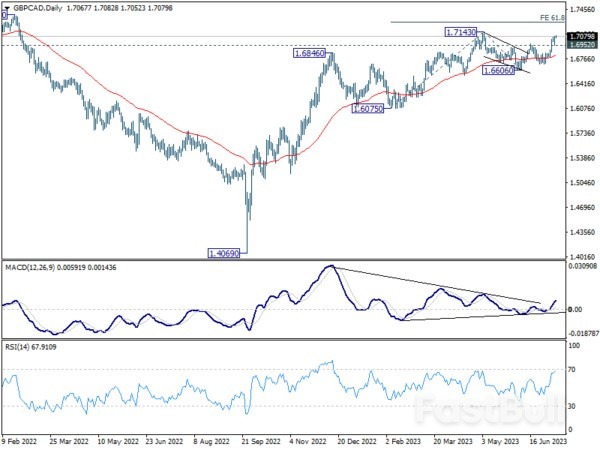
          In the context of significant economic events, GBP/CAD deserves attention. Today's spotlight is on UK employment data, while tomorrow brings UK GDP report and BoC rate decision. Technically speaking, as long as 1.6952 support level holds, rebound from 1.6606 is expected to extend past 1.7143 high. If this happens, it would signify resumption of the overall uptrend from 1.4069 (2022 low), targeting 61.8% projection of 1.6075 to 1.7143 from 1.6606 at 1.7266 in the near term. Nevertheless, break of 1.6952 could extend the corrective pattern from 1.7143 with another falling leg before uptrend resumes.Dollar Decline Intensifies, Yen Holding Pole Position_1
          In Asia, at the time of writing, Nikkei is up 0.04%. Hong Kong HSI is up 1.53%. China Shanghai SSE is up 0.48%. Singapore Strait Times is up 0.12%. Japan 10-year JGB yield is down -0.0135 at 0.459. Overnight, DOW rose 0.62%. S&P 500 rose 0.24%. NASDAQ rose 0.18%. 10-year yield dropped -0.044 to 4.006.

          Fed Bostic advocates patience as restrictiveness is working

          Atlanta Fed President Raphael Bostic projected a sense of confidence in the current monetary policies during his speech on Monday, suggesting the potential for patience as restrictive strategy seems to be yielding desired outcomes.
          Bostic noted, "I have the view that we can be patient — our policy right now is clearly in the restrictive territory," adding that the economy's signs of slowing down indicate that the policy is achieving its intended effect.
          The Atlanta Fed President pointed out that underlying data for prices "is actually telling a very positive story." Bostic believes that momentum is building in the disinflationary trend, stating, "We have got that momentum going. You could see inflation getting back to 2% without having to do more."
          Despite his overall optimistic outlook, Bostic did note that he would be concerned if expectations for consumer-price increases became "unanchored." This situation would necessitate further action from policymakers. However, he expressed confidence that "inflation is still moving steadily back to target" and that inflation expectations are centered around 2%.
          Bostic summed up his stance by stating, "I am comfortable being patient."

          Fed Daly: We need to raise rates to bridle the economy more

          San Francisco Fed President Mary Daly acknowledged yesterday that while inflation appears to be slowing, it remains far too elevated. In an interview held at the Brookings Institution in Washington, D.C., Daly indicated the need for further measures to counteract inflationary pressures.
          She affirmed, "I think it's a very reasonable projection to say a couple of more rate hikes will be necessary."
          Daly reflected on the resilience of the U.S.. economy, which has shown surprising strength despite ongoing economic challenges. The robust data, according to Daly, signal a clear need for intervention: "We need to raise rates to bridle that economy more."
          "With labor market still strong, inflation high, risks of doing too little are outweighing risks of doing too much," she added.
          Nevertheless, "It's appropriate to slow the pace of rate hikes."

          Australia's Westpac consumer sentiment up 2.7% mom, but pessimism still prevails

          Westpac-MI Consumer Sentiment Index in Australia witnessed a modest 2.7% mom increase in July, rising to 81.3. However, the index remains entrenched the deeply pessimistic territory, a condition that has prevailed for over a year now.
          According to Westpac, the main driving force behind this month's uplift is easing in monthly inflation, which dipped from 6.8% in April to 5.6% in May.
          RBA decision to pause in July, however, failed to instill confidence. In fact, the sentiment was considerably more buoyant before the decision, with an index reading of 88, marking an 11.2% rise from June. Post-RBA responses, on the other hand, presented a combined index reading of 77.9, a dip of -11.6% from the pre-RBA sample and a -1.6% fall from June's reading.
          Westpac's key message is clear: "Sentiment is probably not going to stage a sustained lift from current deeply pessimistic levels until inflation is much lower and interest rates are firmly on hold."
          Looking ahead to the RBA's next meeting on August 1, Westpac expects that if annual underlying inflation prints around 6.1% for the June quarter, and if the unemployment rate continues to hold well below full employment, the case for higher rates will be clear.
          As such, Westpac anticipates that RBA Board will raise cash rate by 0.25% at both August and September Board meetings, followed by a prolonged pause. The first rate cut in the subsequent easing cycle is expected next May.

          Looking ahead

          UK employment, and Germany ZEW economic sentiment are the main features in European session. Germany will also publish CPI final while Italy will release industrial production. Later in the day, U.S. will release NFIB small business index.

          USD/JPY Daily Outlook

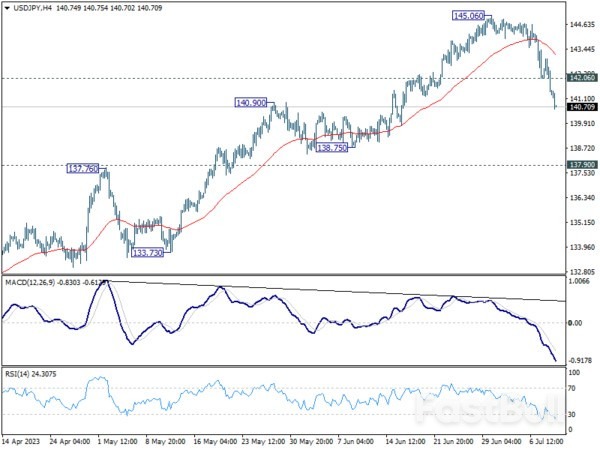
          USD/JPY's fall from 145.06 continues today and and breaches 140.90 resistance turned support. There is no clear sign of bottoming yet, and intraday bias stays on the downside for 137.90 next. On the upside, above 142.06 minor resistance will turn intraday bias neutral and bring consolidations first, before staging another fall.Dollar Decline Intensifies, Yen Holding Pole Position_2
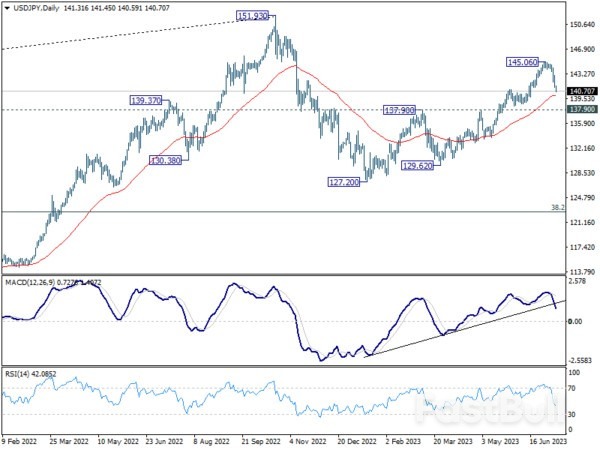
          In the bigger picture, current downside acceleration, as seen in daily MACD, argues that fall from 145.06 is already the third leg of the corrective pattern from 151.93 (2022 high). Sustained break of 137.90 resistance turned support should confirm this case and target 127.20 (2023 low) and below. For now, this will remain the favored case as long as 145.06 resistance holds.Dollar Decline Intensifies, Yen Holding Pole Position_3

          Source: ActionForex.com

          Risk Warnings and Disclaimers
          You understand and acknowledge that there is a high degree of risk involved in trading. Following any strategies or investment methods may lead to potential losses. The content on the site is provided by our contributors and analysts for information purposes only. You are solely responsible for determining whether any trading assets, securities, strategy, or any other product is suitable for investing based on your own investment objectives and financial situation.
          Comments
          Add to Favorites
          Share

          Hungry Exchanges Fight for Slice of American Pie

          Kevin Du

          Cryptocurrency

          Crypto platforms are vying for dominance in the United States, the world's biggest market, following a regulatory crackdown that's shaken the sector.
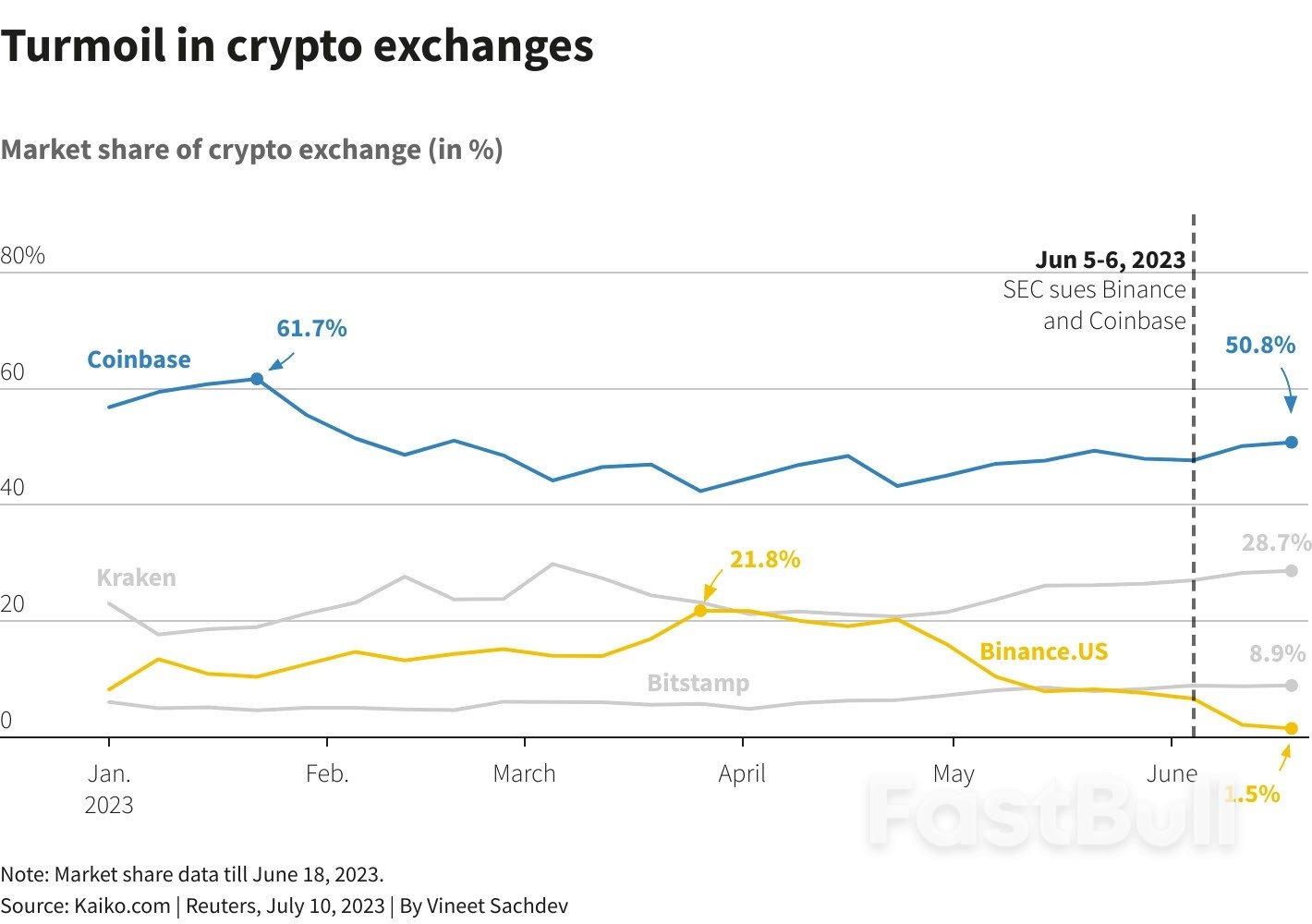
          Coinbase and Binance.US, two of the largest crypto exchanges by market share among those operating in America, have lost ground this year. The former has fallen to about 51% as of June 18 from a high of 62% in January, while the latter has sunk to around 1.5% from 22% in March, according to data from Kaiko.
          Both Binance and Coinbase have been sued by the U.S. Securities and Exchange Commission (SEC) for alleged securities laws violations, though deny wrongdoing. Their regulatory woes and others' have conspired with the collapse of Sam Bankman-Fried's FTX last year to conjure crypto chaos.
          Rivals scent blood.
          Kraken, Bitstamp and LMAX Digital - an institutional crypto exchange - have seen their market shares increase since the start of this year by as much as 5.66%, according to the Kaiko data, which represents the global market share of exchanges that operate in the United States.
          Kraken has leapt to about 29%, leaving Binance.US in its wake.
          "Dominance in the U.S. market is really important," said Ravi Doshi, co-head of trading at Genesis Trading. "The majority of the trading volume happens during U.S. trading hours because the most amount of capital is here and the most amount of interest from institutions is coming from the U.S."
          Guy Hirsch, global managing director at Kraken, said the company had "dedicated significant time and resources to enhance the quality of its platform".
          Bobby Zagotta, CEO of Bitstamp USA, said its recent growth was driven by a "flight to quality" in the marketplace. Bitstamp's global market share among exchanges operating in the U.S. has risen to about 9%.
          Coinbase and LMAX declined to comment on the data, while Binance.US - the American affiliate of the world's largest crypto exchange - didn't respond to a request for comment.Hungry Exchanges Fight for Slice of American Pie_1
          'Tons And Tons' of Tokens
          The swings in market share are happening at a precarious time for the digital asset industry, with the SEC arguing that most crypto coins are unregistered securities.
          It may not be that simple for hungry challengers to grab market share, according to market players.
          In years gone by, crypto exchanges could swiftly gobble up business by offering access to a swathe of coins.
          "Differentiating based on the breadth of your offerings has provided a lot of these exchanges with popular adoption," said Wade Guenther, a partner at investment firm Wilshire Phoenix.
          Both Kraken and Coinbase, for instance, list more than 200 tokens, including some that the SEC in its lawsuits has labeled as unregistered securities, like solana and polygon.
          Now, though, the increased regulatory scrutiny of those offerings has made it more challenging for exchanges to follow the old playbook.
          "As an exchange operator, you're increasing your risk, because you're offering these tokens that could be deemed as securities," said Doshi at Genesis Trading.
          Still, the cost-benefit analysis for exchanges could change if crypto token prices were to rebound and there was suddenly increased interest from investors, said Doshi.
          "I can totally see this happening again, where tons and tons of more tokens are added as we enter a new bull market."

          Source: Devdiscourse

          Risk Warnings and Disclaimers
          You understand and acknowledge that there is a high degree of risk involved in trading. Following any strategies or investment methods may lead to potential losses. The content on the site is provided by our contributors and analysts for information purposes only. You are solely responsible for determining whether any trading assets, securities, strategy, or any other product is suitable for investing based on your own investment objectives and financial situation.
          Comments
          Add to Favorites
          Share

          Japan's Changing Views on Price Hikes Open Door for BOJ Policy Tweak

          Thomas

          Central Bank

          Japanese consumers may finally be shedding their decades-old frugal mindset, spending more on items that retailers were once too afraid to raise prices on and paving the way for the central bank to finally unwind its massive monetary stimulus.
          The world's third-largest economy is seeing early signs of demand-driven inflation with an increasing number of hotels, restaurants and retailers now charging more for services - without losing consumers who are willing to pay more on prospects of higher wages.
          At Ougatou Hotel in northern Japan, the fastest selling rooms are the luxury suites with a private bath overlooking the mountainous surroundings - despite costing double the fee for a standard room and a 5% increase in charges that began in May.
          "Thankfully, higher prices haven't affected our business much with rooms fully packed through November," Hiroki Wakita, a staff at the hotel, told Reuters.
          French restaurant Robuchon in Tokyo has a waiting list of two months even though it hiked the price of its set menu dinner, which now costs up to $400 per person.
          Ukai, a traditional Japanese restaurant near the landmark Tokyo tower, now charges up to 22,000 yen ($156) for its set menu, 24% more than last November.
          "There's no doubt rising wages and bonuses are among factors prodding customers to come dine with us despite the price hikes," said Ukai manager Yuka Hoshino. "Our customers no longer think price hikes are something special."
          The broadening in price increases from goods to services highlights a turning point in Japan's economy, where stagnant wage and services price growth has kept inflation subdued for more than two decades.
          It is also drawing the attention of the Bank of Japan (BOJ), which is shifting away from its view the recent cost-driven inflation will prove temporary.
          The BOJ is starting to drop signs that inflation is increasingly driven by improving consumer demand which, if sustained, could give new Governor Kazuo Ueda justification to pivot away from his predecessor's massive monetary stimulus.
          "Consumption and wages are rising. The mood is clearly changing," said a source familiar with the BOJ's thinking.
          "Japan is seeing early signs of progress in achieving inflation accompanied by higher wages," another source said, a view echoed by two more sources. "The next key question is whether this becomes a trend."
          Different Kind of Inflation
          Japanese wages have barely risen in the past decade, bogged down by entrenched expectations of weak inflation.
          However, those views have since changed after firms began passing on a spike in raw material costs, which pushed inflation above the BOJ's 2% target and kept it there for more than a year.
          Services prices rose 1.7% in May from a year earlier with the cost of dining up 7.1% and leisure by 3.1%, data showed.
          In a survey in April, 86 dine-out chains - or 70.4% of the total - hiked prices at least once since 2022, citing rising raw material and labour costs, Tokyo Shoko Research said.
          Workers' pay is also starting to rise. After agreeing to hike wages at the fastest pace in three decades this year, firms will remain under pressure to keep hiking pay next year due to a tight job market, analysts say.
          A survey in April showed 85.2% of hotels and 78% of restaurants complained of labour shortages, up from 77.3% and 56.1%, respectively, from a year ago, Teikoku Databank said.
          Prospects of higher wages are emboldening consumers.
          Akihito Sato said the food company he works for had hiked wages this year. "I bought a new set of golf clubs. That was a big treat to myself," he told Reuters while strolling the upscale shopping district of Ginza.
          "I certainly feel the positive effect of wage hikes is spreading. My dad, for one, got a pay raise this year and bought a new car for himself and another for my brother," said Shohei Kanai, a 21-year-old student who himself expects a pay hike.
          The BOJ is changing its tone on the drivers of inflation and how they see progress made in sustainably hitting 2% inflation.
          Deputy Governor Ryozo Himino said recent price rises were stronger than previously projected and inflation expectations were moving up - and import costs weren't the only reason.
          At the BOJ's June meeting, some board members saw upside risks to inflation with one saying increases in prices and wages are "becoming more embedded in corporate behaviour," a summary of their opinions showed.
          "It's clear the nature of inflation is beginning to change with more and more service-sector firms raising prices, something we haven't seen up until the past few months," said former top BOJ economist Seisaku Kameda.
          "The rise in service prices is broadening, probably more than the BOJ had expected. Japan may be on the cusp of seeing the wage-inflation cycle the central bank had hoped to achieve."
          ($1 = 140.7800 yen)

          Source: KFGO

          Risk Warnings and Disclaimers
          You understand and acknowledge that there is a high degree of risk involved in trading. Following any strategies or investment methods may lead to potential losses. The content on the site is provided by our contributors and analysts for information purposes only. You are solely responsible for determining whether any trading assets, securities, strategy, or any other product is suitable for investing based on your own investment objectives and financial situation.
          Comments
          Add to Favorites
          Share
          FastBull
          Copyright © 2025 FastBull Ltd

          728 RM B 7/F GEE LOK IND BLDG NO 34 HUNG TO RD KWUN TONG KLN HONG KONG

          TelegramInstagramTwitterfacebooklinkedin
          App Store Google Play Google Play
          Products
          Charts

          Chats

          Q&A with Experts
          Screeners
          Economic Calendar
          Data
          Tools
          Membership
          Features
          Function
          Markets
          Copy Trading
          Latest Signals
          Contests
          News
          Analysis
          24/7
          Columns
          Education
          Company
          Careers
          About Us
          Contact Us
          Advertising
          Help Center
          Feedback
          User Agreement
          Privacy Policy
          Business

          White Label

          Data API

          Web Plug-ins

          Poster Maker

          Affiliate Program

          Risk Disclosure

          The risk of loss in trading financial instruments such as stocks, FX, commodities, futures, bonds, ETFs and crypto can be substantial. You may sustain a total loss of the funds that you deposit with your broker. Therefore, you should carefully consider whether such trading is suitable for you in light of your circumstances and financial resources.

          No decision to invest should be made without thoroughly conducting due diligence by yourself or consulting with your financial advisors. Our web content might not suit you since we don't know your financial conditions and investment needs. Our financial information might have latency or contain inaccuracy, so you should be fully responsible for any of your trading and investment decisions. The company will not be responsible for your capital loss.

          Without getting permission from the website, you are not allowed to copy the website's graphics, texts, or trademarks. Intellectual property rights in the content or data incorporated into this website belong to its providers and exchange merchants.

          Not Logged In

          Log in to access more features

          FastBull Membership

          Not yet

          Purchase

          Become a signal provider
          Help Center
          Customer Service
          Dark Mode
          Price Up/Down Colors

          Log In

          Sign Up
          Position
          Layout
          Fullscreen
          Default to Chart
          The chart page opens by default when you visit fastbull.com