• Trade
  • Markets
  • Copy
  • Contests
  • News
  • 24/7
  • Calendar
  • Q&A
  • Chats
Trending
Screeners
SYMBOL
LAST
BID
ASK
HIGH
LOW
NET CHG.
%CHG.
SPREAD
SPX
S&P 500 Index
6904.08
6904.08
6904.08
6913.26
6893.48
-1.66
-0.02%
--
DJI
Dow Jones Industrial Average
48405.20
48405.20
48405.20
48471.70
48297.26
-56.72
-0.12%
--
IXIC
NASDAQ Composite Index
23462.71
23462.71
23462.71
23521.05
23426.78
-11.62
-0.05%
--
USDX
US Dollar Index
97.870
97.950
97.870
97.940
97.600
+0.210
+ 0.22%
--
EURUSD
Euro / US Dollar
1.17508
1.17515
1.17508
1.17795
1.17450
-0.00210
-0.18%
--
GBPUSD
Pound Sterling / US Dollar
1.34675
1.34682
1.34675
1.35304
1.34492
-0.00420
-0.31%
--
XAUUSD
Gold / US Dollar
4366.65
4367.08
4366.65
4404.17
4323.27
+34.54
+ 0.80%
--
WTI
Light Sweet Crude Oil
57.900
57.930
57.900
58.345
57.484
+0.194
+ 0.34%
--

Community Accounts

Signal Accounts
--
Profit Accounts
--
Loss Accounts
--
View More

Become a signal provider

Sell trading signals to earn additional income

View More

Guide to Copy Trading

Get started with ease and confidence

View More

Signal Accounts for Members

All Signal Accounts

Best Return
  • Best Return
  • Best P/L
  • Best MDD
Past 1W
  • Past 1W
  • Past 1M
  • Past 1Y

All Contests

  • All
  • Trump Updates
  • Recommend
  • Stocks
  • Cryptocurrencies
  • Central Banks
  • Featured News
Top News Only
Share

Spot Gold Little Changed After US Fed Minutes, Last Up 0.8% At $4364.30/Oz

Share

USA Dollar Index Holds Gains After Fed Minutes, Last Up 0.21% At 98.21

Share

Fed Minutes: Some Participants Suggested Under Their Economic Outlooks It Would Likely Be Appropriate To Leave Rates Unchanged For Some Time After December Cut

Share

Fed Minutes: Several Participants Pointed To Risk Of Higher Inflation Becoming Entrenched, Suggested Further Rate Cuts Could Be Misinterpreted As Lack Of Commitment To 2% Target

Share

Fed Minutes: Most Participants Noted Moving Toward More Neutral Policy Stance Would Help Forestall Possible Job Market Deterioration

Share

Fed Minutes: Participants Judged Reserve Balances Had Declined To 'Ample' Levels, Assessed It Appropriate To Begin Reserve Management Purchases Of Treasury Securities

Share

Fed Minutes: Policymakers Emphasized Importance Of Communicating That Treasury Purchases Are Solely To Ensure Rate Control, Have No Monetary Policy Implications

Share

Economic Growth Outlook In Fed Staff Projection Was Modestly Faster Than At October Meeting

Share

Fed Minutes: Most Participants Judged Further Rate Cuts Would Likely Be Appropriate If Inflation Declined Over Time As Expected

Share

Fed Minutes: Some Of Those Who Supported Cutting Rates Indicated The Decision Was Finely Balanced Or They Could Have Supported Leaving Rates Unchanged

Share

Most Participants At Fed's December 9-10 Meeting Supported Lowering Fed Funds Rate Though Some Preferred Leaving Rates Unchanged

Share

UK Foreign Office: We Continue To Call For Restraint And The Avoidance Of Any Further Actions That Risk Undermining Peace And Stability

Share

Peru's Central Bank Says Buy 436 Million Dollars In Spot Market

Share

Disney Agrees To $10 Million Civil Penalty And Injunction For Alleged Violations Of Children's Privacy Laws -USA Justice Department Statement

Share

ICE Certified Arabica Stocks Decreased By 750 As Of December 30, 2025

Share

[European Stock Market "Eleven" Closing Report | ASML Rises Nearly 1.3%, German SAP Falls About 12% For The Year] On Tuesday (December 30), ASML Holding Rose 1.28%, Lvmh Group, Sanofi, L'Oréal, GlaxoSmithKline, Roche, And AstraZeneca Rose By A Maximum Of 0.92%, Nestlé Closed Flat, Novartis Fell 0.27%, And Novo Nordisk Fell 0.76%. German SAP Fell 0.05% To €208.35, With A Cumulative Decline Of Nearly 11.83% By 2025

Share

New York Fed Accepts $12.605 Billion Of $12.605 Billion Submitted To Reverse Repo Facility On Dec 30

Share

Baker Hughes - Gulf Of Mexico Rig Count Unchanged, North Dakota Rigs Unchanged, Pennsylvania Unchanged, Texas -1 In Week To Dec 30

Share

Baker Hughes - US Horizontal Drilling Rigs Up 2 At 476 In Week To Dec 30

Share

Baker Hughes - US Drillers Add Oil And Natgas Rigs For Second Week In A Row

TIME
ACT
FCST
PREV
U.S. EIA Weekly Cushing, Oklahoma Crude Oil Stocks Change

--

F: --

P: --

U.S. EIA Weekly Crude Demand Projected by Production

--

F: --

P: --

U.S. EIA Weekly Gasoline Stocks Change

--

F: --

P: --

U.S. EIA Weekly Crude Stocks Change

--

F: --

P: --

U.S. EIA Weekly Natural Gas Stocks Change

A:--

F: --

P: --

U.S. Weekly Treasuries Held by Foreign Central Banks

A:--

F: --

P: --

U.S. EIA Weekly Crude Stocks Change

A:--

F: --

P: --

U.S. EIA Weekly Crude Demand Projected by Production

A:--

F: --

P: --

U.S. EIA Weekly Cushing, Oklahoma Crude Oil Stocks Change

A:--

F: --

P: --

U.S. EIA Weekly Gasoline Stocks Change

A:--

F: --

P: --

South Korea Industrial Output MoM (SA) (Nov)

A:--

F: --

P: --
South Korea Retail Sales MoM (Nov)

A:--

F: --

P: --

South Korea Services Output MoM (Nov)

A:--

F: --

P: --

Russia IHS Markit Services PMI (Dec)

A:--

F: --

P: --

Turkey Economic Sentiment Indicator (Dec)

A:--

F: --

P: --

Brazil Unemployment Rate (Nov)

A:--

F: --

P: --

U.S. Weekly Redbook Index YoY

A:--

F: --

P: --

U.S. S&P/CS 10-City Home Price Index YoY (Oct)

A:--

F: --

P: --

U.S. S&P/CS 10-City Home Price Index MoM (Not SA) (Oct)

A:--

F: --

P: --

U.S. S&P/CS 20-City Home Price Index (Not SA) (Oct)

A:--

F: --

P: --

U.S. S&P/CS 20-City Home Price Index MoM (Not SA) (Oct)

A:--

F: --

P: --

U.S. FHFA House Price Index YoY (Oct)

A:--

F: --

P: --
U.S. S&P/CS 20-City Home Price Index YoY (Not SA) (Oct)

A:--

F: --

P: --

U.S. S&P/CS 20-City Home Price Index MoM (SA) (Oct)

A:--

F: --

P: --
U.S. FHFA House Price Index (Oct)

A:--

F: --

P: --

U.S. FHFA House Price Index MoM (Oct)

A:--

F: --

P: --
U.S. Chicago PMI (Dec)

A:--

F: --

P: --

Brazil CAGED Net Payroll Jobs (Nov)

A:--

F: --

P: --

U.S. Weekly Total Oil Rig Count

A:--

F: --

P: --

U.S. Weekly Total Rig Count

A:--

F: --

P: --

FOMC Meeting Minutes
U.S. API Weekly Refined Oil Stocks

--

F: --

P: --

U.S. API Weekly Crude Oil Stocks

--

F: --

P: --

U.S. API Weekly Cushing Crude Oil Stocks

--

F: --

P: --

U.S. API Weekly Gasoline Stocks

--

F: --

P: --

South Korea CPI YoY (Dec)

--

F: --

P: --

China, Mainland NBS Manufacturing PMI (Dec)

--

F: --

P: --

China, Mainland Composite PMI (Dec)

--

F: --

P: --

China, Mainland NBS Non-manufacturing PMI (Dec)

--

F: --

P: --

China, Mainland Caixin Manufacturing PMI (SA) (Dec)

--

F: --

P: --

Turkey Trade Balance (Nov)

--

F: --

P: --

Russia CPI YoY (Dec)

--

F: --

P: --

U.S. MBA Mortgage Application Activity Index WoW

--

F: --

P: --

South Africa Trade Balance (Nov)

--

F: --

P: --

U.S. Initial Jobless Claims 4-Week Avg. (SA)

--

F: --

P: --

U.S. Weekly Continued Jobless Claims (SA)

--

F: --

P: --

U.S. Weekly Initial Jobless Claims (SA)

--

F: --

P: --

U.S. EIA Weekly Cushing, Oklahoma Crude Oil Stocks Change

--

F: --

P: --

U.S. EIA Weekly Crude Demand Projected by Production

--

F: --

P: --

U.S. EIA Weekly Gasoline Stocks Change

--

F: --

P: --

U.S. EIA Weekly Crude Stocks Change

--

F: --

P: --

U.S. EIA Weekly Heating Oil Stock Changes

--

F: --

P: --

U.S. EIA Weekly Crude Oil Imports Changes

--

F: --

P: --

U.S. EIA Weekly Natural Gas Stocks Change

--

F: --

P: --

South Korea Trade Balance Prelim (Dec)

--

F: --

P: --

Indonesia Core Inflation YoY (Dec)

--

F: --

P: --

Indonesia Inflation Rate YoY (Dec)

--

F: --

P: --

Turkey Manufacturing PMI (Dec)

--

F: --

P: --

Brazil IHS Markit Manufacturing PMI (Dec)

--

F: --

P: --

Mexico Manufacturing PMI (Dec)

--

F: --

P: --

South Korea IHS Markit Manufacturing PMI (SA) (Dec)

--

F: --

P: --

Q&A with Experts
    • All
    • Chatrooms
    • Groups
    • Friends
    john flag
    OPEW6D7X5R
    hello everyone
    @OPEW6D7X5Rhello how are you doing
    JustLeon flag
    JustLeon flag
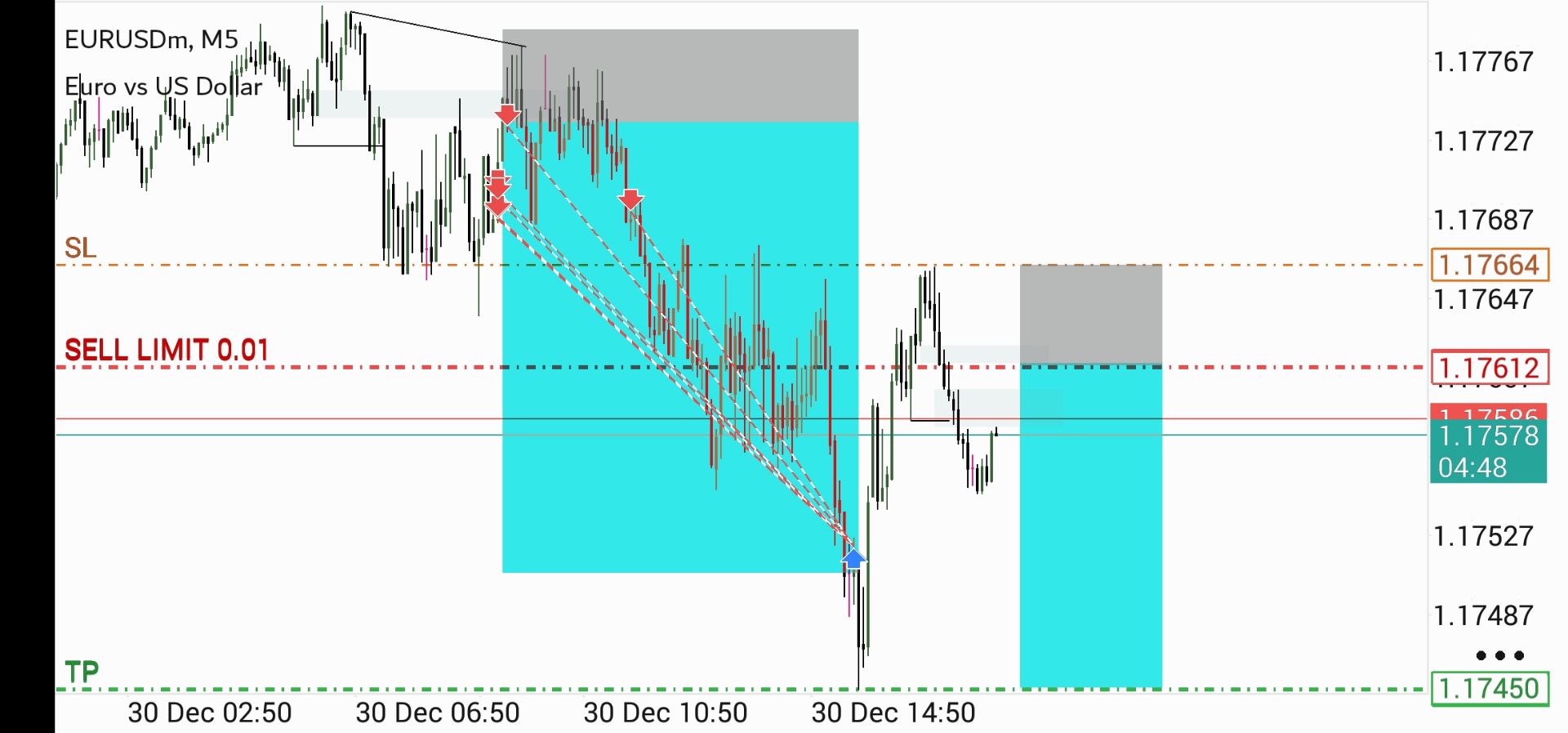
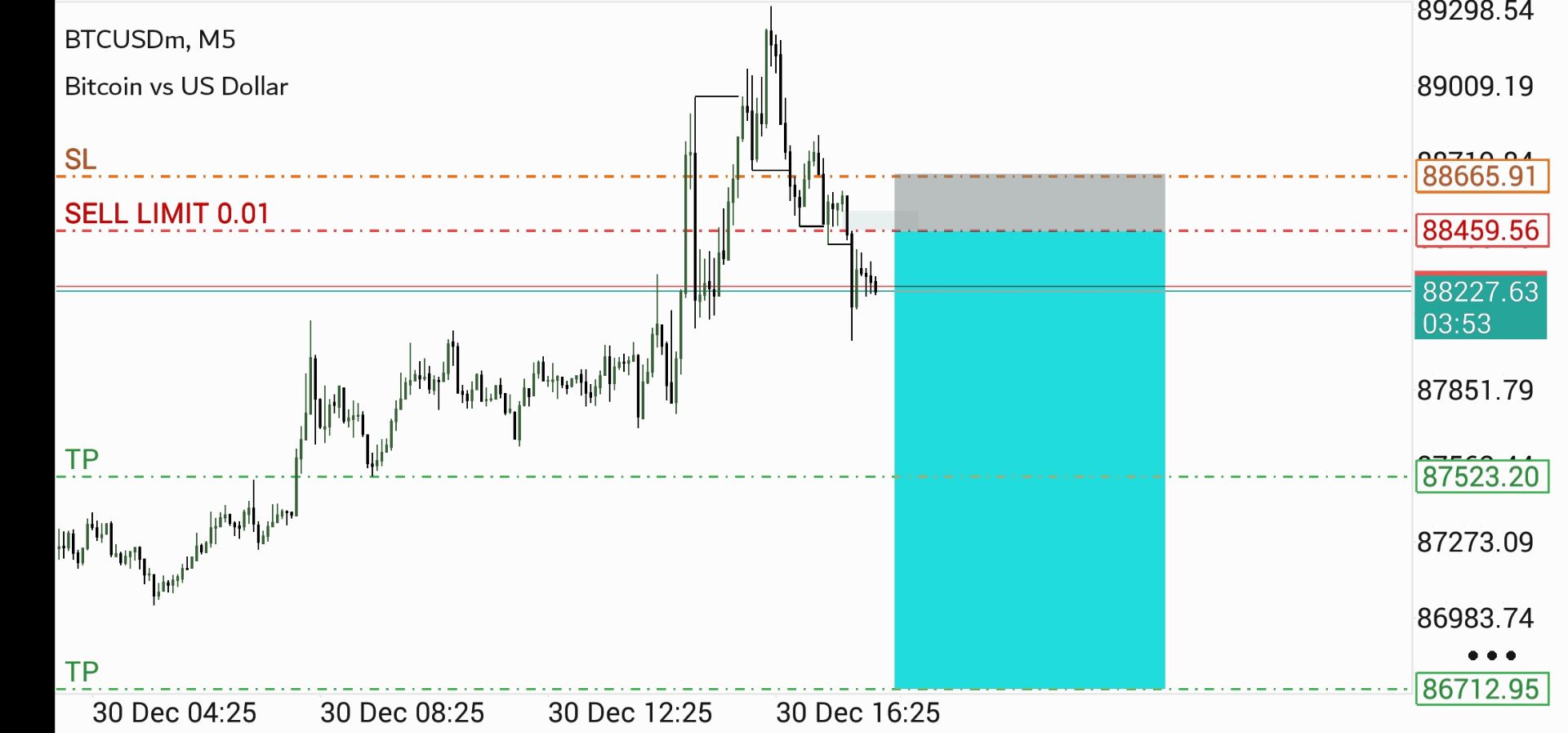
    My last setups for this year❤️
    JustLeon flag
    This message has been withdrawn
    This message has been withdrawn
    2404975 flag
    any setup for gold tomorrow
    This message has been withdrawn
    This message has been withdrawn
    rawa ronte flag
    2404975
    any setup for gold tomorrow
    @Pengunjung2404975down
    This message has been withdrawn
    This message has been withdrawn
    This message has been withdrawn
    This message has been withdrawn
    RPGFX flag
    JustLeon
    @JustLeon Has any of these triggered yet?
    RPGFX flag
    RPGFX flag
    RPGFX flag
    john
    FOMC Meeting is already active, these are initial updates coming in from the meeting @john
    Trader flag
    where to check news
    nzuki davi flag
    Fed Minutes: Most participants supported loweringthe Fed funds rate, though some preferred leaving rates unchanged.
    Type here...
    Add Symbol or Code

      No matching data

      All
      Trump Updates
      Recommend
      Stocks
      Cryptocurrencies
      Central Banks
      Featured News
      • All
      • Russia-Ukraine Conflict
      • Middle East Flashpoint
      • All
      • Russia-Ukraine Conflict
      • Middle East Flashpoint
      Search
      Products

      Charts Free Forever

      Chats Q&A with Experts
      Screeners Economic Calendar Data Tools
      Membership Features
      Data Warehouse Market Trends Institutional Data Policy Rates Macro

      Market Trends

      Market Sentiment Order Book Forex Correlations

      Top Indicators

      Charts Free Forever
      Markets

      News

      News Analysis 24/7 Columns Education
      From Institutions From Analysts
      Topics Columnists

      Latest Views

      Latest Views

      Trending Topics

      Top Columnists

      Latest Update

      Signals

      Copy Rankings Latest Signals Become a signal provider AI Rating
      Contests
      Brokers

      Overview Brokers Assessment Rankings Regulators News Claims
      Broker listing Forex Brokers Comparison Tool Live Spread Comparison Scam
      Q&A Complaint Scam Alert Videos Tips to Detect Scam
      More

      Business
      Events
      Careers About Us Advertising Help Center

      White Label

      Data API

      Web Plug-ins

      Affiliate Program

      Awards Institution Evaluation IB Seminar Salon Event Exhibition
      Vietnam Thailand Singapore Dubai
      Fans Party Investment Sharing Session
      FastBull Summit BrokersView Expo
      Recent Searches
        Top Searches
          Markets
          News
          Analysis
          User
          24/7
          Economic Calendar
          Education
          Data
          • Names
          • Latest
          • Prev

          View All

          No data

          Scan to Download

          Faster Charts, Chat Faster!

          Download App
          English
          • English
          • Español
          • العربية
          • Bahasa Indonesia
          • Bahasa Melayu
          • Tiếng Việt
          • ภาษาไทย
          • Français
          • Italiano
          • Türkçe
          • Русский язык
          • 简中
          • 繁中
          Open Account
          Search
          Products
          Charts Free Forever
          Markets
          News
          Signals

          Copy Rankings Latest Signals Become a signal provider AI Rating
          Contests
          Brokers

          Overview Brokers Assessment Rankings Regulators News Claims
          Broker listing Forex Brokers Comparison Tool Live Spread Comparison Scam
          Q&A Complaint Scam Alert Videos Tips to Detect Scam
          More

          Business
          Events
          Careers About Us Advertising Help Center

          White Label

          Data API

          Web Plug-ins

          Affiliate Program

          Awards Institution Evaluation IB Seminar Salon Event Exhibition
          Vietnam Thailand Singapore Dubai
          Fans Party Investment Sharing Session
          FastBull Summit BrokersView Expo

          How Does Japan's Yield Curve Control Work?

          Cohen

          Central Bank

          Summary:

          New Bank of Japan Governor Kazuo Ueda's main challenge will be to phase out yield curve control (YCC), which has come under criticism for distorting markets by keeping long-term interest rates from rising.

          New Bank of Japan Governor Kazuo Ueda's main challenge will be to phase out yield curve control (YCC), which has come under criticism for distorting markets by keeping long-term interest rates from rising.
          Under YCC, the BOJ targets short-term interest rates at -0.1% and the 10-year government bond yield at 0.5% above or below zero, in an effort to sustainably achieve 2% inflation.
          Here is how Japan's YCC works and its potential pitfalls.
          Why YCC?
          After years of huge bond buying failed to fire up inflation, the BOJ cut short-term rates below zero in January 2016 to fend off an unwelcome yen rise. The move crushed yields across the curve, outraging financial institutions that saw returns on investment evaporate.
          To pull long-term rates back up, the BOJ adopted YCC eight months later by adding a 0% target for 10-year bond yields to its -0.1% short-term rate target.
          The idea was to control the shape of the yield curve to suppress short- to medium-term rates - which affect corporate borrowers - without depressing super-long yields too much and reducing returns for pension funds and life insurers.
          How does it work?
          The BOJ chose a rate regime because it had reached the limit of quantitative easing, where it bought targeted amounts of bonds to push down yields, hoping to stoke inflation and economic activity.
          After the central bank had gobbled up half the bond market, it was hard to commit to buying at a set pace. YCC allowed the BOJ to buy only as much as needed to achieve its 0% yield target.
          The bank has tapered bond buying in times of market calm to lay the groundwork for an eventual end to ultra-easy policy.
          Why the target band?
          As stubbornly low inflation forced the BOJ to maintain YCC longer than expected, bond yields began to hug a tight range and trading volume dwindled.
          To address such side-effects, the BOJ said in July 2018 the 10-year yield could move 0.1% above or below zero. In March 2021, the bank widened the band to 0.25% either direction to breathe life back into a market its buying had paralysed.
          Under attack from investors betting on a rate hike, the BOJ doubled the band in December to 0.5% above or below zero and ramped up bond buying to defend the ceiling.
          Pitfalls?
          YCC worked well when inflation was low and prospects for hitting the BOJ's price target were slim, as investors could sit on a pile of government debt that ensured safe returns.
          But with inflation eroding those gains, investors have sold bonds, pricing in the chance of a near-term rate hike.
          The BOJ has ramped up buying, including through offers to buy unlimited amounts of bonds, to defend its yield cap. That has been criticised by analysts as distorting market pricing and fuelling an unwelcome yen plunge that inflated the cost of raw material imports.
          Tipping point?
          Haunted by a history of political heat for dialling back stimulus prematurely, the BOJ wants to avoid raising rates until it is clear inflation will sustainably hit the bank's 2% target, backed by higher wage growth.
          But markets may force the BOJ to relent. The 10-year yield breached the BOJ's cap in January, before massive BOJ bond buying brought the rate back down. Investors may build up short Japanese government bond positions again if Ueda drops any hints of a near-term tweak to YCC.

          Source: Reuters

          Risk Warnings and Disclaimers
          You understand and acknowledge that there is a high degree of risk involved in trading. Following any strategies or investment methods may lead to potential losses. The content on the site is provided by our contributors and analysts for information purposes only. You are solely responsible for determining whether any trading assets, securities, strategy, or any other product is suitable for investing based on your own investment objectives and financial situation.
          Comments
          Add to Favorites
          Share

          Bank of England Targets 30-Person Team for Digital Currency

          Warren Takunda

          Cryptocurrency

          The Bank of England (BoE) is reportedly assembling a 30-person team to explore the potential of a central bank digital currency (CBDC), according to a recent report. This move comes as the BoE continues to assess the benefits and risks of a CBDC, and follows similar initiatives by central banks around the world.
          The BoE's team will include experts in fields such as payments, cyber security, and monetary policy. The bank aims to develop a clear understanding of how a digital currency could affect the financial system, as well as how it could be designed and implemented in a secure and efficient manner.
          The decision to form a dedicated team for a CBDC indicates the BoE's seriousness in considering the introduction of a digital currency. It follows the publication of a discussion paper in March that sought public feedback on the potential introduction of a CBDC. The BoE has stated that it will continue to engage with stakeholders and conduct further research on the matter.
          While the introduction of a CBDC could offer benefits such as increased financial inclusion and efficiency, it also presents risks such as potential threats to financial stability and privacy concerns. The BoE has emphasized the importance of fully understanding these risks before making any decisions on the matter.
          Other central banks, such as the European Central Bank and the Federal Reserve, are also exploring the potential of a CBDC. China has already launched a digital version of its currency, the digital yuan, which is currently being tested in several regions of the country.
          The BoE's move to assemble a team for a CBDC highlights the growing importance of digital currencies in the global financial system. As technology continues to advance and financial systems evolve, it is likely that more central banks will explore the potential of digital currencies in the years to come.
          Risk Warnings and Disclaimers
          You understand and acknowledge that there is a high degree of risk involved in trading. Following any strategies or investment methods may lead to potential losses. The content on the site is provided by our contributors and analysts for information purposes only. You are solely responsible for determining whether any trading assets, securities, strategy, or any other product is suitable for investing based on your own investment objectives and financial situation.
          Comments
          Add to Favorites
          Share

          Heroes or Villains: Short Sellers' Role in the U.S. Bank Crisis

          Samantha Luan

          Stocks

          As First Republic Bank's share price fell by double-digits in the aftermath of the collapse of Silicon Valley Bank last month, some people close to the San Francisco-based lender were worried short sellers were exacerbating its travails, according to a source familiar with the situation.
          Investors who wager shares in a company will fall were increasing bets on First Republic's stock when it was already taking a beating, making it difficult for the bank to recover its value, according to the source.
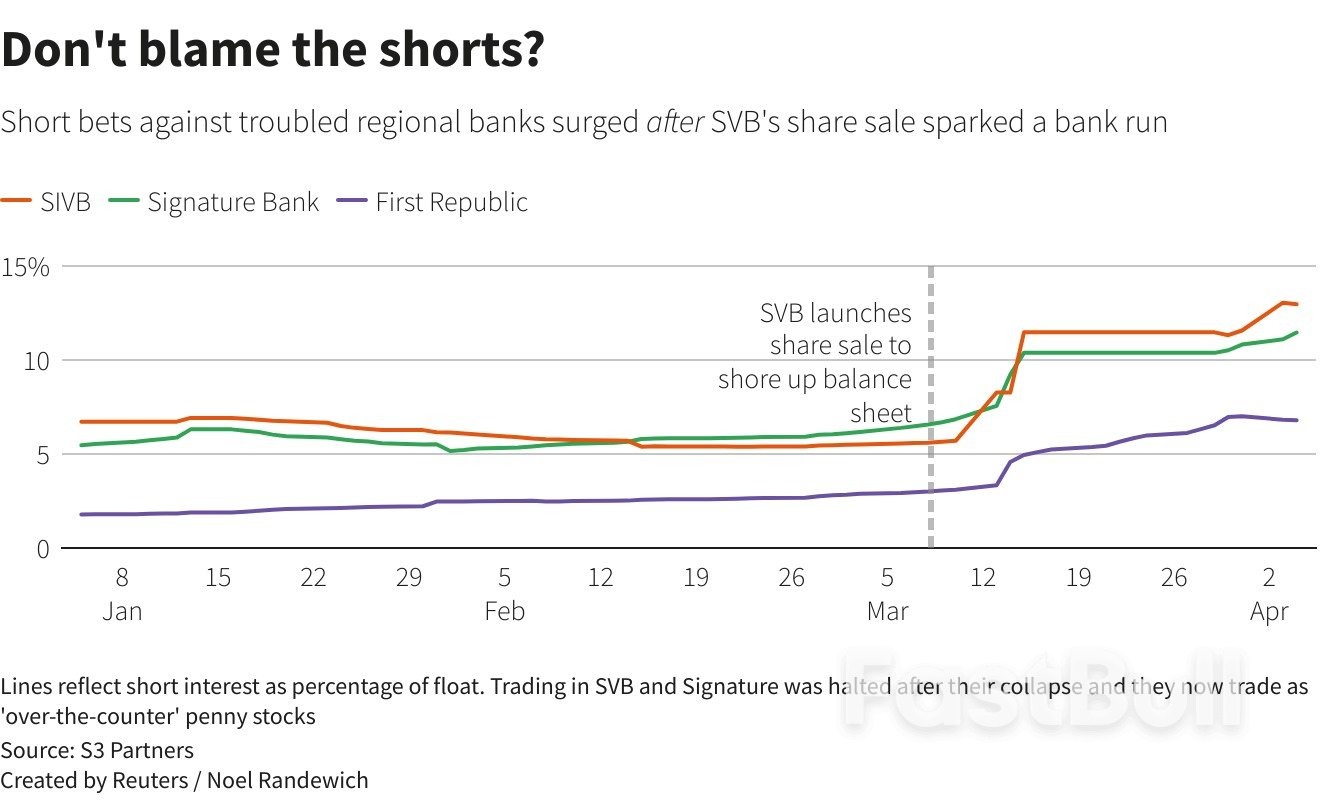
          Short interest in First Republic indeed increased as turmoil in the banking sector intensified, although measures vary. The percent of shares borrowed -- the basic mechanism of a short bet -- was minimal to start the month but increased to between 7% and 37% by March 31, according to various data provider calculations, versus averages between 3% and 5% across all stocks.
          Two of the banks that shut down last month, Silicon Valley Bank (SVB) and Signature Bank, showed a similar pattern: short interest increased as their stock started to fall, at varying degrees of intensity.
          Problems at U.S. regional banks grew last year, as rapidly rising interest rates slashed the value of some banks' holdings in long-term assets such as home loans and government bonds. Some lenders were also challenged by exposure to cryptocurrency and technology companies. The underlying issues exploded last month when depositor flight spiraled out of control and regional lenders across the board saw their shares hit.
          How much short sellers contributed to the downward spiral reprises the debate about whether so-called shorts are market watchdogs or opportunistic investors who profit from others’ misery. In the case of the banking crisis, a review of data and interviews with short sellers and their critics show, the answer may be both.
          "The shorts in the months before the collapse were accurately warning the markets...that the bank (SVB) was being dangerously mismanaged," Dennis Kelleher, President and CEO of Better Markets, a nonprofit industry group in Washington, DC, said in an email. "The problem is once that collapse happened, shorts with various motives started targeting other banks."
          Some short sellers have been public about their negative views on banks but reject suggestions that they are to blame for the problems.
          Short-seller Jim Chanos wrote in a March 13 client letter seen by Reuters that investors had known about the underlying balance sheet problems that brought down SVB since last summer. But it was only when the bank, which his fund was short, "abruptly tried, and failed, to raise capital ... that anyone cared."
          First Republic and Chanos declined to comment. Signature and SVB did not respond to requests for comment.

          Heroes or Villains: Short Sellers' Role in the U.S. Bank Crisis_1Controversial Practice

          Short selling is a controversial practice, blamed in the financial crisis of 2008 for adding to the pain; it was temporarily banned, albeit with little impact. Some high-profile short sellers were later celebrated as making prophetic calls about the U.S. housing market.
          The crisis of confidence in U.S. regional banks started when shares of SVB plunged and depositors fled after it announced plans on March 8 to raise capital to fill a nearly $2 billion hole from the sale of securities.
          The Santa Clara, California-based lender was taken over by regulators on March 10, in turn dragging down the shares of other regional lenders. New York's Signature failed on March 12, and First Republic lost more than 80% of its market value by mid-March.
          As the crisis accelerated, JPMorgan Chase & Co equity analysts wrote on March 17 that short-sellers were "working collectively to drive runs on banks," and venture capitalist David Sacks asked on Twitter whether "scurrilous short sellers" had used social media to exacerbate depositor flight from SVB.
          JPMorgan and Sacks did not respond to requests for comment.
          Even so, interviews and public postings show at least some short sellers had placed bets against regional banks well before the crisis hit.
          These included: William C. Martin, who shorted SVB in January 2023; Nate Koppikar of Orso Partners, who shorted SVB in early 2021; Barry Norris of Argonaut Capital Partners, who shorted SVB in late 2022; John Hempton of Bronte Capital Management, who shorted Signature in late 2021; and Marc Cohodes, who shorted Silvergate Bank in November 2022, according to interviews with Reuters.
          Porter Collins, co-founder of hedge fund manager Seawolf Capital, said he saw how rising interest rates would likely hit banks and, in early 2022, shorted SVB, Signature, First Republic, Silvergate and Charles Schwab Corp.
          "There were warning signs," he said, "that were pretty easy to see for those who looked."
          Schwab and Silvergate did not respond to requests for comment.

          Short Positions

          Such early short sellers, however, were in the small minority. Shorts represented only about 5% of SVB's stock float as of March 1, according to data tracker S3 Partners, with First Republic at around 3% and Signature at 6%. That compares to an average of about 4.65% across all stocks, per S3.
          Data from S&P Global Market Intelligence and ORTEX, who use different methodologies, have similar numbers showing SVB, First Republic and Signature with relatively low overall short levels before the crisis.
          Short positions increased over March, although the measures vary, per the three data providers. On First Republic, the percentage of shares on loan peaked at between 7% and 39% last month, while SVB peaked at between 11% and 19%, and Signature peaked between 6% and 11%.
          Regardless, short positions in most regional banks were nowhere near some highly shorted stocks like electric carmaker Tesla Inc, which hit around 25% as recently as 2019, and GameStop Corp, which surged past 100% of shares in 2020, according to Refinitiv data.
          An exception was Silvergate, a cryptocurrency-focused lender, which for months faced an unusually high level of short interest compared to other banks - above 75% by the time it said it would wind down operations on March 8.
          S3's Ihor Dusaniwsky said the overall increase in shorts on U.S. regional banks during March was an "extraordinarily small" part of overall sector trading; the declines were driven by regular stock holders selling their shares.
          "The shorts are not driving the stock price," Dusaniwsky said. "People are saying that the tail is wagging the dog. It's certainly not the case in most of these names."
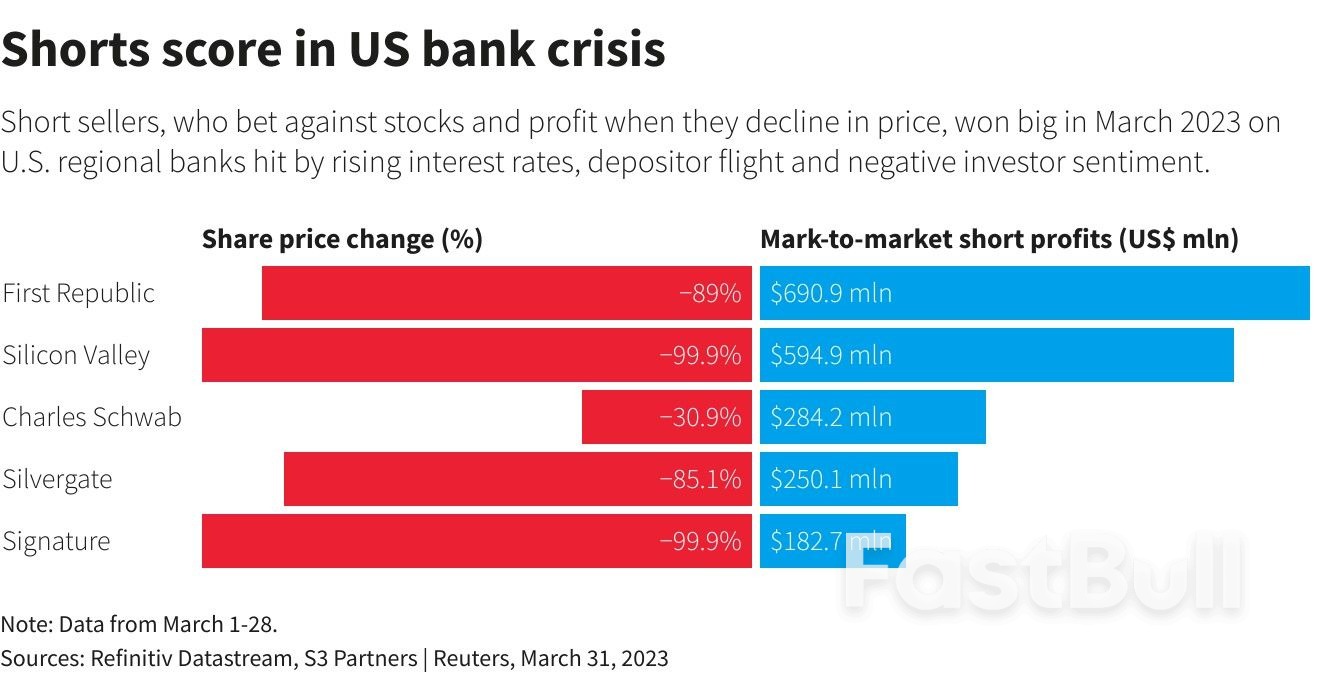
          Short-sellers scored regardless: overall short bets in U.S. regional banks gained $4.76 billion in March, up 35% on an average short interest of $13.4 billion, according to S3.

          Heroes or Villains: Short Sellers' Role in the U.S. Bank Crisis_2Source: Yahoo

          Risk Warnings and Disclaimers
          You understand and acknowledge that there is a high degree of risk involved in trading. Following any strategies or investment methods may lead to potential losses. The content on the site is provided by our contributors and analysts for information purposes only. You are solely responsible for determining whether any trading assets, securities, strategy, or any other product is suitable for investing based on your own investment objectives and financial situation.
          Comments
          Add to Favorites
          Share

          April 10th Financial News

          FastBull Featured

          Daily News

          【Quick Facts】

          1. Non-farm payrolls open the door for the Fed to raise interest rates again.
          2. Russia cut oil production by 700,000 BPD in March.
          3. BoJ change its commander, monetary policy adjustment or to take baby steps.
          4. Trump's criminal charges expose the deep ruptures in U.S. society.
          5. U.S. consumer credit growth slowed in February, and credit card balances grew at the slowest rate in nearly two years.

          【News Details】

          1. Non-farm payrolls open the door for the Fed to raise interest rates again.
          U.S. non-farm payrolls added 236,000 jobs in March; the unemployment rate fell to 3.5% from 3.6% in February; and average hourly earnings fell to 4.2% from 4.6% in February.
          Overall, this jobs report ended up being fairly close to the market's released consensus. While the weak data may solidify expectations for the end of the Fed's tightening cycle, this report still leaves the door open for another rate hike, especially if next week's CPI data is unexpectedly upward again. Following the release of the non-farm payrolls, the market now sees a slightly more than 50% chance of another federal funds rate hike in May.
          2. Russia cut oil production by 700,000 BPD in March.
          According to a person familiar with the matter, Russia's Energy Ministry said the country cut its oil production by about 700,000 BPD last month. However, the figure is inconsistent with data on Russia's seaborne exports in March and supplies to domestic refineries, adding to uncertainty about the actual amount of oil Russia extracted. Russia has pledged to cut crude oil production by 500,000 BPD between March and December in response to Western trade restrictions and price caps imposed by the G7. And according to the Energy Ministry, this production cut went up to 40% more.
          3. BoJ change its commander, monetary policy adjustment or to take baby steps.
          Japanese economist Kazuo Ueda took over as BoJ governor from Haruhiko Kuroda, whose term expired on the 9th. Japanese media and experts generally believe that Ueda will face the thorny issue of how to exit the ultra-loose monetary policy after taking office. In the context of the continued downturn in the Japanese economy, the world economy is facing downward pressure, and the BoJ seeks to normalize monetary policy is not an easy task. Japanese media and experts generally believe that ultra-loose monetary policy in the absence of an effective response to deflation delayed again and again, will likely become a stumbling block to Japan's economic growth. On the other hand, if the policy adjustment is too hasty, it may cause great risk to the Japanese economy, which is currently recovering weakly. After taking office, Ueda may focus on the balance of inheritance and correction, coordinate the relationship between the government, the market and various economic agents, etc.; while maintaining "safe driving", to reduce the side effects of ultra-loose monetary policy, Japan's monetary policy adjustment is not expected to appear "sharp turn".
          4. Trump's criminal charges expose the deep ruptures in U.S. society.
          The antagonism of people rallying outside the courtroom and media coverage of former U.S. President Donald Trump's April 4 court hearing revealed a deep tear in U.S. society - a rupture that is a real danger to American society. As Trump was being questioned, outside the courtroom both Trump supporters and opponents confronted each other, chanting opposite slogans. For Trump supporters, the allegations against Trump are a "political witch hunt". For Trump opponents, the accusations against Trump are a sign of "justice. Not since the American Civil War in 1861 has the United States been so politically split.
          5. U.S. consumer credit growth slowed in February, and credit card balances grew at the slowest rate in nearly two years.
          Data released by the Fed on April 7 showed that total credit increased by $15.3 billion in February, compared with the median estimate of $18 billion by surveyed economists and an upwardly revised $19.5 billion increase in January; the data were not adjusted for inflation. Non-revolving credit (including loans for school tuition and vehicle purchases) increased $10.3 billion, a higher increase than the previous two months of growth. Revolving credit, including credit cards, increased $5.0 billion, the smallest increase since April 2021. This is data from before the collapse of Silicon Valley Bank, from which you can find out the consumer credit situation before the credit environment was further tightened after the banking crisis. Fed tightening has already pushed up interest rates on big-ticket items such as credit cards and cars, putting more pressure on household finances, which could lead to a further slowdown in spending. Other data show that both large and small banks have seen a slowdown in consumer loan growth YoY in recent months.

          【Focus of the Day】

          UTC+8 22:00 U.S. Wholesale Sales Monthly Rate for February
          Risk Warnings and Disclaimers
          You understand and acknowledge that there is a high degree of risk involved in trading. Following any strategies or investment methods may lead to potential losses. The content on the site is provided by our contributors and analysts for information purposes only. You are solely responsible for determining whether any trading assets, securities, strategy, or any other product is suitable for investing based on your own investment objectives and financial situation.
          Comments
          Add to Favorites
          Share

          Japan's New Central Bank Chief Assumes Office as Global Risks Loom

          Thomas

          Central Bank

          Japan's new central bank governor Kazuo Ueda faces a bumpy road as slowing global growth clouds prospects for a sustained pickup in inflation and wages, a prerequisite for phasing out his predecessor's controversial monetary stimulus.
          The 71-year-old academic's term began on Sunday, succeeding Haruhiko Kuroda, whose second, five-year term ended on Saturday. Ueda and his two deputy governors, Shinichi Uchida and Ryozo Himino, will hold a joint news conference at 1015 GMT on Monday.
          Markets will be looking for clues on how soon Ueda could phase out an unpopular bond yield control policy that has drawn criticism for distorting markets and hurting bank margins.
          In parliamentary confirmation hearings in February, Ueda has stressed the need to keep ultra-easy policy to ensure Japan sustainably achieves the BOJ's 2% inflation target backed by wage growth.
          But with inflation exceeding the target, many analysts expect the BOJ to tweak or end yield curve control (YCC), a policy combining a 0.1% target for short-term interest rate and a 0% cap for the 10-year bond yield, as soon as this quarter.
          "The increasing side-effects are a sign the policy effect (of YCC) is working its way through the economy," former BOJ deputy governor Hiroshi Nakaso was quoted as saying in an interview with the Nikkei newspaper.
          "When the appropriate timing comes, the BOJ's new leadership will likely modify or abolish YCC," he said.
          Japan's long-stagnant inflation and wage growth are showing budding signs of change. After hitting a 41-year high of 4.2% in January, core consumer inflation remains above 3% as more firms hike prices in response to rising raw material costs.
          To compensate households for the increase in living costs, major firms have offered wage hikes of nearly 4% this year in annual labour talks, the fastest pace in about three decades.
          At his final briefing as governor on Friday, Kuroda said Japan was moving closer to achieving sustained 2% inflation as the public's long-held perception that prices won't rise, was beginning to change.
          But mounting U.S. recession fears are among headwinds for Japan's export-reliant economy. While the end to COVID-19 curbs is propping up consumption, some analysts warn a recent slew of price hikes for daily necessities could also hurt spending.
          Ueda will chair his first policy meeting on April 27-28, when the board produces fresh quarterly growth and price forecasts extending through fiscal 2025.
          Markets are focusing on whether the board will project inflation accelerating towards, or even hitting, 2% inflation in fiscal 2024 and 2025.
          Under current forecasts, the BOJ expects core consumer inflation to hit 1.6% in the current fiscal year that began in April and accelerate to 1.8% the following year.
          Ueda served as BOJ board member from 1998 to 2005, during which the central bank introduced zero interest rates and then quantitative easing to combat deflation and economic stagnation.

          Source: CNA

          Risk Warnings and Disclaimers
          You understand and acknowledge that there is a high degree of risk involved in trading. Following any strategies or investment methods may lead to potential losses. The content on the site is provided by our contributors and analysts for information purposes only. You are solely responsible for determining whether any trading assets, securities, strategy, or any other product is suitable for investing based on your own investment objectives and financial situation.
          Comments
          Add to Favorites
          Share

          Week Ahead - US CPI Data, Fed Minutes, and BoC Decision on Investors’ Radar

          Justin

          Central Bank

          Economic

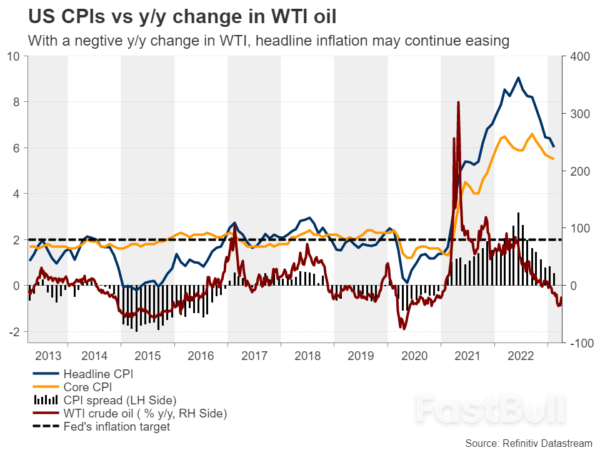
          Will the US CPIs and Fed minutes corroborate the pivot view?

          At the start of this week, investors timidly started tilting the scale towards another rate hike by the Fed at its upcoming gathering in May, but a streak of disappointing US data thereafter revived doubts on what could be the wisest choice at the upcoming gathering.
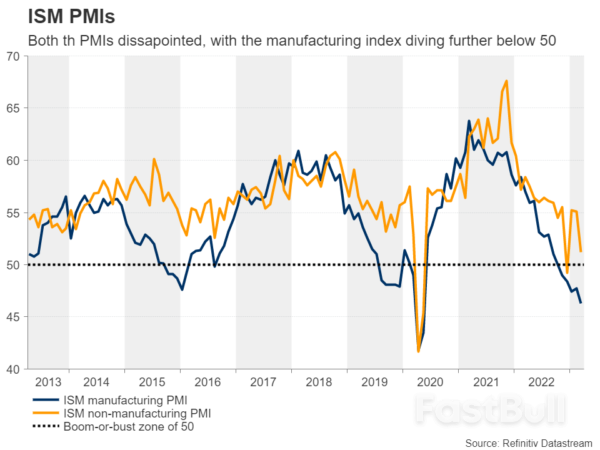
          Both the ISM manufacturing and non-manufacturing PMI survey disappointed on all fronts, from employment to prices, with the outlook of the labor market becoming dimmer after job openings for February slipped to their lowest in nearly two years and after the ADP report revealed that the private sector gained fewer than expected jobs in March and much less than it did in February.
          Week Ahead - US CPI Data, Fed Minutes, and BoC Decision on Investors’ Radar_1
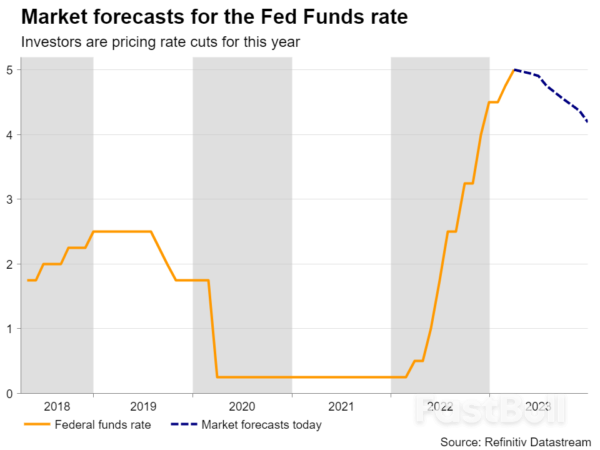
          With all that in mind, market participants are now evenly split on whether the Fed should deliver one last 25bps hike in May or stay sidelined, anticipating a series of reductions to start in the summer, with interest rates seen ending 2023 at around 4.2%.
          Week Ahead - US CPI Data, Fed Minutes, and BoC Decision on Investors’ Radar_2
          On Wednesday, the CPI data for March are scheduled to be released, while later in the same day, the Fed will publish the minutes of its latest gathering, where officials hiked by 25bps, but changed their forward guidance to note that future increments ‘may’ be warranted. Coming in the midst of concerns about the stability of the banking system, the word ‘may’ was the key to opening the door for a potential pause as soon as at the next gathering, even as the new “dot plot” and several policymakers in the aftermath of the meeting continued indicating that another hike is likely.
          Week Ahead - US CPI Data, Fed Minutes, and BoC Decision on Investors’ Radar_3
          Investors seem to ignore anything that pushes against their view and pay more attention to reaffirmations. Thus, they may dig into the minutes to see whether officials discussed the possibility of a pause. Further slowdown in inflation and even the slightest glimpse in the minutes hinting at a the likelihood of a pause, could add extra credence to the market’s view, thereby sending Treasury yields and the US dollar lower.
          The big question is how Wall Street traders will interpret the information. Up until this week, bad data was good for stocks on the thinking that lower interest rates will result in pricier valuations. However, that theme changed this week, with equity indices coming under pressure on fears that the US may be entering a deeper-than-previously-feared downturn.
          As for the rest of the US data, Thursday brings the US PPIs for the month, while the last test for dollar traders during next week will come in the form of the US retail sales and industrial production for March, as well as the preliminary UoM consumer sentiment index for April, all to be released on Friday.

          Will the BoC be the first major central bank to start cutting rates?

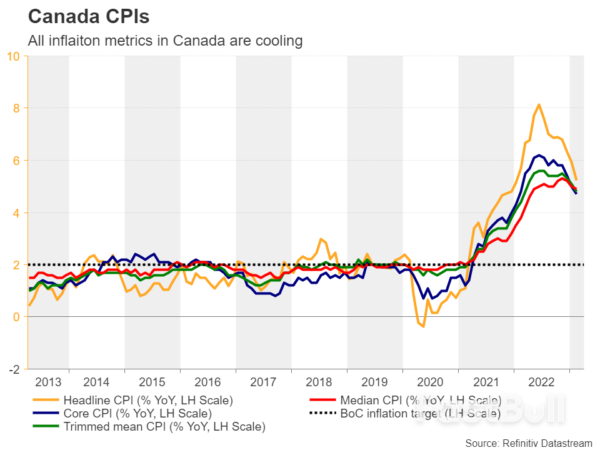
          Wednesday will not be a busy day for dollar traders only. Those having the loonie in their portfolios will have to stay in front of their screens when the BoC decides on interest rates. At their last meeting, Canadian policymakers decided to keep interest rates unchanged, becoming the first major central bank to hit the pause button in this tightening crusade. Although in its statement, the BoC reiterated it remains prepared to increase rates further if needed, it also said that the latest data remains in line with the Bank’s expectations that CPI inflation will come down to around 3% in the middle of the year.
          Week Ahead - US CPI Data, Fed Minutes, and BoC Decision on Investors’ Radar_4
          Post-meeting data showed that most inflation metrics in Canada slowed by more than expected in February, reaffirming the Bank’s view and prompting investors to assign a 15% chance of a rate cut as soon as at next week’s gathering, with the remaining 85% pointing to no action. This means that if officials decide to keep interest rates untouched, any market reaction may come from hints and clues regarding the Bank’s future course of action. So, anything suggesting that they could start cutting rates soon could add pressure to the Canadian dollar.

          Aussie awaits Australia’s jobs report and China’s inflation numbers

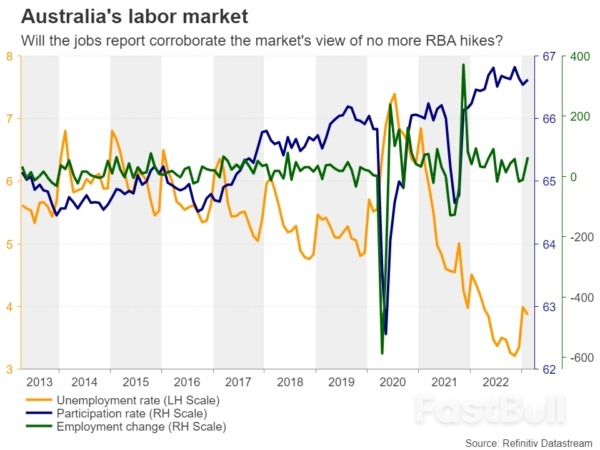
          With the RBA standing pat on Tuesday but noting that some further tightening may be needed, aussie traders may pay extra attention to the Australian employment report for March scheduled to be released on Thursday, but also on the Chinese CPI and PPI data, which come on Tuesday, as the world’s second largest economy is Australia’s main trading partner.
          The Chinese CPI is forecast to have accelerated notably, but the PPI is expected to have remained well into the negative territory. The former could be due to increasing domestic demand after the economy’s reopening from the COVID-related restrictions, but putting the latter into the equation, it may be hard to identify whether Chinese exports to Australia will fuel Australian inflation. China’s overall trade balance data are coming out on Thursday.
          Currently investors are almost fully convinced that the RBA will not deliver any other rate increases. On the contrary, they are nearly fully pricing in a quarter-point rate reduction by the end of this year, and a weak jobs report could justify that view, thereby hurting the already-wounded aussie even more, especially against its New Zealand counterpart, which benefited this week from the RBNZ’s decision to hike by 50bps and signal that more hikes are on the cards.
          Week Ahead - US CPI Data, Fed Minutes, and BoC Decision on Investors’ Radar_5

          Other releases on tap

          From the Eurozone, retail sales and industrial production for February are coming on Tuesday and Thursday, while on Thursday, traders will also get the industrial and manufacturing production figures, the monthly GDP, and the trade balance, all for February. With the BoE expected to deliver more than 25bps worth of additional rate increments before it takes the sidelines, pound traders may seek reaffirmation in these releases.

          Source:XM

          To stay updated on all economic events of today, please check out our Economic calendar
          Risk Warnings and Disclaimers
          You understand and acknowledge that there is a high degree of risk involved in trading. Following any strategies or investment methods may lead to potential losses. The content on the site is provided by our contributors and analysts for information purposes only. You are solely responsible for determining whether any trading assets, securities, strategy, or any other product is suitable for investing based on your own investment objectives and financial situation.
          Comments
          Add to Favorites
          Share

          Global Climate Coalitions Need Safer Harbour from Antitrust Turbulence

          Cohen

          Economic

          Global companies that form alliances to help them to tackle climate change need clear "safe harbour" guidelines from governments to allay fears they could be tripped up by antitrust rules, legal experts said.
          Hundreds of companies have banded together into various groups with pledges to reduce carbon emissions to net zero by mid-century.
          But there is limited guidance from governments and regulators on how far they can collaborate to reach that goal without overstepping antitrust boundaries.
          Zurich Insurance Group on Wednesday said it was quitting an industry grouping of insurers focused on cutting carbon emissions. That followed Munich Re's unexpected announcement last week that it was leaving the group - the Net Zero Insurance Alliance (NZIA) - to avoid antitrust risks.
          The German reinsurer on Friday quit group less than two years after co-founding the coalition, part of the Glasgow Financial Alliance for Net Zero (GFANZ) umbrella group of sectors pushing to decarbonise.
          Alec Burnside, a partner at law firm Dechert, said both Britain and the European Commission had offered "relatively timid" guidance when what was needed were "explicit safe harbours for companies."
          "There should be confirmation in the guidance coming out of antitrust agencies to re-assure companies committing to GFANZ," he said.
          Also last week, a Danish pension scheme said it could quit the Net Zero Asset Owner Alliance because of a perceived lack of ambition among peers, which several sources said stemmed from fears of attracting antitrust lawsuits.
          The antitrust tensions mark a further setback to GFANZ several months after U.S. asset manager Vanguard pulled out, citing a need to express its own views independently to investors.
          Lack of Specific Guidance
          The European Union and Britain have published draft guidelines on how companies can co-operate within the law, but have not released guidance specific to financial institutions and net-zero alliances.
          A European Commission spokesperson said its guidance, to be finalised in June, is designed to show agreements with a "genuine sustainability objective" will not violate antitrust laws, and that some will benefit from exemptions.
          Britain's competition regulator in February explained how it would ease rules to ensure businesses were not "unnecessarily or erroneously deterred" from collaborating.
          Businesses can get exemptions if they demonstrate a climate change agreement between companies meets four conditions, including provision of benefits such as promotion of economic progress and that consumers will gain.
          In the U.S., some Republican politicians have highlighted the potential antitrust implications of these climate groups.
          They have been threatening court action as part of a broader attack on environmental, social and governance investing. U.S. authorities are yet to offer companies any formal protection.
          Some legal experts said that while they believe the antitrust fears to be overblown, the risk is that members of alliances will use them as a reason to quit.
          Keith Johnson, CEO of Global Investor Collaboration Services in Minnesota, who advises asset managers and owners on fiduciary duties and governance, said Republicans may not have much legal ground for their arguments but they might still get executives to dial back their ESG efforts.
          "It's not as much as the actual liability exposure as it is the intimidation factor," he said, noting that companies would want to avoid the hassle of litigation even if they can ultimately win.
          More Cautious
          When it gave guidance in January, NZIA made clear members were committed to complying with regulations, including antitrust laws, and were free to make their own policies and set their own carbon reduction targets.
          Munich Re said its concerns were linked to the relative market share of NZIA, which has 29 members representing around 15% of insurance premiums sold, globally.
          The Net Zero Asset Owner Alliance (NZAOA), which Munich Re also belongs to, has 85 members managing $11 trillion against more than $126 trillion in global invested assets. Munich Re said given that ratio, the associated risks were "significantly lower,"
          Munich Re also said it remained committed to its own climate targets, and it has restrictions on financing and underwriting of some fossil fuel business, including new oil and gas fields.
          Zurich said it wanted to focus its resources "to support our customers with their transition" and that it remained committed to its sustainability ambitions, but did not elaborate further on its reasons for leaving the NZIA.
          Reuters contacted its 17 other members, three of which confirmed they would remain members. The other 14 declined to comment or did not respond to requests for comment.
          Aviva said it remained committed to NZIA as achieving net zero was "something companies cannot do in isolation".
          Allianz said the net-zero alliances were world-leading in their efforts to mitigate climate change and that it continued to chair the NZAOA.
          Grupo Catalana Occidente told Reuters that because the path to net zero was still being decided, assessing antitrust concerns was "not possible, at this stage". Its NZIA membership is a "firm commitment to climate neutrality", it said.
          Ben Caldecott, director of the Oxford Sustainable Finance Group at the University of Oxford, said that anti-competition concerns were used as a "smokescreen" for some companies that do not want to adhere to the requirements of a climate alliance. He said this made it all the more urgent for regulators to provide better clarity.
          "These alliances depend on momentum," said Caldecott. "If they start to lose critical mass it becomes potentially existential."

          Source: Inside Telecom

          To stay updated on all economic events of today, please check out our Economic calendar
          Risk Warnings and Disclaimers
          You understand and acknowledge that there is a high degree of risk involved in trading. Following any strategies or investment methods may lead to potential losses. The content on the site is provided by our contributors and analysts for information purposes only. You are solely responsible for determining whether any trading assets, securities, strategy, or any other product is suitable for investing based on your own investment objectives and financial situation.
          Comments
          Add to Favorites
          Share
          FastBull
          Copyright © 2025 FastBull Ltd

          728 RM B 7/F GEE LOK IND BLDG NO 34 HUNG TO RD KWUN TONG KLN HONG KONG

          TelegramInstagramTwitterfacebooklinkedin
          App Store Google Play Google Play
          Products
          Charts

          Chats

          Q&A with Experts
          Screeners
          Economic Calendar
          Data
          Tools
          Membership
          Features
          Function
          Markets
          Copy Trading
          Latest Signals
          Contests
          News
          Analysis
          24/7
          Columns
          Education
          Company
          Careers
          About Us
          Contact Us
          Advertising
          Help Center
          Feedback
          User Agreement
          Privacy Policy
          Personal Information Protection Statement
          Business

          White Label

          Data API

          Web Plug-ins

          Poster Maker

          Affiliate Program

          Risk Disclosure

          The risk of loss in trading financial instruments such as stocks, FX, commodities, futures, bonds, ETFs and crypto can be substantial. You may sustain a total loss of the funds that you deposit with your broker. Therefore, you should carefully consider whether such trading is suitable for you in light of your circumstances and financial resources.

          No decision to invest should be made without thoroughly conducting due diligence by yourself or consulting with your financial advisors. Our web content might not suit you since we don't know your financial conditions and investment needs. Our financial information might have latency or contain inaccuracy, so you should be fully responsible for any of your trading and investment decisions. The company will not be responsible for your capital loss.

          Without getting permission from the website, you are not allowed to copy the website's graphics, texts, or trademarks. Intellectual property rights in the content or data incorporated into this website belong to its providers and exchange merchants.

          Not Logged In

          Log in to access more features

          FastBull Membership

          Not yet

          Purchase

          Become a signal provider
          Help Center
          Customer Service
          Dark Mode
          Price Up/Down Colors

          Log In

          Sign Up

          Position
          Layout
          Fullscreen
          Default to Chart
          The chart page opens by default when you visit fastbull.com