• Trade
  • Markets
  • Copy
  • Contests
  • News
  • 24/7
  • Calendar
  • Q&A
  • Chats
Trending
Screeners
SYMBOL
LAST
BID
ASK
HIGH
LOW
NET CHG.
%CHG.
SPREAD
SPX
S&P 500 Index
6827.42
6827.42
6827.42
6899.86
6801.80
-73.58
-1.07%
--
DJI
Dow Jones Industrial Average
48458.04
48458.04
48458.04
48886.86
48334.10
-245.98
-0.51%
--
IXIC
NASDAQ Composite Index
23195.16
23195.16
23195.16
23554.89
23094.51
-398.69
-1.69%
--
USDX
US Dollar Index
97.890
97.970
97.890
98.070
97.880
-0.060
-0.06%
--
EURUSD
Euro / US Dollar
1.17469
1.17476
1.17469
1.17486
1.17262
+0.00075
+ 0.06%
--
GBPUSD
Pound Sterling / US Dollar
1.33859
1.33866
1.33859
1.33894
1.33546
+0.00152
+ 0.11%
--
XAUUSD
Gold / US Dollar
4340.36
4340.77
4340.36
4350.16
4294.68
+40.97
+ 0.95%
--
WTI
Light Sweet Crude Oil
57.033
57.063
57.033
57.601
57.030
-0.200
-0.35%
--

Community Accounts

Signal Accounts
--
Profit Accounts
--
Loss Accounts
--
View More

Become a signal provider

Sell trading signals to earn additional income

View More

Guide to Copy Trading

Get started with ease and confidence

View More

Signal Accounts for Members

All Signal Accounts

Best Return
  • Best Return
  • Best P/L
  • Best MDD
Past 1W
  • Past 1W
  • Past 1M
  • Past 1Y

All Contests

  • All
  • Trump Updates
  • Recommend
  • Stocks
  • Cryptocurrencies
  • Central Banks
  • Featured News
Top News Only
Share

EU Commission Spokersperson: EU Commission President Set To Travel To Berlin Monday Evening

Share

Brazil Economists See Brazilian Real At 5.40 Per Dollar By Year-End 2025 Versus 5.40 In Previous Estimate - Central Bank Poll

Share

Brazil Economists See Year-End 2026 Interest Rate Selic At 12.13% Versus 12.25% In Previous Estimate - Central Bank Poll

Share

Indonesia Minister: Final Agreement With USA On Tariffs Will Be Signed By Both Leaders And It Likely Would Not Happened This Year

Share

EU Commission Spokesperson: EU Commission Still Expects To Sign EU MERCOSUR Agreement By The End Of The Year

Share

New Czech Finance Minister Schillerova: Aiming For 2026 Budget To Be Approved By Cabinet In Second Half Of January

Share

Capital One Financial-30+ Day Performing Delinquencies Rate For Domestic Credit Card 4.01% At November End

Share

Capital One Financial- November Domestic Credit Card Net Charge-Offs Rate 5.02%

Share

Capital One Financial - November Auto Net Charge-Offs Rate 1.71%

Share

Capital One Financial - 30+ Day Performing Delinquencies Rate For Auto 5.02% At November End

Share

Brazil's Igp-10 Price Index Rises 0.04% In Dec

Share

Ukraine President Zelenskiy Will Meet Dutch Prime Minister Schoof And Dutch King In The Hague On Tuesday

Share

Pakistan Central Bank: Cuts Key Rate By 50 Bps To 10.50%

Share

German Government Spokesperson: Russian Central Bank Lawsuit Has No Impact On EU Plans To Use Frozen Russian State Assets For Ukraine

Share

German Government Spokesperson: United States Is Also Invited To This Evening's Talks Between The Europeans And Ukraine President Zelenskiy

Share

EU Official: EU Foreign Ministers Adopt Sanctions Targeting 14 Persons, Entities Under Russia Hybrid Threats Regime

Share

Polish Zloty Firms To 4.2175 Versus Euro, Strongest Since Early April

Share

China Npc Standing Committee Meeting To Review Draft Revision To Foreign Trade Law

Share

China Npc Standing Committee To Hold Meeting Dec 22-27

Share

The European Council Stated That, In Light Of Recent Mixed Activities And Threats Against Member States, It Has Expanded The List Of Individuals And Entities That Support Or Benefit From Actions Linked To The Belarusian Government

TIME
ACT
FCST
PREV
China, Mainland M1 Money Supply YoY (Nov)

A:--

F: --

P: --

India CPI YoY (Nov)

A:--

F: --

P: --

India Deposit Gowth YoY

A:--

F: --

P: --

Brazil Services Growth YoY (Oct)

A:--

F: --

P: --

Mexico Industrial Output YoY (Oct)

A:--

F: --

P: --

Russia Trade Balance (Oct)

A:--

F: --

P: --

Philadelphia Fed President Henry Paulson delivers a speech
Canada Building Permits MoM (SA) (Oct)

A:--

F: --

P: --

Canada Wholesale Sales YoY (Oct)

A:--

F: --

P: --

Canada Wholesale Inventory MoM (Oct)

A:--

F: --

P: --

Canada Wholesale Inventory YoY (Oct)

A:--

F: --

P: --

Canada Wholesale Sales MoM (SA) (Oct)

A:--

F: --

P: --

Germany Current Account (Not SA) (Oct)

A:--

F: --

P: --

U.S. Weekly Total Rig Count

A:--

F: --

P: --

U.S. Weekly Total Oil Rig Count

A:--

F: --

P: --

Japan Tankan Small Manufacturing Outlook Index (Q4)

A:--

F: --

P: --

Japan Tankan Large Non-Manufacturing Diffusion Index (Q4)

A:--

F: --

P: --

Japan Tankan Large Non-Manufacturing Outlook Index (Q4)

A:--

F: --

P: --

Japan Tankan Large Manufacturing Outlook Index (Q4)

A:--

F: --

P: --

Japan Tankan Small Manufacturing Diffusion Index (Q4)

A:--

F: --

P: --

Japan Tankan Large Manufacturing Diffusion Index (Q4)

A:--

F: --

P: --

Japan Tankan Large-Enterprise Capital Expenditure YoY (Q4)

A:--

F: --

P: --

U.K. Rightmove House Price Index YoY (Dec)

A:--

F: --

P: --

China, Mainland Industrial Output YoY (YTD) (Nov)

A:--

F: --

P: --

China, Mainland Urban Area Unemployment Rate (Nov)

A:--

F: --

P: --

Saudi Arabia CPI YoY (Nov)

A:--

F: --

P: --

Euro Zone Industrial Output YoY (Oct)

A:--

F: --

P: --

Euro Zone Industrial Output MoM (Oct)

A:--

F: --

P: --

Canada Existing Home Sales MoM (Nov)

A:--

F: --

P: --

U.K. Inflation Rate Expectations

--

F: --

P: --

Euro Zone Total Reserve Assets (Nov)

--

F: --

P: --

Canada National Economic Confidence Index

--

F: --

P: --

Canada New Housing Starts (Nov)

--

F: --

P: --

U.S. NY Fed Manufacturing Employment Index (Dec)

--

F: --

P: --

U.S. NY Fed Manufacturing Index (Dec)

--

F: --

P: --

Canada Core CPI YoY (Nov)

--

F: --

P: --

Canada Manufacturing Unfilled Orders MoM (Oct)

--

F: --

P: --

U.S. NY Fed Manufacturing Prices Received Index (Dec)

--

F: --

P: --

U.S. NY Fed Manufacturing New Orders Index (Dec)

--

F: --

P: --

Canada Manufacturing New Orders MoM (Oct)

--

F: --

P: --

Canada Core CPI MoM (Nov)

--

F: --

P: --

Canada Trimmed CPI YoY (SA) (Nov)

--

F: --

P: --

Canada Manufacturing Inventory MoM (Oct)

--

F: --

P: --

Canada CPI YoY (Nov)

--

F: --

P: --

Canada CPI MoM (Nov)

--

F: --

P: --

Canada CPI YoY (SA) (Nov)

--

F: --

P: --

Canada Core CPI MoM (SA) (Nov)

--

F: --

P: --

Canada CPI MoM (SA) (Nov)

--

F: --

P: --

Federal Reserve Board Governor Milan delivered a speech
U.S. NAHB Housing Market Index (Dec)

--

F: --

P: --

Australia Composite PMI Prelim (Dec)

--

F: --

P: --

Australia Services PMI Prelim (Dec)

--

F: --

P: --

Australia Manufacturing PMI Prelim (Dec)

--

F: --

P: --

Japan Manufacturing PMI Prelim (SA) (Dec)

--

F: --

P: --

U.K. 3-Month ILO Employment Change (Oct)

--

F: --

P: --

U.K. Unemployment Claimant Count (Nov)

--

F: --

P: --

U.K. Unemployment Rate (Nov)

--

F: --

P: --

U.K. 3-Month ILO Unemployment Rate (Oct)

--

F: --

P: --

U.K. Average Weekly Earnings (3-Month Average, Including Bonuses) YoY (Oct)

--

F: --

P: --

U.K. Average Weekly Earnings (3-Month Average, Excluding Bonuses) YoY (Oct)

--

F: --

P: --

Q&A with Experts
    • All
    • Chatrooms
    • Groups
    • Friends
    Connecting
    .
    .
    .
    Type here...
    Add Symbol or Code

      No matching data

      All
      Trump Updates
      Recommend
      Stocks
      Cryptocurrencies
      Central Banks
      Featured News
      • All
      • Russia-Ukraine Conflict
      • Middle East Flashpoint
      • All
      • Russia-Ukraine Conflict
      • Middle East Flashpoint
      Search
      Products

      Charts Free Forever

      Chats Q&A with Experts
      Screeners Economic Calendar Data Tools
      Membership Features
      Data Warehouse Market Trends Institutional Data Policy Rates Macro

      Market Trends

      Market Sentiment Order Book Forex Correlations

      Top Indicators

      Charts Free Forever
      Markets

      News

      News Analysis 24/7 Columns Education
      From Institutions From Analysts
      Topics Columnists

      Latest Views

      Latest Views

      Trending Topics

      Top Columnists

      Latest Update

      Signals

      Copy Rankings Latest Signals Become a signal provider AI Rating
      Contests
      Brokers

      Overview Brokers Assessment Rankings Regulators News Claims
      Broker listing Forex Brokers Comparison Tool Live Spread Comparison Scam
      Q&A Complaint Scam Alert Videos Tips to Detect Scam
      More

      Business
      Events
      Careers About Us Advertising Help Center

      White Label

      Data API

      Web Plug-ins

      Affiliate Program

      Awards Institution Evaluation IB Seminar Salon Event Exhibition
      Vietnam Thailand Singapore Dubai
      Fans Party Investment Sharing Session
      FastBull Summit BrokersView Expo
      Recent Searches
        Top Searches
          Markets
          News
          Analysis
          User
          24/7
          Economic Calendar
          Education
          Data
          • Names
          • Latest
          • Prev

          View All

          No data

          Scan to Download

          Faster Charts, Chat Faster!

          Download App
          English
          • English
          • Español
          • العربية
          • Bahasa Indonesia
          • Bahasa Melayu
          • Tiếng Việt
          • ภาษาไทย
          • Français
          • Italiano
          • Türkçe
          • Русский язык
          • 简中
          • 繁中
          Open Account
          Search
          Products
          Charts Free Forever
          Markets
          News
          Signals

          Copy Rankings Latest Signals Become a signal provider AI Rating
          Contests
          Brokers

          Overview Brokers Assessment Rankings Regulators News Claims
          Broker listing Forex Brokers Comparison Tool Live Spread Comparison Scam
          Q&A Complaint Scam Alert Videos Tips to Detect Scam
          More

          Business
          Events
          Careers About Us Advertising Help Center

          White Label

          Data API

          Web Plug-ins

          Affiliate Program

          Awards Institution Evaluation IB Seminar Salon Event Exhibition
          Vietnam Thailand Singapore Dubai
          Fans Party Investment Sharing Session
          FastBull Summit BrokersView Expo

          How American and European Banks Are Dealing with the Fallout from the Us Banking Turmoil

          Justin

          Central Bank

          Summary:

          The US's bank troubles have been concentrated among smaller-sized banks, while the larger institutions have weathered the storm relatively well so far. The impact on banks in the European Union has remained moderate. European banks carry substantial liquidity buffers that they can tap into in times of stress.
          US bank troubles remain limited to smaller banks so far

          US bank worries have somewhat eased after the substantial deposit instability in the regional banks in March and April resulted in four mid-sized banks collapsing. The combination of a high perceived impact from higher interest rates on these banks’ balance sheets and their relatively large uninsured deposit bases made them vulnerable to fast and extensive deposit outflows, potentially exaggerated by social media and the ease of mobile banking. The problems have been concentrated among smaller lenders. Larger US banks have remained more stable throughout the crisis and have, to an extent, been part of the solution.
          Finding a large and strong enough acquirer for a failing bank may get more difficult if there are more resolution cases. Lack of transparency on the potential treatment of uninsured depositors is a factor keeping financial markets (and depositors) on their toes regarding US bank risks. Currently, depositors may count on deposit insurance of up to US$250k. In a report detailing three alternative ways to change the deposit guarantee system, the Federal Deposit Insurance Corporation (FDIC) suggests that a targeted significant increase in deposit insurance coverage for business payment accounts could best meet the objective of financial stability and depositor protection relative to its costs. Targeted changes to the current framework could provide stability to the whole system but would come with a cost for the industry as a whole. As also pointed out by the FDIC, however, unlimited coverage would risk eliminating depositor discipline and result in the market discipline being driven by debtholders and stockholders.
          In our view, stabilisation of deposit swings remains key for the sector worries to subside. The JPMorgan First Republic transaction removed one risk factor providing uncertainty to financial markets. A targeted change to the deposit guarantee scheme could become part of a wider solution in the longer term but is unlikely to be a quick remedy as it requires Congressional action for some parts. Higher coverage would also result in higher deposit insurance costs for the industry. In our opinion, increasing coverage could benefit smaller and riskier banks over stronger ones, as the latter already have better access to funding markets at more attractive levels. An unlimited deposit guarantee would pose a risk of a moral hazard.
          The problems have been concentrated among smaller regional US banks, and we would not rule out further problems arising in the sector due to the tricky combination of relatively large unrealised losses and uninsured deposits. Our base case is that larger banks remain better positioned, with their systemic importance and stronger buffers supporting market confidence. In a more negative scenario, smaller names could need a wider solution than handling issues on the go as they surface.

          In Europe, banks weathered US bank stresses well

          US bank troubles have had limited repercussions on the European banking sector. Large European banks have strong capital and liquidity buffers, which allow them to weather a substantial amount of uncertainty in times of stress. Despite some pressure on deposit balances, we have not seen major liquidity events in European banks outside of Credit Suisse. In fact, European bank earnings in the first quarter have been relatively strong.
          European banks have to meet a Liquidity Coverage Ratio (LCR) of 100% to prepare for liquidity outflows. The main idea of the LCR is to force banks to hold sufficient liquid assets to meet potential net liquidity outflows over a 30-day stress period. European banking sectors exceed the requirement with large margins.
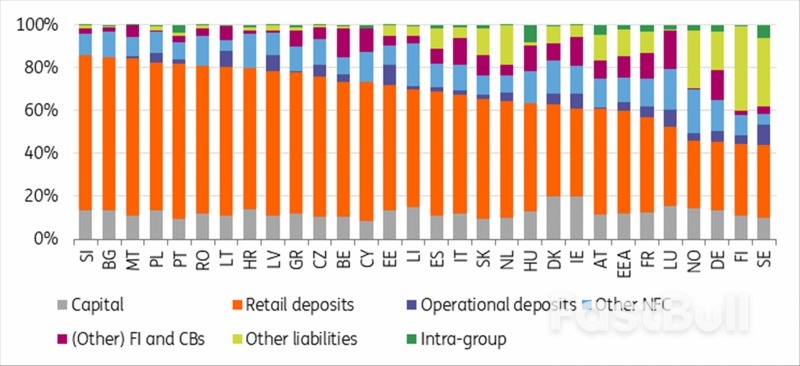
          We have seen bank deposit bases contract in the first quarter this year. In an environment of higher interest rates, clients may start to look for better-yielding alternatives to bank deposits, which may reflect as deposit outflows and result in upside pressures on deposit pricing. When assessing banks’ liquidity risks, retail deposits are generally seen as stickier and less prone to quick outflows. The bulk is supported by deposit guarantee schemes protecting deposit balances of up to €100k. Southern European banks rely more on retail deposits in their funding mix, while Nordic, German and French banks have a smaller share of retail deposits in their funding palette. German and French banks have attracted a larger share of operational and other non-financial customer deposits than their Belgian or Dutch peers. These deposits may be more price sensitive and more volatile in times of stress.

          Available stable funding split by country (after weighting) as of end-2022

          How American and European Banks Are Dealing with the Fallout from the Us Banking Turmoil_1
          In case of liquidity outflows, banks rely on their liquidity buffers. Cash can be easily deployed. Debt securities may be used as collateral for central bank funding or in repo markets. Selling down securities portfolios may instead have an impact on earnings and capital metrics if the bonds were not being marked to market.
          The bulk of liquidity buffers in countries such as Germany, the Netherlands and France rely on cash and reserves. In Southern European countries including Portugal, Italy, Greece and Spain, the share of central government exposures of liquidity buffers is instead higher.

          Banking sector liquid assets by country (after weighting)

          How American and European Banks Are Dealing with the Fallout from the Us Banking Turmoil_2
          In our recent publication, Scrutiny of Liquidity Metrics has Increased, we calculated that most European banks could absorb substantial outflows in their less stable deposit bases (including deposits outside deposit guarantee schemes) with their existing liquidity buffers. Large banks with the least room for stressed deposit outflows included names less geared towards stable (retail) deposit funding, including selected Swiss, UK and Spanish banks. Banks with the strongest headroom for these types of liquidity shocks included mainly selected Benelux and Nordic names in our selection of banks.
          Depositor protection is also on the radar in Europe, as it is in the US. One factor that could potentially support deposit stability in European banks is the Crisis Management and Deposit Insurance (CMDI) framework that is currently being assessed for changes. The European Commission proposals provide for a general depositor preference with a single-tiered ranking. This means that all deposits, including uncovered corporate deposits, will rank above ordinary unsecured claims in insolvency. Moreover, the relative ranking between the different categories of deposits would be replaced by a single-tier depositor preference, where all deposits rank pari-passu without a super-preference for covered deposits. These proposals suggest better protection for depositors, which could make deposits stickier and less prone to deposit runs. A general depositor preference would make the layer including preferred senior unsecured debt thinner in most EU countries. This would likely push up the costs of issuing preferred senior unsecured debt and result in a tightening of the spread of non-preferred senior over preferred senior debt. Part of the impact could be mitigated by growing loss-absorption buffers, pushing up bank wholesale funding costs.

          Conclusion

          The US's bank troubles have been concentrated among smaller-sized banks, while the larger institutions have weathered the storm relatively well so far. The impacts on banks in the European Union have remained moderate. European banks carry substantial liquidity buffers that they can tap into in times of stress. On both sides of the pond, authorities are looking into potential changes that could result in better protection for depositors and as such perhaps more stability for the development of deposits in times of stress. An increase in depositor protection will push up costs from the guarantee schemes that will eventually be borne by the banking system. Better protection for depositors may increase the costs of issuing preferred senior unsecured debt in selected EU countries due to a higher potential burden sharing in times of stress.

          Source: ING

          Risk Warnings and Disclaimers
          You understand and acknowledge that there is a high degree of risk involved in trading. Following any strategies or investment methods may lead to potential losses. The content on the site is provided by our contributors and analysts for information purposes only. You are solely responsible for determining whether any trading assets, securities, strategy, or any other product is suitable for investing based on your own investment objectives and financial situation.
          Comments
          Add to Favorites
          Share

          Three Key Risks to The Global Outlook

          Cohen

          Economic

          Risk 1: US bank troubles widen to several new institutions

          Our base case:
          The substantial deposit instability in many US regional banks has resulted in four mid-sized banks failing. The combination of the high perceived impact of higher interest rates on these banks' balance sheets and their large uninsured deposit bases made them vulnerable to fast and extensive deposit outflows, perhaps exaggerated by social media and the ease of mobile banking.
          Large US banks have remained stable throughout the crisis, and to an extent, they've been part of the solution. Stabilisation of deposits is key for the sector worries to subside. The potential changes to the deposit guarantee scheme in the US could become part of the solution in the longer term, although this would come at a cost for the sector as a whole and is unlikely to be a quick fix.
          We don't rule out further problems arising in some of these smaller US banks but expect larger banks to be able to weather the storm. The European banking sector remains well capitalised and, due to the stringent liquidity rules, can withstand substantial deposit outflows with their existing buffers. Ironically, the fact that a banking union has not been finalised might currently help. We do not expect to see major liquidity events in large European banks.
          Risk scenario and how it plays out:
          The US bank problems have been driven by a quick loss of confidence on the part of uninsured depositors towards regional banks. If the loss of confidence were to spread quickly to impact more institutions, it could result in several banks struggling to absorb deposit outflows simultaneously. This could create worries over contagion in the system and exaggerate further deposit instability. Finding buyers for assets to safeguard depositors and operational continuity for several, although smaller, banks at the same time could pose challenges.
          In the very worst-case scenario, several smaller lenders end up being absorbed by larger ones. The failing banks may, however, come with unforeseen additional risks, which may eventually result in the credit profiles of the larger acquirers weakening more than expected. If the issues are severe enough, they may pose risks to the stability of the larger acquiring banks. If markets question the wider extent of the financial system's whole stability, then severe market disturbance may arise.
          Wider economic impact:
          Further banking stresses would fuel a further tightening in lending standards that we've already seen in the US. History shows this is almost always followed by a sharp rise in the unemployment rate and would deepen the recession we already expect. While it's uncertain whether contagion would spread directly to Europe, the prospect of a US downturn would inevitably have wider economic repercussions overseas. Central banks have so far been able to separate out financial stability and monetary policy tools, but such stresses, should they happen, are ultimately borne out of higher interest rates. This scenario would likely herald earlier and more aggressive rate cuts in both the US and Europe.

          Risk 2: US fails to lift debt ceiling, triggering default

          Our base case:
          Politicians see sense and recognise the economic and financial damage default would cause. Government workers and creditors may get a little nervous about whether they would be paid, but concessions would be made by both sides, and the debt ceiling is raised in time.
          Risk scenario and how it plays out:
          House Republicans have already approved a package to raise the ceiling, but this involves significant government spending cuts that Senate Democrats refuse even to consider. They and the White House want the ceiling raised with no conditions attached, which the Republicans won't accept. Given the personalities involved and their entrenched positions, a smooth and quick deal looks out of the question. We fear that it will take significant economic and financial market stress to trigger a climbdown from the key players, including a government shutdown and possible default.
          Wider economic/market impact:
          If a government shutdown and default look likely, the impact on financial markets, consumers and businesses would be huge at a time when sentiment is already fragile in the wake of recent banking failures. A default (or the material threat thereof) on just one bond would cause the rating agencies to downgrade US Treasuries. All financial products beholden to the US in any way would be at material risk for downgrade too. The dollar would suffer, and risk assets come under major pressure.

          Risk 3: European natural gas prices surge

          Our base case:
          Fuller-than-usual European gas storage means the EU enters next winter in a strong place. Storage is currently more than 60% full, compared to around 36% at the same stage last year. Assuming a 'normal' winter, storage should be roughly aligned with the five-year average this time next year. We expect TTF natural gas to average €60/MWh over the fourth quarter of this year and €65/MWh in the first three months of 2024.
          Risk scenario and how it plays out:
          The European market is still structurally short gas, and demand destruction is needed to balance the market. A colder-than-usual heating season over the 2023/24 winter and the cut-off of remaining Russian pipeline flows would tighten the market and push prices above €120/MWh. However, a higher starting point for storage levels, the TTF price cap, and the potential for voluntary demand cuts becoming mandatory prevent prices from trading back to the 2022 highs.
          Wider economic impact:
          Experience this winter suggests the economy can weather higher gas prices, even if this resilience is highly dependent on the weather. Next winter is also likely to coincide with a period of weaker global growth and tighter corporate margins. European headline inflation stays higher for longer, though on the basis that gas prices stay well below 2022 highs, then we're still likely to see CPI end the year much lower than current levels. However, gas prices have proved to be an important ingredient in higher services inflation and also higher wage settlements. That could mean European core CPI stays higher for longer. Stagflation will be the name of the game.
          The ECB and the Bank of England will struggle to take rates much higher than in our base case, but this scenario could push back the date of the first rate cut in Europe – amplifying potential divergence between the Federal Reserve and other central banks.

          Source: ING

          To stay updated on all economic events of today, please check out our Economic calendar
          Risk Warnings and Disclaimers
          You understand and acknowledge that there is a high degree of risk involved in trading. Following any strategies or investment methods may lead to potential losses. The content on the site is provided by our contributors and analysts for information purposes only. You are solely responsible for determining whether any trading assets, securities, strategy, or any other product is suitable for investing based on your own investment objectives and financial situation.
          Comments
          Add to Favorites
          Share

          Why Bitcoin Falters Amid Historic Anti-Bank Sentiment

          Kevin Du

          Cryptocurrency

          As US banks continue to fail, one would expect Bitcoin (BTC) to skyrocket in value and adoption. However, reality paints a different picture.
          This article looks into the complexities of this digital currency's struggle as it grapples with regulatory challenges, environmental criticisms, and burgeoning competition.
          The Unfulfilled Promise of a Digital Alternative?
          Despite a rising tide of anti-bank sentiment, Bitcoin's ascent remains stubbornly grounded. As the public's faith in traditional financial institutions wanes, Bitcoin, the original cryptocurrency, should be soaring. However, a confluence of factors, including regulatory uncertainty, environmental concerns, and rival digital currencies, has stymied its progress.
          The 2008 financial crisis, followed by numerous banking scandals, has shaken the public's trust in traditional banks. Consequently, many have sought alternative financial solutions, which should have propelled BTC into the mainstream. As a decentralized currency that operates outside the realm of central banks and governments, Bitcoin promised to democratize finance and empower individuals.
          Yet, despite its potential, Bitcoin struggles to gain widespread adoption. Regulatory uncertainty continues to create apprehension among potential users and investors. Governments and financial regulators worldwide grapple with the implications of digital currencies, imposing varying degrees of restrictions and guidelines. For example, in the United States, the SEC's ongoing deliberations over the classification of cryptocurrencies as securities or commodities create a climate of doubt.
          Furthermore, environmental concerns have cast a shadow over Bitcoin's promise. The mining process, which requires significant computational power, consumes vast amounts of energy, leading to a substantial carbon footprint.
          Bitcoin Competition and Energy Consumption
          This has prompted criticism from environmentalists and the broader public, who are increasingly conscious of climate change and its impacts. The University of Cambridge estimates that Bitcoin's annual energy consumption exceeds that of countries like Argentina or the Netherlands.
          Finally, the rise of rival digital currencies has compounded Bitcoin's challenges. As newer cryptocurrencies, such as Ethereum, Solana, and Cardano, gain adoption, each brings unique features and benefits that cater to different user needs. Some offer faster transaction speeds, lower fees, or improved privacy, presenting formidable competition for Bitcoin. These alternatives have fragmented the market, diluting Bitcoin's once-dominant position.
          As a result, Bitcoin's growth remains stagnant despite the increasing disillusionment with traditional financial institutions. Its failure to capitalize on this opportunity can be attributed to the complex interplay of regulatory uncertainty, environmental concerns, and the expanding landscape of digital currencies.
          Why Bitcoin Falters Amid Historic Anti-Bank Sentiment_1Regulatory Roadblocks
          One major factor inhibiting Bitcoin's growth is the ever-present shadow of regulatory uncertainty. Governments worldwide grapple with the implications of this decentralized currency, attempting to strike a balance between innovation and security. Consequently, BTC's potential remains mired in a quagmire of doubt, deterring mainstream adoption.
          Take China, for instance, where the government has implemented a blanket ban on cryptocurrency transactions. Such a hostile environment curtails Bitcoin's expansion, leaving investors and users apprehensive.
          The Green Dilemma
          Environmental concerns surrounding Bitcoin mining pose another obstacle. The energy-intensive process of validating transactions and securing the network has drawn widespread criticism, with detractors arguing that Bitcoin's energy consumption rivals that of entire nations.
          This tarnishes the cryptocurrency's image, discouraging potential supporters.
          As a result, more eco-friendly alternatives have emerged, such as Ethereum's transition to a proof-of-stake consensus mechanism, which significantly reduces energy usage. In this green-conscious world, Bitcoin's environmentally unfriendly mining process puts it at a disadvantage.
          Crypto Competition: The Battle for Supremacy
          As the pioneer of decentralized digital currencies, Bitcoin still reigns supreme. However, the advent of numerous alternative cryptocurrencies, each boasting distinct advantages and features, has diluted Bitcoin's dominance. From privacy-focused Monero to the fast, low-cost transactions of Litecoin, these rivals chip away at Bitcoin's market share.
          The proliferation of decentralized finance (DeFi) projects, built primarily on Ethereum's blockchain, further erodes Bitcoin's stronghold. These innovative platforms offer financial services without intermediaries, addressing some of the very concerns that fueled anti-bank sentiment in the first place.
          The Future: Potential Catalysts for Bitcoin's Resurgence
          Despite these setbacks, Bitcoin is far from doomed. Several factors could propel its growth, thrusting it back into the limelight. For instance, the ongoing development of the Lightning Network promises to improve Bitcoin's scalability, facilitating faster and cheaper transactions. This enhancement could rekindle enthusiasm for digital currency.
          Moreover, as central banks explore the issuance of digital currencies (CBDCs), public interest in cryptocurrencies could surge. Bitcoin, as the most recognizable name in the space, may benefit from this heightened attention.
          Finally, the institutional adoption of cryptocurrencies as a store of value or hedge against inflation could lend credibility to Bitcoin. As more companies MicroStrategy add Bitcoin to their balance sheets, the cryptocurrency's reputation may improve, spurring further investment.
          The Million-Dollar Question
          The current state of BTC raises a crucial question: if not now, when? Will the cryptocurrency ever reach the dizzying heights of a $1 million valuation by 2023's end, as some predict? While the path remains uncertain, Bitcoin's future hinges on its ability to overcome the challenges it faces today.
          To succeed, Bitcoin must navigate the murky waters of regulatory uncertainty, adapt to a more environmentally conscious world, and outmaneuver its competitors. Only then can it capitalize on anti-bank sentiment and secure its position as a viable alternative to traditional finance.

          Source: Be in Crypto

          Risk Warnings and Disclaimers
          You understand and acknowledge that there is a high degree of risk involved in trading. Following any strategies or investment methods may lead to potential losses. The content on the site is provided by our contributors and analysts for information purposes only. You are solely responsible for determining whether any trading assets, securities, strategy, or any other product is suitable for investing based on your own investment objectives and financial situation.
          Comments
          Add to Favorites
          Share

          Central Banks Are Undergoing a Data Revolution

          Justin

          Central Bank

          Economic

          New data and enhanced data capabilities offer opportunities for central banks across a wide range of functionalities, including monetary policy, financial stability, macro- and microprudential policies, financial inclusion and payments systems. But many central banks are bogged down by legacy systems and a lack of internal data management strategies, as OMFIF’s latest report, ‘Central banks in the digital age: Bringing data into focus’, finds.
          To discuss the findings of the report as well as developments in central banks’ approaches to data, OMFIF convened a panel of experts from the central banking world to discuss the modernisation.

          Despite operating within quite different economies, there are similarities in central banks’ data challenges

          Representatives from the central banks of Chile, Lithuania and Italy were broadly in agreement on their data challenges and newfound strategies. Their sentiments were echoed by Bruno Tissot, head of statistics and research support at the Bank of International Settlements, in his experience of engaging with central banks around the world on statistical and data capabilities.
          During the discussion, central bank officials cited the variety of data sources, the presence of data siloes and a lack of a coherent data governance strategy as challenges. In addition, cultural change was highlighted by all panellists as a key barrier to faster technological upgrading and institutional transformation. In terms of the infrastructure, all the panellists stated an interest in moving to data lakes for at least some databases.

          Central banks prepared to use unconventional ‘statistical buffers’ in extraordinary circumstances

          All panellists reported the use of high-frequency indicators or other unconventional metrics of economic activity in addition to traditional data. This trend was catalysed by the Covid-19 pandemic when central banks were forced to look beyond traditional statistics for measures of economic activity. Most commonly, these included vehicular mobility and telecommunications data.
          Since the pandemic, the use of ‘unconventional’ data sources has greatly expanded. News and social media data are being used to capture expectations and sentiment and are now considered by some institutions as a ‘complementary indicator’ to traditional consumer surveys. At the Bank of Lithuania, these are being used in an ‘anecdotal format’ for now, explained Edita Lukaševičiūtė, head of the bank’s data governance division, but they are also exploring the incorporation of social media sentiment for ‘analytical purposes’.

          Weariness towards private data providers

          Both the costs and quality of the data acquired by private providers were mentioned as potential risks. Gloria Peña, director of the statistics division of the Banco Central de Chile, noted that while experimental data is more timely, traditional data is often of higher quality. ‘We need to verify and validate [these] sources, we need to make sure there are no errors, even if they are experimental… they are subject to more revision.’ The trade-off between timeliness and quality was also identified as a challenge.
          Peña explained further that the bank ‘cannot incorporate something when we are not sure we are going to have that source in the future’. This sentiment was echoed by Giuseppe Bruno, head of the IT division of the Banca d’Italia’s economics and statistics directorate, who warned that central banks must ‘be careful with the private data providers’. He noted several risks: costs which can ‘multiply by five from one period to another’, the format of data which can change without notice and the potential lack of a consistent flow of data over a longer period.

          Full migration to cloud services raises questions of sovereignty and security for central banks

          ‘We’re headed in the direction to look at the cloud seriously as a community to central bankers,’ noted Benjie Fraser, head of the asset owner segment of EMEA at State Street Bank & Trust, ‘but it raises [questions] for practitioners around sensitive information.’
          All central bankers on the panel reported using the cloud, but only with public data for now. The panellists acknowledged the advantages of cloud infrastructure, including cost, resiliency and enhanced capabilities. But for sensitive or private data, the panellists expressed reservations. Data encryption could offer one solution, while data localisation may be seen as necessary for other institutions. It is still too early to tell how this will evolve.

          Central banks generally sanguine on their data capabilities

          When asked if satisfied with their data capabilities, the panellists’ answers ranged from four to seven out of 10 – a rather lacklustre evaluation. However, the panellists expressed excitement regarding several initiatives both within and between central banks.
          Peña emphasised the usefulness of a data warehouse for sharing codes across departments at the Banco Central de Chile. This way, they ‘don’t duplicate or waste time if someone already did the same thing’. Bruno echoed the importance of sharing codes and applications via the work that the BIS and International Financial Corporation are conducting with central banks globally. ‘They have set up a training platform so that we meet every year and discuss a variety of issues related to platforms for sharing code and data’ and providing examples.
          Along with technology and processes, cultural change is another obstacle which central banks are working to tackle. ‘People’ is the final pillar of the data governance framework at the Bank of Lithuania. As noted by Lukaševičiūtė, ‘We need to educate people, if we have new technologies, we have to ensure that the people who work with these technologies know how to work.’

          Source:Taylor Pearce

          To stay updated on all economic events of today, please check out our Economic calendar
          Risk Warnings and Disclaimers
          You understand and acknowledge that there is a high degree of risk involved in trading. Following any strategies or investment methods may lead to potential losses. The content on the site is provided by our contributors and analysts for information purposes only. You are solely responsible for determining whether any trading assets, securities, strategy, or any other product is suitable for investing based on your own investment objectives and financial situation.
          Comments
          Add to Favorites
          Share

          South East Asia Set to Enter Coal Importer Big Leagues

          Thomas

          Commodity

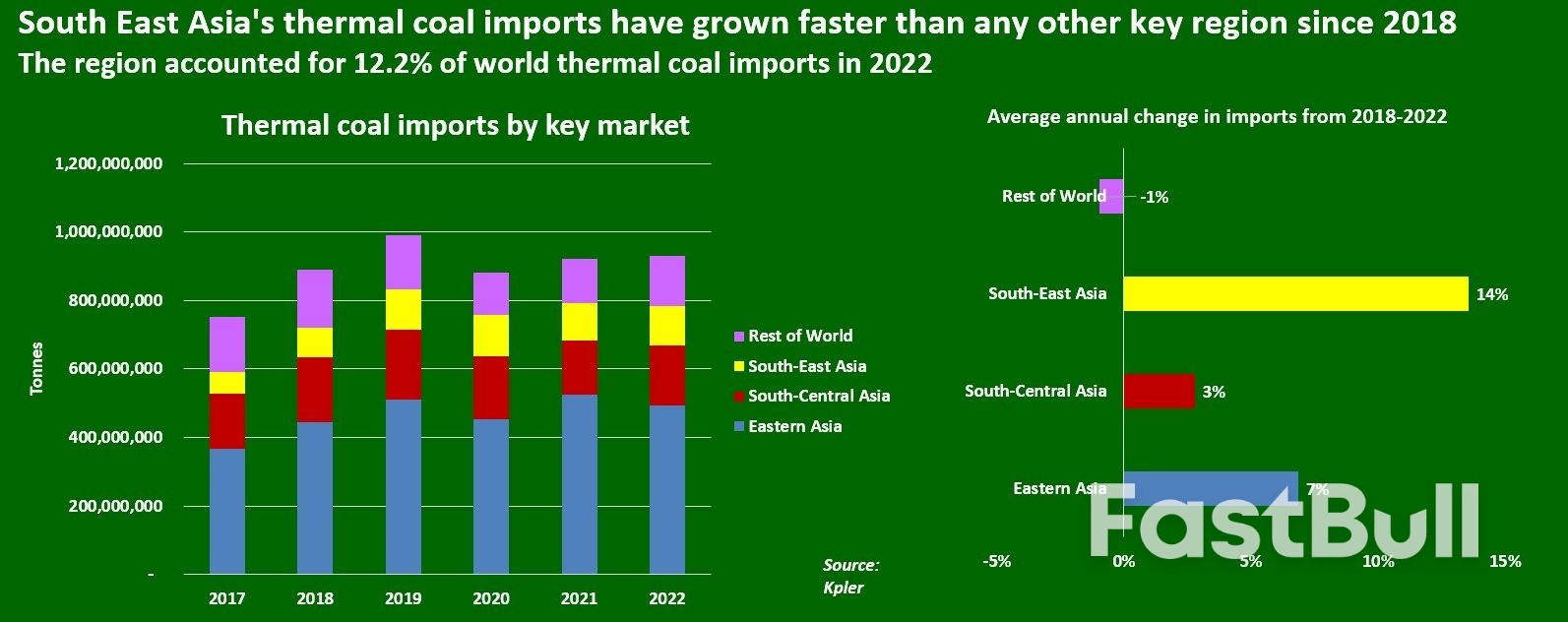
          Southeast Asia only accounts for around 12% of global thermal coal imports, so is often overshadowed by China and India in discussions about key coal consumer markets and the associated impact on emissions.
          However, the region routinely imports well over 100 million tonnes of coal annually, and has outpaced other major importers in terms of annual growth rates since 2018, expanding at an average rate of 14% per year, flows data from Kpler shows.
          That growth pace compares to 3% for China and 13% for India, and if sustained means that the region could soon emerge as a powerful driver of global coal use that could offset coal usage declines that are expected in other markets.
          South East Asia Set to Enter Coal Importer Big Leagues_1What's more, due to the varied nature of the area's economies, political systems and demographic trends, the Southeast Asian region as a whole may be less likely to comply with global targets to reduce coal use, and less susceptible to international pressure to reverse emissions trajectories.
          High Dependency
          Central to the region's coal import appetite is the area's high reliance on coal to generate electricity.
          Indonesia, the largest economy in the region and top global thermal coal exporter, does not actually need to import much coal but relies on it for over 60% of electricity generation, data from Our World in Data shows.
          South East Asia Set to Enter Coal Importer Big Leagues_2The Philippines is the largest coal importer in the region, and along with Malaysia, Vietnam and Cambodia relies on coal for over 40% of electricity, while Thailand uses coal for around 20% of electricity generation.
          The cumulative use of the region is estimated at around 200 million tonnes per year, according to the U.S. Energy Information Administration.
          Peak Period
          While coal use across the region is fairly constant, the summer months when the weather is hottest tend to be when coal imports hit their highest.
          In 2022, Southeast Asia's total thermal coal imports jumped to more than 10 million tonnes per month from May through August, from a monthly average of roughly 8 million tonnes during the opening four months of the year.
          South East Asia Set to Enter Coal Importer Big Leagues_3For the first four months of 2023, Southeast Asia's thermal imports are running 18% above where they were at the same point in 2022, which suggests that utilities may be better stocked this year than last ahead of the pick up in demand for air conditioning over the summer.
          Economic growth across the region also slowed over the opening quarter of 2023 compared to late 2022 as global goods consumption wavered, which may result in reduced industrial power demand over the coming months.
          However, the ongoing economic recovery in China is having supportive effects across the region.
          Revived manufacturing activity in China is leading to increased demand for parts and raw materials sourced from key supplier nations such as Malaysia, Indonesia and The Philippines, which all have strong supply chain links to China.
          Penny Pinching
          Despite the mixed economic signals, the International Monetary Fund projects most Southeast Asian economies to undergo robust expansions in 2023, with real gross domestic product (GDP) expected to grow by 5% in Indonesia, 6% in The Philippines, and 5.8% in Vietnam, according to a regional outlook published this month.
          That said, some of those projections have been trimmed since late 2022 as the health of the global economy soured due to rising interest rates and the continuing fallout from the Russia-Ukraine war.
          As a result, power producers across the region are likely to take a conservative approach to power generation additions, and will likely favour the lowest cost option for baseload power production.
          In turn, that should support continued strong use of coal in electricity generation mixes, and limited expansions to use of costlier natural gas which remains well above long-term average prices on international markets.
          If Southeast Asia's power producers continue to favour coal as the primary source of electricity while the regional economies expand, the area's coal imports could push steadily higher, and pose a fresh concern for climate trackers who are advocating for reduced coal use in all regions.

          Source: The Star

          Risk Warnings and Disclaimers
          You understand and acknowledge that there is a high degree of risk involved in trading. Following any strategies or investment methods may lead to potential losses. The content on the site is provided by our contributors and analysts for information purposes only. You are solely responsible for determining whether any trading assets, securities, strategy, or any other product is suitable for investing based on your own investment objectives and financial situation.
          Comments
          Add to Favorites
          Share

          Us Debt Ceiling Is Just One of Many Trip Hazards for Markets

          Justin

          Economic

          Political

          In February, when the Congressional Budget Office projected that the US government would run out of money this summer, Joe Amato, president and chief investment officer of private equites at Neuberger Berman, suggested that investors should consider that to be just as important as they considered the outlook on inflation and rates.
          Amato did not think the US would default on its debt, but he warned that the threshold could still be ‘a source of volatility over the next three to six months.’ Over recent weeks, it has become a top concern for investors, although from our perspective it represents merely one among several potential trip hazards.
          Despite the increasingly frequent headlines about the risks of hitting the debt ceiling, these concerns do not appear to be making their way into equity markets. Stocks are close to their highs for the year and the Chicago Board Options Exchange volatility index is close to its low.
          In our view, every time the risks build up and the markets fail to correct, it reinforces the case for caution on risky assets, particularly while high rates on cash and short-dated fixed income mean investors are being ‘paid to be patient’.

          Nervousness

          There is growing alarm that the debt ceiling is closing in. Still, the consensus is that Republicans don’t want to be blamed for the chaos of a default (as evidenced by the bill they passed in the House of Representatives in April), Democrats don’t want the issue to be postponed into an election year and therefore a last-minute compromise will be reached. Perhaps a calm market is the appropriate response.
          We don’t think so. The US didn’t default in 2011, but it got close enough for the S&P 500 index to lose almost a fifth of its value. If things go to the wire, the government may have to temporarily halt government spending to make interest payments, creating what could be an additional growth shock to an already faltering economy.
          Markets aren’t entirely ignoring the risks now. The spread between the yields of one-month and three-month Treasury bills has been exceptionally wide and volatile. Similarly, while the VIX is near its 2023 low, the Merrill Lynch Option Volatility Estimate (the equivalent of the VIX for bonds) has been bouncing around at historically high levels. It may be only a matter of time before that nervousness spills into equities.

          Warning against complacency

          For more than a month, it seemed that the banking-sector stresses that broke out in March had been contained. The shares of First Republic Bank, perceived to be the most likely next casualty, had stabilised at around $14. But First Republic’s disclosure that first-quarter deposit withdrawals were bigger than analysts had estimated halved its share price again, sending a new shockwave through the wider sector.
          That is likely to raise further concern about leverage and financing pressures in certain parts of the US commercial real estate industry, to which the vulnerable regional banking sector has been an outsized lender. This is a segment of the market that we are watching closely.
          While there may be no more First Republic-magnitude shocks and large-cap technology appears to be holding up well, we have long anticipated that the earnings picture will deteriorate significantly as we move through the year. Those expectations are getting support from weakening economic data (a US gross domestic product slump in the first quarter), tighter credit conditions and stubbornly persistent inflation and central bank hawkishness, especially in Europe and the UK.

          Cautious, liquid and flexible

          This is a long list of obstacles waiting to trip up markets during 2023. It is possible that none causes a major incident. But we think it is probable that at least some of them will significantly slow down progress.
          We believe investors can benefit from remaining cautious, liquid and flexible over the coming months, ready to take advantage should markets take a fall. High rates at the front end of yield curves mean there is little opportunity cost to doing so, should things turn out better than expected.

          Source:Erik Knutzen

          To stay updated on all economic events of today, please check out our Economic calendar
          Risk Warnings and Disclaimers
          You understand and acknowledge that there is a high degree of risk involved in trading. Following any strategies or investment methods may lead to potential losses. The content on the site is provided by our contributors and analysts for information purposes only. You are solely responsible for determining whether any trading assets, securities, strategy, or any other product is suitable for investing based on your own investment objectives and financial situation.
          Comments
          Add to Favorites
          Share

          From Genesis to Dominance: The Evolution of Bitcoin

          Kevin Du

          Cryptocurrency

          In 2009, the world witnessed the birth of Bitcoin (BTC) – an enigmatic invention by the pseudonymous Satoshi Nakamoto. This revolutionary digital currency laid the foundation for a financial paradigm shift, transforming the way we perceive and transact value.
          Bitcoin's pioneering role in shaping the cryptocurrency landscape has been instrumental, carving out a path for countless digital assets to follow.
          Satoshi's white paper outlined a peer-to-peer electronic cash system that aimed to address the flaws in the traditional financial system, such as double-spending and the need for trust in centralized institutions. Its creation spurred a new era of financial innovation, setting the stage for a diverse and dynamic market.

          The Catalysts of Bitcoin's Meteoric Rise

          Decentralization and Security: Core Tenets
          At the heart of Bitcoin's success lies its decentralized and secure nature. By utilizing blockchain technology, it eliminates the need for central authorities, empowering individuals with financial autonomy. Bitcoin's robust security is bolstered by a vast network of miners, making it virtually impervious to attacks, thus attracting investors who seek a reliable store of value.
          Bitcoin's security relies on a consensus mechanism called Proof-of-Work (PoW). Miners compete to solve complex mathematical problems, validating transactions and securing the network in the process.
          This decentralized approach has withstood the test of time, offering a level of protection that many other cryptocurrencies strive to emulate.
          Limited Supply: The Gold Standard of Digital Assets
          Bitcoin's built-in scarcity, with only 21 million coins ever to be mined, mimics the properties of gold. This scarcity drives demand, contributing to its meteoric rise in value. As mainstream adoption grows, the allure of owning a finite digital asset increases, propelling Bitcoin's dominance further.
          The concept of halving, wherein mining rewards decrease by 50% roughly every four years, further intensifies Bitcoin's scarcity. These halving events create supply shocks, which have historically correlated with significant price increases, as witnessed in the 2013, 2017, and 2021 bull markets.
          Media Attention and Brand Recognition
          The media's fascination with Bitcoin has played a pivotal role in its ascent. The cryptocurrency's meteoric rise captured public imagination, turning it into a household name. Its brand recognition surpasses that of its competitors, making it the de facto leader in the digital currency space.
          High-profile endorsements and investments from companies such as Tesla and MicroStrategy further cemented Bitcoin's status. The 2017 surge, where Bitcoin reached nearly $20,000, and the subsequent bull run in 2020-2021, reaching over $67,000, generated global headlines, fueling interest and curiosity.

          The Ripple Effect: Bitcoin's Impact on the Crypto Market

          The Altcoin Boom: Innovation and Diversification
          Bitcoin's success has spawned a myriad of alternative cryptocurrencies or "altcoins," each with unique features and use-cases. This diversification has led to a flourishing market, with thousands of cryptocurrencies vying for a slice of the pie. Despite fierce competition, Bitcoin remains the benchmark by which all others are measured.
          Ethereum, for example, expanded on Bitcoin's blockchain technology to create a platform for decentralized applications (dApps), allowing developers to build a wide range of solutions. Other altcoins, such as Ripple (XRP) and Litecoin (LTC), have focused on improving transaction speed and efficiency.
          Shaping the Regulatory Landscape
          As the leading cryptocurrency, Bitcoin has been both a catalyst and a litmus test for regulatory frameworks worldwide. Governments and financial institutions have had to adapt to the changing landscape, creating rules and guidelines to ensure a more secure and compliant market.
          Bitcoin's influence on regulatory developments is undeniable and continues to shape the future of digital currencies.
          For example, the U.S. Securities and Exchange Commission (SEC) has taken steps to regulate initial coin offerings (ICOs) and cryptocurrency exchanges. Likewise, the European Union has implemented the Fifth Anti-Money Laundering Directive (5AMLD), which extends regulatory measures to cryptocurrency service providers.

          The Challenger Conundrum: Why Bitcoin Remains Unrivaled

          First-Mover Advantage and Network Effects
          Bitcoin's pioneering status grants it a formidable first-mover advantage. The vast network of users, miners, and developers has created a self-reinforcing ecosystem that strengthens its position as the leading cryptocurrency. This network effect makes it increasingly hard for new entrants to dethrone the reigning champion.
          As the first and most widely-adopted cryptocurrency, Bitcoin benefits from extensive infrastructure support, including a wide array of wallets, exchanges, and payment processors. This solid foundation enables users to access and use Bitcoin more easily than other cryptocurrencies, amplifying its dominance.
          The Lindy Effect: Longevity Breeds Confidence
          The Lindy Effect posits that the future life expectancy of a technology is proportional to its current age. With each passing day, Bitcoin proves its resilience and longevity, solidifying its status as the digital gold standard. This enduring presence instills investor confidence, reinforcing Bitcoin's dominance.
          Bitcoin's survival through numerous market cycles, controversies, and regulatory challenges serves as evidence of its durability. This resilience attracts not only retail but also institutional investors, who see it as a viable long-term investment option.
          The Store of Value Proposition: A Safe Haven in a Volatile Market
          Bitcoin's reputation as a store of value has been instrumental in maintaining its leading position. Amid economic uncertainty and market volatility, investors flock to BTC as a digital safe haven. While other cryptocurrencies may offer novel utility, they have yet to unseat it as the premier digital asset.
          Bitcoin's ability to retain value during periods of economic turmoil, such as the COVID-19 pandemic, further solidifies its position as a store of value. Its comparison to gold as "digital gold" highlights its potential as an inflation hedge, drawing interest from investors seeking long-term stability.

          Bitcoin's Continued Dominance

          The evolution of Bitcoin from its genesis to its current position of dominance is a testament to its resilience, innovation, and influence. Factors such as decentralization, security, scarcity, and media attention have propelled Bitcoin to heights that other cryptocurrencies have yet to reach. Its ongoing influence on the development and adoption of cryptocurrencies worldwide ensures its continued dominance.
          From humble beginnings to its current status as the leading cryptocurrency, Bitcoin's journey has been nothing short of remarkable. While the market continues to evolve and competitors emerge, Bitcoin remains the yardstick by which all other digital assets are measured. Its impact on the financial landscape is indelible, forever altering our understanding of money and value.

          Source: Be in Crypto

          Risk Warnings and Disclaimers
          You understand and acknowledge that there is a high degree of risk involved in trading. Following any strategies or investment methods may lead to potential losses. The content on the site is provided by our contributors and analysts for information purposes only. You are solely responsible for determining whether any trading assets, securities, strategy, or any other product is suitable for investing based on your own investment objectives and financial situation.
          Comments
          Add to Favorites
          Share
          FastBull
          Copyright © 2025 FastBull Ltd

          728 RM B 7/F GEE LOK IND BLDG NO 34 HUNG TO RD KWUN TONG KLN HONG KONG

          TelegramInstagramTwitterfacebooklinkedin
          App Store Google Play Google Play
          Products
          Charts

          Chats

          Q&A with Experts
          Screeners
          Economic Calendar
          Data
          Tools
          Membership
          Features
          Function
          Markets
          Copy Trading
          Latest Signals
          Contests
          News
          Analysis
          24/7
          Columns
          Education
          Company
          Careers
          About Us
          Contact Us
          Advertising
          Help Center
          Feedback
          User Agreement
          Privacy Policy
          Business

          White Label

          Data API

          Web Plug-ins

          Poster Maker

          Affiliate Program

          Risk Disclosure

          The risk of loss in trading financial instruments such as stocks, FX, commodities, futures, bonds, ETFs and crypto can be substantial. You may sustain a total loss of the funds that you deposit with your broker. Therefore, you should carefully consider whether such trading is suitable for you in light of your circumstances and financial resources.

          No decision to invest should be made without thoroughly conducting due diligence by yourself or consulting with your financial advisors. Our web content might not suit you since we don't know your financial conditions and investment needs. Our financial information might have latency or contain inaccuracy, so you should be fully responsible for any of your trading and investment decisions. The company will not be responsible for your capital loss.

          Without getting permission from the website, you are not allowed to copy the website's graphics, texts, or trademarks. Intellectual property rights in the content or data incorporated into this website belong to its providers and exchange merchants.

          Not Logged In

          Log in to access more features

          FastBull Membership

          Not yet

          Purchase

          Become a signal provider
          Help Center
          Customer Service
          Dark Mode
          Price Up/Down Colors

          Log In

          Sign Up

          Position
          Layout
          Fullscreen
          Default to Chart
          The chart page opens by default when you visit fastbull.com