• Trade
  • Markets
  • Copy
  • Contests
  • News
  • 24/7
  • Calendar
  • Q&A
  • Chats
Trending
Screeners
SYMBOL
LAST
BID
ASK
HIGH
LOW
NET CHG.
%CHG.
SPREAD
SPX
S&P 500 Index
6827.42
6827.42
6827.42
6899.86
6801.80
-73.58
-1.07%
--
DJI
Dow Jones Industrial Average
48458.04
48458.04
48458.04
48886.86
48334.10
-245.98
-0.51%
--
IXIC
NASDAQ Composite Index
23195.16
23195.16
23195.16
23554.89
23094.51
-398.69
-1.69%
--
USDX
US Dollar Index
97.980
98.060
97.980
98.020
97.980
+0.030
+ 0.03%
--
EURUSD
Euro / US Dollar
1.17396
1.17403
1.17396
1.17402
1.17285
+0.00002
0.00%
--
GBPUSD
Pound Sterling / US Dollar
1.33682
1.33696
1.33682
1.33732
1.33580
-0.00025
-0.02%
--
XAUUSD
Gold / US Dollar
4302.71
4303.15
4302.71
4307.76
4294.68
+3.32
+ 0.08%
--
WTI
Light Sweet Crude Oil
57.381
57.418
57.381
57.386
57.194
+0.148
+ 0.26%
--

Community Accounts

Signal Accounts
--
Profit Accounts
--
Loss Accounts
--
View More

Become a signal provider

Sell trading signals to earn additional income

View More

Guide to Copy Trading

Get started with ease and confidence

View More

Signal Accounts for Members

All Signal Accounts

Best Return
  • Best Return
  • Best P/L
  • Best MDD
Past 1W
  • Past 1W
  • Past 1M
  • Past 1Y

All Contests

  • All
  • Trump Updates
  • Recommend
  • Stocks
  • Cryptocurrencies
  • Central Banks
  • Featured News
Top News Only
Share

Australia's S&P/ASX 200 Index Down 0.6% At 8647.60 Points In Early Trade

Share

Nomura CEO: Aim To Develop Japanese Direct Lending Market

Share

Nomura CEO: Aim To Bring Private Debt Know-How From Overseas

Share

HSBC - Scheme Consideration Refers To Proposal For Privatisation Of Hang Seng Bank

Share

[Report: SpaceX Launches Bake-Off Process To Select Underwriters For Potential IPO] According To Sources Familiar With The Matter, SpaceX Executives Have Initiated A Process To Select Wall Street Investment Banks To Advise The Company On Its Initial Public Offering (IPO). Several Investment Banks Are Scheduled To Submit Their First Round Of Proposals This Week, A Process Known As "bake-off," Which Represents The Most Concrete Step The Rocket Maker Has Taken Towards A Potentially "blockbuster IPO," According To The Sources

Share

RBNZ: ASB Has Co-Operated With The Reserve Bank And Has Admitted Liability For All Seven Causes Of Action

Share

RBNZ: Court Proceedings For Breaches Of Core Requirements Under Anti-Money Laundering And Countering Financing Of Terrorism Act From At Least December 2019

Share

Jose Antonio Kast Leads Chile Presidential Election's Runoff Vote With 4.46% Of Ballots Counted: Official Count

Share

Mayor: Russian Air Defence Units Destroy Drone Heading For Moscow

Share

Australia's ASIC - ASIC And Reserve Bank Of Australia Will Step Up Their Review To Uplift Their Joint Supervisory Model

Share

US Envoy Witkoff Says A Lot Of Progress Was Made At Berlin Talks On Russia/Ukraine War

Share

Syria's President Sharaa Sends Condolences To Trump Over Killing Of USA Soldiers In Syria - Syrian Presidency

Share

ECOWAS Commission President: ECOWAS Rejects Guinea-Bissau Junta Transition Plan, Demands Return To Constitutional Order

Share

On Sunday (December 14), The Bangladesh DSE Broad Index Closed Down 0.62% At 4932.97 Points

Share

US President Trump: A New Federal Reserve Chairman Will Be Chosen Soon

Share

US President Trump: Inflation Is “completely Offset” And You Don’t Want To See Deflation

Share

Trump: Will Be A Lot Of Damage Done To The People That Attacked Troops In Syria

Share

Trump: Terrible Attack In Bondi Beach

Share

Interior Ministry - Syria Arrests Five Suspects In Shooting Of USA And Syrian Troops In Palmyra

Share

France Says Conditions For EU Vote On MERCOSUR Deal Not Yet Met, Despite Recent Progress — Prime Minister's Office

TIME
ACT
FCST
PREV
U.K. Trade Balance (Oct)

A:--

F: --

P: --

U.K. Services Index MoM

A:--

F: --

P: --

U.K. Construction Output MoM (SA) (Oct)

A:--

F: --

P: --

U.K. Industrial Output YoY (Oct)

A:--

F: --

P: --

U.K. Trade Balance (SA) (Oct)

A:--

F: --

P: --

U.K. Trade Balance EU (SA) (Oct)

A:--

F: --

P: --

U.K. Manufacturing Output YoY (Oct)

A:--

F: --

P: --

U.K. GDP MoM (Oct)

A:--

F: --

P: --

U.K. GDP YoY (SA) (Oct)

A:--

F: --

P: --

U.K. Industrial Output MoM (Oct)

A:--

F: --

P: --

U.K. Construction Output YoY (Oct)

A:--

F: --

P: --

France HICP Final MoM (Nov)

A:--

F: --

P: --

China, Mainland Outstanding Loans Growth YoY (Nov)

A:--

F: --

P: --

China, Mainland M2 Money Supply YoY (Nov)

A:--

F: --

P: --

China, Mainland M0 Money Supply YoY (Nov)

A:--

F: --

P: --

China, Mainland M1 Money Supply YoY (Nov)

A:--

F: --

P: --

India CPI YoY (Nov)

A:--

F: --

P: --

India Deposit Gowth YoY

A:--

F: --

P: --

Brazil Services Growth YoY (Oct)

A:--

F: --

P: --

Mexico Industrial Output YoY (Oct)

A:--

F: --

P: --

Russia Trade Balance (Oct)

A:--

F: --

P: --

Philadelphia Fed President Henry Paulson delivers a speech
Canada Building Permits MoM (SA) (Oct)

A:--

F: --

P: --

Canada Wholesale Sales YoY (Oct)

A:--

F: --

P: --

Canada Wholesale Inventory MoM (Oct)

A:--

F: --

P: --

Canada Wholesale Inventory YoY (Oct)

A:--

F: --

P: --

Canada Wholesale Sales MoM (SA) (Oct)

A:--

F: --

P: --

Germany Current Account (Not SA) (Oct)

A:--

F: --

P: --

U.S. Weekly Total Rig Count

A:--

F: --

P: --

U.S. Weekly Total Oil Rig Count

A:--

F: --

P: --

Japan Tankan Large Non-Manufacturing Diffusion Index (Q4)

--

F: --

P: --

Japan Tankan Small Manufacturing Outlook Index (Q4)

--

F: --

P: --

Japan Tankan Large Non-Manufacturing Outlook Index (Q4)

--

F: --

P: --

Japan Tankan Large Manufacturing Outlook Index (Q4)

--

F: --

P: --

Japan Tankan Small Manufacturing Diffusion Index (Q4)

--

F: --

P: --

Japan Tankan Large Manufacturing Diffusion Index (Q4)

--

F: --

P: --

Japan Tankan Large-Enterprise Capital Expenditure YoY (Q4)

--

F: --

P: --

U.K. Rightmove House Price Index YoY (Dec)

--

F: --

P: --

China, Mainland Industrial Output YoY (YTD) (Nov)

--

F: --

P: --

China, Mainland Urban Area Unemployment Rate (Nov)

--

F: --

P: --

Saudi Arabia CPI YoY (Nov)

--

F: --

P: --

Euro Zone Industrial Output YoY (Oct)

--

F: --

P: --

Euro Zone Industrial Output MoM (Oct)

--

F: --

P: --

Canada Existing Home Sales MoM (Nov)

--

F: --

P: --

Euro Zone Total Reserve Assets (Nov)

--

F: --

P: --

U.K. Inflation Rate Expectations

--

F: --

P: --

Canada National Economic Confidence Index

--

F: --

P: --

Canada New Housing Starts (Nov)

--

F: --

P: --

U.S. NY Fed Manufacturing Employment Index (Dec)

--

F: --

P: --

U.S. NY Fed Manufacturing Index (Dec)

--

F: --

P: --

Canada Core CPI YoY (Nov)

--

F: --

P: --

Canada Manufacturing Unfilled Orders MoM (Oct)

--

F: --

P: --

Canada Manufacturing New Orders MoM (Oct)

--

F: --

P: --

Canada Core CPI MoM (Nov)

--

F: --

P: --

Canada Manufacturing Inventory MoM (Oct)

--

F: --

P: --

Canada CPI YoY (Nov)

--

F: --

P: --

Canada CPI MoM (Nov)

--

F: --

P: --

Canada CPI YoY (SA) (Nov)

--

F: --

P: --

Canada Core CPI MoM (SA) (Nov)

--

F: --

P: --

Canada CPI MoM (SA) (Nov)

--

F: --

P: --

Q&A with Experts
    • All
    • Chatrooms
    • Groups
    • Friends
    Connecting
    .
    .
    .
    Type here...
    Add Symbol or Code

      No matching data

      All
      Trump Updates
      Recommend
      Stocks
      Cryptocurrencies
      Central Banks
      Featured News
      • All
      • Russia-Ukraine Conflict
      • Middle East Flashpoint
      • All
      • Russia-Ukraine Conflict
      • Middle East Flashpoint
      Search
      Products

      Charts Free Forever

      Chats Q&A with Experts
      Screeners Economic Calendar Data Tools
      Membership Features
      Data Warehouse Market Trends Institutional Data Policy Rates Macro

      Market Trends

      Market Sentiment Order Book Forex Correlations

      Top Indicators

      Charts Free Forever
      Markets

      News

      News Analysis 24/7 Columns Education
      From Institutions From Analysts
      Topics Columnists

      Latest Views

      Latest Views

      Trending Topics

      Top Columnists

      Latest Update

      Signals

      Copy Rankings Latest Signals Become a signal provider AI Rating
      Contests
      Brokers

      Overview Brokers Assessment Rankings Regulators News Claims
      Broker listing Forex Brokers Comparison Tool Live Spread Comparison Scam
      Q&A Complaint Scam Alert Videos Tips to Detect Scam
      More

      Business
      Events
      Careers About Us Advertising Help Center

      White Label

      Data API

      Web Plug-ins

      Affiliate Program

      Awards Institution Evaluation IB Seminar Salon Event Exhibition
      Vietnam Thailand Singapore Dubai
      Fans Party Investment Sharing Session
      FastBull Summit BrokersView Expo
      Recent Searches
        Top Searches
          Markets
          News
          Analysis
          User
          24/7
          Economic Calendar
          Education
          Data
          • Names
          • Latest
          • Prev

          View All

          No data

          Scan to Download

          Faster Charts, Chat Faster!

          Download App
          English
          • English
          • Español
          • العربية
          • Bahasa Indonesia
          • Bahasa Melayu
          • Tiếng Việt
          • ภาษาไทย
          • Français
          • Italiano
          • Türkçe
          • Русский язык
          • 简中
          • 繁中
          Open Account
          Search
          Products
          Charts Free Forever
          Markets
          News
          Signals

          Copy Rankings Latest Signals Become a signal provider AI Rating
          Contests
          Brokers

          Overview Brokers Assessment Rankings Regulators News Claims
          Broker listing Forex Brokers Comparison Tool Live Spread Comparison Scam
          Q&A Complaint Scam Alert Videos Tips to Detect Scam
          More

          Business
          Events
          Careers About Us Advertising Help Center

          White Label

          Data API

          Web Plug-ins

          Affiliate Program

          Awards Institution Evaluation IB Seminar Salon Event Exhibition
          Vietnam Thailand Singapore Dubai
          Fans Party Investment Sharing Session
          FastBull Summit BrokersView Expo

          Hawkish Fed vs Dovish Others

          Cohen

          Economic

          Central Bank

          Summary:

          The Swiss National Bank (SNB) and the Bank of England (BoE) surprised by maintaining their rates unchanged at yesterday's trading session. The Bank of Japan (BoJ) surprised by maintaining its ultra-lose monetary policy stance unchanged.

          The Swiss National Bank (SNB) and the Bank of England (BoE) surprised by maintaining their rates unchanged at yesterday's trading session. The Bank of Japan (BoJ) surprised by maintaining its ultra-lose monetary policy stance unchanged. Combined with a hawkish pause earlier this week, the major currencies further sank against the greenback. The USD/CHF advanced past the 200-DMA, and Cable slipped to 1.2232, a fresh low since March, and whispers of a potential return to parity against the US dollar sparked, yet again. Reasonably, the pound-dollar could return to 1.20, and below, if the major 38.2% Fibonacci support – which stands at 1.2080 is pulled out and lets the pair slip into a medium-term bearish consolidation zone. But we will likely see the Federal Reserve (Fed) soften its tone before we start talking about parity in Cable.
          Now, looking at what the BoE did, you know that I was surprised, and intrigued with the decision. In Switzerland for example, inflation – official inflation – steadied below the SNB's 2%, target. The latest data shows that the Swiss CPI is at no higher than 1.6% – even though we are expecting a monstrous rise in health insurance costs, and another 20% rise in average in electricity costs that will certainly drill holes in our pockets at the start of next year, but for now inflation is at 1.6%, say the numbers, and alone, it justifies a SNB pause. But in Britain, the no action is quite premature. Inflation in Britain is almost at 7%, the energy prices are rising, the war in Ukraine is nowhere close to being over, sterling pound is now losing value, which means that whatever the Brits will import from now will cost them more than during the last months, when the pound was appreciating. It's hard to see how, with all these developments, the BoE won't be obliged to hike, again. The only way is a really bad economic performance.
          A bright spot
          If there is one bright spot in Britain with all this, it is the FTSE100. First, the rising energy prices are good for the energy-rich FTSE100. Second, softer sterling makes these companies more affordable for international investors, who should of course think of hedging their sterling exposure, and third, more than 80% of the FTSE100 companies' revenues come from oversees, which means that when they convert their shiny dollar revenues back to a morose sterling, well, they can't really complain with a stronger dollar. Consequently, if a more dovish BoE is bad for sterling, the combination of a hawkish Fed and a dovish BoE and a pitiless OPEC is certainly good for the FTSE100. The index has been left behind the S&P500 this year, as the tech rally is what propelled the American index to the skies, but that technology wind is now turning direction. The FTSE 100 broke its February to September down trending trend to the upside and is fundamentally and technically poised to gain further positive traction, whereas, the S&P500 is heaving a rough month, with technology stocks set for their worse performance this year, under the pressure of rising US yields, which make their valuations look even more expensive.
          Interestingly, the US 2-year yield peaked at 5.20% after the Fed's hawkish pause this week and is back headed toward the 5% mark, but the gap between the US 2-year yield and the top range of the Fed funds rate is around 40bp, which is a big gap, and even if the Fed decided not to hike rates, this gap should narrow, in theory. If it does not, it means that bond traders are betting against the Fed's hawkishness and think that the melting savings, the loosening jobs market, tightening bank lending conditions and strikes, and restart of student loan repayments and a potential government shutdown could prevent that last rate hike to happen before this year ends. And indeed, activity on Fed funds futures gives more than 70% chance for a third pause at the FOMC's November meeting, and Goldman Sachs now sees the US expansion slow to 1.3% from 3.1% printed in the Q3. KPMG also warned that a prolonged auto stoppage may precipitate contraction. And if no deal is inked by noon today, the strikes will get worse.
          One's bad fortune is another's good fortune
          The Japanese auto exports surged big this year, they were 50% higher in yen terms. The yen is certainly not doing well, but yes, you can't have it all. That cheap yen is one of the reasons why the Japanese export so well outside their country. And in case you missed, the BoJ did nothing today to exit their hyper-ultra-loose monetary policy. They didn't even give a hint of normalization, meaning that the yen will hardly strengthen from the actual levels. In the meantime, Toyota, Mitsubishi and Honda shares are having a stellar year, and the U.S. strikes will only help them do better.

          Source: Swissquote Bank SA

          To stay updated on all economic events of today, please check out our Economic calendar
          Risk Warnings and Disclaimers
          You understand and acknowledge that there is a high degree of risk involved in trading. Following any strategies or investment methods may lead to potential losses. The content on the site is provided by our contributors and analysts for information purposes only. You are solely responsible for determining whether any trading assets, securities, strategy, or any other product is suitable for investing based on your own investment objectives and financial situation.
          Comments
          Add to Favorites
          Share

          Yen Down on Silent BoJ; DOW Stares at Key Support in Week's Finale

          Samantha Luan

          Economic

          Central Bank

          Forex

          In a move that left many market observers bemused, Yen declined in Asian trading session after BoJ opted for continuity, leaving its monetary policy untouched. Notably, the bank refrained from dropping any hints about potential alterations in its policy stance in the foreseeable future. With U.S. 10-year yield surging to a remarkable 16-year high, Yen may face further selling pressure in the coming sessions. Meanwhile, attention is shifting to forthcoming PMI releases from major economies, including Eurozone, UK, and U.S., as the week approaches its end.
          Reflecting on the week's performance, both Sterling and Swiss Franc have been the laggards, affected by decisions of BoE and SNB to maintain their policies unchanged. The anticipation is growing that these central banks might have reached the apex of their tightening cycles already. Trailing closely behind in terms of weakness is Yen. New Zealand Dollar has emerged as the top performer, followed by Canadian Dollar and U.S. Dollar. Euro and Australian Dollar are exhibiting a mixed performance.
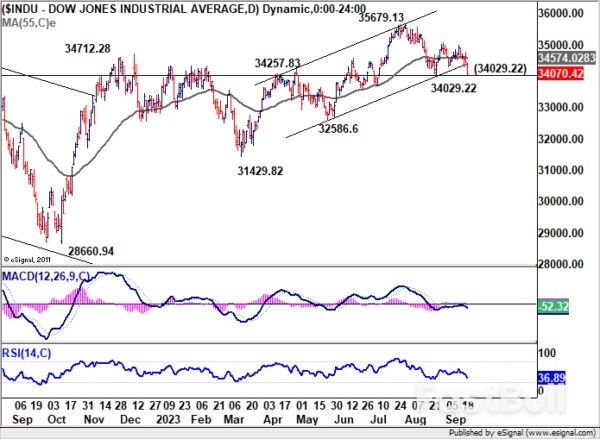
          Technically, in light of Fed's hawkish stance this week, market players are keenly watching for signs of escalating risk aversion. If DOW plunges below 34092.22 support level and wraps up the week beneath it, it would not only signify a renewed decline from 15679.13 but also set a bearish tone that extends into Q4, potentially aiming for 31429.82 support.Yen Down on Silent BoJ; DOW Stares at Key Support in Week's Finale_1
          In Asia, at the time of writing, Nikkei is down -0.43%. Hong Kong HSI is up 0.86%. China Shanghai SSE is up 0.67%. Singapore Strait Times is up 0.05%. Japan 10-year JGB yield is down -0.0037 at 0.750. Overnight, DOW dropped -1.08%. S&P 500 dropped -1.64%. NASDAQ dropped -1.82%. 10-year yield surged 0.131 to 4.480.

          BoJ stands pat, drops no hint on future adjustment

          BoJ maintains a steady course today and keeps monetary policy unchanged. It also chooses choosing not to make any adjustments in the statement that would suggest a departure from its existing negative interest rate stance or the yield curve control measures. The central bank even retains the pledge that it "will not hesitate to take additional easing measures if necessary."
          In unanimous decisions, short-term policy interest rate is held at -0.10%. 10-year JGB yield target is held at 0%, with a band of plus and minus 0.5%. Moreover, the bank's offer to purchase 10-year JGBs at a rate of 1.0% daily through fixed-rate market operations remains unchanged.
          BoJ anticipates the Japanese economy to maintain a moderate recovery in the near term. However, it has also flagged concerns, noting that the economy is "under downward pressure stemming from a slowdown in the pace of recovery in overseas economies." Beyond this phase, the central bank is optimistic that the economy will exhibit growth "at a pace above its potential growth rate" due to the strengthening of a "virtuous cycle from income to spending."
          Regarding inflation, BoJ foresees the year-on-year core CPI to "decelerate" owing to diminishing import price effects. Nevertheless, in the subsequent period, the CPI is projected to "accelerate again moderately", spurred by an improving output gap, along with rising medium-to-long-term inflation expectations and wage growth.
          Released earlier, Japan headline CPI slowed slightly from 3.3% yoy to 3.2% yoy in August. CPI core (ex-food) was unchanged at 3.1% yoy. CPI core-core (ex food and energy) was unchanged at 4.3% yoy.

          Japan's PMI manufacturing fell to 48.6, slackening demand and lower employment

          Japan's Manufacturing PMI further declined from 49.6 to 48.6 in September, falling short of the anticipated 49.9, marking the most pronounced contraction since February. PMI Services also receded from 54.3 to 53.3. PMI Composite, which gives a holistic view of the broader economy, tapered off from 52.6 to 51.8.
          Usamah Bhatti, an Economist at S&P Global Market Intelligence, noted that the future doesn't seem particularly rosy, with forward-looking indicators hinting at a possible slackening of demand and activity. While service firms did experience a rise, manufacturing segment reported a sharp decline in new orders, the most pronounced in seven months.
          Another worrisome development is the reduced employment levels in the private sector. Bhatti stated, "As pressure on capacity eased, there was a renewed reduction in employment levels." This trend was "the first since the start of the year and the quickest since August 2020." He attributed this to companies not replacing those who voluntarily exited, often as a strategy "amid elevated cost burdens."

          Australia PMI composite back to expansion, risk of "no land" for the economy

          In September, Australia's Manufacturing PMI slipped to a 3-month low, declining from 49.6 to 48.2. In contrast, PMI Services showcased resilience, rising from 47.8 to a 4-month high of 50.5. PMI Composite also surged from 48.0 to 50.2, a 4-month peak, signaling a return to expansion in the broader economy.
          Warren Hogan, Chief Economic Advisor at Judo Bank,said that "demand in the economy is holding up, and business activity remains on a sound footing." He further remarked that, contrary to some expectations, the present economic scenario isn't about choosing between a "hard or soft landing." Instead, he proposed that the real risk is of "no landing" for the economy.
          Hogan further touched upon the inflation concerns that have been a pivotal discussion in financial circles. "The inflation indicators remain elevated at levels pointing to above-target CPI over the next 6-9 months," he stated. He pointed out that input prices remained unchanged in September, hinting at continued cost pressures. However, the final prices index experienced a slight dip in the September flash report. Despite this marginal decline, Hogan suggested that "inflation over the second half of 2023 could be higher than desired."
          This latest PMI data follows a trend of stronger-than-predicted figures emerging from Australia in recent weeks. While this demonstrates economic stamina and persisting inflation, all eyes are on RBA's next steps. Hogan postulates that the RBA Board, under leadership of the new Governor Michele Bullock, will likely adopt a patient stance. However, he doesn't rule out further monetary tightening, possibly "in early November on Melbourne Cup day," should the economic indicators not align with RBA's projections of a slowdown.

          New Zealand's trade data sees China dominates decline in exports and imports

          In August, New Zealand observed a dip in both its goods exports and imports compared to the previous year, leading to a monthly trade deficit of NZD -2.3B.
          Compared to figures from August 2022, goods exports saw a reduction of NZD -296m, marking a -5.6% yoy drop, settling at NZD 5.0B. On the other hand, goods imports displayed an even steeper decline, shrinking by NZD -639m or -8.1% yoy, amounting to NZD 7.3B.
          A deeper dive into the export figures revealed China as the major contributor to the monthly dip. Exports to China fell sharply by NZD -262m, representing an -18% yoy decline. Other notable declines were witnessed in exports to Australia, which dipped by NZD -71m (-9.0% yoy), and Japan, with a decrease of NZD -34m (-11% yoy). However, there was some silver lining with U.S. and EU. Exports to the USA grew by NZD 62m, marking a 9.6% yoy increase, and those to the EU surged by NZD 28m, a 7.7% yoy rise.
          China also took the lead in the contraction in imports. Imports from China plummeted by NZD -363m, a stark -19% yoy decline. Other significant reductions in imports were observed from Australia, down by NZD -92m (-9.7% yoy), South Korea with a drop of NZD -74m (-13% yoy), and U.S. decreasing by NZD -36m (-5.4% yoy). In contrast, imports from EU displayed a robust growth, climbing by NZD 120m or 12% yoy.

          ECB's Lane: 4% deposit rate can bring inflation back to target within projection horizon

          ECB's Chief Economist, Philip Lane, offered insights into last week's rate hike during a speech overnight. He noted that "the choice between holding at 375 and moving to 400 was finely balanced," referring to the deposit rate. Lane went on to express that opting for an additional hike was a safer decision "at a margin".
          He believed that 4% deposit rate should be "consistent with a return of inflation to target within the projection horizon." The condition is that it's to be " maintained for a sufficiently long duration".
          Looking to the future, Lane cautioned about the extended phase of uncertainty that looms regarding the disinflation process. Highlighting the intricacies of the present economic climate, Lane pointed to the "initial inflation shock, the lagged nature of wage adjustment in the euro area, [and] the considerable sectoral rebalancing" as contributors to the prolonged period of inflation uncertainty.

          Looking ahead

          UK retail sales and PMIs will be featured in European session together with Eurozone PMIs. Later in the day, Canada will release retail sales while U.S. will publish PMIs too.

          USD/JPY Daily Outlook

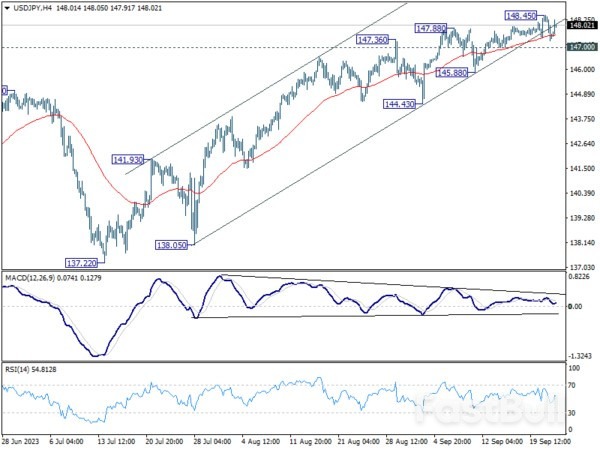
          USD/JPY dipped to 147.31 but quickly recovered. Intraday bias is turned neutral first. For now, further rally is in favor as long as 147.00 support holds. Above 148.45 will resume larger rally from 127.20. Next target is 151.93 high. However, firm break of 147.00 will should confirm short term topping, and turn bias to the downside for 145.88 support and below.Yen Down on Silent BoJ; DOW Stares at Key Support in Week's Finale_2
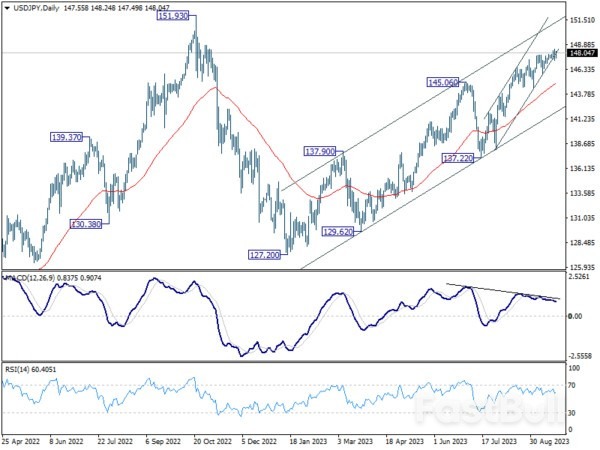
          In the bigger picture, while rise from 127.20 is strong, it could still be seen as the second leg of the corrective pattern from 151.93 (2022 high). Rejection by 151.93, followed by break of 137.22 support will indicate that the third leg of the pattern has started. However, sustained break of 151.93 will confirm resumption of long term up trend.Yen Down on Silent BoJ; DOW Stares at Key Support in Week's Finale_3

          Source: ActionForex

          To stay updated on all economic events of today, please check out our Economic calendar
          Risk Warnings and Disclaimers
          You understand and acknowledge that there is a high degree of risk involved in trading. Following any strategies or investment methods may lead to potential losses. The content on the site is provided by our contributors and analysts for information purposes only. You are solely responsible for determining whether any trading assets, securities, strategy, or any other product is suitable for investing based on your own investment objectives and financial situation.
          Comments
          Add to Favorites
          Share

          Global Market Quick Take: Asia – September 22, 2023

          SAXO

          Economic

          Bond

          Stocks

          Forex

          Commodity

          Market Data

          U.S. Equities

          Rising Treasury yields, which reached new highs since 2007, continued to weigh on stocks. The S&P 500 plunged 1.6% to 4,330, marking a decrease of more than 1.5% in a single day for the first time since April. All sectors declined, with the rate-sensitive real estate sector being hit the hardest. Magacap Tech names dragged down the Nasdaq 100, which tumbled 1.8% to 14,694. Amazon plummeted 4.4%, while Nvidia declined by 2.9%.

          Fixed income

          Yields from the belly (5-year) onward to the long end extended their post-FOMC march higher following the surge in long-end UK Gilts after the Bank of England held rates unchanged across the pond and a surprise drop in the initial jobless claims to 201K, signifying a still-hot U.S. labor market. The USD15 billion 10-year TIPS action registered robust demand. Selling concentrated on the long end, with the 10-year and 30-year yields rising by 9bps to 4.49% and 13bps to 4.57%, respectively, while the 2-year yield ended the session 3bps lower at 5.14%.

          China/HK Equities

          Following the post-FOMC selloff in the U.S. equity market, the Hang Seng Index slid by 1.3% to 17,655, while the Hang Seng Tech Index plunged by 1.9%. Healthcare, materials, and information technology were the top laggards. Alibaba Health tumbled by 4.9%, and XPeng plummeted for the second day, down by 6.9%, after lowering the selling price of the new version of its G9 model. The CSI300 shed 0.9%.

          FX

          Dollar strength continued in the post-Fed reaction, although some of the gains were reversed. High event risk from the Bank of Japan meeting ahead and USD/JPY hit fresh near 11-month highs of 148.46 but fell subsequently to ~147-.50 levels. AUD/USD plummeted from highs of 0.6511 to drop back towards 0.64 amid risk-off although NZD/USD did better and stayed above 0.59 on Q2 GDP surprise. GBP/USD broke below key 1.23 support with BOE holding rates but rebounded to the big figure later. EUR/USD stays below 1.07.

          Commodities

          Crude oil prices remained soft earlier in the session on Fed's higher-for-longer message offsetting concerns of tighter supplies, but Russia's announcement to temporarily ban diesel and gasoline exports brought some gains again. Macro theme continued to be of a risk-off, which is capping the move in oil towards $100 for now. Copper was down over 2% along with declines in other base metals amid risk-off and lack of China stimulus announcements.

          Macro

          • US jobless claims fell to 201k from 221k, the lowest since the end of January, and against expectations for a rise to 225k. The downtrend again suggested that labor market is not cooling too rapid, and raised concerns whether the Fed will have to keep its foot on the pedal.
          • The Bank of England defied market expectations and kept interest rates unchanged with a 5-4 vote split. Instead, the Bank upscaled the rate of quantitative tightening from £80b to £100b per annum to accommodate a larger bond maturity profile next year. A tightening bias was maintained with the MPC repeating the message that "further tightening in monetary policy would be required if there were evidence of more persistent inflationary pressures". Market still expects another rate hike with 70% probability.
          • Among other central bank meetings yesterday, the Swiss National Bank defied wide expectations for a 25bps hike and left its policy rate unchanged, while Sweden and Norway's central banks both hiked the expected 25bps. Brazil's central bank cut rates by the expected 50bps after starting the easing cycle in August and following recent rate cuts by Poland and Chile.
          • Japan's headline August CPI came in firmer-than-expected at 3.2% YoY vs. expected 3.0%, slowing only a notch from prior 3.3% YoY. Inflation ex-fresh food remained unchanged at 3.1% YoY, and also above expectations while the core-core measure (ex-fresh food and energy) held up at 4.3% YoY as expected.

          In the news

          • The China Securities Regulatory Commission (CSRC) has checked with several major brokers about short-selling activities and trading strategies of their quant clients (Reuters)
          • Cisco to Buy Splunk for $28 Billion in Giant AI-Powered Data Bet (Bloomberg)
          • To reduce AI costs, Google wants to ditch Broadcom as its TPU server chip supplier (The Information)
          • Microsoft announced a "unified" AI for its Windows 11 platform and four new Surface devices (Reuters)
          • Senate Republicans are predicting that Speaker Kevin McCarthy (R-Calif.) will need to reach out to House Democrats to get the votes to prevent a government shutdown at the end of next week (The Hill)

          Macro events

          • BoJ Policy Announcement – read full preview here
          • EZ/UK/U.S. Flash PMIs (Sep), UK Retail Sales (Aug), Canadian Retail Sales (Jul)
          To stay updated on all economic events of today, please check out our Economic calendar
          Risk Warnings and Disclaimers
          You understand and acknowledge that there is a high degree of risk involved in trading. Following any strategies or investment methods may lead to potential losses. The content on the site is provided by our contributors and analysts for information purposes only. You are solely responsible for determining whether any trading assets, securities, strategy, or any other product is suitable for investing based on your own investment objectives and financial situation.
          Comments
          Add to Favorites
          Share

          The Bank of Japan Maintained its Loose Stance & Dovish Outlook

          FXCM

          Central Bank

          Economic

          The Bank of Japan maintained its uber-loose stance, which includes interest rates at -0.1%, yield curve control (YCC) and quantitative and qualitative easing (QQE). It also reaffirmed its dovish outlook, saying it will "patiently continue with monetary easing" and will not hesitate to take additional action if necessary, in order to achieve the 2% inflation target "in a sustainable and stable manner".
          Earlier today, CPI ex-fresh food steadied at 3.1% y/y in August and although it has moderated from the recent four-decades peak, it has been printing above the central bank's 2% target for seventeen straight months. The BoJ itself over the summer raised the median inflation projection, to +2.5% for FY2023, from +1.8% previously.
          Having been troubled by decades of deflation, policymakers struggle to create a virtuous price-wage cycle, which makes them hesitant to call it a day. They believe that "sustainable and stable achievement" of the 2% target "has not yet come in sight", requiring the continuation of monetary easing.
          Back in July the central bank took a step towards normalization by loosening its grip on the yield curve control, but that change also allows it to sustain its dovish stance. Earlier this month, Governor Ueda opened the door to an eventual exit from negative rates, saying that officials could have enough data to make that determination by the end of the year. This marked a hawkish shift in rhetoric, but no imminent action was indicated.
          The BoJ's loose monetary setting places it on the opposite side of it major counterparts, especially the U.S. Fed, which has been a great source of strength for USD/JPY. The Fed delivered a hawkish hold on Wednesday, keeping another hike on the table and pointing to a tighter 2024 policy path than previously expected. The latest round of decisions sustains the favorable monetary policy differential.
          To stay updated on all economic events of today, please check out our Economic calendar
          Risk Warnings and Disclaimers
          You understand and acknowledge that there is a high degree of risk involved in trading. Following any strategies or investment methods may lead to potential losses. The content on the site is provided by our contributors and analysts for information purposes only. You are solely responsible for determining whether any trading assets, securities, strategy, or any other product is suitable for investing based on your own investment objectives and financial situation.
          Comments
          Add to Favorites
          Share

          Sizzling Rally in U.S. Energy Stocks Has Room to Run, Bulls Say

          Samantha Luan

          Economic

          Stocks

          Energy

          Contrarian investors were rewarded for betting on the beaten down U.S. energy sector earlier this year with a blazing rally. Some believe a tight oil market and resilient U.S. growth will keep energy stocks rising for the rest of 2023.
          The largest U.S. energy exchange traded fund, the Energy Select Sector SPDR Fund, is up nearly 15% over the last three months and stands near its highest level in nine years.
          The move follows a rally in oil that has taken the price of U.S. West Texas Intermediate crude (WTI) up more than 30% since June on supply concerns from extended production cuts by Saudi Arabia and Russia, as well as unexpected strength in the U.S. economy.
          Bullish investors argue that energy stocks are still cheap by historical standards - and far less richly valued than other areas of the market. The energy sector currently trades at a forward price to earnings ratio of 12.2, well below its historical median forward P/E of 15.3, according to LSEG DataStream. The S&P 500 trades at a forward P/E of 20.
          "Valuations can go up even if the oil price stays static because on a cash flow basis these stocks are very reasonably priced," said Charles Lemonades, head of hedge fund Value Works LLC, who is overweight the sector.
          Energy stocks surged last year as inflation jumped to 40-year highs but landed with a thud at the start of 2023, when expectations of a U.S. recession and oversupply encouraged investors to take profits.
          Both forecasts failed to materialize: economic growth in the U.S. proved far more resilient than many had predicted, despite the Federal Reserve's most aggressive monetary policy tightening in decades.
          Meanwhile, drillers have been taking rigs offline, contributing to what is widely seen as a tight market, while Russia and Saudi Arabia have curtailed production.
          The U.S. rig count is about 16% below where it was this time last year, according to data from U.S. energy services firm Baker Hughes. Overall, U.S. oil output from top shale-producing regions is on track to fall for a third month in a row in October to the lowest level since May, the U.S. Energy Information Administration said.
          Despite recent gains, the S&P 500 energy sector is up only 4.2% year-to-date, compared with a 38% rise in technology stocks and a nearly 45% rise in communication. The broader S&P 500 index is up about 16%.
          "Energy companies have newfound supply discipline" that will keep oil supply constrained, wrote Savita Subramanian, equity and quant strategist at BofA Global Investors, who has an overweight on the sector.
          Citi on Monday became one the latest banks to predict that global benchmark Brent crude could exceed $100 a barrel this year.
          While higher oil prices tend to eventually weigh on demand, that is unlikely to happen until Brent rises to between $110 and $120, said Bjarne Schieldrop, chief commodity analyst at SEB Research.
          At the same time, continued production caps by Russia and Saudi Arabia will keep a floor under oil prices for the time being, he said.
          Parts of the market appear skeptical energy stocks have much further to run.
          Bearish investors point to the sector's earnings, where growth rates are expected to decline by 37% in the third quarter, followed by double-digit declines in both the fourth quarter and the first quarter of 2024, according to LSEG estimates.Sizzling Rally in U.S. Energy Stocks Has Room to Run, Bulls Say_1
          Energy demand could suffer if a rebound in the economy of top commodity consumer China fails to materialize. A 2024 recession in the U.S. - which many strategists still view as a possibility despite growing hopes of a soft landing, could also weigh on oil prices.
          Persistently high oil prices could also lead to worries over a rebound in U.S. inflation, bolstering the case for the Fed to cool economic growth by keeping rates higher for longer.
          "A supply driven increase in oil prices brings the prospect of both a renewal in inflation … and a slowdown in real consumer expenditures," analysts at Macquarie wrote.
          Still, Rodney Clayton, a portfolio manager at Duff & Phelps Investment Management, believes the energy sector's large dividends will attract income-seeking investors - especially if the economy falters and bond yields fall.
          "Companies are building up the trust of investors and are very reluctant to cut those dividends," he said. "That should result in a ... smoother ride for energy stocks than we've been accustomed to."

          Source: Reuters

          To stay updated on all economic events of today, please check out our Economic calendar
          Risk Warnings and Disclaimers
          You understand and acknowledge that there is a high degree of risk involved in trading. Following any strategies or investment methods may lead to potential losses. The content on the site is provided by our contributors and analysts for information purposes only. You are solely responsible for determining whether any trading assets, securities, strategy, or any other product is suitable for investing based on your own investment objectives and financial situation.
          Comments
          Add to Favorites
          Share

          Europe's Currencies Feel Fresh Pain as Central Bank Support Fades

          Devin

          Economic

          Forex

          There's no respite for struggling European currencies as a likely pause in central bank interest-rate rises and a weakening economic outlook puts the focus on prospective rate cuts ahead.
          Sterling slid to a more than six-month low against the dollar on Thursday, even after the Bank of England held rates at a 15-year high and pledged to raise borrowing costs again if it cannot tame inflation.
          The Swiss franc, one of this year's best performing major currencies versus the dollar, fell almost 1% at one point after Switzerland surprised markets by pausing its rate rise cycle.
          Meanwhile, Thursday's quarter-point rate rise in Sweden failed to provide much respite for the battered Scandinavian currency, which is down over 6% against the greenback so far this year.
          In short, the outlook for currencies in Europe is bearish, analysts and investors say, citing a strengthening dollar and stagnant economic growth in European nations as oil prices rise.
          "We are turning to a bigger focus on growth than what central banks do," said Kit Juckes, global head of currency strategy at Societe Generale.

          Europe's Currencies Feel Fresh Pain as Central Bank Support Fades_1Sounding Hawkish

          The BoE offered mixed messages by pledging to stay tough on inflation, still more than triple its 2% target, while noting that economic growth was slowing.
          The European Central Bank last week lifted rates to a record 4% and upgraded its inflation forecast for 2024, but the euro fell and has lost almost 2% against the dollar this month.
          SocGen's Juckes said the euro was "headed for a look at parity," in a reference to the $1 marker.
          The ECB, like the U.S. Federal Reserve, has pushed the idea of rates staying higher for longer. This backdrop should support a currency but in the euro's case, traders are homing in on the region's economic underperformance and betting the ECB will be forced to cut before the Fed.
          Overall, Europe's central banks "would like to portray this idea of higher for longer (rates)," said Ed Hutchings, head of rates at Aviva Investors. But markets, he said, were "getting ahead of this."Europe's Currencies Feel Fresh Pain as Central Bank Support Fades_2
          Sweden's Riksbank raised its key rate by 25 bps to 4% and said it may need to do more to bring inflation lower. The currency, which the central bank labeled "unjustifiably weak," barely caught a break and remains near a record low against the euro.
          Sweden's economy, hurt by turmoil in the real estate market, is expected to contract this year.
          In fact, the only central bank whose hawkish tones have struck a chord with markets is the Fed, which on Wednesday held rates steady but signaled one more rate rise this year.
          The dollar index which measures the U.S. currency against peers, is near its highest in over six months.
          This, said Manulife Investment Management chief investment officer Nathan Thooft, is because "the data suggests the U.S. economy right now is much better than much of Western Europe."
          He expected one the of big European central banks to be the first to cut rates.
          Economists polled by Reuters expect the euro zone economy to grow 0.6% this year, the UK to expand 0.4% and the United States by 2%.
          "As we become more data dependent, currencies swing around with every bit of data that's available," said Bjoern Jesch, global chief investment officer at DWS Group.
          The push and pull in market expectations ahead of rate decisions, as has been the case in Britain and the euro area this month, highlights rising volatility around central bank meetings.
          Nomura expects sterling to weaken to $1.22 by end-October, from $1.23 now; ING economists said the Swedish crown remained "vulnerable."

          Volatility

          Another driver of dollar strength is oil prices, trading near 10-month highs above $90 a barrel.
          "The U.S. is an oil producer so it tends to get hurt very little by higher oil prices whereas Europe and Japan get hit more," said Barclays global head of FX strategy Themos Fiotakis.
          European central banks were "in a bind," Fiotakis added, as higher oil prices also threatened to push inflation higher.
          This made rate cuts bets in Europe seem vulnerable, said Orla Garvey, senior fixed income portfolio manager at Federated Hermes.
          "Growth and inflation data will be more volatile going forward and this in itself will create higher market volatility," she said.

          Source: Reuters

          To stay updated on all economic events of today, please check out our Economic calendar
          Risk Warnings and Disclaimers
          You understand and acknowledge that there is a high degree of risk involved in trading. Following any strategies or investment methods may lead to potential losses. The content on the site is provided by our contributors and analysts for information purposes only. You are solely responsible for determining whether any trading assets, securities, strategy, or any other product is suitable for investing based on your own investment objectives and financial situation.
          Comments
          Add to Favorites
          Share

          Swiss National Bank Shocks Markets with Rate Pause: Swiss Franc Tumbles

          Devin

          Central Bank

          Economic

          SNB's Rate Decision
          The Swiss National Bank has taken the unexpected step of maintaining its policy rate at 1.75%. This decision has caught markets off guard, as the consensus had been leaning toward a 25 basis point interest rate increase. The SNB's rationale for this move is rooted in its assessment that the "significant tightening of monetary policy over recent quarters is countering remaining inflationary pressure."Swiss National Bank Shocks Markets with Rate Pause: Swiss Franc Tumbles_1
          Market Reaction
          The repercussions of the SNB's unanticipated decision were swift and pronounced. Swiss bond yields experienced a sharp decline, and the Swiss Franc's exchange rate suffered notable setbacks. Notable changes include the Pound to Swiss Franc (GBP/CHF) exchange rate surging by 0.45% to 1.1145, the Euro to Swiss Franc (EUR/CHF) appreciating by 0.73% to 0.9651, and the US Dollar to Swiss Franc (USD/CHF) strengthening by 0.78% to 0.9058.
          SNB's Stance
          While the SNB has temporarily suspended its interest rate hikes, it has left the door open for future rate increases. The central bank underscored that additional monetary policy tightening may be necessary to ensure price stability over the medium term. However, the market's interpretation suggests that the SNB is unlikely to pursue further rate hikes in the immediate future.
          Market Expectations
          The unexpected pause in the SNB's rate hikes has prompted a swift adjustment in market expectations. Traders and investors are now reevaluating their assumptions, with a growing belief that the SNB may have concluded its interest rate hiking cycle and may even contemplate future rate cuts.
          SNB Intervention
          The SNB is renowned for its proactive intervention in the foreign exchange market to manage the Swiss Franc's valuation. While the currency may face downward pressure due to the rate decision, the SNB's demonstrated willingness to intervene in the forex market is expected to cap the Franc's depreciation.
          The SNB's surprise rate decision has sent reverberations throughout financial markets, emphasizing the central bank's commitment to balancing its monetary policy against inflationary pressures. The Swiss Franc's trajectory, in particular, will remain a focal point for traders and investors as they assess the SNB's next moves in the ever-evolving global economic landscape.
          To stay updated on all economic events of today, please check out our Economic calendar
          Risk Warnings and Disclaimers
          You understand and acknowledge that there is a high degree of risk involved in trading. Following any strategies or investment methods may lead to potential losses. The content on the site is provided by our contributors and analysts for information purposes only. You are solely responsible for determining whether any trading assets, securities, strategy, or any other product is suitable for investing based on your own investment objectives and financial situation.
          Comments
          Add to Favorites
          Share
          FastBull
          Copyright © 2025 FastBull Ltd

          728 RM B 7/F GEE LOK IND BLDG NO 34 HUNG TO RD KWUN TONG KLN HONG KONG

          TelegramInstagramTwitterfacebooklinkedin
          App Store Google Play Google Play
          Products
          Charts

          Chats

          Q&A with Experts
          Screeners
          Economic Calendar
          Data
          Tools
          Membership
          Features
          Function
          Markets
          Copy Trading
          Latest Signals
          Contests
          News
          Analysis
          24/7
          Columns
          Education
          Company
          Careers
          About Us
          Contact Us
          Advertising
          Help Center
          Feedback
          User Agreement
          Privacy Policy
          Business

          White Label

          Data API

          Web Plug-ins

          Poster Maker

          Affiliate Program

          Risk Disclosure

          The risk of loss in trading financial instruments such as stocks, FX, commodities, futures, bonds, ETFs and crypto can be substantial. You may sustain a total loss of the funds that you deposit with your broker. Therefore, you should carefully consider whether such trading is suitable for you in light of your circumstances and financial resources.

          No decision to invest should be made without thoroughly conducting due diligence by yourself or consulting with your financial advisors. Our web content might not suit you since we don't know your financial conditions and investment needs. Our financial information might have latency or contain inaccuracy, so you should be fully responsible for any of your trading and investment decisions. The company will not be responsible for your capital loss.

          Without getting permission from the website, you are not allowed to copy the website's graphics, texts, or trademarks. Intellectual property rights in the content or data incorporated into this website belong to its providers and exchange merchants.

          Not Logged In

          Log in to access more features

          FastBull Membership

          Not yet

          Purchase

          Become a signal provider
          Help Center
          Customer Service
          Dark Mode
          Price Up/Down Colors

          Log In

          Sign Up

          Position
          Layout
          Fullscreen
          Default to Chart
          The chart page opens by default when you visit fastbull.com