Markets
News
Analysis
User
24/7
Economic Calendar
Education
Data
- Names
- Latest
- Prev


Signal Accounts for Members
All Signal Accounts
All Contests


U.K. Input PPI MoM (Not SA) (Dec)A:--
F: --
U.K. Core CPI MoM (Dec)A:--
F: --
P: --
U.K. Retail Prices Index MoM (Dec)A:--
F: --
P: --
U.K. Input PPI YoY (Not SA) (Dec)A:--
F: --
P: --
U.K. CPI YoY (Dec)A:--
F: --
P: --
U.K. Output PPI MoM (Not SA) (Dec)A:--
F: --
P: --
U.K. Output PPI YoY (Not SA) (Dec)A:--
F: --
P: --
U.K. Core Retail Prices Index YoY (Dec)A:--
F: --
P: --
U.K. Core CPI YoY (Dec)A:--
F: --
P: --
U.K. Retail Prices Index YoY (Dec)A:--
F: --
P: --
Indonesia 7-Day Reverse Repo RateA:--
F: --
P: --
Indonesia Loan Growth YoY (Dec)A:--
F: --
P: --
Indonesia Deposit Facility Rate (Jan)A:--
F: --
P: --
Indonesia Lending Facility Rate (Jan)A:--
F: --
P: --
South Africa Core CPI YoY (Dec)A:--
F: --
P: --
South Africa CPI YoY (Dec)A:--
F: --
P: --
IEA Oil Market Report
U.K. CBI Industrial Output Expectations (Jan)A:--
F: --
U.K. CBI Industrial Prices Expectations (Jan)A:--
F: --
P: --
South Africa Retail Sales YoY (Nov)A:--
F: --
P: --
U.K. CBI Industrial Trends - Orders (Jan)A:--
F: --
P: --
Mexico Retail Sales MoM (Nov)A:--
F: --
P: --
U.S. MBA Mortgage Application Activity Index WoWA:--
F: --
P: --
Canada Industrial Product Price Index YoY (Dec)A:--
F: --
Canada Industrial Product Price Index MoM (Dec)A:--
F: --
U.S. Weekly Redbook Index YoYA:--
F: --
P: --
U.S. Pending Home Sales Index YoY (Dec)A:--
F: --
P: --
U.S. Pending Home Sales Index MoM (SA) (Dec)A:--
F: --
P: --
U.S. Construction Spending MoM (Oct)A:--
F: --
U.S. Pending Home Sales Index (Dec)A:--
F: --
P: --
U.S. API Weekly Refined Oil Stocks--
F: --
P: --
U.S. API Weekly Gasoline Stocks--
F: --
P: --
U.S. API Weekly Cushing Crude Oil Stocks--
F: --
P: --
U.S. API Weekly Crude Oil Stocks--
F: --
P: --
South Korea GDP Prelim YoY (SA) (Q4)--
F: --
P: --
South Korea GDP Prelim QoQ (SA) (Q4)--
F: --
P: --
Japan Imports YoY (Dec)--
F: --
P: --
Japan Exports YoY (Dec)--
F: --
P: --
Japan Goods Trade Balance (SA) (Dec)--
F: --
P: --
Japan Trade Balance (Not SA) (Dec)--
F: --
Australia Employment (Dec)--
F: --
P: --
Australia Labor Force Participation Rate (SA) (Dec)--
F: --
P: --
Australia Unemployment Rate (SA) (Dec)--
F: --
P: --
Australia Full-time Employment (SA) (Dec)--
F: --
P: --
Turkey Consumer Confidence Index (Jan)--
F: --
P: --
Turkey Capacity Utilization (Jan)--
F: --
P: --
Turkey Late Liquidity Window Rate (LON) (Jan)--
F: --
P: --
Turkey Overnight Lending Rate (O/N) (Jan)--
F: --
P: --
Turkey 1-Week Repo Rate--
F: --
P: --
U.K. CBI Distributive Trades (Jan)--
F: --
P: --
U.K. CBI Retail Sales Expectations Index (Jan)--
F: --
P: --
U.S. Weekly Continued Jobless Claims (SA)--
F: --
P: --
U.S. Initial Jobless Claims 4-Week Avg. (SA)--
F: --
P: --
U.S. Real Personal Consumption Expenditures Final QoQ (Q3)--
F: --
P: --
Canada New Housing Price Index MoM (Dec)--
F: --
P: --
U.S. Weekly Initial Jobless Claims (SA)--
F: --
P: --
U.S. Real GDP Annualized QoQ Final (Q3)--
F: --
P: --
U.S. PCE Price Index Final QoQ (AR) (Q3)--
F: --
P: --
U.S. Personal Outlays MoM (SA) (Nov)--
F: --
P: --
U.S. Core PCE Price Index YoY (Nov)--
F: --
P: --


No matching data
Latest Views
Latest Views
Trending Topics
Top Columnists
Latest Update
White Label
Data API
Web Plug-ins
Affiliate Program
View All

No data
The IEA projects a deep oil surplus by early 2026, driven by soaring production that masks geopolitical risks and rising prices.
The global oil market is on track for a deep surplus of 4.25 million barrels per day (bpd) in the first quarter of 2026, according to the International Energy Agency (IEA). In its latest monthly report, the agency that advises industrialized nations highlighted that a glut of supply is currently offsetting geopolitical risks that would typically drive prices higher.
This projected surplus represents about 4% of total world demand and is larger than many other market predictions. Despite the oversupply forecast, oil prices have risen approximately 6% since the beginning of the year, with global benchmark Brent trading at $65.02 as of Wednesday morning.
Recent events have injected significant uncertainty into the market, though their impact has so far been muted by the sheer volume of available oil. Key geopolitical flashpoints include:
• Venezuela: The capture of President Nicolas Maduro by the U.S. at the start of the month has disrupted the country's short-term supplies. The U.S. has called for investment to boost Venezuelan production, but the immediate effect has been a reduction in exports. The IEA noted the U.S. blockade on Venezuelan shipments lowered exports by 580,000 bpd from December to early January.
• Iran: The prospect of reduced supplies has been heightened by threats of potential U.S. military strikes.
• Kazakhstan: The country's output has been curtailed by drone attacks and technical problems.
Despite these disruptions, the IEA stated that "bloated balances provide some comfort to market participants and have kept prices in check." The agency concluded that barring any major new supply disruptions, "a significant surplus is likely to re-emerge in the first quarter of 2026."
The growing imbalance between supply and demand is primarily driven by production increases from OPEC+ (the Organization of the Petroleum Exporting Countries and its allies, including Russia), which began boosting output in April 2025 after a long period of cuts.
However, OPEC+ is not the only source of new supply. Producers outside the alliance, including the United States, Guyana, and Brazil, have also ramped up their production. In response to the growing surplus, OPEC+ has paused its output hikes for the first quarter of 2026.
Looking at the full year, the IEA revised its forecast for global supply growth higher, now expecting an increase of 2.5 million bpd, up from its December estimate of 2.4 million bpd. The agency projects that 52% of this growth will come from countries outside the OPEC+ group.
While supply is surging, the IEA has also adjusted its demand-side projections. The agency now sees global oil demand growing by 930,000 bpd, an upward revision of 70,000 bpd from its previous report. This adjustment is attributed to a normalization of economic conditions following last year's tariff turmoil and oil prices that are lower than a year ago.
Even with the stronger demand forecast, the IEA's figures still point to an implied market surplus of 3.69 million bpd for the full year.
This outlook contrasts with that of OPEC, which expects faster demand growth of 1.38 million bpd this year. Based on OPEC's data, the market is projected to be nearly balanced in 2026, rather than facing a significant surplus.
The surplus is expected to be particularly acute in the first quarter due to seasonal factors. Global oil refineries are scheduled to conduct planned maintenance shutdowns during this period, which temporarily reduces their demand for crude oil.
"With seasonal refinery maintenance about to commence, reducing demand for crude, further reductions in crude production will be needed," the Paris-based IEA warned. This seasonal dip in demand is set to amplify the effects of the already high production levels, further contributing to the projected glut.
A sudden selloff in long-dated Japanese government bonds rattled global markets this week, creating a ripple effect that briefly spooked U.S. Treasuries and exposed growing strains in sovereign debt.
The turmoil began on Wednesday, January 21, when yields on 30-year and 40-year Japanese government bonds (JGBs) surged by more than 25 basis points in a single session. Market participants described the dramatic move as a six-standard-deviation event, highlighting its extreme rarity and severity.
This volatility didn't stay contained. It quickly spilled across borders, pushing the U.S. 10-year Treasury yield to its highest level since August as investors were forced to reassess risk in government bond markets worldwide.
The pressure on JGBs stems from a mix of domestic factors that are challenging investor confidence after years of ultra-loose monetary policy. Key drivers include:
• Rising Interest Rates: Japan is facing the prospect of higher domestic interest rates.
• Political Uncertainty: Election-related risks are contributing to market anxiety.
• Central Bank Policy: There are growing expectations that the Bank of Japan may have to deploy unconventional bond-buying measures.
These persistent issues suggest that simple verbal interventions from policymakers may not be enough to calm the market and prevent further volatility.
According to an analyst from Bitfinex, this episode was more than just a market tremor. It functioned as a liquidity shock that effectively put the credibility of global financial policy to a stress test.
For cryptocurrency markets, the event carries both immediate and long-term implications. In the short term, widespread stress across bonds and other risk assets tends to dampen enthusiasm for speculative investments, potentially limiting price gains for digital assets.
While the immediate outlook may be challenging, repeated disruptions in traditional safe-haven assets like government bonds could bolster the long-term investment case for Bitcoin.
As concerns mount over political influence on monetary policy and the overall stability of sovereign debt, investors may increasingly turn to non-sovereign alternatives like Bitcoin. If interest rate instability and currency pressures continue to plague the global financial system, crypto assets could see their strategic role in diversified portfolios re-evaluated, especially as confidence in conventional "risk-free" assets is repeatedly called into question.
President Donald Trump announced he expects to sign new cryptocurrency market structure legislation "very soon," positioning the initiative as a key move to prevent China from dominating the digital asset sector.
Speaking at the World Economic Forum, Trump confirmed that Congress is developing a new bill for crypto and Bitcoin, building on the GENIUS Act passed last year.
Trump argued that the upcoming legislation is crucial for national strategy, not just ideology. He stated the bill would "unlock new pathways for Americans to reach financial freedom" while securing U.S. leadership in the crypto space.
According to Trump, allowing China to capture emerging technology markets would make it incredibly difficult for the United States to regain its competitive footing. He also noted a shift in domestic politics, claiming that voter pushback against the Biden administration's previous stance on crypto has made the issue politically popular.
Trump tied the push for crypto regulation to what he described as a strong economic performance since his return to office. He presented several key economic indicators to support this claim:
• Inflation: Core inflation over the last three months was 1.6%.
• GDP Growth: The economy is projected to grow at a rate of 5.4% in the fourth quarter.
• Stock Market: U.S. markets have hit 52 all-time highs since the election, adding approximately $9 trillion to savings and retirement accounts.
• Social Programs: Over 1.2 million people have transitioned off food assistance programs.
• Investment: The administration has secured commitments for $18 trillion in new investment, with the final amount potentially reaching $20 trillion.
He contrasted these figures with the less than $1 trillion in investment commitments made during the previous four years, declaring the U.S. economy "the hottest country anywhere in the world."
In his remarks, Trump also addressed foreign policy, emphasizing that he does not plan to use military force to achieve U.S. objectives. He asserted that American strength serves as its own deterrent, negating the need for escalating conflicts.
He raised questions about the NATO alliance, expressing doubt that member nations would support the U.S. in a crisis despite America's defense commitments. Citing recent tensions over Greenland that caused minor market volatility, Trump described his approach as transactional, insisting that U.S. security guarantees must be met with reciprocal support from allies. He argued that the United States has shouldered an unfair share of the costs without certainty of equal backing in return.
Trump concluded by framing America's economic expansion as a benefit to the entire world, calling the United States the "economic engine of the planet." He noted that current growth projections have already surpassed earlier estimates from the International Monetary Fund and suggested his trade and tariff policies could accelerate that growth even further.
Speaking at the Davos Economic Forum on Wednesday, U.S. President Donald Trump said he is open to negotiations for the United States to acquire Greenland but appeared to rule out using military force.
"I don't want to use force," Trump said during a speech in Switzerland. "I won't use force."
His remarks follow a day of unease in financial markets, where U.S. stocks fell on Tuesday over concerns that his threats to annex Greenland and impose tariffs on European nations opposing the plan could trigger a trade war with the EU.
Despite backing away from a military threat, Trump made it clear he intends to take over the Danish territory. He called for "immediate negotiations" and issued a thinly veiled warning.
"You can say 'yes' and we will be very appreciative, or you can say 'no' and we will remember," he stated.
Trump dismissed alternative arrangements, insisting that a lease would be insufficient. He argued that full ownership is necessary for defense purposes.
"All we're asking for is to get Greenland, including right title and ownership, because you need the ownership to defend it," Trump said. "You can't defend it on a lease. No. 1, legally, it's not defensible that way, totally. And, No. 2, psychologically, who the hell wants to defend a license agreement or a lease?"
Trump defended the controversial proposal by citing previous U.S. expansion in North America and historical European colonialism, stating, "There's nothing wrong with it." He also argued that the U.S. took control of Greenland during World War II to protect it from Nazi Germany and that it was "stupid" to have returned it to Denmark.
While his administration has previously cited Greenland's rare earths and "critical minerals" as a reason for the bid, Trump seemed to downplay their importance. "To get to this rare earth, you got to go through hundreds of feet of ice," he said. "That's not the reason we need it."
During his speech, Trump referred to Greenland as a "piece of ice" and repeatedly misidentified it as "Iceland."
The address also included familiar themes from the president, who praised his own accomplishments while criticizing allies. He targeted European energy policies for not allowing oil exploration in the North Sea and for building "windmills all over Europe." He also praised China for not having "a single windmill," an inaccurate claim given China's massive investment in wind and solar energy.
Trump also had sharp words for Canada's prime minister, Mark Carney, who had suggested on Tuesday that economies should diversify away from a reliance on the U.S.
"Canada should be grateful to us," Trump said. "Canada lives because of the United States. Remember that, Mark, the next time you make your statements."
Despite framing the Greenland plan as a counter to Moscow and Beijing, Trump expressed respect for Russian President Vladimir Putin and Chinese President Xi Jinping. He also commented on Ukraine, stating that U.S. efforts to end the war are progressing and that he plans to meet with Ukrainian President Volodymyr Zelenskiy on Thursday.
"And I'm dealing with President Putin, and he wants to make a deal," Trump said, adding, "I can say that we're reasonably close." According to the Kremlin, Trump's envoy Steve Witkoff is scheduled to meet with Putin in Moscow on Thursday.
Trump projected an optimistic future for Venezuela, claiming a U.S. military operation to remove leader Nicolas Maduro would transform the country into a booming oil producer. He asserted that "every major oil company is coming in with us."
However, this view was not universally shared at Davos. While Chevron, Spain's Repsol, and Italy's Eni indicated they could expand their existing Venezuelan operations, ExxonMobil CEO Darren Woods described the country's business and legal environment as "uninvestible."
The White House also noted that Trump could meet with Venezuelan interim president Delcy Rodriguez on the sidelines of the forum.
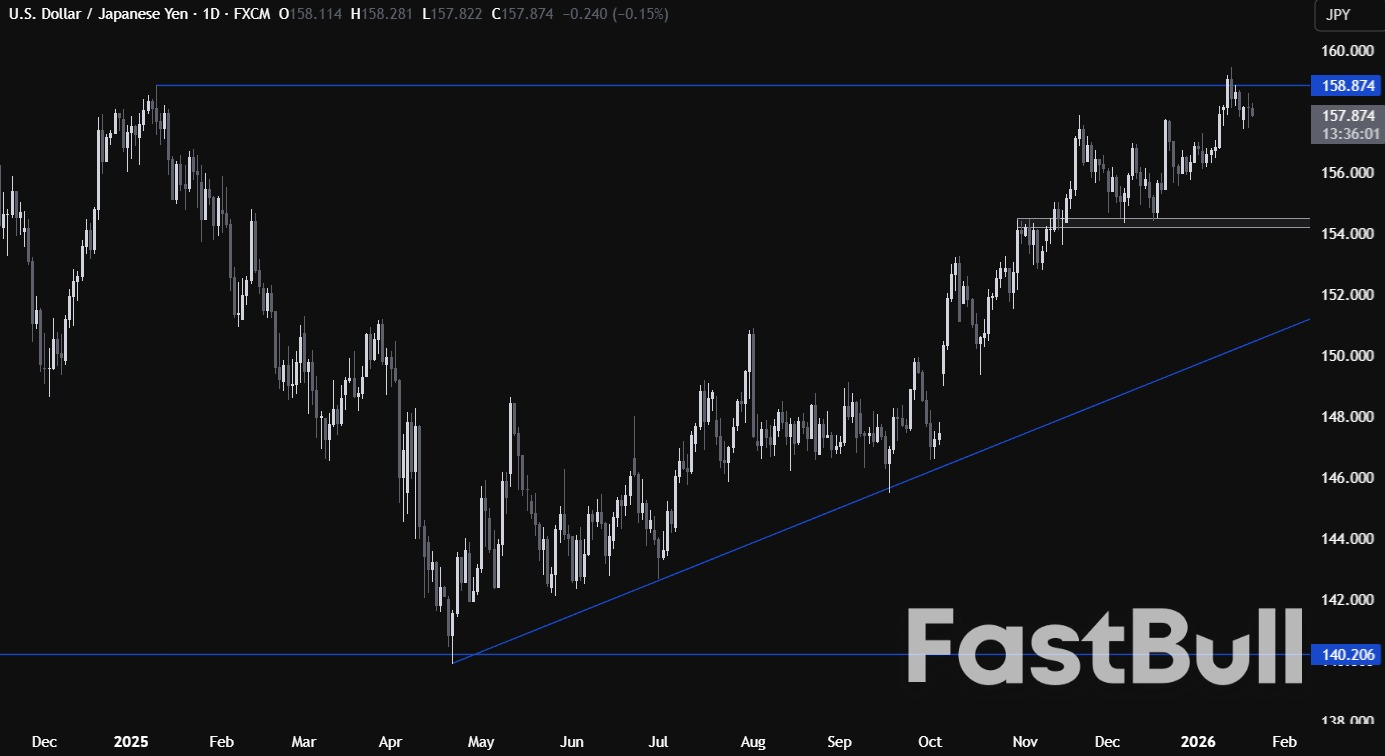
USDJPY - daily
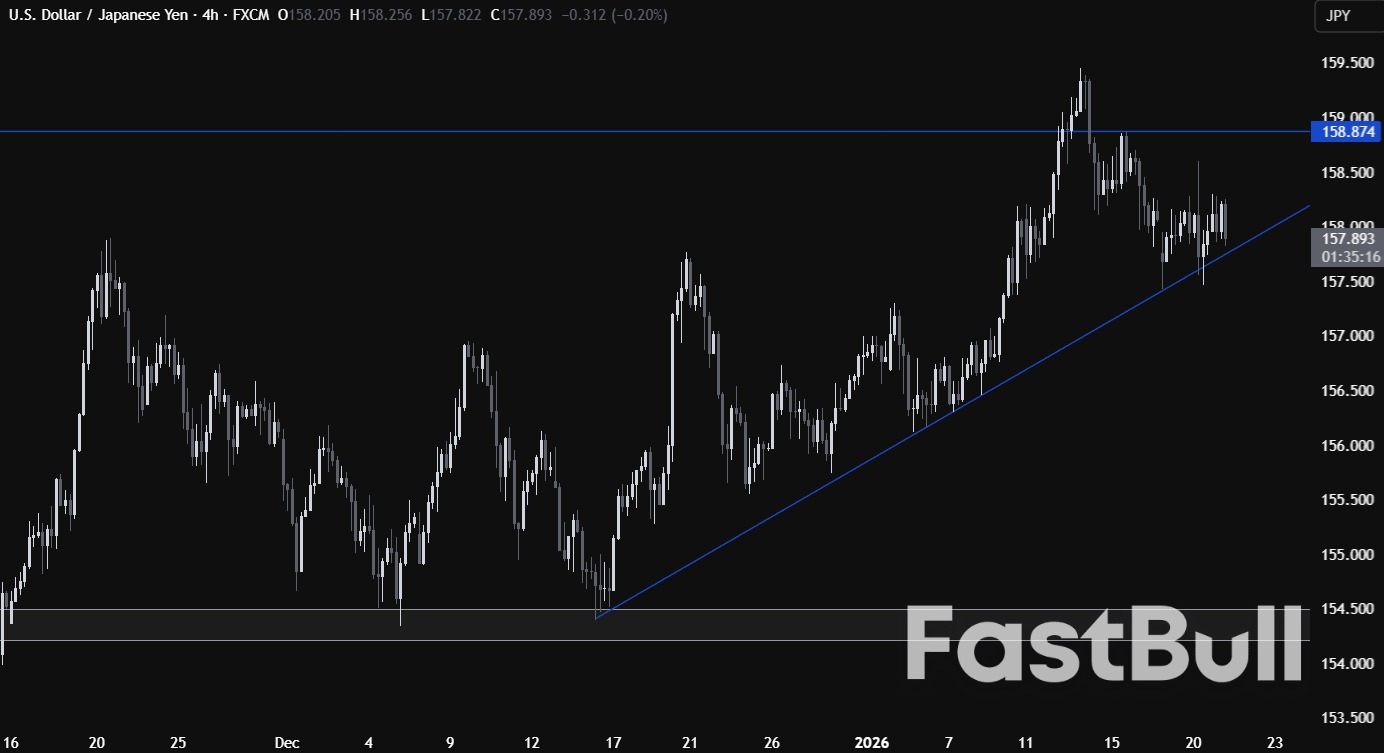
USDJPY - 4 hour
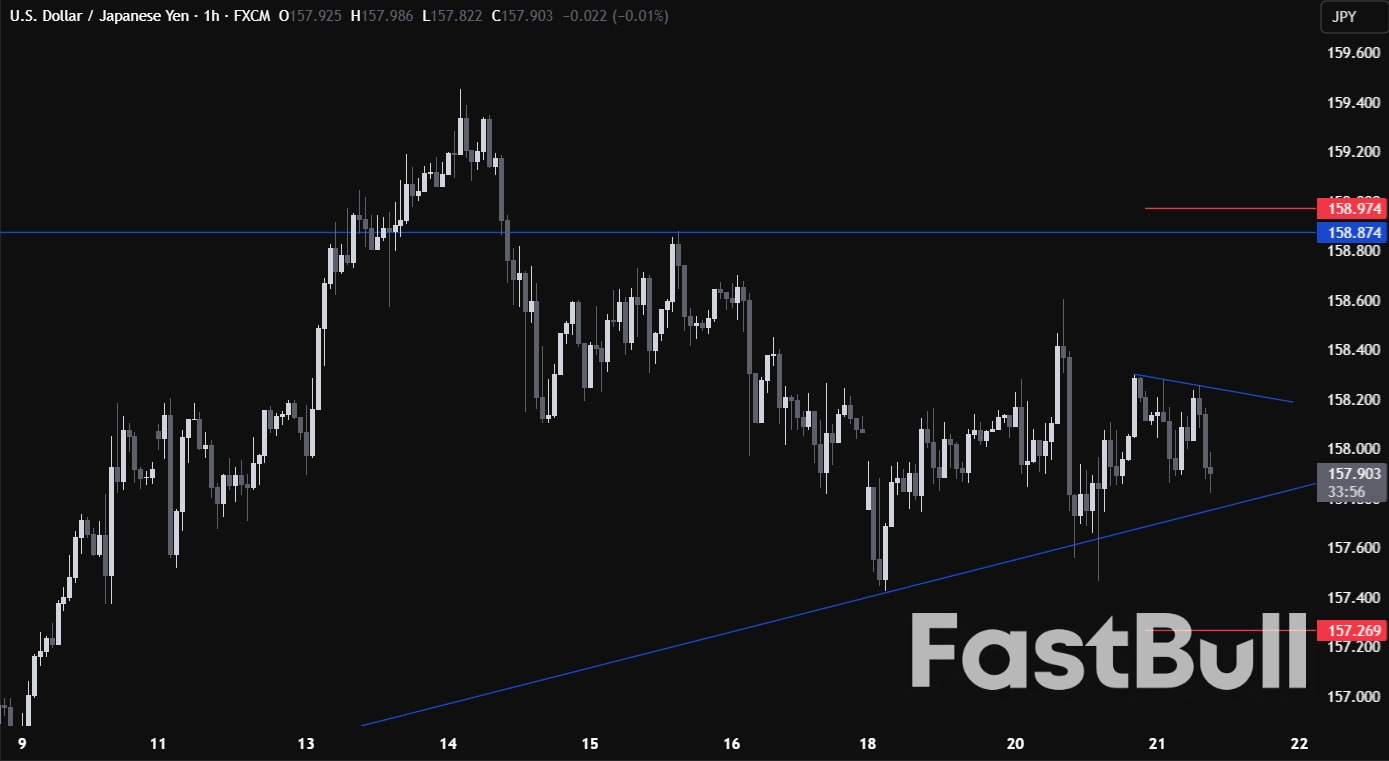
USDJPY - 1 hourLong-dated German bond yields climbed for a fourth consecutive session on Wednesday as investors grappled with a turbulent global environment. The market is currently processing the aftershocks of a major selloff in Japanese debt while keeping a close eye on an unpredictable geopolitical landscape.
Germany’s 30-year bond yield rose nearly 3 basis points to 3.51%, marking a 10 basis point increase for the week. If this trend holds, it would represent the largest weekly jump since early December. The benchmark 10-year German yield also edged higher, rising almost 2 basis points to 2.88%.
A primary catalyst for the market movement was a sharp selloff in Japanese government bonds (JGBs) on Tuesday, which recorded the largest single-day yield spike since 2003. The turbulence quickly spread to international debt markets, pushing eurozone yields higher.
While Japanese markets stabilized on Wednesday, with bond yields there falling sharply, the initial shock continued to influence European sentiment. "I think the market is digesting a little bit what happened in Japan," said Anne Beaudu, a global fixed income portfolio manager at Amundi. Tim Graf, head of macro strategy for EMEA at State Street Markets, noted that the JGB market is "starting to find some equilibrium."
Rising long-term bond yields often signal increased uncertainty or expectations of future government borrowing, as investors demand a higher risk premium to hold the debt. Following significant selloffs, some investors also see an opportunity to purchase bonds they believe will recover in value.
Alongside market-specific events, geopolitics has become a dominant theme for investors. "Since the beginning of the year, it's very much about geopolitics," Beaudu explained, referencing the external policies of U.S. President Donald Trump and their implications for Europe.
Headlines from the World Economic Forum in Davos, Switzerland, have fueled this uncertainty. President Trump's wide-ranging speech, which included remarks ruling out the use of force to control Greenland, largely failed to calm eurozone bond markets.
The standoff over Greenland has had tangible consequences. In response to Trump's demands and tariff threats, the European Parliament decided on Wednesday to suspend its work on the European Union's trade deal with the United States. Graf of State Street Markets identified this standoff as a factor that "added to market pressure" triggered by the JGB moves.
Despite the volatility in secondary markets, the primary market for new eurozone government bonds has remained robust. A busy period of issuance from several countries has been met with solid demand.
"There has been a lot of issuance since the beginning of the year. It's continuing. It has been very well absorbed by the market and I don't see any sign of stress on this today," Beaudu commented.
This resilience was evident in Germany's latest auction of 30-year bonds on Wednesday. The sale secured an average yield of 3.49%, slightly higher than the 3.45% from an earlier sale this month. However, demand increased, with the bid-to-cover ratio climbing to 2.4 from a previous 2.1.
In other parts of the eurozone, shorter-dated yields were stable, with Germany's two-year yield holding flat at 2.08%. France's 10-year yield also remained steady at 3.53% after concerns over the country's domestic budget eased earlier in the week.
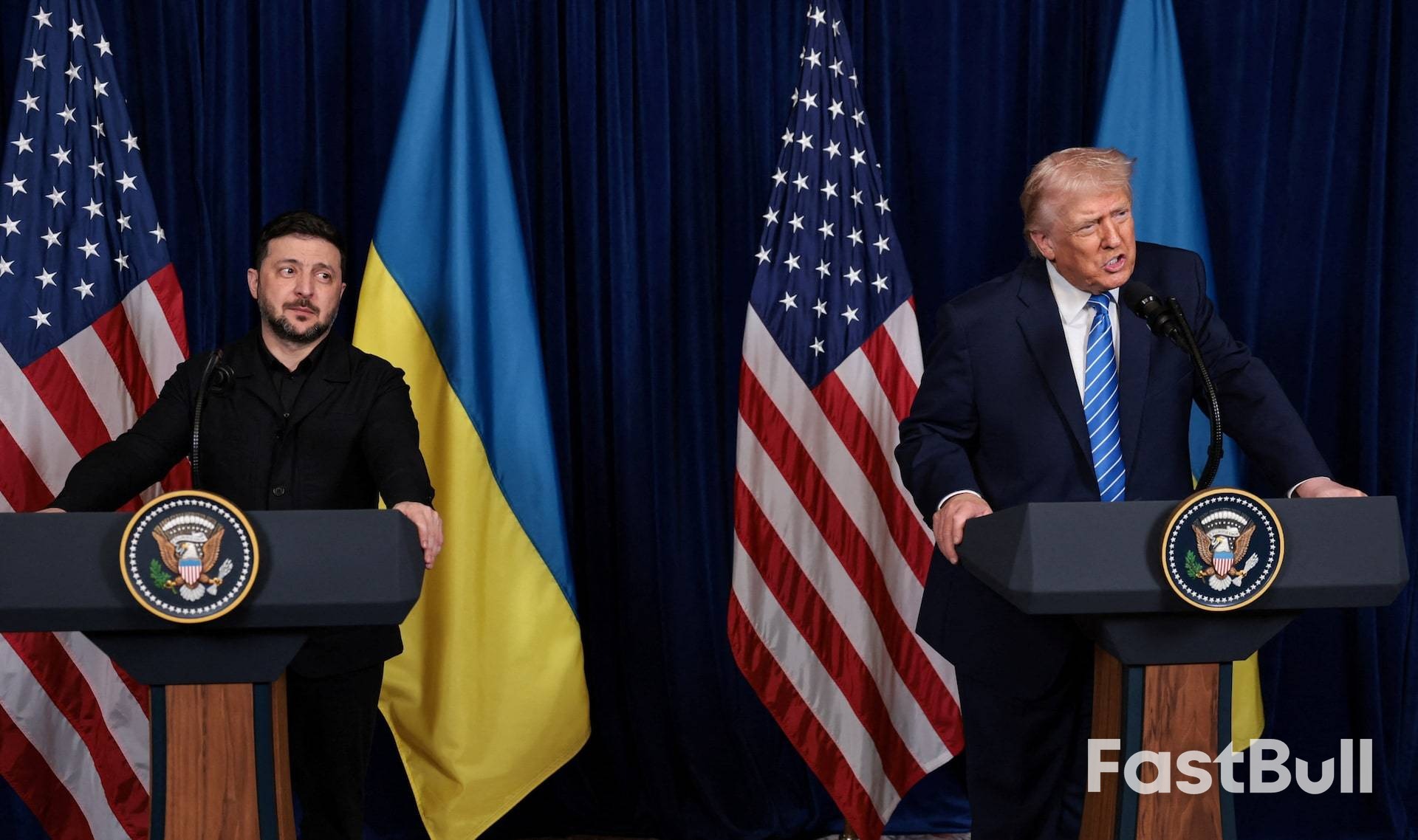
Speaking in Davos, Switzerland, U.S. President Donald Trump announced on Wednesday that a peace deal to end the war in Ukraine could be imminent. He stated that both Ukrainian President Volodymyr Zelenskiy and Russian President Vladimir Putin are now positioned to reach an agreement.

Trump asserted that he is actively dealing with Putin, who he said is keen to make a deal. He added his belief that Zelenskiy is also prepared to finalize an agreement to conclude the conflict, which is approaching its fourth year.
During a discussion following his formal remarks to global leaders and business executives, Trump expressed confidence that a deal was now "reasonably close," despite previous setbacks where both leaders had backed away from potential agreements.
"I think I can say that we're reasonably close," Trump said, emphasizing the urgency of ending the conflict. "We have to get it stopped."
Trump's comments come as Ukraine prepares to mark the fourth anniversary of Russia's full-scale invasion on February 24.
President Trump also stated he would meet with President Zelenskiy in Switzerland. He initially mentioned the meeting was scheduled for Wednesday, a detail that was disputed by a source familiar with Zelenskiy's agenda. Trump later clarified that the meeting was planned for Thursday.
This new optimism follows a period of frustration for the U.S. President, who said he had expected to negotiate an end to the war sooner but cited "abnormal hatred" between the two leaders as a major obstacle. Just last week, Trump had told Reuters that he viewed Zelenskiy as the primary impediment to reaching a peace accord.
On Wednesday, however, Trump’s tone shifted, suggesting Washington was making progress in brokering a ceasefire.
"I believe they're at a point now where they can come together and get a deal done," he concluded. "And if they don't, they're stupid."
White Label
Data API
Web Plug-ins
Poster Maker
Affiliate Program
The risk of loss in trading financial instruments such as stocks, FX, commodities, futures, bonds, ETFs and crypto can be substantial. You may sustain a total loss of the funds that you deposit with your broker. Therefore, you should carefully consider whether such trading is suitable for you in light of your circumstances and financial resources.
No decision to invest should be made without thoroughly conducting due diligence by yourself or consulting with your financial advisors. Our web content might not suit you since we don't know your financial conditions and investment needs. Our financial information might have latency or contain inaccuracy, so you should be fully responsible for any of your trading and investment decisions. The company will not be responsible for your capital loss.
Without getting permission from the website, you are not allowed to copy the website's graphics, texts, or trademarks. Intellectual property rights in the content or data incorporated into this website belong to its providers and exchange merchants.
Not Logged In
Log in to access more features

FastBull Membership
Not yet
Purchase
Log In
Sign Up