• Trade
  • Markets
  • Copy
  • Contests
  • News
  • 24/7
  • Calendar
  • Q&A
  • Chats
Trending
Screeners
SYMBOL
LAST
BID
ASK
HIGH
LOW
NET CHG.
%CHG.
SPREAD
SPX
S&P 500 Index
6895.11
6895.11
6895.11
6941.31
6885.75
-68.63
-0.99%
--
DJI
Dow Jones Industrial Average
48951.44
48951.44
48951.44
49195.10
48851.98
-240.54
-0.49%
--
IXIC
NASDAQ Composite Index
23351.03
23351.03
23351.03
23590.19
23314.51
-358.83
-1.51%
--
USDX
US Dollar Index
98.810
98.890
98.810
98.990
98.670
-0.110
-0.11%
--
EURUSD
Euro / US Dollar
1.16452
1.16459
1.16452
1.16614
1.16359
+0.00033
+ 0.03%
--
GBPUSD
Pound Sterling / US Dollar
1.34305
1.34315
1.34305
1.34637
1.34190
+0.00098
+ 0.07%
--
XAUUSD
Gold / US Dollar
4621.04
4621.45
4621.04
4641.84
4588.51
+34.94
+ 0.76%
--
WTI
Light Sweet Crude Oil
61.554
61.584
61.554
61.822
60.145
+0.698
+ 1.15%
--

Community Accounts

Signal Accounts
--
Profit Accounts
--
Loss Accounts
--
View More

Become a signal provider

Sell trading signals to earn additional income

View More

Guide to Copy Trading

Get started with ease and confidence

View More

Signal Accounts for Members

All Signal Accounts

Best Return
  • Best Return
  • Best P/L
  • Best MDD
Past 1W
  • Past 1W
  • Past 1M
  • Past 1Y

All Contests

  • All
  • Trump Updates
  • Recommend
  • Stocks
  • Cryptocurrencies
  • Central Banks
  • Featured News
Top News Only
Share

Source: UK Withdraws Some Personnel From Qatar Air Base

Share

Minneapolis Fed President Kashkari: I'M Confident Fed Officials Will Continue To Make The Best Decisions They Can

Share

Minneapolis Fed President Kashkari: We All Believe An Independent Central Bank Makes The Best Policy

Share

Ukraine President Zelenskiy To Declare State Of Emergency For Energy After Russian Attac

Share

Minneapolis Fed President Kashkari: Inflation Has Been Main Driver Thus Far Of Financial Distress

Share

Minneapolis Fed President Kashkari: Hasn't Seen Anything Very Alarming In Consumer Borrowing Yet

Share

Minneapolis Fed President Kashkari: Households Have Pretty Good Balance Sheets

Share

Norway Sending Two Military Staffers To Greenland, Daily Vg And News Agency Ntb Report, Citing Defence Minister

Share

Minneapolis Fed President Kashkari: Crypto 'Basically Useless' For Consumers

Share

Source: Ukraine Accuses Former Prime Minister Tymoshenko Of Bribery

Share

Minneapolis Fed President Kashkari: Most Business A.I. Use Now Experimental, Not Yet Leading To Layoffs

Share

Minneapolis Fed President Kashkari: It Will Take A Few More Months For Government Data To Recover From Shutdown Impact

Share

Ukraine President Zelenskiy: Ukraine Will Significantly Increase Volume Of Electricity Imports

Share

Minneapolis Fed President Kashkari: Not Sure What Current Break Even Rate Is For Job Market

Share

Minneapolis Fed President Kashkari: Consistently Hears From Businesses About Desire For Legal Immigration

Share

Minneapolis Fed President Kashkari: Fed Really Needs To Monitor Both Sides Of Its Mandates

Share

Minneapolis Fed President Kashkari: Welcomes Recent Decline In Unemployment Rate

Share

Minneapolis Fed President Kashkari: Fed's Job And Inflation Goals Are In Tension

Share

Minneapolis Fed President Kashkari: Declines Comment On Trump Administration Buying Mortgage Bonds

Share

Minneapolis Fed President Kashkari: Biggest Barrier To Housing Market Is Supply

TIME
ACT
FCST
PREV
U.K. 10-Year Note Auction Yield

A:--

F: --

P: --

Canada Leading Index MoM (Dec)

A:--

F: --

P: --
U.S. MBA Mortgage Application Activity Index WoW

A:--

F: --

P: --

U.S. PPI YoY (Excl. Food, Energy & Trade) (Oct)

A:--

F: --

P: --
U.S. PPI MoM Final (Excl. Food, Energy and Trade) (SA) (Oct)

A:--

F: --

P: --
U.S. Core PPI YoY (Nov)

A:--

F: --

P: --
U.S. PPI MoM (SA) (Nov)

A:--

F: --

P: --
U.S. PPI YoY (Nov)

A:--

F: --

P: --
U.S. Current Account (Q3)

A:--

F: --

P: --
U.S. Retail Sales YoY (Nov)

A:--

F: --

P: --

U.S. Retail Sales (Nov)

A:--

F: --

P: --

U.S. Core Retail Sales MoM (Nov)

A:--

F: --

P: --
U.S. Retail Sales MoM (Excl. Automobile) (SA) (Nov)

A:--

F: --

P: --
U.S. Core Retail Sales (Nov)

A:--

F: --

P: --

U.S. Retail Sales MoM (Excl. Gas Stations & Vehicle Dealers) (SA) (Nov)

A:--

F: --

P: --
U.S. Retail Sales MoM (Nov)

A:--

F: --

P: --
U.S. Core PPI MoM (SA) (Nov)

A:--

F: --

P: --
Philadelphia Fed President Henry Paulson delivers a speech
U.S. Commercial Inventory MoM (Oct)

A:--

F: --

P: --
U.S. Existing Home Sales Annualized Total (Dec)

A:--

F: --

P: --
U.S. Existing Home Sales Annualized MoM (Dec)

A:--

F: --

P: --
U.S. EIA Weekly Cushing, Oklahoma Crude Oil Stocks Change

A:--

F: --

P: --

U.S. EIA Weekly Crude Stocks Change

A:--

F: --

P: --

U.S. EIA Weekly Gasoline Stocks Change

A:--

F: --

P: --

U.S. EIA Weekly Crude Demand Projected by Production

A:--

F: --

P: --

U.S. EIA Weekly Crude Oil Imports Changes

A:--

F: --

P: --

U.S. EIA Weekly Heating Oil Stock Changes

A:--

F: --

P: --

U.S. Refinitiv/Ipsos Primary Consumer Sentiment Index (PCSI) (Jan)

A:--

F: --

P: --

China, Mainland M2 Money Supply YoY (Dec)

--

F: --

P: --

China, Mainland M0 Money Supply YoY (Dec)

--

F: --

P: --

China, Mainland M1 Money Supply YoY (Dec)

--

F: --

P: --

Japan Domestic Enterprise Commodity Price Index YoY (Dec)

--

F: --

P: --

Japan Domestic Enterprise Commodity Price Index MoM (Dec)

--

F: --

P: --

Japan PPI MoM (Dec)

--

F: --

P: --

Australia Consumer Inflation Expectations (Jan)

--

F: --

P: --

U.K. 3-Month RICS House Price Balance (Dec)

--

F: --

P: --

South Korea Benchmark Interest Rate

--

F: --

P: --

Saudi Arabia CPI YoY (Dec)

--

F: --

P: --

U.K. Services Index MoM (SA) (Nov)

--

F: --

P: --

U.K. Services Index YoY (Nov)

--

F: --

P: --

U.K. Manufacturing Output MoM (Nov)

--

F: --

P: --

U.K. Trade Balance (Nov)

--

F: --

P: --

U.K. Monthly GDP 3M/3M Change (Nov)

--

F: --

P: --

U.K. GDP MoM (Nov)

--

F: --

P: --

U.K. Industrial Output MoM (Nov)

--

F: --

P: --

U.K. Trade Balance Non-EU (SA) (Nov)

--

F: --

P: --

U.K. Trade Balance (SA) (Nov)

--

F: --

P: --

U.K. Manufacturing Output YoY (Nov)

--

F: --

P: --

U.K. Construction Output MoM (SA) (Nov)

--

F: --

P: --

U.K. Industrial Output YoY (Nov)

--

F: --

P: --

U.K. Services Index MoM

--

F: --

P: --

U.K. Construction Output YoY (Nov)

--

F: --

P: --

U.K. GDP YoY (SA) (Nov)

--

F: --

P: --

U.K. Trade Balance EU (SA) (Nov)

--

F: --

P: --

France HICP Final MoM (Dec)

--

F: --

P: --

Germany Annual GDP Growth

--

F: --

P: --
Italy Industrial Output YoY (SA) (Nov)

--

F: --

P: --

Canada Existing Home Sales MoM (Dec)

--

F: --

P: --

Q&A with Experts
    • All
    • Chatrooms
    • Groups
    • Friends
    SlowBear ⛅ flag
    JustLeon
    @JustLeonOh then you are ahead of me with 1hr not bad at all boss
    SlowBear ⛅ flag
    SlowBear ⛅
    @Agues45 The TP level might be a stretch but then again i am looking forwards to seeing how it all ends
    JustLeon flag
    SlowBear ⛅
    @SlowBear ⛅forever fam❤️
    JustLeon flag
    SlowBear ⛅
    @SlowBear ⛅I'm proud of you too fam♥️❤️
    SlowBear ⛅ flag
    JustLeon
    @JustLeonyes boss, all day everyday - Your happily ever after haha
    SlowBear ⛅ flag
    JustLeon
    @JustLeonCool so are you done for the day or you are still holding those trades?
    JustLeon flag
    SlowBear ⛅
    @SlowBear ⛅heck nah I'm not I'm waiting for the last trade and I'll be gone Tommorow I won't be trading because of the news events
    3271138 flag
    Agues45
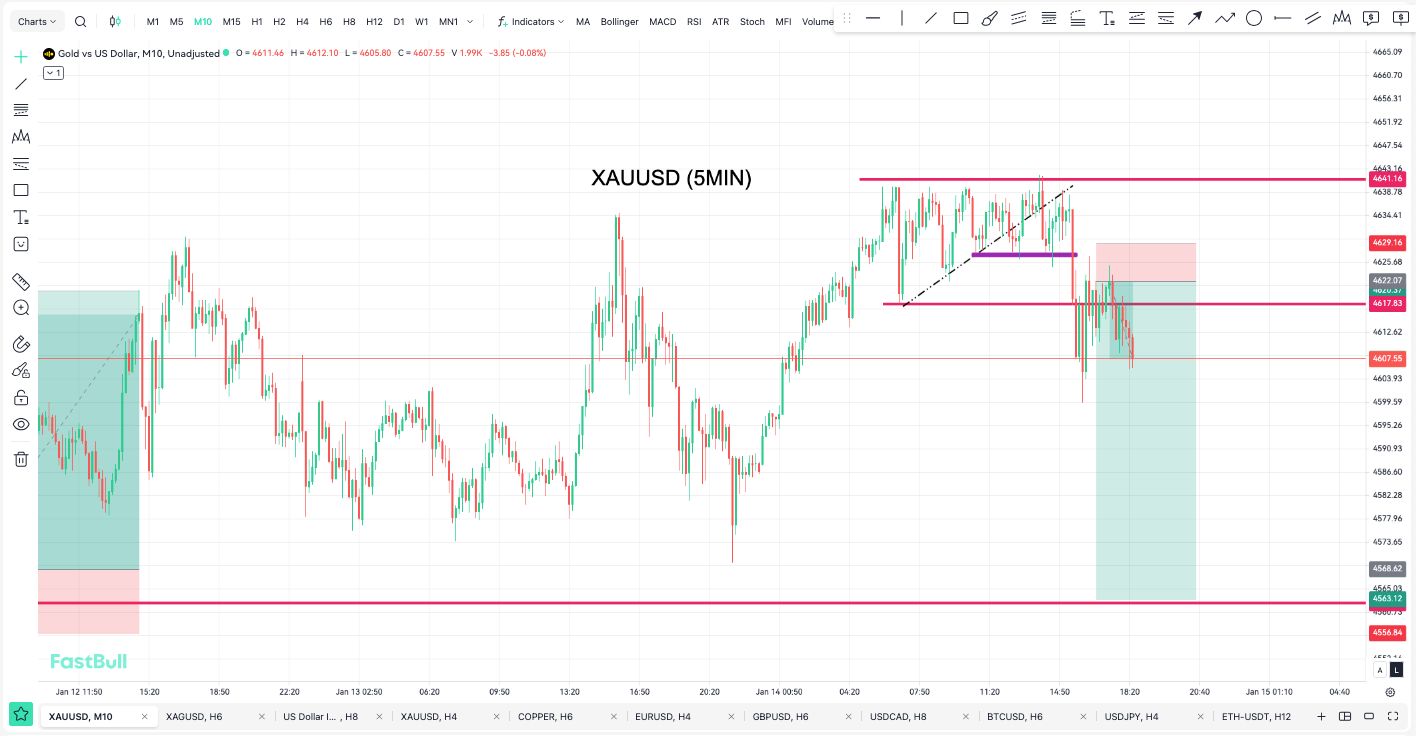
    gold fulback togo 4619-4634
    @Agues454619 buy position pls updete bro
    JustLeon flag
    JustLeon flag
    This is my last trade
    SlowBear ⛅ flag
    JustLeon
    @JustLeon Oh the news event tomorrow? which event is that boss? i am not seeing anything worth not trading for on the calendar
    SlowBear ⛅ flag
    JustLeon
    @JustLeonWait is this the begining of the trade or the end of it? cos this is still very youngs bro
    SlowBear ⛅ flag
    JustLeon
    This is my last trade
    @JustLeon I though you have clsed the buy, the trade is still very young so i will wish you the very best bro!
    Lonewolve flag
    SlowBear ⛅
    @SlowBear ⛅
    JustLeon flag
    SlowBear ⛅
    @SlowBear ⛅bro like I'm seeing alot of 3red bells And what I do know is that they affect the market alot
    JustLeon flag
    SlowBear ⛅
    @SlowBear ⛅yh and I'll b holding it till it reaches my tp
    JustLeon flag
    SlowBear ⛅
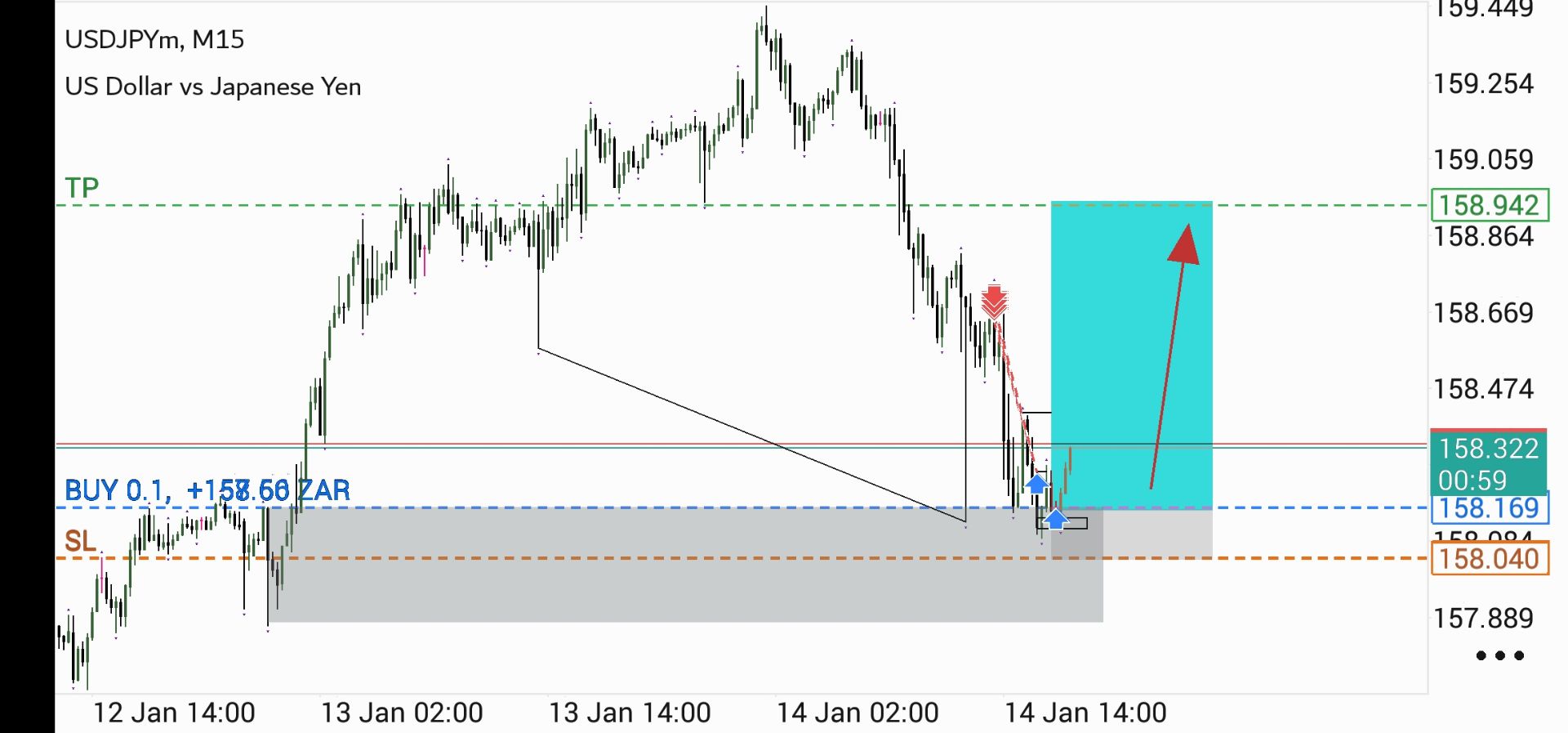
    @SlowBear ⛅I closed the euraud and the USDJPY sell, and longed USDJPY again
    SlowBear ⛅ flag
    JustLeon
    @JustLeon It is just the initial jobless claim that has little impact on the market - but it can cause some moves on Gold
    SlowBear ⛅ flag
    JustLeon
    @JustLeon Oh make sense then boss, wisj you the best on that trade bro!
    SlowBear ⛅ flag
    JustLeon
    @JustLeonAll day making profist this is what everyone wish they have but you just hit the jackpot today keep milking
    Type here...
    Add Symbol or Code

      No matching data

      All
      Trump Updates
      Recommend
      Stocks
      Cryptocurrencies
      Central Banks
      Featured News
      • All
      • Russia-Ukraine Conflict
      • Middle East Flashpoint
      • All
      • Russia-Ukraine Conflict
      • Middle East Flashpoint
      Search
      Products

      Charts Free Forever

      Chats Q&A with Experts
      Screeners Economic Calendar Data Tools
      Membership Features
      Data Warehouse Market Trends Institutional Data Policy Rates Macro

      Market Trends

      Market Sentiment Order Book Forex Correlations

      Top Indicators

      Charts Free Forever
      Markets

      News

      News Analysis 24/7 Columns Education
      From Institutions From Analysts
      Topics Columnists

      Latest Views

      Latest Views

      Trending Topics

      Top Columnists

      Latest Update

      Signals

      Copy Rankings Latest Signals Become a signal provider AI Rating
      Contests
      Brokers

      Overview Brokers Assessment Rankings Regulators News Claims
      Broker listing Forex Brokers Comparison Tool Live Spread Comparison Scam
      Q&A Complaint Scam Alert Videos Tips to Detect Scam
      More

      Business
      Events
      Careers About Us Advertising Help Center

      White Label

      Data API

      Web Plug-ins

      Affiliate Program

      Awards Institution Evaluation IB Seminar Salon Event Exhibition
      Vietnam Thailand Singapore Dubai
      Fans Party Investment Sharing Session
      FastBull Summit BrokersView Expo
      Recent Searches
        Top Searches
          Markets
          News
          Analysis
          User
          24/7
          Economic Calendar
          Education
          Data
          • Names
          • Latest
          • Prev

          View All

          No data

          Scan to Download

          Faster Charts, Chat Faster!

          Download App
          English
          • English
          • Español
          • العربية
          • Bahasa Indonesia
          • Bahasa Melayu
          • Tiếng Việt
          • ภาษาไทย
          • Français
          • Italiano
          • Türkçe
          • Русский язык
          • 简中
          • 繁中
          Open Account
          Search
          Products
          Charts Free Forever
          Markets
          News
          Signals

          Copy Rankings Latest Signals Become a signal provider AI Rating
          Contests
          Brokers

          Overview Brokers Assessment Rankings Regulators News Claims
          Broker listing Forex Brokers Comparison Tool Live Spread Comparison Scam
          Q&A Complaint Scam Alert Videos Tips to Detect Scam
          More

          Business
          Events
          Careers About Us Advertising Help Center

          White Label

          Data API

          Web Plug-ins

          Affiliate Program

          Awards Institution Evaluation IB Seminar Salon Event Exhibition
          Vietnam Thailand Singapore Dubai
          Fans Party Investment Sharing Session
          FastBull Summit BrokersView Expo

          Germany's Warning: EU Must Get Tough as US Alliance Crumbles

          King Ten

          Remarks of Officials

          Economic

          Political

          Summary:

          Germany's Klingbeil warns Europe must assert economic power, fearing "pawn" status as the transatlantic alliance dissolves.

          German Finance Minister Lars Klingbeil has issued a stark warning: Europe must adopt a more assertive economic posture or risk becoming a "pawn of the major powers" in a turbulent global landscape.

          Speaking at a DIW Institute event in Berlin, Klingbeil argued that the foundational U.S.-led transatlantic alliance, which has long underpinned European prosperity, is fundamentally breaking apart. He noted that the increasing use of trade policy as a weapon is placing an "extreme burden" on Germany's export-dependent economy.

          The Transatlantic Relationship is "Dissolving"

          Klingbeil, a co-leader of the Social Democrats and deputy to Chancellor Friedrich Merz, emphasized that Europe can no longer afford to be "naive and blind" about its relationship with the United States. His conviction was strengthened during a recent visit to Washington.

          "I believe... that the transatlantic alliance is undergoing a far more profound transformation than we have been willing to admit," he stated. "The transatlantic relationship as we have known it is dissolving."

          While he described a recent dinner conversation with U.S. Treasury Secretary Scott Bessent as positive, the overall message was one of urgent realism. To navigate this "new world," Klingbeil insisted the EU "must not shy away from tougher, more far-reaching measures where we are under pressure."

          A Call for Assertive European Economic Policy

          Klingbeil pointed to existing EU levies on Chinese-made vehicles and steel as examples of the necessary assertiveness Europe must embrace. He stressed that international competitors are actively undermining the continent's economic strength.

          "Our competition is not sleeping; it is deliberately attacking our competitiveness," he said. "And that is why I say: We must assert ourselves more strongly than before."

          This strategic reevaluation has become a top priority for the ruling coalition of Merz's conservatives and Klingbeil's SPD, which came to office in May. The government has been forced to reassess its ties with major trading partners, including the U.S. and China, as they adopt increasingly protectionist policies.

          Germany's Uphill Economic Battle

          The urgency of this geopolitical shift is underscored by Germany's own economic challenges. The federal statistics office is set to release its first estimate for 2025 GDP, with economists forecasting meager annual growth of just 0.2%.

          This would mark the first expansion since 2022, following two years of contraction. GDP is projected to grow by approximately 1% this year, as government stimulus measures begin to take hold.

          To counter the slowdown, Klingbeil highlighted his government's aggressive domestic strategy. "We have launched the largest investment offensive in our country's history," he explained. "With €500 billion for infrastructure and at least as much again for defense, we're providing a strong government stimulus."

          These efforts, which also include a package of corporate tax incentives, are part of the government's push to revive Europe's largest economy amid unprecedented global challenges.

          To stay updated on all economic events of today, please check out our Economic calendar
          Risk Warnings and Disclaimers
          You understand and acknowledge that there is a high degree of risk involved in trading. Following any strategies or investment methods may lead to potential losses. The content on the site is provided by our contributors and analysts for information purposes only. You are solely responsible for determining whether any trading assets, securities, strategy, or any other product is suitable for investing based on your own investment objectives and financial situation.
          Add to Favorites
          Share

          Venezuela Oil: A Post-Maduro Boom on the Horizon?

          Catherine Richards

          Data Interpretation

          Political

          Commodity

          Remarks of Officials

          Economic

          Traders' Opinions

          Energy

          A change in leadership could unlock a dramatic resurgence in Venezuela's oil industry, with a new forecast predicting crude output could surge by roughly 50% over the next decade. According to industry consultant Enverus, this would mark a significant return for the Caribbean nation, home to some of the world's largest crude reserves, to the global energy market.

          Gauging the Production Potential

          Enverus, one of the oil industry's premier forecasting firms, projects that production could reach approximately 1.5 million barrels a day by 2035. This analysis is among the first to model a post-Maduro oil landscape for Venezuela.

          The potential for growth is substantial. If political stability and investment conditions improve, Enverus outlines a high-case scenario where Venezuela's total output could climb to 3 million barrels a day by 2035.

          The Steep Climb: Overcoming Years of Neglect

          A comeback of this scale faces significant hurdles. Venezuela's recent output has fluctuated near 1 million barrels per day, far below its 1970s peak of almost 4 million barrels. Reviving the industry would require companies to rebuild or replace abandoned rigs, repair leaky pipelines, and restore fire-ravaged equipment.

          Beyond infrastructure, oil executives are seeking clear legal frameworks, guarantees for their investments, and security for their employees before committing capital.

          Big Oil's Cautious Stance

          President Donald Trump has called on US oil companies to channel at least $100 billion into reviving Venezuela's energy sector. Following a White House meeting with nearly 20 industry representatives, it's clear that while the opportunity is recognized, major players are proceeding with caution.

          Exxon Mobil Corp. Chief Executive Darren Woods told Trump that the South American country is currently "uninvestable," a sentiment that echoes warnings from other industry leaders. However, Woods also expressed confidence that the Trump administration could deliver the legal and regulatory reforms needed for any future investment.

          For now, Exxon's arch-rival, Chevron Corp., remains the only major international oil company with active operations in Venezuela.

          Market Impact: Bracing for New Supply

          While producers deliberate, oil traders and US refiners are already positioning themselves for access to Venezuelan crude. Trump has said Venezuela will relinquish as much as 50 million barrels of its oil for the US to sell, and trading houses Trafigura Group and Vitol Group are preparing to move the crude. The sudden availability of 50 million barrels would represent one of the largest unexpected supply flows in years.

          Short-Term Glut vs. Long-Term Deficit

          Despite the potential influx, Enverus expects the added barrels will not greatly impact the price of Brent, the global crude benchmark. The market is already grappling with a forecast glut for this year, which is expected to transition into supply shortfalls later in the decade.

          "Even with accelerated sanctions relief, we still see 1–2 million barrels per day of global oversupply in the first half of 2026 and limited incremental volumes from Venezuela," said Al Salazar, head of macro research at Enverus.

          The long-term outlook is different. "Long-term global oil balances are projected to face a deficit of 2 million barrels per day by 2035, creating space for Venezuela's incremental supply without materially impacting prices," Enverus concluded.

          To stay updated on all economic events of today, please check out our Economic calendar
          Risk Warnings and Disclaimers
          You understand and acknowledge that there is a high degree of risk involved in trading. Following any strategies or investment methods may lead to potential losses. The content on the site is provided by our contributors and analysts for information purposes only. You are solely responsible for determining whether any trading assets, securities, strategy, or any other product is suitable for investing based on your own investment objectives and financial situation.
          Add to Favorites
          Share

          Iran warned it would retaliate if Trump launched an attack; the United States withdrew some personnel from regional bases.

          Justin

          Political

          A U.S. official said Wednesday that the United States is withdrawing some personnel from bases in the Middle East. This comes after a senior Iranian official said that Tehran had warned its neighbors that Iran would also strike U.S. bases if Washington launches an attack.

          Iran’s leadership is struggling to quell the worst domestic unrest in the history of the Islamic Republic, as Tehran tries to block repeated threats from US President Donald Trump to intervene on behalf of anti-government protesters.

          An unnamed U.S. official said that, out of caution, the U.S. is withdrawing some personnel from key bases in the region, given the escalating tensions.

          Three diplomats said some personnel have been advised to leave the region’s main U.S. air base in Qatar, although there are no immediate signs of a large-scale troop evacuation, as happened hours before last year’s Iranian missile attack.

          Trump has repeatedly threatened to intervene in the situation in Iran in support of protesters. In Iran, authorities have reportedly cracked down on protests against clerical rule, resulting in thousands of deaths.

          Iran and its Western adversaries have described the unrest as the most violent since the 1979 Islamic Revolution. The unrest, which began two weeks ago as demonstrations protesting dire economic conditions, has escalated rapidly in recent days. The Islamic Revolution established a theocratic regime in Iran.

          An Iranian official said the death toll had exceeded 2,000, while a human rights organization said it had surpassed 2,600.

          Iranian Armed Forces Chief of Staff Abdulrahim Mousavi said on Wednesday that Iran "has never faced such massive destruction," blaming it on foreign enemies. French Foreign Minister Jean-Noël Barrow called it "the most brutal repression in contemporary Iranian history."

          Israeli sources assess that Trump has decided to intervene.

          An Israeli official said that, according to Israeli assessments, Trump has decided to intervene, but the scope and timing of the intervention remain unclear.

          The three diplomats told Reuters that some personnel had been told to leave the U.S. Al Udeid Air Base in Qatar by Wednesday night.

          One diplomat described the move as a “posture change” rather than an “ordered withdrawal.” There was no indication that troops were being moved to nearby football fields and shopping malls as they had last June, hours before Iran launched missiles at the base in retaliation for a U.S. airstrike.

          The U.S. Embassy in Doha has not yet commented on the matter, and the Qatari Ministry of Foreign Affairs did not immediately respond to requests for comment.

          Iranian authorities accused the United States and Israel of instigating the unrest, claiming it was carried out by what Iran calls terrorists.

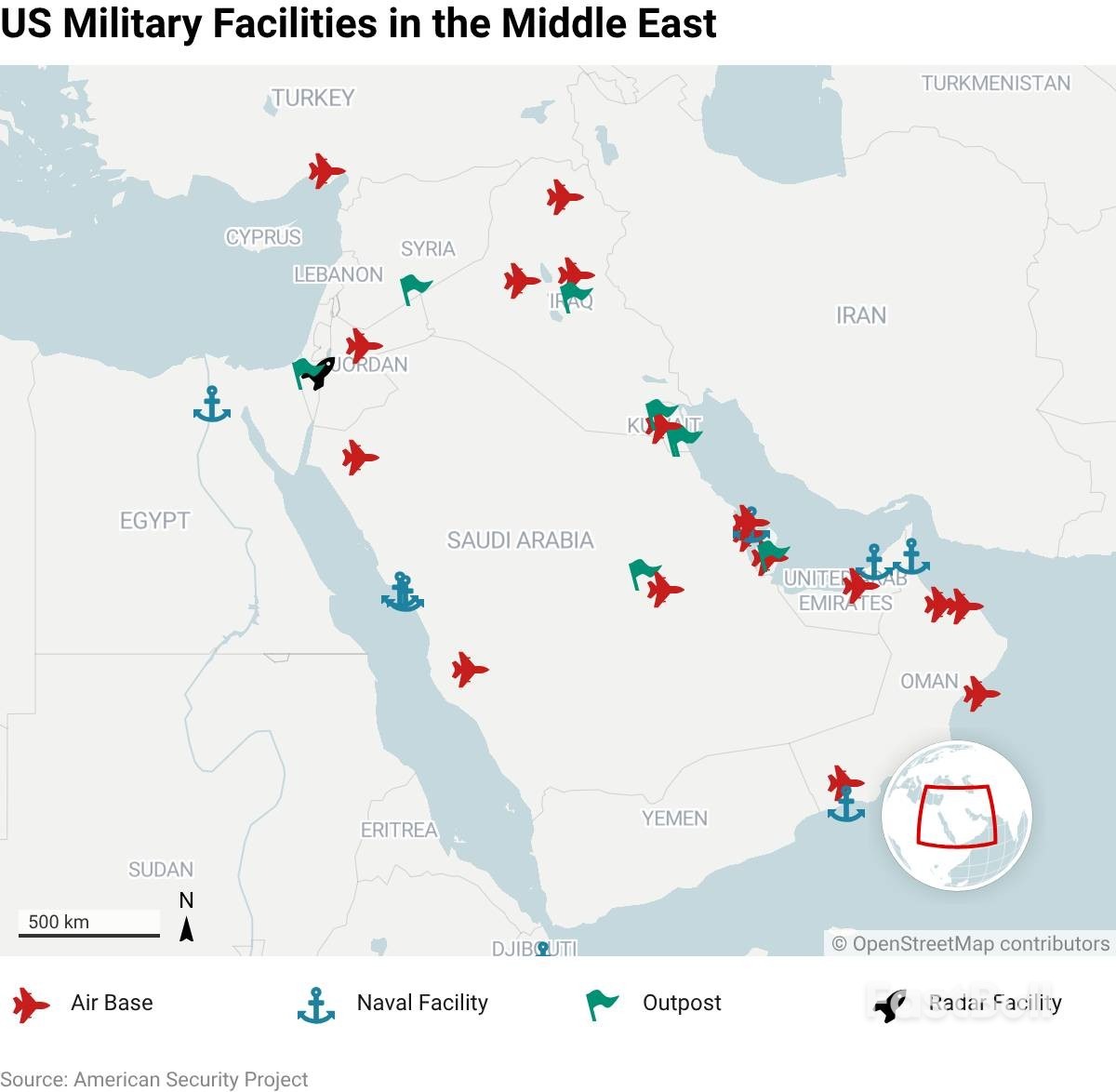
          Iran warned it would retaliate if Trump launched an attack; the US withdrew some personnel from regional bases.Map of US military facilities in the Middle East.

          Iran requests regional countries to prevent a US attack.

          Trump has been publicly threatening to intervene in Iran for days, but has yet to provide any specific details.

          On Tuesday, in an interview with CBS News, Trump vowed that the United States would take "very strong action" if Iran executed protesters. He also urged the Iranian people to continue their protests and take over government institutions, declaring that "aid is coming."

          A senior Iranian official, speaking on condition of anonymity, said that Tehran has asked U.S. allies in the region to stop Washington from attacking Iran.

          The official stated, "Tehran has told regional countries, including Saudi Arabia, the UAE, and Turkey, that if the United States launches an attack on Iran, U.S. bases in those countries will be attacked."

          The official added that direct contact between Iranian Foreign Minister Abbas Araghchi and U.S. envoy Steve Witkov has been suspended.

          The United States has deployed multiple forces in the region, including the forward headquarters of the Central Command in Al Udeid, Qatar, and the headquarters of the U.S. Fifth Fleet in Bahrain.

          Western officials say the government does not appear to be on the verge of collapse.

          The flow of information within Iran has been hampered due to the internet outage.

          HRANA, a U.S.-based human rights organization, says it has confirmed 2,403 deaths of protesters and 147 government-affiliated individuals to date, a number far exceeding the death tolls in previous waves of protests in 2022 and 2009 when authorities cracked down on them.

          In June, Israel and the United States launched a 12-day airstrike against Iran, severely damaging the Iranian government's prestige. This followed setbacks for Iran's regional allies in Lebanon and Syria. European countries then initiated the process of restoring UN sanctions on Iran's nuclear program, exacerbating Iran's economic crisis.

          A Western official said the massive unrest caught the authorities off guard during a vulnerable period, but the government does not appear to be facing imminent collapse, and its security agencies remain in control.

          The authorities attempted to demonstrate that they still enjoyed public support. Iranian state television broadcast footage of massive funeral processions in Tehran, Isfahan, Bushehr, and other cities to mourn those who died in the riots. People waved flags and images of Supreme Leader Ayatollah Ali Khamenei and held up signs with anti-riot slogans.

          President Masoud Pezeshkian is an elected figure whose power is subordinate to Khamenei. In a cabinet meeting, he stated that as long as the government has the support of the people, "all the enemies' attempts against the country will be futile."

          Iranian state media reported that Ali Larijani, head of Iran's top security agency, spoke by phone with the Qatari foreign minister, while Araghchi spoke separately with his counterparts in the UAE and Turkey.

          Aragh told UAE Foreign Minister Sheikh Abdullah bin Zayed that "the situation has calmed down" and that the Iranian people are determined to defend their national sovereignty and security from foreign interference.

          During a visit to a Tehran prison holding arrested protesters, Iran's chief justice stated that swift trials and punishments of those who "behead or burn others" are crucial to ensuring such incidents do not recur.

          According to the Human Rights Activists Association (HRANA), 18,137 people have been arrested so far.

          The Iranian Kurdish human rights organization Hengaw reported that a 26-year-old man, Erfan Soltani, was arrested for participating in protests in Karaj and was scheduled to be executed on Wednesday. The organization stated on Wednesday that it could not yet confirm whether the sentence had been carried out.

          Source: Reuters

          Risk Warnings and Disclaimers
          You understand and acknowledge that there is a high degree of risk involved in trading. Following any strategies or investment methods may lead to potential losses. The content on the site is provided by our contributors and analysts for information purposes only. You are solely responsible for determining whether any trading assets, securities, strategy, or any other product is suitable for investing based on your own investment objectives and financial situation.
          Add to Favorites
          Share

          India's $4 Trillion Economy Hits a Crossroads

          Michael Ross

          Economic

          Data Interpretation

          Central Bank

          Daily News

          In 2025, India's economy presented a picture of remarkable calm in a turbulent world. While other nations grappled with crisis management, India posted strong growth, kept inflation in check, and maintained robust foreign exchange reserves.

          But this stability, achieved while avoiding a contraction, masks deeper structural issues. As the nation awaits the Union Budget for 2026-27, the focus is shifting from past performance to future direction. The key question now is whether the current economic model can deliver shared prosperity for all.

          A closer look at the data reveals a complex reality. While real GDP growth hit 8.2% in the July-September quarter and consumer price inflation averaged a low 1.8% in July-August, this macroeconomic stability may have reached its limits.

          Growth Is Strong, But Dangerously Narrow

          India's economic recovery in 2025 was real, but it was also lopsided. Unlike previous growth cycles powered by broad-based investment, this one leaned heavily on two pillars: consumption and services.

          • Private Consumption: Private Final Consumption Expenditure grew by about 7.0% in the first quarter of the fiscal year.

          • Services Exports: Net receipts from services exports continued to climb, surpassing $50 billion.

          This consumption-led model can produce impressive headline figures, but it fails to expand the economy's productive capacity at the same rate. Without a sustained private capital expenditure cycle, India risks operating below its long-term potential.

          The Missing Piece: Private Investment Stays Sidelined

          The most significant gap in India's growth story is the hesitation of private investment. Despite corporate profits reaching a 15-year high, a corresponding surge in capital expenditure has not materialized. While total investment announcements rose 39% to $355.45 billion in the first nine months of FY25, this has not been enough to shift the economy's reliance on consumption.

          This persistent investment gap, occurring under nearly ideal macroeconomic conditions, points to a structural problem, not just a cyclical pause. When capital flows primarily into consumer credit instead of industrial capacity, the economy generates more debt than durable wages.

          Monetary Policy Has Reached Its Limit

          The Reserve Bank of India (RBI) has deployed its full arsenal to stimulate the economy. Retail inflation eased to a five-month low of 4.31% in January 2025, down from 5.22% in December 2024, largely due to moderating food prices.

          In response, the RBI initiated decisive easing measures, injecting $33.3 trillion of liquidity through open market operations and forex swaps. Yet, the impact on the real economy has been muted.

          Credit growth hovered around 11-12%, but the bulk of this lending flowed into retail loans rather than long-term productive investments. This disconnect reveals a critical insight: the primary constraint on India's growth is no longer monetary.

          The Paradox of External Stability

          On the surface, India's external accounts appear stable. The current account deficit for FY25 was contained at approximately 0.6% of GDP, with the January-March quarter even recording a surplus of over 1%. Strong services exports and remittances, which brought in over $80 billion quarterly, consistently offset the country's large merchandise trade deficit.

          However, the capital account tells a different story. In 2025, foreign institutional investors (FIIs) withdrew between $1.9 billion and $2.1 billion from Indian equities—the largest annual outflow on record. Consequently, the rupee depreciated by over 5% against the dollar, breaching the 90-to-1 mark and becoming Asia's weakest major currency.

          The RBI chose not to defend a specific exchange rate level, instead intervening only to smooth volatility. This strategy reflects an acceptance of the open-economy trilemma: with capital mobility and monetary easing, the exchange rate must absorb the pressure. The result was a managed depreciation that supported exports without causing market panic.

          Hidden Risks in the Banking System

          India's banking sector looks healthier than it has in a decade. Gross non-performing assets have fallen to around 2.6%, public sector banks posted quarterly profits exceeding $5.4 million, and capital adequacy ratios are well above regulatory minimums.

          This apparent strength, however, is built on a foundation of risk aversion. Bank balance sheets are clean not because of efficient risk management but because they have avoided risk altogether. Public sector banks now hold government securities far exceeding statutory requirements, often close to 30% of their assets.

          This creates a "sovereign-bank nexus," where the stability of the banking system is tied directly to the government's fiscal health. It also suppresses private credit creation and weakens monetary policy. Even after 125 basis points of policy rate cuts, lending rates adjusted slowly because banks, facing deposit shortages and credit-deposit ratios exceeding 80%, were forced to keep deposit rates high.

          The Budget's True Test: From Stability to Growth

          The upcoming budget must confront this macroeconomic tension. Government capital expenditure is nearing its fiscal limits, with the deficit targeted at 4.4%. Private investment has failed to step up as the primary engine of growth. The financial system is stable, but its stability is a function of avoiding risk rather than pricing it.

          Transitioning from a $4 trillion to a $5 trillion economy will depend not on how well risks are contained, but on how effectively capital is deployed into productive sectors. The real test for the budget is whether it can unlock this shift. If it fails, 2025 will be remembered as the year India perfected macroeconomic management while postponing its development.

          To stay updated on all economic events of today, please check out our Economic calendar
          Risk Warnings and Disclaimers
          You understand and acknowledge that there is a high degree of risk involved in trading. Following any strategies or investment methods may lead to potential losses. The content on the site is provided by our contributors and analysts for information purposes only. You are solely responsible for determining whether any trading assets, securities, strategy, or any other product is suitable for investing based on your own investment objectives and financial situation.
          Add to Favorites
          Share

          China’s Trade Surplus Surges 20% to a Record $1.2 Trillion, Even With Trump’s Tariffs

          Warren Takunda

          Economic

          China’s trade surplus surged to a record of almost $1.2 trillion in 2025, the government said Wednesday, as exports to other countries made up for slowing shipments to the U.S. under President Donald Trump’s onslaught of higher tariffs.
          China’s exports rose 5.5% for the whole of last year to $3.77 trillion, customs data showed, as Chinese automakers and other manufacturers expanded into markets across the globe. Imports flatlined at $2.58 trillion. The 2024 trade surplus was over $992 billion.
          In December, China’s exports climbed 6.6% from the year before in dollar terms, better than economists’ estimates and higher than November’s 5.9% year-on-year increase. Imports in December were up 5.7% year-on-year, compared to November’s 1.9%.
          China’s trade surplus surpassed the $1 trillion mark for the first time in November, when the trade surplus reached $1.08 trillion in the first 11 months of last year.
          Economists expect exports will continue to support China’s economy this year, despite trade friction and geopolitical tensions.
          “We continue to expect exports to act as a big growth driver in 2026,” said Jacqueline Rong, chief China economist at BNP Paribas.
          While China’s exports to the U.S. fell sharply after Trump returned to office and escalated his trade war with the world’s second-largest economy, that decline has been largely offset by shipments to other markets in South America, Southeast Asia, Africa and Europe.
          For the whole of 2025, China’s exports to the U.S. fell 20%. In contrast, exports to Africa surged 26%. Those to Southeast Asian countries jumped 13%; to the European Union 8%, and to Latin America, 7%.
          Strong global demand for computer chips and other devices and the materials needed to make them were among categories that supported China’s exports, analysts said.
          Exports of electronics and electrical equipment were by far the largest export category, rising 8.4% from a year earlier.
          Car exports also grew last year. Auto exports surged 21% in 2025 to more than 7 million units, driven by electric vehicles and plug-in hybrids, according to the China Association of Automobile Manufacturers, an industry group, on Wednesday.
          China also exported more grain and fertilizer, while its sales of furniture, shoes and other labor intensive products fell.
          Strong exports have helped keep China’s economy growing at an annual rate close to its official target of about 5%. That has triggered alarm in countries that fear a flood of cheap imports is damaging local industries.
          China faces a “severe and complex” external trade environment in 2026, Wang Jun, vice minister of China’s customs administration, told reporters in Beijing. But he said China’s “foreign trade fundamentals remain solid.”
          The head of the International Monetary Fund last month called for China to fix its economic imbalances and speed up its shift from reliance on exports by boosting domestic demand and investment.
          A prolonged property downturn in China after the authorities cracked down on excessive borrowing, triggering defaults by many developers, is still weighing on consumer confidence and domestic demand.
          China’s leaders have made increasing spending by consumers and businesses a focus of economic policy, but actions taken so far have had a limited impact. That included government trade-in subsidies over the past months that encouraged consumers to buy newer, more energy efficient items, such as home appliances and vehicles.
          “We expect domestic demand growth to stay tepid,” said Rong of BNP Paribas. “In fact, the policy boost to domestic demand looks weaker than last year -- in particular the fiscal subsidy program for consumer goods.”
          In the case of autos, domestic sales rose 6% in 2025, but they fell back toward the end of the year as those subsidies were scaled back or phased out in some areas.
          Gary Ng, a senior economist at French investment bank Natixis, forecasts that China’s exports will grow about 3% in 2026, less than the 5.5% growth in 2025. With slow import growth, he expects China’s trade surplus to remain above $1 trillion this year.

          Source: AP

          To stay updated on all economic events of today, please check out our Economic calendar
          Risk Warnings and Disclaimers
          You understand and acknowledge that there is a high degree of risk involved in trading. Following any strategies or investment methods may lead to potential losses. The content on the site is provided by our contributors and analysts for information purposes only. You are solely responsible for determining whether any trading assets, securities, strategy, or any other product is suitable for investing based on your own investment objectives and financial situation.
          Add to Favorites
          Share

          Crude Oil Strengthens on Risk Premium With Bulls Eyeing This Breakout Zone Next

          Adam

          Commodity

          The start of the year has brought several reasons for higher prices in commodity markets, including crude oil. WTI crude has risen by about $4 per barrel in recent days. This is a noticeable move, but it does not signal panic.
          Investors are watching events in the Middle East closely. Anti-government protests in Iran are intensifying, and the situation could worsen if the US decides to step in militarily and support the opposition. Such a move would likely support demand and help oil prices stay above $66 per barrel.
          At the same time, attention is also on Venezuela following the removal of President Nicolas Maduro. If the US gains greater control over Venezuela’s oil sector and investment flows resume over the coming years, oil supply could increase. That would add downward pressure on prices.

          Will There Be US Military Intervention in Iran?

          Protests are continuing across Iran as living conditions worsen due to economic stress and climate-related problems, including in the capital, Tehran. Regardless of how much outside influence is involved, the United States appears keen to use the situation as part of a wider geopolitical strategy by offering military support to the opposition.
          This raises the risk of a broader conflict, especially given the interests of Russia and China in the region. As a result, investors are becoming more cautious, which is pushing money toward traditional safe-haven assets such as gold and silver, and, for different reasons, crude oil.
          Looking ahead, China’s response will be crucial. Beijing is a close ally of Tehran, and after the US intervention in Venezuela, home to the world’s largest proven oil reserves, estimated at around 303 billion barrels, China may seek to prevent further action against another country closely aligned with its interests.
          Iran plays an important role in the global oil market. It is the fourth-largest oil producer within OPEC+ and holds a powerful lever in the form of a possible blockade of the Strait of Hormuz. However, such a move appears unlikely, as it would also harm China, one of Iran’s key partners. It is also worth noting that Iran did not take this step during the recent escalation of tensions with Israel.
          If the worst-case scenarios are avoided, oil prices may face some short-term pressure. A sharp spike in prices, however, looks unlikely at this stage.

          Will WTI Crude Oil Remain Above $60?

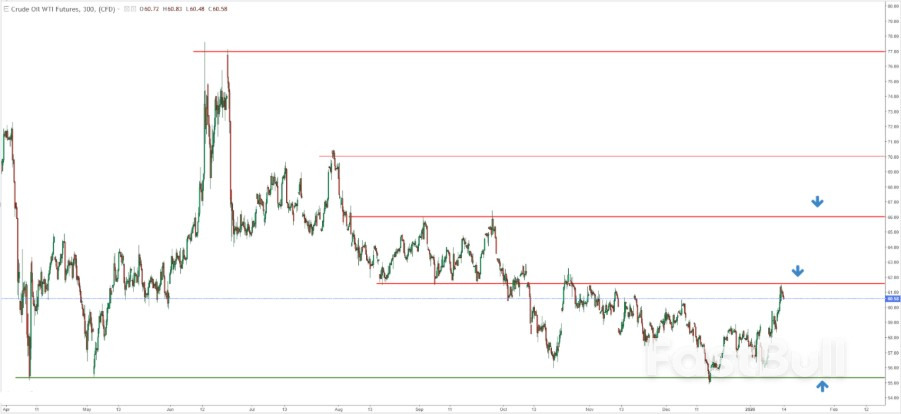
          Another failed attempt to break below the $55 per barrel support level has led to a period of consolidation, with prices moving within a $55 to $61 range. Buyers are now likely to test the upper end of this range, which looks achievable given rising geopolitical tensions.
          Crude Oil Strengthens on Risk Premium With Bulls Eyeing This Breakout Zone Next_1
          If buyers break above this level, the next target sits around $66 per barrel. Key support remains near $55 per barrel.

          Source: investing

          Risk Warnings and Disclaimers
          You understand and acknowledge that there is a high degree of risk involved in trading. Following any strategies or investment methods may lead to potential losses. The content on the site is provided by our contributors and analysts for information purposes only. You are solely responsible for determining whether any trading assets, securities, strategy, or any other product is suitable for investing based on your own investment objectives and financial situation.
          Add to Favorites
          Share

          US Inflation: CPI Data Masks Deeper Economic Pain

          Michael Ross

          Data Interpretation

          Commodity

          Remarks of Officials

          Economic

          Central Bank

          Energy

          Daily News

          While the latest U.S. Consumer Price Index (CPI) report showed a slightly softer annual increase in core prices, it offers little relief for either consumers or Federal Reserve policymakers.

          For everyday households, a sharp spike in food prices is a stark reminder of the ongoing affordability crisis. At the same time, underlying data points to upside risks for the Personal Consumption Expenditures (PCE) price index—the Fed's preferred inflation metric—creating an uncomfortable outlook for the central bank.

          The December report showed the headline CPI rising at an annual rate of 2.7%, meeting expectations. Core prices, which exclude food and energy, increased by 2.6%, just a tenth of a percentage point below forecasts.

          Rising Food and Energy Costs Hit Consumers

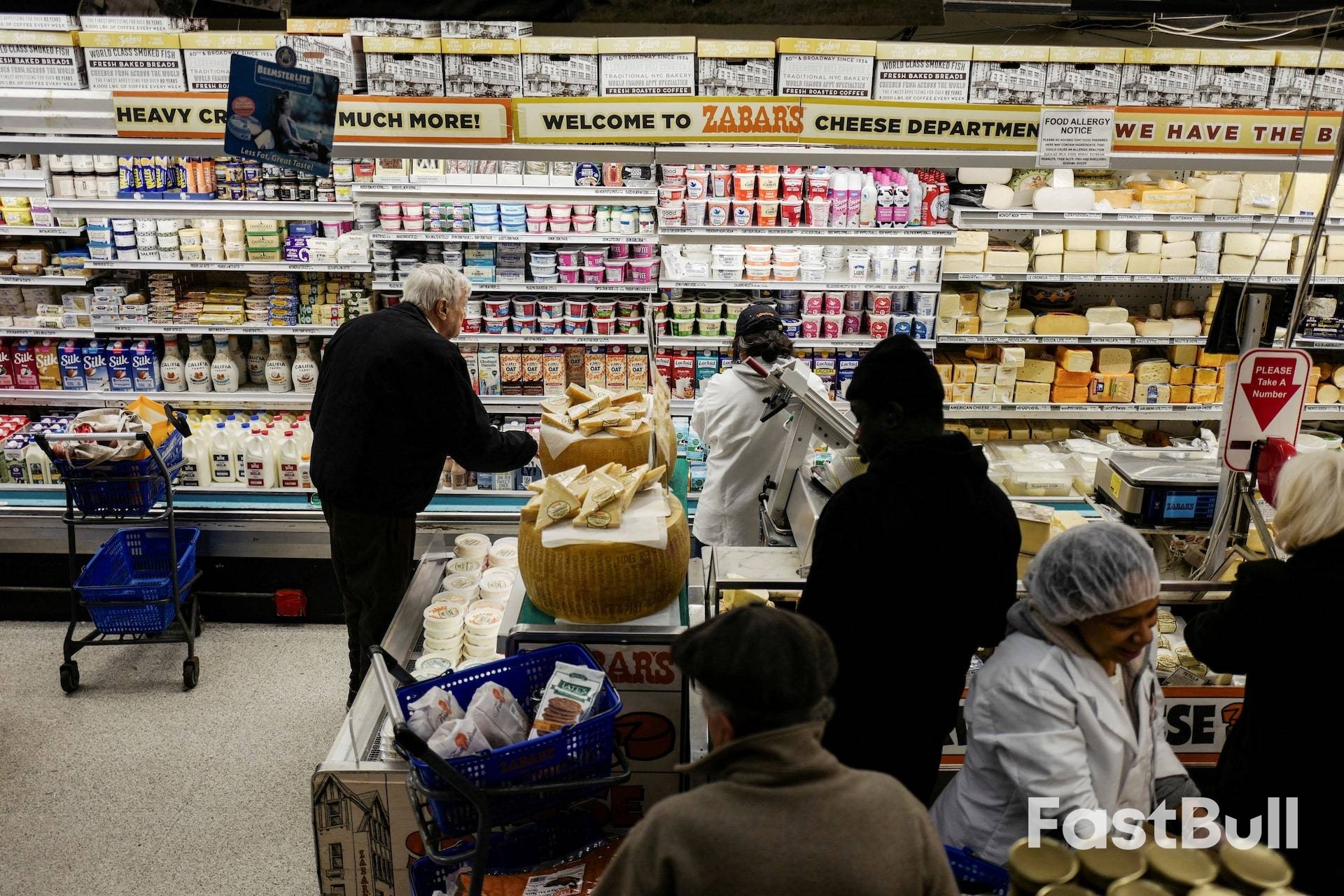
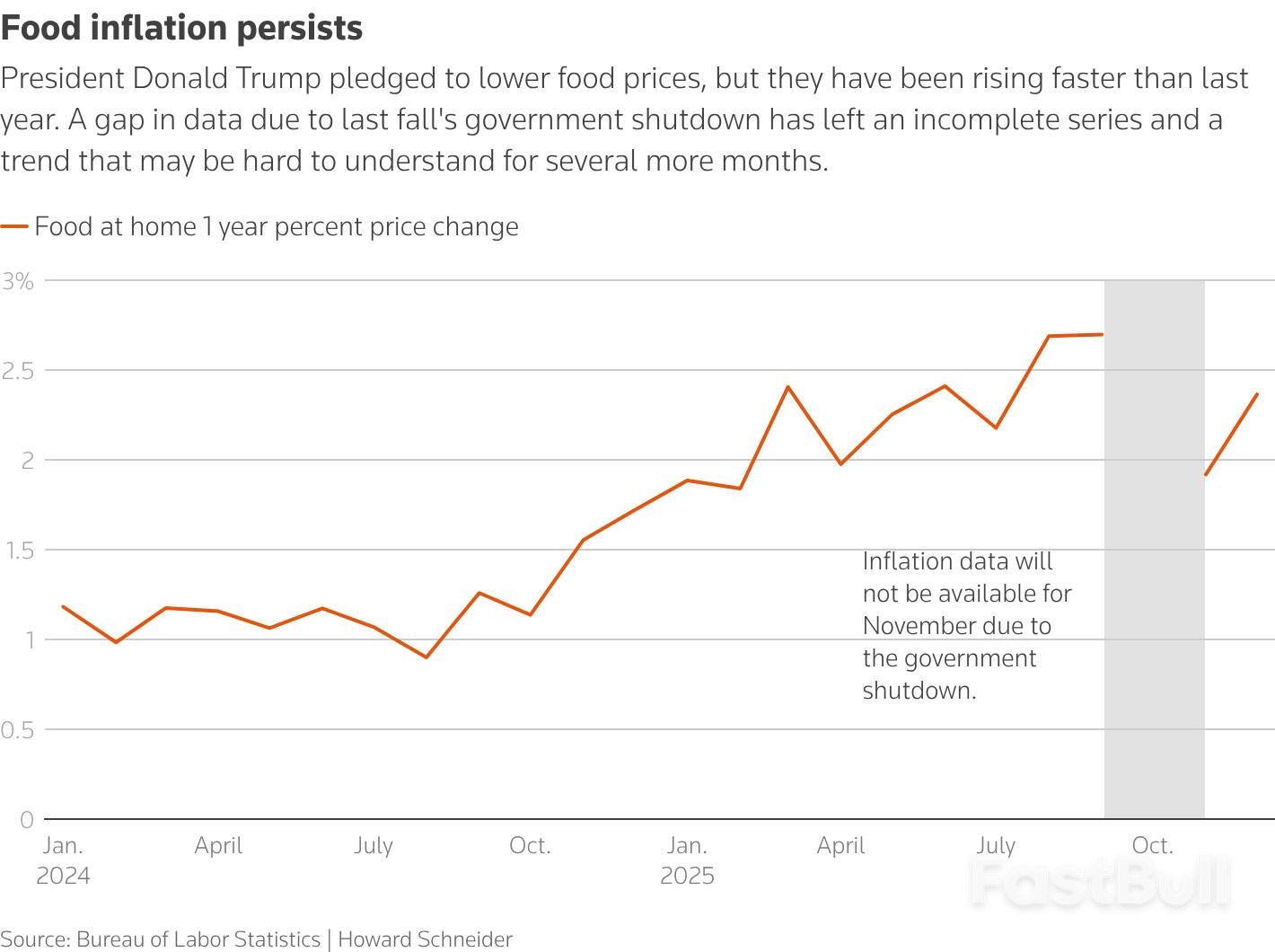
          Despite the seemingly stable core reading, the details are more troubling. Food prices jumped 0.7% in December alone, marking the largest monthly increase since October 2022. This pushed the annual rate of food inflation up to 3.1%.

          This surge in grocery bills comes as oil prices begin to climb again, fueled by geopolitical tensions related to President Donald Trump's foreign policy. While a potential oversupply could cap energy prices, the recent uptick is another source of anxiety for U.S. households.

          Figure 1: The "food at home" price index highlights the ongoing pressure on consumers, with food inflation showing a rising trend through late 2025.

          The Fed's Real Problem: CPI vs. PCE Inflation

          Federal Reserve officials tend to focus on core inflation, which strips out volatile food and energy costs. Consumers, however, do not have this luxury, especially those with lower incomes.

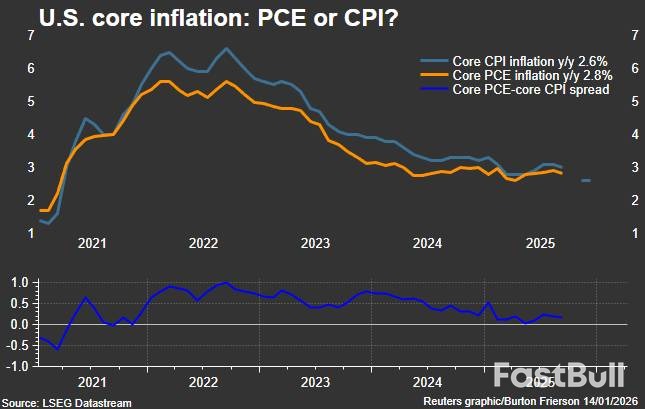
          Economists are now highlighting a growing "wedge" between the monthly CPI and PCE inflation measures. This divergence suggests that the December PCE data, delayed until February 20 due to a government shutdown, could come in hotter than expected.

          Figure 2: U.S. core inflation trends show a persistent gap between CPI and the Fed's preferred PCE measure, which has remained higher for much of the 2021-2024 period.

          Skanda Amarnath, co-founder of Employ America, notes that the fixed-weight basket of the CPI can underrepresent areas where consumers spend significantly, such as software. In contrast, the PCE index better reflects actual spending habits. "When you look at the goods where people actually allocate their dollars... we're seeing some meaningful upside right now," he explains.

          This view is shared by major financial institutions. Economists at Barclays and Morgan Stanley have raised their forecasts for monthly December PCE inflation to just under 0.5%, which would push the annual rate to 2.8% or 2.9%. Similarly, BNP Paribas analyst Andy Schneider stated that December's PCE inflation will be "significantly" higher than the CPI reading.

          Is 3% the New 2% Inflation Target?

          The Federal Reserve is well aware of these dynamics. New York Fed President John Williams said this week that he expects inflation to peak near 3% in the first half of this year before easing and returning to the 2% target next year.

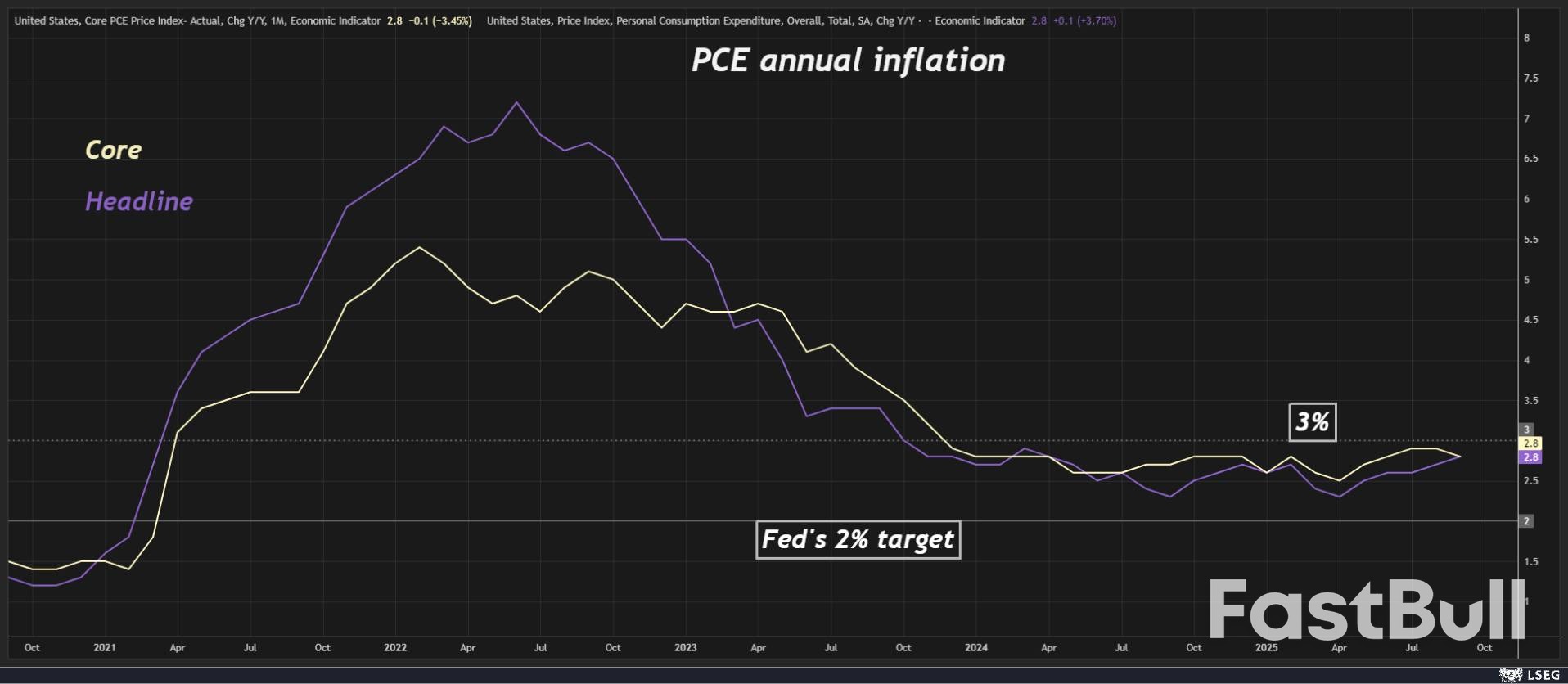
          While this outlook aligns with the Fed's December economic projections, the lack of urgency is notable. It has been nearly five years since any major inflation measure—whether CPI or PCE, headline or core—has been below the central bank's 2% goal. If Williams' forecast is accurate, it will be nearly six years before the target is met again.

          Figure 3: Annual PCE inflation, both headline and core, remains elevated above the Federal Reserve's 2% target, with projections showing it stabilizing near 2.8% through 2025.

          Though officials will not state it publicly, the Fed appears to have tacitly accepted that 3% is the new 2%, at least for now.

          Outlook: Persistent Inflation Risks Remain

          Several factors could keep inflation hovering closer to the 3% mark in the coming months, including:

          • Companies passing on tariff costs.

          • A tight housing supply.

          • Potential energy price shocks.

          • Demand fueled by expected tax relief and fiscal stimulus.

          While some of these risks may not materialize, the current landscape suggests that both consumers and policymakers will have to contend with above-target inflation for the foreseeable future.

          To stay updated on all economic events of today, please check out our Economic calendar
          Risk Warnings and Disclaimers
          You understand and acknowledge that there is a high degree of risk involved in trading. Following any strategies or investment methods may lead to potential losses. The content on the site is provided by our contributors and analysts for information purposes only. You are solely responsible for determining whether any trading assets, securities, strategy, or any other product is suitable for investing based on your own investment objectives and financial situation.
          Add to Favorites
          Share
          FastBull
          Copyright © 2026 FastBull Ltd

          728 RM B 7/F GEE LOK IND BLDG NO 34 HUNG TO RD KWUN TONG KLN HONG KONG

          TelegramInstagramTwitterfacebooklinkedin
          App Store Google Play Google Play
          Products
          Charts

          Chats

          Q&A with Experts
          Screeners
          Economic Calendar
          Data
          Tools
          Membership
          Features
          Function
          Markets
          Copy Trading
          Latest Signals
          Contests
          News
          Analysis
          24/7
          Columns
          Education
          Company
          Careers
          About Us
          Contact Us
          Advertising
          Help Center
          Feedback
          User Agreement
          Privacy Policy
          Personal Information Protection Statement
          Business

          White Label

          Data API

          Web Plug-ins

          Poster Maker

          Affiliate Program

          Risk Disclosure

          The risk of loss in trading financial instruments such as stocks, FX, commodities, futures, bonds, ETFs and crypto can be substantial. You may sustain a total loss of the funds that you deposit with your broker. Therefore, you should carefully consider whether such trading is suitable for you in light of your circumstances and financial resources.

          No decision to invest should be made without thoroughly conducting due diligence by yourself or consulting with your financial advisors. Our web content might not suit you since we don't know your financial conditions and investment needs. Our financial information might have latency or contain inaccuracy, so you should be fully responsible for any of your trading and investment decisions. The company will not be responsible for your capital loss.

          Without getting permission from the website, you are not allowed to copy the website's graphics, texts, or trademarks. Intellectual property rights in the content or data incorporated into this website belong to its providers and exchange merchants.

          Not Logged In

          Log in to access more features

          FastBull Membership

          Not yet

          Purchase

          Become a signal provider
          Help Center
          Customer Service
          Dark Mode
          Price Up/Down Colors

          Log In

          Sign Up

          Position
          Layout
          Fullscreen
          Default to Chart
          The chart page opens by default when you visit fastbull.com