Markets
News
Analysis
User
24/7
Economic Calendar
Education
Data
- Names
- Latest
- Prev


Signal Accounts for Members
All Signal Accounts
All Contests


U.K. Trade Balance Non-EU (SA) (Oct)A:--
F: --
P: --
U.K. Trade Balance (Oct)A:--
F: --
P: --
U.K. Services Index MoMA:--
F: --
P: --
U.K. Construction Output MoM (SA) (Oct)A:--
F: --
P: --
U.K. Industrial Output YoY (Oct)A:--
F: --
P: --
U.K. Trade Balance (SA) (Oct)A:--
F: --
P: --
U.K. Trade Balance EU (SA) (Oct)A:--
F: --
P: --
U.K. Manufacturing Output YoY (Oct)A:--
F: --
P: --
U.K. GDP MoM (Oct)A:--
F: --
P: --
U.K. GDP YoY (SA) (Oct)A:--
F: --
P: --
U.K. Industrial Output MoM (Oct)A:--
F: --
P: --
U.K. Construction Output YoY (Oct)A:--
F: --
P: --
France HICP Final MoM (Nov)A:--
F: --
P: --
China, Mainland Outstanding Loans Growth YoY (Nov)A:--
F: --
P: --
China, Mainland M2 Money Supply YoY (Nov)A:--
F: --
P: --
China, Mainland M0 Money Supply YoY (Nov)A:--
F: --
P: --
China, Mainland M1 Money Supply YoY (Nov)A:--
F: --
P: --
India CPI YoY (Nov)A:--
F: --
P: --
India Deposit Gowth YoYA:--
F: --
P: --
Brazil Services Growth YoY (Oct)A:--
F: --
P: --
Mexico Industrial Output YoY (Oct)A:--
F: --
P: --
Russia Trade Balance (Oct)A:--
F: --
P: --
Philadelphia Fed President Henry Paulson delivers a speech
Canada Building Permits MoM (SA) (Oct)A:--
F: --
P: --
Canada Wholesale Sales YoY (Oct)A:--
F: --
P: --
Canada Wholesale Inventory MoM (Oct)A:--
F: --
P: --
Canada Wholesale Inventory YoY (Oct)A:--
F: --
P: --
Canada Wholesale Sales MoM (SA) (Oct)A:--
F: --
P: --
Germany Current Account (Not SA) (Oct)A:--
F: --
P: --
U.S. Weekly Total Rig CountA:--
F: --
P: --
U.S. Weekly Total Oil Rig CountA:--
F: --
P: --
Japan Tankan Large Non-Manufacturing Diffusion Index (Q4)--
F: --
P: --
Japan Tankan Small Manufacturing Outlook Index (Q4)--
F: --
P: --
Japan Tankan Large Non-Manufacturing Outlook Index (Q4)--
F: --
P: --
Japan Tankan Large Manufacturing Outlook Index (Q4)--
F: --
P: --
Japan Tankan Small Manufacturing Diffusion Index (Q4)--
F: --
P: --
Japan Tankan Large Manufacturing Diffusion Index (Q4)--
F: --
P: --
Japan Tankan Large-Enterprise Capital Expenditure YoY (Q4)--
F: --
P: --
U.K. Rightmove House Price Index YoY (Dec)--
F: --
P: --
China, Mainland Industrial Output YoY (YTD) (Nov)--
F: --
P: --
China, Mainland Urban Area Unemployment Rate (Nov)--
F: --
P: --
Saudi Arabia CPI YoY (Nov)--
F: --
P: --
Euro Zone Industrial Output YoY (Oct)--
F: --
P: --
Euro Zone Industrial Output MoM (Oct)--
F: --
P: --
Canada Existing Home Sales MoM (Nov)--
F: --
P: --
Euro Zone Total Reserve Assets (Nov)--
F: --
P: --
U.K. Inflation Rate Expectations--
F: --
P: --
Canada National Economic Confidence Index--
F: --
P: --
Canada New Housing Starts (Nov)--
F: --
P: --
U.S. NY Fed Manufacturing Employment Index (Dec)--
F: --
P: --
U.S. NY Fed Manufacturing Index (Dec)--
F: --
P: --
Canada Core CPI YoY (Nov)--
F: --
P: --
Canada Manufacturing Unfilled Orders MoM (Oct)--
F: --
P: --
Canada Manufacturing New Orders MoM (Oct)--
F: --
P: --
Canada Core CPI MoM (Nov)--
F: --
P: --
Canada Manufacturing Inventory MoM (Oct)--
F: --
P: --
Canada CPI YoY (Nov)--
F: --
P: --
Canada CPI MoM (Nov)--
F: --
P: --
Canada CPI YoY (SA) (Nov)--
F: --
P: --
Canada Core CPI MoM (SA) (Nov)--
F: --
P: --


No matching data
Latest Views
Latest Views
Trending Topics
Top Columnists
Latest Update
White Label
Data API
Web Plug-ins
Affiliate Program
View All

No data
The US might be on the brink of its biggest crypto moment yet, but it is coming with a full dose of political theater, stablecoins, and Trump-branded urgency. House Republicans are reportedly prepping to deliver the Senate’s landmark GENIUS Act to President Trump’s desk as early as the week of July 7.
At the same time, they’re eyeing a vote on the long-awaited crypto market structure bill, CLARITY Act. It is anticipated that the House might package both bills together in a single procedural vote. This can be a legislative two-for-one special voting, which is now turbocharged by Trump’s all-caps tweet, “LIGHTNING FAST.”
The GENIUS Act is not a small bill, as it might sound. This is the first serious attempt to give US dollar-pegged stablecoins proper federal guardrails and a legal backup to private digital dollar issuers. It passed the Senate with a strong bipartisan 68-30 vote and sent a clear signal that crypto’s moving to Washington.
Trump’s digital asset empire and 2024 campaign have been powered by some big crypto players, meme coins, and David Sacks. In an X post, the Crypto Czar stated that “July will be a big month, with a bill signing for GENIUS, and CLARITY going to the Senate!”
Sacks even thanked Senate Banking Committee Chair Tim Scott and Digital Assets Subcommittee Chair Senator Cynthia Lummis for laying down a clear timeline and plan for crypto market structure legislation. This includes introducing the bill before August recess, marking it up in the first week of September, and getting it done by the end of the month.
He added that President Trump supports CLARITY on market structure as well as GENIUS on stablecoins.
July will be a big month, with a bill signing for GENIUS, and CLARITY going to the Senate!
The strategy here seems clear: ride the bipartisan momentum of stablecoin regulation to pull the broader market structure bill across the finish line. It’s a political high-wire act because while GENIUS has Senate traction, the CLARITY Act faces a rockier path, with agriculture and banking committees still weighing in. However, if anyone can turn regulatory chaos into a political showstopper, it’s Trump.
According to reports, Capitol Hill aides say conversations are still underway on how to move both bills forward. Committee chairs like French Hill and Tim Scott are threading the needle to make sure the crypto industry, which poured $250 million into this election cycle, gets the clarity it’s been asking for.
Meanwhile, the White House Council on Digital Assets, helmed by Bo Hines, is talking openly about making the US “welcoming” again for innovators. That’s a serious pivot from the “Operation Chokepoint 2.0” just a year ago.
If the House moves fast in July, Trump could be signing the first federal crypto law in US history before summer ends and setting the stage for a regulatory framework that turns the US into the next crypto capital.
The digital assets market is still stuck in turbulence, while Bitcoin is sailing the high waves alone. As all the major altcoins printed red indexes, BTC price is slowly moving towards its recent all-time high. Despite fresh pullbacks, Bitcoin is trading over $107k. The cumulative crypto market cap hovers around $3.28 trillion, with a trading volume of $100 billion.
The stablecoin market saw some bullish updates lately and its total market cap moved to breach the $260 billion mark. Tether’s USDT is still the king of the category as it holds $157.5 billion of the market cap with a trading volume of over $38 billion. USDC stands second in the tally with a cap of $61.6 billion.
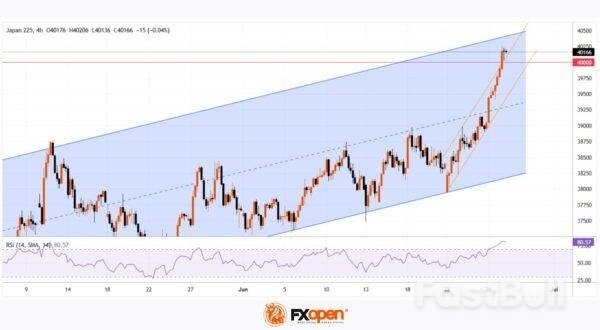
As the chart shows, the Nikkei 225 stock index (Japan 225 on FXOpen) has risen above the psychological level of 40,000 points — for the first time in five months.
Bullish drivers include:
Reduced geopolitical risks. A ceasefire between Iran and Israel has boosted market sentiment, with stock indices rising both on Wall Street (yesterday the Nasdaq 100 hit a new all-time high) and in Japan.
Easing fears of a prolonged trade war. White House Press Secretary Karoline Leavitt noted that the timeline for implementing tariffs is flexible and could be extended.
Economic news. Recent data shows that inflation in Japan has slowed for the first time in four months: the core consumer price index fell to 3.1% from 3.6% in May.
Technical Analysis of the Nikkei 225 Chart

Price movements are forming an upward channel (highlighted in blue), but the market appears vulnerable to a pullback, as suggested by:
proximity to the upper boundary of the channel;
overbought conditions indicated by the RSI.
If a pullback develops, it will provide yet another example of how the price failed to hold above the psychological level of 40,000 — something we’ve seen repeatedly since October 2024, and we’ve been pointing out this pattern for quite some time.
Therefore, we might witness another false breakout above the 40K level on the Nikkei 225 (Japan 225 on FXOpen), followed by a retreat deeper into the blue channel — potentially towards its median line.
Trade global index CFDs with zero commission and tight spreads. Open your FXOpen account now or learn more about trading index CFDs with FXOpen.
This article represents the opinion of the Companies operating under the FXOpen brand only. It is not to be construed as an offer, solicitation, or recommendation with respect to products and services provided by the Companies operating under the FXOpen brand, nor is it to be considered financial advice.
European nations should not halt the continent's green transition, Denmark's climate minister told Reuters, as his country prepares to lead EU negotiations on a new climate target amid a backlash from some governments concerned about its cost.
The European Commission plans to propose a new 2040 climate target next week to slash EU emissions by 90% compared with 1990 levels, but faces pushback from countries including Poland and France which are worried that this aim is too high.
Lars Aagaard, energy and climate minister for Denmark, said in an interview that short-term challenges - including budgets stretched by increased military spending - must not distract from Europe's need to switch to green energy.
"The answer to Europe's competitiveness is that we transition to using electricity for more things. It's that we can produce it ourselves. We can do that with renewable energy. We can do it with nuclear power," Aagaard said.
"It's not a solution for the climate, nor the security challenge, to halt the (green) transition in Europe," he added.
Denmark takes over the EU's six-month rotating presidency in July and will lead negotiations on the 2040 goal, at a time when Europe is sharply raising defence spending following Russia's full-scale invasion of Ukraine.
The EU's green transition and its race to re-arm are taking place against a "grim background," Aagaard said, citing geopolitical tensions.
"It's not a celebration that Europe has to rearm militarily. It's because we are threatened. And it's not a celebration that we have to go green. Climate change is also serious," he said.
The European Union has rolled back a series of green policies this year, trying to contain reactions from member countries and struggling industries over environmental rules.
The 2040 goal will aim to keep EU countries on track between their 2030 emissions target and a 2050 net zero goal.
In its latest gasoline fuel update, which was released this week, the U.S. Energy Information Administration (EIA) showed an increasing price trend for U.S. regular gasoline.
The update highlighted that the U.S. regular gasoline price averaged $3.108 per gallon on June 9, $3.139 per gallon on June 16, and $3.213 per gallon on June 23. The June 23 price was $0.225 less than the year ago price, the update outlined.
Of the five Petroleum Administration for Defense District (PADD) regions highlighted in the EIA’s latest fuel update, the West Coast was shown to have the highest regular gasoline price as of June 23, at $4.162 per gallon. The Gulf Coast was shown in the update to have the lowest regular gasoline price as of June 23, at $2.844 per gallon.
A glossary section of the EIA site notes that the 50 U.S. states and the District of Columbia are divided into five districts, with PADD 1 further split into three subdistricts. PADDs 6 and 7 encompass U.S. territories, the site adds.
According to the AAA Fuel Prices website, the average price of regular gasoline in the U.S. is $3.207 per gallon, as of June 27. Yesterday’s average was $3.220 per gallon, the week ago average was $3.217 per gallon, the month ago average was $3.174 per gallon, and the year ago average was $3.503 per gallon, the site showed.
The highest recorded average price for regular gasoline was seen on June 14, 2022, at $5.016 per gallon, the AAA Fuel Prices site outlined.
GasBuddy’s live ticking average for regular gasoline in the U.S. was $3.199 per gallon as of 7.25am EST on June 27. The figure was 0.9 cents lower than yesterday’s average, 1.7 cents lower than last week’s average, 5.2 cents higher than last month’s average, and 31.0 cents lower than last year’s average, GasBuddy’s website highlighted.
In its latest short term energy outlook (STEO), which was released on June 10, the EIA projected that the regular gasoline retail price in the U.S. will average $3.09 per gallon in 2025 and $3.08 per gallon in 2026.
The EIA forecast in that STEO that the regular gasoline retail price in the U.S. will average $3.16 per gallon in the second quarter of 2025, $3.14 per gallon in the third quarter, $2.97 per gallon in the fourth quarter, $2.95 per gallon in the first quarter of 2026, $3.17 per gallon in the second quarter, $3.21 per gallon in the third quarter, and $3.01 per gallon in the fourth quarter.
That STEO highlighted that the regular gasoline retail price in the U.S. averaged $3.10 per gallon in the first quarter of 2025 and $3.31 per gallon overall in 2024.
In its previous STEO, which was released in May, the EIA projected that the regular gasoline retail price in the U.S. would come in at $3.09 per gallon in 2025 and $3.07 per gallon in 2026.
The EIA’s latest fuel update, which pegged the retail price of regular gasoline at $3.17 per gallon in April 2025, showed that 49 percent of that total went towards crude oil costs, 19 percent went towards distribution and marketing costs, 16 percent went towards taxes, and 16 percent went towards refining costs.
A previous EIA fuel update released in June 2024, which pinned the retail price of regular gasoline at $3.61 per gallon in April that year, showed that 55 percent of that total went towards crude oil costs, 19 percent went towards refining costs, 14 percent went towards taxes, and 12 percent went towards distribution and marketing costs.
The intensifying conflict in the Middle East has pushed inflation higher for the first time in 2025 and weakened confidence in the eurozone, according to data released Friday.
Consumer prices were 0.8% higher in France and 2.2% higher in Spain in June than a year earlier compared with 0.6% and 2% in May, respectively, according to European Union harmonized data. Both were slightly stronger readings than expected by economists polled by The Wall Street Journal.
The data gives an early indication of any effect Middle East tensions had on prices in major eurozone economies. Annual inflation had fallen since late last year in both countries.
France's statistics agency this month cited "a rebound in energy prices, notably those of petroleum products." In Spain, inflation rose primarily based on the increase in fuel prices compared with a decrease in June of last year, the country's statistics agency said.
Oil prices spiked in the wake of Israel's attack on Iran, though they have fallen in recent days as hostilities eased.
The European Central Bank's president, Christine Lagarde, said earlier this week that a reduction in the flow of oil and gas through the Strait of Hormuz could send a range of prices higher.
"It would certainly impact on the price of oil and the price of gas, which itself could be of such depth and duration that it would trigger secondary effects and it would apply on a much broader basis," she told lawmakers at the European Parliament.
The impact of rising oil prices likely also hit industrial confidence this month. The European Commission's economic sentiment indicator, also published Friday, unexpectedly ticked lower this month, dragged by more pessimism in the industrial sector, which is more reliant on energy.
Industrial order books, stocks and production expectations all were weaker in June, the commission said, even as sentiment in the services sector rose. The effect of continuing trade uncertainty with the U.S. likely also prompted uneasy attitudes among manufacturing firms.
However, despite sustained geopolitical concerns, the data won't likely immediately concern ECB policymakers, with inflation in the eurozone reaching below the central bank's 2% target in the latest data for May. Investors anticipate the bank to cut interest rates again later this year.
Higher energy prices could weaken eurozone economic growth and therefore add a dampening effect on inflation, ECB Vice President Luis de Guindos said Thursday.
"The outbreak of the Israel-Iran conflict adds some uncertainty about oil price developments," he said.
The ECB cut its key interest rate earlier this month for an eighth time since June last year, as inflation continued to cool in the early part of this year. German inflation data is due on Monday, with data for the eurozone as a whole due on Tuesday.
China’s economy is showing positive signs and confidence is building, but challenges such as insufficient domestic demand and deflationary pressure persist, according to the country’s central bank.
The People’s Bank of China, in a statement after its quarterly monetary policy committee meeting, said it will adopt a flexible approach to policymaking, taking into account both domestic and international conditions. Monetary policy will remain “moderately loose,” with the aim of maintaining stable economic growth and prices within a reasonable range, it said.
While consumer sentiment is weak, better-than-expected retail sales in May provided some relief. In a speech at the World Economic Forum meeting in Tianjin this week, Premier Li Qiang said China can turn consumption into a driver for the economy.
Officials often express confidence they can build the consumer sector into a key engine of the world’s second-biggest economy, the task is becoming more pressing as governments around the world — not least the US — push back on Chinese exports. China and the US are now working on a new trade agreement.
Federal Reserve Bank of Minneapolis President Neel Kashkari said he sees two interest-rate cuts as likely this year — with the first potentially in September — but warned that tariffs could have a delayed impact on inflation and policymakers should remain flexible.
“While we gather more evidence on the true tariff shock affecting the economy, I believe we should put more emphasis on the actual inflation and real economic data that we are seeing without committing to an easing policy path in case the effects of tariffs are merely delayed,” Kashkari wrote in an essay published Friday on his bank’s website.
Kashari said he has left his rate projections for 2025 unchanged since December. At that point, Fed policymakers had delivered a full percentage point of cuts, all in the final four months of the year, as price pressures cooled and the labor market showed signs of weakness. He expected just two cuts then because he was unsure inflation would continue to fall in this year, he wrote.
He kept that projection in March amid heightened tariff uncertainty and little further progress on inflation. Now, though there hasn’t been much evidence of a hit to prices from tariffs, he worries that may still materialize later this year.
Kashkari said his forecast for two rate cuts implies the first would come in September.
Fed officials left rates unchanged when they met last week. Since then, two Fed governors, Christopher Waller and Michelle Bowman, have signaled they might back lowering rates as early as next month. But most policymakers who spoke this week, including Kashkari, made clear they aren’t seriously considering a move in July.
President Donald Trump has repeatedly lashed out at Federal Reserve Chair Jerome Powell over over the bank’s position to hold interest rates steady.
Earlier: Trump Says Three or Four People on List to Replace Fed’s Powell
In the essay, the Minneapolis Fed chief also said that the US central bank shouldn’t be bound to a particular policy path even if it resumes lowering rates in September.
“If the data called for it, we could hold the policy rate at the new level until we gained greater confidence that inflation was headed back to our target,” Kashkari wrote.
Kashkari praised the economy’s resilience in the face of higher-than-expected tariff announcements in April and said the labor market has “cooled gently.”
He said business leaders he’s spoken with have expressed a reluctance to pass tariff costs on to customers, but that if trade deals aren’t struck and tariff rates remain high, they might have to do so. Kashkari also pointed to the time required to ship goods to the US from Asia as another reason the tariff effect may materialize later.
White Label
Data API
Web Plug-ins
Poster Maker
Affiliate Program
The risk of loss in trading financial instruments such as stocks, FX, commodities, futures, bonds, ETFs and crypto can be substantial. You may sustain a total loss of the funds that you deposit with your broker. Therefore, you should carefully consider whether such trading is suitable for you in light of your circumstances and financial resources.
No decision to invest should be made without thoroughly conducting due diligence by yourself or consulting with your financial advisors. Our web content might not suit you since we don't know your financial conditions and investment needs. Our financial information might have latency or contain inaccuracy, so you should be fully responsible for any of your trading and investment decisions. The company will not be responsible for your capital loss.
Without getting permission from the website, you are not allowed to copy the website's graphics, texts, or trademarks. Intellectual property rights in the content or data incorporated into this website belong to its providers and exchange merchants.
Not Logged In
Log in to access more features

FastBull Membership
Not yet
Purchase
Log In
Sign Up