• Trade
  • Markets
  • Copy
  • Contests
  • News
  • 24/7
  • Calendar
  • Q&A
  • Chats
Trending
Screeners
SYMBOL
LAST
BID
ASK
HIGH
LOW
NET CHG.
%CHG.
SPREAD
SPX
S&P 500 Index
6827.42
6827.42
6827.42
6899.86
6801.80
-73.58
-1.07%
--
DJI
Dow Jones Industrial Average
48458.04
48458.04
48458.04
48886.86
48334.10
-245.98
-0.51%
--
IXIC
NASDAQ Composite Index
23195.16
23195.16
23195.16
23554.89
23094.51
-398.69
-1.69%
--
USDX
US Dollar Index
97.950
98.030
97.950
98.500
97.950
-0.370
-0.38%
--
EURUSD
Euro / US Dollar
1.17394
1.17409
1.17394
1.17496
1.17192
+0.00011
+ 0.01%
--
GBPUSD
Pound Sterling / US Dollar
1.33707
1.33732
1.33707
1.33997
1.33419
-0.00148
-0.11%
--
XAUUSD
Gold / US Dollar
4299.39
4299.39
4299.39
4353.41
4257.10
+20.10
+ 0.47%
--
WTI
Light Sweet Crude Oil
57.233
57.485
57.233
58.011
56.969
-0.408
-0.71%
--

Community Accounts

Signal Accounts
--
Profit Accounts
--
Loss Accounts
--
View More

Become a signal provider

Sell trading signals to earn additional income

View More

Guide to Copy Trading

Get started with ease and confidence

View More

Signal Accounts for Members

All Signal Accounts

Best Return
  • Best Return
  • Best P/L
  • Best MDD
Past 1W
  • Past 1W
  • Past 1M
  • Past 1Y

All Contests

  • All
  • Trump Updates
  • Recommend
  • Stocks
  • Cryptocurrencies
  • Central Banks
  • Featured News
Top News Only
Share

Thai Leader Anutin: Landmine Blast That Killed Thai Soldiers 'Not A Roadside Accident'

Share

Thai Leader Anutin: Thailand To Continue Military Action Until 'We Feel No More Harm'

Share

Cambodian Prime Minister Hun Manet Says He Had Phone Calls With Trump And Malaysian Leader Anwar About Ceasefire

Share

Cambodia's Hun Manet Says USA, Malaysia Should Verify 'Which Side Fired First' In Latest Conflict

Share

Cambodia's Hun Manet: Cambodia Maintains Its Stance In Seeking Peaceful Resolution Of Disputes

Share

Nasdaq Companies: Allergan, Ferrovia, Insmed, Monolithic Power Systems, Seagate Technology, And Western Digital Will Be Added To The NASDAQ 100 Index. Biogen, CdW, GlobalFoundries, Lululemon, ON Semiconductor, And Tradedesk Will Be Removed From The NASDAQ 100 Index

Share

Witkoff Headed To Berlin This Weekend To Meet With Zelenskiy, European Leaders -Wsj Reporter On X

Share

Russia Attacks Two Ukrainian Ports, Damaging Three Turkish-Owned Vessels

Share

[Historic Flooding Occurs In At Least Four Rivers In Washington State Due To Days Of Torrential Rains] Multiple Areas In Washington State Have Been Hit By Severe Flooding Due To Days Of Torrential Rains, With At Least Four Rivers Experiencing Historic Flooding. Reporters Learned On The 12th That The Floods Caused By The Torrential Rains In Washington State Have Destroyed Homes And Closed Several Highways. Experts Warn That Even More Severe Flooding May Occur In The Future. A State Of Emergency Has Been Declared In Washington State

Share

Trump Says Proposed Free Economic Zone In Donbas Would Work

Share

Trump: I Think My Voice Should Be Heard

Share

Trump Says Will Be Choosing New Fed Chair In Near Future

Share

Trump Says Proposed Free Economic Zone In Donbas Complex But Would Work

Share

Trump Says Land Strikes In Venezuela Will Start Happening

Share

US President Trump: Thailand And Cambodia Are In A Good Situation

Share

State Media: North Korean Leader Kim Hails Troops Returning From Russia Mission

Share

The 10-year Treasury Yield Rose About 5 Basis Points During The "Fed Rate Cut Week," And The 2/10-year Yield Spread Widened By About 9 Basis Points. On Friday (December 12), In Late New York Trading, The Yield On The Benchmark 10-year US Treasury Note Rose 2.75 Basis Points To 4.1841%, A Cumulative Increase Of 4.90 Basis Points For The Week, Trading Within A Range Of 4.1002%-4.2074%. It Rose Steadily From Monday To Wednesday (before The Fed Announced Its Rate Cut And Treasury Bill Purchase Program), Subsequently Exhibiting A V-shaped Recovery. The 2-year Treasury Yield Fell 1.82 Basis Points To 3.5222%, A Cumulative Decrease Of 3.81 Basis Points For The Week, Trading Within A Range Of 3.6253%-3.4989%

Share

Trump: Lots Of Progress Being Made On Russia-Ukraine

Share

NOPA November US Soybean Crush Estimated At 220.285 Million Bushels

Share

SPDR Gold Trust Reports Holdings Up 0.22%, Or 2.28 Tonnes, To 1053.11 Tonnes By Dec 12

TIME
ACT
FCST
PREV
U.K. Trade Balance Non-EU (SA) (Oct)

A:--

F: --

P: --

U.K. Trade Balance (Oct)

A:--

F: --

P: --

U.K. Services Index MoM

A:--

F: --

P: --

U.K. Construction Output MoM (SA) (Oct)

A:--

F: --

P: --

U.K. Industrial Output YoY (Oct)

A:--

F: --

P: --

U.K. Trade Balance (SA) (Oct)

A:--

F: --

P: --

U.K. Trade Balance EU (SA) (Oct)

A:--

F: --

P: --

U.K. Manufacturing Output YoY (Oct)

A:--

F: --

P: --

U.K. GDP MoM (Oct)

A:--

F: --

P: --

U.K. GDP YoY (SA) (Oct)

A:--

F: --

P: --

U.K. Industrial Output MoM (Oct)

A:--

F: --

P: --

U.K. Construction Output YoY (Oct)

A:--

F: --

P: --

France HICP Final MoM (Nov)

A:--

F: --

P: --

China, Mainland Outstanding Loans Growth YoY (Nov)

A:--

F: --

P: --

China, Mainland M2 Money Supply YoY (Nov)

A:--

F: --

P: --

China, Mainland M0 Money Supply YoY (Nov)

A:--

F: --

P: --

China, Mainland M1 Money Supply YoY (Nov)

A:--

F: --

P: --

India CPI YoY (Nov)

A:--

F: --

P: --

India Deposit Gowth YoY

A:--

F: --

P: --

Brazil Services Growth YoY (Oct)

A:--

F: --

P: --

Mexico Industrial Output YoY (Oct)

A:--

F: --

P: --

Russia Trade Balance (Oct)

A:--

F: --

P: --

Philadelphia Fed President Henry Paulson delivers a speech
Canada Building Permits MoM (SA) (Oct)

A:--

F: --

P: --

Canada Wholesale Sales YoY (Oct)

A:--

F: --

P: --

Canada Wholesale Inventory MoM (Oct)

A:--

F: --

P: --

Canada Wholesale Inventory YoY (Oct)

A:--

F: --

P: --

Canada Wholesale Sales MoM (SA) (Oct)

A:--

F: --

P: --

Germany Current Account (Not SA) (Oct)

A:--

F: --

P: --

U.S. Weekly Total Rig Count

A:--

F: --

P: --

U.S. Weekly Total Oil Rig Count

A:--

F: --

P: --

Japan Tankan Large Non-Manufacturing Diffusion Index (Q4)

--

F: --

P: --

Japan Tankan Small Manufacturing Outlook Index (Q4)

--

F: --

P: --

Japan Tankan Large Non-Manufacturing Outlook Index (Q4)

--

F: --

P: --

Japan Tankan Large Manufacturing Outlook Index (Q4)

--

F: --

P: --

Japan Tankan Small Manufacturing Diffusion Index (Q4)

--

F: --

P: --

Japan Tankan Large Manufacturing Diffusion Index (Q4)

--

F: --

P: --

Japan Tankan Large-Enterprise Capital Expenditure YoY (Q4)

--

F: --

P: --

U.K. Rightmove House Price Index YoY (Dec)

--

F: --

P: --

China, Mainland Industrial Output YoY (YTD) (Nov)

--

F: --

P: --

China, Mainland Urban Area Unemployment Rate (Nov)

--

F: --

P: --

Saudi Arabia CPI YoY (Nov)

--

F: --

P: --

Euro Zone Industrial Output YoY (Oct)

--

F: --

P: --

Euro Zone Industrial Output MoM (Oct)

--

F: --

P: --

Canada Existing Home Sales MoM (Nov)

--

F: --

P: --

Euro Zone Total Reserve Assets (Nov)

--

F: --

P: --

U.K. Inflation Rate Expectations

--

F: --

P: --

Canada National Economic Confidence Index

--

F: --

P: --

Canada New Housing Starts (Nov)

--

F: --

P: --

U.S. NY Fed Manufacturing Employment Index (Dec)

--

F: --

P: --

U.S. NY Fed Manufacturing Index (Dec)

--

F: --

P: --

Canada Core CPI YoY (Nov)

--

F: --

P: --

Canada Manufacturing Unfilled Orders MoM (Oct)

--

F: --

P: --

Canada Manufacturing New Orders MoM (Oct)

--

F: --

P: --

Canada Core CPI MoM (Nov)

--

F: --

P: --

Canada Manufacturing Inventory MoM (Oct)

--

F: --

P: --

Canada CPI YoY (Nov)

--

F: --

P: --

Canada CPI MoM (Nov)

--

F: --

P: --

Canada CPI YoY (SA) (Nov)

--

F: --

P: --

Canada Core CPI MoM (SA) (Nov)

--

F: --

P: --

Q&A with Experts
    • All
    • Chatrooms
    • Groups
    • Friends
    Connecting
    .
    .
    .
    Type here...
    Add Symbol or Code

      No matching data

      All
      Trump Updates
      Recommend
      Stocks
      Cryptocurrencies
      Central Banks
      Featured News
      • All
      • Russia-Ukraine Conflict
      • Middle East Flashpoint
      • All
      • Russia-Ukraine Conflict
      • Middle East Flashpoint
      Search
      Products

      Charts Free Forever

      Chats Q&A with Experts
      Screeners Economic Calendar Data Tools
      Membership Features
      Data Warehouse Market Trends Institutional Data Policy Rates Macro

      Market Trends

      Market Sentiment Order Book Forex Correlations

      Top Indicators

      Charts Free Forever
      Markets

      News

      News Analysis 24/7 Columns Education
      From Institutions From Analysts
      Topics Columnists

      Latest Views

      Latest Views

      Trending Topics

      Top Columnists

      Latest Update

      Signals

      Copy Rankings Latest Signals Become a signal provider AI Rating
      Contests
      Brokers

      Overview Brokers Assessment Rankings Regulators News Claims
      Broker listing Forex Brokers Comparison Tool Live Spread Comparison Scam
      Q&A Complaint Scam Alert Videos Tips to Detect Scam
      More

      Business
      Events
      Careers About Us Advertising Help Center

      White Label

      Data API

      Web Plug-ins

      Affiliate Program

      Awards Institution Evaluation IB Seminar Salon Event Exhibition
      Vietnam Thailand Singapore Dubai
      Fans Party Investment Sharing Session
      FastBull Summit BrokersView Expo
      Recent Searches
        Top Searches
          Markets
          News
          Analysis
          User
          24/7
          Economic Calendar
          Education
          Data
          • Names
          • Latest
          • Prev

          View All

          No data

          Scan to Download

          Faster Charts, Chat Faster!

          Download App
          English
          • English
          • Español
          • العربية
          • Bahasa Indonesia
          • Bahasa Melayu
          • Tiếng Việt
          • ภาษาไทย
          • Français
          • Italiano
          • Türkçe
          • Русский язык
          • 简中
          • 繁中
          Open Account
          Search
          Products
          Charts Free Forever
          Markets
          News
          Signals

          Copy Rankings Latest Signals Become a signal provider AI Rating
          Contests
          Brokers

          Overview Brokers Assessment Rankings Regulators News Claims
          Broker listing Forex Brokers Comparison Tool Live Spread Comparison Scam
          Q&A Complaint Scam Alert Videos Tips to Detect Scam
          More

          Business
          Events
          Careers About Us Advertising Help Center

          White Label

          Data API

          Web Plug-ins

          Affiliate Program

          Awards Institution Evaluation IB Seminar Salon Event Exhibition
          Vietnam Thailand Singapore Dubai
          Fans Party Investment Sharing Session
          FastBull Summit BrokersView Expo

          Fixed-Income Outlook 2024: Bonds Roar Back

          Owen Li

          Bond

          Summary:

          The tide has turned for bonds.

          2023 was a year of transition for the global economy and financial markets. As extreme inflation subsided, investors' attention shifted to slowing growth and prospects for rate cuts. The resulting rollercoaster ride included a surge in bond yields, with the 10-year US Treasury yield briefly touching 5% as technical conditions clouded the fundamental picture.
          By November, however, the tide had begun to turn. Sidelined cash flooded back into the market, rapidly driving yields down and prices up. We don't think the rally has run its course, though—we're optimistic for 2024.

          Yields to Trend Lower

          Key central bank rates and bond yields remain high globally and are likely to remain elevated well into 2024 before retreating. Further, the chance of higher policy rates from here is slim; the potential for rates to decline is much higher.
          In the euro area, for example, after years of negative yields, AAA-rated 10-year German Bunds currently yield 2.0%. Meanwhile, inflation in the region is heading back toward target. Given weak expected growth, the European Central Bank may need to ease midyear.
          In the US, where inflation—while declining—is still well above the Federal Reserve's target, we expect rates to remain elevated into the second half of 2024. Given current trends in economic data, we think the Fed has completed its rate-hiking cycle and will remain on pause until inflation is closer to 2%, when it can begin to ease in the face of cooling US growth. Despite Treasuries' recent rally, yields remain very compelling, with the US 10-year Treasury now yielding 3.9%.
          For bond investors, these conditions are nearly ideal. After all, most of a bond's return over time comes from its yield. And falling yields—which we expect in the latter half of 2024—boost bond prices. Investors should consider extending duration in this environment to gain exposure to rates.

          Not All Late-Cycle Environments Are Alike

          It's true that sustained higher rates are likely to lead, eventually, to a turn in the credit cycle. Rate hikes are already weighing on activity in many sectors. Corporations have continued to beat earnings expectations, but not as impressively as earlier in the year. Some companies have noted that consumers are spending less. Indeed, households have already spent much of their savings accumulated during the pandemic. Leverage is creeping higher, and interest coverage—the ratio of a company's EBITDA to its total interest payments—has begun to decline.
          But because corporate fundamentals started from a position of historic strength we're not expecting a tsunami of corporate defaults and downgrades. Plus, falling rates later in the year should help relieve refinancing pressure on corporate issuers.

          Strategies for Today's Environment

          In our view, bond investors can thrive in today's favorable environment by adopting a balanced stance and applying these strategies:
          1. Get invested. It's not too late to join the bond party. If you're still parked in cash or cash equivalents in lieu of bonds—the “T-bill and chill” strategy made popular in 2022—you're losing out on the daily income accrual provided by higher-yielding bonds, as well as the potential price gains as yields continue to decline.
          2. Extend duration. If your portfolio's duration, or sensitivity to interest rates, has veered toward the ultrashort end, consider lengthening your portfolio's duration. As the economy slows and interest rates decline, duration tends to benefit portfolios. Government bonds, the purest source of duration, also provide ample liquidity and help to offset equity market volatility.
          3. Hold credit. Yields across credit-sensitive assets such as corporate bonds and securitized debt are higher than they've been in years, giving income-oriented investors a long-awaited opportunity to fill their tanks. But credit investors should be selective and pay attention to liquidity. CCC-rated corporates and lower-rated securitized debt are most vulnerable in an economic downturn. Long-maturity investment-grade corporates can also be volatile and are currently overpriced, in our view. Conversely, short-duration high-yield debt offers higher yields and lower default risk than longer debt, thanks to an inverted yield curve.
          4. Adopt a balanced stance. We believe that both government bonds and credit sectors have a role to play in portfolios today. Among the most effective strategies are those that pair government bonds and other interest-rate-sensitive assets with growth-oriented credit assets in a single, dynamically managed portfolio. This kind of pairing also helps mitigate risks outside our base-case scenario of weak growth—such as the return of extreme inflation, or an economic collapse.
          5. Consider a systematic approach. Today's environment of weakening economic growth also increases potential alpha from fixed-income security selection. Active systematic fixed-income investing approaches, which are highly customizable, can help investors harvest these opportunities. Systematic approaches rely on a range of predictive factors, such as momentum, that are not efficiently captured through traditional investing. Because systematic approaches depend on different performance drivers, their returns will likely differ from and complement traditional active strategies.

          Get In and Get Active

          Active investors should stay nimble and prepare to take advantage of shifting valuations and windows of opportunity as the year progresses. Above all, investors should get off the sidelines and fully invest in the bond markets. Today's high yields and potential return opportunities will be hard to beat.

          Source: Alliance Bernstein

          Risk Warnings and Disclaimers
          You understand and acknowledge that there is a high degree of risk involved in trading. Following any strategies or investment methods may lead to potential losses. The content on the site is provided by our contributors and analysts for information purposes only. You are solely responsible for determining whether any trading assets, securities, strategy, or any other product is suitable for investing based on your own investment objectives and financial situation.
          Comments
          Add to Favorites
          Share

          Magnitude 7.6 Earthquake Strikes Japan, Residents Flee Some Coastal Areas

          Glendon

          Political

          A powerful earthquake has struck central Japan, killing several people, destroying buildings, knocking out power to tens of thousands of homes and prompting residents in some coastal areas to flee to higher ground.
          Officials in Ishikawa prefecture confirmed four fatalities, the Kyodo news agency reported early on Tuesday.
          The quake with a preliminary magnitude of 7.6 triggered waves of about 1m (3 feet) along Japan's west coast and neighbouring South Korea on Monday, with authorities saying larger waves could follow.
          The Japan Meteorological Agency (JMA) issued tsunami warnings for the prefectures of Ishikawa, Niigata and Toyama. A major tsunami warning – the first since the March 2011 earthquake and tsunami that struck northeastern Japan – was initially issued for Ishikawa but later downgraded and then cut to an advisory.
          Magnitude 7.6 Earthquake Strikes Japan, Residents Flee Some Coastal Areas_1
          Russia and North Korea also issued tsunami warnings for some areas.
          Japanese government spokesperson Yoshimasa Hayashi told reporters that the earthquake had caused several destroyed houses, and led to fires, and army personnel have been dispatched to help with rescue operations while authorities continue to assess the damage.
          More strong quakes in the area, where seismic activity has been simmering for more than three years, could occur over coming days, JMA official Toshihiro Shimoyama said.
          Japanese Prime Minister Fumio Kishida told reporters he had instructed search-and-rescue teams to do everything possible to save lives, even though access to quake-hit areas is difficult due to blocked roads.
          Chris Gilbert, reporting from Tokyo, said authorities had located several people trapped.
          “The government has identified at least six to 10 people trapped inside buildings and [the total] may be much higher than that, considering the government is usually quite conservative about these numbers until their official [final tally],” Gilbert said.
          Footage aired by NHK appeared to show buildings collapsing in Ishikawa, and tremors shook buildings in the capital Tokyo on the opposite coast.
          More than 36,000 households lost power in Ishikawa and Toyama prefectures, utilities provider Hokuriku Electric Power said.
          Japan's Nuclear Regulation Authority said no irregularities have been confirmed at nuclear power plants along the Sea of Japan, including five active reactors at Kansai Electric Power's Ohi and Takahama plants in Fukui prefecture.
          Hokuriku's Shika plant in Ishikawa, located the closest to the quake's epicentre, had already halted its two reactors before the quake for regular inspection and saw no impact from the quake, the agency said.
          South Korea's meteorological agency said the sea level in some parts of the Gangwon province on the east coast may rise.
          Japan is one of the countries in the world most at risk from earthquakes. A huge earthquake and tsunami struck northeastern Japan on March 11, 2011, killing nearly 20,000 people, devastating towns and triggering nuclear meltdowns in Fukushima.

          Source: AL JAZEERA

          Risk Warnings and Disclaimers
          You understand and acknowledge that there is a high degree of risk involved in trading. Following any strategies or investment methods may lead to potential losses. The content on the site is provided by our contributors and analysts for information purposes only. You are solely responsible for determining whether any trading assets, securities, strategy, or any other product is suitable for investing based on your own investment objectives and financial situation.
          Comments
          Add to Favorites
          Share

          December Jobs Report Headlines First Week of 2024 Trading: What to Know

          Kevin Du

          Economic

          Stocks

          The S&P 500 (^GSPC) enters the new year having risen for nine-straight weeks, the longest consecutive run of weekly gains since 2004.
          The first week of trading in 2024 will instantly put the rally to the test with a crucial December jobs report slated for release on Friday morning. The economic calendar will also feature meeting notes from the Federal Reserve, the latest update on job openings and fresh data on activity in the manufacturing and services sectors.
          On the corporate side, quarterly reports from Cal-Maine Foods. (CALM), Walgreen Boots Alliance (WBA) and Constellation Brands (STZ) highlight a sparse week of corporate results. Quarterly delivery numbers from electric-vehicle maker Tesla (TSLA)will also be closely tracked by Wall Street.
          A roaring-two month rally brought several of the major indexes to all-time highs or close to it at the end of last year. The Dow Jones added 13.7%, or more than 4,500 points in 2023, and breached 37,000 for the first time ever. The S&P 500 added 24%, pushing the major average within striking distance of its record close of 4,796.56. Meanwhile the Nasdaq Composite (^IXIC) added 43.42%, its best yearly return since 2020.
          December Jobs Report Headlines First Week of 2024 Trading: What to Know_1
          Increased bets that the US economy could achieve the vaunted "soft landing" — where inflation retreats to the Fed's 2% goal without a recession — drove the stock market rally to end 2023. A key piece of that narrative has been that the labor market has held up more than many expected.
          Notable parts of that storyline include an unemployment rate hovering near the same levels as when the Fed began its rate hiking cycle, the ratio of unemployed workers to job openings hitting its lowest level in more than two years, and minimal upticks in layoffs as tracked by weekly jobless claims.
          To some economists, all of this shows a labor market that's cooling enough that cash-flush consumers won't send inflation higher but isn't so weak that a recession may be inbound.
          Projections for the December jobs report reflect a similar narrative. The report is expected to show 168,000 nonfarm payroll jobs were added to the US economy last month while the unemployment rate ticked higher to 3.8%, according to data from Bloomberg. In November, the US economy added 199,000 jobs while the unemployment rate unexpectedly declined to 3.7%.
          "We do not expect to see a sharp contraction in employment just yet, but remain cautious as we head into 2024," Jefferies' economics team led by Thomas Simons wrote in a research note on Friday. "With the UAW strike finally in the rearview, we expect the volatility in manufacturing payrolls we saw over the last couple of months to level out."
          December Jobs Report Headlines First Week of 2024 Trading: What to Know_2
          Markets are entering the new year betting that the Fed cuts interest rates in March. As of Friday, investors put a 87% chance on a rate cut by the end of the March meeting, per the CME FedWatch Tool.
          But among economists, there's no consensus on that expectation. To Morgan Stanley chief US economist Ellen Zentner, data like the December jobs report will have to indicate more signs of cooling than have currently been presented for the market's current projection of March cut to happen.
          "Resilient labor markets with a soft downward trend also point to a later start to cuts than what markets are expecting," Zentner wrote in a research note on Dec. 19.
          Zentner believes monthly payroll additions would have to sink below 50,000 by February's report, coinciding with consistent low inflation readings, for the Fed to cut in March. And even still, the job slowdown would have to be a trend not one low reading.
          "Nonfarm payrolls are noisy, so we do not think one weak print will suffice for a rate cut," Zentner said of jobs reports.
          Morgan Stanley's base case remains the first Fed cut will come in May.
          Broadly, one of the largest questions facing investors will be whether the late 2023 rally simply pulled up the timeline of the gains investors expect in 2024, or if the market has further to run past its current level of all-time highs.
          Ryan Detrick, the chief markets strategist at Carson Group, points out that history is on the side of stocks continuing gains in 2024.
          In years where November and December brought an S&P 500 rally of more than 10%, which just happened at the end of 2023, the benchmark average rose an average of 19.5% in the next year, per Detrick's research.
          But even some of the market's biggest bulls have noted recently that those gains aren't likely to come at a steady pace upward. Fundstrat head of research Tom Lee, who holds one of the highest targets for the S&P 500 next year at 5,200, sees a decline coming for the major average early in 2024.
          "To us, it is only a matter of days before we make new all-time highs [for the S&P 500]," Lee wrote in a note to clients on Friday. "But then we likely consolidate."
          Lee believes a few key concerns could weigh on markets. He believes investors could get “itchy” around when the Fed will cut rates and points out that a downturn around February or March in an election year is typical.
          “In the current context, we could see S&P 500 4,400-4,500 once we make all-time highs, or a modest pullback,” Lee wrote. “This is consistent with our 2024 Year Ahead Outlook, where our base case is the S&P 500 makes most of its gains in [the second half of 2024].”

          Source: Yahoo Finance

          To stay updated on all economic events of today, please check out our Economic calendar
          Risk Warnings and Disclaimers
          You understand and acknowledge that there is a high degree of risk involved in trading. Following any strategies or investment methods may lead to potential losses. The content on the site is provided by our contributors and analysts for information purposes only. You are solely responsible for determining whether any trading assets, securities, strategy, or any other product is suitable for investing based on your own investment objectives and financial situation.
          Comments
          Add to Favorites
          Share

          These Are the Boldest Bitcoin Predictions for 2024 — One Calls for a 1,000% Rally to $500,000

          Owen Li

          Cryptocurrency

          These Are the Boldest Bitcoin Predictions for 2024 — One Calls for a 1,000% Rally to $500,000_1
          Bitcoin had a huge rally in 2023, with the digital currency up some 152% for the year.
          And a number of commentators CNBC spoke to — both inside and outside of the cryptocurrency industry — expect the rise to continue.
          After hitting a record high in 2021, bitcoin had a rough 2022, which was marked by the collapse of high-profile projects, liquidity issues and bankruptcies.
          That year, FTX, once one of the world's largest cryptocurrency exchanges, filed for bankruptcy. In 2023, its founder Sam Bankman-Fried was found guilty of all seven criminal counts brought against him by federal prosecutors in the U.S.
          Also in 2023, Binance's Changpeng Zhao pleaded guilty to criminal charges and stepped down as the company's CEO as part of a $4.3 billion settlement with the Department of Justice.
          Now that those two high-profile cases are out the way, many cryptocurrency executives see it as a chance to move forward and draw a line under the bad behavior of two of the industry's poster children.
          With fervor returning to the crypto markets, industry executives are calling the start of a new bull run, mainly predicated on two things — the bitcoin “halving” and the potential approval of a bitcoin exchange-traded fund in the U.S.
          The halving, which happens every four years, is an event written in bitcoin's code. The rewards so-called miners get for mining bitcoin is cut in half. This keeps a cap on supply of bitcoin, of which there will only ever be 21 million. In previous price cycles, halving preceded a rise in the price of bitcoin.
          Meanwhile, there is growing excitement that the U.S. Securities and Exchange Commission will approve the first ever bitcoin ETF, after years of opposition. This would mean investors can buy a product that tracks the price of bitcoin, without having to go on to an exchange and hold the digital currency directly. The industry is hoping this will draw in a wider range of investors, and in particular, large institutional investors.
          With all of this excitement comes some quite bold predictions about bitcoin's price. Here's a selection of some of them.

          Mark Mobius: $60,000

          In 2022, Mark Mobius correctly forecast bitcoin would drop to $20,000 when it was trading above $28,000. He had a price call of $10,000 thereafter, which he stuck to in 2023. However, that did not materialize, as bitcoin rallied.
          For 2024, Mobius told CNBC that bitcoin could reach $60,000 by the end of the year.
          "No rationale for that prediction," Mobius said, except that a bitcoin ETF looks likely and "that has heightened interest" in the cryptocurrency.

          Bit Mining: $75,000

          Youwei Yang, chief economist of crypto mining firm Bit Mining, believes that bitcoin could reach a high of $75,000 by 2024.
          Yang attributes the anticipated price rise to a bitcoin ETF being approved, leading to higher institutional investment in bitcoin, as well as May 2024's bitcoin halving, which would result in the bitcoin supply being constrained.
          "I anticipate the Bitcoin will be trading around $25K to $75K in 2024, and $45K to $130K in 2025," Yang said in an emailed note.
          "While high prices are possible, not all investors will profit due to market volatility and the human tendencies of fear and greed."
          Yang said the ETF approval remains the biggest story for bitcoin in 2024 — though investors should hold a degree of caution on timing given the wounds left by collapses of major crypto firms like Luna and FTX, and as it is an election year when the topic of crypto is likely to become more of a political issue.
          "Timing the market is hard, but a gradual approach — accumulating in bear markets and taking profits in bull markets — might be a more effective strategy for whom don't have early-on accumulations."

          CoinShares: $80,000

          James Butterfill, head of research at CoinShares, said the landscape for digital assets is set for "significant change" in 2024, driven by the potential approval of bitcoin ETFs in the U.S.
          "This long-awaited development is poised to expand the investor base for cryptocurrencies and integrate them more closely with traditional financial markets," Butterfill told CNBC via email.
          "Estimations suggest that a 20% investment increase from current assets under management (around US$3 billion) could potentially propel Bitcoin prices to US$80,000."
          Meanwhile, the scenario of central banks cutting interest rates could also "play a decisive role" in moving bitcoin higher, Butterfill added.
          The market will be also looking at factors beyond the halving — which he considers already priced into bitcoin — that could influence the price of the digital coin further.
          "Thus, while the halving is a known event, other elements, particularly the potential for interest rate reductions, are likely to be significant in shaping Bitcoin's price in the future," Butterfill said.

          Nexo: $100,000

          Antoni Trenchev, a noted bitcoin bull and co-founder of Nexo, a cryptocurrency exchange, believes bitcoin could hit $100,000 in 2024.
          In 2022, he called for bitcoin to hit $100,000, but that didn't happen. Instead, the price of bitcoin collapsed that year. He held off from any further price predictions.
          But in a note in December, Trenchev reinstated his $100,000 call for 2024, citing the halving and potential approval of multiple bitcoin ETFs.
          "My expectation for 2024 is that the twin-turbo boost from the Bitcoin halving & spot ETF approval should propel Bitcoin to $100,000, with the prospect of further highs in 2025," Trenchev said in a note. "The road to $100,000 will be lined with unexpected potholes and double-digit declines as Bitcoin."
          Trenchev added that the biggest gains will come from digital tokens and projects "that aren't even on the radar yet."

          Standard Chartered: $100,000

          In November, Standard Chartered doubled down on its $100,000 call for bitcoin made in April. The bank said this will be driven by the approval of numerous ETFs.
          The halving will also be supportive for bitcoin, the bank said.

          Carol Alexander: $100,000

          In 2022, University of Sussex professor of finance Carol Alexander had a fairly successful run of calling bitcoin's future price.
          She predicted bitcoin would slip to $10,000 in 2022. That year, bitcoin fell as low as around $15,480, according to CoinDesk data. For 2023, Alexander said bitcoin would rally as high as $50,000. Bitcoin reached a yearly high of roughly $44,700 in early December.
          Alexander told CNBC that during the first quarter of 2024, bitcoin will trade within the $40,000 to $55,000 range, owing to "professional traders creating volatility."
          The next stage will depend on when the U.S. Securities and Exchange Commission settles charges against Coinbase and Binance, which could be required before approval of a bitcoin ETF, according to Alexander, echoing other commentators. The SEC sued both Coinbase and Binance in 2023.
          Alexander said settlement of those charges is likely in either the second or third quarter, after which ETFs will be approved and bitcoin's price will rise to $70,000, a new all-time high.
          The price after that depends on the abilities of the ETF providers, such as Blackrock and Fidelity, "to equip their market makers not only to create the ETFs, but also to defend price manipulations" on exchanges which create "excessive volatility."
          "Before end of 2024 price could exceed $100k, but only if Blackrock and Fidelity market maker algorithms have the ability to reduce volatility," Alexander concluded.

          Matrixport: $125,000

          Matrixport, which bills itself as a crypto financial services firm, released a note in November projecting that bitcoin would reach $63,140 by April 2024 and $125,000 by the end of next year.
          "Based on our inflation model, the macro environment is expected to remain a robust tailwind for crypto. Another decline in inflation is anticipated, prompting the Federal Reserve to likely initiate interest rate cuts," Matrixport said in its report.
          "Combined with geopolitical crosscurrents, this healthy dose of monetary support should push Bitcoin to new highs in 2024."
          Many commentators see easing monetary policy as supportive for bitcoin, which is viewed as a risky asset. Meanwhile, some see bitcoin as a sort of "safe haven" asset to pour money into in times of geopolitical strife, though many disagree with this theory.

          CoinFund: Up to $500,000

          Venture capital CoinFund has one of the highest price calls for bitcoin for 2024.
          "Bitcoin has a strong inverse correlation with the dollar and real yields, and both are now going down," Seth Ginns, managing partner at CoinFund, told CNBC via email. "We also expect the follow through inflows post-launch of the BTC spot ETF, as well as growing excitement around the likely approval of ETH (ether) spot ETFs later in 2024, will be quite meaningful."
          Ginns added that he thinks the industry is in the process of "regulatory normalization."
          Ginns said that bitcoin could touch $1 million per coin "in this next cycle," but said a more "reasonable expectation" for 2024 would see bitcoin between $250,000 and $500,000.

          Source: CNBC

          Risk Warnings and Disclaimers
          You understand and acknowledge that there is a high degree of risk involved in trading. Following any strategies or investment methods may lead to potential losses. The content on the site is provided by our contributors and analysts for information purposes only. You are solely responsible for determining whether any trading assets, securities, strategy, or any other product is suitable for investing based on your own investment objectives and financial situation.
          Comments
          Add to Favorites
          Share

          King Dollar Seen Vulnerable in 2024 If Fed Pivots

          Glendon

          Economic

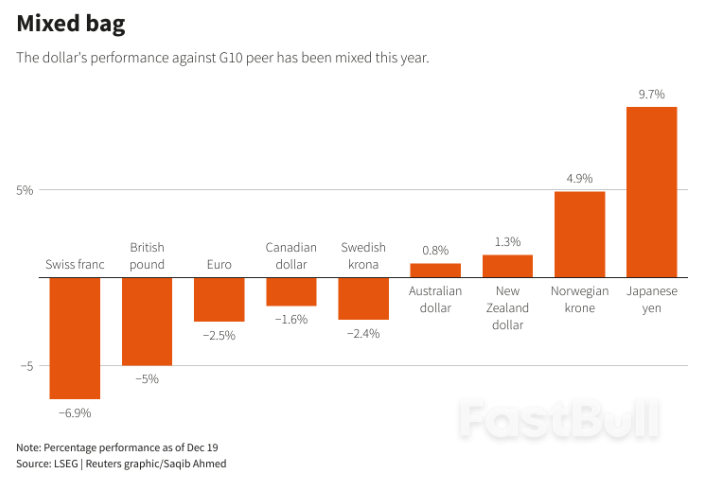
          After soaring to a two-decade high on the back of the Fed's rate hikes in 2022, the U.S. currency has been largely range-bound this year on the back of resilient U.S. growth and the central bank's vow to keep borrowing costs elevated.
          The dollar was on track for a 2% loss this year against a basket of its peers , its first yearly decline since 2020.
          The December Fed meeting marked an unexpected shift, after Chairman Jerome Powell said the historic monetary policy tightening that brought rates to their highest level in decades was likely over, thanks to cooling inflation. Policymakers now project 75 basis points of cuts next year.
          Falling rates are generally seen as a headwind for the dollar, making assets in the U.S. currency less attractive to yield-seeking investors. Though strategists had expected the dollar to weaken next year, a faster pace of rate cuts could accelerate the currency's decline.
          Still, betting on a weaker dollar has been a perilous undertaking in recent years, and some investors are wary of jumping the gun. A U.S. economy that continues to outperform its peers could be one factor presenting an obstacle for bearish investors.
          The Fed's aggressive monetary policy tightening, along with post-pandemic policies to boost U.S. growth, "fueled the notion of American exceptionalism and delivered the most powerful dollar rally since the 1980s," said Kit Juckes, chief FX strategist at Societe Generale.
          With the Fed set to ease policy, "some of those gains should be reversed," he said.

          FADING STRENGTH?

          Getting the dollar right is key for analysts and investors, given the U.S. currency's central role in global finance.
          For the U.S., a weak dollar would make exports more competitive abroad and boost the profits of multinationals by making it cheaper to convert their foreign profits into dollars. About a quarter of S&P 500 companies generate more than 50% of revenues outside the U.S., according to FactSet data.
          An early December Reuters poll of 71 FX strategists showed expectations for the dollar to fall against G10 currencies in 2024, with the greater part of its decline coming in the second half of the year.
          King Dollar Seen Vulnerable in 2024 If Fed Pivots_1
          Whether they're right may come down to how the U.S. economy performs compared to its global peers next year and the pace at which central banks adjust monetary policy.
          So far, it's been an uneven picture. In the eurozone, a downturn in business activity deepened in December, according to closely watched surveys that show the bloc's economy is almost certainly in recession. Still, the European Central Bank has pushed back against rate cut expectations as it remains focused on fighting inflation. The euro is up more than 3% against the dollar this year.
          The "growth slowdown is more entrenched in other economies," said Thanos Bardas, senior portfolio manager at Neuberger Berman, who is bullish on the dollar over the next 12 months. "For the U.S. it will take a while for growth to slow down."
          Others, however, see areas of strength, particularly in Asian economies. Paresh Upadhyaya, director of fixed income and currency strategy at Amundi US, says he believes the market is "way too pessimistic" on the outlook for growth in China and India. Accelerating growth could boost the countries' appetite for raw materials, benefiting commodity currencies such as the Australian, New Zealand and Canadian dollars.
          China will step up policy adjustments to support an economic recovery in 2024, according to state media reports.
          Jack McIntyre, portfolio manager at Brandywine Global in Philadelphia, is counting on U.S. growth slowing while Chinese growth picks up. He has been selling the dollar to fund the purchase of Asian currencies.
          "The dollar's bull run is very mature," he said.
          The International Monetary Fund in October forecast the U.S. economy would grow by 1.5% in 2024, compared to 1.2% for the eurozone and 4.2% for China.
          Of course, the dollar's trajectory could depend on how much Fed easing and falling inflation is already reflected in its price. Futures tied to the Fed's policy rate show investors factoring in more than 150 basis points in cuts next year, about twice as much as Fed policymakers have penciled in.
          "If inflation stalls and does not continue to decline that's where the case grows for the Fed to hold off," said Matt Weller, head of market research at StoneX. "That would certainly be a bullish development for the dollar."

          Source: REUTERS

          To stay updated on all economic events of today, please check out our Economic calendar
          Risk Warnings and Disclaimers
          You understand and acknowledge that there is a high degree of risk involved in trading. Following any strategies or investment methods may lead to potential losses. The content on the site is provided by our contributors and analysts for information purposes only. You are solely responsible for determining whether any trading assets, securities, strategy, or any other product is suitable for investing based on your own investment objectives and financial situation.
          Comments
          Add to Favorites
          Share

          Global Economy Faces Rough Weather Ahead

          Damon

          Economic

          Rising prices trigger protests as Fed's interest rate hikes cause spillover effects worldwide
          US actors Bryan Cranston and Aaron Paul met again in August. This time not for the reunion of the Breaking Bad series, but on the picket line in solidarity protests with other Hollywood actors.
          Speaking to the crowd, Cranston said, "We just want them to see reality and fairness and come back to the table and talk to us."
          Striking actors started the rally in mid-July, more than two months after screenwriters began protests in their bid to get better pay and working conditions under the influence of streaming services and artificial intelligence.
          The celebrity-packed picket lines brought more attention to the so-called Hollywood double strike — writers and actors — unseen in 60 years.
          From coast to coast, a wave of strikes has gripped the US throughout 2023, rippling across industries such as logistics and automobiles.
          The country's United Auto Workers union began a strike in mid-September against all the Big Three automakers, namely Ford Motor, General Motors and Stellantis. The first-ever strike of all three at once in the union's 88-year history came after failed talks on new contracts.
          In the past 50 years across the United States, there has been a massive redistribution of wealth, Vermont Senator Bernie Sanders said at a rally, highlighting the rising salaries of the CEOs of the Big Three automakers.
          Against this backdrop, the union had reportedly been negotiating for significantly higher pay and new benefits.
          "After the pandemic, the US economy grappled with sluggish growth and encountered intense competition from other countries, presenting challenges for businesses," Wang Zhen, a research professor of international politics at the Institute of International Relations, Shanghai Academy of Social Sciences, told China Daily.
          During the pandemic, the US implemented stimulus packages to bolster the economy.
          "The fiscal expansion policies led to high inflation and elevated the cost of living for the working class," Wang said. "In addition, technological advancements, particularly artificial intelligence, have encroached upon the traditional interests of corporate workers, prompting them to take to the streets to defend their rights."
          The US inflation rate started to grow at a more than 2 percent rate from March 2021 and peaked at 9.1 percent in June 2022 to a 40-year high, according to the US Bureau of Labor Statistics.
          To tame inflation, the US Federal Reserve raised its benchmark policy interest rate 11 times since March 2022 from the near-zero level to the current 5.25-5.50 percent range, marking the fastest pace in 40 years.
          "The Fed is as aggressive as it has been since the early 1980s," Chris Turner, global head of markets at the Dutch banking group ING, was quoted by CNN as saying.
          "They're willing to tolerate higher unemployment and a recession", he said. "That's not good for international growth."
          Even though inflation has eased from a peak of 9.1 percent last year, it remains too high for the Fed.
          The US central bank said it remains "highly attentive to inflation risks" and that it is strongly committed to returning inflation to its 2 percent goal as it left interest rates unchanged on a Dec 13 meeting, a third pause from September.
          The rate-setting group pointed to recent indicators showing that economic activity has slowed in the third quarter.
          The high rates have put the banking system under pressure, which has seen the collapse of Silicon Valley Bank and Signature Bank in March, and the failure of First Republic Bank in May. Elsewhere, UBS agreed in March to buy Credit Suisse in a rescue move to avert a banking sector meltdown.
          "Ripple effects of US financial system strains could lead to tighter credit, sharper slowdown worldwide," said a report by The Wall Street Journal earlier this year. "Turmoil in the US banking sector isn't just a problem for the US. It also increases the risks of a global recession."
          Xu Gao, chief economist at Bank of China International, told China Daily, "After the collapse of the Silicon Valley Bank, the growth rate of credit extended to entities by the US banking system showed a slower pace.
          "Once the accumulated liquidity is drained, the impact of subsequent liquidity crunch is expected to manifest in the real economy."
          Citing the manufacturing purchasing managers index in the US which has run under 50 since November last year, Xu said, "Although the US economy seems to be doing well this year, its role as a driving force for global economic growth has declined."
          The World Economic Outlook published by the International Monetary Fund in October said: "Borrowing costs for emerging (markets) and developing economies remain high, constraining priority spending and raising the risk of debt distress.… The danger is of a sharp repricing of risk, especially for emerging markets, that would appreciate further the US dollar, trigger capital outflows, and increase borrowing costs and debt distress."
          In November, European Central Bank President Christine Lagarde told the European Parliament that although she expected the weakening of inflationary pressures to continue, "the medium-term outlook for inflation remains surrounded by considerable uncertainty". She said wages would continue to play a pivotal role in driving domestic inflation.
          Daily squeeze on budgets
          Tomas Hnyk, a Prague resident, told China Daily that ordinary people face a daily squeeze on their budgets.
          "The costs of energy and food and their basic services increased by a lot more than their income," he said.
          Energy prices have surged, especially after the Russia-Ukraine conflict, which cast a long shadow on the continent as no quick ending is seen, he said.
          "Prices went up for almost everything," he said. "Despite inflation being smaller than it was, it is still a big issue. For people with less money, it is a huge deal."
          This frustration is not only felt in the Czech Republic, but also across other European countries, as they have experienced a wave of protests, with citizens demanding concrete steps from the government to ease their economic burden.
          In France, people protested against an increase in the retirement age. In Germany, striking transportation workers caused major disruptions at airports and bus and train stations.
          The United Kingdom also witnessed pay disputes across sectors, with workers demanding higher wages. Strikes in schools, railways and hospitals have become more frequent, notably in the National Health Service, where health workers staged the largest strike in its 75-year history. The financial strain intensified as Birmingham and Nottingham declared bankruptcy in September and November, respectively.
          Meanwhile, Africa suffers from high inflation, as highlighted in the IMF Regional Economic Outlook for Sub-Saharan Africa published in October, which said: "Inflation is still too high. Inflation at end 2023 is projected to stay in double digits in 14 countries."
          In its Economic Outlook published in late November, the Organization for Economic Cooperation and Development said it expected the global economy to slow down slightly in 2024 as a result of the tightening of monetary policy, weaker trade and dipping consumer confidence.
          It projected a global GDP growth of 2.9 percent in 2023, followed by a mild slowdown to 2.7 percent in 2024 and a slight improvement to 3 percent in 2025. Asia is expected to continue to account for the bulk of global growth in 2024-25, as it has done this year.
          Observers noted a recent trend of de-globalization, spearheaded by the US, resulting in disruptions to global supply chains.
          The US and its Western allies "have been the biggest beneficiaries "of world economic integration and globalization since the end of the Cold War, Wang from the Shanghai Academy of Social Sciences said.
          However, since former US president Donald Trump assumed office in 2017, a shift toward anti-globalization policies has been evident, initiating trade and technology wars aimed at curbing the ascent of developing countries, Wang said.
          "These policies, among others, failed to achieve the 'manufacturing reshoring' advocated by US policymakers, and have increased the operation costs for enterprises. This, in turn, burdens people across the globe, and poses a challenge to the world economic recovery after the pandemic."
          Leading to disruptions
          The so-called decoupling or de-risking undeniably leads to disruptions to the global supply chains, said Xu from the Bank of China International. "The potential hurdles and risks associated with this trend raise valid concerns about the overall stability and interconnectedness of the global economic landscape."
          Commenting on economic security, Pascal Lamy, former director-general of the World Trade Organization, said: "You cannot do anything just by waving your flag of national security. This would destroy the multilateral trading system. So we have an issue which I think necessitates better attention."
          As the US monetary tightening cycle nears an end, there is a real risk of recession for the US whose economy stands at a "precarious crossroads", Xu said, pointing to challenges to global economic recovery.
          "Although overall if I look at these three engines — technology, ideology, and peace or geopolitical tensions or conflicts — I still believe that these engines will keep pushing for globalization," Lamy told a recent event hosted by the Center for China and Globalization.
          2024 will be a pivotal year for elections worldwide, coupled with the Russia-Ukraine conflict and the Gaza crisis, which will add to uncertainties across the globe, Wang said.
          Although headwinds abound, Wang remains cautiously optimistic about the potential growth.
          "It is still possible for the international community to maintain overall peace. After the pandemic, the willingness of countries around the world to strive for economic development has not waned, and the momentum of technological change has not stalled," he said.
          "Additionally, the negative repercussions of the Fed's rate hikes will be absorbed gradually, and it is widely anticipated that the Fed will pivot to monetary easing next year. These factors combined will bring new impetus and hope to the recovery of the world economy."

          Source: ChinaDaily

          To stay updated on all economic events of today, please check out our Economic calendar
          Risk Warnings and Disclaimers
          You understand and acknowledge that there is a high degree of risk involved in trading. Following any strategies or investment methods may lead to potential losses. The content on the site is provided by our contributors and analysts for information purposes only. You are solely responsible for determining whether any trading assets, securities, strategy, or any other product is suitable for investing based on your own investment objectives and financial situation.
          Comments
          Add to Favorites
          Share

          What Does China's 2024 Economic Policy Look Like?

          Samantha Luan

          Economic

          The 2023 Chinese Central Economic Work Conference (CEWC), an annual meeting mechanism of the Communist Party where the economic direction of the nation for the upcoming year is deliberated and agreed upon by key stakeholders, recently concluded on December 12, and the readout from the meeting stresses a stability-oriented pathway for the Chinese economy in 2024. Overall, the line of action seems pretty clear, at least from the CEWC deliberations - moving away from export-led to domestic demand-led growth, expanding high-quality production process, achieving self-reliance in critical tech but collaborating with trade partners as necessary, and ensuring financial discipline alongside stability of funds and liquidity. Needless to say, many of these goals have been repeated in the past few years, but some of them require intense structural reform, including by means of abandoning long-held beliefs and practices of the Chinese party-state.
          How is China strategically addressing the challenges?
          To begin with, the 2023 CEWC acknowledged that China is indeed leaving behind three years of tumultuous economic policy planning during the COVID-19 Pandemic, concentrating now on economic recovery in key areas.
          The first key area, in this regard, is dual circulation. As global demand has continued to decline amidst heightened sentiments of protectionism and ‘de-risking', thereby leaving overcapacity in China's manufacturing sector unaddressed, the country is now looking inwards to boost domestic consumption and only allow for a complimentary relationship with international demand. The Chinese President Xi Jinping has referred to this as the "New Pattern of Development," and is an ambitious structural reform for a country known as the world's manufacturing hub. Hence, it is likely that going forth, the country shall lay increased emphasis on domestic demand as the mainstay of economic growth, with international demand only complimenting it.
          What specific measures or strategies are being implemented?
          The turn to domestic demand has now accentuated the concept of "high-quality" growth of the economy, i.e. growth which is only backed by quantitative success and not superseded by it. For the CPC, addressing the primary economic and developmental contradiction of the century is key to ensuring domestic legitimacy, and under Mr. Xi, the principal contradiction is between unbalanced and inadequate development and the people's ever-growing needs for a better life. Naturally, the need for a better life has become the foundation for high-quality growth, alongside the necessity to focus resources on specialized self-reliance, which is being fuelled by U.S.-China geopolitical contestation and declining exports.
          The focus is also now on vitalising research and development in sectors requiring high-quality growth, such as high-technology and sustainable manufacturing, while little provisions have been made for low-end manufacturing segments in the CEWC readout. Agriculture, however, has continued to receive attention, given that the sector continues to contribute about 7.3% to the Chinese GDP, and about 5% to GDP growth (both as of 2022). Moreover, agriculture-linked incentives align with other policy goals such as "rural revitalisation" and food security. At the same time, the economic plan also aims to technologically advance agriculture through the establishment of "agriculture innovation centers."
          Self-reliance in core technologies has continued to be a repeated and explicit goal for the revival of the Chinese economy, in the backdrop of intensifying tech-related export controls placed by the U.S. and its issue-based and treaty-based allies (such as the Netherlands and Japan respectively) against China. Although, the language of the CEWC readout has changed from "self-improvement" in high-technology in 2022 to "strength" in 2023. Speculatively, it may be so that the shift from self-improvement to strength demonstration is a factor of boosted confidence of the CPC in the past year, amidst developments such as the development of a 7 nanometer chip by Semiconductor Manufacturing International Corporation (SMIC), a Chinese fabrication company, just a few months ago, as well as other strides in the application of Artificial Intelligence technology in defence. It could also mean that there is now a focus on strengthening innovation and advancement in core technologies in China has already demonstrated capabilities in.
          Domestically, the stance on financial policy has remained the same, which is, following a "prudent monetary policy" and a "proactive fiscal policy." The latter was also reiterated at the Central Financial Work Conference that took place just a month ago and has now become part of the implementational mandate of the newly established Central Finance Commission led by Premier Li Qiang. Under ‘proactive fiscal policy', in the past year, China has mobilised tools such as tax rebates for medium and small enterprises, as well as interest rate discounts for local governments. This is to enable them to alleviate some of the debt stress and continue to invest either in keeping employees on a regular payroll (which applies to MSEs) or in unhindered development of infrastructure (which is applicable to local governments).
          The idea of easing local government finance vehicle (LGFV) debt, for example, was broached at the Politburo meeting held in July this year, where it was declared that a debt-relief package was essential at the local and regional governments' level. By October, the Standing Committee of the National People's Congress approved a special bond issuance worth CNY 1 trillion to select local governments in the aftermath of several natural disasters like floods and typhoons, so that their post-disaster recovery and infrastructural resilience plans continue as normal. This was, of course, not a direct LGFV bailout, but provided room above-budget for funding-impaired local governments that also faced the brunt of disaster recovery.
          But at the same time, the 2023 CEWC readout has issued a fair warning to local authorities, that they have to become accustomed to frugality. This has been coupled with a warning notice on strict supervision of financial discipline. It is no secret that amidst flailing domestic private investment which gave a boost to provincial government funds for their infrastructure projects, the debt burden on local authorities has increased. Although numbers differ, the recorded LGFV debt in China is somewhere around $60 trillion. This debt is inclusive of loans, bonds, and shadow bank borrowing. And so, the highlight of the economic policy in this regard will not be bailouts, but mere "fiscal sustainability."
          The monetary policy is to follow a similar approach, where the levels of liquidity in the economy are to be stabilized, and excessive infusion of liquidity is to be avoided. This is unlike what was promised by former Chinese Vice Premier Liu He at the Davos Forum at the very beginning of this year, where he vowed to give a "blood transfusion" to the economy. This is, however, not to say that the attention on stability isn't prudent, given that Yuan has depreciated 8% against the dollar in 2023. The sentiment was different in January when the currency peaked in the aftermath of the scrapping of the Zero-COVID policy. Moreover, critical factors such as lack of income confidence, increasing unemployment against rising age dependency ratio, stagnation of household savings at a high point, and capital outflows exacerbated by geopolitical hostility, all indicate that injecting more liquidity will do no good as overall investment and borrowing sentiments are in decline.
          Finally, to alleviate some of the economic concerns caused by capital flight and geopolitical competition, in addition to reiterating self-reliance and domestic consumption-led growth, the 2023 CEWC has made the interesting provision to "promote balanced trade" to "increase international demand." It seems from this statement that China is willing to take some of the fences down vis-a-vis access to its market for its key trade partners (especially the European Union, which is now increasingly emphasizing "de-risking"). In doing so, trade may become more "balanced" and not necessarily lop-sided in China's favour. It not only helps China to continue on the path to "opening-up," which has been called for many times in the CEWC readout, but also fulfills the two-pronged goal of enabling China's high-quality growth and circumventing any real decoupling. At the same time, it allows China to focus its crunched resources on self-reliance in key verticals such as high technology and food insecurity, where geopolitical contestation with the U.S. is unlikely to let up anytime soon.

          Source: The Hindu

          To stay updated on all economic events of today, please check out our Economic calendar
          Risk Warnings and Disclaimers
          You understand and acknowledge that there is a high degree of risk involved in trading. Following any strategies or investment methods may lead to potential losses. The content on the site is provided by our contributors and analysts for information purposes only. You are solely responsible for determining whether any trading assets, securities, strategy, or any other product is suitable for investing based on your own investment objectives and financial situation.
          Comments
          Add to Favorites
          Share
          FastBull
          Copyright © 2025 FastBull Ltd

          728 RM B 7/F GEE LOK IND BLDG NO 34 HUNG TO RD KWUN TONG KLN HONG KONG

          TelegramInstagramTwitterfacebooklinkedin
          App Store Google Play Google Play
          Products
          Charts

          Chats

          Q&A with Experts
          Screeners
          Economic Calendar
          Data
          Tools
          Membership
          Features
          Function
          Markets
          Copy Trading
          Latest Signals
          Contests
          News
          Analysis
          24/7
          Columns
          Education
          Company
          Careers
          About Us
          Contact Us
          Advertising
          Help Center
          Feedback
          User Agreement
          Privacy Policy
          Business

          White Label

          Data API

          Web Plug-ins

          Poster Maker

          Affiliate Program

          Risk Disclosure

          The risk of loss in trading financial instruments such as stocks, FX, commodities, futures, bonds, ETFs and crypto can be substantial. You may sustain a total loss of the funds that you deposit with your broker. Therefore, you should carefully consider whether such trading is suitable for you in light of your circumstances and financial resources.

          No decision to invest should be made without thoroughly conducting due diligence by yourself or consulting with your financial advisors. Our web content might not suit you since we don't know your financial conditions and investment needs. Our financial information might have latency or contain inaccuracy, so you should be fully responsible for any of your trading and investment decisions. The company will not be responsible for your capital loss.

          Without getting permission from the website, you are not allowed to copy the website's graphics, texts, or trademarks. Intellectual property rights in the content or data incorporated into this website belong to its providers and exchange merchants.

          Not Logged In

          Log in to access more features

          FastBull Membership

          Not yet

          Purchase

          Become a signal provider
          Help Center
          Customer Service
          Dark Mode
          Price Up/Down Colors

          Log In

          Sign Up

          Position
          Layout
          Fullscreen
          Default to Chart
          The chart page opens by default when you visit fastbull.com