• Trade
  • Markets
  • Copy
  • Contests
  • News
  • 24/7
  • Calendar
  • Q&A
  • Chats
Screeners
SYMBOL
LAST
ASK
BID
HIGH
LOW
NET CHG.
%CHG.
SPREAD
SPX
S&P 500 Index
6939.02
6939.02
6939.02
6964.08
6893.47
-29.99
-0.43%
--
DJI
Dow Jones Industrial Average
48892.46
48892.46
48892.46
49047.68
48459.88
-179.09
-0.36%
--
IXIC
NASDAQ Composite Index
23461.81
23461.81
23461.81
23662.25
23351.55
-223.30
-0.94%
--
USDX
US Dollar Index
96.970
97.050
96.970
97.140
96.840
-0.020
-0.02%
--
EURUSD
Euro / US Dollar
1.18558
1.18567
1.18558
1.18745
1.18393
+0.00067
+ 0.06%
--
GBPUSD
Pound Sterling / US Dollar
1.36827
1.36838
1.36827
1.37053
1.36600
-0.00008
-0.01%
--
XAUUSD
Gold / US Dollar
4594.65
4595.08
4594.65
4884.47
4402.03
-299.84
-6.13%
--
WTI
Light Sweet Crude Oil
61.581
61.611
61.581
63.933
61.209
-3.846
-5.88%
--

Community Accounts

Signal Accounts
--
Profit Accounts
--
Loss Accounts
--
View More

Become a signal provider

Sell trading signals to earn additional income

View More

Guide to Copy Trading

Get started with ease and confidence

View More

Signal Accounts for Members

All Signal Accounts

Best Return
  • Best Return
  • Best P/L
  • Best MDD
Past 1W
  • Past 1W
  • Past 1M
  • Past 1Y

All Contests

  • All
  • Trump Updates
  • Recommend
  • Stocks
  • Cryptocurrencies
  • Central Banks
  • Featured News
Top News Only
Share

India's Nifty 50 Index Last Up 0.5%

Share

Swedish Manufacturing PMI 56.0 Points In Jan - Silf/Swedbank

Share

Stats Office - Swiss December Retail Sales +2.9% Year-On-Year Versus Revised +1.7% In Previous Month

Share

Iran's Foreign Ministry Spokesperson Baghaei Says Tehran Is Examining Details Of Various Diplomatic Processes, Hopes For Results In Coming Days

Share

Israel Expected To Reopen Gaza's Rafah Border Crossing To Egypt, With Limits

Share

FAA Head Says Concerned Other Countries Aren't Putting Enough Resources Into Certifying USA Aircraft

Share

European Benchmark Gas Contract Falls 10.5% To 35.50 EUR/Mwh - Lseg Data

Share

Statistics Bureau - Kazakhstan's January CPI At 1.0% Month-On-Month

Share

S&P Global: Kazakhstan January Manufacturing PMI At 49.8%

Share

German Dec Retail Sales +1.5 Percent Year-On-Year (Versus Reuters Consensus Forecast For +1.1 Percent)

Share

Russian Security Committee's Vice Chairman Medvedev: Russia Will Not Accept NATO-Member Forces In Ukraine

Share

Russian Security Committee's Vice Chairman Medvedev: Nuclear Arms Control For Past 60 Years Helped Verify Intentions And Build Trust

Share

Russian Security Committee's Vice Chairman Medvedev: The Territorial Issue In Ukraine Talks Is Most Complicated

Share

Russian Security Committee's Vice Chairman Medvedev: If New Start Expires It Does Not Necessarily Mean A Catastrophe But It Should Alarm Everyone

Share

Russian Security Committee's Vice Chairman Medvedev: Our Proposal To USA On Extending The Limits Of New Start Remains On The Table

Share

USA Dollar Jumps 1% Against Norwegian Crown To 9.7062

Share

Turkey's Main BIST 100 Index Down 1.7% At Early Trading

Share

India's Nifty 50 Index Last Up 0.4%

Share

Kazakhstan's Central Bank Says It Sold Foreign Currency Worth 350 Billion Tenge In January To Mirror Gold Purchases, Will Sell Foreign Currency Worth 350 Billion In February

Share

Spot Gold Extends Losses, Last Down Over 9% At $4403,29.Oz

TIME
ACT
FCST
PREV
U.S. Core PPI YoY (Dec)

A:--

F: --

P: --
U.S. Core PPI MoM (SA) (Dec)

A:--

F: --

P: --

U.S. PPI YoY (Dec)

A:--

F: --

P: --

U.S. PPI MoM (SA) (Dec)

A:--

F: --

P: --

Canada GDP MoM (SA) (Nov)

A:--

F: --

P: --

Canada GDP YoY (Nov)

A:--

F: --

P: --

U.S. PPI MoM Final (Excl. Food, Energy and Trade) (SA) (Dec)

A:--

F: --

P: --

U.S. PPI YoY (Excl. Food, Energy & Trade) (Dec)

A:--

F: --

P: --

U.S. Chicago PMI (Jan)

A:--

F: --

P: --
Canada Federal Government Budget Balance (Nov)

A:--

F: --

P: --

U.S. Weekly Total Oil Rig Count

A:--

F: --

P: --

U.S. Weekly Total Rig Count

A:--

F: --

P: --

China, Mainland NBS Manufacturing PMI (Jan)

A:--

F: --

P: --

China, Mainland NBS Non-manufacturing PMI (Jan)

A:--

F: --

P: --

China, Mainland Composite PMI (Jan)

A:--

F: --

P: --

South Korea Trade Balance Prelim (Jan)

A:--

F: --

P: --
Japan Manufacturing PMI Final (Jan)

A:--

F: --

P: --

South Korea IHS Markit Manufacturing PMI (SA) (Jan)

A:--

F: --

P: --

Indonesia IHS Markit Manufacturing PMI (Jan)

A:--

F: --

P: --

China, Mainland Caixin Manufacturing PMI (SA) (Jan)

A:--

F: --

P: --

Indonesia Trade Balance (Dec)

A:--

F: --

P: --

Indonesia Inflation Rate YoY (Jan)

A:--

F: --

P: --

Indonesia Core Inflation YoY (Jan)

A:--

F: --

P: --

India HSBC Manufacturing PMI Final (Jan)

A:--

F: --

P: --

Australia Commodity Price YoY (Jan)

A:--

F: --

P: --

Russia IHS Markit Manufacturing PMI (Jan)

A:--

F: --

P: --

Turkey Manufacturing PMI (Jan)

A:--

F: --

P: --

U.K. Nationwide House Price Index MoM (Jan)

A:--

F: --

P: --

U.K. Nationwide House Price Index YoY (Jan)

A:--

F: --

P: --

Germany Actual Retail Sales MoM (Dec)

A:--

F: --

P: --
Italy Manufacturing PMI (SA) (Jan)

--

F: --

P: --

South Africa Manufacturing PMI (Jan)

--

F: --

P: --

Euro Zone Manufacturing PMI Final (Jan)

--

F: --

P: --

U.K. Manufacturing PMI Final (Jan)

--

F: --

P: --

Brazil IHS Markit Manufacturing PMI (Jan)

--

F: --

P: --

Canada National Economic Confidence Index

--

F: --

P: --

Canada Manufacturing PMI (SA) (Jan)

--

F: --

P: --

U.S. IHS Markit Manufacturing PMI Final (Jan)

--

F: --

P: --

U.S. ISM Output Index (Jan)

--

F: --

P: --

U.S. ISM Inventories Index (Jan)

--

F: --

P: --

U.S. ISM Manufacturing Employment Index (Jan)

--

F: --

P: --

U.S. ISM Manufacturing New Orders Index (Jan)

--

F: --

P: --

U.S. ISM Manufacturing PMI (Jan)

--

F: --

P: --

South Korea CPI YoY (Jan)

--

F: --

P: --

Japan Monetary Base YoY (SA) (Jan)

--

F: --

P: --

Australia Building Approval Total YoY (Dec)

--

F: --

P: --

Australia Building Permits MoM (SA) (Dec)

--

F: --

P: --

Australia Building Permits YoY (SA) (Dec)

--

F: --

P: --

Australia Private Building Permits MoM (SA) (Dec)

--

F: --

P: --

Australia Overnight (Borrowing) Key Rate

--

F: --

P: --

RBA Rate Statement
Japan 10-Year Note Auction Yield

--

F: --

P: --

Saudi Arabia IHS Markit Composite PMI (Jan)

--

F: --

P: --

RBA Press Conference
Turkey PPI YoY (Jan)

--

F: --

P: --

Turkey CPI YoY (Jan)

--

F: --

P: --

Turkey CPI YoY (Excl. Energy, Food, Beverage, Tobacco & Gold) (Jan)

--

F: --

P: --

Q&A with Experts
    • All
    • Chatrooms
    • Groups
    • Friends
    SlowBear ⛅ flag
    Ikeh Sunday
    @Ikeh SundayReally? cos the chart i saw earlier wa sthat of XAUUSD and not XAGUSD
    Ikeh Sunday flag
    SlowBear ⛅
    @SlowBear ⛅am on one month on silver chart. it was gold i show 15m view
    Ikeh Sunday flag
    SlowBear ⛅
    @SlowBear ⛅the one with entry is silver not gold
    SlowBear ⛅ flag
    Ikeh Sunday
    @Ikeh Sunday Oh got it now, thanks for that clarification
    Ikeh Sunday flag
    SlowBear ⛅
    @SlowBear ⛅ur well come
    SlowBear ⛅ flag
    Ikeh Sunday
    @Ikeh Sunday Cool that is clear now, so you are selling and targeting 70.20 on Silver not bad i will look into it myself
    SlowBear ⛅ flag
    Ikeh Sunday
    @Ikeh Sunday Wow, you are one discipline trader bro, you are very loyal to silver
    Ikeh Sunday flag
    SlowBear ⛅
    @SlowBear ⛅am use to it and besides it's the only instrument that moves in volume . we just have to get it right or get wiped
    SlowBear ⛅ flag
    Ikeh Sunday
    @Ikeh Sunday I completely understands you bro, experience mixed with sustainability - Silver provides both!
    Kung Fu flag
    Ikeh Sunday
    @Ikeh SundayI'd rather target a sellside when or if silver drops to $70.
    SlowBear ⛅ flag
    Ikeh Sunday
    @Ikeh SundayAnd getting it right comes in slow but once mastered that is all you need to buy a mansion in Johanesburg!
    Kung Fu flag
    I'd look for more sellside just below $70, precisely at $69.50. That's a breakout to the downside @Ikeh Sunday
    Kung Fu flag
    @Ikeh Sunday$65 will be, in that case, my very first target.
    JOSHUA flag
    Seems gold is picking up
    SlowBear ⛅ flag
    JOSHUA
    Seems gold is picking up
    @JOSHUAIt will pick up, but the pick will be slow and sluggish - so stay on a look out
    favour flag
    JOSHUA
    Seems gold is picking up
    @JOSHUAnot yet
    favour flag
    JOSHUA
    Seems gold is picking up
    @JOSHUAjust respected a FVG
    SlowBear ⛅ flag
    JOSHUA
    Seems gold is picking up
    @JOSHUAif you in fact wants to trade Gold today just look for an entry on 5min timeframe
    Kung Fu flag
    JOSHUA
    Seems gold is picking up
    @JOSHUAmaybe. Maybe that pickup is only a shallow retracement
    Kung Fu flag
    @JOSHUAin what time frame are you viewing it
    Type here...
    Add Symbol or Code

      No matching data

      All
      Trump Updates
      Recommend
      Stocks
      Cryptocurrencies
      Central Banks
      Featured News
      • All
      • Russia-Ukraine Conflict
      • Middle East Flashpoint
      • All
      • Russia-Ukraine Conflict
      • Middle East Flashpoint
      Search
      Products

      Charts Free Forever

      Chats Q&A with Experts
      Screeners Economic Calendar Data Tools
      Membership Features
      Data Warehouse Market Trends Institutional Data Policy Rates Macro

      Market Trends

      Market Sentiment Order Book Forex Correlations

      Top Indicators

      Charts Free Forever
      Markets

      News

      News Analysis 24/7 Columns Education
      From Institutions From Analysts
      Topics Columnists

      Latest Views

      Latest Views

      Trending Topics

      Top Columnists

      Latest Update

      Signals

      Copy Rankings Latest Signals Become a signal provider AI Rating
      Contests
      Brokers

      Overview Brokers Assessment Rankings Regulators News Claims
      Broker listing Forex Brokers Comparison Tool Live Spread Comparison Scam
      Q&A Complaint Scam Alert Videos Tips to Detect Scam
      More

      Business
      Events
      Careers About Us Advertising Help Center

      White Label

      Data API

      Web Plug-ins

      Affiliate Program

      Awards Institution Evaluation IB Seminar Salon Event Exhibition
      Vietnam Thailand Singapore Dubai
      Fans Party Investment Sharing Session
      FastBull Summit BrokersView Expo
      Recent Searches
        Top Searches
          Markets
          News
          Analysis
          User
          24/7
          Economic Calendar
          Education
          Data
          • Names
          • Latest
          • Prev

          View All

          No data

          Scan to Download

          Faster Charts, Chat Faster!

          Download App
          English
          • English
          • Español
          • العربية
          • Bahasa Indonesia
          • Bahasa Melayu
          • Tiếng Việt
          • ภาษาไทย
          • Français
          • Italiano
          • Türkçe
          • Русский язык
          • 简中
          • 繁中
          Open Account
          Search
          Products
          Charts Free Forever
          Markets
          News
          Signals

          Copy Rankings Latest Signals Become a signal provider AI Rating
          Contests
          Brokers

          Overview Brokers Assessment Rankings Regulators News Claims
          Broker listing Forex Brokers Comparison Tool Live Spread Comparison Scam
          Q&A Complaint Scam Alert Videos Tips to Detect Scam
          More

          Business
          Events
          Careers About Us Advertising Help Center

          White Label

          Data API

          Web Plug-ins

          Affiliate Program

          Awards Institution Evaluation IB Seminar Salon Event Exhibition
          Vietnam Thailand Singapore Dubai
          Fans Party Investment Sharing Session
          FastBull Summit BrokersView Expo

          EU Prepares Sanctions on Kyrgyzstan Over Alleged Role in Circumventing Russia Restrictions

          Gerik

          Economic

          Summary:

          The European Union is set to sanction Kyrgyzstan for allegedly facilitating trade that helps Russia bypass Western restrictions, marking the first time Brussels has activated its anti circumvention mechanism against a third country....

          A Precedent Setting Move By Brussels

          The European Union is preparing to impose sanctions on Kyrgyzstan for allegedly enabling trade flows that undermine restrictions placed on Russia. If implemented, this would represent the first activation of the EU’s anti circumvention mechanism against a non member state, signaling a significant escalation in enforcement strategy.
          Proposed measures include restrictions on exports of machinery and selected radio and telecommunications equipment to Kyrgyzstan. The intent is not only punitive but preventative, aiming to close logistical and financial pathways that allow sanctioned goods to reach Russia indirectly.

          Tightening The Net Around Russia’s Financial And Energy Sectors

          Alongside the proposed actions against Kyrgyzstan, the EU is considering further tightening sanctions on Russian banks and oil companies. Crypto related services and other financial institutions suspected of helping Moscow evade restrictions may also be targeted. The upcoming package is expected to broaden trade limitations on companies and products linked to Russia’s defense industry, while certain Russian metal imports could face new barriers.
          EU officials argue that these steps reflect a deliberate effort to strengthen enforcement rather than merely expand sanction lists. The objective is to reduce leakage points that weaken the overall effectiveness of the sanctions regime.

          Why Kyrgyzstan Has Drawn Scrutiny

          Western officials increasingly view Kyrgyzstan as a commercial intermediary for Russia since the outbreak of the Russia Ukraine conflict in 2022. As sanctions restricted Moscow’s direct access to Western markets, Russia appears to have relied more heavily on alternative trade routes through friendly or loosely regulated partners.
          Economic ties between Russia and Kyrgyzstan have deepened markedly. Bilateral trade rose from around 2 billion USD in 2021 to 3.3 billion USD in 2023, before reaching approximately 5 billion USD in 2025. This rapid growth has raised concerns that Kyrgyzstan’s economy is being used as a conduit rather than as a purely independent trading partner.

          Structural Factors Enabling Trade Diversion

          As a member of the Eurasian Economic Union, Kyrgyzstan benefits from relatively open access to the Russian market and limited internal border controls. After 2022, imports into Kyrgyzstan from both China and the EU surged. Imports from the EU alone jumped from 310 million USD in 2021 to nearly 3 billion USD in 2024, with a significant portion reportedly re exported onward to Russia.
          Sanctions have constrained Russia’s access to machinery, electronics, vehicles, and other goods with potential military or dual use applications. The combination of increased imports into Kyrgyzstan and expanding exports to Russia has therefore drawn heightened attention from European regulators.

          From Trade Corridor To Financial Hub

          Some analysts suggest that Kyrgyzstan’s role extends beyond goods transit. An economist from Kyrgyzstan told Reuters that, as a consequence of sanctions, the country has effectively become a form of offshore financial center for Russian companies, allowing them to use Kyrgyzstan’s financial system to manage transactions and maintain access to international trade networks.
          This assessment highlights a correlation between sanctions pressure on Russia and the rapid expansion of Kyrgyzstan’s trade and financial activity. While not definitive proof of causation in every transaction, the scale and timing of the shift have reinforced EU concerns.

          Implications For Sanctions Enforcement

          If the EU proceeds with sanctions against Kyrgyzstan, the move would send a clear signal that third countries facilitating circumvention face tangible consequences. It would also broaden the geographic scope of sanctions enforcement beyond Russia itself, raising the compliance stakes for states positioned along alternative trade corridors.
          More broadly, the case illustrates how sanctions regimes increasingly depend not only on their formal design but on the ability to monitor and disrupt indirect channels. As Russia adapts to prolonged restrictions, the EU appears prepared to respond by extending pressure outward, transforming sanctions from a bilateral tool into a wider system of conditional economic engagement.
          To stay updated on all economic events of today, please check out our Economic calendar
          Risk Warnings and Disclaimers
          You understand and acknowledge that there is a high degree of risk involved in trading. Following any strategies or investment methods may lead to potential losses. The content on the site is provided by our contributors and analysts for information purposes only. You are solely responsible for determining whether any trading assets, securities, strategy, or any other product is suitable for investing based on your own investment objectives and financial situation.
          Add to Favorites
          Share

          India's Record Borrowing Plan Sends Bond Yields Soaring

          John Adams

          Traders' Opinions

          Remarks of Officials

          Economic

          Central Bank

          Bond

          Indian government bonds sold off sharply following the federal budget, with the 10-year benchmark yield hitting its highest level in nearly a year. The market slump was driven by the government's announcement of a record-high borrowing program, which has weakened already fragile investor sentiment.

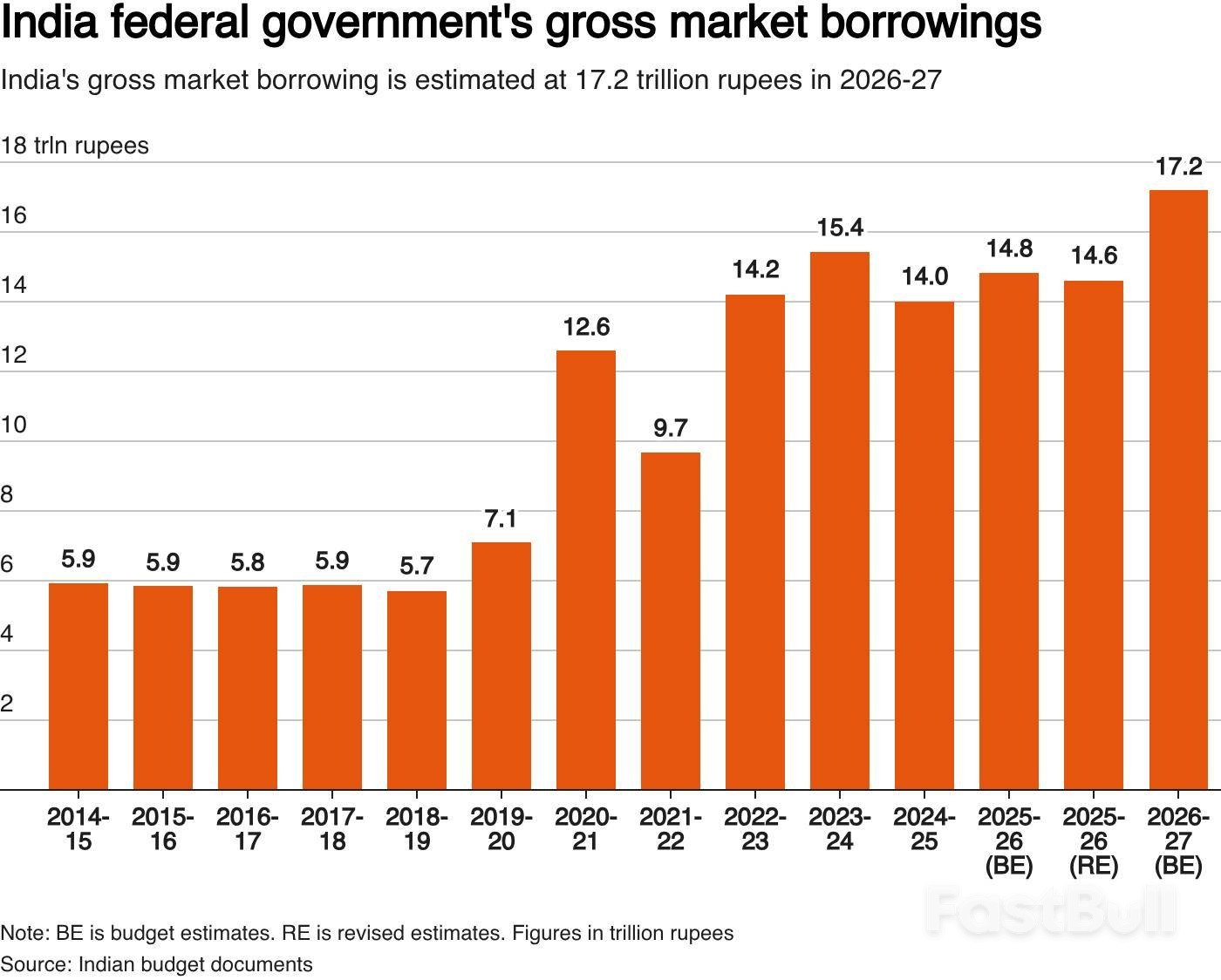
          The government plans to borrow a gross 17.2 trillion rupees ($187.5 billion) in the next fiscal year, which runs from April through March. This news immediately pushed bond prices down and yields up.

          Market Reacts to Massive Borrowing Target

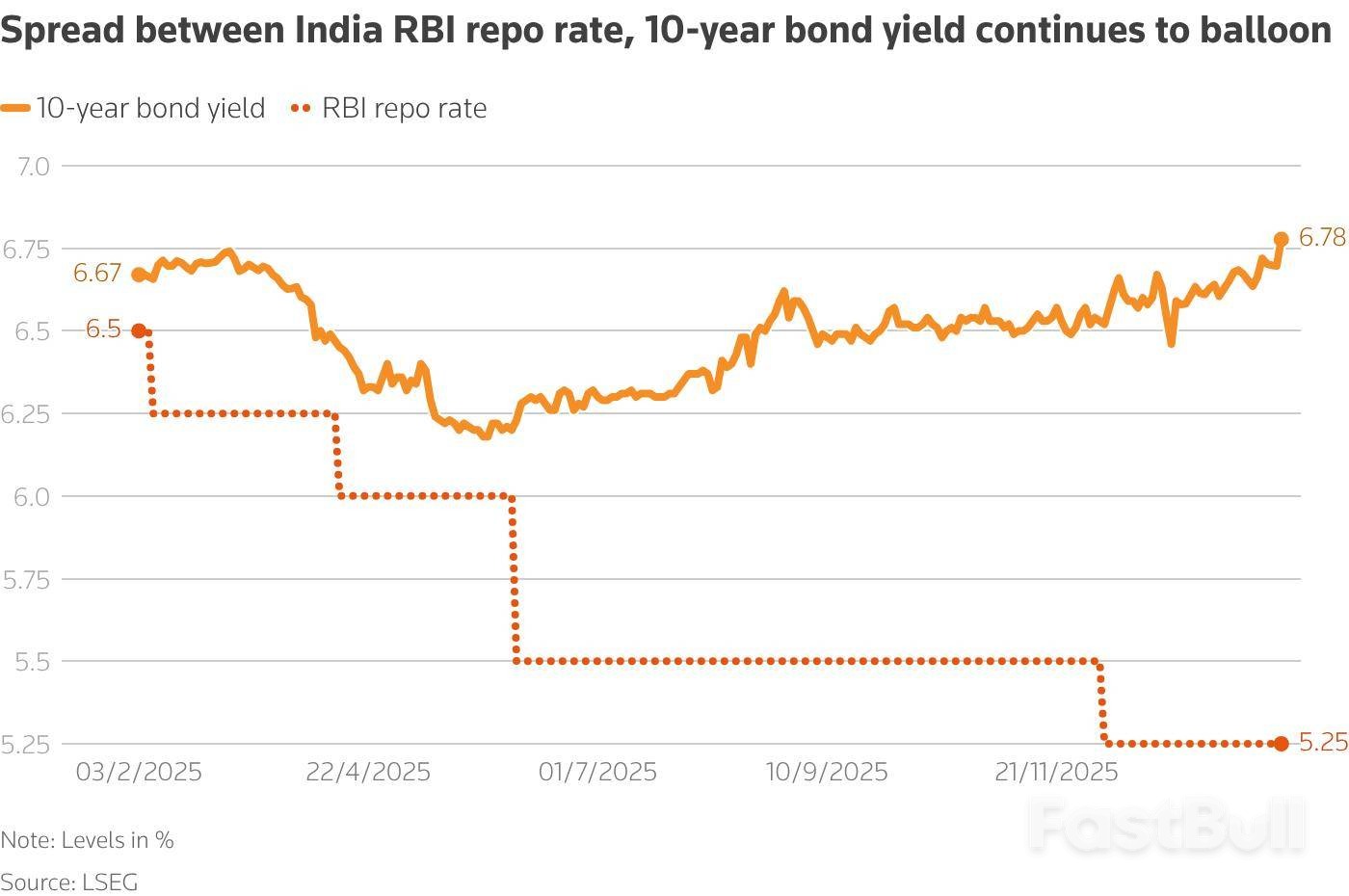
          The yield on the benchmark 6.48% 2035 bond jumped 8 basis points to 6.78% on Monday, a peak not seen since last March. This move comes as the market grapples with a lack of investor appetite and recent losses on trading portfolios.

          Even before the budget announcement, the market showed signs of stress. The 10-year benchmark yield had already risen by around 20 basis points between December and January, despite a 25 basis point policy rate cut and significant debt purchases by the central bank.

          Figure 1: This chart shows India's gross market borrowings, highlighting the projected surge to a record 17.2 trillion rupees in fiscal year 2026-27, the key driver behind the recent bond market sell-off.

          Why Higher Bond Yields Matter for India's Economy

          The 10-year government bond yield is a crucial economic indicator because it serves as a benchmark for borrowing costs across the country. When this yield rises, it creates several challenges:

          • Higher Costs for Companies and States: Both corporate and state-level borrowing becomes more expensive, as their loan rates are priced relative to government bonds.

          • Increased Government Debt Burden: The government itself must pay more to finance its operations, straining public finances.

          • Complicates Central Bank Policy: The Reserve Bank of India (RBI) has been cutting policy rates to support economic growth. Rising market yields work against these efforts, making monetary policy less effective.

          Figure 2: The widening gap between the RBI's repo rate and the 10-year bond yield from February to November 2025 illustrates the growing tension between official monetary policy and market-driven borrowing costs.

          Analyst Outlook: Caution and a Call for RBI Action

          Market analysts are now expressing caution and looking to the central bank for support.

          "We remain cautious on bonds, (and) despite the recent cheapening, we do not advocate long positions here and think the 10-year can push closer to 7% near term," said Nathan Sribalasundaram, Asia rates strategist at Nomura. He noted that while the RBI remains the "marginal buyer," the central bank has a low bar for announcing further bond purchases through Open Market Operations (OMOs).

          Dhiraj Nim, an economist at ANZ, shared a similar view on the RBI's role. "With macro factors likely to dampen the private sector's bond demand, the RBI is expected to use open market operations to boost liquidity and manage borrowing costs simultaneously," he said.

          What Traders Are Watching Next

          With the market under pressure, all eyes are on the Reserve Bank of India's monetary policy decision this Friday. While another rate change is not expected, traders and investors are anxiously awaiting any announcements about liquidity injections or new bond-buying programs designed to stabilize the market.

          To stay updated on all economic events of today, please check out our Economic calendar
          Risk Warnings and Disclaimers
          You understand and acknowledge that there is a high degree of risk involved in trading. Following any strategies or investment methods may lead to potential losses. The content on the site is provided by our contributors and analysts for information purposes only. You are solely responsible for determining whether any trading assets, securities, strategy, or any other product is suitable for investing based on your own investment objectives and financial situation.
          Add to Favorites
          Share

          Copper's Wild Ride: Prices Plunge From Record Highs

          Edward Lawson

          Traders' Opinions

          Remarks of Officials

          Economic

          Central Bank

          Commodity

          Copper prices continued their sharp decline from a record high, leaving traders to debate whether bullish Chinese investors will step back in after several days of chaotic trading rocked global metals markets.

          The intense volatility has some seasoned market observers stepping back, citing heightened risks and a disconnect between financial speculation and softening physical demand. Yet, conversations among traders in China suggest a strong appetite to buy the dip, with analysts unwilling to rule out another major swing higher.

          Record Highs Meet a Sharp Reversal

          On the London Metal Exchange (LME), the industrial metal sank by as much as 4.2% to $12,600 per ton. This followed a dramatic week where prices first soared to a record above $14,500 last Thursday before crashing below $13,000 in intraday trading on Friday. Other metals, including aluminum, tin, nickel, and silver, also posted steep declines.

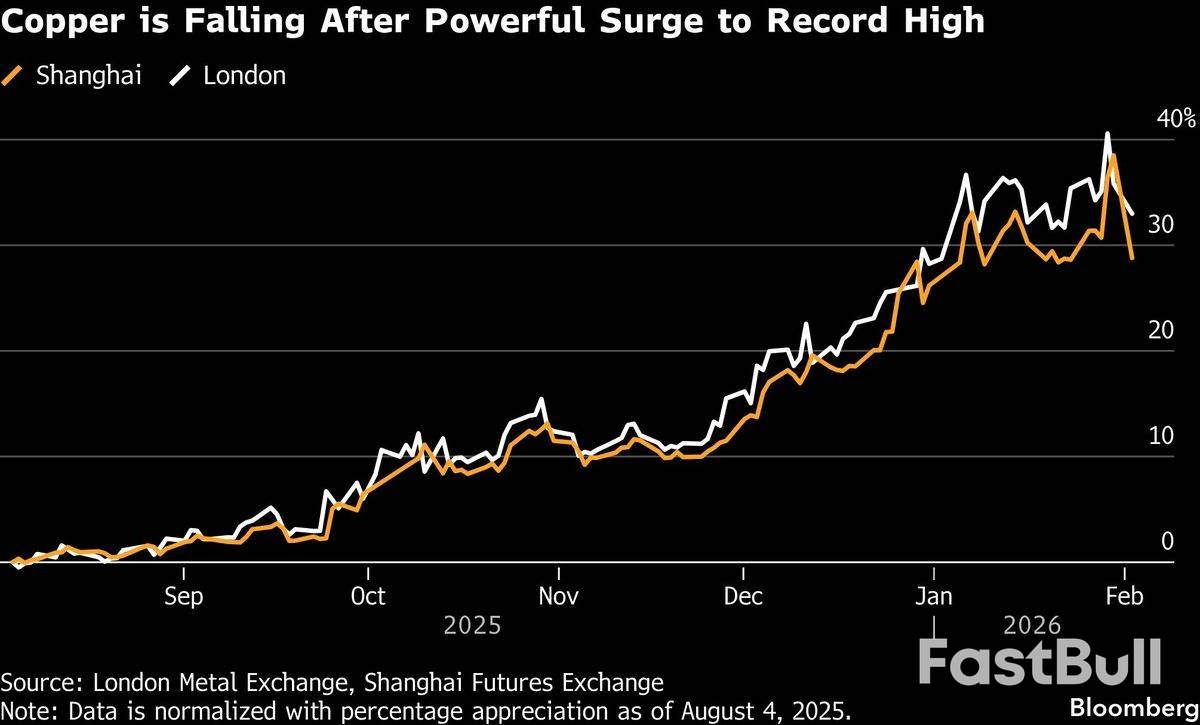
          The extreme moves capped a strong period for copper, which saw futures gain over 40% in 2025 amid mine disruptions, speculation on demand from the energy transition, and the potential for new U.S. import tariffs.

          Copper's price appreciation on the London and Shanghai exchanges shows a steep rally followed by a sharp correction in early 2026.

          Chinese Investor Sentiment Fuels Market Frenzy

          The recent rally in both base and precious metals was initially driven by a surge of interest from investors in China, where funds have been rotating into commodities amid doubts about the U.S. dollar and a shift away from currencies and sovereign bonds.

          However, Friday's selloff was sparked by news that U.S. President Donald Trump named Kevin Warsh, known as a tough inflation fighter, to head the Federal Reserve.

          Despite the turbulence, January was the busiest month ever for metals trading on the Shanghai Futures Exchange (SHFE), with copper volumes hitting a record during Friday's downturn.

          "Some funds are exiting ahead of the Lunar New Year to avoid risk amid such high volatility," noted Gao Yin, an analyst at Shuohe Asset Management Co. "But the medium- to long-term logic behind this round of rally remains intact. There is a unanimous, bullish consensus among Chinese investors."

          Investor Hype vs. Physical Market Reality

          The frenzy in financial markets contrasts sharply with softening physical demand. Traders familiar with the industry report that buying from fabricators has been muted, even with the price drop. Many industrial users are also winding down operations ahead of the Lunar New Year holiday.

          This disconnect was further highlighted by data showing China's factory activity unexpectedly stalled in December. Copper bulls appear to be looking past weak immediate consumption, focusing instead on broader macro trends like easier global monetary policy, a softer dollar, and increased fiscal spending in developed economies.

          Analysts See Dip as "Supercycle" Buying Opportunity

          Some analysts believe the current pullback is a strategic entry point.

          "The near-term correction will provide a good window to buy," wrote Li Yaoyao, an analyst at Xinhu Futures Co., in a note. The firm suggested copper is entering a "supercycle" of sustained high prices and could trade between 100,000 yuan ($14,385) and 150,000 yuan per ton in Shanghai this year.

          As of the latest trading, copper on the SHFE was down 3.4% at 100,110 yuan a ton. In London, LME copper fell 4.2% to $12,601.50 a ton at 12:05 p.m. Singapore time, after closing 3.4% lower on Friday. Other industrial metals also declined, with aluminum losing 2.8% and tin falling by more than 8%. Iron ore in Singapore dipped 0.3% to $103.35 a ton.

          To stay updated on all economic events of today, please check out our Economic calendar
          Risk Warnings and Disclaimers
          You understand and acknowledge that there is a high degree of risk involved in trading. Following any strategies or investment methods may lead to potential losses. The content on the site is provided by our contributors and analysts for information purposes only. You are solely responsible for determining whether any trading assets, securities, strategy, or any other product is suitable for investing based on your own investment objectives and financial situation.
          Add to Favorites
          Share

          US Pressure Fuels China’s Semiconductor Rise as Domestic Giants Break Into the Global Top Tier

          Gerik

          Economic

          Export Controls As An Unexpected Catalyst

          The recent acceleration of China’s semiconductor industry has been closely linked to restrictive measures imposed by the United States. Rather than halting progress, these constraints have intensified Beijing’s push for technological self reliance. By the end of 2025, China had secured positions for three domestic semiconductor equipment makers within the global top 20, marking a structural shift in the global supply chain rather than a temporary adjustment.
          According to Nikkei, China has focused systematically on reinforcing its weakest links, particularly in equipment and materials. This strategic focus reflects a clear cause and effect relationship: tighter external controls have directly incentivized deeper domestic investment and faster capability development.

          Naura’s Rapid Climb Signals Industrial Maturity

          State backed Naura Technology Group has emerged as the most prominent symbol of this transformation. Founded in 2001, Naura produces a wide range of equipment used in etching, deposition, and other critical stages of chip manufacturing. By revenue, the company rose from eighth place globally in 2022 to fifth place in 2025, ranking just behind ASML, Applied Materials, Lam Research, and Tokyo Electron.
          Naura’s revenue expanded by an estimated 21 percent last year, underscoring not only strong domestic demand but also improving competitiveness across multiple process segments. This rise illustrates correlation between sustained policy support and commercial scale, rather than a short lived surge driven by subsidies alone.

          AMEC And SMEE Close Critical Technology Gaps

          Another key player, Advanced Micro-Fabrication Equipment, ranked thirteenth globally in 2025. Founded by an engineer formerly employed at Lam Research and Applied Materials, AMEC specializes in plasma etching systems. Its flagship tools are reportedly being used in 5 nanometer chip production, a level comparable with leading global standards, signaling a narrowing technology gap in advanced logic manufacturing.
          Meanwhile, SMEE ranked twentieth, focusing on lithography systems used to transfer circuit patterns onto wafers. While SMEE’s tools remain well behind ASML’s cutting edge offerings, the company plays a strategically vital role as one of the very few domestic lithography suppliers in China. Its appeal lies less in absolute performance and more in supply security, highlighting a trade off between technological frontier and industrial resilience.

          A Broader Ecosystem Takes Shape

          Expanding the scope to the global top 30 adds two more Chinese firms, ACM Research and Hwatsing Technology, reinforcing the picture of a rapidly broadening ecosystem. Analysts attribute this momentum to coordinated investment between national semiconductor funds and local governments, with capital deliberately channeled toward equipment and materials rather than only chip design.
          According to Tetsuo Omori of Techno Systems Research, China now produces roughly 20 to 30 percent of its own semiconductor manufacturing equipment, up sharply from around 10 percent just three years ago. This growth reflects cumulative capability building rather than a single breakthrough, indicating a structural trend.

          Near Total Coverage Of The Manufacturing Process

          Advanced semiconductor manufacturing involves more than one thousand individual process steps, each requiring specialized tools. Executives at component trading firms supporting Chinese fabs note that domestic suppliers are now capable of covering virtually all major processes, including deposition, etching, and cleaning. This breadth reduces dependency risks and enhances system level stability, even if individual tools do not always match the world’s most advanced alternatives.
          The impact is already visible in market data. According to SEMI, sales of chipmaking equipment in China surged 35 percent in 2024 to reach 49.5 billion USD, making it the world’s largest market. In the short term, this intensifies competitive pressure on Japanese, American, and European suppliers operating in China.

          The EUV Barrier Remains Intact

          Despite these advances, a critical limitation persists. Chinese firms have yet to develop extreme ultraviolet lithography equipment, which is essential for producing 2 nanometer and 3 nanometer chips. This technology remains exclusively supplied by ASML, maintaining a decisive choke point in the most advanced segment of the industry.
          ASML chief executive Christophe Fouquet has stated that China would require many years to develop EUV machines independently. This assessment highlights a clear causal constraint: while China’s supply chain expansion strengthens resilience and mid range competitiveness, the absence of EUV technology caps its ability to fully challenge the global technology frontier.
          Overall, US restrictions have accelerated China’s semiconductor equipment industry rather than suppressing it, producing a more diversified and self sufficient ecosystem with growing global relevance. The rise of Naura, AMEC, and SMEE demonstrates how industrial policy and market demand can reshape competitive rankings. However, without EUV lithography, China’s semiconductor ascent remains powerful but incomplete, resilient in scale yet constrained at the very edge of technological leadership.
          To stay updated on all economic events of today, please check out our Economic calendar
          Risk Warnings and Disclaimers
          You understand and acknowledge that there is a high degree of risk involved in trading. Following any strategies or investment methods may lead to potential losses. The content on the site is provided by our contributors and analysts for information purposes only. You are solely responsible for determining whether any trading assets, securities, strategy, or any other product is suitable for investing based on your own investment objectives and financial situation.
          Add to Favorites
          Share

          Japanese Yen Plunges Past 155 Against the Dollar

          Samantha Luan

          Remarks of Officials

          Stocks

          Economic

          Central Bank

          Forex

          Daily News

          Political

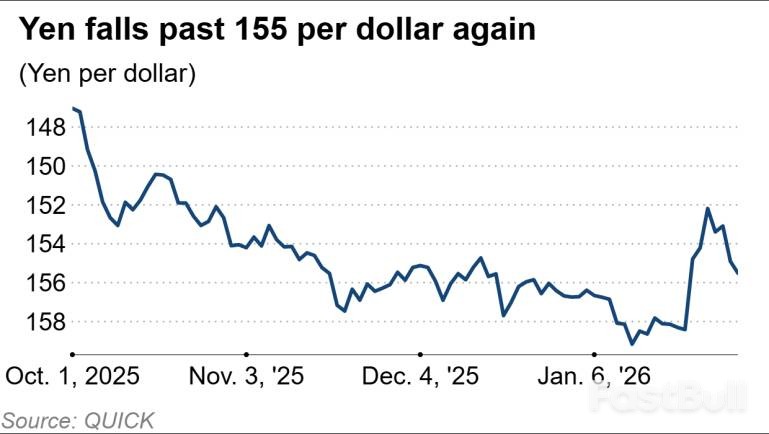
          The Japanese yen weakened significantly on Monday, sliding past the key 155 level against the U.S. dollar. The move was triggered by comments from Prime Minister Sanae Takaichi that markets interpreted as an endorsement of a weaker currency, compounded by a strengthening greenback.

          Figure 1: The USD/JPY exchange rate chart from October 2025 to January 2026 shows the yen's weakening trend, culminating in its move past the 155 mark.

          Takaichi's Comments Fuel Speculative Selling

          Over the weekend, Prime Minister Takaichi highlighted the advantages of a weaker yen during a campaign speech for a lower house election scheduled for February 8. She argued that a strong yen hurts exporters' competitiveness and that the current currency weakness represents "a big opportunity for export industries."

          Takaichi also noted that Japan's Foreign Exchange Fund Special Account has "coffers that are brimming now," a remark that further fueled market speculation.

          Analysts suggested that these comments, especially when combined with U.S. Treasury Secretary Scott Bessent's recent statement that Washington would "absolutely not" intervene in currency markets, were likely to accelerate speculative yen selling.

          In response to the market reaction, Takaichi attempted to clarify her position on social media, stating that the press had misunderstood her. "My intention was not to say whether yen appreciation or yen depreciation is good or bad, but to note that 'we want to build a strong economy that is resilient to exchange rate fluctuations,'" she explained.

          Despite her clarification, the yen continued its slide. The decline was further supported by a Finance Ministry announcement confirming that Japan had not conducted any foreign exchange interventions in the past few weeks.

          Dollar Strengthens on Hawkish Fed Chair Nomination

          The yen's fall was not just a story of local politics; it was also driven by strong investor demand for the U.S. dollar.

          On Friday, U.S. President Donald Trump announced his intention to nominate Kevin Warsh as the next Federal Reserve chair, succeeding Jerome Powell. This news prompted a dollar recovery after a sharp sell-off last week.

          Michael Wan, a senior currency analyst at MUFG Bank, described Warsh as a hawk. "History would suggest he is a hawk with a predisposition to focus on inflation," Wan wrote in a note. He added that Warsh has historically been critical of the Fed expanding its balance sheet and believes the central bank has overstepped its mandate.

          While Warsh has more recently voiced support for interest rate cuts, his nomination has led the market to anticipate less aggressive monetary easing from the Fed, strengthening the dollar.

          Nikkei's Brief Rally Fades as Tech Stocks Tumble

          The yen's depreciation initially provided a boost to the Japanese stock market. Shares of major exporters like Toyota Motor and Subaru rose as a weaker currency makes their products more competitive abroad.

          The benchmark Nikkei Stock Average reflected this optimism, at one point climbing over 900 points, a gain of 1.7%.

          However, the rally was short-lived. The stock market quickly lost momentum and turned lower as a tumble in major technology stocks erased the early gains.

          To stay updated on all economic events of today, please check out our Economic calendar
          Risk Warnings and Disclaimers
          You understand and acknowledge that there is a high degree of risk involved in trading. Following any strategies or investment methods may lead to potential losses. The content on the site is provided by our contributors and analysts for information purposes only. You are solely responsible for determining whether any trading assets, securities, strategy, or any other product is suitable for investing based on your own investment objectives and financial situation.
          Add to Favorites
          Share

          OPEC+ Signals Likely Output Freeze in March as Oil Prices Reach Six Month High

          Gerik

          Economic

          Commodity

          Oil Prices Strengthen Despite Oversupply Expectations

          Global oil markets have entered the new year on firmer footing, with prices reaching their highest levels in six months. At the close of trading on January 31, Brent crude was priced at nearly 70 USD per barrel, approaching the recent high of 71.89 USD per barrel recorded on January 29. This rally has occurred even as many forecasts continue to warn of potential global oversupply in 2026, which would typically exert downward pressure on prices.
          The current price strength reflects a shift in market focus from medium term supply balances toward short term risk factors, particularly those related to geopolitical uncertainty and operational disruptions.

          OPEC+ Poised to Maintain Current Output Policy

          The OPEC+ grouping is widely expected to maintain its existing plan to pause further production increases in March 2026. According to sources familiar with the discussions, the upcoming meeting of eight core OPEC+ members is primarily aimed at reaffirming the current production framework rather than introducing new policy changes for subsequent months.
          This cautious stance follows earlier decisions to halt output hikes during the first quarter of 2026, a period typically characterized by seasonally weaker demand. The relationship between demand seasonality and supply discipline remains central to OPEC+ market management strategy, as premature increases could undermine price stability.

          Middle East Tensions Drive Risk Premium

          Geopolitical developments in the Middle East have emerged as a key driver behind the recent rise in oil prices. International media reports indicate that US President Donald Trump is considering various policy options toward Iran, including the possibility of targeted military action aimed at increasing political pressure.
          While both Washington and Tehran have signaled openness to high level dialogue, Iranian officials have stated that national defense capabilities are not subject to negotiation. At the same time, broad US sanctions continue to restrict Iran’s oil export revenues, reinforcing supply related risk perceptions in energy markets. These dynamics contribute to a correlation between geopolitical escalation risks and short term price movements, even in the absence of actual supply losses.

          Kazakhstan Supply Issues Add Further Support

          Beyond geopolitics, oil prices have also been supported by ongoing supply disruptions in Kazakhstan, where the energy sector has faced repeated operational issues in recent months. These disruptions have tightened available supply at the margin, adding to upward price pressure.
          A partial offset has emerged, however, as Kazakhstan recently announced the gradual restart of operations at the giant Tengiz oil field, beginning in the middle of last week. While this development may ease some immediate concerns, the restart is expected to be phased, limiting its near term impact on global supply balances.

          Recent Production History Shapes Current Strategy

          From April to December 2025, OPEC+ increased production quotas by approximately 2.9 million barrels per day, equivalent to around 3 percent of global demand. This expansion was designed to gradually unwind earlier supply cuts while avoiding market disruption.
          However, as consumption typically softens during the first quarter, the group opted to freeze further increases to stabilize prices. The current deliberations reflect continuity rather than a policy shift, suggesting that OPEC+ remains focused on managing volatility rather than responding aggressively to short term price signals.

          JMMC Monitoring Without Direct Policy Power

          Alongside the main policy meeting, the Joint Ministerial Monitoring Committee will also convene to review the latest market data. While the committee does not have authority to set production levels, its assessments and recommendations play an important role in shaping subsequent decisions by the broader alliance.
          Overall, the likely extension of the production freeze underscores OPEC+ preference for caution. With geopolitical risks elevated and supply disruptions unresolved, the group appears inclined to prioritize price stability in the near term, even as longer term questions about demand growth and oversupply remain unresolved.
          To stay updated on all economic events of today, please check out our Economic calendar
          Risk Warnings and Disclaimers
          You understand and acknowledge that there is a high degree of risk involved in trading. Following any strategies or investment methods may lead to potential losses. The content on the site is provided by our contributors and analysts for information purposes only. You are solely responsible for determining whether any trading assets, securities, strategy, or any other product is suitable for investing based on your own investment objectives and financial situation.
          Add to Favorites
          Share

          Trading In The Week Ahead: Silver Volatility, US Nonfarm Payrolls & Global Market Risks

          Pepperstone

          Commodity

          Forex

          Extreme Volatility and Position Sizing Remain the Core Risk

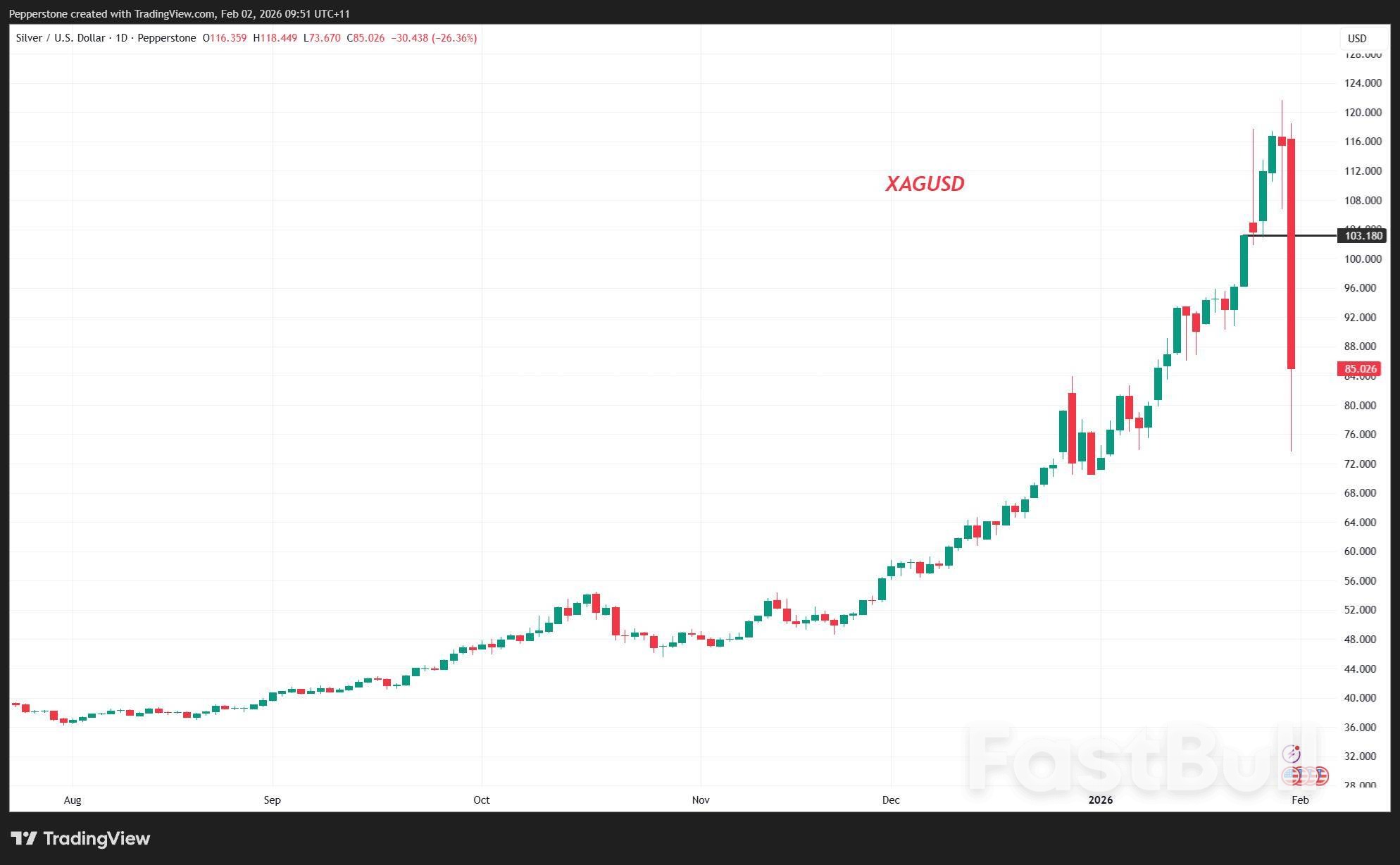
          Last week will not be forgotten for some time. Those with exposure to ultra-crowded markets will be acutely aware that trading any financial instrument with a 10-day realised volatility of 186%, as seen in silver, demands both an open mind as to where the collective may push price and a disciplined approach to position sizing. Correctly sizing exposure relative to such extreme levels of volatility is absolutely essential. As the new trading week begins and markets attempt to re-establish fair value and some form of balance, the eruptions seen in several more dysfunctional markets may yet prove to be aftershocks. Carrying risk when one cannot immediately react remains the primary consideration.

          Market Flows, Liquidity and Event Risk Drive Price Action

          Markets ultimately respond to flows, while liquidity conditions go a long way in explaining the magnitude of price movements. For risk managers, the event risks ahead must also be carefully assessed. Traders are right to ask whether an upcoming event is likely to generate an outsized move or a volatility shock that could materially impact existing exposures. Given the range of possible outcomes, it is also worth questioning whether there is any clear directional skew that provides a genuine trading edge.

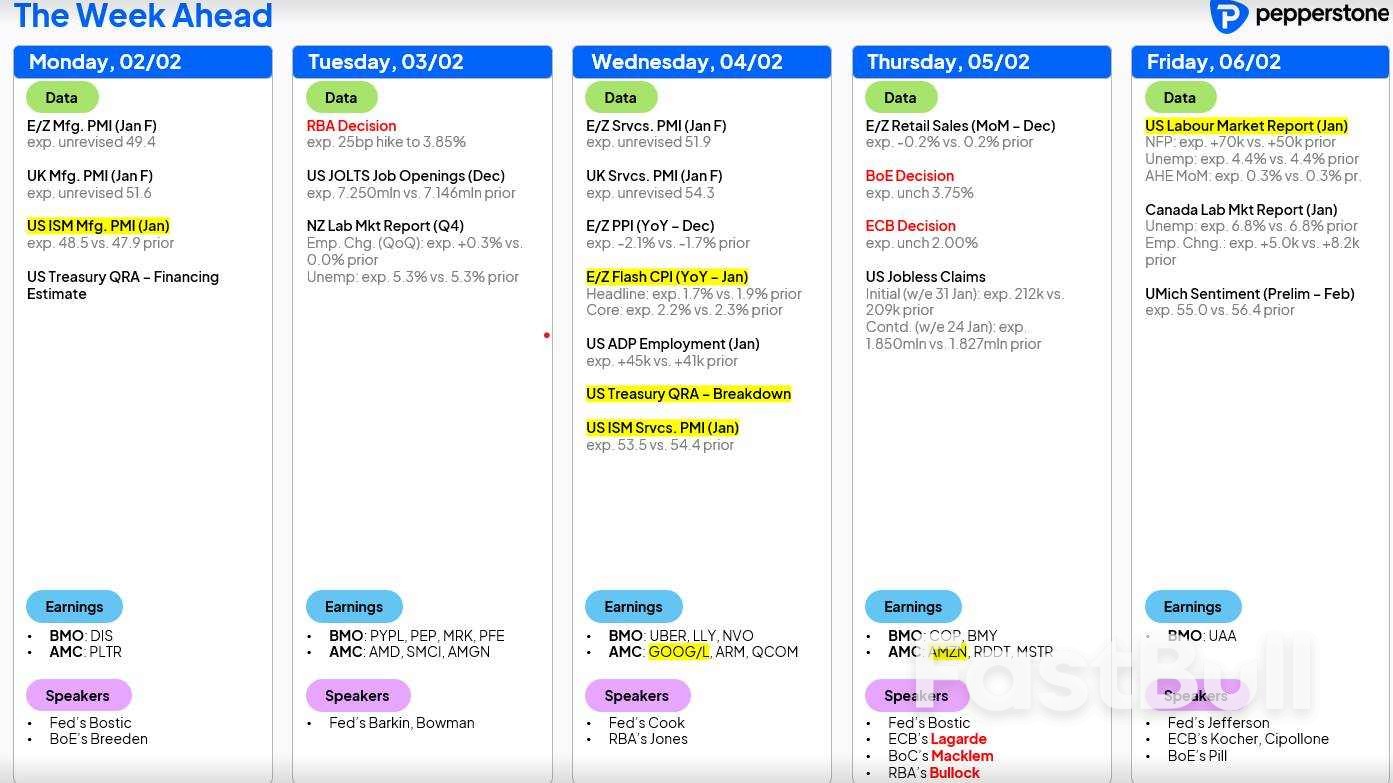
          US Nonfarm Payrolls the Marquee Scheduled Event Risk This Week

          With that framework in mind, it is fitting that the economic calendar is particularly full in the week ahead. The Friday release of US nonfarm payrolls stands out as the marquee risk event. Markets are currently modelling a central estimate of 68,000 net new jobs created in January, with the unemployment rate expected to hold at 4.4%. If realised, this outcome would likely be viewed as supportive for risk assets such as equities, offering enough job creation to limit renewed concerns about the US labour market, but not so strong as to materially reduce expectations for Fed rate cuts in June or July, or the pricing of two 25 basis point cuts by December.

          JOLTS and ISM Surveys Still Capable of Moving Risk

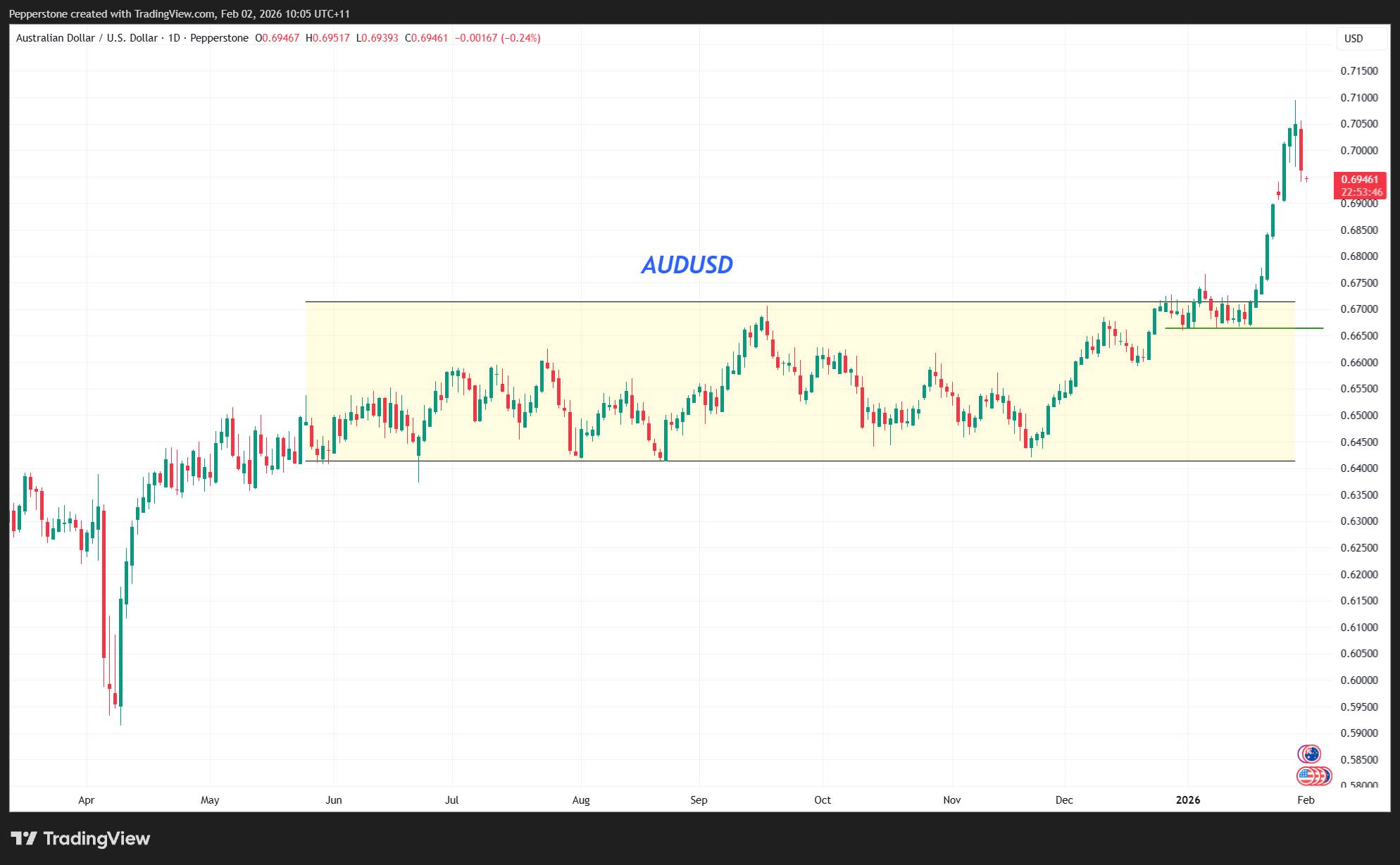
          Elsewhere in the US, and while likely secondary to nonfarm payrolls, JOLTS job openings and the ISM manufacturing and services surveys still have the capacity to move markets if outcomes prove to be meaningful outliers relative to expectations. RBA Meeting Poses Near Term Risk for AUD Traders Outside the US, the RBA meeting on Tuesday presents a near-term risk for AUD exposures. Interest rate swaps price around 15 basis points of tightening for this meeting, implying a 71% probability of a 25 basis point hike. That said, even if the RBA does raise rates, any AUD reaction may fade quickly unless the accompanying statement is interpreted as sufficiently hawkish to lift expectations for further tightening at future meetings.

          ECB and BoE Meetings Likely to Generate Only Short Lived Volatility

          The ECB and BoE meetings are not expected to result in changes to policy rates. While there may be some review of ECB guidance and the potential for brief volatility in EUR and GBP pairs, any market reaction should be contained and short-lived.

          US Earnings Season Accelerates with Major Tech in Focus

          US equity indices will also command attention, with just under 30% of S&P 500 market capitalisation reporting earnings and guidance this week. Alphabet and Amazon are the major heavyweight releases, while trader favourites such as Palantir, AMD, Qualcomm, Iren, Reddit and Barrick are also on the radar.

          European Earnings and Index Consolidation Continue

          It is a similarly busy earnings week in Europe, with around 30% of Euro Stoxx market capitalisation due to report. European equity indices are consolidating after a modest pullback from recent all-time highs. Conviction around a clear directional move in the DAX or Euro Stoxx 50 remains low, and the indices likely require further work to attract meaningful flows in either direction.

          Silver Volatility Highlights Structural Stress in Precious Metals Markets

          Attention also naturally remains on silver, gold and the US dollar. Silver, and XAGUSD in particular, has become a case study in trading within a dysfunctional market, with products that typically move in close alignment becoming fractured and misaligned. XAG is trading with a 10-day realised volatility of 186%, equating to daily realised moves of nearly 12%, which is extraordinary. The CME's shift to percentage-based margining and successive increases in margin requirements have clearly contributed, alongside elevated positioning.

          China Liquidity and SHFE Selling Triggered the Latest Silver Liquidation

          China remains central to the silver narrative and appears to have provided the trigger for Friday's generational moves. Many traders outside China are now familiar with the UBS SDIC silver futures fund (161226), which had become the primary vehicle for Chinese retail investors to gain exposure to silver. When the Shenzhen Stock Exchange halted trading in the fund on Friday, investors were effectively locked in and forced to seek alternative ways to reduce exposure. That exit occurred through SHFE silver futures, with the resulting selling pressure rippling into COMEX futures and triggering a significant liquidation of positions.

          Is Silver Near a Bottom or Are Further Aftershocks Ahead

          Whether silver has reached a durable bottom is difficult to say. Another round of selling cannot be ruled out as Shanghai futures markets reopen, particularly given the residual stress across leveraged positions and market structure.

          Good luck to all.

          Source: Pepperstone

          Risk Warnings and Disclaimers
          You understand and acknowledge that there is a high degree of risk involved in trading. Following any strategies or investment methods may lead to potential losses. The content on the site is provided by our contributors and analysts for information purposes only. You are solely responsible for determining whether any trading assets, securities, strategy, or any other product is suitable for investing based on your own investment objectives and financial situation.
          Add to Favorites
          Share
          FastBull
          Copyright © 2026 FastBull Ltd

          728 RM B 7/F GEE LOK IND BLDG NO 34 HUNG TO RD KWUN TONG KLN HONG KONG

          TelegramInstagramTwitterfacebooklinkedin
          App Store Google Play Google Play
          Products
          Charts

          Chats

          Q&A with Experts
          Screeners
          Economic Calendar
          Data
          Tools
          Membership
          Features
          Function
          Markets
          Copy Trading
          Latest Signals
          Contests
          News
          Analysis
          24/7
          Columns
          Education
          Company
          Careers
          About Us
          Contact Us
          Advertising
          Help Center
          Feedback
          User Agreement
          Privacy Policy
          Personal Information Protection Statement
          Business

          White Label

          Data API

          Web Plug-ins

          Poster Maker

          Affiliate Program

          Risk Disclosure

          The risk of loss in trading financial instruments such as stocks, FX, commodities, futures, bonds, ETFs and crypto can be substantial. You may sustain a total loss of the funds that you deposit with your broker. Therefore, you should carefully consider whether such trading is suitable for you in light of your circumstances and financial resources.

          No decision to invest should be made without thoroughly conducting due diligence by yourself or consulting with your financial advisors. Our web content might not suit you since we don't know your financial conditions and investment needs. Our financial information might have latency or contain inaccuracy, so you should be fully responsible for any of your trading and investment decisions. The company will not be responsible for your capital loss.

          Without getting permission from the website, you are not allowed to copy the website's graphics, texts, or trademarks. Intellectual property rights in the content or data incorporated into this website belong to its providers and exchange merchants.

          Not Logged In

          Log in to access more features

          Connect Broker
          Become a signal provider
          Help Center
          Customer Service
          Dark Mode
          Price Up/Down Colors

          Log In

          Sign Up

          Position
          Layout
          Fullscreen
          Default to Chart
          The chart page opens by default when you visit fastbull.com