• Trade
  • Markets
  • Copy
  • Contests
  • News
  • 24/7
  • Calendar
  • Q&A
  • Chats
Trending
Screeners
SYMBOL
LAST
BID
ASK
HIGH
LOW
NET CHG.
%CHG.
SPREAD
SPX
S&P 500 Index
6827.42
6827.42
6827.42
6899.86
6801.80
-73.58
-1.07%
--
DJI
Dow Jones Industrial Average
48458.04
48458.04
48458.04
48886.86
48334.10
-245.98
-0.51%
--
IXIC
NASDAQ Composite Index
23195.16
23195.16
23195.16
23554.89
23094.51
-398.69
-1.69%
--
USDX
US Dollar Index
97.950
98.030
97.950
98.500
97.950
-0.370
-0.38%
--
EURUSD
Euro / US Dollar
1.17394
1.17409
1.17394
1.17496
1.17192
+0.00011
+ 0.01%
--
GBPUSD
Pound Sterling / US Dollar
1.33707
1.33732
1.33707
1.33997
1.33419
-0.00148
-0.11%
--
XAUUSD
Gold / US Dollar
4299.39
4299.39
4299.39
4353.41
4257.10
+20.10
+ 0.47%
--
WTI
Light Sweet Crude Oil
57.233
57.485
57.233
58.011
56.969
-0.408
-0.71%
--

Community Accounts

Signal Accounts
--
Profit Accounts
--
Loss Accounts
--
View More

Become a signal provider

Sell trading signals to earn additional income

View More

Guide to Copy Trading

Get started with ease and confidence

View More

Signal Accounts for Members

All Signal Accounts

Best Return
  • Best Return
  • Best P/L
  • Best MDD
Past 1W
  • Past 1W
  • Past 1M
  • Past 1Y

All Contests

  • All
  • Trump Updates
  • Recommend
  • Stocks
  • Cryptocurrencies
  • Central Banks
  • Featured News
Top News Only
Share

Iranian Media Says 18 Crew Members Of Foreign Tanker Seized In Gulf Of Oman Over Carrying 'Smuggled Fuel' Detained

Share

Regional Governor: Two Killed In Ukrainian Drone Strike On Russia's Saratov

Share

Chinese Foreign Ministry - China Foreign Minister Met With United Arab Emirates Counterpart On Dec 12

Share

China's Central Financial And Economic Affairs Commission Deputy Director: Will Expand Export And Increase Import In 2026

Share

Thai Leader Anutin: Landmine Blast That Killed Thai Soldiers 'Not A Roadside Accident'

Share

Thai Leader Anutin: Thailand To Continue Military Action Until 'We Feel No More Harm'

Share

Cambodian Prime Minister Hun Manet Says He Had Phone Calls With Trump And Malaysian Leader Anwar About Ceasefire

Share

Cambodia's Hun Manet Says USA, Malaysia Should Verify 'Which Side Fired First' In Latest Conflict

Share

Cambodia's Hun Manet: Cambodia Maintains Its Stance In Seeking Peaceful Resolution Of Disputes

Share

Nasdaq Companies: Allergan, Ferrovia, Insmed, Monolithic Power Systems, Seagate Technology, And Western Digital Will Be Added To The NASDAQ 100 Index. Biogen, CdW, GlobalFoundries, Lululemon, ON Semiconductor, And Tradedesk Will Be Removed From The NASDAQ 100 Index

Share

Witkoff Headed To Berlin This Weekend To Meet With Zelenskiy, European Leaders -Wsj Reporter On X

Share

Russia Attacks Two Ukrainian Ports, Damaging Three Turkish-Owned Vessels

Share

[Historic Flooding Occurs In At Least Four Rivers In Washington State Due To Days Of Torrential Rains] Multiple Areas In Washington State Have Been Hit By Severe Flooding Due To Days Of Torrential Rains, With At Least Four Rivers Experiencing Historic Flooding. Reporters Learned On The 12th That The Floods Caused By The Torrential Rains In Washington State Have Destroyed Homes And Closed Several Highways. Experts Warn That Even More Severe Flooding May Occur In The Future. A State Of Emergency Has Been Declared In Washington State

Share

Trump Says Proposed Free Economic Zone In Donbas Would Work

Share

Trump: I Think My Voice Should Be Heard

Share

Trump Says Will Be Choosing New Fed Chair In Near Future

Share

Trump Says Proposed Free Economic Zone In Donbas Complex But Would Work

Share

Trump Says Land Strikes In Venezuela Will Start Happening

Share

US President Trump: Thailand And Cambodia Are In A Good Situation

Share

State Media: North Korean Leader Kim Hails Troops Returning From Russia Mission

TIME
ACT
FCST
PREV
U.K. Trade Balance Non-EU (SA) (Oct)

A:--

F: --

P: --

U.K. Trade Balance (Oct)

A:--

F: --

P: --

U.K. Services Index MoM

A:--

F: --

P: --

U.K. Construction Output MoM (SA) (Oct)

A:--

F: --

P: --

U.K. Industrial Output YoY (Oct)

A:--

F: --

P: --

U.K. Trade Balance (SA) (Oct)

A:--

F: --

P: --

U.K. Trade Balance EU (SA) (Oct)

A:--

F: --

P: --

U.K. Manufacturing Output YoY (Oct)

A:--

F: --

P: --

U.K. GDP MoM (Oct)

A:--

F: --

P: --

U.K. GDP YoY (SA) (Oct)

A:--

F: --

P: --

U.K. Industrial Output MoM (Oct)

A:--

F: --

P: --

U.K. Construction Output YoY (Oct)

A:--

F: --

P: --

France HICP Final MoM (Nov)

A:--

F: --

P: --

China, Mainland Outstanding Loans Growth YoY (Nov)

A:--

F: --

P: --

China, Mainland M2 Money Supply YoY (Nov)

A:--

F: --

P: --

China, Mainland M0 Money Supply YoY (Nov)

A:--

F: --

P: --

China, Mainland M1 Money Supply YoY (Nov)

A:--

F: --

P: --

India CPI YoY (Nov)

A:--

F: --

P: --

India Deposit Gowth YoY

A:--

F: --

P: --

Brazil Services Growth YoY (Oct)

A:--

F: --

P: --

Mexico Industrial Output YoY (Oct)

A:--

F: --

P: --

Russia Trade Balance (Oct)

A:--

F: --

P: --

Philadelphia Fed President Henry Paulson delivers a speech
Canada Building Permits MoM (SA) (Oct)

A:--

F: --

P: --

Canada Wholesale Sales YoY (Oct)

A:--

F: --

P: --

Canada Wholesale Inventory MoM (Oct)

A:--

F: --

P: --

Canada Wholesale Inventory YoY (Oct)

A:--

F: --

P: --

Canada Wholesale Sales MoM (SA) (Oct)

A:--

F: --

P: --

Germany Current Account (Not SA) (Oct)

A:--

F: --

P: --

U.S. Weekly Total Rig Count

A:--

F: --

P: --

U.S. Weekly Total Oil Rig Count

A:--

F: --

P: --

Japan Tankan Large Non-Manufacturing Diffusion Index (Q4)

--

F: --

P: --

Japan Tankan Small Manufacturing Outlook Index (Q4)

--

F: --

P: --

Japan Tankan Large Non-Manufacturing Outlook Index (Q4)

--

F: --

P: --

Japan Tankan Large Manufacturing Outlook Index (Q4)

--

F: --

P: --

Japan Tankan Small Manufacturing Diffusion Index (Q4)

--

F: --

P: --

Japan Tankan Large Manufacturing Diffusion Index (Q4)

--

F: --

P: --

Japan Tankan Large-Enterprise Capital Expenditure YoY (Q4)

--

F: --

P: --

U.K. Rightmove House Price Index YoY (Dec)

--

F: --

P: --

China, Mainland Industrial Output YoY (YTD) (Nov)

--

F: --

P: --

China, Mainland Urban Area Unemployment Rate (Nov)

--

F: --

P: --

Saudi Arabia CPI YoY (Nov)

--

F: --

P: --

Euro Zone Industrial Output YoY (Oct)

--

F: --

P: --

Euro Zone Industrial Output MoM (Oct)

--

F: --

P: --

Canada Existing Home Sales MoM (Nov)

--

F: --

P: --

Euro Zone Total Reserve Assets (Nov)

--

F: --

P: --

U.K. Inflation Rate Expectations

--

F: --

P: --

Canada National Economic Confidence Index

--

F: --

P: --

Canada New Housing Starts (Nov)

--

F: --

P: --

U.S. NY Fed Manufacturing Employment Index (Dec)

--

F: --

P: --

U.S. NY Fed Manufacturing Index (Dec)

--

F: --

P: --

Canada Core CPI YoY (Nov)

--

F: --

P: --

Canada Manufacturing Unfilled Orders MoM (Oct)

--

F: --

P: --

Canada Manufacturing New Orders MoM (Oct)

--

F: --

P: --

Canada Core CPI MoM (Nov)

--

F: --

P: --

Canada Manufacturing Inventory MoM (Oct)

--

F: --

P: --

Canada CPI YoY (Nov)

--

F: --

P: --

Canada CPI MoM (Nov)

--

F: --

P: --

Canada CPI YoY (SA) (Nov)

--

F: --

P: --

Canada Core CPI MoM (SA) (Nov)

--

F: --

P: --

Q&A with Experts
    • All
    • Chatrooms
    • Groups
    • Friends
    Connecting
    .
    .
    .
    Type here...
    Add Symbol or Code

      No matching data

      All
      Trump Updates
      Recommend
      Stocks
      Cryptocurrencies
      Central Banks
      Featured News
      • All
      • Russia-Ukraine Conflict
      • Middle East Flashpoint
      • All
      • Russia-Ukraine Conflict
      • Middle East Flashpoint
      Search
      Products

      Charts Free Forever

      Chats Q&A with Experts
      Screeners Economic Calendar Data Tools
      Membership Features
      Data Warehouse Market Trends Institutional Data Policy Rates Macro

      Market Trends

      Market Sentiment Order Book Forex Correlations

      Top Indicators

      Charts Free Forever
      Markets

      News

      News Analysis 24/7 Columns Education
      From Institutions From Analysts
      Topics Columnists

      Latest Views

      Latest Views

      Trending Topics

      Top Columnists

      Latest Update

      Signals

      Copy Rankings Latest Signals Become a signal provider AI Rating
      Contests
      Brokers

      Overview Brokers Assessment Rankings Regulators News Claims
      Broker listing Forex Brokers Comparison Tool Live Spread Comparison Scam
      Q&A Complaint Scam Alert Videos Tips to Detect Scam
      More

      Business
      Events
      Careers About Us Advertising Help Center

      White Label

      Data API

      Web Plug-ins

      Affiliate Program

      Awards Institution Evaluation IB Seminar Salon Event Exhibition
      Vietnam Thailand Singapore Dubai
      Fans Party Investment Sharing Session
      FastBull Summit BrokersView Expo
      Recent Searches
        Top Searches
          Markets
          News
          Analysis
          User
          24/7
          Economic Calendar
          Education
          Data
          • Names
          • Latest
          • Prev

          View All

          No data

          Scan to Download

          Faster Charts, Chat Faster!

          Download App
          English
          • English
          • Español
          • العربية
          • Bahasa Indonesia
          • Bahasa Melayu
          • Tiếng Việt
          • ภาษาไทย
          • Français
          • Italiano
          • Türkçe
          • Русский язык
          • 简中
          • 繁中
          Open Account
          Search
          Products
          Charts Free Forever
          Markets
          News
          Signals

          Copy Rankings Latest Signals Become a signal provider AI Rating
          Contests
          Brokers

          Overview Brokers Assessment Rankings Regulators News Claims
          Broker listing Forex Brokers Comparison Tool Live Spread Comparison Scam
          Q&A Complaint Scam Alert Videos Tips to Detect Scam
          More

          Business
          Events
          Careers About Us Advertising Help Center

          White Label

          Data API

          Web Plug-ins

          Affiliate Program

          Awards Institution Evaluation IB Seminar Salon Event Exhibition
          Vietnam Thailand Singapore Dubai
          Fans Party Investment Sharing Session
          FastBull Summit BrokersView Expo

          Egypt Avoided An Economic Meltdown. What Next?

          Alex

          Economic

          Summary:

          In a few short weeks in March, Egypt emerged from its worst currency crisis in decades to become the hottest trade in emerging markets.

          The rapid change of fortune began with a $35 billion tourism development deal with the United Arab Emirates, the largest inward investment in Egypt’s history. This brought an infusion of dollars that paved the way for a record interest rate hike and an expanded International Monetary Fund loan. Whether the government is able to fix the economic problems that precipitated the meltdown isn’t clear. Egypt has a track record of announcing market-friendly reforms, then dragging its feet.

          1. Why the crisis?

          Egypt gets much of its hard currency from energy exports, tourism, fees from ships plying the Suez Canal and money sent home by expatriates. Domestic industries are hobbled by under-investment, and private companies complain of unfair competition from entities linked to the country’s powerful military. This limits foreign direct investment outside the oil and gas industry, leaving Egypt’s finances more susceptible to the volatile flows of “hot money” invested over shorter periods by international funds. A sharp devaluation in the Egyptian pound that began in 2022 aggravated inflation, creating a potential political powder keg in a country where many households depend on state subsidies to afford essential goods. Capital flight and a dearth of hard currency brought the supply of dollars to dangerously low levels in 2023. The pound began changing hands on the black market at twice its official rate, raising costs for businesses and importers. Attacks on shipping in the Red Sea by Yemen’s Houthi militants dented Suez Canal fees. Remittances ebbed as Egyptians abroad held back transfers in the expectation of another devaluation.

          2. What was the fix?

          The deal with the UAE to transform Ras El-Hekma, a pristine stretch of Mediterranean coastline, into a tourism haven brought an immediate confidence boost that pulled the country back from the brink. Authorities followed it up with an interest-rate hike of 6 percentage points that helped to reverse capital flight by giving rate-arbitrage investors the opportunity to make annual returns of more than 20%. In a widely-anticipated move, the central bank said it would allow the currency to float, triggering an almost 40% plunge in the pound’s value against the dollar in a single day. The IMF had been calling for a flexible currency regime for many months, and the multilateral lender rewarded Egypt’s government by almost tripling the size of a loan program first approved in 2022 to $8 billion. This was a catalyst for a further influx of around $14 billion in financial support from the European Union and the World Bank.

          3. How did foreign investors respond?

          There was a stampede into Egypt’s local-currency bonds. For now, investors have targeted tactical trades and are waiting for more evidence that the country has turned a corner before locking up their money in more strategic, longer-term investments. For that reason, most of the money has flowed into short-term opportunities like carry trades rather than Egypt’s dollar bonds. In fact, the country’s international debt has lost some of its allure in the dash to local-currency debt offering higher returns.

          4. How did we get here?

          Egypt has suffered periodic economic crises since the Arab Spring uprising of 2011 and the government has struggled to cover huge bills for wheat imports, subsidies and public sector salaries. President Abdel-Fattah El-Sisi, who came to power in 2013 after the military under his leadership ousted Islamist President Mohamed Mursi, tried to kick-start the economy by launching vast public works projects, including widening the Suez Canal and building a new administrative capital in the desert. Returns on those investments have been patchy, and many of them were funded through borrowing. By late 2023, almost half of state revenue was being spent on debt interest. That was only sustainable because of high interest rates and a managed currency that propped up foreign demand for local debt. The jump in global interest rates following the pandemic and Russia’s invasion of Ukraine led investors to pull some $20 billion out of Egypt, precipitating a crisis that many saw as long in the making.

          5. What happens next?

          The government has said it will fulfil a pledge made to the IMF to curb state spending and boost competition by giving the private sector a bigger role in the economy. It’s made similar promises in the past, only for those efforts to largely fizzle. One concern among investors is that the authorities will reverse course on the latest devaluation at the earliest opportunity — as they did in 2016 and again in 2022 — in order to tamp down galloping price increases that are threatening social stability and forcing the government to pay out more in subsidies.

          6. Does Egypt actually have a free floating currency now?

          There’s a lot of skepticism about that, including from Bloomberg Emerging Markets Economist Ziad Daoud, who says that the currency’s movement is “too smooth” for a true free float. The central bank has stressed a commitment to continue a transition to flexible inflation targeting.

          7. What does it all mean for Egypt’s regional standing?

          Egypt’s role as a regional power broker, which developed under President Gamal Abdel-Nasser in the 1960s, has been slowly eclipsed as Gulf monarchies used their oil wealth to extend their influence across the Middle East and Africa. More recently, the Israel-Hamas war has reaffirmed Egypt’s pivotal role in the region’s politics. The first Arab nation to make peace with Israel, it controls the only non-Israeli border points into besieged Gaza and will have a say in the outcome of the conflict. The idea that Egypt is too important to be allowed to fail helped it to secure past bailouts. The latest cash infusions come with more strings attached. The EU’s €7.4 billion funding package hinges partly on Egypt helping to limit illegal migration to the bloc. And more than ever, the Gulf nations want a decent return on projects like Ras El-Hekma so have an interest in good stewardship of the economies where those investments are made.

          Source:Bloomberg

          To stay updated on all economic events of today, please check out our Economic calendar
          Risk Warnings and Disclaimers
          You understand and acknowledge that there is a high degree of risk involved in trading. Following any strategies or investment methods may lead to potential losses. The content on the site is provided by our contributors and analysts for information purposes only. You are solely responsible for determining whether any trading assets, securities, strategy, or any other product is suitable for investing based on your own investment objectives and financial situation.
          Add to Favorites
          Share

          What 10 Years of Modi Rule Has Meant for India’s Economy

          Thomas

          Economic

          Political

          As Narendra Modi was storming to victory in the election of 2014, he said that “acchhe din aane waale hain” — good times are coming.
          Now as Mr. Modi stands set to secure another term as prime minister in elections starting on April 19, the value of India’s stock market has grown threefold since he first took office. India’s economy is almost twice as big as it was.
          Stocks have risen so much because the number of Indians with enough wealth and appetite for investment risk has jumped — to nearly 5 percent of the population from barely 2 percent.
          But the economic gains have been widely unequal. The bulk of India’s growth depends on those at the top of the income ladder, including a coterie of huge and tightly controlled businesses.
          Ninety percent of India’s population of 1.4 billion is estimated to subsist on less than $3,500 a year. Yet in the poorest rural districts, life has been made more bearable by welfare programs that have expanded under Mr. Modi. Many of the benefits are solid and visible: sacks of free grain, toilets, gas cylinders and housing materials. Purely commercial developments have transformed village life: LED lights, cheap smartphones and nearly free mobile data have changed the nature of idle time.
          While America was experiencing a “vibecession,” feeling glum despite upbeat economic news, India has been doing the opposite. Here many of the signals are mixed — but the vibes are fantastic. International surveys show India’s consumers have become the most upbeat anywhere.
          Foreigners are also feeling good about the Modi economy. Banks like Morgan Stanley and JPMorgan Chase are rushing to upgrade India’s weighting in their global stock and bond indexes. Chris Wood, one of the best-regarded market strategists in Asia, warned that if Mr. Modi were not re-elected this year, Indian markets could crash by 25 percent or more.
          A strange thing about the spirit of optimism about the Modi economy is that India’s rates of growth over the past 10 years have been very similar to those of the decade that preceded it, under a government that Mr. Modi often blames for wrecking the country.
          As real as it is, the Indian economic success story is also an attribute of what could be the singular characteristic of Mr. Modi’s years in the top job: his ability to control all levers of power, with showmanship as the first priority.
          Mr. Modi’s face is everywhere, perhaps more present in New Delhi than that of any democratically elected leader in any other capital. In the run-up to the Group of 20 summit last September, his slogans took credit for virtually every positive development that could be found in this inexorably emerging economy.
          In the bullish climate surrounding the Indian economy, even the pessimists are optimistic. While official statistics anticipate growth of 7.3 percent in the current fiscal year, most finance professionals in Mumbai peg the figure at 6 to 6.5 percent. The lowest estimate touches 4.5 percent, which would still beat the United States and possibly China.
          Expressing even mild skepticism is avoided. Economists who depend on government work must be careful not to speak frankly. Economists who do not work with the government are becoming scarce, as independent think tanks are raided and shuttered.
          Message control is much more pronounced than it was under Mr. Modi’s predecessor, the award-winning economist Manmohan Singh. India became known as a “flailing state” during Mr. Singh’s time in office, even with growth occasionally hitting the 10 percent mark.
          Mr. Modi has been busy remaking the institutions of Indian governance. Political competition has been all but eliminated at the national level, and he has exploited animosity against the country’s Muslim minority of 200 million.
          Mr. Modi has also used state power to make things happen in strictly economic affairs, mostly for better though sometimes for worse. Infrastructure is on a tear. There is some overbuilding, but the fact that building gets done is a welcome relief. Welfare programs have become more responsive.
          India — especially in banking and business transactions — has made a widespread digital leap. The push began during the previous management of Mr. Singh, but Mr. Modi has run with it. The “India Stack,” a suite of software platforms that runs on the base of Aadhaar, a biometric identification system, means that Indians now have access to faster and cheaper peer-to-peer transactions than Americans.
          Taxes have been overhauled. India has driven more of the economy into the formal sector, for instance by enacting a Goods and Services Tax like Europe’s value-added tax, allowing more revenue to be extracted from more people and businesses. That has freed up money for public spending and, by lowering corporate tax rates, private financing.
          One minus on the digitization ledger came on Nov. 8, 2016, when at 8 p.m. Mr. Modi abruptly declared that all large currency notes were suddenly worthless. That was supposed to deprive criminals of “black money.” Instead, it crippled economic activity.
          There are other ways the Indian government’s power to act decisively and usually without check has created distortions and inequalities. The biggest companies have profited wildly. Of the $1.4 trillion in wealth created by the most prestigious stock index from 2012 to 2022, 80 percent went to 20 companies, Marcellus Investment Managers in Mumbai estimated in 2022. Those companies are the ones that can talk directly to the government.
          No one better illustrates the concentration of corporate wealth, and the risks associated with it, than Gautam Adani. Outside India, few knew his name until 2022, when he suddenly appeared on lists as the world’s second-richest person, after Elon Musk.
          The flagship stock of Mr. Adani’s conglomerate nearly doubled in the year after Mr. Modi was elected and grew eight times larger after he was re-elected in 2019. The Adani Group became, in effect, a logistics arm of the government, building up ports, highways, bridges and solar farms at speeds never before seen.
          Then last year Mr. Adani’s empire was accused of fraud by a New York short-seller, costing Mr. Adani $150 billion on paper. Though Mr. Adani, who denied the claims, has recouped most of the money he lost, the episode exposed a risk in the Modi strategy of allowing the few at the tippy top to amass enormous clout.
          Companies aside, on an individual level, India’s recent growth has been uncomfortably unequal. Having the world’s biggest population explains why so many foreign investors are attracted to its consumer market. Most Indians are rural, and 75 percent of them are by most measures poor, qualifying for free food rations intended to prevent malnutrition. Though that warrants some caution, it leaves room for growth.
          Sales of luxury goods have been booming, especially since the pandemic, generating yearslong waiting lists for vehicles like the Mercedes G 63. Sales of motorbikes and scooters, which transport far more Indians than all the four-wheeled cars combined, have been stagnant.
          The most painful aspect of the economy is the jobs situation. Officially about 7 percent of Indians are unemployed. Vastly more are underemployed. In the past month, Indians desperate to find better incomes abroad have died trying: crossing the United States’ borders, fighting as underequipped mercenaries for Russia in Ukraine and filling positions left empty by Palestinians forced to stop working in Israel.
          And yet, the ascent of India in the world economy seems preordained. It has moved ahead of Britain to become the world’s fifth-largest economy, and it is expected to surpass Japan and Germany to become the world’s third largest within the next few years.
          More multinational businesses are expected to flock to India, creating opportunities for Indians. Only a small proportion of consumers can expect to enjoy living standards taken for granted in the United States, but they are becoming more numerous by the year, and can now be found even in small cities.
          Red tape remains to impede businesses without connections to the top of government. But the direction of movement is promising: Projects that used to require two years of permission-seeking can now be completed in 15 days.
          Along with the acchhe din he promised in 2014, Mr. Modi pledged “minimum government, maximum governance,” sounding like a 1980s America free marketeer. In practice, his economic approach has not been defined by theory or ideology. He has thrown everything against the wall to see what sticks. He has thrown persistently, and with force. When economists talk about India, they have stopped talking about the “flailing state.”

          Source: India Elections

          To stay updated on all economic events of today, please check out our Economic calendar
          Risk Warnings and Disclaimers
          You understand and acknowledge that there is a high degree of risk involved in trading. Following any strategies or investment methods may lead to potential losses. The content on the site is provided by our contributors and analysts for information purposes only. You are solely responsible for determining whether any trading assets, securities, strategy, or any other product is suitable for investing based on your own investment objectives and financial situation.
          Add to Favorites
          Share

          IMF Approves $8 Billion Egypt Loan as Global Bailout Takes Shape

          Alex

          Economic

          The International Monetary Fund approved a $5 billion augmentation to its loan program for Egypt, part of a wave of global aid pledged to bolster a stumbling economy put under added pressure by the war in Gaza.
          The executive board’s assent increases the Extended Fund Facility arrangement from the $3 billion originally approved in December 2022 to $8 billion. It will enable an immediate disbursement of about $820 million, the Washington-based lender said Friday in a statement.
          Egypt’s new IMF agreement was announced March 6 after authorities enacted a long-awaited currency flotation and allowed the pound to lose around 40% of its value against the dollar. Funding from a $35 billion deal with the United Arab Emirates, the largest inward investment in Egypt’s history, paved the way for the move.
          “Egypt is facing significant macroeconomic challenges that have become more complex to manage given the spillovers from the recent conflict in Gaza and Israel,” IMF Managing Director Kristalina Georgieva said in the statement. “Recent measures toward correcting macroeconomic imbalances, including unification of the exchange rate, clearance of the foreign exchange demand backlog, and significant tightening of monetary and fiscal policies, were difficult, but critical steps forward, and efforts should be sustained going forward.”
          The deal is part of more than $50 billion in investments, loans and grants pledged to shore up the economy of a Middle Eastern nation with a key role in managing the region’s upheaval that’s increasingly seen as too big to fail.
          The nation of over 105 million people has also been hammered by conflicts elsewhere in recent years. Russia’s invasion of Ukraine drove up wheat and oil import prices that drained dollar reserves, while the spillover from the Israel-Hamas war has dented tourism and slashed Suez Canal fees, both crucial sources of hard currency.
          Egypt, already the IMF’s second-biggest borrower after Argentina, expects to get access to about $1.2 billion in additional financing from the lender. Following the devaluation and pledges, investors enticed by high yields and a cheaper currency have piled into Egypt’s local bonds at a record pace.

          Source:Bloomberg

          To stay updated on all economic events of today, please check out our Economic calendar
          Risk Warnings and Disclaimers
          You understand and acknowledge that there is a high degree of risk involved in trading. Following any strategies or investment methods may lead to potential losses. The content on the site is provided by our contributors and analysts for information purposes only. You are solely responsible for determining whether any trading assets, securities, strategy, or any other product is suitable for investing based on your own investment objectives and financial situation.
          Add to Favorites
          Share

          How JP Morgan Is Betting on India's New Age Economy

          Kevin Du

          Economic

          Jamie Dimon, chairman and CEO of JPMorgan Chase, has always been bullish on India. At the JP Morgan India Investor Summit in late 2023, he highlighted the remarkable growth of JP Morgan's subsidiary Indian, the world's largest bank ($538 billion as of March 4, 2024), over the past years.
          Although JP Morgan primarily focuses on wholesale banking in the country, its target areas go large among Indian corporates or multinationals. Emerging as the winner in the Best Foreign Bank category in the BT-KPMG Best Banks and NBFCs Survey 2022, new-age and other firms in the banking that industry are competitors in segments are huge opportunities business for the bank. 23 for the third consecutive year.
          “Our [primary] Business in India is wholesale and we will continue to innovate and-added solutions on the wholesale side of the business... but some of the solutions we develop on the wholesale side of the business are relevant. [other] Banks too,” said Kaustubh Kulkarni, senior country officer-India and vice president-Asia Pacific, JP Morgan.
          JP Morgan has been innovating a lot on blockchain, and according to Kulkar pini, Indian banks are currently “assessing” potential partnerships with foreign banks to leverage the solutions there. “We can be a technology partner for an Indian bank they can where use the solutions we develop for their customers and clients,” he says.
          This is significant as JP Morgan's strategy goes beyond the financial services partner of the choice of Indian companies. This includes collaborating with them as an innovation or technology partner. Currently, the financial services element dominates the two business models, accounting for 98% of the bank's total business. "It's important that we to 2% because it keeps us ahead of everyone else."
          Interestingly, the bank scored high on various parameters including growth in profit, absolute increase in CASA market share, three-year CAGR of total deposits, cost-income ratio, return on and return on capital employed. . . How, this in implies no way that the bank is not focused on innovation. “As a bank counterparty, we can do many things. We also want to see what we can do with the technical capabilities and solutions we have developed and deployed for ourselves.”
          With a strong focus on the new age economy, JP Morgan is now putting more in-ignited on tapping into opportunities emerging as the banking crisis in the US. “We continue to focus [emerging] And the focus is going even to increase of the challenges we see around the world. We are now working with many companies. Many US companies that were banked by other banks are now our clients. Some of them [companies] The Indian environment also needs to have an active ecosystem, explains Kulkarni.
          In 2023, three major banks—Silicon Valley Bank, Signature Bank, and First Republic Bank—failed, opening business opportunities for other major banks, including JP Morgan.
          According to Kulkarni, the multinational bank has critical scale and scale in the new economy segment in the US, and the benefits are visible in other key markets, including India. “We have critical scale in the new-economy segment in the U.S., and the net result is provide we very competitive product and solution for new-economy companies worldwide,” he says, that’s adding are four to there five critical markets. including the UK, Israel, the Middle East and India.
          The new-age firms offer not only banking business potential for JP Morgan, but also broader opportunities in investment banking and capital markets. The Indian arm of the global bank is already a leader in the foreign banking sector when it comes to market share segments de as Foreign Portfolio Investor (FPI) transactions in the capital market and as a custodian for such investors. It has a market share of 23-25% in the security business. As India grows and more new-age companies, the need for capital and partnerships will increase, and we we play a key role in all aspects of lending, corporate banking and investment banking to engage companies, Kulkarni. . .
          Going forward, the bank intends to focus more on financial inclusion and energy transition, while continuing to advance in both investment and traditional banking. Kulkarni is optimistic about the current growth prospects in the banking sector in India. According to him, a lot can happen in terms of diversification, growth while can be scaled. “This is one of the best periods of growth for banks. We are probably in the early to mid-cycle. Growth on the asset side will be healthy, and on the liability the and deposit sides, it will be more. Overall, there will be no NPA build-up, but somewhere around the edges you will see NPA build-up. Some NPA challenges It doesn't mean it come will immediately, he says.
          There will be a lot of investment opportunities from the private sector, in financing opportunities for the good quality companies, adds Kulkarni.
          This certainly bodes well for JP Morgan and the Indian banking fraternity in general.

          Source: Aim Web

          To stay updated on all economic events of today, please check out our Economic calendar
          Risk Warnings and Disclaimers
          You understand and acknowledge that there is a high degree of risk involved in trading. Following any strategies or investment methods may lead to potential losses. The content on the site is provided by our contributors and analysts for information purposes only. You are solely responsible for determining whether any trading assets, securities, strategy, or any other product is suitable for investing based on your own investment objectives and financial situation.
          Add to Favorites
          Share

          Firm Expectations of Fed Rate Cut Propel Gold Price Toward Fresh All-Time Highs

          Zi Cheng

          Traders' Opinions

          Commodity

          Fundamental Analysis

          The XAU/USD, or gold price, demonstrates resilience near a recent peak of approximately $2,260 in anticipation of a busy week ahead on the US economic calendar. As expectations grow for the Federal Reserve to consider a rate cut in June, gold holds onto its gains. Fed Chair Jerome Powell's acknowledgment of the decrease in February's core Personal Consumption Expenditures inflation data aligns with the Fed's objective of observing signs of easing price pressures towards the 2% target.
          The prospect of a Fed rate cut, especially following a two-year period of rate hikes, diminishes yields on interest-bearing assets like US bonds. However, this bolsters the attractiveness of gold as an investment. While 10-year US Treasury yields saw a slight increase in Monday's European session, they have since declined to 4.20%.
          Meanwhile, the US Dollar Index, which gauges the US Dollar's value against six major currencies, stabilizes around the 104.50 mark. The upside potential for the US Dollar remains restrained amid strong expectations for a Fed rate cut. Uncertainty prevails ahead of the release of the United States Nonfarm Payrolls report and associated labor data, constraining the downside for the dollar.
          Following a surge to a record-breaking high near $2,260, the gold price stabilizes as it moves sideways. Demand for this precious metal remains robust, fueled by mounting expectations in the market that the Federal Reserve will initiate a cycle of interest rate cuts starting in June.
          While Powell expressed confidence in the progress toward easing inflation, he emphasized that the Fed does not feel rushed to implement rate cuts given the current strength of the economy. He stressed the importance of further progress on inflation before considering interest rate adjustments and cautioned against hasty rate cuts, citing the robust conditions in the economy and labor market.

          Technical Analysis

          XAU/USD has been very strong since the start of the year due to the weakening of Dollar has propelled it to all time highs. This is the time all traders should not go against the trend and sell Gold. Although from the chart we can see that it has surged towards all time highs without retracement, it does not mean we should go against the trend.
          My outlook for Gold would be waiting for retracement back around the 0.618% level then wait for some signs of bullishness to long Gold.
          Firm Expectations of Fed Rate Cut Propel Gold Price Toward Fresh All-Time Highs_1
          Risk Warnings and Disclaimers
          You understand and acknowledge that there is a high degree of risk involved in trading. Following any strategies or investment methods may lead to potential losses. The content on the site is provided by our contributors and analysts for information purposes only. You are solely responsible for determining whether any trading assets, securities, strategy, or any other product is suitable for investing based on your own investment objectives and financial situation.
          Add to Favorites
          Share

          East Asia Faces Growth Slowdown as World Bank Cautions Amid Chinese Economic Slump

          Zi Cheng

          Traders' Opinions

          Economic

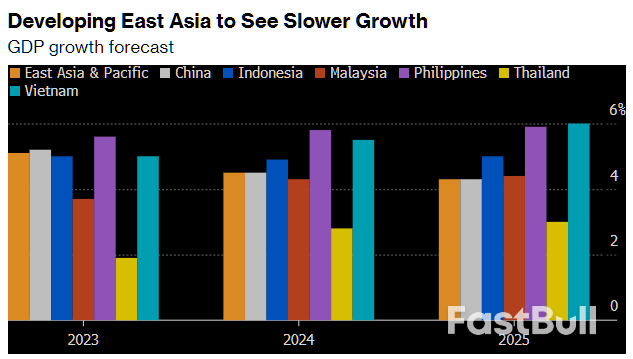
          According to the World Bank, the developing economies in East Asia and the Pacific are poised to experience a slowdown in growth, amid persistent challenges such as higher interest rates and escalating geopolitical tensions. The World Bank's semi-annual outlook indicates a projected GDP growth of 4.5% for 2024 and 4.3% for 2025, compared to the estimated 5% in 2023. Although many economies in the region are expected to outpace global growth, their expansion rates remain below pre-pandemic levels.
          This deceleration is partially attributed to the anticipated moderation in the growth of the world's second-largest economy, with forecasts indicating a decrease to 4.5% and 4.3% for the current and subsequent years respectively. The World Bank noted in its report that China is endeavoring to transition towards a more balanced growth trajectory, yet encounters challenges in stimulating alternative sources of demand.

          East Asia Faces Growth Slowdown as World Bank Cautions Amid Chinese Economic Slump_1Source: World Bank

          The development lender emphasized that China requires more than traditional fiscal stimulus measures. Instead, it suggests that bolstering social protection, implementing progressive taxation, and redirecting public expenditure from infrastructure towards human capital development will be instrumental in boosting consumption.
          Excluding China, the developing nations of East Asia and the Pacific are expected to demonstrate a stable expansion of 4.6% this year, followed by a slight uptick to 4.8% next year. This growth is anticipated to be driven by a potential rebound in goods exports and an easing of financial conditions. Notably, the Philippines, Vietnam, and Cambodia are positioned for growth rates exceeding 5% in 2024 and around 6% in 2025, while Thailand and Myanmar lag behind among the region's major economies.
          Regarding downside risks, the World Bank highlighted that core inflation remains elevated in the US and EU, coupled with tight labor markets, indicating that interest rates are likely to remain higher than pre-pandemic levels in the foreseeable future. Additionally, political developments within countries and escalating geopolitical tensions contribute to heightened uncertainty.
          The World Bank also issued a cautionary note regarding the significant increase in debt across the region, which leads to elevated borrowing costs and constrains both consumption and investment. Corporate debt in China and Vietnam has surged by over 40 percentage points of GDP since 2010, surpassing levels seen in advanced economies. Furthermore, household debt in China, Malaysia, and Thailand exceeds that of other emerging markets.
          On the external front, the rise in trade protectionism, particularly from advanced economies, poses a threat to growth for developing East Asia and the Pacific. This trend limits access to key markets such as the US, South Korea, and Japan, while firms receiving subsidies could potentially become competitors to those in the region. The World Bank highlighted a significant increase in trade-distorting measures in 2023, three times larger than those observed in 2019.
          To stay updated on all economic events of today, please check out our Economic calendar
          Risk Warnings and Disclaimers
          You understand and acknowledge that there is a high degree of risk involved in trading. Following any strategies or investment methods may lead to potential losses. The content on the site is provided by our contributors and analysts for information purposes only. You are solely responsible for determining whether any trading assets, securities, strategy, or any other product is suitable for investing based on your own investment objectives and financial situation.
          Add to Favorites
          Share

          Young Voters Are More Concerned With The Economy. That’s Bad For Biden

          Samantha Luan

          Economic

          Political

          They’re weighed down by student debt. They’re shut out of the housing market. They’re hit by higher costs of living. And they want President Joe Biden to listen.
          At a time when Donald Trump is cutting into Biden’s 2020 advantage with young adults, the growing list of grievances among those between the ages 18-29 is a worrying sign for Biden as he seeks a second term.
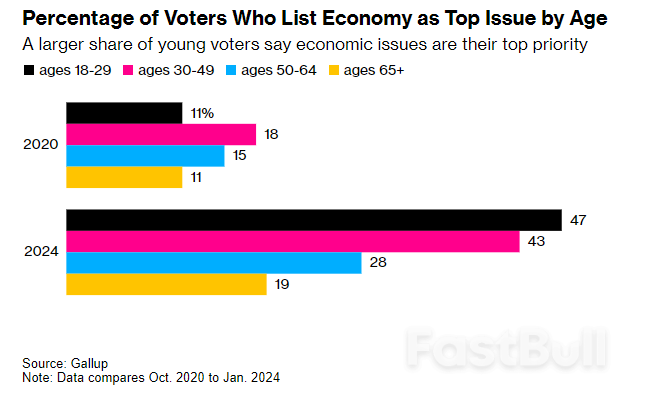
          People in that age cohort are more than twice as likely to cite the economy as their top concern compared with older adults in recent Gallup data. And while all voters are more worried about the economy now than they were heading into the 2020 presidential election, the pessimism has spiked the most among those under 30.
          Young Voters Are More Concerned With The Economy. That’s Bad For Biden_1
          That concern is being reflected in polls. Trump is currently leading the president 47% to 40% with voters 18-34 in swing states, according to a March Bloomberg News/Morning Consult poll. By contrast, Biden won 61% of voters under 30 last cycle.
          Though the November election is months off and attitudes can shift, there’s no doubt Biden will need support from Generation Z and Millennial voters to win.
          Incumbents get the blame when voters are dissatisfied with the economy. The challenge for Biden is that even though economic growth has been solid in the past year, the job market is robust and the inflation rate is cooling, polls after polls show many people don’t feel like it.
          Younger Americans have a long list of headwinds: stunted action on student-loan forgiveness, the highest interest rates since they’ve been in diapers and expensive rents.
          Older Americans, who are more likely to live in houses they own with low mortgage rates and who have benefited from years of housing and stock market appreciation, are less pessimistic about the economy. The contrasting way generations emerged financially from the coronavirus pandemic may provide a playbook for Biden on how to hone his political message to young adults.
          Christian Martin, a 22-year-old college senior from Atlanta, Georgia, said he hasn’t yet felt the impact of Biden’s economic policies. He’s worried about making student-loan payments after he graduates while keeping up with the elevated costs of living.
          “If Biden can address the issues that the youth are feeling, then the turnout can be stronger than what it’s projected to be,” he said in an interview. “This is Biden’s chance to hear what we have to say, because that’s essentially all it is, you know, unfulfilled promises.”
          Biden’s plan to forgive billions of dollars in student debt was struck down last year by the Supreme Court, which rejected one of his signature initiatives as exceeding his power.
          “The President is fighting to lower costs for young Americans — forgiving student debt, lowering health and eliminating junk fees,” Seth Schuster, a Biden campaign spokesperson, said by e-mail. “Meanwhile, Donald Trump appointed the Supreme Court Justices who denied student-debt relief and ensured that young people now have less rights than the generations before them.”
          Biden’s plan to forgive billions of dollars in student debt was struck down last year by the Supreme Court, which rejected one of his signature initiatives as exceeding his power.
          “The President is fighting to lower costs for young Americans — forgiving student debt, lowering health and eliminating junk fees,” Seth Schuster, a Biden campaign spokesperson, said by e-mail. “Meanwhile, Donald Trump appointed the Supreme Court Justices who denied student-debt relief and ensured that young people now have less rights than the generations before them.”Young Voters Are More Concerned With The Economy. That’s Bad For Biden_2
          The pandemic upended the economy when young voters were just entering adulthood, endangering their job prospects as businesses locked down and complicating their housing options as rents skyrocketed.
          “They had a more severe impact of Covid itself in a direct economic way,” said Kei Kawashima-Ginsberg, Newhouse director of Tufts University’s Center for Information & Research on Civic Learning and Engagement. “Whether it’s gas, or housing, or rent or health care, they’re having a really hard time having affordability for that because of the lack of stored wealth.”
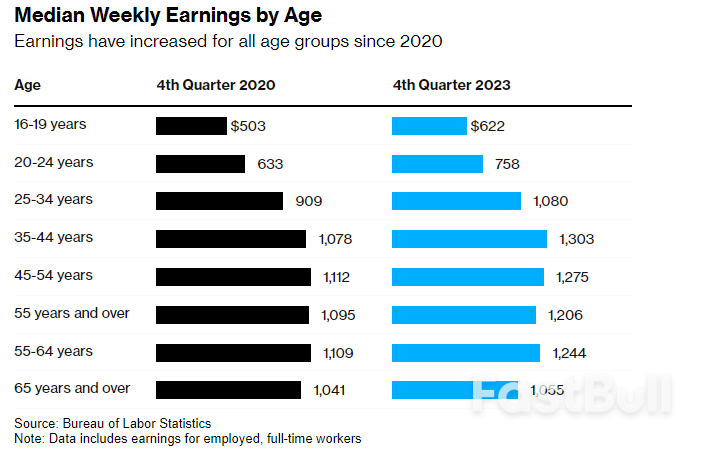
          Inflation has eased significantly in the past year, including for necessities such as food, but prices remain considerably higher than they were before the 2020 election. And while wages have grown for all age groups in recent years, young adults have the lowest earnings in addition to having fewer assets.
          Much of those wage increases have also been eaten up by higher rent costs, which rose about 18% between October 2020 and January 2024, according to Redfin. Buying a property is increasingly out of reach for many young adults, with home prices up 21% over the same period, according to the Federal Reserve Bank of Atlanta. Swing-state voters ages 18-34 are more likely than any other age cohort to list housing costs as important for their vote in 2024, according to the Bloomberg News/Morning Consult poll.
          Debt is also souring some younger Americans’ views about the economy, according to EY Chief Economist Gregory Daco. Adults in their twenties and thirties have higher rates of credit-card debt that have deepened into serious delinquency, meaning the debt is 90 days or more past due, according to data from the New York Fed.
          Many young adults are making payments on federal student debt that they had hoped would be forgiven by Biden’s plan. The White House has used more narrow methods to approve nearly $144 billion in forgiveness, targeting specific groups, including those with disabilities, some former for-profit college students and public servants who have been paying their loans for years.
          Young Voters Are More Concerned With The Economy. That’s Bad For Biden_3
          Student loans and rent prices weigh on Ariela Lara, an 18-year-old high school senior from San Leandro, California, as she debates which college to attend. Lara said her family cannot afford to take on debt, so she will attend the school that offers her the most in aid.
          “As I’ve been getting into this world of adulthood, it’s hard to achieve financial stability in our country,” she said, adding that climate change and the economy are her top issues as she considers her first vote in a presidential election. “We’re telling Biden to wake up and to start saying that he needs the youth vote. He needs us immensely.”

          Source:Bloomberg

          To stay updated on all economic events of today, please check out our Economic calendar
          Risk Warnings and Disclaimers
          You understand and acknowledge that there is a high degree of risk involved in trading. Following any strategies or investment methods may lead to potential losses. The content on the site is provided by our contributors and analysts for information purposes only. You are solely responsible for determining whether any trading assets, securities, strategy, or any other product is suitable for investing based on your own investment objectives and financial situation.
          Add to Favorites
          Share
          FastBull
          Copyright © 2025 FastBull Ltd

          728 RM B 7/F GEE LOK IND BLDG NO 34 HUNG TO RD KWUN TONG KLN HONG KONG

          TelegramInstagramTwitterfacebooklinkedin
          App Store Google Play Google Play
          Products
          Charts

          Chats

          Q&A with Experts
          Screeners
          Economic Calendar
          Data
          Tools
          Membership
          Features
          Function
          Markets
          Copy Trading
          Latest Signals
          Contests
          News
          Analysis
          24/7
          Columns
          Education
          Company
          Careers
          About Us
          Contact Us
          Advertising
          Help Center
          Feedback
          User Agreement
          Privacy Policy
          Business

          White Label

          Data API

          Web Plug-ins

          Poster Maker

          Affiliate Program

          Risk Disclosure

          The risk of loss in trading financial instruments such as stocks, FX, commodities, futures, bonds, ETFs and crypto can be substantial. You may sustain a total loss of the funds that you deposit with your broker. Therefore, you should carefully consider whether such trading is suitable for you in light of your circumstances and financial resources.

          No decision to invest should be made without thoroughly conducting due diligence by yourself or consulting with your financial advisors. Our web content might not suit you since we don't know your financial conditions and investment needs. Our financial information might have latency or contain inaccuracy, so you should be fully responsible for any of your trading and investment decisions. The company will not be responsible for your capital loss.

          Without getting permission from the website, you are not allowed to copy the website's graphics, texts, or trademarks. Intellectual property rights in the content or data incorporated into this website belong to its providers and exchange merchants.

          Not Logged In

          Log in to access more features

          FastBull Membership

          Not yet

          Purchase

          Become a signal provider
          Help Center
          Customer Service
          Dark Mode
          Price Up/Down Colors

          Log In

          Sign Up

          Position
          Layout
          Fullscreen
          Default to Chart
          The chart page opens by default when you visit fastbull.com