
• Trade
  • Markets
  • Copy
  • Contests
  • News
  • 24/7
  • Calendar
  • Q&A
  • Chats
Trending
Screeners
SYMBOL
LAST
BID
ASK
HIGH
LOW
NET CHG.
%CHG.
SPREAD
SPX
S&P 500 Index
6827.42
6827.42
6827.42
6899.86
6801.80
-73.58
-1.07%
--
DJI
Dow Jones Industrial Average
48458.04
48458.04
48458.04
48886.86
48334.10
-245.98
-0.51%
--
IXIC
NASDAQ Composite Index
23195.16
23195.16
23195.16
23554.89
23094.51
-398.69
-1.69%
--
USDX
US Dollar Index
97.950
98.030
97.950
98.500
97.950
-0.370
-0.38%
--
EURUSD
Euro / US Dollar
1.17394
1.17409
1.17394
1.17496
1.17192
+0.00011
+ 0.01%
--
GBPUSD
Pound Sterling / US Dollar
1.33707
1.33732
1.33707
1.33997
1.33419
-0.00148
-0.11%
--
XAUUSD
Gold / US Dollar
4299.39
4299.39
4299.39
4353.41
4257.10
+20.10
+ 0.47%
--
WTI
Light Sweet Crude Oil
57.233
57.485
57.233
58.011
56.969
-0.408
-0.71%
--

Community Accounts

Signal Accounts
--
Profit Accounts
--
Loss Accounts
--
View More

Become a signal provider

Sell trading signals to earn additional income

View More

Guide to Copy Trading

Get started with ease and confidence

View More

Signal Accounts for Members

All Signal Accounts

Best Return
  • Best Return
  • Best P/L
  • Best MDD
Past 1W
  • Past 1W
  • Past 1M
  • Past 1Y

All Contests

  • All
  • Trump Updates
  • Recommend
  • Stocks
  • Cryptocurrencies
  • Central Banks
  • Featured News
Top News Only
Share

USA Embassy In Lithuania: Maria Kalesnikava Is Not Going To Vilnius

Share

USA Embassy In Lithuania: Other Prisoners Are Being Sent From Belarus To Ukraine

Share

Ukraine President Zelenskiy: Five Ukrainians Released By Belarus In US-Brokered Deal

Share

USA Vilnius Embassy: USA Stands Ready For "Additional Engagement With Belarus That Advances USA Interests"

Share

USA Vilnius Embassy: Belarus, USA, Other Citizens Among The Prisoners Released Into Lithuania

Share

USA Vilnius Embassy: USA Will Continue Diplomatic Efforts To Free The Remaining Political Prisoners In Belarus

Share

USA Vilnius Embassy: Belarus Releases 123 Prisoners Following Meeting Of President Trump's Envoy Coale And Belarus President Lukashenko

Share

USA Vilnius Embassy: Masatoshi Nakanishi, Aliaksandr Syrytsa Are Among The Prisoners Released By Belarus

Share

USA Vilnius Embassy: Maria Kalesnikava And Viktor Babaryka Are Among The Prisoners Released By Belarus

Share

USA Vilnius Embassy: Nobel Peace Prize Laureate Ales Bialiatski Is Among The Prisoners Released By Belarus

Share

Belarusian Presidential Administration Telegram Channel: Lukashenko Has Pardoned 123 Prisoners As Part Of Deal With US

Share

Two Local Syrian Officials: Joint US-Syrian Military Patrol In Central Syria Came Under Fire From Unknown Assailants

Share

Israeli Military Says It Targeted 'Key Hamas Terrorist' In Gaza City

Share

Rwanda's Actions In Eastern Drc Are A Clear Violation Of Washington Accords Signed By President Trump - Secretary Of State Rubio

Share

Israeli Military Issues Evacuation Warning In Southern Lebanon Village Ahead Of Strike - Spokesperson On X

Share

Belarusian State Media Cites US Envoy Coale As Saying He Discussed Ukraine And Venezuela With Lukashenko

Share

Belarusian State Media Cites US Envoy Coale As Saying That US Removes Sanctions On Belarusian Potassium

Share

Thai Prime Minister: No Ceasefire Agreement With Cambodia

Share

US, Ukraine To Discuss Ceasefire In Berlin Ahead Of European Summit

Share

Incoming Czech Prime Minister Babis: Czech Republic Will Not Take On Guarantees For Ukraine Financing, European Commission Must Find Alternatives

TIME
ACT
FCST
PREV
U.K. Trade Balance Non-EU (SA) (Oct)

A:--

F: --

P: --

U.K. Trade Balance (Oct)

A:--

F: --

P: --

U.K. Services Index MoM

A:--

F: --

P: --

U.K. Construction Output MoM (SA) (Oct)

A:--

F: --

P: --

U.K. Industrial Output YoY (Oct)

A:--

F: --

P: --

U.K. Trade Balance (SA) (Oct)

A:--

F: --

P: --

U.K. Trade Balance EU (SA) (Oct)

A:--

F: --

P: --

U.K. Manufacturing Output YoY (Oct)

A:--

F: --

P: --

U.K. GDP MoM (Oct)

A:--

F: --

P: --

U.K. GDP YoY (SA) (Oct)

A:--

F: --

P: --

U.K. Industrial Output MoM (Oct)

A:--

F: --

P: --

U.K. Construction Output YoY (Oct)

A:--

F: --

P: --

France HICP Final MoM (Nov)

A:--

F: --

P: --

China, Mainland Outstanding Loans Growth YoY (Nov)

A:--

F: --

P: --

China, Mainland M2 Money Supply YoY (Nov)

A:--

F: --

P: --

China, Mainland M0 Money Supply YoY (Nov)

A:--

F: --

P: --

China, Mainland M1 Money Supply YoY (Nov)

A:--

F: --

P: --

India CPI YoY (Nov)

A:--

F: --

P: --

India Deposit Gowth YoY

A:--

F: --

P: --

Brazil Services Growth YoY (Oct)

A:--

F: --

P: --

Mexico Industrial Output YoY (Oct)

A:--

F: --

P: --

Russia Trade Balance (Oct)

A:--

F: --

P: --

Philadelphia Fed President Henry Paulson delivers a speech
Canada Building Permits MoM (SA) (Oct)

A:--

F: --

P: --

Canada Wholesale Sales YoY (Oct)

A:--

F: --

P: --

Canada Wholesale Inventory MoM (Oct)

A:--

F: --

P: --

Canada Wholesale Inventory YoY (Oct)

A:--

F: --

P: --

Canada Wholesale Sales MoM (SA) (Oct)

A:--

F: --

P: --

Germany Current Account (Not SA) (Oct)

A:--

F: --

P: --

U.S. Weekly Total Rig Count

A:--

F: --

P: --

U.S. Weekly Total Oil Rig Count

A:--

F: --

P: --

Japan Tankan Large Non-Manufacturing Diffusion Index (Q4)

--

F: --

P: --

Japan Tankan Small Manufacturing Outlook Index (Q4)

--

F: --

P: --

Japan Tankan Large Non-Manufacturing Outlook Index (Q4)

--

F: --

P: --

Japan Tankan Large Manufacturing Outlook Index (Q4)

--

F: --

P: --

Japan Tankan Small Manufacturing Diffusion Index (Q4)

--

F: --

P: --

Japan Tankan Large Manufacturing Diffusion Index (Q4)

--

F: --

P: --

Japan Tankan Large-Enterprise Capital Expenditure YoY (Q4)

--

F: --

P: --

U.K. Rightmove House Price Index YoY (Dec)

--

F: --

P: --

China, Mainland Industrial Output YoY (YTD) (Nov)

--

F: --

P: --

China, Mainland Urban Area Unemployment Rate (Nov)

--

F: --

P: --

Saudi Arabia CPI YoY (Nov)

--

F: --

P: --

Euro Zone Industrial Output YoY (Oct)

--

F: --

P: --

Euro Zone Industrial Output MoM (Oct)

--

F: --

P: --

Canada Existing Home Sales MoM (Nov)

--

F: --

P: --

Euro Zone Total Reserve Assets (Nov)

--

F: --

P: --

U.K. Inflation Rate Expectations

--

F: --

P: --

Canada National Economic Confidence Index

--

F: --

P: --

Canada New Housing Starts (Nov)

--

F: --

P: --

U.S. NY Fed Manufacturing Employment Index (Dec)

--

F: --

P: --

U.S. NY Fed Manufacturing Index (Dec)

--

F: --

P: --

Canada Core CPI YoY (Nov)

--

F: --

P: --

Canada Manufacturing Unfilled Orders MoM (Oct)

--

F: --

P: --

Canada Manufacturing New Orders MoM (Oct)

--

F: --

P: --

Canada Core CPI MoM (Nov)

--

F: --

P: --

Canada Manufacturing Inventory MoM (Oct)

--

F: --

P: --

Canada CPI YoY (Nov)

--

F: --

P: --

Canada CPI MoM (Nov)

--

F: --

P: --

Canada CPI YoY (SA) (Nov)

--

F: --

P: --

Canada Core CPI MoM (SA) (Nov)

--

F: --

P: --

Q&A with Experts
    • All
    • Chatrooms
    • Groups
    • Friends
    Connecting
    .
    .
    .
    Type here...
    Add Symbol or Code

      No matching data

      All
      Trump Updates
      Recommend
      Stocks
      Cryptocurrencies
      Central Banks
      Featured News
      • All
      • Russia-Ukraine Conflict
      • Middle East Flashpoint
      • All
      • Russia-Ukraine Conflict
      • Middle East Flashpoint
      Search
      Products

      Charts Free Forever

      Chats Q&A with Experts
      Screeners Economic Calendar Data Tools
      Membership Features
      Data Warehouse Market Trends Institutional Data Policy Rates Macro

      Market Trends

      Market Sentiment Order Book Forex Correlations

      Top Indicators

      Charts Free Forever
      Markets

      News

      News Analysis 24/7 Columns Education
      From Institutions From Analysts
      Topics Columnists

      Latest Views

      Latest Views

      Trending Topics

      Top Columnists

      Latest Update

      Signals

      Copy Rankings Latest Signals Become a signal provider AI Rating
      Contests
      Brokers

      Overview Brokers Assessment Rankings Regulators News Claims
      Broker listing Forex Brokers Comparison Tool Live Spread Comparison Scam
      Q&A Complaint Scam Alert Videos Tips to Detect Scam
      More

      Business
      Events
      Careers About Us Advertising Help Center

      White Label

      Data API

      Web Plug-ins

      Affiliate Program

      Awards Institution Evaluation IB Seminar Salon Event Exhibition
      Vietnam Thailand Singapore Dubai
      Fans Party Investment Sharing Session
      FastBull Summit BrokersView Expo
      Recent Searches
        Top Searches
          Markets
          News
          Analysis
          User
          24/7
          Economic Calendar
          Education
          Data
          • Names
          • Latest
          • Prev

          View All

          No data

          Scan to Download

          Faster Charts, Chat Faster!

          Download App
          English
          • English
          • Español
          • العربية
          • Bahasa Indonesia
          • Bahasa Melayu
          • Tiếng Việt
          • ภาษาไทย
          • Français
          • Italiano
          • Türkçe
          • Русский язык
          • 简中
          • 繁中
          Open Account
          Search
          Products
          Charts Free Forever
          Markets
          News
          Signals

          Copy Rankings Latest Signals Become a signal provider AI Rating
          Contests
          Brokers

          Overview Brokers Assessment Rankings Regulators News Claims
          Broker listing Forex Brokers Comparison Tool Live Spread Comparison Scam
          Q&A Complaint Scam Alert Videos Tips to Detect Scam
          More

          Business
          Events
          Careers About Us Advertising Help Center

          White Label

          Data API

          Web Plug-ins

          Affiliate Program

          Awards Institution Evaluation IB Seminar Salon Event Exhibition
          Vietnam Thailand Singapore Dubai
          Fans Party Investment Sharing Session
          FastBull Summit BrokersView Expo

          Credit Suisse Takeover, Central Bank Action Calm Jittery Markets

          Devin

          Central Bank

          Summary:

          Moves by authorities to avert a global banking crisis appeared to have lifted market confidence on Monday as investors welcomed emergency dollar liquidity from top central banks and a historic Swiss-backed acquisition of troubled Credit Suisse by UBS Group.
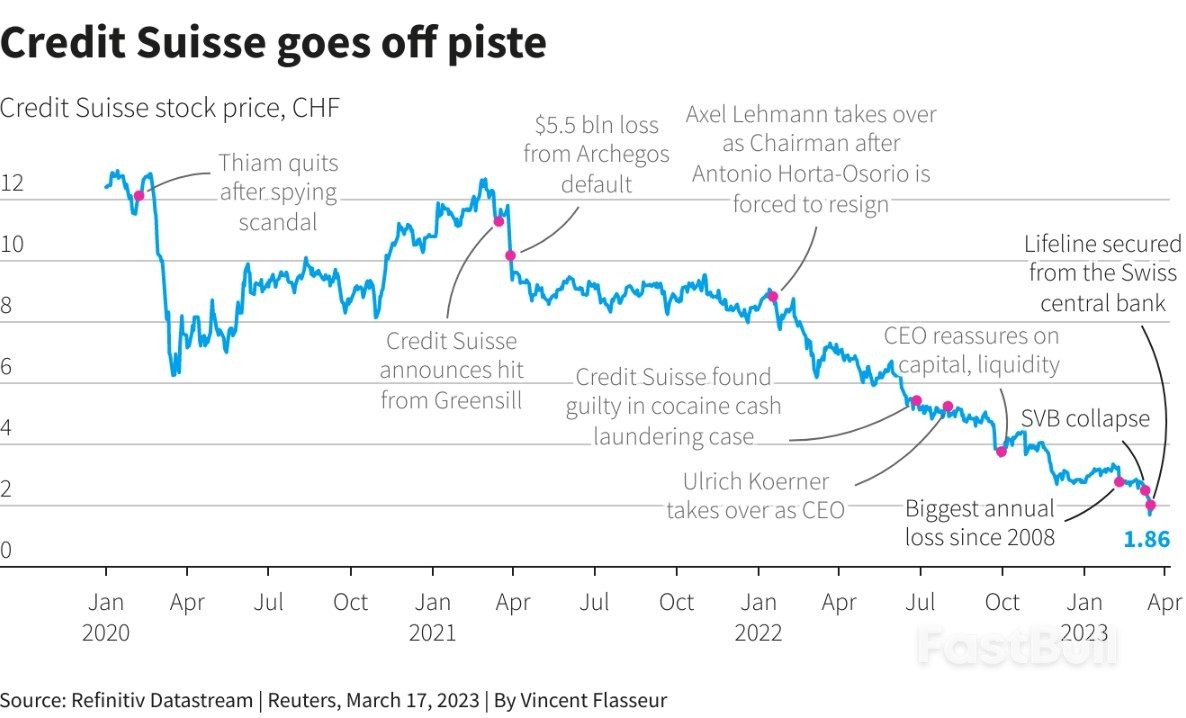
          Credit Suisse Takeover, Central Bank Action Calm Jittery Markets_1Moves by authorities to avert a global banking crisis appeared to have lifted market confidence on Monday as investors welcomed emergency dollar liquidity from top central banks and a historic Swiss-backed acquisition of troubled Credit Suisse by UBS Group.
          In a package orchestrated by Swiss regulators on Sunday, UBS Group AG will pay 3 billion Swiss francs ($3.23 billion) for 167-year-old Credit Suisse Group AG and assume up to $5.4 billion in losses.
          Major central banks, faced with the risk of a fast-moving loss of confidence in the financial system, also scrambled on Sunday to bolster the flow of cash around the world with a series of coordinated currency swaps to ensure banks have the dollars needed to operate.
          The Swiss banking marriage is backed by a massive government guarantee, helping prevent what would have been one of the largest banking collapses since the fall of Lehman Brothers in 2008.
          Financial markets staged a modest relief rally in Asia on Monday but are wary about a range of risks including contagion, the fragile state of U.S. regional banks, and moral hazard.
          "Policy makers will be hoping that the weekend's UBS buyout of troubled Credit Suisse will draw a line under recent market stresses," said Brian Martin, ANZ head of G3 economics in London.
          "Central banks were already facing the conundrum of 'how much is enough?' in the face of resilient labour markets, given the lags with which their policy decisions affect economies. They now have a new conundrum: 'how much is too much?' for financial stability?"
          Pressure on UBS helped seal Sunday's deal.
          "It's a historic day in Switzerland, and a day frankly, we hoped, would not come," UBS Chairman Colm Kelleher told analysts on a conference call. "I would like to make it clear that while we did not initiate discussions, we believe that this transaction is financially attractive for UBS shareholders," Kelleher said.
          UBS CEO Ralph Hamers said there were still many details to be worked through.
          "I know that there must be still questions that we have not been able to answer," he said. "And I understand that and I even want to apologise for it."
          In a global response not seen since the height of the pandemic, the Fed said it had joined central banks in Canada, England, Japan, the EU and Switzerland in a coordinated action to enhance market liquidity. The European Central Bank vowed to support euro zone banks with loans if needed, adding the Swiss rescue of Credit Suisse was "instrumental" in restoring calm.
          Unresolved Issues
          Problems remain in the U.S. banking sector, where bank stocks remained under pressure despite a move by several large banks to deposit $30 billion into First Republic Bank, an institution rocked by the failures of Silicon Valley and Signature Bank.
          On Sunday, First Republic saw its credit ratings downgraded deeper into junk status by S&P Global, which said the deposit infusion may not solve its liquidity problems.
          U.S. bank deposits have stabilized, with outflows slowing or stopping and, in some cases, reversing, a U.S. official said on Sunday, adding the problems of Credit Suisse are unrelated to recent deposit runs on U.S. banks and that U.S. banks have limited exposure to Credit Suisse.
          The U.S. Federal Deposit Insurance Corp (FDIC) is planning to relaunch the sale process for Silicon Valley Bank, with the regulator seeking a potential breakup of the lender, according to people familiar with the matter.
          There are also concerns about what happens next at Credit Suisse and what that means for investors and employees.
          UBS chairman Kelleher told a media conference that it will wind down Credit Suisse's investment bank, which has thousands of employees worldwide. UBS said it expected annual cost savings of some $7 billion by 2027.
          The Swiss central bank said Sunday's deal includes 100 billion Swiss francs ($108 billion) in liquidity assistance for UBS and Credit Suisse.
          Credit Suisse shares had lost a quarter of their value last week. The bank was forced to tap $54 billion in central bank funding as it tries to recover from scandals that have undermined confidence.
          Under the deal with UBS, some Credit Suisse bondholders are major losers. The Swiss regulator decided that Credit Suisse bonds with a notional value of $17 billion will be valued at zero, angering some of the holders of the debt who thought they would be better protected than shareholders in the takeover deal announced on Sunday.
          ($1 = 0.9280 Swiss francs)

          Source: Reuters

          Risk Warnings and Disclaimers
          You understand and acknowledge that there is a high degree of risk involved in trading. Following any strategies or investment methods may lead to potential losses. The content on the site is provided by our contributors and analysts for information purposes only. You are solely responsible for determining whether any trading assets, securities, strategy, or any other product is suitable for investing based on your own investment objectives and financial situation.
          Comments
          Add to Favorites
          Share

          Macron Wins Pyrrhic Victory on Pension Bill, Risks Fuelling Anger

          Cohen

          Political

          President Emmanuel Macron's move to shun the National Assembly and push through an unpopular pension system overhaul without a vote in the lower house may secure a reform he says is needed for France's finances. But it may end up a Pyrrhic victory.
          By using special constitutional powers instead of risking lawmakers rejecting the reform, Macron has given ammunition to the opposition and to trade union leaders who cast the reform as undemocratic.
          It could also play into the far right's hands.
          "It's a democratic coup," far-right leader Marine Le Pen told reporters after a chaotic session in parliament, where Prime Minister Elisabeth Borne was booed as she announced that the government would invoke article 49.3 of the constitution allowing it to pass the legislation without a vote.
          Despite a series of costly sweeteners, the government concluded it had failed to garner enough votes from conservative lawmakers in the lower house to ensure passage for its plan to raise the minimum retirement age to 64 from 62.
          Once known as a high-stakes political gambler, Macron chose to play it safe.
          He was too concerned about the broader financial implications to risk jeopardising a reform meant to reassure investors and ratings agencies about French debt sustainability, a government source said.
          However, weeks of heated debates in parliament and street protests drawing over 1 million people risked leaving a toxic legacy that could boost far-right populists, analysts said.
          "This reform has all the ingredients to boost votes for parties on the radical right," said Bruno Palier, a political scientist at French university Sciences-Po.
          Palier said bearing the brunt of the reform would be the lower middle-class, a segment of the population that already felt like it was the loser of globalisation, as it did in Britain before Brexit and in the United States before Donald Trump's election.
          "This resentment is not going to disappear, it's going to morph into something different, it'll just wait for voting ballots to manifest itself again," he added.
          Past leaders who have meddled with the retirement age have done so to their cost, Palier said, pointing to Nicolas Sarkozy's failure to win re-election in 2012 after he pushed the retirement age to 62 from 60 in 2010.
          Le Pen Ambush
          To be sure, claims of authoritarianism by the pension bill's critics are far-fetched.
          Article 49.3 of the constitution, which Macron invoked to pass the reform, has been used by governments of the left, right and centre in the past. Former Socialist prime minister Michel Rocard resorted to the special powers it entails 28 times in the 1980s and 1990s.
          However, from the outset Macron's government failed to make the case for reform.
          Ministers initially sold the changes as necessary to save the pension system from collapse. They then explained that the changes were a "left-wing reform".
          Political observers say Le Pen played her hand well.
          She is well-placed to benefit from the way the debate unfolded, political sources and disillusioned voters have told Reuters, with Macron being barred from running for a third term in 2027 and no clear successor in sight.
          "Mrs Le Pen is ready for the ambush," Laurent Berger, the head of the moderate CFDT union said on Thursday, hours before the vote. "The resentment, the social debt that's building, is going to be exploited by the populists and the far-right. It's scary," he said.
          Le Pen has repeatedly stated her opposition to the reform but has instructed her colleagues in parliament to refrain from using obstructionist tactics like those of the radical left bloc, in line with her long-term goal of winning respectability.
          At one point in the debates she even asked her lawmakers to stand and applaud the minister in charge of defending the reform, who had been called a "murderer" by one left-wing lawmaker.
          A government source told Reuters Le Pen had appeared the respectable opponent in parliament as the left sought to block the bill with thousands of amendments and the centre-right bickered over whether to support the legislation.
          "She even managed to look like the arbiter of debates, which is incredible," the source said.
          Macron will want to turn the page quickly, with government officials already preparing more socially minded reforms.
          But the end of debates in parliament may do little to quell anger on the streets. An Odoxa poll showed 62% of the French think protests should continue even once the bill is adopted.
          Within moments of the government bypassing parliament, an impromptu demonstration took place on Paris' Place de la Concorde opposite the National Assembly.
          The symbolism was powerful: It was there where Louis XVI was guillotined 230 years ago.

          Source: Reuters

          Risk Warnings and Disclaimers
          You understand and acknowledge that there is a high degree of risk involved in trading. Following any strategies or investment methods may lead to potential losses. The content on the site is provided by our contributors and analysts for information purposes only. You are solely responsible for determining whether any trading assets, securities, strategy, or any other product is suitable for investing based on your own investment objectives and financial situation.
          Comments
          Add to Favorites
          Share

          Week Ahead – Fed Decision to Fuel Volatility in Nervous Market

          Justin

          Central Bank

          Economic

          Fed dilemma

          It’s going to be a difficult meeting for Fed officials on Wednesday, who will have to decide whether the priority is to safeguard the stability of the US financial system or fight inflation at all costs.
          Traders are betting that the episode in the banking sector will force the Fed to stop its tightening cycle soon, perhaps even at this meeting. The implied probability of a quarter-point rate increase next week stands at 80%, with a 20% chance that the Fed does nothing at all. Beyond that, markets are pricing in rate cuts for the summer.
          Week Ahead – Fed Decision to Fuel Volatility in Nervous Market_1
          Admittedly, this speculation seems overblown. The broader banking system and especially the big US players are well capitalized, so there isn’t much threat of a Lehman-style meltdown. Most of the stress is in smaller regional banks, which the Fed has already rushed to support by rolling out an emergency lending program.
          Instead, the real enemy is still inflation. Fed officials have stressed that the metric they care most about is services inflation excluding shelter, which printed 6.9% last month. That’s too hot, and coupled with the strength in employment indicators, it doesn’t allow policymakers any room to stop tightening.
          It was only last week that the Fed Chairman warned rates might be raised higher than what his central bank projected in December. Back then, Fed officials expected rates to end the year at 5.1%, but current market pricing sees them at only 4.2% by year-end. That’s a huge gap, and if those projections are maintained or raised further next week, it would probably ‘shock’ markets.
          Week Ahead – Fed Decision to Fuel Volatility in Nervous Market_2
          In other words, investors believe that if there is a rate increase next week, it will be the final one this cycle. But the Fed might say otherwise. It has already taken measures to shore up the banking system, and inflation is far too high to stop raising rates.
          If the Fed indeed sticks to its guns, that could spark a strong repricing in the markets, propelling US yields higher and boosting the dollar in the process. In contrast, the main casualty might be the Japanese yen, so dollar/yen could experience a particularly violent reaction.

          BoE meeting a coin toss

          The United Kingdom has remained out of the spotlight lately, as investors are more nervous about banks in the US and Eurozone. In fact, most UK news has been positive lately, both politically and economically.
          After several months of business surveys warning about a UK recession, the latest batch painted a brighter picture, revealing a recovery in new business orders that is positive news for future growth. Of course, the economy is not out of the woods. Inflation is still running at double-digits, as electricity prices have surged dramatically and post-Brexit worker shortages have exacerbated the issue.
          Investors will receive an inflation update on Wednesday, ahead of the latest business surveys that will be released Friday alongside retail sales. But the main event will be on Thursday, when the Bank of England announces its decision.
          Week Ahead – Fed Decision to Fuel Volatility in Nervous Market_3
          Markets see this rate decision as a coin toss, pricing in 50-50 chances for a quarter-point rate increase or no action. This pricing seems fair, as the British economy is not in great shape and central bank officials have been hesitant to raise rates overall. Since the data flow has been stronger lately, the odds likely favor a rate hike, but it’s a close call.
          As for sterling, the outlook seems cautiously negative. The UK economy might be stabilizing but is still fragile, its inflation problem is bigger than other nations, and the BoE is near the end of its tightening campaign. Combined with the pound’s sensitivity to the global investment mood at a time of turbulence in the markets, it’s tough to be optimistic.

          Switzerland’s banking troubles

          Switzerland has been at the epicenter of the recent banking panic, amid fears about the solvency of Credit Suisse. Nerves calmed after the Swiss National Bank pledged $54bn in emergency funding to the troubled bank, but the stress hasn’t disappeared as there is still elevated demand for derivatives that protect against a Credit Suisse default.
          Despite this turmoil, investors still expect the SNB to raise rates by a quarter of a percent on Thursday. The rate increase is already fully priced in, so the market reaction will depend mostly on the economic commentary and any signals about future actions.
          Week Ahead – Fed Decision to Fuel Volatility in Nervous Market_4
          Bank troubles aside, the outlook for the Swiss franc looks positive. The SNB is still intervening in the FX market but it has switched sides in recent quarters – it is now buying francs on the open market to help the currency appreciate. Coupled with ongoing rate hikes and resurfacing concerns about the world economy, the environment is favorable for the safe-haven franc.
          The wild card is Credit Suisse, but judging by the forceful policy response, it is likely that it will be protected.
          Finally on the data front, the spotlight will fall on the Eurozone, where the latest PMI business surveys will be released Friday. Over in Canada, inflation and retail sales stats will be released Tuesday ahead of the minutes of the latest Bank of Canada meeting on Wednesday.

          Source:XM

          To stay updated on all economic events of today, please check out our Economic calendar
          Risk Warnings and Disclaimers
          You understand and acknowledge that there is a high degree of risk involved in trading. Following any strategies or investment methods may lead to potential losses. The content on the site is provided by our contributors and analysts for information purposes only. You are solely responsible for determining whether any trading assets, securities, strategy, or any other product is suitable for investing based on your own investment objectives and financial situation.
          Comments
          Add to Favorites
          Share

          Deposit Insurance Is Addiction Not Medication

          Alex

          Economic

          Deposit insurance is as American as apple pie, and twice as unhealthy. After Silicon Valley Bank and Signature Bank failed over the weekend, Uncle Sam swept in, promising to pay back all of their customers. That move may have prevented a wave of copycat bank runs. But the idea of bailing out savers without limit is both unworkable and unhelpful.
          Risk-free banking for most households is the norm almost everywhere, but it's a recent invention. Save for the United States, which kicked off the trend in 1933, most countries only launched formal deposit guarantees within the last 50 years. Britain joined the club in 1979, and Europe mandated coverage for member states' banks in 1994. China was a latecomer in 2015. New Zealand is one of the few holdouts, though a scheme is working its way through parliament.
          The main charm of deposit guarantees is that they reduce the risk of bank runs. The failure of SVB Financial highlighted the weakness in that thinking. Bank deposits in the United States are guaranteed up to $250,000, and over 90% of SVB's accounts held more than that sum. It's a widely shared vulnerability. Around $7 trillion of all U.S. deposits are uninsured, 40% of the total. Thirty years ago it was less than 20%.
          Deposit Insurance Is Addiction Not Medication_1SVB's customers weren't entirely wrong to flee when they sensed danger. When a bank fails the Federal Deposit Insurance Corp, which backs savers using funds raised from a levy on the banking industry, usually steps in and finds a buyer to take on depositors of all sizes. But not always. The Washington Federal Bank for Savings, which failed in 2017, left uninsured depositors high and dry. Even today, only 42% of claims have been paid back, according to the FDIC.
          Though the FDIC has only promised to make SVB and Signature's customers whole, the idea that it has set a template for the industry helped take the heat out of the crisis. The question is what happens next. At some point, the authorities will have to spell out their position. There are broadly three choices they could make.
          One is to try and throw a bigger and more permanent protective net around savers. When the financial crisis struck in 2008, the FDIC heroically pledged to back all deposits in non-interest-bearing accounts that weren't already covered. It can't do that this time. The Dodd-Frank Act of 2010 restricts the FDIC to offering unlimited guarantees to depositors of an individual bank, which must be in receivership. FDIC boss Martin Gruenberg could still team up with Treasury Secretary Janet Yellen and Federal Reserve Chair Jay Powell to propose blanket insurance if their agencies agreed a crisis was afoot, but they would need Congressional approval, which they almost certainly would not get. They would also need to overhaul regulation to make sure even smaller banks could fail without hitting depositors.
          Alternatively, regulators could invite the market to provide a solution – say, with privately funded insurance for deposits over the guaranteed limit. Massachusetts has that already, though its banks are small. Germany too enjoys unlimited insurance courtesy of a club of private banks. If U.S. lenders or their customers were prepared to pay a fair price to make deposits run-proof, maybe a consortium of financiers could step in. The FDIC discussed that possibility back in 2007, but concluded that a scheme of that type would probably need some kind of government backstop.
          The trouble is that deposit insurance is like Novocaine – the higher the dose, the more the patient becomes numb. SVB's wealthy clients already turned a blind eye to the bank's fickle funding and losses in its investment portfolio. If they knew their deposits were riskless, they would have been even more supine. Conversely, if SVB's managers believed their patrons could flee, they might have been more careful about loading up on long-dated securities they couldn't easily sell.
          For that reason, the best option is probably to do nothing – or better still, lower the deposit insurance limit. That might seem cruel. Deposit guarantees, with their aura of protecting the small saver, have a folksy appeal reinforced by the cinematic lesson in banking that is "It's a Wonderful Life." But most Americans have far less than $250,000 in their bank. At JPMorgan the average insured deposit is just $7,000.
          For tens of millions of customers, the $250,000 limit is a benefit they do not need, but still help fund. Lenders must pay a levy to the FDIC to cover future payouts, a sum that rose this year because the fund is understocked. The fee is calculated not just on insured deposits but on all of its liabilities. Like any cost, bankers have an incentive to offset that through fees to customers, which tend to fall hardest on low-income households. Lowering the limit therefore ought to appeal to both small-government Republicans and progressive Democrats.
          With savers and investors jittery, regulators will need to tread carefully. It's hard to get uninsured depositors to understand the dangers they face. If SVB's venture capital and technology startup customers were oblivious to the risks, others are unlikely to be more vigilant. And if savers find themselves on the hook for small banks' losses, funds will fly to larger lenders like JPMorgan and Bank of America, or migrate to non-banks like money market funds. Over time, though, that's preferable to the false pretense that uninsured funds are safe come hell or high water.
          Once the smoke has cleared, the healthiest thing would be to cut the 90-year riskless-banking convention down to size. After all, the U.S. system is an outlier in its generosity. Canada's insured limit is $73,000, one-third that of its neighbor, even though the two countries' bank balances per capita are the same. Britain's limit is $100,000, as is Switzerland's. The FDIC used to cap insurance at the same level, but raised it during the 2008 financial crisis. In setting the bar too high, the architects of U.S. finance have made banking more risky, and less fair.

          Deposit Insurance Is Addiction Not Medication_2Source: YAHOO

          To stay updated on all economic events of today, please check out our Economic calendar
          Risk Warnings and Disclaimers
          You understand and acknowledge that there is a high degree of risk involved in trading. Following any strategies or investment methods may lead to potential losses. The content on the site is provided by our contributors and analysts for information purposes only. You are solely responsible for determining whether any trading assets, securities, strategy, or any other product is suitable for investing based on your own investment objectives and financial situation.
          Comments
          Add to Favorites
          Share

          GPT-4 Could Turn Work into A Hyperproductive Hellscape

          Kevin Du
          OpenAI has announced a major upgrade to the technology that underpins ChatGPT, the seemingly magical online tool that professionals have been using to draft emails, write blog posts and more. If you think of ChatGPT as a car, the new language model known as GPT-4 adds a more powerful engine.
          The old ChatGPT could only read text. The new ChatGPT can look at a photo of the contents of your fridge and suggest a dinner recipe. The old ChatGPT scored in the 10th percentile on the bar exam. The new one was in the 90th.
          In the hours since its release, people have used it to create a website from a hand-drawn sketch or look through a dating website for an ideal partner.
          But this is the fun part of unleashing a powerful language model to the public. The honeymoon period. What are the long-term consequences? OpenAI (once again) hasn't disclosed the datasets it used to train GPT-4, so that means researchers can't scrutinise the model to determine how it might inadvertently manipulate or misinform people.
          More broadly though, it ushers in a new era of hyper-efficiency, where professionals will have to work smarter and faster - or perish.
          Enabling staff to 'assist more people more quickly'
          There is no better example of this than Morgan Stanley, which has been using GPT-4 since last year. According to an announcement by the bank on Tuesday, Morgan Stanley trained GPT-4 on thousands of papers published by its analysts on capital markets, asset classes, industry analysis and more, to create a chatbot for its own wealth advisers. About 200 staff at the bank have been using it daily, the company said.
          "Think of it as having our Chief Investment Strategist, Chief Global Economist, Global Equities Strategist and every other analyst around the globe on call for every advisor, every day," Morgan Stanley analytics chief Jeff McMillan said in an official statement.
          But here was the line that really stood out from OpenAI's own write-up of the case study:
          "McMillan says the effort will also further enrich the relationship between Morgan Stanley advisors and their clients by enabling them to assist more people more quickly."
          How much more quickly? A spokesperson for Morgan Stanley tells me its advisers can now do in seconds what they used to do in half an hour, such as looking at an analyst's note to advise a client on the performance of certain companies and their shares.
          Gpt-4 Will Raise the Bar for Humans
          Powerful AI systems like GPT-4 aren't going to replace large swaths of professional workers, as many have instinctively feared. But they will put them under greater pressure to be more productive and faster at what they do. They will raise the bar on what is considered acceptable output and usher in an era of ultra-efficiency unlike anything we've seen before.
          That is what partly happened to professional translators and interpreters. As artificial intelligence tools like Google Translate and DeepL grew in popularity among business customers, many translators feared they would be replaced. Instead, they were expected to increase their output.
          Before the advent of translation tools, a professional would be expected to translate between 1,000 and 2,000 words a day, according to Nuria Llanderas, who has been a professional interpreter for more than 20 years.
          "Now they are expected to manage 7,000," she says. Her industry peers have predicted more AI systems will start supporting them on simultaneous translation, but that could also mean more work for the human translators in practice, checking that the machine's output isn't wrong.
          It will also raise the bar on the humans' performance. "With the extra help you have no excuses to leave anything out," Llanderas adds.
          Much of this is typical of the march of technology. Smartphones allowed us to be connected to work at all times. Slack allowed us to communicate with more people inside a company, more seamlessly.
          But such tools also kept us further chained to work, squeezing out minutes in the day that workers might have used in the past for contemplation, strategic thinking or just taking a breather.
          GPT-4 clearly has the potential to wring more value out of human workers, but it may well come at the cost of our mental energy. However brilliant these models become, watch out for how they might take you a tiny step closer to burnout.

          Source: Bloomberg

          Risk Warnings and Disclaimers
          You understand and acknowledge that there is a high degree of risk involved in trading. Following any strategies or investment methods may lead to potential losses. The content on the site is provided by our contributors and analysts for information purposes only. You are solely responsible for determining whether any trading assets, securities, strategy, or any other product is suitable for investing based on your own investment objectives and financial situation.
          Comments
          Add to Favorites
          Share

          Uk Wage Growth Cools Amid Uncertain Economic Outlook

          Justin

          Economic

          Signs of slower pay growth

          Data from the Office for National Statistics (ONS) showed average employee earnings (excluding bonuses) growing at an annual rate of 6.5% in the three months to January. That represented a cooling from the 6.7% rate seen in the three months to December, albeit still running higher than anything seen since comparable data were first available over 20 years ago, barring an initial blip during the early months of the pandemic.
          The big question is whether this represents a turning point, after which pay growth will weaken sharply, or whether pay growth will remain stubbornly high. The latter is naturally a concern to policymakers, boding ill for inflation to be pushed higher by rising pay deals.
          Looking in more detail at recent pay growth, single-month data showed regular pay rising at an annual rate of 6.1% in January, which is the slowest rate since last September and represented a second month of moderation. On the same basis, private sector pay growth has fallen to 6.2% in January, down sharply from 7.1% in January and 7.6% in December, so likewise cooling for a second successive month.
          More timely survey data meanwhile suggest that overall pay growth will continue to moderate in the near term. The monthly survey of around 400 recruitment consultancies conducted by S&P Global on behalf of KPMG and the REC. showed average pay awarded to people taking up new permanent jobs grew at a slightly accelerated rate in February, but this rate is still far lower than seen throughout much of 2022 and in fact lies only slightly above the five-year average seen prior to the pandemic. This is broadly consistent with annual wage growth in the region of 3%, which would not be a concern to the Bank of England.
          Similarly, the survey showed pay for temporary and contract workers grew in February at one of the slowest rates seen over the past two years.
          Uk Wage Growth Cools Amid Uncertain Economic Outlook_1

          Public sector pay growth accelerates

          One area of concern is the public sector, where pay growth accelerated to 4.8% in the latest three months according to official statistics, and to 5.4% in January alone. This in part reflects the impact of industrial action, as public sector workers seek to restore lost real pay amid the cost of living crisis. However, with inflation running at double digits in recent months, it's clear that real pay continues to fall at an historically high rate, providing a likely driver of ongoing industrial action and a pay bargaining chip that favors employees.
          Uk Wage Growth Cools Amid Uncertain Economic Outlook_2
          Key to future pay growth will naturally therefore be the degree to which headline inflation cools in the UK, as this will affect pay bargaining. But pay bargaining power will also depend on the extent to which economic growth - and hence demand for staff - slows, as well as the supply of labour.

          Weakened demand for staff and fewer shortages

          Although the PMI survey showed jobs growth picking up in February after falling slightly in the prior two months, the recruitment industry survey showed the number of people placed in permanent jobs still falling at one of the steepest rates seen since the global financial crisis. Growth of agency billings from temp/contract workers also remained largely becalmed, contrasting markedly with the near-record increases seen this time last year. This relatively subdued employment picture suggest that we could see some downward pressures to pay growth in the coming months.
          Uk Wage Growth Cools Amid Uncertain Economic Outlook_3
          At the same time, the sharp deterioration in staff availability seen during the pandemic, which contributed to higher pay growth, has also faded. While overall staff availability as reported by recruitment agencies continued to deteriorate in February, the incidence of shortages has fallen to a near two-year low.
          This combination of weakened demand for additional staff and fewer incidences of skill shortages should combine to help restrain pay growth in the months ahead.
          Uk Wage Growth Cools Amid Uncertain Economic Outlook_4

          How solid is business confidence?

          An important metric to watch will be the degree to which a recent upturn in business confidence will be sustained. The PMI surveys found business expectations regarding output in the 12 months ahead to have revived further in February from the low -point seen in the immediate aftermath of last autumn's mini budget. With the hiring trend closely correlated with business confidence, near-term prospects for the employment trend are positive, though we remain skeptical of this improvement.
          Sentiment has been buoyed by a combination of greater political stability with the Sunak administration, signs of inflation peaking and reduced recession risks. A concern is that these reduced recession risks could now prompt further, more aggressive, monetary policy tightening should inflation worries persist, which seems likely in the very near term at least. Such a renewed hawkish stance could set the recovery back. Thus, even in the case of economic growth proving stronger than anticipated, tighter policy will likely curb that expansion, maintaining a distinct possibility of the UK seeing a mild recession in 2023.
          Uk Wage Growth Cools Amid Uncertain Economic Outlook_5
          The immediate outlook therefore appears to be one where wage growth is pulled in differing directions by various forces. On one hand, a diminished pool of available labour and stubbornly elevated inflation in the first half of 2023 have the potential to exert ongoing upward pressure on wage growth in the coming months. On the other hand, while economic growth and business confidence has picked up since late last year, the foundations of this improvement look unconvincing to date, hence economic growth - and employment growth - are likely to remain sluggish at best in 2023. This will act as a dampener on any wage growth.
          Much therefore remains uncertain in terms of the labour market. Budget measures are likely to help boost growth, via improving the supply of labour and encouraging investment, but these measures are likely to have only a modest impact on a bigger picture which sees the UK continuing to struggle against low productivity growth, low investment and various negative consequences of Brexit, as well as the ongoing damage to households from a severe drop in real wages.

          Source:S&P Global Market Intelligence

          To stay updated on all economic events of today, please check out our Economic calendar
          Risk Warnings and Disclaimers
          You understand and acknowledge that there is a high degree of risk involved in trading. Following any strategies or investment methods may lead to potential losses. The content on the site is provided by our contributors and analysts for information purposes only. You are solely responsible for determining whether any trading assets, securities, strategy, or any other product is suitable for investing based on your own investment objectives and financial situation.
          Comments
          Add to Favorites
          Share

          Taking Advantage of the New Global Digital Market

          Thomas

          Economic

          Forecasting how the global economy and markets will perform in 2023 is getting schizophrenic, with a wide range of possibilities before us. Devising the right economic and technology strategy becomes imperative, not just for nations and businesses but also investors.
          After two stellar years in trade from late 2020 to 2022, exports from China shrank 6.8% in the first two months of 2023 compared with last year, marking a fifth consecutive month of negative growth. The financial markets were beginning to worry that the world's largest merchandise exporter was going to slow after a prolonged Covid-19 lockdown amid a year-long tightening of monetary policy globally. With Europe embroiled in war and the US Federal Reserve still hawkish on interest rates, the bulls and bears were clearly more divided than ever.
          Financial returns year to date mirror this confusion. So far, equity markets are up, bond markets are down, and the US Treasury yield curve is inverted, suggesting a recession may be looming later in the year. As US-China tensions rise further, with new restrictive measures being piled onto China, supply chains are being reconfigured, but not without higher costs and risks. Investors fret about the implications these factors may have on future profits.
          Bank for International Settlements (BIS) economic counsellor Hyun Song Shin has just disclosed how global trade patterns emphasise the direct relationship that working capital availability has on supply chain growth (BIS Working Paper 1070, January 2023). Decades of globalisation and financialisation resulted in greater liquidity available for global cross-border lending, which peaked in 2007. The lengthening of supply chains requires more financing to cover inventories in transit. Thus, tightening of liquidity has the effect of putting pressure on production chain operations across national borders.
          Since the 2007/8 global financial crisis, the share of global goods exports as a portion of gross domestic product (GDP) has continuously fallen from nearly 20% to about 17%. Part of this is a reflection of Western banks that reduced their trade financing after the pain of the crisis. Despite the world's adoption of a loose monetary policy, the Asian Development Bank estimated the trade financing gap to be as high as 10% of total merchandise exports, or about US$2 trillion. Thus, as overall monetary policy reversed, consistent with Shin's analysis, impediments to funding would constrict supply chains and global exports will slow down.
          Shin warns that "long production chains and offshoring are sustainable only when credit is cheap, and chains that have become overextended are vulnerable to financial shocks that raise the cost of borrowing". Thus, China's negative export growth may be a warning of broader consequences of tighter liquidity and of potential supply chain decoupling due to geopolitical tensions. As China is also the world's largest importer of intermediate goods, regional exports markets will also be hurt, as two-thirds of intermediary exports by Asian countries are essentially regional trade, according to the World Trade Organization (WTO). With Chinese imports declining by 10.2% in January and February this year, effects will be felt in the order books of its exporting neighbours.
          A schism in global supply chains may fit the geopolitical strategy of "friend-shoring" production — moving production back on-shore or within allied territories. But raising barriers for products within the existing global trade networks is challenging, since it may take years to shift production and markets. Even a long period of globalisation cannot quickly erode comparative advantages in both physical infrastructure (hardware) or logistics skills (organisational software). Thus, the tensions shaping our world at present are advancing the trade war front to new industries.
          We see this happening within the electric vehicle (EV) supply chain. Recognising the importance of this nascent technology, China moved early to secure a commanding position in the industry and came to supply 69% of the world's lithium-ion batteries by last year, while controlling 64% of the global EV market, according to Caixin magazine. Chinese companies ventured abroad early to secure access to lithium assets around the world in order to control the battery supply chain.
          Last year, the US responded.
          Under a combination of the Inflation Reduction Act and CHIPS (Creating Helpful Incentives to Produce Semiconductors) and Science Act of 2022, the US launched a mixture of tax incentives, subsidies and industrial policy seeking to aggressively domesticate its own battery, semiconductor and EV supply chain. The CHIPS Act alone may provide as much as US$280 billion in federal aid to help semiconductor companies build their factories and foundries in the US. Other incentives include nudging US-based EV makers towards purchasing materials locally or via partners that the US has free trade agreements with. These are ambitious programmes to rival China, which had already granted more than RMB100 billion in EV subsidies since 2009, reported Caixin. The industrial policy adopted by the US government has also alarmed the European Union, as it fears that European companies may not be on a level playing field against their US counterparts.
          The implications of geopolitically motivated investments in key production and supply chains mean that state intervention in markets will distort the normal supply-and-demand dynamics of production. There is real risk of supply overshoots in semiconductors and EVs in the medium term, which will hurt corporate profits. Moreover, countries imposing export restrictions on goods, such as semiconductors, can have an adverse effect on corporate profits as well, since broken supply chains cannot harness economies of scale.
          All these suggest that corporate profits may be pressured in the short term in areas of technology production. But this does not mean that there are no opportunities for specialised production. Smart tech companies are already figuring out how to exploit market niches that the giants are not interested in dominating.
          One bright spot amid all this is the digital economy. In 2021, the WTO estimated exports of digitally delivered services to have reached US$3.7 trillion. That is equivalent to nearly 4% of world GDP in nominal terms. The Covid-19 pandemic has accelerated the shift of online delivery of knowledge services. This was most obvious in 2020, when lockdowns disrupted physical logistics and trade flows. By comparison, being relatively borderless and untethered from the conventions of supply chains, exports of digital services grew 14% in that period as we sheltered in our homes and relied on our devices more than ever.
          Reflecting the fundamental changes in our modern lifestyles, exports of digitally delivered services grew at an average rate of 7.3% a year from 2005 to 2019, outpacing growth in traditional goods exports. Value-added services delivered online reflect a fundamental shift of production (of services) to those markets that have the talent and generous research and development (R&D) to design, produce and deliver creative software and services. Artificial intelligence and the availability of 5G networks and beyond will only accelerate this shift. We have already seen how India and the Philippines have become beneficiaries in the offshoring of software services, owing to their cheaper skilled labour force, which itself is the product of strong investments in STEM (science, technology, engineering and mathematics) education in both countries.
          As global manufacturing supply chains begin to fragment, the production of specialised design, testing, support and ancillary services will command a higher value, particularly if these skills aid in manufacturing or improve traditional agriculture and mining production efficiency or sustainability. This creates new opportunities for first-mover emerging markets that devote attention to improving the 3 T's: technology, tourism (higher-value services) and talent.
          Perhaps the stagnant share of global goods exports in the world economy described by Shin can be thought of differently — that we have created a new frontier of globalisation that will help global wealth to grow faster than conventional trade.
          The opportunities for Malaysia are therefore in the new digital economy, building on our strengths already in the exports of electronics and engineering, and our comparative advantages in energy, palm oil and tourism. The real challenge in this new era is how to provide investments in talent, technology and creativity, by not only giving access to working capital financing for new firms in this area, but also investing heavily in start-ups that are opening new markets in a fragmented global world.

          Source: The Edge Malaysia

          To stay updated on all economic events of today, please check out our Economic calendar
          Risk Warnings and Disclaimers
          You understand and acknowledge that there is a high degree of risk involved in trading. Following any strategies or investment methods may lead to potential losses. The content on the site is provided by our contributors and analysts for information purposes only. You are solely responsible for determining whether any trading assets, securities, strategy, or any other product is suitable for investing based on your own investment objectives and financial situation.
          Comments
          Add to Favorites
          Share
          FastBull
          Copyright © 2025 FastBull Ltd

          728 RM B 7/F GEE LOK IND BLDG NO 34 HUNG TO RD KWUN TONG KLN HONG KONG

          TelegramInstagramTwitterfacebooklinkedin
          App Store Google Play Google Play
          Products
          Charts

          Chats

          Q&A with Experts
          Screeners
          Economic Calendar
          Data
          Tools
          Membership
          Features
          Function
          Markets
          Copy Trading
          Latest Signals
          Contests
          News
          Analysis
          24/7
          Columns
          Education
          Company
          Careers
          About Us
          Contact Us
          Advertising
          Help Center
          Feedback
          User Agreement
          Privacy Policy
          Business

          White Label

          Data API

          Web Plug-ins

          Poster Maker

          Affiliate Program

          Risk Disclosure

          The risk of loss in trading financial instruments such as stocks, FX, commodities, futures, bonds, ETFs and crypto can be substantial. You may sustain a total loss of the funds that you deposit with your broker. Therefore, you should carefully consider whether such trading is suitable for you in light of your circumstances and financial resources.

          No decision to invest should be made without thoroughly conducting due diligence by yourself or consulting with your financial advisors. Our web content might not suit you since we don't know your financial conditions and investment needs. Our financial information might have latency or contain inaccuracy, so you should be fully responsible for any of your trading and investment decisions. The company will not be responsible for your capital loss.

          Without getting permission from the website, you are not allowed to copy the website's graphics, texts, or trademarks. Intellectual property rights in the content or data incorporated into this website belong to its providers and exchange merchants.

          Not Logged In

          Log in to access more features

          FastBull Membership

          Not yet

          Purchase

          Become a signal provider
          Help Center
          Customer Service
          Dark Mode
          Price Up/Down Colors

          Log In

          Sign Up

          Position
          Layout
          Fullscreen
          Default to Chart
          The chart page opens by default when you visit fastbull.com