• Trade
  • Markets
  • Copy
  • Contests
  • News
  • 24/7
  • Calendar
  • Q&A
  • Chats
Trending
Screeners
SYMBOL
LAST
BID
ASK
HIGH
LOW
NET CHG.
%CHG.
SPREAD
SPX
S&P 500 Index
6827.42
6827.42
6827.42
6899.86
6801.80
-73.58
-1.07%
--
DJI
Dow Jones Industrial Average
48458.04
48458.04
48458.04
48886.86
48334.10
-245.98
-0.51%
--
IXIC
NASDAQ Composite Index
23195.16
23195.16
23195.16
23554.89
23094.51
-398.69
-1.69%
--
USDX
US Dollar Index
98.050
98.130
98.050
98.070
97.970
+0.100
+ 0.10%
--
EURUSD
Euro / US Dollar
1.17310
1.17317
1.17310
1.17404
1.17283
-0.00084
-0.07%
--
GBPUSD
Pound Sterling / US Dollar
1.33589
1.33599
1.33589
1.33732
1.33556
-0.00118
-0.09%
--
XAUUSD
Gold / US Dollar
4313.11
4313.50
4313.11
4313.82
4294.68
+13.72
+ 0.32%
--
WTI
Light Sweet Crude Oil
57.455
57.492
57.455
57.500
57.194
+0.222
+ 0.39%
--

Community Accounts

Signal Accounts
--
Profit Accounts
--
Loss Accounts
--
View More

Become a signal provider

Sell trading signals to earn additional income

View More

Guide to Copy Trading

Get started with ease and confidence

View More

Signal Accounts for Members

All Signal Accounts

Best Return
  • Best Return
  • Best P/L
  • Best MDD
Past 1W
  • Past 1W
  • Past 1M
  • Past 1Y

All Contests

  • All
  • Trump Updates
  • Recommend
  • Stocks
  • Cryptocurrencies
  • Central Banks
  • Featured News
Top News Only
Share

[Shooting In New York Leaves 6 Injured] According To The New York Police Department, A Shooting Occurred Outside A Party Venue In Brooklyn, New York, Early On The Morning Of The 14th, Injuring Six Teenagers

Share

South Korea Special Prosecutor: Yoon Mobilized The Military To Suspend Parliament And Eliminate Political Opponents

Share

Most Active China Coking Coal Contract Rises 3%

Share

South Korean Special Prosecutor: Former President Yoon Prepared Martial Law Declaration Starting In April 2024

Share

South Korean Special Prosecutor: We Have Charged 24 For Involvement In Insurrection Led By Ex-President Yoon

Share

South Korean Prosecutor Prosecutor: Yoon Conducted Abnormal Military Operations To Provoke North Korea To Create Justification For Martial Law

Share

China, Saudi Arabia Agree To Strengthen Coordination On Regional, Global Matters

Share

Bank Of Japan: Some Retailers, Real Estate Firms Voiced Concern Over Impact Of Worsening Japan-China Relations

Share

[CITIC Securities: AI-Driven, North American Cloud Vendors' Revenue Growth Expected To Continue To Accelerate] A Research Report From CITIC Securities Indicates That 2026 Will Be A Year Of Accelerated Revenue Growth For Major North American Cloud Computing Vendors. AI Training And Inference From Large Customers Will Be The Main Drivers Of Demand, While Demand For Traditional Cloud Services Will Also Steadily Recover. Furthermore, The Commissioning Of Data Centers And Custom Chips Will Further Alleviate The Shortage Of Computing Power Supply

Share

Bank Of Japan: Some Non-Manufacturers Voiced Concern Over Negative Impact Of Higher Prices On Consumption, Dampening Demand Among Inbound Tourists

Share

Bank Of Japan: Firms Cited Concern Over Impact Of US Tariffs, Rising Labour Costs, Labour Shortage As Factors Clouding Business Outlook

Share

Bank Of Japan: Firms Cited Pass Through Of Costs, Robust Demand As Factors Brightening Business Outlook

Share

Seoul Stock Market's KOSPI Falls More Than 2%

Share

Finance Ministry: UK Regulation Of Cryptoassets To Start In October 2027

Share

UK Mi6 Spy Chief Warns Of 'Aggressive' Russia Threat In First Speech

Share

Japan's Nikkei Share Average Falls 0.8% In Early Trading

Share

Bank Of Japan: Japan Small Manufacturers' Sentiment Index, At +6, Is Highest Since March 2019

Share

Bank Of Japan Tankan: March Small Non-Manufacturers Index Seen At +10(Reuters Poll: 10)

Share

Bank Of Japan Tankan: Dec All Firms Employment Index -38

Share

Bank Of Japan Tankan: Japan Big Manufacturers See Fy2025/26 Recurring Profits -7.8%

TIME
ACT
FCST
PREV
U.K. Trade Balance (Oct)

A:--

F: --

P: --

U.K. Services Index MoM

A:--

F: --

P: --

U.K. Construction Output YoY (Oct)

A:--

F: --

P: --

France HICP Final MoM (Nov)

A:--

F: --

P: --

China, Mainland Outstanding Loans Growth YoY (Nov)

A:--

F: --

P: --

China, Mainland M2 Money Supply YoY (Nov)

A:--

F: --

P: --

China, Mainland M0 Money Supply YoY (Nov)

A:--

F: --

P: --

China, Mainland M1 Money Supply YoY (Nov)

A:--

F: --

P: --

India CPI YoY (Nov)

A:--

F: --

P: --

India Deposit Gowth YoY

A:--

F: --

P: --

Brazil Services Growth YoY (Oct)

A:--

F: --

P: --

Mexico Industrial Output YoY (Oct)

A:--

F: --

P: --

Russia Trade Balance (Oct)

A:--

F: --

P: --

Philadelphia Fed President Henry Paulson delivers a speech
Canada Building Permits MoM (SA) (Oct)

A:--

F: --

P: --

Canada Wholesale Sales YoY (Oct)

A:--

F: --

P: --

Canada Wholesale Inventory MoM (Oct)

A:--

F: --

P: --

Canada Wholesale Inventory YoY (Oct)

A:--

F: --

P: --

Canada Wholesale Sales MoM (SA) (Oct)

A:--

F: --

P: --

Germany Current Account (Not SA) (Oct)

A:--

F: --

P: --

U.S. Weekly Total Rig Count

A:--

F: --

P: --

U.S. Weekly Total Oil Rig Count

A:--

F: --

P: --

Japan Tankan Small Manufacturing Outlook Index (Q4)

A:--

F: --

P: --

Japan Tankan Large Non-Manufacturing Diffusion Index (Q4)

A:--

F: --

P: --

Japan Tankan Large Non-Manufacturing Outlook Index (Q4)

A:--

F: --

P: --

Japan Tankan Large Manufacturing Outlook Index (Q4)

A:--

F: --

P: --

Japan Tankan Small Manufacturing Diffusion Index (Q4)

A:--

F: --

P: --

Japan Tankan Large Manufacturing Diffusion Index (Q4)

A:--

F: --

P: --

Japan Tankan Large-Enterprise Capital Expenditure YoY (Q4)

A:--

F: --

P: --

U.K. Rightmove House Price Index YoY (Dec)

A:--

F: --

P: --

China, Mainland Industrial Output YoY (YTD) (Nov)

--

F: --

P: --

China, Mainland Urban Area Unemployment Rate (Nov)

--

F: --

P: --

Saudi Arabia CPI YoY (Nov)

--

F: --

P: --

Euro Zone Industrial Output YoY (Oct)

--

F: --

P: --

Euro Zone Industrial Output MoM (Oct)

--

F: --

P: --

Canada Existing Home Sales MoM (Nov)

--

F: --

P: --

Euro Zone Total Reserve Assets (Nov)

--

F: --

P: --

U.K. Inflation Rate Expectations

--

F: --

P: --

Canada National Economic Confidence Index

--

F: --

P: --

Canada New Housing Starts (Nov)

--

F: --

P: --

U.S. NY Fed Manufacturing Employment Index (Dec)

--

F: --

P: --

U.S. NY Fed Manufacturing Index (Dec)

--

F: --

P: --

Canada Core CPI YoY (Nov)

--

F: --

P: --

Canada Manufacturing Unfilled Orders MoM (Oct)

--

F: --

P: --

U.S. NY Fed Manufacturing Prices Received Index (Dec)

--

F: --

P: --

U.S. NY Fed Manufacturing New Orders Index (Dec)

--

F: --

P: --

Canada Manufacturing New Orders MoM (Oct)

--

F: --

P: --

Canada Core CPI MoM (Nov)

--

F: --

P: --

Canada Trimmed CPI YoY (SA) (Nov)

--

F: --

P: --

Canada Manufacturing Inventory MoM (Oct)

--

F: --

P: --

Canada CPI YoY (Nov)

--

F: --

P: --

Canada CPI MoM (Nov)

--

F: --

P: --

Canada CPI YoY (SA) (Nov)

--

F: --

P: --

Canada Core CPI MoM (SA) (Nov)

--

F: --

P: --

Canada CPI MoM (SA) (Nov)

--

F: --

P: --

Federal Reserve Board Governor Milan delivered a speech
U.S. NAHB Housing Market Index (Dec)

--

F: --

P: --

Australia Composite PMI Prelim (Dec)

--

F: --

P: --

Australia Services PMI Prelim (Dec)

--

F: --

P: --

Australia Manufacturing PMI Prelim (Dec)

--

F: --

P: --

Japan Manufacturing PMI Prelim (SA) (Dec)

--

F: --

P: --

Q&A with Experts
    • All
    • Chatrooms
    • Groups
    • Friends
    Connecting
    .
    .
    .
    Type here...
    Add Symbol or Code

      No matching data

      All
      Trump Updates
      Recommend
      Stocks
      Cryptocurrencies
      Central Banks
      Featured News
      • All
      • Russia-Ukraine Conflict
      • Middle East Flashpoint
      • All
      • Russia-Ukraine Conflict
      • Middle East Flashpoint
      Search
      Products

      Charts Free Forever

      Chats Q&A with Experts
      Screeners Economic Calendar Data Tools
      Membership Features
      Data Warehouse Market Trends Institutional Data Policy Rates Macro

      Market Trends

      Market Sentiment Order Book Forex Correlations

      Top Indicators

      Charts Free Forever
      Markets

      News

      News Analysis 24/7 Columns Education
      From Institutions From Analysts
      Topics Columnists

      Latest Views

      Latest Views

      Trending Topics

      Top Columnists

      Latest Update

      Signals

      Copy Rankings Latest Signals Become a signal provider AI Rating
      Contests
      Brokers

      Overview Brokers Assessment Rankings Regulators News Claims
      Broker listing Forex Brokers Comparison Tool Live Spread Comparison Scam
      Q&A Complaint Scam Alert Videos Tips to Detect Scam
      More

      Business
      Events
      Careers About Us Advertising Help Center

      White Label

      Data API

      Web Plug-ins

      Affiliate Program

      Awards Institution Evaluation IB Seminar Salon Event Exhibition
      Vietnam Thailand Singapore Dubai
      Fans Party Investment Sharing Session
      FastBull Summit BrokersView Expo
      Recent Searches
        Top Searches
          Markets
          News
          Analysis
          User
          24/7
          Economic Calendar
          Education
          Data
          • Names
          • Latest
          • Prev

          View All

          No data

          Scan to Download

          Faster Charts, Chat Faster!

          Download App
          English
          • English
          • Español
          • العربية
          • Bahasa Indonesia
          • Bahasa Melayu
          • Tiếng Việt
          • ภาษาไทย
          • Français
          • Italiano
          • Türkçe
          • Русский язык
          • 简中
          • 繁中
          Open Account
          Search
          Products
          Charts Free Forever
          Markets
          News
          Signals

          Copy Rankings Latest Signals Become a signal provider AI Rating
          Contests
          Brokers

          Overview Brokers Assessment Rankings Regulators News Claims
          Broker listing Forex Brokers Comparison Tool Live Spread Comparison Scam
          Q&A Complaint Scam Alert Videos Tips to Detect Scam
          More

          Business
          Events
          Careers About Us Advertising Help Center

          White Label

          Data API

          Web Plug-ins

          Affiliate Program

          Awards Institution Evaluation IB Seminar Salon Event Exhibition
          Vietnam Thailand Singapore Dubai
          Fans Party Investment Sharing Session
          FastBull Summit BrokersView Expo

          China's Soft Economic Data Will Mean Lower Commodity Imports, But Not Yet

          Owen Li

          Commodity

          Summary:

          A run of weak economic data in China is likely to show up in softer imports of key commodities, albeit with a lag given the time taken to physically ship resources from around the globe.

          A run of weak economic data in China is likely to show up in softer imports of key commodities, albeit with a lag given the time taken to physically ship resources from around the globe.
          The manufacturing indicator, the official Purchasing Managers' Index (PMI), dropped to a five-month low of 48.8 points in May, the National Bureau of Statistics (NBS) said on Wednesday.
          This was the second month the measure was below the 50-level that separates expansion from contraction, and it was also weaker than the median forecast for a rise in May to 49.4 from April's 49.2.
          Weakness in China's manufacturing sector has been matched by soft outcomes in other important parts of the world's second-biggest economy.
          Property investment fell 16.2% year-on-year in April, the fastest since November 2022, according to Reuters calculations based on official data.
          Property sales measured by floor area slumped 11.8% on year in April, the most this year, versus a 3.5% fall in March.
          Industrial profits fell 20.6% in the first four months of the year from the same period in 2022, according to NBS data.
          The major bright spot for the Chinese economy is retail sales, which jumped 18.4% in April from the same month a year earlier, but even this performance was short of market expectations for a 21% leap.
          But retail spending isn't the top driver of demand for commodities, although it does act to boost demand for refined fuels such as gasoline and jet kerosene as people increase travel.
          Rather it is construction and manufacturing that propel commodity demand, especially for steel raw material iron ore and for copper.
          Construction and infrastructure account for about 55% of China's steel consumption, with manufacturing, including vehicles and machinery, taking about 30%.
          The softness in those sectors is likely to show up in commodity imports in coming months, but not yet.
          Import strength to fade?
          In fact, imports of major commodities in May are likely to be robust, but it is worth remembering that these are lagging indicators.
          Seaborne iron ore imports are expected at about 93.29 million tonnes, according to Refinitiv data, which would be stronger than the 90.44 million tonnes recorded by customs in April.
          Crude oil imports are expected by Refinitiv Oil Research to come in at 11.22 million barrels per day (bpd), which would be up from the 10.36 million bpd in April and down from the 34-month high of 12.37 million bpd in March.
          Imports of all grades of seaborne coal are forecast by commodity analysts Kpler to be 34.33 million tonnes in May, up from 33.61 million in April, but down from March's 34.42 million.
          However, it is worth noting that coal imports in the March to May period are the highest in Kpler records going back to January 2017.
          The May import performance is likely a reflection of expectations by Chinese refiners and steel mills that the economic rebound would be stronger than it has actually been.
          If this is the case, it's likely that they may consider trimming imports in coming months, especially if the run of soft economic data continues.
          It can take several months between the arranging of a crude oil cargo and its delivery and processing in a Chinese refinery, and iron ore cargoes also tend to be secured several weeks ahead of shipment and delivery.
          The X-factor is price. If crude oil, iron ore, coal and copper prices all continue to drop, it's possible that Chinese buyers will import more than they need, choosing to build inventories for when prices start rising again.
          Global benchmark Brent crude futures ended at $72.66 a barrel on Wednesday, the lowest close in four weeks.
          Iron ore futures traded in Singapore finished at $105.07 a tonne, down 10 cents from the previous close and some 20% below the peak this year of $131.19 from March 15.
          London copper futures ended at $8,089 a tonne on Wednesday, down 0.4% from the prior close and 13.5% below the closing peak this year of $9,356 on Jan. 23.
          While lower prices may encourage some Chinese buying, it's also likely that importers may wait for further price falls, especially if the economic performance continues to sputter.

          Source: Reuters

          Risk Warnings and Disclaimers
          You understand and acknowledge that there is a high degree of risk involved in trading. Following any strategies or investment methods may lead to potential losses. The content on the site is provided by our contributors and analysts for information purposes only. You are solely responsible for determining whether any trading assets, securities, strategy, or any other product is suitable for investing based on your own investment objectives and financial situation.
          Comments
          Add to Favorites
          Share

          Dollar Skips to the Fed Beat

          Samantha Luan

          Forex

          USD: We're hearing more of this term 'skip'
          Having enjoyed a decent rally on the back of some surprisingly strong JOLTS job opening data, the dollar sold off late yesterday on a couple of Federal Reserve speakers (Patrick Harker and Philip Jefferson) suggesting that the Fed could potentially 'skip' a rate hike at the June meeting - but leave the door open for a July hike. That term 'skip' first entered the Fed lexicon with remarks from Christopher Waller last week and suggests the Fed is indeed starting to use a new communication tool for gracefully ending its tightening cycle.
          While that new strategy does provide some flexibility for the Fed, the data will be a key determinant on whether indeed it does skip the June hike. The release of the Fed's Beige Book last night looked reasonably positive. It was hard to identify any clear signs of slowing activity and consumption was holding up well. Perhaps there were some early signs that pressures in the tight labour market were easing - but nothing to support any recessionary narrative. That suggests this current dollar dip does not need to run too far.
          Ahead of tomorrow's May nonfarm payroll report, today sees the release of ISM Manufacturing, Initial Claims and the ADP employment report. A slightly better external environment - China's small-business PMI was better than expected in May - could see the dollar edge marginally lower were US data to come in on the soft side today. However, we doubt the dollar will go too far ahead of tomorrow's more important jobs and wage data. DXY could trade in a 104.00-104.50 range and if the Fed policy rate could be flatlining after all this summer then expect further interest in the carry trade. Here, USD/JPY could grind back to the 141 area.
          Also, look out for weekly US crude inventory data later today. Brent has remained very soft and a large build in inventories could keep it at its lows (weighing on oil-exporting FX) ahead of this weekend's OPEC+ meeting.
          EUR: Will eurozone core inflation decline much?
          Declines this week in German, French and Spanish May inflation data have the market speculating about a soft eurozone flash CPI number today. Consensus expects the headline to drop to 6.3% year-on-year from 7.0% with the core falling to 5.5% from 5.6%. A faster fall in eurozone inflation than in the US would confound a market that had been betting that the greater weight of assets in US inflation would bring that measure lower faster than in the eurozone. Softer European inflation this week has also seen eurozone swap rates drop relative to those in the US. The two-year EUR:USD swap differential has now widened back to levels seen in March - weighing on EUR/USD.
          Barring a major surprise in the eurozone CPI data, we can probably see EUR/USD tracing out something like a 1.0650-1.0720 range today - i.e. a holding pattern ahead of tomorrow's NFP data. Bigger picture, however, we reiterate that this 1.05/1.07 area should prove a base for EUR/USD this summer - given that conditions are nowhere near as severe as those that drove EUR/USD so much lower this time last year.
          Some idiosyncratic EUR weakness following weaker-than-expected inflation figures in the eurozone put a cap on EUR/SEK and EUR/NOK yesterday. However, both pairs face significant bullish pressure due to the high-beta character of Scandinavian currencies and specific vulnerabilities: the recent dovish turn by Sweden's Riksbank and domestic real estate woes for the krona, and poor liquidity and oil weakness for Norway's krone. May was the first month since October 2022 where NOK outperformed SEK (NOK/SEK rose roughly 2.5%), largely on the back of diverging monetary policy narratives. We think that Norges Bank can still surprise on the hawkish side (especially after a somewhat disappointing FX sales announcement for June) while the Riksbank appears stuck in its dovish communication missteps, and we expect NOK's outperformance over SEK to be the norm in the coming months. Today, the Riksbank also releases its financial stability report. Let's look out for any updates on developments in the commercial real estate sector.
          GBP: Still going strong
          Sterling continues to perform well. Markets have scaled back some of the aggressive (110bp) tightening priced in for this year, but not by much. Equally, there had been some speculation that Bank of England hawk, Catherine Mann, could use a speech yesterday to push back against these tightening expectations - as the BoE chose to do last year when the market priced a Bank Rate at 5.50%. True to form, however, Mann warned that UK consumers were using excess pandemic-level savings to fund spending - and that corporates were taking advantage of better pricing power to improve margins.
          This leaves the market pricing close to 100bp of tightening this year and has sent EUR/GBP below 0.8600. And sterling now looks like a decent intra-European target currency for the carry trade. Unless eurozone CPI today surprises on the upside to drag eurozone swap rates higher, EUR/GBP looks as though it can drift to the 0.8550 area.
          CEE: European Parliament to vote on Hungary
          Today's calendar offers PMI numbers across the region, the second estimate of GDP in Hungary, and the state budget result in the Czech Republic for May. In general, we expect a slight deterioration in industry sentiment across the board. In the Czech Republic, the state budget for April showed the worst result on record which drew a lot of attention and raises questions about government bond issuance for the rest of the year. On the other hand, the government recently unveiled a consolidation package targeting by far the lowest fiscal deficit in the region for next year (1.8% of GDP), which produces mixed feelings overall. Later, the Czech National Bank will decide on changes to the settings of the financial stability instruments. It is very likely that some limits on mortgage lending will be relaxed. A central bank press conference is scheduled for 3.45pm local time.
          On the political side, today at 11.00am local time the European Parliament (EP) will vote on a resolution entitled "Breaches of the Rule of Law and fundamental rights in Hungary and frozen EU funds". Some MEPs are protesting against Hungary's EU presidency, which is scheduled for the second half of next year. So potentially we could see negative headlines today linked to the rule of law and EU money.
          As a result, we will be watching the Hungarian forint today, which is currently near record highs, and the market positioning is arguably long. Thus, we suspect that any noise around Hungary may spark a forint sell-off closer to 373 EUR/HUF. Moreover, a further decline in EUR/USD threatens the entire region once again, building pressure for weakness across the board. However, at the end of the day, the EP has no legal power in the matter. Thus, we think the market could re-enter the HUF at a later date, benefiting from by far the highest carry within the region.

          Source: ING

          Risk Warnings and Disclaimers
          You understand and acknowledge that there is a high degree of risk involved in trading. Following any strategies or investment methods may lead to potential losses. The content on the site is provided by our contributors and analysts for information purposes only. You are solely responsible for determining whether any trading assets, securities, strategy, or any other product is suitable for investing based on your own investment objectives and financial situation.
          Comments
          Add to Favorites
          Share

          Data Does the Talking

          Devin

          Economic

          Central Bank

          Bull steepening on lower inflation prints

          Yield curves are in bull steepening mode. While underlying risk sentiment was dampened by softer Chinese data, it was the first European inflation readings that provided the push lower in the European session. Notably it was sterling rates that outperformed, but we attribute that to its generally higher beta and, as we highlighted before, that it displayed the highest discrepancy between market levels and central bank messaging to begin with. But also, in the eurozone the market is now no longer fully discounting two more 25bp hikes from the European Central Bank.
          The releases itself, German and then French preliminary country data, showed headline inflation dropping faster than anticipated. Our economist sees signs of broadening disinflationary trends, but also cautions that inflation data will be subject to more statistical noise given government interventions such as the newly introduced €49 monthly train tickets in Germany, which pushed inflation down in May.
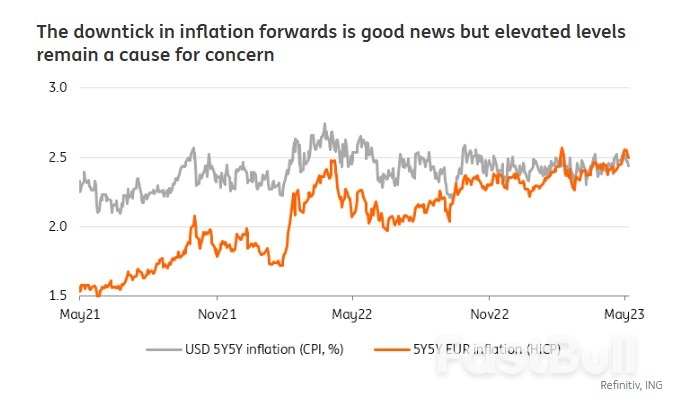
          Some ECB officials have also reacted with cautious optimism to the inflation data. France's Villeroy noted that we will probably have seen the peak in French inflation now with the monetary policy tightening also starting to show its effect. In his view it was a sign that "rather than the level of the terminal rate […], it's how long we remain there that is essential". The ECB's hawks, who had been more vocal in recent weeks, might still question whether the tightening delivered so far is sufficient. Looking at market-based expectations of inflation they could point to 5y5y inflation swap forwards, while falling again is still sitting above 2.5%. And despite encouraging developments in the headline, it is the underlying dynamics of core inflation that remains key.

          Data Does the Talking_1Key Fed officials make the case for skipping June

          The US session saw more volatility around a mixed bag of data releases. Regional PMIs were weaker while data on job openings came in stronger than expected. More interesting – and with larger effect on front end pricing – were comments from two key Federal Open Market Committee voting members. Fed Governor Jefferson and Philadelphia Fed President Harker both made the case for skipping the June FOMC meeting. After all, the anecdotal evidence provided in the Fed's Beige book released yesterday showed hints of a cooling job market and also more signs of disinflationary dynamics gaining traction.
          The Fed funds forward for the June meeting period dropped by some 8bp to below 10bp in the wake of the comments. The forward for July, marking the high point in the forwards, ie, terminal rate, also dropped 5bp with 21bp hikes now discounted. Markets, and in the end also the Fed, will be looking to the key data ahead, such as the payrolls report due tomorrow and the next CPI report. Strong readings here would still make the case for a June hike.

          Today's events and market view

          Month-end has passed and with it probably also some of the short covering that has helped push rates lower again in recent days. In the end, the data will dictate direction and today's session already has to offer some key releases.
          In the eurozone the focus is on the eurozone flash CPI. Country data has already primed markets for a larger drop in the headline rate, key will now be the core rate that is seen edging down only marginally from 5.6% to 5.5% year-on-year. Apart from scheduled appearances of ECB's Lagarde and Knot we will also get the ECB accounts of the May meeting. They may shed more light on the internal deliberations and perhaps any bargains between dovish and hawkish camps. Recall, the ECB slowed the pace to hiking by only 25bp, but added a hawkish twist by announcing a full stop to APP reinvestments. Also, look out for any concerns surrounding upcoming TLTRO repayments.
          In the US markets will be looking to the ADP payrolls report ahead of tomorrow's official jobs data. More important could be the ISM manufacturing index with a more detailed read on the underlying trends in employment and prices than the disappointing regional indices of late.
          In primary markets we will see longer dated bond supply from France and auctions from Spain. Slovakia mandated a new 10y bond yesterday.

          Source: ING

          To stay updated on all economic events of today, please check out our Economic calendar
          Risk Warnings and Disclaimers
          You understand and acknowledge that there is a high degree of risk involved in trading. Following any strategies or investment methods may lead to potential losses. The content on the site is provided by our contributors and analysts for information purposes only. You are solely responsible for determining whether any trading assets, securities, strategy, or any other product is suitable for investing based on your own investment objectives and financial situation.
          Comments
          Add to Favorites
          Share

          Dollar Mixed Ahead of ADP and ISM, Euro Eyes CPI

          Samantha Luan

          Forex

          Dollar turned mixed in Asian session as traders are awaiting fresh inspirations from economic data and comments from Fed officials. The FOMC is clearly split in way with some policymakers advocating a "hold" in June. Nevertheless, they're unified in another way that even a "hold" doesn't necessarily means a "pause", not to mention a "peak". The greenback, in any case, will look into today's ADP employment and ISM manufacturing, as well as tomorrow's non-farm payroll data for more guidance.
          Australian Dollar is recovering mildly, with help from China's manufacturing data, but upside is limited. Yen is turning softer again after this week's rebound is losing momentum. Sterling is holding on to gains against Euro and Swiss Franc, as well as Dollar. Meanwhile, Canadian Dollar is sluggish together with New Zealand Dollar.
          Technically, Euro is clearly weaker this week after downside surprising in France and Germany inflation data. Yet, EUR/CHF is still working hard to form a bottom and focuses will be on 0.9760 minor resistance today. Firm break there should confirm short term bottoming at 0.9670 and bring stronger rebound back to 0.9797/9878 resistance zone. The next move will depend on markets' reaction to today's Eurozone CPI data.
          Dollar Mixed Ahead of ADP and ISM, Euro Eyes CPI_1In Asia, Nikkei closed up 0.84%. Hong Kong HSI is up 0.54%. China Shanghai SSE is up 0.28%. Singapore Strait Times is up 0.12%. Japan 10-year JGB yield is down -0.0081 at 0.425. Overnight, DOW dropped -0.41%. S&P 500 dropped -0.61%. NASDAQ dropped -0.63%. 10-year yield dropped -0.063 to 3.637.

          SNB Jordan: We don't see a big risk in over-tightening monetary policy

          SNB Chairman Thomas Jordan recently warned yesterday that the more inflation is entrenched in the perception of companies and households, the harder it is to bring it down. He highlighted the urgency of the situation, stating, "We have to bring it back below 2% as soon as possible."
          Discussing the bank's approach towards interest rates, Jordan assured that Switzerland's are "still very low". "We don't see a big risk in over-tightening monetary policy. It is not something that will damage financial stability in general in Switzerland," he affirmed.
          Regarding the financial stability issues surrounding Credit Suisse, Jordan clarified that it was an individual case where the problem was not interest rates, but rather a "lack of trust of market participants in an institution."
          Looking ahead, market expectations suggest a 25bps rise from the current 1.5% level when the central bank delivers its next assessment in June.

          BoE Mann: Inflation gap in the UK more persistent than others

          BoE policymaker, Catherine Mann, has highlighted the unique and mounting inflation problem that Britain is facing in comparison to the United States and the Eurozone.
          Mann pointed to both large-scale price increases and the rising persistence of these underlying pressures as causes for concern. She emphasized, "The gap (between headline and core CPI) that I have in my country is more persistent than the gaps that we see in either of my neighbours, the U.S. or the euro area."
          The gap she refers to is the disparity between headline inflation (which includes volatile commodities like food and energy) and core inflation (which excludes these commodities).
          Notably, Mann underscored the role of British businesses and increased wages in maintaining high core inflation. She explains that businesses in the UK have been successful in passing on price rises, contributing to this persistent inflation gap. This, coupled with increased wages, suggests that headline inflation has been slower to recede towards the core rate than it has in other regions.
          "There is a gap between the headline, which is incorporating energy which went up really high and now has come down, and core where we do start to see the implications coming through pricing channels, through wage negotiations, into something that is persistent," Mann explained.

          Fed Jefferson: A pause in June doesn't mean rates have peaked

          Comments from top officials from Fed suggested a pause in interest rate hikes in June while possible, shouldn't be misinterpreted as a sign that peak rates for the cycle have been reached.
          Fed Governor, Philip Jefferson, clarified, "A decision to hold our policy rate constant at a coming meeting should not be interpreted to mean that we have reached the peak rate for this cycle."
          Jefferson, suggested that skipping a rate hike at an upcoming meeting would provide an opportunity for the committee to review more data before deciding on the extent of any further policy tightening.
          Philadelphia Fed President, Patrick Harker, echoed this sentiment, albeit with a more forceful argument for the need to 'skip' rather than 'pause'. "I am in a camp increasingly coming into this meeting of thinking that we really should skip, not pause," he remarked.
          Harker believes the current policy is nearing, if not already at, a restrictive level and suggests a period of careful reflection before further action is taken.
          Harker added, "I think we have to be ready that we might have to do more and I'm fully aware we have to do that and willing to do that, but I want to give it a little bit of time."

          IMF sees opportunity for Japan to re-anchoring Inflation Expectations

          IMF chief economist, Pierre-Olivier Gourinchas, suggested that a unique opportunity may be presenting itself in Japan to re-anchor inflation expectations to BoJ's target. However, he cautioned that the process won't be instantaneous.
          "There's an opportunity right now," Gourinchas said, "but it will take time. It won't happen overnight." Achieving this re-anchoring requires convincing the public that Japan won't slide back into deflation – a challenge given the country's prolonged struggle with price stagnation. Gourinchas believes it's "too early" for the BoJ to tighten policy, stressing the need for careful handling of the situation.
          Pointing to the global trend of persistent inflation despite initial expectations of transitory dynamics, Gourinchas warned, "Obviously, the history of the last two years is one where inflation that was supposed to be transitory, turned out to be not transitory. We could have similar dynamics in Japan." Given this possibility, he underscored the need for vigilance and readiness to tighten monetary policy if inflation remains too high.
          Regarding potential strategies for policy tightening, Gourinchas suggested a cautious approach. "It's probably safer to first move away from the control of long-term yields. And then, if the need arises to tighten monetary policy, it can do so as part of the usual tightening of the policy rate," he proposed. However, he acknowledged that executing this transition would be technically complex.

          Japan PMI manufacturing finalized at 50.6, a decisive turnaround

          Japan PMI Manufacturing was finalized at 50.6 in May, up from April's 49.5. That's the first expansionary reading since October 2022, signalling a modest overall improvement in operating conditions. Also, business optimism reached highest level since January 2022, while supplier performance stabilized.
          Tim Moore, Economics Director at S&P Global Market Intelligence, said: "The latest au Jibun Bank PMI survey highlights a decisive turnaround in manufacturing sector performance during May and brings to an end a six-month period of weakening business conditions."

          China Caixin PMI manufacturing rose to 50.9, activity improved

          China Caixin PMI Manufacturing rose from 49.5 to 50.9 in May, signaling the first improvement in the health of the sector since February. Caixin noted stronger increase in output as firms saw fresh upturn in new business. Input costs fell solidly. Employment, however, continued to decline as business confidence softened.
          Wang Zhe, Senior Economist at Caixin Insight Group said: "In a nutshell, manufacturing activity improved in May. Both supply and demand expanded, but employment sank to a three-year low. Businesses stepped up purchasing, inventories of raw materials grew marginally, logistics picked up, prices continued to slump, and manufacturers' optimism wavered."

          Looking ahead

          Eurozone CPI flash and ECB meeting accounts are the main feature in European session. Eurozone will also release unemployment rate and PMI manufacturing final. UK will release PMI manufacturing final, M4 money supply and mortgage approvals.
          Later in the day, US ISM manufacturing and ADP employment will take center stage. Weekly jobless claims will also be released.

          USD/CAD Daily Outlook

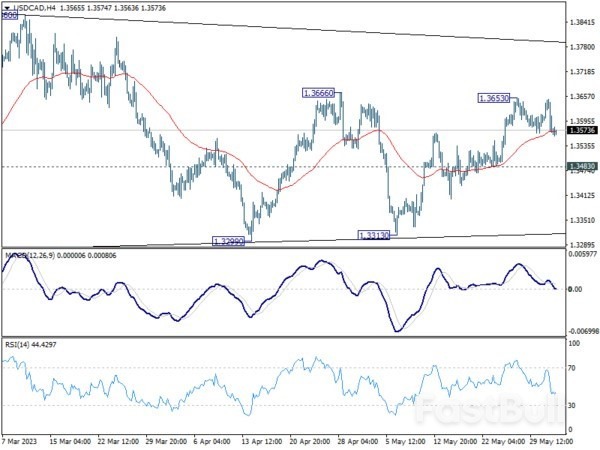
          USD/CAD is staying in range below 1.3653 and intraday bias remains neutral. Price actions from 1.3976 are seen as a triangle consolidation pattern. Above 1.3666 will target 1.3860 resistance first. Firm break of 1.3860 will argue that larger up trend is ready to resume through 1.3976 high.Dollar Mixed Ahead of ADP and ISM, Euro Eyes CPI_2
          In the bigger picture, rise from 1.2005 (2021 low) is expected to resume through 1.3976 after consolidation from there completes. On decisive break of 1.3976, next target will be 1.4667/89 long term resistance zone. This will remain the favored case as long as 38.2% retracement of 1.2005 to 1.3976 at 1.3233 holds.Dollar Mixed Ahead of ADP and ISM, Euro Eyes CPI_3

          Source: ActionForex.com

          Risk Warnings and Disclaimers
          You understand and acknowledge that there is a high degree of risk involved in trading. Following any strategies or investment methods may lead to potential losses. The content on the site is provided by our contributors and analysts for information purposes only. You are solely responsible for determining whether any trading assets, securities, strategy, or any other product is suitable for investing based on your own investment objectives and financial situation.
          Comments
          Add to Favorites
          Share

          Oil Steadies After U.S. House Passes Debt Ceiling Deal to Avoid Default

          Damon

          Commodity

          Oil prices were steady on Thursday after the U.S. House of Representatives passed a bill to raise the nation's $31.4 trillion debt ceiling days before a potential default.
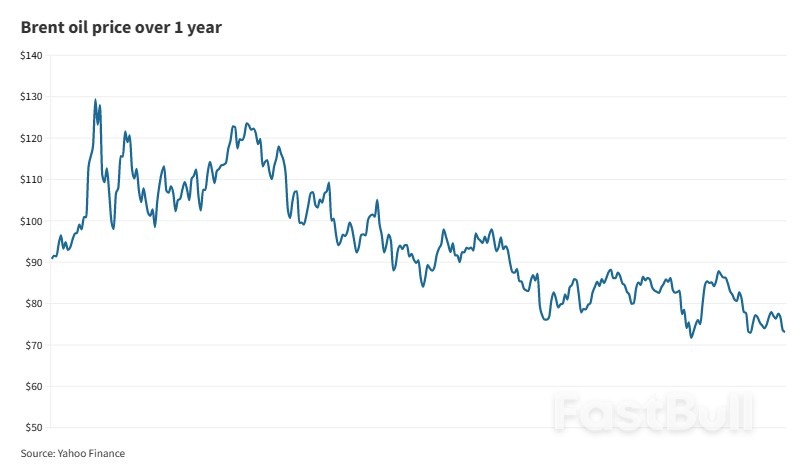
          Brent, the benchmark for two thirds of the world's oil, was trading 0.73 per cent higher at $73.13 a barrel at 8.35am UAE time. West Texas Intermediate, the gauge that tracks U.S. crude, was up 0.68 per cent at $68.55 a barrel.
          Brent settled 1.2 per cent lower on Wednesday and has lost more than 5 per cent of its value in the last two days amid concerns over the debt deal negotiations and a surprise rise in U.S. crude stocks.
          Oil Steadies After U.S. House Passes Debt Ceiling Deal to Avoid Default_1A U.S. default would have sent shock waves across the global financial system and probably triggered a recession, severely denting crude demand.
          The U.S. House of Representatives voted 314-117 on Wednesday night in favour of the bill to raise the country's borrowing limit before the June 5 deadline.
          "The bill now goes to the Senate where it is expected to pass without incident, coming in just in time before the June 5 deadline when Treasury Secretary Janet Yellen has said the government will run out of money if a deal is not agreed," said Daniel Richards, Mena economist at Emirates NBD.
          Investors were also encouraged by positive manufacturing data from China, the world's second-largest economy and top crude importer.
          The Caixin/S&P Global manufacturing purchasing managers' index increased to 50.9 in May, from 49.5 in April, above the 50-point mark that separates expansion from contraction.
          Manufacturing business conditions in China improved for the first time in three months during May, the survey said.
          However, business confidence around the 12-month outlook for output slipped to a seven-month low in May amid concerns over global economic uncertainty, it said.
          Meanwhile, economic activity in the U.S., the world's largest oil-consuming nation, is showing signs of slowing down.
          The U.S. Federal Reserve said that economic activity was "little changed" overall in April and early May, but expectations for future growth "deteriorated" a little.
          "Contacts still largely expected a further expansion in activity … manufacturing activity was flat to up in most districts, and supply chain issues continued to improve," the Fed said in its latest Beige Book, a report on current economic conditions.
          "Commercial construction and real estate activity decreased overall, with the office segment continuing to be a weak spot. Outlooks for farm income fell in most districts and energy activity was flat to down amidst lower natural gas prices," the report said.
          U.S. WTI prices fell by about 2 per cent on Wednesday as an unexpected increase in U.S. crude stocks – an indicator of crude demand – stoked concerns about excess supply.
          The country's oil inventories rose by about 5.2 million barrels last week, according to the American Petroleum Institute.
          Analysts polled by Reuters were expecting a drawdown of 1.4 million barrels.
          The U.S. Energy Information Administration will release its weekly stock data later Thursday.
          Meanwhile, the 23-member OPEC+ alliance is set to meet in Vienna on Sunday to discuss the group's production policy.
          On April 2, OPEC+ producers announced voluntary output cuts of 1.16 million barrels per day to ensure oil market stability.
          Brent, which crossed $85 a barrel after the group's decision, has since lost about 14 per cent of its value on a weakening global crude demand outlook.

          Source: The National News

          Risk Warnings and Disclaimers
          You understand and acknowledge that there is a high degree of risk involved in trading. Following any strategies or investment methods may lead to potential losses. The content on the site is provided by our contributors and analysts for information purposes only. You are solely responsible for determining whether any trading assets, securities, strategy, or any other product is suitable for investing based on your own investment objectives and financial situation.
          Comments
          Add to Favorites
          Share

          U.S. Corporate Debt Binge Could Be Hard to Sustain

          Alex

          Bond

          Large U.S. companies have been on a bond issuance binge but this rapid pace in supply may be hard to sustain ahead of expected volatility related to extending the U.S. debt ceiling and another possible move higher in interest rates.
          Investment-grade rated companies issued $152 billion in May, making it the busiest May since 2020 when the pandemic crisis prompted record debt issuance volumes, according to data from Informa Global Markets. Junk-rated companies meanwhile raised $22.1 billion, for the busiest May since 2021 when 73 companies raised $49.1 billion.
          "I believe we have seen an acceleration of issuance into May," said Richard Wolff, head of U.S. bond syndicate at SG CIB, saying this was a result of debt issuance being pulled forward.
          "So, the ensuing months should see a slight moderation of supply," Wolff added.
          This debt issuance spree is on the back of strong demand for what were relatively higher yielding corporate bonds after Treasury yields rose in May from levels touched in late April.
          New investment-grade bonds in May received orders that were three to four times the offering size on average, according to IGM data.
          Junk bonds also got decent demand as yields at just under 9% were "historically really attractive levels we haven't seen for years outside of the pandemic or the energy crisis before that," said Manuel Hayes, senior portfolio manager at London-based asset manager Insight Investment.
          "It's an attractive income source considering bonds are being issued primarily by companies rated in the upper bands of junk so had a lower probability of default," he added.
          Changing Tide
          The debt binge, however, gave a broad hint that the largest companies in the world are not optimistic on borrowing conditions later in the year.
          Near-term funding costs are likely to spike due to a drain on liquidity - the Treasury is expected to issue nearly $1.1 trillion in new Treasury bills (T-bills) over the next seven months, according to recent JPMorgan estimates, to replenish its coffers.
          Spreads charged on corporate bonds as a premium over Treasuries or credit spreads, which have been stable so far are expected to widen, adding to funding costs for prospective borrowers.
          "It's more likely credit spreads widen from here given the macro concerns of the debt ceiling and resultant near-term large T-bill issuance, Fed tightening to dampen inflation, and geopolitical risks," said Jessica Lehmann, head of investment-grade and emerging markets syndicate at HSBC.
          Fed funds futures traders now see the Fed as more likely to hike interest rates this month than leave them unchanged, as economic data beats expectations and lawmakers appear to have reached a deal to raise the debt ceiling.
          “I could foresee liquidity becoming an issue even if the debt ceiling negotiations come to a resolution, particularly if ratings agencies continue to sour on how the situations and negotiations were handled," said Blair Shwedo, head of investment-grade trading at U.S. Bank.
          Despite what appears to be a strong new issue backdrop, "there is credit sensitivity and a higher bar for less familiar, less liquid issuers," said Jiyann Daemi, director, U.S. IG syndicate at TD Securities. He added that this bar "might continue to move higher, should there be further market dislocation."

          Source: Reuters

          Risk Warnings and Disclaimers
          You understand and acknowledge that there is a high degree of risk involved in trading. Following any strategies or investment methods may lead to potential losses. The content on the site is provided by our contributors and analysts for information purposes only. You are solely responsible for determining whether any trading assets, securities, strategy, or any other product is suitable for investing based on your own investment objectives and financial situation.
          Comments
          Add to Favorites
          Share

          JOLTS Report and Debt Ceiling Concerns Fuel US Stock Market Decline

          Warren Takunda

          Economic

          In the latest trading session, US stocks experienced a continuation of losses as market indices trended downwards. The Dow Jones Industrial Average dropped by over 100 points, the S&P 500 declined by 0.4%, and the Nasdaq Composite saw a 0.3% decrease. Multiple factors contributed to this downturn, including an unexpected rise in job vacancies according to the JOLTS report, which reinforced speculation of potential interest rate hikes by the Federal Reserve in the coming month. Additionally, concerns surrounding the progress of the debt ceiling debate were closely monitored by traders. Amidst this backdrop, several companies faced individual challenges, resulting in a further negative impact on the overall market sentiment.
          JOLTS Report and Debt Ceiling Concerns Fuel US Stock Market Decline_1JOLTS Report Reinforces Speculation of Interest Rate Hikes
          The release of the JOLTS (Job Openings and Labor Turnover Survey) report provided an unexpected surprise, indicating a rise in job vacancies to 10 million. This increase in job openings has fueled speculations that the Federal Reserve might consider raising interest rates in an attempt to manage potential inflationary pressures and maintain a stable economy. As a result, investors reacted to this news by adjusting their portfolios, leading to a sell-off in various sectors of the market.
          Debt Ceiling Progress Causes Unease
          Traders closely monitored the progress of discussions surrounding the debt ceiling issue. The House of Representatives was expected to vote on the bill after it was cleared by the House Rules Committee with a 7-6 majority. If the bill successfully passes the House, it will then require approval from the Senate. Uncertainty surrounding the outcome of this legislative process added to market volatility and prompted cautious investor sentiment.
          Corporate Challenges Amplify Market Downturn
          Several individual companies faced challenges that further impacted the negative sentiment in the market. Advance Auto Parts, a prominent player in the automotive retail industry, witnessed a significant decline of nearly 32% after revising down its full-year forecasts. This sudden adjustment in projections raised concerns about the overall health of the automotive sector and added pressure to the company's stock performance.
          Technology giants, Hewlett Packard Enterprise and HP Inc, also experienced declines in their share prices. Both companies failed to meet revenue estimates, leading to a 6.5% drop in Hewlett Packard Enterprise shares and a 3% decline for HP Inc. Disappointing financial results from these technology companies contributed to the broader market's negative sentiment.
          Energy companies such as Chevron and Exxon Mobil also suffered losses. The decline in oil prices, coupled with concerns about the overall economic outlook, weighed on the performance of these energy sector giants.
          Monthly Performance Comparison
          Looking at the performance of major indices in May, the Nasdaq Composite showed relative strength, gaining nearly 7%. This growth was primarily driven by the strength of AI-related stocks, which have continued to attract investor attention. The S&P 500 posted a modest gain of 0.4% during the same period. However, the Dow Jones Industrial Average faced significant headwinds, experiencing a decline of over 3% in May.
          The US stock market faced extended losses, with the Dow, S&P 500, and Nasdaq Composite all declining in the latest trading session. Factors such as the unexpected rise in job vacancies highlighted by the JOLTS report and concerns surrounding the debt ceiling progress contributed to the market downturn. Additionally, individual challenges faced by companies such as Advance Auto Parts, Hewlett Packard Enterprise, and HP Inc intensified the negative sentiment. While the Nasdaq Composite showed resilience, driven by AI-related stocks, the Dow Jones Industrial Average struggled throughout May. As investors navigate these uncertain times, it is crucial to stay informed and closely monitor developments that may impact market dynamics.
          To stay updated on all economic events of today, please check out our Economic calendar
          Risk Warnings and Disclaimers
          You understand and acknowledge that there is a high degree of risk involved in trading. Following any strategies or investment methods may lead to potential losses. The content on the site is provided by our contributors and analysts for information purposes only. You are solely responsible for determining whether any trading assets, securities, strategy, or any other product is suitable for investing based on your own investment objectives and financial situation.
          Comments
          Add to Favorites
          Share
          FastBull
          Copyright © 2025 FastBull Ltd

          728 RM B 7/F GEE LOK IND BLDG NO 34 HUNG TO RD KWUN TONG KLN HONG KONG

          TelegramInstagramTwitterfacebooklinkedin
          App Store Google Play Google Play
          Products
          Charts

          Chats

          Q&A with Experts
          Screeners
          Economic Calendar
          Data
          Tools
          Membership
          Features
          Function
          Markets
          Copy Trading
          Latest Signals
          Contests
          News
          Analysis
          24/7
          Columns
          Education
          Company
          Careers
          About Us
          Contact Us
          Advertising
          Help Center
          Feedback
          User Agreement
          Privacy Policy
          Business

          White Label

          Data API

          Web Plug-ins

          Poster Maker

          Affiliate Program

          Risk Disclosure

          The risk of loss in trading financial instruments such as stocks, FX, commodities, futures, bonds, ETFs and crypto can be substantial. You may sustain a total loss of the funds that you deposit with your broker. Therefore, you should carefully consider whether such trading is suitable for you in light of your circumstances and financial resources.

          No decision to invest should be made without thoroughly conducting due diligence by yourself or consulting with your financial advisors. Our web content might not suit you since we don't know your financial conditions and investment needs. Our financial information might have latency or contain inaccuracy, so you should be fully responsible for any of your trading and investment decisions. The company will not be responsible for your capital loss.

          Without getting permission from the website, you are not allowed to copy the website's graphics, texts, or trademarks. Intellectual property rights in the content or data incorporated into this website belong to its providers and exchange merchants.

          Not Logged In

          Log in to access more features

          FastBull Membership

          Not yet

          Purchase

          Become a signal provider
          Help Center
          Customer Service
          Dark Mode
          Price Up/Down Colors

          Log In

          Sign Up

          Position
          Layout
          Fullscreen
          Default to Chart
          The chart page opens by default when you visit fastbull.com