• Trade
  • Markets
  • Copy
  • Contests
  • News
  • 24/7
  • Calendar
  • Q&A
  • Chats
Trending
Screeners
SYMBOL
LAST
BID
ASK
HIGH
LOW
NET CHG.
%CHG.
SPREAD
SPX
S&P 500 Index
6827.42
6827.42
6827.42
6899.86
6801.80
-73.58
-1.07%
--
DJI
Dow Jones Industrial Average
48458.04
48458.04
48458.04
48886.86
48334.10
-245.98
-0.51%
--
IXIC
NASDAQ Composite Index
23195.16
23195.16
23195.16
23554.89
23094.51
-398.69
-1.69%
--
USDX
US Dollar Index
97.950
98.030
97.950
98.500
97.950
-0.370
-0.38%
--
EURUSD
Euro / US Dollar
1.17394
1.17409
1.17394
1.17496
1.17192
+0.00011
+ 0.01%
--
GBPUSD
Pound Sterling / US Dollar
1.33707
1.33732
1.33707
1.33997
1.33419
-0.00148
-0.11%
--
XAUUSD
Gold / US Dollar
4299.39
4299.39
4299.39
4353.41
4257.10
+20.10
+ 0.47%
--
WTI
Light Sweet Crude Oil
57.233
57.485
57.233
58.011
56.969
-0.408
-0.71%
--

Community Accounts

Signal Accounts
--
Profit Accounts
--
Loss Accounts
--
View More

Become a signal provider

Sell trading signals to earn additional income

View More

Guide to Copy Trading

Get started with ease and confidence

View More

Signal Accounts for Members

All Signal Accounts

Best Return
  • Best Return
  • Best P/L
  • Best MDD
Past 1W
  • Past 1W
  • Past 1M
  • Past 1Y

All Contests

  • All
  • Trump Updates
  • Recommend
  • Stocks
  • Cryptocurrencies
  • Central Banks
  • Featured News
Top News Only
Share

Incoming Czech Prime Minister Babis: Czech Republic Will Not Take On Guarantees For Ukraine Financing, European Commission Must Find Alternatives

Share

Turkey President Erdogan: Hopes To Discuss Ukraine-Russia Peace Plan With Trump After Meeting With Putin

Share

Turkey President Erdogan: Peace Is Not Far Away, Black Sea Should Not Be Used As A Battleground, Safe Navigation Needed

Share

IAEA: Ukraine's Znpp Temporarily Lost All Offsite Power Overnight Due To Widespread Military Activities Affecting The Electrical Grid

Share

Iranian Media Says 18 Crew Members Of Foreign Tanker Seized In Gulf Of Oman Over Carrying 'Smuggled Fuel' Detained

Share

Regional Governor: Two Killed In Ukrainian Drone Strike On Russia's Saratov

Share

Chinese Foreign Ministry - China Foreign Minister Met With United Arab Emirates Counterpart On Dec 12

Share

China's Central Financial And Economic Affairs Commission Deputy Director: Will Expand Export And Increase Import In 2026

Share

Thai Leader Anutin: Landmine Blast That Killed Thai Soldiers 'Not A Roadside Accident'

Share

Thai Leader Anutin: Thailand To Continue Military Action Until 'We Feel No More Harm'

Share

Cambodian Prime Minister Hun Manet Says He Had Phone Calls With Trump And Malaysian Leader Anwar About Ceasefire

Share

Cambodia's Hun Manet Says USA, Malaysia Should Verify 'Which Side Fired First' In Latest Conflict

Share

Cambodia's Hun Manet: Cambodia Maintains Its Stance In Seeking Peaceful Resolution Of Disputes

Share

Nasdaq Companies: Allergan, Ferrovia, Insmed, Monolithic Power Systems, Seagate Technology, And Western Digital Will Be Added To The NASDAQ 100 Index. Biogen, CdW, GlobalFoundries, Lululemon, ON Semiconductor, And Tradedesk Will Be Removed From The NASDAQ 100 Index

Share

Witkoff Headed To Berlin This Weekend To Meet With Zelenskiy, European Leaders -Wsj Reporter On X

Share

Russia Attacks Two Ukrainian Ports, Damaging Three Turkish-Owned Vessels

Share

[Historic Flooding Occurs In At Least Four Rivers In Washington State Due To Days Of Torrential Rains] Multiple Areas In Washington State Have Been Hit By Severe Flooding Due To Days Of Torrential Rains, With At Least Four Rivers Experiencing Historic Flooding. Reporters Learned On The 12th That The Floods Caused By The Torrential Rains In Washington State Have Destroyed Homes And Closed Several Highways. Experts Warn That Even More Severe Flooding May Occur In The Future. A State Of Emergency Has Been Declared In Washington State

Share

Trump Says Proposed Free Economic Zone In Donbas Would Work

Share

Trump: I Think My Voice Should Be Heard

Share

Trump Says Will Be Choosing New Fed Chair In Near Future

TIME
ACT
FCST
PREV
U.K. Trade Balance Non-EU (SA) (Oct)

A:--

F: --

P: --

U.K. Trade Balance (Oct)

A:--

F: --

P: --

U.K. Services Index MoM

A:--

F: --

P: --

U.K. Construction Output MoM (SA) (Oct)

A:--

F: --

P: --

U.K. Industrial Output YoY (Oct)

A:--

F: --

P: --

U.K. Trade Balance (SA) (Oct)

A:--

F: --

P: --

U.K. Trade Balance EU (SA) (Oct)

A:--

F: --

P: --

U.K. Manufacturing Output YoY (Oct)

A:--

F: --

P: --

U.K. GDP MoM (Oct)

A:--

F: --

P: --

U.K. GDP YoY (SA) (Oct)

A:--

F: --

P: --

U.K. Industrial Output MoM (Oct)

A:--

F: --

P: --

U.K. Construction Output YoY (Oct)

A:--

F: --

P: --

France HICP Final MoM (Nov)

A:--

F: --

P: --

China, Mainland Outstanding Loans Growth YoY (Nov)

A:--

F: --

P: --

China, Mainland M2 Money Supply YoY (Nov)

A:--

F: --

P: --

China, Mainland M0 Money Supply YoY (Nov)

A:--

F: --

P: --

China, Mainland M1 Money Supply YoY (Nov)

A:--

F: --

P: --

India CPI YoY (Nov)

A:--

F: --

P: --

India Deposit Gowth YoY

A:--

F: --

P: --

Brazil Services Growth YoY (Oct)

A:--

F: --

P: --

Mexico Industrial Output YoY (Oct)

A:--

F: --

P: --

Russia Trade Balance (Oct)

A:--

F: --

P: --

Philadelphia Fed President Henry Paulson delivers a speech
Canada Building Permits MoM (SA) (Oct)

A:--

F: --

P: --

Canada Wholesale Sales YoY (Oct)

A:--

F: --

P: --

Canada Wholesale Inventory MoM (Oct)

A:--

F: --

P: --

Canada Wholesale Inventory YoY (Oct)

A:--

F: --

P: --

Canada Wholesale Sales MoM (SA) (Oct)

A:--

F: --

P: --

Germany Current Account (Not SA) (Oct)

A:--

F: --

P: --

U.S. Weekly Total Rig Count

A:--

F: --

P: --

U.S. Weekly Total Oil Rig Count

A:--

F: --

P: --

Japan Tankan Large Non-Manufacturing Diffusion Index (Q4)

--

F: --

P: --

Japan Tankan Small Manufacturing Outlook Index (Q4)

--

F: --

P: --

Japan Tankan Large Non-Manufacturing Outlook Index (Q4)

--

F: --

P: --

Japan Tankan Large Manufacturing Outlook Index (Q4)

--

F: --

P: --

Japan Tankan Small Manufacturing Diffusion Index (Q4)

--

F: --

P: --

Japan Tankan Large Manufacturing Diffusion Index (Q4)

--

F: --

P: --

Japan Tankan Large-Enterprise Capital Expenditure YoY (Q4)

--

F: --

P: --

U.K. Rightmove House Price Index YoY (Dec)

--

F: --

P: --

China, Mainland Industrial Output YoY (YTD) (Nov)

--

F: --

P: --

China, Mainland Urban Area Unemployment Rate (Nov)

--

F: --

P: --

Saudi Arabia CPI YoY (Nov)

--

F: --

P: --

Euro Zone Industrial Output YoY (Oct)

--

F: --

P: --

Euro Zone Industrial Output MoM (Oct)

--

F: --

P: --

Canada Existing Home Sales MoM (Nov)

--

F: --

P: --

Euro Zone Total Reserve Assets (Nov)

--

F: --

P: --

U.K. Inflation Rate Expectations

--

F: --

P: --

Canada National Economic Confidence Index

--

F: --

P: --

Canada New Housing Starts (Nov)

--

F: --

P: --

U.S. NY Fed Manufacturing Employment Index (Dec)

--

F: --

P: --

U.S. NY Fed Manufacturing Index (Dec)

--

F: --

P: --

Canada Core CPI YoY (Nov)

--

F: --

P: --

Canada Manufacturing Unfilled Orders MoM (Oct)

--

F: --

P: --

Canada Manufacturing New Orders MoM (Oct)

--

F: --

P: --

Canada Core CPI MoM (Nov)

--

F: --

P: --

Canada Manufacturing Inventory MoM (Oct)

--

F: --

P: --

Canada CPI YoY (Nov)

--

F: --

P: --

Canada CPI MoM (Nov)

--

F: --

P: --

Canada CPI YoY (SA) (Nov)

--

F: --

P: --

Canada Core CPI MoM (SA) (Nov)

--

F: --

P: --

Q&A with Experts
    • All
    • Chatrooms
    • Groups
    • Friends
    Connecting
    .
    .
    .
    Type here...
    Add Symbol or Code

      No matching data

      All
      Trump Updates
      Recommend
      Stocks
      Cryptocurrencies
      Central Banks
      Featured News
      • All
      • Russia-Ukraine Conflict
      • Middle East Flashpoint
      • All
      • Russia-Ukraine Conflict
      • Middle East Flashpoint
      Search
      Products

      Charts Free Forever

      Chats Q&A with Experts
      Screeners Economic Calendar Data Tools
      Membership Features
      Data Warehouse Market Trends Institutional Data Policy Rates Macro

      Market Trends

      Market Sentiment Order Book Forex Correlations

      Top Indicators

      Charts Free Forever
      Markets

      News

      News Analysis 24/7 Columns Education
      From Institutions From Analysts
      Topics Columnists

      Latest Views

      Latest Views

      Trending Topics

      Top Columnists

      Latest Update

      Signals

      Copy Rankings Latest Signals Become a signal provider AI Rating
      Contests
      Brokers

      Overview Brokers Assessment Rankings Regulators News Claims
      Broker listing Forex Brokers Comparison Tool Live Spread Comparison Scam
      Q&A Complaint Scam Alert Videos Tips to Detect Scam
      More

      Business
      Events
      Careers About Us Advertising Help Center

      White Label

      Data API

      Web Plug-ins

      Affiliate Program

      Awards Institution Evaluation IB Seminar Salon Event Exhibition
      Vietnam Thailand Singapore Dubai
      Fans Party Investment Sharing Session
      FastBull Summit BrokersView Expo
      Recent Searches
        Top Searches
          Markets
          News
          Analysis
          User
          24/7
          Economic Calendar
          Education
          Data
          • Names
          • Latest
          • Prev

          View All

          No data

          Scan to Download

          Faster Charts, Chat Faster!

          Download App
          English
          • English
          • Español
          • العربية
          • Bahasa Indonesia
          • Bahasa Melayu
          • Tiếng Việt
          • ภาษาไทย
          • Français
          • Italiano
          • Türkçe
          • Русский язык
          • 简中
          • 繁中
          Open Account
          Search
          Products
          Charts Free Forever
          Markets
          News
          Signals

          Copy Rankings Latest Signals Become a signal provider AI Rating
          Contests
          Brokers

          Overview Brokers Assessment Rankings Regulators News Claims
          Broker listing Forex Brokers Comparison Tool Live Spread Comparison Scam
          Q&A Complaint Scam Alert Videos Tips to Detect Scam
          More

          Business
          Events
          Careers About Us Advertising Help Center

          White Label

          Data API

          Web Plug-ins

          Affiliate Program

          Awards Institution Evaluation IB Seminar Salon Event Exhibition
          Vietnam Thailand Singapore Dubai
          Fans Party Investment Sharing Session
          FastBull Summit BrokersView Expo

          China's Imports Recover

          Owen Li

          Commodity

          Summary:

          China's crude oil and natural gas imports recovered strongly in May, which could help improve market sentiment. For copper, China's concentrate imports jumped to a fresh high, while unwrought copper imports remain soft.

          Energy – China's crude oil imports recover
          China's crude oil imports recovered to 51.44mt or around 12.16MMbbls/d (up 17% month-on-month and 12% year-on-year) in May 2023, as some of the refineries increased their utilisation rate after concluding maintenance. Demand slowdown from China has been a major concern for the crude oil market recently, and a recovery in oil imports is likely to provide some comfort to the oil market. Higher refinery utilisation has also increased refined product supplies in the Chinese market, with China reverting to being a net exporter of refined products last month. Among other energy products, natural gas imports into China increased 17.3% YoY to 10.6mt in May as lower gas prices in the Asian market supported demand for storage.
          In its latest short-term energy outlook report, the Energy Information Administration (EIA) revised higher domestic oil production estimates, as the decision by OPEC+ to extend output cuts could push oil prices higher and bring more investments into exploration. The administration revised higher the production estimates to 12.61MMbbls/d for 2023 compared to earlier estimates of 12.53MMbbls/d and output of 11.88MMbbls/d in 2022. For 2024, production estimates are revised higher to 12.77MMbbls/d compared to earlier estimates of 12.69MMbbls/d. On the other hand, U.S. demand for crude oil is revised down from 20.47MMbbls/d to 20.42MMbbls/d on slow demand for distillates – although this is still higher than the 20.28MMbbls/d of consumption in 2022.
          Meanwhile, the American Petroleum Institute (API) reported that the U.S. crude oil inventories decreased by 1.71MMbbls over the last week, in contrast to market expectations for the addition of around 350Mbbls. Cushing crude oil stocks are reported to have increased by 1.53MMbbls. On the products side, API reported that gasoline and distillates inventories rose by 2.42MMbbls and 4.5MMbbls respectively over the week ending 2 June. The more widely followed EIA report will be released later today.
          Metals – Chinese copper concentrate imports at record highs
          China released its preliminary trade data for metals this morning, which shows total monthly imports for unwrought copper fell 4.6% YoY to 444kt in May, largely on account of higher domestic production of the refined metal. Cumulatively, unwrought copper imports fell 11% YoY to 2.14mt in the first five months of the year. Meanwhile, imports of copper concentrate rose 16.7% YoY to a fresh record of 2.56mt last month, with year-to-date imports up 8.8% YoY to 11.31mt from January to May this year. In ferrous metals, iron ore monthly imports rose 3.9% YoY (+6.3% MoM) to 96.17mt last month, while cumulative imports are up 7.7% YoY to 480.7mt from January to May.
          On the exports side, China's unwrought aluminium and aluminium products shipments fell 29.7% YoY to 475.4kt last month while year-to-date exports declined 20.2% YoY to 2.32mt in the first five months of the year. Exports of steel products jumped 41% YoY to 36.4mt from January to May this year.
          Meanwhile, data from the Mines and Geosciences Bureau shows that nickel output in the Philippines rose 5.4% YoY to 3.9dmt in 1Q23 despite only a few mines being in production. The bureau reported that only 13 out of the nation's 33 operating mines reported output for the above-mentioned period, as some were impacted by unfavourable weather conditions while few were undergoing scheduled maintenance. However, the bureau remains optimistic about the outlook for the mining industry over the long term, following the expected recovery of the global economy and strong demand for nickel ore.
          Agriculture – Chinese soybean imports surge
          The latest trade numbers from Chinese Customs show that soybean imports in China rose 24.3% YoY (+65.6% MoM) to a record high of 12.02mt in May. The imports surged sharply as the delayed cargoes (due to last month's strict inspections) were finally unloaded at ports. Cumulatively, soybean imports rose 11.2% YoY to 42.3mt over the first five months of the year.
          Weekly data from the European Commission show that soft wheat shipments from the EU reached 28.9mt for the season as of 4 June, up 11.4% compared to 25.9mt from the same period last year. Morocco, Algeria, and Nigeria were the top destinations for these shipments. Meanwhile, the EU's corn imports stood at 24.6mt, compared to 15.3mt reported a year ago.

          Source: ING

          Risk Warnings and Disclaimers
          You understand and acknowledge that there is a high degree of risk involved in trading. Following any strategies or investment methods may lead to potential losses. The content on the site is provided by our contributors and analysts for information purposes only. You are solely responsible for determining whether any trading assets, securities, strategy, or any other product is suitable for investing based on your own investment objectives and financial situation.
          Comments
          Add to Favorites
          Share

          Fearless VIX, China Miss, Canada Hike?

          Damon

          Economic

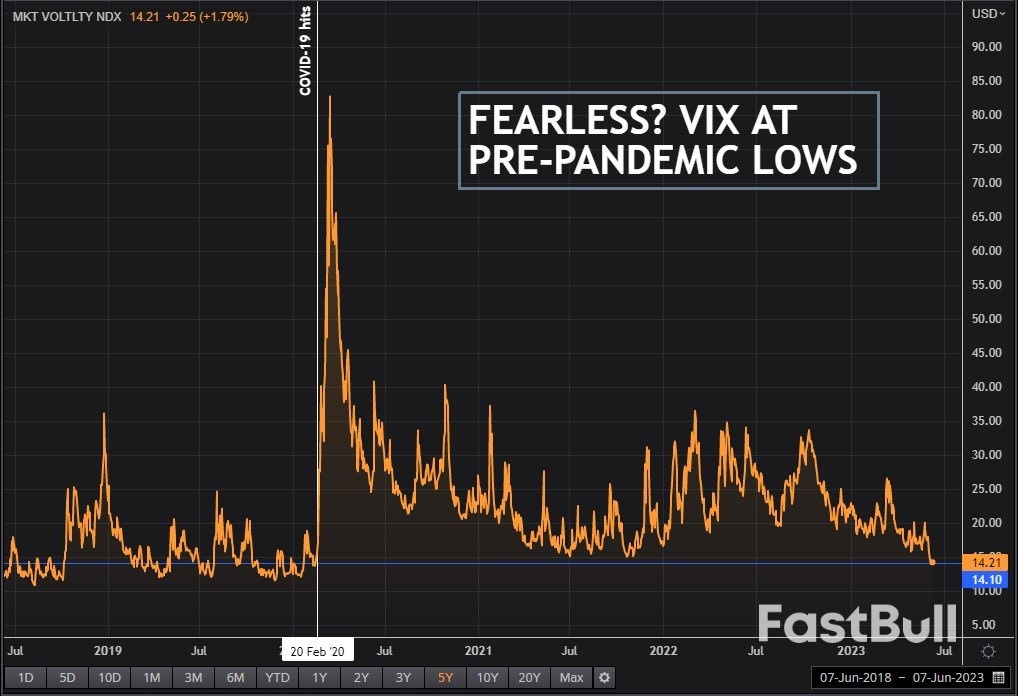
          With U.S. stock market volatility back at pre-pandemic lows, you'd be forgiven for wondering where the market angst had gone.
          Wall St's 'fear index', the VIX gauge of implied S&P500 equity volatility, closed below 14 on Tuesday for the first time since February 2020 - more than 5 points below its 33-year average. The S&P500 eked another closing high for the year, with 2023's tech-led gains seemingly broadening out to a outperforming small cap Russell 2000 that gained 2.7%.
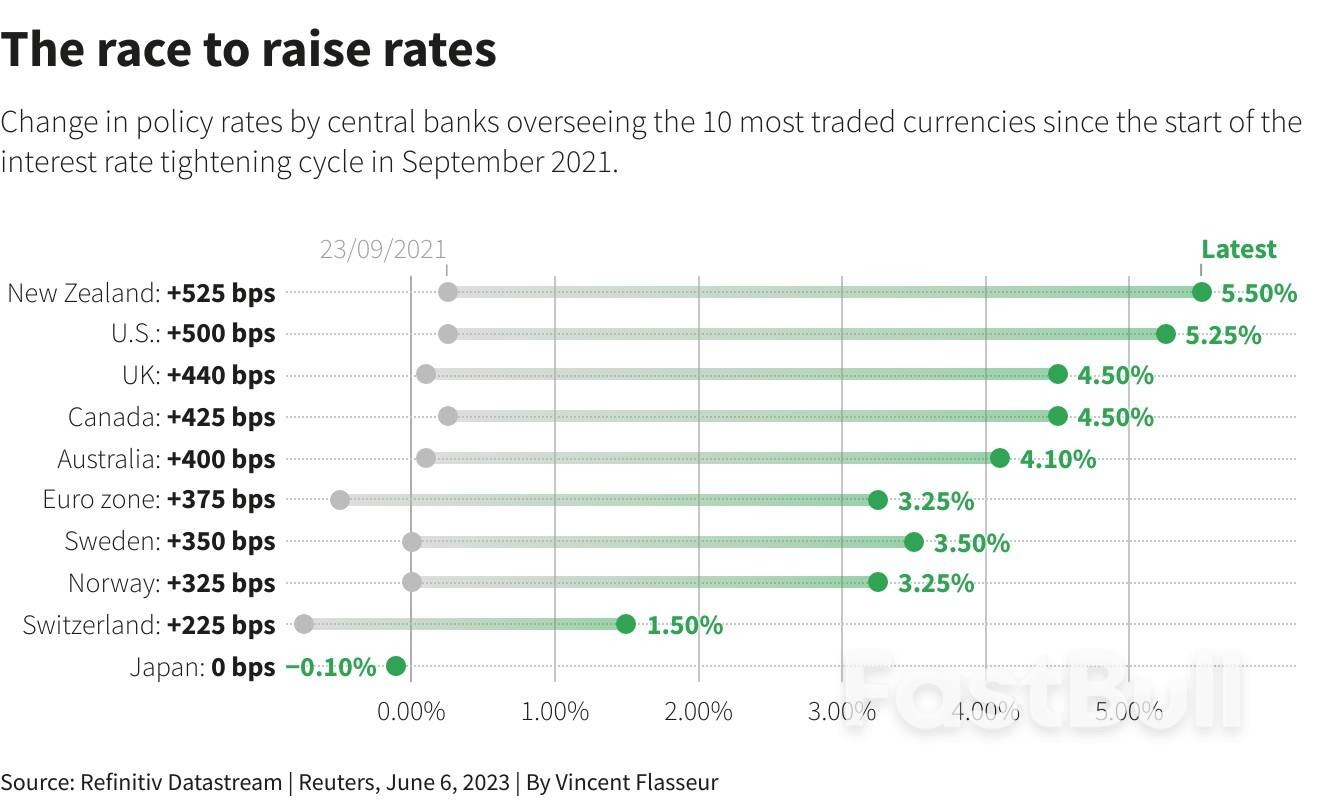
          A widely expected pause in the Federal Reserve's brutal rate rise campaign next week is clearly helping the mood, with futures now showing only a one-in-five chance of another tightening on June 14.
          News of another sharp drop in the New York Fed's index of global supply chain pressures in May helps that cause.
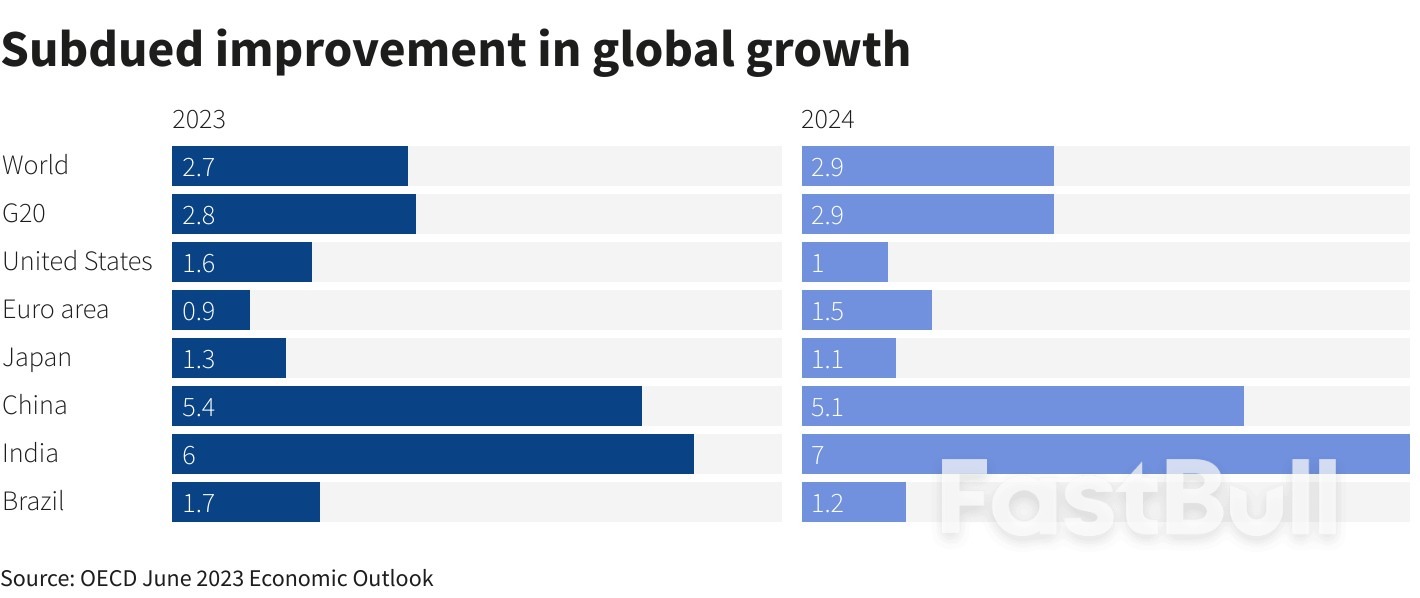
          And despite lacing updated world forecasts with caution and some question marks over 2024, the Organisation for Economic Cooperation and Development and the World Bank both lifted their 2023 global growth forecasts over the past 24 hours.
          What's more, the OECD saw Fed rates peaking after just one more hike to the 5.25-5.5% range and "modest" cuts next year.
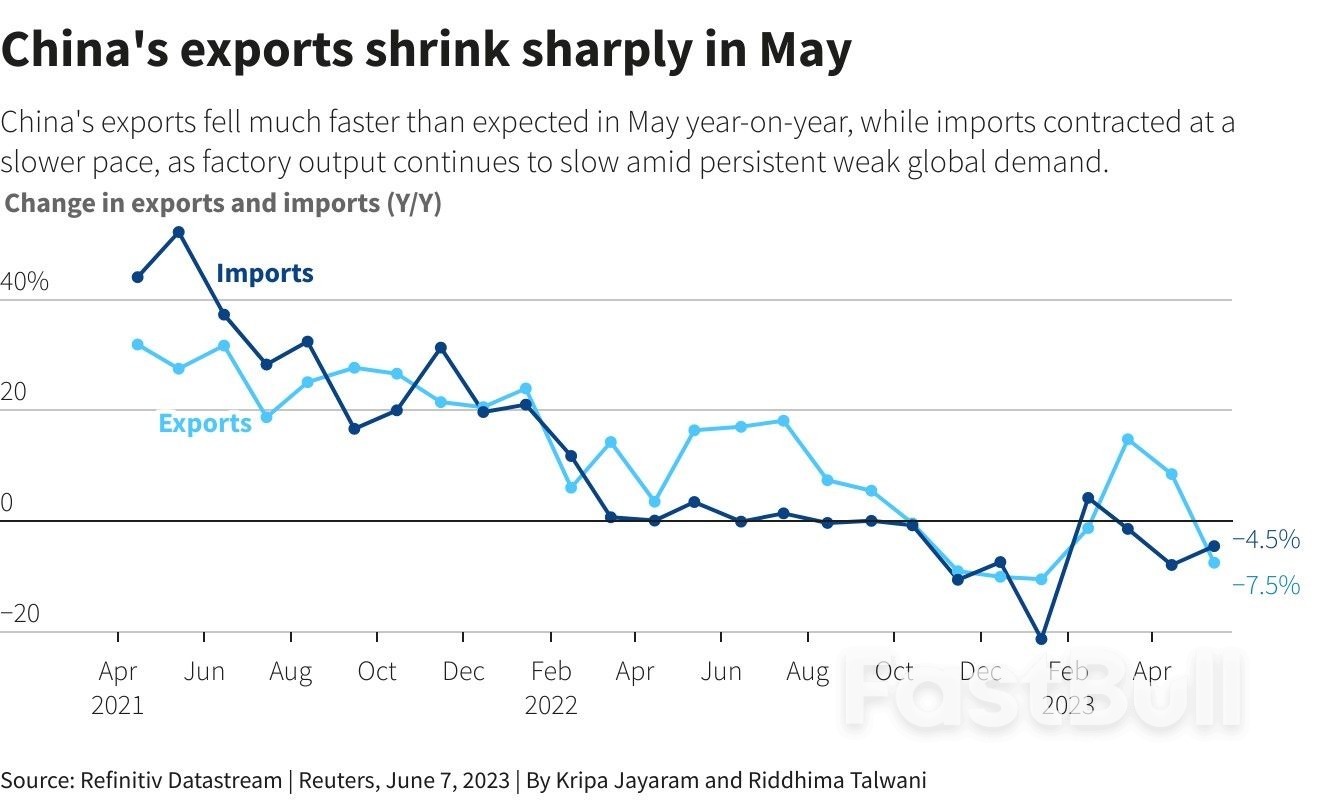
          While dire Chinese export numbers for May might question those growth scenarios, they also cut across thoughts of a fresh inflation spur from the country's re-opening this year.
          Oil prices remain lower on the week despite new Saudi output cut plans and year-on-year prices are still falling at 36%.
          The Fed's April report credit conditions will be watched closely later for any more signs the banking stress of the previous month crimped lending.
          Wednesday sees another test of the central bank 'pause' thesis, however, with markets putting 50-50 chance on the Bank of Canada resuming its rate hikes after a four-month hiatus. The Canadian dollar pushed higher ahead of the policy decision.
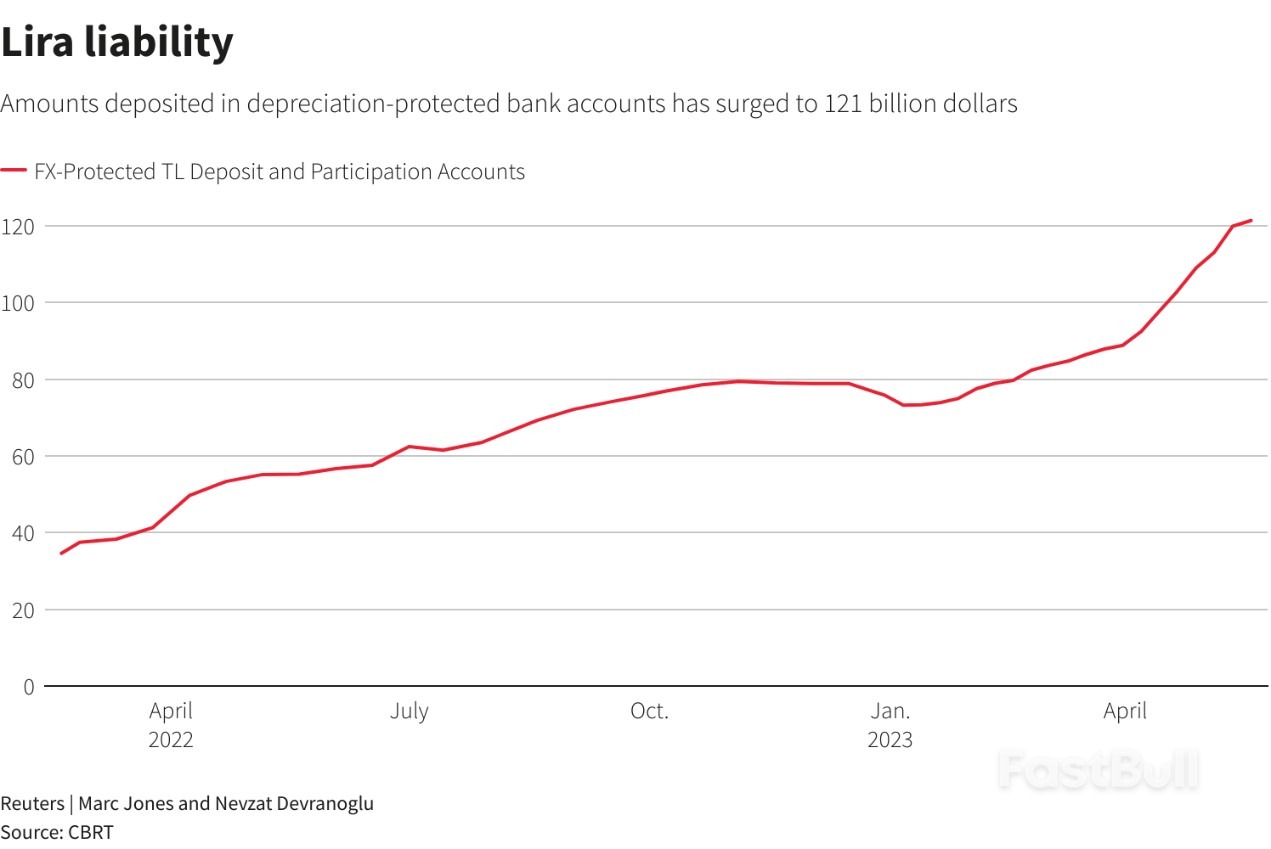
          Elsewhere, the withering slide of Turkey's lira since last month's re-election of President Tayyip Erdogan went up several gears on Wednesday as it plunged a further 7% - almost doubling losses seen since the vote.
          The weakening comes as heavy intervention to artificially prop up the currency before the election - which further drained reserve coffers and central bank IOUs - is expected to be abandoned by new finance minister Mehmet Simsek.
          Crypto tokens such as bitcoin steadied after hitting 3-month lows on Tuesday when U.S. regulators expanded their crackdown on crypto exchanges to the Coinbase platform, the second lawsuit in two days against a major crypto exchange.
          More broadly, U.S. stock futures, European and Asia bourses were steady to lower on Wednesday. The dollar was a touch lower and bonds were steady.
          Events to watch for later on Wednesday:
          * Bank of Canada key policy interest rate announcement
          * U.S. April trade balance. Federal Reserve issues Consumer Credit report for April
          * Britain's Prime Minister Rishi Sunak travels to Washington to meet with U.S. President Joe Biden
          * U.S. corporate earnings: Campbell Soup, Brown-FormanFearless VIX, China Miss, Canada Hike?_1Fearless VIX, China Miss, Canada Hike?_2Fearless VIX, China Miss, Canada Hike?_3Fearless VIX, China Miss, Canada Hike?_4

          Fearless VIX, China Miss, Canada Hike?_5Source: Yahoo

          To stay updated on all economic events of today, please check out our Economic calendar
          Risk Warnings and Disclaimers
          You understand and acknowledge that there is a high degree of risk involved in trading. Following any strategies or investment methods may lead to potential losses. The content on the site is provided by our contributors and analysts for information purposes only. You are solely responsible for determining whether any trading assets, securities, strategy, or any other product is suitable for investing based on your own investment objectives and financial situation.
          Comments
          Add to Favorites
          Share

          Euro Economic Misses May Mask Pandemic Reboot

          Cohen

          Economic

          Even if some yearn for pre-pandemic familiarity after three years of global economic disruption, the euro zone may not want or need to go back there.
          One of the biggest questions in world markets is just how durable the changes wrought by COVID-19 - and the compounding energy shock that followed Russia's invasion of Ukraine - will be on economic behaviour, growth and inflation around the world.
          There are usually two camps - one assuming an eventual return to a slow-growth square one; another sketching a volatile world of higher inflation, borrowing costs and 'geo-economic' realignment.
          Policymakers still battling the related inflation spike and debt piles say it's too early to tell. And this week's World Bank update described the global economy as still 'hobbled' by three years of shocks and with its outlook still 'precarious'.
          Bond fund giant Pimco's five-year view talks of a possible end to an era of "volatility-suppressing policies", leaving markets in for a bout of "heightened volatility" and aftershocks.
          And yet there are scattered signs that the pre-pandemic world is re-emerging as energy prices and inflation gradually subside, worker shortages ease and cross-border travel revives.
          The New York Federal Reserve's index of global supply chain pressures fell to its lowest level in May in the 25-year series.
          And even in financial markets - also contending with a year of steep interest rate rises and pockets of banking stress - Wall Street's 'fear index' of equity market volatility fell to its lowest close this week since before the onset of the pandemic in 2020.
          The picture in Europe - on the front line of the Ukraine conflict and forced into a natural gas rethink amid Russia's pipeline cuts - has been even harder to parse.
          Consensus on the euro zone economic cycle has flipped twice in just six months - from recession angst to relief and back.
          And now, suggesting a more unwelcome return to pre-2020 trends, the latest economic numbers are starting to register disappointment and underperformance again too.
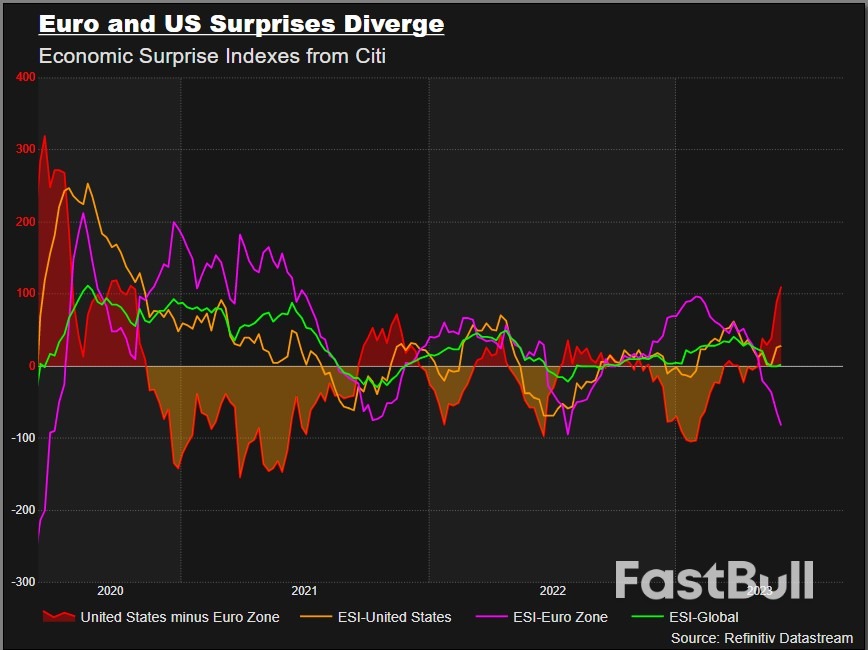
          As interest rates surge after years at near-zero levels, economic 'surprise' indexes for the bloc have plummeted to their most negative since the aftermath of the Ukraine invasion and the gas price explosion last summer.
          That's happened even as global equivalents continue to match forecasts and the U.S. version has pushed back higher into consensus-busting territory. So much so, the gap between euro zone and U.S. surprise indexes is at its widest since 2020.
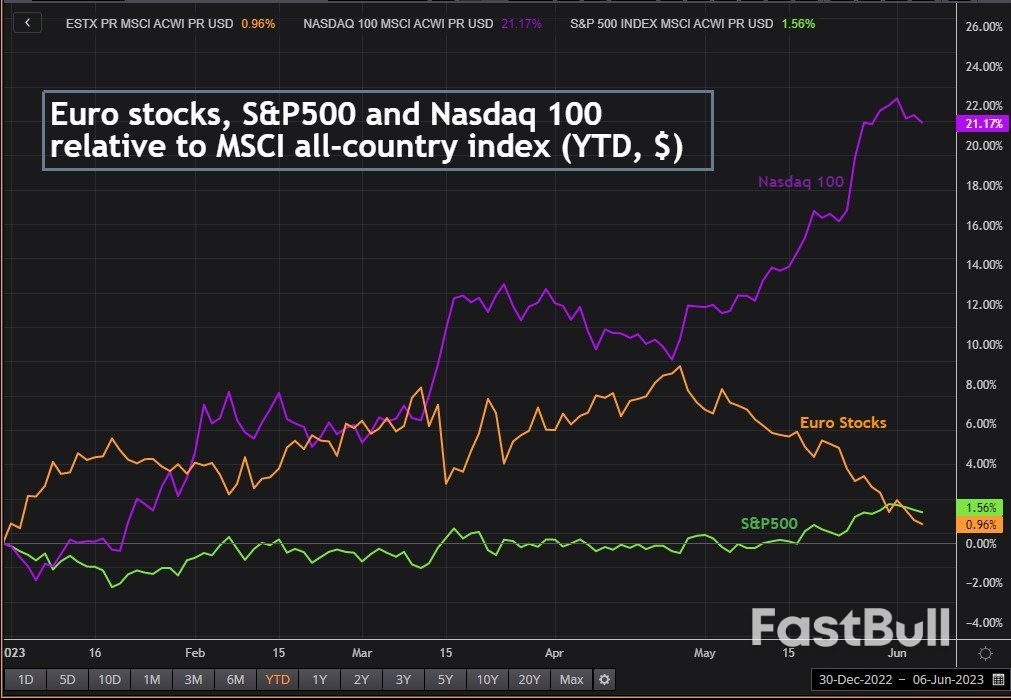
          In the markets, the euro's surge since the final quarter of last year is fading again against a re-charged dollar. So too is the outperformance of euro zone stocks over the past year.Euro Economic Misses May Mask Pandemic Reboot_1Euro Economic Misses May Mask Pandemic Reboot_2
          Euro Economic Misses May Mask Pandemic Reboot_3'Bull case'
          With renewed cyclical angst, comes the old handwringing.
          Long-held doubts have resurfaced about Europe's place in a potentially deglobalising world, with high debt and an ageing workforce. Added to that are fears for the competitiveness of its industry as China goes up the value chain and competes, while Europe still lags the now AI-fueled U.S. digital economy and struggles to retain access to pricey commodity imports.
          But there's a more positive take. And that riffs on how the pandemic thunderbolt may have shaken the zone from its torpor.
          In a report this week entitled "The Bull Case For Europe", TS Lombard economist Davide Oneglia insists the shift in euro zone fiscal and monetary policy mix due to the pandemic may have "profoundly positive" effects on long-term growth and assets.
          "The old (euro zone) export-led growth model is dead - but this is good news," he said, adding that the new wave of public investment, greening of the economy and tight job market strengthen domestic demand amid signs of a productivity revival.
          "Market narratives about euro zone long-term growth seem overly pessimistic," he said. "Don't fear the demise of the old, dysfunctional euro zone growth model."
          Oneglia's main point is that a decade of balanced budget pressures, loose money and reliance on "internal devaluation" to regain competitiveness is over. And it's no longer optional anyway in a world reshaped by technological decoupling from China, which now becomes a rival for industrial markets rather than an export market.
          The pandemic was a 'watershed', he said. The big picture was an entire change of model that trumps cyclical hiccups.
          What's more, the end of the zero-interest period could also help boost aggregate productivity as it pulls the plug on a large number of 'zombie' companies - indebted, loss-making firms kept alive by extraordinarily cheap borrowing - and frees up capital for newer, more innovative startups.
          If successful, the euro zone may never be going back to the pre-pandemic world.Euro Economic Misses May Mask Pandemic Reboot_4

          Euro Economic Misses May Mask Pandemic Reboot_5Source: Reuters

          To stay updated on all economic events of today, please check out our Economic calendar
          Risk Warnings and Disclaimers
          You understand and acknowledge that there is a high degree of risk involved in trading. Following any strategies or investment methods may lead to potential losses. The content on the site is provided by our contributors and analysts for information purposes only. You are solely responsible for determining whether any trading assets, securities, strategy, or any other product is suitable for investing based on your own investment objectives and financial situation.
          Comments
          Add to Favorites
          Share

          ECB Preview: Don't Look Back in Anger

          Devin

          Central Bank

          Macro developments since the May meeting have clearly had more to offer the doves than the hawks at the ECB. Headline inflation has continued to come down but remains far off 2%, survey-based inflation expectations have also started to slow, growth has disappointed and confidence indicators seem to have peaked. In previous times, such a backdrop would have been enough for the ECB to consider pausing rate hikes and wait for the effects of the rate hikes so far to fully unfold. However, the ECB is fully determined right now to err on the side of higher rates.
          Minutes of May meeting point to ongoing tightening bias
          This tightening bias was also reflected in the minutes of the ECB's May meeting. The surprisingly weak Bank Lending Survey ahead of the last meeting clearly scared some ECB members enough to slow the pace of rate hikes but not enough to start thinking about an end to, or at least a pause in, the hiking cycle. In fact, a large number of ECB members assessed the risks to price stability as being clearly tilted to the upside over the policy-relevant horizon. High underlying inflation and stubbornly high core inflation were the main reasons behind the ECB's view that the conditions were not in place to "declare victory" or to be complacent about the inflation outlook.
          Staff projections won't bring substantial change
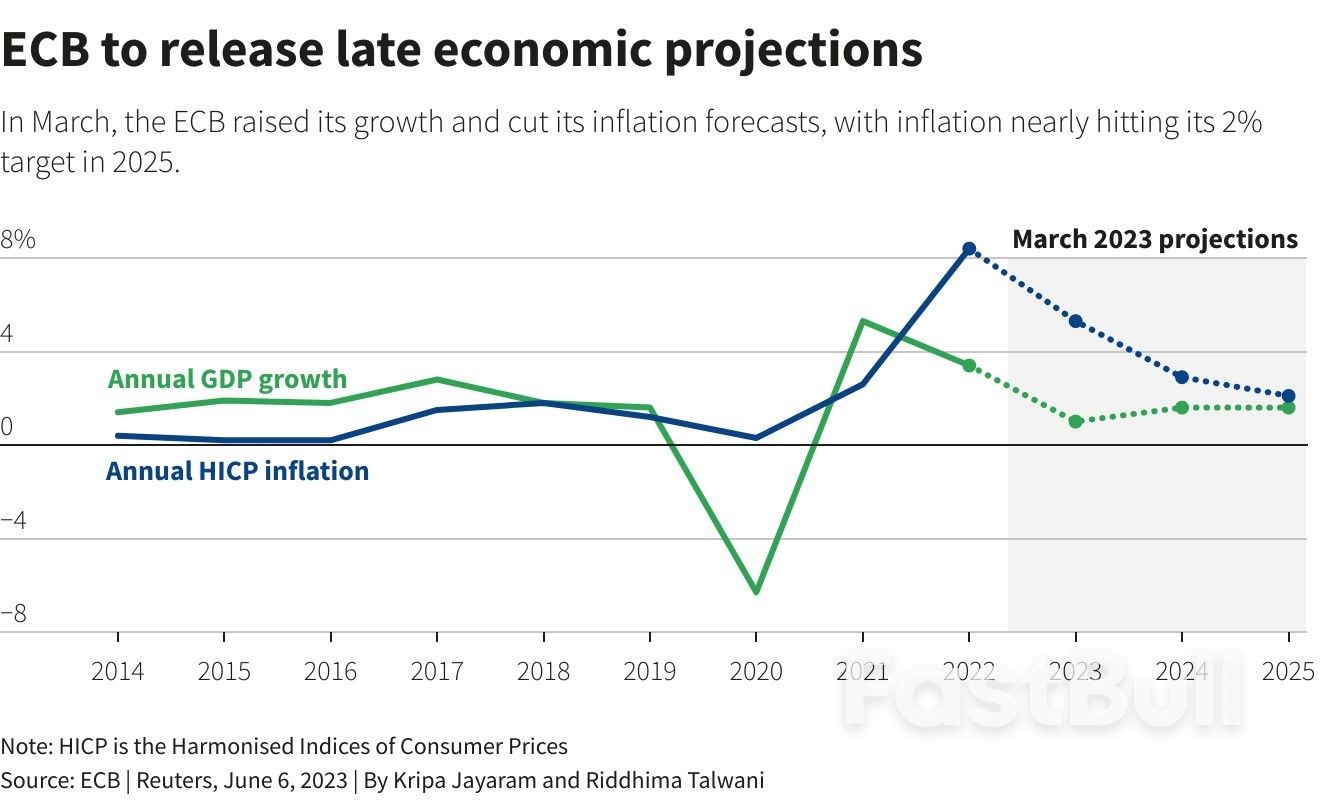
          Next week's meeting will also bring a new round of ECB staff projections. While gas prices have dropped further since the last projections in May, oil prices are broadly back at where they were in March. Market interest rates have also hardly changed and only the slightly weaker euro could technically add some inflationary pressure. At the same time, however, it will be interesting to see how the ECB is dealing with the disappointing soft and hard macro data of late. Remember that back in March, the ECB expected eurozone GDP growth to return to its potential quarterly growth rate of 0.4% quarter-on-quarter from the third quarter of 2022 onwards. This was a surprising forecast given the delayed adverse impact from monetary policy tightening and ongoing structural transitions. It was also remarkable as at the same time, inflation was forecast to return to 2% by the end of 2025. An economy growing at full speed which also gradually allows inflation to disappear is a very unlikely phenomenon.
          For next week, we expect slight downward revisions to the ECB's GDP growth forecasts for this year and next but hardly any revisions to the inflation forecasts. This would mean that the ECB sticks to the 2025 forecast of 2.1% for headline and 2.2% for core inflation.
          Hiking will continue, and not only next week
          Despite the recent decreases, actual headline and core inflation and expectations for inflation only to return to target in two years from now are clear arguments for the ECB to not only continue hiking by 25bp next week but to also keep the door open for rate hikes beyond then.
          However, the eurozone economy has turned out to be less resilient than anticipated a few weeks ago and confidence indicators, with all the caveats currently attached to them, point to a weakening of growth momentum again. As headline inflation is gradually retreating, the risk increases that any additional rate hike could quickly turn out to be a policy mistake; at least in a few months from now. Still, the ECB simply cannot afford to get it wrong again. This is why they are putting more than usual emphasis on actual inflation developments. Even if this completely contradicts forward-looking monetary policy, the ECB is in no position to take a chance and is not giving any impression that it might look back in anger.

          Source: ING

          Risk Warnings and Disclaimers
          You understand and acknowledge that there is a high degree of risk involved in trading. Following any strategies or investment methods may lead to potential losses. The content on the site is provided by our contributors and analysts for information purposes only. You are solely responsible for determining whether any trading assets, securities, strategy, or any other product is suitable for investing based on your own investment objectives and financial situation.
          Comments
          Add to Favorites
          Share

          UK House Prices Experience First Decline since 2012: Halifax House Price Index Reveals

          Warren Takunda

          Traders' Opinions

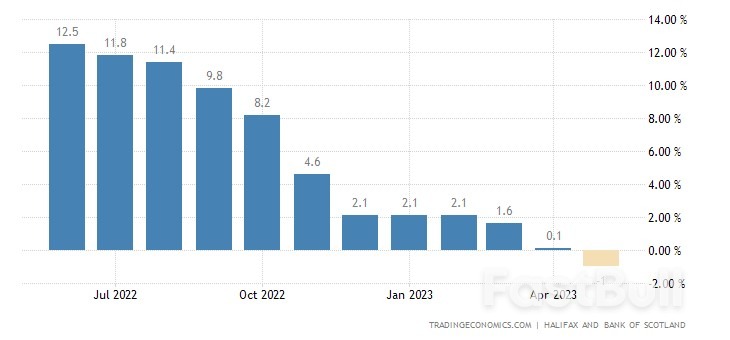
          The housing market in the United Kingdom has witnessed a significant shift as the Halifax house price index reports a 1% year-on-year decrease in May 2023. This decline marks the first time house prices have fallen since December 2012, aligning with market expectations and indicating a notable cooling off of the previously buoyant market. In comparison to the previous month, house prices remained stagnant, reflecting a plateau in the market's recent growth trajectory.
          UK House Prices Experience First Decline since 2012: Halifax House Price Index Reveals_1The initial resurgence observed in the housing sector during the first quarter of this year has subsided, primarily due to the impact of rising interest rates slowly permeating through household budgets. With monetary policy adjustments taking effect, consumers are starting to feel the strain, leading to a moderation in property prices across the country.
          An analysis of the Halifax house price index reveals that the most substantial decline has been observed in the prices of flats, which dropped by 1.9%. Terraced houses also experienced a downturn of 1.0%, followed by a decrease of 0.5% in the prices of semi-detached properties. However, the market for detached houses defied the trend, with prices registering a modest increase of 0.4%.
          The contrasting performance between existing and new build properties further illustrates the changing dynamics in the housing market. Existing houses have continued to lose value, depreciating by 1.9%. On the other hand, prices for newly constructed properties have maintained an upward trajectory, albeit at a subdued pace. The rate of increase for new builds slowed to 2.8%, the weakest rate in almost three years.
          The average cost of a property in the UK now stands at £286,532, marginally lower than the previous month's figure of £286,662. While this slight decline may seem inconsequential, it reflects the prevailing uncertainties and challenges faced by the housing market.
          Experts believe that the combination of rising interest rates and affordability concerns has contributed to the overall slowdown. With mortgage rates edging higher, aspiring homeowners are grappling with increased borrowing costs, impacting their purchasing power. Additionally, elevated house prices, particularly in the more desirable areas, have made it increasingly difficult for first-time buyers to enter the market.
          Despite these challenges, the housing market remains an integral component of the UK economy. A slowdown in price growth can offer a more sustainable environment, ensuring a healthy balance between supply and demand. However, policymakers and industry stakeholders will closely monitor the situation, as a prolonged downturn could have wider implications for the overall economic landscape.
          As the housing market adjusts to these changing dynamics, prospective buyers, sellers, and industry participants are advised to exercise caution and seek expert guidance when navigating the evolving landscape. The future trajectory of the market will depend on a range of factors, including monetary policy decisions, housing supply, and economic stability both domestically and globally.
          Risk Warnings and Disclaimers
          You understand and acknowledge that there is a high degree of risk involved in trading. Following any strategies or investment methods may lead to potential losses. The content on the site is provided by our contributors and analysts for information purposes only. You are solely responsible for determining whether any trading assets, securities, strategy, or any other product is suitable for investing based on your own investment objectives and financial situation.
          Comments
          Add to Favorites
          Share

          A Close Call on the Bank of Canada Today

          Samantha Luan

          Forex

          USD: Lack of domestic factors
          A quiet data calendar has left the pricing for the Federal Reserve's June meeting little changed, with a 20-25% implied probability of a hike after the soft ISM services figures on Monday. That and the generally supported environment for equities haven't triggered any substantial dollar correction though.
          The market's bearish mood on European currencies remains the prevailing theme, and the dollar's resilience probably denotes reluctance to add dollar shorts ahead of the US CPI risk event on 13th June – which is still seen as having the potential to tilt the balance to a hike the following day.
          We think markets will watch the Bank of Canada decision (which we discuss in detail in the CAD section below) with great interest today. Following the Reserve Bank of Australia rate hike yesterday, another hawkish surprise from a developed central bank in the run-up to the FOMC meeting could cause the revamp of some hawkish speculation, especially considering Canada's economic affinity with the US.
          Given the lack of other market-moving events today, a BoC hike could end up supporting the USD too. But, as discussed in our BoC preview, we expect a hawkish hold – in which case the spill-over into the dollar may not be very material given that should be insufficient to prompt markets to price out the implied chances of a Fed June hike currently embedded in the USD curve.
          EUR: European currencies still unloved
          The euro continues to suffer from a softening inflation story in the eurozone. Yesterday, April's report on consumer expectations showed a considerable drop (12-month gauge down to 4.1% from 5.0% in a month), which triggered a rally in the euro area's front-end yields. This has prevented any re-tightening in the 2-year EUR-USD swap rate gap, despite the slight decline in Fed hawkish expectations after Monday's US ISM numbers.
          While easing inflation should build a case for the doves, ECB communication has not seen drastic changes as we head into next week's policy announcement. Yesterday, President Christine Lagarde reiterated her call for more tightening, and her hawkish tone is probably a key factor keeping markets attached to the 40-45bp pricing for the July meeting. We have other speakers to keep an eye on today. Barring major dovish remarks, and unless a BoC hike has a positive spill-over on the dollar, we feel EUR/USD can remain anchored to 1.0700 for now.
          Elsewhere in Europe, pressure on Scandinavian currencies has resumed. EUR/SEK is trading at 11.684 this morning: the intra-day all-time print is at 11.79, and as we have reiterated multiple times in recent publications, the lack of any support from the Riksbank is making it hard to pick a top for the pair in the near term. The financially-distressed Swedish landlord SBB is reportedly denying rumours about discounted sales of its business units, but a default warning from creditors has emerged and the centrality of the firm in the Swedish real estate space means more risk premium (related to a property market collapse) could be priced into SEK now. A recovery for the krona seems unlikely in the near term.
          CAD: Our call is a BoC hawkish hold today
          The Bank of Canada moved considerably earlier than other central banks to the dovish side of the spectrum and has kept rates on hold since January. Now, stubborn inflation, an ultra-tight labour market and a more benign growth backdrop are building the case for a return to monetary tightening. Markets are attaching a 45% implied probability that a 25bp hike will be delivered today.
          While admitting it's a rather close call, we think a hawkish hold is more likely (here's our full meeting preview), as policymakers may want to err on the side of caution while assessing the lagged effect of monetary tightening. We still expect a return to 2% inflation in Canada in the early part of 2024 with the help of softer commodity prices. Developments in the US also play a rather important role for the BoC: recent jitters in the US economic outlook (ISM reports recently added to recession fears) and the proximity to a "toss-up" FOMC meeting would also warrant an extension of the pause.
          Still, we expect another hold by the BoC to be accompanied by hawkish language. Markets are pricing in 40bp of tightening by the end of the summer, and we doubt policymakers have an interest in pushing back or significantly disappointing the market's hawkish expectations given recent data. So, as long as a hold contains enough hints at potential future tightening, we think the negative impact on CAD should be short-lived and we keep favouring the loonie against other pro-cyclical currencies in the current risk environment.
          CEE: Dovish NBP leads us to bearish view on zloty
          Today, another series of economic data from the CEE region continues. Industrial production data will be published in Hungary and retail sales for April in the Czech Republic. Later, the Czech National Bank will release intervention numbers for April – but it can be assumed that the central bank was not active in the market given the current EUR/CZK level. The last time the central bank intervened in the FX market was last October.
          Later today, at 3pm local time, we will see a press conference from the Governor of the National Bank of Poland. As expected, rates remained unchanged yesterday and the statement didn't show anything new either. Today's press conference will be the main focus of the market and we can expect a rather dovish tone supported by lower-than-expected inflation for May.
          The situation in the FX market in the region remains unclear in what direction it will take. The Polish zloty will of course be the main focus. Given the expected dovish tone of the governor, the market is likely to be open to price in more monetary easing, pushing the interest rate differential down. However, this is not the main driver at the moment and if anything, it is more global sentiment that is deciding the zloty. At the same time, it is hard to see what role the MinFin operation in the FX market may play in the strongest levels of the zloty since June 2021. However, the strong long market positioning and dovish NBP leads us to a rather bearish view on the zloty and we see a rather higher EUR/PLN after the end of the press conference today above 4.490.

          Source: ING

          Risk Warnings and Disclaimers
          You understand and acknowledge that there is a high degree of risk involved in trading. Following any strategies or investment methods may lead to potential losses. The content on the site is provided by our contributors and analysts for information purposes only. You are solely responsible for determining whether any trading assets, securities, strategy, or any other product is suitable for investing based on your own investment objectives and financial situation.
          Comments
          Add to Favorites
          Share

          China Exports Experience Sharper Decline Than Expected, Weighed Down by Weak Global Demand

          Warren Takunda

          Economic

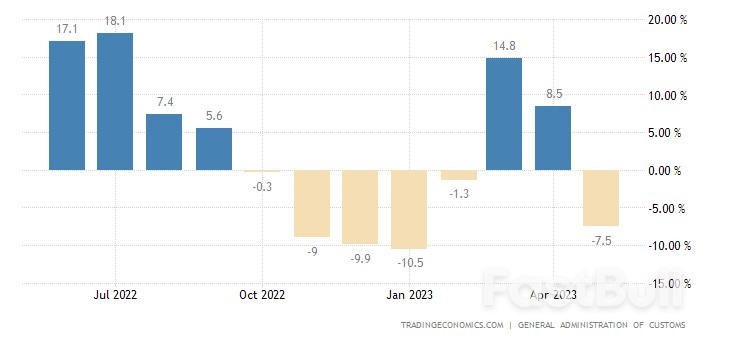
          China's exports witnessed a significant downturn in May 2023, registering a year-on-year contraction of 7.5%, amounting to USD 283.5 billion. This decline follows a period of steady growth in April, when exports expanded by 8.5%. The latest figures indicate the first negative growth since February and the most substantial decline in four months. Surprisingly, the slump in exports surpassed market expectations, which had predicted a more moderate decrease of 0.4%. The disappointing performance can be attributed to insufficient global demand, hampering the recovery of outbound shipments.China Exports Experience Sharper Decline Than Expected, Weighed Down by Weak Global Demand_1
          The weakened global appetite for Chinese goods poses a challenge for the world's second-largest economy, which heavily relies on exports to sustain its growth trajectory. The decline in exports signals potential headwinds for China's manufacturing and trade sectors, which could have wider implications for its overall economic health.
          China's Trade Surplus Narrows to Three-Month Low amid Struggling Exports
          China Exports Experience Sharper Decline Than Expected, Weighed Down by Weak Global Demand_2China's trade surplus for May 2023 contracted to USD 65.81 billion, marking a significant decline from USD 78.40 billion recorded during the corresponding period last year. The latest surplus figure fell short of market forecasts of USD 92 billion and represents the smallest surplus recorded since February. The narrowing trade surplus can be attributed to a sharper decline in exports compared to imports, a trend directly influenced by weak global demand.
          The country's exports contracted by 7.5% on a year-on-year basis, reaching a three-month low of USD 283.5 billion. This decline not only represents the first negative growth in three months but also signifies the steepest drop since January, far exceeding market expectations of a modest 0.4% decline. In contrast, imports declined by 4.5%, mainly driven by weakening domestic demand, softening commodity prices, and the strength of the US dollar.
          Furthermore, the politically sensitive trade surplus between China and the United States witnessed a substantial increase of 27.8% year-on-year, reaching USD 359.48 billion during the first five months of this year. This surge in surplus may add further strain to the already tense trade relations between the two economic giants.
          China's Imports Continue to Decline, Though at a Slower Pace Than Predicted
          China Exports Experience Sharper Decline Than Expected, Weighed Down by Weak Global Demand_3Imports into China displayed resilience in May 2023, falling by 4.5% year-on-year to USD 217.69 billion. While this decline continues the downward trend in purchases for the third consecutive month, it is worth noting that the drop was less severe than market estimates, which had projected an 8.0% decrease. In April, imports had experienced a 7.9% plunge.
          The decline in imports can be attributed to weakened domestic demand, softened commodity prices, and the stronger US dollar. Notably, purchases of copper declined by 4.6% compared to the previous year, following a significant 12.5% drop in April. However, there were exceptions to the downward trend, with imports of crude oil growing by 12.2% and iron ore increasing by 4%. Moreover, the import of soybeans surged by 24% to reach a record 12.02 million tonnes. This remarkable increase was primarily due to the delayed unloading of cargoes, resulting from strict inspections implemented in the previous month.
          Considering the cumulative data for the first five months of 2023, imports into China have declined by 6.7% compared to the same period in 2022. The persistence of this downward trend in imports could signal ongoing challenges for China's domestic consumption and manufacturing sectors, which rely on imported goods and raw materials
          To stay updated on all economic events of today, please check out our Economic calendar
          Risk Warnings and Disclaimers
          You understand and acknowledge that there is a high degree of risk involved in trading. Following any strategies or investment methods may lead to potential losses. The content on the site is provided by our contributors and analysts for information purposes only. You are solely responsible for determining whether any trading assets, securities, strategy, or any other product is suitable for investing based on your own investment objectives and financial situation.
          Comments
          Add to Favorites
          Share
          FastBull
          Copyright © 2025 FastBull Ltd

          728 RM B 7/F GEE LOK IND BLDG NO 34 HUNG TO RD KWUN TONG KLN HONG KONG

          TelegramInstagramTwitterfacebooklinkedin
          App Store Google Play Google Play
          Products
          Charts

          Chats

          Q&A with Experts
          Screeners
          Economic Calendar
          Data
          Tools
          Membership
          Features
          Function
          Markets
          Copy Trading
          Latest Signals
          Contests
          News
          Analysis
          24/7
          Columns
          Education
          Company
          Careers
          About Us
          Contact Us
          Advertising
          Help Center
          Feedback
          User Agreement
          Privacy Policy
          Business

          White Label

          Data API

          Web Plug-ins

          Poster Maker

          Affiliate Program

          Risk Disclosure

          The risk of loss in trading financial instruments such as stocks, FX, commodities, futures, bonds, ETFs and crypto can be substantial. You may sustain a total loss of the funds that you deposit with your broker. Therefore, you should carefully consider whether such trading is suitable for you in light of your circumstances and financial resources.

          No decision to invest should be made without thoroughly conducting due diligence by yourself or consulting with your financial advisors. Our web content might not suit you since we don't know your financial conditions and investment needs. Our financial information might have latency or contain inaccuracy, so you should be fully responsible for any of your trading and investment decisions. The company will not be responsible for your capital loss.

          Without getting permission from the website, you are not allowed to copy the website's graphics, texts, or trademarks. Intellectual property rights in the content or data incorporated into this website belong to its providers and exchange merchants.

          Not Logged In

          Log in to access more features

          FastBull Membership

          Not yet

          Purchase

          Become a signal provider
          Help Center
          Customer Service
          Dark Mode
          Price Up/Down Colors

          Log In

          Sign Up

          Position
          Layout
          Fullscreen
          Default to Chart
          The chart page opens by default when you visit fastbull.com