
• Trade
  • Markets
  • Copy
  • Contests
  • News
  • 24/7
  • Calendar
  • Q&A
  • Chats
Trending
Screeners
SYMBOL
LAST
BID
ASK
HIGH
LOW
NET CHG.
%CHG.
SPREAD
SPX
S&P 500 Index
6831.97
6831.97
6831.97
6878.28
6827.18
-38.43
-0.56%
--
DJI
Dow Jones Industrial Average
47657.22
47657.22
47657.22
47971.51
47611.93
-297.76
-0.62%
--
IXIC
NASDAQ Composite Index
23469.88
23469.88
23469.88
23698.93
23455.05
-108.24
-0.46%
--
USDX
US Dollar Index
99.020
99.100
99.020
99.160
98.730
+0.070
+ 0.07%
--
EURUSD
Euro / US Dollar
1.16377
1.16385
1.16377
1.16717
1.16162
-0.00049
-0.04%
--
GBPUSD
Pound Sterling / US Dollar
1.33244
1.33253
1.33244
1.33462
1.33053
-0.00068
-0.05%
--
XAUUSD
Gold / US Dollar
4186.11
4186.52
4186.11
4218.85
4175.92
-11.80
-0.28%
--
WTI
Light Sweet Crude Oil
58.564
58.594
58.564
60.084
58.495
-1.245
-2.08%
--

Community Accounts

Signal Accounts
--
Profit Accounts
--
Loss Accounts
--
View More

Become a signal provider

Sell trading signals to earn additional income

View More

Guide to Copy Trading

Get started with ease and confidence

View More

Signal Accounts for Members

All Signal Accounts

Best Return
  • Best Return
  • Best P/L
  • Best MDD
Past 1W
  • Past 1W
  • Past 1M
  • Past 1Y

All Contests

  • All
  • Trump Updates
  • Recommend
  • Stocks
  • Cryptocurrencies
  • Central Banks
  • Featured News
Top News Only
Share

U.S. Senate Democratic Member And Antitrust Activist Warren Stated That Paramount Skydance's Hostile Takeover Offer Triggered A "Level 5 Antitrust Alert."

Share

Benin Government: Coup Plotters Kidnapped Two Senior Military Officials Who Were Later Freed

Share

Canada: G7 Finance Ministers Discussed Export Controls And Critical Minerals In Call

Share

Benin Government: Nigeria Carried Out Air Strikes To Help Thwart Coup Bid

Share

Fitch: Expects General Government (Gg) Deficit To Fall Modestly In Canada And But Rise Modestly In USA In 2026

Share

An Important Point Of Consensus Was Concern Regarding Application Of Non-Market Policies, Including Export Controls, To Critical Minerals Supply Chains

Share

Fitch: Despite Full-Year Impact Of Tariffs, We Expect USA Fiscal Deficit To Widen In 2026 Due To Additional Tax Cuts Under One Big Beautiful Bill Act

Share

Private Equity Firm Cinven Has Signed A £190 Million Deal To Acquire A Majority Stake In UK Advisory Firm Flint Global

Share

Bank Of England's Taylor Expects Inflation To Fall To Target 'In The Near Term'

Share

Ukraine President Zelenskiy: He Will Travel To Italy On Tuesday

Share

China Is Not Interested In Forcing Russia To End Its War In Ukraine

Share

ICE Certified Arabica Stocks Decreased By 5144 As Of December 08, 2025

Share

UK Government: Leaders All Agreed That "Now Is A Critical Moment And That We Must Continue To Ramp Up Support To Ukraine And Economic Pressure On Putin"

Share

UK Government: After Meeting With The Leaders Of France, Germany And Ukraine, UK Prime Minister Convened A Call With Other European Allies To Update Them On The Latest Situation

Share

Am Best: US Incurred Asbestos Losses Rise Again In 2024 To $1.5 Billion

Share

Readout Of UK Prime Minister's Engagements With Counterparts From France, Germany And European Partners: Discussed Positive Progress Made To Use Immobilised Russian Sovereign Assets To Support Ukraine's Reconstruction

Share

New York Fed Accepts $1.703 Billion Of $1.703 Billion Submitted To Reverse Repo Facility On Dec 08

Share

Ukraine President Zelenskiy: Coalition Of Willing Meeting To Take Place This Week

Share

Ukraine President Zelenskiy: Ukraine Lacks $800 Million For USA Weapons Purchase Programme This Year

Share

Zimbabwe's President Removes Winston Chitando As Mines Minister, Replaces Him With Polite Kambamura

TIME
ACT
FCST
PREV
France Trade Balance (SA) (Oct)

A:--

F: --

P: --
Euro Zone Employment YoY (SA) (Q3)

A:--

F: --

P: --
Canada Part-Time Employment (SA) (Nov)

A:--

F: --

P: --

Canada Unemployment Rate (SA) (Nov)

A:--

F: --

P: --

Canada Full-time Employment (SA) (Nov)

A:--

F: --

P: --

Canada Labor Force Participation Rate (SA) (Nov)

A:--

F: --

P: --

Canada Employment (SA) (Nov)

A:--

F: --

P: --

U.S. PCE Price Index MoM (Sept)

A:--

F: --

P: --

U.S. Personal Income MoM (Sept)

A:--

F: --

P: --

U.S. Core PCE Price Index MoM (Sept)

A:--

F: --

P: --

U.S. PCE Price Index YoY (SA) (Sept)

A:--

F: --

P: --

U.S. Core PCE Price Index YoY (Sept)

A:--

F: --

P: --

U.S. Personal Outlays MoM (SA) (Sept)

A:--

F: --

P: --
U.S. 5-10 Year-Ahead Inflation Expectations (Dec)

A:--

F: --

P: --

U.S. Real Personal Consumption Expenditures MoM (Sept)

A:--

F: --

P: --
U.S. Weekly Total Rig Count

A:--

F: --

P: --

U.S. Weekly Total Oil Rig Count

A:--

F: --

P: --

U.S. Consumer Credit (SA) (Oct)

A:--

F: --

P: --
China, Mainland Foreign Exchange Reserves (Nov)

A:--

F: --

P: --

Japan Trade Balance (Oct)

A:--

F: --

P: --

Japan Nominal GDP Revised QoQ (Q3)

A:--

F: --

P: --

China, Mainland Imports YoY (CNH) (Nov)

A:--

F: --

P: --

China, Mainland Exports (Nov)

A:--

F: --

P: --

China, Mainland Imports (CNH) (Nov)

A:--

F: --

P: --

China, Mainland Trade Balance (CNH) (Nov)

A:--

F: --

P: --

China, Mainland Exports YoY (USD) (Nov)

A:--

F: --

P: --

China, Mainland Imports YoY (USD) (Nov)

A:--

F: --

P: --

Germany Industrial Output MoM (SA) (Oct)

A:--

F: --

P: --
Euro Zone Sentix Investor Confidence Index (Dec)

A:--

F: --

P: --

Canada National Economic Confidence Index

A:--

F: --

P: --

U.K. BRC Like-For-Like Retail Sales YoY (Nov)

--

F: --

P: --

U.K. BRC Overall Retail Sales YoY (Nov)

--

F: --

P: --

Australia Overnight (Borrowing) Key Rate

--

F: --

P: --

RBA Rate Statement
RBA Press Conference
Germany Exports MoM (SA) (Oct)

--

F: --

P: --

U.S. NFIB Small Business Optimism Index (SA) (Nov)

--

F: --

P: --

Mexico 12-Month Inflation (CPI) (Nov)

--

F: --

P: --

Mexico Core CPI YoY (Nov)

--

F: --

P: --

Mexico PPI YoY (Nov)

--

F: --

P: --

U.S. Weekly Redbook Index YoY

--

F: --

P: --

U.S. JOLTS Job Openings (SA) (Oct)

--

F: --

P: --

China, Mainland M1 Money Supply YoY (Nov)

--

F: --

P: --

China, Mainland M0 Money Supply YoY (Nov)

--

F: --

P: --

China, Mainland M2 Money Supply YoY (Nov)

--

F: --

P: --

U.S. EIA Short-Term Crude Production Forecast For The Year (Dec)

--

F: --

P: --

U.S. EIA Natural Gas Production Forecast For The Next Year (Dec)

--

F: --

P: --

U.S. EIA Short-Term Crude Production Forecast For The Next Year (Dec)

--

F: --

P: --

EIA Monthly Short-Term Energy Outlook
U.S. API Weekly Gasoline Stocks

--

F: --

P: --

U.S. API Weekly Cushing Crude Oil Stocks

--

F: --

P: --

U.S. API Weekly Crude Oil Stocks

--

F: --

P: --

U.S. API Weekly Refined Oil Stocks

--

F: --

P: --

South Korea Unemployment Rate (SA) (Nov)

--

F: --

P: --

Japan Reuters Tankan Non-Manufacturers Index (Dec)

--

F: --

P: --

Japan Reuters Tankan Manufacturers Index (Dec)

--

F: --

P: --

Japan Domestic Enterprise Commodity Price Index MoM (Nov)

--

F: --

P: --

Japan Domestic Enterprise Commodity Price Index YoY (Nov)

--

F: --

P: --

China, Mainland PPI YoY (Nov)

--

F: --

P: --

China, Mainland CPI MoM (Nov)

--

F: --

P: --

Italy Industrial Output YoY (SA) (Oct)

--

F: --

P: --

Q&A with Experts
    • All
    • Chatrooms
    • Groups
    • Friends
    Connecting
    .
    .
    .
    Type here...
    Add Symbol or Code

      No matching data

      All
      Trump Updates
      Recommend
      Stocks
      Cryptocurrencies
      Central Banks
      Featured News
      • All
      • Russia-Ukraine Conflict
      • Middle East Flashpoint
      • All
      • Russia-Ukraine Conflict
      • Middle East Flashpoint
      Search
      Products

      Charts Free Forever

      Chats Q&A with Experts
      Screeners Economic Calendar Data Tools
      Membership Features
      Data Warehouse Market Trends Institutional Data Policy Rates Macro

      Market Trends

      Market Sentiment Order Book Forex Correlations

      Top Indicators

      Charts Free Forever
      Markets

      News

      News Analysis 24/7 Columns Education
      From Institutions From Analysts
      Topics Columnists

      Latest Views

      Latest Views

      Trending Topics

      Top Columnists

      Latest Update

      Signals

      Copy Rankings Latest Signals Become a signal provider AI Rating
      Contests
      Brokers

      Overview Brokers Assessment Rankings Regulators News Claims
      Broker listing Forex Brokers Comparison Tool Live Spread Comparison Scam
      Q&A Complaint Scam Alert Videos Tips to Detect Scam
      More

      Business
      Events
      Careers About Us Advertising Help Center

      White Label

      Data API

      Web Plug-ins

      Affiliate Program

      Awards Institution Evaluation IB Seminar Salon Event Exhibition
      Vietnam Thailand Singapore Dubai
      Fans Party Investment Sharing Session
      FastBull Summit BrokersView Expo
      Recent Searches
        Top Searches
          Markets
          News
          Analysis
          User
          24/7
          Economic Calendar
          Education
          Data
          • Names
          • Latest
          • Prev

          View All

          No data

          Scan to Download

          Faster Charts, Chat Faster!

          Download App
          English
          • English
          • Español
          • العربية
          • Bahasa Indonesia
          • Bahasa Melayu
          • Tiếng Việt
          • ภาษาไทย
          • Français
          • Italiano
          • Türkçe
          • Русский язык
          • 简中
          • 繁中
          Open Account
          Search
          Products
          Charts Free Forever
          Markets
          News
          Signals

          Copy Rankings Latest Signals Become a signal provider AI Rating
          Contests
          Brokers

          Overview Brokers Assessment Rankings Regulators News Claims
          Broker listing Forex Brokers Comparison Tool Live Spread Comparison Scam
          Q&A Complaint Scam Alert Videos Tips to Detect Scam
          More

          Business
          Events
          Careers About Us Advertising Help Center

          White Label

          Data API

          Web Plug-ins

          Affiliate Program

          Awards Institution Evaluation IB Seminar Salon Event Exhibition
          Vietnam Thailand Singapore Dubai
          Fans Party Investment Sharing Session
          FastBull Summit BrokersView Expo

          China's Gasoline Demand Peak Nears as EV Boom Hastens Transition

          Thomas

          Economic

          Summary:

          China's demand for petrol is likely to peak as early as next year as electric vehicle sales soar, several analysts say, bringing forward an energy transition milestone for the world's biggest polluter and a headache for global refiners.
          China's demand for petrol is likely to peak as early as next year as electric vehicle sales soar, several analysts say, bringing forward an energy transition milestone for the world's biggest polluter and a headache for global refiners.
          The International Energy Agency (IEA) and consultancy Rystad Energy have brought forward forecasts of China's peak gasoline demand by about a year to 2024, while Chinese state majors PetroChina and Sinopec see it in 2025.
          The earlier halt in gasoline demand growth in the world's No. 2 oil consumer will push Chinese refiners to ramp up exports of the motor fuel to Asia and spur them to make more naphtha, diesel and jet fuel, crimping refining margins in the region.
          "It will be a challenge for refiners to rebalance their output," said Toril Bosoni, IEA's head of oil industry and markets division.
          "We are seeing a shift towards higher middle distillates yields like jet fuel and gasoil ... also seeing rebalancing of naphtha and gasoline into petrochemicals feedstocks."
          EV Boom
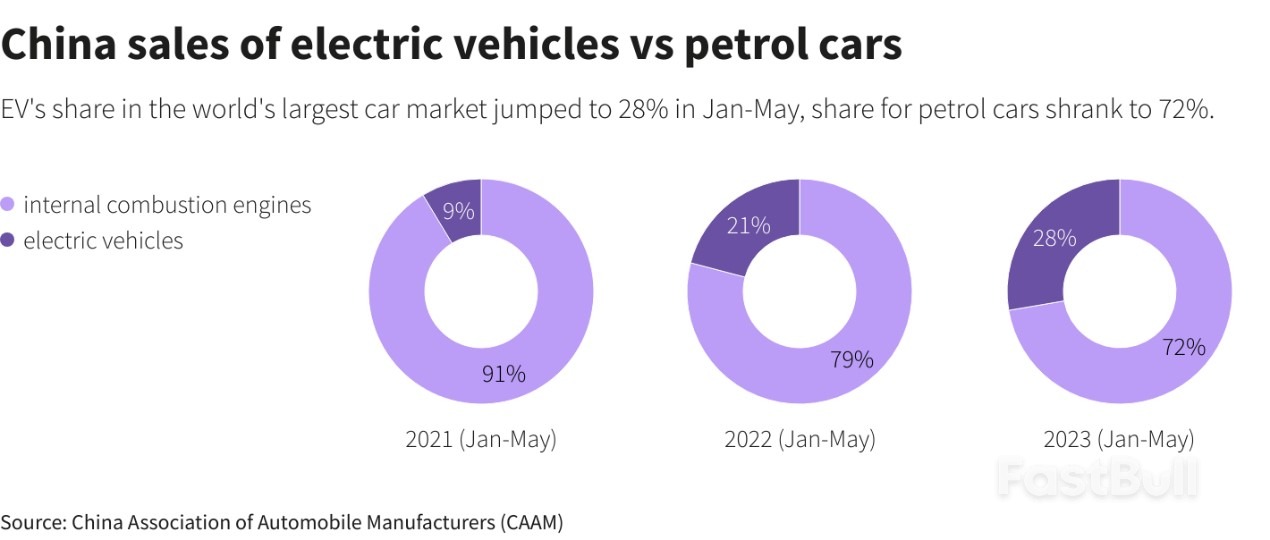
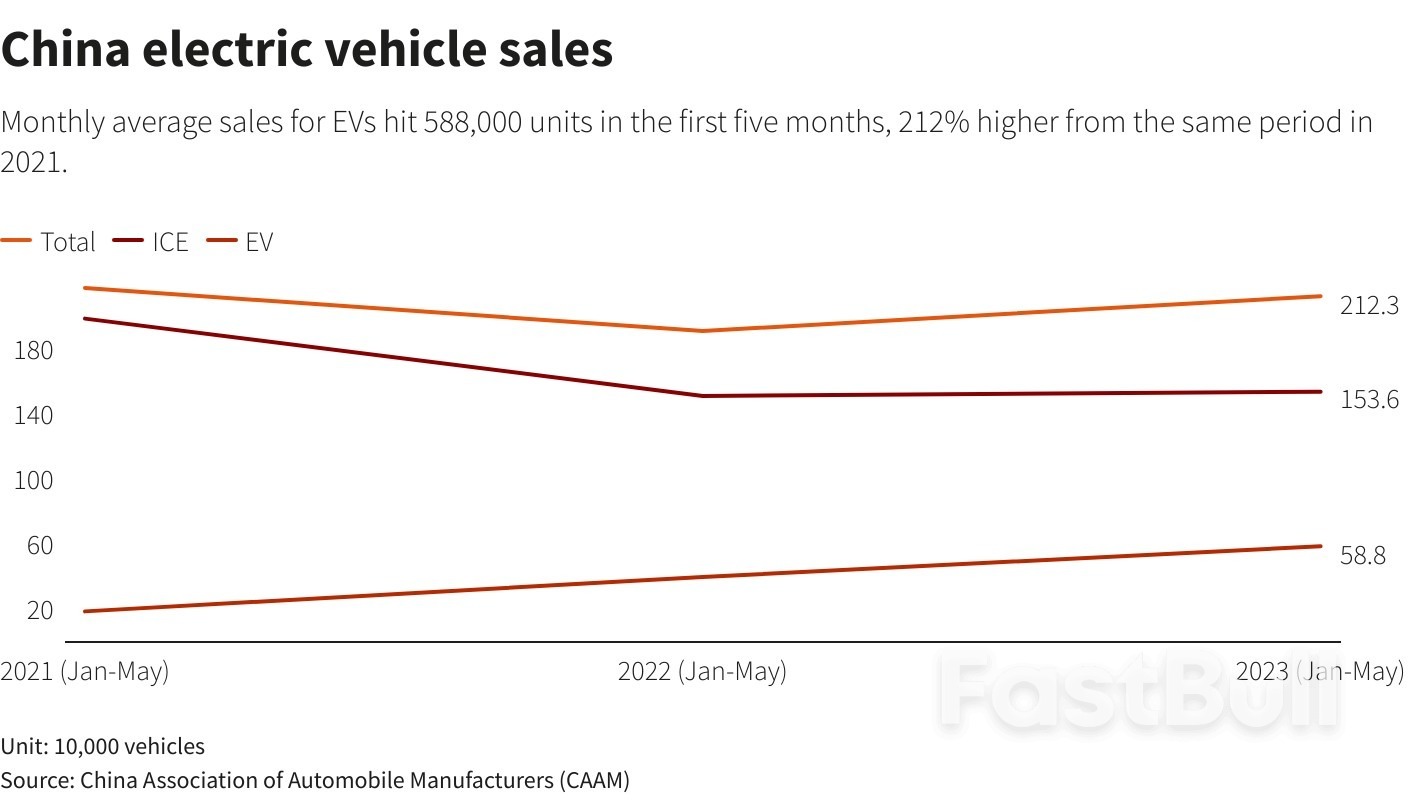
          In January to May, EV's share in the world's largest car market jumped to 28%, up from 9% in the same period of 2021, while the share for petrol cars shrank to 72% from 91%, data from China Association of Automobile Manufacturers showed.China's Gasoline Demand Peak Nears as EV Boom Hastens Transition_1
          China is now looking to spur EV adoption in rural areas by improving charging infrastructure and encouraging banks, local governments and auto makers to offer support, said Gaurav Batra, consultancy EY's lead analyst of global automotive and transportation.
          China's Gasoline Demand Peak Nears as EV Boom Hastens Transition_2As a result of accelerating EV sales, Paris-based IEA now expects Chinese gasoline demand to peak in 2024 at about 3.7 million barrels per day (bpd), bringing forward an earlier projection of demand plateauing in 2025/2026.
          Rystad Energy also sees the peak at 3.7 million bpd but coming as early as the first quarter of 2024, compared with an earlier projection between 2024 and 2025, said Mukesh Sahdev, senior vice president, head of downstream/oil trading.
          The research arm of China's state refiner CNPC expects gasoline demand to peak in 2025, citing accelerating sales of EVs, and sees gasoline demand shrinking 2.3% annually between 2026 and 2030.
          Predicting the country's refined fuel demand to peak around 2025, top Asian refiner Sinopec's chairman Ma Yongsheng said on Monday China will strictly control refining capacity and hasten the petrochemical industry's transition to low-carbon, high-end growth.
          Gasoline Surplus
          With gasoline consumption having topped out in the U.S., the world's top gas guzzler, in 2019 and China set to peak around next year, global gasoline markets could move into a surplus from 2025.
          The glut is expected to grow steadily over the next five years to about 1.3 million bpd by 2028 in the absence of any significant output adjustments by refiners, according to IEA forecasts in a medium-term outlook.
          North America, China and India could each move from roughly balanced gasoline markets to net exporters in 2028 of around 600,000 bpd, 900,000 bpd and 130,000 bpd, respectively, it said.
          Shifting away from transport fuels, new refineries in China are focusing on petrochemicals.
          For example, Shenghong Petrochemical, the latest mega refiner to start operations, has a design yield of only 30% for gasoline, diesel and jet fuel combined, compared with 65% for Chinese majors in first quarter this year, said Jianan Sun, China energy market analyst at Energy Aspects.
          China's Gasoline Demand Peak Nears as EV Boom Hastens Transition_3Some refineries have been boosting production of feedstocks, such as naphtha, while other upgraded facilities are producing more propylene and olefin-based derivatives for processing into chemicals, an official at a Chinese state-refinery told Reuters.
          China's massive move into petrochemicals is already causing a glut globally, prompting companies to shift investments to high-end energy transition materials.

          Source: Yahoo

          To stay updated on all economic events of today, please check out our Economic calendar
          Risk Warnings and Disclaimers
          You understand and acknowledge that there is a high degree of risk involved in trading. Following any strategies or investment methods may lead to potential losses. The content on the site is provided by our contributors and analysts for information purposes only. You are solely responsible for determining whether any trading assets, securities, strategy, or any other product is suitable for investing based on your own investment objectives and financial situation.
          Comments
          Add to Favorites
          Share

          Judiciary Is Shaking the Country's Foundations

          Cohen

          Political

          Like the ripples spreading from a pebble tossed into a pool, Israel's Knesset vote, 64-0, to "rebalance" powers of judiciary and legislature has added fresh turbulence to the already choppy waters of this troubled country's international relations.
          For now, the waves of domestic protest in the build-up to the vote, now even more stormy since its passing, obscure the outfall with allies. In the long run, however, they may yet come to dwarf the impact of this historic decision on the country.
          From its creation 75 years ago, Israel has endured rocky and at times violent relations in a region where some of its neighbours still challenge its very existence. That strength to resist and prosper has its roots in both its unity and its powerful allies.
          Now those staples of stability are being put to the test.
          Israel's strongest friend, the US, has been urging Prime Minister Benjamin Netanyahu and his extreme right-wing religious coalition government to exercise caution, warning the vote, and others that are expected to follow, could undermine Israel's powerful democracy by reducing the influence of the judiciary.
          Mr Netanyahu and his government argue the reverse is true, and that as elected officials, unlike the judiciary, they represent the will of the people and therefore actually embody core democratic values.
          The result however, if all the planned changes go through, will give Israel's most hardline, right-wing government in its history the power to run roughshod over existing judicial checks and balances at a time when the government's relations with Palestinians are at their lowest ebb in recent memory, and tensions over aggressive Israeli security operations and proposed settlements on occupied territory are at their highest in a generation.
          The US State Department's reaction was swift, echoing views from the White House: "It was unfortunate that the vote today took place with the slimmest possible majority," adding "we believe changes of this magnitude ought to be made with really the broadest consensus possible and that did not happen here."
          The reality is, Mr Netanyahu, who had a pacemaker inserted in his chest 48 hours before the vote, has been on rocky ground with the White House since he got back into office late December last year and cobbled together his extreme-right coalition.
          Last week it was Israel's President, Isaac Herzog, not Mr Netanyahu, who got an invite to the White House to meet President Joe Biden. The intention was to ease some of the growing tensions and potentially persuade this vital ally on the potential consequences of ignoring US concerns.
          Mr Biden did get to show his pro-Israel credentials. But Mr Herzog, whose role is mostly ceremonial, doesn't have the powers Mr Netanyahu does and if he was given a message of caution he wasn't, it appears, able to make it stick when he got home.
          On the eve of Mr Herzog's visit, Mr Biden did extend a slightly ambiguous invite to Mr Netanyahu for later in the year. Whatever form it takes, it is unlikely to be smooth sailing when it does happen. Mr Biden has described this Netanyahu government as "one of the most extremist" in 50 years.
          Mr Netanyahu and his conservative religious and settler coalition appears to be straining the democratic values Mr Biden came into office championing, and that until recently Israel seemed to share.
          Aaron David Miller, a seasoned US diplomat who has served several different Democrat and Republican administrations, says Mr Biden is in a bind: "What you have here is a president who is waking up to the fact that that he's no longer dealing with the old Benjamin Netanyahu, the risk averse, cautious [one] who takes one step forward and two steps back. He's dealing now with a desperate Benjamin Netanyahu, risk-ready, determined for any number of reasons to keep this government, this extreme right-wing government."
          The personal stakes for Mr Netanyahu are huge. Out of office he faces a number of legal challenges that, although he dismisses, could land him in jail if proven. Current polling in Israel predicts if elections were held today Mr Netanyahu could not form a government.
          Mr Miller predicts Mr Biden's current pressure is unlikely to bend the trajectory of Mr Netanyahu's collision: "He must maintain this coalition filled with radical fundamentalist extremist ministers, even at the risk of undermining destroying Israeli institutions, undermining the cohesion of the country and injecting a fair amount of tension into us Israeli relations."
          Others among Israel's staunch allies, like the UK, have also responded by urging the Israeli government to "build consensus and avoid division", and to preserve the independence of its judiciary.
          The US, like the UK, has been struggling to work out how best to handle Mr Netanyahu.
          In March, the UK and Israel signed a "landmark agreement deepening tech, trade and security ties", saying the countries were "committed to a modern, innovative, forward-looking relationship". Yet four months later in July, the UK, alongside Australia and Canada, was publicly criticising Mr Netanyahu's policies, saying Israel's expansion in the West Bank was an "obstacle to peace".
          It is hard to see how the waves this Netanyahu government has set in motion can ultimately push his goal of expanding the Abraham Accords signed three years ago with the UAE, Bahrain and Morocco safely ashore, let alone Mr Netanyahu's aspiration of what he calls "expanding the circle of peace" to include Saudi Arabia.
          His government has already faced criticism from the UAE for its handling of tensions with Palestinians, an area in which several of his hardline ministers goad Mr Netanyahu to get even tougher.
          For now, Israel's allies are likely to look on with increasing alarm. According to Mr Miller, the potential domestic political cost of an ugly spat with Israel's Prime Minister just as Mr Biden is about to enter an election cycle is a risk he is unlikely to take: "He has no desire and seems to me to impose any costs or consequences, not just on the issue of Israeli internal politics, but on what the Israeli government is doing in the West Bank, which is pursuing a set of annexation in policies in everything but name so yeah, I think it's going to be very difficult for Mr Biden to continue to walk that line. But I believe he will."
          If Israel's allies are unclear about how to handle the situation, Israel's enemies are applauding the tumult. Neighbouring Lebanon's Iran-backed Hezbollah claimed, not for the first time, that Israel is self-destructing, and on a "path of collapse and fragmentation".
          Unlike a single pebble in thrown in a pond, the ripples Mr Netanyahu's government is creating are accumulative: pebble, followed by stone, followed by rock. They are not going to ebb quickly to insignificance.
          At worst, they could erode Israel's democratic foundations and drown out the supportive voices of even its staunchest allies.
          At a minimum, they will bring additional and unwanted turbulence to the increasingly fragile world order where China exploits America's diplomatic missteps and Russia brazenly invades its neighbour, throwing out its own destabilising tsunami of harsh economic peril.

          Source: The National News

          Risk Warnings and Disclaimers
          You understand and acknowledge that there is a high degree of risk involved in trading. Following any strategies or investment methods may lead to potential losses. The content on the site is provided by our contributors and analysts for information purposes only. You are solely responsible for determining whether any trading assets, securities, strategy, or any other product is suitable for investing based on your own investment objectives and financial situation.
          Comments
          Add to Favorites
          Share

          Week Ahead – NFP Report to Probably Steal the Limelight from BoE and RBA

          Justin

          Commodity

          Central Bank

          Economic

          Another close call for the RBA?

          The Reserve Bank of Australia meets on Tuesday for its August policy decision and markets and economists are split as to what the outcome will be. Analysts are predicting a 25-basis-point increase in the cash rate to 4.35% following a pause in July. However, the minutes of the July meeting revealed the decision was a close call and that the Board would “reassess the situation” in August.
          Week Ahead – NFP Report to Probably Steal the Limelight from BoE and RBA_1
          The Bank will publish updated economic projections on Friday but it’s doubtful how much clarity they will provide. Economic data has been somewhat mixed lately – the jobless rate dipped to 3.5% in June, but inflation also fell more than expected, with CPI cooling to 6.0% year-on-year in Q2.
          However, other indicators have been gloomier as the manufacturing and services PMIs both contracted in July. That’s why the markets aren’t convinced that policymakers will press the hike button, although they do foresee one final 25-bps increase over the next nine months. But there is reason to be optimistic as Australian exporters stand to benefit from China’s renewed efforts to stimulate its economy.
          Therefore, if policymakers choose to stay on the sidelines for another meeting, the decision might not be very negative for the Australian dollar as a hawkish hold is the most dovish scenario. But neither are they likely to close the door to additional hikes if they decide not to wait and raise rates next week, boosting the local dollar.
          The aussie could also gain if the PMIs out of China show some improvement in July. The official manufacturing and non-manufacturing PMIs are out on Monday, while the Caixin manufacturing and services PMIs are due on Tuesday and Thursday, respectively.

          BoE to downshift again

          The Bank of England is certain to raise the Bank Rate again when it meets on Thursday but there is less confidence about the size of the hike. A 25-bps increase is fully baked in, but markets have assigned around a 30% probability of a larger 50-bps move. Following the June inflation figures when UK CPI finally tumbled below 8% and core CPI eased too, the arguments for a second consecutive double hike have weakened considerably, and even more so after the recent dismal PMIs for July.
          Week Ahead – NFP Report to Probably Steal the Limelight from BoE and RBA_2
          Very poor flash PMI estimates tend to get revised up and that could happen when the final readings are released on Tuesday (manufacturing) and Thursday (services). However, the UK economy is clearly struggling amid a slowdown in its biggest trading partners and households being squeezed from soaring mortgage costs. Hence, the Bank of England is unlikely to go big even as it stresses the need for further tightening.
          In the event that the BoE doesn’t surprise, what might be more relevant for the pound is the BoE’s latest set of inflation forecasts, in particular, how fast it sees CPI falling to the 2% target.

          Is the US labour market coming off the boil?

          The Fed decision may be out of the way but the upcoming jobs report could prove more vital for the markets as Powell kept his options open for the September meeting. The jobs market in America has been steadily losing steam this year but not nearly fast enough to ease concerns about a wage-price spiral. However, the Fed may finally be getting what it wants as employment grew at the slowest pace in two-and-a-half years in June and that trend likely continued in July.
          Nonfarm payrolls are expected to have risen by 184k in July, down from 209k previously. The unemployment rate is forecast to have held steady at 3.6%, while average earnings probably kept growing by slightly more than 4% y/y.
          Week Ahead – NFP Report to Probably Steal the Limelight from BoE and RBA_3
          The weekly jobless claims have been edging lower for most of July so a positive NFP surprise is possible, though the markets might not necessarily welcome a strong print as it would bolster the case for a September rate hike.
          Investors will be able to further scrutinize the US labour market with Tuesday’s JOLTS job openings and Wednesday’s ADP employment report. Other data will include the Chicago PMI on Monday and factory orders on Thursday.
          But aside from the payrolls numbers, what could move the US dollar the most are the ISM PMIs on Tuesday (manufacturing) and Thursday (non-manufacturing). Like in Europe, the US manufacturing sector has been in recession this year but in stark contrast, the services economy has continued to expand, and the non-manufacturing PMI unexpectedly bounced higher in June.
          With the Fed undecided about whether to raise rates again, the incoming data could swing the odds in the dollar’s favour if they are stronger-than-expected.

          Euro eyes flash CPI as ECB ponders pausing

          The European Central Bank made a dovish turn this week by not committing to further rate hikes. The change in stance came on the back of softer inflation readings as well as growing signs that the Eurozone economy could be headed for a recession.
          Monday’s flash CPI numbers for July will therefore be crucial in shaping expectations about additional rate hikes in the euro area this year. The headline rate of inflation slipped to 5.5% y/y in June and is projected to fall again to 5.3% in July to a one-and-a-half year low.
          Week Ahead – NFP Report to Probably Steal the Limelight from BoE and RBA_4
          However, underlying inflation is proving to be a lot stickier as core CPI that excludes all volatile items such as food and energy edged up in June to 5.5%. It is forecast to inch lower to 5.4% in July, but any upside surprises could lead to some scaling back of bets that the ECB is done raising rates.
          Preliminary GDP estimates for the second quarter are also released on Monday. Economic growth was flat in the first quarter, but GDP likely managed a modest expansion of 0.1% in the three months to June.
          With future rate hikes hanging in the balance, the euro will be very sensitive to price and growth indicators in the run up to the September meeting.

          More data and an OPEC meeting

          Elsewhere, CPI numbers will be watched in Switzerland on Thursday and New Zealand’s quarterly jobs data will be important for the kiwi early on Wednesday. Meanwhile, Canada will get employment figures too for July on Friday.
          Another solid labour market report could boost the odds of one more rate increase by the Bank of Canada this year, lifting the loonie. On the other hand, the Canadian currency will likely shrug off a meeting of OPEC and non-OPEC countries on Thursday as the major oil producers are not expected to announce any significant changes to their output quotas. Oil futures have been rallying lately following the previously announced cuts by Saudi Arabia and Russia, but also on the hopes that more pro-growth policies in China will buoy demand.
          Week Ahead – NFP Report to Probably Steal the Limelight from BoE and RBA_5

          Source: XM

          To stay updated on all economic events of today, please check out our Economic calendar
          Risk Warnings and Disclaimers
          You understand and acknowledge that there is a high degree of risk involved in trading. Following any strategies or investment methods may lead to potential losses. The content on the site is provided by our contributors and analysts for information purposes only. You are solely responsible for determining whether any trading assets, securities, strategy, or any other product is suitable for investing based on your own investment objectives and financial situation.
          Comments
          Add to Favorites
          Share

          Can Spain & Portugal Solve Europe's Industrial Power Cost Crisis?

          Devin

          Economic

          Several major European industrial sectors have been hammered by high power costs over the past year after Russia's invasion of Ukraine cut natural gas flows to the region and high inflation and interest rates cooled global consumer demand.
          European output of chemicals, paper, crude steel and aluminium have all slumped from pre-crisis levels, and many energy-intensive operations risk permanent closure unless power costs drop significantly from current levels, according to the International Energy Agency's latest electricity market report.
          However, forward power price markets indicate that future power costs in major manufacturing hubs such as Germany, France and Poland will not only stay well above historical averages, but will remain prone to regular steep rallies as energy systems retool away from fossil fuels.
          Can Spain & Portugal Solve Europe's Industrial Power Cost Crisis?_1In contrast, power costs in Spain and Portugal will remain relatively stable and substantially lower than the average across Western Europe, thanks to price caps that are expected to stay in place for the foreseeable future.
          These price caps in turn look set to result in widening power price discounts for consumers based in Spain and Portugal - known as Iberia - compared to Western European consumers, and may offer potential power price relief for industry.
          Iberian Exception
          The price caps in place are a result of the so-called Iberian Exception, which argued that Spain and Portugal should be able to come up with their own price-setting power rules due to the fact that Iberia historically relied far less on Russian gas imports than the rest of Europe.
          European lawmakers agreed, and allowed for Spain and Portugal to strip out the price of natural gas in their electricity price-setting system and enact a new pricing method from mid-2022.
          Since then, the power price differences for Iberia-based consumers and those in Germany, Europe's largest power consumer, have been significant: Power prices in Spain for the second half of 2022 averaged less than half of those in Germany.
          Can Spain & Portugal Solve Europe's Industrial Power Cost Crisis?_2So far in 2023, German and Spanish power prices have traded relatively close together, but forward power markets expect price trends to diverge later in the year as German values climb again.
          Business Moves
          In the year or so since Russia's invasion of Ukraine disrupted Europe's gas flows and sent power prices soaring, many energy-intensive businesses have had no option but to scale back or halt operations until energy costs drop and greater clarity emerges regarding the energy price outlook.
          However, with long-term power prices now expected to remain well above historical averages, some business may now consider relocating some or all operations to lower cost locations.
          Some will consider shifting energy-intensive production processes outside of Europe altogether, targeting the lower operating costs available in Asia, Africa and elsewhere.
          But others will be keen to exploit the favourable tax treatments afforded to businesses that manufacture products within Europe, and so will look to stay within the Eurozone.
          For those firms, Spain and Portugal will likely emerge as potential locations for some production processes and operations, due mainly to lower energy costs.
          Spain and Portugal have not been entirely free from some power cost inflation even with the Iberian Exception. So far in 2023 Spain's power prices have averaged around 90% more than the average for 2018 through 2020.
          However, Germany's power prices in 2023 have averaged 165% more than the 2018-20 average, and are widely expected to trend higher through the remainder of this decade.
          As a result, many of Germany's most energy-intensive sectors may have no option but to review if and how they can shift operations elsewhere.
          In particular, Germany's chemicals and fertilizer sectors - the largest in Europe - will urgently need to find low-cost operating bases or risk mounting financial losses tied to staff furloughs and under-utilized production lines.
          Some of these may be able to relocate operations to locations in Iberia, and might be able to resume output before overseas competitors take over their lost market share.
          Other industries may struggle to accommodate operations shifting from Northern to Southern Europe, especially for businesses that are tightly integrated into manufacturing supply chains that rely on just-in-time inventory management and other tightly-knit industrial systems.
          However, with high power costs inflicting extensive damage to much of Europe's industry, it is clear that some sector reshaping is inevitable, and Spain and Portugal may be viewed as preferable locations to regions outside of Europe where costs might be lower but market access to Europe's consumers may be limited.

          Source: Reuters

          To stay updated on all economic events of today, please check out our Economic calendar
          Risk Warnings and Disclaimers
          You understand and acknowledge that there is a high degree of risk involved in trading. Following any strategies or investment methods may lead to potential losses. The content on the site is provided by our contributors and analysts for information purposes only. You are solely responsible for determining whether any trading assets, securities, strategy, or any other product is suitable for investing based on your own investment objectives and financial situation.
          Comments
          Add to Favorites
          Share

          What is at Stake for the United States in Niger?

          Thomas

          Political

          Soldiers in Niger declared a military coup on Wednesday, overthrowing President Mohamed Bazoum. The landlocked nation, a key U.S. ally in the region, has received millions in assistance from Washington.
          Here are answers to questions about U.S.-Niger ties:
          Why is Niger Important to the United States?
          The country, located in the semi-arid Sahel region, plays an outsized role in the United States' Africa strategy. Most importantly, it is a key partner for Washington's fight against Islamist insurgents who have killed thousands of people and displaced millions more. U.S. military personnel have been training local forces to fight militant groups.
          The Biden administration has also held up Niger as a democratic success story in a region that has faced a series of coups or attempted power grabs over the past three years.
          Bazoum's ouster threatens both priorities.
          What Are the Military Ties Between the U.S. And Niger?
          Niger and its neighbors Mali, Burkina Faso, Nigeria and Chad are all struggling to repel Islamist insurgents.
          Groups linked to al Qaeda and Islamic State have carried out dozens of attacks in southwestern Niger, including some that have killed dozens of Nigerien soldiers, but the violence has not spread across the whole country as it has done elsewhere.
          "Niger has been an incredible security partner on the continent, and so we will continue to pay close attention to this," State Department deputy spokesperson Vedant Patel told reporters on Thursday.
          There are about 1,100 U.S. troops in Niger, where the U.S. military operates out of two bases.
          In 2017, the government of Niger approved the use of armed American drones from the country to target militants.
          Why Has Washington Praised Democracy in Niger?
          While violence in Mali and Burkina Faso led to military coups and a shift in alliances away from Western nations and towards Russia, Niger managed a democratic transfer of power in 2021 and has kept smooth relations with the West.
          The State Department in March said Niger had "taken important steps to consolidate and strengthen its democracy."
          A State Department official in March also praised Bazoum for speaking out against Russia's private Wagner group of mercenaries, which has been hired by Mali's junta to help fight insurgents there. Mali describes the Wagner personnel on its territory as trainers.
          Patel said on Thursday he was not aware of any indication that the Wagner force could be involved in the overthrow of Bazoum, but said the situation continues to be quite fluid.
          What Assistance Does the U.S. Provide to Niger?
          U.S. Secretary of State Antony Blinken announced $150 million in new humanitarian aid for Africa's Sahel region in a visit to Niger in March, the first visit by a U.S. Secretary of State.
          The State Department in March said the United States had plans to provide $101 million in bilateral assistance to Niger in fiscal year 2022, including assistance for food security, democracy and governance, and security.
          The U.S. also provided nearly $135.4 million in bilateral humanitarian assistance in fiscal year 2022, the State Department said.
          It is unclear how much the United States has given in security assistance specifically. The U.S. Embassy in Niamey in 2021 said the Pentagon and State Department had provided Niger more than $500 million in equipment and training since 2012.
          How Would Bazoum's Ouster Affect U.S. Aid?
          U.S. law on foreign aid prohibits most assistance to any country where the elected head of government has been deposed in a coup d'etat or by decree, unless the Secretary of State determines that providing aid is in the national security interest of the United States.
          Members of Congress who run the appropriations subcommittees responsible for foreign aid said on Thursday they were watching the situation closely.
          "I think the State Department first has to reach the conclusion that the new junta has taken power in a coup," said Democratic Senator Chris Coons, who chairs the Senate subcommittee.
          "Let's not get ahead of ourselves. If that's what happened, we will cut off assistance, consistent with U.S. policy."
          Republican Representative Mario Diaz-Balart, who chairs the House subcommittee, said he was monitoring the developments.

          Source: Yahoo

          Risk Warnings and Disclaimers
          You understand and acknowledge that there is a high degree of risk involved in trading. Following any strategies or investment methods may lead to potential losses. The content on the site is provided by our contributors and analysts for information purposes only. You are solely responsible for determining whether any trading assets, securities, strategy, or any other product is suitable for investing based on your own investment objectives and financial situation.
          Comments
          Add to Favorites
          Share

          Bank of England Credibility Depends on a Framework with the Treasury

          Justin

          Central Bank

          Economic

          It is a mistake to suppose that central banks have the tools to alleviate the adverse consequences of poor fiscal policy, much less to restrain profligate governments. The most that the central bank can do is to reassure financial markets temporarily, until the government is able to implement a fiscal strategy which the markets find to be credible.
          What that strategy turns out to be is specific to the circumstances of each case and cannot be known in advance. The fiscal authorities must discover it by a process of policy initiatives, followed by assessment of the effects of their actions and prompt course correction, until such time as interest and exchange rates settle down to some predictable pathway.
          There is little chance of a return to financial market tranquility if fiscal and monetary policies are not closely aligned at every step. The process of policy-making in general, and most especially in times of difficulty, is best exemplified by circumstances of US President Richard Nixon’s announcement on August 15 1971, that the Federal Reserve Bank of New York would no longer sell gold at the fixed price of $35 an ounce.
          In his revealing book Three Days at Camp David, Jeffrey Garten describes how that decision was taken. It was the outcome of intense discussion involving top officials from the US Treasury, the Federal Reserve and other economic officials and advisers. The discussions were informed by background studies which had been prepared beforehand and discussed with experts.
          The president’s announcement was followed immediately by intense rounds of consultation with officials and leaders of business and opinion at home and abroad, explaining the reasons for the decision and responding to questions, comments and reactions. This led to a fully informed, consistent framework, based on the Camp David discussions.
          Contrary to popular notions of central bank independence and monetary targeting of inflation, the most effective way to conduct economic policy is through a coordinated framework. Strategies should be formulated based on data and analysis by a council headed by the minister of finance and including senior economic policy expertise from the central bank and the Treasury. The council’s mandate should include joint formulation of government budgeting, financial and debt strategies, and monetary and exchange rate policies.
          Targets for growth, inflation, public sector borrowing, debt management, exchange rates and interest rates should all be set within an internally consistent framework. It may not be advisable to announce all or any of the targets; what matters is that the public and the financial markets believe any announcements to be credible.
          Policy changes should be announced simultaneously by the bank and the Treasury; the policy council should meet regularly to evaluate the most up-to-date information on the effects of policy and make course corrections as necessary. The council and its members should explain the strategy to the media and the general public, publish supporting data and analysis for those who wish to make their own evaluation and issue regular updates on progress with the implementation of the strategy.
          There are many cogent reasons for joint policy-making by the Treasury and the central bank, including uncertainties about the credit channel, the spillover effects of monetary expansion to other economies, unwanted exchange rate movements, the effects of fiscal dominance on interest rates and macroprudential concerns.
          But the most compelling argument against the notion of inflation targeting by an independent central bank is the loss of credibility by both the bank and the Treasury should the messages and signals emanating from those two sources not be the same. A framework for joint policy making is the only way to minimise uncertainty in financial and exchange markets, and to reassure those markets in times of difficulty that the authorities – monetary and fiscal – have control and are able to restore calm.

          Source: DeLisle Worrell

          To stay updated on all economic events of today, please check out our Economic calendar
          Risk Warnings and Disclaimers
          You understand and acknowledge that there is a high degree of risk involved in trading. Following any strategies or investment methods may lead to potential losses. The content on the site is provided by our contributors and analysts for information purposes only. You are solely responsible for determining whether any trading assets, securities, strategy, or any other product is suitable for investing based on your own investment objectives and financial situation.
          Comments
          Add to Favorites
          Share

          Reserve Bank of Australia Policy Move and Regional PMI Data

          Damon

          Economic

          RBA likely to maintain rates as inflation slows
          The Reserve Bank of Australia (RBA) can use the latest inflation data as an excuse to leave the cash rate target unchanged at 4.1% this month. But while the figures are being touted as "better than expected" the truth is that the monthly June figure was still running hot, and with base effects almost used up, there may well be more convincing periods in the months ahead for the RBA to deliver further tightening. Our current thinking is that the bank will maintain rates at the current level until September, which could respond to inflation backtracking higher, or just not making sufficient downward progress.
          The latest data from the Australian Bureau of Statistics shows that the CPI for the second quarter fell to 6.0% year-on-year, lower than the 6.2% consensus. This is also the lowest quarterly rise since September 2021. As both headline and trimmed mean inflation are now below the central bank's forecast, this gives it a good reason to believe that it is time to stop.
          China PMI likely lower again
          Both the manufacturing PMI released by Caixin and the official numbers are expected to dip further as the government has yet to roll out any concrete policy to boost growth. While a weak yuan could provide a lift to the export sector, it also reflects the general pessimism that has taken hold in the economy. This has led to many consumers delaying spending; thus, we should see the services PMI also drop for a second month as the effect of "revenge spending" fizzles out.
          Trade and inflation numbers from Korea
          Korean exports are expected to decline for the tenth straight month on the back of sluggish semiconductor and petroleum exports. Export details to the US and the EU should be monitored more carefully, as this could signal how consumers cope with rate hikes.
          Consumer inflation should stabilise further down to 2.5% year-on-year in July (vs 2.7% in June), mainly due to the high base last year. Meanwhile, recent floods and a rebound in global oil prices should push up food and energy prices on a monthly basis.
          Japan reports activity data next week
          Monthly activity data should be closely watched in order to gauge whether Japan's recovery can be sustained in the second quarter. Surveys and other forward-looking data suggest that both industrial production and retail sales will gain in June, supported by solid catch-up demand and improvement in the global supply chain.
          Indonesia's inflation likely steady while Philippine price pressures ease further
          Both the Philippines and Indonesia will report inflation next week. Inflation in Indonesia returned to target earlier this year and we expect both headline and core inflation to remain well-behaved. Headline inflation should be flat at 3.5%YoY while core inflation could dip to 2.5%YoY from 2.6%.
          Meanwhile, in the Philippines, headline inflation will continue its slide helped along by favourable base effects. Philippine inflation could edge lower to 4.8%YoY (from 5.4%) while core inflation could likely trend lower to 7.0%. Despite moderating price pressures, both Bank Indonesia and Bangko Sentral ng Pilipinas will likely keep rates untouched for the time being to provide support for their respective currencies.
          Singapore retail sales could bounce in June
          Retail sales, which have been a bright spot for Singapore's economy, could extend their gains for another month. June retail sales could rise by 3.5%YoY although this will be down 2.8% from the previous month. Slowing inflation coupled with the influx of foreign arrivals should provide some support, especially in services related to leisure and recreation.

          Source: ING

          To stay updated on all economic events of today, please check out our Economic calendar
          Risk Warnings and Disclaimers
          You understand and acknowledge that there is a high degree of risk involved in trading. Following any strategies or investment methods may lead to potential losses. The content on the site is provided by our contributors and analysts for information purposes only. You are solely responsible for determining whether any trading assets, securities, strategy, or any other product is suitable for investing based on your own investment objectives and financial situation.
          Comments
          Add to Favorites
          Share
          FastBull
          Copyright © 2025 FastBull Ltd

          728 RM B 7/F GEE LOK IND BLDG NO 34 HUNG TO RD KWUN TONG KLN HONG KONG

          TelegramInstagramTwitterfacebooklinkedin
          App Store Google Play Google Play
          Products
          Charts

          Chats

          Q&A with Experts
          Screeners
          Economic Calendar
          Data
          Tools
          Membership
          Features
          Function
          Markets
          Copy Trading
          Latest Signals
          Contests
          News
          Analysis
          24/7
          Columns
          Education
          Company
          Careers
          About Us
          Contact Us
          Advertising
          Help Center
          Feedback
          User Agreement
          Privacy Policy
          Business

          White Label

          Data API

          Web Plug-ins

          Poster Maker

          Affiliate Program

          Risk Disclosure

          The risk of loss in trading financial instruments such as stocks, FX, commodities, futures, bonds, ETFs and crypto can be substantial. You may sustain a total loss of the funds that you deposit with your broker. Therefore, you should carefully consider whether such trading is suitable for you in light of your circumstances and financial resources.

          No decision to invest should be made without thoroughly conducting due diligence by yourself or consulting with your financial advisors. Our web content might not suit you since we don't know your financial conditions and investment needs. Our financial information might have latency or contain inaccuracy, so you should be fully responsible for any of your trading and investment decisions. The company will not be responsible for your capital loss.

          Without getting permission from the website, you are not allowed to copy the website's graphics, texts, or trademarks. Intellectual property rights in the content or data incorporated into this website belong to its providers and exchange merchants.

          Not Logged In

          Log in to access more features

          FastBull Membership

          Not yet

          Purchase

          Become a signal provider
          Help Center
          Customer Service
          Dark Mode
          Price Up/Down Colors

          Log In

          Sign Up

          Position
          Layout
          Fullscreen
          Default to Chart
          The chart page opens by default when you visit fastbull.com