• Trade
  • Markets
  • Copy
  • Contests
  • News
  • 24/7
  • Calendar
  • Q&A
  • Chats
Trending
Screeners
SYMBOL
LAST
BID
ASK
HIGH
LOW
NET CHG.
%CHG.
SPREAD
SPX
S&P 500 Index
6827.42
6827.42
6827.42
6899.86
6801.80
-73.58
-1.07%
--
DJI
Dow Jones Industrial Average
48458.04
48458.04
48458.04
48886.86
48334.10
-245.98
-0.51%
--
IXIC
NASDAQ Composite Index
23195.16
23195.16
23195.16
23554.89
23094.51
-398.69
-1.69%
--
USDX
US Dollar Index
97.950
98.030
97.950
98.500
97.950
-0.370
-0.38%
--
EURUSD
Euro / US Dollar
1.17394
1.17409
1.17394
1.17496
1.17192
+0.00011
+ 0.01%
--
GBPUSD
Pound Sterling / US Dollar
1.33707
1.33732
1.33707
1.33997
1.33419
-0.00148
-0.11%
--
XAUUSD
Gold / US Dollar
4299.39
4299.39
4299.39
4353.41
4257.10
+20.10
+ 0.47%
--
WTI
Light Sweet Crude Oil
57.233
57.485
57.233
58.011
56.969
-0.408
-0.71%
--

Community Accounts

Signal Accounts
--
Profit Accounts
--
Loss Accounts
--
View More

Become a signal provider

Sell trading signals to earn additional income

View More

Guide to Copy Trading

Get started with ease and confidence

View More

Signal Accounts for Members

All Signal Accounts

Best Return
  • Best Return
  • Best P/L
  • Best MDD
Past 1W
  • Past 1W
  • Past 1M
  • Past 1Y

All Contests

  • All
  • Trump Updates
  • Recommend
  • Stocks
  • Cryptocurrencies
  • Central Banks
  • Featured News
Top News Only
Share

Ukraine President Zelenskiy: US, European Security Guarantees Instead Of NATO Membership Is Compromise From Ukraine's Side

Share

Ukraine President Zelenskiy: There Won't Be A Peace Plan That Everyone Will Like, There Will Be Compromises

Share

Ukraine President Zelenskiy: He Has Had No US Reaction Yet To Revised Peace Proposals

Share

Kremlin Says NATO's Rutte Is Irresponsible To Talk Of War With Russia

Share

Israel Foreign Minister Saar: The Australian Government, Which Has Received Countless Warning Signs, Must Come To Its Senses

Share

Israel Foreign Minister Saar: Calls For 'Globalize The Intifada' Were Realized Today

Share

Zelenskiy Demands 'Dignified' Peace As US And Ukraine Officials Meet In Berlin

Share

Australia Opposition Leader: The Loss Of Life In Bondi Beach Shooting Is Significant

Share

Russian Defence Ministry Says Russian Forces Capture Varvarivka In Ukraine's Zaporizhzhia Region

Share

Israel President Herzog: Our Sisters And Brothers In Sydney Have Been Attacked By Vile Terrorists In A Very Cruel Attack On Jews Who Went To Light The First Candle Of Hanukkahon Bondi Beach

Share

Australia Prime Minister: I Just Have Spoken To The AFP Commissioner And The Nsw Premier. We Are Working With Nsw Police And Will Provide Further Updates As More Information Is Confirmed

Share

Australia Prime Minister: The Scenes In Bondi Are Shocking And Distressing. Police And Emergency Responders Are On The Ground Working To Save Lives. My Thoughts Are With Every Person Affected

Share

Petroleum Ministry: Egypt Proposes A Unified Arab Emergency Oil And Gas Purchases Mechanism

Share

Ukraine President Zelenskiy: Services Have Been Working To Restore Electricity, Heating, Water Supply To Regions Following Russian Strikes On Energy Infrastructure

Share

Hamas Gaza Chief Confirms Killing Of The Group's Senior Commander In Israeli Strike

Share

Foreign Ministry - Iran's Foreign Minister Araqchi To Visit Russia And Belarus In Coming Week

Share

Defence Ministry: Russia Downs 235 Ukrainian Drones Overnight

Share

Trump Isn't Certain His Economic Policies Will Translate To Midterm Wins

Share

The United States And Mexico Have Reached An Agreement On How To Resolve The Water Dispute In The Rio Grande Basin (which Borders Texas). Starting December 15, Mexico Will Supply The U.S. With An Additional 20.2 Acre-feet (a Unit Of Volume For Irrigation). The Agreement Seeks To “strengthen Water Management In The Rio Grande Basin” Within The Framework Of The 1944 Water Treaty

Share

U.S. Transportation Secretary Duffy: The Engine Of United Airlines Flight 803 That Malfunctioned Caught Fire

TIME
ACT
FCST
PREV
U.K. Trade Balance (Oct)

A:--

F: --

P: --

U.K. Services Index MoM

A:--

F: --

P: --

U.K. Construction Output MoM (SA) (Oct)

A:--

F: --

P: --

U.K. Industrial Output YoY (Oct)

A:--

F: --

P: --

U.K. Trade Balance (SA) (Oct)

A:--

F: --

P: --

U.K. Trade Balance EU (SA) (Oct)

A:--

F: --

P: --

U.K. Manufacturing Output YoY (Oct)

A:--

F: --

P: --

U.K. GDP MoM (Oct)

A:--

F: --

P: --

U.K. GDP YoY (SA) (Oct)

A:--

F: --

P: --

U.K. Industrial Output MoM (Oct)

A:--

F: --

P: --

U.K. Construction Output YoY (Oct)

A:--

F: --

P: --

France HICP Final MoM (Nov)

A:--

F: --

P: --

China, Mainland Outstanding Loans Growth YoY (Nov)

A:--

F: --

P: --

China, Mainland M2 Money Supply YoY (Nov)

A:--

F: --

P: --

China, Mainland M0 Money Supply YoY (Nov)

A:--

F: --

P: --

China, Mainland M1 Money Supply YoY (Nov)

A:--

F: --

P: --

India CPI YoY (Nov)

A:--

F: --

P: --

India Deposit Gowth YoY

A:--

F: --

P: --

Brazil Services Growth YoY (Oct)

A:--

F: --

P: --

Mexico Industrial Output YoY (Oct)

A:--

F: --

P: --

Russia Trade Balance (Oct)

A:--

F: --

P: --

Philadelphia Fed President Henry Paulson delivers a speech
Canada Building Permits MoM (SA) (Oct)

A:--

F: --

P: --

Canada Wholesale Sales YoY (Oct)

A:--

F: --

P: --

Canada Wholesale Inventory MoM (Oct)

A:--

F: --

P: --

Canada Wholesale Inventory YoY (Oct)

A:--

F: --

P: --

Canada Wholesale Sales MoM (SA) (Oct)

A:--

F: --

P: --

Germany Current Account (Not SA) (Oct)

A:--

F: --

P: --

U.S. Weekly Total Rig Count

A:--

F: --

P: --

U.S. Weekly Total Oil Rig Count

A:--

F: --

P: --

Japan Tankan Large Non-Manufacturing Diffusion Index (Q4)

--

F: --

P: --

Japan Tankan Small Manufacturing Outlook Index (Q4)

--

F: --

P: --

Japan Tankan Large Non-Manufacturing Outlook Index (Q4)

--

F: --

P: --

Japan Tankan Large Manufacturing Outlook Index (Q4)

--

F: --

P: --

Japan Tankan Small Manufacturing Diffusion Index (Q4)

--

F: --

P: --

Japan Tankan Large Manufacturing Diffusion Index (Q4)

--

F: --

P: --

Japan Tankan Large-Enterprise Capital Expenditure YoY (Q4)

--

F: --

P: --

U.K. Rightmove House Price Index YoY (Dec)

--

F: --

P: --

China, Mainland Industrial Output YoY (YTD) (Nov)

--

F: --

P: --

China, Mainland Urban Area Unemployment Rate (Nov)

--

F: --

P: --

Saudi Arabia CPI YoY (Nov)

--

F: --

P: --

Euro Zone Industrial Output YoY (Oct)

--

F: --

P: --

Euro Zone Industrial Output MoM (Oct)

--

F: --

P: --

Canada Existing Home Sales MoM (Nov)

--

F: --

P: --

Euro Zone Total Reserve Assets (Nov)

--

F: --

P: --

U.K. Inflation Rate Expectations

--

F: --

P: --

Canada National Economic Confidence Index

--

F: --

P: --

Canada New Housing Starts (Nov)

--

F: --

P: --

U.S. NY Fed Manufacturing Employment Index (Dec)

--

F: --

P: --

U.S. NY Fed Manufacturing Index (Dec)

--

F: --

P: --

Canada Core CPI YoY (Nov)

--

F: --

P: --

Canada Manufacturing Unfilled Orders MoM (Oct)

--

F: --

P: --

Canada Manufacturing New Orders MoM (Oct)

--

F: --

P: --

Canada Core CPI MoM (Nov)

--

F: --

P: --

Canada Manufacturing Inventory MoM (Oct)

--

F: --

P: --

Canada CPI YoY (Nov)

--

F: --

P: --

Canada CPI MoM (Nov)

--

F: --

P: --

Canada CPI YoY (SA) (Nov)

--

F: --

P: --

Canada Core CPI MoM (SA) (Nov)

--

F: --

P: --

Canada CPI MoM (SA) (Nov)

--

F: --

P: --

Q&A with Experts
    • All
    • Chatrooms
    • Groups
    • Friends
    Connecting
    .
    .
    .
    Type here...
    Add Symbol or Code

      No matching data

      All
      Trump Updates
      Recommend
      Stocks
      Cryptocurrencies
      Central Banks
      Featured News
      • All
      • Russia-Ukraine Conflict
      • Middle East Flashpoint
      • All
      • Russia-Ukraine Conflict
      • Middle East Flashpoint
      Search
      Products

      Charts Free Forever

      Chats Q&A with Experts
      Screeners Economic Calendar Data Tools
      Membership Features
      Data Warehouse Market Trends Institutional Data Policy Rates Macro

      Market Trends

      Market Sentiment Order Book Forex Correlations

      Top Indicators

      Charts Free Forever
      Markets

      News

      News Analysis 24/7 Columns Education
      From Institutions From Analysts
      Topics Columnists

      Latest Views

      Latest Views

      Trending Topics

      Top Columnists

      Latest Update

      Signals

      Copy Rankings Latest Signals Become a signal provider AI Rating
      Contests
      Brokers

      Overview Brokers Assessment Rankings Regulators News Claims
      Broker listing Forex Brokers Comparison Tool Live Spread Comparison Scam
      Q&A Complaint Scam Alert Videos Tips to Detect Scam
      More

      Business
      Events
      Careers About Us Advertising Help Center

      White Label

      Data API

      Web Plug-ins

      Affiliate Program

      Awards Institution Evaluation IB Seminar Salon Event Exhibition
      Vietnam Thailand Singapore Dubai
      Fans Party Investment Sharing Session
      FastBull Summit BrokersView Expo
      Recent Searches
        Top Searches
          Markets
          News
          Analysis
          User
          24/7
          Economic Calendar
          Education
          Data
          • Names
          • Latest
          • Prev

          View All

          No data

          Scan to Download

          Faster Charts, Chat Faster!

          Download App
          English
          • English
          • Español
          • العربية
          • Bahasa Indonesia
          • Bahasa Melayu
          • Tiếng Việt
          • ภาษาไทย
          • Français
          • Italiano
          • Türkçe
          • Русский язык
          • 简中
          • 繁中
          Open Account
          Search
          Products
          Charts Free Forever
          Markets
          News
          Signals

          Copy Rankings Latest Signals Become a signal provider AI Rating
          Contests
          Brokers

          Overview Brokers Assessment Rankings Regulators News Claims
          Broker listing Forex Brokers Comparison Tool Live Spread Comparison Scam
          Q&A Complaint Scam Alert Videos Tips to Detect Scam
          More

          Business
          Events
          Careers About Us Advertising Help Center

          White Label

          Data API

          Web Plug-ins

          Affiliate Program

          Awards Institution Evaluation IB Seminar Salon Event Exhibition
          Vietnam Thailand Singapore Dubai
          Fans Party Investment Sharing Session
          FastBull Summit BrokersView Expo

          China Maintains Yuan Defense After Currency Nears Red Line

          Owen Li

          Economic

          Forex

          Central Bank

          Summary:

          China stuck to a pattern of keeping yuan weakness contained as pressure from a resilient dollar and poor investor sentiment pushes it toward a policy red line.

          The People’s Bank of China kept its daily reference rate for the managed currency broadly unchanged, implying to traders that yuan stability is key. China sets the so-called fixing at 9:15 a.m. local time, around which the currency is then permitted to trade in a 2% range.
          Traders have been eyeing the fixing for signs of where Beijing wants to guide the yuan after it weakened to within a whisker of the edge of its trading range last week. China’s policymakers have been vigilant of currency pressure which can spill over to local stocks and bonds, despite the fact that the country’s export engine would benefit from a weaker yuan.
          “Such a move to keep the fix steady should dampen any form of imagination that markets may have on steady RMB policy,” said Christopher Wong, an FX strategist at Oversea-Chinese Banking Corp. “There is lingering speculation of a further weakening in the yuan but that’s not the message policymakers want to send out.”
          Recent resilience in the dollar — a result of bets that the Federal Reserve will keep its policy rates higher for longer — is making the PBOC’s mandate of steadying the yuan even more difficult. The currency has also come under pressure as investors sour on the prospects for China’s economic growth.

          Stability Prized

          Stability tends to be prized because rapid yuan drops can also lead to a vicious cycle of capital outflows and exacerbated losses. As a regional currency anchor, any message which triggers yuan volatility can quickly spill over into other markets.
          The yuan traded little changed around 7.2330 per dollar after the steady fixing, which was set at 7.0947. China’s large state-owned banks sold dollars in the morning but only in limited quantities, according to traders who asked not to be named as they were not authorized to speak publicly.
          For Fiona Lim, a senior FX strategist at Malayan Banking Bhd., the new line in the sand for the yuan seems to be around 7.24 per dollar given Monday’s fixing. The PBOC may only allow its currency weaken beyond that level when the broader market environment supports significant dollar strength, she said.
          That’s a view shared by Fidelity International economist Peiqian Liu.
          “If dollar strength is more persistent and structural in nature, we could see the PBOC gradually loosen its control over the fix but if it’s more speculative and volatile, the central bank may prefer to keep the yuan fix stable,” she said.

          Red Line

          Complicating matters is the yuan weakening toward the edge of its trading band.
          The PBOC has stepped in aggressively to stabilize the yuan on each of the five occasions it neared that policy red line in past years. It has adopted tools ranging from verbal warnings to boosting the cost of short wagers against the currency.
          The yuan has never moved outside of its permitted range in history. So there is little guidance on what may happen to China’s spot market if the currency tries to touch the weak end this time around.
          What’s more certain is that investors will likely see trading disruptions, with some transactions not being able to go through. That’s based on what happened in a corner of the spot market last week, when traders weren’t able to execute some trades as the yuan neared the weak end of the band.
          “I think the pressure is rising for an increase in volatility for both fixing and spot and it’s increasingly difficult for the PBOC to draw a hard line here if the dollar continues to strengthen,” said Xiaojia Zhi head of research at Credit Agricole CIB. “That said, the PBOC would remain mindful to manage the expectations.”

          Source: Bloomberg

          To stay updated on all economic events of today, please check out our Economic calendar
          Risk Warnings and Disclaimers
          You understand and acknowledge that there is a high degree of risk involved in trading. Following any strategies or investment methods may lead to potential losses. The content on the site is provided by our contributors and analysts for information purposes only. You are solely responsible for determining whether any trading assets, securities, strategy, or any other product is suitable for investing based on your own investment objectives and financial situation.
          Add to Favorites
          Share

          Forex-Light Wind in Dollar's Sails after Bumper US Payrolls

          Thomas

          Economic

          Forex

          U.S. consumer price inflation for March on Wednesday and a European Central Bank (ECB) policy meeting on Thursday will be the main economic markers for the big global currencies this week.
          Those follow a week of vacillation as traders watched Japanese authorities talk their currency higher, and as U.S. services, the closely watched employment report on Friday and a bunch of Federal Reserve speakers sent mixed signals on rates.
          The dollar was just marginally higher, with the Swiss franc, Canadian dollar and Japan's yen the main losers among the six currencies in the dollar's trade-weighted index.
          The dollar "can remain supported this week if the U.S. CPI for March remains solid as we expect," analysts at Commonwealth Bank of Australia said.
          In the United States, a tight job market and limited progress on inflation in the last couple of months have amplified calls among top officials, including Fed Chair Jerome Powell, to be "patient" as they approach the decision on when to cut rates.
          The March consumer price index is key for market participants seeking evidence that factors that made inflation accelerate more than expected at the start of the year are abating.
          Yields on U.S. debt have meanwhile pushed higher. At the short end of the curve, the two-year yield, which reflects interest rate move expectations, hit 4.7820%, the highest since Nov. 28.
          Following the jobs data, the U.S. rate futures market has reduced the odds of a June rate cut to 50%, down from 66% late on Thursday, the CME's FedWatch tool showed.
          The dollar's biggest gains this year have been against the two big funding currencies for carry trades, the yen and Swiss franc. Both are down roughly 7% each versus the dollar this year.
          The Japanese yen weakened 0.11% to 151.79 per dollar. Yen futures data from CFTC showed non-commercial short positions had climbed to 143,230 contracts on April 2, the largest since December 2023.
          "The upside in dollar-yen is limited and the daily range is very low because of the risk of intervention by Japanese authorities," said Nomura currency strategist Jin Moteki.
          That low volatility and the widening spreads between dollar and yen yields was spurring more carry trades, leading to increased short positions on yen, he said.
          The euro was flat at $1.0834, while sterling was last trading at $1.2631, down 0.08% on the day.
          The base case for the ECB is to hold rates this week and possibly reinforce the possibility of a cut in June. But while the ECB is increasingly confident that inflation is heading back to its 2% target, it has remained vague about further easing.
          The kiwi dipped initially but was subsequently flat at $0.6016 heading into a Reserve Bank of New Zealand (RBNZ) policy meeting on Wednesday. It has shed 3.5% in three weeks, however, as markets bet the recent weakness in economic data could make the RBNZ dovish.
          Westpac analysts said the scenario of "a less dovish Fed contrasting with a more dovish RBNZ" could potentially push the currency to November lows around $0.59.
          Chinese markets reopened after holidays on Thursday and Friday to more weakness in the currency, keeping the yuan close to last week's four-and-a-half-month low.
          Gold prices hit a record high, and are up 16% since mid-February.
          In cryptocurrencies, bitcoin last rose 2.72% to $69,500.82.

          Source: Reuters

          To stay updated on all economic events of today, please check out our Economic calendar
          Risk Warnings and Disclaimers
          You understand and acknowledge that there is a high degree of risk involved in trading. Following any strategies or investment methods may lead to potential losses. The content on the site is provided by our contributors and analysts for information purposes only. You are solely responsible for determining whether any trading assets, securities, strategy, or any other product is suitable for investing based on your own investment objectives and financial situation.
          Add to Favorites
          Share

          RBNZ Seen Pushing Back Against Bets On Early Interest-Rate Cuts

          Samantha Luan

          Economic

          New Zealand’s central bank may this week push back against investor bets that interest-rate cuts are coming, even though the economy has slumped into a double-dip recession.
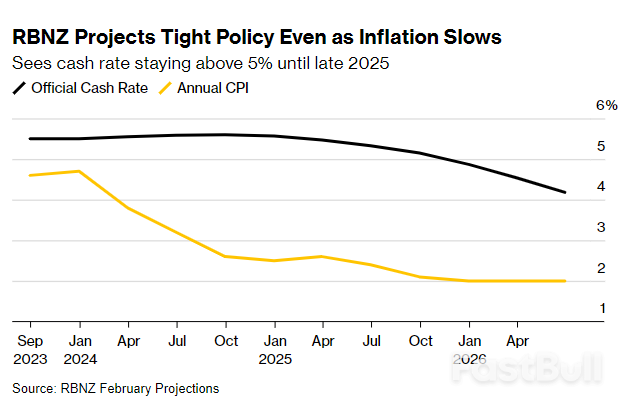
          The Reserve Bank will keep the Official Cash Rate at 5.5% for a sixth straight meeting Wednesday in Wellington, according to all 15 economists in a Bloomberg News survey. They expect policymakers to stress the need for rates to stay restrictive for a prolonged period to tame inflation.
          “Markets have taken a more aggressive view on the timing and extent of OCR cuts. Those expectations will be disappointed this time around,” said Kelly Eckhold, chief New Zealand economist at Westpac Banking Corp. in Auckland. “There is little to support the idea that interest rates can be cut much earlier than the RBNZ previously assumed.”
          The central bank in February projected it won’t start easing policy until 2025, citing concerns that record immigration will add to demand. Since then, data showed the economy slid back into recession in the second half of 2023, prompting investors to fully price in a pivot to rate cuts in the third quarter of this year.RBNZ Seen Pushing Back Against Bets On Early Interest-Rate Cuts_1
          The RBNZ will release Wednesday’s decision at 2 p.m. local time. It is a policy review rather than a full Monetary Policy Statement, so the bank won’t publish fresh economic forecasts or hold a news conference with Governor Adrian Orr.
          Most economists expect the first rate cut will occur in the fourth quarter, although some see one as early as August. Westpac and ANZ Bank don’t see cuts starting until early 2025.
          By contrast, investors are pricing two cuts and a 70% chance of a third before the end of this year, swaps data show.
          Central banks globally are focused on how quickly inflation is slowing and when they can begin easing. The Swiss National Bank unveiled a surprise rate cut last month — the first by a Group-of-10 central bank — while the Reserve Bank of Australia has indicated its next move is down. The Federal Reserve continues to signal as many as three cuts this year, although the start of any easing remains unclear.
          A Fed cut this year might allow the RBNZ to ease earlier than it projects by pushing up the New Zealand dollar and suppressing imported inflation, Chief Economist Paul Conway said last month.
          For now, inflation at 4.7% remains well above the RBNZ’s 1-3% target band and latest price indicators have been less benign than the RBNZ would like, said Stephen Toplis, head of research at Bank of New Zealand in Wellington.
          While there are also signs of “increasing economic distress,” suggesting a weaker growth outlook, “we do not believe there is sufficient evidence at this juncture for the bank to signal an earlier move” on rates, Toplis said. BNZ expects the first cut will occur in November.

          Source:Bloomberg

          To stay updated on all economic events of today, please check out our Economic calendar
          Risk Warnings and Disclaimers
          You understand and acknowledge that there is a high degree of risk involved in trading. Following any strategies or investment methods may lead to potential losses. The content on the site is provided by our contributors and analysts for information purposes only. You are solely responsible for determining whether any trading assets, securities, strategy, or any other product is suitable for investing based on your own investment objectives and financial situation.
          Add to Favorites
          Share

          Five Themes to Watch as Earnings Season Begins: ‘A Little Inflation in the System Isn’t A Bad Thing for Corporate Profits’

          Samantha Luan

          Economic

          Yes, the S&P 500 Index rose 10% from January to March. Strategists, however, predict that S&P 500 companies will post their smallest year-over-year profit growth since 2019, just 3.9%, in the first quarter, according to data compiled by Bloomberg Intelligence. But in this case the market may be onto something, because those forecasts could very well turn out to be overly gloomy — like they were in the fourth quarter, when expectations were for around 1% growth and the actual results turned out to be over 8%.
          “With traders anticipating interest-rate cuts by the Federal Reserve later this year, that will likely feed into even stronger consumer spending, economic activity and, in turn, better earnings growth and higher stock prices,” Wendy Soong, senior analyst at BI, said over the phone.
          Earnings season kicks into full swing Friday, with JPMorgan Chase & Co., Wells Fargo & Co. and Citigroup Inc. reporting. Other companies including BlackRock Inc. — world’s largest asset manager — and State Street Corp., along with Delta Air Lines Inc. will deliver results this week.
          Here’s a look at five key themes to watch:

          Concentrated Growth

          A resilient economy and strong consumer demand are expected to fuel a rise in earnings growth for S&P 500 companies for a second straight quarter following three straight quarters of profit contraction. And strong margins from big tech firms will likely be a key driver.
          Profits for the seven biggest growth companies in the S&P 500 — Apple Inc., Microsoft Corp., Alphabet Inc., Amazon.com Inc., Nvidia Corp., Meta Platforms Inc. and Tesla Inc. — are on course to rise 38% in the first quarter, according to Bloomberg Intelligence. When excluding them, the rest of the index’s profits are anticipated to shrink by 2%.
          Wall Street expects this trend to reverse as the year progresses. In the fourth quarter, those seven firms are expected to post earnings growth of 15% compared with 18% for the rest of the S&P 500, according to data compiled by David Kelly, chief global strategist at JPMorgan Asset Management.

          Raising Expectations

          Analysts have been raising their earnings forecasts faster than they are marking them down for previously unloved groups, from health care to utilities.
          In fact, seven of 11 sectors in the S&P 500 are poised to see profit growth accelerate over the next year. Utilities, financials and health care are the lead sectors when ranked by 25th-percentile earnings revisions, with energy, materials and communication services at the bottom, BI data show.

          Cash Hordes

          Corporate cash and free cash flow are at record high levels, setting the stage for a recovery in how the largest US companies deploy their capital, whether through payouts to stockholders or investing in expanding their businesses.
          Shareholder payouts rebounded in the fourth quarter for S&P 500 companies, and buybacks revived after four consecutive quarters of declines, BI data show. An increase in capital expenditures will depend on a rebound outside the heavy-spending technology sector, BI’s Soong said.

          Margins Improving

          Traders will be keeping a close eye on operating margins, a key gauge of profitability that historically offers a signal on where a company’s stock price is headed.
          The gap between rising consumer and producer prices has narrowed significantly over the past year thanks to corporate cost-cutting that drove profits higher, as well as an unexpected artificial intelligence boom. Analysts now see operating margins for the first quarter at 15%, with the worst of the pain in the rear-view mirror as forecasts improve in the coming quarters, data compiled by BI show.

          Sector Picking

          Traders aren’t expecting share prices to move in unison this earnings season. Differing inflation outlooks for S&P 500 sectors has left a gauge of expected one-month correlation in the index’s stocks hovering near its lowest since 2018, Bloomberg data show. A reading of 1 means securities will move in lockstep, it’s currently at 0.16.
          This comes as three of the 11 groups — communication services, technology and utilities — are expected to post profit expansions of more than 20%, while energy, materials and health-care companies will likely see profits shrink. Contrary to popular belief, moderate inflation historically has been good for earnings broadly because it promotes growth, lending and borrowing, according to Dan Eye, chief investment officer at Fort Pitt Capital Group.
          “Earnings are in nominal terms, so having a little inflation in the system isn’t a bad thing for corporate profits,” Eye said. “The stock market clearly sniffed that out in the first quarter, given the big rally.”

          Source: CFO Daily

          To stay updated on all economic events of today, please check out our Economic calendar
          Risk Warnings and Disclaimers
          You understand and acknowledge that there is a high degree of risk involved in trading. Following any strategies or investment methods may lead to potential losses. The content on the site is provided by our contributors and analysts for information purposes only. You are solely responsible for determining whether any trading assets, securities, strategy, or any other product is suitable for investing based on your own investment objectives and financial situation.
          Add to Favorites
          Share

          Gold Weekly Forecast: Gold Holds Up High As Geopolitical Tensions Outweigh USD Strength

          Alex

          Commodity

          Economic

          Gold price (XAU/USD) preserved its bullish momentum and registered strong gains in the first three days of the week. Following a short-lasting correction on Thursday, the pair regained its traction and touched a new record high above $2,300 on Friday. Next week’s inflation data from the US could significantly influence the market pricing of the Federal Reserve’s (Fed) interest rate outlook and drive Gold’s valuation.

          Gold rally picked up steam this week

          Gold gained traction at the weekly opening as trading conditions started to normalize following the long weekend. With investors reacting to the slightly softer-than-forecast Personal Consumption Expenditures (PCE) Price Index data that was released on Easter Friday, the US Dollar (USD) struggled to find demand on Monday and allowed XAU/USD to push higher. Later in the American session, the USD staged a rebound following the upbeat ISM Manufacturing PMI and limited Gold’s upside.
          In the absence of high-tier data releases, Gold extended its rally on Tuesday and gained over 1% on a daily basis. On Wednesday, the data from the US showed that the ISM Services PMI edged lower to 51.4 in March from 52.6 in February. More importantly, the Prices Paid Index, the inflation component of the survey, declined to 53.4 from 58.6, highlighting a softening in the service sector’s input inflation. As the USD came under renewed selling pressure after this report, XAU/USD closed the seventh consecutive day in positive territory.
          Gold continued to climb higher in the Asian session on Thursday and set a new all-time high of $2,305 before staging a technical correction and snapping its winning streak. Hawkish comments from Fed officials helped the USD stay resilient against its rivals and caused XAU/USD to reverse its direction in the second half of the day. Minneapolis Fed President Neel Kashkari noted that he projected two rate reductions in 2024 but said that now he wonders if the Fed should cut rates at all this year if inflation continues to move sideways. Moreover, Richmond Fed President Thomas Barkin noted that it's "hard to reconcile current breadth of inflation with the progress the Fed needs to see for rate cuts."
          The US Bureau of Labor Statistics (BLS) announced on Friday that Nonfarm Payrolls rose 303,000 in March. This reading followed the 270,000 increase (revised from 275,000) recorded in February and surpassed the market expectation of 200,000 by a wide margin. Other details of the jobs report showed that the Unemployment Rate edged lower to 3.8% from 3.9% in February while the annual wage inflation, as measured by the change in the Average Hourly Earnings, softened to 4.1% from 4.3% as projected. The USD held its ground after the upbeat labor market data but Gold ignored the USD strength and advanced beyond $2,310.
          Throughout this week, Gold’s usual inverse correlation with US Treasury bond yields weakened. Although the benchmark 10-year US Treasury bond yield climbed above 4.4% for the first time since November, Gold continued to stretch higher as it benefited from escalating geopolitical tensions.
          Iran pledged to retaliate against Israel after seven officers got killed in a suspected Israeli airstrike on the Iranian embassy compound in Syria earlier in the week, reviving fears over a deepening and prolonged conflict in the Middle East. Additionally, there is market speculation about China unloading US Treasury bond holdings to replace them with Gold. This could be a possible explanation for how Gold continued to gain value while US T-bond yields edged higher but it’s difficult to confirm or deny this theory due to a lack of available information. Chinese central bank does announce changes in its reserves but this data will be available around mid-May. World Gold Council reported on March 13 that the People’s Bank of China (PBoC) announced that Gold reserves had increased by 22 tonnes in February.

          Gold investors await US inflation data, watch geopolitics

          The US economic docket will not offer any high-tier data releases at the beginning of next week. On Wednesday, the BLS will publish the Consumer Price Index (CPI) data for March. On a monthly basis, the CPI and the core CPI are both forecast to rise 0.3%. In case the monthly core CPI rises at a stronger pace than forecast, the immediate reaction could boost the USD and trigger a downward correction in Gold. On the other hand, a print of 0.2% or lower could revive expectations for a June rate cut and hurt the USD.
          The BLS will release the Producer Price Index (PPI) data on Thursday. In the past, market participants paid little to no mind to producer inflation data. The previous couple of PPI releases, however, triggered big reactions. In February, the PPI rose 0.6% on a monthly basis. A similarly strong growth in monthly producer inflation could feed into expectations about consumer inflation remaining sticky and support the USD.
          On Thursday, the European Central Bank (ECB) will announce its monetary policy decisions. This event might not have a direct impact on Gold’s valuation. However, a dovish ECB stance could highlight the policy divergence between the Fed and drive capital outflows out of the Euro into the USD. In this scenario, the broad-based USD strength could make it difficult for XAU/USD to gain traction.
          In the Asian session on Friday, Trade Balance data from China, the world’s biggest consumer of Gold, will be watched closely by market participants. If this data points to an improving economic growth outlook in China, Gold could benefit from it.
          Investors will also keep a close eye on geopolitical developments and comments from Fed officials. A further escalation of tensions in the Middle East could support XAU/USD regardless of the USD’s overall performance.

          Gold technical outlook

          The Relative Strength Index (RSI) indicator on the daily chart stays well above 70, suggesting that Gold remains technically overbought in the near term. If XAU/USD fails to reach a new high and starts a technical correction, the Fibonacci 23.6% retracement of the February-April uptrend could be seen as the first bearish target at $2,230 ahead of $2,200 (20-day Simple Moving Average).
          It’s difficult to set bullish targets for Gold but buyers could remain interested as long as holds steady above $2,300. The upper limit of the ascending regression channel could act as resistance at $2,330.

          Source:Bloomberg

          To stay updated on all economic events of today, please check out our Economic calendar
          Risk Warnings and Disclaimers
          You understand and acknowledge that there is a high degree of risk involved in trading. Following any strategies or investment methods may lead to potential losses. The content on the site is provided by our contributors and analysts for information purposes only. You are solely responsible for determining whether any trading assets, securities, strategy, or any other product is suitable for investing based on your own investment objectives and financial situation.
          Add to Favorites
          Share

          Global Market Quick Take: Asia – April 8, 2024

          SAXO

          Economic

          Equities

          US stocks shrugged off the higher bond yields triggered by a strong job report and chose instead to focus on the resilience of the economy’s positive implications on corporate earnings. The S&P 500 staged a broad-based rally with all of its 11 sectors finishing 1.1% higher at 5,204 on Friday, led by communication services, industrials and information technology. GE surged 6.1%, topping the performance of the S&P 500. The tech-heavy Nasdaq 100 gained 1.3%. Tesla shed 3.6% following a Reuters report that Tesla has scrapped its plan to make low-cost EVs while focusing on developing robotaxis.
          In Japan, the Nikkei 225 plummeted 2% to 38,992 as investors trimmed positions amid rising tensions in the Middle East that saw oil prices higher and stirring up risk-off sentiments, coupled with cautious corporate earnings forecasts. The mainland Chinese markets remained closed for a holiday while Hong Kong’s Hang Seng Index finished nearly unchanged in a lackluster session.
          On April 8, Shimao Group announced that China Constructtion Bank (Asia) filed a winding-up petition at the High Court of the Hong Kong SAR against the company.

          FX

          The reaction of the FX markets to the hot US jobs report was short-lived, as the dollar’s jump to 104.70 was erased quickly. Dollar ended the week marginally lower despite hawkish Fedspeak and US exceptionalism in the week, signaling that much of the hawkishness may have been priced in for now. NOK was the G10 outperformer for the week, as USDNOK slid below 10.8 on oil price gains. Sharp jump in Treasury yields however saw Japanese yen weakening again, and USDJPY remains in the intervention threat zone of 151.50+. USDCAD rose above resistance at 1.3615 to its YTD lows amid a soft Canadian jobs report where unemployment rate rose to 6.1% from 5.9%. EURUSD supported at 1.08 for now and GBPUSD stays above 1.26.

          Commodities

          Oil prices pushed lower at the start of the new week in Asia after Brent touched $92/barrel levels on Friday and closed at its highest levels in over five months. Geopolitical tensions have underpinned gains recently, but Iran risks remained in check over the weekend and reports are suggesting that talks of a ceasefire in Mideast are progressing. Gold also retreated from post-NFP highs of $2,330 as geopolitical premium was being taken off, and Silver followed after 10% gains last week. Copper prices also turning lower as the week begins and focus will be on China’s return from holidays and their yuan fixing.

          Fixed income

          Strong gains in employment in both the non-farm payroll establishment survey and the household survey, a decline in the unemployment rate, and a rebound in the workweek all pointed to a robust US labour market. As a result, Treasuries sold off across the yield curve. The 2-year yield finished 10bps higher at 4.75% and the 10-year yield added 9bps to settle at 4.40%. Investors’ focus is turning to the CPI inflation data and the FOMC minutes on Wednesday. Core-CPI is expected to dip modestly to 0.3% M/M from 0.4% and 3.7% Y/Y from 3.8%. Regarding the FOMC minutes, investors will scrutinize the discussion on a potential slowing down of the runoff of the Fed’s securities holdings, or quantitative tightening. Given Powell's repeated use of the phrase 'fairly soon' in the latest post-FOMC press conference, it's probable that the Fed will announce a reduction in the pace of balance sheet runoff during the May 1 FOMC meeting, with implementation expected to begin in June.

          Macro

          US jobs report was hot once again. Headline NFP added 303k jobs in March, above the 200k forecast, the 270k prior. The unemployment rate eased to 3.8% from 3.9%, despite expectations for it to be left unchanged while the labour force participation rate rose to 62.7% from 62.5%. While the report once again shows that US economy remains resilient in the face of high interest rates, focus shifts to US CPI release this week which will be a bigger test of whether the recent inflation bump is a trend or not.
          Fedspeak tilted generally hawkish with Bowman saying that it is not yet time for the US to consider cutting rates, while Barkin said the March NFP was very strong. Logan (non-voter) said it is too soon to think about cutting rates, given upside risks to inflation. Markets are now expecting less than three rate cuts this year and the odds of a July rate cut are lower at 91%.
          China’s PBOC announced that the central bank will provide RMB 500 billion in loans to banks at a preferential rate of 1.75%. These loans are intended for banks to extend 1-year credits to industries, supporting technological innovation and enhancing industrial capabilities.
          During the three-day Qingming Festival holiday, China's domestic tourist travels reached 119 million, marking an 11.5% increase from the same period in 2019. Domestic tourism spending rose to RMB 54 billion, reflecting a 12.7% growth compared to the same period in 2019. In other words, spending per person/trip surpassed the pre-pandemic level.
          US Treasury Secretary Janet Yellen voiced concerns in Beijing about China exporting overcapacity in new energy vehicles and solar modules to the U.S. Expectations are for further contention between the two countries in these industries in the coming months, as trade and national security become focal points in the upcoming US presidential and congressional elections.
          The People’s Bank of China increased its gold holding to 72.74 million troy ounces in March in its 17th consecutive month of buying.
          To stay updated on all economic events of today, please check out our Economic calendar
          Risk Warnings and Disclaimers
          You understand and acknowledge that there is a high degree of risk involved in trading. Following any strategies or investment methods may lead to potential losses. The content on the site is provided by our contributors and analysts for information purposes only. You are solely responsible for determining whether any trading assets, securities, strategy, or any other product is suitable for investing based on your own investment objectives and financial situation.
          Add to Favorites
          Share

          Asia Stocks Hesitant, Dollar Firms As US Payrolls Dent Fed Rate Cut Wagers

          Kevin Du

          Economic

          Stocks

          Oil prices fell nearly 2% as Middle East tensions eased after Israel withdrew more soldiers from southern Gaza, while gold prices slumped 1% after scaling record high on Friday as U.S. Treasury yields remain elevated.
          MSCI's broadest index of Asia-Pacific shares outside Japan was 0.26% higher, while Tokyo's Nikkei rose 1%.
          China mainland stocks reopened after extended holidays from Thursday, with the blue-chip gauge 0.5% lower. Hong Kong's Hang Seng Index rose 0.33%.
          Wall Street's main indexes closed higher on Friday after data showed U.S. job growth blew past expectations in March and wages increased at a steady clip, suggesting the economy ended the first quarter on solid ground.
          "Resilient economic data are a double-edged sword for markets," said ANZ strategists in a note. "On the positive side, resilient growth indicates an economy far from recession, but it could also mean the Fed will keep rates higher for longer."
          Markets are now pricing in 49.1% chance of an interest rate cut from the Fed in June, the CME FedWatch tool showed, with July shaping up to be the new starting point for the eagerly awaited easing cycle.
          Investors are also pricing in 62 basis points of cuts this year, less than the 75 basis points the Fed has projected.
          Investor focus this week will be squarely on the U.S. consumer price index (CPI) report, which is expected to show core inflation slowing to 3.7% in March from 3.8% the prior month.
          The expected slip in core inflation is unlikely to bring back a possible June cut after last week’s solid data dented that chance, according to Kit Juckes, FX strategist at Societe Generale.
          "Market expectations are drifting in favour of a cut in July rather than June and it’s easy to see why."
          The changing expectations on the outlook for U.S. rates have lifted Treasury yields, with the two-year Treasury yield, which typically moves in step with interest rate expectations, up 4.2 basis points at 4.774%, the highest in nearly four months.
          The yield on 10-year Treasury notes was up 4.4 basis points to 4.422%.
          The elevated yields boosted the dollar, with the euro down 0.06% to $1.0829, while sterling was last trading at $1.2622, down 0.11% on the day.
          The Japanese yen weakened 0.12% to 151.78 per dollar as traders remain on alert for possible intervention by Japanese authorities.
          Nicholas Chia, Asia macro strategist at Standard Chartered, said the yen will be vulnerable to a materially strong U.S. CPI report, with "intervention speak likely to be back on the agenda."
          The dollar index, which measures the U.S. currency against six rivals, was at 104.35.
          The European Central Bank is due to meet later this week and is widely expected to keep rates steady. Investors see almost no chance of a cut on April 11 but have fully priced in a move for June, followed by another two or three steps later this year.
          In commodities, spot gold dropped 0.5% to $2,317.09 an ounce, having breached record peak last week.
          U.S. crude fell 2.32% to $84.89 per barrel and Brent was at $88.89, down 2.5% on the day.
          Israel and Hamas sent teams to Egypt for fresh talks on a potential ceasefire ahead of the Eid holidays, easing tensions in the Middle East that drove up oil prices by more than 4% last week on concerns of supply disruption.

          Source: Reuters

          To stay updated on all economic events of today, please check out our Economic calendar
          Risk Warnings and Disclaimers
          You understand and acknowledge that there is a high degree of risk involved in trading. Following any strategies or investment methods may lead to potential losses. The content on the site is provided by our contributors and analysts for information purposes only. You are solely responsible for determining whether any trading assets, securities, strategy, or any other product is suitable for investing based on your own investment objectives and financial situation.
          Add to Favorites
          Share
          FastBull
          Copyright © 2025 FastBull Ltd

          728 RM B 7/F GEE LOK IND BLDG NO 34 HUNG TO RD KWUN TONG KLN HONG KONG

          TelegramInstagramTwitterfacebooklinkedin
          App Store Google Play Google Play
          Products
          Charts

          Chats

          Q&A with Experts
          Screeners
          Economic Calendar
          Data
          Tools
          Membership
          Features
          Function
          Markets
          Copy Trading
          Latest Signals
          Contests
          News
          Analysis
          24/7
          Columns
          Education
          Company
          Careers
          About Us
          Contact Us
          Advertising
          Help Center
          Feedback
          User Agreement
          Privacy Policy
          Business

          White Label

          Data API

          Web Plug-ins

          Poster Maker

          Affiliate Program

          Risk Disclosure

          The risk of loss in trading financial instruments such as stocks, FX, commodities, futures, bonds, ETFs and crypto can be substantial. You may sustain a total loss of the funds that you deposit with your broker. Therefore, you should carefully consider whether such trading is suitable for you in light of your circumstances and financial resources.

          No decision to invest should be made without thoroughly conducting due diligence by yourself or consulting with your financial advisors. Our web content might not suit you since we don't know your financial conditions and investment needs. Our financial information might have latency or contain inaccuracy, so you should be fully responsible for any of your trading and investment decisions. The company will not be responsible for your capital loss.

          Without getting permission from the website, you are not allowed to copy the website's graphics, texts, or trademarks. Intellectual property rights in the content or data incorporated into this website belong to its providers and exchange merchants.

          Not Logged In

          Log in to access more features

          FastBull Membership

          Not yet

          Purchase

          Become a signal provider
          Help Center
          Customer Service
          Dark Mode
          Price Up/Down Colors

          Log In

          Sign Up

          Position
          Layout
          Fullscreen
          Default to Chart
          The chart page opens by default when you visit fastbull.com