• Trade
  • Markets
  • Copy
  • Contests
  • News
  • 24/7
  • Calendar
  • Q&A
  • Chats
Trending
Screeners
SYMBOL
LAST
BID
ASK
HIGH
LOW
NET CHG.
%CHG.
SPREAD
SPX
S&P 500 Index
6827.42
6827.42
6827.42
6899.86
6801.80
-73.58
-1.07%
--
DJI
Dow Jones Industrial Average
48458.04
48458.04
48458.04
48886.86
48334.10
-245.98
-0.51%
--
IXIC
NASDAQ Composite Index
23195.16
23195.16
23195.16
23554.89
23094.51
-398.69
-1.69%
--
USDX
US Dollar Index
97.950
98.030
97.950
98.500
97.950
-0.370
-0.38%
--
EURUSD
Euro / US Dollar
1.17394
1.17409
1.17394
1.17496
1.17192
+0.00011
+ 0.01%
--
GBPUSD
Pound Sterling / US Dollar
1.33707
1.33732
1.33707
1.33997
1.33419
-0.00148
-0.11%
--
XAUUSD
Gold / US Dollar
4299.39
4299.39
4299.39
4353.41
4257.10
+20.10
+ 0.47%
--
WTI
Light Sweet Crude Oil
57.233
57.485
57.233
58.011
56.969
-0.408
-0.71%
--

Community Accounts

Signal Accounts
--
Profit Accounts
--
Loss Accounts
--
View More

Become a signal provider

Sell trading signals to earn additional income

View More

Guide to Copy Trading

Get started with ease and confidence

View More

Signal Accounts for Members

All Signal Accounts

Best Return
  • Best Return
  • Best P/L
  • Best MDD
Past 1W
  • Past 1W
  • Past 1M
  • Past 1Y

All Contests

  • All
  • Trump Updates
  • Recommend
  • Stocks
  • Cryptocurrencies
  • Central Banks
  • Featured News
Top News Only
Share

Israel Says It Kills Senior Hamas Commander Raed Saed In Gaza

Share

Ukraine's Navy Says Russian Drone Attack Hit Civilian Turkish Vessel Carrying Sunflower Oil To Egypt On Saturday

Share

Israeli Military Says It Put Planned Strike On South Lebanon Site On Hold After Lebanese Army Requested Access

Share

Norwegian Nobel Committee: Calls On The Belarusian Authorities To Release All Political Prisoners

Share

Norwegian Nobel Committee: His Freedom Is A Deeply Welcome And Long-Awaited Moment

Share

Ukraine Says It Received 114 Prisoners From Belarus

Share

USA Embassy In Lithuania: Maria Kalesnikava Is Not Going To Vilnius

Share

USA Embassy In Lithuania: Other Prisoners Are Being Sent From Belarus To Ukraine

Share

Ukraine President Zelenskiy: Five Ukrainians Released By Belarus In US-Brokered Deal

Share

USA Vilnius Embassy: USA Stands Ready For "Additional Engagement With Belarus That Advances USA Interests"

Share

USA Vilnius Embassy: Belarus, USA, Other Citizens Among The Prisoners Released Into Lithuania

Share

USA Vilnius Embassy: USA Will Continue Diplomatic Efforts To Free The Remaining Political Prisoners In Belarus

Share

USA Vilnius Embassy: Belarus Releases 123 Prisoners Following Meeting Of President Trump's Envoy Coale And Belarus President Lukashenko

Share

USA Vilnius Embassy: Masatoshi Nakanishi, Aliaksandr Syrytsa Are Among The Prisoners Released By Belarus

Share

USA Vilnius Embassy: Maria Kalesnikava And Viktor Babaryka Are Among The Prisoners Released By Belarus

Share

USA Vilnius Embassy: Nobel Peace Prize Laureate Ales Bialiatski Is Among The Prisoners Released By Belarus

Share

Belarusian Presidential Administration Telegram Channel: Lukashenko Has Pardoned 123 Prisoners As Part Of Deal With US

Share

Two Local Syrian Officials: Joint US-Syrian Military Patrol In Central Syria Came Under Fire From Unknown Assailants

Share

Israeli Military Says It Targeted 'Key Hamas Terrorist' In Gaza City

Share

Rwanda's Actions In Eastern Drc Are A Clear Violation Of Washington Accords Signed By President Trump - Secretary Of State Rubio

TIME
ACT
FCST
PREV
U.K. Trade Balance Non-EU (SA) (Oct)

A:--

F: --

P: --

U.K. Trade Balance (Oct)

A:--

F: --

P: --

U.K. Services Index MoM

A:--

F: --

P: --

U.K. Construction Output MoM (SA) (Oct)

A:--

F: --

P: --

U.K. Industrial Output YoY (Oct)

A:--

F: --

P: --

U.K. Trade Balance (SA) (Oct)

A:--

F: --

P: --

U.K. Trade Balance EU (SA) (Oct)

A:--

F: --

P: --

U.K. Manufacturing Output YoY (Oct)

A:--

F: --

P: --

U.K. GDP MoM (Oct)

A:--

F: --

P: --

U.K. GDP YoY (SA) (Oct)

A:--

F: --

P: --

U.K. Industrial Output MoM (Oct)

A:--

F: --

P: --

U.K. Construction Output YoY (Oct)

A:--

F: --

P: --

France HICP Final MoM (Nov)

A:--

F: --

P: --

China, Mainland Outstanding Loans Growth YoY (Nov)

A:--

F: --

P: --

China, Mainland M2 Money Supply YoY (Nov)

A:--

F: --

P: --

China, Mainland M0 Money Supply YoY (Nov)

A:--

F: --

P: --

China, Mainland M1 Money Supply YoY (Nov)

A:--

F: --

P: --

India CPI YoY (Nov)

A:--

F: --

P: --

India Deposit Gowth YoY

A:--

F: --

P: --

Brazil Services Growth YoY (Oct)

A:--

F: --

P: --

Mexico Industrial Output YoY (Oct)

A:--

F: --

P: --

Russia Trade Balance (Oct)

A:--

F: --

P: --

Philadelphia Fed President Henry Paulson delivers a speech
Canada Building Permits MoM (SA) (Oct)

A:--

F: --

P: --

Canada Wholesale Sales YoY (Oct)

A:--

F: --

P: --

Canada Wholesale Inventory MoM (Oct)

A:--

F: --

P: --

Canada Wholesale Inventory YoY (Oct)

A:--

F: --

P: --

Canada Wholesale Sales MoM (SA) (Oct)

A:--

F: --

P: --

Germany Current Account (Not SA) (Oct)

A:--

F: --

P: --

U.S. Weekly Total Rig Count

A:--

F: --

P: --

U.S. Weekly Total Oil Rig Count

A:--

F: --

P: --

Japan Tankan Large Non-Manufacturing Diffusion Index (Q4)

--

F: --

P: --

Japan Tankan Small Manufacturing Outlook Index (Q4)

--

F: --

P: --

Japan Tankan Large Non-Manufacturing Outlook Index (Q4)

--

F: --

P: --

Japan Tankan Large Manufacturing Outlook Index (Q4)

--

F: --

P: --

Japan Tankan Small Manufacturing Diffusion Index (Q4)

--

F: --

P: --

Japan Tankan Large Manufacturing Diffusion Index (Q4)

--

F: --

P: --

Japan Tankan Large-Enterprise Capital Expenditure YoY (Q4)

--

F: --

P: --

U.K. Rightmove House Price Index YoY (Dec)

--

F: --

P: --

China, Mainland Industrial Output YoY (YTD) (Nov)

--

F: --

P: --

China, Mainland Urban Area Unemployment Rate (Nov)

--

F: --

P: --

Saudi Arabia CPI YoY (Nov)

--

F: --

P: --

Euro Zone Industrial Output YoY (Oct)

--

F: --

P: --

Euro Zone Industrial Output MoM (Oct)

--

F: --

P: --

Canada Existing Home Sales MoM (Nov)

--

F: --

P: --

Euro Zone Total Reserve Assets (Nov)

--

F: --

P: --

U.K. Inflation Rate Expectations

--

F: --

P: --

Canada National Economic Confidence Index

--

F: --

P: --

Canada New Housing Starts (Nov)

--

F: --

P: --

U.S. NY Fed Manufacturing Employment Index (Dec)

--

F: --

P: --

U.S. NY Fed Manufacturing Index (Dec)

--

F: --

P: --

Canada Core CPI YoY (Nov)

--

F: --

P: --

Canada Manufacturing Unfilled Orders MoM (Oct)

--

F: --

P: --

Canada Manufacturing New Orders MoM (Oct)

--

F: --

P: --

Canada Core CPI MoM (Nov)

--

F: --

P: --

Canada Manufacturing Inventory MoM (Oct)

--

F: --

P: --

Canada CPI YoY (Nov)

--

F: --

P: --

Canada CPI MoM (Nov)

--

F: --

P: --

Canada CPI YoY (SA) (Nov)

--

F: --

P: --

Canada Core CPI MoM (SA) (Nov)

--

F: --

P: --

Q&A with Experts
    • All
    • Chatrooms
    • Groups
    • Friends
    Connecting
    .
    .
    .
    Type here...
    Add Symbol or Code

      No matching data

      All
      Trump Updates
      Recommend
      Stocks
      Cryptocurrencies
      Central Banks
      Featured News
      • All
      • Russia-Ukraine Conflict
      • Middle East Flashpoint
      • All
      • Russia-Ukraine Conflict
      • Middle East Flashpoint
      Search
      Products

      Charts Free Forever

      Chats Q&A with Experts
      Screeners Economic Calendar Data Tools
      Membership Features
      Data Warehouse Market Trends Institutional Data Policy Rates Macro

      Market Trends

      Market Sentiment Order Book Forex Correlations

      Top Indicators

      Charts Free Forever
      Markets

      News

      News Analysis 24/7 Columns Education
      From Institutions From Analysts
      Topics Columnists

      Latest Views

      Latest Views

      Trending Topics

      Top Columnists

      Latest Update

      Signals

      Copy Rankings Latest Signals Become a signal provider AI Rating
      Contests
      Brokers

      Overview Brokers Assessment Rankings Regulators News Claims
      Broker listing Forex Brokers Comparison Tool Live Spread Comparison Scam
      Q&A Complaint Scam Alert Videos Tips to Detect Scam
      More

      Business
      Events
      Careers About Us Advertising Help Center

      White Label

      Data API

      Web Plug-ins

      Affiliate Program

      Awards Institution Evaluation IB Seminar Salon Event Exhibition
      Vietnam Thailand Singapore Dubai
      Fans Party Investment Sharing Session
      FastBull Summit BrokersView Expo
      Recent Searches
        Top Searches
          Markets
          News
          Analysis
          User
          24/7
          Economic Calendar
          Education
          Data
          • Names
          • Latest
          • Prev

          View All

          No data

          Scan to Download

          Faster Charts, Chat Faster!

          Download App
          English
          • English
          • Español
          • العربية
          • Bahasa Indonesia
          • Bahasa Melayu
          • Tiếng Việt
          • ภาษาไทย
          • Français
          • Italiano
          • Türkçe
          • Русский язык
          • 简中
          • 繁中
          Open Account
          Search
          Products
          Charts Free Forever
          Markets
          News
          Signals

          Copy Rankings Latest Signals Become a signal provider AI Rating
          Contests
          Brokers

          Overview Brokers Assessment Rankings Regulators News Claims
          Broker listing Forex Brokers Comparison Tool Live Spread Comparison Scam
          Q&A Complaint Scam Alert Videos Tips to Detect Scam
          More

          Business
          Events
          Careers About Us Advertising Help Center

          White Label

          Data API

          Web Plug-ins

          Affiliate Program

          Awards Institution Evaluation IB Seminar Salon Event Exhibition
          Vietnam Thailand Singapore Dubai
          Fans Party Investment Sharing Session
          FastBull Summit BrokersView Expo

          China Lithium Boom Slows As Sagging Prices Batter High-Cost Miners

          Thomas

          Commodity

          Energy

          Summary:

          Global lithium prices down over 80% in past 12 months. Analysts expect mining of lepidolite in China to be hit. Almost half of China's lithium output in 2023 came from lepidolite, Fastmarkets says.

          A slump in the price of lithium, a key raw material in electric car batteries, is dragging on China's mining of the ultralight metal which together with a costly extraction process is prompting a reassessment of output growth and new project plans.
          Softening EV demand has knocked down global lithium prices, with a basket tracked by Benchmark Mineral Intelligence plunging more than 80% in the past 12 months. That has already forced many producers worldwide to shutter production and cut jobs.
          In China, which accounted for about a quarter of the world's mined lithium output in 2023, analysts expect the mining of lepidolite - a hard rock ore that is relatively expensive for producing lithium - to take a hit as a prolonged price slump makes costly production unsustainable.
          "Lepidolite mining and new projects in China and worldwide are taking a big hit from prices, while other types of lithium mines that provide some relative cost advantages, especially brines in South America, will keep on a fast-growing pace," said Susan Zou, a vice president at Rystad Energy.
          The consultancy has slashed its forecast for China's mined lithium output growth in 2024 to about 12% from 54% previously, mainly due to the lepidolite slowdown. Globally, it now expects 27% growth in mined lithium output, down from 42% previously.
          Almost half of China's lithium output in 2023 came from lepidolite, pricing agency Fastmarkets said, adding volumes of the ore more than doubled over the past two years to 114,500 metric tons of lithium carbonate equivalent (LCE).
          It costs about 80,000 yuan ($11,120) to 120,000 yuan to process a ton of LCE from lepidolite in China, while it costs around 40,000 yuan and 60,000 yuan to get the same volume from brine deposits and spodumene, respectively, analysts say.
          That undermines the economics of lepidolite mining in China, where softer EV demand and a supply glut have pushed down spot lithium carbonate prices to around 100,000 yuan from peaks near 600,000 yuan in November 2022.
          Five China-based analysts forecast spot prices will stay in the 100,000 yuan to 120,000 yuan range in 2024 or rise slightly higher, despite a futures rally boosted by restocking demand after the Lunar New Year holiday.
          'MARKET IS REALLY BAD'
          China ranks fourth in lithium reserves. Beijing has been pushing for more investment to ramp up mining to meet demand from the battery sector and to cut its reliance on imports.
          Much of that investment has been in the southern province of Jiangxi, home to some of the newest lepidolite projects that are rich in kaolinite, a clay mineral with lower lithium content that costs around 120,000 yuan per ton of LCE to produce, according to research firm CRU.
          Such projects include EV battery giant CATL's vast new Jianxiawo mine and Yongxing Special Materials Technology's Huashan mine.
          CATL won exploration rights for Jianxiawo in April 2022 with a bid of 865 million yuan, according to the government of Yichun, the provincial mining hub.
          "Projects including the Jianxiawo mine are facing negative margins and very high risk of production curtailment," said Yin Yiwei, a senior CRU analyst.
          CATL and Yongxing did not immediately respond to emails seeking comment.
          Market speculation that CATL had suspended production at Jianxiawo sparked a rally in shares of Australian miners last month, but CATL said at the time that operations were normal.
          "The market is really bad. Producers in Yichun are trying to survive with higher costs and poor prices," said a mining expert working for a major company in Yichun.
          A survey of 11 Jiangxi lithium carbonate producers published by Mysteel on Feb. 28 found widespread production suspensions in February.
          Yan Yun, secretary of the Yichun committee of China's ruling Communist Party, acknowledged the city's lithium battery sector had been hit by falling prices and a supply-demand mismatch.
          "But we still believe the industry has great prospects," he told the official Jiangxi Daily, as the global auto industry moves towards an electric future.
          Li Liangbin, chairman of Ganfeng Lithium, a major Chinese miner that produces mostly from spodumene, sees a role for lepidolite.
          "Lepidolite, due to its relatively high costs and large volumes, is a flexible variable and can help keep supply, demand and lithium prices balanced," he said.

          Source: Reuters

          Risk Warnings and Disclaimers
          You understand and acknowledge that there is a high degree of risk involved in trading. Following any strategies or investment methods may lead to potential losses. The content on the site is provided by our contributors and analysts for information purposes only. You are solely responsible for determining whether any trading assets, securities, strategy, or any other product is suitable for investing based on your own investment objectives and financial situation.
          Add to Favorites
          Share

          In Wage Growth the BoJ Hopes

          Westpac

          Economic

          Central Bank

          The Bank of Japan and financial markets are eagerly awaiting the Shunto wage decision for Japan's largest trade confederation RENGO, which is due in. In our view, the result will likely be more of a reflection of near-term cyclicality than structural strength in the economy. It is therefore unlikely to justify a material policy shift by the Bank of Japan (BoJ).
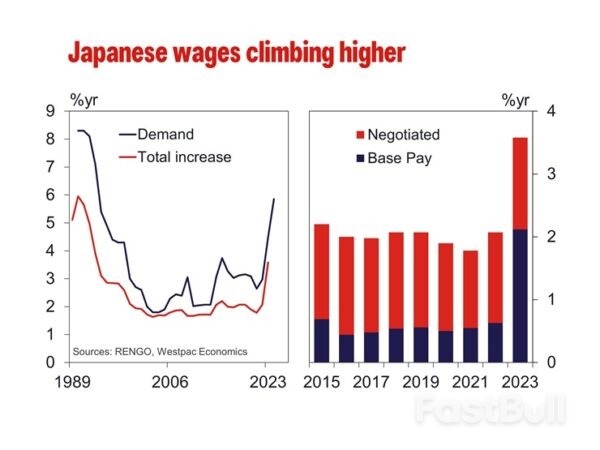
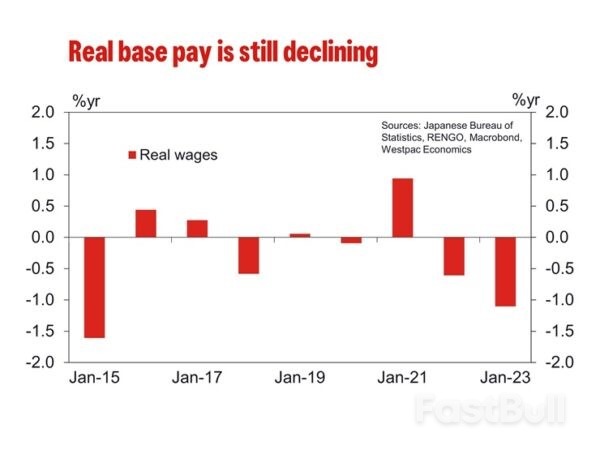
          Japan's recent strong wage growth reflects the lagged effect of cyclical momentum in the economy. RENGO wages rose 3.6% in 2023 after averaging 2% between 2014 and 2022. Base pay, which goes to all employees, rose 2% trumping the average 0.6% rise since 2015. In justifying their decision, RENGO drew attention to higher cost of living. Inflation rose 4% through 2022, well above the 0.5%yr average between 2010 and 2019. Inflation subsequently eased to 2.6%yr during 2023, following the global disinflationary pulse, and is expected to ease further hence.
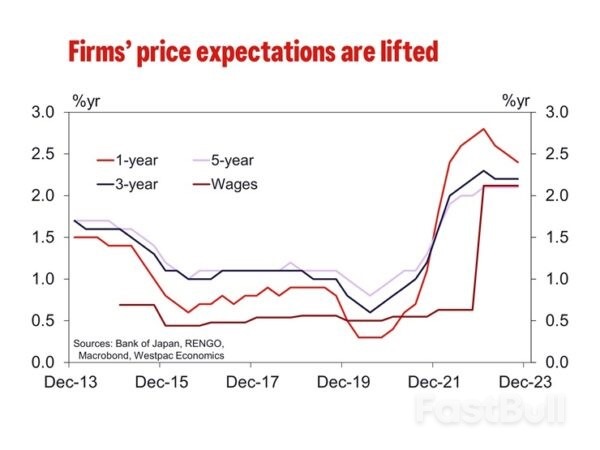
          In Wage Growth the BoJ Hopes_1As of 2023 Q4, the inflation outlook for 1, 3 and 5 years came to 2.4%, 2.2% and 2.1% respectively. While still above the circa 1% average for all three time periods 2014 to 2019, it is also materially below where inflation has been. Still-elevated current inflation expectations may support wage growth in the near-term, but this effect looks set to dissipate as actual inflation prints come in weaker.
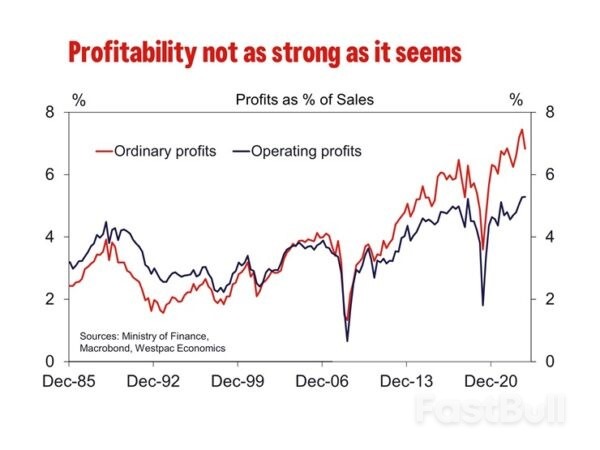
          In Wage Growth the BoJ Hopes_2Rising profitability has also been used to argue for stronger wage growth in 2024 with a focus on strength in ordinary profits. However, operating profits are only slightly above the pre-COVID peak and below the 10-year pre-COVID trend. Operating profit as a share of sales are also relatively unimpressive, hovering around pre-COVID rates. The disparity between operating profits, which do not include investment-related income, and ordinary profits implies profitability is being flattered by financial investment returns not firms' underlying profitability. It is only the latter that would given businesses confidence to increase wages at or above the rate of inflation.
          In Wage Growth the BoJ Hopes_3Rather than being a support for wage growth, beyond 2024, we expect structural factors to act at a headwind for sustained wages growth. In Japan, wage increases depend on seniority, so job mobility is low and companies typically find it unnecessary to raise wages to retain staff. This also disincentivises employees from reskilling or making career changes into higher growth areas. In 2016, then Govenor Kuroda outlined low job mobility as a key challenge for the labour market and the country's growth potential.
          In Wage Growth the BoJ Hopes_4Further, participation has recently been rising thanks to a growing cohort of part-time workers, primarily women and those aged 65 and above. Wage growth is slower for part time workers, and the loss of tax and social benefits for secondary income earners dissaude many from labour market and the country's growth potential.
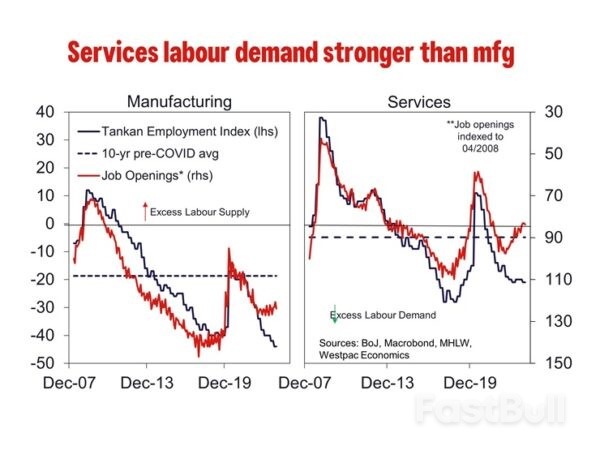
          While some large companies such as Suntory and Nomura have publicly committed to raising salaries by 7-16%, many others will hold back believing the labour they will require will remain available. According to the Tankan survey, firms are reporting labour shortages as less severe than pre-COVID in manufacturing; while shortages in services persist to what was seen in the early 1990s. The number of new job openings in the services sector are also settling below the pre-COVID peak while new openings in manufacturing continue to decline. Part of this reflects a structural decline in manufacturing jobs, with south-east Asia providing attractive alternative locations for facilities and automation also limiting labour demand. Given manufacturing employs around 15% of the labour force, weaker demand will act as a drag on aggregate wages. This points to a softening labour market overall but also diverging outcomes for services and manufacturing.
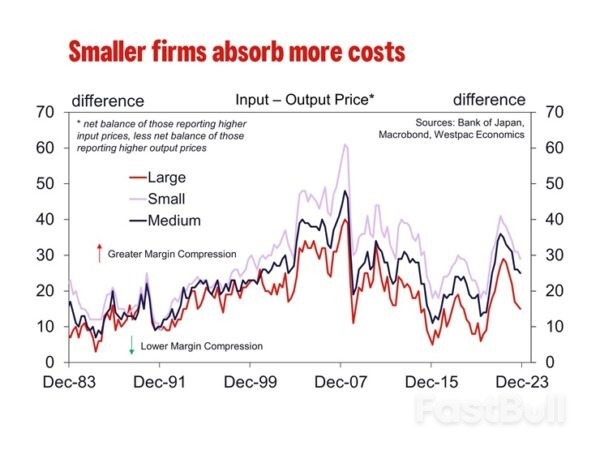
          In Wage Growth the BoJ Hopes_5Small businesses have been particularly unenthusiastic about raising wages. As an example, a survey completed by Johnan Shinkin Bank and the Tokyo Shimbun daily reported 72.8% of small and medium-sized businesses in the Tokyo metropolitan area said they ” have no plans to raise wages this year”. Smaller employers tend to make up the bulk of employers and so can have a significant effect on aggregate outcomes. Their reluctance is arguably principally due to an inability to pass on higher costs to consumers, particularly when households are price sensitive as they are now, but also as they are much less able to scale up and therefore benefit from efficiency and large markets.
          In Wage Growth the BoJ Hopes_6One segment of the labour market that is showing increasing wages is younger Japanese workers. They are more likely to have in demand skills, particularly for high-skill work, and are also more likely to job hop being early in their careers. As such, wage gains are thought to be skewed towards younger workers. BoJ research also shows that wages for high skill workers are increasing. However given Japan's ageing population and weak immigration program, young people make up a small fraction of the labour force, so wage gains in this cohort is unlikely to drive aggregate wage gains or consumption.
          Looking beyond 2024, both cyclical and structural factors are likely to limit wage gains and thereby keep a lid on domestic inflation pressures. While the second estimate for GDP has revised away recession, the economy remains weak and at risk of global developments. All this points to an absence of demand-side inflation pressures necessary to justify a tightening cycle of scale. While the BoJ can likely justify the end of negative rates in coming months, moving the policy materially above zero is unwarranted and potentially a decision that would put at risk all the work undertaken in recent years to aim to achieve the inflation target on a sustainable basis. All considered, the shunto wage outcome is unlikely to be the opportunity markets are hoping for a generational change in monetary policy.
          To stay updated on all economic events of today, please check out our Economic calendar
          Risk Warnings and Disclaimers
          You understand and acknowledge that there is a high degree of risk involved in trading. Following any strategies or investment methods may lead to potential losses. The content on the site is provided by our contributors and analysts for information purposes only. You are solely responsible for determining whether any trading assets, securities, strategy, or any other product is suitable for investing based on your own investment objectives and financial situation.
          Add to Favorites
          Share

          Global Market Quick Take: Asia – March 14, 2024

          SAXO

          Economic

          Global Market Quick Take: Asia – March 14, 2024_1

          US Equities

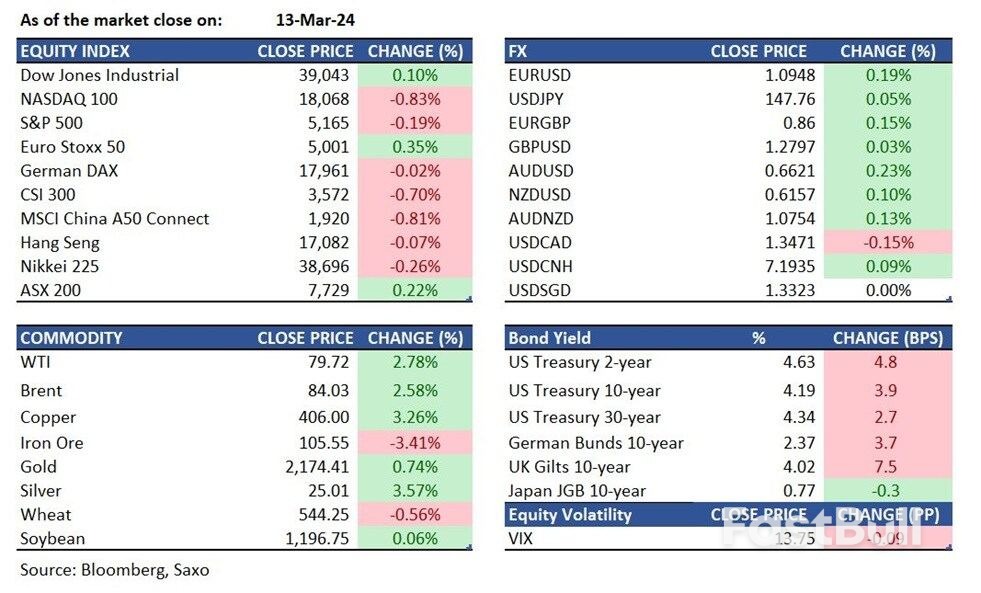
          Copper mining and energy stocks saw gains driven by increases in copper and oil prices. Freeport-McMoRan notably surged by 7.6%, while Valero Energy, Marathon Petroleum, and Marathon Oil each added 3% to 5%. However, the Nasdaq 100 and S&P 500 experienced pullbacks of 0.8% and 0.2%, respectively, partly due to a retreat in chipmaker stocks. Nvidia slid 1.1%, while AMD, Intel, Micron, On Semiconductor, and Marvell Technology all saw declines ranging from 3% to 5%. Additionally, Tesla declined by 4.5% following an analyst downgrade to underweight, citing projections of zero volume growth in 2024 and a volume decrease in 2025. Dollar Tree, a discount store operator, plummeted by 14.2% due to EPS guidance falling below estimates, a pessimistic outlook for 2024, and plans to close 1,000 stores. McDonald’s also experienced a decline of 3.9%, attributing it to lower-income customers opting to eat at home more frequently.

          Hong Kong/China Equities

          Stocks in Hong Kong managed to hold on to recent gains, with the Hang Seng Index ticking down modestly by 0.1% while the Hang Seng Tech Index added another 0.3%. Mining stocks outperformed, led by CMOC, Zijing Mining, MMG, and Jiangxi Copper. Chinese developers retreated as Country Garden missed an onshore bond coupon payment. In the mainland, CSI300 slid 0.7%, dragged down by real estate, non-bank financials, and construction materials.

          Fixed income

          The day following the release of the hot CPI report, and with the Fed currently in blackout ahead of the FOMC meeting, investors further adjusted their expectations for a June Fed rate cut downward. It resulted in a 5bps increase in the 2-year Treasury yield, settling at 4.63%. The 10-year yield also rose, adding 4bps to reach 4.19%. Meanwhile, the auction of $22 billion in 30-year Treasury bonds met with robust demand.

          FX

          Narrow ranges in FX with Fed in a blackout. The dollar pushed slightly lower in the late US session but recovered subsequently. Low volatility continues to fuel carry trades, and funding currencies CHF and JPY were sold off. USDCHF rose to 0.8790 and USDJPY touched 148 despite positive signals on wage negotiations, suggesting that BOJ March pivot may be well priced-in. AUDUSD stayed above 0.66 amid dollar weakness and a rally in metals prices. EURUSD rose to highs of 1.0964 for the week, with immediate resistance at 1.0970. GBPUSD is stuck at 1.28, and we see risks of dampening equity sentiment coming to hurt. EURGBP is back at 0.8560 and could re-test 0.8570.

          Commodities

          Gold resumed its rally and pared the losses seen after the hot US CPI release, coming back to the $2,170+ levels. PPI today could be key and another hot inflation print can derail the momentum and result in a short-term pullback before the yellow metal can continue higher. Iron ore prices continued to grind lower towards USD100/ton amid growing concerns of China’s economic growth prospects and lack of supportive measures at the NPC. Other metals, however, rallied on a weaker dollar. Crude oil prices also inched higher after EIA data showed a withdrawal in US oil inventories, which fell 1.54mb, the first decline in seven months. Markets were also jittery due to the Ukrainian drone attack on a Russian refinery.

          Macro

          Japan’s wage negotiation results started to come through, although the first tally of consolidated results from Rengo – the federation of unions – will be released on Friday. Second tally is due March 22, followed by the third tally on April 4 and final tally in early July. Toyota agreed to meet its union’s pay demands in full with record raises. Honda agreed for wage hike of 5.6% while Nippon Steel agreed for 14.2%. Overall wage hike in 2023 was 3.58% for 2024 forecast is over 4%, the highest in three decades.
          The Atlanta Fed's Wage Growth Tracker was 5.0% in February, the same as for January. For people who changed jobs, the Tracker in February was 5.3%, down from 5.6% in January. For those not changing jobs, the Tracker was 4.7%, unchanged from January. US PPI and retail sales will be on the radar today, and any hints of a hot PPI would send hawkish waves to the market increasing the odds of a dot plot shift from the Fed next week.
          The China Securities Regulatory Commission (CSRC) stated that its top priority is risk prevention and emphasized its commitment to strict control over IPOs, as well as enhanced supervision of listed companies and the securities and futures industry.
          To stay updated on all economic events of today, please check out our Economic calendar
          Risk Warnings and Disclaimers
          You understand and acknowledge that there is a high degree of risk involved in trading. Following any strategies or investment methods may lead to potential losses. The content on the site is provided by our contributors and analysts for information purposes only. You are solely responsible for determining whether any trading assets, securities, strategy, or any other product is suitable for investing based on your own investment objectives and financial situation.
          Add to Favorites
          Share

          Yellen Says Rates ‘Unlikely’ To Return To Pre-Covid Levels

          Alex

          Economic

          US Treasury Secretary Janet Yellen said it’s “unlikely” that market interest rates will return to levels that prevailed before the Covid-19 pandemic triggered a wave of inflation and higher yields.
          Asked why White House projections released Monday showed markedly higher expectations for interest rates in coming years compared with projections a year ago, Yellen said the new numbers were in line with private sector forecasts.
          “I think it reflects current market realities and the forecasts that we’re seeing in the private sector — that it seems unlikely that yields are going to go back to being as low as they were before the pandemic,” Yellen told reporters Wednesday in Elizabethtown, Kentucky.
          The yield on 10-year US Treasury notes averaged 2.39% in the decade through 2019 — low by historical standards. It spiked above 5% last October after the Federal Reserve raised rates aggressively to combat inflation, and now sits just below 4.2%.
          A considerable debate has emerged among economists over whether, in the long run, rates would return to pre-pandemic levels or settle higher.
          The Treasury chief said “it’s important that the assumptions that we built into the budget are reasonable and consistent with thinking of the broad range of forecasters.”
          Yellen has hinted in recent weeks that her own views on the issue had shifted. In January 2023, she indicated it was more likely that low rates would return. But this January she said “the jury’s still out” on the question.
          The new White House projections were part of President Joe Biden’s $7.3 trillion fiscal 2025 budget proposal. They assume now that the average rates on three-month and 10-year US Treasury bills and notes will be markedly higher over the next three years than they anticipated a year ago.

          Higher Forecast

          The three-month rate, for example, will average 5.1% this year, up from the 3.8% projected last March, White House officials said. The 10-year yield projection rose to 4.4% from 3.6%.
          The latter projection might have been even higher but for the intervention of Lael Brainard, director of the National Economic Council, according to people familiar with the matter prior to the release.
          Higher rates on the growing burden of US debt add significantly to the overall deficit and debt figures. Under the current assumptions, the White House expects the US to spend about $890 billion, or 3.1% of gross domestic product, on net interest expenses this year.
          Yellen spoke as she traveled to Kentucky to tout the Biden administration’s economic policy record, part of her stepped up efforts this year to address domestic audiences in the run-up to the 2024 elections.

          Source:Bloomberg

          To stay updated on all economic events of today, please check out our Economic calendar
          Risk Warnings and Disclaimers
          You understand and acknowledge that there is a high degree of risk involved in trading. Following any strategies or investment methods may lead to potential losses. The content on the site is provided by our contributors and analysts for information purposes only. You are solely responsible for determining whether any trading assets, securities, strategy, or any other product is suitable for investing based on your own investment objectives and financial situation.
          Add to Favorites
          Share

          Copper Prices Are Soaring: The State Of Play For ASX Copper Miners

          Devin

          Commodity

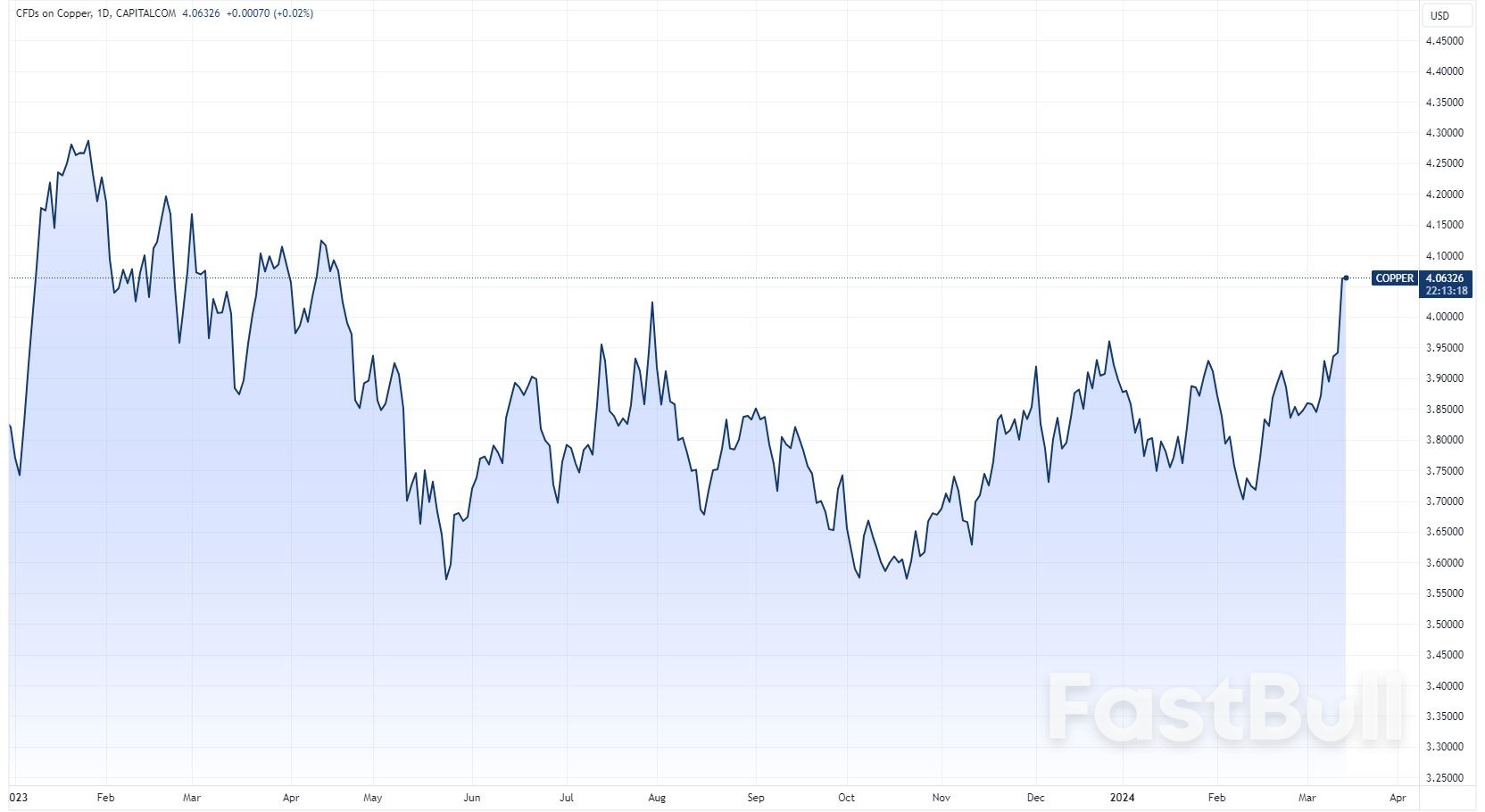
          Copper prices topped US$4 a pound on Wednesday after major Chinese copper smelters jointly agreed to cut production at loss-making plants to cope with a shortage of the raw material, according to Reuters.
          "Chinese smelters have been rapidly expanding their capacity over the past year to get ahead of an expected surge in copper demand ... but several mine disruptions globally ... have meant copper concentrate is now in short supply," the article notes.
          Copper prices have not traded above these levels since April 2023. Despite the well-documented nature of growing demand, a lack of new supply and ongoing supply disruptions – It's taken a rare production cut from China to drive up copper prices.
          Copper Prices Are Soaring: The State Of Play For ASX Copper Miners_1

          Copper futures chart

          The state of play for ASX copper stocks

          Let's set the scene for local copper stocks.
          1.There's not much to choose from in terms of pure play copper stocks. BHP completed its acquisition of Oz Minerals in mid-2023, leaving us with just one larger cap player – Sandfire Resources (ASX: SFR)
          2.The other names are struggling: 2022-23 was a rough year for emerging copper miners and developers amid soaring capex costs, labour shortages and adverse weather conditions. We'll take a closer look at two key stragglers below.
          3.US$4/lb copper is not US$4/lb copper: Copper prices are back at US$4/lb ... which is exactly where it was three years ago. But what about costs? The unit costs for copper production at BHP's Escondida Project was US$1/lb in FY21. The latest half-year FY24 results flagged unit costs of US$1.51/lb. While prices have gone nowhere, unit costs for one of the world's largest copper mines has risen 50% (and it's much more for smaller players).
          4.Maybe its time to look at ETFs: Given the lack of pure play exposure, it might be worth taking a look at the Global X Copper Miners ETF (ASX: WIRE). This ETF provides investors access to a global basket of copper miners. Its top three exposures include Chile's Antofagasta, Canada's Ivanhoe Mines, and Lundin Mining.
          5.Higher prices are higher prices: While the above points paint a bearish picture for the copper scene – Higher prices will inevitably lift valuations, irrespective of any challenges in operating conditions.

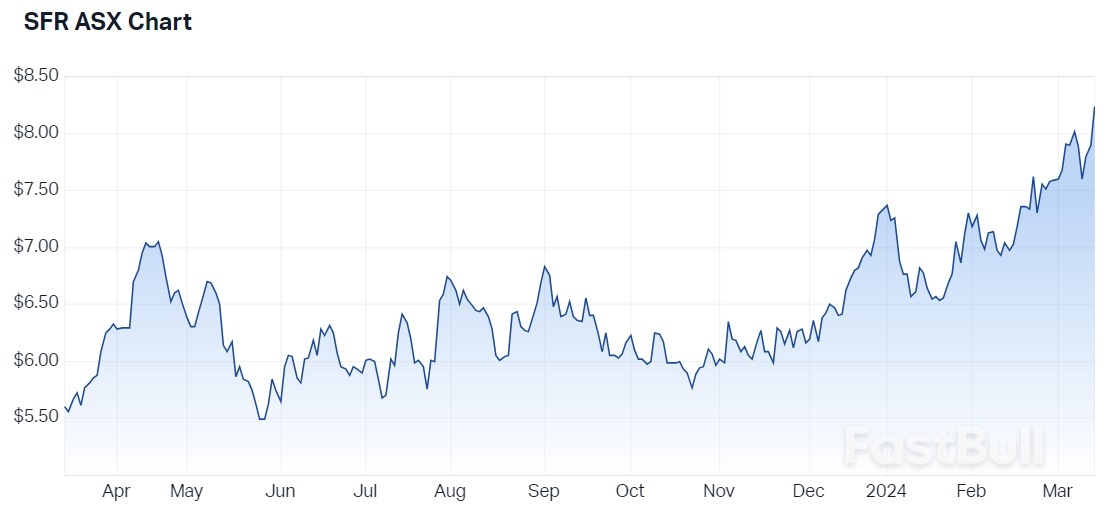
          Sandfire Resources (ASX: SFR)

          Copper Prices Are Soaring: The State Of Play For ASX Copper Miners_2

          Sandfire Resources 12-month price chart

          Mines: MATSA operation in Spain, Motheo Project in Botswana, DeGrussa mine (production ceased in late 2022) in WA and Black Butte (undeveloped) in US.
          Production: FY24 guidance of 97,000 tonnes of copper, 88,000 tonnes of zinc and 135,000 tonnes of copper equivalent.
          Broker views: Macquarie retained an Outperform rating and $8.10 target price following the company's half-yea FY24 result. "Sandfire's 1HFY24 was largely in line with Underlying NPAT of (US$37m) within US$8m of consensus estimates of (US$29m). Sandfire's transition to ex-capex at Motheo in FY25 should drive stronger cash generation," the analysts said in a note dated 26 February.
          Key takeaways: Sandfire is currently ramping up production at MATSA and Motheo (MATSA accounted for 67% of Group copper production in FY23). Macquarie's modelling expects capex to ease from US$325 million in FY23 to US$100 million in FY25. The ex-capex scenario will bump free cash flow from -$217 million in FY23 to $267 million in FY25.

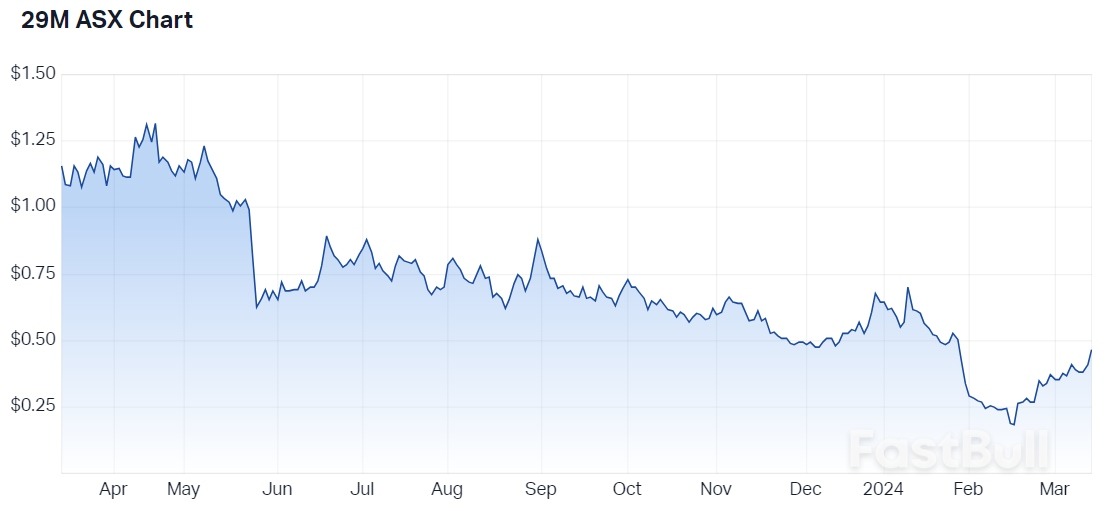
          29Metals (ASX: 29M)

          Copper Prices Are Soaring: The State Of Play For ASX Copper Miners_329Metals 12-month price chart

          Mines: Golden Grove in WA and Capricorn Copper in Queensland.
          Production: Reported FY23 (for the year ended 31 December 2023) copper and zinc production of 24,200 tonnes and 51,500 tonnes respectively. Copper production was down 40% year-on-year due to an extreme weather event at Capricorn. Costs and impairments associated with Capricorn Copper totaled approximately $220 million in FY23. The resulted in a net loss of $440 million for the calendar year.
          Broker views: Citi has a Neutral rating on the stock with a 45 cent target price. The analysts expect an $80 million capital raise in this half to support the Capricorn's phased recovery.
          Key takeaways: Citi expects the $80 million capital raise to be conducted at a 15% discount and dilute the company's net asset value by around 14%. That's a bit of an overhang for the stock.

          Aeris Resources (ASX: AIS)

          Copper Prices Are Soaring: The State Of Play For ASX Copper Miners_4

          Aeris 12-month price chart

          Mines: Tritton Copper operations in NSW, Cracow Gold operations in Queensland, Jaguar Operations in WA, North Queensland Copper operations and Stockman Project in Victoria.
          Production: Maintained FY24 production guidance of 28-35,000 tonnes of copper, up from 27,400 tonnes in FY23.
          Broker views: Macquarie has a Neutral rating on the stock with a 13 cent target price as of 1 March 2024. "1H FY24 losses were lower than expected, but we remain cautious due to the leveraged balance sheet with net debt of A$40 million."
          Key takeaways: Aeris has seen its share price fall almost 80% in the past twelve months, largely due to soaring production costs. The company reported a net loss of $140 million in FY23. What's interesting is that Aeris opted to take on more debt on 2 August 2023 (as opposed to a capital raise). The $50 million debt facility has some rather brutal terms including:
          · Interest rate: BBSY (basically short-term floating interest rate which is currently around 4.35%) plus 11.0% per annum
          · Establishment fee: 3.5%
          · Undrawn commitment fee: 5.0% per annum
          With a cash balance of only $22.7 million (as of 31 December 2023), there is the risk of another capital raise of draw additional debt should copper prices weaken or if there are more headwinds at one of its projects.

          Bottom Line

          Copper stocks are carrying plenty of baggage in the form of a heavy capex cycle, recovering from adverse weather conditions and challenged balance sheets. While a rising copper price environment generally lifts miner valuations – It's important to stay mindful of these potential risks.

          Source: Market Index

          Risk Warnings and Disclaimers
          You understand and acknowledge that there is a high degree of risk involved in trading. Following any strategies or investment methods may lead to potential losses. The content on the site is provided by our contributors and analysts for information purposes only. You are solely responsible for determining whether any trading assets, securities, strategy, or any other product is suitable for investing based on your own investment objectives and financial situation.
          Add to Favorites
          Share

          March 14th Financial News

          FastBull Featured

          Daily News

          [Quick Facts]

          1. Japanese firms agree to biggest wage hike in decades, paving way for BOJ shift.
          2. BOJ to debate ending negative rates in March if wage survey strong.
          3. ECB unveils new monetary policy framework.
          4. Yellen says US rates are unlikely to return to pre-pandemic levels.

          [News Details]

          Japanese firms agree to biggest wage hike in decades, paving way for BOJ shift
          Japan's annual wage negotiations were in full swing on Wednesday. The Japanese Association of Metal, Machinery, and Manufacturing Workers said 60 affiliated unions secured an average pay increase of 5.32%, exceeding last year's tally. The Japanese Trade Union Confederation (Rengo), Japan's largest union, will collect data on its members' pay raises on March 15 and announce the results. The organization's members demanded an average pay raise of 5.85%, the highest level since 19983, compared with 4.49% asked at the same time last year.
          The preliminary results of the negotiations indicate that many Japanese workers will receive the largest pay raises in decades. This is certainly a positive sign for the Bank of Japan (BOJ), which will hold a meeting in a few days to discuss whether to end its negative interest rate policy. Toyota Motor Corporation, Japan's largest company by market capitalization, said Wednesday it agreed to fully meet a record pay raise proposed by labor unions. Workers across the auto industry are expected to get a raise of at least 5%.
          BOJ to debate ending negative rates in March if wage survey strong
          The Bank of Japan is likely to scrutinize a preliminary survey on the wage talks' outcome, to be released by Rengo on Friday, in deciding whether conditions to phase out stimulus have fallen into place, the sources said. The Bank of Japan will debate ending its negative interest rate policy next week if Friday's preliminary survey on big firms' wage talks outcome yields strong results, marking a landmark shift away from its decade-long stimulus programme and Japan's first interest rate hike since 2007.
          However, a shift in policy in March was hardly a done deal, as some of the nine policy board members were concerned about recent signs of consumer weakness that highlighted the fragility of Japan's economic recovery. The BOJ may put off the decision until April if policymakers feel they need to assess more data, such as the "tankan" business sentiment survey due on April 1, and the bank's quarterly report on regional Japanese economies.
          ECB unveils new monetary policy framework
          The European Central Bank (ECB) released a new framework on monetary policy that retains the current interest rate guidance system but gives the banking sector more discretion in determining the necessary cash for operations. Under the new framework, the banking sector can decide for itself how much additional liquidity it needs from the central bank, in addition to the liquidity provided by the new permanent bond portfolio. While no timetable has been provided for transitioning to the new mechanism, this process will be protracted due to the substantial funds that remain within the system from past stimulus measures.
          The assessment confirms that the financial system and monetary policy have changed considerably in recent years, and the new framework will ensure that our policy implementation is effective, strong, flexible, and efficient, ECB President Lagarde said in a statement.
          Yellen says US rates are unlikely to return to pre-pandemic levels
          National interest rates are unlikely to fall back to pre-pandemic levels, US Treasury Secretary Janet Yellen said in a speech on Wednesday. A series of reports showed inflationary pressures within the .S rebounded at the beginning of the year. Inflation could face a bumpy return to normal.
          Progress achieved in disinflation has not stalled. I wouldn't expect this to be a smooth path month to month, but the trend is clearly favorable. Yellen said.
          It will take some time for changes in housing costs to trickle down to the CPI. I firmly expect this largest single influence on inflation to gradually decline this year.

          [Focus of the Day]

          UTC+8 17:30 ECB Executive Board Member Elderson Speaks
          UTC+8 19:00 ECB Executive Board Member Schnabel Speaks
          UTC+8 20:30 U.S. PPI (Feb)
          UTC+8 20:30 U.S. Retail Sales MoM (Feb)
          UTC+8 02:00 Next Day: ECB Vice-President Guindos Speaks
          Risk Warnings and Disclaimers
          You understand and acknowledge that there is a high degree of risk involved in trading. Following any strategies or investment methods may lead to potential losses. The content on the site is provided by our contributors and analysts for information purposes only. You are solely responsible for determining whether any trading assets, securities, strategy, or any other product is suitable for investing based on your own investment objectives and financial situation.
          Add to Favorites
          Share

          Why China’s Efforts To Resolve Hidden Government Debt Could Fall Short

          Samantha Luan

          Economic

          China’s central government has rolled out a new round of measures since the second half of last year to help local governments swap or restructure their off-the-books borrowing in a bid to control debt risk.
          However, the sheer scale of the country’s local government hidden debt — up to more than 70 trillion yuan ($9.8 trillion) according to some estimates, more than twice Germany’s GDP — means that the measures at best are far inadequate and will provide only temporary relief to what experts say is a looming liquidity crisis for regional authorities.
          At worst, it could further inflame the problem, promoting more off-the-books borrowing and increasing risk to economic and financial stability in the world’s second-largest economy, whose wobbly post-pandemic recovery has investors spooked, dragging the benchmark CSI 300 Index down 11% last year.
          Local government financing vehicles (LGFVs), state-owned companies set up to borrow on behalf of local authorities, are responsible for the heaviest burden of local government hidden debts, which are usually taken out to invest in public projects such as highways and bridges.
          China’s regional governments have long resorted to borrowing via LGFVs to help fund infrastructure investments to boost growth.
          The issue of hidden debt has gained more urgency as local governments, especially poorer ones, have been struggling to repay the principal and interest. Compounding the problem is that many have run their coffers down implementing Covid control measures during the three years of the Covid-19 pandemic.
          A prolonged property market downturn has also left holes in local balance sheets, as a big chunk of their revenue source — proceeds from selling land to developers — shrank.

          Beijing’s response

          Policymakers have been trying to resolve the problem for years, allocating quotas for local authorities to bring their hidden debt into their official budgets.
          While previous plans to resolve hidden debt took a more piecemeal approach, the most recent measures, which the top leadership at a July meeting called a “package of debt-resolving plans,” have prompted cities and provincial-level regions across the country to issue more than 1 trillion yuan of “special refinancing bonds” to repay some of their off-the-books debt.
          The proceeds will mainly be used to repay local government hidden debt that had been recorded by the Ministry of Finance by 2018 and will mature by the end of 2024, and will also be used to pay certain government arrears owed to businesses, sources with knowledge of the matter told Caixin. The total issuances in this round may end up raising 1.5 trillion yuan, they said.
          Meanwhile, since September, the central government has been instructing commercial banks in 12 heavily indebted provincial-level regions to restructure LGFVs’ non-standard debts or swap them for bank loans with longer maturities and lower interest rates, in a bid to relieve repayment pressure on local authorities and LGFVs. The program has now been expanded to cover all the other provincial-level regions on the Chinese mainland, sources with knowledge of the matter told Caixin.
          Non-standard debt usually refers to debt that isn’t traded on the interbank market or stock exchanges, such as trust loans, acceptance bills and accounts receivable. While LGFVs have never defaulted on bonds, some have on non-standard debt.
          Last week, Finance Minister Lan Foan said in a press briefing that local government debt risks have been “mitigated overall” and are now “controllable.” The central government will further promote the implementation of the package of plans to resolve local government hidden debt, he said.
          Still, many problems are left unsolved even as more hidden debt is being swapped for low-cost bank loans or on-balance-sheet local government bonds.
          One problem is that despite the ban on local authorities from providing implicit guarantees for LGFV bond repayments, the rescue package reinforces investor belief that these bonds won’t default because the government will come to the rescue. Thus, in a spiraling cycle, investors are again scooping up these debt instruments.
          Simply put, instead of discouraging the issuance of LGFV bonds, the package has made the bonds in hot demand again.
          “It suddenly feels like all LGFV bonds are safe, although it’s uncertain how long this will last,” said a mutual fund manager who invests in LGFV bonds.
          LGFV bond issuances in the third quarter raised 1.5 trillion yuan, a 7% increase compared with the previous quarter, with net financing also growing 4.2% quarter-on-quarter, according to data compiled by financial information provider East Money Information Co. Ltd.

          Non-standard debt

          Regardless, the government is forging ahead.
          In September, the State Council issued a document instructing financial institutions to play their role in resolving local governments’ implicit debt, sources with knowledge of the matter told Caixin. Financial institutions should focus on the 12 regions under especially heavy debt burdens, and ease the risks associated with their LGFV debts set to mature by the end of 2024.
          Authorities in Chongqing, whose GDP ranked No. 5 among all mainland cities in 2023, have been at the forefront of the effort. The city’s financial regulatory bureau established seven task forces to investigate hidden debt in each district, sources with knowledge of the matter told Caixin.
          Meanwhile, authorities in the city asked 10 banks to handle hidden debt-resolution work in county-level districts, the sources said. The banks were told to deal with both LGFVs’ bonds and high-cost non-standard debt.
          The Chongqing government hoped to swap all non-standard LGFV debt for bank loans and thus reduce the cost of borrowing to below 5%, according to a government source who works with state-owned assets.
          On Dec. 8, multiple banks in Chongqing, led by a local branch of state-owned Agricultural Bank of China Ltd. , swapped 50 million yuan of non-standard debt owed by an LGFV for bank loans, according to a Dec. 11 report published by local paper Chongqing Daily. However, the report was taken down from its website within days.
          Non-standard debts have become a focus of the country’s latest effort to resolve hidden debt, as the high returns they offer to investors, which can go above 10% in some cases, mean high financing costs.
          Taian, a city in East China’s Shandong province, vowed to swap all of certain local state-owned companies’ non-standard financing with annual interest rates between 9% and 12%, in a bid to prevent debt defaults, local media reported in October.

          Banks vs. LGFVs

          Chongqing isn’t the only place that is closely combing through its hidden debt. Many other local governments have also set up task forces to assess hidden debt and compile a list of LGFVs, sources at major state-owned banks told Caixin.
          The focus, they said, is on LGFV bonds and non-standard debt that will mature by the end of 2024, although LGFVs can negotiate with financial institutions to address debts that will mature at a later date.
          The path to swapping non-standard debt isn’t plain sailing.
          Local authorities would like to swap non-standard debt for bank loans with minimum interest rates and maturities of 20 to 30 years, and it’s best for them if there’s no need to pay any principal or interest in the first five years, but such deals are hard for banks to stomach, banking sources told Caixin.
          “Banks aren’t very enthusiastic (about swapping LGFV debt),” the Chongqing government source said. They are mainly extending or swapping debts owed to themselves, or cutting their interest rates, as a way of fulfilling a “political mission,” he said, adding that some banks ask for new collateral for the swaps.
          A source who works for an LGFV in northern China said working with banks has been time-consuming, because each bank has its own requirements.
          Banks may consider issuing new loans to swap LGFV debt if the borrower is suffering from short-term liquidity pressures, the proceeds have been invested in financially sustainable projects, and a concrete debt-resolving plan is in place, according to banking sources.
          In principle, the new loans shouldn’t have a maturity longer than 10 years, and the borrower should repay at least 10% of the principal every year, a person at a major state-owned bank said.
          If an LGFV can’t repay its debt, and the debt doesn’t meet requirements for being restructured or swapped at a bank, the local authority can apply for emergency liquidity support from the central bank, banking sources said.
          The total amount of such support available is around 1.3 trillion to 1.6 trillion yuan, multiple sources with knowledge of the matter said.

          No panacea

          Debt restructuring or swaps, either through banks or special refinancing bonds, will only provide temporary relief against an imminent liquidity crisis, scholars and analysts said.
          These measures may not be sufficient to prevent localities from taking on more hidden debts, and a long-term cure requires a revamp of how fiscal revenues and spending obligations are split between the central and local governments, they said.
          Scholars, including Zhang Ming, a deputy director of the Institute of Finance and Banking at the Chinese Academy of Social Sciences, have called for rebalancing the country’s systems for tax sharing and fiscal expenditure.
          To help local governments balance their income and expenditure, Zhang suggested that new taxes be levied with most of the revenue going to local authorities. Meanwhile, certain spending, such as pension and medical insurance expenditure, can be managed by higher levels of government, he wrote in a recent article.
          On the other hand, Qiao Baoyun, head of the China Academy of Public Finance and Public Policy at the Central University of Finance and Economics, said the root of local governments’ debt problem is insufficient checks on how they spend their money.
          Luo Zhiheng, chief economist at Yuekai Securities Co. Ltd, suggested that local governments should be downsized — both in terms of responsibilities and headcount — so that the market can play a bigger role in deciding how money should be spent.

          Source:Caixin

          To stay updated on all economic events of today, please check out our Economic calendar
          Risk Warnings and Disclaimers
          You understand and acknowledge that there is a high degree of risk involved in trading. Following any strategies or investment methods may lead to potential losses. The content on the site is provided by our contributors and analysts for information purposes only. You are solely responsible for determining whether any trading assets, securities, strategy, or any other product is suitable for investing based on your own investment objectives and financial situation.
          Add to Favorites
          Share
          FastBull
          Copyright © 2025 FastBull Ltd

          728 RM B 7/F GEE LOK IND BLDG NO 34 HUNG TO RD KWUN TONG KLN HONG KONG

          TelegramInstagramTwitterfacebooklinkedin
          App Store Google Play Google Play
          Products
          Charts

          Chats

          Q&A with Experts
          Screeners
          Economic Calendar
          Data
          Tools
          Membership
          Features
          Function
          Markets
          Copy Trading
          Latest Signals
          Contests
          News
          Analysis
          24/7
          Columns
          Education
          Company
          Careers
          About Us
          Contact Us
          Advertising
          Help Center
          Feedback
          User Agreement
          Privacy Policy
          Business

          White Label

          Data API

          Web Plug-ins

          Poster Maker

          Affiliate Program

          Risk Disclosure

          The risk of loss in trading financial instruments such as stocks, FX, commodities, futures, bonds, ETFs and crypto can be substantial. You may sustain a total loss of the funds that you deposit with your broker. Therefore, you should carefully consider whether such trading is suitable for you in light of your circumstances and financial resources.

          No decision to invest should be made without thoroughly conducting due diligence by yourself or consulting with your financial advisors. Our web content might not suit you since we don't know your financial conditions and investment needs. Our financial information might have latency or contain inaccuracy, so you should be fully responsible for any of your trading and investment decisions. The company will not be responsible for your capital loss.

          Without getting permission from the website, you are not allowed to copy the website's graphics, texts, or trademarks. Intellectual property rights in the content or data incorporated into this website belong to its providers and exchange merchants.

          Not Logged In

          Log in to access more features

          FastBull Membership

          Not yet

          Purchase

          Become a signal provider
          Help Center
          Customer Service
          Dark Mode
          Price Up/Down Colors

          Log In

          Sign Up

          Position
          Layout
          Fullscreen
          Default to Chart
          The chart page opens by default when you visit fastbull.com