• Trade
  • Markets
  • Copy
  • Contests
  • News
  • 24/7
  • Calendar
  • Q&A
  • Chats
Trending
Screeners
SYMBOL
LAST
BID
ASK
HIGH
LOW
NET CHG.
%CHG.
SPREAD
SPX
S&P 500 Index
6838.11
6838.11
6838.11
6878.28
6827.18
-32.29
-0.47%
--
DJI
Dow Jones Industrial Average
47684.85
47684.85
47684.85
47971.51
47611.93
-270.13
-0.56%
--
IXIC
NASDAQ Composite Index
23505.36
23505.36
23505.36
23698.93
23455.05
-72.76
-0.31%
--
USDX
US Dollar Index
99.010
99.090
99.010
99.160
98.730
+0.060
+ 0.06%
--
EURUSD
Euro / US Dollar
1.16392
1.16399
1.16392
1.16717
1.16162
-0.00034
-0.03%
--
GBPUSD
Pound Sterling / US Dollar
1.33273
1.33282
1.33273
1.33462
1.33053
-0.00039
-0.03%
--
XAUUSD
Gold / US Dollar
4185.88
4186.29
4185.88
4218.85
4175.92
-12.03
-0.29%
--
WTI
Light Sweet Crude Oil
58.596
58.626
58.596
60.084
58.495
-1.213
-2.03%
--

Community Accounts

Signal Accounts
--
Profit Accounts
--
Loss Accounts
--
View More

Become a signal provider

Sell trading signals to earn additional income

View More

Guide to Copy Trading

Get started with ease and confidence

View More

Signal Accounts for Members

All Signal Accounts

Best Return
  • Best Return
  • Best P/L
  • Best MDD
Past 1W
  • Past 1W
  • Past 1M
  • Past 1Y

All Contests

  • All
  • Trump Updates
  • Recommend
  • Stocks
  • Cryptocurrencies
  • Central Banks
  • Featured News
Top News Only
Share

Trump: Farming Equipment Has Gotten Too Expensive

Share

Trump: We Will Take Off A Lot Of Environment Rules That Affect Tractor Companies

Share

Kremlin Says Still No Word On US-Ukraine Talks In Florida

Share

Trump: USA Will Take Small Portion Of Tariff Revenues To Give It To Farmers

Share

Trump: Taking Action To Protect Farmers

Share

Nymex January Gasoline Futures Closed At $1.7981 Per Gallon, And Nymex January Heating Oil Futures Closed At $2.2982 Per Gallon

Share

USA Crude Oil Futures Settle At $58.88/Bbl, Down $1.20, 2.00 Percent

Share

Netflix Co-CEO On Warner Bros Deal: We Are Very Confident That Regulators Should And Will Approve It

Share

Alina Habba, The Interim Federal Prosecutor For New Jersey, Has Resigned. This Follows An Appeals Court Ruling That President Trump's Nomination Of Her Was Illegitimate

Share

Netflix Co-CEO On Paramount Skydance Bid For Warner Bros Says The Move Was Entirely Expected- UBS Conf

Share

U.S. Senate Democratic Member And Antitrust Activist Warren Stated That Paramount Skydance's Hostile Takeover Offer Triggered A "Level 5 Antitrust Alert."

Share

Benin Government: Coup Plotters Kidnapped Two Senior Military Officials Who Were Later Freed

Share

Canada: G7 Finance Ministers Discussed Export Controls And Critical Minerals In Call

Share

Benin Government: Nigeria Carried Out Air Strikes To Help Thwart Coup Bid

Share

Fitch: Expects General Government (Gg) Deficit To Fall Modestly In Canada And But Rise Modestly In USA In 2026

Share

An Important Point Of Consensus Was Concern Regarding Application Of Non-Market Policies, Including Export Controls, To Critical Minerals Supply Chains

Share

Fitch: Despite Full-Year Impact Of Tariffs, We Expect USA Fiscal Deficit To Widen In 2026 Due To Additional Tax Cuts Under One Big Beautiful Bill Act

Share

Private Equity Firm Cinven Has Signed A £190 Million Deal To Acquire A Majority Stake In UK Advisory Firm Flint Global

Share

Bank Of England's Taylor Expects Inflation To Fall To Target 'In The Near Term'

Share

Ukraine President Zelenskiy: He Will Travel To Italy On Tuesday

TIME
ACT
FCST
PREV
France Trade Balance (SA) (Oct)

A:--

F: --

P: --
Euro Zone Employment YoY (SA) (Q3)

A:--

F: --

P: --
Canada Part-Time Employment (SA) (Nov)

A:--

F: --

P: --

Canada Unemployment Rate (SA) (Nov)

A:--

F: --

P: --

Canada Full-time Employment (SA) (Nov)

A:--

F: --

P: --

Canada Labor Force Participation Rate (SA) (Nov)

A:--

F: --

P: --

Canada Employment (SA) (Nov)

A:--

F: --

P: --

U.S. PCE Price Index MoM (Sept)

A:--

F: --

P: --

U.S. Personal Income MoM (Sept)

A:--

F: --

P: --

U.S. Core PCE Price Index MoM (Sept)

A:--

F: --

P: --

U.S. PCE Price Index YoY (SA) (Sept)

A:--

F: --

P: --

U.S. Core PCE Price Index YoY (Sept)

A:--

F: --

P: --

U.S. Personal Outlays MoM (SA) (Sept)

A:--

F: --

P: --
U.S. 5-10 Year-Ahead Inflation Expectations (Dec)

A:--

F: --

P: --

U.S. Real Personal Consumption Expenditures MoM (Sept)

A:--

F: --

P: --
U.S. Weekly Total Rig Count

A:--

F: --

P: --

U.S. Weekly Total Oil Rig Count

A:--

F: --

P: --

U.S. Consumer Credit (SA) (Oct)

A:--

F: --

P: --
China, Mainland Foreign Exchange Reserves (Nov)

A:--

F: --

P: --

Japan Trade Balance (Oct)

A:--

F: --

P: --

Japan Nominal GDP Revised QoQ (Q3)

A:--

F: --

P: --

China, Mainland Imports YoY (CNH) (Nov)

A:--

F: --

P: --

China, Mainland Exports (Nov)

A:--

F: --

P: --

China, Mainland Imports (CNH) (Nov)

A:--

F: --

P: --

China, Mainland Trade Balance (CNH) (Nov)

A:--

F: --

P: --

China, Mainland Exports YoY (USD) (Nov)

A:--

F: --

P: --

China, Mainland Imports YoY (USD) (Nov)

A:--

F: --

P: --

Germany Industrial Output MoM (SA) (Oct)

A:--

F: --

P: --
Euro Zone Sentix Investor Confidence Index (Dec)

A:--

F: --

P: --

Canada National Economic Confidence Index

A:--

F: --

P: --

U.K. BRC Like-For-Like Retail Sales YoY (Nov)

--

F: --

P: --

U.K. BRC Overall Retail Sales YoY (Nov)

--

F: --

P: --

Australia Overnight (Borrowing) Key Rate

--

F: --

P: --

RBA Rate Statement
RBA Press Conference
Germany Exports MoM (SA) (Oct)

--

F: --

P: --

U.S. NFIB Small Business Optimism Index (SA) (Nov)

--

F: --

P: --

Mexico 12-Month Inflation (CPI) (Nov)

--

F: --

P: --

Mexico Core CPI YoY (Nov)

--

F: --

P: --

Mexico PPI YoY (Nov)

--

F: --

P: --

U.S. Weekly Redbook Index YoY

--

F: --

P: --

U.S. JOLTS Job Openings (SA) (Oct)

--

F: --

P: --

China, Mainland M1 Money Supply YoY (Nov)

--

F: --

P: --

China, Mainland M0 Money Supply YoY (Nov)

--

F: --

P: --

China, Mainland M2 Money Supply YoY (Nov)

--

F: --

P: --

U.S. EIA Short-Term Crude Production Forecast For The Year (Dec)

--

F: --

P: --

U.S. EIA Natural Gas Production Forecast For The Next Year (Dec)

--

F: --

P: --

U.S. EIA Short-Term Crude Production Forecast For The Next Year (Dec)

--

F: --

P: --

EIA Monthly Short-Term Energy Outlook
U.S. API Weekly Gasoline Stocks

--

F: --

P: --

U.S. API Weekly Cushing Crude Oil Stocks

--

F: --

P: --

U.S. API Weekly Crude Oil Stocks

--

F: --

P: --

U.S. API Weekly Refined Oil Stocks

--

F: --

P: --

South Korea Unemployment Rate (SA) (Nov)

--

F: --

P: --

Japan Reuters Tankan Non-Manufacturers Index (Dec)

--

F: --

P: --

Japan Reuters Tankan Manufacturers Index (Dec)

--

F: --

P: --

Japan Domestic Enterprise Commodity Price Index MoM (Nov)

--

F: --

P: --

Japan Domestic Enterprise Commodity Price Index YoY (Nov)

--

F: --

P: --

China, Mainland PPI YoY (Nov)

--

F: --

P: --

China, Mainland CPI MoM (Nov)

--

F: --

P: --

Italy Industrial Output YoY (SA) (Oct)

--

F: --

P: --

Q&A with Experts
    • All
    • Chatrooms
    • Groups
    • Friends
    Connecting
    .
    .
    .
    Type here...
    Add Symbol or Code

      No matching data

      All
      Trump Updates
      Recommend
      Stocks
      Cryptocurrencies
      Central Banks
      Featured News
      • All
      • Russia-Ukraine Conflict
      • Middle East Flashpoint
      • All
      • Russia-Ukraine Conflict
      • Middle East Flashpoint
      Search
      Products

      Charts Free Forever

      Chats Q&A with Experts
      Screeners Economic Calendar Data Tools
      Membership Features
      Data Warehouse Market Trends Institutional Data Policy Rates Macro

      Market Trends

      Market Sentiment Order Book Forex Correlations

      Top Indicators

      Charts Free Forever
      Markets

      News

      News Analysis 24/7 Columns Education
      From Institutions From Analysts
      Topics Columnists

      Latest Views

      Latest Views

      Trending Topics

      Top Columnists

      Latest Update

      Signals

      Copy Rankings Latest Signals Become a signal provider AI Rating
      Contests
      Brokers

      Overview Brokers Assessment Rankings Regulators News Claims
      Broker listing Forex Brokers Comparison Tool Live Spread Comparison Scam
      Q&A Complaint Scam Alert Videos Tips to Detect Scam
      More

      Business
      Events
      Careers About Us Advertising Help Center

      White Label

      Data API

      Web Plug-ins

      Affiliate Program

      Awards Institution Evaluation IB Seminar Salon Event Exhibition
      Vietnam Thailand Singapore Dubai
      Fans Party Investment Sharing Session
      FastBull Summit BrokersView Expo
      Recent Searches
        Top Searches
          Markets
          News
          Analysis
          User
          24/7
          Economic Calendar
          Education
          Data
          • Names
          • Latest
          • Prev

          View All

          No data

          Scan to Download

          Faster Charts, Chat Faster!

          Download App
          English
          • English
          • Español
          • العربية
          • Bahasa Indonesia
          • Bahasa Melayu
          • Tiếng Việt
          • ภาษาไทย
          • Français
          • Italiano
          • Türkçe
          • Русский язык
          • 简中
          • 繁中
          Open Account
          Search
          Products
          Charts Free Forever
          Markets
          News
          Signals

          Copy Rankings Latest Signals Become a signal provider AI Rating
          Contests
          Brokers

          Overview Brokers Assessment Rankings Regulators News Claims
          Broker listing Forex Brokers Comparison Tool Live Spread Comparison Scam
          Q&A Complaint Scam Alert Videos Tips to Detect Scam
          More

          Business
          Events
          Careers About Us Advertising Help Center

          White Label

          Data API

          Web Plug-ins

          Affiliate Program

          Awards Institution Evaluation IB Seminar Salon Event Exhibition
          Vietnam Thailand Singapore Dubai
          Fans Party Investment Sharing Session
          FastBull Summit BrokersView Expo

          Calm or Calamity?

          Samantha Luan

          Bond

          Commodity

          Energy

          Summary:

          Britain, for now, remains the key to whether a calmer mood can take a hold in markets unnerved by turmoil in the UK that has stoked wider worries about financial stability.
          Britain, for now, remains the key to whether a calmer mood can take a hold in markets unnerved by turmoil in the UK that has stoked wider worries about financial stability.
          Traders are back on Japanese yen intervention watch, while the U.S. earnings season has kicked off.
          Here's a look at the week ahead in markets from Kevin Buckland in Tokyo, Lewis Krauskopf in New York, and Tommy Wilkes and Dhara Ranasinghe in London. Graphics by Vincent Flasseur.

          Buyer of Last Resort

          The Bank of England is no longer be the buyer of last resort of battered British bonds
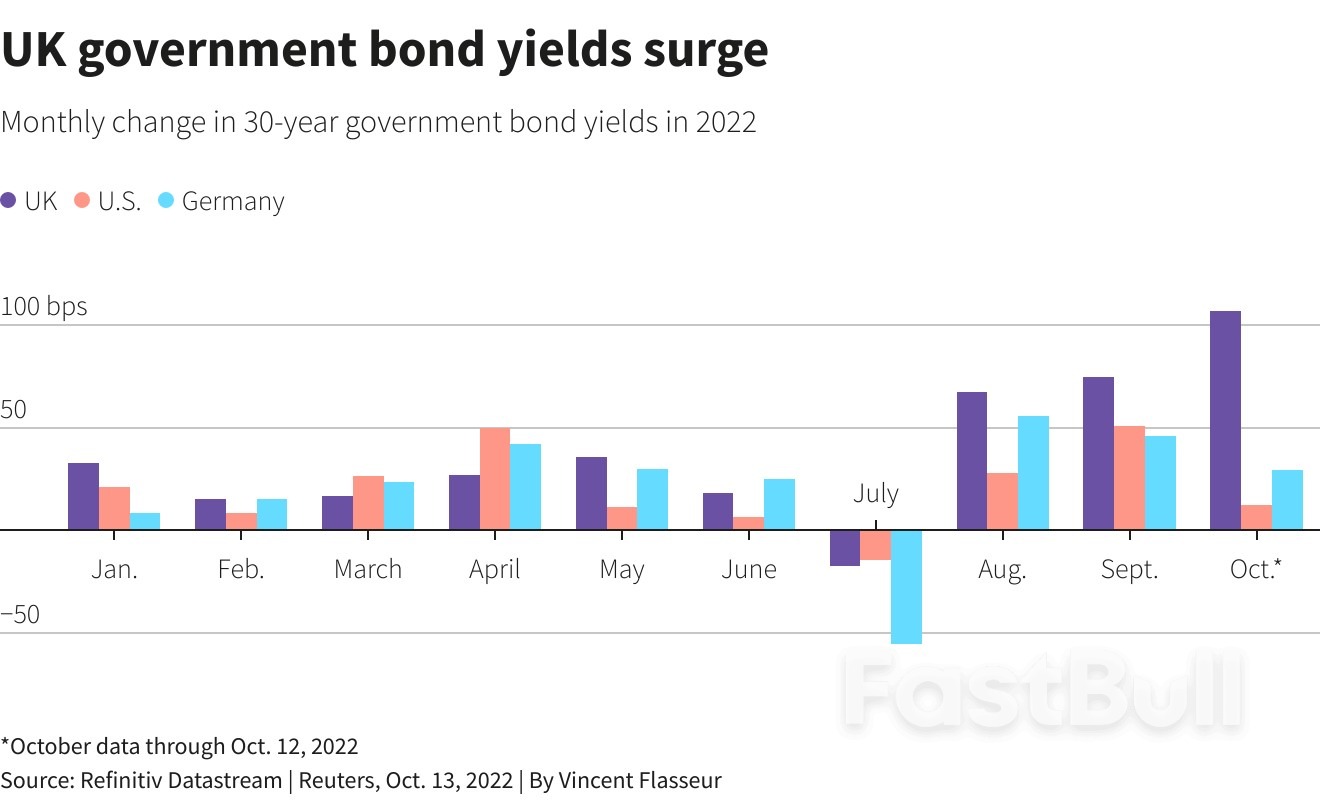
          The government's "mini-Budget" on Sept. 23 sparked some of the biggest ever jumps in UK bond yields, spooked wider markets and triggered a crisis among pension funds needing to find bucket loads of cash.
          The BoE has been forced to intervene repeatedly to ensure financial stability, even as those measures contradict its task of fighting inflation by jacking up interest rates and selling some of the bonds it owns.
          The pensions industry has warned schemes aren't ready for bond-buying to end.
          Kwasi Kwarteng was sacked as finance minister on Friday. Now, Britain's new finance minister Jeremy Hunt said he will announce tax and spending measures on Monday, two weeks earlier than scheduled, as he tries to stem a loss of confidence in the government's fiscal plans.

          Calm or Calamity?_1Stress Test

          On top of UK turmoil, unease triggered by decades-high inflation, an energy shock and aggressive global rate hikes are putting markets through a stress test.
          The carnage in British gilts has exposed vulnerabilities in the pensions sector, shining a light on financial stability risks. So, the coming days will see increased focus on other possible hot spots that have gone under the radar of regulators.
          The IMF warns of "disorderly asset repricings" and "financial market contagion." Asset manager PIMCO reckons the UK is unlikely to be the only source of instability, adding that loan and private credit markets may also face stress.

          Calm or Calamity?_2Earnings Season

          The third-quarter U.S. earnings season heats up as companies report results in the throes of a difficult operating environment given a strengthening dollar and surging inflation.
          Earnings for S&P 500 companies overall are expected to have climbed 4.1% from the year-earlier period, which would be the slowest growth since the fourth quarter of 2020.
          But more focus may be on how executives project the future; consensus analyst estimates are for a nearly 8% rise in profits next year, according to Refinitiv IBES, but many investors are dubious of that forecast as recession risks loom.
          A market slide has moderated stock valuations, but a downgrade in the earnings outlook could dampen equities' attractiveness. Upcoming earnings reports includes results from Tesla, Netflix and Johnson & Johnson.

          Calm or Calamity?_3Intervention Watch

          Traders are back on currency intervention watch as the dollar scales fresh 24-year peaks to the yen and heads back towards multi-year highs versus the Chinese yuan and Korean won.
          Japan's currency careened to the cusp of 147 per dollar on Wednesday, crashing through the trough at 145.89 that spurred the Bank of Japan to intervene last month to support the yen for the first time since 1998.
          South Korea also sold billions of dollars last quarter to prop up its currency, as the won plumbed a 13-year low just shy of 1,445 per dollar last month. Even so, it's not strayed far from there, nearing 1,440 last week.
          China's state banks stepped up their intervention to defend a weakening yuan on Monday. And traders are jittery over more aggressive steps to come.
          And there was no sign from G7 economies meeting in Washington of joint intervention to ease the pain of a soaring dollar.

          Calm or Calamity?_4Source: Reuters

          Risk Warnings and Disclaimers
          You understand and acknowledge that there is a high degree of risk involved in trading. Following any strategies or investment methods may lead to potential losses. The content on the site is provided by our contributors and analysts for information purposes only. You are solely responsible for determining whether any trading assets, securities, strategy, or any other product is suitable for investing based on your own investment objectives and financial situation.
          Comments
          Add to Favorites
          Share

          Can Diwali Festive Demand Brighten Prospects for Indian Businesses Amid Recession Fears?

          Thomas
          Businesses in India are looking forward to a much-needed boost from the Hindu festival of Diwali this month, which is traditionally a time when consumer spending spikes in Asia's third-largest economy.
          Optimism is strong despite recent signs of slowing economic activity in the country and steep inflation, as well as fears about the global economy slipping into a recession.
          "Consumption tends to spike significantly during Diwali," says Ram Kalyan Medury, founder and chief executive of Jama Wealth, an investment advisory. "Even [the risk of] an inflation-ridden recession on the global front cannot dampen the festive spirit."
          "Sales, discounts and across the board increase in footfalls in shops and digital footfall for e-commerce websites alike means demand increases. More festive demand means more to cheer for the businesses."
          Diwali, often referred to as the festival of lights, is widely associated with the goddess of wealth, Lakshmi, and many Indians wait until this time to splash out on big purchases, from jewellery to televisions, new cars, and even homes.
          The five days of festivities this year begin on Saturday, with the main day of Diwali falling on Monday.
          As a consumer-driven economy, Diwali is a critical time of the year for many sectors in India. Alongside the retail sector, manufacturing and other industries also benefit from the uptick in spending.
          "People, irrespective of their socio-economic condition, go out and purchase goods," says Sonal Jindal, founder of Medusa Exim, an international supply chain management company.
          The Confederation of All India Traders forecasts that, with Covid-19 curbs lifted, sales during Diwali this year will be up 30 per cent compared to 2021 for the industry group's 80 million small and medium-sized businesses, which generate more than $1.5 trillion in sales annually.
          "Businesses in India are preparing to celebrate the peak festive season by expanding their staff, looking to launch new products or services, especially since the Covid restrictions are finally removed," says Ms Jindal.
          "Businesses like ours, which are running in co-ordination with a number of vendors and associates, can heave a sigh of relief as owners look forward to a good show in the market."
          India's gross domestic product grew by 13.5 per cent in the quarter between April and June, the fastest pace in a year, according to government data, as the economy bounced back from the harsh impact of the pandemic.
          But the economic environment has become more challenging in recent months. Inflation hit a five-month high of 7.41 per cent in September, driven by higher food prices and Russia's invasion of Ukraine, pushing up commodities prices globally.
          Soaring inflation prompted India's central bank, the Reserve Bank of India, to deliver its fourth consecutive interest rate increase in September. This makes borrowing costs higher for consumers and businesses and can dampen spending trends.
          Purchasing managers' surveys reveal that activity in India's services and manufacturing sectors moderated in September because of inflationary pressures.
          Most agencies have been lowering their growth forecasts for India, with the International Monetary Fund on Tuesday cutting its GDP growth projection for the country for the current financial year until the end of March to 6.8 per cent from an earlier forecast of 7.4 per cent. But given its relatively fast growth amid a challenging global environment, IMF managing director Kristalina Georgieva described India as a "bright spot on this otherwise darker horizon".
          Despite the challenges, the latest Consumer Pyramids Household Survey by the think tank Centre for Monitoring Indian Economy shows that consumer sentiments rose to a 30-month high in September.
          "There is a lot of positivity in the air this year," says Meenakshi Kalsi, managing partner at Metro & Metro Shoes, based in Agra in north India. "There is reason to cheer as consumers are indicating willingness to spend more."
          "Festival seasons are very important for the Indian economy as the spending increases multifold involving a huge boost to the economy of the country," she says.
          Business was tough for the footwear industry during the pandemic, she explains, as schools and offices shut, and people were not attending celebrations and gatherings.
          Ms Kalsi says that not everything is rosy, however, as companies like hers face challenges, including high transport costs and some difficulties procuring raw materials. Nonetheless, she remains optimistic about an improvement in demand.
          "I'm in hope for economic revival," says Ms Kalsi.
          Many companies are gearing up for a pick-up in demand during the festival period.
          "We are anticipating a double-digit growth in the sales percentage as compared to the same period last year," says Harsh Shah, founder of Rupa Steel Centre, a manufacturer of utensils in India. "We have prepared in advance with supplies in place to cater to a sudden rise in demand during the festival."
          However, Mr Shah says that he is noticing that the market dynamics are changing amid a trend towards online purchasing compared with shopping in brick-and-mortar stores.
          "Ahead of the festive season, we have seen a lean demand from the retail market," he says. "The retail industry is facing some brunt due to lesser walk-ins. A known contributor to this phenomenon has been the e-commerce space."
          The move towards online shopping could have an effect on any small and medium sized traders who are dependent on sales through physical stores, Mr Shah says.
          Jewellers in India are among those who are anticipating a festive boost this year. The first day of Diwali, known as Dhanteras, is when many Indians traditionally purchase gold.
          "We are expecting good numbers this Diwali," says Ketan Chokshi, managing director and jewellery designer at Narayan Jewellers.
          "Though there is [the] impact of inflation, we see a growth from last year."
          Given the economic conditions and global uncertainty, some people are "a little sceptical and are saving more," Mr Chokshi says.
          He adds that India is "doing well" and has "not been as tough as the last two years have been".
          "Indian retailers and e-commerce players are expecting a bumper Diwali," says Shrikant Nibandhe, managing director at One World Logistics.
          "The Diwali sales are expected to surpass previous highs and make up for the lacklustre sales during the pandemic years."
          Prospects brighten for India's real estate industry during Diwali period. Home sales have seen a robust recovery this year. The number of homes sold across India's top eight cities was up 15 per cent in the quarter between July and September, according to property consultancy Knight Frank.
          However, the latest RBI interest rate increase of 50 basis points, which makes home loans more expensive, will affect affordability, says Shishir Baijal, chairman and managing director of Knight Frank India.
          "This might slow down home buying decision for a short to medium term," he says. "However, we hope, India's steady economic growth and revival in consumer's sentiment towards the economy will bring back confidence amongst the end users and support their home buying activities."
          Rohit Gera, managing director of Gera Developments, a property developer based in Pune, says he remains "cautiously optimistic in the near term".
          "The sales momentum overall for the real estate industry has picked up and that is a trend that is here to stay during the festive season as well," says Mr Gera.
          The outlook for Diwali may be relatively bright for India, but financial experts warn that there are significant economic challenges looming, which could mean that the momentum does not continue for too long after the festivities are over.
          "Inflation will catch up eventually and since the West is likely to be in [a] recession, the demand outlook for most of India's exports is also expected to go down," says Jama Wealth's Mr Medury.
          "This could put a brake on consumer spending but is unlikely in October and during this Diwali."

          Source: The National News

          Risk Warnings and Disclaimers
          You understand and acknowledge that there is a high degree of risk involved in trading. Following any strategies or investment methods may lead to potential losses. The content on the site is provided by our contributors and analysts for information purposes only. You are solely responsible for determining whether any trading assets, securities, strategy, or any other product is suitable for investing based on your own investment objectives and financial situation.
          Comments
          Add to Favorites
          Share

          American Consumers are Becoming More Price-Sensitive Again

          Michelle
          ASKED ABOUT the state of the economy, Americans are surprisingly gloomy. More than half say they are experiencing financial hardship; more than a third say they are having difficulty paying for regular household expenses. Yet, even as surveys suggest that Americans are tightening their belts amid persistently high inflation, data show that they continue to spend at a healthy clip. Last month the Bureau of Economic Analysis reported that consumer spending is growing by 1.8% year on year after adjusting for inflation—not far from its historic average. A report by the Bank of America Institute, a think-tank, finds that consumer payments are growing at double digits, a sign that the American shopper "is still spending".
          This resilience can be explained in part by mattress-loads of savings. Americans accumulated more than $2trn in excess savings during the pandemic, when the federal government doled out unemployment benefits and stimulus cheques even as households cut back on travel, entertainment and eating out. Although some of this has been spent, households are still sitting on a $1.4trn cushion, reckons Ian Shepherdson of Pantheon Macroeconomics, a consultancy. The labour market is healthy, too. Unemployment has fallen to 3.5%, the lowest it has been in 50 years. In August there were 10.1m job openings, or 1.7 vacancies for every jobless person.
          But another less-appreciated reason why spending has been so steady in the face of soaring inflation is a shift in consumers' sensitivity to prices, or "price elasticity of demand". This concept, seldom mentioned outside economics textbooks, has been a hot topic of debate among investors and company executives in the past year (see chart 1). The term has found its way to the earnings calls of consumer-goods giants such as PepsiCo, whose bosses talked of favourable "demand-elasticity trends" while presenting the food-and-drinks giant's unexpectedly bubbly quarterly results on October 12th.
          The available data appear to back them up. Figures compiled by IRI, a market-research firm, suggest that consumers are indeed significantly less price sensitive now than they were before the pandemic. Using scanner data on prices and sales recorded with each purchase of thousands of items across more than 125,000 supermarkets, chemists, dollar stores and big-box retailers, IRI estimates that price elasticities have fallen for 22 out of 25 product categories since February 2020, and remained flat for the other three (see chart 2). All told, IRI reckons that consumers were roughly 20% less price sensitive in the 52-week period ending September 4th than they had been in the year before the pandemic.
          Why the shift? Experts offer three possible reasons. First, as panic-buying led to empty supermarket shelves in the early months of the pandemic, consumers adjusted their shopping routines and tried brands they weren't used to, says Brett Gordon, a marketing professor at Northwestern University. With more time at home, people also became more comfortable splurging on pricier food and household items. Last, consumers cut the time they spent shopping—by roughly 9% between 2019 and 2021 according to government statistics. The way they use that has changed, too. "A lot of people maybe spent more time shopping for things to outfit their homes, but less time worrying about everyday consumer products," says Alexander MacKay of Harvard Business School.
          There are some signs that consumers are starting to pull back. Walmart, a retailing behemoth, says that its shoppers are switching from pricey deli meats to hot dogs, and from gallons (3.8 litres) of milk to half-gallons. Best Buy, an electronics retailer, says its customers are increasingly opting for private-label tvs over name-brand sets. Such shifts in consumer behaviour are most pronounced among lower-income households. tjx, a discount department store, says that, for the first time in years, outlets in higher-income areas are growing faster than those in lower-income ones. "Middle-income and high-income consumers are continuing to spend," explains Krishnakumar Davey of IRI, but "low-income stores and low-income consumers are pulling back a little bit."
          This will be on the minds of investors as America's listed companies report their quarterly earnings in the coming weeks. Those hoping for clear answers may be disappointed. Although packaged-goods firms agree that shoppers will start to balk at higher prices, there is far less consensus about when exactly this will happen. As James Quincey, boss of Coca-Cola, told investors earlier this year, "I expect elasticity to increase at some point in the future. Will that be next quarter? Or will that be next year? I can't give you the answer to that."

          Source: yahoo

          Risk Warnings and Disclaimers
          You understand and acknowledge that there is a high degree of risk involved in trading. Following any strategies or investment methods may lead to potential losses. The content on the site is provided by our contributors and analysts for information purposes only. You are solely responsible for determining whether any trading assets, securities, strategy, or any other product is suitable for investing based on your own investment objectives and financial situation.
          Comments
          Add to Favorites
          Share

          The British Currency Finds Some Relief in Asian Dealings

          Alex
          Kwarteng's sacking on Friday triggered a core bond relief rally with UK Gilts outperforming. Prime minister Truss appointed Jeremy Hunt as his successor and gave a press conference later in which she dropped an £18bn corporate tax cut plan. But it did little to convince markets fundamentally.
          UK bond yields bottomed, erased previous losses and eventually rose between 11.6 bps (2y) to 23.4 bps (30y) in the UK. It was a screeching intraday turnaround of more than 50 bps, supported by the Bank of England leaving the market after having bought a total of just £1.4bn+ bonds on the last day.
          European yields rose in lockstep, adding 3.5 bps to 9.8 bps in a steepener. U.S. yields lagged peers but caught up after the release of the Michigan consumer confidence in which one-year inflation expectations unexpectedly rose north of 5% again.
          The 5-10y gauge (2.9%) topped 2.8% estimates too. Bets for Fed rate hikes lean towards a 5% terminal rate, in line with the analysis of Fed's Daly last week.
          U.S. yields advanced 3.2 bps at the front end to 6.6-7.7 bps at longer maturities with the 10y yield closing above 4% for the first time since '08. U.S. equities tanked more than 3% (Nasdaq), erasing about half of the gains seen in the historical intraday reversal on Thursday.
          The dollar dominated FX space. USD/JPY soared beyond the 1998 high to close at 148.67. EUR/USD losses could have been bigger though (close at 0.972). Sterling remained in the defensive.
          EUR/GBP closed above 0.87 and Cable eased to 1.117. The British currency finds some relief in Asian dealings after Hunt in an interview yesterday said nothing is off the table when asked if other measures in the minibudget could be abandoned. It's a stark contrast with Truss herself last week saying she expects Hunt to agree to no more U-turns.
          It makes us question the underlying strength of the move this morning. We're also keen to see the Gilt market open without the Bank of England's backstop. Things remain interesting politically too. More Tories call for Truss to resign. Hunt met with the BoE and the Debt Management Office last night and will make a statement on the medium-term fiscal plan later today.
          USD/JPY holds steady near a 30-year high and government officials are back with unconvincing verbal interventions. Chinese authorities fixed the yuan at USD/CNY 7.1095 but you can't fight market forces. USD/CNY is attacking previous cycle (closing) highs of 7.20 on yuan weakness.
          EUR/USD heads north to 0.975, the DXY takes a breather at 112.97. U.S. Treasury yields lose a few bps and German Bund futures trade higher. We wouldn't be surprised to see some short-term consolidation in core bonds (UK Gilts not included, to be clear) near their recent highs as markets await new impetus from the likes of the ECB (next week). EUR/USD should hold on in the 0.95-1 trading range.

          News Headlines

          The FT reports that the European Commission is likely to freeze regional aid to Poland as the country's suppression of judicial independence still interferes with the EU's charter of fundamental rights. Warsaw already made some reforms to its system for discipling judges, but these don't go far enough. At stake is a total of €76.5bn of cohesion funding.
          The EC did already sign off on three of Poland's cohesion programme initiatives (big infrastructure & green investments) for which unconditional prefinancing is available (0.5% of the overall amount). The first tranche of the pandemic-related EU recovery fund (€2.85bn in grants and €1.37bn in loans) is also yet to be released. The Polish zloty starts the week on the back foot with EUR/PLN rising from 4.80 to 4.85.
          A draft EC proposal seen by the FT suggests that Brussels wants to set a maximum dynamic price at which gas transactions can take place on the Dutch Title Transfer Facility (TTF), the benchmark for the bloc.
          The proposals also include measures to limit volatility in energy derivatives markets, as well as a longer-term project to create a new benchmark for liquefied natural gas.
          Urgent measures are also needed to ensure member states co-operate more effectively on gas purchasing, with a particular focus on refilling storage facilities next year. EU leaders meet on Thursday and Friday in Brussels to find joint solutions to tackle the energy crisis.

          Source: KBC Bank

          Risk Warnings and Disclaimers
          You understand and acknowledge that there is a high degree of risk involved in trading. Following any strategies or investment methods may lead to potential losses. The content on the site is provided by our contributors and analysts for information purposes only. You are solely responsible for determining whether any trading assets, securities, strategy, or any other product is suitable for investing based on your own investment objectives and financial situation.
          Comments
          Add to Favorites
          Share

          Foreign Firms' Tax Evasion Amount More Than Doubled Since 2018

          Ukadike Micheal
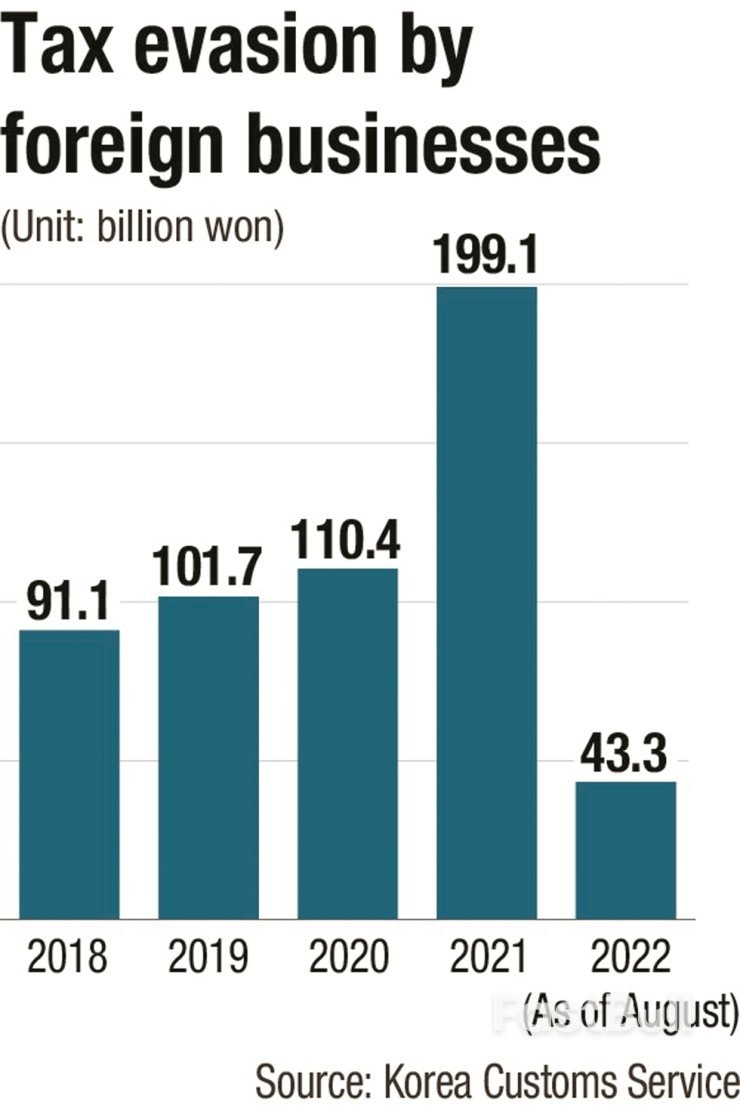
          Foreign businesses have been increasingly engaged in tax evasion over the past four years, with the amount of unpaid taxes more than doubling between 2018 and 2021 to almost 200 billion won, data showed Monday.Foreign Firms' Tax Evasion Amount More Than Doubled Since 2018_1
          Compiled by the Korea Customs Service (KCS) and released by Rep. Yang Ki-dae of the main opposition Democratic Party of Korea (DPK), the data showed foreign firms evaded paying 199.1 billion won ($138.8 million) in taxes in 2021, up from 110.4 billion won 2020, 101.7 billion won in 2019 and 91.1 billion won in 2018.
          The amount totaled 43.3 billion won during the first eight months of this year.
          The number of firms linked to tax evasion varied according to the year with 90 in 2018, 81 in 2019, 71 in 2020, 82 in 2021 and 55 during January and August this year.
          "The taxes being dodged by foreign enterprises are rising to a worrisome level," Rep. Yang said in a press release, noting the cases of tax evasion especially surged 80.3 percent from 2020 to 2021.
          He pointed out those firms are affiliates of multinational businesses, and are believed to be exploiting the difference in tax rates by countries where they operate in order to avoid paying taxes.
          "The customs agency is urged to go over relevant codes to prevent tax evasion," the lawmaker added.
          A KCS official explained that the reasons for tax evasion vary by company and that there is "no specific answer to why there are more unpaid taxes over the years."
          "Nevertheless, we'll closely monitor suspected companies and make sure to prevent any loopholes that lead to tax evasion," the official told The Korea Times on condition of anonymity.
          A separate finding from the National Tax Service (NTS) in 2021 showed multiple foreign businesses used internal trading with their parent companies abroad as a way to illegally transfer revenue they made here and reported to Korean tax authorities to make it appear as if their sales were smaller than what they actually earned.

          Source: TheKoreaTimes

          Risk Warnings and Disclaimers
          You understand and acknowledge that there is a high degree of risk involved in trading. Following any strategies or investment methods may lead to potential losses. The content on the site is provided by our contributors and analysts for information purposes only. You are solely responsible for determining whether any trading assets, securities, strategy, or any other product is suitable for investing based on your own investment objectives and financial situation.
          Comments
          Add to Favorites
          Share

          [ECB] Three Officials Deliver Speeches

          FastBull Featured

          Remarks of Officials

          Several European Central Bank (ECB) officials made speeches on October 14, with the main points as follows.
          ECB Vice President Luis de Guindos said in an interview on the same day that the euro area was going to face a very difficult combination of low economic growth, including the possibility of a technical recession, and high inflation, and was getting closer to the downside scenario in the September ECB projections (complete suspension of Russian energy supply, the euro area economy shrinking by nearly 1% in 2023 and inflation falling to 6.9% in 2023). However, Guindos declined to make a specific forecast for the euro area terminal rate.
          Joachim Nagel, Member of the ECB Governing Council and President of the Deutsche Bundesbank, said in a speech in Washington on October 15 that German inflation was expected to be higher than 7% next year; it was expected that German GDP could fall sharply in the fourth quarter of 2022 and the first quarter of 2023, implying that Germany would fall into recession. He believed that despite the possibility of a deep recession in Germany, the ECB would still need to raise interest rates several times to keep inflation down, and should consider balance sheet reduction. The pace and magnitude of rate hikes would depend on data and the inflation outlook. In any case, the ECB's Governing Council must not let up too soon. If inflation expectations were to de-anchor to the upside, interest rates would have to rise even faster or higher.
          Speaking at the 37th Annual G30 International Banking Seminar, Klaas Knot, Member of the ECB Governing Council and President of the Dutch central bank, said they should be vigilant for a wage-price spiral. In many euro countries, wage negotiations take place in the fall. There were signs of substantially higher wage demands, some of which had already been met. In addition, governments had already taken fiscal measures in light of soaring energy prices. Broader fiscal stimulus, however, would push up demand and thus counteract the course of monetary policy and fuel inflation. Against this backdrop, further rate hikes were expected in the coming months until rates reach the neutral level, at which point it makes sense to consider the roll-off of asset purchases by limiting reinvestments. There would not be an abrupt turn in policy (meaning a halt in rate hikes or even a cut). The greater the rate hike, the closer it will be to the prospect of inflation falling back to the target level. After that, the pace of rate hikes may slow.

          Guindos' Speech

          Nagel's Speech

          Knot's Speech

          Risk Warnings and Disclaimers
          You understand and acknowledge that there is a high degree of risk involved in trading. Following any strategies or investment methods may lead to potential losses. The content on the site is provided by our contributors and analysts for information purposes only. You are solely responsible for determining whether any trading assets, securities, strategy, or any other product is suitable for investing based on your own investment objectives and financial situation.
          Comments
          Add to Favorites
          Share

          IMF Plugs Financing Gaps as Riskier Emerging Markets Face Squeeze

          Owen Li
          There's little relief in sight for a host of developing nations from Egypt to Malawi and from Pakistan to Ecuador, all of whom are facing a painful economic squeeze as the costs of servicing debt rise further.
          Officials from the International Monetary Fund (IMF) and other bodies expect the debt crunch to heap more pressure on these so-called 'frontier markets', which are already struggling with the impacts of Russia's war in Ukraine and the Federal Reserve's tightening cycle to cool U.S. inflation.
          Many of these countries are also still wrestling with the effects of the COVID-19 pandemic. Locked out of worldwide debt markets and with China redrafting its role as the lender of choice to many poorer nations, countries are increasingly relying on the help of the IMF to plug financing gaps.
          "Their fiscal space to deal with all of this is very little," Gita Gopinath, the IMF's first deputy managing director, told a seminar on the sidelines of the annual IMF-World Bank Meeting. "We will grapple (with this) for several months to come."
          The Washington-based lender has agreed new programmes or augmented existing ones for 18 countries to the tune of $90 billion since Russia invaded Ukraine in February, its managing director Kristalina Georgieva said. Including support since the start of COVID-19, this total rises to $260 billion for 93 countries while another 28 have expressed interest in receiving support.
          The fund needs to navigate shoring up fragile economies while ensuring often painful economic reforms don't fall by the wayside.
          "The IMF is trying to strike balance between conditionality and agility," said Patrick Curran, senior economist at Tellimer, who is in Washington for the international lender's meetings.
          "Countries like Pakistan, Egypt, Lebanon and Sri Lanka can't simply have the funding without any sort of commitments from the government."
          Sri Lanka recently struck a staff level agreement to unlock almost $3 billion, while Zambia got the nod on a $1.3 billion loan programme, a key step to start receiving disbursements.
          Both countries have defaulted on overseas debt but are also set to rework debt with bilateral lenders, with all eyes set on China as the IMF and G7 economies insist Beijing implement debt relief for poorer nations.
          Ghana, Egypt, Tunisia and Malawi are all in talks on some type of IMF financing.

          More pain to come?

          Rising borrowing costs and risk aversion amid growth woes and soaring inflation have seen the likes of Kenya, Egypt and Ecuador locked out of capital markets.
          Over a quarter of emerging market sovereign bonds trade at spreads over U.S. Treasuries in excess of 1,000 basis points - a threshold for distinguishing distressed debt, Deutsche Bank calculated in a recent report. Such yields make it impossible for countries to tap international capital markets.
          With major central banks such as the Fed and the European Central Bank still in the early stage of rate hike cycles, pressure on emerging currencies and bond yields would continue at least through mid-next year, said Deutsche Bank's Michael Spencer, adding the hit from FX depreciations, especially against the dollar, was the "main source of risk to government finances" in developing nations.
          Investors have yanked $70 billion from emerging market bond funds so far in 2022, according to data from JPMorgan, which pegs year-end outflows at $80 billion.
          In Washington, discussions were rife as to when creditors might change tack and buy emerging markets bonds again.
          March could be a turning point, assuming the Fed stops hiking rates after a peak in inflation. For others, it is not that straightforward due to global uncertainty.
          "It is a world with higher rates, higher inflation, and slower economy," added the head of sovereign debt of a large New York-based investment fund.
          More defaults are also in the making, said Elena Duggar, managing director of credit strategy & research at ratings agency Moody's.
          "Frontier markets, which are highly reliant on external financing, which have a larger share of foreign currency debt have been most vulnerable," said Duggar, also in Washington.
          Countries' debt burdens have risen. The average public debt to GDP ratio - a key measure of fiscal health - rose to 60% in 2022 from 36% in 2012, the IMF's most recent Global Financial Stability Report found.
          Turning to the IMF for financing has been the traditional playbook for smaller, strained countries in times of crisis.
          A set of new IMF tools should also help funnel more funds to such countries in the short-term.
          A food shock financing window aims to help countries facing shortages and urgent balance of payment needs, while the Resilience and Sustainability Trust adds financing to help countries deal with climate change, pandemics and other longer-term issues
          However, IMF funding alone is unlikely to be enough and the strings attached can be hindrance rather than help, said JPMorgan's Nicolaie Alexandru-Chidesciuc.
          "But IMF does act as an anchor and allows access to a broader set of funding, even if not from the market," said Alexandru-Chidesciuc.

          Source: Reuters

          Risk Warnings and Disclaimers
          You understand and acknowledge that there is a high degree of risk involved in trading. Following any strategies or investment methods may lead to potential losses. The content on the site is provided by our contributors and analysts for information purposes only. You are solely responsible for determining whether any trading assets, securities, strategy, or any other product is suitable for investing based on your own investment objectives and financial situation.
          Comments
          Add to Favorites
          Share
          FastBull
          Copyright © 2025 FastBull Ltd

          728 RM B 7/F GEE LOK IND BLDG NO 34 HUNG TO RD KWUN TONG KLN HONG KONG

          TelegramInstagramTwitterfacebooklinkedin
          App Store Google Play Google Play
          Products
          Charts

          Chats

          Q&A with Experts
          Screeners
          Economic Calendar
          Data
          Tools
          Membership
          Features
          Function
          Markets
          Copy Trading
          Latest Signals
          Contests
          News
          Analysis
          24/7
          Columns
          Education
          Company
          Careers
          About Us
          Contact Us
          Advertising
          Help Center
          Feedback
          User Agreement
          Privacy Policy
          Business

          White Label

          Data API

          Web Plug-ins

          Poster Maker

          Affiliate Program

          Risk Disclosure

          The risk of loss in trading financial instruments such as stocks, FX, commodities, futures, bonds, ETFs and crypto can be substantial. You may sustain a total loss of the funds that you deposit with your broker. Therefore, you should carefully consider whether such trading is suitable for you in light of your circumstances and financial resources.

          No decision to invest should be made without thoroughly conducting due diligence by yourself or consulting with your financial advisors. Our web content might not suit you since we don't know your financial conditions and investment needs. Our financial information might have latency or contain inaccuracy, so you should be fully responsible for any of your trading and investment decisions. The company will not be responsible for your capital loss.

          Without getting permission from the website, you are not allowed to copy the website's graphics, texts, or trademarks. Intellectual property rights in the content or data incorporated into this website belong to its providers and exchange merchants.

          Not Logged In

          Log in to access more features

          FastBull Membership

          Not yet

          Purchase

          Become a signal provider
          Help Center
          Customer Service
          Dark Mode
          Price Up/Down Colors

          Log In

          Sign Up

          Position
          Layout
          Fullscreen
          Default to Chart
          The chart page opens by default when you visit fastbull.com