• Trade
  • Markets
  • Copy
  • Contests
  • News
  • 24/7
  • Calendar
  • Q&A
  • Chats
Trending
Screeners
SYMBOL
LAST
BID
ASK
HIGH
LOW
NET CHG.
%CHG.
SPREAD
SPX
S&P 500 Index
6827.42
6827.42
6827.42
6899.86
6801.80
-73.58
-1.07%
--
DJI
Dow Jones Industrial Average
48458.04
48458.04
48458.04
48886.86
48334.10
-245.98
-0.51%
--
IXIC
NASDAQ Composite Index
23195.16
23195.16
23195.16
23554.89
23094.51
-398.69
-1.69%
--
USDX
US Dollar Index
97.950
98.030
97.950
98.500
97.950
-0.370
-0.38%
--
EURUSD
Euro / US Dollar
1.17394
1.17409
1.17394
1.17496
1.17192
+0.00011
+ 0.01%
--
GBPUSD
Pound Sterling / US Dollar
1.33707
1.33732
1.33707
1.33997
1.33419
-0.00148
-0.11%
--
XAUUSD
Gold / US Dollar
4299.39
4299.39
4299.39
4353.41
4257.10
+20.10
+ 0.47%
--
WTI
Light Sweet Crude Oil
57.233
57.485
57.233
58.011
56.969
-0.408
-0.71%
--

Community Accounts

Signal Accounts
--
Profit Accounts
--
Loss Accounts
--
View More

Become a signal provider

Sell trading signals to earn additional income

View More

Guide to Copy Trading

Get started with ease and confidence

View More

Signal Accounts for Members

All Signal Accounts

Best Return
  • Best Return
  • Best P/L
  • Best MDD
Past 1W
  • Past 1W
  • Past 1M
  • Past 1Y

All Contests

  • All
  • Trump Updates
  • Recommend
  • Stocks
  • Cryptocurrencies
  • Central Banks
  • Featured News
Top News Only
Share

US Envoy John Coale Says Around 1000 Remaining Political Prisoners In Belarus Could Be Released In Coming Months

Share

US Defense Secretary Hegseth: Attacker Was Killed By Partner Forces

Share

Pentagon Says Two USA Army Soldiers And One Civilian USA Interpreter Were Killed, And Three Were Wounded In Syria

Share

Israel Says It Kills Senior Hamas Commander Raed Saed In Gaza

Share

Ukraine's Navy Says Russian Drone Attack Hit Civilian Turkish Vessel Carrying Sunflower Oil To Egypt On Saturday

Share

Israeli Military Says It Put Planned Strike On South Lebanon Site On Hold After Lebanese Army Requested Access

Share

Norwegian Nobel Committee: Calls On The Belarusian Authorities To Release All Political Prisoners

Share

Norwegian Nobel Committee: His Freedom Is A Deeply Welcome And Long-Awaited Moment

Share

Ukraine Says It Received 114 Prisoners From Belarus

Share

USA Embassy In Lithuania: Maria Kalesnikava Is Not Going To Vilnius

Share

USA Embassy In Lithuania: Other Prisoners Are Being Sent From Belarus To Ukraine

Share

Ukraine President Zelenskiy: Five Ukrainians Released By Belarus In US-Brokered Deal

Share

USA Vilnius Embassy: USA Stands Ready For "Additional Engagement With Belarus That Advances USA Interests"

Share

USA Vilnius Embassy: Belarus, USA, Other Citizens Among The Prisoners Released Into Lithuania

Share

USA Vilnius Embassy: USA Will Continue Diplomatic Efforts To Free The Remaining Political Prisoners In Belarus

Share

USA Vilnius Embassy: Belarus Releases 123 Prisoners Following Meeting Of President Trump's Envoy Coale And Belarus President Lukashenko

Share

USA Vilnius Embassy: Masatoshi Nakanishi, Aliaksandr Syrytsa Are Among The Prisoners Released By Belarus

Share

USA Vilnius Embassy: Maria Kalesnikava And Viktor Babaryka Are Among The Prisoners Released By Belarus

Share

USA Vilnius Embassy: Nobel Peace Prize Laureate Ales Bialiatski Is Among The Prisoners Released By Belarus

Share

Belarusian Presidential Administration Telegram Channel: Lukashenko Has Pardoned 123 Prisoners As Part Of Deal With US

TIME
ACT
FCST
PREV
U.K. Trade Balance Non-EU (SA) (Oct)

A:--

F: --

P: --

U.K. Trade Balance (Oct)

A:--

F: --

P: --

U.K. Services Index MoM

A:--

F: --

P: --

U.K. Construction Output MoM (SA) (Oct)

A:--

F: --

P: --

U.K. Industrial Output YoY (Oct)

A:--

F: --

P: --

U.K. Trade Balance (SA) (Oct)

A:--

F: --

P: --

U.K. Trade Balance EU (SA) (Oct)

A:--

F: --

P: --

U.K. Manufacturing Output YoY (Oct)

A:--

F: --

P: --

U.K. GDP MoM (Oct)

A:--

F: --

P: --

U.K. GDP YoY (SA) (Oct)

A:--

F: --

P: --

U.K. Industrial Output MoM (Oct)

A:--

F: --

P: --

U.K. Construction Output YoY (Oct)

A:--

F: --

P: --

France HICP Final MoM (Nov)

A:--

F: --

P: --

China, Mainland Outstanding Loans Growth YoY (Nov)

A:--

F: --

P: --

China, Mainland M2 Money Supply YoY (Nov)

A:--

F: --

P: --

China, Mainland M0 Money Supply YoY (Nov)

A:--

F: --

P: --

China, Mainland M1 Money Supply YoY (Nov)

A:--

F: --

P: --

India CPI YoY (Nov)

A:--

F: --

P: --

India Deposit Gowth YoY

A:--

F: --

P: --

Brazil Services Growth YoY (Oct)

A:--

F: --

P: --

Mexico Industrial Output YoY (Oct)

A:--

F: --

P: --

Russia Trade Balance (Oct)

A:--

F: --

P: --

Philadelphia Fed President Henry Paulson delivers a speech
Canada Building Permits MoM (SA) (Oct)

A:--

F: --

P: --

Canada Wholesale Sales YoY (Oct)

A:--

F: --

P: --

Canada Wholesale Inventory MoM (Oct)

A:--

F: --

P: --

Canada Wholesale Inventory YoY (Oct)

A:--

F: --

P: --

Canada Wholesale Sales MoM (SA) (Oct)

A:--

F: --

P: --

Germany Current Account (Not SA) (Oct)

A:--

F: --

P: --

U.S. Weekly Total Rig Count

A:--

F: --

P: --

U.S. Weekly Total Oil Rig Count

A:--

F: --

P: --

Japan Tankan Large Non-Manufacturing Diffusion Index (Q4)

--

F: --

P: --

Japan Tankan Small Manufacturing Outlook Index (Q4)

--

F: --

P: --

Japan Tankan Large Non-Manufacturing Outlook Index (Q4)

--

F: --

P: --

Japan Tankan Large Manufacturing Outlook Index (Q4)

--

F: --

P: --

Japan Tankan Small Manufacturing Diffusion Index (Q4)

--

F: --

P: --

Japan Tankan Large Manufacturing Diffusion Index (Q4)

--

F: --

P: --

Japan Tankan Large-Enterprise Capital Expenditure YoY (Q4)

--

F: --

P: --

U.K. Rightmove House Price Index YoY (Dec)

--

F: --

P: --

China, Mainland Industrial Output YoY (YTD) (Nov)

--

F: --

P: --

China, Mainland Urban Area Unemployment Rate (Nov)

--

F: --

P: --

Saudi Arabia CPI YoY (Nov)

--

F: --

P: --

Euro Zone Industrial Output YoY (Oct)

--

F: --

P: --

Euro Zone Industrial Output MoM (Oct)

--

F: --

P: --

Canada Existing Home Sales MoM (Nov)

--

F: --

P: --

Euro Zone Total Reserve Assets (Nov)

--

F: --

P: --

U.K. Inflation Rate Expectations

--

F: --

P: --

Canada National Economic Confidence Index

--

F: --

P: --

Canada New Housing Starts (Nov)

--

F: --

P: --

U.S. NY Fed Manufacturing Employment Index (Dec)

--

F: --

P: --

U.S. NY Fed Manufacturing Index (Dec)

--

F: --

P: --

Canada Core CPI YoY (Nov)

--

F: --

P: --

Canada Manufacturing Unfilled Orders MoM (Oct)

--

F: --

P: --

Canada Manufacturing New Orders MoM (Oct)

--

F: --

P: --

Canada Core CPI MoM (Nov)

--

F: --

P: --

Canada Manufacturing Inventory MoM (Oct)

--

F: --

P: --

Canada CPI YoY (Nov)

--

F: --

P: --

Canada CPI MoM (Nov)

--

F: --

P: --

Canada CPI YoY (SA) (Nov)

--

F: --

P: --

Canada Core CPI MoM (SA) (Nov)

--

F: --

P: --

Q&A with Experts
    • All
    • Chatrooms
    • Groups
    • Friends
    Connecting
    .
    .
    .
    Type here...
    Add Symbol or Code

      No matching data

      All
      Trump Updates
      Recommend
      Stocks
      Cryptocurrencies
      Central Banks
      Featured News
      • All
      • Russia-Ukraine Conflict
      • Middle East Flashpoint
      • All
      • Russia-Ukraine Conflict
      • Middle East Flashpoint
      Search
      Products

      Charts Free Forever

      Chats Q&A with Experts
      Screeners Economic Calendar Data Tools
      Membership Features
      Data Warehouse Market Trends Institutional Data Policy Rates Macro

      Market Trends

      Market Sentiment Order Book Forex Correlations

      Top Indicators

      Charts Free Forever
      Markets

      News

      News Analysis 24/7 Columns Education
      From Institutions From Analysts
      Topics Columnists

      Latest Views

      Latest Views

      Trending Topics

      Top Columnists

      Latest Update

      Signals

      Copy Rankings Latest Signals Become a signal provider AI Rating
      Contests
      Brokers

      Overview Brokers Assessment Rankings Regulators News Claims
      Broker listing Forex Brokers Comparison Tool Live Spread Comparison Scam
      Q&A Complaint Scam Alert Videos Tips to Detect Scam
      More

      Business
      Events
      Careers About Us Advertising Help Center

      White Label

      Data API

      Web Plug-ins

      Affiliate Program

      Awards Institution Evaluation IB Seminar Salon Event Exhibition
      Vietnam Thailand Singapore Dubai
      Fans Party Investment Sharing Session
      FastBull Summit BrokersView Expo
      Recent Searches
        Top Searches
          Markets
          News
          Analysis
          User
          24/7
          Economic Calendar
          Education
          Data
          • Names
          • Latest
          • Prev

          View All

          No data

          Scan to Download

          Faster Charts, Chat Faster!

          Download App
          English
          • English
          • Español
          • العربية
          • Bahasa Indonesia
          • Bahasa Melayu
          • Tiếng Việt
          • ภาษาไทย
          • Français
          • Italiano
          • Türkçe
          • Русский язык
          • 简中
          • 繁中
          Open Account
          Search
          Products
          Charts Free Forever
          Markets
          News
          Signals

          Copy Rankings Latest Signals Become a signal provider AI Rating
          Contests
          Brokers

          Overview Brokers Assessment Rankings Regulators News Claims
          Broker listing Forex Brokers Comparison Tool Live Spread Comparison Scam
          Q&A Complaint Scam Alert Videos Tips to Detect Scam
          More

          Business
          Events
          Careers About Us Advertising Help Center

          White Label

          Data API

          Web Plug-ins

          Affiliate Program

          Awards Institution Evaluation IB Seminar Salon Event Exhibition
          Vietnam Thailand Singapore Dubai
          Fans Party Investment Sharing Session
          FastBull Summit BrokersView Expo

          Bundesbank Sees German Economy Gaining Momentum in Coming Years

          Cohen

          Economic

          Summary:

          The Bundesbank expects the German economy to slowly gain momentum in 2024 followed by stronger growth in the years ahead, according to fresh forecasts published Friday.
          The Bundesbank expects the German economy to slowly gain momentum in 2024 followed by stronger growth in the years ahead, according to fresh forecasts published Friday.
          Real gross domestic product will increase by 0.3% this year, it said, slightly tweaking its December forecast of 0.4%. Output growth will then accelerate, expanding 1.1% in 2025 and 1.4% in 2026.
          “The German economy is extricating itself from the period of economic weakness,” Bundesbank President Joachim Nagel said in a statement. “Households are benefiting from strong wage growth, a gradual decline in inflation and a stable labor market.”
          The outlook underscores Germany's rebound from last year's slump, highlighted in particular by the struggles of its key manufacturing sector. Industrial output unexpectedly fell for a second straight month in April, signaling a weak start to the quarter in Europe's largest economy.
          Still, the labor market has shown itself to be surprisingly resilient and held at 5.9% all year, with companies clinging to workers amid widespread shortages of skilled staff. That means any economic upswing might not be accompanied by a simultaneous boost in hiring as firm instead deploy staff they kept while they had less demand.
          The Bundesbank expects private consumption to gradually pick up and export business to improve from the second half of the year. “Against this backdrop, industry will also grow more strongly again,” it said.
          On inflation, which has contributed to Germany's woes, the Bundesbank lifted its forecast for this year slightly. Consumer-price growth is seen at 2.8% — and 2.7% in 2025 and 2.2% in 2026. Core inflation, which strips out volatile elements like food and energy costs, is expected to slow to 3.1% in 2023 and 2.5% and 2.3% in the following two years.
          Nagel warned that the inflation rate is continuing to decline, but at a “subdued” pace.
          “We on the ECB Governing Council are not driving on auto-pilot when it comes to interest-rate cuts,” he said.
          The Bundesbank published its projections a day after the ECB delivered on its promise to cut rates but left investors querying where policy is headed next by also saying it will take longer for inflation to reach 2%.

          Source: Bloomberg

          To stay updated on all economic events of today, please check out our Economic calendar
          Risk Warnings and Disclaimers
          You understand and acknowledge that there is a high degree of risk involved in trading. Following any strategies or investment methods may lead to potential losses. The content on the site is provided by our contributors and analysts for information purposes only. You are solely responsible for determining whether any trading assets, securities, strategy, or any other product is suitable for investing based on your own investment objectives and financial situation.
          Add to Favorites
          Share

          Saudi Arabia Set for $11.2 Billion Haul From Aramco Sale

          Owen Li

          Commodity

          Stocks

          The government is expected to sell almost 1.55 billion shares for 27.25 Saudi riyals ($7.27) apiece, people familiar with the matter said, asking not to be identified because the information wasn't public yet. That's a 6% discount to the stock's last close before the deal was announced of 29 riyals.
          While that's in the bottom half of the proposed range of 26.70 riyals to 29 riyals, Aramco shares have been trading below the top end since the deal was announced on Sunday. They closed at 28.30 riyals on Thursday, after having dropped to the lowest in over a year in the days leading up to the offer.
          Secondary offerings are rare in the region. Prior deals include Saudi Telecom Co. and Tadawul Group Holding, which operates Riyadh's stock exchange — both priced at a roughly 10% discount.
          Saudi Arabia had demand for all shares in a few hours after the books opened Sunday and the deal attracted significant interest from foreign investors, Bloomberg News reported Thursday. It wasn't immediately clear exactly how much demand came from overseas, but those investors put in enough bids to more than fully cover the offering, people familiar with the matter said.
          That's a turnaround from the firm's initial public offering in 2019, when global funds had largely stayed away and left the government reliant on local investors. That had put the spotlight on foreign participation in the current sale, even as the oil market outlook darkens amid strong supply and demand concerns in China.
          A top selling point this time around is Aramco's $124 billion annual dividend, the world's biggest. The company's stock, however, is expensive compared with major Western oil companies.
          A representative for Aramco didn't immediately respond to a request for comment on the price, which was reported earlier by the Wall Street Journal. The company has said final pricing will be announced Friday.
          The Saudi government is selling stock in the state oil behemoth to raise funds for ambitious plans by Crown Prince Mohammed bin Salman to revamp the country's economy.
          The massive spending plans mean the government needs oil at near $100 a barrel, according to the International Monetary Fund. Even as crude trades at about $83 a barrel this year, the company is churning out massive dividends, helping the government and boosting the stock's attractiveness for investors.
          Oil prices, which haven't been near those levels since late 2022, slid in recent days to below $80. The Organization of Petroleum Exporting Countries and its allies earlier this month agreed to extend some of their supply cuts into 2025, but also laid out a framework to gradually return some of the voluntary cutbacks starting in October.
          The Saudi government owns about 82% of Aramco, while the Public Investment Fund holds a further 16% stake. The kingdom will continue to be the main shareholder after the offering.
          SNB Capital is lead manager of the share sale, according to a previous statement. It is also serving as a joint global coordinator along with Citigroup Inc., Goldman Sachs Group Inc., HSBC Holdings Plc, JPMorgan Chase & Co., Bank of America Corp. and Morgan Stanley. M. Klein & Co. and Moelis & Co. are independent financial advisers on the offering, according to the statement.

          Source: Bloomberg

          Risk Warnings and Disclaimers
          You understand and acknowledge that there is a high degree of risk involved in trading. Following any strategies or investment methods may lead to potential losses. The content on the site is provided by our contributors and analysts for information purposes only. You are solely responsible for determining whether any trading assets, securities, strategy, or any other product is suitable for investing based on your own investment objectives and financial situation.
          Add to Favorites
          Share

          The Wiggle Room Around 2% Inflation Targets

          Warren Takunda

          Economic

          This week's milestone G7 interest rate cuts dispel any notion that hitting 2% inflation targets spot on is a precondition for central bank moves or indeed sensible - and may guide thinking on the Federal Reserve and Bank of England too.
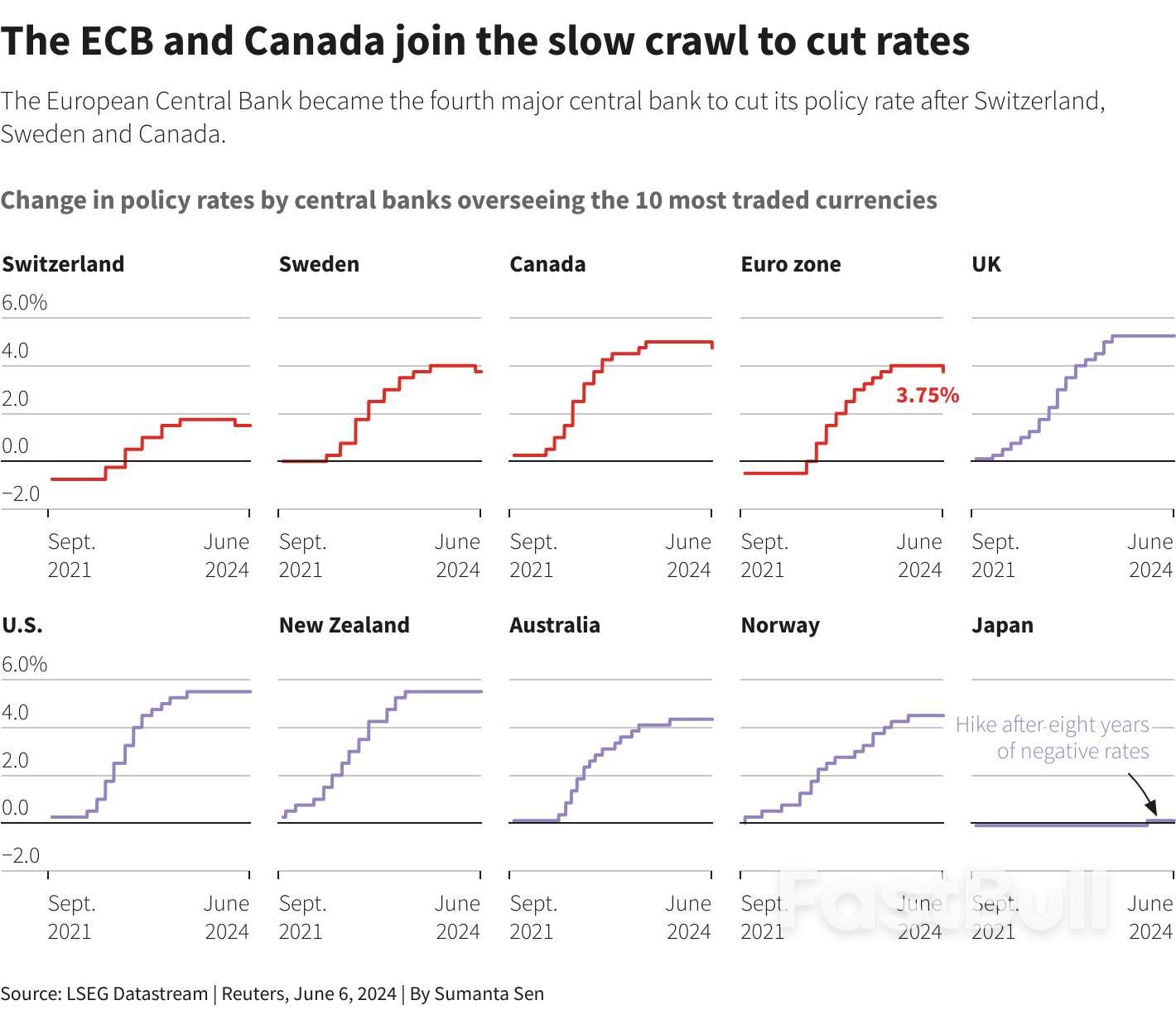
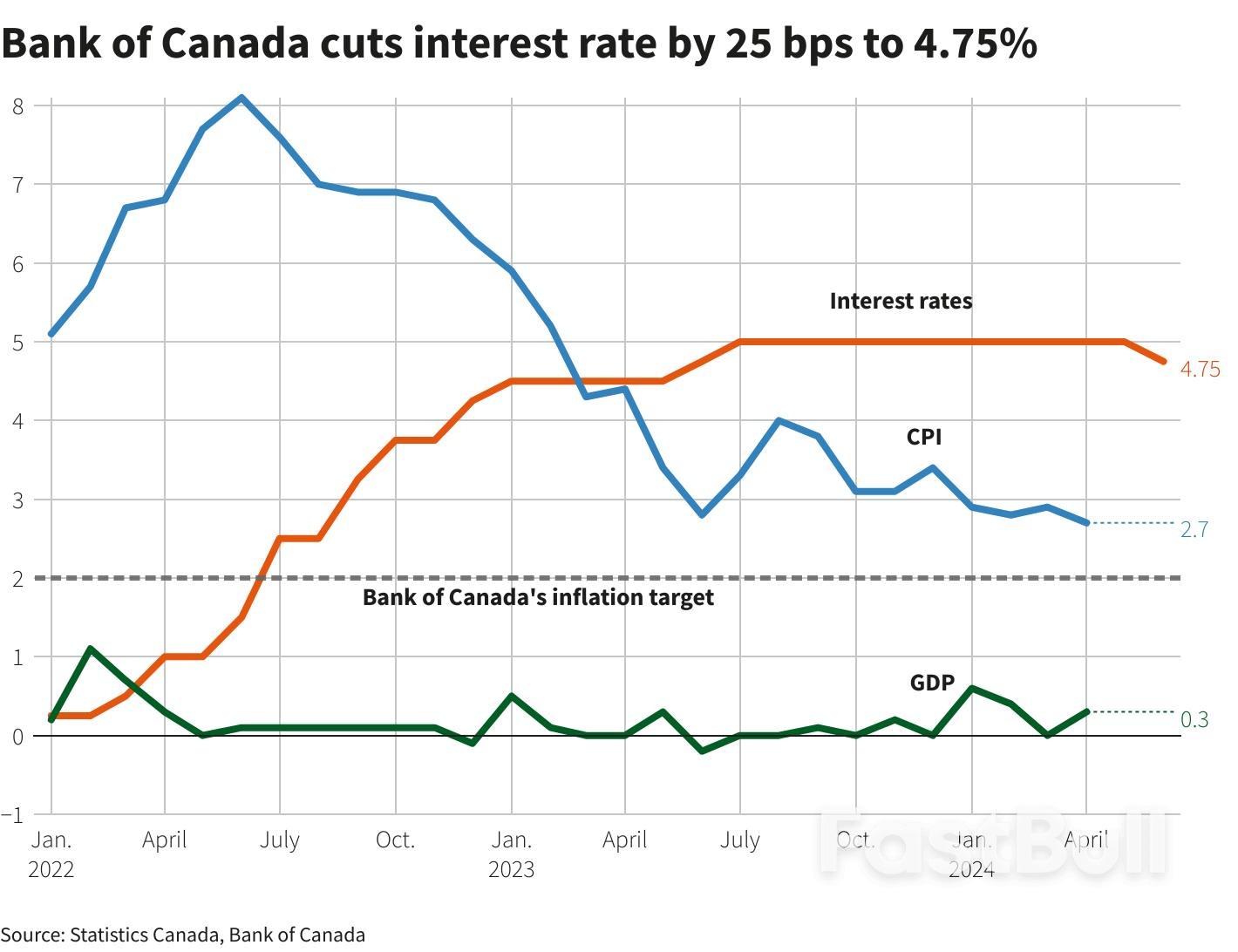
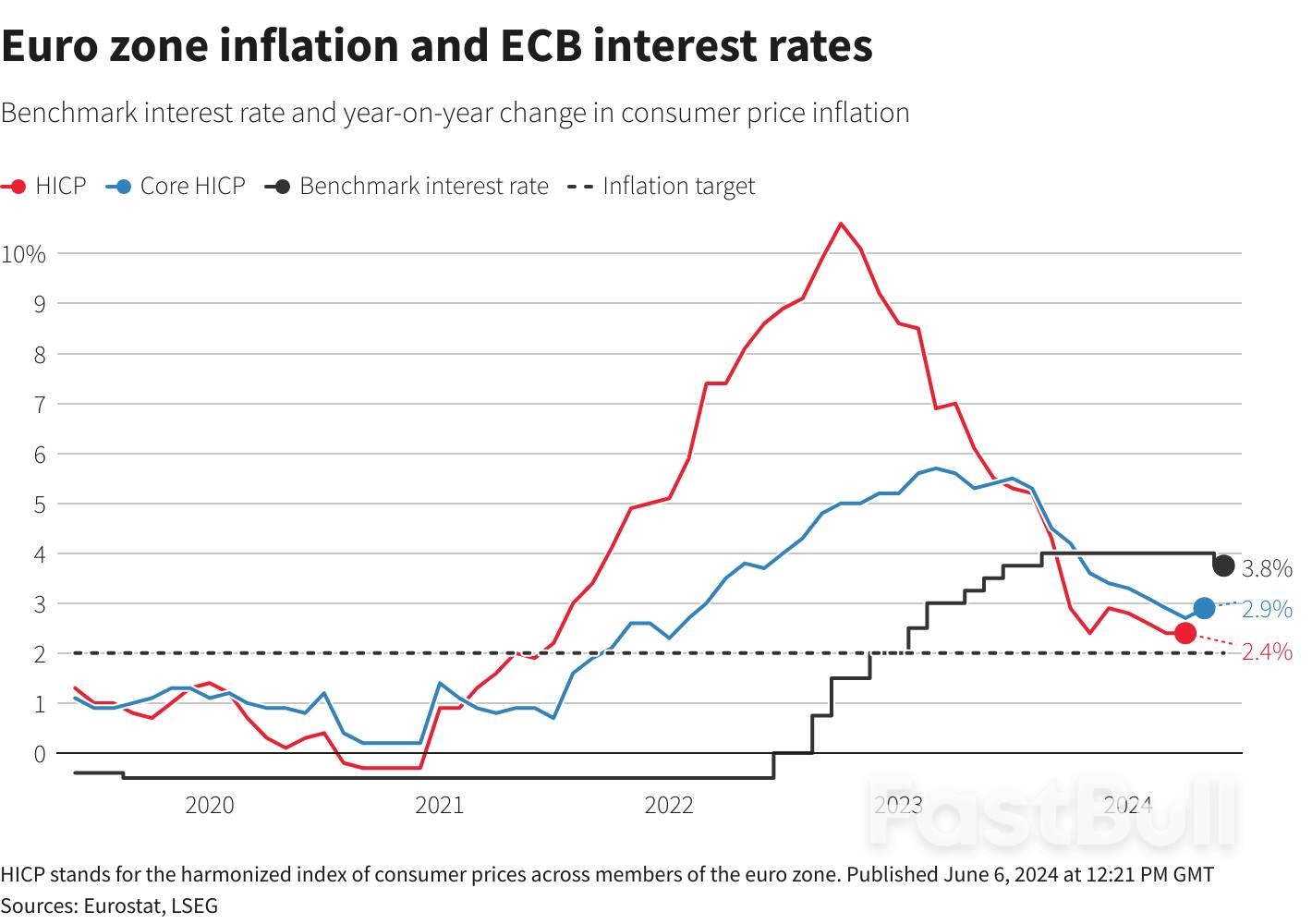
          The European Central Bank and the Bank of Canada, covering four of the G7 major economies, cut interest rates on Wednesday and Thursday in the first reversals of some two years of policy tightening aimed at reining in post-pandemic inflation spikes.
          In well-telegraphed moves, both announced the cuts even with headline inflation rates still above 2.0% targets - 2.6% in the euro zone and 2.7% in Canada. "Core" rates excluding energy and food and other volatile prices are just as high.
          Have they rashly jumped the gun?
          The reasons are well documented - the central banks continue to insist the targets will be hit, they forecast success on that front over the next year or two and claim policy is being pre-emptive by removing just a notch of restraint on slow-growing economies.
          But the timing also reveals the degree of latitude central banks see around what might appear like precise targets - and how getting inflation to within one-tenth of one percentage point of a fairly arbitrary goal may be a fool's errand anyway.
          The Wiggle Room Around 2% Inflation Targets _1
          Many policymakers and economists doubt the wisdom of exact point targeting - citing numerous supply-side distortions in many components of inflation baskets and fretting about wider damage to economies simply in order to ring a 2% bell.
          Having successfully punctured inflation rates to a quarter of the peaks seen in 2022, the risk of forcing recession and a rise in unemployment just to zap a final half percentage point seems to some an overly high price.
          That's especially so if - as their own forecasts and financial market pricing seems to suggest - the risk of a significant re-acceleration of inflation is seen to be low.
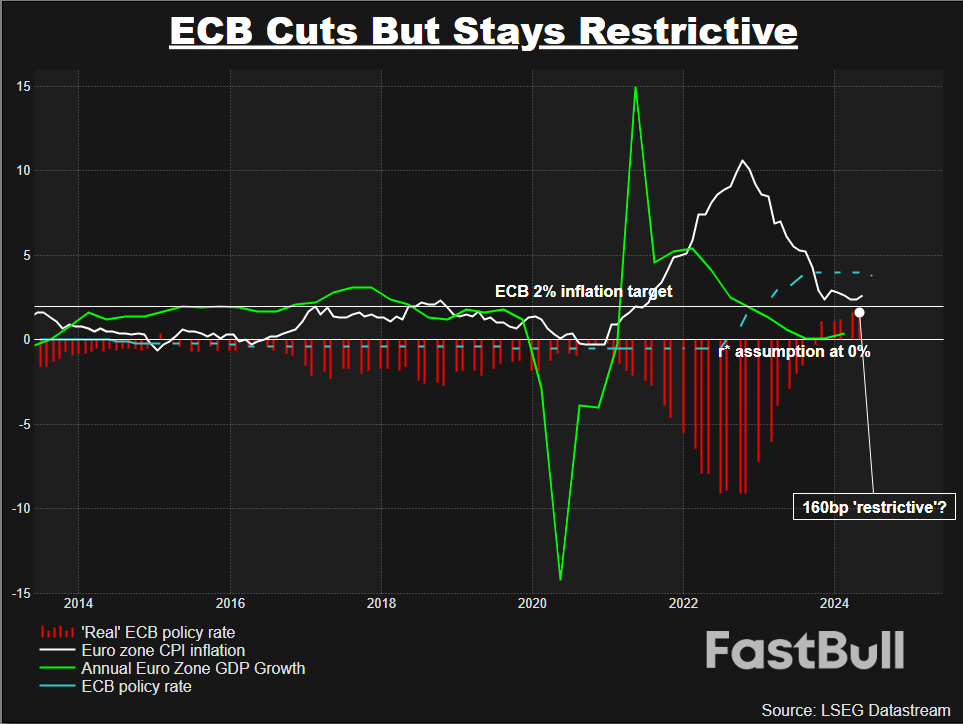
          The debate then shifts to degrees of policy "restrictiveness" - judged mainly by how far current policy rates are above assumed "neutral" levels that would no longer bear down on or stimulate economic activity.
          That in itself leaves a lot of wiggle room for most central banks.
          Even if there's considerable uncertainty on exactly where those largely theoretical neutral rates lie, most experts agree they are much lower than now - allowing central banks to claim a foot's on the brake even as they pare back borrowing rates.
          The Wiggle Room Around 2% Inflation Targets _2
          Estimates by ECB and BoC officials, opens new tab themselves, and indeed from Fed policymakers, opens new tab, indicate neutral policy rates have likely crept higher since the COVID-19 pandemic but they are still almost half the current levels.
          The ECB and BoC were at pains to stress this week that the first cuts don't necessarily presage a series that would wipe out monetary restriction altogether and they continue to monitor everything from sectoral price pressures to wage developments.
          The Wiggle Room Around 2% Inflation Targets _3

          ROOM TO MANOEUVRE

          But restriction aside, central banks' formal targets themselves are not always as rigid as they seem either.
          The Bank of Canada, for example, continually refers to its 2% target in public, but its most recent framework agreement, opens new tab with government covering the 2022-2026 period refers to the 2% target as a mid-point of a 1%-3% "inflation-control range".
          As Canadian inflation has already spent some four months below the upper end of that range, it's not hard to see the green light to ease with the local economy slowing sharply.
          For 18 years, the ECB used to have a target to get inflation "below but close to 2%," but its 2021 strategy review, opens new tab adopted a more symmetric target around 2% "over the medium term" - which at the time was aimed at addressing years of undershoot and acknowledging that an averaging over the time was better.
          And even though it nudged up its 2024 and 2025 inflation forecasts a touch while cutting rates on Thursday, the ECB still expects inflation to average as low as 1.9% in 2026.
          The Wiggle Room Around 2% Inflation Targets _4

          ECB Cuts But Stays Restrictive

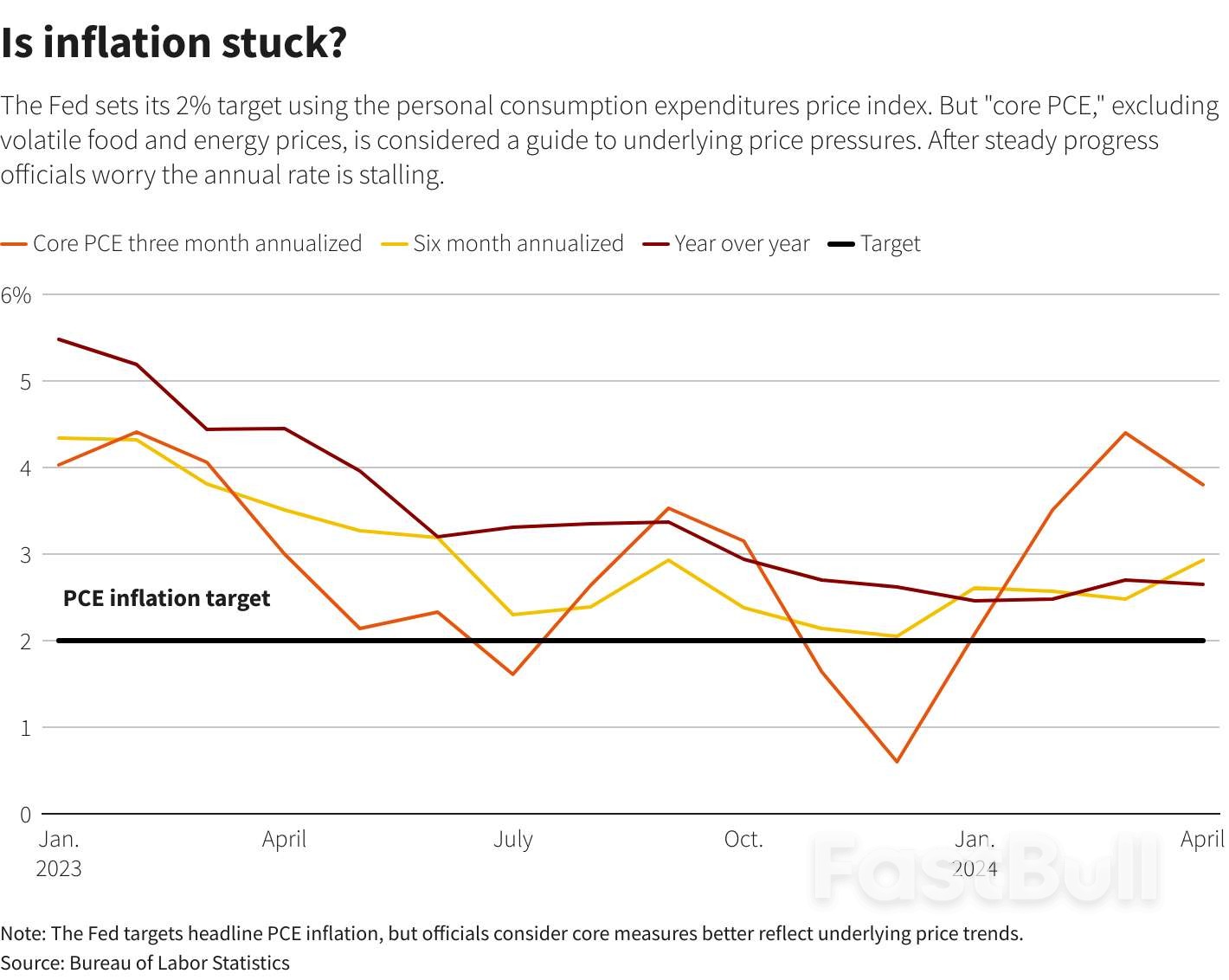
          For the Fed, which holds a policy meeting next week, inflation captured by its core PCE gauge is now similar to equivalents faced by the ECB and BoC - but it's hesitating on rate cuts due to a much stronger economy and looser U.S. fiscal stance.
          However, the U.S. central bank preceded the ECB in a shift of strategy in 2020 toward long-term averaging, opens new tab of inflation in assessing its target.
          Although it's publicly sidestepped that approach during the latest battle - with its next review expected some time next year - the whole approach de-emphasizes the idea of hitting 2% precisely at any one point as the only policy trigger.
          What's more, the Fed's solo 2016-2019 tightening campaign to bring policy rates back up to neutral was also conducted even when core PCE rates languished below 2% for all but two months of that period. In other words, the return to neutral policy rates then didn't require inflation to be bang on target.
          That same argument could be applied in reverse now.
          The Wiggle Room Around 2% Inflation Targets _5
          For investors, the bias from here will likely be more restrictive policy on average in the years ahead.
          But that probably shouldn't prevent some cuts from here.
          "What is not being openly discussed, certainly by policymakers, is that we might not be able to get back below 2% without a severe recession," said Chris Iggo, chair of the AXA IM Investment Institute, adding that just keeping a lid on inflation here may now see policy rates in a 3%-4% range on a longer-term basis in the U.S. and the United Kingdom and at some 2%-3% in the euro zone.
          "How far above that range rates go depends on the appetite for forcing inflation back down through engineering a recession, an increase in spare capacity and higher unemployment," he wrote. "Living with inflation a little above the target range has greater social utility than the alternative."
          The Wiggle Room Around 2% Inflation Targets _6

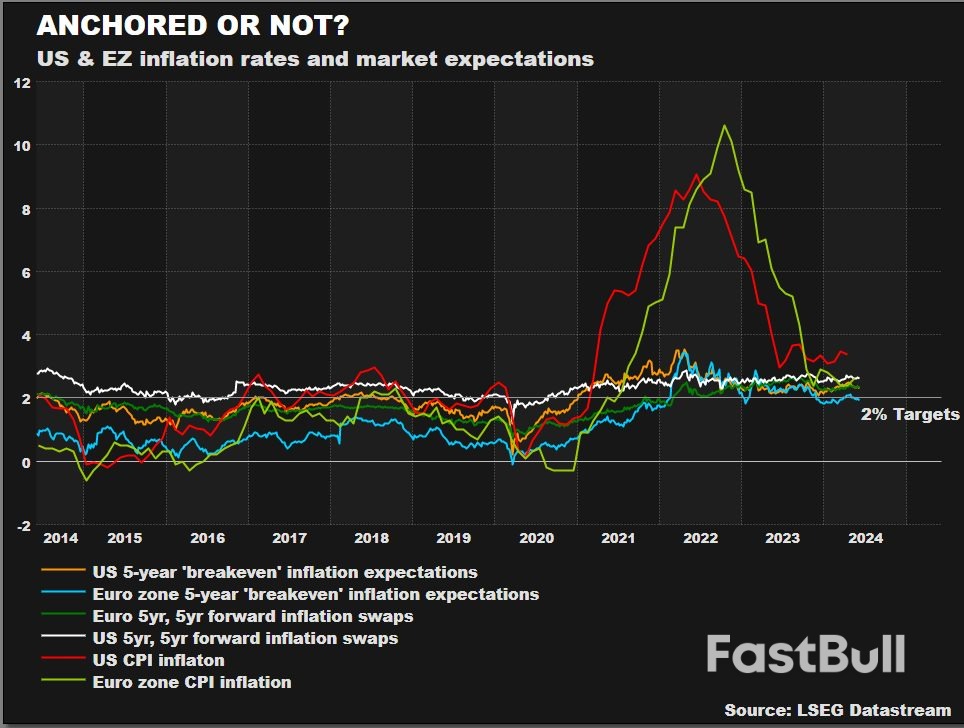
          Inflation expectations anchored?

          Source: Reuters

          To stay updated on all economic events of today, please check out our Economic calendar
          Risk Warnings and Disclaimers
          You understand and acknowledge that there is a high degree of risk involved in trading. Following any strategies or investment methods may lead to potential losses. The content on the site is provided by our contributors and analysts for information purposes only. You are solely responsible for determining whether any trading assets, securities, strategy, or any other product is suitable for investing based on your own investment objectives and financial situation.
          Add to Favorites
          Share

          The Reserve Bank of India Delivers a Hawkish Hold

          ING

          Economic

          Central Bank

          Surprisingly interesting meeting
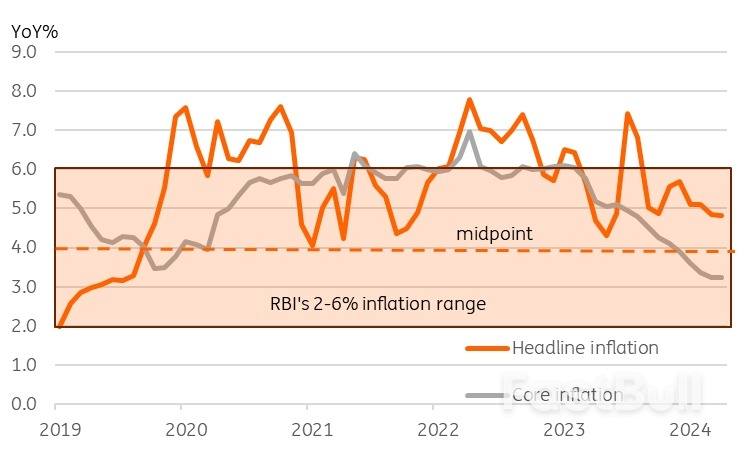
          On paper, this should have been a routine meeting with nothing much to report. India's headline inflation remains stuck in the top half of the Reserve Bank of India's (RBI) inflation target range (2-6%) at 4.8% year-on-year, and first quarter GDP growth for 2024 was another stratospheric 7.7% YoY. Federal Reserve rate cuts still seem a way off and until this week, Asian FX was on the back foot, and the INR was only holding its ground due to heavy RBI management.
          But the loss of Prime Minister Narendra Modi's outright majority and the need to lean more heavily on coalition allies to run the country has increased talk of greater government spending, some slippage on reforms, and potentially even some chiselling away at the RBI's independence.
          And that may be the light in which to read today's RBI statement, which pushed back at calls for imminent easing and doesn't suggest the RBI will be minded to ease until later on in the year.

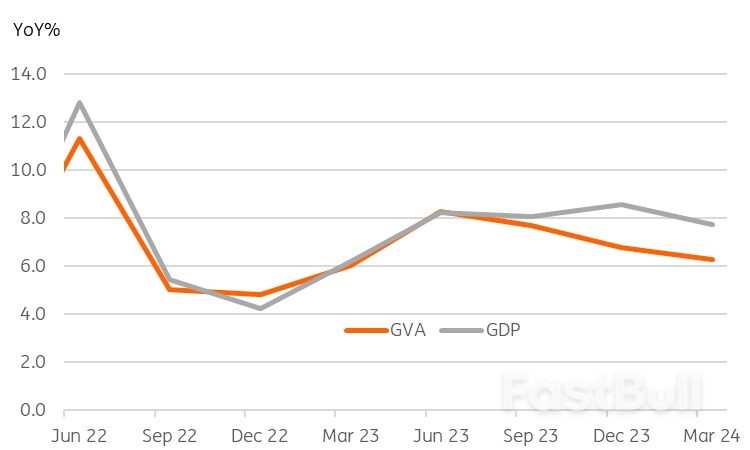
          GDP versus GVA (YoY%)

          The Reserve Bank of India Delivers a Hawkish Hold_1

          Why is easing even being talked about?

          With growth hovering in the high-7% range, and inflation only just below 5%, it may seem strange that anyone - including two MPC members - is arguing for a rate cut. It may seem just as strange that cuts are being advocated on the basis that the RBI's rate policy is currently damaging growth.
          Those who make such arguments note that the gross value added (GVA) measures of economic output, a production-based equivalent of GDP, has been running much softer than GDP growth. Compared to the 7.7% GDP rate recorded for the first quarter of this year, the GVA measure recorded only 6.3% in the same period and has been consistently softer than GDP, which even some previous RBI governors have hinted was a slightly flaky statistic.
          With some commentators pointing to high unemployment (despite the apparent strong growth) as a reason for disaffection at the polls, a boost to growth from lower rates might be seen as one way to repair some of that damage.

          Headline versus core inflation

          The Reserve Bank of India Delivers a Hawkish Hold_2

          Core inflation is looking fairly benign

          On the inflation front, headline inflation has been in the top half of the RBI's range for quite some time – although much of that is owed to elevated food prices, and core inflation looks much less concerning.
          But as the RBI statement notes, some of these non-core influences are expected to persist, and only briefly for one quarter (the third quarter of this year) does it expect inflation to dip below the mid-point of their inflation target range.
          The RBI also quite sensibly seems to view the risks of persistent shocks to food as asymmetric and biased upwards given climate change and the growing likelihood of meteorological shocks.
          So, despite running one of the highest policy rates in the region, both in absolute terms and relative to inflation ("realised" real inflation is a rough yardstick for policy tightness), it looks as if the RBI wants to see a bit more evidence of inflation coming down and running closer to its target midpoint before it would consider easing rates.
          We are not forecasting the RBI to cut until the fourth quarter of this year. But we could move this up to the third quarter if the Federal Reserve begins to ease before then, as this would also take some pressure off the INR.
          To stay updated on all economic events of today, please check out our Economic calendar
          Risk Warnings and Disclaimers
          You understand and acknowledge that there is a high degree of risk involved in trading. Following any strategies or investment methods may lead to potential losses. The content on the site is provided by our contributors and analysts for information purposes only. You are solely responsible for determining whether any trading assets, securities, strategy, or any other product is suitable for investing based on your own investment objectives and financial situation.
          Add to Favorites
          Share

          U.S. May Non-farm Payrolls Outlook: Government Employment Could Be Decisive

          FastBull Featured
          The U.S. Bureau of Labor Statistics will release the non-farm payroll report for May on June 7, ET. The significant decrease in the previous non-farm payroll report in April, which was well below expectations and the previous reading, has reignited speculation of a rate cut. Additionally, the three-month average of non-farm payrolls for April was 242,000, compared to 269,000 in March and 261,000 in February.
          What does this mean?
          Looking at historical levels, the average monthly increase in employment in 2023 was 251,000, while in the first quarter of 2024, it was 276,000 per month. Therefore, despite the unexpected sharp decline in non-farm payroll in April, the overall U.S. labor market remains relatively tight. In other words, there has been a slowdown, but it is limited.
          The above is the April non-farm payroll data, which gives an overview of the U.S. labor market. In simple terms, while the April non-farm payroll provided some hope for the Federal Reserve, it did not establish a slowing trend for them as a single set of data cannot pinpoint the issue.
          Looking at the breakdown of the April non-farm payroll data, employment growth was mainly concentrated in healthcare and social assistance, transportation and warehousing, and retail. However, employment in the automotive manufacturing and temporary services sectors declined. The leisure and hospitality as well as construction saw growth, although at a slower pace.
          Knowing the above-mentioned influencing factors, we could get an overview of the non-farm payrolls this time.
          JOLTs Job Openings and ADP
          JOLTs Job Openings
          According to the April JOLTs Job Openings and the May ADP Employment Report released this week:
          In April, job openings in healthcare and social assistance (-204,000) and state and local government education (-59,000) decreased.
          Briefly speaking, a decrease in job openings in a particular industry does not contradict an increase in non-farm payrolls. The decrease in job openings could be due to previously advertised positions being filled or some companies withdrawing the recruitment for those openings, while the increase in employment reflects the successful filling of positions. The two can occur simultaneously and actually complement each other, providing a more complete picture of labor market dynamics.
          In the healthcare and social assistance sector, there has been a significant decrease in job openings. Although it is unclear how many of these openings have translated into additional employment (a decrease in job openings does not directly equate to an increase in employment numbers), the large base number suggests that the contribution to new employment numbers will not be insignificant.
          As for the government sector, typically, due to its significantly lower weight compared to the private sector, its impact on non-farm payroll employment is relatively limited. However, it is worth noting that last July, government employment experienced a significant decline, mainly due to a decrease in education positions at the state and local level coinciding with the summer break. In the July JOLTs Job Openings Report at that time, there was a reduction of 62,000 positions in state and local government education roles.
          Judging from the current timing and the sharp decrease in job openings in April JOLTs in both state and local government education (-59,000), is it similar to the above scenario? Therefore, it is reasonable to believe that most of these reduced job openings have not been filled, but rather reduced recruitment (such as closing job postings). Further evidence is that government departures increased by 38,000 in April, with state and local government education-related departures accounting for 32,000, a high percentage of 84%.
          In the upcoming data, whether it is non-farm payrolls or JOLTs Job Openings, government data may not be too promising due to seasonal reasons.
          ADP
          In the ADP employment report for May, the goods-producing sector added only 3,000 jobs despite the boom in the construction industry (32,000 jobs), significantly down from 47,000 the previous month. This decline was primarily driven by the drag from manufacturing, natural resources, and mining. The service-producing sector added 149,000 jobs, with trade, transportation, and utilities increasing by 55,000 jobs, and education and health services adding 46,000 jobs.
          The boom in the construction industry can be attributed to the housing market. Early in the year, due to the lack of existing home inventory for single-family homes, developers expanded single-family home starts. However, high mortgage rates have led to sluggish new home sales. As of the end of April, the inventory of new homes for sale remained high at 480,000 units, the highest level since 2008. At the current sales pace, this translates to a supply of 9.1 months, whereas a balanced market typically has a supply of 5 to 6 months, indicating ample new home inventory. In contrast, the supply of existing homes is only 3.5 months, with an average market duration of 26 days, significantly lower than March's 33 days.
          From this, it can be inferred that in April, the housing market focus shifted from new homes to existing homes, which means the construction industry may lose its primary driving force. The abundant inventory and reduced sales of new homes will likely lead to a decrease in new home starts, subsequently reducing the need for related workers. It should be noted that due to the lag between home sales and home construction, changes in employment numbers in the construction industry may not be immediately apparent. In other words, construction employment is likely to gradually decrease in the future.
          Clues about the trade, transportation, and utilities sectors can be found in the recently released ISM Services PMI. In May, these sectors significantly exceeded market expectations due to a notable increase in business activity, faster growth in new orders, and slower supplier deliveries. The three driving factors suggest increased demand for transportation and warehousing. Additionally, the business activity index for trade, transportation, and utilities also recorded a rise, indicating that business activities in these sectors are expanding. Taken together, trade, transportation, and utilities are likely to perform well in the upcoming non-farm payroll report.
          As for education and health services, this is a large category that includes healthcare and social assistance. The analysis for this category has already been provided earlier.
          Driving Sectors in Previous NFP
          Besides the aforementioned sectors, several other industries have consistently played a crucial role in driving changes in non-farm payroll employment figures over the years.
          Leisure and Hospitality: Recently, there has been an uptick in travel activities in the U.S., likely due to the upcoming travel season, which undoubtedly boosts the leisure and hospitality sector. Last year's vacation season saw a slump in the leisure and hospitality sector, possibly due to high inflation and high oil prices at the time. However, current inflation and oil prices are considerably lower than last year, which may encourage more vacation activities. Furthermore, the impact of the vacation season on the leisure and hospitality sector is seasonal and prolonged, suggesting a potential increase in employment in this sector in the upcoming NFP report.
          Retail Trade: Multiple recent indicators have shown that consumers are becoming more sensitive to prices, increasingly resisting further price hikes by businesses. It is becoming harder for companies to pass on costs, indicating that consumers are now more cautious with their spending. Many retailers have started offering discounts to attract customers. Nonetheless, this adjustment takes time and is unlikely to be reflected in this month's NFP data. Therefore, the retail trade sector might perform poorly in the upcoming report.
          Overall Outlook: The healthcare social assistance sector and the government sector are expected to be the biggest variables in this month's NFP report. While employment in the construction industry might weaken, this will be a gradual process. The transportation and warehousing sector might perform well, the leisure and hospitality sector could show improvement compared to the April NFP report, while the retail trade sector might underperform. Overall, the significant drop in April's non-farm payrolls was mainly due to the poor performance of the leisure and hospitality sector. In May, this sector is likely to perform better, though it might be offset by the performance of the government sector. If the government sector performs well, the NFP report might exceed expectations; if it underperforms, it could drag down the overall results.
          Risk Warnings and Disclaimers
          You understand and acknowledge that there is a high degree of risk involved in trading. Following any strategies or investment methods may lead to potential losses. The content on the site is provided by our contributors and analysts for information purposes only. You are solely responsible for determining whether any trading assets, securities, strategy, or any other product is suitable for investing based on your own investment objectives and financial situation.
          Add to Favorites
          Share

          London Midday: Stocks Fall as Investors Eye Payrolls Report

          Warren Takunda

          Economic

          Stocks

          London stocks had fallen into the red by midday on Friday as investors eyed the release of the latest US non-farm payrolls report.
          The FTSE 100 was down 0.6% at 8,238.20.
          Russ Mould, investment director at AJ Bell, said: "After a week of steady recovery from Monday’s sell-off, the FTSE 100 returned to the back foot on Friday, dragged lower by retail and banking stocks.
          "Wall Street paused for breath last night ahead of non-farm payrolls data later and, more significantly, a meeting of the Federal Reserve next week. The Fed isn’t expected to cut rates just yet, but investors will be watching closely for any indication a move on this front is coming."
          The non-farm payrolls report for May is due at 1330 BST, along with average earnings and the unemployment rate.
          Consensus expectations are for 185,000 to have been added in May, versus 175,000 in April and 315,000 in March. Meanwhile, the unemployment rate is expected to be unchanged at 3.9%.
          On home shores, data released earlier showed that house prices were largely unchanged last month as the market continued to stabilise.
          According to the latest Halifax house price index, average house prices were "static" in May, down just 0.1% on a monthly basis. On an annual basis, house price growth was 1.5%, up from 1.1% in April.
          As a result, a typical UK home now costs £288,688.
          Amanda Bryden, head of mortgages at Halifax, said: "Market activity remained resilient throughout the spring months, supported by strong nominal wage growth and some evidence of an improvement in confidence about the economic outlook.
          "A period of relatively stability in both house prices and interest rates should give a degree of confidence to both buyers and selling.
          "While homebuyers will continue to respond to changes in borrowing costs, set against a backdrop of limited supply of properties, the market is unlikely to see huge fluctuations in the near term."
          There wasn’t a whole lot happening on the corporate front, but housebuilder Bellway gained as it kept its guidance for housing completions this fiscal year but lifted its forecast for pricing.
          The company now expects selling prices to average £305,000 for the 12 months to 31 July, down from £310,306 last year but ahead of previous guidance of £295,000 due to changes in product mix.
          Bellway said it has seen stronger trading through the spring selling seasons, with improved affordability supporting an increase in customer confidence and reservation rates compared to the first half of the financial year.
          On the downside, C&C Group plunged after the drinks maker said chief executive Patrick McMahon would be stepping down after accounting errors in the last three years when he was chief finance director.
          The company, which makes brands such as Magners cider and Tennent’s beer, said corrections to the accounts would result in an aggregate underlying operating profit adjustment charge of €5m.
          C&C released unaudited results for the year to February 29 revealing a loss before tax of €111m compared with a profit of €52m a year earlier.

          Source: Sharecast

          To stay updated on all economic events of today, please check out our Economic calendar
          Risk Warnings and Disclaimers
          You understand and acknowledge that there is a high degree of risk involved in trading. Following any strategies or investment methods may lead to potential losses. The content on the site is provided by our contributors and analysts for information purposes only. You are solely responsible for determining whether any trading assets, securities, strategy, or any other product is suitable for investing based on your own investment objectives and financial situation.
          Add to Favorites
          Share

          ECB Policymakers Warn about Inflation Challenge

          Samantha Luan

          Economic

          Central Bank

          The ECB cut interest rates from record highs on Thursday in a long-telegraphed move, but held back from any pledge to ease policy further after inflation and wage growth data in recent weeks came in above its expectations, indicating it will need even longer to meet its target.
          The biggest warning came perhaps from Germany, the euro zone's largest economy, which poured cold water on suggestions that a big wage jump this year was a one-off.
          "Negotiated wages are expected to rise particularly sharply this year and continue to see strong growth thereafter," the Bundesbank said. "Inflation is proving to be stubborn, especially in the case of services."
          Wage rises increase disposable incomes and thus put upward pressure on prices, particularly in wage sensitive sectors like services.
          Bundesbank chief Joachim Nagel said Thursday's rate cut was not premature given the progress on inflation but he also said the ECB would not be on auto pilot for further rate cuts.
          Austria's Robert Holzmann, the only policymaker to oppose Thursday's cut, said that inflation was stickier than the ECB predicted, so the bank needed to act more cautiously in the future.

          TRICKY FEW MONTHS

          ECB Vice President Luis de Guindos said that inflation could still rise from current levels before dropping back to 2% towards the end of next year, making the next few months difficult.
          "There will be months when inflation may even accelerate slightly but we are convinced that next year it will converge with the target," he told Spanish radio station Onda Cero.
          "The coming months will not be easy," he said.
          While most policymakers refrained from making policy predictions, Lithuania's Gediminas Simkus suggested there could be room to ease further this year.
          When asked if further monetary easing this year was possible, Simkus said: "If the economy develops according to forecast, I think so, yes".
          Markets see between one and two cuts this year and a total of four cuts between now and the end of next year in the 3.75% deposit rate.
          Economists argue that any rate at or above 3% restricts economic growth so ECB policy will continue to hold back the economy well into next year.
          The closest ECB President Christine Lagarde came to predicting future moves on Thursday was when she said there was a "strong likelihood" that Thursday's cut was not a one-off but rather the start of a dialling back process.
          Policymakers speaking to Reuters on Thursday, however, said that any step in July is highly unlikely and the next possible window to cut rates would be in September, provided data in the run up to that meeting supported such a move.
          ECB board member Isabel Schnabel, who has already called for a pause in July, nuanced her words on Friday, steering clear of any specific comment on the next meeting.
          "As the future inflation outlook remains uncertain, we cannot pre-commit to a particular rate path," she said.

          Source: Reuters

          To stay updated on all economic events of today, please check out our Economic calendar
          Risk Warnings and Disclaimers
          You understand and acknowledge that there is a high degree of risk involved in trading. Following any strategies or investment methods may lead to potential losses. The content on the site is provided by our contributors and analysts for information purposes only. You are solely responsible for determining whether any trading assets, securities, strategy, or any other product is suitable for investing based on your own investment objectives and financial situation.
          Add to Favorites
          Share
          FastBull
          Copyright © 2025 FastBull Ltd

          728 RM B 7/F GEE LOK IND BLDG NO 34 HUNG TO RD KWUN TONG KLN HONG KONG

          TelegramInstagramTwitterfacebooklinkedin
          App Store Google Play Google Play
          Products
          Charts

          Chats

          Q&A with Experts
          Screeners
          Economic Calendar
          Data
          Tools
          Membership
          Features
          Function
          Markets
          Copy Trading
          Latest Signals
          Contests
          News
          Analysis
          24/7
          Columns
          Education
          Company
          Careers
          About Us
          Contact Us
          Advertising
          Help Center
          Feedback
          User Agreement
          Privacy Policy
          Business

          White Label

          Data API

          Web Plug-ins

          Poster Maker

          Affiliate Program

          Risk Disclosure

          The risk of loss in trading financial instruments such as stocks, FX, commodities, futures, bonds, ETFs and crypto can be substantial. You may sustain a total loss of the funds that you deposit with your broker. Therefore, you should carefully consider whether such trading is suitable for you in light of your circumstances and financial resources.

          No decision to invest should be made without thoroughly conducting due diligence by yourself or consulting with your financial advisors. Our web content might not suit you since we don't know your financial conditions and investment needs. Our financial information might have latency or contain inaccuracy, so you should be fully responsible for any of your trading and investment decisions. The company will not be responsible for your capital loss.

          Without getting permission from the website, you are not allowed to copy the website's graphics, texts, or trademarks. Intellectual property rights in the content or data incorporated into this website belong to its providers and exchange merchants.

          Not Logged In

          Log in to access more features

          FastBull Membership

          Not yet

          Purchase

          Become a signal provider
          Help Center
          Customer Service
          Dark Mode
          Price Up/Down Colors

          Log In

          Sign Up

          Position
          Layout
          Fullscreen
          Default to Chart
          The chart page opens by default when you visit fastbull.com