• Trade
  • Markets
  • Copy
  • Contests
  • News
  • 24/7
  • Calendar
  • Q&A
  • Chats
Trending
Screeners
SYMBOL
LAST
BID
ASK
HIGH
LOW
NET CHG.
%CHG.
SPREAD
SPX
S&P 500 Index
6827.42
6827.42
6827.42
6899.86
6801.80
-73.58
-1.07%
--
DJI
Dow Jones Industrial Average
48458.04
48458.04
48458.04
48886.86
48334.10
-245.98
-0.51%
--
IXIC
NASDAQ Composite Index
23195.16
23195.16
23195.16
23554.89
23094.51
-398.69
-1.69%
--
USDX
US Dollar Index
97.950
98.030
97.950
98.500
97.950
-0.370
-0.38%
--
EURUSD
Euro / US Dollar
1.17394
1.17409
1.17394
1.17496
1.17192
+0.00011
+ 0.01%
--
GBPUSD
Pound Sterling / US Dollar
1.33707
1.33732
1.33707
1.33997
1.33419
-0.00148
-0.11%
--
XAUUSD
Gold / US Dollar
4299.39
4299.39
4299.39
4353.41
4257.10
+20.10
+ 0.47%
--
WTI
Light Sweet Crude Oil
57.233
57.485
57.233
58.011
56.969
-0.408
-0.71%
--

Community Accounts

Signal Accounts
--
Profit Accounts
--
Loss Accounts
--
View More

Become a signal provider

Sell trading signals to earn additional income

View More

Guide to Copy Trading

Get started with ease and confidence

View More

Signal Accounts for Members

All Signal Accounts

Best Return
  • Best Return
  • Best P/L
  • Best MDD
Past 1W
  • Past 1W
  • Past 1M
  • Past 1Y

All Contests

  • All
  • Trump Updates
  • Recommend
  • Stocks
  • Cryptocurrencies
  • Central Banks
  • Featured News
Top News Only
Share

China's Central Financial And Economic Affairs Commission Deputy Director: Will Expand Export And Increase Import In 2026

Share

Thai Leader Anutin: Landmine Blast That Killed Thai Soldiers 'Not A Roadside Accident'

Share

Thai Leader Anutin: Thailand To Continue Military Action Until 'We Feel No More Harm'

Share

Cambodian Prime Minister Hun Manet Says He Had Phone Calls With Trump And Malaysian Leader Anwar About Ceasefire

Share

Cambodia's Hun Manet Says USA, Malaysia Should Verify 'Which Side Fired First' In Latest Conflict

Share

Cambodia's Hun Manet: Cambodia Maintains Its Stance In Seeking Peaceful Resolution Of Disputes

Share

Nasdaq Companies: Allergan, Ferrovia, Insmed, Monolithic Power Systems, Seagate Technology, And Western Digital Will Be Added To The NASDAQ 100 Index. Biogen, CdW, GlobalFoundries, Lululemon, ON Semiconductor, And Tradedesk Will Be Removed From The NASDAQ 100 Index

Share

Witkoff Headed To Berlin This Weekend To Meet With Zelenskiy, European Leaders -Wsj Reporter On X

Share

Russia Attacks Two Ukrainian Ports, Damaging Three Turkish-Owned Vessels

Share

[Historic Flooding Occurs In At Least Four Rivers In Washington State Due To Days Of Torrential Rains] Multiple Areas In Washington State Have Been Hit By Severe Flooding Due To Days Of Torrential Rains, With At Least Four Rivers Experiencing Historic Flooding. Reporters Learned On The 12th That The Floods Caused By The Torrential Rains In Washington State Have Destroyed Homes And Closed Several Highways. Experts Warn That Even More Severe Flooding May Occur In The Future. A State Of Emergency Has Been Declared In Washington State

Share

Trump Says Proposed Free Economic Zone In Donbas Would Work

Share

Trump: I Think My Voice Should Be Heard

Share

Trump Says Will Be Choosing New Fed Chair In Near Future

Share

Trump Says Proposed Free Economic Zone In Donbas Complex But Would Work

Share

Trump Says Land Strikes In Venezuela Will Start Happening

Share

US President Trump: Thailand And Cambodia Are In A Good Situation

Share

State Media: North Korean Leader Kim Hails Troops Returning From Russia Mission

Share

The 10-year Treasury Yield Rose About 5 Basis Points During The "Fed Rate Cut Week," And The 2/10-year Yield Spread Widened By About 9 Basis Points. On Friday (December 12), In Late New York Trading, The Yield On The Benchmark 10-year US Treasury Note Rose 2.75 Basis Points To 4.1841%, A Cumulative Increase Of 4.90 Basis Points For The Week, Trading Within A Range Of 4.1002%-4.2074%. It Rose Steadily From Monday To Wednesday (before The Fed Announced Its Rate Cut And Treasury Bill Purchase Program), Subsequently Exhibiting A V-shaped Recovery. The 2-year Treasury Yield Fell 1.82 Basis Points To 3.5222%, A Cumulative Decrease Of 3.81 Basis Points For The Week, Trading Within A Range Of 3.6253%-3.4989%

Share

Trump: Lots Of Progress Being Made On Russia-Ukraine

Share

NOPA November US Soybean Crush Estimated At 220.285 Million Bushels

TIME
ACT
FCST
PREV
U.K. Trade Balance Non-EU (SA) (Oct)

A:--

F: --

P: --

U.K. Trade Balance (Oct)

A:--

F: --

P: --

U.K. Services Index MoM

A:--

F: --

P: --

U.K. Construction Output MoM (SA) (Oct)

A:--

F: --

P: --

U.K. Industrial Output YoY (Oct)

A:--

F: --

P: --

U.K. Trade Balance (SA) (Oct)

A:--

F: --

P: --

U.K. Trade Balance EU (SA) (Oct)

A:--

F: --

P: --

U.K. Manufacturing Output YoY (Oct)

A:--

F: --

P: --

U.K. GDP MoM (Oct)

A:--

F: --

P: --

U.K. GDP YoY (SA) (Oct)

A:--

F: --

P: --

U.K. Industrial Output MoM (Oct)

A:--

F: --

P: --

U.K. Construction Output YoY (Oct)

A:--

F: --

P: --

France HICP Final MoM (Nov)

A:--

F: --

P: --

China, Mainland Outstanding Loans Growth YoY (Nov)

A:--

F: --

P: --

China, Mainland M2 Money Supply YoY (Nov)

A:--

F: --

P: --

China, Mainland M0 Money Supply YoY (Nov)

A:--

F: --

P: --

China, Mainland M1 Money Supply YoY (Nov)

A:--

F: --

P: --

India CPI YoY (Nov)

A:--

F: --

P: --

India Deposit Gowth YoY

A:--

F: --

P: --

Brazil Services Growth YoY (Oct)

A:--

F: --

P: --

Mexico Industrial Output YoY (Oct)

A:--

F: --

P: --

Russia Trade Balance (Oct)

A:--

F: --

P: --

Philadelphia Fed President Henry Paulson delivers a speech
Canada Building Permits MoM (SA) (Oct)

A:--

F: --

P: --

Canada Wholesale Sales YoY (Oct)

A:--

F: --

P: --

Canada Wholesale Inventory MoM (Oct)

A:--

F: --

P: --

Canada Wholesale Inventory YoY (Oct)

A:--

F: --

P: --

Canada Wholesale Sales MoM (SA) (Oct)

A:--

F: --

P: --

Germany Current Account (Not SA) (Oct)

A:--

F: --

P: --

U.S. Weekly Total Rig Count

A:--

F: --

P: --

U.S. Weekly Total Oil Rig Count

A:--

F: --

P: --

Japan Tankan Large Non-Manufacturing Diffusion Index (Q4)

--

F: --

P: --

Japan Tankan Small Manufacturing Outlook Index (Q4)

--

F: --

P: --

Japan Tankan Large Non-Manufacturing Outlook Index (Q4)

--

F: --

P: --

Japan Tankan Large Manufacturing Outlook Index (Q4)

--

F: --

P: --

Japan Tankan Small Manufacturing Diffusion Index (Q4)

--

F: --

P: --

Japan Tankan Large Manufacturing Diffusion Index (Q4)

--

F: --

P: --

Japan Tankan Large-Enterprise Capital Expenditure YoY (Q4)

--

F: --

P: --

U.K. Rightmove House Price Index YoY (Dec)

--

F: --

P: --

China, Mainland Industrial Output YoY (YTD) (Nov)

--

F: --

P: --

China, Mainland Urban Area Unemployment Rate (Nov)

--

F: --

P: --

Saudi Arabia CPI YoY (Nov)

--

F: --

P: --

Euro Zone Industrial Output YoY (Oct)

--

F: --

P: --

Euro Zone Industrial Output MoM (Oct)

--

F: --

P: --

Canada Existing Home Sales MoM (Nov)

--

F: --

P: --

Euro Zone Total Reserve Assets (Nov)

--

F: --

P: --

U.K. Inflation Rate Expectations

--

F: --

P: --

Canada National Economic Confidence Index

--

F: --

P: --

Canada New Housing Starts (Nov)

--

F: --

P: --

U.S. NY Fed Manufacturing Employment Index (Dec)

--

F: --

P: --

U.S. NY Fed Manufacturing Index (Dec)

--

F: --

P: --

Canada Core CPI YoY (Nov)

--

F: --

P: --

Canada Manufacturing Unfilled Orders MoM (Oct)

--

F: --

P: --

Canada Manufacturing New Orders MoM (Oct)

--

F: --

P: --

Canada Core CPI MoM (Nov)

--

F: --

P: --

Canada Manufacturing Inventory MoM (Oct)

--

F: --

P: --

Canada CPI YoY (Nov)

--

F: --

P: --

Canada CPI MoM (Nov)

--

F: --

P: --

Canada CPI YoY (SA) (Nov)

--

F: --

P: --

Canada Core CPI MoM (SA) (Nov)

--

F: --

P: --

Q&A with Experts
    • All
    • Chatrooms
    • Groups
    • Friends
    Connecting
    .
    .
    .
    Type here...
    Add Symbol or Code

      No matching data

      All
      Trump Updates
      Recommend
      Stocks
      Cryptocurrencies
      Central Banks
      Featured News
      • All
      • Russia-Ukraine Conflict
      • Middle East Flashpoint
      • All
      • Russia-Ukraine Conflict
      • Middle East Flashpoint
      Search
      Products

      Charts Free Forever

      Chats Q&A with Experts
      Screeners Economic Calendar Data Tools
      Membership Features
      Data Warehouse Market Trends Institutional Data Policy Rates Macro

      Market Trends

      Market Sentiment Order Book Forex Correlations

      Top Indicators

      Charts Free Forever
      Markets

      News

      News Analysis 24/7 Columns Education
      From Institutions From Analysts
      Topics Columnists

      Latest Views

      Latest Views

      Trending Topics

      Top Columnists

      Latest Update

      Signals

      Copy Rankings Latest Signals Become a signal provider AI Rating
      Contests
      Brokers

      Overview Brokers Assessment Rankings Regulators News Claims
      Broker listing Forex Brokers Comparison Tool Live Spread Comparison Scam
      Q&A Complaint Scam Alert Videos Tips to Detect Scam
      More

      Business
      Events
      Careers About Us Advertising Help Center

      White Label

      Data API

      Web Plug-ins

      Affiliate Program

      Awards Institution Evaluation IB Seminar Salon Event Exhibition
      Vietnam Thailand Singapore Dubai
      Fans Party Investment Sharing Session
      FastBull Summit BrokersView Expo
      Recent Searches
        Top Searches
          Markets
          News
          Analysis
          User
          24/7
          Economic Calendar
          Education
          Data
          • Names
          • Latest
          • Prev

          View All

          No data

          Scan to Download

          Faster Charts, Chat Faster!

          Download App
          English
          • English
          • Español
          • العربية
          • Bahasa Indonesia
          • Bahasa Melayu
          • Tiếng Việt
          • ภาษาไทย
          • Français
          • Italiano
          • Türkçe
          • Русский язык
          • 简中
          • 繁中
          Open Account
          Search
          Products
          Charts Free Forever
          Markets
          News
          Signals

          Copy Rankings Latest Signals Become a signal provider AI Rating
          Contests
          Brokers

          Overview Brokers Assessment Rankings Regulators News Claims
          Broker listing Forex Brokers Comparison Tool Live Spread Comparison Scam
          Q&A Complaint Scam Alert Videos Tips to Detect Scam
          More

          Business
          Events
          Careers About Us Advertising Help Center

          White Label

          Data API

          Web Plug-ins

          Affiliate Program

          Awards Institution Evaluation IB Seminar Salon Event Exhibition
          Vietnam Thailand Singapore Dubai
          Fans Party Investment Sharing Session
          FastBull Summit BrokersView Expo

          BOJ Must Be Vigilant to Yen's Impact on Economy, Says Deputy Governor Himino

          Cohen

          Economic

          Central Bank

          Forex

          Summary:

          Bank of Japan Deputy Governor Ryozo Himino said the central bank must be "very vigilant" to the impact the yen's moves could have on the economy...

          Bank of Japan Deputy Governor Ryozo Himino said the central bank must be "very vigilant" to the impact the yen's moves could have on the economy, suggesting the currency's weakness will be among factors affecting the timing of its next interest rate hike.
          However, he said it was inappropriate for central banks to directly target exchange rates in setting monetary policy, as other factors needed to be considered as well.
          "Exchange-rate fluctuations affect economic activity in various ways. It also affects inflation in a broad-based and sustained way, beyond the direct impact on import prices," Himino said on Tuesday.
          "That's why we obviously need to be very vigilant to, and analyse very closely, the impact of exchange-rate volatility on the economy, prices and their outlook," he said in a panel session hosted by Columbia University in Tokyo.
          The BOJ shouldn't automatically respond to exchange-rate moves in setting interest rates, though, as there were "other aspects" that need to be taken into account such as the economic and price outlook, he added.
          A weak yen has become a headache for Prime Minister Fumio Kishida's administration, which has seen its approval ratings slump as the currency's decline pushed up households' cost of living by inflating the price of importing food and fuel.
          BOJ Governor Kazuo Ueda has ruled out using monetary policy to directly influence exchange-rate moves, but signalled the chance of raising rates if the weak yen pushes up inflation more than expected.
          Many market players expect the BOJ to raise interest rates from current near-zero levels this year with some expecting a move as early as July, partly to slow the yen's persistent decline.
          Asked what the central bank would do with its huge balance sheet, Himino said the BOJ would make a decision focusing on how it would affect the economy, prices and its goal of sustainably achieving its 2% inflation target.
          "It's desirable for markets to set long-term interest rates. On the other hand, the BOJ has been deeply involved in the bond market up till very recently and our presence remains very large. We need to avoid causing discontinuity or any unintended moves in the market," Himino said.
          The remarks underscore the tricky balancing act the BOJ faces in allowing market forces to drive long-term interest rates higher, while avoiding an abrupt spike in bond yields.
          In March, the BOJ ended eight years of negative interest rates and a policy capping long-term borrowing costs around zero dubbed yield curve control (YCC).
          The decision was partly aimed at breathing life back to a market made dormant by the BOJ's huge presence, and allowing market forces to drive yield moves.
          Markets are focusing on whether the BOJ, at its next policy meeting on June 13-14, will move to a full-fledged reduction in its huge bond purchases.
          The 10-year government bond yield briefly jumped to 1.1% last week, the highest level since July 2011, on growing expectations of a near-term interest rate hike.

          Source: Reuters

          To stay updated on all economic events of today, please check out our Economic calendar
          Risk Warnings and Disclaimers
          You understand and acknowledge that there is a high degree of risk involved in trading. Following any strategies or investment methods may lead to potential losses. The content on the site is provided by our contributors and analysts for information purposes only. You are solely responsible for determining whether any trading assets, securities, strategy, or any other product is suitable for investing based on your own investment objectives and financial situation.
          Add to Favorites
          Share

          Modi Eyes Victory As India Counts Epic Vote

          Alex

          Economic

          Political

          India's Hindu nationalist Prime Minister Narendra Modi and his allies were heading for victory at the halfway point in the country's general election count on Tuesday, but with a reduced parliamentary majority.
          His campaign deepened concerns for minority rights in the world's most populous country, as he wooed the Hindu majority to the worry of the 200-million-plus Muslim community.
          Early figures showed Modi and his coalition allies on track to win a third term with a reduced majority after a six-week-long election that saw 642 million people vote in seven stages across the world's most populous country.
          Modi, 73, said at the weekend he was confident that "the people of India have voted in record numbers" to re-elect his government, a decade after he first became prime minister.
          But stocks slumped over seven percent on India's benchmark Sensex index in afternoon trade, after opposition parties appeared to have put up a better-than-expected fight, suggesting a reduced majority for Modi's ruling Bharatiya Janata Party (BJP).
          Shares in the main listed unit of Adani Enterprises -- owned by key Modi ally Gautam Adani -- dropped 25 percent.
          With half the votes counted, election commission figures showed the BJP and its allies leading in at least 290 out of a total of 543 seats.
          That is above the 272 needed for a lower house parliamentary majority, but lower than the joint total for the BJP and allies of 353 in 2019.

          Opposition criticism

          Modi's opponents have struggled to counter the BJP's well-oiled and well-funded campaign juggernaut, and have been hamstrung by what they say are politically motivated criminal cases aimed at hobbling challengers.
          US think tank Freedom House said this year that the BJP had "increasingly used government institutions to target political opponents".
          Arvind Kejriwal, chief minister of the capital Delhi and a key leader in an alliance formed to compete against Modi, returned to jail on Sunday.
          Kejriwal, 55, was detained in March over a long-running corruption probe, but was later released and allowed to campaign as long as he returned to custody once voting ended.
          "When power becomes dictatorship, then jail becomes a responsibility," Kejriwal said before surrendering himself, vowing to continue "fighting" from behind bars.
          Many of India's Muslim minority are increasingly uneasy about their futures and their community's place in the constitutionally secular country.
          Modi himself made several strident comments about Muslims on the campaign trail, referring to them as "infiltrators".

          Logistics of vote count

          The polls were staggering in their size and logistical complexity, with voters casting their ballots in megacities New Delhi and Mumbai, as well as in sparsely populated forest areas and the high-altitude territory of Kashmir.
          Votes were cast on electronic voting machines, so the tally will be rapid, with results expected later Tuesday.
          Counting began in the morning at key tally centres in each state, with the data fed into computers.
          "People should know about the strength of Indian democracy," chief election commissioner Rajiv Kumar said Monday, vowing there was a "robust counting process in place".

          Heatwave voting

          In past years, key trends have been clear by mid-afternoon with losers conceding defeat, even though full and final results may only come late on Tuesday night.
          Celebrations had already begun at the headquarters of Modi's BJP before the full announcement of results.
          Figures so far showed the BJP with a vote share just over one point higher than its last victory in 2019, but the party was forecast to win fewer seats.
          Election chief Kumar on Monday proclaimed the 642 million votes cast a "world record".
          But based on the commission's figure of an electorate of 968 million, turnout came to 66.3 percent, down roughly one percentage point from 67.4 percent in the last polls in 2019.
          Final voter data is yet to be released as repolling took place in two stations in West Bengal state on Monday.
          Analysts have partly blamed the lower turnout on a searing heatwave across northern India, with temperatures over 45 degrees Celsius (113 degrees Fahrenheit).

          Source:AFP

          To stay updated on all economic events of today, please check out our Economic calendar
          Risk Warnings and Disclaimers
          You understand and acknowledge that there is a high degree of risk involved in trading. Following any strategies or investment methods may lead to potential losses. The content on the site is provided by our contributors and analysts for information purposes only. You are solely responsible for determining whether any trading assets, securities, strategy, or any other product is suitable for investing based on your own investment objectives and financial situation.
          Add to Favorites
          Share

          Corn, Wheat Drop; Soybeans Rise After 5-day Slide

          Cohen

          Economic

          Commodity

          Wheat slid for a fifth session despite concerns of supply constraint in Russia.
          Soybean inched higher after a five-session slide amid expectations of lower harvests in Brazil and the European Union.
          “Better-than-expected corn conditions, and rapid seeding progress had all led to a fall in pricing,” said Andrew Whitelaw at agricultural consultants Episode 3 in Canberra.
          The US Department of Agriculture (USDA) rated 75% of the US corn crop as good-to-excellent in its first condition ratings for the 2024 crop, up from 64% a year earlier.
          Meanwhile, US Crop Watch producers rated their corn health below that of recent years due to wet conditions during and after planting, though soybeans are doing relatively better.
          The most-active corn contract on the Chicago Board of Trade (CBOT) fell 0.39% to $4.41-3/4 a bushel as of 0251 GMT, hitting its lowest since April 22.
          Brazil’s second-corn harvest for the 2024 cycle had reached 4.7% of the planted area in the key center-south region as of Thursday, agribusiness consultancy AgRural said, up 2.7 percentage points from the previous week.
          Brazil’s total corn crop estimate was reduced to 121.75 million tons from 125.6 million tons, consultancy StoneX said, which also lowered its soybean crop outlook to 149 million tons from 150.8 million tons.
          Strategie Grains slightly cut its EU soybean output projection to 3.06 million tons from 3.11 million earlier, but still up about 5% from last year’s 2.9 million tons.
          Soybeans rose 0.13% to $11.86-1/4 a bushel after a five-day slide.
          Meanwhile, wheat slid 0.11% to $6.72 a bushel, reversing gains earlier in the session.
          “In the absence of further bullish news, we expect that the wheat market will trade in a relatively tight range, with a downward bias,” Whitelaw added.
          Grains prices are expected to stay slightly bearish to neutral, as the market has been overbought, a Vietnam-based trader said.
          The Australian government said the country would harvest around 700,000 metric tons more wheat than it previously thought but slashed its forecast for canola production after some areas suffered long periods of low rainfall.
          Russia may declare a nationwide emergency by the end of this week due to frosts that have damaged crops ranging from grains to apples, to pave the way for insurance claims, Agriculture Minister Oksana Lut was quoted as saying.
          Russian wheat export prices rose again last week as harvest expectations continued to deteriorate, analysts said, while also noting high volatility and reduced demand.
          Egypt’s state grains buyer the General Authority for Supply Commodities is seeking wheat in an international tender (FOB) for shipment between July 5-15 and/or July 15 -25.

          Source:Reuters

          To stay updated on all economic events of today, please check out our Economic calendar
          Risk Warnings and Disclaimers
          You understand and acknowledge that there is a high degree of risk involved in trading. Following any strategies or investment methods may lead to potential losses. The content on the site is provided by our contributors and analysts for information purposes only. You are solely responsible for determining whether any trading assets, securities, strategy, or any other product is suitable for investing based on your own investment objectives and financial situation.
          Add to Favorites
          Share

          Pound to Dollar Rate Hits Fresh Highs, JOLTS in Focus

          Warren Takunda

          Economic

          Forex

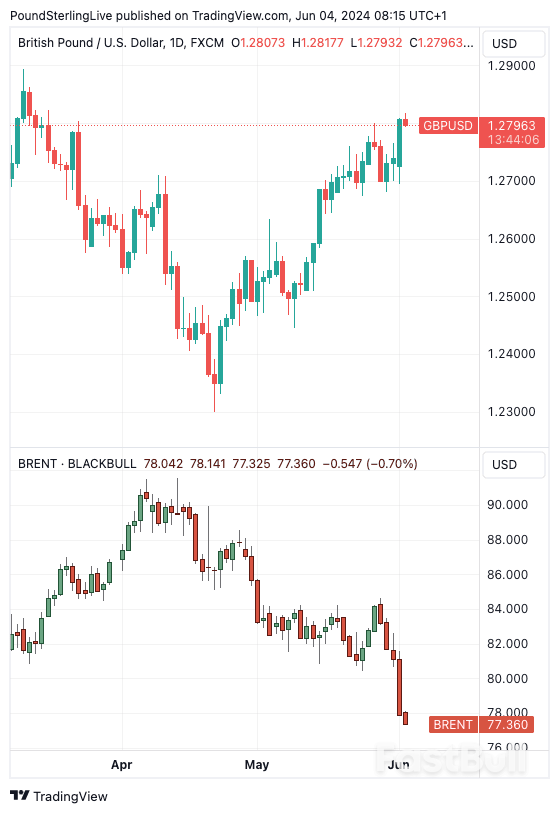
          The Dollar was sold following a soft domestic data print while a sharp decline in oil prices also weighed.
          "News that the ISM manufacturing survey fell below the 49 handle in May increased pressure on the greenback across the board, driving the US Dollar Index (DXY) back to 104. Thus, EUR-USD and GBP-USD accelerated their rebound back above 1.09 and 1.28, respectively," says Roberto Mialich, FX Strategist at UniCredit Bank.
          The ISM Manufacturing PMI fell to 48.7 in May from 49.2, undershooting expectations for 49.6. The Prices Paid component of the report read at 57, down from 60.9 and below estimates for 60. "The US ISM manufacturing report came in generally weak, echoing the message pencilled in by last week’s soft US PCE report and Chicago PMI and offsetting the picture from the May manufacturing PMI," says Evelyne Gomez-Liechti, Rates Strategist at Mizuho.
          "The dollar is starting to show signs of weakness," says Chris Turner, head of FX research at ING Bank.
          Oil prices meanwhile dipped by nearly 4% as investors reacted to news OPEC would begin raising oil production from October. Falling oil prices are disinflationary and will bolster views the Federal Reserve can cut intrest rates later in the year. Furthermore, because commodities are priced in dollars, any significant selloffs can weigh on the currency.
          Elsewhere, the Atlanta Federal Reserve's GDPNow estimate for GDP growth in Q2 dropped sharply from 2.7% to 1.8%, which suggests below-trend growth has continued through the 1H of this year.
          Pound to Dollar Rate Hits Fresh Highs, JOLTS in Focus_1

          Above: GBP/USD at daily intervals and oil prices (lower panel).

          "The latest developments have provided further evidence that the U.S. economy has lost upward momentum at the start of this year which is beginning to put a dampener on U.S. dollar strength," says Lee Hardman, FX strategist at MUFG Bank.
          The U.S. labour market is front and centre this week, with eyes now turning to the JOLTS report, which will give a sense as to how new job openings are faring.
          ING's Turner points out that the Federal Reserve places emphasis on this report and a soft print could send the Dollar to new lows.
          "Today's U.S. JOLTS job openings data could determine whether recent dollar losses are just idle range-trading or the start of an important new trend. We certainly see downside risks to the dollar today," says Turner.
          Consensus looks for a fall to 8400k in April, down from 8488k in March. The quit rate is expected to fall to 2% from a peak of 3% over previous years. "That should signal a further easing of wage pressures," says Turner.

          Source: Poundsterlinglive

          To stay updated on all economic events of today, please check out our Economic calendar
          Risk Warnings and Disclaimers
          You understand and acknowledge that there is a high degree of risk involved in trading. Following any strategies or investment methods may lead to potential losses. The content on the site is provided by our contributors and analysts for information purposes only. You are solely responsible for determining whether any trading assets, securities, strategy, or any other product is suitable for investing based on your own investment objectives and financial situation.
          Add to Favorites
          Share

          Groundhog Day on US Interest Rate Markets

          Thomas

          Economic

          Markets

          Groundhog day on US interest rate markets. At the end of April, US money markets were positioned for a first Fed rate cut at the December. It made them vulnerable to soft patches in eco figures. By mid-May, the pendulum swung to a first rate cut in September with follow-up action in December. At this stage, investors picked-up the more hawkish/inflationary details again. At the end of May, they arrived back where they started a month earlier: discounting only one 25 bps rate cut by December. Which made them vulnerable to… soft patches in eco figures.
          Yesterday's May US manufacturing ISM immediately pulled the right/wrong strings. The headline figure showed a modest setback, from 49.2 to 48.7 instead of the longed-for modest improvement to 49.5. Apart from March 2024 (50.3), the manufacturing sector has been shrinking since November 2022. Details showed a very small rise in production levels (50.2). New (domestic) orders fell at a significantly faster pace (45.4 from 49.1) but got some buffer by rising export orders (50.6 from 48.7). Manufacturers continue to work through inventory backlogs. The prices paid index decelerated from 60.9 in April to 57 which nevertheless remains the second fastest price growth since August 2022. The report ended on a bright note with the employment subindex growing for the first time since September (51.1 from 48.6).
          Markets solely focused on weakening demand in the ISM, triggering a rally in US Treasuries. US yields lost 6.5 bps to 11.1 bps (30-yr). The curve move already suggests that something else was at play as well. Oil prices are the culprit. Brent crude started slipping around the start of the US session and the move continued after the ISM. The move is partly supply-inspired (following this weekend's OPEC+ meeting including scaling back some production cuts from September), partly because of technical reasons (acceleration after losing YTD bottoms around $80.5/b) and partly demand-driven (ISM details). In the end, Brent crude lost almost $3/b, taking the weekly loss to $7/b (currently $77.5/b) and directly impacting long term rates via inflation expectations.
          German Bunds followed US T's higher with the belly of the curve outperforming the wings. German yields lost 6.8 bps (2-yr) to 8.8 bps (30-yr). The dollar suffered from both the ISM and lower oil prices (positive correlation since US turned net exporter). EUR/USD closed above the 1.0884/95 resistance area (1.0904). If confirmed, this suggests room to head towards 1.10. The combination of ECB meeting and other key US eco data later this week (services ISM, ADP, payrolls) makes it too soon to call this resistance already definitely broken.

          News & Views

          South Korean inflation slowed further in May to 2.7% Y/Y from 2.9% (vs 2.8% consensus), touching the lowest level since July last year. The monthly pace of price growth remains low at 0.1% M/M after an unchanged reading in April. Core inflation excluding food and energy also eased from 2.3% Y/Y to 2.2%, the slowest pace since December 2021. Food prices declined by 0.7%, slowing the Y/Y-measure to 5.1% from 5.9%. Transport related costs were source of upward price pressure, adding 0.6% M/M and 3.8% Y/Y.
          After the publication, the Bank of Korea acknowledged the progress in inflation, but it is still looking for further evidence that inflation is converging towards its 2% inflation target. The BoK last month kept its policy rate unchanged at 3.5%. However, its assessment at that time was seen as tilting to the softer side, despite an upward revision to the growth outlook. The won is still trading at historically weak levels and might be a reason to stay cautious on starting a protracted rate cut cycle.
          Data from the British Retail Consortium showed that total UK retail sales increased 0.7% Y/Y in May. This was above the 3-month moving average of 0.3%, but below the 10 month average growth of 2.0%. BRC assess the May sales development as “a mild recovery”. Food sales increased 3.6% Y/Y in the three months to May. However, non-foods sales decreased 2.4% 3M Y/Y, which is a steeper decline than the 12 month average of -1.7%. Non-food sales also were lower compared the same month last year. BRC said that “despite a strong bank holiday weekend for retailers, minimal improvement to weather across most of May meant only a modest rebound in retail sales last month”. Looking froward, “retailers remain optimistic that major events such as the Euros and the Olympics will bolster consumer confidence this summer”.

          Source: KBC Bank

          To stay updated on all economic events of today, please check out our Economic calendar
          Risk Warnings and Disclaimers
          You understand and acknowledge that there is a high degree of risk involved in trading. Following any strategies or investment methods may lead to potential losses. The content on the site is provided by our contributors and analysts for information purposes only. You are solely responsible for determining whether any trading assets, securities, strategy, or any other product is suitable for investing based on your own investment objectives and financial situation.
          Add to Favorites
          Share

          Saudi Arabian Businesses See Sales Growth At Its Slowest In 2 Years

          Samantha Luan

          Economic

          Saudi businesses saw month-on-month sales growth drop to its lowest point in the last two years during May - but this could be a minor blip as overall demand remains strong and new orders keep coming in. This is according to the latest PMI (Purchasing Managers Index) data from Riyad Bank.
          What businesses should, however, be concerned about is the high inventory they are carrying.
          “The rise in inventory levels and prices has prompted firms to adjust their purchasing behaviors to align with their sales strategies,” said Naif Al-Ghaith, Chief Economist at Riyad Bank.
          “This cautious approach indicates a strategic response to the changing market dynamics and the need to maintain a sustainable business model.”
          The best-performing sector was construction, with the Saudi market seeing more projects coming through and many of them now entering the tendering or construction phase.

          What does the May PMI say

          The Saudi PMI score – which is a composite of business orders, capex plans, etc. - was 56.4 in May, a slight drop from April’s 57. (Any score over 50 shows solid to high business expansion.)
          “That said, the reading was the second-lowest for 22 months, higher only than January's recent nadir,” says the Riyad Bank report.

          Higher job intake

          On the hiring side, there continues to be more progress, as Saudi Arabia opens up key sectors.
          Private sector firms raised their employment levels in May, helping to offset the 'first decline in over two years in April'. Staffing growth was 'mostly linked' to higher workloads and efforts to reduce outstanding orders, which duly fell slightly.
          "This growth has necessitated an increase in employment to meet the growing demand for goods and services," said Al-Ghaith. “The Purchasing Managers' Index (PMI) for Saudi Arabia's non-oil economy shows a positive trend, driven by increasing demand as evidenced by the rise in new orders.
          "However, the surge in demand has also led to price pressures impacting input prices and staff costs, although the increase in output prices has been observed at a slower pace.
          "This balancing act reflects the challenges faced by businesses in managing costs while trying to capitalize on the expanding market."

          Competition is eating into margins

          Across major sectors, businesses keep pointing to the increased competition, which adds to the difficulties in gaining new customer wins.

          Source:gulfnews

          To stay updated on all economic events of today, please check out our Economic calendar
          Risk Warnings and Disclaimers
          You understand and acknowledge that there is a high degree of risk involved in trading. Following any strategies or investment methods may lead to potential losses. The content on the site is provided by our contributors and analysts for information purposes only. You are solely responsible for determining whether any trading assets, securities, strategy, or any other product is suitable for investing based on your own investment objectives and financial situation.
          Add to Favorites
          Share

          Asian Shares Weaken as Indian Election Results Roll In

          Warren Takunda

          Economic

          Stocks

          Asian share markets retreated on Tuesday as global investors awaited India's official election results and considered the prospect that the U.S. economy's 'exceptionalism' is starting to unwind as manufacturing activity there further weakened.
          MSCI's broadest index of Asia-Pacific shares outside Japan was down 0.4%, after U.S. stocks ended the previous session with mild gains. The index is up 2.1% so far this month.
          Australian shares were down 0.15%, while Japan's Nikkei stock index slid 0.11%.
          Hong Kong's Hang Seng Index was up 0.33% and China's CSI300 Index up 0.23% after initially opening in negative territory.
          In India, share markets sold off sharply after early vote counting showed Prime Minister Narendra Modi's Bharatiya Janata Party (BJP)-led alliance was not headed for a landslide win as predicted.
          A Modi victory had been expected to be positive for the country's financial markets, according to analysts, on the hope India will undertake further economic reform.
          But the reduced prospect of Modi's alliance winning an overwhelming majority rattled investors.
          The Nifty index dropped as much as 5.43% to 22,000.60 points, while the BSE index fell 5.4% to 72,337.34 points. Both indexes had touched all-time highs on Monday. Both markets recovered slightly to trade down around 2.3% each.
          In early European trades, the pan-region Euro Stoxx 50 futures slipped 0.1% to 5,007, German DAX futures were down 0.21% at 18,615 and FTSE futures were down 0.09% at 8,265.5.
          U.S. stock futures, the S&P 500 e-minis , were up 0.01% at 5,297.8.
          The strength of the U.S. labour market will be closely watched in the new few days with the Job Openings and Labor Turnover Survey (JOLTS) due to be published later on Tuesday. Non-farm payroll figures for May are out on Friday.
          "We're expecting a slight easing in demand for labour in the U.S. market," said Raisah Rasid, JPMorgan Asset Management's global market strategist.
          "What does that mean for the Fed? I think all data points to one interest rate cut later in the year, potentially in December. If the data moves in a different direction than expected that cut could be moved forward to September."
          In Hong Kong, the city's Hang Seng Mainland Property Index rose 2.5% following a Citigroup research note upgrading the target prices for 23 Chinese property companies it covers.
          "We are starting to see more green shoots in China, especially after the measures and stimulus that has been revealed for the property sector," said David Chao, Invesco Asia Pacific's global market strategist.
          "More measures are expected. That is helping to develop a risk on environment in Asia, emerging market Asia and equities over bonds. I think there is still some more to go in the recent market rally that we have seen."
          The yield on benchmark 10-year Treasury notes reached 4.4099% compared with its U.S. close of 4.402% on Monday. The two-year yield , which rises with traders' expectations of higher Fed fund rates, touched 4.8245% compared with a U.S. close of 4.818%.
          On Monday, U.S. Treasury yields fell to the lowest point in two weeks, after the country's manufacturing activity slipped for the second consecutive month in May.
          The two-year yield was 6 basis points lower while the 10-year yield was down 11 basis points.
          "The sharper move at the long-end is a sign that weaker manufacturing data is unlikely to shift the dial on Fed rate cuts near term, but is perhaps a signal of the market's view of neutral interest rates as US economic exceptionalism fades," Westpac economist Jameson Coombs said in a note on Tuesday.
          In Europe, investors expect the European Central Bank on Thursday to cut the benchmark rate by 25 basis points to 3.75%.
          The dollar rose 0.13% against the yen to 156.3 in Asian trading on Tuesday. It is still some distance from its high this year of 160.03 in late April.
          The European single currency was up 0.1% on the day at $1.0912, having gained 0.65% in a month, while the dollar index , which tracks the greenback against a basket of currencies of other major trading partners, was down at 104.
          U.S. crude dipped 0.88% to $73.57 a barrel. Brent crude fell to $77.77 per barrel. Both benchmarks slid to four-month lows on Monday after the Organization of the Petroleum Exporting Countries and allies, together known as OPEC+, agreed to start unwinding some production cuts from October.
          Gold was slightly lower. Spot gold was traded at $2348.64 per ounce.

          Source: Reuters

          To stay updated on all economic events of today, please check out our Economic calendar
          Risk Warnings and Disclaimers
          You understand and acknowledge that there is a high degree of risk involved in trading. Following any strategies or investment methods may lead to potential losses. The content on the site is provided by our contributors and analysts for information purposes only. You are solely responsible for determining whether any trading assets, securities, strategy, or any other product is suitable for investing based on your own investment objectives and financial situation.
          Add to Favorites
          Share
          FastBull
          Copyright © 2025 FastBull Ltd

          728 RM B 7/F GEE LOK IND BLDG NO 34 HUNG TO RD KWUN TONG KLN HONG KONG

          TelegramInstagramTwitterfacebooklinkedin
          App Store Google Play Google Play
          Products
          Charts

          Chats

          Q&A with Experts
          Screeners
          Economic Calendar
          Data
          Tools
          Membership
          Features
          Function
          Markets
          Copy Trading
          Latest Signals
          Contests
          News
          Analysis
          24/7
          Columns
          Education
          Company
          Careers
          About Us
          Contact Us
          Advertising
          Help Center
          Feedback
          User Agreement
          Privacy Policy
          Business

          White Label

          Data API

          Web Plug-ins

          Poster Maker

          Affiliate Program

          Risk Disclosure

          The risk of loss in trading financial instruments such as stocks, FX, commodities, futures, bonds, ETFs and crypto can be substantial. You may sustain a total loss of the funds that you deposit with your broker. Therefore, you should carefully consider whether such trading is suitable for you in light of your circumstances and financial resources.

          No decision to invest should be made without thoroughly conducting due diligence by yourself or consulting with your financial advisors. Our web content might not suit you since we don't know your financial conditions and investment needs. Our financial information might have latency or contain inaccuracy, so you should be fully responsible for any of your trading and investment decisions. The company will not be responsible for your capital loss.

          Without getting permission from the website, you are not allowed to copy the website's graphics, texts, or trademarks. Intellectual property rights in the content or data incorporated into this website belong to its providers and exchange merchants.

          Not Logged In

          Log in to access more features

          FastBull Membership

          Not yet

          Purchase

          Become a signal provider
          Help Center
          Customer Service
          Dark Mode
          Price Up/Down Colors

          Log In

          Sign Up

          Position
          Layout
          Fullscreen
          Default to Chart
          The chart page opens by default when you visit fastbull.com