• Trade
  • Markets
  • Copy
  • Contests
  • News
  • 24/7
  • Calendar
  • Q&A
  • Chats
Trending
Screeners
SYMBOL
LAST
BID
ASK
HIGH
LOW
NET CHG.
%CHG.
SPREAD
SPX
S&P 500 Index
6827.42
6827.42
6827.42
6899.86
6801.80
-73.58
-1.07%
--
DJI
Dow Jones Industrial Average
48458.04
48458.04
48458.04
48886.86
48334.10
-245.98
-0.51%
--
IXIC
NASDAQ Composite Index
23195.16
23195.16
23195.16
23554.89
23094.51
-398.69
-1.69%
--
USDX
US Dollar Index
97.950
98.030
97.950
98.500
97.950
-0.370
-0.38%
--
EURUSD
Euro / US Dollar
1.17394
1.17409
1.17394
1.17496
1.17192
+0.00011
+ 0.01%
--
GBPUSD
Pound Sterling / US Dollar
1.33707
1.33732
1.33707
1.33997
1.33419
-0.00148
-0.11%
--
XAUUSD
Gold / US Dollar
4299.39
4299.39
4299.39
4353.41
4257.10
+20.10
+ 0.47%
--
WTI
Light Sweet Crude Oil
57.233
57.485
57.233
58.011
56.969
-0.408
-0.71%
--

Community Accounts

Signal Accounts
--
Profit Accounts
--
Loss Accounts
--
View More

Become a signal provider

Sell trading signals to earn additional income

View More

Guide to Copy Trading

Get started with ease and confidence

View More

Signal Accounts for Members

All Signal Accounts

Best Return
  • Best Return
  • Best P/L
  • Best MDD
Past 1W
  • Past 1W
  • Past 1M
  • Past 1Y

All Contests

  • All
  • Trump Updates
  • Recommend
  • Stocks
  • Cryptocurrencies
  • Central Banks
  • Featured News
Top News Only
Share

Thai Leader Anutin: Landmine Blast That Killed Thai Soldiers 'Not A Roadside Accident'

Share

Thai Leader Anutin: Thailand To Continue Military Action Until 'We Feel No More Harm'

Share

Cambodian Prime Minister Hun Manet Says He Had Phone Calls With Trump And Malaysian Leader Anwar About Ceasefire

Share

Cambodia's Hun Manet Says USA, Malaysia Should Verify 'Which Side Fired First' In Latest Conflict

Share

Cambodia's Hun Manet: Cambodia Maintains Its Stance In Seeking Peaceful Resolution Of Disputes

Share

Nasdaq Companies: Allergan, Ferrovia, Insmed, Monolithic Power Systems, Seagate Technology, And Western Digital Will Be Added To The NASDAQ 100 Index. Biogen, CdW, GlobalFoundries, Lululemon, ON Semiconductor, And Tradedesk Will Be Removed From The NASDAQ 100 Index

Share

Witkoff Headed To Berlin This Weekend To Meet With Zelenskiy, European Leaders -Wsj Reporter On X

Share

Russia Attacks Two Ukrainian Ports, Damaging Three Turkish-Owned Vessels

Share

[Historic Flooding Occurs In At Least Four Rivers In Washington State Due To Days Of Torrential Rains] Multiple Areas In Washington State Have Been Hit By Severe Flooding Due To Days Of Torrential Rains, With At Least Four Rivers Experiencing Historic Flooding. Reporters Learned On The 12th That The Floods Caused By The Torrential Rains In Washington State Have Destroyed Homes And Closed Several Highways. Experts Warn That Even More Severe Flooding May Occur In The Future. A State Of Emergency Has Been Declared In Washington State

Share

Trump Says Proposed Free Economic Zone In Donbas Would Work

Share

Trump: I Think My Voice Should Be Heard

Share

Trump Says Will Be Choosing New Fed Chair In Near Future

Share

Trump Says Proposed Free Economic Zone In Donbas Complex But Would Work

Share

Trump Says Land Strikes In Venezuela Will Start Happening

Share

US President Trump: Thailand And Cambodia Are In A Good Situation

Share

State Media: North Korean Leader Kim Hails Troops Returning From Russia Mission

Share

The 10-year Treasury Yield Rose About 5 Basis Points During The "Fed Rate Cut Week," And The 2/10-year Yield Spread Widened By About 9 Basis Points. On Friday (December 12), In Late New York Trading, The Yield On The Benchmark 10-year US Treasury Note Rose 2.75 Basis Points To 4.1841%, A Cumulative Increase Of 4.90 Basis Points For The Week, Trading Within A Range Of 4.1002%-4.2074%. It Rose Steadily From Monday To Wednesday (before The Fed Announced Its Rate Cut And Treasury Bill Purchase Program), Subsequently Exhibiting A V-shaped Recovery. The 2-year Treasury Yield Fell 1.82 Basis Points To 3.5222%, A Cumulative Decrease Of 3.81 Basis Points For The Week, Trading Within A Range Of 3.6253%-3.4989%

Share

Trump: Lots Of Progress Being Made On Russia-Ukraine

Share

NOPA November US Soybean Crush Estimated At 220.285 Million Bushels

Share

SPDR Gold Trust Reports Holdings Up 0.22%, Or 2.28 Tonnes, To 1053.11 Tonnes By Dec 12

TIME
ACT
FCST
PREV
U.K. Trade Balance Non-EU (SA) (Oct)

A:--

F: --

P: --

U.K. Trade Balance (Oct)

A:--

F: --

P: --

U.K. Services Index MoM

A:--

F: --

P: --

U.K. Construction Output MoM (SA) (Oct)

A:--

F: --

P: --

U.K. Industrial Output YoY (Oct)

A:--

F: --

P: --

U.K. Trade Balance (SA) (Oct)

A:--

F: --

P: --

U.K. Trade Balance EU (SA) (Oct)

A:--

F: --

P: --

U.K. Manufacturing Output YoY (Oct)

A:--

F: --

P: --

U.K. GDP MoM (Oct)

A:--

F: --

P: --

U.K. GDP YoY (SA) (Oct)

A:--

F: --

P: --

U.K. Industrial Output MoM (Oct)

A:--

F: --

P: --

U.K. Construction Output YoY (Oct)

A:--

F: --

P: --

France HICP Final MoM (Nov)

A:--

F: --

P: --

China, Mainland Outstanding Loans Growth YoY (Nov)

A:--

F: --

P: --

China, Mainland M2 Money Supply YoY (Nov)

A:--

F: --

P: --

China, Mainland M0 Money Supply YoY (Nov)

A:--

F: --

P: --

China, Mainland M1 Money Supply YoY (Nov)

A:--

F: --

P: --

India CPI YoY (Nov)

A:--

F: --

P: --

India Deposit Gowth YoY

A:--

F: --

P: --

Brazil Services Growth YoY (Oct)

A:--

F: --

P: --

Mexico Industrial Output YoY (Oct)

A:--

F: --

P: --

Russia Trade Balance (Oct)

A:--

F: --

P: --

Philadelphia Fed President Henry Paulson delivers a speech
Canada Building Permits MoM (SA) (Oct)

A:--

F: --

P: --

Canada Wholesale Sales YoY (Oct)

A:--

F: --

P: --

Canada Wholesale Inventory MoM (Oct)

A:--

F: --

P: --

Canada Wholesale Inventory YoY (Oct)

A:--

F: --

P: --

Canada Wholesale Sales MoM (SA) (Oct)

A:--

F: --

P: --

Germany Current Account (Not SA) (Oct)

A:--

F: --

P: --

U.S. Weekly Total Rig Count

A:--

F: --

P: --

U.S. Weekly Total Oil Rig Count

A:--

F: --

P: --

Japan Tankan Large Non-Manufacturing Diffusion Index (Q4)

--

F: --

P: --

Japan Tankan Small Manufacturing Outlook Index (Q4)

--

F: --

P: --

Japan Tankan Large Non-Manufacturing Outlook Index (Q4)

--

F: --

P: --

Japan Tankan Large Manufacturing Outlook Index (Q4)

--

F: --

P: --

Japan Tankan Small Manufacturing Diffusion Index (Q4)

--

F: --

P: --

Japan Tankan Large Manufacturing Diffusion Index (Q4)

--

F: --

P: --

Japan Tankan Large-Enterprise Capital Expenditure YoY (Q4)

--

F: --

P: --

U.K. Rightmove House Price Index YoY (Dec)

--

F: --

P: --

China, Mainland Industrial Output YoY (YTD) (Nov)

--

F: --

P: --

China, Mainland Urban Area Unemployment Rate (Nov)

--

F: --

P: --

Saudi Arabia CPI YoY (Nov)

--

F: --

P: --

Euro Zone Industrial Output YoY (Oct)

--

F: --

P: --

Euro Zone Industrial Output MoM (Oct)

--

F: --

P: --

Canada Existing Home Sales MoM (Nov)

--

F: --

P: --

Euro Zone Total Reserve Assets (Nov)

--

F: --

P: --

U.K. Inflation Rate Expectations

--

F: --

P: --

Canada National Economic Confidence Index

--

F: --

P: --

Canada New Housing Starts (Nov)

--

F: --

P: --

U.S. NY Fed Manufacturing Employment Index (Dec)

--

F: --

P: --

U.S. NY Fed Manufacturing Index (Dec)

--

F: --

P: --

Canada Core CPI YoY (Nov)

--

F: --

P: --

Canada Manufacturing Unfilled Orders MoM (Oct)

--

F: --

P: --

Canada Manufacturing New Orders MoM (Oct)

--

F: --

P: --

Canada Core CPI MoM (Nov)

--

F: --

P: --

Canada Manufacturing Inventory MoM (Oct)

--

F: --

P: --

Canada CPI YoY (Nov)

--

F: --

P: --

Canada CPI MoM (Nov)

--

F: --

P: --

Canada CPI YoY (SA) (Nov)

--

F: --

P: --

Canada Core CPI MoM (SA) (Nov)

--

F: --

P: --

Q&A with Experts
    • All
    • Chatrooms
    • Groups
    • Friends
    Connecting
    .
    .
    .
    Type here...
    Add Symbol or Code

      No matching data

      All
      Trump Updates
      Recommend
      Stocks
      Cryptocurrencies
      Central Banks
      Featured News
      • All
      • Russia-Ukraine Conflict
      • Middle East Flashpoint
      • All
      • Russia-Ukraine Conflict
      • Middle East Flashpoint
      Search
      Products

      Charts Free Forever

      Chats Q&A with Experts
      Screeners Economic Calendar Data Tools
      Membership Features
      Data Warehouse Market Trends Institutional Data Policy Rates Macro

      Market Trends

      Market Sentiment Order Book Forex Correlations

      Top Indicators

      Charts Free Forever
      Markets

      News

      News Analysis 24/7 Columns Education
      From Institutions From Analysts
      Topics Columnists

      Latest Views

      Latest Views

      Trending Topics

      Top Columnists

      Latest Update

      Signals

      Copy Rankings Latest Signals Become a signal provider AI Rating
      Contests
      Brokers

      Overview Brokers Assessment Rankings Regulators News Claims
      Broker listing Forex Brokers Comparison Tool Live Spread Comparison Scam
      Q&A Complaint Scam Alert Videos Tips to Detect Scam
      More

      Business
      Events
      Careers About Us Advertising Help Center

      White Label

      Data API

      Web Plug-ins

      Affiliate Program

      Awards Institution Evaluation IB Seminar Salon Event Exhibition
      Vietnam Thailand Singapore Dubai
      Fans Party Investment Sharing Session
      FastBull Summit BrokersView Expo
      Recent Searches
        Top Searches
          Markets
          News
          Analysis
          User
          24/7
          Economic Calendar
          Education
          Data
          • Names
          • Latest
          • Prev

          View All

          No data

          Scan to Download

          Faster Charts, Chat Faster!

          Download App
          English
          • English
          • Español
          • العربية
          • Bahasa Indonesia
          • Bahasa Melayu
          • Tiếng Việt
          • ภาษาไทย
          • Français
          • Italiano
          • Türkçe
          • Русский язык
          • 简中
          • 繁中
          Open Account
          Search
          Products
          Charts Free Forever
          Markets
          News
          Signals

          Copy Rankings Latest Signals Become a signal provider AI Rating
          Contests
          Brokers

          Overview Brokers Assessment Rankings Regulators News Claims
          Broker listing Forex Brokers Comparison Tool Live Spread Comparison Scam
          Q&A Complaint Scam Alert Videos Tips to Detect Scam
          More

          Business
          Events
          Careers About Us Advertising Help Center

          White Label

          Data API

          Web Plug-ins

          Affiliate Program

          Awards Institution Evaluation IB Seminar Salon Event Exhibition
          Vietnam Thailand Singapore Dubai
          Fans Party Investment Sharing Session
          FastBull Summit BrokersView Expo

          Bitcoin Price Could Surpass $150k by the End of the Year

          Samantha Luan

          Cryptocurrency

          Summary:

          The Bitcoin bull run is back and it could be its strongest run yet, according to experts...

          After a tumultuous 2022, which saw the cryptocurrency market lose $2 trillion and Bitcoin's price drop by 63%, experienced a remarkable turnaround.
          Last week, the Bitcoin price hit a new record high, surpassing an impressive $73,000 for the first time. Although the weekend saw a mix of fear and greed as Bitcoin dropped to lows of $64,500, it has since rebounded above $69,000, with significant selling of BTC put options indicating that fear has diminished and investors are eager to buy the dip.
          This resurgence is attributed to the approval of Bitcoin exchange-traded funds (ETFs) by the SEC, simplifying the investment process and attracting institutional investors. Major players like BlackRock are heavily investing in Bitcoin ETFs, highlighting the cryptocurreny’s growing mainstream acceptance.
          Looking ahead, a 'halving' event in April could further boost Bitcoin prices by tightening supply. Yet, risks persist, especially with retail investors borrowing to invest in crypto, which could amplify market volatility.
          The current market rally has led many financial firms to adopt a bullish stance on crypto. Standard Chartered recently revised its year-end target for Bitcoin to $150,000.3 Analysts Gautam Chhugani and Mahika Sapra from Bernstein are optimistic about Bitcoin's future, reiterating their $150,000 price target by mid-2025.4 They anticipate growing institutional interest in Bitcoin equities, benefiting mining companies.
          Scott Melker and Bitwise's CIO Matt Hougan foresee a bullish trend for Bitcoin, with Hougan suggesting a potential price surpassing $200,000 this year. Galaxy Digital CEO Mike Novogratz also sees significant global demand for Bitcoin.
          Bitcoin isn’t the only cryptocurrency experiencing a surge. Following a memecoin frenzy over the weekend, Solana surpassed $200 and reached a record $89 billion market cap. Solana's total trading volume also surpassed Ethererum, reaching over $6.3 billion on March 16 and 17 compared to ETH’s $4.4 billion.
          According to a lead market analyst at crypto exchange Swyftx, “Solana has effectively become the “people’s coin,” with the potential to reach $415, and even as high as $1,000.
          As crypto continues its ascent, companies like Neptune Digital Assets Corp stands out as a leader in the industry, focusing on financial technology and providing investors with access to a wide range of blockchain and cryptocurrency assets.
          Neptune Digital Assets, which was named as one of the top performers on the TSX Venture Exchange for the second time in 3 years, is pioneering a comprehensive strategy that leverages the full spectrum of digital currency operations, including Bitcoin mining, staking, blockchain nodes, and decentralized finance (DeFi).
          By offering investors an opportunity to engage with a diversified portfolio of income-generating digital assets, Neptune not only democratizes access to the burgeoning sector but also ensures a balanced exposure to its potential rewards.

          Seizing Growth Opportunity Through Strategic Solana Investment

          On March 27, Neptune Digital Assets Corp reached a significant growth milestone in its proof-of-stake operations with the acquisition of 26,964 Solana (SOL) tokens, a leading proof-of-stake (PoS) blockchain protocol. The purchase was made at a price of US$64 per SOL token, representing a 66% discount to the current market value of US$193 per SOL. This move reflects Neptune's commitment to identifying and capitalizing on high-potential opportunities in the digital asset space. The company now holds a total of 31,181 staked SOL tokens, which are earning rewards.
          Neptune has been actively expanding its staking business line, where it delegates tokens or operates nodes to secure PoS blockchain networks and earn rewards. These rewards contribute to Neptune's revenue streams, enhancing value for shareholders.
          With Solana's PoS mechanism, Neptune Digital Assets anticipates generating an annual yield of approximately 7.5%. The acquired Solana tokens will be locked and staked, with 80% being released linearly on a monthly basis until January 2028 and the remaining 20% in March 2025. During the lock period, the tokens will earn staking rewards, subject to fluctuation.
          "Our growing focus on proof-of-stake cryptocurrencies such as Solana, Polkadot, and Atom aligns with our commitment to generating sustainable revenue streams in the rapidly evolving blockchain ecosystem,” said Cale Moodie, CEO of Neptune Digital Assets. “Solana's staking rewards, combined with its robust infrastructure, present an attractive opportunity for Neptune to generate revenue while contributing to the security and decentralization of the Solana network. This is a remarkable opportunity to grow our assets and revenues at a substantial discount to prevailing market prices."
          Solana is known for its fast transaction speeds and low fees, making it a popular platform for decentralized applications (dApps) and decentralized finance (DeFi) projects. With this investment, Neptune positions itself at the forefront of innovation in the blockchain space.
          In January, Neptune Digital Assets announced its financial results for the quarter ending November 30, 2023 with $39 million in assets and no debt. The company's digital asset portfolio includes significant holdings of 335 BTC and 175,000 ATOM, along with investments in ETH, DOT, SOL, GRT, and a notable $3.52 million stake in SpaceX, reflecting Neptune's strategic and diversified investment approach in the blockchain and digital assets sector.

          Source: NewsDirect

          Risk Warnings and Disclaimers
          You understand and acknowledge that there is a high degree of risk involved in trading. Following any strategies or investment methods may lead to potential losses. The content on the site is provided by our contributors and analysts for information purposes only. You are solely responsible for determining whether any trading assets, securities, strategy, or any other product is suitable for investing based on your own investment objectives and financial situation.
          Add to Favorites
          Share

          What Lies Ahead In Gold as Prices Surge, Entering Uncharted Territory

          Chandan Gupta

          Commodity

          Traders' Opinions

          Gold Prices Surge to Record Highs

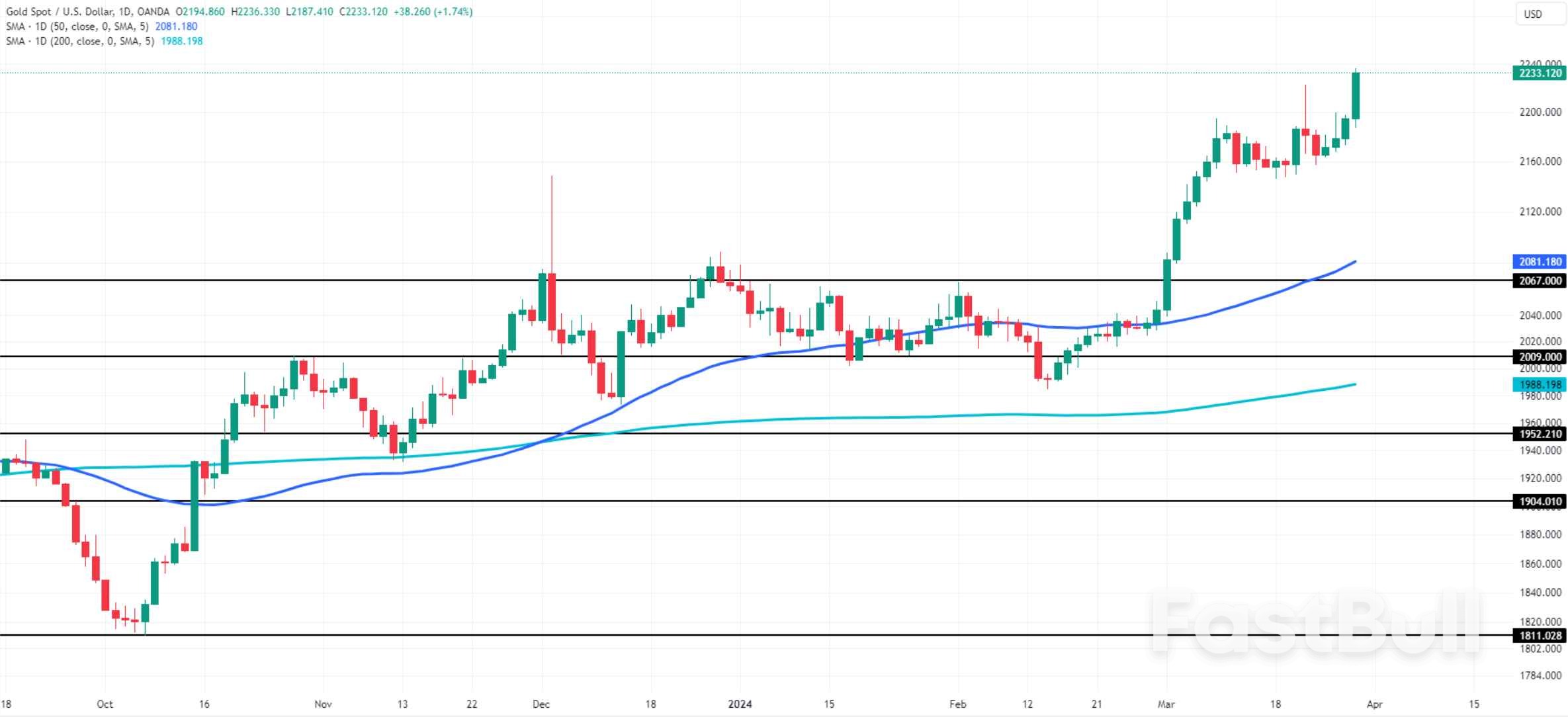
          The price of gold achieved a record high on Thursday, driven by a blend of factors including persistent inflation, high interest rates, and geopolitical tensions. Central banks are significantly increasing their gold holdings, contributing to this upsurge. The Federal Reserve’s anticipated interest rate cuts, as detailed in a recent J.P. Morgan report, are also playing a crucial role in gold’s price rally. On Thursday, XAU/USD settled at $2233.12, up $38.26 or +1.74%.What Lies Ahead In Gold as Prices Surge, Entering Uncharted Territory _1

          Investor Sentiment and Market Analysis

          Investors, seeking stability in these uncertain times, are turning to gold as a hedge against inflation and as a safe haven asset. This surge in demand has pushed gold prices to unprecedented levels. Experts, like Matt Willer of Phoenix Capital Group and Eric Croak of Croak Capital, highlight the combined effects of economic indicators and global tensions on gold’s appeal. With U.S. economic indicators showing softness, the demand for gold is on the rise, while other commodities face reduced demand.

          Record Prices and Market Factors

          Spot gold has seen a substantial increase, logging its best month since July 2020 with a 9% rise. U.S. gold futures also settled higher. The driving forces include anticipation of rate cuts by the Federal Reserve and robust safe-haven demand. Daniel Ghali of TD Securities notes the role of traders adjusting positions before holidays and increased trading activity at month-end and quarter-end.

          Short-term Forecast and Long-term Potential

          In the short term, experts like Eric Croak expect volatility, with prices potentially fluctuating between $2,140 and $2,200 per ounce. Stephen Akin of Akin Investments suggests that technical analysis points to a potential rise to $2,300 – $2,400 in the next one to two years. Despite potential short-term pullbacks, the overall outlook for gold remains bullish. Sean Casterline of Delta Private Wealth anticipates that any pullback would be limited, with previous resistance levels now forming support.
          In conclusion, the combination of ongoing geopolitical tensions, economic indicators, and market sentiment suggests a bullish forecast for gold in both the short and long term. Investors and traders should closely monitor these factors for insights into gold’s future performance.

          Technical AnalysisWhat Lies Ahead In Gold as Prices Surge, Entering Uncharted Territory _2

          Gold (XAU/USD) hit an all-time high on Thursday, settling at a record close. There is no resistance at current levels, which means traders should watch for a closing price reversal top to signal the end of this surge.
          On the downside, the key short-term support is $2146.155. A trade through this level will change the short-term trend to down. The nearest intermediate trend support is the 50-day moving average at $2081.18.
          Risk Warnings and Disclaimers
          You understand and acknowledge that there is a high degree of risk involved in trading. Following any strategies or investment methods may lead to potential losses. The content on the site is provided by our contributors and analysts for information purposes only. You are solely responsible for determining whether any trading assets, securities, strategy, or any other product is suitable for investing based on your own investment objectives and financial situation.
          Add to Favorites
          Share

          Key Fed Inflation Gauge Rose 2.8% Annually in February, as Expected

          Warren Takunda

          Central Bank

          Economic

          Inflation rose in line with expectations in February, likely keeping the Federal Reserve on hold before it can start considering interest rate cuts, according to a measure the central bank considers its more important barometer.
          The personal consumption expenditures price index excluding food and energy increased 2.8% on a 12-month basis and was up 0.3% from a month ago, the Commerce Department reported Friday. Both numbers matched the Dow Jones estimates.
          Including volatile food and energy costs, the headline PCE reading showed a 0.3% increase for the month and 2.5% at the 12-month rate, compared to estimates for 0.4% and 2.5%.
          Both the stock and bond markets were closed in observance of the Good Friday holiday.
          While the Fed looks at both measures when making policy, it considers core to be a better gauge of long-term inflation pressures. The Fed targets 2% annual inflation; core PCE inflation hasn’t been below that level in three years.
          “Nothing really super surprising. Obviously not the numbers the Fed wants to see, but I don’t think this is going to catch anybody off guard when they come back to work on Monday,” Victoria Greene, chief investment officer at G Squared Private Wealth, told CNBC. “I think everybody is going to pivot to labor pretty quickly and say well maybe if we see some weakness and cracks over here, this little stickiness in inflation and PCE isn’t going to matter as much.”
          Rising energy costs helped push up the headline reading, with a 2.3% increase. The food index edged up 0.1%. Inflation pressures came more from the goods side, which rose 0.5%, compared to the 0.3% increase for services. That countered the trend over the past year, during which services rose 3.8% while goods actually fell by 0.2%.
          Other upward pressure came from international travel services, air transportation, and financial services and insurance. On the goods side, the motor vehicles and parts category was the biggest contributor.
          Along with the inflation increase, consumer spending shot up 0.8% on the month, well ahead of the 0.5% estimate, possibly indicating additional inflation pressures. Personal income increased 0.3%, slightly softer than the 0.4% estimate.
          The release comes a little more than a week after the central bank again held its benchmark short-term borrowing rate steady and indicated it still has not seen enough progress on inflation to consider cutting. In their quarterly update of rate projections, members of the Federal Open Market Committee again pointed to three quarter-percentage point cuts this year and in 2025.
          Markets expect the Fed to remain on hold again when it releases its decision on May 1, then begin cutting at the June 11-12 meeting. Market pricing is in line with FOMC projections for three cuts, according to the CME Group’s FedWatch measure of futures market action.

          Source: CNBC

          To stay updated on all economic events of today, please check out our Economic calendar
          Risk Warnings and Disclaimers
          You understand and acknowledge that there is a high degree of risk involved in trading. Following any strategies or investment methods may lead to potential losses. The content on the site is provided by our contributors and analysts for information purposes only. You are solely responsible for determining whether any trading assets, securities, strategy, or any other product is suitable for investing based on your own investment objectives and financial situation.
          Add to Favorites
          Share

          Old Xi Jinping Speech Sparks China Monetary Easing Speculation

          Kevin Du

          Economic

          Central Bank

          But most analysts say the People's Bank of China (PBOC) will stick with traditional tools rather than resorting to massive liquidity injections through "quantitative easing" (QE), as some major economies such as Japan and the United States have done.
          Market expectations remain high for more stimulus to boost the world's second-largest economy, which is showing tentative signs of momentum despite a long-running debt crisis in the property sector, which used to account for a quarter of China's gross domestic product.
          "The People's Bank of China must slowly increase the trading of treasury bonds in its open market operations," Xi told a major financial meeting in October in a speech that was not published at the time but was included in a book this month.
          The Hong Kong-based South China Morning Post cited an excerpt of the speech on Thursday from the book, triggering market talk about how to interpret Xi's words against the backdrop of the PBOC's reluctance to flood the system with liquidity due to fears of inflation and asset bubbles.
          China's blue-chip stock index bounced 0.5% off one-month lows on Thursday. On Friday, 10-year treasury bond futures rose the most in three weeks.
          The speculation also reflects investor sensitivity to comments made by Xi, China's president for 11 years and its most powerful ruler since Mao Zedong.
          The PBOC did not immediately respond to a request for comment.

          LIQUIDITY AMPLE, ROOM TO CUT RATES

          Xi's speech was "not buying government bonds in the primary market, therefore not an indication of QE", said Morgan Stanley's chief China economist, Robin Xing.
          "In fact, in the same speech, Beijing made hawkish comments that the deleveraging process requires a tighter grip on money and credit supply, which we believe indicates continued preference for austerity to prevent misallocations," Xing said in a note to investors.
          The PBOC is not allowed to buy bonds directly from the central government. It last bought them in the secondary market in 2007.
          Xi was "calling for replenishing the central bank's monetary policy toolkit", including expanding its options in open-market trading of government bonds to manage liquidity, said Tao Wang, head of Asia economics and chief China economist at UBS Investment Bank.
          Guolian Securities economist Rocky Fan said the PBOC could buy treasury bonds while reducing reverse repurchases, replacing one with the other.
          Among other traditional policy tools, PBOC Deputy Governor Xuan Changneng said last week that cutting commercial banks' reserve requirement ratios, now averaging around 7% after a 50-basis-point cut in January, would be an important way to inject liquidity.
          Last month, the PBOC cut its five-year loan prime rate by 25 basis points to 3.95%, the most since the reference rate was introduced in 2019.
          The PBOC last cut the rate on one-year medium-term lending facility loans, a guide to the loan prime rate, by 15 basis points to 2.50% in August.
          "(Other) central banks are doing QE because their policy rates are close to zero and they can't cut any further, but the PBOC still has room to cut its policy rate, which is now 2.5%," Macquarie economists wrote in a note.
          China is targeting 3.9 trillion yuan ($540 billion) in local government special bond issuance this year to support the economy, up from 3.8 trillion yuan last year, and 1 trillion yuan in special ultra-long term treasury bonds to help key sectors.
          Reflecting high demand for bonds and the ample liquidity in the financial system, China's 30-year treasuries yield around 2.47%, near this month's record low of 2.442%.
          "Whether you look at money supply or the level of interest rates, the degree of monetary easing we've experienced has rarely been seen in history," said Xia Chun, chief economist at Forthright Holdings.

          Source: Reuters

          To stay updated on all economic events of today, please check out our Economic calendar
          Risk Warnings and Disclaimers
          You understand and acknowledge that there is a high degree of risk involved in trading. Following any strategies or investment methods may lead to potential losses. The content on the site is provided by our contributors and analysts for information purposes only. You are solely responsible for determining whether any trading assets, securities, strategy, or any other product is suitable for investing based on your own investment objectives and financial situation.
          Add to Favorites
          Share

          Investors Eye Fed Rate Cut, Earnings as Key to Sustaining Market Rally

          Warren Takunda

          Central Bank

          Economic

          After a stellar start to the year for stocks, investors are on guard for potential bumps in the second quarter as they gauge whether the Federal Reserve delivers on an expected interest rate cut by June and turn their focus on the health of upcoming earnings.
          The S&P 500 (.SPX), opens new tab ended the first quarter with a gain of more than 10%, its largest first quarter advance since the nearly 13.1% jump in the first quarter of 2019. While so-called Magnificent Seven stocks such as chipmaker Nvidia (NVDA.O), opens new tab and Facebook parent Meta Platforms (META.O), opens new tab provided the bulk of the gains for the quarter, economically-sensitive sectors such as energy and industrials have rallied over the past six weeks.
          Whether the rally continues through June will likely depend on the Fed, which has not yet signaled that inflation has come down enough, opens new tab to justify a rate cut. Markets began January with 6 to 7 cuts priced in over the course of 2024, but are now anticipating 3 cuts after signs of resiliency in the US economy increased investor confidence in a so-called soft landing.
          "The market and the Fed are finally aligned on expectations, but that puts even more pressure on every economic report that comes out because it doesn't take a lot to make everyone run the same way," said Joe Kalish, Chief Global Macro Strategist at Ned Davis Research. "We are expecting more volatility if we don't see more progress on the inflation front."
          Futures markets are now implying a 61% chance of a 25 basis point cut rate at the Fed's policy meeting that concludes June 12, bringing benchmark rates to a range of 5 to 5.25%, according to CME's FedWatch Tool.
          Continued growth in the US economy will likely continue the recent broadening of the market rally into cyclical sectors and small-cap stocks as investors search for more attractive valuations, said Jason Alonzo, a portfolio manager on Harbor Capital’s multi-asset strategies team. The Russell 2000 (.RUT), opens new tab index of small-cap stocks ended the first quarter with a 4.8% gain, while the S&P 500 industrials sector rose nearly 11% over the same time
          "Right now the only thing the market cares about is whether the Fed remains in control even if the economy re-accelerates," Alonzo said. "If that idea was upset somewhat and the Fed had to imply that rate hikes were back on the table, that would be a shock to investors and cause a real issue for all assets."
          Economic readings next week, including ISM manufacturing data, ISM services, and the closely-watched non-farm payrolls report, which economists polled by Reuters expect to show a growth of 198,000 jobs in March.
          Investors should not be surprised if the market rally starts to slow as the Fed nears a potential rate cut, noted Sam Stovall, chief investment strategist at CFRA Research. Since 1989, the S&P 500 has gained an average of 15.5% between the last rate hike of a cycle and the first rate cut, but gained an average of just 5.4% in the six months following the first rate cut, he said.
          Still, strong momentum in the first quarter has historically carried over to the following quarter, said Keith Lerner, Co-Chief Investment Officer at Truist Advisory Services. Of the 11 times that the S&P 500 has posted a total return of 10% or more in the first quarter, the market continued to advance in the second quarter 9 times, with an average gain of 6.2%, he said.
          "The market deserves the benefit of the doubt and at this point we think bull market rules apply," Lerner said. The biggest risk to a continued rally would be a sign that the Fed is considering keeping rates at current levels through the end of the year, which would lead to "dramatic" repricing of risk assets, he said.
          The likelihood of a market slowdown will also depend largely on corporate earnings, which came in surprisingly robust and helped push the S&P 500 to a series of record closing highs despite the market repricing interest rate policy, said Emily Roland, Co-Chief Investment Strategist at John Hancock Investment Management.
          S&P 500 earnings grew at a 10.1% pace in the last quarter of 2023, more than double the 4.7% expected advance, according to LSEG I/B/E/S. High interest rates will likely weigh on consumer and corporate spending, with analysts expecting a 5.1% earnings growth over the first quarter. Companies begin reporting results in earnest the second week of April.
          "If earnings continue to surprise to the upside, the Fed will have a hard time justifying 3 cuts this year," Roland said. "But if we see a leveling out of inflation this economic re-acceleration could turn into something more sustainable."

          Source: Reuters

          To stay updated on all economic events of today, please check out our Economic calendar
          Risk Warnings and Disclaimers
          You understand and acknowledge that there is a high degree of risk involved in trading. Following any strategies or investment methods may lead to potential losses. The content on the site is provided by our contributors and analysts for information purposes only. You are solely responsible for determining whether any trading assets, securities, strategy, or any other product is suitable for investing based on your own investment objectives and financial situation.
          Add to Favorites
          Share

          Green Steel Is Possible and Even Affordable, But Still Unlikely

          Owen Li

          Economic

          Commodity

          Decarbonising steel production is key to achieving global net-zero emission targets and the good news is that it can be achieved, and the cost isn't prohibitive for some uses.
          The bad news is decarbonising steel isn't likely to happen without regulation, coupled with price incentives that drive a shift in investment and consumption.
          Steel production accounts for about 8% of global carbon emissions and about 30% of emissions from industry, and the sector is the major consumer of metallurgical coal, which is a key source of heat and carbon needed to turn iron ore into steel.
          The determining factors in any discussion about switching to producing green steel is how much more will it cost than the current, well-established methods, and whether it can be scaled up fast enough.
          The cost premium shows how it can work, and equally why it likely won't.
          The good news is that the premium is not as big as many would fear, depending upon how and where you produce the green steel.
          The premium may be almost nothing or up to about $150 a metric ton, according to the consensus of presentations at last week's Global Iron Ore and Steel Forecast Conference, held in Perth in Western Australia, the state that produces the bulk of the world's exported iron ore.
          To put that in perspective, hot-rolled coil futures in Shanghai ended at 3,782 yuan a ton on Tuesday, equivalent to $524.24, while London-traded U.S. steel ended at $803.
          Figures from Monash University in Australia show that green steel could be made in Western Australia for about A$850 ($570) a ton using a mix of wind, solar, battery storage and hydrogen.
          The bad news is that even a relatively modest premium likely makes green steel unviable for much of the market, where costs are a major factor.

          China Steel

          Take China's steel demand as an example.
          China produces about half of the world's steel and buys just over 70% of global seaborne iron volumes.
          Its steel consumption in 2024 was 907.3 million tons, according to data from S&P Global Commodity Insights.
          The only sector that may be prepared to pay a premium for green steel is automotive manufacturing.
          This is because the volume of steel per car is probably around 1-1.5 tons, meaning that even assuming a premium of $150 a ton for green steel, the impact on the retail price of a vehicle is negligible.
          It's possible the marketing value of saying the car is produced with green steel may exceed the actual cost of using the environmentally friendly product.
          However, China's automotive sector used 54 million tons of steel in 2024, according to S&P Global, which is a mere 6% of total demand.
          The biggest steel consumers are property and infrastructure, which used a combined 518 million tons in 2024, or 57% of the total.
          A modern skyscraper building may use about 700 tons of steel per floor, meaning a 100-story building would use some 70,000 tons, which at a premium of $150 a ton would add about $10.5 million to the cost.
          High-speed rail can use between 30,000 and 60,000 tons of steel per km, and even using the lower figure means going green adds $4.5 million per km.
          Both of these numbers mean that green steel is likely unaffordable for these applications, especially in Asia, the world's most populous continent and the biggest driver of steel demand currently and likely for the next 30 years.

          Investment Switch

          The second major factor confronting green steel is how to switch from the current method of using a blast furnace to turn iron ore into pig iron using coal, and then using a basic oxygen furnace (BOF) to turn this into steel.
          There are several different paths available, but the one most likely to succeed involves using green energy to upgrade iron ore into direct reduced iron (DRI), which can then be turned into steel using an electric arc furnace or by using a hydrogen or natural gas powered BOF.
          However, DRI is too volatile to be shipped, meaning that if Australia was to upgrade its iron ore to DRI, it would have to be further beneficiated into hot briquetted iron (HBI), a solid form that can be shipped.
          It's possible that HBI could be shipped from Australia to steel mills in China, Japan and other producing countries in Asia, but these countries would have to have the green hydrogen or clean electricity available to produce the final steel products.
          All of this requires extensive capital investment, and currently the money isn't flowing in this direction given China and other countries across Asia are still building blast furnaces and BOFs designed to use coal.
          This is why the only way to drive a switch to green steel is likely through regulation and price signals such as carbon border taxes.
          But getting global agreement on a carbon pricing system for steel is likely to be fraught, as developing nations in Asia will almost certainly push back on having to pay more for their steel.

          Source: Reuters

          To stay updated on all economic events of today, please check out our Economic calendar
          Risk Warnings and Disclaimers
          You understand and acknowledge that there is a high degree of risk involved in trading. Following any strategies or investment methods may lead to potential losses. The content on the site is provided by our contributors and analysts for information purposes only. You are solely responsible for determining whether any trading assets, securities, strategy, or any other product is suitable for investing based on your own investment objectives and financial situation.
          Add to Favorites
          Share

          Homebuyers Need to Earn 80% More than They Did in 2020 to Afford A Home in Today's Market

          Devin

          Economic

          Home prices are up 42% since 2020, but because both rates and borrowing costs have skyrocketed, you need to earn 80% more to comfortably afford a home in today’s market.
          Median incomes have risen just 23% over the past four years, leaving many people out of the running for homeownership.
          In 2020, a household earning $59,000 a year could afford a typical home priced at about $240,815. At the time, that income level was less than the US median income of $66,000, meaning more than half of American households had sufficient cash flow to purchase a home without overextending their budgets.
          Today, those shopping for a home need to earn $106,000 annually to afford a median-priced home for $342,941.
          That’s $47,000 more than they needed to earn in 2020 to afford a home and well above today’s average income of $81,000.
          These findings from a new Zillow analysis revealed how tough breaking into homeownership has become as the cost of purchasing a home has outpaced income growth edging out hopeful buyers from the market.
          A point of concern: Barely a handful of major metros evaluated were affordable at the median income. The real estate firm defines affordability as spending no more than 30% of your income after offering a 10% down payment.
          “Incomes needed to purchase a home are just much, much higher than the typical household income,” said Orphe Divounguy, chief economist at Zillow, which conducted the analysis. “The increase in cost is pricing out many families that would like to get on the housing ladder.”

          Monthly payments nearly double

          As home values and mortgage rates have climbed, the monthly mortgage payment on a typical US home nearly doubled over the past four years.
          In fact, today’s typical buyer would be facing a monthly mortgage payment that was 96% higher compared to 2020 levels, Zillow found. That’s an average payment of $2,200 a month, with a 10% down payment.
          The main difference is that mortgage rates ended January 2020 near 3.5%. So far this year, rates have hovered between 6.5% and 7%.
          The dramatic uptick in both rates and home prices has put would-be buyers in a tough spot. Particularly, home values have been outpacing wage growth for over a year now.
          For instance, Divounguy pointed out that last year buyers needed to earn an income of $97,000 to afford a typical home, up from $86,000 in 2022. That was $22,000 above last year’s median household income of $75,000.
          “The income needed to comfortably afford a typical home is now six figures,” said Divounguy. “It’s a big increase that’s due to a combination of higher prices, mortgage rates and limited supply.”
          So far, neither mortgage rates nor home prices have shown signs of easing anytime soon.
          Rates have surged closer to 7% at the end of this month, with economists from Fannie Mae now expecting rates to drop to 6% by the end of the year. Zillow also forecast home prices to increase by 0.9% over 2024 to an average of $349,611.

          ‘Co-buying to tackle the affordability crunch’

          The pressure of affordability has delayed younger buyers from purchasing their first home.
          For a household making the median income, it would take 8.5 years before they would have enough saved to put 10% down, a year longer than it would have in 2020, Zillow found.
          First-time homebuyers are also getting slightly older.
          “Traditional measures of affordability are at 30-year lows, and that will impact the age of first-time homebuyers,” Doug Duncan, chief economist at Fannie Mae, told Yahoo Finance. “It means they will have to marshal more resources before they can enter the purchase market, which typically takes them longer.”
          The average age of entry-level buyers moved up to 36, Fannie Mae found, up from 31 just five years ago. To save up for a down payment, more and more buyers are resorting to "house hacking" — defined by Zillow as renting out part of a home or an entire property to save money.
          Meanwhile, some 21% of those who purchased last year reported getting financial help from friends or family, according to Zillow.
          “Buyers are co-buying to tackle the affordability crunch,” said Divounguy. “We’re also seeing that buyers are getting help from friends, and half of first-time buyers got help from family and friends in the form of a gift or loan in order to make up for their down payment.”

          What homebuyers need to earn to afford a home

          Even folks in the most affordable metropolitan areas need to earn more in 2024 to purchase a home comfortably.
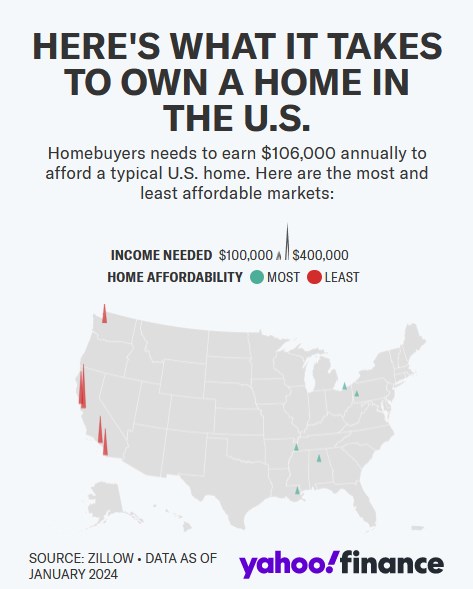
          Pittsburgh was the most affordable metro area, where buyers need an average household income of at least $58,232 to purchase a median-priced home. This was followed by Memphis, which required an income of $69,976, Cleveland ($70,048), and Birmingham ($74,338), according to Zillow.
          Out of the 50 US markets, only three major metros were affordable to those making an average income of $81,000: Pittsburgh, St. Louis, and Detroit.
          Homebuyers Need to Earn 80% More than They Did in 2020 to Afford A Home in Today's Market_1
          By contrast, there are seven markets among major metros where would-be buyers need to earn $200,000 or more to afford a typical home. The top four were all in California — with San Jose taking the lead at ($454,296), followed by San Francisco ($330,864), Los Angeles ($279,250), and San Diego ($273,613).
          Next came Seattle ($213,984), followed by New York City ($213,615), and Boston ($205,253).
          “In this environment, buyers should really get their finances in order first,” Divounguy said. “You’ll want to start the search process early, get your credit right, and that can save you thousands over the course of the loan.”

          Source: Yahoo Finance

          To stay updated on all economic events of today, please check out our Economic calendar
          Risk Warnings and Disclaimers
          You understand and acknowledge that there is a high degree of risk involved in trading. Following any strategies or investment methods may lead to potential losses. The content on the site is provided by our contributors and analysts for information purposes only. You are solely responsible for determining whether any trading assets, securities, strategy, or any other product is suitable for investing based on your own investment objectives and financial situation.
          Add to Favorites
          Share
          FastBull
          Copyright © 2025 FastBull Ltd

          728 RM B 7/F GEE LOK IND BLDG NO 34 HUNG TO RD KWUN TONG KLN HONG KONG

          TelegramInstagramTwitterfacebooklinkedin
          App Store Google Play Google Play
          Products
          Charts

          Chats

          Q&A with Experts
          Screeners
          Economic Calendar
          Data
          Tools
          Membership
          Features
          Function
          Markets
          Copy Trading
          Latest Signals
          Contests
          News
          Analysis
          24/7
          Columns
          Education
          Company
          Careers
          About Us
          Contact Us
          Advertising
          Help Center
          Feedback
          User Agreement
          Privacy Policy
          Business

          White Label

          Data API

          Web Plug-ins

          Poster Maker

          Affiliate Program

          Risk Disclosure

          The risk of loss in trading financial instruments such as stocks, FX, commodities, futures, bonds, ETFs and crypto can be substantial. You may sustain a total loss of the funds that you deposit with your broker. Therefore, you should carefully consider whether such trading is suitable for you in light of your circumstances and financial resources.

          No decision to invest should be made without thoroughly conducting due diligence by yourself or consulting with your financial advisors. Our web content might not suit you since we don't know your financial conditions and investment needs. Our financial information might have latency or contain inaccuracy, so you should be fully responsible for any of your trading and investment decisions. The company will not be responsible for your capital loss.

          Without getting permission from the website, you are not allowed to copy the website's graphics, texts, or trademarks. Intellectual property rights in the content or data incorporated into this website belong to its providers and exchange merchants.

          Not Logged In

          Log in to access more features

          FastBull Membership

          Not yet

          Purchase

          Become a signal provider
          Help Center
          Customer Service
          Dark Mode
          Price Up/Down Colors

          Log In

          Sign Up
          Position
          Layout
          Fullscreen
          Default to Chart
          The chart page opens by default when you visit fastbull.com