• Trade
  • Markets
  • Copy
  • Contests
  • News
  • 24/7
  • Calendar
  • Q&A
  • Chats
Trending
Screeners
SYMBOL
LAST
BID
ASK
HIGH
LOW
NET CHG.
%CHG.
SPREAD
SPX
S&P 500 Index
6818.18
6818.18
6818.18
6861.30
6801.50
-9.23
-0.14%
--
DJI
Dow Jones Industrial Average
48376.01
48376.01
48376.01
48679.14
48285.67
-82.03
-0.17%
--
IXIC
NASDAQ Composite Index
23108.41
23108.41
23108.41
23345.56
23012.00
-86.75
-0.37%
--
USDX
US Dollar Index
97.940
98.020
97.940
98.070
97.740
-0.010
-0.01%
--
EURUSD
Euro / US Dollar
1.17476
1.17484
1.17476
1.17686
1.17262
+0.00082
+ 0.07%
--
GBPUSD
Pound Sterling / US Dollar
1.33735
1.33743
1.33735
1.34014
1.33546
+0.00028
+ 0.02%
--
XAUUSD
Gold / US Dollar
4304.15
4304.49
4304.15
4350.16
4285.08
+4.76
+ 0.11%
--
WTI
Light Sweet Crude Oil
56.320
56.350
56.320
57.601
56.233
-0.913
-1.60%
--

Community Accounts

Signal Accounts
--
Profit Accounts
--
Loss Accounts
--
View More

Become a signal provider

Sell trading signals to earn additional income

View More

Guide to Copy Trading

Get started with ease and confidence

View More

Signal Accounts for Members

All Signal Accounts

Best Return
  • Best Return
  • Best P/L
  • Best MDD
Past 1W
  • Past 1W
  • Past 1M
  • Past 1Y

All Contests

  • All
  • Trump Updates
  • Recommend
  • Stocks
  • Cryptocurrencies
  • Central Banks
  • Featured News
Top News Only
Share

Goldman Sachs Says They Believe That The Copper Price Is Vulnerable To An Ai-Linked Price Correction

Share

Goldman Sachs Upgrades 2026 Copper Price Forecast To $11400 From $10,650

Share

Attempts By Ukrainian Troops To Advance From The South-West To Outskirts Of Kupiansk Are Being Thwarted

Share

Russian Troops Control All Of Kupiansk - IFX Cites Russian Military

Share

On Monday (December 15), The South Korean Won Ultimately Rose 0.60% Against The US Dollar, Closing At 1468.91 Won. The Won Was On An Upward Trend Throughout The Day, Rising Significantly At 17:00 Beijing Time And Reaching A Daily High Of 1463.04 Won At 17:36

Share

Health Ministry: Israeli Forces Kill Palestinian Teen In West Bank

Share

New York Federal Reserve President Williams: Over Time, The Size Of Reserves Could Grow From $2.9 Trillion

Share

New York Fed President Williams: AI Valuations Are High, But There Is A Real Driving Factor

Share

New York Federal Reserve President Williams: The Job Market Is In Very Good Shape

Share

New York Fed President Williams: 'Very Supportive' Of USA Central Bank's Decision To Cut Interest Rates Last Week

Share

New York Fed President Williams: 'Too Early To Say' What Central Bank Should Do At January Meeting

Share

New York Fed President Williams: Strong Markets Part Of Reason Why Economy Will Grow Robustly In 2026

Share

New York Fed President Williams: What Constitutes Ample Reserves Will Change Over Time

Share

New York Fed President Williams: Market Valuations 'Elevated,' But There Are Reasons For Pricing

Share

New York Fed President Williams: Ample Reserves System Working Very Well

Share

New York Fed President Williams: Some Signs That Parts Of Underlying Economy Not As Strong As GDP Data Suggests

Share

New York Fed President Williams: Expects Coming Job Data Will Show Gradual Cooling

Share

Ukraine President Zelenskiy: Monitoring Of Ceasefire Should Be Part Of Security Guarantees

Share

Ukraine President Zelenskiy: Ukraine Needs Clear Understanding On Security Guarantees Before Taking Any Decisions Regarding Frontlines

Share

U.S. Commerce Secretary Rutnick Praised Korea Zinc Co. Ltd., Stating That The United States Will Have Priority Access To The Company's Products In 2026

TIME
ACT
FCST
PREV
Japan Tankan Small Manufacturing Outlook Index (Q4)

A:--

F: --

P: --

Japan Tankan Large Non-Manufacturing Outlook Index (Q4)

A:--

F: --

P: --

Japan Tankan Large Manufacturing Outlook Index (Q4)

A:--

F: --

P: --

Japan Tankan Small Manufacturing Diffusion Index (Q4)

A:--

F: --

P: --

Japan Tankan Large-Enterprise Capital Expenditure YoY (Q4)

A:--

F: --

P: --

U.K. Rightmove House Price Index YoY (Dec)

A:--

F: --

P: --

China, Mainland Industrial Output YoY (YTD) (Nov)

A:--

F: --

P: --

China, Mainland Urban Area Unemployment Rate (Nov)

A:--

F: --

P: --

Saudi Arabia CPI YoY (Nov)

A:--

F: --

P: --

Euro Zone Industrial Output YoY (Oct)

A:--

F: --

P: --

Euro Zone Industrial Output MoM (Oct)

A:--

F: --

P: --

Canada Existing Home Sales MoM (Nov)

A:--

F: --

P: --

Canada National Economic Confidence Index

A:--

F: --

P: --

Canada New Housing Starts (Nov)

A:--

F: --

P: --
U.S. NY Fed Manufacturing Employment Index (Dec)

A:--

F: --

P: --

U.S. NY Fed Manufacturing Index (Dec)

A:--

F: --

P: --

Canada Core CPI YoY (Nov)

A:--

F: --

P: --

Canada Manufacturing Unfilled Orders MoM (Oct)

A:--

F: --

P: --

U.S. NY Fed Manufacturing Prices Received Index (Dec)

A:--

F: --

P: --

U.S. NY Fed Manufacturing New Orders Index (Dec)

A:--

F: --

P: --

Canada Manufacturing New Orders MoM (Oct)

A:--

F: --

P: --

Canada Core CPI MoM (Nov)

A:--

F: --

P: --

Canada Trimmed CPI YoY (SA) (Nov)

A:--

F: --

P: --

Canada Manufacturing Inventory MoM (Oct)

A:--

F: --

P: --

Canada CPI YoY (Nov)

A:--

F: --

P: --

Canada CPI MoM (Nov)

A:--

F: --

P: --

Canada CPI YoY (SA) (Nov)

A:--

F: --

P: --

Canada Core CPI MoM (SA) (Nov)

A:--

F: --

P: --

Canada CPI MoM (SA) (Nov)

A:--

F: --

P: --

Federal Reserve Board Governor Milan delivered a speech
U.S. NAHB Housing Market Index (Dec)

A:--

F: --

P: --

Australia Composite PMI Prelim (Dec)

--

F: --

P: --

Australia Services PMI Prelim (Dec)

--

F: --

P: --

Australia Manufacturing PMI Prelim (Dec)

--

F: --

P: --

Japan Manufacturing PMI Prelim (SA) (Dec)

--

F: --

P: --

U.K. 3-Month ILO Employment Change (Oct)

--

F: --

P: --

U.K. Unemployment Claimant Count (Nov)

--

F: --

P: --

U.K. Unemployment Rate (Nov)

--

F: --

P: --

U.K. 3-Month ILO Unemployment Rate (Oct)

--

F: --

P: --

U.K. Average Weekly Earnings (3-Month Average, Including Bonuses) YoY (Oct)

--

F: --

P: --

U.K. Average Weekly Earnings (3-Month Average, Excluding Bonuses) YoY (Oct)

--

F: --

P: --

France Services PMI Prelim (Dec)

--

F: --

P: --

France Composite PMI Prelim (SA) (Dec)

--

F: --

P: --

France Manufacturing PMI Prelim (Dec)

--

F: --

P: --

Germany Services PMI Prelim (SA) (Dec)

--

F: --

P: --

Germany Manufacturing PMI Prelim (SA) (Dec)

--

F: --

P: --

Germany Composite PMI Prelim (SA) (Dec)

--

F: --

P: --

Euro Zone Composite PMI Prelim (SA) (Dec)

--

F: --

P: --

Euro Zone Services PMI Prelim (SA) (Dec)

--

F: --

P: --

Euro Zone Manufacturing PMI Prelim (SA) (Dec)

--

F: --

P: --

U.K. Services PMI Prelim (Dec)

--

F: --

P: --

U.K. Manufacturing PMI Prelim (Dec)

--

F: --

P: --

U.K. Composite PMI Prelim (Dec)

--

F: --

P: --

Euro Zone ZEW Economic Sentiment Index (Dec)

--

F: --

P: --

Germany ZEW Current Conditions Index (Dec)

--

F: --

P: --

Germany ZEW Economic Sentiment Index (Dec)

--

F: --

P: --

Euro Zone Trade Balance (Not SA) (Oct)

--

F: --

P: --

Euro Zone ZEW Current Conditions Index (Dec)

--

F: --

P: --

Euro Zone Trade Balance (SA) (Oct)

--

F: --

P: --

Euro Zone Total Reserve Assets (Nov)

--

F: --

P: --

U.K. Inflation Rate Expectations

--

F: --

P: --

Q&A with Experts
    • All
    • Chatrooms
    • Groups
    • Friends
    Connecting
    .
    .
    .
    Type here...
    Add Symbol or Code

      No matching data

      All
      Trump Updates
      Recommend
      Stocks
      Cryptocurrencies
      Central Banks
      Featured News
      • All
      • Russia-Ukraine Conflict
      • Middle East Flashpoint
      • All
      • Russia-Ukraine Conflict
      • Middle East Flashpoint
      Search
      Products

      Charts Free Forever

      Chats Q&A with Experts
      Screeners Economic Calendar Data Tools
      Membership Features
      Data Warehouse Market Trends Institutional Data Policy Rates Macro

      Market Trends

      Market Sentiment Order Book Forex Correlations

      Top Indicators

      Charts Free Forever
      Markets

      News

      News Analysis 24/7 Columns Education
      From Institutions From Analysts
      Topics Columnists

      Latest Views

      Latest Views

      Trending Topics

      Top Columnists

      Latest Update

      Signals

      Copy Rankings Latest Signals Become a signal provider AI Rating
      Contests
      Brokers

      Overview Brokers Assessment Rankings Regulators News Claims
      Broker listing Forex Brokers Comparison Tool Live Spread Comparison Scam
      Q&A Complaint Scam Alert Videos Tips to Detect Scam
      More

      Business
      Events
      Careers About Us Advertising Help Center

      White Label

      Data API

      Web Plug-ins

      Affiliate Program

      Awards Institution Evaluation IB Seminar Salon Event Exhibition
      Vietnam Thailand Singapore Dubai
      Fans Party Investment Sharing Session
      FastBull Summit BrokersView Expo
      Recent Searches
        Top Searches
          Markets
          News
          Analysis
          User
          24/7
          Economic Calendar
          Education
          Data
          • Names
          • Latest
          • Prev

          View All

          No data

          Scan to Download

          Faster Charts, Chat Faster!

          Download App
          English
          • English
          • Español
          • العربية
          • Bahasa Indonesia
          • Bahasa Melayu
          • Tiếng Việt
          • ภาษาไทย
          • Français
          • Italiano
          • Türkçe
          • Русский язык
          • 简中
          • 繁中
          Open Account
          Search
          Products
          Charts Free Forever
          Markets
          News
          Signals

          Copy Rankings Latest Signals Become a signal provider AI Rating
          Contests
          Brokers

          Overview Brokers Assessment Rankings Regulators News Claims
          Broker listing Forex Brokers Comparison Tool Live Spread Comparison Scam
          Q&A Complaint Scam Alert Videos Tips to Detect Scam
          More

          Business
          Events
          Careers About Us Advertising Help Center

          White Label

          Data API

          Web Plug-ins

          Affiliate Program

          Awards Institution Evaluation IB Seminar Salon Event Exhibition
          Vietnam Thailand Singapore Dubai
          Fans Party Investment Sharing Session
          FastBull Summit BrokersView Expo

          Bitcoin ETF on the Horizon: BlackRock Leverages Coinbase Custody for Application

          Warren Takunda

          Traders' Opinions

          BlackRock, the largest asset manager globally, is reportedly close to filing an application for a Bitcoin ETF, as per an informed insider. The source disclosed that BlackRock intends to utilize Coinbase Custody for the ETF and rely on the spot market data from the crypto exchange for pricing. Coinbase declined to comment when approached for confirmation.
          BlackRock initiated its collaboration with Coinbase in the middle of last year, aiming to facilitate direct crypto access for institutional investors.
          It remains unclear whether the proposed ETF will track spot prices or futures contracts. BlackRock has yet to respond to requests for clarification.
          Thus far, the Securities and Exchange Commission (SEC), which oversees ETFs in the United States, has rejected all applications for spot Bitcoin ETFs. However, the commission has granted approval for various Bitcoin futures ETFs to commence trading.
          Bitcoin ETFs: A Comprehensive Overview
          A Bitcoin exchange-traded fund (ETF) presents investors with an opportunity to gain exposure to the largest cryptocurrency by market capitalization without the need for direct ownership.
          Bitcoin ETFs track the value of Bitcoin and can be bought, sold, and traded on traditional stock market exchanges, rather than cryptocurrency trading platforms. This provides a reliable vehicle for mainstream investors and speculators to gain Bitcoin price exposure through a familiar and established investment instrument.
          ETFs are well-established financial instruments that are prevalent in the industry. They offer price exposure to diverse assets and industries, including commodities, currencies, and sectors focused on environmental sustainability or diversity.
          As of now, the United States has yet to approve a spot Bitcoin ETF, although investors can access Bitcoin futures ETFs. The distinction between the two lies in the backing of the ETFs, where spot Bitcoin ETFs are backed by actual Bitcoin (BTC), whereas Bitcoin futures ETFs rely on derivatives tied to Bitcoin.
          The introduction of a Bitcoin ETF would broaden the range of available investment options for U.S. investors.
          Pros and Cons of a Bitcoin ETF
          While purchasing Bitcoin directly from a cryptocurrency exchange or Bitcoin ATM is accessible to anyone, an ETF presents several advantages, including:
          Convenience: ETFs eliminate the need to navigate the complexities of using a crypto wallet or opening accounts on crypto exchanges.
          Users do not possess BTC directly but still gain price exposure through investment vehicles they are more familiar with, along with established tax regulations.
          Portfolio Diversification: ETFs can hold multiple assets, including Bitcoin-related stocks, allowing investors to diversify their portfolios across traditional markets.
          Even if an ETF solely comprises BTC, investors gain an option to diversify their holdings within conventional markets.
          Despite these significant benefits, a Bitcoin ETF has limitations that should be considered:
          Fees: ETFs often encompass management fees, diverting a portion of the funds from investments to cover managerial costs. Before investing, it is advisable to examine the "expense ratio" of an ETF and aim for the lowest possible figure, ideally below 1%.
          Lack of Direct Ownership: Bitcoin ETFs cannot be exchanged for other cryptocurrencies since holders do not possess the underlying asset, only gaining price exposure.
          Trading Hours: Unlike the continuous availability of cryptocurrency trading, financial exchanges like the New York Stock Exchange operate limited hours, potentially causing delays in reacting to significant price movements.
          Pricing Accuracy: Real-time changes in Bitcoin's value may not be immediately reflected in the ETF's value, particularly if the ETF encompasses multiple holdings.
          Accessing Bitcoin ETFs
          Although spot Bitcoin ETFs have not yet obtained approval within the United States, they are already accessible in other parts of the world. The increasing prominence of the cryptocurrency sector has allowed numerous providers to introduce Bitcoin exchange-traded funds in various countries. Notable instances encompass:
          In Canada, there are notable Bitcoin exchange-traded funds (ETFs) offered by 3IQ Coinshares, Purpose Bitcoin, and CI Galaxy Bitcoin. Across Europe, investors can access Bitcoin through 21Shares Bitcoin ETP, BTCetc - ETC Group Physical Bitcoin, VanEck Bitcoin ETN, Iconic Funds Physical Bitcoin ETP, and Bitpanda Bitcoin ETC. In Brazil, QR Capital's Bitcoin ETF provides an avenue for exposure to the cryptocurrency. Additionally, WisdomTree Bitcoin is available in Jersey for interested investors.
          Although a spot Bitcoin ETF is not currently available in the United States, Bitcoin futures ETFs exist, along with ETFs focused on Bitcoin-invested or related companies. Such ETFs may include companies like Tesla (TSLA) or those involved in supporting mining infrastructure and related technologies.
          Bitcoin ETF Progress in the United States
          Many eyes are on the United States as the approval of a Bitcoin exchange-traded fund is highly anticipated. However, securing the U.S. Securities and Exchange Commission's (SEC) endorsement has proven challenging, with numerous applications and proposals rejected in recent years. Despite some progress, the likelihood of approval for a spot Bitcoin ETF remains relatively low at present.
          As well as Bitwise's application for a spot Bitcoin ETF, Grayscale Investments' Bitcoin Trust (GBTC) was rejected by the SEC in June 2022. Grayscale has filed a lawsuit against the SEC, seeking a review by theppeals for the District of Columbia Circuit.
          Although certain companies have re-submitted applications for Bitcoin ETF approval to the SEC, immediate prospects for U.S. investors gaining access to a spot Bitcoin ETF appear uncertain.
          Is a Bitcoin ETF Superior to Bitcoin Ownership?
          The answer to this question is subjective, as each investor has distinct needs and expectations. A Bitcoin ETF offers price exposure without representing BTC ownership, making it particularly suitable for those seeking a more passive investment approach, individuals cautious about Bitcoin, or traders aiming to diversify their portfolios conveniently.
          On the other hand, owning Bitcoin is advantageous for regular traders, those intending to use BTC as a currency, or individuals looking to explore cryptocurrencies more extensively through trading or alternative means.
          While purchasing Bitcoin from an exchange, broker, or ATM only requires identity verification, spot Bitcoin ETFs await SEC approval. Futures-based ETFs are available, but price exposure alone may not suffice for all investors.
          Risk Warnings and Disclaimers
          You understand and acknowledge that there is a high degree of risk involved in trading. Following any strategies or investment methods may lead to potential losses. The content on the site is provided by our contributors and analysts for information purposes only. You are solely responsible for determining whether any trading assets, securities, strategy, or any other product is suitable for investing based on your own investment objectives and financial situation.
          Comments
          Add to Favorites
          Share

          Wall Street isn't Buying what Powell, Economists are Forecasting

          Damon

          Stocks

          Defying the odds, the world's biggest stock market has recouped all losses caused by the most disruptive monetary-tightening campaign in a generation.
          And not even recession warnings or fresh monetary threats from Jerome Powell are stopping fund managers as they join the big artificial intelligence-fuelled rally.
          Yet plenty on Wall Street have cause for concern. Think sobering economic signals in the bond market, rich equity valuations and febrile market patterns across decades of business cycles.
          Doug Ramsey, for one, warns against complacency. The way Leuthold's chief investment officer sees it: If the yield curve since the 1960s has it right, a recession really is coming around September — based on the persistently negative gap between three month and 10-year Treasury yields.
          "Those who've successfully played the current rally, in part because of excessive investor pessimism, should recognise the crowd is now mostly aboard," said Ramsey. "My biggest concern by far is the lagged impact of the last 15 months' tightening."
          After the Federal Reserve paused hikes Wednesday (June 14), the S&P 500 closed at 4,372.59, a level seen in March 2022 when Chair Powell kicked off the hiking cycle — sparking a bear market across stocks and bonds and predictions that a recession would surely land this year.
          Now stock enthusiasts are in the driving seat. Big Tech promises to fuel a fresh wave of corporate profits, inflation is easing at long last and historically speaking rate pauses have marked a key inflection point that have ushered in double-digit returns. In Thursday trading, the S&P 500 rose above the 4,400 mark for its six-day advance.
          "The bulls have the upper hand right now," said Zachary Hill, head of portfolio management at Horizon Investments, who thinks both economists and investors have underestimated the strength of the US consumer. "The worst is behind us."
          The rise in US stocks came after equity positioning was cut to the bone amid consensus expectations for more losses at the start of 2023 before a second-half rebound. As stocks kept rallying, sceptics had to cave.
          Rules-based and discretionary investors are now overweight equities for the first time since February 2022, data compiled by Deutsche Bank AG show. A survey by the National Association of Active Investment Managers shows equity exposure has doubled since early January to 90% last week.
          That doesn't mean the advance can't keep on going. But already high equity positioning means investors have less dry powder to buy equities in the months ahead. And it's looking choppy out there. Forecasters surveyed by Bloomberg are predicting that the economy will contract mildly in the third and fourth quarters.
          Then, there's the valuation constraint. At 19 times projected 12-month earnings, the S&P 500's multiple is about 8% higher than its 10-year average.
          Since World War II, there have been nine bear markets that have been accompanied by an economic downturn, and the S&P 500 on average has declined 35% versus 28% for bear markets that didn't come with one, per Sam Stovall, chief investment strategist at CFRA.
          Meanwhile there have been just three bear runs since 1948 without recessions — and each time a new bull rally started within five months of stock prices hitting a low.
          Even if there's a recession, it's the length that really matters. The depth of peak-to-trough real GDP declines isn't historically correlated to the severity of stock slumps, according to Gina Martin Adams, chief equity strategist at Bloomberg Intelligence. Yet shorter recessions have led to more rapid rebounds.
          With the job market still strong, the consensus expectation is that any downturn will be mild, helping to explain why fund managers are choosing to rebuild their market exposures rather than miss out on further tech-powered gains.
          "The medium-term trajectory once we get past this does not look like an economy that suffered deeper scars that will take years to heal," said Yung-Yu Ma, chief investment strategist at BMO Wealth. "That allows for some comfort to hold onto positions, even for investors that might think we have a bumpy road ahead."

          Source: Bloomberg

          Risk Warnings and Disclaimers
          You understand and acknowledge that there is a high degree of risk involved in trading. Following any strategies or investment methods may lead to potential losses. The content on the site is provided by our contributors and analysts for information purposes only. You are solely responsible for determining whether any trading assets, securities, strategy, or any other product is suitable for investing based on your own investment objectives and financial situation.
          Comments
          Add to Favorites
          Share

          Easing Inflation and Positive Data Drive S&P 500 and Nasdaq to New Heights

          Warren Takunda

          Stocks

          The S&P 500 and Nasdaq reached new 14-month highs on Thursday, propelled by fresh economic data and the growing belief among investors that the U.S. Federal Reserve is approaching the end of its aggressive interest-rate hiking cycle.
          Investors found solace in falling Treasury yields, as a series of economic indicators pointed to easing inflation, offsetting concerns about potential future rate hikes.
          Surprising data revealed that U.S. retail sales unexpectedly rose in May, reflecting increased consumer spending across various sectors, including the automotive industry. In addition, jobless claims remained steady at a seasonally adjusted 262,000 for the week ending June 10, although this figure exceeded economists' forecast of 249,000 claims.
          Furthermore, import prices experienced a decline in May, with the annual decrease marking the sharpest drop in three years. This followed a report earlier in the week indicating that headline inflation in April rose less than initially anticipated.
          These latest developments come on the heels of the Federal Reserve's decision to leave interest rates unchanged within the 5%-5.25% range on Wednesday. The central bank also signaled a potential half-percentage-point rate hike later this year, citing persistent inflationary pressures and a resilient U.S. economy.
          Ross Mayfield, an investment strategy analyst at Baird, noted, "Given the softer inflation data earlier this week and the positive economic data following the Fed meeting, the market is rallying and yields are falling because investors are skeptical of the Fed's hawkish stance. The market doesn't believe that the Fed has two more rate hikes in its plans."
          According to the CME Fedwatch tool, traders currently foresee a 67% likelihood of a 25-basis-point rate hike in July, followed by a potential rate cut by December.
          Thursday's market gains were widespread, with sectors sensitive to economic conditions leading the charge. Ten of the 11 S&P 500 sector indexes experienced gains, driven by a 1.37% increase in healthcare and a 1.22% surge in energy, fueled by rising oil prices.
          The pullback in U.S. Treasury yields benefited rate-sensitive growth stocks, as evidenced by over 2% gains in Microsoft and Meta Platforms.
          David Russell, Vice President of Market Intelligence at TradeStation, explained, "There is a significant amount of sidelined money from investors who were wary of a recession, and as those concerns dissipate, people are returning to equities."
          So far in 2023, the S&P 500 has climbed 15%, while the Nasdaq has surged 31%, buoyed by signs of economic resilience, better-than-expected earnings reports, and the belief that interest rates are nearing their peak.
          The S&P 500 closed at 4,415.69 points, marking a 0.99% increase. The Nasdaq rose 0.89% to reach 13,747.56 points, while the Dow Jones Industrial Average advanced 1.16%, ending at 34,371.99 points.
          Kroger Co experienced a 2.8% decline after falling short of first-quarter revenue estimates. Conversely, Kohl's Corp saw a 1.1% increase after receiving an upgrade from TD Cowen, which raised its rating for the department store operator from "market perform" to "outperform."
          U.S.-listed shares of Chinese companies Alibaba Group and JD.com rose over 3% following the People's Bank of China's decision to cut borrowing costs for its medium-term policy loans, marking the first such reduction in 10 months.
          Advancing issues significantly outnumbered declining ones within the S&P 500, with a ratio of 5-to-1. The S&P 500 recorded 36 new highs and no new lows, while the Nasdaq achieved 59 new highs and 65 new lows.
          Risk Warnings and Disclaimers
          You understand and acknowledge that there is a high degree of risk involved in trading. Following any strategies or investment methods may lead to potential losses. The content on the site is provided by our contributors and analysts for information purposes only. You are solely responsible for determining whether any trading assets, securities, strategy, or any other product is suitable for investing based on your own investment objectives and financial situation.
          Comments
          Add to Favorites
          Share

          After the Hawks, Here Comes the Bank of Japan Dove

          Thomas

          Central Bank

          The Bank of Japan, the most dovish major central bank in the world, announces its latest policy decision on Friday, with markets highly sensitive to signs of when and to what degree it will ditch its super-loose policy.
          Asian markets should go into the decision on the front foot, after the S&P 500 and Nasdaq closed at 14-month highs on Thursday as investors bet that U.S. interest rates are close to peaking.
          The BOJ follows surprisingly aggressive interest rate increases and guidance recently from policymakers in Canada and Australia, and this week's hawkish signals from the European Central Bank and, to a lesser extent, the U.S. Federal Reserve.
          The BOJ remains the outlier among major central banks, promising to maintain its loose policy until it is sure inflation meets the 2% target. Polls, sources and market moves all suggest no move on rates or the yield curve control (YCC) scheme, leaving the focus on BOJ Governor Kazuo Ueda's press conference.
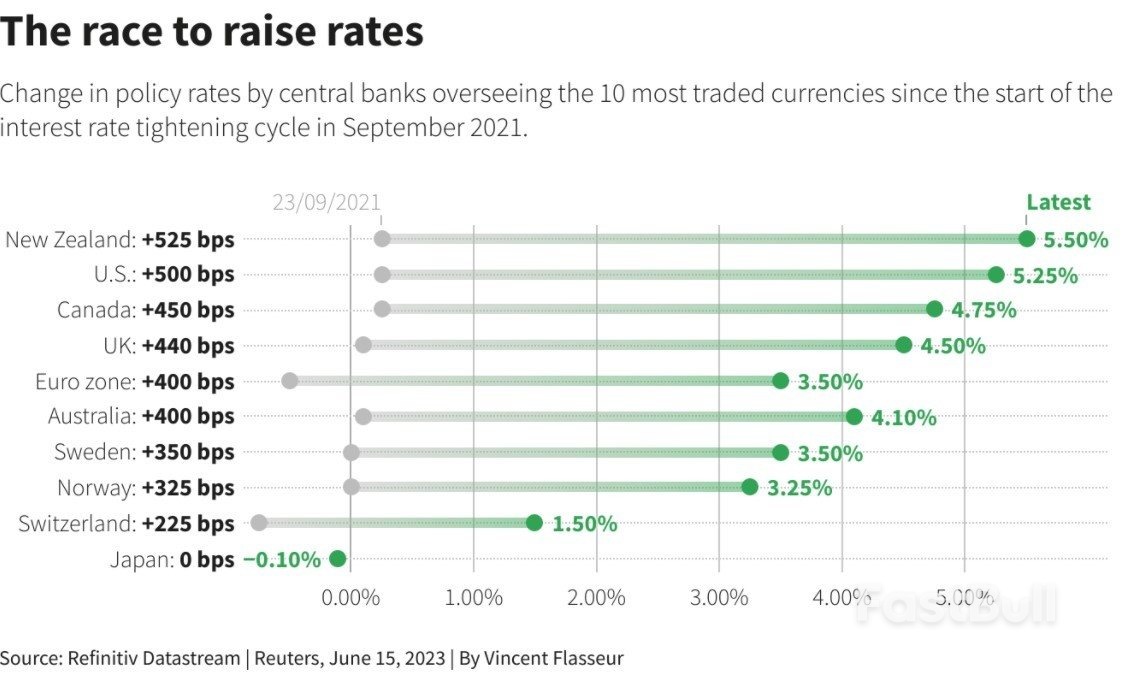
          While the Fed and others have tightened policy by 500 basis points or raised rates to their highest in decades, Japanese interest rates are still negative and the central bank is buying unlimited amounts of bonds to cap yields at a certain level.
          After the Hawks, Here Comes the Bank of Japan Dove_1Around half of the economists in a Reuters poll expect a rollback of easing, including a tweak to YCC, in either July or September. Ueda could open the door to this on Friday, nodding to inflation currently overshooting BOJ forecasts and a potential upgrade to BOJ price projections in July, they said.
          But Ueda has stressed the need to maintain ultra-loose policy until durable wage growth accompanies rising prices. Changes to YCC may come as soon as July, but an interest rate hike is a long way off - Bank of America analysts think rates will stay on hold until summer 2024.
          If Japanese assets are any indication, investors expect Ueda and his colleagues to err on the dovish side.
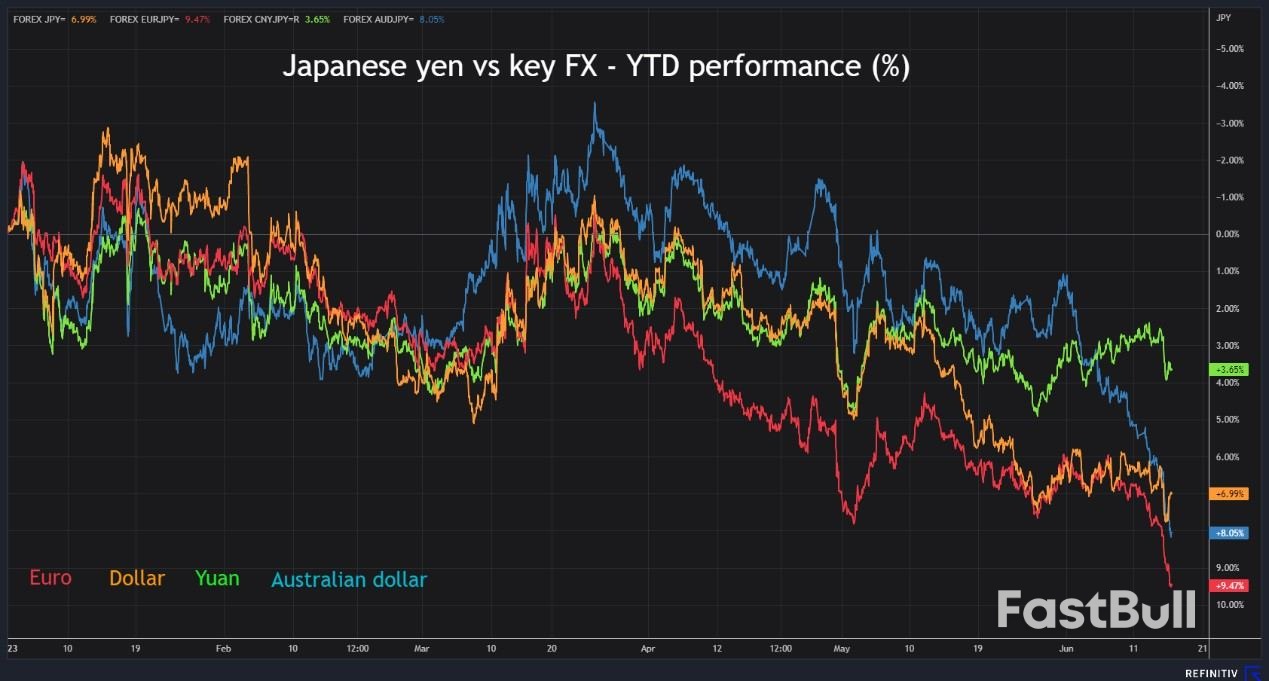
          After the Hawks, Here Comes the Bank of Japan Dove_2The yen on Thursday slid to a new low for the year through 141.00 per dollar and, most remarkably after the ECB made it clear it will raise rates further, to a 15-year low against the euro of 153.68 per euro.
          Japanese authorities will be watching these developments closely and intervention to stop the rot cannot be ruled out. Perhaps 145.00 per dollar would be the trigger.
          The cheapness of Japan's currency has made its stock markets extremely attractive to foreign investors. The benchmark Nikkei 225 index rose to fresh 33-year high of 33,767 points on Thursday before closing marginally lower.
          Here are key developments that could provide more direction to markets on Friday:
          - Japan monetary policy decision
          - Euro zone inflation (May, final reading)
          - Fed's Bullard, Waller and Barkin all speak

          Source: Yahoo

          Risk Warnings and Disclaimers
          You understand and acknowledge that there is a high degree of risk involved in trading. Following any strategies or investment methods may lead to potential losses. The content on the site is provided by our contributors and analysts for information purposes only. You are solely responsible for determining whether any trading assets, securities, strategy, or any other product is suitable for investing based on your own investment objectives and financial situation.
          Comments
          Add to Favorites
          Share

          Lagarde Pre-Announces Another ECB Rate Hike for July

          Justin

          Central Bank

          Economic

          One month before the first anniversary of what's become the European Central Bank's most aggressive tightening cycle on record, the ECB is continuing its fight against inflation and hiked its policy rate by 25bp. The deposit rate is now at 3.5%. A year ago, it stood at -0.5%. The ECB also made official what it had already announced at the May meeting; the reinvestments of bond purchases made under the Asset Purchase Programme will stop next month.

          Upward revision to inflation forecast supports more rate hikes to come

          Despite a recent softening, actual headline and core inflation remain too high. With expectations for inflation to return to target only in two years' time, there are clear arguments for the ECB to continue raising rates. The fact that the bank's newest staff projections include an upward revision of both headline and core inflation across the entire time horizon must have strengthened the case for continued hiking.
          In its latest macro projections, ECB staff now expect headline inflation to come in at 5.4% this year, 3% in 2024 and 2.2% in 2025. Core inflation is expected to come in at 5.1%, 3% and 2.3%, respectively. Remember that in its review of its monetary policy strategy, the ECB stated that inflation returning to target at the end of the forecast horizon was not sufficient or in line with price stability.

          The ECB had not even thought about a potential pause in its hiking cycle

          Interestingly, ECB staff remain one of the last growth optimists standing. GDP growth in the eurozone is expected to come in at 0.9%, 1.5% and 1.6%, respectively, up to 2025, slightly lower than in the March forecasts. The downward revision, however, seems to be the result of the weaker-than-previously-expected start to the year rather than the result of a change in the fundamental assessment. This is somewhat striking, given that ECB staff still seems to expect eurozone growth to return to potential growth in every single quarter before the end of the year.
          During the news conference, President Christine Lagarde somewhat deviated from the recent ECB strategy to stop forward guidance and have a meeting-by-meeting approach as she pre-announced a rate hike for the next ECB meeting in July. Lagarde repeated the earlier phrase that the ECB had “more ground to cover” but added that a rate hike in July was very likely. Lagarde also remarked that the ECB had not even thought about a potential pause in its hiking cycle.

          ECB at risk of going too far

          Still, and even if Christine Lagarde tried to paint a different picture, with the Federal Reserve’s hawkish pause and a eurozone economy not only turning out to be less resilient than anticipated but also facing a very subdued growth outlook, the ECB is increasingly taking the risk of worsening the economic outlook. Also, historical evidence suggests that core inflation normally lags headline inflation while services inflation lags that of goods. These are two strong arguments for a further slowing of core inflation in the second half of the year.
          However, as much as arguments against further rate hikes are getting stronger, the ECB simply cannot afford to be wrong about inflation. The Bank wants and has to be sure that it has slayed the inflation dragon before considering a policy change. This is why they are putting more than usual emphasis on actual inflation developments.
          While such a strategy supports the ECB’s credibility, by definition, it runs the risk of falling behind the curve. Given the time lags with which monetary policy operates and affects the economy, central banks should be forward-looking, not now-looking. This is the theory. In practice, however, the ECB will not change its tightening stance until core inflation shows clear signs of a turning point.
          We won't be seeing that at the July meeting, and probably not in the September one, either. In fact, we think it would require an economic earthquake for the European Central Bank not to hike in September as well.

          Source:ING

          To stay updated on all economic events of today, please check out our Economic calendar
          Risk Warnings and Disclaimers
          You understand and acknowledge that there is a high degree of risk involved in trading. Following any strategies or investment methods may lead to potential losses. The content on the site is provided by our contributors and analysts for information purposes only. You are solely responsible for determining whether any trading assets, securities, strategy, or any other product is suitable for investing based on your own investment objectives and financial situation.
          Comments
          Add to Favorites
          Share

          Mixed US Data Offers Little Clarity on Prospect of July Fed Rate Hike

          Justin

          Central Bank

          Economic

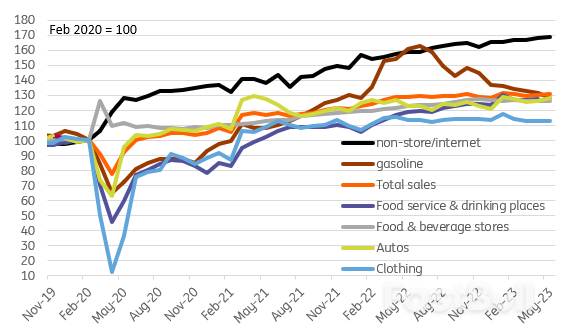
          Retail sales led by autos and building materials

          Today's US numbers are a bit mixed and do little to provide clarity on the outlook for interest rates. Retail sales were better than hoped, rising 0.3% month-on-month versus the -0.2% consensus yet the control group (which strips out volatile components and better matches with broader consumer spending trends) came in at +0.2% as expected while there was a downward revision to April from (+0.7% to +0.6%).
          The details show building material sales surged 2.2% MoM while motor vehicle and parts sales jumped 1.4% despite the unit auto sales from manufacturers reporting a sizeable contraction (down to an annualised 15.05mn from 15.91mn) and the CPI suggesting prices for new vehicles fell 0.1% MoM. Strip out these two components and retail sales would have fallen 0.5% on a 3M annualised rate. The underlying story is weaker than the headline suggests.

          Retail sales levels

          Mixed US Data Offers Little Clarity on Prospect of July Fed Rate Hike_1

          Jobless claims suggest a softening jobs market

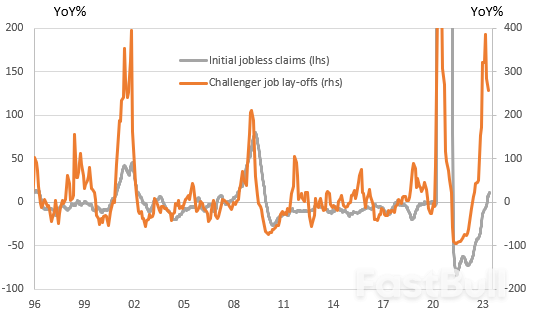
          Arguably the bigger story is the initial jobless claims numbers. Remember, they surprisingly jumped last week to 261k from 233k. The market had been expecting a retracement back to 245k, but instead, they were revised up last month by 1k and have held at 262k this week. Continuing claims have also moved higher to 1.775mn from 1.755mn (consensus was 1.768mn). This means we have the highest number of initial jobless claims since October 2021 with the job lay-off announcements pointing to jobless claims continuing to grind higher in the coming weeks and months. Consequently, while demand for workers remains firm, the rising lay-offs mean we should anticipate the net gain in payrolls to moderate. Furthermore, there is a concern that we are losing well-paid, full-time jobs in the likes of the tech and business service sectors, and they are merely being replaced by lower-paid, part-time jobs in the leisure and hospitality sectors.

          Rising lay-offs suggest jobless claims have further to rise (%YoY%)

          Mixed US Data Offers Little Clarity on Prospect of July Fed Rate Hike_2

          Manufacturing is weak outside of autos

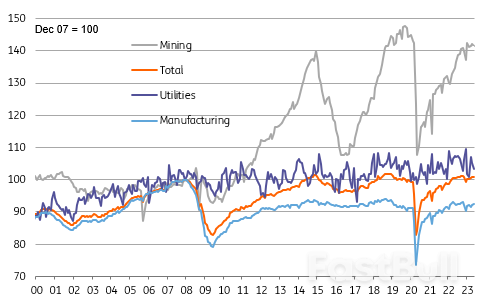
          Meanwhile, May industrial production fell 0.2% MoM versus the +0.1% consensus. Manufacturing actually rose 0.1% rather than contract 0.1% as the consensus predicted, but mining fell 0.4% while utilities output fell 1.8% on reduced electricity consumption. Within manufacturing, auto output rose 0.2% MoM to stand 10% YoY higher given strong order books, but all other components are softer with total manufacturing output down 0.3% YoY and ex-auto manufacturing down 1.1% YoY. The regional manufacturing indicators - the very volatile NY Empire survey and the Philly Fed survey - moved in different directions with the Empire survey strengthening significantly while the Philly Fed softened. The national ISM index has been sub-50 (in contraction territory) for seven consecutive months and these regional indicators suggest we should expect this to continue for an eighth month.

          Industrial production levels

          Mixed US Data Offers Little Clarity on Prospect of July Fed Rate Hike_3
          Other numbers include import prices falling a little more than expected (-0.6% MoM/-5.9%), underscoring the point made in yesterday's PPI report that pipeline price pressures are weakening swiftly even though the Fed doesn't want to acknowledge it.

          Source:ING

          To stay updated on all economic events of today, please check out our Economic calendar
          Risk Warnings and Disclaimers
          You understand and acknowledge that there is a high degree of risk involved in trading. Following any strategies or investment methods may lead to potential losses. The content on the site is provided by our contributors and analysts for information purposes only. You are solely responsible for determining whether any trading assets, securities, strategy, or any other product is suitable for investing based on your own investment objectives and financial situation.
          Comments
          Add to Favorites
          Share

          Iron Ore Dances Between China Stimulus Optimism and Soft Economic Reality

          Owen Li

          Commodity

          Iron ore is engaging in a familiar dance of flitting between hopes of more and effective economic stimulus in China, and the reality that the rebound in the world's second-biggest economy is sputtering.
          The spot price of iron ore has gyrated in recent weeks, driven by hopes for more stimulus from Beijing and concerns that the run of soft economic indicators is likely to extend.
          China buys more than 70% of the total volume of global seaborne iron ore and produces just over half of the world's steel, making its economic conditions key to the outlook for the main raw material for steel.
          The price of iron ore contracts traded in Singapore ended at $113.42 a metric tonne on Wednesday, up marginally on the day but also up 10.8% from the low this year of $102.33 on May 5.
          The immediate driver was news that China's central bank on Wednesday lowered a key short-term lending rate for the first time in 10 months, cutting the seven-day reverse repo rate by 10 basis points to 1.90%.
          That reduction, and expectations of further cuts to other lending rates, is sparking optimism that Beijing is acting to boost the flagging property sector, which consumes about one-third of China's steel output.
          The hope can be seen in the domestic iron ore price, with contracts on the Dalian Commodity Exchange outperforming Singapore futures.
          The front-month Dalian contract ended at 804 yuan ($112.29) a metric tonne on Wednesday, up 1.5% on the day and about 17.8% above the closing low for the year of 682.5 yuan on May 25.
          There are also some fundamental supports for the iron ore price, most noticeably declining inventories at China's ports.
          Port stockpiles monitored by consultants SteelHome dropped to 126.2 million metric tonnes in the week to June 9, down from 126.9 million the previous week and hitting their lowest level since July last year.
          There is a seasonal pattern to inventories as they build over the northern winter while steel mills curb output, then drop as steel production ramps up for the summer construction season.
          In the same week last year, inventories were at 128.3 million metric tonnes, or 1.6% above the current level.
          Although this isn't a huge drop on a year-on-year basis, it does indicate that there is room for steel mills to keep imports at a robust level and keep stockpiles comfortable.
          Another bullish indicator is steel mills' lifting production rates, with data from the China Iron and Steel Association showing output at its members rose to 2.23 million metric tonnes a day in the June 1-11 period, up 6.5% from the May 21-31 period.
          The association also reported that steel inventories were 15.8 million metric tonnes over June 1-10, up 1.2% from the prior 10 days but down 15% from the same period in 2022.
          Soft Economic Data
          Countering the positive indicators for iron ore demand is a raft of underwhelming economic data that shows China's rebound after ending its strict zero-COVID policy in December has been uneven.
          Industrial output grew 3.5% in May from a year earlier, the National Bureau of Statistics said on Wednesday, slowing from the 5.6% gain in April and below a 3.6% increase expected by analysts in a Reuters poll.
          Retail sales, which had been the bright spot in China's economy in the first quarter, lifted 12.7%, missing forecasts of 13.6% growth and down from April's 18.4%.
          The weak data may actually boost iron ore sentiment, as investors will expect further stimulus measures from Beijing.
          But for any rally to sustain, it will be necessary for stimulus to translate into actual steel demand in coming months.
          In the meantime, China's appetite for iron ore imports is likely to remain locked within the fairly tight band of 90 million to 103 million metric tonnes per month, which has persisted since July 2022.
          June's imports are expected to be about 98 million metric tonnes by commodity analysts Kpler, which would be slightly ahead of May's official customs figure of 96.18 million.

          Source: Reuters

          Risk Warnings and Disclaimers
          You understand and acknowledge that there is a high degree of risk involved in trading. Following any strategies or investment methods may lead to potential losses. The content on the site is provided by our contributors and analysts for information purposes only. You are solely responsible for determining whether any trading assets, securities, strategy, or any other product is suitable for investing based on your own investment objectives and financial situation.
          Comments
          Add to Favorites
          Share
          FastBull
          Copyright © 2025 FastBull Ltd

          728 RM B 7/F GEE LOK IND BLDG NO 34 HUNG TO RD KWUN TONG KLN HONG KONG

          TelegramInstagramTwitterfacebooklinkedin
          App Store Google Play Google Play
          Products
          Charts

          Chats

          Q&A with Experts
          Screeners
          Economic Calendar
          Data
          Tools
          Membership
          Features
          Function
          Markets
          Copy Trading
          Latest Signals
          Contests
          News
          Analysis
          24/7
          Columns
          Education
          Company
          Careers
          About Us
          Contact Us
          Advertising
          Help Center
          Feedback
          User Agreement
          Privacy Policy
          Business

          White Label

          Data API

          Web Plug-ins

          Poster Maker

          Affiliate Program

          Risk Disclosure

          The risk of loss in trading financial instruments such as stocks, FX, commodities, futures, bonds, ETFs and crypto can be substantial. You may sustain a total loss of the funds that you deposit with your broker. Therefore, you should carefully consider whether such trading is suitable for you in light of your circumstances and financial resources.

          No decision to invest should be made without thoroughly conducting due diligence by yourself or consulting with your financial advisors. Our web content might not suit you since we don't know your financial conditions and investment needs. Our financial information might have latency or contain inaccuracy, so you should be fully responsible for any of your trading and investment decisions. The company will not be responsible for your capital loss.

          Without getting permission from the website, you are not allowed to copy the website's graphics, texts, or trademarks. Intellectual property rights in the content or data incorporated into this website belong to its providers and exchange merchants.

          Not Logged In

          Log in to access more features

          FastBull Membership

          Not yet

          Purchase

          Become a signal provider
          Help Center
          Customer Service
          Dark Mode
          Price Up/Down Colors

          Log In

          Sign Up

          Position
          Layout
          Fullscreen
          Default to Chart
          The chart page opens by default when you visit fastbull.com