
• Trade
  • Markets
  • Copy
  • Contests
  • News
  • 24/7
  • Calendar
  • Q&A
  • Chats
Trending
Screeners
SYMBOL
LAST
BID
ASK
HIGH
LOW
NET CHG.
%CHG.
SPREAD
SPX
S&P 500 Index
6827.42
6827.42
6827.42
6899.86
6801.80
-73.58
-1.07%
--
DJI
Dow Jones Industrial Average
48458.04
48458.04
48458.04
48886.86
48334.10
-245.98
-0.51%
--
IXIC
NASDAQ Composite Index
23195.16
23195.16
23195.16
23554.89
23094.51
-398.69
-1.69%
--
USDX
US Dollar Index
97.950
98.030
97.950
98.500
97.950
-0.370
-0.38%
--
EURUSD
Euro / US Dollar
1.17394
1.17409
1.17394
1.17496
1.17192
+0.00011
+ 0.01%
--
GBPUSD
Pound Sterling / US Dollar
1.33707
1.33732
1.33707
1.33997
1.33419
-0.00148
-0.11%
--
XAUUSD
Gold / US Dollar
4299.39
4299.39
4299.39
4353.41
4257.10
+20.10
+ 0.47%
--
WTI
Light Sweet Crude Oil
57.233
57.485
57.233
58.011
56.969
-0.408
-0.71%
--

Community Accounts

Signal Accounts
--
Profit Accounts
--
Loss Accounts
--
View More

Become a signal provider

Sell trading signals to earn additional income

View More

Guide to Copy Trading

Get started with ease and confidence

View More

Signal Accounts for Members

All Signal Accounts

Best Return
  • Best Return
  • Best P/L
  • Best MDD
Past 1W
  • Past 1W
  • Past 1M
  • Past 1Y

All Contests

  • All
  • Trump Updates
  • Recommend
  • Stocks
  • Cryptocurrencies
  • Central Banks
  • Featured News
Top News Only
Share

USA Embassy In Lithuania: Maria Kalesnikava Is Not Going To Vilnius

Share

USA Embassy In Lithuania: Other Prisoners Are Being Sent From Belarus To Ukraine

Share

Ukraine President Zelenskiy: Five Ukrainians Released By Belarus In US-Brokered Deal

Share

USA Vilnius Embassy: USA Stands Ready For "Additional Engagement With Belarus That Advances USA Interests"

Share

USA Vilnius Embassy: Belarus, USA, Other Citizens Among The Prisoners Released Into Lithuania

Share

USA Vilnius Embassy: USA Will Continue Diplomatic Efforts To Free The Remaining Political Prisoners In Belarus

Share

USA Vilnius Embassy: Belarus Releases 123 Prisoners Following Meeting Of President Trump's Envoy Coale And Belarus President Lukashenko

Share

USA Vilnius Embassy: Masatoshi Nakanishi, Aliaksandr Syrytsa Are Among The Prisoners Released By Belarus

Share

USA Vilnius Embassy: Maria Kalesnikava And Viktor Babaryka Are Among The Prisoners Released By Belarus

Share

USA Vilnius Embassy: Nobel Peace Prize Laureate Ales Bialiatski Is Among The Prisoners Released By Belarus

Share

Belarusian Presidential Administration Telegram Channel: Lukashenko Has Pardoned 123 Prisoners As Part Of Deal With US

Share

Two Local Syrian Officials: Joint US-Syrian Military Patrol In Central Syria Came Under Fire From Unknown Assailants

Share

Israeli Military Says It Targeted 'Key Hamas Terrorist' In Gaza City

Share

Rwanda's Actions In Eastern Drc Are A Clear Violation Of Washington Accords Signed By President Trump - Secretary Of State Rubio

Share

Israeli Military Issues Evacuation Warning In Southern Lebanon Village Ahead Of Strike - Spokesperson On X

Share

Belarusian State Media Cites US Envoy Coale As Saying He Discussed Ukraine And Venezuela With Lukashenko

Share

Belarusian State Media Cites US Envoy Coale As Saying That US Removes Sanctions On Belarusian Potassium

Share

Thai Prime Minister: No Ceasefire Agreement With Cambodia

Share

US, Ukraine To Discuss Ceasefire In Berlin Ahead Of European Summit

Share

Incoming Czech Prime Minister Babis: Czech Republic Will Not Take On Guarantees For Ukraine Financing, European Commission Must Find Alternatives

TIME
ACT
FCST
PREV
U.K. Trade Balance Non-EU (SA) (Oct)

A:--

F: --

P: --

U.K. Trade Balance (Oct)

A:--

F: --

P: --

U.K. Services Index MoM

A:--

F: --

P: --

U.K. Construction Output MoM (SA) (Oct)

A:--

F: --

P: --

U.K. Industrial Output YoY (Oct)

A:--

F: --

P: --

U.K. Trade Balance (SA) (Oct)

A:--

F: --

P: --

U.K. Trade Balance EU (SA) (Oct)

A:--

F: --

P: --

U.K. Manufacturing Output YoY (Oct)

A:--

F: --

P: --

U.K. GDP MoM (Oct)

A:--

F: --

P: --

U.K. GDP YoY (SA) (Oct)

A:--

F: --

P: --

U.K. Industrial Output MoM (Oct)

A:--

F: --

P: --

U.K. Construction Output YoY (Oct)

A:--

F: --

P: --

France HICP Final MoM (Nov)

A:--

F: --

P: --

China, Mainland Outstanding Loans Growth YoY (Nov)

A:--

F: --

P: --

China, Mainland M2 Money Supply YoY (Nov)

A:--

F: --

P: --

China, Mainland M0 Money Supply YoY (Nov)

A:--

F: --

P: --

China, Mainland M1 Money Supply YoY (Nov)

A:--

F: --

P: --

India CPI YoY (Nov)

A:--

F: --

P: --

India Deposit Gowth YoY

A:--

F: --

P: --

Brazil Services Growth YoY (Oct)

A:--

F: --

P: --

Mexico Industrial Output YoY (Oct)

A:--

F: --

P: --

Russia Trade Balance (Oct)

A:--

F: --

P: --

Philadelphia Fed President Henry Paulson delivers a speech
Canada Building Permits MoM (SA) (Oct)

A:--

F: --

P: --

Canada Wholesale Sales YoY (Oct)

A:--

F: --

P: --

Canada Wholesale Inventory MoM (Oct)

A:--

F: --

P: --

Canada Wholesale Inventory YoY (Oct)

A:--

F: --

P: --

Canada Wholesale Sales MoM (SA) (Oct)

A:--

F: --

P: --

Germany Current Account (Not SA) (Oct)

A:--

F: --

P: --

U.S. Weekly Total Rig Count

A:--

F: --

P: --

U.S. Weekly Total Oil Rig Count

A:--

F: --

P: --

Japan Tankan Large Non-Manufacturing Diffusion Index (Q4)

--

F: --

P: --

Japan Tankan Small Manufacturing Outlook Index (Q4)

--

F: --

P: --

Japan Tankan Large Non-Manufacturing Outlook Index (Q4)

--

F: --

P: --

Japan Tankan Large Manufacturing Outlook Index (Q4)

--

F: --

P: --

Japan Tankan Small Manufacturing Diffusion Index (Q4)

--

F: --

P: --

Japan Tankan Large Manufacturing Diffusion Index (Q4)

--

F: --

P: --

Japan Tankan Large-Enterprise Capital Expenditure YoY (Q4)

--

F: --

P: --

U.K. Rightmove House Price Index YoY (Dec)

--

F: --

P: --

China, Mainland Industrial Output YoY (YTD) (Nov)

--

F: --

P: --

China, Mainland Urban Area Unemployment Rate (Nov)

--

F: --

P: --

Saudi Arabia CPI YoY (Nov)

--

F: --

P: --

Euro Zone Industrial Output YoY (Oct)

--

F: --

P: --

Euro Zone Industrial Output MoM (Oct)

--

F: --

P: --

Canada Existing Home Sales MoM (Nov)

--

F: --

P: --

Euro Zone Total Reserve Assets (Nov)

--

F: --

P: --

U.K. Inflation Rate Expectations

--

F: --

P: --

Canada National Economic Confidence Index

--

F: --

P: --

Canada New Housing Starts (Nov)

--

F: --

P: --

U.S. NY Fed Manufacturing Employment Index (Dec)

--

F: --

P: --

U.S. NY Fed Manufacturing Index (Dec)

--

F: --

P: --

Canada Core CPI YoY (Nov)

--

F: --

P: --

Canada Manufacturing Unfilled Orders MoM (Oct)

--

F: --

P: --

Canada Manufacturing New Orders MoM (Oct)

--

F: --

P: --

Canada Core CPI MoM (Nov)

--

F: --

P: --

Canada Manufacturing Inventory MoM (Oct)

--

F: --

P: --

Canada CPI YoY (Nov)

--

F: --

P: --

Canada CPI MoM (Nov)

--

F: --

P: --

Canada CPI YoY (SA) (Nov)

--

F: --

P: --

Canada Core CPI MoM (SA) (Nov)

--

F: --

P: --

Q&A with Experts
    • All
    • Chatrooms
    • Groups
    • Friends
    Connecting
    .
    .
    .
    Type here...
    Add Symbol or Code

      No matching data

      All
      Trump Updates
      Recommend
      Stocks
      Cryptocurrencies
      Central Banks
      Featured News
      • All
      • Russia-Ukraine Conflict
      • Middle East Flashpoint
      • All
      • Russia-Ukraine Conflict
      • Middle East Flashpoint
      Search
      Products

      Charts Free Forever

      Chats Q&A with Experts
      Screeners Economic Calendar Data Tools
      Membership Features
      Data Warehouse Market Trends Institutional Data Policy Rates Macro

      Market Trends

      Market Sentiment Order Book Forex Correlations

      Top Indicators

      Charts Free Forever
      Markets

      News

      News Analysis 24/7 Columns Education
      From Institutions From Analysts
      Topics Columnists

      Latest Views

      Latest Views

      Trending Topics

      Top Columnists

      Latest Update

      Signals

      Copy Rankings Latest Signals Become a signal provider AI Rating
      Contests
      Brokers

      Overview Brokers Assessment Rankings Regulators News Claims
      Broker listing Forex Brokers Comparison Tool Live Spread Comparison Scam
      Q&A Complaint Scam Alert Videos Tips to Detect Scam
      More

      Business
      Events
      Careers About Us Advertising Help Center

      White Label

      Data API

      Web Plug-ins

      Affiliate Program

      Awards Institution Evaluation IB Seminar Salon Event Exhibition
      Vietnam Thailand Singapore Dubai
      Fans Party Investment Sharing Session
      FastBull Summit BrokersView Expo
      Recent Searches
        Top Searches
          Markets
          News
          Analysis
          User
          24/7
          Economic Calendar
          Education
          Data
          • Names
          • Latest
          • Prev

          View All

          No data

          Scan to Download

          Faster Charts, Chat Faster!

          Download App
          English
          • English
          • Español
          • العربية
          • Bahasa Indonesia
          • Bahasa Melayu
          • Tiếng Việt
          • ภาษาไทย
          • Français
          • Italiano
          • Türkçe
          • Русский язык
          • 简中
          • 繁中
          Open Account
          Search
          Products
          Charts Free Forever
          Markets
          News
          Signals

          Copy Rankings Latest Signals Become a signal provider AI Rating
          Contests
          Brokers

          Overview Brokers Assessment Rankings Regulators News Claims
          Broker listing Forex Brokers Comparison Tool Live Spread Comparison Scam
          Q&A Complaint Scam Alert Videos Tips to Detect Scam
          More

          Business
          Events
          Careers About Us Advertising Help Center

          White Label

          Data API

          Web Plug-ins

          Affiliate Program

          Awards Institution Evaluation IB Seminar Salon Event Exhibition
          Vietnam Thailand Singapore Dubai
          Fans Party Investment Sharing Session
          FastBull Summit BrokersView Expo

          Bank of Canada Likely to Lead the US Fed in Rate Cuts

          Alex

          Economic

          Central Bank

          Summary:

          The Bank of Canada (BoC) is likely to move ahead of the US Federal Reserve on its first rate cut...

          The Bank of Canada (BoC) is likely to move ahead of the US Federal Reserve on its first rate cut, as tepid economic growth and cooling inflation are priming up conditions to ease borrowing rates sooner, economists and analysts said.
          The Canadian central bank may also need deeper cuts in the current cycle, since the economy is much more sensitive to interest rates due to its household debt, which as a percentage of net disposable income is the highest among G7 countries, they warn.
          Usually, a strong economy south of the border is good news for Canada, since about three quarters of Canada's international trade is knitted to the US. But with the Canadian economy clocking growth of 1% in the fourth quarter, compared with a 3.2% annualized increase in the US, the Bank of Canada may chart its own course.
          "The Canadian economy has buckled under the pressure of higher interest rates... therefore, they can't match the Fed," said Simon Harvey, head of forex analysis at Monex, who expects a 25 basis point cut in June.
          Money markets are pricing in a 70% chance of a quarter point cut at the BoC's June 5 meeting, and bets for a cut at its April 10 gathering have risen to 20% since data last week showed an unexpected slowdown in inflation.
          The Fed is widely expected to cut rates for the first time at its June 11-12 meeting.
          Aggressive rate cuts could help lower the burden for Canadian consumers who are facing elevated costs of living amid mortgage, auto loan and credit card payments. About a fifth of Canadian mortgage holders are expected to renew their contracts next year and rate cuts could give them some relief.
          At the same time, deeper and faster cuts could weaken the Canadian dollar, which risks reigniting inflationary pressures, forex analysts said.
          Last week, the Swiss National Bank in a surprise move became the first major central bank to cut interest rates, due to easing inflation, a move that wrong-footed markets. Others are expected to follow.
          In Canada, inflation fell to an eight-month low of 2.8% in February, while US consumer prices posted a sharp jump, fueling expectations of a BoC lead over the Fed's move.
          "Headline and underlying inflation is a bit cooler in Canada, with the low-side surprise in February driving an even bigger wedge," Douglas Porter, chief economist at BMO Financial Group, wrote in a note last week.
          "We have long been of the view that the BoC will move ahead of the Fed," he said.
          Despite two back-to-back soft inflation prints, Bank of Canada Governor Tiff Macklem has said underlying price pressures in the economy still persisted and it was still too early to consider a cut. The bank's key interest rate has been at 5.0% since July.
          But whenever the Bank of Canada starts, economists and analysts said, the country would need deeper rate cuts than its neighbor.
          "Canada is seen cutting more aggressively over a longer time frame," said Karl Schamotta, chief market strategist at Corpay.

          Source: Reuters

          To stay updated on all economic events of today, please check out our Economic calendar
          Risk Warnings and Disclaimers
          You understand and acknowledge that there is a high degree of risk involved in trading. Following any strategies or investment methods may lead to potential losses. The content on the site is provided by our contributors and analysts for information purposes only. You are solely responsible for determining whether any trading assets, securities, strategy, or any other product is suitable for investing based on your own investment objectives and financial situation.
          Add to Favorites
          Share

          Asian Stocks Trade Mixed after Wall Street Decline: Markets Wrap

          Kevin Du

          Stocks

          Shares fell at the open in Hong Kong and mainland China, while rising in Japan and Australia. The recent advance in China’s equity markets will likely be tested, as key financial institutions announce earnings, starting with Industrial & Commercial Bank of China Ltd. later Wednesday.
          Alibaba Group Holding Ltd. declined in Hong Kong after the company called off a $1 billion-plus initial public offering for its Cainiao logistics arm. Chinese EV giant BYD Co. also fell after reporting 2023 profit that missed estimates.
          Meanwhile, Apple Inc.’s iPhone shipments in China dropped about 33% in February from a year ago, according to official data, extending a slump in demand for the flagship device in its most important overseas market.
          US stock futures pointed to gains after the S&P 500 declined for a third day. The US equity benchmark is on track to notch five straight months of gains, but now traders are debating whether the road gets rougher for the rally to keep chugging along as stock valuations remain elevated relative to history.
          Japan’s Nikkei 225 is one of few Asian equity benchmarks that are able to match the pace of the US rally — advancing more than 20% this year and on track for one of its best quarters ever. Hong Kong has been unable to fully recover after plunging at the start of the year and is set for a slight decline in the three-month period ending March, while Sydney is set to post a modest gain.
          Investors will have to assess many moving parts when looking at potential month-end flows, which includes a holiday shortened week this month, according to Tony Sycamore, a market analyst at IG Australia Pty.
          “Typically, rebalancing involves selling the best-performing stock markets, which for March would be Korea, Germany, Japan, and the US, and buying the laggards,” he wrote in a note. “More broadly, this month should, in theory, see outflows from equities and into fixed income, which has underperformed relative to equities.”
          Cocoa Surge
          Treasuries steadied in Asian trading after rebounding from session lows on Tuesday following a $67 billion sale of five year-notes. The yen weakened to an intraday low as a hawkish Bank of Japan board member said financial conditions will stay accommodative.
          The dollar was marginally stronger against its Group-of-10 peers, while the offshore yuan was little changed after the People’s Bank of China once again boosted support for the currency.
          Profits at China’s industrial companies increased in the first two months of the year, extending a gaining streak since August and adding to positive signs in the economy.
          Cocoa futures surged above an unprecedented $10,000 a metric ton on Tuesday before erasing gains and taking a breather from a historic rally that has seen prices of the key chocolate ingredient double this year.
          Oil extended a modest decline after an industry report pointed to a sizable build in US inventories, and wider markets struck a weaker tone ahead of the end of the quarter. Gold fell, but traded close to its record.
          As traders geared up for the Fed’s preferred inflation gauge on Friday — when markets will be closed — they parsed the latest economic readings. US consumer confidence held steady, durable goods orders climbed while home-price growth accelerated at the fastest rate since 2022.
          For equities to warrant their gains in recent months, global central banks must ease monetary policy this year and companies have to deliver healthy earnings growth, according to JPMorgan Chase & Co.’s Marko Kolanovic.

          Source: Bloomberg

          Risk Warnings and Disclaimers
          You understand and acknowledge that there is a high degree of risk involved in trading. Following any strategies or investment methods may lead to potential losses. The content on the site is provided by our contributors and analysts for information purposes only. You are solely responsible for determining whether any trading assets, securities, strategy, or any other product is suitable for investing based on your own investment objectives and financial situation.
          Add to Favorites
          Share

          AUD to USD Forecast: Aussie Inflation Puts the RBA in the Spotlight

          Zi Cheng

          Forex

          Traders' Opinions

          Monthly CPI Indicator Puts the RBA in the Spotlight

          On Wednesday, Australian inflation figures for February will impact buyer demand for the AUD/USD. Hotter-than-expected numbers could put an RBA rate hike back on the table. Economists forecast the monthly CPI Indicator to increase from 3.4% to 3.5%.
          A more hawkish RBA rate path could raise borrowing costs, reducing disposable income. Downward trends in disposable income could affect consumer spending, dampening demand-driven inflation.
          In March, the RBA remained concerned about inflation amidst uncertainty about the outlook for household spending. The Westpac Consumer Confidence Survey for March signaled a likely pullback in spending, with consumers concerned about a higher-for-longer RBA rate path.
          Nonetheless, the RBA believes taming inflation remains a priority over household income and the economy.
          Beyond the numbers, investors must also consider chatter from Beijing. Despite an uncertain macroeconomic environment, Beijing has held back fiscal stimulus measures to shore up the Chinese economy.

          US Economic Calendar: Fed Speakers in Focus

          On Wednesday, investors must monitor Fed commentary following the recent FOMC Economic Projections. Deviations from the median outlook for interest rates could impact buyer demand for the AUD/USD.
          In the first half of the week, Fed speakers sent mixed signals vis-à-vis interest rate trajectory.
          Raphael Bostic toed a more hawkish line, pairing his projection for interest rate cuts from two to one 25-bais point interest rate cut in 2024.Lisa Cook called for caution on easing monetary policy.In contrast, Austan Goolsbee saw housing inflation trending in the right direction, supporting the median projection from the FOMC Economic Projections.
          According to the CME FedWatch Tool, the chances of a 25-basis point May Fed rate cut increased from 12.3% (March 22) to 14.5% (March 26). Moreover, the probability of a 25-basis point June rate cut has declined from 66.7% to 58.3%. The latest figures highlight the uncertainty surrounding the timing of a Fed interest rate cut.
          Fed speakers need monitoring amidst the increasing uncertainty. However, the US Core PCE Price Index numbers (March 29) and the US Jobs Report (April 5) could decide the outcome of the June FOMC meeting.

          Short-Term Forecast

          Near-term AUD/USD trends will hinge on the Australian and US inflation figures and central bank chatter. US inflation figures on Friday could significantly influence bets on an H1 2024 Fed rate cut. However, Australian inflation numbers could put a rate hike back on the table and tilt monetary policy divergence toward the Aussie dollar.

          AUD/USD Price Action

          Daily Chart
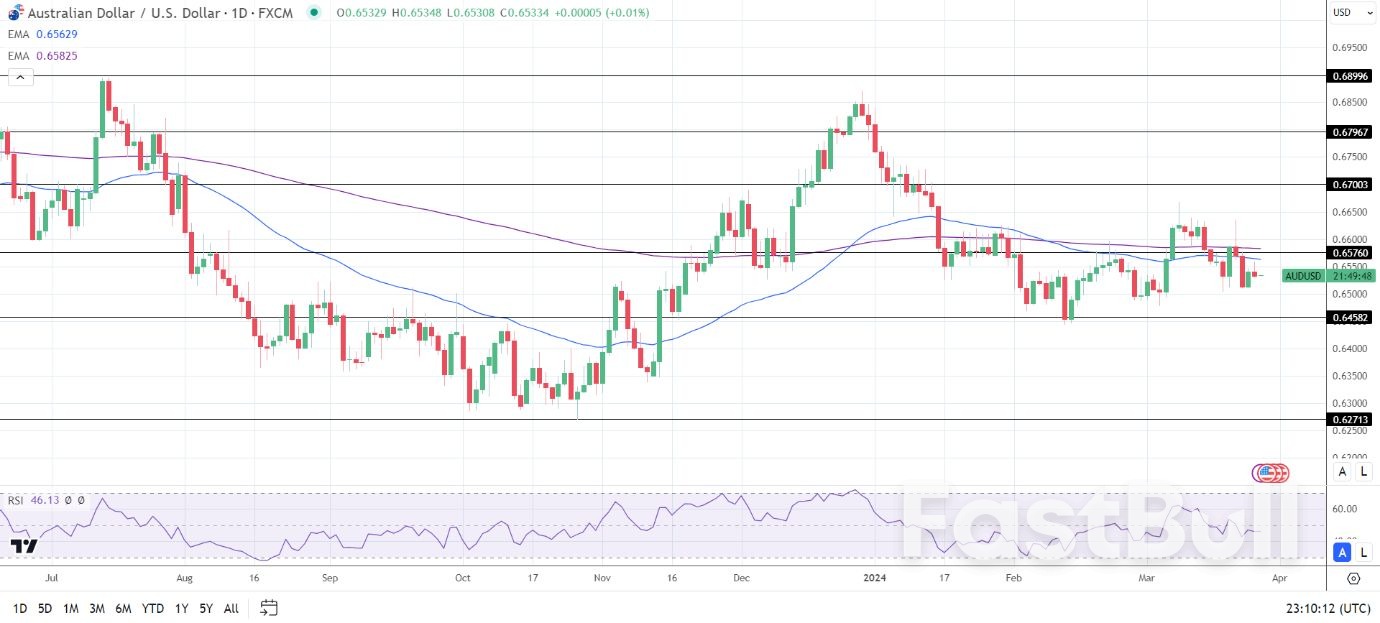
          The AUD/USD hovered beneath the 50-day and 200-day EMAs, sending the bearish price signals.
          An Aussie dollar break above the 50-day EMA could give the bulls a run at the $0.65760 resistance level and the 200-day EMA.
          Australian inflation numbers and Fed commentary need consideration.
          Conversely, an AUD/USD fall through the $0.65 handle could signal a drop to the $0.64582 support level.
          With a 14-period Daily RSI reading of 46.13, the AUD/USD could fall below the $0.64582 support level before becoming oversold.
          AUD to USD Forecast: Aussie Inflation Puts the RBA in the Spotlight_1

          Source: FX Empire

          Risk Warnings and Disclaimers
          You understand and acknowledge that there is a high degree of risk involved in trading. Following any strategies or investment methods may lead to potential losses. The content on the site is provided by our contributors and analysts for information purposes only. You are solely responsible for determining whether any trading assets, securities, strategy, or any other product is suitable for investing based on your own investment objectives and financial situation.
          Add to Favorites
          Share

          National Bank of Hungary Review: Back to 75

          ING

          Central Bank

          Economic

          National Bank of Hungary Review: Back to 75_1

          Market stability made the difference in March

          After a brief, temporary acceleration in February, the National Bank of Hungary (NBH) again erred on the side of caution at its March rate-setting meeting. While the macroeconomic fundamentals alone would have allowed the pace of easing to be maintained at 100bp, the unfavourable turn in the risk complex over the past month was a deal-breaker.
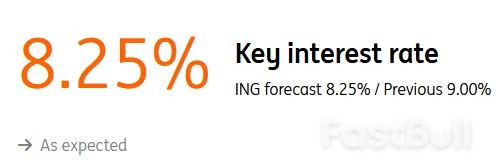
          As a result, the Monetary Council decided on 26 March to cut the key interest rate by 75bp to 8.25% and to maintain the symmetry of the interest rate corridor with similarly large cuts at both ends. Given that the median of market forecasts was ultimately in line with the actual decision, we can’t call the outcome a surprise. If anything, the unanimity behind the 75bp move can be described as a surprise. And the fact that a 50bp easing was also on the table (alongside the 75bp and 100bp cuts) is very telling and suggests to us that the NBH is indeed shifting to a more hawkish stance even before the well-publicised change of era in the second quarter of 2024.

          The central bank defines the boundaries of the playing field, sort of

          While the statement and press release were generally orchestrated to send as many hawkish signals as possible, it did not go so far as to set in stone any forthcoming decision. The central bank has ended the era of rapid easing and remains cautious, disciplined and data-driven in its approach to future rate settings.
          The telegraphed slowdown in the easing cycle in the second quarter could be seen as a sign that the NBH will reduce the pace of hikes at some point in the next three rate-setting meetings. This means that we can't rule out a repeat of the 75bp easing in April. During the Q&A session in the press conference, Deputy Governor Virág also avoided clearly ruling out the possibility of a 75bp move going forward. Last but not least, Mr Virág stressed at the press conference that the Monetary Council considers the 6.50-7.00% range (narrowing from the previous 6.00-7.00%) as the most realistic for the policy rate at the end of June. Connecting all the dots, it seems that the new menu card would include 50bp and 75bp moves as a base case.
          The forward guidance shows only a nuanced but really important change, supporting the overall hawkish tone of the rate-setting meeting. The Monetary Council sees a temporary rise in domestic inflation from the middle of the year (which we fully agree with), but also sees the global disinflation process and international investor sentiment as key risks. As a result, a careful approach to monetary policy is warranted in the coming months. In our view, this is yet another (and additional) hawkish reference pointing to an approaching downshift in the decision-making process.

          We expect the easing to last only until June

          This new and narrower playing field (the 6.50-7.00% range for the policy rate by end-June) is still in line with our base case of a 6.50% policy rate after the June rate-setting meeting. To get there, however, we need to factor in another 75bp cut in April before the slowdown to 50bp. In our view, it is far too early to call the April move, so – at this stage – we leave our call unchanged, but raise the possibility of a 50bp move if warranted by incoming macroeconomic data and market stability issues.
          As for the outlook further ahead, the central bank has wisely decided to keep its cards close to its chest. The only significant (albeit implicit) statement comes from the fact that the Monetary Council pushed back against the dovish extremes beyond the median range of year-end forecasts, implicitly suggesting a policy rate of 6.00-6.50% by the year-end. This means that a further slowdown in easing or even a pause in the cutting cycle in the second half of the year is on the cards. This would be in line with our outlook for interest rates after June, which sees the policy rate at 6.50% as the mid-cycle terminal rate. This level of the policy rate would still maintain a positive real interest rate environment, together with a substantial risk premium over regional peers, thus supporting HUF assets.
          To stay updated on all economic events of today, please check out our Economic calendar
          Risk Warnings and Disclaimers
          You understand and acknowledge that there is a high degree of risk involved in trading. Following any strategies or investment methods may lead to potential losses. The content on the site is provided by our contributors and analysts for information purposes only. You are solely responsible for determining whether any trading assets, securities, strategy, or any other product is suitable for investing based on your own investment objectives and financial situation.
          Add to Favorites
          Share

          Risk Sentiments Stabilise, Australia's Inflation Surprises on the Downside

          IG

          Economic

          Stocks

          Forex

          Asia Open

          The Asian session was met with a slightly positive open, with Nikkei +0.44%, ASX +0.30% and KOSPI +0.05% at the time of writing, as risk sentiments attempt to stabilise following recent profit-taking. This comes as major US indices drifted lower overnight, with some caution kicking in ahead of the key US core Personal Consumption Expenditures (PCE) price index release on Friday.
          At the recent Federal Reserve (Fed) meeting, policymakers have revealed some tolerance for slightly higher inflation, suggesting that it may have to take a significant upside surprise in the inflation read to sway the Fed's view of keeping to three rate cuts through 2024. For now, consensus is for the core PCE price index to stay unchanged at 2.8% year-on-year, while the headline read may edge slightly higher to 2.5% from previous 2.4%, which may continue to leave market participants eyeing a potential rate cut as early as June.
          Treasury yields were largely subdued, coming off a promising 5-year Treasury auction overnight, and not providing much of a cue for the equities market. The Nikkei 225 continues to hang just less than 2% from its month-to-date high, while the Hang Seng Index (HSI) attempts to stabilise at a time of the year where its seasonality turns more favourable. Notably, the Straits Times Index (STI) is seeking to challenge its year-to-date high in today's session, with any move above the 3,260 level of resistance boding well for a continuation of the near-term upward trend.

          Economic data to digest: Australia's inflation

          The economic calendar today leaves Australia's monthly inflation data in focus, and with the Reserve Bank of Australia (RBA) dropping its tightening bias at its previous meeting, the inflation data today provided some justification for its decision. The monthly consumer price index (CPI) indicator has stayed unchanged at 3.4% for the third straight month, with market participants finding some comfort that it is lower than the 3.5% consensus and that pricing pressures are still broadly under control.
          That anchored views for impending rate cuts from the central bank in the months ahead, likely in its August meeting, with the odds of any earlier rate move revolving around the Fed's June meeting outcome.

          What to watch: AUD/USD struggles on lower-than-expected inflation

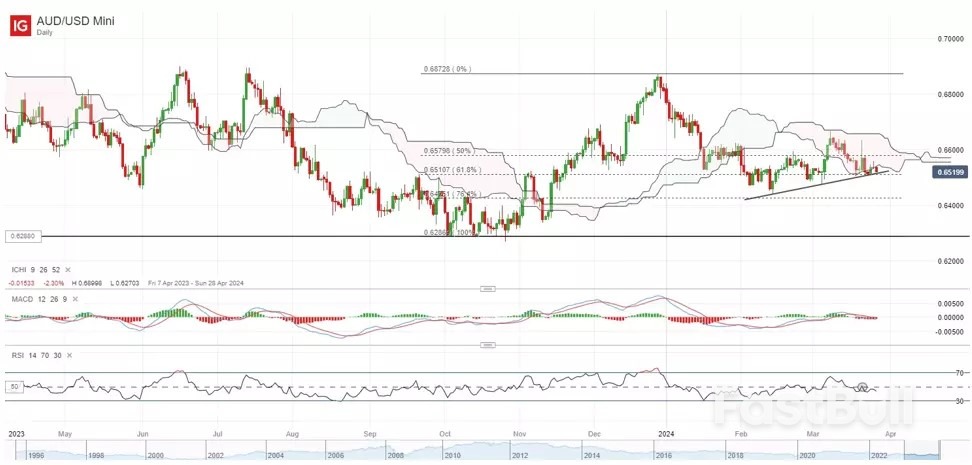
          The AUD/USD reacted to the downside in today's session, with the pair back to retest an upward trendline support at around the 0.652 level, after an earlier attempt to rebound this week was quickly stopped short by its 200-day moving average (MA). For now, the near-term bearish bias may remain, with its daily relative strength index (RSI) failing to reclaim its key 50 level, while its daily moving average convergence divergence (MACD) is also eyeing for a cross into negative territory. Ahead, any breakdown of the near-term trendline support may pave the way for the pair to retest the 0.645 level next while on the upside, its 200-day MA at the 0.656 level will prove to be a heavy resistance to overcome.Risk Sentiments Stabilise, Australia's Inflation Surprises on the Downside_1
          To stay updated on all economic events of today, please check out our Economic calendar
          Risk Warnings and Disclaimers
          You understand and acknowledge that there is a high degree of risk involved in trading. Following any strategies or investment methods may lead to potential losses. The content on the site is provided by our contributors and analysts for information purposes only. You are solely responsible for determining whether any trading assets, securities, strategy, or any other product is suitable for investing based on your own investment objectives and financial situation.
          Add to Favorites
          Share

          U.S. Protectionism Lurks Behind Yen's Stubborn Weakness

          Zi Cheng

          Traders' Opinions

          Forex

          The yen is caught in a historic stretch of weakening that shows no sign of ending even after the Bank of Japan's first interest rate hike in 17 years, thanks to the persistently strong dollar backed by protectionist U.S. policies.
          Amid the flurry of monetary policy meetings by global central banks in the second half of March, Tohru Sasaki of Fukuoka Financial Group put forward an interesting idea.
          Upon cross-referencing those recent monetary policy decisions with the relative strength of major currencies over the past three years, Sasaki found that Mexico, Brazil and Switzerland -- which have some of the strongest currencies -- moved to cut interest rates. Meanwhile, Turkey and Japan, whose currencies are especially weak, opted for rate hikes.
          As a country's currency appreciates, investment by foreign companies typically ebbs, slowing the economy and making rate cuts more likely. The reverse happens during periods of depreciation.
          But Sasaki saw one exception: The U.S., part of the strong-currency contingent, left rates unchanged and even released an outlook putting rate cuts somewhat further off.
          "The fact that foreign investment has continued even with a strong dollar is because of growing protectionism," he said. "Since the economy isn't slowing, it's hard to lower interest rates."
          Rather than a shift to yen appreciation, Sasaki predicts the greenback will remain strong for some time.
          U.S. President Joe Biden is pushing a "Buy American" policy as he seeks reelection in November.
          "On my watch, federal projects that you fund -- like helping build American roads, bridges and highways -- will be made with American products and built by American workers creating good-paying American jobs," he said in his State of the Union address March 7.
          The administration's vocal support of protectionism comes with an eye toward Biden's presumed election matchup against former President Donald Trump. In light of that, American economic policy likely will continue to put the U.S. first. Companies based outside the U.S. will have no choice but to pour money into production facilities or other investments there.
          Speculators are sensitive to this dynamic. Based on data from the U.S. Commodity Futures Trading Commission, Mizuho Bank found that net long positions on the dollar against eight other currencies held by hedge funds and other speculative investors surged on March 19, just before the Federal Reserve's last meeting.
          "Speculative money has flowed back into the dollar on expectations that rate cuts would be pushed back," said Daisuke Karakama, chief market economist at Mizuho.
          Markets have been at the mercy of the speculation surrounding American monetary policy.
          In early 2023, many market players forecast the yen strengthening against the dollar on expectations that U.S. interest rate cuts would begin as early as that year. But the Fed kept raising rates until midyear, and the yen tumbled back beyond 150 against the dollar in the fall.
          This year, too, the prevailing view was that the yen would strengthen early in the year as the Fed lowered rates. Yet the Japanese currency instead crossed the 150 threshold again, spurring many to shift to a more bearish view.
          Even with the BOJ scrapping its negative-rate policy, the persistent speculation about delayed U.S. rate cuts is keeping markets from seeing a clear scenario for a yen rally. If the tide does turn, it may be due to Fed rate cuts becoming a realistic possibility, or the BOJ moving early to raise rates further.

          Source: Nikkei Asia

          Risk Warnings and Disclaimers
          You understand and acknowledge that there is a high degree of risk involved in trading. Following any strategies or investment methods may lead to potential losses. The content on the site is provided by our contributors and analysts for information purposes only. You are solely responsible for determining whether any trading assets, securities, strategy, or any other product is suitable for investing based on your own investment objectives and financial situation.
          Add to Favorites
          Share

          March 27th Financial News

          FastBull Featured

          Daily News

          [Quick Facts]

          1. German and UK bond yields edge up and rate-cut bets hold steady.
          2. Guindos says the eurozone could fall into recession.
          3. McCarthy is facing a recall crisis 3 after the temporary spending bill.
          4. Shunichi Suzuki says he won't rule out any steps to rein in yen's weakness.
          5. UK food price inflation falls back sharply.
          6. BOE's Mann says markets are pricing in too many rate cuts.

          [News Details]

          German and UK bond yields edge up and rate-cut bets hold steady
          After the German and Dutch government bond issues, German Bund yields extended their opening gains, with the 10-year yield leading the way. The trading volume of German Bund futures slipped for a second straight day to around 75% of the 20-day moving average.
          Money market bets on rate cuts from the European Central Bank hold steady, with 91 basis points of cuts expected by the end of the year. UK bond yields slightly bull-flatten. The UK Debt Management Office (DMO) has scheduled its next 10-year bond issuance for April 4. The trading volume of futures fell to around 85% of the 20-day moving average as the market was closed on Friday for a holiday. Traders' bets on the Bank of England's (BOE) rate cuts were largely unchanged, with 74 basis points of cuts expected in 2024.
          Guindos says the eurozone could fall into recession
          The eurozone may be in a recession, said Luis de Guindos, Vice President of the European Central Bank (ECB), on Tuesday. The data show that economic activity slowed in the third quarter of 2023, contracting by 0.1%, and indicators point to a contraction in December as well, confirming the possibility of a technical recession in the second half of 2023.
          The latest data points to an uncertain future and a weaker outlook. The easing of inflation is "good news", but the slowdown in growth is more disappointing. The weakness appears to be broad-based, with construction and manufacturing hit particularly hard. The services sector is set to weaken in the coming months as activity in other areas of the economy has weakened.
          McCarthy is facing a recall crisis 3 after the temporary spending bill
          As US House Speaker Kevin McCarthy supported a bipartisan bill to avert a government shutdown, this has sparked dissatisfaction among far-right Republicans who are calling for his removal as Speaker of the House. Matt Gaetz, a Florida Republican, said on Sunday that he would file a motion to remove the speaker from office this week. But the procedure hasn't led to a speaker's recall since 1910. Gaetz said he did so because McCarthy accepted a bipartisan bill that didn't include deep spending cuts demanded by hard-line conservatives. It was one of the promises McCarthy made when he was elected Speaker, which was unfulfilled.
          Shunichi Suzuki says he won't rule out any steps to rein in yen's weakness
          The weak yen has both positive and negative effects on the economy, but excessive exchange rate volatility will bring uncertainty to business operations, which will in turn damage the economy, said Japan's Finance Minister Shunichi Suzuki on Tuesday. Suzuki said he does not want to see excessive volatility as the trend of the exchange rate can reflect the economic fundamentals, which is important.
          Shunichi Suzuki did not comment on the possibility of the authorities intervening in the currency market to stop the depreciation of the yen, but he said that the speed of exchange rate fluctuations will be a factor in deciding whether to intervene or not. If there is excessive volatility, he will not rule out any measures.
          This speech echoed the concerns of the Japanese Finance Ministry's finance officer in his speech two days ago and also strengthened the Japanese government's concern about the speed of market fluctuations, rather than the specific exchange rate level.
          UK food price inflation falls back sharply
          The annual rate for grocery inflation in the UK fell to 4.5% over the four weeks to March 17 from 5.3% recorded in the previous month, data from market researcher Kantar showed. Food prices were the main driver of the fall in headline inflation which declined to 3.4% in February from 4% in the previous month, and Kantar's data suggests this trend is set to continue this month. The data also pointed to strong growth in sales of branded goods and purchases at higher-priced supermarkets, in stark contrast to the trend seen for much of the past two years.
          BOE's Mann says markets are pricing in too many rate cuts
          I think the market has priced in too many rate cuts, Catherine Mann, the Bank of England's chief economist, said in an interview on Tuesday. In some sense, I don't have to cut because the market already is. Maybe the markets are a bit too complacent about how long they think the Bank of England will hold rates.
          Wage dynamics in the UK are stronger and more persistent than the wage dynamics in either the United States or the euro area. Underlying services dynamics are also stickier than either the US or the euro area. So, on that basis, it's hard to argue that the BOE will be ahead of the other two regions, especially the US.

          [Focus of the Day]

          UTC+8 18:00 Eurozone Economic Confidence Index (Mar)
          UTC+8 17:00 ECB Executive Board Member Cipollone Speaks
          UTC+8 20:30 ECB Executive Board Member Elderson Speaks
          UTC+8 02:00 SNB Deputy Governor Speaks on the Next Monetary Policy
          Risk Warnings and Disclaimers
          You understand and acknowledge that there is a high degree of risk involved in trading. Following any strategies or investment methods may lead to potential losses. The content on the site is provided by our contributors and analysts for information purposes only. You are solely responsible for determining whether any trading assets, securities, strategy, or any other product is suitable for investing based on your own investment objectives and financial situation.
          Add to Favorites
          Share
          FastBull
          Copyright © 2025 FastBull Ltd

          728 RM B 7/F GEE LOK IND BLDG NO 34 HUNG TO RD KWUN TONG KLN HONG KONG

          TelegramInstagramTwitterfacebooklinkedin
          App Store Google Play Google Play
          Products
          Charts

          Chats

          Q&A with Experts
          Screeners
          Economic Calendar
          Data
          Tools
          Membership
          Features
          Function
          Markets
          Copy Trading
          Latest Signals
          Contests
          News
          Analysis
          24/7
          Columns
          Education
          Company
          Careers
          About Us
          Contact Us
          Advertising
          Help Center
          Feedback
          User Agreement
          Privacy Policy
          Business

          White Label

          Data API

          Web Plug-ins

          Poster Maker

          Affiliate Program

          Risk Disclosure

          The risk of loss in trading financial instruments such as stocks, FX, commodities, futures, bonds, ETFs and crypto can be substantial. You may sustain a total loss of the funds that you deposit with your broker. Therefore, you should carefully consider whether such trading is suitable for you in light of your circumstances and financial resources.

          No decision to invest should be made without thoroughly conducting due diligence by yourself or consulting with your financial advisors. Our web content might not suit you since we don't know your financial conditions and investment needs. Our financial information might have latency or contain inaccuracy, so you should be fully responsible for any of your trading and investment decisions. The company will not be responsible for your capital loss.

          Without getting permission from the website, you are not allowed to copy the website's graphics, texts, or trademarks. Intellectual property rights in the content or data incorporated into this website belong to its providers and exchange merchants.

          Not Logged In

          Log in to access more features

          FastBull Membership

          Not yet

          Purchase

          Become a signal provider
          Help Center
          Customer Service
          Dark Mode
          Price Up/Down Colors

          Log In

          Sign Up

          Position
          Layout
          Fullscreen
          Default to Chart
          The chart page opens by default when you visit fastbull.com