• Trade
  • Markets
  • Copy
  • Contests
  • News
  • 24/7
  • Calendar
  • Q&A
  • Chats
Trending
Screeners
SYMBOL
LAST
BID
ASK
HIGH
LOW
NET CHG.
%CHG.
SPREAD
SPX
S&P 500 Index
6827.42
6827.42
6827.42
6899.86
6801.80
-73.58
-1.07%
--
DJI
Dow Jones Industrial Average
48458.04
48458.04
48458.04
48886.86
48334.10
-245.98
-0.51%
--
IXIC
NASDAQ Composite Index
23195.16
23195.16
23195.16
23554.89
23094.51
-398.69
-1.69%
--
USDX
US Dollar Index
97.950
98.030
97.950
98.500
97.950
-0.370
-0.38%
--
EURUSD
Euro / US Dollar
1.17394
1.17409
1.17394
1.17496
1.17192
+0.00011
+ 0.01%
--
GBPUSD
Pound Sterling / US Dollar
1.33707
1.33732
1.33707
1.33997
1.33419
-0.00148
-0.11%
--
XAUUSD
Gold / US Dollar
4299.39
4299.39
4299.39
4353.41
4257.10
+20.10
+ 0.47%
--
WTI
Light Sweet Crude Oil
57.233
57.485
57.233
58.011
56.969
-0.408
-0.71%
--

Community Accounts

Signal Accounts
--
Profit Accounts
--
Loss Accounts
--
View More

Become a signal provider

Sell trading signals to earn additional income

View More

Guide to Copy Trading

Get started with ease and confidence

View More

Signal Accounts for Members

All Signal Accounts

Best Return
  • Best Return
  • Best P/L
  • Best MDD
Past 1W
  • Past 1W
  • Past 1M
  • Past 1Y

All Contests

  • All
  • Trump Updates
  • Recommend
  • Stocks
  • Cryptocurrencies
  • Central Banks
  • Featured News
Top News Only
Share

USA Embassy In Lithuania: Maria Kalesnikava Is Not Going To Vilnius

Share

USA Embassy In Lithuania: Other Prisoners Are Being Sent From Belarus To Ukraine

Share

Ukraine President Zelenskiy: Five Ukrainians Released By Belarus In US-Brokered Deal

Share

USA Vilnius Embassy: USA Stands Ready For "Additional Engagement With Belarus That Advances USA Interests"

Share

USA Vilnius Embassy: Belarus, USA, Other Citizens Among The Prisoners Released Into Lithuania

Share

USA Vilnius Embassy: USA Will Continue Diplomatic Efforts To Free The Remaining Political Prisoners In Belarus

Share

USA Vilnius Embassy: Belarus Releases 123 Prisoners Following Meeting Of President Trump's Envoy Coale And Belarus President Lukashenko

Share

USA Vilnius Embassy: Masatoshi Nakanishi, Aliaksandr Syrytsa Are Among The Prisoners Released By Belarus

Share

USA Vilnius Embassy: Maria Kalesnikava And Viktor Babaryka Are Among The Prisoners Released By Belarus

Share

USA Vilnius Embassy: Nobel Peace Prize Laureate Ales Bialiatski Is Among The Prisoners Released By Belarus

Share

Belarusian Presidential Administration Telegram Channel: Lukashenko Has Pardoned 123 Prisoners As Part Of Deal With US

Share

Two Local Syrian Officials: Joint US-Syrian Military Patrol In Central Syria Came Under Fire From Unknown Assailants

Share

Israeli Military Says It Targeted 'Key Hamas Terrorist' In Gaza City

Share

Rwanda's Actions In Eastern Drc Are A Clear Violation Of Washington Accords Signed By President Trump - Secretary Of State Rubio

Share

Israeli Military Issues Evacuation Warning In Southern Lebanon Village Ahead Of Strike - Spokesperson On X

Share

Belarusian State Media Cites US Envoy Coale As Saying He Discussed Ukraine And Venezuela With Lukashenko

Share

Belarusian State Media Cites US Envoy Coale As Saying That US Removes Sanctions On Belarusian Potassium

Share

Thai Prime Minister: No Ceasefire Agreement With Cambodia

Share

US, Ukraine To Discuss Ceasefire In Berlin Ahead Of European Summit

Share

Incoming Czech Prime Minister Babis: Czech Republic Will Not Take On Guarantees For Ukraine Financing, European Commission Must Find Alternatives

TIME
ACT
FCST
PREV
U.K. Trade Balance Non-EU (SA) (Oct)

A:--

F: --

P: --

U.K. Trade Balance (Oct)

A:--

F: --

P: --

U.K. Services Index MoM

A:--

F: --

P: --

U.K. Construction Output MoM (SA) (Oct)

A:--

F: --

P: --

U.K. Industrial Output YoY (Oct)

A:--

F: --

P: --

U.K. Trade Balance (SA) (Oct)

A:--

F: --

P: --

U.K. Trade Balance EU (SA) (Oct)

A:--

F: --

P: --

U.K. Manufacturing Output YoY (Oct)

A:--

F: --

P: --

U.K. GDP MoM (Oct)

A:--

F: --

P: --

U.K. GDP YoY (SA) (Oct)

A:--

F: --

P: --

U.K. Industrial Output MoM (Oct)

A:--

F: --

P: --

U.K. Construction Output YoY (Oct)

A:--

F: --

P: --

France HICP Final MoM (Nov)

A:--

F: --

P: --

China, Mainland Outstanding Loans Growth YoY (Nov)

A:--

F: --

P: --

China, Mainland M2 Money Supply YoY (Nov)

A:--

F: --

P: --

China, Mainland M0 Money Supply YoY (Nov)

A:--

F: --

P: --

China, Mainland M1 Money Supply YoY (Nov)

A:--

F: --

P: --

India CPI YoY (Nov)

A:--

F: --

P: --

India Deposit Gowth YoY

A:--

F: --

P: --

Brazil Services Growth YoY (Oct)

A:--

F: --

P: --

Mexico Industrial Output YoY (Oct)

A:--

F: --

P: --

Russia Trade Balance (Oct)

A:--

F: --

P: --

Philadelphia Fed President Henry Paulson delivers a speech
Canada Building Permits MoM (SA) (Oct)

A:--

F: --

P: --

Canada Wholesale Sales YoY (Oct)

A:--

F: --

P: --

Canada Wholesale Inventory MoM (Oct)

A:--

F: --

P: --

Canada Wholesale Inventory YoY (Oct)

A:--

F: --

P: --

Canada Wholesale Sales MoM (SA) (Oct)

A:--

F: --

P: --

Germany Current Account (Not SA) (Oct)

A:--

F: --

P: --

U.S. Weekly Total Rig Count

A:--

F: --

P: --

U.S. Weekly Total Oil Rig Count

A:--

F: --

P: --

Japan Tankan Large Non-Manufacturing Diffusion Index (Q4)

--

F: --

P: --

Japan Tankan Small Manufacturing Outlook Index (Q4)

--

F: --

P: --

Japan Tankan Large Non-Manufacturing Outlook Index (Q4)

--

F: --

P: --

Japan Tankan Large Manufacturing Outlook Index (Q4)

--

F: --

P: --

Japan Tankan Small Manufacturing Diffusion Index (Q4)

--

F: --

P: --

Japan Tankan Large Manufacturing Diffusion Index (Q4)

--

F: --

P: --

Japan Tankan Large-Enterprise Capital Expenditure YoY (Q4)

--

F: --

P: --

U.K. Rightmove House Price Index YoY (Dec)

--

F: --

P: --

China, Mainland Industrial Output YoY (YTD) (Nov)

--

F: --

P: --

China, Mainland Urban Area Unemployment Rate (Nov)

--

F: --

P: --

Saudi Arabia CPI YoY (Nov)

--

F: --

P: --

Euro Zone Industrial Output YoY (Oct)

--

F: --

P: --

Euro Zone Industrial Output MoM (Oct)

--

F: --

P: --

Canada Existing Home Sales MoM (Nov)

--

F: --

P: --

Euro Zone Total Reserve Assets (Nov)

--

F: --

P: --

U.K. Inflation Rate Expectations

--

F: --

P: --

Canada National Economic Confidence Index

--

F: --

P: --

Canada New Housing Starts (Nov)

--

F: --

P: --

U.S. NY Fed Manufacturing Employment Index (Dec)

--

F: --

P: --

U.S. NY Fed Manufacturing Index (Dec)

--

F: --

P: --

Canada Core CPI YoY (Nov)

--

F: --

P: --

Canada Manufacturing Unfilled Orders MoM (Oct)

--

F: --

P: --

Canada Manufacturing New Orders MoM (Oct)

--

F: --

P: --

Canada Core CPI MoM (Nov)

--

F: --

P: --

Canada Manufacturing Inventory MoM (Oct)

--

F: --

P: --

Canada CPI YoY (Nov)

--

F: --

P: --

Canada CPI MoM (Nov)

--

F: --

P: --

Canada CPI YoY (SA) (Nov)

--

F: --

P: --

Canada Core CPI MoM (SA) (Nov)

--

F: --

P: --

Q&A with Experts
    • All
    • Chatrooms
    • Groups
    • Friends
    Connecting
    .
    .
    .
    Type here...
    Add Symbol or Code

      No matching data

      All
      Trump Updates
      Recommend
      Stocks
      Cryptocurrencies
      Central Banks
      Featured News
      • All
      • Russia-Ukraine Conflict
      • Middle East Flashpoint
      • All
      • Russia-Ukraine Conflict
      • Middle East Flashpoint
      Search
      Products

      Charts Free Forever

      Chats Q&A with Experts
      Screeners Economic Calendar Data Tools
      Membership Features
      Data Warehouse Market Trends Institutional Data Policy Rates Macro

      Market Trends

      Market Sentiment Order Book Forex Correlations

      Top Indicators

      Charts Free Forever
      Markets

      News

      News Analysis 24/7 Columns Education
      From Institutions From Analysts
      Topics Columnists

      Latest Views

      Latest Views

      Trending Topics

      Top Columnists

      Latest Update

      Signals

      Copy Rankings Latest Signals Become a signal provider AI Rating
      Contests
      Brokers

      Overview Brokers Assessment Rankings Regulators News Claims
      Broker listing Forex Brokers Comparison Tool Live Spread Comparison Scam
      Q&A Complaint Scam Alert Videos Tips to Detect Scam
      More

      Business
      Events
      Careers About Us Advertising Help Center

      White Label

      Data API

      Web Plug-ins

      Affiliate Program

      Awards Institution Evaluation IB Seminar Salon Event Exhibition
      Vietnam Thailand Singapore Dubai
      Fans Party Investment Sharing Session
      FastBull Summit BrokersView Expo
      Recent Searches
        Top Searches
          Markets
          News
          Analysis
          User
          24/7
          Economic Calendar
          Education
          Data
          • Names
          • Latest
          • Prev

          View All

          No data

          Scan to Download

          Faster Charts, Chat Faster!

          Download App
          English
          • English
          • Español
          • العربية
          • Bahasa Indonesia
          • Bahasa Melayu
          • Tiếng Việt
          • ภาษาไทย
          • Français
          • Italiano
          • Türkçe
          • Русский язык
          • 简中
          • 繁中
          Open Account
          Search
          Products
          Charts Free Forever
          Markets
          News
          Signals

          Copy Rankings Latest Signals Become a signal provider AI Rating
          Contests
          Brokers

          Overview Brokers Assessment Rankings Regulators News Claims
          Broker listing Forex Brokers Comparison Tool Live Spread Comparison Scam
          Q&A Complaint Scam Alert Videos Tips to Detect Scam
          More

          Business
          Events
          Careers About Us Advertising Help Center

          White Label

          Data API

          Web Plug-ins

          Affiliate Program

          Awards Institution Evaluation IB Seminar Salon Event Exhibition
          Vietnam Thailand Singapore Dubai
          Fans Party Investment Sharing Session
          FastBull Summit BrokersView Expo

          Argentina Under a New Government: What Are the Big Economic Challenges?

          Devin

          Economic

          Summary:

          With a new administration, Argentina stands at a potential turning point. By implementing aggressive fiscal and monetary reforms, President Milei's government aims to stabilise the economy and reduce inflation...
          With a new administration, Argentina stands at a potential turning point. By implementing aggressive fiscal and monetary reforms, President Milei's government aims to stabilise the economy and reduce inflation. The likely success of these measures in sparking economic recovery is an open question.
          With one of the world's highest inflation rates and after more than a decade of economic stagnation and rising poverty, Argentina once again finds itself teetering on the brink of economic collapse. The urgent need for a plan to stabilise the economy has entrusted the newly elected President Javier Milei with a clear mandate: eradicate inflation and reignite economic growth. As the nation watches with a mixture of exhaustion and bated breath, the world also turns its gaze to Argentina, wondering whether Milei's strategies will be the long-awaited remedy for the country's struggles.
          The deep-rooted cause of Argentina's economic distress and chronic inflation is persistent public overspending financed by money creation. This understanding lies at the core of Milei's policy agenda. While the plans signal a move in the right direction, there are no silver bullets. Achieving low and stable inflation involves difficult trade-offs; implementation is challenging; and reforms often take time to bear fruit.

          What are the longstanding causes of Argentina's economic struggles?

          Persistent fiscal deficits and chronic inflation are longstanding issues in Argentina. The inflation rate averaged 190% between 1944 and 2023, and the government defaulted on its sovereign debt nine times (of which three occurred during the past two decades). More recently, the size of the consolidated government increased by almost 15 percentage points of GDP: from 23.2% in 2003 to 37.8% of GDP in 2022. Argentina has continuously run fiscal deficits since 2009, with the shortfall reaching 4.4% of GDP in 2023.
          Governments do not always need to run fiscal surpluses, especially in a growing economy with access to international capital markets. But Argentina is a long way off being in this situation. Over the last decade, the country has witnessed a 10.4% drop in per capita income, and its history of sovereign defaults and restructurings has led to prohibitively high interest rates in international credit markets. As a consequence, the strategy has been an increasing reliance on the inflation tax as the means to finance the fiscal gaps.
          The inevitable outcome has been a decline in the value of the Argentine peso and significant pressures on the official exchange rate. To prevent currency depreciation, the policy response was to resort to price and capital controls (commonly known as ‘cepo'), several multiple exchange rates, negative real interest rates, quantitative import restrictions and export taxes.
          But these policies have served as mere stopgaps, as they have compounded relative price distortions, widened the gap between the official and informal market exchange rates, and led to deterioration in the central bank's balance sheet.
          Exchange rate manipulation artificially distorts trade flows, prompting importers to advance their imports, and exporters to mis-invoice their exports in anticipation of future devaluations. This has led the central bank to deplete its international reserves and increase interest-bearing liabilities, which are notes and bonds issued to absorb the excess liquidity resulting from money creation. For example, before Milei took office, the central bank held interest-bearing liabilities worth 11.3% of GDP and negative net international reserves of more than $11 billion.
          These distortions have taken a hefty toll on the real economy. Investment has only grown at 1.1% between 2011 and 2023, and World Bank data show that credit to the private sector by banks was only 10.7% in 2022 – compared with an average of 47.4% in Latin America and the Caribbean as a whole. Exports per capita have also declined by 27.3% between 2011 and 2021 (Atlas of Economic Complexity).
          But the Argentine economy has the potential to prosper. While many countries struggle to diversify and integrate into the global economy, Argentina has many avenues for sustained growth, including high-tech activities in agriculture, oil and gas, lithium, information technologies and software development (to name just a few).
          Yet the recurring economic instability has undermined the high potential of many of these opportunities. So, creating a financially viable state would increase national savings and capital flows, reduce interest rates and foreign exchange rate risk, and allow for an environment conducive to investment and growth. The industries are there, but the wider economic conditions act as a drag on progress.
          While Milei appears poised to address the root cause of Argentina's economic problems with resolute actions, the road ahead is still fraught with challenges.

          A new strategy: Milei's fiscal and monetary policy approaches

          Since Milei assumed office on 10 December 2023, his administration has been implementing a dual approach to stabilising Argentina's economy. The first component is fiscal reform. Acknowledging chronic overspending as a key driver of inflation, the government has focused on eradicating the large fiscal deficit.
          Previous programmes where fiscal adjustment was either absent or short-lived got quickly off track, such as the Argentine 1978 ‘Tablita', the 1985 Austral Plan, and the recent attempt of former President Macri's administration between 2016 and 2019 (Calvo and Vegh, 1999; Sturzenegger, 2019).
          The second component is the monetary approach, aimed at restoring the central bank's balance sheet by reducing the large peso-denominated liabilities and increasing foreign assets.
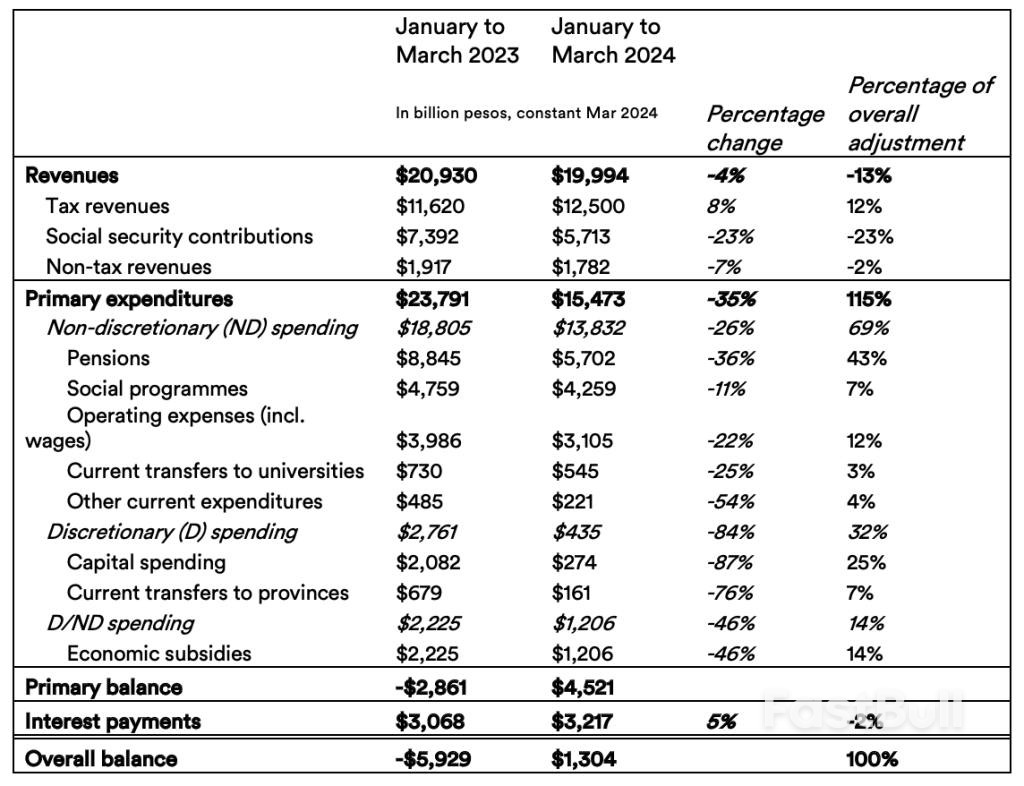
          Fiscally, the government has set an ambitious goal to cut the deficit by five percentage points of GDP in 2024. Progress is evident, with a fiscal surplus recorded in the first quarter of the year (see Table 1). Spending cuts have been deep and across the board, slashing real primary expenditures by 35% compared with last year.
          On the one hand, non-discretionary spending is being adjusted below the inflation rate. For example, pensions decreased by 36% year-over-year and contributed the lion's share of the overall fiscal adjustment, amounting to 43% of the total. On the other hand, the cuts include a significant nominal reduction in discretionary spending. Capital spending and transfers to provinces contributed 32% of the overall fiscal adjustment. Economic subsidies, particularly for energy firms, have been reduced at the expense of accumulating arrears with utility companies.
          On the revenue side, despite a 4% drop in total real revenues due to decreased social security contributions, tax revenues are up, fuelled by the ‘Impuesto País'. This tax on certain exchange rate operations – acting as a de facto import duty – currently makes up 9% of total revenues. Economists debate its classification, arguing that recognising it as an import tax could accelerate the removal of exchange rate controls.
          Argentina Under a New Government: What Are the Big Economic Challenges?_1

          Table 1: Fiscal accounts of the national public sector

          On the monetary front, the central bank has focused on addressing the excess supply of pesos. Fiscal surpluses contributed to the elimination of all monetary financing to the government.
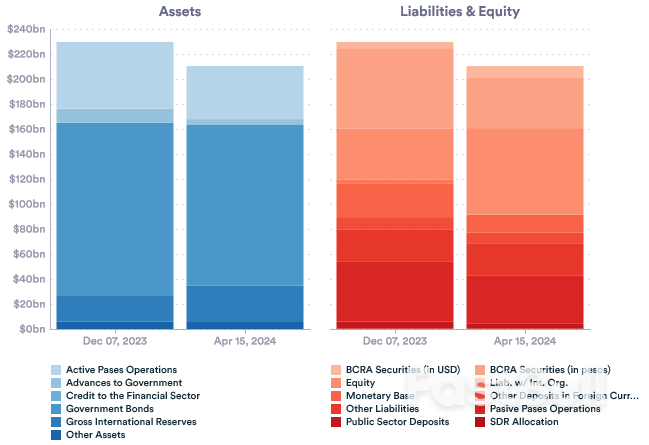
          At the same time, the central bank holds a large amount of interest-bearing liabilities, which aim at absorbing part of the excess money created to finance fiscal deficits. While monetary financing does not bear interest to the central bank, it exerts pressure on the official exchange rate, therefore forcing the central bank to resort to these more expensive liabilities to mitigate its impact. Before Milei took office, the monetary base and net interest-bearing liabilities – that is, BCRA (Banco Central de la Republica Argentina) securities in pesos – represented 37.7% of total assets.
          The devaluation of the peso that occurred three days into Milei's term of office significantly helped to reduce this large stock. To correct the overvalued exchange rate and bridge the significant gap with the informal exchange rate market, the central bank devalued the peso by around 50% – from 391 pesos to 833 pesos per US dollar – diminishing both the monetary base and interest-bearing liabilities on the balance sheet.
          Since the devaluation, the central bank has rapidly reduced nominal interest rates, currently at an annual rate of 50%. As these rates are running below inflation, this approach has helped to reduce the real interest payments by the central bank and thus curtail the flow of new interest-bearing liabilities. Figure 1 shows the reduction of BCRA securities from $64.3 to $40.6 billion between 7 December 2023 and 15 April 2024.
          On the assets side, the central bank is committed to turning net international reserves – gross reserves minus swap lines and deposits in foreign currency – into positive territory. While they are still negative, the central bank has been able to accumulate gross reserves, which reached $29.2 billion on 15 April 2024.
          But these reserves remain insufficient to settle the substantial inherited debt owed to importers. In 2023, as the central bank could no longer afford to lose reserves, it stopped selling foreign currency to importers. To address this challenge, the central bank issued the BOPREAL, a series of bonds designed to pay importers over the coming months and years by leveraging the foreign assets that the central bank is committed to accumulate.
          While the BOPREAL has allowed for a maturity lengthening of the liabilities at the central bank, it also implies an increase in dollar-denominated liabilities. Along with other securities called Lediv, the BOPREAL pushed dollar-denominated liabilities to $9 billion (or 4.3% of total assets). Although it has received less attention, it is noteworthy that the share of government bonds held by the central bank (mostly denominated in pesos) remains large, accounting for around 61% of total assets.
          Finally, accumulating international reserves is crucial for any new monetary policy regime to be credible. To date, the central bank has introduced a ‘crawling peg', a regime that depreciates the currency by 2% monthly and decided to maintain inherited capital controls. While many expected an early removal due to the distortions it generates, as explained above, keeping them allows the central bank to manage and reduce the money supply more effectively by controlling capital flows.
          Argentina Under a New Government: What Are the Big Economic Challenges?_2

          Figure 1: Balance sheet of the central bank (7 December 2023 to 15 April 2024)

          What future challenges does the government face?

          Milei's strategy so far has yielded several promising initial results. Sovereign spreads – a measure of the default risk on a country's government bonds – have dropped significantly: by more than 700 basis points between 4 December 2023 and 22 April 2024. While still at high levels, monthly inflation fell sharply from 25% in December, after the initial devaluation, to 11% in March. The central bank has also been able to accumulate international reserves and stabilise the gap between the official and informal exchange rates at around 20%, containing market expectations of a significant devaluation moving forward.
          But while these measures have steered these indicators in the right direction, they have also imposed a substantial economic and social cost. The stringent belt-tightening on both fiscal and monetary fronts has rapidly shifted expectations, yet it has simultaneously driven the economy into a deep recession.
          This highlights the delicate trade-off between stabilising the economy and promoting growth. Economic activity fell by 3.3% year-over-year per month in December, January and February. Private estimates also suggest a decline in March. Relative price distortions have not yet been fully corrected. For example, the reduction in economic subsidies, leading to increased utility tariffs for the public, only began this April. Further effects may soon take hold.
          The severe recession raises questions about when and how the country will return to a path of economic growth. Although a slow recovery of real wages and an improved 2023/24 agricultural harvest may provide short-term relief, the government must seek alternative fiscal strategies to mitigate the heavy toll on the private sector.
          For example, reassessing the importance of the curtailed public investment is crucial. Protecting public investment during fiscal adjustments creates incentives for expanding private investment (Izquierdo et al, 2019). It can also neutralise the contractionary effects of fiscal adjustments, and even spur output growth over the medium term (Puig et al, 2021).
          As it serves as a complementary factor of production, it is also associated with the productivity of the private sector and its ability to thrive and enhance economic growth. So, it is essential strategically to maintain certain areas of public investment or, alternatively, to promote private sector-led initiatives for public good provision.
          On the external front, removing capital controls is crucial to unlock export-led growth in the medium to long term. The timing of the removal remains uncertain, as the controls play a crucial role in sustaining fiscal adjustment and cleaning up the central bank's balance sheet.
          Meanwhile, the clock is ticking given the race between inflation and the 2% monthly depreciation rate. Specifically, as inflation accelerates at a pace faster than the depreciation of the currency, there is a concern that the real currency appreciation will lead to deterioration in the trade balance, compromising the accumulation of international reserves and exerting pressure on the official exchange rate.
          At the same time, given the deep reforms being undertaken, macroeconomic fundamentals are changing, making it difficult to determine the equilibrium value of the exchange rate. In any case, the current crawling peg regime lacks credibility as a long-term stabilisation mechanism.
          A new monetary framework will need to emerge. Currently, all monetary options are on the table, including adopting a more flexible regime that adjusts interest rates to control inflation, a system where multiple currencies circulate and compete within the economy, and abandoning the local currency entirely in favour of the US dollar.
          Lastly, the success of any new stabilisation plan hinges on a credible commitment to implement fiscal reforms effectively. Milei seems determined to go all the way. But the government needs to secure congressional approval, where it lacks a majority, as well as other political and judicial support to cement its fiscal reforms moving forward.
          As we write this piece, extensive deliberations are underway in Congress, focused on analysing the multitude of laws that Milei is pushing. Economic policy planning is one thing: political and legal delivery is another.
          It is the first time since the turn of the century that Argentina is purposefully addressing the deep-rooted cause of all its economic struggles. The government should be strategic so that the country can, once and for all, break free from its recurring challenges and finally unlock its economic potential. Plans are in place, but there is still much work to be done.

          Source: Economics Observatory

          To stay updated on all economic events of today, please check out our Economic calendar
          Risk Warnings and Disclaimers
          You understand and acknowledge that there is a high degree of risk involved in trading. Following any strategies or investment methods may lead to potential losses. The content on the site is provided by our contributors and analysts for information purposes only. You are solely responsible for determining whether any trading assets, securities, strategy, or any other product is suitable for investing based on your own investment objectives and financial situation.
          Add to Favorites
          Share

          Morning Bid: Stocks Buoyant as Sweden Cuts, Oil Skids

          Warren Takunda

          Stocks

          Economic

          Wall Street looks to have brushed off the latest hawkish Federal Reserve noises and Disney's outsize swoon, with European bourses stalking new records as Sweden becomes the latest G10 central bank to cut interest rates and oil prices plunged.
          Stocks futures and Treasury yields held pretty steady overnight even after Minneapolis Fed chief and known hawk Neel Kashkari said all policy options were on the table in getting inflation back in the bottle.
          "If we need to hold rates where they are for an extended period of time to tap the brakes on the economy, or if we even needed to raise, we would do what we needed to do to get inflation back down," Kashkari said.
          Perhaps seen as a outlier and not even a voting member of the Fed's policymaking committee this year, markets appeared to bat the comments away.
          Helped by brisk demand for the hefty $58 billion sale of three-year notes on Tuesday and another sharp fall in crude oil prices, Treasury yields were relatively calm going into a $42 billion 10-year auction later on Wednesday.
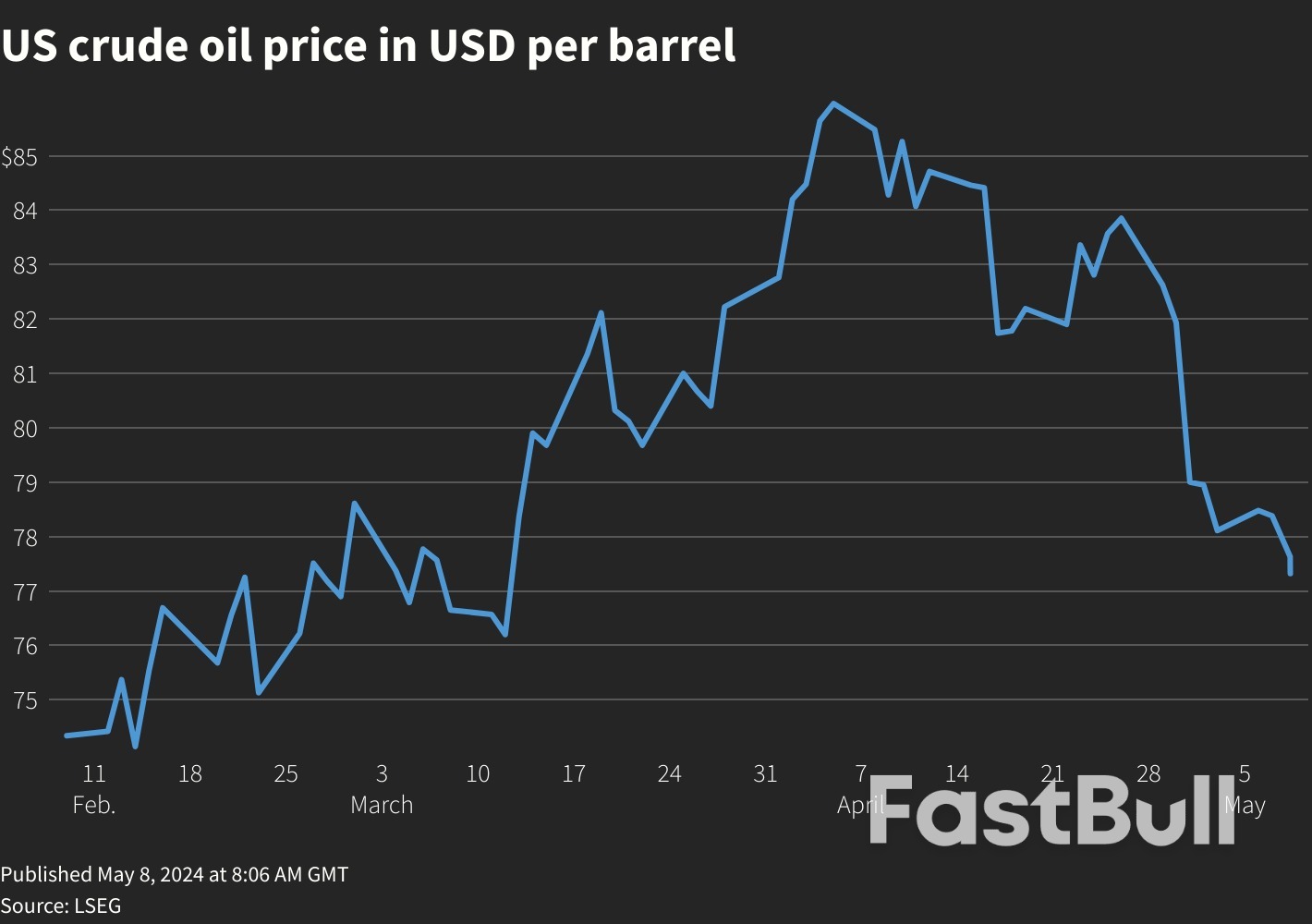
          Crude oil prices fell to their lowest since March 11 as industry data showed a pile-up of U.S. inventories - a sign of weakening demand - and cautious supply expectations emerged ahead of an OPEC+ policy meeting next month.
          U.S. crude stocks rose by 509,000 barrels in the week ended May 3, sources said, citing American Petroleum Institute figures, and gasoline and distillate inventories also rose. Official U.S. government data is due later in the day.
          The fight against climate change and the widespread desire to decarbonise the economy has given an extraordinary boost to investments in renewable energy.
          And European bourses looked set for record highs as Sweden cut interest rates on Wednesday and underlined the divergence between European central banks policymaking and the Fed's.
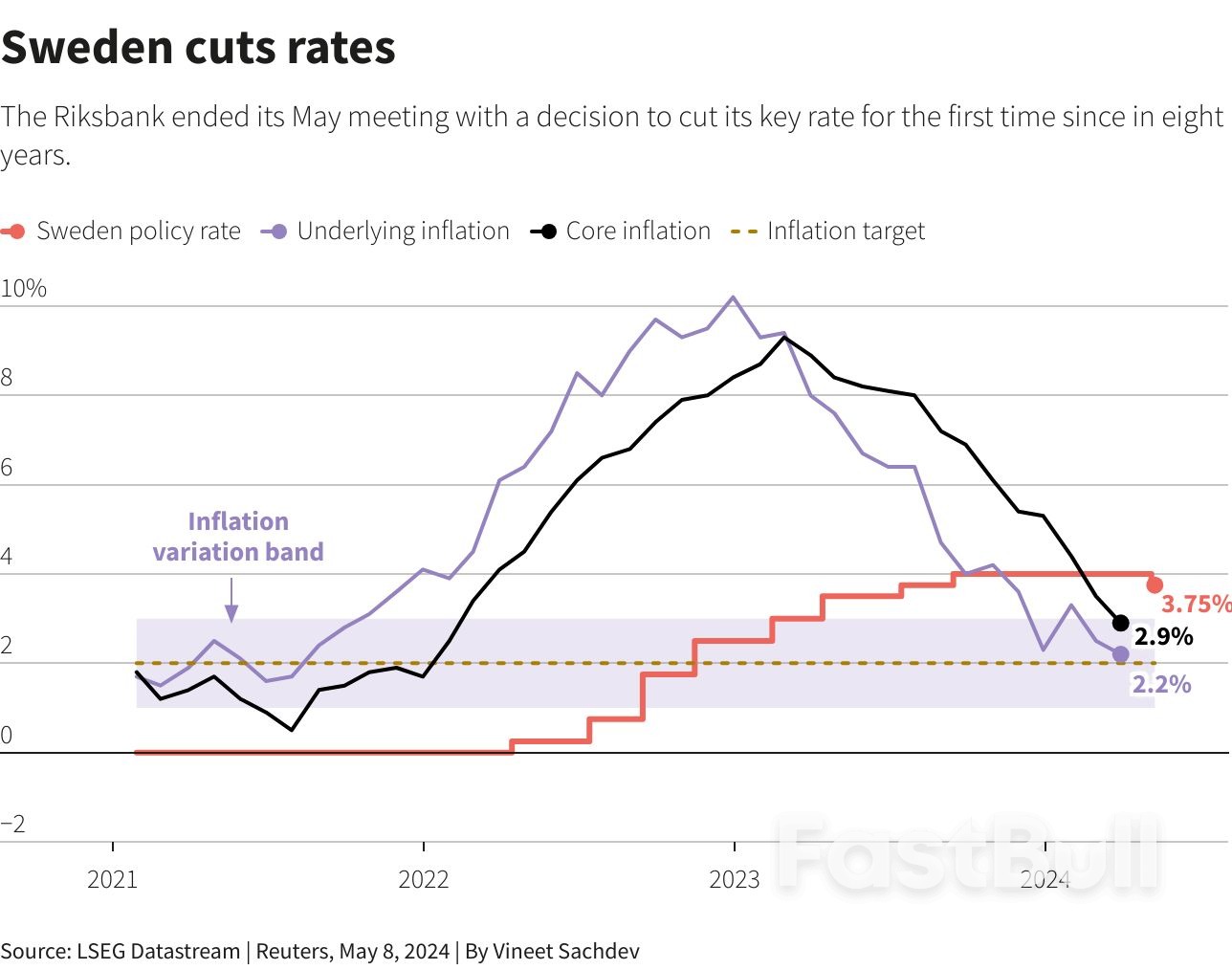
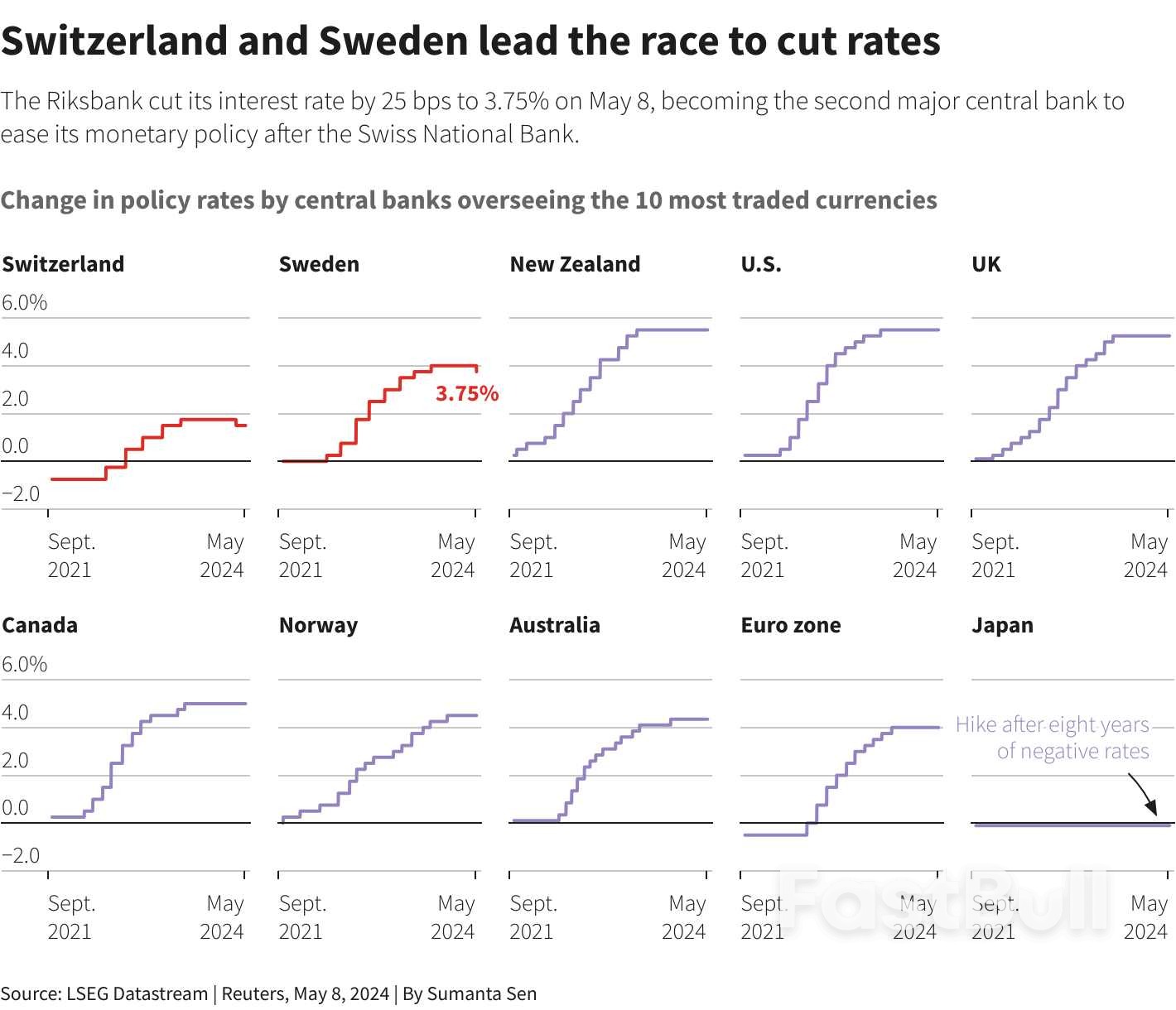
          Sweden's central bank cut its key interest rate to 3.75% from 4.00% as expected and said it was likely to cut the rate two more times in the second half of the year if the outlook for inflation still holds.
          After eight rate hikes in Sweden, inflation is now close to the Riksbank's 2% target after peaking at over 10%.
          The Riksbank is the second of the major G10 central banks to ease, with the Swiss National Bank jumping the gun in March.
          And crucially, the crown , weakened only marginally.
          With the European Central Bank now widely expected to cut rates next month, attention turns to Thursday's Bank of England meeting. Although no UK move is expected this week, there's considerable speculation the BoE may open the door for a rate cut in June too.
          Britain's benchmark FTSE 100 (.FTSE) hit a new record high on Tuesday, 10-year gilt yields fell to their lowest in almost four weeks and the pound slipped.
          The overall picture kept the dollar buoyed generally (.DXY) - especially against the ailing Japanese yen. Dollar/yen climbed back above 155 despite fresh warnings from Japanese authorities of repeat intervention to sells dollars.
          Asian stocks bucked the U.S. and European trend and wobbled across the board earlier, with Tokyo, Shanghai and Hong Kong all ending in the red.
          Back on Wall Street, Tuesday's gains and steady overnight futures survived another retreat in Tesla and Walt Disney's (DIS.N) 10% slump. Disney fell as a surprise profit in its streaming entertainment division was eclipsed by a drop in its traditional TV business and weaker box office.
          Shares in electric-pickup maker Rivian (RIVN.O) fell about 5% in out-of-hours trade overnight as it stuck to a 2024 production forecast well below Wall Street targets and reported a wider-than-expected first-quarter loss as it ended a weeks-long manufacturing halt.
          Key diary items that may provide direction to U.S. markets later on Wednesday:
          * Federal Reserve Vice Chair Philip Jefferson, Fed Board Governor Lisa Cook and Boston Fed President Susan Collins speak
          * US corporate earnings: Uber, News Corp, Airbnb, Emerson Electric, Corpay, Celanese, Atmos Energy, NiSource, STERIS, Broadridge Financial Solutions
          * Chinese President Xi Jinping in Serbia and Hungary as part of week-long visit to Europe
          * US Treasury auctions $42 billion of 10-year notes
          Morning Bid: Stocks Buoyant as Sweden Cuts, Oil Skids_1Morning Bid: Stocks Buoyant as Sweden Cuts, Oil Skids_2Morning Bid: Stocks Buoyant as Sweden Cuts, Oil Skids_3Morning Bid: Stocks Buoyant as Sweden Cuts, Oil Skids_4Morning Bid: Stocks Buoyant as Sweden Cuts, Oil Skids_5

          Source: Reuters

          To stay updated on all economic events of today, please check out our Economic calendar
          Risk Warnings and Disclaimers
          You understand and acknowledge that there is a high degree of risk involved in trading. Following any strategies or investment methods may lead to potential losses. The content on the site is provided by our contributors and analysts for information purposes only. You are solely responsible for determining whether any trading assets, securities, strategy, or any other product is suitable for investing based on your own investment objectives and financial situation.
          Add to Favorites
          Share

          Brazil's Central Bank Are Set to Slow Pace of Rate Cuts After Changing Guidance

          Samantha Luan

          Economic

          Central Bank

          Twenty-two of 32 analysts surveyed by Bloomberg expect the bank led by Roberto Campos Neto to lower the benchmark Selic by a quarter-point to 10.5% after markets close on Wednesday. The remaining ten bet on a seventh straight reduction of 50 basis points. Traders are also split, with digital options in the local stock market indicating a 72% chance that policymakers will temper the easing pace.
          Campos Neto set the stage for the most suspenseful rate decision so far this year by telling investors last month that the bank is no longer committed to keeping its easing pace, but is instead considering four possible economic scenarios, including one with smaller rate cuts. The change in forward guidance surprised investors who were already worried about the Federal Reserve's reluctance to start reducing borrowing costs and also Brazil's weakening fiscal target.
          What Bloomberg Economics Says
          “Brazil's central bank is widely expected to cut interest rates again at its May 8 meeting, but there's disagreement on whether policymakers will stick to their 50-basis-point path or slow the pace. We think that debate will extend to the BCB board.”— Adriana Dupita, Brazil and Argentina economist
          Brazil's decision will be published on the central bank's website after 6:30 p.m. in Brasilia, with a statement from its board. Here's what to look for:

          Four Scenarios

          Investors will scan the bank's statement for any guidance about its next rate decision in June, and whether there's still unanimity on the board. Unlike in prior rate meetings, rising uncertainties on the global and domestic fronts make Wednesday's statement open-ended.
          “They could now remove their forward guidance, given that board members have appeared to differ in their speeches,” said Carla Argenta, chief economist at CM Capital.
          If central bankers opt for a quarter-point cut, investors will interpret that move as the start of a new pace even if policymakers refrain from explicitly saying so. At the same time, analysts will also be on the look-out for more details on the scenarios first described by Campos Neto last month in a meeting that was opened to the press at the last minute.
          Reading from prepared notes, Campos Neto said a “big repricing” of assets in response to higher global rates could jeopardize Brazil's central bank plans. While less global uncertainty would allow the board to carry on with half-point cuts, high volatility would force it to pare down the easing pace, he said.
          Two other scenarios — in which the bank would have to change its balance of risks or its base-case outlook — seemed murkier.
          Monetary Policy Director Gabriel Galipolo refrained from mentioning the four scenarios in his latest public speech, sparking speculation that not all board members may be in agreement. At a news conference last week, Supervision Director Ailton Aquino said a “cautious” stance is needed due to market volatility.
          “The global scenario requires a more cautious pace,” said Laiz Carvalho, Brazil economist at BNP Paribas. She expects a hawkish tone in the post-meeting statement and a unanimous decision to cut rates by 25 basis points. “We could see a debate about their pace in the minutes” to their rate decision.

          Fiscal Woes

          Central bankers could reinforce the importance of fulfilling fiscal pledges after President Luiz Inacio Lula da Silva's government opened the door for more spending in 2025. The economic team said it will aim for a balanced primary budget — which excludes interest payments — instead of a surplus next year.
          On top of that, devastating floods in southern Brazil are increasing spending pressure even further.
          Moody's Ratings raised Brazil's credit outlook to positive last week, though the decision is unlikely to change the bleak view investors have on the government's ability to shore up public accounts.
          “Between signs of political fatigue on efforts to raise revenues, little will to cut expenditures and moderate growth, public debt seems poised to grow,” JPMorgan Chase & Co. analysts Cassiana Fernandez, Vinicius Moreira and Mirella Sampaio wrote in a recent research note.

          Source: Bloomberg

          To stay updated on all economic events of today, please check out our Economic calendar
          Risk Warnings and Disclaimers
          You understand and acknowledge that there is a high degree of risk involved in trading. Following any strategies or investment methods may lead to potential losses. The content on the site is provided by our contributors and analysts for information purposes only. You are solely responsible for determining whether any trading assets, securities, strategy, or any other product is suitable for investing based on your own investment objectives and financial situation.
          Add to Favorites
          Share

          Contrary to Expectations: US Real Estate Market

          Damon

          Economic

          Previously, the Fed expected housing inflation to decrease, with the decline in rents reflected in CPI weights. However, the performance of the US real estate market has been entirely contrary to expectations. In most parts of the US, despite mortgage rates rising to their highest level in 20 years, housing prices have remained resilient. This current market scenario is somewhat perplexing for those who anticipated a decline in housing prices.
          Considering the longstanding issue of housing shortages, it is anticipated that in the coming months, housing prices will receive moderate boosts due to supply constraints and some technical factors.

          Insufficient Housing Supply

          Over the past few years, homebuyers have been competing for limited housing supply, especially existing homes, which account for over 70% of listed residential properties in the US. Currently, the supply of existing homes, if sold at the current pace, can only support three months, whereas the supply needed for a balanced market is five to six months, indicating tight supply as a major factor driving the increase in housing prices.
          Unlike many other countries, most homes in the US are financed with fixed-rate mortgages. Homeowners who secured mortgages at low rates before the pandemic have no reason to sell their properties in the current high - rate environment. This suggests that they may refrain from putting their homes back on the market for resale, exacerbating the housing supply shortage and supporting housing prices.
          Contrary to Expectations: US Real Estate Market_1
          The latest report from the National Association of Realtors (NAR) shows that, under the impact of insufficient housing supply, the median sales price of existing homes rose by 5.7% year-on-year to $384,500 in March. Additionally, the average time homes spent on the market in March was 33 days, significantly lower than the previous value of 38 days, indicating continued strong demand in the housing market.
          In this context, homebuilders are recognizing the additional demand for housing brought about by population growth and are gradually increasing the construction of new homes. Despite builders increasing construction, new home inventory is still quickly absorbed by the market. It's worth noting that while the number of unsold new homes remains at historically average levels, single - family homes are still scarce, accounting for only a quarter of the current inventory.
          Contrary to Expectations: US Real Estate Market_2
          Part of the reason for the shortage of single-family homes is due to systemic undersupply since the global financial crisis. With the substantial decline in home values, builders have become more cautious about increasing the construction of single-family homes. Even when single-family homes are constructed, they are more often used for rental rather than sale. These trends continue to result in the US market absorbing single-family home supply, causing demand to outpace supply.

          Demand Helps Support Housing Prices

          The high cost of home buying has deterred potential homebuyers. Due to rising housing prices and interest rates, the monthly payments for potential homebuyers have significantly increased. The current monthly payments are more than twice as high as they were several years ago, leading many potential homebuyers to temporarily refrain from purchasing, reflecting reduced demand in the market.
          Contrary to Expectations: US Real Estate Market_3
          Despite these adverse factors, there are still some suppressed demands that may drive real estate activity in the future.
          The soaring cost of housing makes renting more affordable than buying. However, the overall proportion of renters is declining. This may be due to people's increasing preference for homeownership and reluctance to miss out on opportunities for rising house prices. If this current trend continues, the decrease in the proportion of renters will also help support housing prices.
          Furthermore, the future market will also see an increase in demand from millennials and first-time buyers. Data suggests that although millennials have entered the traditional home-buying age group, many have yet to purchase homes. With life events such as marriage and childbirth, coupled with falling interest rates, it is expected to prompt more millennials to enter the real estate market in the coming years, thereby bringing structural high demand in the future.
          In a sense, the relationship between insufficient supply and weakened demand in the current real estate market remains tense. In the long run, housing supply constraints may be the primary factor affecting housing prices. This supply-demand relationship is expected to result in a modest increase in housing prices in 2024.
          To stay updated on all economic events of today, please check out our Economic calendar
          Risk Warnings and Disclaimers
          You understand and acknowledge that there is a high degree of risk involved in trading. Following any strategies or investment methods may lead to potential losses. The content on the site is provided by our contributors and analysts for information purposes only. You are solely responsible for determining whether any trading assets, securities, strategy, or any other product is suitable for investing based on your own investment objectives and financial situation.
          Add to Favorites
          Share

          Australian Dollar Forecasts Lowered at CBA

          Warren Takunda

          Economic

          Forex

          "We tweak our currency forecasts following our updated central bank views and changes in commodity prices," says Joseph Capurso, Head of International and Sustainable Economics at CBA.
          The Dollar is seen to have peaked but is expected to prove resistant to a major selloff that would typically boost Australian Dollar exchange rates. Previously, the pace of decline was expected to be faster, which meant the major Aussie exchange rates had more upside potential in 2024/2025.
          Still-high U.S. bond yields are seen supporting the Greenback for a while longer, on account of the Federal Reserve's likely reluctance to cut interest rates owing to signs inflation is taking its time to fall back to target.
          "We consider AUD/USD can lift modestly rather than strongly over the next year. One obstacle to large gains in AUD/USD is the large negative interest rate differential between Australia and the U.S.," says Capurso.
          Analysts at CBA still maintain a view that the Australian Dollar is "well past" its cyclical lows and "we expect the next big move in AUD/USD will be up rather than down."
          An improving global economic backdrop is expected to be a key driver of Aussie upside, including a Chinese revival. Analysts note Hong Kong’s Hang Seng equity index - a proxy for the Chinese economy - is already pointing to such a recovery.
          Downside risks to the Aussie Dollar would be another Federal Reserve rate hike and the re-election of Donald Trump as U.S. President, as CBA thinks any wage tensions between the U.S. and China will weigh.
          The Reserve Bank of Australia is meanwhile considered a potential upside risk.
          "One upside risk to our AUD/USD forecasts is if the Reserve Bank of Australia (RBA) increases the cash rate. Until recently, financial markets were partially pricing a rate hike by the RBA before the end of the year. While we disagree with the argument for rate hikes based on our economic forecasts, if we are wrong and the RBA increases the cash rate at least once, AUD/USD could be higher than our new forecasts," says Capurso.
          A number of investment banks had raised expectations that the RBA would hike interest rates again owing to surprisingly strong quarter-1 inflation.
          However, the RBA's May update showed the bar to such a move was set particularly high, resulting in a paring of rate hike expectations and a softening in the AUD.
          The next near-term trigger for AUD comes in the form of next week's all-important U.S. inflation release, where an undershoot against expectations can provide a boost for this pro-cyclical currency.
          CBA now forecasts AUD/USD to end 2024 at 0.69, down from 0.71 previously. 0.71 is now pencilled in for March 2024, down from 0.73 previously.
          For the AUD/GBP exchange rate, the new forecast is 0.5391 at year-end, down from 0.5462. The March 2025 forecast is 0.5462, down from 0.5530 previously.
          This translates into a Pound to Australian Dollar forecast of 1.8550 and 1.83.

          Source: Poundsterlinglive

          To stay updated on all economic events of today, please check out our Economic calendar
          Risk Warnings and Disclaimers
          You understand and acknowledge that there is a high degree of risk involved in trading. Following any strategies or investment methods may lead to potential losses. The content on the site is provided by our contributors and analysts for information purposes only. You are solely responsible for determining whether any trading assets, securities, strategy, or any other product is suitable for investing based on your own investment objectives and financial situation.
          Add to Favorites
          Share

          Fragile Treasuries Relying on Rare Macro Serenity

          Kevin Du

          Economic

          Bond

          What's more, if the benign "soft landing" or "no landing" economic forecasts on which the already scary U.S. budget math is predicated fail to play out, the Federal Reserve may ultimately be forced to start buying bonds again.
          The Treasury market is at a delicate juncture. Federal annual budget deficits over the next several years are projected to run into the trillions of dollars, and will need to be funded by increasingly wary lenders.
          The risk is that the deficit and borrowing outlook is even more challenging than it looks, because these projections are based on macroeconomic forecasts that may turn out to be too optimistic.
          Take the unemployment rate, currently at 3.9%. The non-partisan Congressional Budget Office's baseline scenario is for unemployment to rise to 4.2% this year, 4.5% in the following year, dip back to 4.3% in 2026, average 4.4% over the next two years and then average 4.5% over the five-year period through 2034.
          History shows, however, that recessions are accompanied by far steeper rises in unemployment than that. Every recession in the past half century has been associated with unemployment rising at least two percentage points, usually more.
          The fall in tax revenues and rise in benefits spending from an adverse shock of that nature would almost certainly widen deficits further and force Washington to issue more debt, resulting in higher bond yields.
          Just how high would in part be determined by demand. But to be sure of keeping long-term borrowing costs under control the Federal Reserve may have to step in, U-turn on its balance sheet reduction drive, and resume full-on quantitative easing.
          "The risk that the Fed monetizes excessive deficits in the next five to 10 years has to be taken seriously," says Willem Buiter, a former rate-setter at the Bank of England, adding that a return to something akin to permanent QE is "quite likely."
          "But the Fed should be reducing its balance sheet significantly, and not be the buyer of first resort," Buiter notes.
          No economic indicator moves the bond market more than jobs and inflation data. As Alex Etra at Exante Data notes, most of the increase in nominal bond yields over the last 18 months has been around non-farm payrolls and consumer price index and personal consumption expenditures inflation reports.

          DEFICITS AND TERM PREMIUM

          The CBO's baseline projections show the U.S. budget deficit widening to 6.1% of gross domestic product next year and not shrinking below 5% for the next decade.
          In dollar terms, that's an annual shortfall of between $1.64 and $2.56 trillion every year for the next decade that the government has to plug, mostly through borrowing.
          The annual U.S. budget balance is almost always in deficit, but rarely this deep - between World War Two and the Great Financial Crisis it exceeded 5% of GDP only once, in 1983.
          International Monetary Fund estimates for the "general government fiscal balance" show the annual deficit out to 2029 even wider, from 6.0% to 7.1% of GDP.
          In its "Fiscal Monitor" update in April the IMF warned that the U.S. Treasury's plans to issue more debt, coinciding with quantitative tightening, has probably fueled the recent increase in bond market volatility and rise in term premiums.
          Term premium is the extra compensation investors demand for lending to the government over the long term instead of rolling over shorter-term loans. Rising term premiums are a reflection of higher risk aversion, and negative budgetary shocks are a prime source.
          "Empirical evidence suggests that all else being equal, a 1 percentage point increase in the U.S. primary deficit is associated with a rise in term premiums of about 11 basis points in the quarters that follow," IMF economists found.
          A rising term premium may also reflect changes in the make-up of demand for Treasuries, as "price-insensitive" buyers like foreign central banks see their market footprint shrink while "price-sensitive" buyers in the private sector increase theirs.
          According to Barclays, the overseas private sector now owns more of the $25 trillion U.S. debt outstanding than the overseas official sector. All else equal, those who "choose" to buy Treasuries rather than those who "need" to buy them will demand more compensation for absorbing the increase in supply.
          "This has implications for how Treasury supply will be received by markets, not just in terms of the term premium that is demanded to own Treasuries, but also the volatility of the rates markets," Barclays analysts wrote last month.

          Source: Reuters

          To stay updated on all economic events of today, please check out our Economic calendar
          Risk Warnings and Disclaimers
          You understand and acknowledge that there is a high degree of risk involved in trading. Following any strategies or investment methods may lead to potential losses. The content on the site is provided by our contributors and analysts for information purposes only. You are solely responsible for determining whether any trading assets, securities, strategy, or any other product is suitable for investing based on your own investment objectives and financial situation.
          Add to Favorites
          Share

          US Weighs Upgrade for Vietnam to 'Market Economy' Status

          Samantha Luan

          Economic

          Political

          The move, opposed by U.S. steelmakers and Gulf Coast shrimpers but backed by retailers and other business groups, would reduce the punitive anti-dumping duties set on Vietnamese imports because of its current status as a non-market economy with heavy state influence.
          "Vietnam is already a market economy," said Ted Osius, head of the U.S.-ASEAN Business Council, which backs the upgrade. "It has met key criteria such as currency convertibility and is ready for an accurate designation."
          The Commerce Department will hear arguments from both sides during a virtual hearing on Wednesday afternoon in Washington as part of a review due to be completed in late July.
          Vietnam has argued to be freed of the non-market label because of recent economic reforms, saying retaining the moniker is bad for increasingly close two-way ties that Washington sees as a counterbalance to China.
          During Biden's visit to Hanoi last year, the two countries elevated ties to a "comprehensive strategic partnership", lifting Washington's diplomatic status in Vietnam to match China and Russia.
          Last year, Vietnamese Prime Minister Pham Minh Chinh also urged U.S. Treasury Secretary Janet Yellen for an end to the non-market label, befitting Vietnam's status as a U.S. "friend-shoring" destination to diversify supply chains away from China.
          The current designation lumps Vietnam in with China, Russia, Belarus, Azerbaijan an nine other countries as non-market economies subject to higher anti-dumping duties.
          "American businesses are already investing significantly in Vietnam as they recognize its growth potential," said Osius, a former U.S. ambassador to Vietnam.
          The Commerce Department has a fairly narrow set of criteria for determining market economy status.
          These include the extent to which the country's currency is convertible; its wage rates are a result of free bargaining between labor and management, and permission for joint ventures or other foreign investment.
          Further criteria include whether the government owns or controls the means of production and the government controls the allocation of resources and price and output decisions.
          It can also consider other factors.

          LOWER SHRIMP DUTIES

          Goods from non-market economies are subject to higher tariff rates in anti-dumping duty investigations that use third-country proxy prices to determine a product's fair market value.
          This year, the U.S. International Trade Commission renewed anti-dumping duties of 25.76% on frozen farmed shrimp from Vietnam, but duties on shrimp from Thailand, a market economy, are only 5.34%.
          The Southern Shrimp Alliance of U.S. shrimp fishermen and processors said it opposed the grant of market economy status because of Vietnam's bars on land ownership, its weak labor laws and lower shrimp duties that would hurt its members.
          Upgrading Vietnam's status also faces significant opposition in Congress, with eight U.S. senators and 31 members of the House of Representatives making similar arguments to Commerce Secretary Gina Raimondo.
          They have urged her to also consider that the move would aid Chinese state firms that have invested heavily in Vietnam, by letting them more easily circumvent U.S. tariffs on their goods.
          Roy Houseman, legislative director of the United Steelworkers Union (USW), added that the change would "erode our domestic manufacturing base, undermine U.S. supply chain resiliency and reinforce Vietnam's role as a conduit for an influx of unfairly traded Chinese goods."
          Biden has heavily courted union votes in the looming November presidential election, particularly from steelworkers in the key swing state of Pennsylvania.
          He has opposed Nippon Steel's proposed takeover of Pittsburgh-based U.S. Steel, and called for sharply higher "Section 301" tariffs on imports of Chinese steel.

          Source: Reuters

          To stay updated on all economic events of today, please check out our Economic calendar
          Risk Warnings and Disclaimers
          You understand and acknowledge that there is a high degree of risk involved in trading. Following any strategies or investment methods may lead to potential losses. The content on the site is provided by our contributors and analysts for information purposes only. You are solely responsible for determining whether any trading assets, securities, strategy, or any other product is suitable for investing based on your own investment objectives and financial situation.
          Add to Favorites
          Share
          FastBull
          Copyright © 2025 FastBull Ltd

          728 RM B 7/F GEE LOK IND BLDG NO 34 HUNG TO RD KWUN TONG KLN HONG KONG

          TelegramInstagramTwitterfacebooklinkedin
          App Store Google Play Google Play
          Products
          Charts

          Chats

          Q&A with Experts
          Screeners
          Economic Calendar
          Data
          Tools
          Membership
          Features
          Function
          Markets
          Copy Trading
          Latest Signals
          Contests
          News
          Analysis
          24/7
          Columns
          Education
          Company
          Careers
          About Us
          Contact Us
          Advertising
          Help Center
          Feedback
          User Agreement
          Privacy Policy
          Business

          White Label

          Data API

          Web Plug-ins

          Poster Maker

          Affiliate Program

          Risk Disclosure

          The risk of loss in trading financial instruments such as stocks, FX, commodities, futures, bonds, ETFs and crypto can be substantial. You may sustain a total loss of the funds that you deposit with your broker. Therefore, you should carefully consider whether such trading is suitable for you in light of your circumstances and financial resources.

          No decision to invest should be made without thoroughly conducting due diligence by yourself or consulting with your financial advisors. Our web content might not suit you since we don't know your financial conditions and investment needs. Our financial information might have latency or contain inaccuracy, so you should be fully responsible for any of your trading and investment decisions. The company will not be responsible for your capital loss.

          Without getting permission from the website, you are not allowed to copy the website's graphics, texts, or trademarks. Intellectual property rights in the content or data incorporated into this website belong to its providers and exchange merchants.

          Not Logged In

          Log in to access more features

          FastBull Membership

          Not yet

          Purchase

          Become a signal provider
          Help Center
          Customer Service
          Dark Mode
          Price Up/Down Colors

          Log In

          Sign Up

          Position
          Layout
          Fullscreen
          Default to Chart
          The chart page opens by default when you visit fastbull.com