• Trade
  • Markets
  • Copy
  • Contests
  • News
  • 24/7
  • Calendar
  • Q&A
  • Chats
Trending
Screeners
SYMBOL
LAST
BID
ASK
HIGH
LOW
NET CHG.
%CHG.
SPREAD
SPX
S&P 500 Index
6827.42
6827.42
6827.42
6899.86
6801.80
-73.58
-1.07%
--
DJI
Dow Jones Industrial Average
48458.04
48458.04
48458.04
48886.86
48334.10
-245.98
-0.51%
--
IXIC
NASDAQ Composite Index
23195.16
23195.16
23195.16
23554.89
23094.51
-398.69
-1.69%
--
USDX
US Dollar Index
97.890
97.970
97.890
98.070
97.810
-0.060
-0.06%
--
EURUSD
Euro / US Dollar
1.17497
1.17504
1.17497
1.17596
1.17262
+0.00103
+ 0.09%
--
GBPUSD
Pound Sterling / US Dollar
1.33888
1.33896
1.33888
1.33961
1.33546
+0.00181
+ 0.14%
--
XAUUSD
Gold / US Dollar
4324.35
4324.69
4324.35
4350.16
4294.68
+24.96
+ 0.58%
--
WTI
Light Sweet Crude Oil
56.950
56.980
56.950
57.601
56.789
-0.283
-0.49%
--

Community Accounts

Signal Accounts
--
Profit Accounts
--
Loss Accounts
--
View More

Become a signal provider

Sell trading signals to earn additional income

View More

Guide to Copy Trading

Get started with ease and confidence

View More

Signal Accounts for Members

All Signal Accounts

Best Return
  • Best Return
  • Best P/L
  • Best MDD
Past 1W
  • Past 1W
  • Past 1M
  • Past 1Y

All Contests

  • All
  • Trump Updates
  • Recommend
  • Stocks
  • Cryptocurrencies
  • Central Banks
  • Featured News
Top News Only
Share

Portugal Treasury Puts 2026 Net Financing Needs At 13 Billion Euros, Up From 10.8 Billion In 2025

Share

Portugal Treasury Expects 2026 Net Financing Needs At 29.4 Billion Euros, Up From 25.8 Billion In 2025

Share

Bank Of America Says With Indonesia's Smelter Now Ramping Up, It Expects Aluminium Supply Growth To Accelerate To 2.6% Year On Year In 2026

Share

Bank Of America Expects A Deficit In Aluminium Next Year And Sees Prices Pushing Above $3000/T

Share

Fed Data - USA Effective Federal Funds Rate At 3.64 Percent On 12 December On $102 Billion In Trades Versus 3.64 Percent On $99 Billion On 11 December

Share

Brazil's Petrobras Says No Impact Seen On Oil, Petroleum Products Output As Workers Start Planned Strike

Share

Statement: US Travel Group Warns New Proposed Trump Administration Requirements For Foreign Tourists To Provide Social Media Histories Could Mean Millions Of People Opting Not To Visit

Share

Blackrock: Kerry White Will Become Head Of Citi Investment Management At Citi Wealth

Share

Blackrock: Rob Jasminski, Head Of Citi Investment Management, Has Joined With Team

Share

Blackrock: Effective Dec 15, Citi Investment Management Employees Will Join Blackrock

Share

Blackrock: Formally Launch Citi Portfolio Solutions Powered By Blackrock

Share

According To Data From The Federal Reserve Bank Of New York, The Secured Overnight Funding Rate (Sofr) Was 3.67% On The Previous Trading Day (December 15), Compared To 3.66% The Day Before

Share

Peru Energy And Mines Ministry: Copper Production Up 4.8% Year-On-Year In October To 248192 Metric Tons

Share

Security Source: Ukrainian Drones Hits Russian Oil Infrastructure In Caspian Sea For Third Time

Share

Spot Palladium Extends Gains, Last Up 5% To $1562.7/Oz

Share

Mexico's Economy Ministry Announces Start Of Anti-Dumping Investigation And Anti-Subsidy Investigations Into USA Pork Imports

Share

Canada Nov CPI Common +2.8%, CPI Median +2.8%, CPI Trim +2.8% On Year

Share

NY Fed's Empire State Prices Paid Index +37.6 In December Versus+49.0 In November

Share

Canada Nov Consumer Prices +0.1% On Month, +2.2% On Year

Share

Canada Nov CPI Core -0.1% On Month, +2.9% On Year

TIME
ACT
FCST
PREV
Japan Tankan Small Manufacturing Outlook Index (Q4)

A:--

F: --

P: --

Japan Tankan Large Non-Manufacturing Outlook Index (Q4)

A:--

F: --

P: --

Japan Tankan Large Manufacturing Outlook Index (Q4)

A:--

F: --

P: --

Japan Tankan Small Manufacturing Diffusion Index (Q4)

A:--

F: --

P: --

Japan Tankan Large Manufacturing Diffusion Index (Q4)

A:--

F: --

P: --

Japan Tankan Large-Enterprise Capital Expenditure YoY (Q4)

A:--

F: --

P: --

U.K. Rightmove House Price Index YoY (Dec)

A:--

F: --

P: --

China, Mainland Industrial Output YoY (YTD) (Nov)

A:--

F: --

P: --

China, Mainland Urban Area Unemployment Rate (Nov)

A:--

F: --

P: --

Saudi Arabia CPI YoY (Nov)

A:--

F: --

P: --

Euro Zone Industrial Output YoY (Oct)

A:--

F: --

P: --

Euro Zone Industrial Output MoM (Oct)

A:--

F: --

P: --

Canada Existing Home Sales MoM (Nov)

A:--

F: --

P: --

Canada National Economic Confidence Index

A:--

F: --

P: --

Canada New Housing Starts (Nov)

A:--

F: --

P: --
U.S. NY Fed Manufacturing Employment Index (Dec)

A:--

F: --

P: --

U.S. NY Fed Manufacturing Index (Dec)

A:--

F: --

P: --

Canada Core CPI YoY (Nov)

A:--

F: --

P: --

Canada Manufacturing Unfilled Orders MoM (Oct)

A:--

F: --

P: --

U.S. NY Fed Manufacturing Prices Received Index (Dec)

A:--

F: --

P: --

U.S. NY Fed Manufacturing New Orders Index (Dec)

A:--

F: --

P: --

Canada Manufacturing New Orders MoM (Oct)

A:--

F: --

P: --

Canada Core CPI MoM (Nov)

A:--

F: --

P: --

Canada Trimmed CPI YoY (SA) (Nov)

A:--

F: --

P: --

Canada Manufacturing Inventory MoM (Oct)

A:--

F: --

P: --

Canada CPI YoY (Nov)

A:--

F: --

P: --

Canada CPI MoM (Nov)

A:--

F: --

P: --

Canada CPI YoY (SA) (Nov)

A:--

F: --

P: --

Canada Core CPI MoM (SA) (Nov)

A:--

F: --

P: --

Canada CPI MoM (SA) (Nov)

A:--

F: --

P: --

Federal Reserve Board Governor Milan delivered a speech
U.S. NAHB Housing Market Index (Dec)

--

F: --

P: --

Australia Composite PMI Prelim (Dec)

--

F: --

P: --

Australia Services PMI Prelim (Dec)

--

F: --

P: --

Australia Manufacturing PMI Prelim (Dec)

--

F: --

P: --

Japan Manufacturing PMI Prelim (SA) (Dec)

--

F: --

P: --

U.K. 3-Month ILO Employment Change (Oct)

--

F: --

P: --

U.K. Unemployment Claimant Count (Nov)

--

F: --

P: --

U.K. Unemployment Rate (Nov)

--

F: --

P: --

U.K. 3-Month ILO Unemployment Rate (Oct)

--

F: --

P: --

U.K. Average Weekly Earnings (3-Month Average, Including Bonuses) YoY (Oct)

--

F: --

P: --

U.K. Average Weekly Earnings (3-Month Average, Excluding Bonuses) YoY (Oct)

--

F: --

P: --

France Services PMI Prelim (Dec)

--

F: --

P: --

France Composite PMI Prelim (SA) (Dec)

--

F: --

P: --

France Manufacturing PMI Prelim (Dec)

--

F: --

P: --

Germany Services PMI Prelim (SA) (Dec)

--

F: --

P: --

Germany Manufacturing PMI Prelim (SA) (Dec)

--

F: --

P: --

Germany Composite PMI Prelim (SA) (Dec)

--

F: --

P: --

Euro Zone Composite PMI Prelim (SA) (Dec)

--

F: --

P: --

Euro Zone Services PMI Prelim (SA) (Dec)

--

F: --

P: --

Euro Zone Manufacturing PMI Prelim (SA) (Dec)

--

F: --

P: --

U.K. Services PMI Prelim (Dec)

--

F: --

P: --

U.K. Manufacturing PMI Prelim (Dec)

--

F: --

P: --

U.K. Composite PMI Prelim (Dec)

--

F: --

P: --

Euro Zone ZEW Economic Sentiment Index (Dec)

--

F: --

P: --

Germany ZEW Current Conditions Index (Dec)

--

F: --

P: --

Germany ZEW Economic Sentiment Index (Dec)

--

F: --

P: --

Euro Zone Trade Balance (Not SA) (Oct)

--

F: --

P: --

Euro Zone ZEW Current Conditions Index (Dec)

--

F: --

P: --

Euro Zone Trade Balance (SA) (Oct)

--

F: --

P: --

U.S. Retail Sales MoM (Excl. Automobile) (SA) (Oct)

--

F: --

P: --

Q&A with Experts
    • All
    • Chatrooms
    • Groups
    • Friends
    Connecting
    .
    .
    .
    Type here...
    Add Symbol or Code

      No matching data

      All
      Trump Updates
      Recommend
      Stocks
      Cryptocurrencies
      Central Banks
      Featured News
      • All
      • Russia-Ukraine Conflict
      • Middle East Flashpoint
      • All
      • Russia-Ukraine Conflict
      • Middle East Flashpoint
      Search
      Products

      Charts Free Forever

      Chats Q&A with Experts
      Screeners Economic Calendar Data Tools
      Membership Features
      Data Warehouse Market Trends Institutional Data Policy Rates Macro

      Market Trends

      Market Sentiment Order Book Forex Correlations

      Top Indicators

      Charts Free Forever
      Markets

      News

      News Analysis 24/7 Columns Education
      From Institutions From Analysts
      Topics Columnists

      Latest Views

      Latest Views

      Trending Topics

      Top Columnists

      Latest Update

      Signals

      Copy Rankings Latest Signals Become a signal provider AI Rating
      Contests
      Brokers

      Overview Brokers Assessment Rankings Regulators News Claims
      Broker listing Forex Brokers Comparison Tool Live Spread Comparison Scam
      Q&A Complaint Scam Alert Videos Tips to Detect Scam
      More

      Business
      Events
      Careers About Us Advertising Help Center

      White Label

      Data API

      Web Plug-ins

      Affiliate Program

      Awards Institution Evaluation IB Seminar Salon Event Exhibition
      Vietnam Thailand Singapore Dubai
      Fans Party Investment Sharing Session
      FastBull Summit BrokersView Expo
      Recent Searches
        Top Searches
          Markets
          News
          Analysis
          User
          24/7
          Economic Calendar
          Education
          Data
          • Names
          • Latest
          • Prev

          View All

          No data

          Scan to Download

          Faster Charts, Chat Faster!

          Download App
          English
          • English
          • Español
          • العربية
          • Bahasa Indonesia
          • Bahasa Melayu
          • Tiếng Việt
          • ภาษาไทย
          • Français
          • Italiano
          • Türkçe
          • Русский язык
          • 简中
          • 繁中
          Open Account
          Search
          Products
          Charts Free Forever
          Markets
          News
          Signals

          Copy Rankings Latest Signals Become a signal provider AI Rating
          Contests
          Brokers

          Overview Brokers Assessment Rankings Regulators News Claims
          Broker listing Forex Brokers Comparison Tool Live Spread Comparison Scam
          Q&A Complaint Scam Alert Videos Tips to Detect Scam
          More

          Business
          Events
          Careers About Us Advertising Help Center

          White Label

          Data API

          Web Plug-ins

          Affiliate Program

          Awards Institution Evaluation IB Seminar Salon Event Exhibition
          Vietnam Thailand Singapore Dubai
          Fans Party Investment Sharing Session
          FastBull Summit BrokersView Expo

          Are Commodities at The Start of a Secular Bull Run?

          Cohen

          Commodity

          Economic

          Summary:

          THE uptrend in the prices of a number of commodities — reflected in the 14.2% rise in the S&P GSCI from its recent December trough — brought back memories...

          THE uptrend in the prices of a number of commodities — reflected in the 14.2% rise in the S&P GSCI from its recent December trough — brought back memories of the commodity bull run in 2021 and 2022, when the effects of the Covid-19 pandemic followed by the war in Ukraine choked global supply chains and sent food prices higher.
          With the current trajectory of commodity prices, is the asset class headed for another bull run so soon after the last one?
          Commodity experts say the strength seen in prices so far has varied from one commodity to another, but they are convinced that prices have found a new base. This means that the next move for prices is upwards this year, but many are not calling it a bull run just yet.
          "We see global commodity price cycles as having passed their troughs, with prices expected to be higher on average in 2024 than in 2023," says Paul Bloxham, HSBC's chief economist for Australia, New Zealand and global commodities.
          On whether the uptrend can be sustained and even move higher, the answer seemed to be dependent on the type of commodity.Are Commodities at The Start of a Secular Bull Run?_1
          Standard Chartered head of commodities research Paul Horsnell believes that for some key commodities like oil and copper, the lack of investment in previous years has led to the supply side being stressed as demand rises. "This is most pronounced in oil and we see scope for further price increases over the next 18 months to balance the market." He adds that copper should similarly rise into the medium term with the global energy transition proving to be a strong medium-term positive for many metals.
          HSBC's Bloxham calls the current commodity price uptrend a "super-squeeze, not a super-cycle", a view he has held since the last commodity boom in 2021/2022.
          "The difference is that the still-elevated commodity price levels are due to supply constraints, rather than strong demand, as was the case in the China-led super-cycle in the earlier part of this century. The key supply constraints driving the super-squeeze include geopolitics, climate change and the energy transition," he explains.
          In an April 1 report, DBS Research says a price surge in commodities will not be occurring soon but it believes the turnaround seen in commodity prices could mark the end of the disinflationary trend that has soothed equity, bond and credit markets in the past year.

          China factor

          There are several key themes that seem to be affecting commodity prices, the most positive factor being the bottoming of China's economy.
          The country had an insatiable appetite for industrial and construction growth and was one of the largest importers of key metals such as iron ore, copper and aluminium as well as key agricultural commodities. But all that came to a sudden halt due to its strict zero-Covid policy and troubled property sector that led to plummeting demand for metal and other commodities.
          However, a pickup in economic activities in the first two months of this year, coupled with the improvement in China's Purchasing Manager Index (PMI) in March, sparked hope that the worst could be behind the world's second largest economy.
          The PMI rebounded from 49.1 in February to 50.8 points in March. It was the first time in six months that the PMI data had turned expansionary.
          "Commodity traders are increasingly encouraged by signs of demand bottoming in China. This optimism is reflected in fledgling buoyancy in the markets, as critical commodities like crude oil, cocoa, cotton, sugar, palm oil, nickel, aluminium and copper rallied in the first quarter of 2024," says DBS Research in the April report.
          Copper futures on the London Metal Exchange (LME) have gained about 9.15% year to date, but most of the gains have been made in recent weeks. As at April 11, the metal's three-month futures stood at US$9,342 per tonne.
          According to a report by ING Research, the global supply for the metal is tightening as copper mines currently in operation are nearing their peak due to declining ore grades and reserves exhaustion.
          "In Chile, Codelco — the world's biggest supplier of copper — is struggling to return production to pre-pandemic levels of about 1.7 million tonnes a year by the end of the decade, from around 1.3 million tonnes this year. This marks the lowest level in a quarter century amid ageing assets and declining ore grade. At the same time, there is a lack of high-quality large-scale projects in the pipeline that could push the copper market into deficit as demand from the green energy sector grows," says the research outfit.
          Aluminium prices have in recent weeks picked up pace as the LME aluminium futures rebounded from the low of US$2,159 on Jan 22 to US$2,454 per tonne on April 11.
          However, it is not "all coming up roses" yet for China. UOB Global Economics & Markets Research in an April 3 report says the country's real estate market indicators remain negative and "together with the high local government debt, continue to be a major drag on the recovery".
          The research house adds that the outlooks for private consumption and employment remain lacklustre at the moment, bringing concerns of deflation to the forefront. Headline inflation was flat in January and February, while core inflation averaged at 0.8% y-o-y.
          In March, prices rose 0.1% y-o-y but fell 1.0% month on month, as price pressure stayed muted after the Lunar New Year.
          UOB expects China's full-year 2024 gross domestic product (GDP) to grow 4.5% compared with the official target of 5%.

          Geopolitics keeps prices of oil and safe-haven assets elevated

          In the Middle East, Israel's bombardment of Gaza has escalated since its first attack in the final quarter of 2023. The region has seen geopolitical tensions rise in the past months, from Hamas' surprise invasion of Israel on Oct 7 to the ongoing Red Sea crisis that started earlier this year.
          In recent weeks, the situation escalated further after Iran's consulate in Syria was destroyed in a suspected Israeli missile attack. Seven people were killed, including a top commander and his deputy.
          When the Israel-Gaza war erupted last October, there was an initial knee-jerk reaction, with Brent crude prices climbing to US$92.38 per barrel by Oct 19. But the price rally did not hold and declined thereafter. The consensus was that the war would not cause Brent crude prices to soar as neither parties are major oil exporters.
          Nevertheless, close to six months later, views seem to have changed. Following the April 1 attack on Iran's consulate in Syria, analysts see heightened risks of tension in the Middle East, spreading beyond the Gaza strip.
          According to an April 5 report by Maybank Investment Bank Bhd, the price action in financial markets is suggesting a "non-zero chance" of an escalation in the conflict, with oil, gold and safe-haven currencies being better supported.
          Meanwhile, the war between Ukraine and Russia continues to rage, going into the third year. Ukraine has started to target Russia's energy and refinery facilities, adding another layer of complication for crude oil prices.
          If history could serve as a marker, the Iraqi invasion of Kuwait in August 1990, which saw 4.3 million barrels per day being removed from global markets, resulted in crude oil prices skyrocketing from US$34 per barrel to US$77 per barrel.
          "An escalation of security risks in Ukraine and the Middle East is always on the cards, threatening to affect the supply-demand balance at a time when global energy inventory levels are lean," says DBS Research.
          Crude oil is also facing the likelihood of tighter supply ahead, keeping prices elevated as Opec+ maintains its supply cuts, shifting the oil market from a surplus environment to one of a deficit soon.
          "While a rollover of some of the Opec+ (Organization of the Petroleum Exporting Countries plus other oil-producing countries) voluntary cuts was expected, the fact that the full 2.2 million barrels per day of cuts was rolled over into the second quarter of 2024 leaves the oil market in a deeper-than-expected deficit over this period," says ING Research in a March 21 report.
          This year, Brent crude prices have climbed 18% from US$77.04 per barrel to US$90.85 on April 12.
          Gold has also skyrocketed, as anticipated back in 2023, with gold futures rising by about 15% since the start of the year, hitting record highs on a daily basis. As at April 11, gold futures stood at US$2,396.30 per troy ounce.
          While geopolitics teased the price of the bullion higher, expectations that the US Federal Reserve would cut rates this year have also contributed to the uptrend. Interestingly, global central banks have been accumulating gold at a record pace since last year, adding to the soaring prices (see "Four factors behind gold price climb").

          Weather and underinvestment hit harvests

          Meanwhile, climate change has severely impacted the harvest of various crops, leading to soaring prices for these agricultural commodities. Take, for example, cocoa, where global shortages have pushed prices to stratospheric levels, reaching above US$10,000 per tonne this year.
          On April 12, cocoa futures on the Intercontinental Exchange (ICE) hit a high of US$10,582 per tonne, rising over 151% year to date.
          Droughts have ravaged cocoa crops in West Africa, the world's biggest producer of the beans, while severe underinvestment in cocoa farms in the past has compounded the issue.
          "According to the International Cocoa Organization, global cocoa supply will decline by almost 11% over the 2023/2024 season. The crop is still largely cultivated by smallholder farmers, many of whom struggle to make a living income and lack the means to reinvest in their land — which translates to lower yields over time," notes JPMorgan in a report dated April 3.
          The report also says that what was initially a structurally led, supply-side issue that has been exacerbated by dry weather has now morphed into an "investor-driven parabolic move in prices". "For instance, non-commercial investors now hold over 60% of total open interest across cocoa futures and options in the New York market, which is an historical high. Consumers are now scrambling to hedge forward exposure in thin liquidity," it explains.
          Coffee is also seeing a similar situation, where concerns that the hot weather across Vietnam will impact harvests, driving robusta coffee prices up. Vietnam is the world's largest producer of robusta coffee beans.
          The country's agriculture department has forecast a 20% drop in its coffee production this year to 1.472 million metric tons — the smallest harvest in four years — on account of the drought.
          Robusta coffee futures have also climbed significantly this year with the July contract increasing 29% since the start of the year. It closed at US$3,932 per tonne on April 12.
          The dry and hot weather in Malaysia, attributed to the lingering effects of El Niño, has also driven palm oil prices higher on the expectation that production will be affected.
          Last week, palm oil futures traded on Bursa Malaysia Derivatives reached over RM4,440 per tonne, having risen 19% since the start of the year. Nevertheless, prices closed lower at RM4,282 on April 12.
          Recent data from the Malaysian Palm Oil Board shows that the February stockpile dropped to 1.92 million tonnes, a seven-month low, on lower production and stocks, as well as higher domestic consumption.
          Analysts are expecting prices to remain supported for a while, until output increases. Some see this happening as soon as the second quarter, before reaching a peak in the third quarter.

          Source: The Edge Malaysia

          To stay updated on all economic events of today, please check out our Economic calendar
          Risk Warnings and Disclaimers
          You understand and acknowledge that there is a high degree of risk involved in trading. Following any strategies or investment methods may lead to potential losses. The content on the site is provided by our contributors and analysts for information purposes only. You are solely responsible for determining whether any trading assets, securities, strategy, or any other product is suitable for investing based on your own investment objectives and financial situation.
          Add to Favorites
          Share

          Japan Set for Clean Power Surge in 2024

          Samantha Luan

          Economic

          Energy

          Japan's utilities are on track to boost clean electricity output to the highest levels in several years in 2024, after recording a 12.4% rise in clean power output over the first two months from the same period in 2023.
          Clean electricity output during January and February totalled 52.67 terawatt hours (TWh) according to energy think tank Ember, the highest for that period in at least five years.
          Japan's power firms also cut fossil fuel-based generation over the opening two months of the year by 6% from the year before, to the lowest since 2019.
          As a result, clean power sources supplied 31.6% of Japan's electricity during the first two months of 2024, up from a 28% share at the same point in 2023.Japan Set for Clean Power Surge in 2024_1
          With Japan's peak solar and hydro output periods still ahead, utilities are in a position to potentially lift clean power generation even more in the coming months, likely to the highest levels since the country slashed nuclear output in the wake of the 2011 Fukushima accident.

          Power Drivers

          During the first two months of 2024, solar power was the largest source of clean energy in Japan, generating just over 14 TWh of electricity.
          Nuclear reactors (13.3 TWh), hydro dams (10 TWh) and bioenergy plants (9.5 TWh) were the next largest clean sources, followed by wind farms (4 TWh), Ember data shows.
          All sources of clean generation posted increases over the same period in 2023, with nuclear, hydro and bioenergy sources registering double-digit growth.
          Over the same period, coal and gas-fired generation contracted by 2.3% and 5.5% respectively.

          Clean Peak

          Clean generation levels look set to climb further over the coming months as solar output rises to its annual peak and hydro dams receive their largest monthly rain totals during Japan's summer.
          Japan Set for Clean Power Surge in 2024_2In 2022 and 2023, Japan's solar electricity generation levels increased by around 70% from the January-February average during the peak summer months of May through August.
          If that trend is followed again in 2024, this year's solar production should average around 11.75 TWh per month during May, June, July and August, and should account for around 15% of total electricity generation during those months.
          Hydro output has historically roughly doubled from January-February averages during the peak summer months to around 7.5-8.0 TWh a month, and so should also help further lift total clean electricity generation in the middle of this year.
          The summer months also mark the high point of Japan's total electricity demand needs, due to the widespread use of power-hungry air conditioners during the hottest times of year.
          However, to meet some of that additional round-the-clock consumption, utilities may be able to dial up production at nuclear reactors and bioenergy plants that can adjust baseload output levels as needed.Japan Set for Clean Power Surge in 2024_3
          Power firms will also likely deploy more coal and gas-fired electricity if demand levels consistently exceed clean energy supplies, which is often the case during the warmest months of the year.
          But with most clean sources of electricity likely to increase substantially from current levels during the summer, Japan's utilities may be able to limit any increase in fossil fuel-powered output, and thereby continue to build on the clean energy momentum already in evidence so far in 2024.

          Source: Reuters

          To stay updated on all economic events of today, please check out our Economic calendar
          Risk Warnings and Disclaimers
          You understand and acknowledge that there is a high degree of risk involved in trading. Following any strategies or investment methods may lead to potential losses. The content on the site is provided by our contributors and analysts for information purposes only. You are solely responsible for determining whether any trading assets, securities, strategy, or any other product is suitable for investing based on your own investment objectives and financial situation.
          Add to Favorites
          Share

          Fed Faces Dilemma Amid Sticky Inflation and Slowing Economy

          XM

          Central Bank

          Forex

          Stubborn inflation weighs on rate cut bets

          When they last met, Fed officials left interest rates untouched as it was widely expected, and although they revised up their growth and inflation projections, they continued pointing to three quarter-point rate cuts by the end of the year, which served as a disappointment to those expecting less due to stickier than expected inflation.
          Back then, the probability of a first reduction in June rose to around 80% and the total number of basis points worth of reductions by the end of the year was 83. Nonetheless, inflation accelerated further in March and the labor market further tightened, prompting Fed officials to signal that there is no urgency to start loosening, and investors to reevaluate their rate cut bets. This massive repricing supercharged the US dollar, which gained against all its major counterparts and managed to break several key technical levels.
          Fed Faces Dilemma Amid Sticky Inflation and Slowing Economy_1

          But economy grows by less than expected

          Nonetheless, the upbeat momentum in dollar buying did not last for long. The miss in the preliminary S&P Global PMIs for April and the weak first estimate of GDP for Q1 suggest that the world’s largest economy is not faring as greatly as it was previously thought, resulting in some profit taking in dollar long positions.
          But the GDP report was not all bad after all. It came with mixed messages. Despite the US economy growing at its slowest pace in nearly two years, domestic demand remained strong, evident by the strong acceleration in PCE prices during the quarter. This confirmed the notion that inflation is much hotter than the Fed would hope and allowed investors to further reduce the amount of basis points worth of rate cuts expected by December, even as they continued selling the dollar. They are now seeing interest rates only 35bps below current levels.
          Fed Faces Dilemma Amid Sticky Inflation and Slowing Economy_2

          Still higher for longer?

          Next week’s Fed meeting will be one of the smaller ones that are not accompanied by new economic projections nor an updated dot plot. Thus, all the attention will fall on the statement and the press conference by Fed Chair Powell for clues on whether rate cuts are still warranted this year, and if so, how many.
          If officials hint that interest rates should stay at current levels to ensure that inflation will return to their 2% objective, Treasury yields may continue to rise, and the dollar could stage a comeback as market participants further lift their implied rate path. However, anything leaving the door open to more than one rate reduction to avoid a deeper economic slowdown could come as a disappointment and thereby dollar traders may liquidate more of their long positions.
          Fed Faces Dilemma Amid Sticky Inflation and Slowing Economy_3

          Euro/dollar returns within a range

          From a technical standpoint, euro/dollar has been in a recovery mode lately, managing to poke its nose back above 1.0725, the level that acted as the lower bound of the sideways range that contained most of the price action between mid-November and April 11.
          Fed Faces Dilemma Amid Sticky Inflation and Slowing Economy_4
          The recovery may continue for a while longer within the range, but a hawkish Fed may encourage the sellers to take charge from below the 1.0800 zone, near the 50- and 200-day exponential moving averages (EMAs) and push the pair back down to the 1.0725 zone. A break lower could carry more bearish implications, perhaps paving the way towards the 1.0610 zone that provided support between April 16 and 19.
          Alternatively, a dovish Fed may drive euro/dollar above the EMAs and initially aim for the 1.0875 area. However, the pair would still be within the aforementioned range and thus, the broader outlook would still be neutral. For the picture to be considered bullish, a break above 1.0940 may be needed.

          Source:XM

          Risk Warnings and Disclaimers
          You understand and acknowledge that there is a high degree of risk involved in trading. Following any strategies or investment methods may lead to potential losses. The content on the site is provided by our contributors and analysts for information purposes only. You are solely responsible for determining whether any trading assets, securities, strategy, or any other product is suitable for investing based on your own investment objectives and financial situation.
          Add to Favorites
          Share

          China's EV Strategy of Going Small and Cheap to Pay Big Dividends in Asia

          Thomas

          Economic

          China's dominance of global electric vehicle production and sales is an established fact, but a new International Energy Agency (IEA) report points to the country extending its influence in autos across the fast-growing economies of Asia.
          The IEA's Global Electric Vehicle (EV) Outlook 2024 report, released on Tuesday, shows that China accounted for 60% of all EV sales in 2023, and its rapid uptake will continue, with one in three cars on China's roads in 2030 expected to be electric.
          Perhaps more significantly the IEA sees China's influence and lead in EVs spreading throughout Asia as it leverages its vast industrial resources to invest and promote cheaper EVs in countries such as Thailand, Vietnam and Indonesia.
          The key to success for China's EVs, when compared to vehicles made in Europe and North America, is cost.
          "In China, we estimate that more than 60% of electric cars
          sold in 2023 were already cheaper than their average combustion engine equivalent," the report said.
          "However, electric cars remain 10% to 50% more expensive than combustion engine equivalents in Europe and the United States, depending on the country and car segment," the IEA said.
          China is pursuing a different path with EVs compared to Europe and North America, choosing to emphasise smaller and cheaper city cars that can compete, and even out-compete equivalent internal combustion engine (ICE) vehicles.
          In contrast, the bulk of European and U.S. EVs have been larger, more luxurious and more costly, with automakers seemingly targeting a wealthier demographic of early adopters of new technologies.
          What is happening is that China has built an early advantage in making EVs cheaper and accessible to more people, a strategy that is likely to pay off in Asia.
          This is especially the case in countries where switching to EVs, both cars and two- and three-wheelers, enjoys policy support and incentives from governments.
          "In 2023, 55% to 95% of the electric car sales across major emerging and developing economies were large models that are unaffordable for the average consumer, hindering mass-market uptake," the IEA said.
          "However, smaller and much more affordable models launched in 2022 and 2023 have quickly become bestsellers, especially those by Chinese car makers expanding overseas," the report said.

          Asia EV Surge

          In Thailand, EV sales quadrupled year-on-year in 2023 to reach a 10% market share and the Southeast Asian country has launched subsidies for battery manufacturing and lowered tariffs, which allowed Chinese car makers to increase their presence.
          In Vietnam, the IEA said car sales contracted in 2023, but EVs still managed to grow to reach a 15% market share, while in Malaysia EV registrations more than tripled amid tax breaks and import duty exemptions.
          India, the world's most populous country, saw EV registrations rise 70% in 2023 from the year before, while overall car sales rose by 10%.
          Indonesia is a good example of the combination of policy incentives and the availability of cheaper Chinese-made EVs.
          The IEA said until 2019 EV sales in Indonesia were below 100 a year, and this jumped to 17,000 by 2023 as EVs benefited from a Value-Added Tax rate of just 1% compared to 11% for ICE vehicles.
          Indonesia also put local content requirements of 40% in place last year in order for EVs to enjoy purchase incentives, and currently only two models qualify.
          But more manufacturers are setting up in the Southeast Asian nation, including China's BYD, which aims to build manufacturing facilities to produce 150,000 vehicles, and Vietnam's VinFast, which plans to have a capacity of 50,000 cars per year.
          It is worth noting that China's EV sector is facing its own struggles. The state planner expects an intensifying price war amid a glut of supply and new models. China is also facing a European Union investigation on whether to impose tariffs on imports of EVs on the basis that the state has subsidised Chinese car makers, a claim Beijing dismisses as baseless.
          Overall, the IEA report shows that China's path of cheaper and smaller EVs is likely a winner in Asia, the fastest-growing region of the world.
          It also shows that European and U.S. automakers have substantial work to do to improve the affordability of EVs, and to boost the infrastructure needed to support their widespread adoption.
          The report also hoses down some of the worries about a rapid shift to EVs, such as the additional electricity required, saying that the power required by EVs is likely to rise from 0.5% of the global total of electricity generated in 2023 to less than 10% by 2035.

          Source: Yahoo

          To stay updated on all economic events of today, please check out our Economic calendar
          Risk Warnings and Disclaimers
          You understand and acknowledge that there is a high degree of risk involved in trading. Following any strategies or investment methods may lead to potential losses. The content on the site is provided by our contributors and analysts for information purposes only. You are solely responsible for determining whether any trading assets, securities, strategy, or any other product is suitable for investing based on your own investment objectives and financial situation.
          Add to Favorites
          Share

          Can Chinese PMIs Solidify the Economy’s Recovery Prospects?

          XM

          Economic

          A Fed-dominated week

          The market’s focus next week will be firmly on Wednesday’s Fed meeting. Its outcome and the overall rhetoric could dictate market sentiment for the next month.
          On Tuesday, the April Chinese PMI surveys will be released. The market reacted positively to the recent upside GDP surprise for the first quarter of 2024. However, the positive headline figure masked the mixed underlying details. The pickup in growth was almost entirely driven by a decent increase in industrial production.
          There is continued weakness in the consumer side of the economy. This is the key difference between most economies and the US where consumers, despite the surge in lending and credit card rates, continue to vigorously spend. Retail sales in China remain very weak, a situation mostly attributed to the ailing housing sector.

          Government measures have not had significant impact yet

          Despite several measures put in place to support this sector, house prices remain under pressure. The March 2024 figure showed an annual drop of 2.2% – the highest one since August 2015. As a result, new home sales are going down the drain as both the expectations for lower future house prices and shrinking disposable incomes are forcing buyers to sit on the sidelines for now.
          As a result, there are increasing calls for more action from the PBoC. In February, it managed to surprise the market with its largest ever cut to the 5-year Loan Prime Rate (LPR). This is the benchmark rate for mortgages in China and it could be the only way out from the current housing crisis. However, there is a big obstacle: China’s unwillingness to weaken the yuan.
          However, this obstacle could be removed if central banks across the globe start to ease their monetary policy stance. Barring a surprise, the ECB will most likely announce a rate cut in June with market participants anxiously waiting for a similar signal from the Fed, despite the stickiness seen in inflation since the start of 2024.

          Manufacturing PMIs could maintain the current positive momentum

          Moving back to the Chinese PMIs and both the national and private manufacturing surveys will be published on Tuesday. The former tends to focus on the large state-owned firms, while the latter tends to cover more private and export-oriented corporates. Both are hovering around the 50 threshold, but some positive momentum appears to be building up lately.
          The vibe is different in the national PMI services survey. Following a trough in late 2023, there is an upwards trend in place with the March 2024 print being the strongest once since June 2023.
          Another encouraging set of figures on Tuesday is unlikely to change the overall sentiment about China’s growth outlook but it would definitely allow the market to feel more confident. A few big investment houses have already upgraded their 2024 growth forecasts and more revisions could be on the way if data remains positive during May.

          Aussie could get another boost on Tuesday

          Following the recent stronger Australian inflation report for the first quarter of 2024, the market is pricing in a small probability of a rate hike during 2024. This looks like an exaggerated reaction but a plethora of positive Chinese data prints, and possibly another PBoC rate cut down the line, could really create the conditions of a growth acceleration in the Southern Hemisphere.
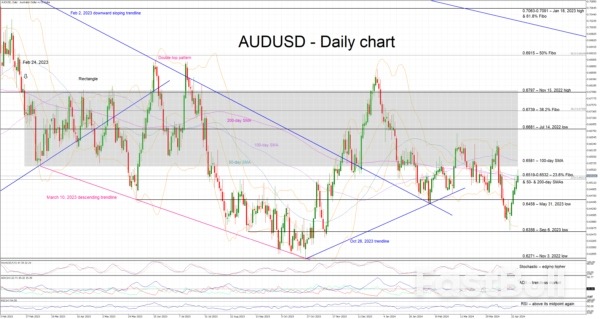
          The aussie/dollar pair has recorded six consecutive green sessions, quickly climbing to the 0.6520 area. If Tuesday’s data proves positive, the 100-day simple moving average (SMA) at 0.6581 is next in line to be tested. On the other hand, weak Chinese data could cast a shadow on the current aussie strength and hence could cause a small correction towards the 0.6458 level.
          Can Chinese PMIs Solidify the Economy’s Recovery Prospects?_1

          Source:XM

          To stay updated on all economic events of today, please check out our Economic calendar
          Risk Warnings and Disclaimers
          You understand and acknowledge that there is a high degree of risk involved in trading. Following any strategies or investment methods may lead to potential losses. The content on the site is provided by our contributors and analysts for information purposes only. You are solely responsible for determining whether any trading assets, securities, strategy, or any other product is suitable for investing based on your own investment objectives and financial situation.
          Add to Favorites
          Share

          US Top Diplomat Meets Xi In Beijing As Ties Hit Turbulence

          Samantha Luan

          Economic

          Political

          US Secretary of State Antony Blinken has begun talks with Chinese President Xi Jinping in Beijing, as the world’s biggest economies spar in high-stakes meetings spanning trade complaints to Beijing’s continued support for Russia.
          America’s top diplomat sat down with the Chinese leader on Friday afternoon, state broadcaster China Central Television confirmed. Blinken earlier emerged from five-and-a-half hours of meetings with China’s Foreign Minister Wang Yi, which included a working lunch.
          During “substantive and constructive” talks the US raised issues such as Beijing’s support for the Kremlin’s military industrial base, peace in the Taiwan Strait — which the Communist Party considers a breakaway territory — and China’s military activity in the South China Sea, according to State Department spokesman Matthew Miller.
          China’s Foreign Minister accused the US of taking “endless measures to suppress China’s economy,” according to Beijing’s readout of the meeting. “This is not fair competition, but containment — and it is not removing risks, but creating risks,” Wang added, citing curbs on science and technology.
          Since Blinken last visited Beijing 10 months ago dialogue between the US-China has increased, with leaders on both sides pledging to keep ties on a more secure footing. But with the American election campaign picking up momentum, and both Democrats and Republicans vowing to take a tougher approach to Beijing, there is still plenty of room for volatility in the bilateral relationship.
          Blinken arrived in China against a stormy backdrop. President Joe Biden signed a law this week that could expel TikTok — owned by China—based ByteDance Ltd. — from the US, an action that came days after the US leader vowed new tariffs on China. Biden has already imposed a slew of trade curbs to block Beijing’s access to advanced chips, which are core to its military development.
          The US is also rallying the European Union to speak with America against China’s industrial policy, with Treasury Chief Janet Yellen warning leaders in Beijing this month that its cheap exports were a concern for the world — a sentiment German Chancellor Olaf Scholz repeated on a trip to the Asian nation days later.
          Yellen raised the prospect of fresh sanctions on Chinese financial institutions that the US says are helping to prop up Russia’s defense industrial base, with the US reportedly already drafting such measures.
          China’s top diplomat earlier warned his American counterpart that while ties had stabilized since Xi and Biden met in San Francisco last November, “negative factors” were increasing. Blinken stressed the importance of dialogue, calling the bilateral relationship the world’s “most-consequential.”
          Although Beijing has heeded US warnings not to send lethal military aid to the Kremlin in the form of weapons or munitions, there is a growing sense that China’s economic and industrial support has helped Russia buck Western sanctions aimed at crippling its defense industry.
          There is also concern in Washington over China’s increased aggression in the South China Sea, particularly around the Second Thomas Shoal, where Chinese vessels have used powerful hoses against ships trying to restock a beached, aging vessel that serves as a semi-permanent maritime outpost. That led the Biden administration to host the leaders of Japan and the Philippines in Washington recently, pledging to step up security cooperation.
          Blinken arrived in the Chinese capital city after a series of more relaxed engagements in Shanghai on Thursday. Those included attending a basketball game, eating dinner at a dumpling restaurant, taking a stroll along the colonial-era riverfront and addressing US and Chinese students at a local New York University campus.
          In a meeting with Chinese Communist Party’s top official in Shanghai, Chen Jining, Blinken also brought up Beijing’s “non-market” policies and the treatment of US businesses in China.
          “We have an obligation for our people – and indeed, an obligation for the world – to manage the relationship between our two countries responsibly,” he added.

          Source:Bloomberg

          To stay updated on all economic events of today, please check out our Economic calendar
          Risk Warnings and Disclaimers
          You understand and acknowledge that there is a high degree of risk involved in trading. Following any strategies or investment methods may lead to potential losses. The content on the site is provided by our contributors and analysts for information purposes only. You are solely responsible for determining whether any trading assets, securities, strategy, or any other product is suitable for investing based on your own investment objectives and financial situation.
          Add to Favorites
          Share

          India's Farmers Are Up In Arms Again. Will It Hurt Modi's reelection campaign?

          Alex

          Economic

          Political

          Farmers in India’s Punjab state are raising the pitch of their ongoing protests, as the second phase of India’s general elections starts Friday.
          Thousands of farmers continue to drum up support for their demands, foremost being a legal guarantee for minimum support prices for their produce.
          They have occupied railway tracks in the northwestern state of Punjab, disrupting operations, with trains on 149 routes either being cancelled, diverted or journeys terminated midway on Wednesday, as they demand the release of farmers taken into police custody.
          While the protestors are beginning to up the ante, the agitation this time, which began in February, seems a pale shadow of their movement in 2020 when hundreds of thousands of farmers took to the streets in a year-long protest against three farm laws.
          In a rare policy setback for Prime Minister Narendra Modi, the farm laws were revoked in 2021.
          This time, however, fenced in by barricades and under the watchful eyes of the state police and paramilitary forces, protests have been relatively low-key and largely restricted to Shambhu and Khanauri borders between the states of Punjab and Haryana in northern India.
          Some of the prominent leaders from other states who participated in the earlier protests were also missing in action.
          The government has shown no signs of capitulation, even as it risks losing support from the massive farmer population at a time when Modi is fighting to win a third term in the national elections.
          The Congress and several opposition parties have put farmers’ demand about minimum support prices (MSP) in their manifesto, while the ruling Bharatiya Janata Party (BJP) has “steadfastly refused to acknowledge this demand, therefore it will have some effect [electorally],” said Yogendra Yadav, political activist and a former psephologist.
          About 250 million people work in agriculture in India, according to government data, constituting about 45% of India’s workforce.
          People are “very sympathetic” to the farmers’ cause due to the BJP’s high-handedness in dealing with the protestors, according to Sanjay Kumar, co-director of Lokniti, a research program at the New Delhi-based Centre for the Study of Developing Societies.
          A Lokniti-CSDS survey earlier this month showed 59% of the respondents found the farmers’ demands “genuine,” while 16% deemed the protests a “conspiracy” against the government.
          The election juggernaut of Modi’s BJP, however, is unlikely to be materially impacted by the ongoing agitation. Several surveys have forecast that the ruling party’s victory is imminent in this national election.
          Kumar said the protests were unlikely to cause any substantial dent to the BJP’s electoral prospects.
          “When farmers go to vote, it’s not like they say: ‘We are farmers so we must vote en masse to throw this government or support that government.’ Often, they vote on party lines. Other identities take over,” Kumar said.
          The same survey showed 44% of the people wished to reelect the government, mostly on account of its “good work.”
          “People might have huge anxieties, but how does it matter if they end up voting for the same party. I don’t see a major change in the outcome of 2024 elections compared with 2019 [when BJP won a second term],” Kumar said.
          CNBC did not immediately receive a response from India’s Agriculture Ministry on queries pertaining to the farmers’ demands.

          Stifling dissent?

          Farm leaders have alleged that the government is trying to keep the protests contained to just Punjab and make it a local issue.
          “When we started the protests, the government told us we could not bring vehicles, such as tractors to Delhi, but could come via public transport. However, when farmers from other BJP-ruled states tried to come to Delhi via trains and buses, they were detained,” claimed farmer leader Jagjit Singh Dallewal, according to a CNBC translation of his statement in Hindi.
          A small of group of farmers from Tamil Nadu held a protest at Jantar Mantar in Delhi on Tuesday and Wednesday in solidarity with their peers from Punjab and Haryana. They said they had also participated in protests at the Shabhu border, the nerve center of the current demonstrations.
          “We will now go to Varanasi and 1,000 people will file nominations against Modi,” said P. Ayyakannu, the leader of the farmers from Tamil Nadu. Modi is contesting for a parliamentary seat from the city of Varansai in the state of Uttar Pradesh.
          Dallewal, the convener of the Samyukta Kisan Morcha (non-political), a coalition on farmers’ unions under which the current protests have been organized, said they will continue to protest, but the demands were not a political issue for them.
          “We are sitting here as elections are on, so political parties have to take notice, and include our demands in their poll manifestos,” Dallewal told CNBC.

          What India’s farmers want

          Indian farmers’ foremost demand is that of guaranteed minimum support prices — the lowest rate at which the government agencies can purchase crops from farmers — aimed at shielding them from wild market fluctuations.
          The farmers want MSP for their agricultural produce to be determined according to the guidelines of the Swaminathan Commission on farmers. The Commission, which came out with five reports between 2004 and 2006, recommends MSP at a 50% profit over their production costs.
          Other key demands include loan waivers, pensions for all farmers above the age of 60, a sharp increase in wages — nearly two to three times the current rates — as well as guaranteed employment for 200 days. They are also insisting that India withdraw from the World Trade Organization.
          Several economists have said the farmers’ demands are not economically viable.
          “These demands are not just detrimental to the agricultural sector, but they will throw a major spanner in the economy. The entire economy will go into a tizzy,” economist and a former chairman of the Commission for Agricultural Costs and Prices, Government of India, Ashok Gulati said.
          Farm leaders who spoke to CNBC, including Dallewal, said their demands were not new and politicians including the prime minister have promised most of the things they are asking for in their past political campaigns.
          Former IMF executive director, Surjit Bhalla, also a former member of prime minister’s economic advisory council was critical of the demands.
          “One of these days, we will all get real … since 2014, we have taken significant steps toward reality, but in certain areas, such as the agri sector, farm laws, we are still stuck in the 19th century,” he told CNBC.
          Arun Kumar, economist and a former professor at New Delhi-based Jawahar Lal Nehru university, disagreed. He said talk about the government being overburdened because of the farmers’ MSP demand was misleading.
          “The legal guarantee for MSP will come into play only if the price [of commodities] drops below a certain level. Only then the government will need to buy,” Kumar told CNBC. ″If the price doesn’t fall below the MSP, the government does not have to buy anything. In fact, 95% of the produce could be sold in the open market.”

          Source:CNBC

          To stay updated on all economic events of today, please check out our Economic calendar
          Risk Warnings and Disclaimers
          You understand and acknowledge that there is a high degree of risk involved in trading. Following any strategies or investment methods may lead to potential losses. The content on the site is provided by our contributors and analysts for information purposes only. You are solely responsible for determining whether any trading assets, securities, strategy, or any other product is suitable for investing based on your own investment objectives and financial situation.
          Add to Favorites
          Share
          FastBull
          Copyright © 2025 FastBull Ltd

          728 RM B 7/F GEE LOK IND BLDG NO 34 HUNG TO RD KWUN TONG KLN HONG KONG

          TelegramInstagramTwitterfacebooklinkedin
          App Store Google Play Google Play
          Products
          Charts

          Chats

          Q&A with Experts
          Screeners
          Economic Calendar
          Data
          Tools
          Membership
          Features
          Function
          Markets
          Copy Trading
          Latest Signals
          Contests
          News
          Analysis
          24/7
          Columns
          Education
          Company
          Careers
          About Us
          Contact Us
          Advertising
          Help Center
          Feedback
          User Agreement
          Privacy Policy
          Business

          White Label

          Data API

          Web Plug-ins

          Poster Maker

          Affiliate Program

          Risk Disclosure

          The risk of loss in trading financial instruments such as stocks, FX, commodities, futures, bonds, ETFs and crypto can be substantial. You may sustain a total loss of the funds that you deposit with your broker. Therefore, you should carefully consider whether such trading is suitable for you in light of your circumstances and financial resources.

          No decision to invest should be made without thoroughly conducting due diligence by yourself or consulting with your financial advisors. Our web content might not suit you since we don't know your financial conditions and investment needs. Our financial information might have latency or contain inaccuracy, so you should be fully responsible for any of your trading and investment decisions. The company will not be responsible for your capital loss.

          Without getting permission from the website, you are not allowed to copy the website's graphics, texts, or trademarks. Intellectual property rights in the content or data incorporated into this website belong to its providers and exchange merchants.

          Not Logged In

          Log in to access more features

          FastBull Membership

          Not yet

          Purchase

          Become a signal provider
          Help Center
          Customer Service
          Dark Mode
          Price Up/Down Colors

          Log In

          Sign Up

          Position
          Layout
          Fullscreen
          Default to Chart
          The chart page opens by default when you visit fastbull.com