• Trade
  • Markets
  • Copy
  • Contests
  • News
  • 24/7
  • Calendar
  • Q&A
  • Chats
Trending
Screeners
SYMBOL
LAST
BID
ASK
HIGH
LOW
NET CHG.
%CHG.
SPREAD
SPX
S&P 500 Index
6846.50
6846.50
6846.50
6878.28
6827.18
-23.90
-0.35%
--
DJI
Dow Jones Industrial Average
47739.31
47739.31
47739.31
47971.51
47611.93
-215.67
-0.45%
--
IXIC
NASDAQ Composite Index
23545.89
23545.89
23545.89
23698.93
23455.05
-32.22
-0.14%
--
USDX
US Dollar Index
99.000
99.080
99.000
99.000
99.000
+0.050
+ 0.05%
--
EURUSD
Euro / US Dollar
1.16333
1.16390
1.16333
1.16362
1.16322
-0.00031
-0.03%
--
GBPUSD
Pound Sterling / US Dollar
1.33175
1.33287
1.33175
1.33177
1.33140
-0.00030
-0.02%
--
XAUUSD
Gold / US Dollar
4189.70
4190.14
4189.70
4218.85
4175.92
-8.21
-0.20%
--
WTI
Light Sweet Crude Oil
58.555
58.807
58.555
60.084
58.495
-1.254
-2.10%
--

Community Accounts

Signal Accounts
--
Profit Accounts
--
Loss Accounts
--
View More

Become a signal provider

Sell trading signals to earn additional income

View More

Guide to Copy Trading

Get started with ease and confidence

View More

Signal Accounts for Members

All Signal Accounts

Best Return
  • Best Return
  • Best P/L
  • Best MDD
Past 1W
  • Past 1W
  • Past 1M
  • Past 1Y

All Contests

  • All
  • Trump Updates
  • Recommend
  • Stocks
  • Cryptocurrencies
  • Central Banks
  • Featured News
Top News Only
Share

On Monday (December 8), In Late New York Trading, S&P 500 Futures Fell 0.21%, Dow Jones Futures Fell 0.43%, NASDAQ 100 Futures Fell 0.08%, And Russell 2000 Futures Fell 0.04%

Share

Morgan Stanley: Data Center ABS Spreads Are Expected To Widen In 2026

Share

(US Stocks) The Philadelphia Gold And Silver Index Closed Down 2.34% At 311.01 Points. (Global Session) The NYSE Arca Gold Miners Index Closed Down 2.17%, Hitting A Daily Low Of 2235.45 Points; US Stocks Remained Slightly Down Before The Opening Bell—holding Steady Around 2280 Points—before Briefly Rising Slightly

Share

IMF: IMF Executive Board Approves Extension Of The Extended Credit Facility Arrangement With Nepal

Share

Trump: Same Approach Will Apply To Amd, Intel, And Other Great American Companies

Share

Trump: Department Of Commerce Is Finalizing Details

Share

Trump: $25% Will Be Paid To United States Of America

Share

Trump: President Xi Responded Positively

Share

[Consumer Discretionary ETFs Fell Over 1.4%, Leading The Decline Among US Sector ETFs; Semiconductor ETFs Rose Over 1.1%] On Monday (December 8), The Consumer Discretionary ETF Fell 1.45%, The Energy ETF Fell 1.09%, The Internet ETF Fell 0.18%, The Regional Banks ETF Rose 0.34%, The Technology ETF Rose 0.70%, The Global Technology ETF Rose 0.93%, And The Semiconductor ETF Rose 1.13%

Share

Trump: I Have Informed President Xi, Of China, That United States Will Allow Nvidia To Ship Its H200 Products To Approved Customers In China

Share

Argentina's Merval Index Closed Up 0.02% At 3.047 Million Points. It Rose To A New Daily High Of 3.165 Million Points In Early Trading In Buenos Aires Before Gradually Giving Back Its Gains

Share

US Stock Market Closing Report | On Monday (December 8), The Magnificent 7 Index Fell 0.20% To 208.33 Points. The "mega-cap" Tech Stock Index Fell 0.33% To 405.00 Points

Share

Pentagon - USA State Dept Approves Potential Sale Of Hellfire Missiles To Belgium For An Estimated $79 Million

Share

Toronto Stock Index .GSPTSE Unofficially Closes Down 141.44 Points, Or 0.45 Percent, At 31169.97

Share

The Nasdaq Golden Dragon China Index Closed Up Less Than 0.1%. Nxtt Rose 21%, Microalgo Rose 7%, Daqo New Energy Rose 4.3%, And 21Vianet, Baidu, And Miniso All Rose More Than 3%

Share

The S&P 500 Initially Closed Down More Than 0.4%, With The Telecom Sector Down 1.9%, And Materials, Consumer Discretionary, Utilities, Healthcare, And Energy Sectors Down By As Much As 1.6%, While The Technology Sector Rose 0.7%. The NASDAQ 100 Initially Closed Down 0.3%, With Marvell Technology Down 7%, Fortinet Down 4%, And Netflix And Tesla Down 3.4%

Share

IMF: Review Pakistan Authorities To Draw The Equivalent Of About US$1 Billion

Share

President Trump Is Committed To The Continued Cessation Of Violence And Expects The Governments Of Cambodia And Thailand To Fully Honor Their Commitments To End This Conflict - Senior White House Official

Share

[Water Overflows From Spent Fuel Pool At Japanese Nuclear Facility] According To Japan's Nuclear Waste Management Company, Following A Strong Earthquake Off The Coast Of Aomori Prefecture Late On December 8th, Workers At The Nuclear Waste Treatment Plant In Rokkasho Village, Aomori Prefecture, Discovered "at Least 100 Liters Of Water" On The Ground Around The Spent Fuel Pool During An Inspection. Analysis Suggests This Water "may Have Overflowed Due To The Earthquake's Shaking." However, It Is Reported That The Overflowed Water "remains Inside The Building And Has Not Affected The External Environment."

Share

Trump Says Netflix, Paramount Are Not His Friends As Warner Bros Fight Heats Up

TIME
ACT
FCST
PREV
France Trade Balance (SA) (Oct)

A:--

F: --

P: --
Euro Zone Employment YoY (SA) (Q3)

A:--

F: --

P: --
Canada Part-Time Employment (SA) (Nov)

A:--

F: --

P: --

Canada Unemployment Rate (SA) (Nov)

A:--

F: --

P: --

Canada Full-time Employment (SA) (Nov)

A:--

F: --

P: --

Canada Labor Force Participation Rate (SA) (Nov)

A:--

F: --

P: --

Canada Employment (SA) (Nov)

A:--

F: --

P: --

U.S. PCE Price Index MoM (Sept)

A:--

F: --

P: --

U.S. Personal Income MoM (Sept)

A:--

F: --

P: --

U.S. Core PCE Price Index MoM (Sept)

A:--

F: --

P: --

U.S. PCE Price Index YoY (SA) (Sept)

A:--

F: --

P: --

U.S. Core PCE Price Index YoY (Sept)

A:--

F: --

P: --

U.S. Personal Outlays MoM (SA) (Sept)

A:--

F: --

P: --
U.S. 5-10 Year-Ahead Inflation Expectations (Dec)

A:--

F: --

P: --

U.S. Real Personal Consumption Expenditures MoM (Sept)

A:--

F: --

P: --
U.S. Weekly Total Rig Count

A:--

F: --

P: --

U.S. Weekly Total Oil Rig Count

A:--

F: --

P: --

U.S. Consumer Credit (SA) (Oct)

A:--

F: --

P: --
China, Mainland Foreign Exchange Reserves (Nov)

A:--

F: --

P: --

Japan Trade Balance (Oct)

A:--

F: --

P: --

Japan Nominal GDP Revised QoQ (Q3)

A:--

F: --

P: --

China, Mainland Imports YoY (CNH) (Nov)

A:--

F: --

P: --

China, Mainland Exports (Nov)

A:--

F: --

P: --

China, Mainland Imports (CNH) (Nov)

A:--

F: --

P: --

China, Mainland Trade Balance (CNH) (Nov)

A:--

F: --

P: --

China, Mainland Exports YoY (USD) (Nov)

A:--

F: --

P: --

China, Mainland Imports YoY (USD) (Nov)

A:--

F: --

P: --

Germany Industrial Output MoM (SA) (Oct)

A:--

F: --

P: --
Euro Zone Sentix Investor Confidence Index (Dec)

A:--

F: --

P: --

Canada National Economic Confidence Index

A:--

F: --

P: --

U.K. BRC Like-For-Like Retail Sales YoY (Nov)

--

F: --

P: --

U.K. BRC Overall Retail Sales YoY (Nov)

--

F: --

P: --

Australia Overnight (Borrowing) Key Rate

--

F: --

P: --

RBA Rate Statement
RBA Press Conference
Germany Exports MoM (SA) (Oct)

--

F: --

P: --

U.S. NFIB Small Business Optimism Index (SA) (Nov)

--

F: --

P: --

Mexico 12-Month Inflation (CPI) (Nov)

--

F: --

P: --

Mexico Core CPI YoY (Nov)

--

F: --

P: --

Mexico PPI YoY (Nov)

--

F: --

P: --

U.S. Weekly Redbook Index YoY

--

F: --

P: --

U.S. JOLTS Job Openings (SA) (Oct)

--

F: --

P: --

China, Mainland M1 Money Supply YoY (Nov)

--

F: --

P: --

China, Mainland M0 Money Supply YoY (Nov)

--

F: --

P: --

China, Mainland M2 Money Supply YoY (Nov)

--

F: --

P: --

U.S. EIA Short-Term Crude Production Forecast For The Year (Dec)

--

F: --

P: --

U.S. EIA Natural Gas Production Forecast For The Next Year (Dec)

--

F: --

P: --

U.S. EIA Short-Term Crude Production Forecast For The Next Year (Dec)

--

F: --

P: --

EIA Monthly Short-Term Energy Outlook
U.S. API Weekly Gasoline Stocks

--

F: --

P: --

U.S. API Weekly Cushing Crude Oil Stocks

--

F: --

P: --

U.S. API Weekly Crude Oil Stocks

--

F: --

P: --

U.S. API Weekly Refined Oil Stocks

--

F: --

P: --

South Korea Unemployment Rate (SA) (Nov)

--

F: --

P: --

Japan Reuters Tankan Non-Manufacturers Index (Dec)

--

F: --

P: --

Japan Reuters Tankan Manufacturers Index (Dec)

--

F: --

P: --

Japan Domestic Enterprise Commodity Price Index MoM (Nov)

--

F: --

P: --

Japan Domestic Enterprise Commodity Price Index YoY (Nov)

--

F: --

P: --

China, Mainland PPI YoY (Nov)

--

F: --

P: --

China, Mainland CPI MoM (Nov)

--

F: --

P: --

Italy Industrial Output YoY (SA) (Oct)

--

F: --

P: --

Q&A with Experts
    • All
    • Chatrooms
    • Groups
    • Friends
    Connecting
    .
    .
    .
    Type here...
    Add Symbol or Code

      No matching data

      All
      Trump Updates
      Recommend
      Stocks
      Cryptocurrencies
      Central Banks
      Featured News
      • All
      • Russia-Ukraine Conflict
      • Middle East Flashpoint
      • All
      • Russia-Ukraine Conflict
      • Middle East Flashpoint
      Search
      Products

      Charts Free Forever

      Chats Q&A with Experts
      Screeners Economic Calendar Data Tools
      Membership Features
      Data Warehouse Market Trends Institutional Data Policy Rates Macro

      Market Trends

      Market Sentiment Order Book Forex Correlations

      Top Indicators

      Charts Free Forever
      Markets

      News

      News Analysis 24/7 Columns Education
      From Institutions From Analysts
      Topics Columnists

      Latest Views

      Latest Views

      Trending Topics

      Top Columnists

      Latest Update

      Signals

      Copy Rankings Latest Signals Become a signal provider AI Rating
      Contests
      Brokers

      Overview Brokers Assessment Rankings Regulators News Claims
      Broker listing Forex Brokers Comparison Tool Live Spread Comparison Scam
      Q&A Complaint Scam Alert Videos Tips to Detect Scam
      More

      Business
      Events
      Careers About Us Advertising Help Center

      White Label

      Data API

      Web Plug-ins

      Affiliate Program

      Awards Institution Evaluation IB Seminar Salon Event Exhibition
      Vietnam Thailand Singapore Dubai
      Fans Party Investment Sharing Session
      FastBull Summit BrokersView Expo
      Recent Searches
        Top Searches
          Markets
          News
          Analysis
          User
          24/7
          Economic Calendar
          Education
          Data
          • Names
          • Latest
          • Prev

          View All

          No data

          Scan to Download

          Faster Charts, Chat Faster!

          Download App
          English
          • English
          • Español
          • العربية
          • Bahasa Indonesia
          • Bahasa Melayu
          • Tiếng Việt
          • ภาษาไทย
          • Français
          • Italiano
          • Türkçe
          • Русский язык
          • 简中
          • 繁中
          Open Account
          Search
          Products
          Charts Free Forever
          Markets
          News
          Signals

          Copy Rankings Latest Signals Become a signal provider AI Rating
          Contests
          Brokers

          Overview Brokers Assessment Rankings Regulators News Claims
          Broker listing Forex Brokers Comparison Tool Live Spread Comparison Scam
          Q&A Complaint Scam Alert Videos Tips to Detect Scam
          More

          Business
          Events
          Careers About Us Advertising Help Center

          White Label

          Data API

          Web Plug-ins

          Affiliate Program

          Awards Institution Evaluation IB Seminar Salon Event Exhibition
          Vietnam Thailand Singapore Dubai
          Fans Party Investment Sharing Session
          FastBull Summit BrokersView Expo

          Adnoc Logistics Soars 52% Following Successful $769 Million Abu Dhab

          Warren Takunda

          Traders' Opinions

          Adnoc Logistics & Services, a subsidiary of the state-owned Abu Dhabi National Oil Company (Adnoc), has experienced a remarkable surge in its stock price, jumping by an impressive 52% after its highly anticipated initial public offering (IPO) in Abu Dhabi. This extraordinary performance reflects the market's overwhelming confidence in the company's potential and the growing attractiveness of the energy sector.
          The IPO, which raised a substantial $769 million, marks a significant milestone for Adnoc Logistics & Services and further demonstrates Adnoc's commitment to diversifying its operations and unlocking value for its stakeholders. It follows the successful listing of another Adnoc subsidiary earlier this year, highlighting the company's strategic approach to capitalizing on the financial markets' favorable conditions.
          Investor enthusiasm for Adnoc Logistics & Services was evident from the remarkable demand generated during the IPO. The company received orders worth an astonishing $125 billion, reflecting the strong interest from both institutional and retail investors. This overwhelming response underscores the belief in the company's growth prospects and the potential for attractive returns.
          Adnoc Logistics & Services is positioned as a key player in the logistics and services sector, supporting the oil and gas industry in Abu Dhabi and beyond. With a wide range of offerings, including shipping, maritime, and onshore and offshore support services, the company plays a crucial role in facilitating the seamless transportation and distribution of energy resources. Its robust infrastructure and strong track record have attracted investors seeking exposure to the thriving energy market in the United Arab Emirates.
          The successful IPO of Adnoc Logistics & Services not only provides a boost to the company's financial standing but also supports the broader ambitions of Adnoc and the Abu Dhabi government. By unlocking value through public offerings, Adnoc can raise capital to fund its ambitious expansion plans, enhance its operational capabilities, and further diversify its revenue streams.
          The impressive market response to the Adnoc Logistics & Services IPO reflects the positive sentiment surrounding the energy sector, driven by increasing global energy demand, favorable oil prices, and the company's strong fundamentals. Investors are recognizing the potential for long-term growth and value creation in this vital industry, and Adnoc Logistics & Services is well-positioned to benefit from these positive dynamics.
          As the stock continues to attract attention and demonstrate its potential, it is essential for investors to closely monitor the company's financial performance and its ability to execute its growth strategy effectively. Additionally, factors such as geopolitical developments, oil price fluctuations, and regulatory changes should be taken into account when evaluating investments in the energy sector.
          The impressive performance of Adnoc Logistics & Services' stock following its IPO serves as a testament to the confidence investors have in the company's future prospects. It also highlights the continued attractiveness of the energy sector for investors seeking opportunities in stable and resilient industries. Adnoc's successful listing adds to the vibrancy of the Abu Dhabi stock market and reinforces the emirate's position as a leading regional hub for business and investment.
          Risk Warnings and Disclaimers
          You understand and acknowledge that there is a high degree of risk involved in trading. Following any strategies or investment methods may lead to potential losses. The content on the site is provided by our contributors and analysts for information purposes only. You are solely responsible for determining whether any trading assets, securities, strategy, or any other product is suitable for investing based on your own investment objectives and financial situation.
          Comments
          Add to Favorites
          Share

          Multi-CBDC Cross-Border Payments Systems Inch Closer to Reality

          Justin

          Central Bank

          Economic

          Improving cross-border payments is a key priority for the G20. At the 2023 Digital Monetary Institute symposium in London, Tommaso Mancini-Griffol, deputy division chief of monetary and capital markets at the International Monetary Fund, said that Libra, Facebook’s attempt at a global currency, delivered a ‘collective shock’ to the public sector. He highlighted the inadequacies of cross-border payments: high costs, low speed and inadequate transparency.
          One of the most promising solutions to these problems is the interconnection of central bank digital currency systems. This is an attractive concept because of the global surge in CBDC development. It is hoped that, as these state digital payments systems emerge, the work of creating a seamless cross-border payments system to bridge the gaps will already have been done.

          Project Icebreaker versus Project mBridge

          Even within this approach, however, there are different strategies. Two projects with distinct philosophies were showcased at the DMI symposium. Project Icebreaker is a collaboration between the Bank of Israel, Norges Bank and Sveriges Riksbank, in coordination with the Bank for International Settlements Innovation Hub Nordic Centre, that aims to connect retail CBDC systems. Project mBridge is a multi-CBDC platform developed by the BIS Innovation Hub Hong Kong Centre, Hong Kong Monetary Authority, Bank of Thailand, People’s Bank of China and the Central Bank of the United Arab Emirates. It is the largest multi-CBDC project involving cross-border transactions.
          Both Project Icebreaker and Project mBridge are multi-CBDC platforms for cross-border payments. Both aim to reduce the costs and increase the speed of cross-border transactions. However, there are key differences in the design and architecture of the models that have implications for interoperability and scalability of the platforms .
          The first and perhaps most important distinction is that Icebreaker aims to interlink domestic retail CBDCs while mBridge is a platform for wholesale CBDCs – in other words, inter-bank settlement. However, although individuals will not interact directly with mBridge, the improvements to the speed and the reductions to the cost of their cross-border transactions should still improve their experience of transacting with counterparties in participating countries.
          The primary difference for retail users of Icebreaker versus mBridge relates to the integration of foreign exchange liquidity provision. Project Icebreaker is a hub-and-spoke system that connects different rCBDC systems of countries (spokes) to a hub, which serves as a marketplace for foreign exchange providers who are willing to provide settlement in more than one currency.
          There are minimal technical preconditions for the rCBDC systems that connect to the hub: they must be a real-time or near-real-time payments system, be able to implement and support the use of hashed time locked contracts and have entities that can act as foreign exchange providers within the rCBDC system. Because foreign exchange providers are within the hub in Icebreaker, this ensures both competition and transparency of on-platform foreign exchange transactions.
          In contrast, Project mBridge has foreign exchange off platform, which means that end users do not have access to the same degree of choice or market transparency. Making provisions to facilitate foreign exchange dealing on bridge was one of the post-pilot recommendations to improve the project. In 2023 and 2024, the roadmap for mBridge will focus on integrating foreign exchange price discovery and matching into the platform.

          Flexibility and scalability

          In terms of scalability, the hub-and-spoke model of Icebreaker minimises the number of connections between domestic rCBDC systems, so it can scale up to support many participating systems without increasing the complexity of the design. The hub routes payment messages and does not act on them – its only action is selecting best foreign exchange rates for the payer. Requirements to be part of the system are low, which allows central banks to have autonomy when designing rCBDC systems, but still participate in an interlinked system enabling cross-border payments.
          Project mBridge, however, does not support the use of bridge currencies, which might limit the flexibility of the platform. Since it will only be able to facilitate transactions between currency pairs with liquid trading, this could limit the future scalability of the system. Integrating foreign exchange price discovery might change this. With foreign exchange liquidity provision integrated in the platform, exchanging one currency for another via a bridge currency might be accomplished as a two-part transaction relatively smoothly.
          Despite being further ahead in foreign exchange liquidity provision and scalability, Project Icebreaker has so far only focused on core features with limited use cases. Before becoming a minimum viable product, Icebreaker still needs to determine a governance arrangement, anti-money laundering and counter-terrorism financing compliance and monitoring, and legal considerations regarding conflict of regulations between connected rCBDC systems.
          Here, the mBridge model has clear advantages. Because of its uniquely designed distributed ledger, it uses a decentralised model to address governance considerations. As explained by Mu Changchun, director-general of the Digital Currency Research Institute at PBoC, for cross-border payments, a trustless, decentralised approach via DLT is appropriate to ensure all participating countries trust the integrity of the network.
          So far, Icebreaker and mBridge have varied in architecture, technology and use of bridge currencies in the development of the two multi-CBDC cross-border payments systems Whether the two will converge or take different approaches to governance, foreign exchange liquidity provision and other factors remains to be seen.

          Source: Arunima Sharan

          To stay updated on all economic events of today, please check out our Economic calendar
          Risk Warnings and Disclaimers
          You understand and acknowledge that there is a high degree of risk involved in trading. Following any strategies or investment methods may lead to potential losses. The content on the site is provided by our contributors and analysts for information purposes only. You are solely responsible for determining whether any trading assets, securities, strategy, or any other product is suitable for investing based on your own investment objectives and financial situation.
          Comments
          Add to Favorites
          Share

          What to Watch for in Friday’s Us Jobs Report

          Justin

          Central Bank

          Economic

          Markets think the Fed will "skip" June hike, but strong jobs could change that

          When Federal Reserve Chair Jerome Powell opened the door to a potential Fed pause after the May FOMC meeting, financial markets swiftly priced a Fed peak with potentially 100bp of rate cuts by January 2024. However, strong jobs, sticky inflation and a raft of hawkish comments from some prominent regional Fed officials saw this completely reversed. As of last Friday a June hike has been seen as more likely than not, with perhaps just a couple of cuts priced by next January. This week though, comments from Fed Governor Philip Jefferson and Philadelphia Fed President Patrick Harker reignited the prospect of skipping a hike in June and a reassessment in July. There is clearly a core group at the Fed who think 500bp of rate hikes and tighter lending conditions may mean they have done enough.
          We outlined our US rates view and the risks surrounding it in this report. It is that the Fed has peaked and we will get rate cuts from the fourth quarter onwards but we must acknowledge that if we get a strong jobs report and US CPI comes in hot on 13 June, the day ahead of the 14 June FOMC meeting, that could be enough to tip the balance in favour of another hike.

          Some data points to strong gains

          At the moment, the consensus is for the economy to add 195,000 jobs in tomorrow’s report, which is lower than the 253,000 outcome for April. In fact, none of the 69 organisations surveyed by Bloomberg expect payrolls to come in stronger than last month, which is a little surprising. In terms of the numbers we have seen, we know that job openings remain incredibly high and are in fact larger than the total number of Americans that regard themselves as unemployed. This means that a lack of people with the required skill sets continues to restrict hiring.
          Yet today’s ADP jobs release reported private payrolls rose 278k versus the 170k consensus - it is a bit of a black box model that doesn’t have a great track record in predicting actual payrolls. Then we have the homebase data on hourly employed workers which was OK and the ISM manufacturing employment which pointed to modest growth. Then there are comments from St. Louis Fed economist Max Dvorkin, reported by MNI as saying that their real-time labour market index points to household employment (not the same as payrolls) rising 638k!

          But other data is more cautious

          Nonetheless, we continue to see the number of job lay-off announcements climb. Indeed, today’s Challenger job lay-offs report for May showed 80,089 total for lay-offs, up 13,094 on April’s level, giving a 286.7% year-on-year change. Hiring announcements totalled just 7,885 versus 23,310 in April. This is the lowest hiring figure since November 2021 and before then, you have to go back to February 2016 to find a lower number than reported today. Yesterday, we had the Federal Reserve’s Beige Book which suggested that “Employment increased in most Districts, though at a slower pace than in previous reports”.

          Rise in lay-offs points to shift in payrolls

          Putting it all together, we have some very contradictory signals, meaning we have little confidence in our own 200k forecasts and an acknowledgement that pretty much anything could happen. That said, the payrolls number isn’t the only figure to watch. Unemployment fell to 3.4% last month, however, it is wages that will probably get more attention given the Fed’s wariness that tight labour markets could keep service sector inflation higher for longer. Last month, it rose 0.5% month-on-month, but the market expects this to slow back to 0.3%.
          Nela Richardson, chief economist at ADP, commented within their report that they saw the second month where there has been a “full percentage point decline in pay growth for job changers," before adding that "pay growth is slowing substantially, and wage-driven inflation may be less of a concern for the economy despite robust hiring."

          Inflation could be the clincher

          In terms of consensus expectations, the market is looking for 195k jobs with unemployment ticking up to 3.5% from 3.4% and average hourly earnings rising 0.3% MoM. If we get something similar to that we are likely to see the market remaining of the view that the Fed will not change policy at the June FOMC meeting, but leave the door open for a possible July rate hike.
          However, if we get a 250k+ figure on jobs and wages rise 0.4% MoM or above and unemployment stays at 3.4%, we suspect it is likely to move in the direction of a 50:50 call for a hike. That would leave the outcome determined by the May CPI report, due out the day ahead of the Fed meeting. A 0.4% MoM core CPI print would put the decision on a knife edge and could give enough ammunition to push another hike over the line.

          Source: ING

          To stay updated on all economic events of today, please check out our Economic calendar
          Risk Warnings and Disclaimers
          You understand and acknowledge that there is a high degree of risk involved in trading. Following any strategies or investment methods may lead to potential losses. The content on the site is provided by our contributors and analysts for information purposes only. You are solely responsible for determining whether any trading assets, securities, strategy, or any other product is suitable for investing based on your own investment objectives and financial situation.
          Comments
          Add to Favorites
          Share

          Hot, Cold and Skipping a Beat

          Damon

          Economic

          If the Federal Reserve does skip raising interest rates this month it's probably because it is as confused as everyone else about the health of the U.S. economy as June kicks off.
          Like a patient with a virus, incoming data appears to blow hot and cold at the same time.
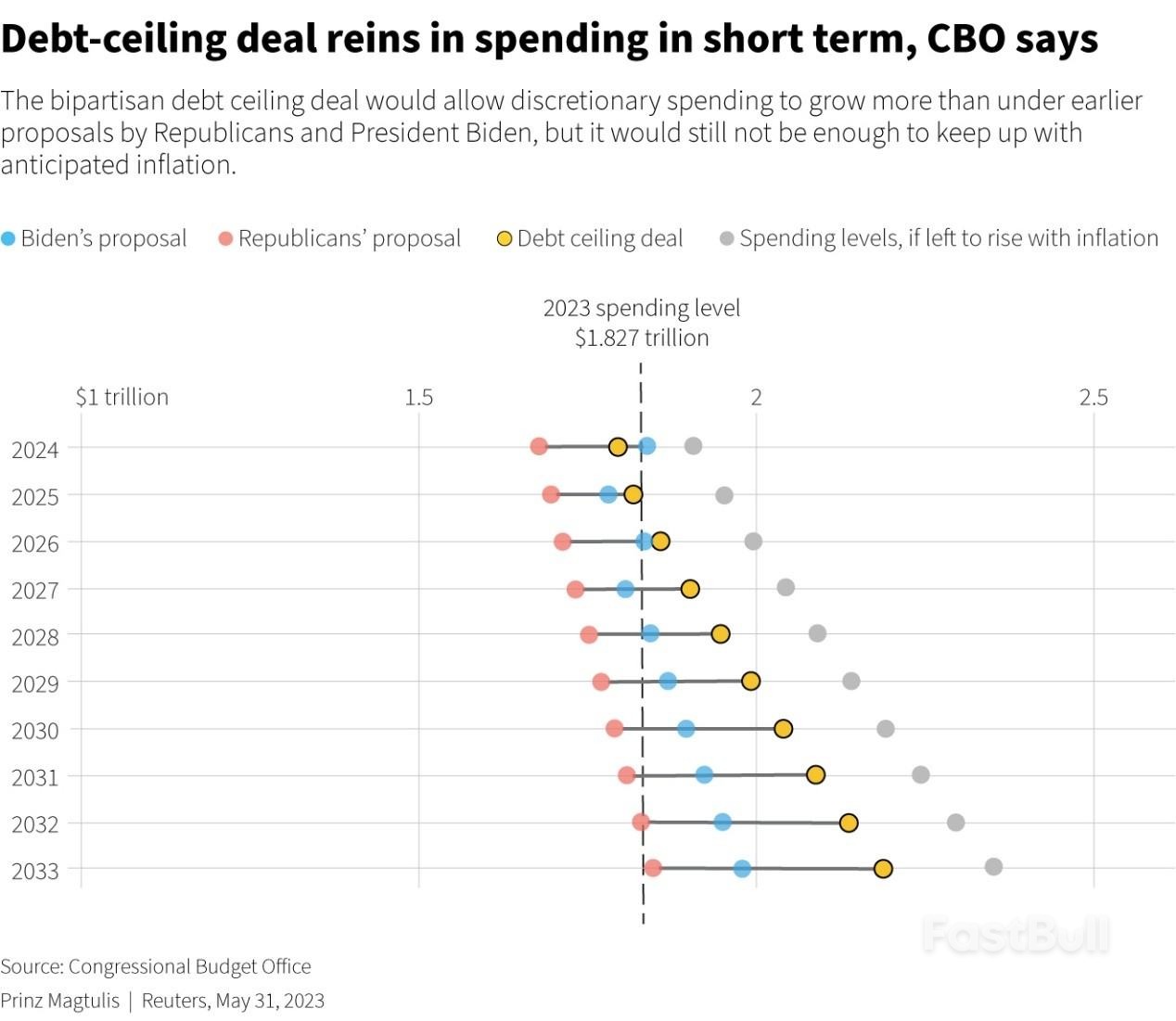
          While a debt ceiling crisis has finally been averted, with the House of Representatives easily passing a deal overnight that lifts the limit until 2025 and the Senate expected to do likewise by Friday, there was much less clarity on the state of U.S. employment or soundings on factory activity.
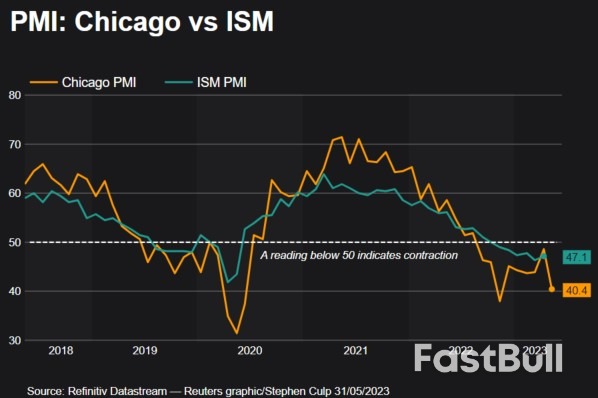
          Private sector and full national snapshots of payroll growth for May are due later today and on Friday. But a renewed rise in U.S. staff vacancies in April showed the labor market tightening again if anything - even a Chicago manufacturing survey alarmed with a sharp contraction in factory activity last month.
          To add to the confusion from overseas, an official readout on deteriorating Chinese manufacturing in May was contradicted by an equivalent private-sector survey released on Thursday.
          Yet, seemingly wary of still above-target inflation getting entrenched in wage settlements, the Fed's interest rate deliberations will likely focus mostly on the rude health of employment and record low joblessness.
          The central bank's "Beige Book" on economic conditions said on Wednesday that the labor market "continued to be strong" in May "with contacts reporting difficulty finding workers across a wide range of skill levels and industries."
          But while Fed hawks have succeeded in convincing financial markets more rate rises are still to come, Fed Governor and vice chair nominee Philip Jefferson held out the prospect that we may not get that additional move this month.
          The upshot is a hesitant market, with futures now seeing a 65% chance of another quarter point hike on June 14 - even if a move is almost fully priced by the end of July.
          Major investors tend to agree - with more and more doubting a significant recession is in fact on the way.
          BlackRock boss Larry Fink said on Wednesday inflation remained sticky and the Fed may need to do more.
          "The economy is more resilient than the market realizes," he said. "I don't see evidence that we're going to have a hard landing."
          U.S. Treasury yields crept back up on Thursday after the debt ceiling vote overnight and despite the mixed economic picture. But Wall Street futures and European stock markets were higher ahead of the U.S. open.
          The dollar was mostly steady, although it set a new high for the year against China's yuan.
          Elsewhere, chair of the G20's Financial Stability Board Klaas Knot said bank regulations and how their liquidity buffers are calculated should be reviewed following recent turmoil in the sector.
          In company news, shares in Salesforce fell 5% overnight after the San Francisco based firm posted its slowest pace of growth in 13 years as companies dialed back spending on cloud-based software offerings in an uncertain economy.
          Events to watch for later on Thursday:
          * U.S. May ADP private sector jobs report, weekly jobless claims, U.S. May S&PGlobal manufacturing business surveys, revised Q1 productivity and unit labor costs
          * European Central Bank meeting minutes
          * Philadelphia Federal Reserve President Patrick Harker speaks
          * U.S. corporate earnings: Broadcom, Dollar General, Hormel Foods, Cooper Companies, Zscaler, LululemonHot, Cold and Skipping a Beat_1Hot, Cold and Skipping a Beat_2Hot, Cold and Skipping a Beat_3

          Hot, Cold and Skipping a Beat_4Source: Yahoo

          To stay updated on all economic events of today, please check out our Economic calendar
          Risk Warnings and Disclaimers
          You understand and acknowledge that there is a high degree of risk involved in trading. Following any strategies or investment methods may lead to potential losses. The content on the site is provided by our contributors and analysts for information purposes only. You are solely responsible for determining whether any trading assets, securities, strategy, or any other product is suitable for investing based on your own investment objectives and financial situation.
          Comments
          Add to Favorites
          Share

          Investors Seek to Break Through Japan Inc's 'Value Trap'

          Thomas

          Stocks

          Economic

          Corporate governance in Japan has suddenly become a cause celebre, rousing the world's third-largest stock market out of decades of lethargy and drawing in hordes of foreign investors.
          Japan's stock market has long been seen by investors as a 'value trap' where companies focus on market share, hoard cash and care little about shareholder returns.
          While there has long been talk of change, 2023 has seen some real evidence of a shift. One such example was when the board of 75-year old elevator maker Fujitec Co Ltd ousted its chairman last month, handing a huge victory to activist investors.
          The Tokyo Stock Exchange (TSE) is forcing reform, too, urging companies with underperforming stocks to demonstrate a better use of capital.
          What has prompted investors globally to sit up and take notice is an endorsement from legendary billionaire investor Warren Buffett. Buffett's firm Berkshire Hathaway Inc increased its stake in Japan's five largest trading houses and said he may invest more in the country.
          "The worm has clearly turned in Japan," said Simon Edelsten, manager of UK-based Artemis's global select strategy fund. "For the Tokyo Stock Exchange to say that all companies that trade below book are going to have to do something about it is a massive change, a big step up."
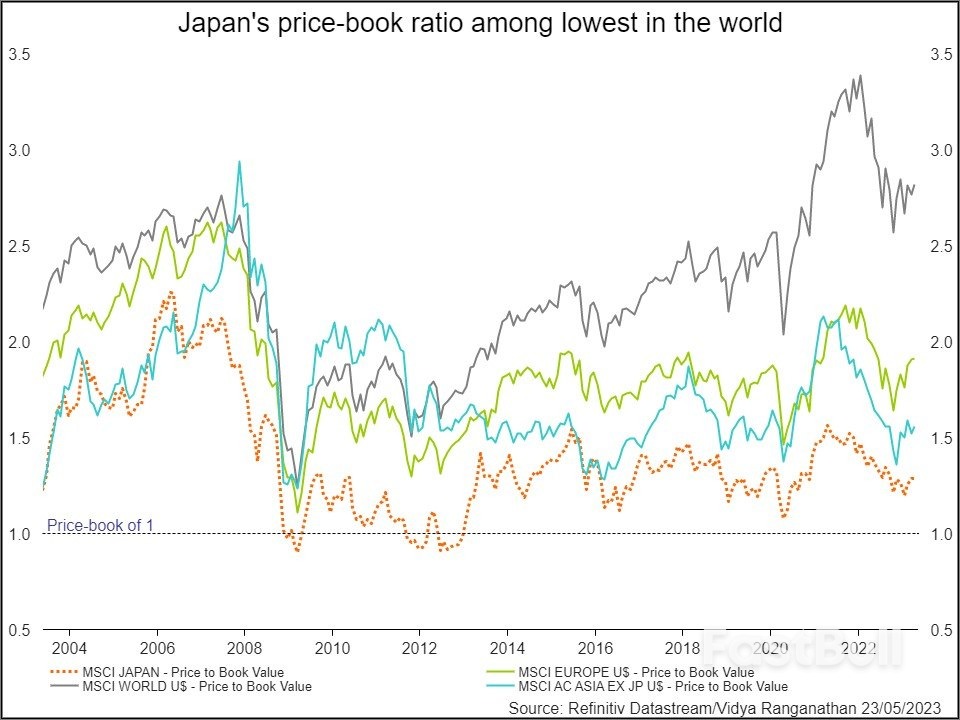
          The Nikkei Average, whose top companies include multinationals Fast Retailing and Sony Group, has persistently been undervalued, trading at close to book value, which is the value of a firm's assets.
          Investors Seek to Break Through Japan Inc's 'Value Trap'_1A TSE analysis showed about half of the 1,800 companies on the exchange's prime section were trading below their book value in January, meaning the market is under-pricing the shares.
          Investors say the push for better corporate governance has led companies to be more open to ideas to boost returns and stock prices. Buybacks for shares in the fiscal year ending in March hit a 16-year peak, according to calculations by Nikkei newspaper.
          "Instead of discussing whether there should be a buyback, it’s a discussion of how big should the buyback be, often," said Jamie Halse, who manages an A$490 million Japan-focused fund at Platinum Asset Management in Sydney.
          "Instead of a discussion about whether they need a woman on the board, it’s why don’t they have more women on the board," he said. "It’s definitely progressed. It’s been accelerating over the last five years and particularly for the last three."
          Hisashi Arakawa, deputy head of Japanese equities for abrdn, said the management teams are more aware of capital efficiency and capital allocation. "We believe that they are increasingly willing to hear to investor views like us."
          Investors Seek to Break Through Japan Inc's 'Value Trap'_2Flocking To Japan
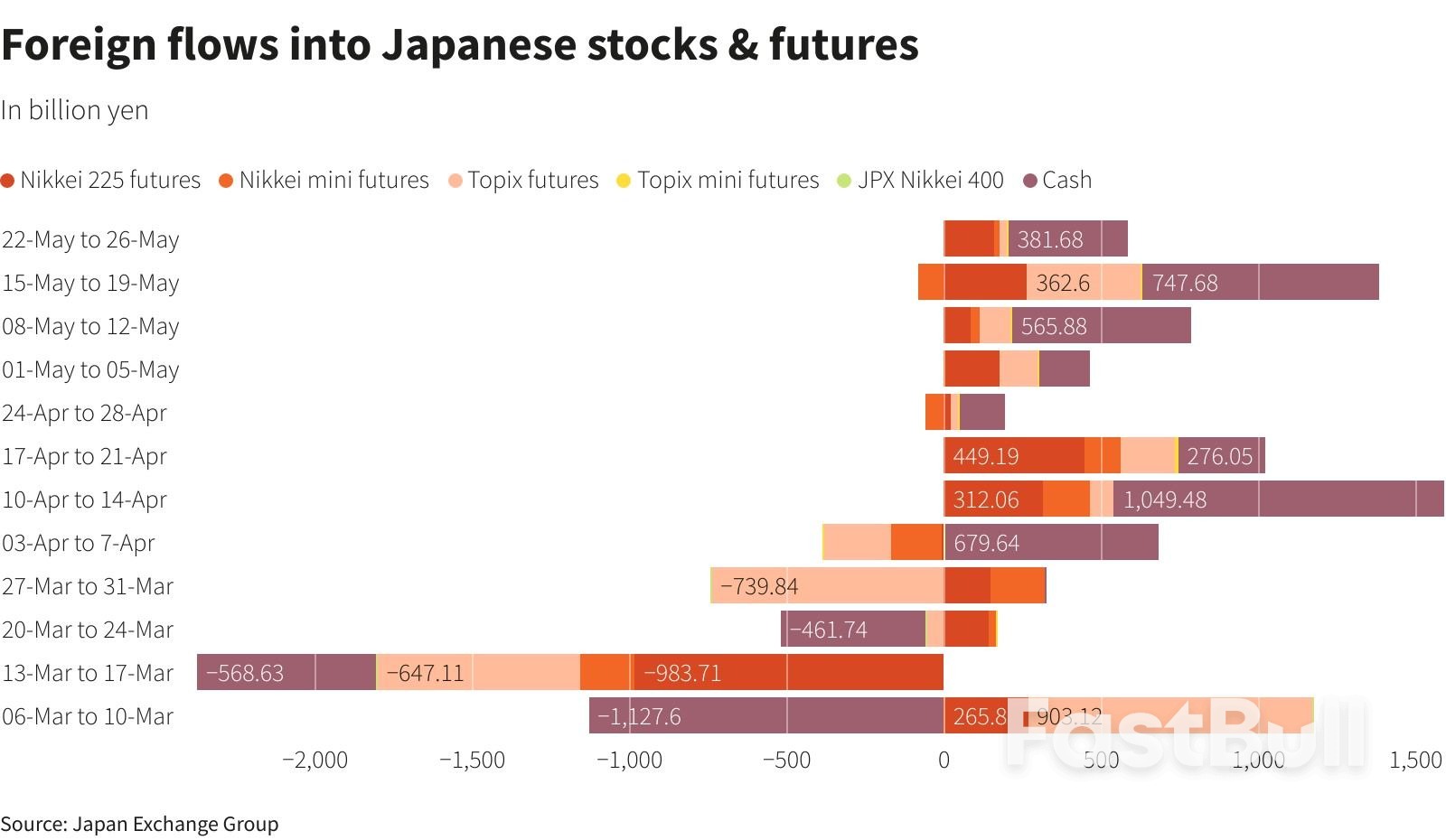
          Foreign investors have also noted the change. Foreign investors purchased about 1.59 trillion yen ($11.82 billion) worth of Japanese shares last week, their biggest buying since at least 2018. The iShares MSCI Japan ETF, is up 8% in 2023 and saw inflows of $346 million in the week of April 5, its biggest weekly inflow in 18 months.
          Artemis' Edelsten said he had been buying first-tier Japanese banks since the summer of 2022 and in the last quarter had built positions in two firms: printer Toppan Inc and machine maker Toyota Industries.
          Investors Seek to Break Through Japan Inc's 'Value Trap'_3To be sure, not everyone is convinced. Steve Holt, head of international equity sales at investment bank RW Baird, said his clients were still wary of investing in Japan.
          "Clients aren’t doing trips out there to discover huge value stories because they tried that for decades, it has been cheap for decades and cheap doesn't mean anything."
          Still, those seeking to play undervalued stocks, i.e. the value proposition, have been rewarded. The MSCI Japan Value index is up 9% since August 2020 versus a 9% drop for the MSCI Japan growth index.
          Seth Fischer, founder of Hong Kong-based Oasis Management whose activism led Fujitec to replace incumbent directors with ones nominated by the fund and then oust Fujitec's chairman, says shareholder votes are no longer overwhelmingly in favor of management, as was always the case in Japan.
          Shares of the company has risen 17% since the board ousted its chairman in March and hit all-time peak of 3,570 yen on Wednesday.
          "You have management that is put under pressure and pushed and pulled towards improving value," said Fischer, who has invested in Japan for 28 years.
          "I think the value trap that was Japan is no longer."

          Source: Yahoo

          To stay updated on all economic events of today, please check out our Economic calendar
          Risk Warnings and Disclaimers
          You understand and acknowledge that there is a high degree of risk involved in trading. Following any strategies or investment methods may lead to potential losses. The content on the site is provided by our contributors and analysts for information purposes only. You are solely responsible for determining whether any trading assets, securities, strategy, or any other product is suitable for investing based on your own investment objectives and financial situation.
          Comments
          Add to Favorites
          Share

          Major Central Banks Renew Rate Hike Push in May

          Cohen

          Central Bank

          The pace of interest rate hikes across major central banks showed little sign of slowing in May but the scale of the tightening tapered off, with growth woes and "sticky" inflation data prompting policymakers to tread more cautiously.
          All six of the central banks overseeing one of the 10 most heavily traded currencies and that met in May hiked rates. Central banks in Australia, New Zealand and Norway joined the European Central Bank, the Bank of England and the Federal Reserve in lifting benchmark rates last month by 25 basis points each, for a cumulative 150 bps.
          That compares with two hikes across five meetings at G10 central banks in April. At the height of the tightening cycle in September last year, eight central banks hiked rates by a cumulative 550 bps.
          "Inflation has proven sticky, even as growth weakens," said Jean Boivin, head of the BlackRock Investment Institute in a note to clients on Tuesday.
          "Markets are reassessing policy rate expectations as sticky inflation makes clear central banks won’t cut them this year – or will keep hiking."
          Year-to-date, G10 central banks have delivered 21 rate hikes and tightened by a total of 725 bps. That compares with 54 rate hikes in the whole of 2022 and 2,700 bps of rate hikes.
          Major Central Banks Renew Rate Hike Push in May_1Meanwhile, emerging markets were slightly further advance in the cycle with some central banks changing tack to easing mode.
          Fifteen out of 18 central banks in the Reuters sample of developing economies met to decide on rate moves, but only policymakers in Israel, South Africa, Thailand and Malaysia hiked, and by a cumulative 125 bps.
          That compares with 11 meetings in April, where two central banks delivered a total of 50 bps.
          Hungary became the first European nation to loosen policy, cutting its emergency one-day deposit rate which it had launched in October to shore up its falling currency, by 100 basis points to 17% in May. The one-day deposit rate is not reflected in the Reuters sample.
          However, the trajectory ahead might not be a smooth one.
          "March and April data confirm that emerging markets have broadly passed their inflation peaks, given decreasing energy prices and strong base effects," said S&P Global Ratings in a recent report.
          But food inflation had remained stickier than expected, S&P added. Data published in May showed the UN world food price index had risen in April for the first time in a year.
          "We currently expect EMs to reach their respective central bank targets (for inflation) by the end of 2024," S&P added.

          Major Central Banks Renew Rate Hike Push in May_2Source: Moneycontorl

          Risk Warnings and Disclaimers
          You understand and acknowledge that there is a high degree of risk involved in trading. Following any strategies or investment methods may lead to potential losses. The content on the site is provided by our contributors and analysts for information purposes only. You are solely responsible for determining whether any trading assets, securities, strategy, or any other product is suitable for investing based on your own investment objectives and financial situation.
          Comments
          Add to Favorites
          Share

          Fed to Hop?

          Alex
          The U.S. dollar gained, and the euro fell yesterday, after data from the Eurozone countries showed a faster-than-expected easing in inflation, while the job openings data from the U.S. hinted, yet again, at further resilience in the U.S. jobs market.
          Falling EZ inflation
          Inflation in France fell from 6.9% to 6% in May, versus 6.4% expected by analysts. That was a nice beat. The French producer price inflation fell more than 5% over the same month, mostly thanks to the falling energy prices. Inflation in Germany fell from 7.6% to 6.3%, defying an uptick to 7.8% expected by analysts. Inflation in Italy eased as well, though not as much as analysts expected. The Eurozone's aggregate inflation data is due this morning, with a chance of beating analysts' expectations to the downside, maybe below 7%. This would be good news for softening the ECB rate hike expectations, but 7% is still more than twice the ECB's policy target of 2% and will certainly not derail the ECB from its trajectory of at least two more rate hikes, if not three.
          Fed to hop?
          Across the Atlantic Ocean, the JOLTS data came in to support the Federal Reserve (Fed) hawks, yesterday. The U.S. job opening made an unexpected U-turn in April and stepped back above the 10 million mark. Today, the ADP report is expected to reveal around 170K new private job additions in the U.S. in May. But the negative surprises on the ADP front barely led to negative surprises in NFP print over the past months. Therefore, the chances are that we will continue seeing the Fed hawks fly low before Friday's jobs data.
          As a result of softer European inflation and stronger U.S. job openings data, the EUR/USD fell as low as 1.0635 yesterday, and the yield spread between the German and U.S. 10-year bonds fell to the lowest levels since the end of February. The downside pressure in the EUR/USD could extend to 1.05 mark, which is the major 38.2% Fibonacci retracement on September to April rebound, without damaging the positive trend building since September. But, for the 1.05 to serve as a defense to the bullish trend, we need a stronger signal that the Fed would pause hiking the rates.
          And this is not the case for now. Even though, the Fed funds futures are back pricing in the possibility of no rate hike in June as the base case scenario, noises from the Fed members hint that a pause to rate hikes in June wouldn't necessarily mean that there won't be another 25bp increase by the end of July.
          Profit taking
          The U.S. House cleared the debt limit bill despite critics both sides. With the bill now headed to the Senate, it's almost certain that it will get approved before the June 5th deadline.
          One would've expected a relief rally on the back of the news that the debt ceiling crisis is almost over, but the stock markets gave a muted reaction. The more than 5.5% slump in Nvidia shares outweighed the debt ceiling optimism.
          As a result, the S&P500 closed 0.60% lower and Nasdaq 100 fell 0.70% as a sign that we will probably see profit taking after the massive AI-triggered tech rally, and after the debt ceiling is raised.
          Equity traders will shift their focus back to more hawkish Fed expectations and rising yields, while the Treasury will suck liquidity back to refill its General Account that has almost emptied with the extended debt ceiling crisis.
          The U.S. 2-year yield is up this morning after a two-session fall, while the 2-10-year portion remains severely inverted keeping recession odds well alive. Today, the ISM manufacturing data is expected to confirm further contraction in activity in May.
          Caixin optimism
          In China, the Caixin manufacturing index printed a number above 50 for May, in the expansion zone, in contradiction with the official PMI which unexpected showed a faster contraction the same month earlier this week. The latter may have helped halting bleeding in crude oil, which lost more than 2.50% yesterday, and more than 10% since the May 24 peak, when the Saudi Prince Bin Salman had warned sellers that it would ouch at the next OPEC meeting.
          The barrel of U.S. crude tipped a toe below $67pb yesterday, and trades a touch above the $68pb this morning, with sellers showing their teeth to Saudi Prince and his warnings. The dynamics in oil prices gives a solid indication that any OPEC-led rally will serve as opportunity to sell a top.
          Zooming into the Chinese stocks, today's better-than-expected Caixin data gave a little boost to Hang Seng index, which tracks a number of mainland stocks, but the index fell 20% since the beginning of this year, and is at the door of the bear market, whereas the U.S. and European stocks were well bid since the start of this week.
          European stocks sputter
          The European stocks fell off the race in the second half of May, at about the same time the euro peaked against the U.S. dollar.
          The Stoxx 600 index follows the EUR/USD very closely, hinting that a further weakness in the EUR/USD should continue weighing on European stocks. The soft rebound in Chinese economy, and rising recession odds in the U.S. weigh on European luxury goods makers, which have been carrying the rally on their shoulders since last year. Hermes, which doubled its share price in about a year gives toppish signs near the 2000 mark, while LVMH is testing the minor 23.6% Fibonacci support on the past year's rally. The current levels look good for further correction in European luxury stocks.

          Source: Swissquote Bank

          Risk Warnings and Disclaimers
          You understand and acknowledge that there is a high degree of risk involved in trading. Following any strategies or investment methods may lead to potential losses. The content on the site is provided by our contributors and analysts for information purposes only. You are solely responsible for determining whether any trading assets, securities, strategy, or any other product is suitable for investing based on your own investment objectives and financial situation.
          Comments
          Add to Favorites
          Share
          FastBull
          Copyright © 2025 FastBull Ltd

          728 RM B 7/F GEE LOK IND BLDG NO 34 HUNG TO RD KWUN TONG KLN HONG KONG

          TelegramInstagramTwitterfacebooklinkedin
          App Store Google Play Google Play
          Products
          Charts

          Chats

          Q&A with Experts
          Screeners
          Economic Calendar
          Data
          Tools
          Membership
          Features
          Function
          Markets
          Copy Trading
          Latest Signals
          Contests
          News
          Analysis
          24/7
          Columns
          Education
          Company
          Careers
          About Us
          Contact Us
          Advertising
          Help Center
          Feedback
          User Agreement
          Privacy Policy
          Business

          White Label

          Data API

          Web Plug-ins

          Poster Maker

          Affiliate Program

          Risk Disclosure

          The risk of loss in trading financial instruments such as stocks, FX, commodities, futures, bonds, ETFs and crypto can be substantial. You may sustain a total loss of the funds that you deposit with your broker. Therefore, you should carefully consider whether such trading is suitable for you in light of your circumstances and financial resources.

          No decision to invest should be made without thoroughly conducting due diligence by yourself or consulting with your financial advisors. Our web content might not suit you since we don't know your financial conditions and investment needs. Our financial information might have latency or contain inaccuracy, so you should be fully responsible for any of your trading and investment decisions. The company will not be responsible for your capital loss.

          Without getting permission from the website, you are not allowed to copy the website's graphics, texts, or trademarks. Intellectual property rights in the content or data incorporated into this website belong to its providers and exchange merchants.

          Not Logged In

          Log in to access more features

          FastBull Membership

          Not yet

          Purchase

          Become a signal provider
          Help Center
          Customer Service
          Dark Mode
          Price Up/Down Colors

          Log In

          Sign Up

          Position
          Layout
          Fullscreen
          Default to Chart
          The chart page opens by default when you visit fastbull.com