


Markets
News
Analysis
User
24/7
Economic Calendar
Education
Data
- Names
- Latest
- Prev


Korea's high level of household debt has been regarded as a major risk factor for the economy for some time.
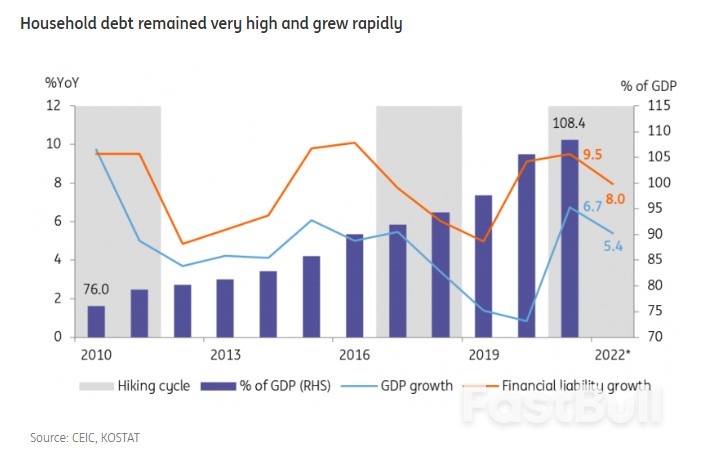 Historical data shows that debt growth tends to decelerate during policy rate hikes and the latest data confirms that this negative correlation holds in the current hike cycle. We expect the negative correlation to strengthen even more in the coming months due to the faster pace of rate hikes this year compared to past hiking cycles.
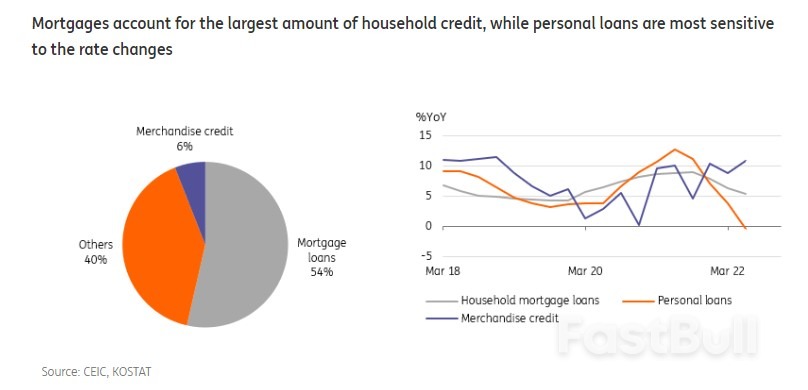 Mortgage loans account for more than half of total household credit
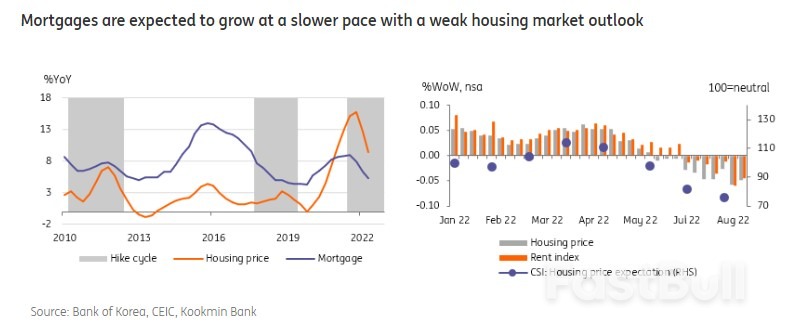
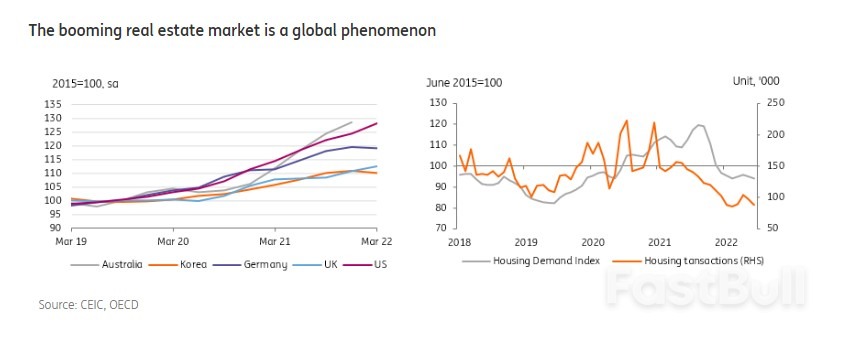 To curb sharp rises in house prices, the government has tightened terms for mortgage loans more stringently since 2020. For home purchases, the loan-to-value (LTV) ratio in speculative overheated districts (basically, the entire area of Seoul) was lowered from 80% to 60%, and then again to 20-40%, and loans for a house value of KRW 1.5bn or more were not available at all. Eventually, with these stringent lending conditions at work, the growth of mortgage loans began to decelerate from last year, and this year the slowdown has been accelerating due to rapid rate hikes and growing concerns over valuations. As forward-looking data points to further price corrections, along with the continuing high-interest environment, mortgage loans will grow at a slower pace in our view.
 Personal loans: the riskiest segment of household debt
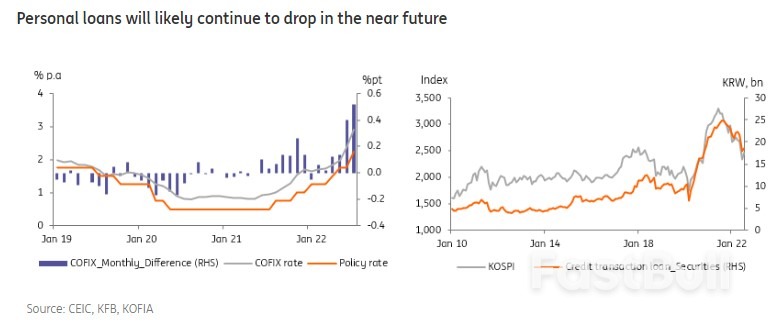 The latest data support our view
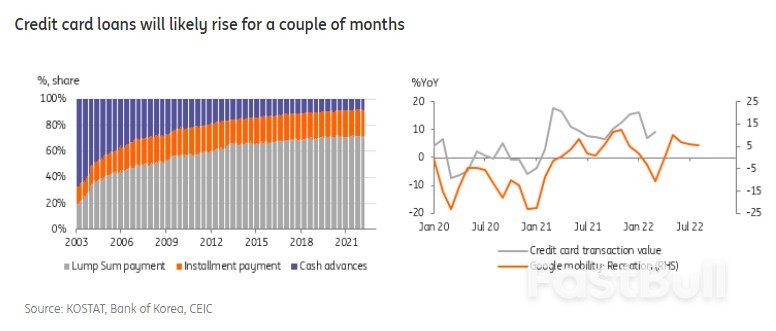 We expect credit card loans to increase in the near term as key leading indicators of household consumption, such as Google Mobility and Oxford's Stringency Index, continue to improve. Although the high inflation rate, tightening monetary environment, and weak asset market will eventually put a burden on household consumption from the next quarter, we believe private consumption will remain relatively solid in the current quarter thanks to the strong jobs market and various government stimulus packages. In particular, healthy service consumption is expected to continue to benefit from the reopening effect for the time being.
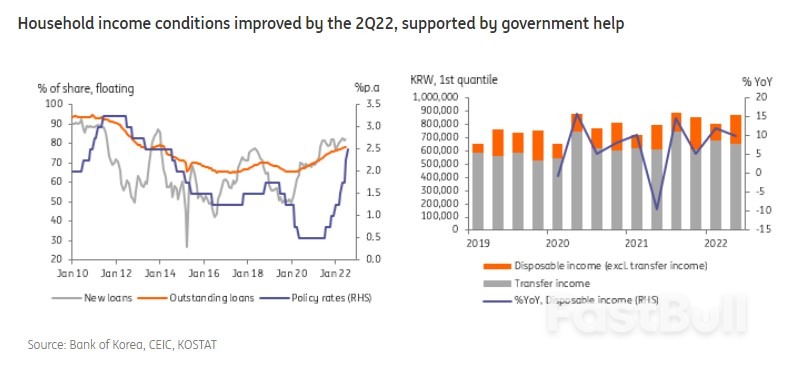
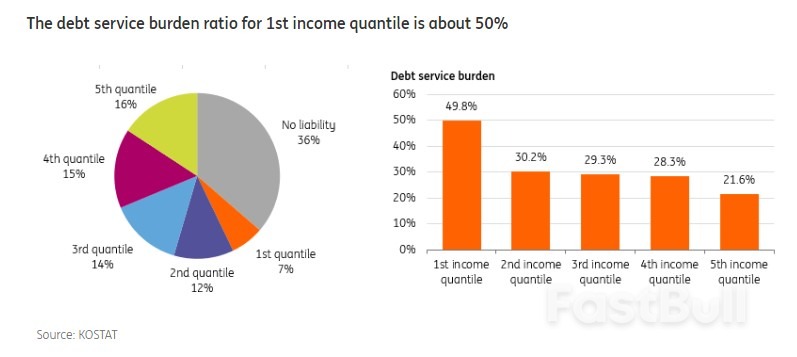 For personal loans, the poor performance of asset markets could be a major risk factor due to the positive correlation between personal loan demand and asset market performance. New demand for leveraged investments will decrease, but it may be difficult to repay existing loans during a period of falling asset prices. But, we believe the bank's stringent Debt-to-Service Ratio (DSR) standards will likely manage potential risks, to some degree. Unemployment and income conditions are the main two factors of loan delinquency and losses but these two factors remain healthy, thus the possibility of default is quite low. The unemployment rate for August stayed at 2.9% and is expected to remain below 3.5% by the end of this year. Real disposable income rose 8.3% YoY in 2Q22. Wage/salary and property incomes declined but transfer and business incomes increased sharply. We think wage/salary incomes will likely rise in the second half of this year as the majority of companies have not finished their annual wage negotiations with labour unions while the reopening will continue to support business income.
  For mortgages, in theory, unless house prices plummet by more than 20%, the possibility of bad loans is still low because the financial authorities previously capped the LTV limit to 80% and recently lowered it to 20-40%. Home prices fell about 13% during the 1998 crisis but recovered quickly during the following expansion period. We don't expect a nationwide sharp depreciation of house prices in the near future, but as the number of unsold properties outside the Seoul Metropolitan area is increasing, the price adjustment is expected to be steeper in small and medium-sized cities than in Seoul. Falling real estate prices will reduce the wealth effect, limiting household consumption activity. For the Jeonse deposit, as the Korea Housing Finance Corporation and other credit guarantee funds guarantee up to 80% of the Jeonse loan, the direct risk exposure for commercial banks is limited. But, for those who do not purchase Jeonse guarantee insurance, the sudden drop in the Jeonse price may be a risk factor.
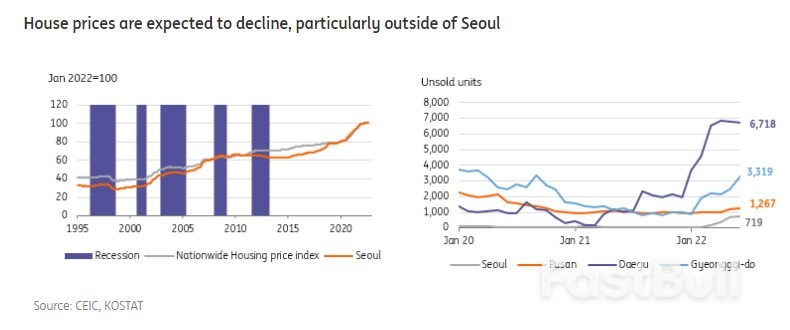 Although the current government has eased some loan terms for first-time buyers and personal loans from the beginning of the third quarter of 2022, it is unlikely that there will be immediate loan demand due to the fairly limited eligible groups and unfavourable market conditions for homebuyers.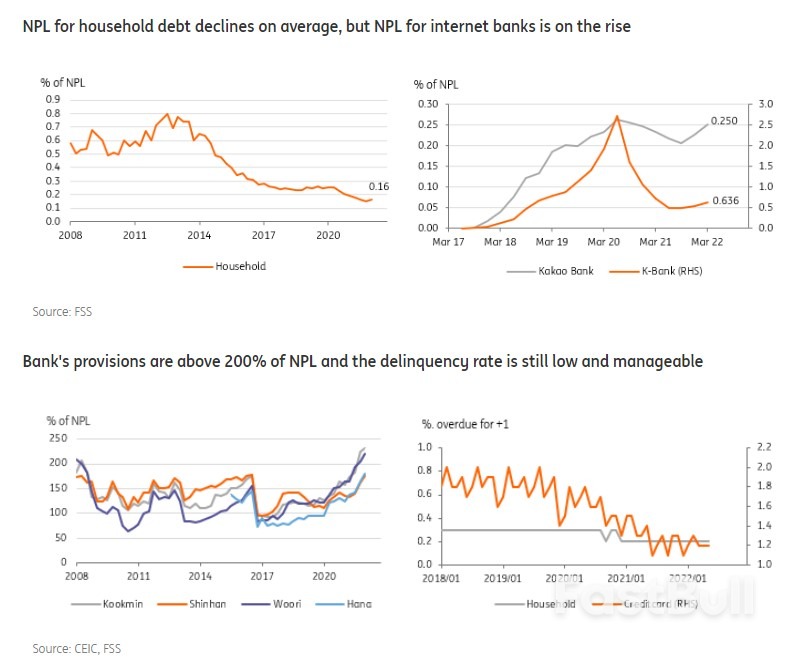

728 RM B 7/F GEE LOK IND BLDG NO 34 HUNG TO RD KWUN TONG KLN HONG KONG


The risk of loss in trading financial instruments such as stocks, FX, commodities, futures, bonds, ETFs and crypto can be substantial. You may sustain a total loss of the funds that you deposit with your broker. Therefore, you should carefully consider whether such trading is suitable for you in light of your circumstances and financial resources.
No decision to invest should be made without thoroughly conducting due diligence by yourself or consulting with your financial advisors. Our web content might not suit you since we don't know your financial conditions and investment needs. Our financial information might have latency or contain inaccuracy, so you should be fully responsible for any of your trading and investment decisions. The company will not be responsible for your capital loss.
Without getting permission from the website, you are not allowed to copy the website's graphics, texts, or trademarks. Intellectual property rights in the content or data incorporated into this website belong to its providers and exchange merchants.
Not Logged In
Log in to access more features

FastBull Membership
Not yet
Purchase


Log In
Sign Up


 Downside risks for EUR…
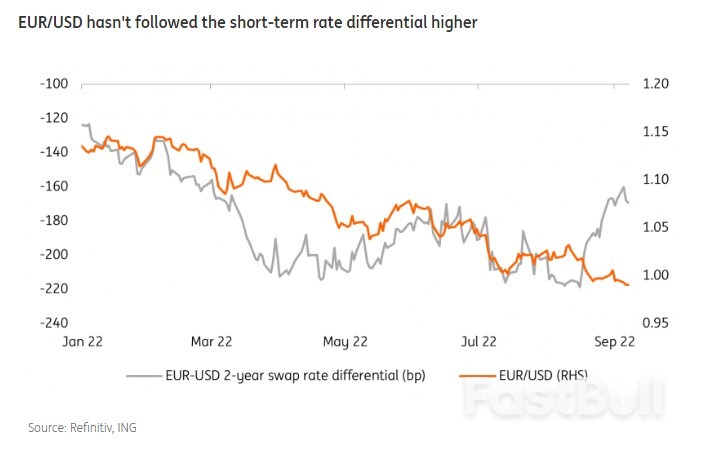 In our EUR/USD short-term fair value model, the short-term rate differential now has a smaller beta than relative equity performance, which is a gauge of diverging growth expectations and is more directly impacted by the energy crisis. This also means that the short-term undervaluation in EUR/USD has shrunk to around 3-4% from the 5-6% peak seen two weeks ago.

