• Trade
  • Markets
  • Copy
  • Contests
  • News
  • 24/7
  • Calendar
  • Q&A
  • Chats
Trending
Screeners
SYMBOL
LAST
BID
ASK
HIGH
LOW
NET CHG.
%CHG.
SPREAD
SPX
S&P 500 Index
6827.42
6827.42
6827.42
6899.86
6801.80
-73.58
-1.07%
--
DJI
Dow Jones Industrial Average
48458.04
48458.04
48458.04
48886.86
48334.10
-245.98
-0.51%
--
IXIC
NASDAQ Composite Index
23195.16
23195.16
23195.16
23554.89
23094.51
-398.69
-1.69%
--
USDX
US Dollar Index
97.950
98.030
97.950
98.500
97.950
-0.370
-0.38%
--
EURUSD
Euro / US Dollar
1.17394
1.17409
1.17394
1.17496
1.17192
+0.00011
+ 0.01%
--
GBPUSD
Pound Sterling / US Dollar
1.33707
1.33732
1.33707
1.33997
1.33419
-0.00148
-0.11%
--
XAUUSD
Gold / US Dollar
4299.39
4299.39
4299.39
4353.41
4257.10
+20.10
+ 0.47%
--
WTI
Light Sweet Crude Oil
57.233
57.485
57.233
58.011
56.969
-0.408
-0.71%
--

Community Accounts

Signal Accounts
--
Profit Accounts
--
Loss Accounts
--
View More

Become a signal provider

Sell trading signals to earn additional income

View More

Guide to Copy Trading

Get started with ease and confidence

View More

Signal Accounts for Members

All Signal Accounts

Best Return
  • Best Return
  • Best P/L
  • Best MDD
Past 1W
  • Past 1W
  • Past 1M
  • Past 1Y

All Contests

  • All
  • Trump Updates
  • Recommend
  • Stocks
  • Cryptocurrencies
  • Central Banks
  • Featured News
Top News Only
Share

China's Central Financial And Economic Affairs Commission Deputy Director: Will Expand Export And Increase Import In 2026

Share

Thai Leader Anutin: Landmine Blast That Killed Thai Soldiers 'Not A Roadside Accident'

Share

Thai Leader Anutin: Thailand To Continue Military Action Until 'We Feel No More Harm'

Share

Cambodian Prime Minister Hun Manet Says He Had Phone Calls With Trump And Malaysian Leader Anwar About Ceasefire

Share

Cambodia's Hun Manet Says USA, Malaysia Should Verify 'Which Side Fired First' In Latest Conflict

Share

Cambodia's Hun Manet: Cambodia Maintains Its Stance In Seeking Peaceful Resolution Of Disputes

Share

Nasdaq Companies: Allergan, Ferrovia, Insmed, Monolithic Power Systems, Seagate Technology, And Western Digital Will Be Added To The NASDAQ 100 Index. Biogen, CdW, GlobalFoundries, Lululemon, ON Semiconductor, And Tradedesk Will Be Removed From The NASDAQ 100 Index

Share

Witkoff Headed To Berlin This Weekend To Meet With Zelenskiy, European Leaders -Wsj Reporter On X

Share

Russia Attacks Two Ukrainian Ports, Damaging Three Turkish-Owned Vessels

Share

[Historic Flooding Occurs In At Least Four Rivers In Washington State Due To Days Of Torrential Rains] Multiple Areas In Washington State Have Been Hit By Severe Flooding Due To Days Of Torrential Rains, With At Least Four Rivers Experiencing Historic Flooding. Reporters Learned On The 12th That The Floods Caused By The Torrential Rains In Washington State Have Destroyed Homes And Closed Several Highways. Experts Warn That Even More Severe Flooding May Occur In The Future. A State Of Emergency Has Been Declared In Washington State

Share

Trump Says Proposed Free Economic Zone In Donbas Would Work

Share

Trump: I Think My Voice Should Be Heard

Share

Trump Says Will Be Choosing New Fed Chair In Near Future

Share

Trump Says Proposed Free Economic Zone In Donbas Complex But Would Work

Share

Trump Says Land Strikes In Venezuela Will Start Happening

Share

US President Trump: Thailand And Cambodia Are In A Good Situation

Share

State Media: North Korean Leader Kim Hails Troops Returning From Russia Mission

Share

The 10-year Treasury Yield Rose About 5 Basis Points During The "Fed Rate Cut Week," And The 2/10-year Yield Spread Widened By About 9 Basis Points. On Friday (December 12), In Late New York Trading, The Yield On The Benchmark 10-year US Treasury Note Rose 2.75 Basis Points To 4.1841%, A Cumulative Increase Of 4.90 Basis Points For The Week, Trading Within A Range Of 4.1002%-4.2074%. It Rose Steadily From Monday To Wednesday (before The Fed Announced Its Rate Cut And Treasury Bill Purchase Program), Subsequently Exhibiting A V-shaped Recovery. The 2-year Treasury Yield Fell 1.82 Basis Points To 3.5222%, A Cumulative Decrease Of 3.81 Basis Points For The Week, Trading Within A Range Of 3.6253%-3.4989%

Share

Trump: Lots Of Progress Being Made On Russia-Ukraine

Share

NOPA November US Soybean Crush Estimated At 220.285 Million Bushels

TIME
ACT
FCST
PREV
U.K. Trade Balance Non-EU (SA) (Oct)

A:--

F: --

P: --

U.K. Trade Balance (Oct)

A:--

F: --

P: --

U.K. Services Index MoM

A:--

F: --

P: --

U.K. Construction Output MoM (SA) (Oct)

A:--

F: --

P: --

U.K. Industrial Output YoY (Oct)

A:--

F: --

P: --

U.K. Trade Balance (SA) (Oct)

A:--

F: --

P: --

U.K. Trade Balance EU (SA) (Oct)

A:--

F: --

P: --

U.K. Manufacturing Output YoY (Oct)

A:--

F: --

P: --

U.K. GDP MoM (Oct)

A:--

F: --

P: --

U.K. GDP YoY (SA) (Oct)

A:--

F: --

P: --

U.K. Industrial Output MoM (Oct)

A:--

F: --

P: --

U.K. Construction Output YoY (Oct)

A:--

F: --

P: --

France HICP Final MoM (Nov)

A:--

F: --

P: --

China, Mainland Outstanding Loans Growth YoY (Nov)

A:--

F: --

P: --

China, Mainland M2 Money Supply YoY (Nov)

A:--

F: --

P: --

China, Mainland M0 Money Supply YoY (Nov)

A:--

F: --

P: --

China, Mainland M1 Money Supply YoY (Nov)

A:--

F: --

P: --

India CPI YoY (Nov)

A:--

F: --

P: --

India Deposit Gowth YoY

A:--

F: --

P: --

Brazil Services Growth YoY (Oct)

A:--

F: --

P: --

Mexico Industrial Output YoY (Oct)

A:--

F: --

P: --

Russia Trade Balance (Oct)

A:--

F: --

P: --

Philadelphia Fed President Henry Paulson delivers a speech
Canada Building Permits MoM (SA) (Oct)

A:--

F: --

P: --

Canada Wholesale Sales YoY (Oct)

A:--

F: --

P: --

Canada Wholesale Inventory MoM (Oct)

A:--

F: --

P: --

Canada Wholesale Inventory YoY (Oct)

A:--

F: --

P: --

Canada Wholesale Sales MoM (SA) (Oct)

A:--

F: --

P: --

Germany Current Account (Not SA) (Oct)

A:--

F: --

P: --

U.S. Weekly Total Rig Count

A:--

F: --

P: --

U.S. Weekly Total Oil Rig Count

A:--

F: --

P: --

Japan Tankan Large Non-Manufacturing Diffusion Index (Q4)

--

F: --

P: --

Japan Tankan Small Manufacturing Outlook Index (Q4)

--

F: --

P: --

Japan Tankan Large Non-Manufacturing Outlook Index (Q4)

--

F: --

P: --

Japan Tankan Large Manufacturing Outlook Index (Q4)

--

F: --

P: --

Japan Tankan Small Manufacturing Diffusion Index (Q4)

--

F: --

P: --

Japan Tankan Large Manufacturing Diffusion Index (Q4)

--

F: --

P: --

Japan Tankan Large-Enterprise Capital Expenditure YoY (Q4)

--

F: --

P: --

U.K. Rightmove House Price Index YoY (Dec)

--

F: --

P: --

China, Mainland Industrial Output YoY (YTD) (Nov)

--

F: --

P: --

China, Mainland Urban Area Unemployment Rate (Nov)

--

F: --

P: --

Saudi Arabia CPI YoY (Nov)

--

F: --

P: --

Euro Zone Industrial Output YoY (Oct)

--

F: --

P: --

Euro Zone Industrial Output MoM (Oct)

--

F: --

P: --

Canada Existing Home Sales MoM (Nov)

--

F: --

P: --

Euro Zone Total Reserve Assets (Nov)

--

F: --

P: --

U.K. Inflation Rate Expectations

--

F: --

P: --

Canada National Economic Confidence Index

--

F: --

P: --

Canada New Housing Starts (Nov)

--

F: --

P: --

U.S. NY Fed Manufacturing Employment Index (Dec)

--

F: --

P: --

U.S. NY Fed Manufacturing Index (Dec)

--

F: --

P: --

Canada Core CPI YoY (Nov)

--

F: --

P: --

Canada Manufacturing Unfilled Orders MoM (Oct)

--

F: --

P: --

Canada Manufacturing New Orders MoM (Oct)

--

F: --

P: --

Canada Core CPI MoM (Nov)

--

F: --

P: --

Canada Manufacturing Inventory MoM (Oct)

--

F: --

P: --

Canada CPI YoY (Nov)

--

F: --

P: --

Canada CPI MoM (Nov)

--

F: --

P: --

Canada CPI YoY (SA) (Nov)

--

F: --

P: --

Canada Core CPI MoM (SA) (Nov)

--

F: --

P: --

Q&A with Experts
    • All
    • Chatrooms
    • Groups
    • Friends
    Connecting
    .
    .
    .
    Type here...
    Add Symbol or Code

      No matching data

      All
      Trump Updates
      Recommend
      Stocks
      Cryptocurrencies
      Central Banks
      Featured News
      • All
      • Russia-Ukraine Conflict
      • Middle East Flashpoint
      • All
      • Russia-Ukraine Conflict
      • Middle East Flashpoint
      Search
      Products

      Charts Free Forever

      Chats Q&A with Experts
      Screeners Economic Calendar Data Tools
      Membership Features
      Data Warehouse Market Trends Institutional Data Policy Rates Macro

      Market Trends

      Market Sentiment Order Book Forex Correlations

      Top Indicators

      Charts Free Forever
      Markets

      News

      News Analysis 24/7 Columns Education
      From Institutions From Analysts
      Topics Columnists

      Latest Views

      Latest Views

      Trending Topics

      Top Columnists

      Latest Update

      Signals

      Copy Rankings Latest Signals Become a signal provider AI Rating
      Contests
      Brokers

      Overview Brokers Assessment Rankings Regulators News Claims
      Broker listing Forex Brokers Comparison Tool Live Spread Comparison Scam
      Q&A Complaint Scam Alert Videos Tips to Detect Scam
      More

      Business
      Events
      Careers About Us Advertising Help Center

      White Label

      Data API

      Web Plug-ins

      Affiliate Program

      Awards Institution Evaluation IB Seminar Salon Event Exhibition
      Vietnam Thailand Singapore Dubai
      Fans Party Investment Sharing Session
      FastBull Summit BrokersView Expo
      Recent Searches
        Top Searches
          Markets
          News
          Analysis
          User
          24/7
          Economic Calendar
          Education
          Data
          • Names
          • Latest
          • Prev

          View All

          No data

          Scan to Download

          Faster Charts, Chat Faster!

          Download App
          English
          • English
          • Español
          • العربية
          • Bahasa Indonesia
          • Bahasa Melayu
          • Tiếng Việt
          • ภาษาไทย
          • Français
          • Italiano
          • Türkçe
          • Русский язык
          • 简中
          • 繁中
          Open Account
          Search
          Products
          Charts Free Forever
          Markets
          News
          Signals

          Copy Rankings Latest Signals Become a signal provider AI Rating
          Contests
          Brokers

          Overview Brokers Assessment Rankings Regulators News Claims
          Broker listing Forex Brokers Comparison Tool Live Spread Comparison Scam
          Q&A Complaint Scam Alert Videos Tips to Detect Scam
          More

          Business
          Events
          Careers About Us Advertising Help Center

          White Label

          Data API

          Web Plug-ins

          Affiliate Program

          Awards Institution Evaluation IB Seminar Salon Event Exhibition
          Vietnam Thailand Singapore Dubai
          Fans Party Investment Sharing Session
          FastBull Summit BrokersView Expo

          [Fed] Mester: As Inflation Is Far from Peaking, Interest Rates Need to Be above 4% Early Next Year

          FastBull Featured

          Remarks of Officials

          Federal Reserve Bank of Cleveland President Loretta Mester delivered a speech at 08:00 a.m. on August 31 ET on "Returning to Price Stability," the main excerpts of which are as follows.

          The Economy

          The key challenge facing our economy is unacceptably high inflation. This inflation stems from many factors, but fundamentally, it reflects an imbalance between strong demand and constrained supply, which has led to significant upward pressures on prices. Price stability is the foundation of a strong economy; it is necessary for ensuring that the U.S. can sustain healthy labor market conditions over the medium and longer run. The Fed has more work to do in order to get inflation under control. This will entail further rate increases to tighten financial conditions, resulting in an economic transition to below-trend growth, slower employment growth, and a higher unemployment rate.
          Indeed, real GDP moved down in the first half of this year. Supply constraints have posed a significant challenge across a variety of sectors. I do not believe the U.S. economy is currently in a recession because the labor market remains very strong. I do acknowledge that the risks of recession over the next year or two have moved up because financial conditions are tightening globally. I expect a fairly sharp slowing in activity, especially when compared to the robust growth the U.S. experienced in 2021.
          With the economy growing below trend, I expect the current very strong labor market conditions to cool. Some cooling off in the labor market will put it on a more sustainable footing. The unemployment rate will rise somewhat above 4 percent by the end of next year. Although the number of job openings has eased in recent months, they remain at historically high levels: there are close to 2 openings per unemployed worker. Wage pressures show little sign of abating. And these wage increases have not kept up with inflation, meaning there's still room for wages to rise. With trend productivity growth estimated to be around 1.25 to 1.5 percent, wage growth will need to moderate to around 3.25 to 3.5 percent to be consistent with price stability.

          Inflation

          It is far too soon to conclude that inflation has peaked. First, measures of the underlying inflation trend did not uniformly decline in July. Second, in the coming months, goods inflation may slow in response to easing demand and the appreciation of the dollar, but the prices of energy and other commodities are set in global markets, and developments related to the ongoing war in Ukraine may lead to higher prices later this year. Third, inflation in the prices of services tends to be more persistent (which is by far the largest and strongest contributor to inflation), especially in the housing market. I expect inflation to move down into a range of 5 to 6 percent for this year.
          Before I conclude that inflation has peaked, I will need to see several months of declines in the month-over-month readings. I will also be carefully watching measures of inflation expectations, particularly expectations of inflation over the medium and longer term.

          Monetary Policy

          Monetary policy cannot affect the supply-side factors. Instead, it works on the demand side of the economy. Given the lagged effects of monetary policy, it would not be appropriate to continue moving rates up.
          Given the current level of inflation and the economic outlook, I anticipate that policy will need to move into a restrictive stance in order to put inflation on a sustained downward trajectory to 2 percent. That means that real interest rates will need to move into positive territory and remain there for some time. Right now, short-term real interest rates are still negative and monetary policy is still accommodative.
          But in the current high-inflation environment, a 2.5 percent nominal funds rate is still accommodative. My current view is that it will be necessary to move the fed funds rate up to somewhat above 4 percent by early next year and hold it there. I do not anticipate the Fed cutting the fed funds rate target next year. It would be a mistake to declare victory over the inflation beast too soon. Doing so would put us back in the stop-and-go monetary policy world of the 1970s.

          Mester's Speech

          Risk Warnings and Disclaimers
          You understand and acknowledge that there is a high degree of risk involved in trading. Following any strategies or investment methods may lead to potential losses. The content on the site is provided by our contributors and analysts for information purposes only. You are solely responsible for determining whether any trading assets, securities, strategy, or any other product is suitable for investing based on your own investment objectives and financial situation.
          Comments
          Add to Favorites
          Share

          China to Publish Detailed Economic Policy Steps in Early September

          Alex
          China said it will publish detailed steps for newly announced economic policy measures in early September, suggesting an urgency for policymakers to revive the sluggish economy amid a resurgence of COVID and an embattled property sector.
          The government will lay out detailed plans to implement the 19 new policies it announced last week to support growth as recent factory activity surveys pointed to a further loss in momentum in the world's second-largest economy in August.
          China will guide commercial banks to provide medium- and long-term loans to key projects and equipment upgrading, state media quoted the cabinet as saying on Wednesday, after a meeting chaired by Premier Li Keqiang.
          To prop up the weak property market, China will also support rigid housing demand, state media reported.
          "Local governments should have 'one policy for one city' to make good use of policy tools" and flexibly use the special loans for home delivery, state media quoted the cabinet meeting as saying.
          The latest steps, which include raising the quota on policy bank financing tools by 300 billion yuan ($43.49 billion), come on top of the 33 measures unveiled in May.
          China's economy narrowly escaped contraction in the June quarter due to widespread COVID-19 lockdowns, and economists say its nascent recovery is in danger of fizzling out amid fresh virus flare-ups and a distressed property sector.
          The cabinet has also sent working groups to major provinces since late August to push forward the implementation of policies.
          "That gives local governments greater autonomy, at the same time asks them to take the responsibility of propping up the property market," said Wen Bin and Wang Jingwen, senior economists at Minsheng Bank, in a note.
          ($1 = 6.8977 Chinese yuan renminbi)

          Source: Reuters

          Risk Warnings and Disclaimers
          You understand and acknowledge that there is a high degree of risk involved in trading. Following any strategies or investment methods may lead to potential losses. The content on the site is provided by our contributors and analysts for information purposes only. You are solely responsible for determining whether any trading assets, securities, strategy, or any other product is suitable for investing based on your own investment objectives and financial situation.
          Comments
          Add to Favorites
          Share

          Asia's Factory Activity Slumps on China's COVID Curbs, U.S. Slowdown

          Owen Li
          Asia's factory activity slumped in August as China's zero COVID curbs and cost pressures continued to hurt businesses, surveys showed on Thursday, darkening the outlook for the region's fragile economic recovery.
          Manufacturing activity was weak in countries ranging from Japan, China, South Korea to Taiwan in a sign sluggish demand was adding to headaches for companies already suffering from lingering supply constraints.
          The U.S. Federal Reserve's resolve to continue aggressive interest rate hikes is also dampening the business mood by stoking fears of recession in one of Asia's biggest export markets, analysts say.
          "China's pandemic curbs and geo-political tensions with the United States continue to disrupt supply chains. Rising inflation is also hurting domestic demand across Asia," said Toru Nishihama, chief economist at Dai-ichi Life Research Institute in Tokyo.
          "Fears of U.S. recession also aren't helping. U.S. and Chinese economies are engines of global growth so when both of them are wobbling, that spells trouble for businesses."
          China's private Caixin/Markit manufacturing purchasing managers' index (PMI) contracted for the first time in three months in August, data showed on Thursday, as soft demand, power shortages and fresh COVID-19 flare-ups disrupting production.
          The unexpectedly weak reading echoed China's official PMI released on Wednesday, which was also below the 50-point mark that separates growth from contraction on a monthly basis.
          Export powerhouses were equally weak. Japan's factory activity grew at its slowest rate in nearly a year in August, while that of South Korea shrank by the sharpest pace in two years, PMIs for both countries showed.
          Manufacturing activity also deteriorated sharply in Taiwan, with production and new orders both falling at the quickest pace since the initial wave of the pandemic in May 2020.
          "The marked deterioration in demand also meant that firms cut back on buying activity and inventories, as more firms anticipate production levels to decline further over the coming year," Annabel Fiddes, economics associate director at S&P Global, said on Taiwan's output outlook.
          The final au Jibun Bank Japan Manufacturing Purchasing Managers' Index (PMI) fell to 51.5 in August from 52.1 in the prior month, marking the weakest growth rate since September 2021.
          South Korea's PMI fell to 47.6 in August from 49.8 in July, remaining below the 50-threshold for a second month and hitting the lowest since July 2020.
          Taiwan's PMI hit 42.7 in August, down from 44.6 in July.
          Weakening demand, however, is having the side-effect of easing price pressures. South Korean manufacturers saw input prices rise in August by the slowest rate in 19 months.
          The average input costs faced by Taiwanese goods producers fell for the first time since May 2020, as prices of some raw material like steel and oil have started to fall.
          Southeast Asia remained a bright spot in the region with manufacturing activity growth in Indonesia, the Philippines and Thailand accelerating, while Malaysia's growth slowed slightly, the PMIs showed.

          Source: Reuters

          Risk Warnings and Disclaimers
          You understand and acknowledge that there is a high degree of risk involved in trading. Following any strategies or investment methods may lead to potential losses. The content on the site is provided by our contributors and analysts for information purposes only. You are solely responsible for determining whether any trading assets, securities, strategy, or any other product is suitable for investing based on your own investment objectives and financial situation.
          Comments
          Add to Favorites
          Share

          Asian Trading Session Attention

          Damon

          Global markets

          U.S. equities continued their slow bleed on Wednesday, the S&P500 dropping another 0.78% and the NASDAQ going 0.56% lower. This wasn't exactly a one-way street, with some periods of strength within the session, but the downtrend was never seriously threatened. Equity futures are poised for more weakness today too, which could set the scene for other asset markets today ahead of tomorrow's payrolls release.
          2Y U.S. Treasury yields added another 5.1bp yesterday, which probably didn't help the tone in equities, and 10Y yields put on another 9bp to reach 3.19%.
          News from the Fed: Loretta Mester is reported as saying that she favours rates above 4% next year and no cut in rates in 2023. That probably helped keep Treasury yields rising across the curve.
          But despite the downbeat market sentiment and rising USD rates EUR/USD managed to rise to 1.004, up from 1.001 this time yesterday. In contrast, the AUD is looking troubled again today following its sell-off yesterday and sits at 0.6835, and looks more likely to keep going down than head back up. Cable too looks in bad shape, dropping to 1.1599 and the JPY is hurtling upwards and at 139.29, the question is, do we hit 140 today?
          Asian FX saw some decent gains from the KRW yesterday, which pulled back to 1338. The INR is also still benefitting from rumours of the inclusion of government securities into global bond indices. Today, the USD looks rampant, however, and it may well be a different story.

          G-7 Macro

          Yesterday's ADP survey was published with a new methodology to make it more accurate (in line with payrolls) and it delivered a weakish looking 132,000 employment gain. It's impossible to tell if this will be reflected in tomorrow's jobs report, but it does seem to suggest that at least a slowdown from 528,000 jobs gain reported in July is on the cards.
          Manufacturing ISM data is the main release from the G-7 today. A slight decrease from last month's 52.8 reading is the median expectation. The prices paid index is also expected to come down a bit more from last month's reading of 60.0.
          There are also PMI releases in Europe and German retail sales to watch out for.

          India

          Indian 2Q22 GDP wasn't quite as punchy as had been expected, though the heavily base-affected release is a little tricky to interpret right now. A 13.5% YoY gain was a bit down on the 15.3% increase that had been expected, but probably still leaves India on track to achieve 7% growth this calendar year.
          Strong investment (+20.1%YoY) and private consumption (25.9%) underpinned the result.
          Though the boost from the re-opening of the economy will probably fade next quarter, and the economy will face stronger headwinds from falling external demand, higher inflation and rising domestic interest rates.
          The fiscal deficit figures for July actually registered a small surplus, which is an improvement on last year's equivalent fiscal balance and should keep India on track to meeting or even beating its 6.4% (GDP) deficit target.

          Australia

          Private capital expenditure released at 0930 SGT provides the first insight into next week's 2Q22 GDP figure. The median forecast is for a 1% gain.
          A further clue comes the day before the release when we get the net trade contribution component. We are tentatively looking for a robust 1% QoQ expansion of activity in 2Q22, which will add to the pressure on the Reserve Bank to keep leaning against inflation.

          Korea

          The trade deficit widened to a record USD -9.4 billion in August, almost double the USD 4.8 billion deficit recorded in July. Exports grew 6.6% YoY in August (vs a revised 9.2% in July and a market consensus of 5.6%).
          As early data suggested, semiconductor exports were quite weak with a -7.8% drop while petroleum/chemical and automobiles led the growth. Meanwhile, imports surged 28.2% YoY in August (vs 21.8% in July and market consensus of 23.7%) due to increases in energy, semiconductors, and chemicals.
          Separately, Korea's manufacturing PMI fell to 47.6 in August from 49.8 in July. This is its lowest reading since July 2020. The output index fell to only 44.6, staying below 50 for the fourth month in a row.
          Combining this weak PMI data with the trade deficit data and yesterday's weaker-than-expected industrial production outcomes, we are revising our growth forecast lower for the second half of the year and now expect a small contraction

          Indonesia

          August inflation is set for release today.
          Both headline and core inflation have been on an uptrend this year with headline inflation now past the central bank's target. Headline inflation will likely settle close to 5%YoY while core inflation should exceed 3%.
          Accelerating inflation and a planned subsidized fuel hike were enough to prod Bank Indonesia to finally hike rates at their last meeting and we believe that BI is not done for the year. Faster inflation, especially after the fuel hike should keep BI on a hiking path.

          Source: ING

          Risk Warnings and Disclaimers
          You understand and acknowledge that there is a high degree of risk involved in trading. Following any strategies or investment methods may lead to potential losses. The content on the site is provided by our contributors and analysts for information purposes only. You are solely responsible for determining whether any trading assets, securities, strategy, or any other product is suitable for investing based on your own investment objectives and financial situation.
          Comments
          Add to Favorites
          Share

          September 1st Financial News

          FastBull Featured

          Daily News

          【Quick Facts】

          1. South Korea's Ministry of Foreign Affairs advises the U.S. side to hold off on canceling the tax credit on Korean-made electric vehicles.
          2. As the energy crisis is severe, the euro area CPI exceeded 9% in August.
          3. The Baltic Dry Index records the biggest monthly decline in more than two years.
          4. The U.K. five-year bond yield rises to its highest level since 2010.
          5. Euro area inflation hits a record high.
          6. Energy prices push German inflation to a record high.

          【News Details】

          South Korea's Ministry of Foreign Affairs advises the U.S. side to hold off on canceling the tax credit on Korean-made electric vehicles
          South Korea's Ministry of Foreign Affairs has advised the U.S. side to postpone the restrictive measures for Korean-made electric vehicles in the Inflation Reduction Act of 2022 until 2025, as disclosed by Yonhap News Agency on August 30.
          The U.S. has striven to promote the localization of the electric vehicle industry chain. On August 16, U.S. President Biden signed the Inflation Reduction Act of 2022 (IRA), marking the official entry into force of the act.
          According to the IRA, only electric vehicles assembled in North America can enjoy tax credits. According to the website of the U.S. Internal Revenue Service, individuals can apply for tax credits when filing their tax returns, thereby reducing the amount of tax they have to pay or increasing their tax refund. A lawyer familiar with the U.S. tax policy explained that U.S. electric car buyers get tax credits, equivalent to a certain amount of tax deductions, which can be deducted from the tax payable when the personal income tax was paid.
          As the energy crisis is severe, the euro area CPI exceeded 9% in August
          On August 31, the latest data from Eurostat showed that the Euro area CPI rose 9.1% year-on-year in August, continuing to hit a record high, higher than the Bloomberg forecast value of 9%. The high energy prices were the main driver for the CPI surge.
          As Euro area gas and electricity prices soared in August, the market has already expected another spike in the euro area CPI in August. In August, euro area energy prices rose 38.3% year-on-year, slightly lower than the 39.6% year-on-year increase in July.
          The Baltic Dry Index records the biggest monthly decline in more than two years
          The Baltic Dry Index fell on Wednesday, August 31, and recorded its biggest monthly decline in more than two years due to poor market demand for various vessel types. The index fell 52 points, or 5.1 percent, to 965 points, a record low in more than two years. It recorded a monthly decline of nearly 50 percent, the largest one-month drop since January 2020 and the third consecutive monthly decline. The Capesize Index fell 35 points or 10.4 percent to a low of 302 points in more than two years and recorded a monthly decline of 86 percent, the largest single-month decline since May 2020.
          The U.K. five-year bond yield rises to its highest level since 2010
          The U.K. five-year bond yield rose to its highest level since 2010, at 2.783 percent, up 11 basis points on the day. The U.K. 20-year bond yield rose above 3.2% for the first time since 2014 and was last at 3.202%, up 11 basis points on the day.
          Euro area inflation hits a record high
          Euro area inflation accelerated to a record high again, reinforcing the case for the European Central Bank to consider a sharp rate hike at next week's meeting.
          Driven by energy and food prices, the euro area consumer price index rose 9.1 percent year-on-year in August, above the median estimate of 9 percent by economists surveyed by Bloomberg.
          Excluding these drivers, the underlying inflation indicator rose modestly to a new high of 4.3 percent, highlighting that price pressures continue to become more widespread.
          Energy prices push German inflation to a record high
          A surge in energy prices pushed German inflation to a record high on the eve of the European Central Bank's meeting next week. Germany's preliminary August CPI rose 8.8% from a year earlier, in line with analysts' median estimate obtained by a Bloomberg survey. The German statistics agency said on August 30 that food and energy costs led the rise, though the government's temporary assistance partially offset its impact.
          The imminent expiration of these assistance measures means that the rise in prices will accelerate further. Euro area inflation, scheduled to be released on August 31, is expected to hit another record at 9 percent.
          The Deutsche Bundesbank expects Germany's fourth-quarter figure to be around 10 percent and sees the outlook as highly uncertain, as the Russia-Ukraine conflict has led to an "uncertain situation" in commodity markets.

          【Today's Focus】

          09:45 China Caixin Manufacturing PMI (SA) (Aug)
          12:00 Indonesia Core Inflation YoY (Aug)
          13:00 India IHS Markit Manufacturing PMI (Aug)
          14:00 U.K. Nationwide House Price Index MoM (Aug)
          14:30 Switzerland CPI MoM (Aug)
          -- Switzerland Actual Retail Sales YoY (Jul)
          -- Switzerland CPI YoY (Aug)
          15:50 France Manufacturing PMI Final (SA) (Aug)
          15:55 Germany Manufacturing PMI Final (SA) (Aug)
          16:00 Eurozone Manufacturing PMI Final (Aug)
          16:30 U.K. Markit/CIPS Manufacturing PMI (Aug)
          17:00 Italy GDP Final YoY (Q2)
          17:00 Eurozone Unemployment Rate (Jul)
          17:00 Turkey ITO Istanbul Retail Price Index (Aug)
          19:30 U.S. Challenger, Grey & Christmas Job Cuts (Aug)
          20:30 U.S. Weekly Initial Jobless Claims (SA)
          21:45 U.S. IHS Markit Manufacturing PMI Final (Aug)
          22:00 U.S. ISM Manufacturing PMI (Aug)
          -- U.S. Construction Expenditure MoM (Jul)
          22:30 U.S. EIA Natural Gas Stocks Weekly
          Risk Warnings and Disclaimers
          You understand and acknowledge that there is a high degree of risk involved in trading. Following any strategies or investment methods may lead to potential losses. The content on the site is provided by our contributors and analysts for information purposes only. You are solely responsible for determining whether any trading assets, securities, strategy, or any other product is suitable for investing based on your own investment objectives and financial situation.
          Comments
          Add to Favorites
          Share

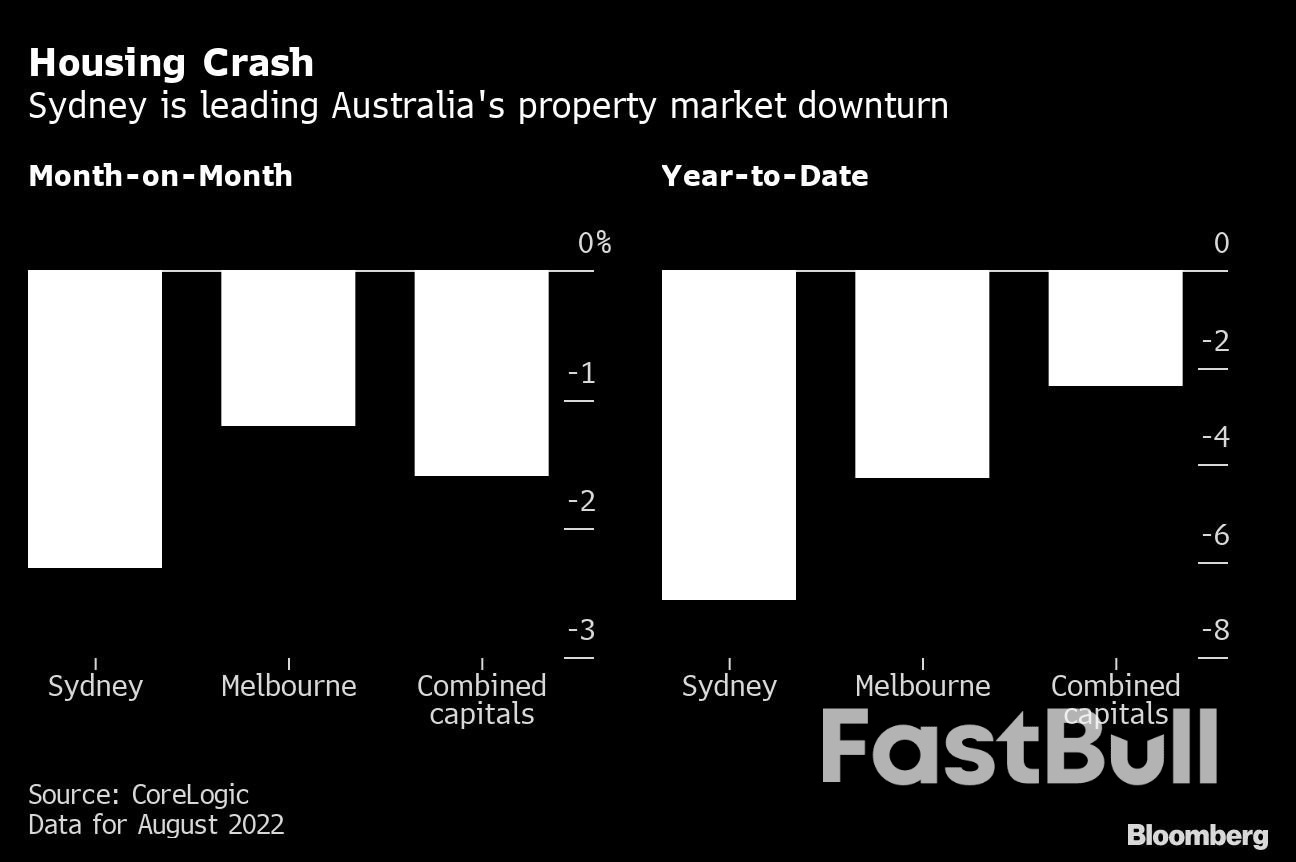
          Australia Home Prices Post Steepest Drop in Almost Four Decades

          Owen Li
          Australian home prices recorded their largest monthly decline in almost four decades in August, with rising interest rates expected to drive further falls this year and next.
          Sydney, Australia's largest market, slid 2.3%, Melbourne dropped 1.2% and Brisbane fell 1.8%, CoreLogic Inc said in a report Thursday (Sept 1). They were the main drivers behind a 1.6% decline in major cities.
          The national index, which includes regional markets, also dropped 1.6% in its worst monthly result since 1983.
          The Reserve Bank of Australia began an earlier-than-expected tightening cycle in May and has since hiked by a total of 175 basis points to take the cash rate to 1.85%. It's widely expected to raise again next week, with money markets implying a rate of 3.2% by December.
          Australia Home Prices Post Steepest Drop in Almost Four Decades_1"It's hard to see housing prices stabilising until interest rates find a ceiling and consumer sentiment starts to improve," said Tim Lawless, research director at CoreLogic.
          RBA officials have signalled confidence in mortgage holders' ability to absorb rising borrowing costs, saying households are in a "fairly good position" to cope with them.
          Lawless expects the RBA's cash rate to rise by at least another 75 basis points from current levels, while adding that more housing stock is likely to come onto the market during the Spring selling season.
          That will add "further downwards pressure on housing values", he said.

          Source: Bloomberg

          Risk Warnings and Disclaimers
          You understand and acknowledge that there is a high degree of risk involved in trading. Following any strategies or investment methods may lead to potential losses. The content on the site is provided by our contributors and analysts for information purposes only. You are solely responsible for determining whether any trading assets, securities, strategy, or any other product is suitable for investing based on your own investment objectives and financial situation.
          Comments
          Add to Favorites
          Share

          Yen Hits 24-Year Low, 140 Level Beckons as Hike Bets Buoy Dollar

          Winkelmann
          The dollar rose broadly on Thursday, particularly against the yen, as investors braced for higher U.S. interest rates while expecting anchored Japanese rates to go nowhere anytime soon.
          The greenback hit a 24-year high of 139.59 against the yen in early Asia trade, a gain of about 0.5% on the previous day's close.
          Expectations for a 75-basis-point U.S. rate hike at next month's Federal Reserve meeting are rising on the back of solid economic data, with Fed funds futures last pointing to a 73% chance of such an increase.
          "Dollar/yen should break 140 before the September (Fed meeting). Looks like we won't have to wait much longer," said Sean Callow, a currency strategist at Westpac in Sydney.
          "So long as expectations for the peak in the Fed funds rate keep ratcheting higher while the Bank of Japan remains on hold, dollar/yen will be a buy on dips. Anywhere in the low 140s now looks plausible."
          Sterling fell about 0.4% to a new 2-1/2 year low of $1.1576, as clouds gather over the British economy. The euro fell 0.3% but was clinging on above parity at $1.0022 as red-hot inflation stokes hike bets in Europe.
          Euro zone inflation rose to a record high at 9.1% in August, data released on Wednesday showed, solidifying the case for further big European Central Bank (ECB) rate hikes to tame inflation.
          Markets have priced in about a 40% chance the ECB will increase rates by 75 basis points next week, even as risks of a painful recession rise along with gas prices.
          "The high inflation and gas supply are still major issues in both the eurozone and the UK, and I think it's going to keep downward pressure on both those currencies," said Joseph Capurso, head of international economics at Commonwealth Bank of Australia.
          "I can see the euro going back below parity again quite soon."
          The U.S. dollar index, which measures the greenback against a basket of currencies, was up 0.12% to 108.99 in early Asia trade, not far off its two-decade high of 109.48 hit on Monday.
          "The U.S. dollar has a bit more upside, partly because we think the market is underestimating how high the Federal Reserve could take the funds rate," said CBA's Capurso.
          Yields on U.S. Treasuries rose accordingly. The two-year Treasury yields were up at 3.516%, the highest since late 2007, while expectations for the peak in the Fed funds rate crept closer to 4%.
          The risk-sensitive Australian and New Zealand dollars were under pressure, with the Aussie down 0.3% at $0.6821, while the kiwi fell 0.3% to $0.6102.

          Source: Reuters

          Risk Warnings and Disclaimers
          You understand and acknowledge that there is a high degree of risk involved in trading. Following any strategies or investment methods may lead to potential losses. The content on the site is provided by our contributors and analysts for information purposes only. You are solely responsible for determining whether any trading assets, securities, strategy, or any other product is suitable for investing based on your own investment objectives and financial situation.
          Comments
          Add to Favorites
          Share
          FastBull
          Copyright © 2025 FastBull Ltd

          728 RM B 7/F GEE LOK IND BLDG NO 34 HUNG TO RD KWUN TONG KLN HONG KONG

          TelegramInstagramTwitterfacebooklinkedin
          App Store Google Play Google Play
          Products
          Charts

          Chats

          Q&A with Experts
          Screeners
          Economic Calendar
          Data
          Tools
          Membership
          Features
          Function
          Markets
          Copy Trading
          Latest Signals
          Contests
          News
          Analysis
          24/7
          Columns
          Education
          Company
          Careers
          About Us
          Contact Us
          Advertising
          Help Center
          Feedback
          User Agreement
          Privacy Policy
          Business

          White Label

          Data API

          Web Plug-ins

          Poster Maker

          Affiliate Program

          Risk Disclosure

          The risk of loss in trading financial instruments such as stocks, FX, commodities, futures, bonds, ETFs and crypto can be substantial. You may sustain a total loss of the funds that you deposit with your broker. Therefore, you should carefully consider whether such trading is suitable for you in light of your circumstances and financial resources.

          No decision to invest should be made without thoroughly conducting due diligence by yourself or consulting with your financial advisors. Our web content might not suit you since we don't know your financial conditions and investment needs. Our financial information might have latency or contain inaccuracy, so you should be fully responsible for any of your trading and investment decisions. The company will not be responsible for your capital loss.

          Without getting permission from the website, you are not allowed to copy the website's graphics, texts, or trademarks. Intellectual property rights in the content or data incorporated into this website belong to its providers and exchange merchants.

          Not Logged In

          Log in to access more features

          FastBull Membership

          Not yet

          Purchase

          Become a signal provider
          Help Center
          Customer Service
          Dark Mode
          Price Up/Down Colors

          Log In

          Sign Up

          Position
          Layout
          Fullscreen
          Default to Chart
          The chart page opens by default when you visit fastbull.com