• Trade
  • Markets
  • Copy
  • Contests
  • News
  • 24/7
  • Calendar
  • Q&A
  • Chats
Trending
Screeners
SYMBOL
LAST
BID
ASK
HIGH
LOW
NET CHG.
%CHG.
SPREAD
SPX
S&P 500 Index
6827.42
6827.42
6827.42
6899.86
6801.80
-73.58
-1.07%
--
DJI
Dow Jones Industrial Average
48458.04
48458.04
48458.04
48886.86
48334.10
-245.98
-0.51%
--
IXIC
NASDAQ Composite Index
23195.16
23195.16
23195.16
23554.89
23094.51
-398.69
-1.69%
--
USDX
US Dollar Index
97.950
98.030
97.950
98.500
97.950
-0.370
-0.38%
--
EURUSD
Euro / US Dollar
1.17394
1.17409
1.17394
1.17496
1.17192
+0.00011
+ 0.01%
--
GBPUSD
Pound Sterling / US Dollar
1.33707
1.33732
1.33707
1.33997
1.33419
-0.00148
-0.11%
--
XAUUSD
Gold / US Dollar
4299.39
4299.39
4299.39
4353.41
4257.10
+20.10
+ 0.47%
--
WTI
Light Sweet Crude Oil
57.233
57.485
57.233
58.011
56.969
-0.408
-0.71%
--

Community Accounts

Signal Accounts
--
Profit Accounts
--
Loss Accounts
--
View More

Become a signal provider

Sell trading signals to earn additional income

View More

Guide to Copy Trading

Get started with ease and confidence

View More

Signal Accounts for Members

All Signal Accounts

Best Return
  • Best Return
  • Best P/L
  • Best MDD
Past 1W
  • Past 1W
  • Past 1M
  • Past 1Y

All Contests

  • All
  • Trump Updates
  • Recommend
  • Stocks
  • Cryptocurrencies
  • Central Banks
  • Featured News
Top News Only
Share

China's Central Financial And Economic Affairs Commission Deputy Director: Will Expand Export And Increase Import In 2026

Share

Thai Leader Anutin: Landmine Blast That Killed Thai Soldiers 'Not A Roadside Accident'

Share

Thai Leader Anutin: Thailand To Continue Military Action Until 'We Feel No More Harm'

Share

Cambodian Prime Minister Hun Manet Says He Had Phone Calls With Trump And Malaysian Leader Anwar About Ceasefire

Share

Cambodia's Hun Manet Says USA, Malaysia Should Verify 'Which Side Fired First' In Latest Conflict

Share

Cambodia's Hun Manet: Cambodia Maintains Its Stance In Seeking Peaceful Resolution Of Disputes

Share

Nasdaq Companies: Allergan, Ferrovia, Insmed, Monolithic Power Systems, Seagate Technology, And Western Digital Will Be Added To The NASDAQ 100 Index. Biogen, CdW, GlobalFoundries, Lululemon, ON Semiconductor, And Tradedesk Will Be Removed From The NASDAQ 100 Index

Share

Witkoff Headed To Berlin This Weekend To Meet With Zelenskiy, European Leaders -Wsj Reporter On X

Share

Russia Attacks Two Ukrainian Ports, Damaging Three Turkish-Owned Vessels

Share

[Historic Flooding Occurs In At Least Four Rivers In Washington State Due To Days Of Torrential Rains] Multiple Areas In Washington State Have Been Hit By Severe Flooding Due To Days Of Torrential Rains, With At Least Four Rivers Experiencing Historic Flooding. Reporters Learned On The 12th That The Floods Caused By The Torrential Rains In Washington State Have Destroyed Homes And Closed Several Highways. Experts Warn That Even More Severe Flooding May Occur In The Future. A State Of Emergency Has Been Declared In Washington State

Share

Trump Says Proposed Free Economic Zone In Donbas Would Work

Share

Trump: I Think My Voice Should Be Heard

Share

Trump Says Will Be Choosing New Fed Chair In Near Future

Share

Trump Says Proposed Free Economic Zone In Donbas Complex But Would Work

Share

Trump Says Land Strikes In Venezuela Will Start Happening

Share

US President Trump: Thailand And Cambodia Are In A Good Situation

Share

State Media: North Korean Leader Kim Hails Troops Returning From Russia Mission

Share

The 10-year Treasury Yield Rose About 5 Basis Points During The "Fed Rate Cut Week," And The 2/10-year Yield Spread Widened By About 9 Basis Points. On Friday (December 12), In Late New York Trading, The Yield On The Benchmark 10-year US Treasury Note Rose 2.75 Basis Points To 4.1841%, A Cumulative Increase Of 4.90 Basis Points For The Week, Trading Within A Range Of 4.1002%-4.2074%. It Rose Steadily From Monday To Wednesday (before The Fed Announced Its Rate Cut And Treasury Bill Purchase Program), Subsequently Exhibiting A V-shaped Recovery. The 2-year Treasury Yield Fell 1.82 Basis Points To 3.5222%, A Cumulative Decrease Of 3.81 Basis Points For The Week, Trading Within A Range Of 3.6253%-3.4989%

Share

Trump: Lots Of Progress Being Made On Russia-Ukraine

Share

NOPA November US Soybean Crush Estimated At 220.285 Million Bushels

TIME
ACT
FCST
PREV
U.K. Trade Balance Non-EU (SA) (Oct)

A:--

F: --

P: --

U.K. Trade Balance (Oct)

A:--

F: --

P: --

U.K. Services Index MoM

A:--

F: --

P: --

U.K. Construction Output MoM (SA) (Oct)

A:--

F: --

P: --

U.K. Industrial Output YoY (Oct)

A:--

F: --

P: --

U.K. Trade Balance (SA) (Oct)

A:--

F: --

P: --

U.K. Trade Balance EU (SA) (Oct)

A:--

F: --

P: --

U.K. Manufacturing Output YoY (Oct)

A:--

F: --

P: --

U.K. GDP MoM (Oct)

A:--

F: --

P: --

U.K. GDP YoY (SA) (Oct)

A:--

F: --

P: --

U.K. Industrial Output MoM (Oct)

A:--

F: --

P: --

U.K. Construction Output YoY (Oct)

A:--

F: --

P: --

France HICP Final MoM (Nov)

A:--

F: --

P: --

China, Mainland Outstanding Loans Growth YoY (Nov)

A:--

F: --

P: --

China, Mainland M2 Money Supply YoY (Nov)

A:--

F: --

P: --

China, Mainland M0 Money Supply YoY (Nov)

A:--

F: --

P: --

China, Mainland M1 Money Supply YoY (Nov)

A:--

F: --

P: --

India CPI YoY (Nov)

A:--

F: --

P: --

India Deposit Gowth YoY

A:--

F: --

P: --

Brazil Services Growth YoY (Oct)

A:--

F: --

P: --

Mexico Industrial Output YoY (Oct)

A:--

F: --

P: --

Russia Trade Balance (Oct)

A:--

F: --

P: --

Philadelphia Fed President Henry Paulson delivers a speech
Canada Building Permits MoM (SA) (Oct)

A:--

F: --

P: --

Canada Wholesale Sales YoY (Oct)

A:--

F: --

P: --

Canada Wholesale Inventory MoM (Oct)

A:--

F: --

P: --

Canada Wholesale Inventory YoY (Oct)

A:--

F: --

P: --

Canada Wholesale Sales MoM (SA) (Oct)

A:--

F: --

P: --

Germany Current Account (Not SA) (Oct)

A:--

F: --

P: --

U.S. Weekly Total Rig Count

A:--

F: --

P: --

U.S. Weekly Total Oil Rig Count

A:--

F: --

P: --

Japan Tankan Large Non-Manufacturing Diffusion Index (Q4)

--

F: --

P: --

Japan Tankan Small Manufacturing Outlook Index (Q4)

--

F: --

P: --

Japan Tankan Large Non-Manufacturing Outlook Index (Q4)

--

F: --

P: --

Japan Tankan Large Manufacturing Outlook Index (Q4)

--

F: --

P: --

Japan Tankan Small Manufacturing Diffusion Index (Q4)

--

F: --

P: --

Japan Tankan Large Manufacturing Diffusion Index (Q4)

--

F: --

P: --

Japan Tankan Large-Enterprise Capital Expenditure YoY (Q4)

--

F: --

P: --

U.K. Rightmove House Price Index YoY (Dec)

--

F: --

P: --

China, Mainland Industrial Output YoY (YTD) (Nov)

--

F: --

P: --

China, Mainland Urban Area Unemployment Rate (Nov)

--

F: --

P: --

Saudi Arabia CPI YoY (Nov)

--

F: --

P: --

Euro Zone Industrial Output YoY (Oct)

--

F: --

P: --

Euro Zone Industrial Output MoM (Oct)

--

F: --

P: --

Canada Existing Home Sales MoM (Nov)

--

F: --

P: --

Euro Zone Total Reserve Assets (Nov)

--

F: --

P: --

U.K. Inflation Rate Expectations

--

F: --

P: --

Canada National Economic Confidence Index

--

F: --

P: --

Canada New Housing Starts (Nov)

--

F: --

P: --

U.S. NY Fed Manufacturing Employment Index (Dec)

--

F: --

P: --

U.S. NY Fed Manufacturing Index (Dec)

--

F: --

P: --

Canada Core CPI YoY (Nov)

--

F: --

P: --

Canada Manufacturing Unfilled Orders MoM (Oct)

--

F: --

P: --

Canada Manufacturing New Orders MoM (Oct)

--

F: --

P: --

Canada Core CPI MoM (Nov)

--

F: --

P: --

Canada Manufacturing Inventory MoM (Oct)

--

F: --

P: --

Canada CPI YoY (Nov)

--

F: --

P: --

Canada CPI MoM (Nov)

--

F: --

P: --

Canada CPI YoY (SA) (Nov)

--

F: --

P: --

Canada Core CPI MoM (SA) (Nov)

--

F: --

P: --

Q&A with Experts
    • All
    • Chatrooms
    • Groups
    • Friends
    Connecting
    .
    .
    .
    Type here...
    Add Symbol or Code

      No matching data

      All
      Trump Updates
      Recommend
      Stocks
      Cryptocurrencies
      Central Banks
      Featured News
      • All
      • Russia-Ukraine Conflict
      • Middle East Flashpoint
      • All
      • Russia-Ukraine Conflict
      • Middle East Flashpoint
      Search
      Products

      Charts Free Forever

      Chats Q&A with Experts
      Screeners Economic Calendar Data Tools
      Membership Features
      Data Warehouse Market Trends Institutional Data Policy Rates Macro

      Market Trends

      Market Sentiment Order Book Forex Correlations

      Top Indicators

      Charts Free Forever
      Markets

      News

      News Analysis 24/7 Columns Education
      From Institutions From Analysts
      Topics Columnists

      Latest Views

      Latest Views

      Trending Topics

      Top Columnists

      Latest Update

      Signals

      Copy Rankings Latest Signals Become a signal provider AI Rating
      Contests
      Brokers

      Overview Brokers Assessment Rankings Regulators News Claims
      Broker listing Forex Brokers Comparison Tool Live Spread Comparison Scam
      Q&A Complaint Scam Alert Videos Tips to Detect Scam
      More

      Business
      Events
      Careers About Us Advertising Help Center

      White Label

      Data API

      Web Plug-ins

      Affiliate Program

      Awards Institution Evaluation IB Seminar Salon Event Exhibition
      Vietnam Thailand Singapore Dubai
      Fans Party Investment Sharing Session
      FastBull Summit BrokersView Expo
      Recent Searches
        Top Searches
          Markets
          News
          Analysis
          User
          24/7
          Economic Calendar
          Education
          Data
          • Names
          • Latest
          • Prev

          View All

          No data

          Scan to Download

          Faster Charts, Chat Faster!

          Download App
          English
          • English
          • Español
          • العربية
          • Bahasa Indonesia
          • Bahasa Melayu
          • Tiếng Việt
          • ภาษาไทย
          • Français
          • Italiano
          • Türkçe
          • Русский язык
          • 简中
          • 繁中
          Open Account
          Search
          Products
          Charts Free Forever
          Markets
          News
          Signals

          Copy Rankings Latest Signals Become a signal provider AI Rating
          Contests
          Brokers

          Overview Brokers Assessment Rankings Regulators News Claims
          Broker listing Forex Brokers Comparison Tool Live Spread Comparison Scam
          Q&A Complaint Scam Alert Videos Tips to Detect Scam
          More

          Business
          Events
          Careers About Us Advertising Help Center

          White Label

          Data API

          Web Plug-ins

          Affiliate Program

          Awards Institution Evaluation IB Seminar Salon Event Exhibition
          Vietnam Thailand Singapore Dubai
          Fans Party Investment Sharing Session
          FastBull Summit BrokersView Expo

          [Fed] Three Fed Officials Deliver Hawkish Speeches

          FastBull Featured

          Remarks of Officials

          Three Federal Reserve officials delivered their speeches on August 30, local time, the main contents of which are as follows.
          Richmond Federal Reserve Bank President Tom Barkin said the U.S. is faced with "post-war-like" inflation and the Fed's responsibility is to take action to reduce inflation, with a focus on keeping interest rates within restrictive levels. He did not believe that inflation will fall as expected. Higher interest rates are needed to control inflation, and real interest rates must be kept above zero. There has been a slowdown in interest rate sensitive sectors, but we are not in a recession right now. A recession is obviously a risk in the process of cooling inflation, but it doesn't have to be catastrophic. He said he would not prejudge the size of the next rate hike which will depend on the coming data.
          Federal Reserve Bank of Atlanta President Raphael Bostic stated that the slower inflation data may give the Fed a reason to slow down interest rate hikes, but it is too early to declare victory over inflation right now. The overall economic situation remains "unclear." Inflation is still too high, so restrictive policies will be needed. The Fed needs to remain cautious when focusing on inflation, because too aggressive rate hikes also pose risks. The Fed will keep act quickly and cautiously.
          New York Federal Reserve President John Williams said that the current economic data are contradictory, with the labor market remaining very strong; the overall situation is similar to that of July. Inflation remains too high. We will focus on inflation, employment, job vacancies, and other data before the next meeting, targeting mainly to bring inflation down, he added. The Fed will be very concerned about the drivers of inflation, because this is the number one problem. It needs to get rates above the long-term neutral levels or at least raise the policy rate to above 3.5% in order to really restrict the economy. The magnitude of rate hikes thereafter will be determined by the coming inflation data. It is estimated that the Fed will keep fighting against inflation next year and will continue to apply restrictive policies for some time, with no rate cuts possible. And from this week, the Fed will accelerate its balance sheet reduction, which will reduce market liquidity.
          Risk Warnings and Disclaimers
          You understand and acknowledge that there is a high degree of risk involved in trading. Following any strategies or investment methods may lead to potential losses. The content on the site is provided by our contributors and analysts for information purposes only. You are solely responsible for determining whether any trading assets, securities, strategy, or any other product is suitable for investing based on your own investment objectives and financial situation.
          Comments
          Add to Favorites
          Share

          High Inflation Not Peaking Yet

          Owen Li

          Market movers today

          The data highlight today will be the euro area HICP figures for August. Headline inflation will likely rise above the 9% mark, despite policy measures to stem the rise in prices. With underlying inflation pressures still broadening and the latest increase in energy commodity still to feed through, an inflation peak in the euro area is not yet in sight, keeping the pressure on ECB to front-load monetary tightening.
          In the U.S., the ADP employment report will give some early hints for non-farm payrolls released on Friday.
          Russia's Gazprom plans to halt gas flows through the Nord Stream1 pipeline today for maintenance. With lingering uncertainty whether gas flows will resume after three days, volatility in European energy markets will likely stay high.
          A speech from Riksbank's Breman is scheduled for 8:30 CET.

          The 60 second overview

          European inflation

          German CPI inflation ticked higher yet again with 7.9% in August, and inflation would be even higher if it was not for the "Tankrabatt" and the fact that the full impact of electricity and natural gas price rises has not nearly fed through to consumers yet. The numbers will increase again in September when the "tankrabatt" runs out.

          U.S. labour market

          The U.S. July JOLTs report provided further evidence of strong labour markets, as job openings rose against expectations to 11.2 million, while June figures were also revised higher.
          Labour demand remains very high relative to the persistent drop in labour supply, and the decline in Conference Board's August jobs 'hard to get' index suggests that overall labour market conditions have likely remained tight over the past month as well.
          Consumer confidence rebounded, while near-term inflation expectations eased slightly, likely reflecting the recovery in consumers' purchasing power amid lower gasoline prices.
          So far, we see little signs of U.S. economy being near recession despite the weakness in leading indicators, and another strong jobs report on Friday could tilt the balance further towards a 75bp hike in September (market prices around 70% probability).
          Atlanta Fed's Bostic emphasized yesterday, that the exact hiking pace will depend on incoming data, but broadly we continue to expect that Fed will have to keep financial conditions restrictive well into the next year in order to ensure that U.S. economy avoids a more persistent period of stagflation – a message which has been echoed by several FOMC members since Powell's speech last Friday.

          China

          Official manufacturing PMIs increased to 49.4 in August from 49.0 in July and thus beat expectations slightly but remains in contractionary territory. The reopening boost is waning and weaker export orders and a continued weak property market weigh on Chinese activity.

          Japan

          Both industrial production and retail sales beat expectations in July. The former is down 1.0% while the latter is up 2.4% yoy. The Japanese economy still has not recovered fully from the pandemic and a surge in Covid cases is threatening to put a break on particularly the service sector once again in Q3.

          FI

          Peripheral spreads underperformed on a day where core yields ended broadly unchanged in the 10y point. However, yields started lower on the day and it was only after the German CPI figure and hawkish tunes from the ECB governing council members, such as Knot (at our Danske Talks), Wunsch, Muller, Vasle leaning for a quick tightening of likely 75bp next week, that rates rose. Nagel said that recession fears should not delay rate hikes.

          FX

          EUR rose vis-à-vis USD, GBP and Scandies yesterday as market affirmed ECB pricing after recent hawkish comments and drop in natural gas prices. EUR/USD trades close to parity, EUR/SEK around 10.70 and EUR/NOK 9.80.

          Credit

          Sentiment in credit markets mirrored other risky assets and also had some catching up from Monday (where CDS indices were closed) to do. iTraxx Xover and Main ended the day 21bp and 5bp wider, respectively.

          Nordic macro

          In Sweden there is a scheduled Riksbank speech at 08:30 CET where we will hear Anna Breman discuss interest rates under the title "From 500% to -0.5% interest rate – and then what?". The money market is pricing in a lot of hikes with 75bp for the September meeting and 100bp for November followed by another 85bp in the first part of 2023. Even though we lean toward substantial frontloading, we think this is probably too much.

          Source: Danske Bank

          Risk Warnings and Disclaimers
          You understand and acknowledge that there is a high degree of risk involved in trading. Following any strategies or investment methods may lead to potential losses. The content on the site is provided by our contributors and analysts for information purposes only. You are solely responsible for determining whether any trading assets, securities, strategy, or any other product is suitable for investing based on your own investment objectives and financial situation.
          Comments
          Add to Favorites
          Share

          EU CPI Set to Post a New Record High

          Devin
          While the DAX managed to finish the day higher yesterday the same could not be said for the rest of Europe's markets, which all finished the day lower, with the catalyst for the underperformance being another weak session for U.S. markets.
          Having seen such a promising start to August, last week's speech by Fed chairman Jay Powell appears to have been the final straw for any sort of hope that we might see another positive month for equity markets, with the S&P500 closing at its lowest level in over a month.
          Yesterday's improvement in U.S. economic data appears to have reinforced the expectation that the resilience of the U.S. economy is likely to mean that the Fed will be a lot less cautious, when it comes to further tightening monetary policy when it meets next on 21st September, when it could well go for its third successive 75bps rate hike, as it looks to drive inflation back down again.
          The recent decline in fuel prices in the U.S. does appear to be encouraging some optimism that inflation, while sticky may well have peaked in the short term, it's also clear that far from looking to contain inflation, the Fed also wants to start pushing it back down quickly as well.
          Today also sees the return of the ADP payrolls report which should offer further clues as to whether the resilience seen in the U.S. labour market in last month's non-farm numbers is showing similar resilience in the private sector. As such the numbers might not track this Friday's numbers in the same way, not that they did previously. Expectations are for 300k to be added in August.
          On this side of the Atlantic, as we look towards Europe there appears to be no such sign of the same thing happening, when it comes to inflation pressure showing signs of peaking.
          Yesterday's German flash CPI numbers for August saw headline inflation hit its highest levels in over 50 years at 8.8%, shifting the focus to today's preliminary August CPI numbers from France, Italy and the EU.
          The French CPI numbers are expected to slip back from 6.8% to 6.7%, although it should be remembered the French government is spending huge amounts of euros in trying to protect the French consumer from the surge in energy prices.
          In Italy August CPI is expected to come in at 8.2%, while on the headline CPI number which the ECB is most interested in for the whole euro area, which is expected to rise to a new record high of 9%, shifting attention towards next week's ECB rate meeting, and another outsize rate rise.
          Another record high for EU CPI will merely serve to embolden the hawks on the governing council who have become more vocal in recent weeks.
          Yesterday we heard from a succession of ECB Governing Council members calling for consideration of a 75bps rate rise at next week's meeting
          Klaas Knot, the Netherlands governing council member, and who has traditionally been more hawkish, said that he was leaning towards a 75bps move and that a move beyond the neutral rate might be required to tame inflation.
          The Slovenian central bank governor Vasle also said he is leaning towards 75bps as well, not altogether surprising given headline CPI is at 11% there.
          The ECB's chief economist Philip Lane was a little more noncommittal merely saying that further rate rises were needed, however it is becoming clearer that the hawks, having been kept quiet for such a long time over the past few years, are slowly sharpening their claws.
          EUR/USD – attempting to carve out a short-term base just above the 0.9900 level with resistance at last week's high at 1.0120. We can see the potential for a squeeze towards 1.0220, but while below that the bias remains for a move towards 0.9660.
          GBP/USD – the pound has continued to look soft with the bias remaining for a move towards the lockdown lows of March 2020 at 1.1500. Resistance comes in at 1.1980 area.
          EUR/GBP – continues to push higher hitting its highest levels since early July, with the next key resistance at 0.8630. The current move higher has trend line support from the lows this month now coming in above the 0.8430 area.
          USD/JPY – edged a little closer to the previous highs at 139 40 which are the next key resistance area and obstacle to further gains towards the 140.00 area. Support now comes in at the 137.15 area or cloud support, and below that at the 50-day SMA at 135.80.

          Source: CMC

          Risk Warnings and Disclaimers
          You understand and acknowledge that there is a high degree of risk involved in trading. Following any strategies or investment methods may lead to potential losses. The content on the site is provided by our contributors and analysts for information purposes only. You are solely responsible for determining whether any trading assets, securities, strategy, or any other product is suitable for investing based on your own investment objectives and financial situation.
          Comments
          Add to Favorites
          Share

          UK House Price Surge to End as Cost-of-Living Crisis Bites

          Devin
          The surge in British house prices will come to an end next year as the cost-of-living crisis and rising borrowing costs put the brakes on what has been a buoyant market for years, a Reuters poll found.
          Inflation is running at a 40-year high of over 10% and with energy bills set to rise 80% from October it is expected to rise much further so households are really feeling the pinch.
          Adding to woes for potential home buyers needing to borrow money, the Bank of England has already raised interest rates to 1.75% from a pandemic-era low of 0.10% and is not done yet, a separate Reuters poll found.
          "Spiralling inflation is leading to a cost-of-living crunch which in turn has led to a new era of rising interest rates," said Aneisha Beveridge at estate agency Hamptons.
          "As a result, we expect house price growth to steadily slow during the remainder of the year and into 2023 when the real impact on households is likely to be felt as interest rates peak."
          According to the Aug. 12-30 poll of 21 property market experts home prices will rise 7.0% this year but that pace will slow to 1.0% next year before picking up to 3.0% in 2024. In a May poll price were expected to rise 2.9% next year.
          In London, a magnet for foreign investors, prices were expected to rise 5.0% this year but outperform the national market and increase 2.0% next year. That follows relative underperformance in recent years.
          "While affordability pressures are likely to weigh on the mainstream market next year, there could be room for surprise in Prime Central London – particularly if sterling continues its downward trend, making London property more appealing to international buyers," said Hamptons' Beveridge.
          The average price of a home is 365,173 pounds ($427,216) and 224,091 pounds for a first-time buyer, according to property website Rightmove, making the dream of owning a home out of reach for many.
          Average pay in Britain is only around 30,000 pounds and salary increases are generally not keeping up with inflation, putting getting on the property ladder further out of reach for many.
          "We are getting to the stage when young people can't even dream of home ownership," said property market consultant Henry Pryor.
          When asked to rate the value of national house prices on a scale of 1 to 10 from extremely cheap to extremely expensive, the median response was 7, matching May's estimate. In the capital it was an unchanged 8.
          Responding to another question, prices would need to fall 8.5% to be fairly valued, the median showed, with forecasts ranging from 5.0% to as high as 35.0%.
          Yet no-one in the poll predicted such a drop across the forecast horizon and only a few had any decline in their base case scenarios.
          ($1 = 0.8548 pound)

          Source: Reuters

          Risk Warnings and Disclaimers
          You understand and acknowledge that there is a high degree of risk involved in trading. Following any strategies or investment methods may lead to potential losses. The content on the site is provided by our contributors and analysts for information purposes only. You are solely responsible for determining whether any trading assets, securities, strategy, or any other product is suitable for investing based on your own investment objectives and financial situation.
          Comments
          Add to Favorites
          Share

          Turkey's Economy Expanded 7.5% in Q2, Seen Slowing in H2

          Devin
          Turkey's economy expanded 7.5% annually in the second quarter of the year, a Reuters poll showed on Wednesday, while the full-year growth forecast stood at 4%, pointing a drop-in economic activity in the second half of the year reflecting weaker demand conditions.
          The economy expanded 7.3% year-on-year in the first quarter, driven by strong performances strong exports and robust domestic demand. It is expected to have kept up the strong performance in the second quarter.
          President Tayyip Erdogan's new economic programme has prioritised growth and exports, while aiming to tackle inflation by shoring up Turkey's chronic current account deficit instead of rate hikes.
          An easing cycle under Erdogan's programme led the lira to end last year down 44% against the dollar and shed another 27% so far this year, sending inflation to a 24-year high of nearly 80% in July.
          While the rate cuts aimed at stimulating the economy, analysts predict that activity could cool in the second half of the year due to a downward trend in demand and an expected economic slowdown in Turkey's largest trade partners.
          The median estimate of 13 economists in a Reuters poll for annual gross domestic product (GDP) growth in the second quarter stood at 7.5%, within a range of 5% and 8.7%.
          The full-year growth was lower, with the median estimate of 18 economists standing at 4.05% and forecasts ranging between 3.3% and 5%.
          Turkey's central bank cited signs of a slowdown in the third quarter last week when it shocked markets by cutting its policy rate by 100 basis points to 13%.
          "It is important that financial conditions remain supportive to preserve the growth momentum in industrial production and the positive trend in employment," the bank said.
          Finance Minister Nureddin Nebati said on Tuesday that he expects growth in the second quarter to come in higher than the 7.3% recorded in the first quarter.
          Turkey's economy was one of few to narrowly expand in 2020, thanks largely to cheap loans. It bounced back in 2021, expanding 11%.
          The Turkish Statistical Institute is expected to announce second quarter growth results at 0700 GMT on Aug. 31.

          Source: Reuters

          Risk Warnings and Disclaimers
          You understand and acknowledge that there is a high degree of risk involved in trading. Following any strategies or investment methods may lead to potential losses. The content on the site is provided by our contributors and analysts for information purposes only. You are solely responsible for determining whether any trading assets, securities, strategy, or any other product is suitable for investing based on your own investment objectives and financial situation.
          Comments
          Add to Favorites
          Share

          U.S. Treasury Traders Switch Strategies as Liquidity Problems Worsen

          Owen Li
          Investors in the $23 trillion U.S. Treasury market are slicing up orders and switching to more easily traded issues, adapting to navigate periodic illiquidity that looks to get worse as the U.S. Federal Reserve reduces the size of its bond portfolio.
          The Fed kicked off "quantitative tightening" (QT) in June, letting its bonds reach maturity without buying more. The exit of the Treasury market's largest buyer and uncertainty over future rate hikes to fight soaring inflation have led to wild price swings. Many investors have changed trading patterns, while others stay on the sidelines, according to more than half a dozen traders and investors interviewed by Reuters.
          "If you're trying to move larger sizes, even $50 million or more, you're probably going to have to do it in smaller bite sizes," said Calvin Norris, Portfolio Manager & US Rates Strategist at Aegon Asset Management.
          He said investors increasingly prefer to trade recently issued "on-the-run" Treasuries which are more liquid than older "off-the-run" ones. Liquidity is also poor for more niche products such as Treasury Inflation-Protected Securities.
          The Treasuries market is the world's largest bond market and serves as a global benchmark for a swathe of other asset classes, making its price gyrations especially worrying.
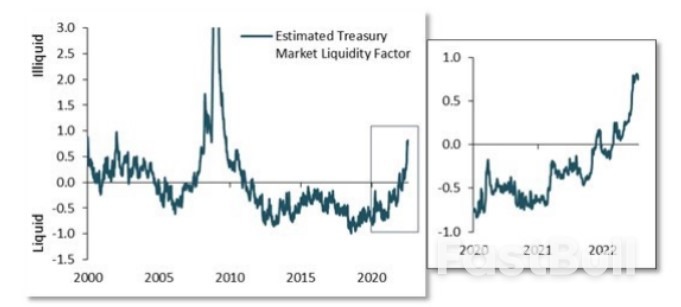
          Measuring liquidity by looking at the size and persistence of unexploited arbitrage opportunities in the Treasury market, investment bank Piper Sandler estimated last month the market to be "the most illiquid it has been over the past 20 years, except of course for the Great Financial Crisis." The following graphic is reproduced from Piper Sandler's research.
          U.S. Treasury Traders Switch Strategies as Liquidity Problems Worsen_1Trading volume has held up this year, averaging at about $630 billion per month in total. But investors said liquidity - the ability to trade an asset without significantly moving its price - has worsened.
          Andrew Brenner, head of international fixed income at National Alliance Securities, said that transactions of, for instance, $100 million, need to be broken down into either $25 or $50 million to be able to trade without moving prices.
          "You have to break it down or you move markets against you," he said.
          When trying to trade less liquid products, some investors said they had struggled to find dealers willing to offer quotes.
          Michael Kushma, chief investment officer of Global Fixed Income at Morgan Stanley Investment Management, said at some points this year his firm had to switch out the bonds they were trying to sell, as the bid discounts dealers were offering were too steep.
          So far the Fed has allowed about $70 billion of Treasuries to mature and roll off its nearly $9 trillion balance sheet, which it plans to reduce at nearly twice the pace it did from 2017 to 2019.
          When the pandemic hit, the Fed bought up to $80 billion Treasuries a month to pump up the economy, but now it will ramp-up Treasury roll-offs to as much as $60 billion each month.

          'Less capital'

          Market volatility and recession fears have made market makers less willing to take large positions.
          "When liquidity dries up dealers don't know where the price is .. So they're reluctant to buy and to make a market in it because they don't know where they're going to sell," said Kushma.
          Some investors noted that dealers have struggled for years to keep up with the ballooning Treasury market and said regulators could do more to free up liquidity after promising to address structural issues in the market.
          They said dealers could buy more bonds if the Fed scrapped a rule introduced following the 2008 financial crisis requiring they hold capital against Treasuries. The Fed temporarily suspended that rule in 2020.
          "There's less capital from market makers ready to step in and push yields back toward fair value," said Steven Abrahams, senior managing director at Amherst Pierpont Securities.
          Some pointed to 20-year Treasuries as an example of how poor liquidity is hurting trading. That tenor has seen little demand since it was reintroduced in 2020. This makes it harder to execute arbitrage trades, for instance swapping exposure to a longer-dated bond with the 20-year one.
          Liquidity has declined even more in recent weeks, investors said, citing thin summer trading and renewed uncertainty over how aggressive the Fed will be on rate hikes.
          "The lack of certainty about the direction of the Fed ... has just put the liquidity and typical liquidity providers in a holding pattern," said John Luke Tyner, fixed income analyst at Aptus Capital Advisors.
          The ICE BofA MOVE Index- a measure of expected volatility in U.S. Treasuries - hit 156 in early July, just shy of its 163 peak in March 2020, when pandemic fears gripped investors and liquidity quickly dropped to 2008 crisis levels. That prompted the Fed to buy $1.6 trillion of Treasuries.
          Some investors said mounting fears of a recession could convince the Fed to slow or stall quantitative tightening. If it keeps tightening, many see no immediate end to the liquidity problems.
          "It just feels like this is going to be the new normal," said John Madziyire, a senior portfolio manager at Vanguard.

          Source: Reuters

          Risk Warnings and Disclaimers
          You understand and acknowledge that there is a high degree of risk involved in trading. Following any strategies or investment methods may lead to potential losses. The content on the site is provided by our contributors and analysts for information purposes only. You are solely responsible for determining whether any trading assets, securities, strategy, or any other product is suitable for investing based on your own investment objectives and financial situation.
          Comments
          Add to Favorites
          Share

          EU and Greece Veer Toward Standoff Over Wiretapping Scandal

          Thomas
          European parliamentarians aren't accepting Greece's sharply worded suggestion that Brussels should keep its nose out of a snowballing wiretapping scandal.
          Greece's bugging furor escalated dramatically on August 5, when two top officials from the center-right administration of Prime Minister Kyriakos Mitsotakis lost their jobs after it transpired that the phone of Nikos Androulakis, head of the center-left Pasok party, had been wiretapped. Mitsotakis's government admitted it acted wrongly but said the wiretap was conducted legally by the spy service — though it is still refusing to say why, citing national security.
          Muddying the case, a separate attempt was made to hack Androulakis' phone around the same time with illegal software called Predator, but Athens is strenuously denying that its secret agents had any connection with that.
          As the scandal was brewing, Greece said it was happy to work with Brussels "in a spirit of co-operation" but was dismissive that the case could provide grounds for EU interference. In response to a letter from the European Commission asking about the surveillance, Greece's Permanent Representative to the EU Ioannis Vrailas on August 2 noted it was "highly debatable" whether any of the points raised by Brussels lay within the competence of the EU. He then rebuked the Commission for being too credulous about press reports on a matter of national security, saying Brussels should refrain from "hastily endorsing verbatim" publications from political media "that do not always distinguish themselves for accuracy and objectivity."
          The publication of Vrailas' letter on August 24 received a riposte from European parliamentarian Sophie in 't Veld, who took to Twitter to tell Vrailas that the Greek spyware scandal was "very much an EU competence." The Dutch MEP complained that the case could involve the contravention of EU laws such as the General Data Protection Regulation — the EU's flagship privacy rulebook — and would also be in the EU's crosshairs for targeting Androulakis, who is a member of the European Parliament.
          When asked whether the European Commission was satisfied with Greece's response, spokesperson Christian Wigand accepted that national security was Greece's exclusive competence but, like in 't Veld, stressed the need for Athens "to respect EU law and the case law of the European Court of Justice."
          "We received the reply from the Greek authorities and are looking into it. The Commission is gathering information concerning the reported use of spyware, such as Pegasus/Predator, and the possible interplay between EU data protection rules and the national security framework and we will continue to follow this issue very closely," he explained.

          First Pegasus, now Predator

          The Greek saga is being followed closely in Brussels, partly because European Parliament officials are already in the midst of a probe to investigate the use of the Pegasus software that has been the focus of scandals in EU countries including Poland, Hungary and Spain.
          Brussels is struggling to answer a tough — yet familiar — question: How can it prevent intelligence and security services at a national level from violating EU citizens' fundamental rights without treading on governments' strict sovereignty on national security matters? Several Commission officials declined to give details about how the EU executive plans to challenge Athens on the revelations.
          It is common practice for governments under fire for use of spyware like Pegasus to tell EU officials to back off, claiming hacks are lawful.
          But European lawmakers are not convinced, pointing out spyware targets included political opponents, not just security threats.
          Saskia Bricmont, a Belgian MEP with the Greens party who sits on the European Parliament's spyware inquiry committee, also known as PEGA, said Greece was now using the same playbook as Poland, Hungary and Spain, by trying to brush the topic under the carpet by playing the national security card.
          "This to me is completely unacceptable because democracy and rule of law are at stake," she said.
          Bricmont called the Commission's response "weak" and said that as the guardian of the treaties, it had an obligation to ensure EU values and the security of citizens were respected.
          Jordi Solé, a Spanish MEP for the Greens, agreed, adding that espionage scandals were not just a matter of national security but of fundamental rights, with elected politicians being targeted because of their positions.
          "That deserves a stronger reaction from everyone including the European Commission," said Solé.
          In regards to the Parliament's role, Bricmont called for European parties to put party affiliations aside and treat each case evenhandedly.
          Another MEP on the PEGA committee, who asked not to be named, said the problem was that there were no legal guidelines on the use of the technology yet at EU level, meaning lawmakers had a responsibility to provide one to uphold democracy in member countries.
          "If there are no legal markers, member states can put whatever they want within the 'national security' context, which drastically changes meaning from one member state to another," they said. "It's not a national affair, it's a European one."

          Source: POLITICO

          Risk Warnings and Disclaimers
          You understand and acknowledge that there is a high degree of risk involved in trading. Following any strategies or investment methods may lead to potential losses. The content on the site is provided by our contributors and analysts for information purposes only. You are solely responsible for determining whether any trading assets, securities, strategy, or any other product is suitable for investing based on your own investment objectives and financial situation.
          Comments
          Add to Favorites
          Share
          FastBull
          Copyright © 2025 FastBull Ltd

          728 RM B 7/F GEE LOK IND BLDG NO 34 HUNG TO RD KWUN TONG KLN HONG KONG

          TelegramInstagramTwitterfacebooklinkedin
          App Store Google Play Google Play
          Products
          Charts

          Chats

          Q&A with Experts
          Screeners
          Economic Calendar
          Data
          Tools
          Membership
          Features
          Function
          Markets
          Copy Trading
          Latest Signals
          Contests
          News
          Analysis
          24/7
          Columns
          Education
          Company
          Careers
          About Us
          Contact Us
          Advertising
          Help Center
          Feedback
          User Agreement
          Privacy Policy
          Business

          White Label

          Data API

          Web Plug-ins

          Poster Maker

          Affiliate Program

          Risk Disclosure

          The risk of loss in trading financial instruments such as stocks, FX, commodities, futures, bonds, ETFs and crypto can be substantial. You may sustain a total loss of the funds that you deposit with your broker. Therefore, you should carefully consider whether such trading is suitable for you in light of your circumstances and financial resources.

          No decision to invest should be made without thoroughly conducting due diligence by yourself or consulting with your financial advisors. Our web content might not suit you since we don't know your financial conditions and investment needs. Our financial information might have latency or contain inaccuracy, so you should be fully responsible for any of your trading and investment decisions. The company will not be responsible for your capital loss.

          Without getting permission from the website, you are not allowed to copy the website's graphics, texts, or trademarks. Intellectual property rights in the content or data incorporated into this website belong to its providers and exchange merchants.

          Not Logged In

          Log in to access more features

          FastBull Membership

          Not yet

          Purchase

          Become a signal provider
          Help Center
          Customer Service
          Dark Mode
          Price Up/Down Colors

          Log In

          Sign Up

          Position
          Layout
          Fullscreen
          Default to Chart
          The chart page opens by default when you visit fastbull.com