• Trade
  • Markets
  • Copy
  • Contests
  • News
  • 24/7
  • Calendar
  • Q&A
  • Chats
Trending
Screeners
SYMBOL
LAST
BID
ASK
HIGH
LOW
NET CHG.
%CHG.
SPREAD
SPX
S&P 500 Index
6857.13
6857.13
6857.13
6865.94
6827.13
+7.41
+ 0.11%
--
DJI
Dow Jones Industrial Average
47850.93
47850.93
47850.93
48049.72
47692.96
-31.96
-0.07%
--
IXIC
NASDAQ Composite Index
23505.13
23505.13
23505.13
23528.53
23372.33
+51.04
+ 0.22%
--
USDX
US Dollar Index
98.900
98.980
98.900
98.980
98.740
-0.080
-0.08%
--
EURUSD
Euro / US Dollar
1.16516
1.16523
1.16516
1.16715
1.16408
+0.00071
+ 0.06%
--
GBPUSD
Pound Sterling / US Dollar
1.33445
1.33454
1.33445
1.33622
1.33165
+0.00174
+ 0.13%
--
XAUUSD
Gold / US Dollar
4223.82
4224.23
4223.82
4230.62
4194.54
+16.65
+ 0.40%
--
WTI
Light Sweet Crude Oil
59.492
59.522
59.492
59.543
59.187
+0.109
+ 0.18%
--

Community Accounts

Signal Accounts
--
Profit Accounts
--
Loss Accounts
--
View More

Become a signal provider

Sell trading signals to earn additional income

View More

Guide to Copy Trading

Get started with ease and confidence

View More

Signal Accounts for Members

All Signal Accounts

Best Return
  • Best Return
  • Best P/L
  • Best MDD
Past 1W
  • Past 1W
  • Past 1M
  • Past 1Y

All Contests

  • All
  • Trump Updates
  • Recommend
  • Stocks
  • Cryptocurrencies
  • Central Banks
  • Featured News
Top News Only
Share

Morgan Stanley Expects Fed To Cut Rates By 25 Bps Each In January And April 2026 Taking Terminal Target Range To 3.0%-3.25%

Share

Azerbaijan's Socar Says Socar And Ucc Holding Sign Memorandum Of Understanding On Fuel Supply To Damascus International Airport

Share

Fca: Measures Include Review Of Credit Union Regulations & Launch Of Mutual Societies Development Unit By Fca

Share

Morgan Stanley Expects US Fed To Cut Interest Rates By 25 Bps In December 2025 Versus Prior Forecast Of No Rate Cut

Share

Russian Defence Ministry Says Russian Forces Capture Bezimenne In Ukraine's Donetsk Region

Share

Bank Of England: Regulators Announce Plans To Support Growth Of Mutuals Sector

Share

[US Government Concealed Records Of Attacks On Venezuelan Ships? US Watchdog: Lawsuit Filed] On December 4th Local Time, The Organization "US Watch" Announced That It Has Filed A Lawsuit Against The US Department Of Defense And The Department Of Justice, Alleging That The Two Departments "illegally Concealed Records Regarding US Government Attacks On Venezuelan Ships." US Watch Stated That The Lawsuit Targets Four Unanswered Requests. These Requests, Based On The Freedom Of Information Act, Aim To Obtain Records From The US Department Of Defense And The Department Of Justice Regarding The US Military Attacks On Ships On September 2nd And 15th. The US Government Claims These Ships Were "involved In Drug Trafficking" But Has Provided No Evidence. Furthermore, The Lawsuit Documents Released By The Organization Mention That Experts Say That If Survivors Of The Initial Attacks Were Killed As Reported, This Could Constitute A War Crime

Share

Standard Chartered Bought Back Total 573082 Shares On Other Exchanges For Gbp9.5 Million On Dec 4 - HKEX

Share

Russian President Putin: Russia Is Ready To Provide Uninterrupted Fuel Supplies To India

Share

French President Macron: Unity Between Europe And The US On Ukraine Is Essential, There Is No Distrust

Share

Russian President Putin: Numerous Agreements Signed Today Aimed To Strengthening Cooperation With India

Share

Russian President Putin: Talks With Indian Colleagues And Meeting With Prime Minister Modi Were Useful

Share

India Prime Minister Modi: Trying For Early Conclusion Of FTA With Eurasian Economic Union

Share

India Prime Minister Modi: India-Russia Agreed On Economic Cooperation Program To Expand Trade Till 2030

Share

India Government: Indian Firms Sign Deal With Russia's Uralchem To Set Up Urea Plant In Russia

Share

UN FAO Forecasts Global Cereal Production In 2025 At 3.003 Billion Metric Tons Versus 2.990 Billion Tons Estimated Last Month

Share

Cores - Spain October Crude Oil Imports Rise 14.8% Year-On-Year To 5.7 Million Tonnes

Share

USA S&P 500 E-Mini Futures Up 0.18%, NASDAQ 100 Futures Up 0.4%, Dow Futures Flat

Share

London Metal Exchange: Copper Inventories Decreased By 275 Tons, Zinc Inventories Increased By 1,050 Tons, Lead Inventories Decreased By 4,500 Tons, Nickel Inventories Remained Unchanged, Aluminum Inventories Decreased By 2,600 Tons, And Tin Inventories Decreased By 90 Tons

Share

India Government: Deal With Russia On Migration

TIME
ACT
FCST
PREV
France 10-Year OAT Auction Avg. Yield

A:--

F: --

P: --

Euro Zone Retail Sales YoY (Oct)

A:--

F: --

P: --

Brazil GDP YoY (Q3)

A:--

F: --

P: --

U.S. Challenger Job Cuts (Nov)

A:--

F: --

P: --

U.S. Challenger Job Cuts MoM (Nov)

A:--

F: --

P: --

U.S. Challenger Job Cuts YoY (Nov)

A:--

F: --

P: --

U.S. Initial Jobless Claims 4-Week Avg. (SA)

A:--

F: --

P: --

U.S. Weekly Initial Jobless Claims (SA)

A:--

F: --

P: --

U.S. Weekly Continued Jobless Claims (SA)

A:--

F: --

P: --

Canada Ivey PMI (SA) (Nov)

A:--

F: --

P: --

Canada Ivey PMI (Not SA) (Nov)

A:--

F: --

P: --

U.S. Non-Defense Capital Durable Goods Orders Revised MoM (Excl. Aircraft) (SA) (Sept)

A:--

F: --

P: --
U.S. Factory Orders MoM (Excl. Transport) (Sept)

A:--

F: --

P: --

U.S. Factory Orders MoM (Sept)

A:--

F: --

P: --

U.S. Factory Orders MoM (Excl. Defense) (Sept)

A:--

F: --

P: --

U.S. EIA Weekly Natural Gas Stocks Change

A:--

F: --

P: --

Saudi Arabia Crude Oil Production

A:--

F: --

P: --

U.S. Weekly Treasuries Held by Foreign Central Banks

A:--

F: --

P: --

Japan Foreign Exchange Reserves (Nov)

A:--

F: --

P: --

India Repo Rate

A:--

F: --

P: --

India Benchmark Interest Rate

A:--

F: --

P: --

India Reverse Repo Rate

A:--

F: --

P: --

India Cash Reserve Ratio

A:--

F: --

P: --

Japan Leading Indicators Prelim (Oct)

A:--

F: --

P: --

U.K. Halifax House Price Index YoY (SA) (Nov)

A:--

F: --

P: --

U.K. Halifax House Price Index MoM (SA) (Nov)

A:--

F: --

P: --

France Current Account (Not SA) (Oct)

A:--

F: --

P: --

France Trade Balance (SA) (Oct)

A:--

F: --

P: --

France Industrial Output MoM (SA) (Oct)

A:--

F: --

P: --

Italy Retail Sales MoM (SA) (Oct)

A:--

F: --

P: --

Euro Zone Employment YoY (SA) (Q3)

--

F: --

P: --

Euro Zone GDP Final YoY (Q3)

--

F: --

P: --

Euro Zone GDP Final QoQ (Q3)

--

F: --

P: --

Euro Zone Employment Final QoQ (SA) (Q3)

--

F: --

P: --

Euro Zone Employment Final (SA) (Q3)

--

F: --

P: --
Brazil PPI MoM (Oct)

--

F: --

P: --

Mexico Consumer Confidence Index (Nov)

--

F: --

P: --

Canada Unemployment Rate (SA) (Nov)

--

F: --

P: --

Canada Labor Force Participation Rate (SA) (Nov)

--

F: --

P: --

Canada Employment (SA) (Nov)

--

F: --

P: --

Canada Part-Time Employment (SA) (Nov)

--

F: --

P: --

Canada Full-time Employment (SA) (Nov)

--

F: --

P: --

U.S. Personal Income MoM (Sept)

--

F: --

P: --

U.S. Dallas Fed PCE Price Index YoY (Sept)

--

F: --

P: --

U.S. PCE Price Index YoY (SA) (Sept)

--

F: --

P: --

U.S. PCE Price Index MoM (Sept)

--

F: --

P: --

U.S. Personal Outlays MoM (SA) (Sept)

--

F: --

P: --

U.S. Core PCE Price Index MoM (Sept)

--

F: --

P: --

U.S. UMich 5-Year-Ahead Inflation Expectations Prelim YoY (Dec)

--

F: --

P: --

U.S. Core PCE Price Index YoY (Sept)

--

F: --

P: --

U.S. Real Personal Consumption Expenditures MoM (Sept)

--

F: --

P: --

U.S. 5-10 Year-Ahead Inflation Expectations (Dec)

--

F: --

P: --

U.S. UMich Current Economic Conditions Index Prelim (Dec)

--

F: --

P: --

U.S. UMich Consumer Sentiment Index Prelim (Dec)

--

F: --

P: --

U.S. UMich 1-Year-Ahead Inflation Expectations Prelim (Dec)

--

F: --

P: --

U.S. UMich Consumer Expectations Index Prelim (Dec)

--

F: --

P: --

U.S. Weekly Total Rig Count

--

F: --

P: --

U.S. Weekly Total Oil Rig Count

--

F: --

P: --

U.S. Consumer Credit (SA) (Oct)

--

F: --

P: --

China, Mainland Foreign Exchange Reserves (Nov)

--

F: --

P: --

Q&A with Experts
    • All
    • Chatrooms
    • Groups
    • Friends
    Connecting
    .
    .
    .
    Type here...
    Add Symbol or Code

      No matching data

      All
      Trump Updates
      Recommend
      Stocks
      Cryptocurrencies
      Central Banks
      Featured News
      • All
      • Russia-Ukraine Conflict
      • Middle East Flashpoint
      • All
      • Russia-Ukraine Conflict
      • Middle East Flashpoint

      Search
      Products

      Charts Free Forever

      Chats Q&A with Experts
      Screeners Economic Calendar Data Tools
      Membership Features
      Data Warehouse Market Trends Institutional Data Policy Rates Macro

      Market Trends

      Market Sentiment Order Book Forex Correlations

      Top Indicators

      Charts Free Forever
      Markets

      News

      News Analysis 24/7 Columns Education
      From Institutions From Analysts
      Topics Columnists

      Latest Views

      Latest Views

      Trending Topics

      Top Columnists

      Latest Update

      Signals

      Copy Rankings Latest Signals Become a signal provider AI Rating
      Contests
      Brokers

      Overview Brokers Assessment Rankings Regulators News Claims
      Broker listing Forex Brokers Comparison Tool Live Spread Comparison Scam
      Q&A Complaint Scam Alert Videos Tips to Detect Scam
      More

      Business
      Events
      Careers About Us Advertising Help Center

      White Label

      Data API

      Web Plug-ins

      Affiliate Program

      Awards Institution Evaluation IB Seminar Salon Event Exhibition
      Vietnam Thailand Singapore Dubai
      Fans Party Investment Sharing Session
      FastBull Summit BrokersView Expo
      Recent Searches
        Top Searches
          Markets
          News
          Analysis
          User
          24/7
          Economic Calendar
          Education
          Data
          • Names
          • Latest
          • Prev

          View All

          No data

          Scan to Download

          Faster Charts, Chat Faster!

          Download App
          English
          • English
          • Español
          • العربية
          • Bahasa Indonesia
          • Bahasa Melayu
          • Tiếng Việt
          • ภาษาไทย
          • Français
          • Italiano
          • Türkçe
          • Русский язык
          • 简中
          • 繁中
          Open Account
          Search
          Products
          Charts Free Forever
          Markets
          News
          Signals

          Copy Rankings Latest Signals Become a signal provider AI Rating
          Contests
          Brokers

          Overview Brokers Assessment Rankings Regulators News Claims
          Broker listing Forex Brokers Comparison Tool Live Spread Comparison Scam
          Q&A Complaint Scam Alert Videos Tips to Detect Scam
          More

          Business
          Events
          Careers About Us Advertising Help Center

          White Label

          Data API

          Web Plug-ins

          Affiliate Program

          Awards Institution Evaluation IB Seminar Salon Event Exhibition
          Vietnam Thailand Singapore Dubai
          Fans Party Investment Sharing Session
          FastBull Summit BrokersView Expo

          U.S. Consumer Sentiment Rises in August, Inflation Expectations Steady

          SRC

          Data Interpretation

          Economic

          Summary:

          As U.S. inflation stabilizes, consumers are more optimistic about their financial expectations. The U.S. consumer sentiment index rose for the first time in five months in August, according to data released by the University of Michigan.

          The University of Michigan released the preliminary results of its Surveys of Consumers for August on August 16:
          The index of consumer sentiment for August came in at 67.8 (expected: 66.9, the previous month: 66.4).
          The index of current economic conditions stood at 60.9 in August (expected: 63.1, the previous month: 62.7).
          The index of consumer expectations rose to 72.1 (expected: 68.5, the previous month: 68.8).
          The one-year-ahead inflation expectations came in at 2.9%, unchanged from 2.9% a month earlier.
          The five-year-ahead inflation expectations came in at 3%, the same as a month ago.
          Consumer sentiment rose by 1.4 points in August, above expectations of 66.9. It was the first increase in five months. The current economic conditions index remained subdued, declining for the fifth consecutive month to the lowest level since December 2022. The preliminary reading of the consumer expectations index was 72.1, a four-month high. Expectations strengthened for both personal finances and the five-year economic outlook, which reached its highest reading in four months.
          Year-ahead inflation expectations came in at 2.9% for the second straight month. These expectations ranged between 2.3 to 3.0% in the two years prior to the pandemic. Five-year-ahead inflation expectations came in at 3.0%, unchanged from the last five months. These expectations remain somewhat elevated relative to the 2.2-2.6% range seen in the two years pre-pandemic.
          This rise in consumer confidence is due in part to the decision of incumbent President Joe Biden not to seek re-election. The survey shows that 41% of consumers believe that Harris is the better candidate for the economy, while 38% chose Trump. Some consumers note that if their election expectations do not come to pass, their expected trajectory of the economy will be entirely different. Hence, consumer expectations are subject to change as the presidential campaign comes into greater focus.

          University Of Michigan's Surveys of Consumers

          To stay updated on all economic events of today, please check out our Economic calendar
          Risk Warnings and Disclaimers
          You understand and acknowledge that there is a high degree of risk involved in trading. Following any strategies or investment methods may lead to potential losses. The content on the site is provided by our contributors and analysts for information purposes only. You are solely responsible for determining whether any trading assets, securities, strategy, or any other product is suitable for investing based on your own investment objectives and financial situation.
          Add to Favorites
          Share

          Weekly Economic & Financial Commentary: Fishing in Jackson Hole for Clues About the Fed Rate Path

          WELLS FARGO

          Economic

          U.S. Review

          Solid Activity Raises Questions About the Degree of Policy Easing

          A quick look across the board suggests recession jitters may be overdone. Inflation continues its gradual descent, and business optimism has trended higher amid cooler input price growth and steady consumer spending. While the growth picture appears solid, it is unlikely to settle the debate on the degree of monetary policy easing this year until we get more clarity on the labor market with preliminary payroll benchmark revision and August's jobs report.
          Consumer prices increased 0.2% in July, in line with expectations. The modest monthly gain was underpinned by restrained food and energy inflation. Most of the increase was thus driven by core services, specifically a stronger-than-expected rise in shelter prices. Core goods continued on their deflationary path, slipping 0.3%, and were pulled down by a large drop in used vehicles prices. The outturn led the headline CPI to tick down a tenth to 2.9% on a year-over-year basis in July, which is the first time that inflation has fallen below 3% since March 2021.
          Weekly Economic & Financial Commentary: Fishing in Jackson Hole for Clues About the Fed Rate Path_1
          Inflation's downward trajectory has provided relief to small businesses. The NFIB Small Business Optimism Index rose for the fourth straight month to 93.7 in July, or its highest since early 2022. Price growth remains a top problem for small business owners, but improving sales expectations have supported plans to expand inventories. Separate data on retail sales show those expectations are not unwarranted—spending at retail stores and food service places rose a better-than-expected 1.0% in July. The sales pop poses some upside risk to our current forecast of a 2.3% annualized rise in real personal consumption expenditures in the third quarter.
          Despite the ongoing strength in consumption, manufacturing remains in the doldrums as solid imports have likely stepped in to fulfill consumer goods demand. Industrial production contracted 0.6% in July. The details point to weakness in motor vehicle & parts manufacturing and utilities production as key drivers of the headline decline, but the environment for capital expenditures remains challenging. Uncertainty around the timing and degree of monetary policy easing and the results of the U.S. presidential election have fostered little incentive for firms to take on major projects today.
          A similar dynamic is playing out in residential construction. Housing starts posted a sharp 6.8% decline in July. Applications for building permits, a leading indicator of home construction, also slipped 4.0% over the month. The broad contraction points to a deferment mindset among home builders and manufacturers alike. As written in Interest Rate Watch, we will be looking for clues on the path of monetary policy this year and next in Chair Powell's speech at the annual Economic Policy Symposium at Jackson Hole on August 23.

          U.S. OutlookWeekly Economic & Financial Commentary: Fishing in Jackson Hole for Clues About the Fed Rate Path_2

          Leading Economic Index • Monday

          Recent trends in the LEI appear divorced from reality. This historical bellwether of recessions has been on the downswing since March 2022, when the Fed first started raising interest rates. After the 28th consecutive slip in June (save for one month when the index was unchanged), it is now sitting eerily close to the low point hit during the pandemic downturn. Although July's labor market deterioration suggests that recession risks are elevated, the long downdraft in LEI overstates recent weakness. Keep in mind that real GDP expanded by 2.8% in the second quarter. Looking closer, however, the decline in LEI has softened in recent months, prompting the index to stop signaling recession on a six-month annualized basis.
          We do not expect the LEI to break trend come July. The index is poised to receive negative hits from contracting ISM new orders and the inverted yield curve. The consumer expectations component will likely be a wash, as outlooks improved in the Conference Board Consumer Confidence survey but deteriorated in the University of Michigan Consumer Sentiment survey. Other components, like a drop in building permits and tick down in hours worked by manufacturing employees, will likely be counteracted by strength in the S&P 500. All told, we forecast a 0.6% dip in July.
          Weekly Economic & Financial Commentary: Fishing in Jackson Hole for Clues About the Fed Rate Path_3

          Existing Home Sales • Thursday

          An unsavory combination of high mortgage rates and rising prices have kept the housing market in a lull. Existing home sales have waned for four consecutive months as of June. At 3.89 million, the annual pace of resales is only a stone’s throw away from the 3.83-million pace low point reached in 2010. We expect the Fed to begin its easing cycle this September, which would put downward pressure on mortgage rates and potentially incentivize buyers to come back from the sidelines. However, sturdy price appreciation alongside slower income growth will likely keep a lid on resales.
          Preliminary evidence suggests that a dip in mortgage rates in June produced a slight bounce in activity in July, but that prohibitive financing costs continued to constrain sales. The 30-year fixed mortgage rate averaged 6.9% in the last week of June, an improvement from 7.2% at the start of May. Leading indicators of housing market activity inched higher in tandem. Pending home sales, which lead existing home sales by a month or two, ticked 4.8% higher in June off a record low reached in May. Mortgage purchase applications also rose modestly over the month. We expect existing home sales to inch 1.3% higher in July to a 3.94 million-unit annual rate, which would remain sluggish compared to recent history.
          Weekly Economic & Financial Commentary: Fishing in Jackson Hole for Clues About the Fed Rate Path_4

          New Home Sales • Friday

          The tailwinds supporting home builders appear to be fading. New home sales dipped 0.6% in June, the second consecutive deterioration that brought the total sales pace 7.4% below its year-ago level. A softer jobs market and growing expectations for lower mortgage rates down the pike appear to be denting demand for new construction. On top of that, builder incentives are losing their sway. According to the National Association of Home Builders, 61% of builders offered incentives like price cuts and mortgage rate buy-downs in both June and July, the highest percentages since January.
          We look for a modest improvement in July. Unlike existing home sales, new home sales reflect transactions at the time of contract signing, indicative of mortgage rates during that current month. Mortgage rates continued to trend lower in July after starting to claw back in June, averaging 6.8% over the month. Although only a minor step down, it marked further progress away from the over 7.0% rates that prevailed in April and May. We forecast a 2.9% uptick in sales to a 635K-unit pace.Weekly Economic & Financial Commentary: Fishing in Jackson Hole for Clues About the Fed Rate Path_5

          International Review

          Steady U.K. Growth, Gradual Inflation Slowdown Mean Measured Central Bank Easing

          The U.K. consumer price index for July offered some good news for Bank of England (BoE) policymakers. Headline inflation firmed a bit less than expected to 2.2% year-over-year, while other measures reflecting the underlying trend slowed further. Core inflation slowed slightly more than forecast to 3.3%, while services inflation was a notable downside surprise at 5.2%. Whether the BoE will be swayed by the surprise in services inflation is an open question. Policymakers, to some extent, discounted surprisingly high outcomes in recent months and so, similarly, might downplay the downside miss for July.
          Meanwhile, U.K. labor market data were mixed and might also give the BoE some pause about lowering interest rates too aggressively. Average weekly earnings slowed slightly more than forecast to 4.5% year-over-year in the three months to June. However, average weekly earnings excluding bonuses were exactly as forecast, rising 5.4%, while for the private sector average weekly earnings excluding bonuses rose 5.2%, which was slightly higher than the BoE's forecast. Separately, the employment details were solid, even if there are some questions about the reliability of the data given the low survey response rates in recent quarters, as well as a tendency for frequent revision.
          Still, the survey-based employment measure showed a gain of 97,000 for the three months to June compared to the three months to March, while the monthly payrolled employees measure showed a gain of 24,000 in July. Meanwhile, U.K. second quarter GDP figures were mixed, but favorable, overall. Q2 GDP rose 0.6% quarter-over-quarter, matching the consensus forecast, although some strength was driven by an increase in government spending. Consumer spending rose a more modest 0.2%, while business investment dipped 0.1%. The second quarter ended on a muted note, as June GDP was flat month-over-month, with services activity down 0.1% and industrial output up 0.8%.
          Even with the modest end to Q2, the U.K. economy appears well-placed for another steady quarter of growth in Q3. Given the moderate ongoing deceleration in wage and inflation trends and steady growth in activity, our view remains that the BoE is likely to hold rates steady in September before resuming rate cuts in November.
          Another country to show more encouraging growth in the second quarter was the economy of Japan. Q2 GDP growth grew at a 3.1% quarter-over-quarter annualized pace, beating the consensus forecast and more than reversing the decline in Q1. The details were also constructive, as Q2 consumer spending grew at a 4% pace and business capital spending grew at a 3.6% pace. With wage growth firming and inflation still elevated, we believe the economic case for further Bank of Japan rate hikes remains intact. Our base case is currently for 25 bps rate hikes in October and January, although recent market turmoil means there is some risk those moves get pushed back to January and April.
          Finally, July activity data from China were mixed and overall likely consistent with ongoing gradual deceleration. The more favorable news was from July retail sales which firmed a bit more than expected to 2.7% year-over-year, while industrial output eased more than forecast to 5.1%. Fixed asset investment also slowed in July, with year-to-date growth decelerating to 3.6% year-over-year. In the absence of large scale fiscal stimulus, and even with some lowering of interest rates and easing in liquidity policy in recent months, we forecast China's GDP growth to slow to 4.8% for full-year 2024.
          Weekly Economic & Financial Commentary: Fishing in Jackson Hole for Clues About the Fed Rate Path_6
          In terms of monetary policy, last week was notable for the Reserve Bank of New Zealand (RBNZ) delivering an initial 25 bps policy rate cut, to 5.25%. The outcome was a mild surprise for economists, with just nine analysts calling for a rate cut versus 14 analysts (and ourselves) that had expected the RBNZ to remain on hold. It also represented a relatively rapid pivot from the RBNZ who, as recently as May, had delivered a hawkish monetary policy announcement at which it revised its peak for the policy rate path higher, suggesting there was still some risk of a rate increase.
          Fast-forward a few months, and a weak economy (the central bank forecasts negative GDP growth in both Q2 and Q3) and a downside surprise for Q2 inflation have increased the RBNZ's confidence that inflation will soon return to the 1%–3% target range. The RBNZ also revised its policy rate projections lower, indicating that further rate cuts should be forthcoming at the upcoming meetings. The central bank projected an average policy rate of 4.92% for Q4-2024, falling to 3.85% by Q4-2025 and 3.13% by Q4-2026.
          The RBNZ's comfort in lowering interest rates this week (ahead of the Q3 inflation figures) means we now expect 25 bps rate cuts in October and November, which would see the policy rate end 2024 at 4.75%. So long as inflation trends continue to moderate, we also forecast 25 bps rate reductions in February, April and May next year. Beyond that, and as the central bank moves closer to a more neutral policy interest rate, we expect a more gradual quarterly cadence of easing, with rate cuts anticipated at the August and November 2025 meetings, which would see the RBNZ's policy rate end next year at 3.50% (compared to our prior forecast of 4.25% by the end of 2025).
          Finally, Norway's central bank—Norges Bank—kept its policy rate unchanged at 4.50% at last week's policy meeting. The central bank acknowledged slowing of inflation to date but also signaled concerns that premature easing could see inflation remain above target for too long. Central bank policymakers also expressed particular concern about weakness in the krone exchange rate, a factor that could boost inflation. Given these developments, the Norges Bank said “the policy rate will likely be kept at the current level for some time ahead.” Our view remains that the Norges Bank will deliver an initial rate cut in Q4 this year, most likely in December.

          International OutlookWeekly Economic & Financial Commentary: Fishing in Jackson Hole for Clues About the Fed Rate Path_7

          Riksbank Policy Rate • Tuesday

          The Riksbank announces its monetary policy decision this week, an announcement at which we (and the consensus) expect Sweden's central bank to lower its policy rate a further 25 bps to 3.50%. The Riksbank held rates steady at 3.75% at its most recent meeting in June, but its statement and economic projections from that meeting were dovish in tone. Acknowledging slower underlying inflation and anticipating slower wage growth, Sweden's central bank lowered its core CPI forecasts as well as its projected policy rate path while saying that “the policy rate can be cut two or three times during the second half of the year.”
          Since then, CPIF ex-energy inflation has slowed even further to 2.2% year-over-year in July, evidence of slower wage growth has begun to emerge and trends in economic activity have remained subdued. Against this backdrop, we fully expect the Riksbank to cut its policy rate by 25 bps at next week's meeting. Market participants might instead be more closely focused on the Riksbank's policy guidance. We expect the central bank will signal at least two more rate cuts over the rest of this year, with the risk tilted toward even more dovish guidance that signals rate cuts at each of the three remaining policy announcements during the rest of 2024.
          Weekly Economic & Financial Commentary: Fishing in Jackson Hole for Clues About the Fed Rate Path_8

          Canada CPI • Tuesday

          Canada's consumer price index for July, due for release this week, looms as a key data point ahead of the Bank of Canada's next monetary policy announcement in early September. The underlying trend in Canadian inflation has been on a decelerating path for several months, contributing to the 50 bps of rate cuts the central bank has delivered so far. To be sure, services inflation and hourly wage growth for permanent employees remain elevated, the former at 4.8% year-over-year in June and the latter at 5.2%. Still, the labor market appears to be softening and broader economic activity is relatively subdued, a factor that is contributing to lessening price pressures more broadly.
          For July, the consensus forecast is for headline inflation to slow further to 2.4% and for core inflation measures to also decelerate, while the trimmed mean CPI is seen slowing to 2.8% and the median CPI is seen slowing to 2.5%. If realized, those readings would mean the average core CPI will have advanced at a 2.4% annualized pace over the past six months, only moderately in excess of the Bank of Canada's 2% inflation. Further evidence of contained inflation trends, combined with indications of a slowing in economic growth momentum, should be enough, in our opinion, for the Bank of Canada to deliver another 25 bps policy rate reduction at its early September monetary policy announcement.
          Weekly Economic & Financial Commentary: Fishing in Jackson Hole for Clues About the Fed Rate Path_9

          Eurozone PMIs • Thursday

          The Eurozone manufacturing and services PMIs are scheduled for release this week, figures that will be important not only for assessing the health of the region's economy, but also the likelihood that the European Central Bank will deliver another interest rate cut at its September monetary policy announcement.
          The Eurozone economy showed improved momentum in early 2024, with GDP growth of 0.3% quarter-over-quarter in both Q1 and Q2. Slowing headline inflation, ongoing employment growth and improving real income trends helped to contribute to the Eurozone's firmer growth trends. That said, sentiment surveys have softened in recent months, reflecting ongoing headwinds in Germany's manufacturing sector and perhaps also temporary uncertainty surrounding the recent French elections.
          For August, the outlook for Eurozone PMI surveys are mixed, with the consensus forecast for the manufacturing PMI to edge up to 45.9 and the services PMI expected to dip to 51.7. However, should the August PMIs show a sharp downside surprise, that could portend slower growth in the second half of this year, reinforcing the chances of a September rate cut, an outcome which is our base case. Significant strength in the PMI surveys, however, would leave the outlook for a September rate cut more clouded, especially if subsequent data releases point to wage growth and services inflation remaining elevated for the time being.
          Weekly Economic & Financial Commentary: Fishing in Jackson Hole for Clues About the Fed Rate Path_10

          Interest Rate Watch

          Fishing in Jackson Hole for Clues About the Fed Rate Path

          While the data calendar will be rather light this week, there will be plenty to chew on when it comes to interest rates as FOMC Chair Powell delivers his annual speech at Jackson Hole. The Chair's address at the Kansas City Fed's annual Economic Policy Symposium has grown to become the most-anticipated Fed speech of the year. The heightened interest stems from a history of various chairs using the forum to deliver significant policy messages during one of the longer calendar stretches between scheduled meetings. These include Ben Bernanke signaling support for additional rounds of quantitative easing in 2010 and 2012, as well as Powell announcing a new FOMC policy framework in 2020, and then delivering pointed remarks in 2022 that the Committee would do what is necessary to restore price stability even if it causes some pain.
          While not every speech by Fed Chairs at Jackson Hole makes waves, we see the potential for Powell's address this year to signal another important policy shift. The FOMC has held the fed funds rate at 5.25%–5.50%, its highest level since 2001, for more than a year now in an effort to corral decades-high inflation. Since the FOMC last adjusted its policy rate in July 2023, inflation has fallen significantly, even though it has not returned all the way back to the FOMC's 2% target. The core PCE deflator has declined from a year-over-year rate of 4.2% to 2.6% and is likely to remain near that 12-month pace through the end of the year by our estimates. As a result, there has been passive tightening in monetary policy over the past year when looking at the fed funds rate on an inflation-adjusted basis (chart).
          Inflation is not the only part of the FOMC's mandate that looks materially different from when the Committee first lifted the fed funds rate to its current range. By a host of measures, labor market conditions have softened over the past year, and according to Chair Powell the jobs market is no longer overheated. Notably, payroll employment growth averaged 264K jobs per month in the 12 months through July 2023, but has slowed to an average pace of 209K in the past 12 months (and likely even less once benchmark revisions are factored in). Meantime, the unemployment rate has risen from 3.5% a year ago to 4.3%. That puts it at the top end of the FOMC's central tendency estimate of the longer-run unemployment rate, implying further loosening in the jobs market would be undesirable.
          Chair Powell's Jackson Hole address, therefore, could be used to take the next step toward a rate cut by suggesting that, amid the evolution of the economy over the past year, the increasingly restrictive stance of policy, when viewed through the lens of the real fed funds rate, may no longer be appropriate. The July FOMC statement and Chair Powell's post-meeting conference illustrated that the risks to the Fed's mandates are no longer all about inflation given the improvement on the price front and cooler state of the jobs market.
          As such, Powell may frame possible easing in terms of a risk-management approach to policy. With economic growth still strong and inflation not fully snuffed out, we would expect Powell to suggest that any easing at this juncture would be a dialing-back of policy restriction, with the policy setting normalizing alongside economic conditions. While his speech is likely to hint that a rate cut is coming as soon as the FOMC's next meeting, we expect him to stop short of offering any clues as to the size of a potential rate adjustment, since there is another month of employment and inflation data still to come before the Committee's September 17–18 meeting.
          Weekly Economic & Financial Commentary: Fishing in Jackson Hole for Clues About the Fed Rate Path_11

          Topic of the Week

          Lower Income Household Liquidity Crunch

          Amid a slowdown in the labor market, the staying power of the consumer is once again central to the economic outlook. However, consumer purchasing power may be dwindling for lower income households. A notable trend has appeared in the Fed's distributional financial accounts data in recent quarters,with lower income households facing an increasingly constrained availability of liquid assets. The story has been that, broadly, households have thus far maintained spending growth at a solid clip, evident in both sustained personal spending and retail sales that have demonstrated surprising strength as of late. Even so, under the hood, lower income households have been drawing on liquid reserves to help maintain spending. These liquid assets, which include cash, checking deposits, savings deposits and money market shares, are important to the outlook for real personal consumption expenditures, as they are the assets most easily deployed for spending.
          Early in the pandemic, households across the income spectrum bolstered their liquid asset reserves. This was due to an infusion of fiscal stimulus and an environment in which certain experiential services spending, such as eating out and concerts, was not possible, causing forced thrift among households. Beginning in early 2022, both lower and higher income households' liquid assets started to decline on a real basis, which continued for over a year for both types of households, though it began diverging in mid-2023. At that point, higher income households resumed bolstering their liquid assets, driven primarily by money market inflows, while lower income households' balances stagnated.
          Liquidity measures are difficult to concretely estimate with precision due to the data being subject to large revisions at times. A simple linear trend analysis suggests that real liquid assets for households below the 80th percentile of the income distribution are now about $500 billion, or over 10%, below where they would have been had they continued on their trend from 2016–2019 in the absence of the pandemic. Meanwhile, liquid assets for households in the top 20% of the income distribution are over $1.6 trillion, or 20%, above where they would have been following their 2016–2019 linear trend. The staying power for middle and lower income households is not as robust as it is for higher income households who have liquid assets that have increased significantly since the pandemic.
          A recent research note from the Federal Reserve Bank of San Francisco corroborates this finding. Perhaps even more cautionary than our simple linear trend analysis, economists at the SF Fed estimate that real liquid assets for all households are now below where they would have been in a scenario without the pandemic. The upshot of both analyses is that middle to low income households are not as flush with cash as they once were.Weekly Economic & Financial Commentary: Fishing in Jackson Hole for Clues About the Fed Rate Path_12

          To stay updated on all economic events of today, please check out our Economic calendar
          Risk Warnings and Disclaimers
          You understand and acknowledge that there is a high degree of risk involved in trading. Following any strategies or investment methods may lead to potential losses. The content on the site is provided by our contributors and analysts for information purposes only. You are solely responsible for determining whether any trading assets, securities, strategy, or any other product is suitable for investing based on your own investment objectives and financial situation.
          Add to Favorites
          Share

          Funds Go Long Yen for First Time in Four Year

          Devin

          Economic

          By one measure, the speculative Japanese yen-funded carry trade has been completely unwound.
          The latest Commodity Futures Trading Commission data show that hedge funds and speculators have flipped their long-standing short yen position and are now net long of the currency for the first time since March, 2021.
          It may have taken a lot in recent weeks to prompt the turn - a hawkish Japanese rate hike, yen-buying intervention and a burst of safe-haven demand amid the historic spike in U.S. stock market volatility early this month - but the flip was quick.
          Data for the week ending August 13 show that funds held a net long position of just over 23,000 contracts, effectively a bullish bet on the currency worth $2 billion.
          Just seven weeks ago they were net short to the tune of 184,000 contracts. That was their biggest short position in 17 years, a $14 billion bet against the currency. The scale and speed of the bullish momentum shift in July and so far this month is historic.Funds Go Long Yen for First Time in Four Year_1
          Funds Go Long Yen for First Time in Four Year_2A short position is essentially a bet that an asset will fall in value, and a long position is a wager its price will rise.
          As analysts at Rabobank point out the yen was the best-performing G10 currency against the dollar in July, rising more than 7%. But it has begun to ease lower again as the vol shock of August 5 fades and investors recover their appetite for risk.
          The question now is whether CFTC funds and speculators more broadly are inclined to go back into yen-funded carry trades or not. There are persuading arguments on both sides.
          Funds Go Long Yen for First Time in Four Year_3The bar to extending long yen positions and for further yen appreciation may be higher. The U.S. economy is still growing at a decent clip - a 2% annualized rate, according to the Atlanta Fed GDPNow model's latest estimate - and the dollar's interest rate and yield advantage over the yen remains substantial.
          The yen 'carry' trade - selling the yen to fund the purchase of higher-yielding currencies or assets - is an attractive strategy from a fundamental perspective despite the recent turmoil.
          "We still hold the view that it is hard for the Dollar to go down (or to be bullish Yen) substantially or durably in the current environment," FX analysts at Goldman Sachs wrote on Friday.
          On the other hand the recent turmoil is not in the rear view mirror completely, and volatility may stay above pre-August 5 levels for some time yet. This is bad for carry trades, which rely on low and stable volatility.
          Measures of implied volatility in dollar/yen from one week to six months out are all higher, especially further out the curve. It may take a more meaningful decline in volatility before speculators consider shorting the yen again.
          And figures on Friday are expected to show that inflation in Japan climbed to 2.7% last month, the highest since February, likely to keep the Bank of Japan minded to continue tightening policy. All while the Fed is about to start cutting rates.
          "While the (U.S-Japanese) rate spread will remain attractive, the danger is that we have entered a period of more sustained volatility that will encourage further liquidation of yen carry positions over the coming months," Morgan Stanley's FX strategy team wrote on Friday.

          Source: Reuters

          To stay updated on all economic events of today, please check out our Economic calendar
          Risk Warnings and Disclaimers
          You understand and acknowledge that there is a high degree of risk involved in trading. Following any strategies or investment methods may lead to potential losses. The content on the site is provided by our contributors and analysts for information purposes only. You are solely responsible for determining whether any trading assets, securities, strategy, or any other product is suitable for investing based on your own investment objectives and financial situation.
          Add to Favorites
          Share

          Five Key Charts to Watch in Global Commodity Markets This Week

          Owen Li

          Commodity

          A steel-industry crisis in China is sending iron ore prices tumbling. Meanwhile, soybean stockpiles are at a record high in the Asian nation. In the US, a hot summer is raising demand for natural gas.
          Here are five notable charts in global commodity markets to consider as the week gets underway.

          Iron Ore

          Iron ore is trading at the lowest level since 2022, making the steel-making staple one of this year's worst-performing commodities.
          Shanghai rebar futures have collapsed to a seven-year low amid weakening demand from China, the world's largest steel market, as officials battle a property crisis.
          Top producer China Baowu Steel Group warned of a worse challenge for the industry than major downturns in 2008 and 2015. Market watchers including Macquarie expect iron ore to remain under pressure as global supplies appear to be running ahead of demand.

          Natural Gas

          The US reported its first summer weekly withdrawal of natural gas stockpiles since 2016 and the first for this time of year in at least a decade.
          A hot summer has caused people to blast their air conditioners, boosting demand for gas to power the plants that support the electricity grid.
          The supply drop is a tell-tale sign that gas, which has traditionally been thought of as a heating fuel, is becoming increasingly critical to keeping the lights on and air-conditioners blowing in hotter months.

          China Soybeans

          China made its largest purchase of US soybeans for the new crop since 2023 last week, adding to a mountain of inventories.
          Still, the Asian nation has been slow to secure US supplies of the crop farmers start harvesting next month, with outstanding volumes at the lowest since Donald Trump's trade war years.
          China has shifted away from US purchases over the past few years, taking advantage of bumper Brazilian crops. It's set to start the 2024-25 marketing year with enough soybeans to cover more than a third of its demand for the season - the most since at least 2004.

          Nuclear Power

          The global nuclear industry has experienced a renaissance in recent years, with more than 80 designs for small modular reactors (SMR) under development.
          But BloombergNEF doesn't anticipate SMR's arrival on the grid until the 2030s, due to costs and regulatory challenges.
          Meanwhile, reactor projects, particularly in the West, are consistently running behind schedule and costing more than imagined. Electricite de France SA's Hinkley Point C plant is still under construction and NuScale Power Corp.'s Idaho-based project was terminated due to high costs.

          Mexican Oil

          Oil output from Mexico's Petroleos Mexicanos has slumped to about half its peak from 20 years ago.
          It's a bad sign for the state-owned driller, whose conventional assets are running dry as it tries to dig itself out from under a nearly $US100 billion debt burden. It now may be shifting focus to work more closely with the private sector, reaching a deal with driller CME Oil and Gas to explore deeper into two mature fields in the Gulf of Mexico, a plan that aims to increase output from them 10-fold by 2028.

          Source: Bloomberg

          Risk Warnings and Disclaimers
          You understand and acknowledge that there is a high degree of risk involved in trading. Following any strategies or investment methods may lead to potential losses. The content on the site is provided by our contributors and analysts for information purposes only. You are solely responsible for determining whether any trading assets, securities, strategy, or any other product is suitable for investing based on your own investment objectives and financial situation.
          Add to Favorites
          Share

          S&p 500: No Second Chances, Week Starting August 19th

          Alex

          Stocks

          Data this week was about as good as even the most optimistic bull might have hoped for and any remaining bearish technical signals were put to rest with the S&P500's (SPY) move through 5390-400. There have now been 7 higher closes in a row and it appears a new leg of the bull market is underway.

          The early resumption of the rally may be frustrating for many who missed the bottom. I'm unfortunately in this camp - after calling the top and a correction to 5265, I was all set to load up again, but of course the market didn't give me a nice little dip to buy. The "crash" on August 5th got me overly cautious and I am now underinvested. I'd love to see another big dip, but I'm also looking at alternative ways to buy, even when the S&P500 is approaching its all-time high; it doesn't tend to give buyers a second chance.

          This week's article will identify new inflection points. These can help keep you on the right side of the trend and can be used to enter trades with minimal risk, even when the market has moved a long way. Various techniques will be applied to multiple timeframes in a top-down process which also considers the major market drivers. The aim is to provide an actionable guide with directional bias, important levels, and expectations for future price action.

          S&P 500 Monthly

          The August bar has not only traded back into the July range above 5390, but is now back in positive territory. There are still 2 full weeks to go until the monthly close, but at this juncture, a bullish bar has formed and only a close below 5390 will shift it neutral/bearish.

          I'm slightly surprised at the brevity of the correction in August. The monthly exhaustion took 8-9 months to set up, and came in confluence with a weekly signal and the major Fib extension at 5638. It was a full house of bearish signals and might still have some lingering effects which cap the gains over 5669.

          The next major target is the 6124 level. This is a measured move where the 2022-2024 rally will be equal in size to the 2020-2022 rally. It is unlikely to be reached this side of the election, but is a possible destination at some point in this bull market.
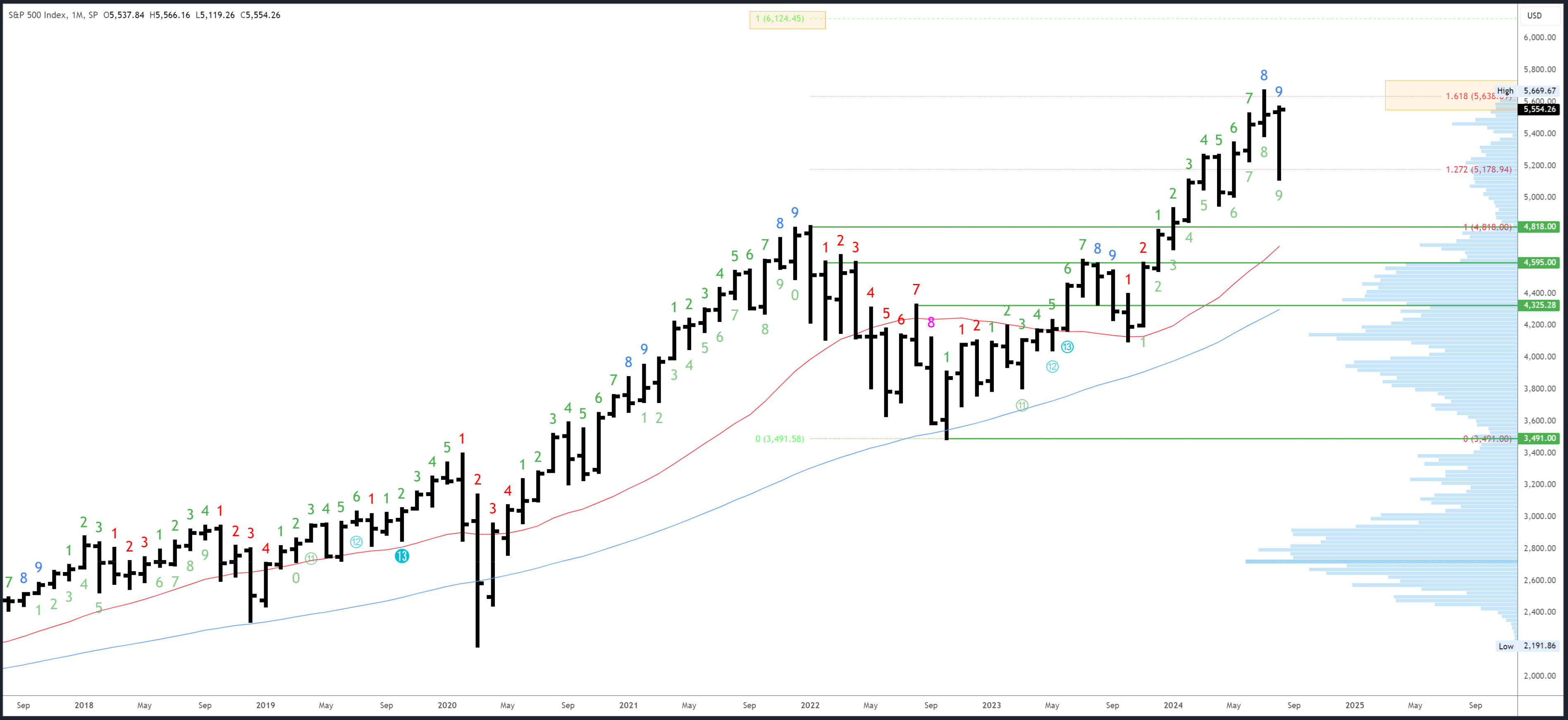
          SPX Monthly (Tradingview)

          5638 and the 5669 are major resistance points.

          5390 and the August low of 5119 are initial supports.

          The August bar will complete the upside Demark exhaustion count. It may have played out already with the correction of nearly 10%, but its effect could linger and limit rallies ahead of the election.

          S&P 500 Weekly

          Last week's article highlighted the need for a "higher low, higher high and higher close over 5344, ideally 5400" to confirm a reversal. These were provided emphatically in a very bullish weekly bar. The close at the highs suggests the rally will follow through early next week.

          The comparison with the initial drop from the 2022 top (highlighted) is still valid, but less compelling with this week's strong action. A large drop next week would be needed to keep this comparison relevant,
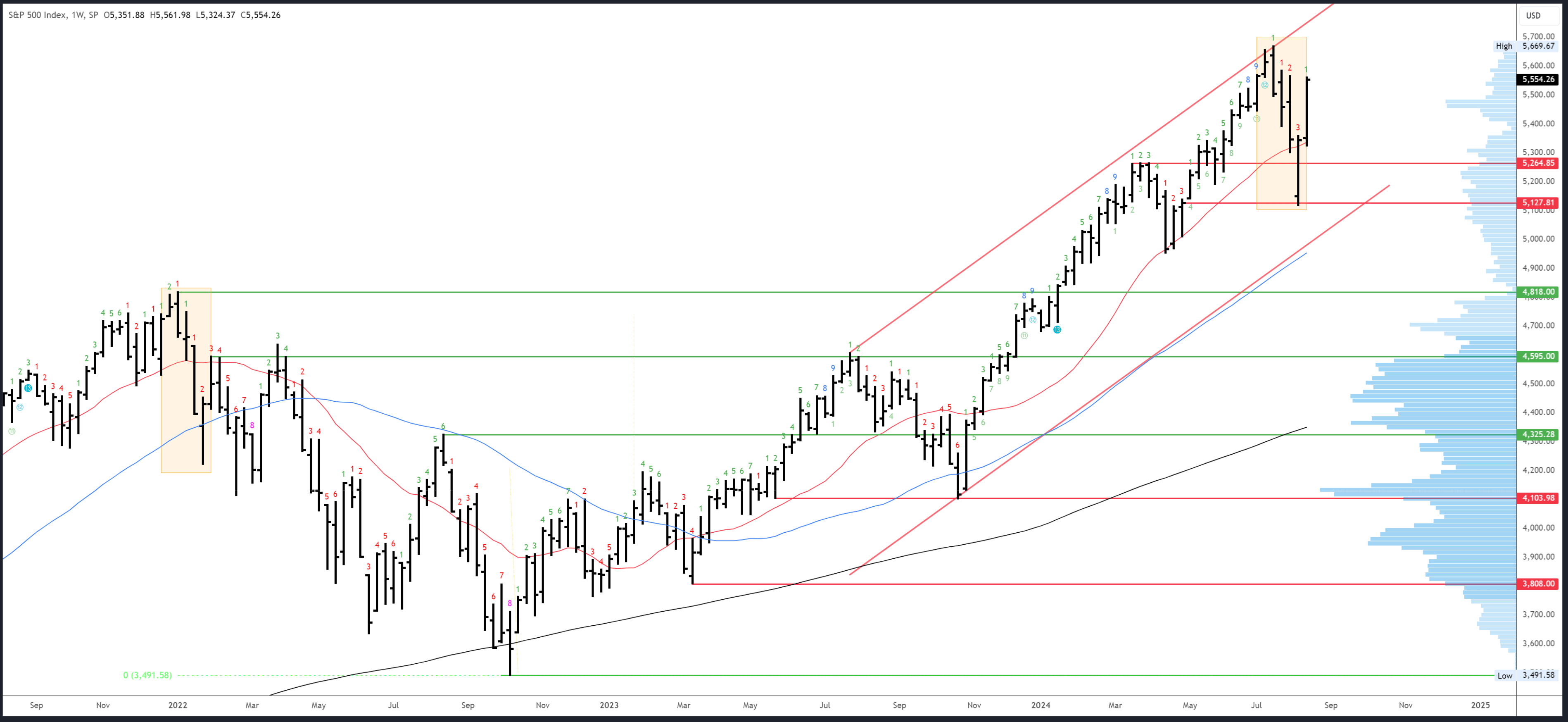
          SPX Weekly (Tradingview)

          Initial resistance comes in at 5566 and is likely to be tested early next week.

          The 20-week MA and low of last week are initial support at 5324.

          Next week will be bar 2 (of a possible 9) in a new upside Demark exhaustion count.

          S&P 500 Daily

          The S&P500 is nearly back where the 3-day crash (if we can call it that) originated at 5566. It's obvious resistance, but so was the 5390-400 area which was cut through last week like it was nothing. This is similar action to early November '23 and to early May '24 when the rally gapped over resistance points and maintained strong momentum.

          Rallies tend to slow when they reach the area of the preceding top and a clean break of 5669 looks unlikely. Expect shallow dips until this level is reached.
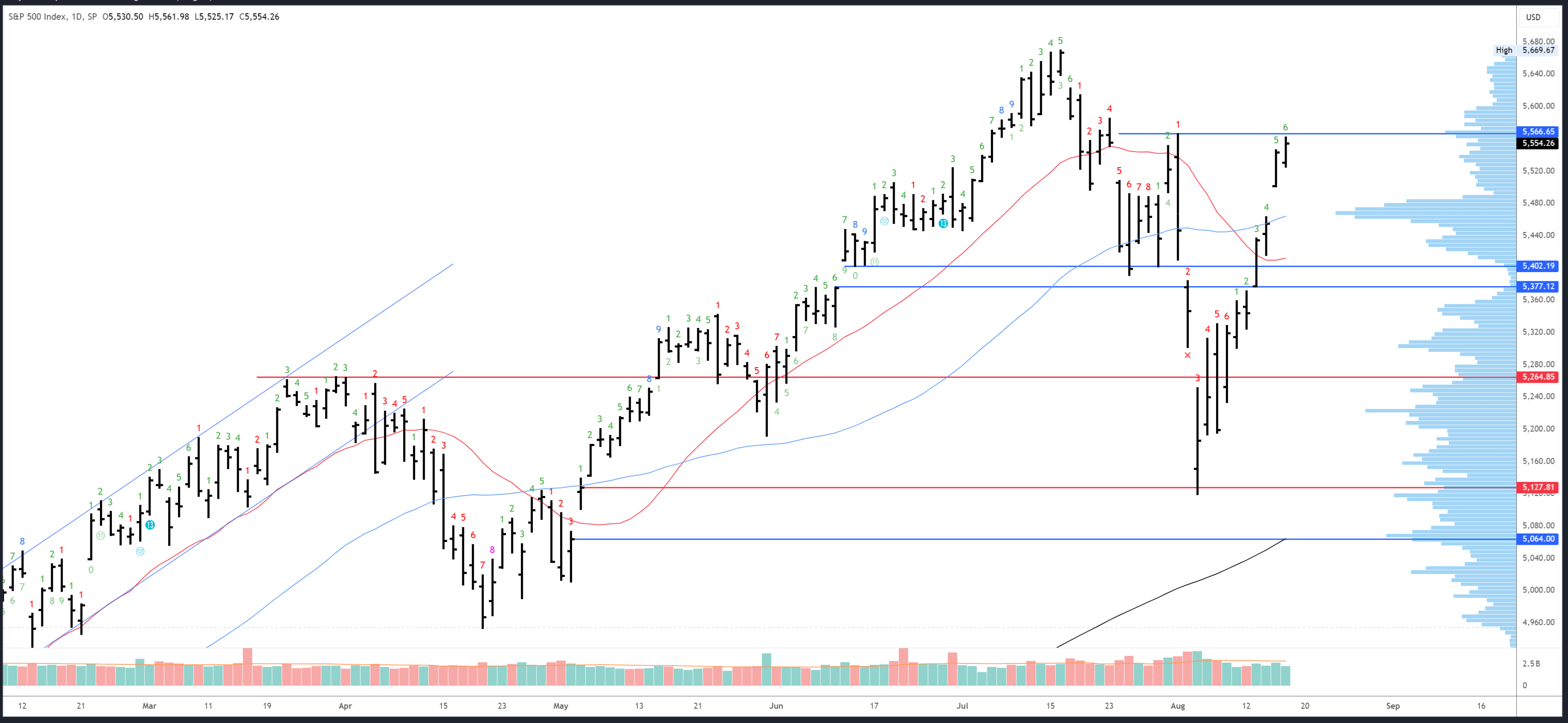
          SPX Daily (Tradingview)

          5566-85 is the first resistance, then the 5669 peak.

          On the downside, the gap at 5500 is potential support, followed by 5463-70 at the high volume area. The 5390-400 area is still relevant; a break below this level would put the recovery into question.

          An upside Demark exhaustion will be on bar 7 (of 9) on Monday. A reaction is often seen on bars 8 or 9 which means a pause/dip gets more likely from Tuesday onwards.

          Drivers/Events

          The data was so good this week, a 50bps cut in September has been priced out and the odds of a 25bps move have risen to 75%. US Core PPI came in at 0.0% when 0.2% was expected, CPI stayed at 0.2%, but most important of all, Unemployment Claims came in lower than expected at 227K, some way from the danger area of 250K. Panic over the labour market seems premature. Importantly, yields moved lower again, this time for the right reasons (low inflation).

          Data next week is on the quiet side and should allow the current move higher to continue. FOMC Minutes are due for release Wednesday while Thursday will bring PMIs and Unemployment Claims - the stronger the better for the S&P500. Fed Chair Powell is scheduled to talk at the Jackson Hole Symposium on Friday. While no surprises are expected, it will be interesting to hear the Fed's view on recent events; will they push back on the dovish repricing and expectations for aggressive cuts? Probably not.

          While the data may be positive, concerns over valuations, the economy and the election could cap the upside. Remember the July top formed on good news (CPI), and the August bottom came when things looked their worst. The reaction to data often depends on the technical context (positioning).

          Probable Moves Next Week(s)

          The bullish bigger picture view is firmly intact and it seems the expected H2 correction has played out already. New all-time highs are expected in the coming weeks, although the trend above 5669 may be limited by the continued effect of the monthly exhaustion signal and concerns over the labour market/economy. Election uncertainty is also likely to cap rallies. I'm anticipating an initial break of 5669 will fail and then lead to a much slower drift higher to form a wedge pattern.

          Short-term, resistance at 5566-85 should be reached early next week. A daily exhaustion signal should then lead to a pause and dip, but 5500 ideally holds to set up continuation to 5669 where a longer consolidation is likely. Assuming this scenario plays out reasonably well, I would buy near 5500 and add if 5463-70 is reached.

          Should 5390-400 break, it would mean my conclusions of a strong move to 5669 are wrong and the S&P500 is still in a correctional phase. Although this would be disappointing, it could provide an opportunity to buy during a deeper dip and I may get a second chance after all.

          Source: SEEKINGALPHA

          Risk Warnings and Disclaimers
          You understand and acknowledge that there is a high degree of risk involved in trading. Following any strategies or investment methods may lead to potential losses. The content on the site is provided by our contributors and analysts for information purposes only. You are solely responsible for determining whether any trading assets, securities, strategy, or any other product is suitable for investing based on your own investment objectives and financial situation.
          Add to Favorites
          Share

          Political Turmoil Threatens Baht Resurgence as Traders Await BOT

          Thomas

          Forex

          Political

          The Thai baht's recent rally is under threat as markets digest the nation's latest political drama ahead of this week's central bank policy meeting.
          The baht has been one of the region's top performing currencies since the start of July — aided partly by a rebound in tourism — after hitting a near two-year low against the dollar in May. The resurgence may be derailed however, following a tumultuous period that included Paetongtarn Shinawatra winning a parliamentary vote to become the new prime minister, while a court ousted her predecessor.
          "We maintain our bearish view on the baht, looking at 36.0 by year end,” said Jeffrey Zhang, emerging markets strategist at Credit Agricole CIB HK Branch. "Thailand's growth could still struggle to get back to trend, and we see a risk of a lower neutral rate given the long-term structural growth impediments.”
          The baht's recent gains against the greenback are also looking technically vulnerable. The currency pair is now in oversold territory, according to a momentum indicator, with some forecasters seeing it as weak as 37.5 per dollar by the end of the year. The baht closed at 34.6 on Friday.
          Traders will now turn their attention to the Bank of Thailand's (BOT) upcoming policy decision this week, with the central bank expected to keep interest rates unchanged at 2.50%. Narrowing yield differentials between Thailand and the US, as markets price in possible Federal Reserve interest-rate cuts in September, may offer support for the baht.
          However, even if the BOT stays on hold, that may not be enough to stop the Asian currency from weakening in the near-term amid the political angst.
          "After recent strong gains, the baht could face resistance to additional strengthening,” said Moh Siong Sim, an FX strategist at Bank of Singapore Ltd, who sees the currency moving toward 36.0 per dollar by the end of this quarter. "US election risks could see dollar strengthening back, especially under a Trump 2.0 scenario,” added Sim.
          Concerns over Thailand's elevated household debt and investment attractiveness remain a high priority for market watchers. Paetongtarn, a daughter of former Thai leader Thaksin Shinawatra, has advocated for lower interest rates and slammed the central bank as an "obstacle” to resolving the country's economic issues. There are also reports that the new government may scrap a US$14 billion (RM61.52 billion) digital cash handout program.
          "With Paetongtarn securing enough votes for PM, political uncertainty has dissipated for now,” Shreya Sodhani, a regional economist at Barclays plc, wrote in a client note on Friday. "We now expect the digital wallet plan to be scrapped, which would imply that the full year 2025 budget faces some delay.”

          Source: Bloomberg

          Risk Warnings and Disclaimers
          You understand and acknowledge that there is a high degree of risk involved in trading. Following any strategies or investment methods may lead to potential losses. The content on the site is provided by our contributors and analysts for information purposes only. You are solely responsible for determining whether any trading assets, securities, strategy, or any other product is suitable for investing based on your own investment objectives and financial situation.
          Add to Favorites
          Share

          Europe's Savvy New Clean Energy Champion

          Devin

          Energy

          Utilities in Portugal have cut the proportion of electricity production from fossil fuels to just 10% so far in 2024, leap-frogging neighbour Spain to emerge as western Europe's second-cleanest large power sector behind France.
          Total clean electricity generation through the first seven months of 2024 jumped 32% from the same months in 2023 to a record 21.76 terawatt hours (TWh), data from energy think tank Ember shows.
          Europe's Savvy New Clean Energy Champion_1Record output from solar and wind farms plus the highest hydro generation total since 2016 have been the main drivers of the clean power surge, which allowed generators to slash natural gas-fired output by 60% from the January to July period in 2023.
          Europe's Savvy New Clean Energy Champion_2Portugal's power firms have also lifted total electricity generation by 7% to the highest since 2021, demonstrating that a multi-pronged approach to boosting clean generation can trigger rapid progress against energy transition targets.

          Turnaround

          The deployment of some of Europe's largest new hydro dams and solar parks this year has been instrumental in accelerating the cuts to fossil fuel use in Portugal's generation mix.
          Both the 1,158 megawatt (MW) capacity Tamega dam and the 202 MW capacity Cerca solar farm commenced operations this year, which allowed power firms to cut total fossil fuel-generated electricity to just 2.53 TWh so far this year through July.
          Europe's Savvy New Clean Energy Champion_3That fossil-fired total is down 59% from the same period in 2023, and is the lowest on record.
          Total power sector emissions have dropped sharply as a result, to 2.12 million metric tons of carbon dioxide for the first seven months, which is 45% less than the same months in 2023 and a new record.

          Hydro Help

          Both the new Tamega facility plus higher precipitation levels have helped steer Portugal's hydro generation higher this year.
          Europe's Savvy New Clean Energy Champion_4Through the first seven months of 2024, pumped storage output was up 67% to 172,758 megawatt hours (MWh), while run-of-river generation was 70% higher at 259,415 MWh, according to LSEG.
          Reservoir-based hydro generation was 76% up at 117,024 MWh.
          Europe's Savvy New Clean Energy Champion_5All told, the cumulative gains in Portugal's hydro generation allowed hydropower's share of the electricity generation mix to average 35.3% so far this year, compared to 20.7% during the same period in 2023, Ember's data shows.
          Solar and wind assets have also seen their shares of the utility generation mix climb.
          Solar power generated an average share of 13.3% of Portugal's electricity so far this year, up from 10.6% in 2023, while wind farms accounted for an average share of 33.1%, up from 32.6% in January-July 2023.
          And clean power's share of the generation mix looks set to keep growing, following new proposals by Portugal's government to increase the weight of renewables in power production.
          As part of goals to become carbon neutral by 2045, renewables will generate 51% of the country's final energy needs by 2030, the government said last month.
          Innovative deployments of renewable assets on existing energy projects look set to help achieve those goals.
          The award-winning Alqueva floating solar park integrates hydro power, floating solar and battery storage that can generate 7.5 gigawatt hours (GWh) of clean energy annually.
          And a planned 274 MW capacity wind farm incorporated into the Tamega dam project will generate enough clean power to meet the annual energy needs of 128,000 homes, according to developer Iberdrola.
          Further expansions in Portugal's solar capacity is also expected following a planned project with The Nature Conservancy to identify optimal solar farm sites, and the country is also exploring offshore wind site suitability alongside upgrades at existing onshore farms.
          In combination, this mix of current momentum and planned growth looks set to push Portugal even higher up the list of Europe's clean power champions, and help the country establish itself as a global energy transition leader.

          Source: Reuters

          Risk Warnings and Disclaimers
          You understand and acknowledge that there is a high degree of risk involved in trading. Following any strategies or investment methods may lead to potential losses. The content on the site is provided by our contributors and analysts for information purposes only. You are solely responsible for determining whether any trading assets, securities, strategy, or any other product is suitable for investing based on your own investment objectives and financial situation.
          Add to Favorites
          Share
          FastBull
          Copyright © 2025 FastBull Ltd

          728 RM B 7/F GEE LOK IND BLDG NO 34 HUNG TO RD KWUN TONG KLN HONG KONG

          TelegramInstagramTwitterfacebooklinkedin
          App Store Google Play Google Play
          Products
          Charts

          Chats

          Q&A with Experts
          Screeners
          Economic Calendar
          Data
          Tools
          Membership
          Features
          Function
          Markets
          Copy Trading
          Latest Signals
          Contests
          News
          Analysis
          24/7
          Columns
          Education
          Company
          Careers
          About Us
          Contact Us
          Advertising
          Help Center
          Feedback
          User Agreement
          Privacy Policy
          Business

          White Label

          Data API

          Web Plug-ins

          Poster Maker

          Affiliate Program

          Risk Disclosure

          The risk of loss in trading financial instruments such as stocks, FX, commodities, futures, bonds, ETFs and crypto can be substantial. You may sustain a total loss of the funds that you deposit with your broker. Therefore, you should carefully consider whether such trading is suitable for you in light of your circumstances and financial resources.

          No decision to invest should be made without thoroughly conducting due diligence by yourself or consulting with your financial advisors. Our web content might not suit you since we don't know your financial conditions and investment needs. Our financial information might have latency or contain inaccuracy, so you should be fully responsible for any of your trading and investment decisions. The company will not be responsible for your capital loss.

          Without getting permission from the website, you are not allowed to copy the website's graphics, texts, or trademarks. Intellectual property rights in the content or data incorporated into this website belong to its providers and exchange merchants.

          Not Logged In

          Log in to access more features

          FastBull Membership

          Not yet

          Purchase

          Become a signal provider
          Help Center
          Customer Service
          Dark Mode
          Price Up/Down Colors

          Log In

          Sign Up

          Position
          Layout
          Fullscreen
          Default to Chart
          The chart page opens by default when you visit fastbull.com
