• Trade
  • Markets
  • Copy
  • Contests
  • News
  • 24/7
  • Calendar
  • Q&A
  • Chats
Trending
Screeners
SYMBOL
LAST
BID
ASK
HIGH
LOW
NET CHG.
%CHG.
SPREAD
SPX
S&P 500 Index
6874.14
6874.14
6874.14
6875.19
6867.67
+17.02
+ 0.25%
--
DJI
Dow Jones Industrial Average
47947.10
47947.10
47947.10
47950.02
47873.62
+96.17
+ 0.20%
--
IXIC
NASDAQ Composite Index
23592.37
23592.37
23592.37
23597.30
23566.37
+87.24
+ 0.37%
--
USDX
US Dollar Index
98.930
99.010
98.930
99.000
98.740
-0.050
-0.05%
--
EURUSD
Euro / US Dollar
1.16455
1.16463
1.16455
1.16715
1.16408
+0.00010
+ 0.01%
--
GBPUSD
Pound Sterling / US Dollar
1.33440
1.33447
1.33440
1.33622
1.33165
+0.00169
+ 0.13%
--
XAUUSD
Gold / US Dollar
4230.51
4230.92
4230.51
4239.24
4194.54
+23.34
+ 0.55%
--
WTI
Light Sweet Crude Oil
59.611
59.641
59.611
59.623
59.187
+0.228
+ 0.38%
--

Community Accounts

Signal Accounts
--
Profit Accounts
--
Loss Accounts
--
View More

Become a signal provider

Sell trading signals to earn additional income

View More

Guide to Copy Trading

Get started with ease and confidence

View More

Signal Accounts for Members

All Signal Accounts

Best Return
  • Best Return
  • Best P/L
  • Best MDD
Past 1W
  • Past 1W
  • Past 1M
  • Past 1Y

All Contests

  • All
  • Trump Updates
  • Recommend
  • Stocks
  • Cryptocurrencies
  • Central Banks
  • Featured News
Top News Only
Share

Turkish Treasury Says November Cash Balance +56.39 Billion Lira

Share

Toronto Stock Index .GSPTSE Rises 18.15 Points, Or 0.06 Percent, To 31495.72 At Open

Share

European Central Bank Governing Council Member Villeroy: The Name Of The Game For Our Future Meetings Remains Full Optionality, The Only Fixed Figure Is Our 2% Inflation Target

Share

European Central Bank Governing Council Member Villeroy: Downside Risks To Inflation Outlook Remain At Least As Significant As The Upside Risks

Share

ECB Governing Council Member Villeroy: The Persistence Of The Deviation Is More Important Than The Magnitude Of The Deviation

Share

A Senior White House Official Declared That President Trump's Administration Viewed Netflix's Acquisition Of Warner Bros. Discovery With "strong Skepticism."

Share

Russian Central Bank: Sets Official Rouble Rate For December 6 At 76.0937 Roubles Per USA Dollar (Previous Rate - 76.9708)

Share

US Natural Gas Futures Surge 4% To 35-Month High In Cold Snap

Share

European Central Bank Governing Council Member Villeroy: Positive And Negative Deviations From 2% Target, If Lasting, Are Equally Undesirable

Share

US President Trump (TruthSocial): The Democratic Party’s Primary Policy Goal Is To Completely Destroy Our US Supreme Court

Share

ECB Governing Council Member Villeroy: ECB Forecasts Play A Key Role In Decision-making

Share

Carr, An Official With The U.S. Federal Communications Commission (FCC), Said: "The EU Taxes U.S. Companies To Subsidize Itself."

Share

Sri Lanka Central Bank: Directs Licensed Banks To Provide Temporary Debt Relief, New Loan Facilities To Affected Borrowers

Share

Sri Lanka Central Bank : Relief Measures To Assist Individuals And Businesses Affected By Recent Cyclonic And Flood Disasters By Licensed Banks

Share

European Central Bank Governing Council Member Villeroy: Currently "Good Position" Of European Central Bank Policy Does Not Mean A Comfortable Position Nor A Fixed One

Share

Canadian Dollar Extends Gains, Touches A 10-Week High At 1.3877 Per USA Dollar

Share

SEBI: Consultation Paper On Review Of Master Circular For Fpis And Designated Depository Participants

Share

IMF: Sri Lankan Authorities Have Requested Financial Assistance From The IMF Under The Rapid Financing Instrument (Rfi) For Sdr 150.5 Million (Approximately 26 Percent Of Quota Or About US$200 Million)

Share

Cvs Health Generates Over $474 Billion In 2024 USA Economic Impact, Supporting Communities Throughout The United States

Share

Fed Data: USA Effective Federal Funds Rate At 3.89 Percent On 04 December On $87 Billion In Trades Versus 3.89 Percent On $85 Billion On 03 December

TIME
ACT
FCST
PREV
U.S. Non-Defense Capital Durable Goods Orders Revised MoM (Excl. Aircraft) (SA) (Sept)

A:--

F: --

P: --
U.S. Factory Orders MoM (Excl. Transport) (Sept)

A:--

F: --

P: --

U.S. Factory Orders MoM (Excl. Defense) (Sept)

A:--

F: --

P: --

U.S. EIA Weekly Natural Gas Stocks Change

A:--

F: --

P: --

Saudi Arabia Crude Oil Production

A:--

F: --

P: --

U.S. Weekly Treasuries Held by Foreign Central Banks

A:--

F: --

P: --

Japan Foreign Exchange Reserves (Nov)

A:--

F: --

P: --

India Repo Rate

A:--

F: --

P: --

India Benchmark Interest Rate

A:--

F: --

P: --

India Reverse Repo Rate

A:--

F: --

P: --

India Cash Reserve Ratio

A:--

F: --

P: --

Japan Leading Indicators Prelim (Oct)

A:--

F: --

P: --

U.K. Halifax House Price Index YoY (SA) (Nov)

A:--

F: --

P: --

U.K. Halifax House Price Index MoM (SA) (Nov)

A:--

F: --

P: --

France Current Account (Not SA) (Oct)

A:--

F: --

P: --

France Trade Balance (SA) (Oct)

A:--

F: --

P: --

France Industrial Output MoM (SA) (Oct)

A:--

F: --

P: --

Italy Retail Sales MoM (SA) (Oct)

A:--

F: --

P: --

Euro Zone Employment YoY (SA) (Q3)

A:--

F: --

P: --

Euro Zone GDP Final YoY (Q3)

A:--

F: --

P: --

Euro Zone GDP Final QoQ (Q3)

A:--

F: --

P: --

Euro Zone Employment Final QoQ (SA) (Q3)

A:--

F: --

P: --

Euro Zone Employment Final (SA) (Q3)

A:--

F: --

P: --
Brazil PPI MoM (Oct)

A:--

F: --

P: --

Mexico Consumer Confidence Index (Nov)

A:--

F: --

P: --

Canada Unemployment Rate (SA) (Nov)

A:--

F: --

P: --

Canada Labor Force Participation Rate (SA) (Nov)

A:--

F: --

P: --

Canada Employment (SA) (Nov)

A:--

F: --

P: --

Canada Part-Time Employment (SA) (Nov)

A:--

F: --

P: --

Canada Full-time Employment (SA) (Nov)

A:--

F: --

P: --

U.S. Personal Income MoM (Sept)

--

F: --

P: --

U.S. Dallas Fed PCE Price Index YoY (Sept)

--

F: --

P: --

U.S. PCE Price Index YoY (SA) (Sept)

--

F: --

P: --

U.S. PCE Price Index MoM (Sept)

--

F: --

P: --

U.S. Personal Outlays MoM (SA) (Sept)

--

F: --

P: --

U.S. Core PCE Price Index MoM (Sept)

--

F: --

P: --

U.S. UMich 5-Year-Ahead Inflation Expectations Prelim YoY (Dec)

--

F: --

P: --

U.S. Core PCE Price Index YoY (Sept)

--

F: --

P: --

U.S. Real Personal Consumption Expenditures MoM (Sept)

--

F: --

P: --

U.S. 5-10 Year-Ahead Inflation Expectations (Dec)

--

F: --

P: --

U.S. UMich Current Economic Conditions Index Prelim (Dec)

--

F: --

P: --

U.S. UMich Consumer Sentiment Index Prelim (Dec)

--

F: --

P: --

U.S. UMich 1-Year-Ahead Inflation Expectations Prelim (Dec)

--

F: --

P: --

U.S. UMich Consumer Expectations Index Prelim (Dec)

--

F: --

P: --

U.S. Weekly Total Rig Count

--

F: --

P: --

U.S. Weekly Total Oil Rig Count

--

F: --

P: --

U.S. Consumer Credit (SA) (Oct)

--

F: --

P: --

China, Mainland Foreign Exchange Reserves (Nov)

--

F: --

P: --

China, Mainland Exports YoY (USD) (Nov)

--

F: --

P: --

China, Mainland Imports YoY (CNH) (Nov)

--

F: --

P: --

China, Mainland Imports YoY (USD) (Nov)

--

F: --

P: --

China, Mainland Imports (CNH) (Nov)

--

F: --

P: --

China, Mainland Trade Balance (CNH) (Nov)

--

F: --

P: --

China, Mainland Exports (Nov)

--

F: --

P: --

Japan Wages MoM (Oct)

--

F: --

P: --

Japan Trade Balance (Oct)

--

F: --

P: --

Japan Real GDP QoQ (Q3)

--

F: --

P: --

Japan Nominal GDP Revised QoQ (Q3)

--

F: --

P: --

Japan Trade Balance (Customs Data) (SA) (Oct)

--

F: --

P: --

Japan GDP Annualized QoQ Revised (Q3)

--

F: --

P: --
Q&A with Experts
    • All
    • Chatrooms
    • Groups
    • Friends
    Connecting
    .
    .
    .
    Type here...
    Add Symbol or Code

      No matching data

      All
      Trump Updates
      Recommend
      Stocks
      Cryptocurrencies
      Central Banks
      Featured News
      • All
      • Russia-Ukraine Conflict
      • Middle East Flashpoint
      • All
      • Russia-Ukraine Conflict
      • Middle East Flashpoint

      Search
      Products

      Charts Free Forever

      Chats Q&A with Experts
      Screeners Economic Calendar Data Tools
      Membership Features
      Data Warehouse Market Trends Institutional Data Policy Rates Macro

      Market Trends

      Market Sentiment Order Book Forex Correlations

      Top Indicators

      Charts Free Forever
      Markets

      News

      News Analysis 24/7 Columns Education
      From Institutions From Analysts
      Topics Columnists

      Latest Views

      Latest Views

      Trending Topics

      Top Columnists

      Latest Update

      Signals

      Copy Rankings Latest Signals Become a signal provider AI Rating
      Contests
      Brokers

      Overview Brokers Assessment Rankings Regulators News Claims
      Broker listing Forex Brokers Comparison Tool Live Spread Comparison Scam
      Q&A Complaint Scam Alert Videos Tips to Detect Scam
      More

      Business
      Events
      Careers About Us Advertising Help Center

      White Label

      Data API

      Web Plug-ins

      Affiliate Program

      Awards Institution Evaluation IB Seminar Salon Event Exhibition
      Vietnam Thailand Singapore Dubai
      Fans Party Investment Sharing Session
      FastBull Summit BrokersView Expo
      Recent Searches
        Top Searches
          Markets
          News
          Analysis
          User
          24/7
          Economic Calendar
          Education
          Data
          • Names
          • Latest
          • Prev

          View All

          No data

          Scan to Download

          Faster Charts, Chat Faster!

          Download App
          English
          • English
          • Español
          • العربية
          • Bahasa Indonesia
          • Bahasa Melayu
          • Tiếng Việt
          • ภาษาไทย
          • Français
          • Italiano
          • Türkçe
          • Русский язык
          • 简中
          • 繁中
          Open Account
          Search
          Products
          Charts Free Forever
          Markets
          News
          Signals

          Copy Rankings Latest Signals Become a signal provider AI Rating
          Contests
          Brokers

          Overview Brokers Assessment Rankings Regulators News Claims
          Broker listing Forex Brokers Comparison Tool Live Spread Comparison Scam
          Q&A Complaint Scam Alert Videos Tips to Detect Scam
          More

          Business
          Events
          Careers About Us Advertising Help Center

          White Label

          Data API

          Web Plug-ins

          Affiliate Program

          Awards Institution Evaluation IB Seminar Salon Event Exhibition
          Vietnam Thailand Singapore Dubai
          Fans Party Investment Sharing Session
          FastBull Summit BrokersView Expo

          The Upcoming Rate Cut: 5 Things Homebuyers Should Consider

          NAR

          Economic

          Commodity

          Summary:

          The Federal Reserve has kept its interest rates unchanged for over a year. However, this is expected to change in the coming week.

          The Federal Reserve has kept its interest rates unchanged for over a year. However, this is expected to change in the coming week. The economy has consistently indicated that it may no longer need the cooling effects of high interest rates. Inflation has dropped below 3%, while job creation has slowed to about 30% below the average pace seen over the past 12 months. Thus, the Fed is strongly considering an interest rate cut at its meeting in mid-September.
          The Fed's interest rate decisions have far-reaching implications for the U.S. economy, particularly the housing market. Homebuyers closely watch to understand how such a change might affect mortgage rates, home prices, and overall housing demand. Below, let's explore the potential effects of the expected Fed rate cut on the housing market, focusing on how these actions may impact mortgage rates and housing affordability.

          Understanding the Fed's rate and its link to the housing market

          First, it’s important to note that the Fed doesn’t directly set mortgage rates. Instead, it controls the federal funds rate, which is the interest rate at which banks lend to one another. However, this rate has a ripple effect across the economy, influencing various other interest rates, including those on savings accounts, loans, and mortgages. When the Fed adjusts its rate, it triggers changes across the broader lending system.
          The expectation of a Fed rate cut typically pushes down long-term rates like the 10-year Treasury yield, which is closely tied to the 30-year fixed mortgage rate. This is why mortgage rates tend to decline in anticipation of a Fed rate cut, even before it officially happens.
          Historically, the market responds to expectations, not just actual Fed decisions. Data shows that both the 10-year Treasury yield and mortgage rates usually start trending down a few months ahead of an anticipated Fed rate cut. Here are a couple of examples:

          Rate cut on September 18, 2007

          While the Fed cut its rates in mid-September 2007 – after holding them at the same level of 5.3% for 14 months – the 10-year Treasury yield had already begun to decline in July and August, ahead of the cut. Specifically, after surpassing 6.7%[1] in mid-July, the 30-year fixed mortgage rate had already dropped to 6.4% by the day before the actual rate cut. On the day of the cut, mortgage rates ticked up, only to drop to 6.35% over the next couple of days before hovering around 6.38% for the next ten days or so. Rates fell below 6.3% on October 10th in anticipation of the Fed’s next rate cut on October 31.

          Rate cut on July 13, 1990

          In July 1990, the Fed lowered its rates, while a couple of months earlier, the 10-year Treasury yield and mortgage rates had already started to fall. After reaching 10.49% on May 10, mortgage rates had already dropped to 10.02% by the day before the cut. On the day of the cut, rates ticked up to 10.03%, and mortgage rates didn’t experience a significant drop afterward. In fact, they rose above the levels seen in July but eventually fell below the 10% threshold following an additional rate cut from the Fed on October 29, 1990.
          We are seeing the same pattern now. Although the Fed has not yet cut rates, the 10-year Treasury yield has been easing since May, and the 30-year fixed mortgage rate has followed suit since June. Mortgage rates are over 100 basis points lower than they were on May 29th. This suggests that markets have already priced in some of the expected impact of the Fed’s upcoming rate cut.

          How low could mortgage rates fall after the cut?

          This is a very challenging question. Predicting mortgage rates is difficult due to the complexity and interplay of various economic factors that influence them. However, in very simple terms, historical data suggests that a 100-basis point rate cut typically leads to an 87-basis point drop in mortgage rates. With the Fed expected to lower its rates by 50 basis points by the end of the year, mortgage rates could fall to around 5.9% by year’s end. Nevertheless, this impact will likely be lessened as mortgage rates have already priced in some of the expected rate cuts. As of now, mortgage rates are already over 100 basis points lower than they were at the end of May 2024.

          Five things homebuyers should consider after the rate cut

          Lower mortgage rates
          One of the most immediate effects of a Fed rate cut is the potential for lower mortgage rates. For prospective homebuyers, this can mean lower monthly payments or the ability to buy a more expensive home than they otherwise could. However, as analyzed above, mortgage rates have already priced in some of the effects of the Fed’s rate cut. This could mean rates may not fall significantly after the cut next week.
          Easier qualifications for mortgages
          When mortgage rates fall, the interest portion of monthly payments decreases, which lowers the total payment. This makes it easier for more borrowers to meet lenders' debt-to-income (DTI) ratio requirements and qualify for mortgages that may have been unaffordable at higher rates. Additionally, with lower rates, lenders consider borrowers less risky since the smaller monthly payments reduce the chances of default. Lower rates not only help the process of qualifying for a new mortgage but also allow homeowners to refinance. In 2023, 74% of mortgage originations for home purchases carried rates above 6% (2.6 million mortgages), along with 82% of home improvement loans (493,230 loans) and 75% of refinances (812,140 refinances).
          Stronger demand for housing
          Lower mortgage rates reduce the cost of borrowing, increase purchasing power, and create a sense of a rush to secure a lower rate, all of which tend to drive up housing demand. However, in many areas where housing inventory is already low, this boost in demand can lead to more competition among buyers. The downside of increased demand is that it puts upward pressure on home prices as multiple buyers compete for a limited number of homes. In markets with ongoing housing shortages, this price increase can offset some of the affordability gains from lower mortgage rates.
          Improved housing affordability
          Home prices and mortgage rates are the two main components that define a mortgage payment. The home price determines the principal amount borrowed, while the mortgage rate affects the interest paid on that principal. Thus, any changes in either of these factors substantially affect the overall monthly mortgage payment. In the meantime, in a previous NAR analysis, data suggests that between these two factors – home prices and mortgage rates - decreasing mortgage rates can more swiftly improve the affordability of homes compared to lowering house prices. A one percentage point decrease in mortgage rates can reduce the monthly mortgage payment mortgage rates as much as a 10% reduction in home prices. However, in areas with a severe housing shortage, lower mortgage rates could be offset by higher home prices, as lower mortgage rates are expected to increase housing demand.
          More inventory in the market
          Affordability is interconnected with the availability of homes. Better affordability also results in more affordable options. According to a recent NAR analysis, with lower mortgage rates, buyers at all income levels can afford a greater number of listings, thereby expanding their choices. The impact is more pronounced at certain income levels, particularly in the middle and upper-middle income brackets ($75,000-$150,000). For higher income levels ($150,000 and over), the percentage increase in affordability is smaller because they already have access to a majority of the housing market. Higher-income levels are also less sensitive to rate changes.
          In addition, the gains from lower mortgage rates could be even larger, as expected rate reductions could encourage more homeowners to sell, thereby increasing the overall housing inventory.
          Furthermore, a Fed rate cut can also positively affect the construction industry. Lower borrowing costs make it cheaper for developers to finance new projects, potentially leading to increased construction of new homes.
          To stay updated on all economic events of today, please check out our Economic calendar
          Risk Warnings and Disclaimers
          You understand and acknowledge that there is a high degree of risk involved in trading. Following any strategies or investment methods may lead to potential losses. The content on the site is provided by our contributors and analysts for information purposes only. You are solely responsible for determining whether any trading assets, securities, strategy, or any other product is suitable for investing based on your own investment objectives and financial situation.
          Add to Favorites
          Share

          Investment Weekly: Emerging Rotations

          HSBC

          Economic

          Risk assets have broadly recovered from August’s sharp sell-off, but not all market moves have unwound. On evidence of cooling US economic activity and lower inflation, traders now expect 1.25% of Fed rate cuts by the end of 2024 – up from the one to two cuts expected in early summer – and that is putting pressure on the US dollar.
          Dollar weakness opens the door for other central banks to ease policy, to support their domestic economies.
          So far, ASEAN has been the region to watch. A weaker dollar, the region’s high sensitivity to Fed policy, and ongoing disinflation, have set the scene for cuts. The Philippines central bank went first in August (reducing rates by 0.25%, and some analysts think Bank Indonesia could soon follow. While there is divergence across the region, ASEAN countries like Indonesia benefit from a resilient macro backdrop, reasonable asset valuations and structural tailwinds like favourable demographics and supportive industrial policies. They’ve also been shielded from the volatility in global technology stocks and resisted the impact of strong moves in the Japanese Yen.
          Investors are reacting to this. ASEAN saw one of the strongest performances in global equities in August, and quarter-to-date – led by the Philippines, Indonesia, and Malaysia. But other EM regions are in the mix, too. Emerging Europe and Frontier regions have also done well. And while not all EMs have yet benefitted, a ‘great rotation’ in performance could continue to see a pick-up for the laggards.

          Market Spotlight

          Tech stocks boost the Hang Seng

          Hong Kong’s Hang Seng index (HSI) delivered a solid performance in August, rising by around 4%. With earnings season ongoing, the index’s technology stocks (which include HK-listed mainland Chinese firms) have mostly beaten consensus. They are benefitting from resilient demand for tech services, overseas expansion which has boosted revenues, and recent mainland Chinese policy support for the sector – given its status as a national growth priority.
          Excluding mainland Chinese tech stocks, Hong Kong’s domestic firms also performed well in August. The MSCI HK index – a close gauge of the market’s domestic stocks – rose 5.3%. Those firms are now seeing a pick-up in earnings estimates, helped by the prospect of imminent US rate cuts, and an improving outlook for non-cyclical sectors like utilities and consumer staples. That said, the downtrend in earnings for domestic stocks since mid-2022 has not yet reversed, with macro challenges still weighing on sectors like financials and real estate. With mainland China’s largely domestic onshore stock market losing more ground in August, some analysts think the HSI could continue to outperform this year given its appealing valuation and superior growth outlook.
          The value of investments and any income from them can go down as well as up and investors may not get back the amount originally invested. Past performance does not predict future returns. The level of yield is not guaranteed and may rise or fall in the future.

          Lens on…

          Back in black

          What do rock legends AC/DC know about the US bond market? …they know the yield curve is ‘Back in Black’.
          The US yield curve – which plots the relationship between two- and 10-year Treasury yields – has been inverted since March 2022. Last week’s dis-inversion – with the curve moving back into the black – shouldn’t really surprise us. After all, short-term bond yields have fallen quickly over the summer, as expectations for Fed cuts have grown.
          But what’s concerning is that a dis-inverting yield curve, driven by ‘bull steepening’ (when the short end of the curve falls faster than the long end) is a robust leading indicator of recession. Even if the yield curve is just a ‘mirror’, reflecting the bond market’s best guess about future interest rates, it looks like an important cyclical change is underway as growth and labour market data cool quickly. That should put investors on alert. The most important thing to watch now is how far – and how fast – the curve steepens.
          A gradual steepening toward a normal, say +0.5% slope, would be fully consistent with a soft landing, and a broadening out pattern in stock markets. Investment Weekly: Emerging Rotations_1

          Private equity’s green shoots

          Private equity activity has been sluggish since mid-2022 – demanding caution on the part of investors. But green shoots of recovery and a pick-up in investment deal-making could signal a turning point.
          On a like-for-like basis with other asset classes, we measure private equity expected returns in the low teens today. That reflects a sizeable equity and illiquidity premium. For an easy frame of reference, it converts to an internal rate of return (IRR) – a measure of investment profitability – of around 20%. These returns look attractive and, with valuations now lower after 2021-22 inflation burst and rapid policy tightening, we may be seeing the start of an interesting entry point for longer-term investors.
          Some headwinds remain for the asset class, however. Exit markets (where investments are sold) remain mixed; data suggest that exit values are improving, but it is difficult to see a strong bounce back in sentiment or activity levels. During the last quarter, exits were just 36% of investments and suggests that the market has still not found its equilibrium.
          Investment Weekly: Emerging Rotations_2

          To stay updated on all economic events of today, please check out our Economic calendar
          Risk Warnings and Disclaimers
          You understand and acknowledge that there is a high degree of risk involved in trading. Following any strategies or investment methods may lead to potential losses. The content on the site is provided by our contributors and analysts for information purposes only. You are solely responsible for determining whether any trading assets, securities, strategy, or any other product is suitable for investing based on your own investment objectives and financial situation.
          Add to Favorites
          Share

          My Say: The Sandwich Generation: The Case For A Consumption-based Contributory Pension

          Alex

          The “sandwich generation” refers to individuals who simultaneously care for their ageing parents while supporting their own children. This demographic trend is becoming increasingly prevalent in Malaysia because of the ageing population, rising life expectancy and strong cultural expectations that children will care for their elderly parents. As the proportion of senior citizens grows, the responsibilities of the sandwich generation will intensify, placing substantial economic and emotional pressure on working adults.

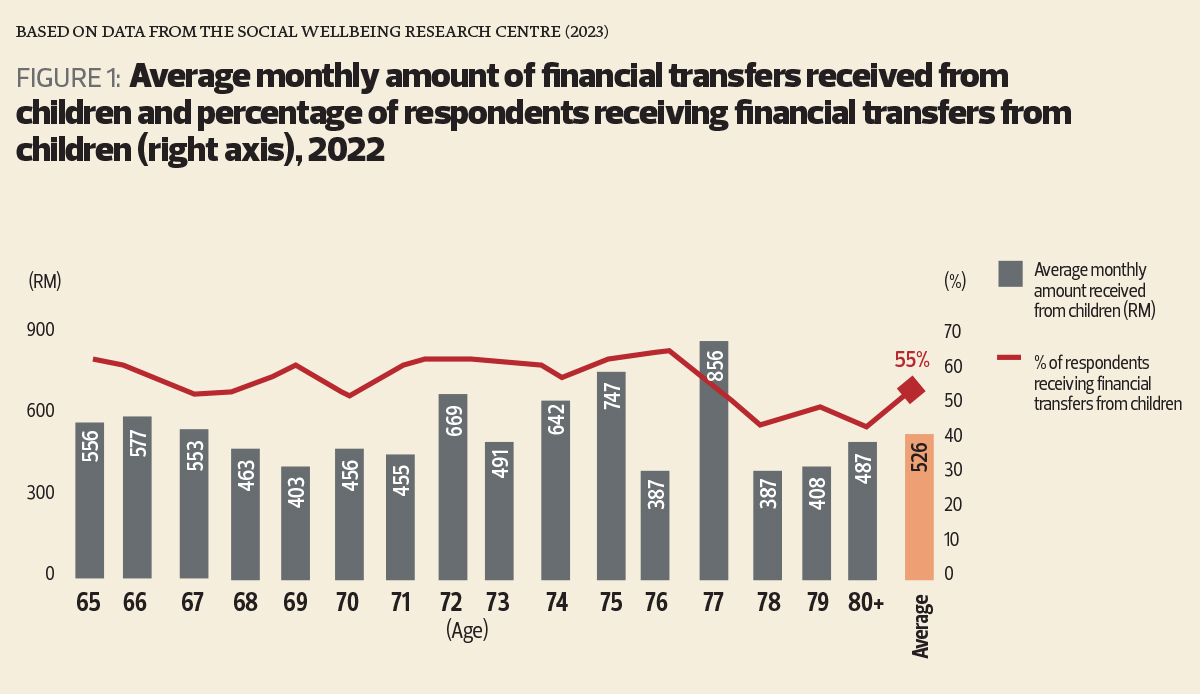
          Malaysia’s healthcare and social security systems have proved inadequate in providing comprehensive support for the elderly. As a result, many elderly Malaysians rely heavily on financial assistance from their children. According to the Malaysia Ageing and Retirement Survey (MARS) by the Social Wellbeing Research Centre (SWRC) at Universiti Malaya, more than half of the elderly respondents (55%) depend on financial transfers from their children, averaging RM526 a month .

          My Say: The Sandwich Generation: The Case For A Consumption-based Contributory Pension_1

          This dependency highlights the inadequacies of old-age income arrangements such as the Employees Provident Fund, which often fall short in covering basic living expenses and medical costs for older adults. The MARS data shows that only 5.1% of senior citizens have EPF savings to last beyond the age of 65, exacerbating the financial burden on their children.

          The dual role of supporting both ageing parents and dependent children places significant financial strain on the sandwich generation. Balancing the costs of their children’s education with the medical and living expenses of their elderly parents is a daunting challenge. MARS data shows that in 2022, individuals aged 40 to 50 allocated an average of RM234 to their parents, representing 7.4% of the average monthly income for the same year. This burden is further compounded by the rising cost of living in Malaysia. The past decade has seen significant increases in the cost of essential goods and services (cumulative increase of 30.8% since 2010), forcing many middle-aged individuals to prioritise the needs of their immediate family over long-term savings and investments. For instance, the national housing affordability index indicates that housing prices are beyond the reach of the average Malaysian household, with a median multiple of 4.7 times the median annual household income, exceeding the internationally accepted affordability threshold of 3.0 times. This situation forces many sandwich-generation families to allocate a substantial portion of their income to housing expenses, further reducing their capacity to support both their children and ageing parents.

          Demographic and labour market challenges

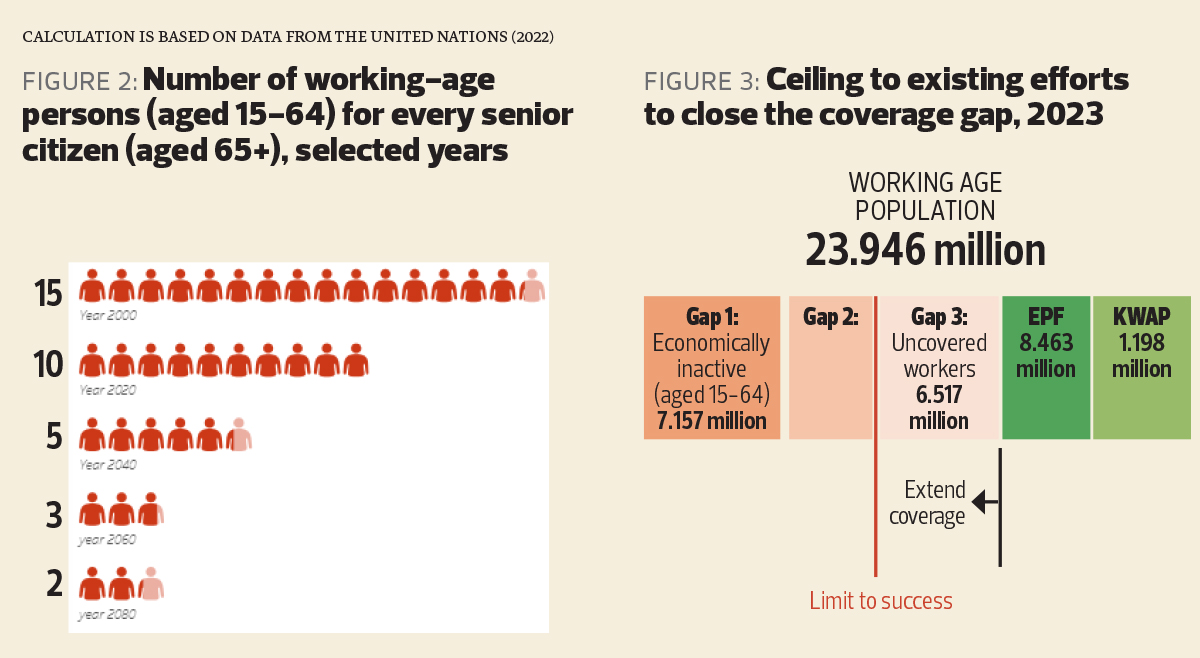
          Malaysia’s demographic landscape is undergoing profound changes, with significant implications for economic development, social security and healthcare. The number of working-age persons to support one senior citizen has declined from 15:1 in 2000 to 10:1 in 2020, and is projected to decrease further to 3:1 by 2060. This shift places immense pressure on working-age adults to support senior citizens, especially in the absence of comprehensive public income security for seniors.

          The Malaysian labour market also faces challenges that exacerbate the pressures on the sandwich generation. One of the most significant issues is the high incidence of low pay, defined as the percentage of the workforce earning less than two-thirds of the median wage. In Malaysia, over 30% of the workforce falls into this category, more than double the Organisation for Economic Co-operation and Development’s 14% low-pay incidence rate. This low-wage structure is coupled with wage disparities along geographical, educational and skill lines. Added to this, the female labour force participation rate, at 55.8% in 2022, is significantly lower than the male participation rate of 81.9%. These disparities contribute to inadequate old-age protection, particularly for vulnerable groups such as women, self-employed workers and low-wage earners.

          My Say: The Sandwich Generation: The Case For A Consumption-based Contributory Pension_2

          System gaps and old-age poverty

          Malaysia’s reliance on an insurance model based on labour market participation and income level, with limited government intervention, results in lower coverage rates and inadequate benefits for most Malaysians. This situation places significant pressure on the sandwich generation to provide for their ageing parents.

          In 2023, 13.735 million working-age individuals, or 57.36% of the population, were not covered by either EPF or Retirement Fund (Inc) (KWAP). These coverage gaps leave many individuals vulnerable to old-age poverty, disproportionately affecting senior citizens.

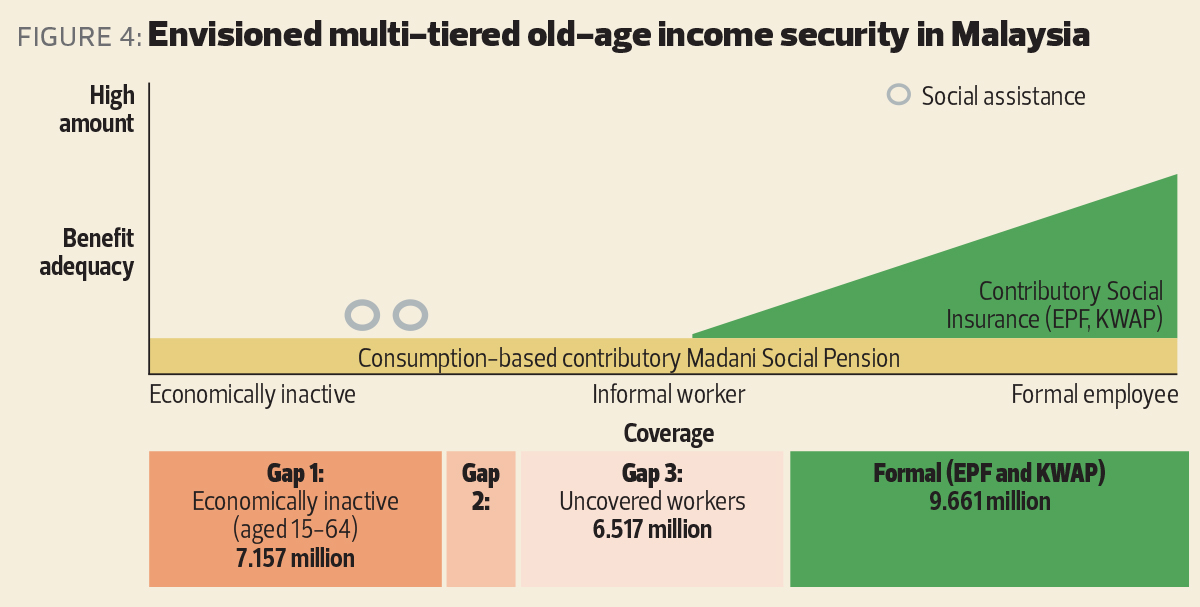
          Closing the coverage gap, therefore, is essential to alleviating the financial strain on the sandwich generation. Effective policy formulation requires a detailed examination of the various segments within the working-age population, acknowledging the specific factors contributing to each gap. For example, EPF’s initiatives, such as i-Saraan, aim to extend coverage to the informal sector and gig economy but fall short in addressing gap 2 (unemployed individuals) and gap 1 (those not in the labour market, particularly women with family responsibilities). These groups risk reaching retirement age without sufficient accumulated savings for old-age income security, leaving them vulnerable to poverty in their senior years and dependent on their children for support. Addressing these gaps comprehensively is crucial for ensuring equitable old-age security across all segments of society.

          Pension adequacy is another significant weakness in Malaysia’s current system. EPF statistics show that more than one-third of contributors withdraw their retirement savings as a lump sum at retirement, currently set at age 55. However, the median savings amount at age 54 is only RM44,025, equivalent to just nine months of per capita income as at 2023. This median savings obscures the fact that female members have a median savings of only RM29,975 compared to RM63,351 for male members, highlighting the compounded financial vulnerability faced by women in retirement.

          The case for a consumption-based contributory pension

          Given the pressing challenges faced by the sandwich generation, the introduction of a consumption-based contributory pension (CBCP) offers a sustainable and equitable solution. Unlike traditional pension schemes that rely on direct payments from labour income, CBCP introduces a 2% contribution linked directly to consumption, harnessing the economic activity of all residents, regardless of employment status. By extending coverage to all senior citizens, including those without employment records, CBCP would particularly benefit women and individuals in unstable forms of employment who are currently excluded from old-age income security.

          CBCP offers a distinct advantage by directly linking contributions to a tangible social benefit — a flat-rate pension of RM700 a month for senior citizens. This direct connection could make CBCP more palatable to the public, positioning it as a progressive policy that not only addresses old-age income security but also alleviates the financial pressures on the sandwich generation.

          My Say: The Sandwich Generation: The Case For A Consumption-based Contributory Pension_3

          Integrating CBCP into Malaysia’s pension system

          Integrating a flat CBCP as a foundational pillar within Malaysia’s pension system would provide a vital complement to existing earnings-related tiers, such as EPF. This strategic approach would significantly broaden the pension system’s reach, encompassing informal and self-employed workers who are often left out of traditional pension schemes, as well as individuals outside the labour force. By ensuring that all senior citizens, regardless of their labour force participation, have access to a guaranteed minimum level of income security, this integration would create a more inclusive and equitable pension framework, addressing critical gaps and enhancing overall social protection.

          By coordinating CBCP with existing old-age income security measures and emphasising synergies, the integrated system can effectively reduce inequality and enhance economic security for the elderly population. This approach also maintains incentives for saving in higher level protection, such as EPF and private sector saving, and labour market participation within Malaysia’s overall fiscal framework.

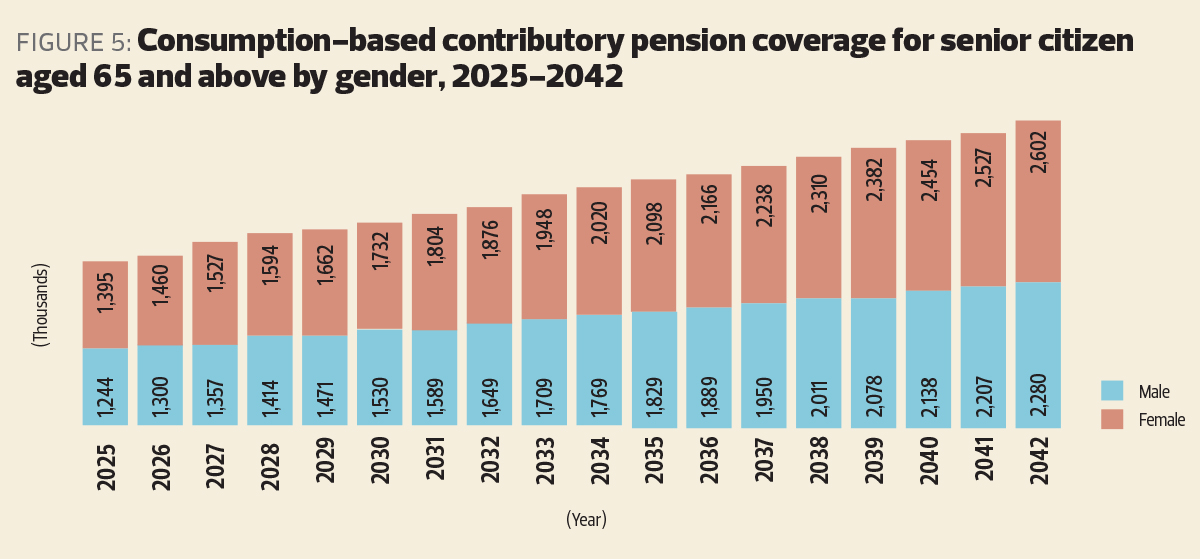
          The proposed CBCP, providing RM700 per month to senior citizens aged 65 and above, would correct the discriminatory labour market, benefiting women more than men, as they tend to live longer.

          My Say: The Sandwich Generation: The Case For A Consumption-based Contributory Pension_4

          The overall cost of CBCP is projected to range from 1.019% to 1.063% of gross domestic product by 2045, with a 2% consumption-based contribution generating sufficient revenue (1.08% of GDP annually) to cover these costs.

          CBCP is technically sound and politically feasible

          Social pensions have significantly reduced old-age poverty and influenced political outcomes in various countries, often benefiting ruling parties electorally. However, implementing a consumption-based contribution in Malaysia faces political challenges, particularly because of past negative experience with consumption-based taxes such as the Goods and Services Tax. Introduced in 2015, GST was unpopular for its regressive impact, leading to its repeal in 2018.

          Despite these concerns, CBCP could be politically viable because, unlike GST, it directly links a 2% consumption contribution to a flat-rate benefit of RM700 for senior citizens. This connection between contributions and social benefits may make CBCP more acceptable to the public, as it supports the elderly, especially those financially dependent on their children.

          To further ease CBCP’s implementation, we suggest reducing workers’ EPF contributions by 2%, which would lead to an increase in real wage and offset the impact of the new contribution.

          Evidence from other countries shows that well-designed social pensions can garner significant public support and become a political asset for governments. For example, the universal old-age pension introduced in Lesotho in 2004 helped the government win subsequent elections, while Peru’s “Pensión 65” programme, launched in 2011, significantly boosted electoral success. Similar evidence was seen in Georgia, Kenya, Bolivia, Brazil and Mauritius. These examples demonstrate the strong appeal of social pensions to the electorate, particularly the sandwich generation.

          The introduction of CBCP in Malaysia offers a viable solution to the financial and emotional pressures faced by the sandwich generation. By extending coverage to all senior citizens, particularly those excluded from traditional pension schemes, CBCP would alleviate the burden on working adults while providing a more inclusive and sustainable social protection system. CBCP represents a forward-thinking policy that addresses the challenges of an ageing population and strengthens the fabric of Malaysian society.

          Source: Theedgemarkets

          Risk Warnings and Disclaimers
          You understand and acknowledge that there is a high degree of risk involved in trading. Following any strategies or investment methods may lead to potential losses. The content on the site is provided by our contributors and analysts for information purposes only. You are solely responsible for determining whether any trading assets, securities, strategy, or any other product is suitable for investing based on your own investment objectives and financial situation.
          Add to Favorites
          Share

          What Are the Key Policy Implications in the 2024 Presidential Race?

          JPMorgan

          Economic

          Political

          In the long run, it is policy, not politics, which matters most for the economy and markets.
          In this piece, we compare the proposals of Vice-President Harris and former President Trump across taxes, trade and immigration, and the potential market implications of different election outcomes.

          Taxes

          Without the urgency of a recession or a pandemic to address, there is little need for fiscal stimulus. However, expiring provisions from the 2017 TCJA Act at the end of 2025 require legislative action, giving the next president a chance to reset tax policy.
          So far, Trump has proposed a permanent extension of major components of the tax act, a further lowering of the corporate tax rate, a renewal of the business tax provisions from the initial years of the TCJA and an elimination of taxes on tips and social security benefits. Trump has also suggested tariff increases as budgetary offsets to these tax cuts.
          Market impact: Stock markets may react favorably to the prospects of lower taxes (or at least, diminished prospects of higher taxes), but concerns over debt sustainability could resurface in credit markets and pressure long-term interest rates higher. According to the CBO, a full extension of the TCJA would cost $4.6 trillion over the next decade. Granted, new tariff revenue could partially offset this while Trump has proposed federal spending cuts elsewhere (albeit with few specifics).
          Meanwhile, Harris has supported extending the expiring personal income tax cuts for single filers making below $400K ($450K for joint), although reverting the top marginal tax rate to 39.6%. Harris has also proposed an expanded child tax credit, new housing incentives, an extension of the health insurance premium tax credit and an increased tax deduction for startup expenses by small businesses. To finance these plans, she has proposed raising the corporate tax rate to 28% from 21% and an increase in the all-in top capital gains rate to 33%, which reflects the capital rate rising to 28% from 20% and the tax on investment income rising to 5% from 3.8%.
          Market impact: Higher taxes for wealthier individuals could dent consumer spending, but this could be offset by the stimulative effect of expanded child tax credits and other tax incentives. Fiscal deficits would still expand but by less and higher corporate and capital gains taxes could roll back a sizable chunk of the revenue reduction from the TCJA.

          Trade, tariffs and industrial policy

          Trade policy is one of the few areas of significant bipartisan agreement. However, the two sides differ in their approaches. Harris would likely maintain the “tough on China” status quo of Biden’s administration with an emphasis on targeted tariffs, such as on steel and aluminum from China. Trump might take a harder line on foreign policy, particularly with China, and might use executive orders to increase control on outbound investment and data. Trump has also proposed a universal baseline tariff on all U.S. imports of 10%, along with a 60% tariff on imports from China.
          On industrial policy, we anticipate a Harris administration would continue to incentivize investments in semiconductor and clean tech manufacturing facilities via the IRA and CHIPS Act. A Trump administration might slow the release of some IRA funds and reduce some subsidies but given their benefits for traditionally red and swing states, we think these funds are likely protected from major upheaval.
          Market impact: Regardless of the election, the next few years are expected to see heightened U.S.-China tensions, with greater use of industrial policy on both sides. Markets will focus on the potential for aggressive tariff hikes, as this is one area where the President has unilateral authority. Higher tariffs could both boost inflation and slow economic growth via diminished trade.

          Immigration

          After a migrant surge in recent years, immigration is set to moderate. The question is how quickly. Presidents of both parties have used executive orders to address the issue, but these have faced legal challenges in the absence of official legislative action. Harris would likely support some stricter deterrence measures on border crossings while continuing to build pathways for migrants to achieve legal status. Meanwhile, the Trump campaign promises a crackdown on migration with much stricter immigration measures and an effort to deport asylum seekers to other countries.
          Market impact: A reduction in immigration overall would slow population growth, leading to knock-on effects on various sectors (i.e. lower school enrollment, lower housing demand and continued labor shortages in certain sectors). However, these effects could take a while to manifest themselves as, even with a sharp decline in future migration, the economy would continue to be impacted by the integration into the economy of recent arrivals.
          Overall, it’s worth emphasizing that each candidate’s policy positions are subject to change, it is uncertain which policies would be prioritized, and it is not clear that Congress would cooperate in implementing them. Moreover, it is even more difficult to ascribe market implications to policies when enacted. While federal government policies can drive some investment outcomes, they are just one part of a broader basket of market drivers and, historically, factors such as interest rates and economic growth have tended to have much greater impact (see for instance, traditional oil and gas vs. renewables under Trump and Biden). As such, while various policy proposals in this election cycle would seem to suggest different market outcomes, more broadly we continue to expect politics to be an unreliable driver of market performance. What Are the Key Policy Implications in the 2024 Presidential Race?_1
          To stay updated on all economic events of today, please check out our Economic calendar
          Risk Warnings and Disclaimers
          You understand and acknowledge that there is a high degree of risk involved in trading. Following any strategies or investment methods may lead to potential losses. The content on the site is provided by our contributors and analysts for information purposes only. You are solely responsible for determining whether any trading assets, securities, strategy, or any other product is suitable for investing based on your own investment objectives and financial situation.
          Add to Favorites
          Share

          European Carmakers Are Struggling Amid Historic EV Shift

          ING

          Energy

          Economic

          Competition from new entrants grows, but short-term reality prevails

          The European car industry is facing challenging times in keeping up with the historic transition to electric vehicles, while competition from new entrants like BYD mounts. It's fair to say that short-term interests are heavily influencing the course.

          You can perhaps see that in the latest news from Volvo. It announced on Thursday that it's U-turned on its heavily promoted targets to produce only electric vehicles by 2030 as demand slows.

          The shift to EVs is a non-linear journey with many uncertainties, as we have seen over the last couple of years. But it’s increasingly putting European carmakers under pressure while total new car sales fail to return to pre-pandemic levels in their home markets. Volkswagen’s CEO, Oliver Blume, sees the competitive environment becoming tougher and emphasises the importance of focusing on production costs and competitiveness as the group's global market share has started to erode with the uptake of EVs.

          At the same time, Volkswagen, as well as several other European carmakers, including Ford and Mercedes, have announced plans to push back earlier targets to phase out sales of internal combustion engines (ICE-)vehicles in Europe. This is remarkable, so what’s going on? Well, there are a number of considerations behind this:

          Due to production costs and severe competition, margins on BEVs are still poor and much lower than on plug-in hybrids, PHEVs, conventional hybrids HEVs or petrol cars. Pushing too hard would hurt profitability in the short run.

          Demand for EVs is currently stagnating in Europe as middle-class drivers are hesitant to make the shift, and lease and rental companies struggle with low residual values.

          The European EV supply chain still needs time to develop, while lower lithium-ion battery prices, and Chinese levels dropping below $100 per kWh challenging new local facilities. Meanwhile, carmakers still depend on China, which entails risks.

          Carmakers made their ICE phase-out pledges prior to the final decision by the European Union and UK to enforce 2035 as the deadline to make the shift. This gave manufacturers more spare time compared to the initial proposal (2030).

          Carmakers also seek flexibility in the current uncertain (fiscal support and trade) policy environment, with government changes potentially having a significant impact.

          Electrification temporarily decelerates in Europe, but continues globally

          Share of electric vehicles (BEV*) in total new car registrations per region

          European Carmakers Are Struggling Amid Historic EV Shift_1

          Source: BNEF, ACEA, ING Research *forecast

          EV product shift still requires speed to avoid missing out on long-term performance

          Amid all the short-term interests and uncertainties, carmakers realise they can't afford to miss out on EVs, and the direction of travel remains clear. The EU is not expected to soften its CO2 targets for production either. This means EV investment programmes and new model development still require speed.

          The decision to temporise the shift is very much intended to maintain profitability and preserve flexibility in a highly uncertain environment. Western EV sales are slowing for several reasons, but this is a temporary development. The direction of travel has not changed, and investments in the makeover of product portfolios still need to continue to secure long-term positions in the market over the next decade.

          To stay updated on all economic events of today, please check out our Economic calendar
          Risk Warnings and Disclaimers
          You understand and acknowledge that there is a high degree of risk involved in trading. Following any strategies or investment methods may lead to potential losses. The content on the site is provided by our contributors and analysts for information purposes only. You are solely responsible for determining whether any trading assets, securities, strategy, or any other product is suitable for investing based on your own investment objectives and financial situation.
          Add to Favorites
          Share

          Week Ahead – Fed to Cut Interest Rates, BoE and BoJ to Remain on Hold

          XM

          Central Bank

          Let the Fed cuts begin

          Since the July US employment report, which sparked fears of recession, investors have been trying to figure out the size of the potential rate cut the Fed will deliver at its September gathering, and the moment of truth has finally come.
          On Wednesday, the Fed announces its decision, and it seems that it is not a matter of whether officials will press the rate cut button, but how strongly. In other words, by how many basis points will they lower the Fed funds target rate.
          Following Chair Powell’s speech at Jackson Hole, where he noted that they will not tolerate further weakness in the labor market, investors locked their gaze on employment-related data, adding to their rate cut bets on any sign of softness. Even the NFP report for August was not as encouraging as expected, with investors seeing then a 30% chance of a 50bps rate cut at next week’s gathering.
          That percentage came down to around 15% after the CPI data for August revealed that underlying inflation remained elevated well above the Fed’s objective of 2%, but it climbed back to 45% after media reports from the Financial Times and the Wall Street Journal said that next week’s decision would be a close call.
          Week Ahead – Fed to Cut Interest Rates, BoE and BoJ to Remain on Hold_1
          Having said all that though, with the Atlanta Fed GDPNow model projecting a solid 2.5% growth rate for Q3, it seems that there is no concrete reason for policymakers to start this easing cycle with an aggressive move. A 25bps cut seems the more sensible move.
          If this is the case, the dollar could gain as those expecting a bigger one may get disappointed, but whether it could hold onto its gains may depend on the updated dot plot and Powell’s remarks about the Committee’s future course of action.
          If the dot plot and Powell suggest fewer basis points worth of reductions this year than the 115 currently expected by the market, the dollar’s engines may receive more fuel. As for Wall Street, confidence that the world’s largest economy is not headed for a recession may keep risk appetite elevated, even if this means fewer-than-expected rate cuts.
          Week Ahead – Fed to Cut Interest Rates, BoE and BoJ to Remain on Hold_2
          US retail sales are due out on Tuesday, but given the importance of the Fed meeting, they are unlikely to hugely impact investors’ positioning.

          Will the BoE confirm November cut bets?

          On Thursday, the central bank torch will be passed to the BoE. At its latest decision, this Bank cut interest rates by 25bps, but the decision was a close call, with officials signaling that they will be careful about future reductions.
          Since then, data has been mostly corroborating the officials’ stance. The PMIs beat expectations in both July and August, while the labor market continued to improve. Although average weekly earnings continued to slow, they’ve been proving stickier than expected, with the y/y rate for July resting at an elevated 5.1%. What’s more, the headline CPI rebounded somewhat in July, with services inflation remaining stubbornly high. The August inflation numbers are coming out on Wednesday, while on Friday, retail sales are scheduled to be released.
          Week Ahead – Fed to Cut Interest Rates, BoE and BoJ to Remain on Hold_3
          Even BoE Governor Bailey himself said at Jackson Hole that they are not in a rush to cut again, prompting market participants to factor in a strong 80% chance for no action at this meeting. The remaining 20% favoring a rate cut may be the result of some concerns after the monthly GDP for July pointed to stagnation.
          Week Ahead – Fed to Cut Interest Rates, BoE and BoJ to Remain on Hold_4
          Should officials indeed keep their hands off the rate cut button, investors will turn their attention to the Bank’s communication about their future plans. According to the UK Overnight Index Swaps (OIS), investors expect another two quarter-point reductions at the November and December gatherings. Thus, if policymakers maintain a no-rush mindset, the pound may extend its latest rebound.

          Strong yen awaits BoJ decision

          On Friday, it will be the turn of the BoJ. In July, Japanese policymakers raised interest rates by 15bps and have been since signaling that more hikes are looming. This allowed investors to pencil in an 85% chance for another 10bps worth of increase by the end of the year.
          Although BoJ officials have been repeatedly noting that the pace of rate hikes will be slow, the divergence in monetary policy strategies between this Bank and the rest of the world has led to a surging yen as traders decided to abandon a previously overcrowded carry trade.
          Week Ahead – Fed to Cut Interest Rates, BoE and BoJ to Remain on Hold_5
          Yet, no policy action is expected at this gathering and thus, the focus will be on whether Ueda and his colleagues will continue to signal more hikes down the road. Anything corroborating the market’s view that another increase could be delivered before year-end, may allow the yen to continue marching north.
          A few hours ahead of the decision, the Nationwide CPI numbers for August will be published.

          Canadian inflation and BoC Summary of Deliberations

          Canada is also releasing its CPI inflation data for August on Tuesday. At last week’s meeting, the BoC cut interest rates for a third time in a row, opening the door to bigger cuts if the economy slows more sharply ahead. On Wednesday, the Bank’s Summary of Deliberations may provide more clarity on that front, but further cooling in consumer prices the day before could very well encourage market participants to add to their rate cut bets. Currently, they are expecting another 60bps worth of cuts by the end of the year. The nation’s retail sales are on Friday’s agenda.
          Week Ahead – Fed to Cut Interest Rates, BoE and BoJ to Remain on Hold_6
          In Australia, the employment report for August is due out on Thursday.

          Source:XM

          Risk Warnings and Disclaimers
          You understand and acknowledge that there is a high degree of risk involved in trading. Following any strategies or investment methods may lead to potential losses. The content on the site is provided by our contributors and analysts for information purposes only. You are solely responsible for determining whether any trading assets, securities, strategy, or any other product is suitable for investing based on your own investment objectives and financial situation.
          Add to Favorites
          Share

          Trump to Launch World Liberty Financial Crypto Platform on Monday

          Samantha Luan

          Cryptocurrency

          Donald Trump’s crypto project World Liberty Financial will launch on Monday, Sept. 16, former President and Republican presidential bidder announced.

          In a Sept. 12 video posted to X, Trump said he would be going live on the platform on Monday to launch the project controlled by his sons, Donald Jr. and Eric Trump.

          “We’re embracing the future with crypto and leaving the slow and outdated big banks behind,” he said.

          Trump has previously made several cryptic posts concerning World Liberty Financial, vaguely positioning it as a decentralized finance (DeFi) platform for borrowing and lending.

          A reported white paper said the project will allow users to store money in a digital wallet, offer a credit account system, borrow or lend cash to others, and use tokens to invest in assets like crypto.

          A nontransferable governance token has also been mentioned as part of the platform.

          Statements from World Liberty Financial have also suggested it wants to spread the use of United States dollar-pegged stablecoins in DeFi.

          Along with bullish comments about stablecoins, the project has teased a partnership and collaboration with DeFi protocol Aave, possibly indicating World Liberty Financial will be built on the Ethereum blockchain.

          Trump has secured strong support within the crypto community since promising to support the industry if again elected president in November.

          He’s pledged clearer regulations and said he’d fire Securities and Exchange Commission chair Gary Gensler, who has undertaken enforcement actions against multiple large crypto firms.

          Sentiment around World Liberty Financial has been mixed, with some questioning Trump’s decision to launch the project while also running for president, with World Liberty Financial set to go live 50 days out from the election.

          Nic Carter, a Trump supporter and Castle Island Ventures partner, told Politico on Sept. 6 that the project was a “huge mistake.”

          “It looks like Trump’s inner circle is just cashing in on his recent embrace of crypto in a kind of naive way,” he said. “Frankly it looks like they’re burning a lot of the goodwill that’s been built with the industry so far.”

          Those linked to the venture have faced an onslaught from hackers and scammers.

          Scammers also managed to hack Donald’s daughter-in-law Lara and his daughter Tiffany Trump’s X accounts on Sept. 4, posting sham links claiming to be connected to World Liberty Financial.

          On Aug. 30, the official World Liberty Financial Telegram group had to denounce a series of fake ads and giveaways attempting to profit from hype around the project.

          While Aug. 8, Eric Trump had to clarify that a Restore the Republic (RTR) memecoin was not affiliated with World Liberty Financial after it surged $155 million within hours of its debut.

          Source: COINTELEGRAPH

          Risk Warnings and Disclaimers
          You understand and acknowledge that there is a high degree of risk involved in trading. Following any strategies or investment methods may lead to potential losses. The content on the site is provided by our contributors and analysts for information purposes only. You are solely responsible for determining whether any trading assets, securities, strategy, or any other product is suitable for investing based on your own investment objectives and financial situation.
          Add to Favorites
          Share
          FastBull
          Copyright © 2025 FastBull Ltd

          728 RM B 7/F GEE LOK IND BLDG NO 34 HUNG TO RD KWUN TONG KLN HONG KONG

          TelegramInstagramTwitterfacebooklinkedin
          App Store Google Play Google Play
          Products
          Charts

          Chats

          Q&A with Experts
          Screeners
          Economic Calendar
          Data
          Tools
          Membership
          Features
          Function
          Markets
          Copy Trading
          Latest Signals
          Contests
          News
          Analysis
          24/7
          Columns
          Education
          Company
          Careers
          About Us
          Contact Us
          Advertising
          Help Center
          Feedback
          User Agreement
          Privacy Policy
          Business

          White Label

          Data API

          Web Plug-ins

          Poster Maker

          Affiliate Program

          Risk Disclosure

          The risk of loss in trading financial instruments such as stocks, FX, commodities, futures, bonds, ETFs and crypto can be substantial. You may sustain a total loss of the funds that you deposit with your broker. Therefore, you should carefully consider whether such trading is suitable for you in light of your circumstances and financial resources.

          No decision to invest should be made without thoroughly conducting due diligence by yourself or consulting with your financial advisors. Our web content might not suit you since we don't know your financial conditions and investment needs. Our financial information might have latency or contain inaccuracy, so you should be fully responsible for any of your trading and investment decisions. The company will not be responsible for your capital loss.

          Without getting permission from the website, you are not allowed to copy the website's graphics, texts, or trademarks. Intellectual property rights in the content or data incorporated into this website belong to its providers and exchange merchants.

          Not Logged In

          Log in to access more features

          FastBull Membership

          Not yet

          Purchase

          Become a signal provider
          Help Center
          Customer Service
          Dark Mode
          Price Up/Down Colors

          Log In

          Sign Up

          Position
          Layout
          Fullscreen
          Default to Chart
          The chart page opens by default when you visit fastbull.com