• Trade
  • Markets
  • Copy
  • Contests
  • News
  • 24/7
  • Calendar
  • Q&A
  • Chats
Trending
Screeners
SYMBOL
LAST
BID
ASK
HIGH
LOW
NET CHG.
%CHG.
SPREAD
SPX
S&P 500 Index
6827.42
6827.42
6827.42
6899.86
6801.80
-73.58
-1.07%
--
DJI
Dow Jones Industrial Average
48458.04
48458.04
48458.04
48886.86
48334.10
-245.98
-0.51%
--
IXIC
NASDAQ Composite Index
23195.16
23195.16
23195.16
23554.89
23094.51
-398.69
-1.69%
--
USDX
US Dollar Index
97.950
98.030
97.950
98.500
97.950
-0.370
-0.38%
--
EURUSD
Euro / US Dollar
1.17394
1.17409
1.17394
1.17496
1.17192
+0.00011
+ 0.01%
--
GBPUSD
Pound Sterling / US Dollar
1.33707
1.33732
1.33707
1.33997
1.33419
-0.00148
-0.11%
--
XAUUSD
Gold / US Dollar
4299.39
4299.39
4299.39
4353.41
4257.10
+20.10
+ 0.47%
--
WTI
Light Sweet Crude Oil
57.233
57.485
57.233
58.011
56.969
-0.408
-0.71%
--

Community Accounts

Signal Accounts
--
Profit Accounts
--
Loss Accounts
--
View More

Become a signal provider

Sell trading signals to earn additional income

View More

Guide to Copy Trading

Get started with ease and confidence

View More

Signal Accounts for Members

All Signal Accounts

Best Return
  • Best Return
  • Best P/L
  • Best MDD
Past 1W
  • Past 1W
  • Past 1M
  • Past 1Y

All Contests

  • All
  • Trump Updates
  • Recommend
  • Stocks
  • Cryptocurrencies
  • Central Banks
  • Featured News
Top News Only
Share

Trump Isn't Certain His Economic Policies Will Translate To Midterm Wins

Share

The United States And Mexico Have Reached An Agreement On How To Resolve The Water Dispute In The Rio Grande Basin (which Borders Texas). Starting December 15, Mexico Will Supply The U.S. With An Additional 20.2 Acre-feet (a Unit Of Volume For Irrigation). The Agreement Seeks To “strengthen Water Management In The Rio Grande Basin” Within The Framework Of The 1944 Water Treaty

Share

U.S. Transportation Secretary Duffy: The Engine Of United Airlines Flight 803 That Malfunctioned Caught Fire

Share

Ukraine President Zelenskiy: He Will Meet US, European Representatives About Peace

Share

UK Prime Minister Office: Prime Minister Starmer Spoke To The President Of The European Commission Ursula Von Der Leyen This Evening - Downing Street Spokesperson

Share

Trump: We Will Retaliate Against ISIS

Share

Trump Says We Mourn The Loss Of Three Great Patriots In Syria In An Ambush

Share

Syrian Interior Ministry Spokesperson Confirms Attacker Was Member Of Security Forces With Extremist Ideology

Share

Syrian Interior Ministry Says Attacker Did Not Have Leadership Role In Security Forces, Did Not Say If He Was Junior Member

Share

Man Who Attacked Syrian, US Military Was Member Of Syrian Security Forces -Three Local Syrian Officials

Share

US Envoy Coale Says Belarus President Lukashenko Agreed To Do All He Can To Stop Weather Balloons Flying Into Lithuania

Share

Ukraine Says Russian Drone Attack Hit Civilian Turkish Vessel

Share

Islamic State Attacker In Syria Was Lone Gunman, Who Was Killed -USA Central Command

Share

US Envoy John Coale Says Around 1000 Remaining Political Prisoners In Belarus Could Be Released In Coming Months

Share

US Defense Secretary Hegseth: Attacker Was Killed By Partner Forces

Share

Pentagon Says Two USA Army Soldiers And One Civilian USA Interpreter Were Killed, And Three Were Wounded In Syria

Share

Israel Says It Kills Senior Hamas Commander Raed Saed In Gaza

Share

Ukraine's Navy Says Russian Drone Attack Hit Civilian Turkish Vessel Carrying Sunflower Oil To Egypt On Saturday

Share

Israeli Military Says It Put Planned Strike On South Lebanon Site On Hold After Lebanese Army Requested Access

Share

Norwegian Nobel Committee: Calls On The Belarusian Authorities To Release All Political Prisoners

TIME
ACT
FCST
PREV
U.K. Trade Balance (Oct)

A:--

F: --

P: --

U.K. Services Index MoM

A:--

F: --

P: --

U.K. Construction Output MoM (SA) (Oct)

A:--

F: --

P: --

U.K. Industrial Output YoY (Oct)

A:--

F: --

P: --

U.K. Trade Balance (SA) (Oct)

A:--

F: --

P: --

U.K. Trade Balance EU (SA) (Oct)

A:--

F: --

P: --

U.K. Manufacturing Output YoY (Oct)

A:--

F: --

P: --

U.K. GDP MoM (Oct)

A:--

F: --

P: --

U.K. GDP YoY (SA) (Oct)

A:--

F: --

P: --

U.K. Industrial Output MoM (Oct)

A:--

F: --

P: --

U.K. Construction Output YoY (Oct)

A:--

F: --

P: --

France HICP Final MoM (Nov)

A:--

F: --

P: --

China, Mainland Outstanding Loans Growth YoY (Nov)

A:--

F: --

P: --

China, Mainland M2 Money Supply YoY (Nov)

A:--

F: --

P: --

China, Mainland M0 Money Supply YoY (Nov)

A:--

F: --

P: --

China, Mainland M1 Money Supply YoY (Nov)

A:--

F: --

P: --

India CPI YoY (Nov)

A:--

F: --

P: --

India Deposit Gowth YoY

A:--

F: --

P: --

Brazil Services Growth YoY (Oct)

A:--

F: --

P: --

Mexico Industrial Output YoY (Oct)

A:--

F: --

P: --

Russia Trade Balance (Oct)

A:--

F: --

P: --

Philadelphia Fed President Henry Paulson delivers a speech
Canada Building Permits MoM (SA) (Oct)

A:--

F: --

P: --

Canada Wholesale Sales YoY (Oct)

A:--

F: --

P: --

Canada Wholesale Inventory MoM (Oct)

A:--

F: --

P: --

Canada Wholesale Inventory YoY (Oct)

A:--

F: --

P: --

Canada Wholesale Sales MoM (SA) (Oct)

A:--

F: --

P: --

Germany Current Account (Not SA) (Oct)

A:--

F: --

P: --

U.S. Weekly Total Rig Count

A:--

F: --

P: --

U.S. Weekly Total Oil Rig Count

A:--

F: --

P: --

Japan Tankan Large Non-Manufacturing Diffusion Index (Q4)

--

F: --

P: --

Japan Tankan Small Manufacturing Outlook Index (Q4)

--

F: --

P: --

Japan Tankan Large Non-Manufacturing Outlook Index (Q4)

--

F: --

P: --

Japan Tankan Large Manufacturing Outlook Index (Q4)

--

F: --

P: --

Japan Tankan Small Manufacturing Diffusion Index (Q4)

--

F: --

P: --

Japan Tankan Large Manufacturing Diffusion Index (Q4)

--

F: --

P: --

Japan Tankan Large-Enterprise Capital Expenditure YoY (Q4)

--

F: --

P: --

U.K. Rightmove House Price Index YoY (Dec)

--

F: --

P: --

China, Mainland Industrial Output YoY (YTD) (Nov)

--

F: --

P: --

China, Mainland Urban Area Unemployment Rate (Nov)

--

F: --

P: --

Saudi Arabia CPI YoY (Nov)

--

F: --

P: --

Euro Zone Industrial Output YoY (Oct)

--

F: --

P: --

Euro Zone Industrial Output MoM (Oct)

--

F: --

P: --

Canada Existing Home Sales MoM (Nov)

--

F: --

P: --

Euro Zone Total Reserve Assets (Nov)

--

F: --

P: --

U.K. Inflation Rate Expectations

--

F: --

P: --

Canada National Economic Confidence Index

--

F: --

P: --

Canada New Housing Starts (Nov)

--

F: --

P: --

U.S. NY Fed Manufacturing Employment Index (Dec)

--

F: --

P: --

U.S. NY Fed Manufacturing Index (Dec)

--

F: --

P: --

Canada Core CPI YoY (Nov)

--

F: --

P: --

Canada Manufacturing Unfilled Orders MoM (Oct)

--

F: --

P: --

Canada Manufacturing New Orders MoM (Oct)

--

F: --

P: --

Canada Core CPI MoM (Nov)

--

F: --

P: --

Canada Manufacturing Inventory MoM (Oct)

--

F: --

P: --

Canada CPI YoY (Nov)

--

F: --

P: --

Canada CPI MoM (Nov)

--

F: --

P: --

Canada CPI YoY (SA) (Nov)

--

F: --

P: --

Canada Core CPI MoM (SA) (Nov)

--

F: --

P: --

Canada CPI MoM (SA) (Nov)

--

F: --

P: --

Q&A with Experts
    • All
    • Chatrooms
    • Groups
    • Friends
    Connecting
    .
    .
    .
    Type here...
    Add Symbol or Code

      No matching data

      All
      Trump Updates
      Recommend
      Stocks
      Cryptocurrencies
      Central Banks
      Featured News
      • All
      • Russia-Ukraine Conflict
      • Middle East Flashpoint
      • All
      • Russia-Ukraine Conflict
      • Middle East Flashpoint

      Search
      Products

      Charts Free Forever

      Chats Q&A with Experts
      Screeners Economic Calendar Data Tools
      Membership Features
      Data Warehouse Market Trends Institutional Data Policy Rates Macro

      Market Trends

      Market Sentiment Order Book Forex Correlations

      Top Indicators

      Charts Free Forever
      Markets

      News

      News Analysis 24/7 Columns Education
      From Institutions From Analysts
      Topics Columnists

      Latest Views

      Latest Views

      Trending Topics

      Top Columnists

      Latest Update

      Signals

      Copy Rankings Latest Signals Become a signal provider AI Rating
      Contests
      Brokers

      Overview Brokers Assessment Rankings Regulators News Claims
      Broker listing Forex Brokers Comparison Tool Live Spread Comparison Scam
      Q&A Complaint Scam Alert Videos Tips to Detect Scam
      More

      Business
      Events
      Careers About Us Advertising Help Center

      White Label

      Data API

      Web Plug-ins

      Affiliate Program

      Awards Institution Evaluation IB Seminar Salon Event Exhibition
      Vietnam Thailand Singapore Dubai
      Fans Party Investment Sharing Session
      FastBull Summit BrokersView Expo
      Recent Searches
        Top Searches
          Markets
          News
          Analysis
          User
          24/7
          Economic Calendar
          Education
          Data
          • Names
          • Latest
          • Prev

          View All

          No data

          Scan to Download

          Faster Charts, Chat Faster!

          Download App
          English
          • English
          • Español
          • العربية
          • Bahasa Indonesia
          • Bahasa Melayu
          • Tiếng Việt
          • ภาษาไทย
          • Français
          • Italiano
          • Türkçe
          • Русский язык
          • 简中
          • 繁中
          Open Account
          Search
          Products
          Charts Free Forever
          Markets
          News
          Signals

          Copy Rankings Latest Signals Become a signal provider AI Rating
          Contests
          Brokers

          Overview Brokers Assessment Rankings Regulators News Claims
          Broker listing Forex Brokers Comparison Tool Live Spread Comparison Scam
          Q&A Complaint Scam Alert Videos Tips to Detect Scam
          More

          Business
          Events
          Careers About Us Advertising Help Center

          White Label

          Data API

          Web Plug-ins

          Affiliate Program

          Awards Institution Evaluation IB Seminar Salon Event Exhibition
          Vietnam Thailand Singapore Dubai
          Fans Party Investment Sharing Session
          FastBull Summit BrokersView Expo

          RBNZ May Start Laying Groundwork for a Rate Cut

          XM

          Economic

          Central Bank

          Summary:

          A dovish shift seems to be underway at the Reserve Bank of New Zealand.Technical recession and falling inflation may pave way for 2024 rate cut.Is a dovish hold on the cards at Wednesday’s meeting (02:00 GMT)?
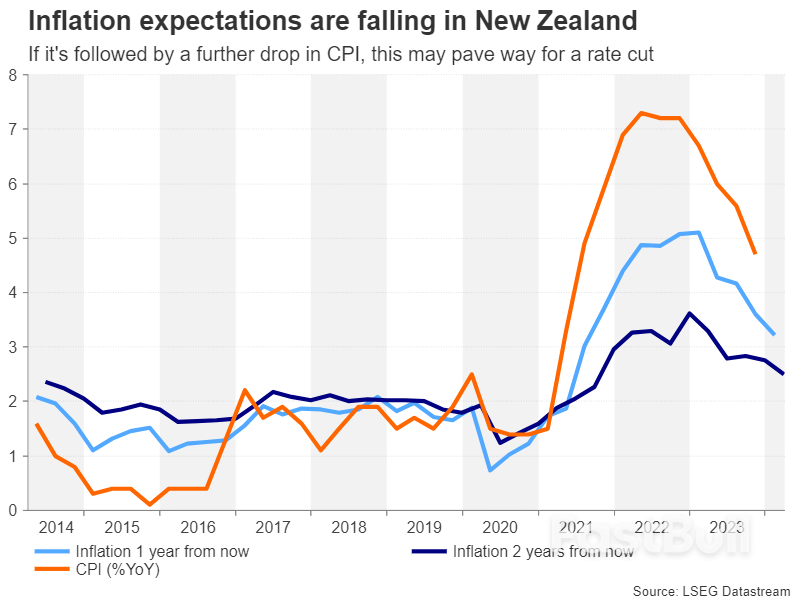
          Weaker economy has been good news for inflation

          New Zealand’s economy shrunk in the final three months of 2023, entering a technical recession for the second time in 15 months. In the bigger picture, economic growth appears to have stagnated, much like in Europe and the United Kingdom. For policymakers, this is probably seen as a necessary price for bringing inflation under control, and all the indications are that it is working.
          Inflation fell to 4.7% in Q4 and there was likely a further drop in the consumer price index in the first few months of 2024 as the RBNZ’s own measures of inflation expectations continued to decline in the first quarter.
          RBNZ May Start Laying Groundwork for a Rate Cut_1
          Things have also been moving in a ‘satisfactory’ direction for the labour market. Worker shortages started to ease after more migrants were allowed to enter the country following the reopening of the borders in 2022. The unemployment rate has been steadily edging higher, reaching 4.0% in Q4 versus the post-pandemic low of 3.2%. More importantly, wage growth has been moderating, falling to 3.9% in Q4.

          Rate cuts may come sooner than anticipated

          Governor Adrian Orr even went as far as acknowledging in recent remarks that the conditions for cutting rates are becoming more apparent. Meanwhile. the Bank’s chief economist, Paul Conway, signalled back in March that a Fed rate cut towards the end of this year would make it easier for the RBNZ to follow suit if it leads to an appreciation in the New Zealand dollar versus the greenback.
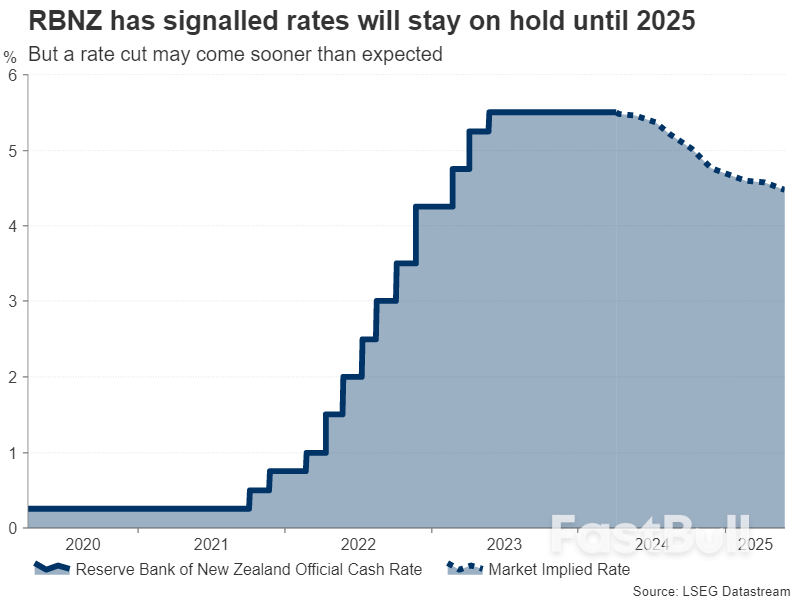
          At the last meeting, policymakers had projected that rates could begin to fall sometime in the middle of 2025, significantly later than the current market pricing of August 2024 for a 25-basis-point cut. There will be no updated forecasts at the April meeting, nor a press conference by Orr, but there’s likely to be some clues in the statement about whether or not committee members are becoming more optimistic about inflation falling within the 1-3% target band sooner than anticipated.
          RBNZ May Start Laying Groundwork for a Rate Cut_2
          Specifically, the language will possibly reveal whether the expected decision to keep the policy rate unchanged at 5.50% will signal another dovish tilt after the Bank adopted a somewhat more neutral stance at the February meeting.

          Kiwi on the slide

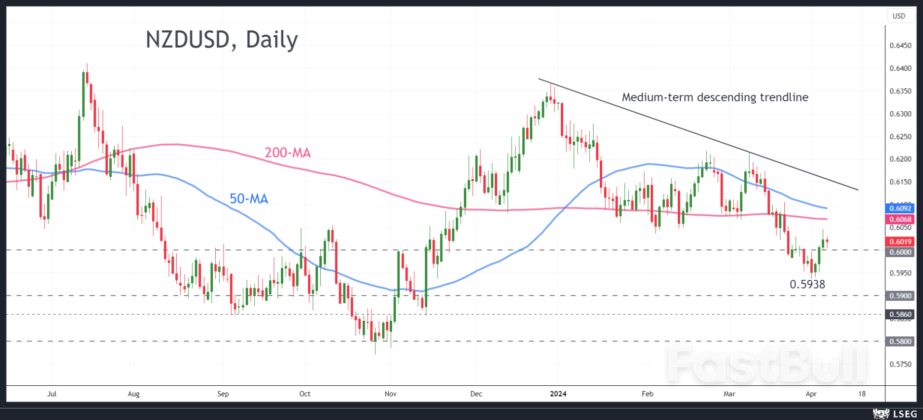
          And this will likely determine the market reaction in the local dollar. The kiwi has come under pressure lately, slipping to four-and-a-half-month lows against the US dollar. Should the language of the statement be more dovish than expected, the kiwi could breach the April 1 low of $0.5938 and head for the $0.5900 mark. A drop below this level would bring $0.5860 into view before targeting the $0.5800 area that supported prices in October 2023.
          RBNZ May Start Laying Groundwork for a Rate Cut_3
          However, if policymakers maintain their caution over the inflation outlook and the need for a prolonged period of restrictive policy, the kiwi could rebound towards its 200-day moving average, currently at $0.6068, before aiming for the medium-term descending trendline.
          Yet, for the kiwi to stage a meaningful rebound, the Fed would first have to start its easing cycle and additionally, China’s economic recovery would have to gather more pace. This would create the ideal conditions for a rally, potentially offsetting any selling pressure from a more dovish RBNZ.

          Source:XM

          To stay updated on all economic events of today, please check out our Economic calendar
          Risk Warnings and Disclaimers
          You understand and acknowledge that there is a high degree of risk involved in trading. Following any strategies or investment methods may lead to potential losses. The content on the site is provided by our contributors and analysts for information purposes only. You are solely responsible for determining whether any trading assets, securities, strategy, or any other product is suitable for investing based on your own investment objectives and financial situation.
          Add to Favorites
          Share

          Tesla Stock Split: A Guide for Curious Investors

          Glendon

          Economic

          Stocks

          Remember the excitement surrounding Tesla's stock split in 2022? If you're curious about what a stock split means for Tesla and your potential investment, then buckle up! This article will navigate you through the world of stock splits and how they apply to Tesla.

          What Exactly is a Stock Split?

          Imagine a company like Tesla decides to split its existing stock "pie" into more slices. This means they increase the number of shares outstanding while lowering the price per share. The company's total value remains the same – it's just like dividing the same amount of dough into more cookies! There are two main types of stock splits:
          Stock Split Ratio: This is expressed as a number and indicates how many new shares an investor receives for each existing share they hold. In Tesla's case, it was a 3-for-1 split, meaning for every share you owned, you received two additional shares.
          Forward Stock Split: This is a less common type of split where a company reduces its stock's par value (a legal minimum value assigned to each share) to achieve a desired share price.

          Why Did Tesla Do a Stock Split?

          There are a few reasons companies like Tesla choose to split their stock. Here are some key motivations:
          Increased Affordability: A lower share price can make Tesla stock more accessible to individual investors, broadening their investor base. This can be particularly attractive for retail investors who might not have been able to afford a pre-split share. Tesla may be aiming to attract a new wave of investors who can contribute to the company's growth.
          Employee Options: Stock options are a common form of employee compensation in tech companies. A split can make these options more attainable for employees, potentially boosting morale and aligning employee interests with company growth. Tesla can incentivize its workforce and retain top talent by making stock options more rewarding.
          Improved Liquidity: A higher number of shares can make the stock more liquid, meaning it's easier to buy and sell. This can attract more investors and potentially lead to increased trading activity. A more liquid stock can benefit both Tesla and its investors by facilitating smoother transactions.

          What Happened After Tesla's Stock Split?

          Tesla's 2022 stock split was a 3-for-1 split. This means for every share an investor-owned, they received two additional shares. While the overall value of their holdings remained unchanged, the price per share became more affordable. Historically, stock splits have sometimes been followed by share price increases, but it's important to remember that correlation doesn't equal causation. The market and a company's performance play a significant role in stock price movements. Tesla's stock did experience some volatility after the split, reflecting broader market trends.

          Does a Stock Split Affect Your Investment Decision?

          A stock split doesn't change the company's fundamentals or long-term potential. It's more about accessibility and investor sentiment. However, it can be a good opportunity to re-evaluate your investment strategy. Consider these factors:
          Tesla's Financial Health: Analyze Tesla's financial statements, including revenue, profitability, and debt levels. This will give you a clearer picture of the company's financial health and prospects.
          Future Growth Prospects: Evaluate Tesla's plans for innovation, new product launches, and market expansion. This will help you assess the company's potential for future growth.
          Overall Market Conditions: Consider the broader market environment, including interest rates, economic indicators, and industry trends. Understanding the market landscape will help you make informed investment decisions.

          The Takeaway: Knowledge is Power

          Understanding stock splits like Tesla's can empower you as an investor. Remember, a split doesn't magically make a company more valuable, but it can be a strategic move to attract new investors and potentially boost future growth. By staying informed and conducting your research, you can make smarter investment choices for your financial future.
          To stay updated on all economic events of today, please check out our Economic calendar
          Risk Warnings and Disclaimers
          You understand and acknowledge that there is a high degree of risk involved in trading. Following any strategies or investment methods may lead to potential losses. The content on the site is provided by our contributors and analysts for information purposes only. You are solely responsible for determining whether any trading assets, securities, strategy, or any other product is suitable for investing based on your own investment objectives and financial situation.
          Add to Favorites
          Share

          US Jobs Strength Continues Despite Survey Weakness

          ING

          Central Bank

          Economic

          Strong jobs trend continues

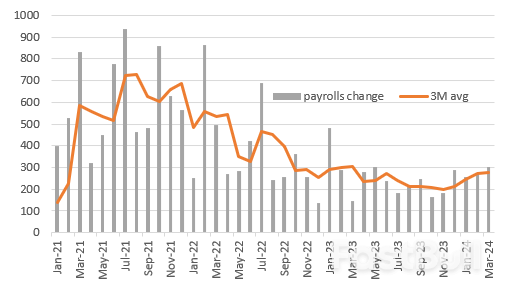
          US non-farm payrolls rose 303k in March versus the 214k consensus while there were 22k of upward revisions to the past two months of data. 303k was higher than anyone was forecasting in the surveys (74 forecasts of which the high was 290k). The unemployment rate came in at 3.8%, down from 3.9% and average hourly earning rose 0.3% month-on-month/4.1% year-on-year. Undeniably strong throughout with interest rate cut expectations unsurprisingly receding on this newsflow.

          Change in non-farm payrolls (000s)

          US Jobs Strength Continues Despite Survey Weakness_1

          But the composition doesn't look so strong

          The details show private payrolls rose 232k with manufacturing flat on the month, construction adding 39k, private education and health up 88k, leisure and hospitality up 49k while government payrolls rose 71k. These latter three categories continue to be the main engines of job creation in the US economy. My issue about this is that all three tend to be lower paid than the median and more likely to be part time and are arguably less secure. For a strong vibrant US economy I would like to see full-time tech, business services, transport & logistics, manufacturing, construction to be contributing much more than 25% of jobs, which is what they have averaged over the past 18 months.

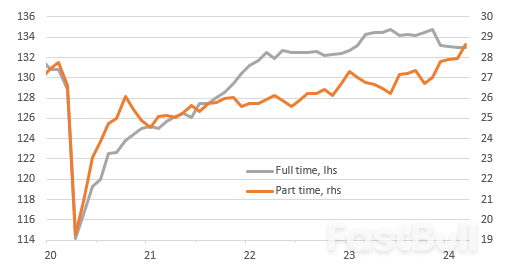
          Full time versus part time employment levels (millions)

          US Jobs Strength Continues Despite Survey Weakness_2
          In this regard, the household survey shows that full-time employment fell for the fourth consecutive month (to 132.94mn) which leaves us at the lowest level of full-time employment since January 2023 while part-time employment rose to an all-time high of 28.632mn. Once again, this suggests the details paint a slightly weaker picture than the headlines alone suggest.

          The prospect of a June rate cut now looks slim

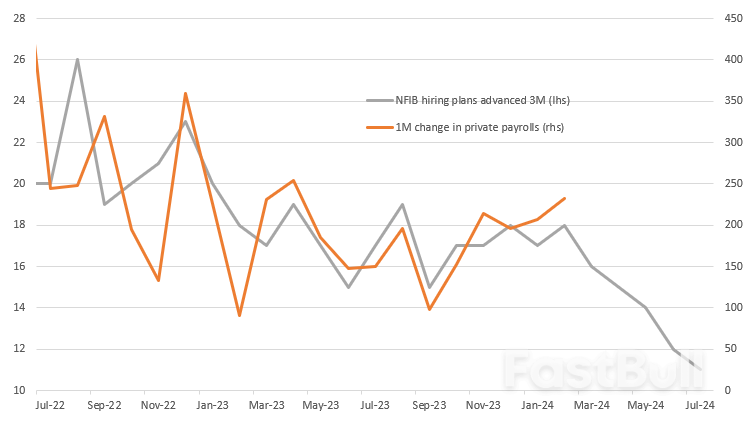
          Moreover, with the ISM employment components in contraction territory, the National Federation of Independent Business (NFIB) hiring intentions survey at the lowest level since May 2020 and job lay-off announcements on the rise there are clear contradictions between official data and what businesses are telling survey compilers. That said, the Federal Reserve obviously won't cut rates imminently with jobs this strong and next week's core CPI print likely to remain hot at 0.3% MoM. Our assumption remains that the official data will eventually reflect the views expressed by business, but it may not come in time for the next FOMC meeting in June.

          NFIB hiring intentions versus private payrolls changes (000s)

          US Jobs Strength Continues Despite Survey Weakness_3

          Source: ING

          To stay updated on all economic events of today, please check out our Economic calendar
          Risk Warnings and Disclaimers
          You understand and acknowledge that there is a high degree of risk involved in trading. Following any strategies or investment methods may lead to potential losses. The content on the site is provided by our contributors and analysts for information purposes only. You are solely responsible for determining whether any trading assets, securities, strategy, or any other product is suitable for investing based on your own investment objectives and financial situation.
          Add to Favorites
          Share

          Survey: Recession Odds for U.S. Economy Have Now Fallen to the Lowest Level in Two Years

          Thomas

          Economic

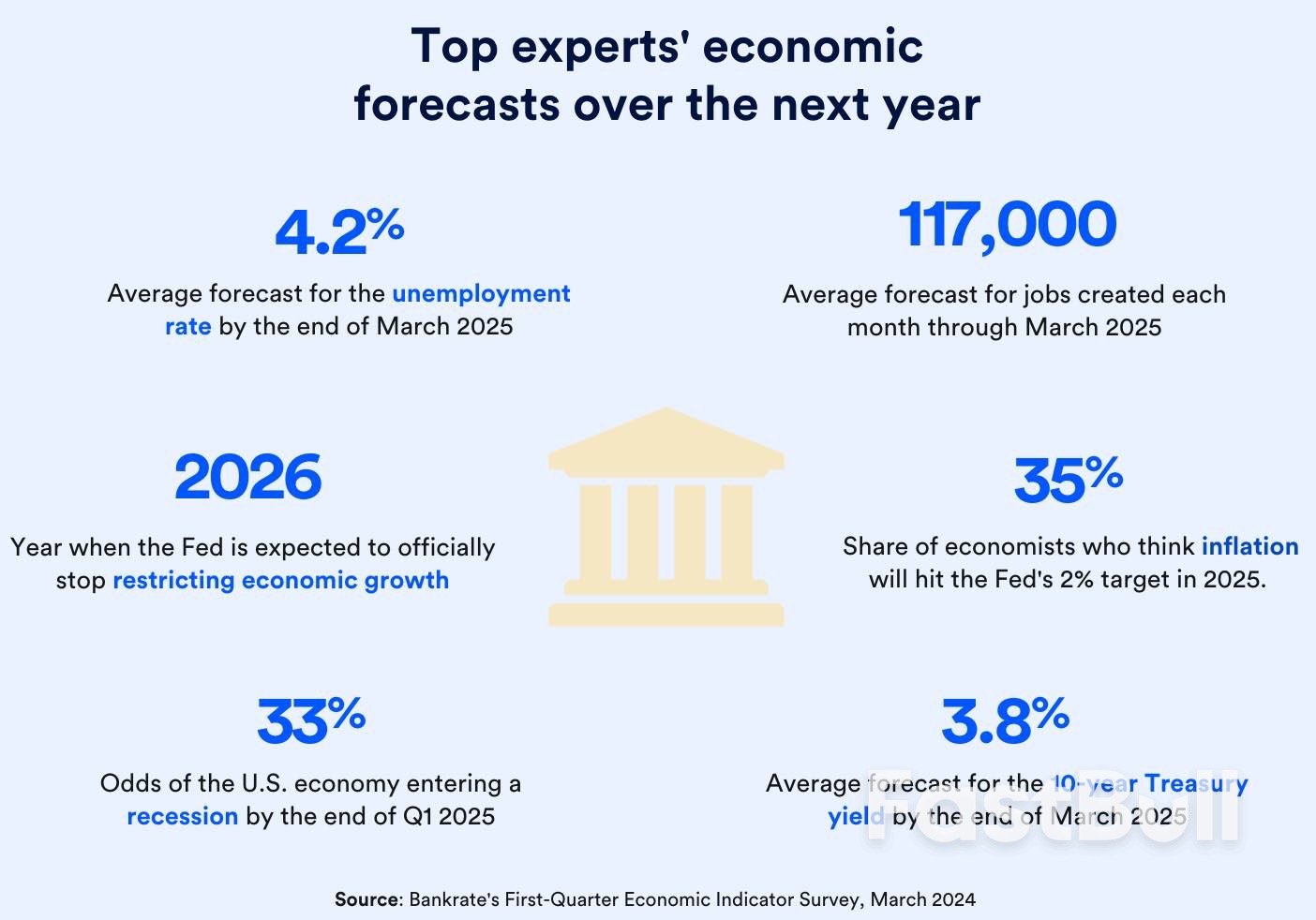
          When the Federal Reserve first started raising interest rates to cool inflation, the U.S. economy entering a recession seemed a foregone conclusion to the nation’s top experts. But quarter after quarter, unemployment held at a historic low, jobs remained plentiful and consumers kept spending — helping the financial system achieve what was considered unthinkable.
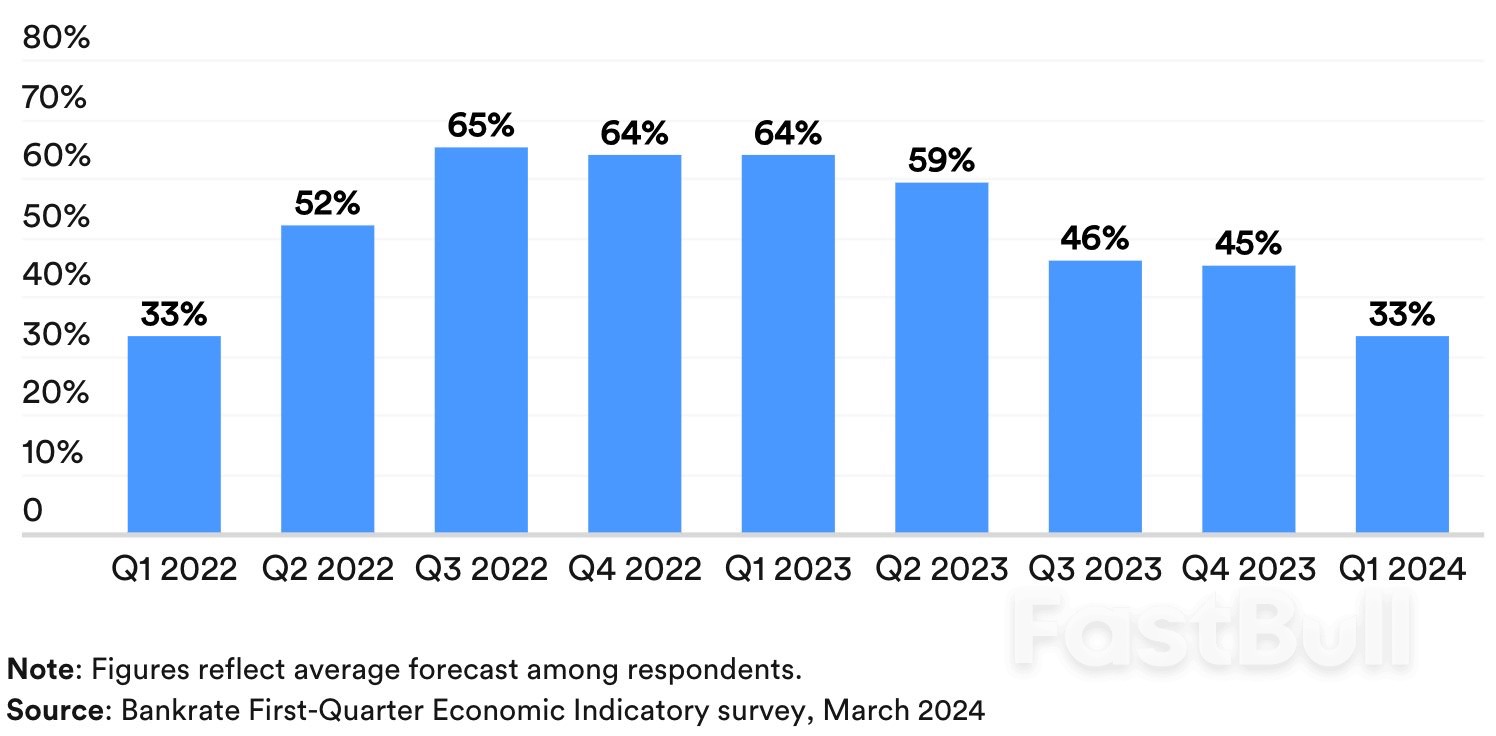
          The odds of the U.S. economy entering a recession within the next 12 months have now fallen to a two-year low of 33 percent, according to Bankrate’s latest quarterly economists’ poll. That’s after soaring as high as 65 percent back in the third quarter of 2022 and falling to about a coin-flip by the final six months of 2023.
          To be sure, only once has the Fed managed to raise interest rates and defeat inflation without causing a recession, suggesting the odds are still not in the U.S. central bank’s favor. Many economists also acknowledge that, even more likely than the economy completely avoiding a downturn, is the timing of the next one getting pushed back.
          Consumers should prepare for a recession when it seems like nothing can bring the U.S. economy down, leveraging their stable paychecks and a high-yield savings account to build their emergency fund.
          "Momentum is expected to remain intact for the foreseeable future, with the nation’s unemployment rate remaining relatively low, providing a generally solid environment for individuals and households to accomplish their financial goals."— MARK HAMRICK, BANKRATE SENIOR ECONOMIC ANALYST

          Key insights on the economy from Bankrate’s Q1 2024 Economic Indicator poll

          Survey: Recession Odds for U.S. Economy Have Now Fallen to the Lowest Level in Two Years_1

          Economists keep pushing back their recession forecasts

          Respondents put the odds of the U.S. economy entering a recession within the next 12 months from as high as 90 percent to as low as 0 percent — the lowest since Bankrate began polling economists on their recession forecasts. It’s also the first time since the third quarter of 2023 that no economist indicated they were absolutely certain of a recession, penciling in 100 percent odds.

          Recession odds are now the lowest in two years

          The odds of a recession within the next 12 months have dropped sharply, as the U.S. economy remains surprisingly resilient to higher interest rates and stubborn inflation.
          Survey: Recession Odds for U.S. Economy Have Now Fallen to the Lowest Level in Two Years_2
          The engine of economic growth is consumer spending, which picked up in February after a post-holiday spending spree slump in January, Department of Commerce data showed. But the foundation for consumption is the job market, where unemployment has held below 4 percent for the longest period since the 1960s.
          That’s even as consumer prices cooled from a staggering peak of 9.1 percent to the most recent level of 3.2 percent. Typically, economists are taught in the early days of their profession that unemployment and inflation have an inverse relationship. When one goes down, the other should typically head up.
          “A soft landing is likely as economic conditions gently cool and inflation gradually reverts to the Fed’s 2 percent target,” says Gregory Daco, chief economist at EY. “Noisy economic data at the start of the year has made the outlook more difficult to assess. Cutting through the noise, the economic picture hasn’t changed much.”
          Last March, Fed officials thought the U.S. economy would grow just 0.4 percent between the fourth quarters of 2022 and 2023. Instead, the financial system ended up expanding a solid 3.1 percent. The resilient streak is expected to continue in the first quarter of 2024, with the Atlanta Fed’s GDPNow tracker estimating 2.8 percent growth.
          The ultimate question is whether inflation can continue gradually retreating back to 2 percent without a broader economic slowdown. One factor that could have a double-edged sword: robust wage growth. One estimate from the Atlanta Fed suggests paychecks are still rising at a pace not seen since the 2000s. That could help keep the U.S. economy on solid ground, but businesses could also decide to pass along those higher expenses to customers if they don’t have increased output or productivity to show for it.
          No matter what, recessions are just as unpredictable as they are inevitable. Economists also point out continued risks with geopolitical tensions abroad, such as in the Middle East, where conflict could further exacerbate energy or oil prices.
          “Geopolitical concerns are likely to increase over the next year, raising questions about inflation and supply chains,” says Joel Naroff, president at Naroff Economics. “That could keep the Fed ‘higher for longer’ than even currently expected.”

          Here’s what the nation’s top economists are saying about the U.S. economy’s odds of a recession

          The probability of recession remains elevated and will stay that way as long as Fed monetary policy remains in restrictive territory. Even so, the risk has diminished in recent months on the resilience of the economic and financial data.— SCOTT ANDERSON | CHIEF U.S. ECONOMIST AT BMO CAPITAL MARKETS
          The economy will be increasingly at risk of a downside shock, as the expansion matures and as the stimulative effect of prior fiscal policy wears off.— MIKE ENGLUND | CHIEF ECONOMIST AT ACTION ECONOMICS
          (I expect) sluggish growth but not a recession. The stock market is unlikely to keep rising, given the already elevated price-earnings ratio, and will hold back some of the wealth effect of consumer spending. Home price growth will be muted, also hindering the wealth effect. All the while, those not owning properties are tapped out, with COVID savings mostly depleted.— LAWRENCE YUN | CHIEF ECONOMIST AT THE NATIONAL ASSOCIATION OF REALTORS

          Source: Bankrate

          To stay updated on all economic events of today, please check out our Economic calendar
          Risk Warnings and Disclaimers
          You understand and acknowledge that there is a high degree of risk involved in trading. Following any strategies or investment methods may lead to potential losses. The content on the site is provided by our contributors and analysts for information purposes only. You are solely responsible for determining whether any trading assets, securities, strategy, or any other product is suitable for investing based on your own investment objectives and financial situation.
          Add to Favorites
          Share

          ECB Seen Cutting Interest Rates Once A Quarter Starting In June

          Cohen

          Economic

          Central Bank

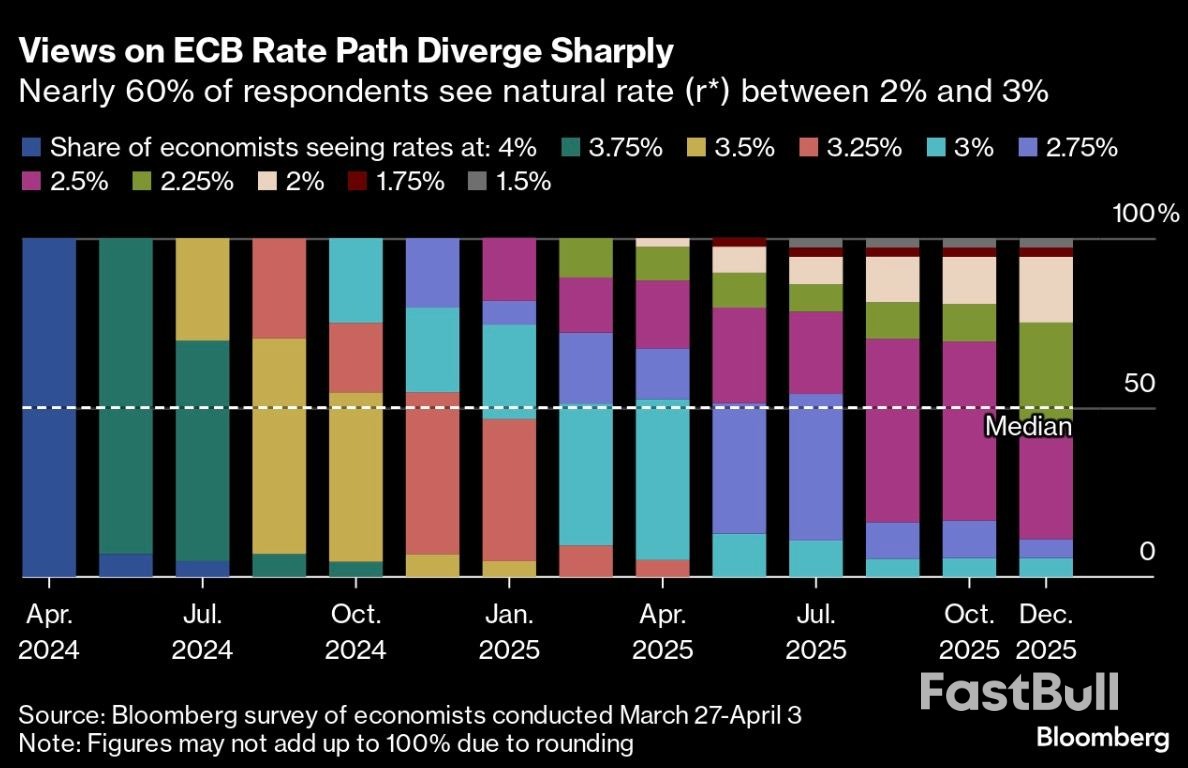
          The European Central Bank will embark in June on a steady-yet-gradual path of interest-rate cuts that’ll run at least through the end of next year, according to economists surveyed by Bloomberg.
          Respondents anticipate a first quarter-point reduction in the deposit rate — currently at a record 4% — at the policy meeting following the Governing Council’s upcoming session on April 11. Similar moves will ensue once a quarter, taking the rate to 2.25% by late 2025.
          ECB Seen Cutting Interest Rates Once A Quarter Starting In June_1
          Officials seem to have all but agreed that June is the month to start dialing back policy restriction. The subsequent pace of easing is less clear, with President Christine Lagarde insisting it’ll be strictly guided by economic performance — and others already busy plotting their preferred course.
          “Since the beginning of rate cuts in the near future seems to be almost decided, attention will now shift to what determines the speed of monetary easing,” said Kristian Toedtmann, a Dekabank economist. “Council members do not seem to have a common understanding of data dependence.”
          Greece’s Yannis Stournaras argued last month that two rate cuts before the summer and four total this year would be “reasonable” given the outlook. His Austrian colleague Robert Holzmann, long an advocate for not moving at all in 2024, said this week he has no “in-principle objection” to an initial June step — but only if the economy allows.
          Some green shoots have emerged recently, hinting at accelerating growth momentum after the 20-nation bloc only narrowly avoided a recession in the second half of last year. Business confidence is improving as well.
          ECB Seen Cutting Interest Rates Once A Quarter Starting In June_2
          “The challenge for the ECB will be not to sound too hawkish,” said Carsten Brzeski, ING’s head of macro. “Instead, it will have to explain that a rate cut in June will not so much be the result of the ECB wanting to support the economy but rather a sign of ‘they simply can’ somewhat normalize the restrictive monetary-policy stance.”
          That’s possible because inflation slowed more quickly than expected in March and consumer expectations of future gains also eased, suggesting the ECB is on track — if not ahead — in its efforts to reach 2% next year.

          What Bloomberg Economics Says...

          “We predict 25-basis-point cuts in June, September, October and December, leaving the deposit rate at 3% by year end. We think below-target inflation and dwindling domestic cost pressures will prompt a faster speed of easing after a pause in July.”
          — David Powell, senior euro-area economist.
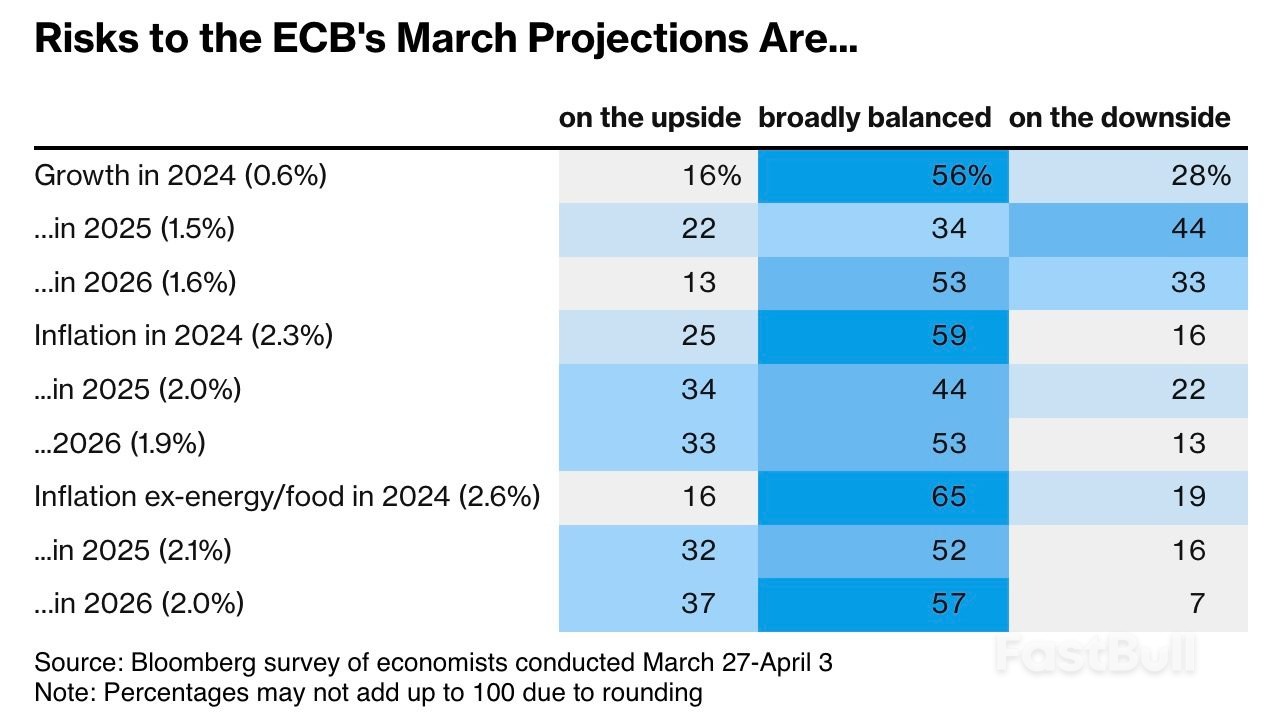
          Most economists in the survey consider risks to the ECB’s latest projections — on growth and inflation — to be broadly balanced, though about a third see upside ones for the latter in 2025 and 2026.
          ECB Seen Cutting Interest Rates Once A Quarter Starting In June_3
          “The ECB should be open to rate cuts as early as June of this year but simultaneously signal to financial markets that overly aggressive rate-cut expectations are unwarranted and counter-productive,” said Dennis Shen, senior director at Scope Ratings, highlighting the risk of a premature loosening of financial conditions.
          Markets are currently pricing around 90 basis points of easing this year, compared to about 70 basis points for the Federal Reserve. That gap has reignited a debate that’s as old as the ECB itself — whether Europe can chart its own policy course or will ultimately be forced to follow the US.
          Only a quarter of respondents say they’re convinced that Fed decisions won’t impact the ECB’s rate path at all, compared to 36% saying they shouldn’t.
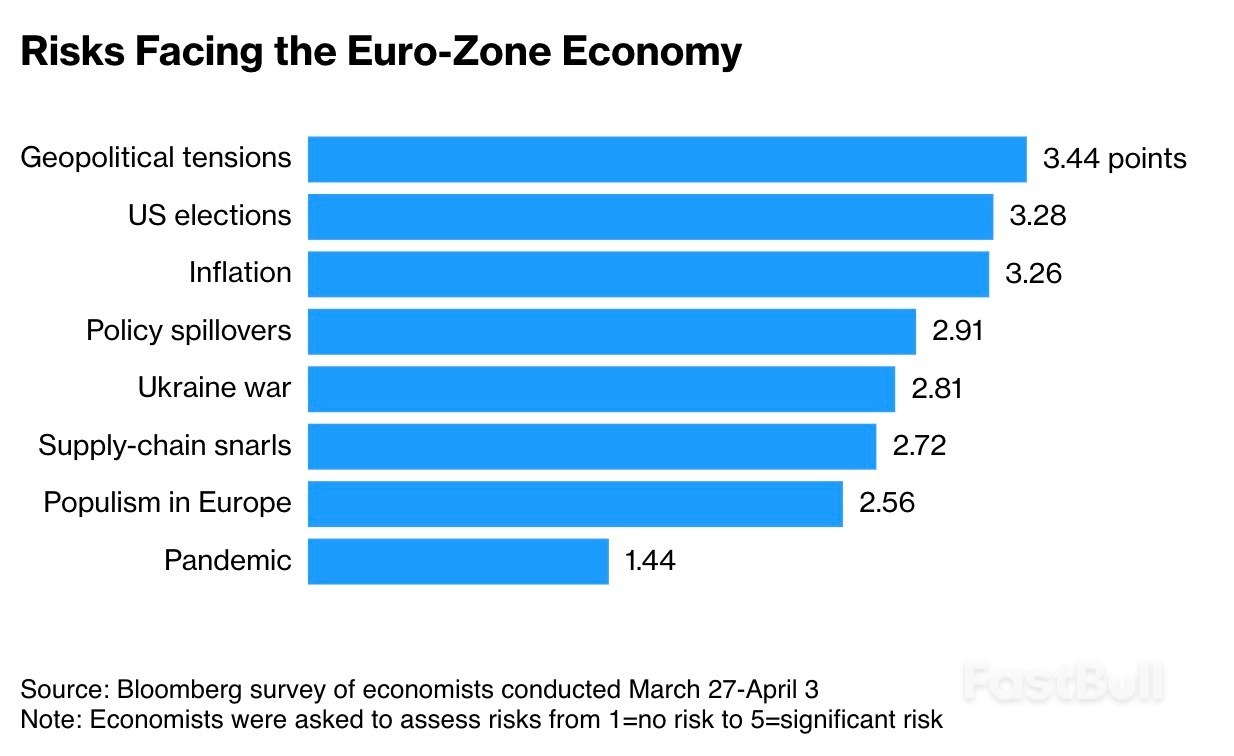
          What’s true is that one of the single-biggest economic risks to the euro area is originating in the US in the form of presidential elections. Economists are similarly concerned about global geopolitical tensions and inflation pressures.

          Source:Bloomberg

          To stay updated on all economic events of today, please check out our Economic calendar
          Risk Warnings and Disclaimers
          You understand and acknowledge that there is a high degree of risk involved in trading. Following any strategies or investment methods may lead to potential losses. The content on the site is provided by our contributors and analysts for information purposes only. You are solely responsible for determining whether any trading assets, securities, strategy, or any other product is suitable for investing based on your own investment objectives and financial situation.
          Add to Favorites
          Share

          March Sees First Decline in UK House Prices After 6 Months

          Zi Cheng

          Traders' Opinions

          Economic

          In March, UK house prices experienced their first decline in six months, as reported by Halifax, surprising economists and indicating a lack of consistency in the property market's recovery.
          The average house price dropped by 1 percent month-on-month in March, decreasing to £288,430 from February's peak of £291,338, marking the end of five consecutive months of increases.
          Halifax's data also revealed that March prices were only 0.3 percent higher than a year earlier, a significantly smaller annual rise compared to the 1.45 percent forecasted by economists in a Reuters poll.
          Kim Kinnaird, director of Halifax mortgages, noted, "Affordability constraints continue to be a challenge for prospective buyers," adding, "House prices have shown surprising resilience in the face of significantly higher borrowing costs."
          These findings are consistent with recent data from Nationwide, which also reported an unexpected decline in house prices for March. However, separate figures released by the Bank of England this week indicated a rise in mortgage approvals to a 17-month high in February.
          Despite the monthly downturn, Kinnaird expressed optimism about the market, citing the data as reflecting improvements in the UK's cost of living crisis.
          "The broader picture is that house prices are up year on year, reflecting the opposing forces of an easing cost of living squeeze — now that pay growth is outpacing general inflation — and relatively high interest rates," Kinnaird remarked.

          March Sees First Decline in UK House Prices After 6 Months_1Source: Halifax

          According to some analysts, the decline in house prices reported by the Nationwide and Halifax indices reflects the increase in mortgage rates during March, contrasting with the six-month low in "effective" interest rates revealed by recent Bank of England data for February.
          Andrew Wishart, a senior economist at research firm Capital Economics, suggested, "I think what we are observing in the house price data released this week is that mortgage rates rose in March, likely returning to 5 percent from 4.5 percent in February, and these elevated rates are exerting downward pressure on prices."
          Economists noted that the future trajectory of house prices would hinge on changes in interest rates, which currently stand at a 16-year peak of 5.25 percent and play a significant role in how lenders determine mortgage rates.

          March Sees First Decline in UK House Prices After 6 Months_2Source: Halifax

          Jonathan Haskel, a member of the Bank of England's policymaking committee, conveyed to the Financial Times last month that he believed reductions in borrowing costs were "a distant prospect" due to underlying inflationary pressures.
          "Mortgage rates are anticipated to decrease gradually from current levels, as markets foresee the Bank of England gradually relaxing its policy constraints," stated Rob Wood, chief UK economist at consultancy Pantheon Macroeconomics. "Consequently, affordability is likely to be stretched, potentially restraining increases in house prices."
          However, indications suggest that relief for homebuyers may arrive sooner. A recent Bank of England survey of UK businesses indicated that expectations for wage growth reached a two-year low in March, reinforcing the notion that the central bank could commence rate cuts starting this summer.
          Wishart remarked that if the Bank of England's benchmark rate decreased more rapidly towards the end of 2024, "we could witness mortgage rates dropping below 4 percent, leading to a near-term plateauing in house prices."
          To stay updated on all economic events of today, please check out our Economic calendar
          Risk Warnings and Disclaimers
          You understand and acknowledge that there is a high degree of risk involved in trading. Following any strategies or investment methods may lead to potential losses. The content on the site is provided by our contributors and analysts for information purposes only. You are solely responsible for determining whether any trading assets, securities, strategy, or any other product is suitable for investing based on your own investment objectives and financial situation.
          Add to Favorites
          Share

          Why Japan is Not Giving Up on Fraught U.S. Steel Deal

          Alex

          Economic

          Days after President Joe Biden joined his election rival Donald Trump in voicing concern about a Japanese purchase of U.S. Steel, the manufacturer began touting the benefits of the deal on billboards near its factories from Alabama to Pennsylvania.
          The billboards may be the most public signs of what some Japanese officials say in private - that despite high hurdles, Nippon Steel could still steer through the fraught $15 billion acquisition of the iconic American manufacturer.
          The deal may well hinge on whether regulators avoid election-year politics by clearing the acquisition after Nov. 5, and, critically, on whether Nippon Steel can win over the influential United Steelworkers (USW) labour union.
          Opposition from the Pittsburgh-based union has far-reaching implications in an election year where Pennsylvania is seen as a key battleground state.
          The deal is effectively "on life support" after Biden's statement last month that U.S. Steel must remain domestically owned and operated, said David Boling, a former U.S. trade official in Japan who now works for consulting firm Eurasia Group.
          Investors seem to agree. Biden's comment, which followed Trump's pledge to block the deal if he wins the Nov. 5 election, sent shares in both companies tumbling. U.S. Steel shares last traded at $41.10, well below the $55 per share price Nippon Steel has offered.
          Nevertheless, it is still premature to declare the deal dead, four senior Japanese officials speaking on condition of anonymity told Reuters - a view shared by some analysts, consultants and lawyers. The White House declined to comment on whether Biden's statement meant the purchase could not proceed.
          Ongoing regulatory reviews in the U.S. may serve to buy time, thereby delaying a final decision until after the election when the campaign rhetoric has dissipated, the officials and others said.
          Furthermore, Nippon Steel could still take steps to ringfence its U.S. operations to ease concerns about foreign ownership.
          And finally, the officials and others say, Nippon Steel could make its way through thorny talks and yet win over the steelworkers.
          Publicly, Tokyo has sought to distance itself from the deal, saying it is a commercial matter - an approach widely seen as an attempt to play down any controversy ahead of a summit between between Japanese premier Fumio Kishida and Biden in Washington on April 10.

          High Hurdles

          U.S. Steel's shareholders are due to vote on the acquisition on April 12, but with the firm's board having unanimously recommended shareholders approve, analysts expect it to pass.
          The next real hurdle is regulatory. The Committee on Foreign Investment in the United States (CFIUS), a government panel that vets deals on national security grounds, is reviewing the transaction. Nippon Steel said the deal is also being examined by antitrust authorities in several countries including the U.S.
          An influential U.S. Senator on Tuesday urged the White House to probe Nippon Steel's exposure to its strategic rival China, a connection the firm has said is "very limited".
          While by law CFIUS should complete deliberations within 90 days, in practice it can take much longer via an increasingly common process where parties withdraw and refile their applications, its latest annual report shows.
          "There is unlikely to be a decision until after the election," said Bill Reinsch, a former U.S. commerce official now advising the Center for Strategic and International Studies. Biden's comments "have not torpedoed the proposed acquisition," he added.
          Two of the Japanese officials said the timing of the deal ahead of the election has stifled debate about its economic merits and that a delay could help calmer heads prevail.
          But taking Biden at his word, getting around foreign ownership concerns won't be easy.
          Nippon Steel has been at pains to stress its "deep roots" in the United States. It has had a presence there since the 1980s and has 4,000 employees in the country.
          Nick Wall, a corporate M&A partner with Allen & Overy in Tokyo, said U.S. regulators may grant conditional approval to the deal if the firm makes changes to the management structure or ensures senior personnel are U.S. nationals.
          "There could be structures put in place to ensure it’s owned and controlled by U.S. people, even if the economic control lies in Japan," said Wall, who is not involved in the deal.
          The sensitive defence sector provides one such example.
          The American subsidiary of British defence contractor BAE Systems does business with the U.S. government under a special agreement where the influence and control of its foreign parent is restricted.
          A Biden adviser said the policy question was "settled" by the president and that if the deal is to include foreign partners it would need a "different approach", declining to elaborate.
          That puts the focus on the USW, which blasted the deal and both companies for not consulting it before the deal was announced. In a letter to its members on Tuesday, USW leadership called Nippon Steel's latest pledges to support workers a "collection of empty promises".
          But a source close to Nippon Steel, who declined to be named due to the sensitivity of the negotiations, said the union could be using the political situation to get better terms and appears to remain engaged in talks.
          "There will be no problem to clear U.S. Steel shareholders meeting, anti-trust examination, and CFIUS examination, if they are handled normally," said Shinichiro Ozaki, senior analyst at Daiwa Securities.
          "But the most important thing, both before and after Biden's statement, remains whether or not Nippon Steel can reach an agreement with USW."

          Source: Reuters

          To stay updated on all economic events of today, please check out our Economic calendar
          Risk Warnings and Disclaimers
          You understand and acknowledge that there is a high degree of risk involved in trading. Following any strategies or investment methods may lead to potential losses. The content on the site is provided by our contributors and analysts for information purposes only. You are solely responsible for determining whether any trading assets, securities, strategy, or any other product is suitable for investing based on your own investment objectives and financial situation.
          Add to Favorites
          Share
          FastBull
          Copyright © 2025 FastBull Ltd

          728 RM B 7/F GEE LOK IND BLDG NO 34 HUNG TO RD KWUN TONG KLN HONG KONG

          TelegramInstagramTwitterfacebooklinkedin
          App Store Google Play Google Play
          Products
          Charts

          Chats

          Q&A with Experts
          Screeners
          Economic Calendar
          Data
          Tools
          Membership
          Features
          Function
          Markets
          Copy Trading
          Latest Signals
          Contests
          News
          Analysis
          24/7
          Columns
          Education
          Company
          Careers
          About Us
          Contact Us
          Advertising
          Help Center
          Feedback
          User Agreement
          Privacy Policy
          Business

          White Label

          Data API

          Web Plug-ins

          Poster Maker

          Affiliate Program

          Risk Disclosure

          The risk of loss in trading financial instruments such as stocks, FX, commodities, futures, bonds, ETFs and crypto can be substantial. You may sustain a total loss of the funds that you deposit with your broker. Therefore, you should carefully consider whether such trading is suitable for you in light of your circumstances and financial resources.

          No decision to invest should be made without thoroughly conducting due diligence by yourself or consulting with your financial advisors. Our web content might not suit you since we don't know your financial conditions and investment needs. Our financial information might have latency or contain inaccuracy, so you should be fully responsible for any of your trading and investment decisions. The company will not be responsible for your capital loss.

          Without getting permission from the website, you are not allowed to copy the website's graphics, texts, or trademarks. Intellectual property rights in the content or data incorporated into this website belong to its providers and exchange merchants.

          Not Logged In

          Log in to access more features

          FastBull Membership

          Not yet

          Purchase

          Become a signal provider
          Help Center
          Customer Service
          Dark Mode
          Price Up/Down Colors

          Log In

          Sign Up
          Position
          Layout
          Fullscreen
          Default to Chart
          The chart page opens by default when you visit fastbull.com