• Trade
  • Markets
  • Copy
  • Contests
  • News
  • 24/7
  • Calendar
  • Q&A
  • Chats
Trending
Screeners
SYMBOL
LAST
BID
ASK
HIGH
LOW
NET CHG.
%CHG.
SPREAD
SPX
S&P 500 Index
6813.13
6813.13
6813.13
6861.30
6801.50
-14.28
-0.21%
--
DJI
Dow Jones Industrial Average
48393.36
48393.36
48393.36
48679.14
48317.93
-64.68
-0.13%
--
IXIC
NASDAQ Composite Index
23063.46
23063.46
23063.46
23345.56
23012.00
-131.70
-0.57%
--
USDX
US Dollar Index
97.810
97.890
97.810
98.070
97.740
-0.140
-0.14%
--
EURUSD
Euro / US Dollar
1.17590
1.17599
1.17590
1.17686
1.17262
+0.00196
+ 0.17%
--
GBPUSD
Pound Sterling / US Dollar
1.33928
1.33938
1.33928
1.34014
1.33546
+0.00221
+ 0.17%
--
XAUUSD
Gold / US Dollar
4319.66
4320.09
4319.66
4350.16
4294.68
+20.27
+ 0.47%
--
WTI
Light Sweet Crude Oil
56.628
56.658
56.628
57.601
56.625
-0.605
-1.06%
--

Community Accounts

Signal Accounts
--
Profit Accounts
--
Loss Accounts
--
View More

Become a signal provider

Sell trading signals to earn additional income

View More

Guide to Copy Trading

Get started with ease and confidence

View More

Signal Accounts for Members

All Signal Accounts

Best Return
  • Best Return
  • Best P/L
  • Best MDD
Past 1W
  • Past 1W
  • Past 1M
  • Past 1Y

All Contests

  • All
  • Trump Updates
  • Recommend
  • Stocks
  • Cryptocurrencies
  • Central Banks
  • Featured News
Top News Only
Share

The Offshore Yuan Broke Through 7.04 Against The US Dollar

Share

Fbi Director: A Fifth Individual Believed To Be Planning A Separate Attack Arrested By Fbi New Orleans

Share

New York Fed President Williams: The 2% Inflation Target Must Be Achieved Without Impacting The Job Market

Share

New York Fed President Williams: Monetary Policy Very Focused On Balancing Job, Inflation Risks

Share

New York Fed President Williams Expects USA Unemployment To Be 4.5% By End Of 2025

Share

New York Fed President Williams: Labor Market Risks Have Risen As Risks To Inflation Have Eased

Share

New York Fed President Williams Expects Inflation To Move To 2.5% In 2026, 2% In 2027

Share

New York Fed President Williams Sees Tariffs As A One-Off Price Adjustment, Not Spilling Over Into Broader Inflation

Share

New York Fed President Williams: Labor Market Cooling Has Been Gradual Process

Share

New York Fed President Williams Expects Active Usage Of Standing Repo Facility To Manage Liquidity

Share

New York Fed President Williams: Critical For USA Central Bank To Get Inflation Back To 2%

Share

New York Fed President Williams Expects 2026 GDP Growth To Hit 2.25%, Well Above 2025 Rate

Share

New York Fed President Williams Projects Jobless Rate Will Come Back Down Over Next Few Years

Share

New York Fed President Williams: Fed Policy Has Moved Toward Neutral From Modestly Restrictive

Share

Federal Reserve Governor Milan: I Would Be Happy To Vote For The Re-election Of Regional Fed Presidents

Share

Miran: What Is Most Surprising Is How Nice And Collegial The Fed Has Been

Share

Miran: The Least Attractive Part Of Being At The Fed Is Having Only 1 Of 12 Votes On A Committee

Share

White House To Host Press Call On Russia-Ukraine Peace Talks

Share

Miran: Was Delighted To Vote In Favor Of Reappointing Current Reserve Bank Presidents, Think They Are Doing A Good Job

Share

Miran: The Reserve Banks Play A Valuable Role In Providing Local Perspectives And Contacts

TIME
ACT
FCST
PREV
Japan Tankan Small Manufacturing Outlook Index (Q4)

A:--

F: --

P: --

Japan Tankan Large Non-Manufacturing Outlook Index (Q4)

A:--

F: --

P: --

Japan Tankan Large Manufacturing Outlook Index (Q4)

A:--

F: --

P: --

Japan Tankan Small Manufacturing Diffusion Index (Q4)

A:--

F: --

P: --

Japan Tankan Large-Enterprise Capital Expenditure YoY (Q4)

A:--

F: --

P: --

U.K. Rightmove House Price Index YoY (Dec)

A:--

F: --

P: --

China, Mainland Industrial Output YoY (YTD) (Nov)

A:--

F: --

P: --

China, Mainland Urban Area Unemployment Rate (Nov)

A:--

F: --

P: --

Saudi Arabia CPI YoY (Nov)

A:--

F: --

P: --

Euro Zone Industrial Output YoY (Oct)

A:--

F: --

P: --

Euro Zone Industrial Output MoM (Oct)

A:--

F: --

P: --

Canada Existing Home Sales MoM (Nov)

A:--

F: --

P: --

Canada National Economic Confidence Index

A:--

F: --

P: --

Canada New Housing Starts (Nov)

A:--

F: --

P: --
U.S. NY Fed Manufacturing Employment Index (Dec)

A:--

F: --

P: --

U.S. NY Fed Manufacturing Index (Dec)

A:--

F: --

P: --

Canada Core CPI YoY (Nov)

A:--

F: --

P: --

Canada Manufacturing Unfilled Orders MoM (Oct)

A:--

F: --

P: --

U.S. NY Fed Manufacturing Prices Received Index (Dec)

A:--

F: --

P: --

U.S. NY Fed Manufacturing New Orders Index (Dec)

A:--

F: --

P: --

Canada Manufacturing New Orders MoM (Oct)

A:--

F: --

P: --

Canada Core CPI MoM (Nov)

A:--

F: --

P: --

Canada Trimmed CPI YoY (SA) (Nov)

A:--

F: --

P: --

Canada Manufacturing Inventory MoM (Oct)

A:--

F: --

P: --

Canada CPI YoY (Nov)

A:--

F: --

P: --

Canada CPI MoM (Nov)

A:--

F: --

P: --

Canada CPI YoY (SA) (Nov)

A:--

F: --

P: --

Canada Core CPI MoM (SA) (Nov)

A:--

F: --

P: --

Canada CPI MoM (SA) (Nov)

A:--

F: --

P: --

Federal Reserve Board Governor Milan delivered a speech
U.S. NAHB Housing Market Index (Dec)

A:--

F: --

P: --

Australia Composite PMI Prelim (Dec)

--

F: --

P: --

Australia Services PMI Prelim (Dec)

--

F: --

P: --

Australia Manufacturing PMI Prelim (Dec)

--

F: --

P: --

Japan Manufacturing PMI Prelim (SA) (Dec)

--

F: --

P: --

U.K. 3-Month ILO Employment Change (Oct)

--

F: --

P: --

U.K. Unemployment Claimant Count (Nov)

--

F: --

P: --

U.K. Unemployment Rate (Nov)

--

F: --

P: --

U.K. 3-Month ILO Unemployment Rate (Oct)

--

F: --

P: --

U.K. Average Weekly Earnings (3-Month Average, Including Bonuses) YoY (Oct)

--

F: --

P: --

U.K. Average Weekly Earnings (3-Month Average, Excluding Bonuses) YoY (Oct)

--

F: --

P: --

France Services PMI Prelim (Dec)

--

F: --

P: --

France Composite PMI Prelim (SA) (Dec)

--

F: --

P: --

France Manufacturing PMI Prelim (Dec)

--

F: --

P: --

Germany Services PMI Prelim (SA) (Dec)

--

F: --

P: --

Germany Manufacturing PMI Prelim (SA) (Dec)

--

F: --

P: --

Germany Composite PMI Prelim (SA) (Dec)

--

F: --

P: --

Euro Zone Composite PMI Prelim (SA) (Dec)

--

F: --

P: --

Euro Zone Services PMI Prelim (SA) (Dec)

--

F: --

P: --

Euro Zone Manufacturing PMI Prelim (SA) (Dec)

--

F: --

P: --

U.K. Services PMI Prelim (Dec)

--

F: --

P: --

U.K. Manufacturing PMI Prelim (Dec)

--

F: --

P: --

U.K. Composite PMI Prelim (Dec)

--

F: --

P: --

Euro Zone ZEW Economic Sentiment Index (Dec)

--

F: --

P: --

Germany ZEW Current Conditions Index (Dec)

--

F: --

P: --

Germany ZEW Economic Sentiment Index (Dec)

--

F: --

P: --

Euro Zone Trade Balance (Not SA) (Oct)

--

F: --

P: --

Euro Zone ZEW Current Conditions Index (Dec)

--

F: --

P: --

Euro Zone Trade Balance (SA) (Oct)

--

F: --

P: --

U.S. Retail Sales MoM (Excl. Gas Stations & Vehicle Dealers) (SA) (Oct)

--

F: --

P: --

U.S. Retail Sales MoM (Excl. Automobile) (SA) (Oct)

--

F: --

P: --

Q&A with Experts
    • All
    • Chatrooms
    • Groups
    • Friends
    Connecting
    .
    .
    .
    Type here...
    Add Symbol or Code

      No matching data

      All
      Trump Updates
      Recommend
      Stocks
      Cryptocurrencies
      Central Banks
      Featured News
      • All
      • Russia-Ukraine Conflict
      • Middle East Flashpoint
      • All
      • Russia-Ukraine Conflict
      • Middle East Flashpoint

      Search
      Products

      Charts Free Forever

      Chats Q&A with Experts
      Screeners Economic Calendar Data Tools
      Membership Features
      Data Warehouse Market Trends Institutional Data Policy Rates Macro

      Market Trends

      Market Sentiment Order Book Forex Correlations

      Top Indicators

      Charts Free Forever
      Markets

      News

      News Analysis 24/7 Columns Education
      From Institutions From Analysts
      Topics Columnists

      Latest Views

      Latest Views

      Trending Topics

      Top Columnists

      Latest Update

      Signals

      Copy Rankings Latest Signals Become a signal provider AI Rating
      Contests
      Brokers

      Overview Brokers Assessment Rankings Regulators News Claims
      Broker listing Forex Brokers Comparison Tool Live Spread Comparison Scam
      Q&A Complaint Scam Alert Videos Tips to Detect Scam
      More

      Business
      Events
      Careers About Us Advertising Help Center

      White Label

      Data API

      Web Plug-ins

      Affiliate Program

      Awards Institution Evaluation IB Seminar Salon Event Exhibition
      Vietnam Thailand Singapore Dubai
      Fans Party Investment Sharing Session
      FastBull Summit BrokersView Expo
      Recent Searches
        Top Searches
          Markets
          News
          Analysis
          User
          24/7
          Economic Calendar
          Education
          Data
          • Names
          • Latest
          • Prev

          View All

          No data

          Scan to Download

          Faster Charts, Chat Faster!

          Download App
          English
          • English
          • Español
          • العربية
          • Bahasa Indonesia
          • Bahasa Melayu
          • Tiếng Việt
          • ภาษาไทย
          • Français
          • Italiano
          • Türkçe
          • Русский язык
          • 简中
          • 繁中
          Open Account
          Search
          Products
          Charts Free Forever
          Markets
          News
          Signals

          Copy Rankings Latest Signals Become a signal provider AI Rating
          Contests
          Brokers

          Overview Brokers Assessment Rankings Regulators News Claims
          Broker listing Forex Brokers Comparison Tool Live Spread Comparison Scam
          Q&A Complaint Scam Alert Videos Tips to Detect Scam
          More

          Business
          Events
          Careers About Us Advertising Help Center

          White Label

          Data API

          Web Plug-ins

          Affiliate Program

          Awards Institution Evaluation IB Seminar Salon Event Exhibition
          Vietnam Thailand Singapore Dubai
          Fans Party Investment Sharing Session
          FastBull Summit BrokersView Expo

          Market Analysis: AUD/USD And NZD/USD Test Support, Break Or Bounce Next?

          FXOpen

          Forex

          Economic

          Summary:

          AUD/USD is attempting a fresh increase from 0.6630. NZD/USD is consolidating and could aim for a move above 0.5800 in the short term.

          AUD/USD is attempting a fresh increase from 0.6630. NZD/USD is consolidating and could aim for a move above 0.5800 in the short term.

          Important Takeaways for AUD/USD and NZD/USD Analysis Today

          · The Aussie Dollar started a minor pullback from 0.6685 against the US Dollar.

          · There is a key bullish trend line forming with support at 0.6645 on the hourly chart of AUD/USD at FXOpen.

          · NZD/USD is consolidating above 0.5765 and 0.5755.

          · There is a major bullish trend line forming with support at 0.5765 on the hourly chart of NZD/USD at FXOpen.

          AUD/USD Technical Analysis

          On the hourly chart of AUD/USD at FXOpen, the pair formed a base above 0.6600. The Aussie Dollar started a decent increase above 0.6630 against the US Dollar to enter a short-term positive zone.

          The pair struggled above 0.6680 and recently corrected some gains. The recent low was formed at 0.6632. The pair is now consolidating and facing resistance near the 50% Fib retracement level of the downward move from the 0.6677 swing high to the 0.6632 low at 0.6655 and the 50-hour simple moving average.
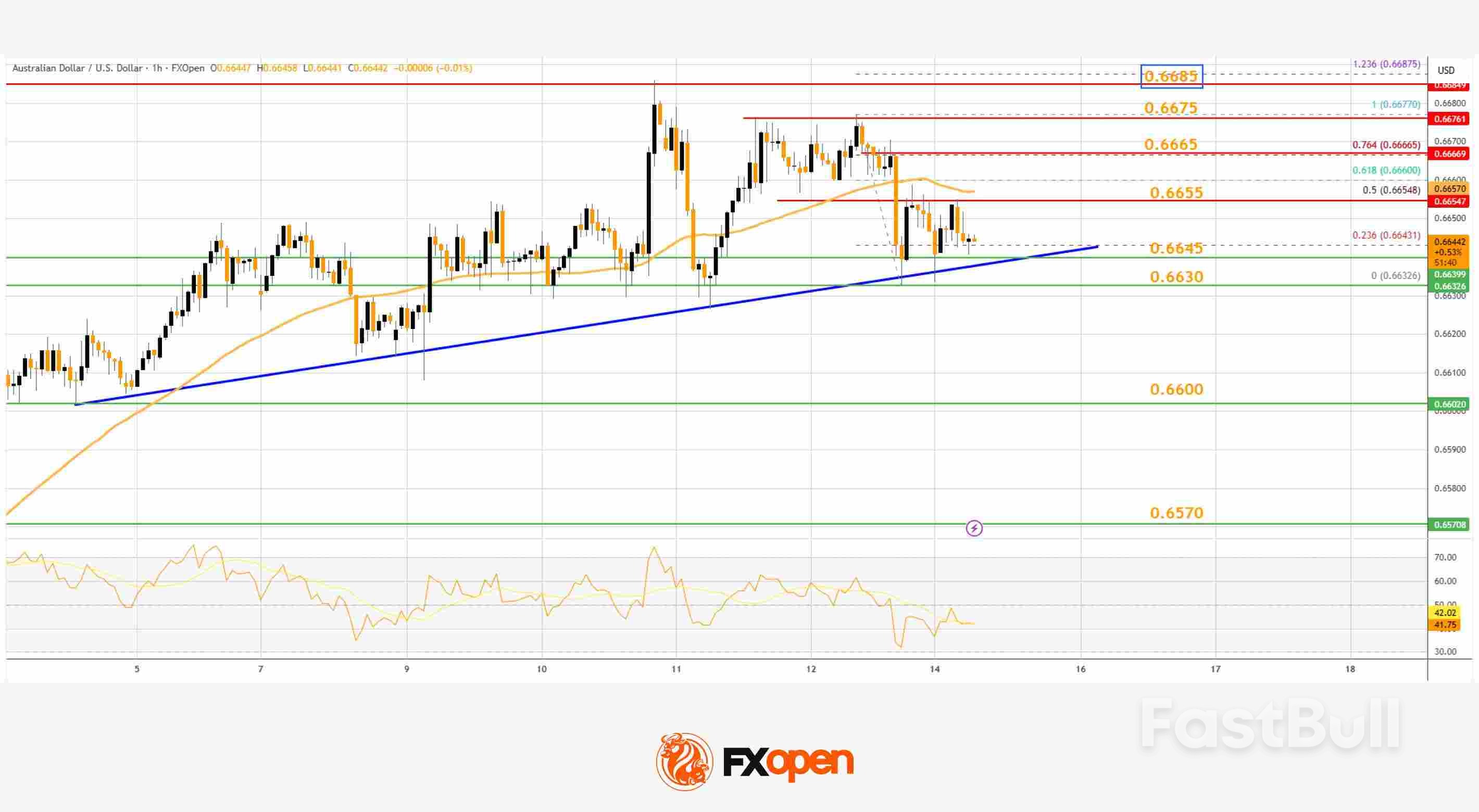
          The AUD/USD chart indicates that the pair could struggle to clear the 76.4% Fib retracement at 0.6665. The first major hurdle for the bulls could be 0.6685.

          An upside break above 0.6685 resistance might send the pair further higher. The next major target is near the 0.6720 level. Any more gains could clear the path for a move toward 0.6750. If there is no close above 0.6665, the pair might start a fresh decline.

          Immediate bid zone could be near the 0.6645 level. There is also a key bullish trend line forming with support at 0.6645. The next area of interest is 0.6630. If there is a downside break below 0.6630, the pair could extend its decline toward 0.6600. Any more losses might signal a move toward 0.6570.

          NZD/USD Technical Analysis

          On the hourly chart of NZD/USD on FXOpen, the pair also followed AUD/USD. The New Zealand Dollar failed to stay above 0.5800 and corrected gains against the US Dollar.

          The pair dipped below 0.5790 and the 50-hour simple moving average and 0.5830. A low was formed at 0.5765, and the pair is now consolidating below the 23.6% Fib retracement level of the downward move from the 0.5831 swing high to the 0.5765 low.
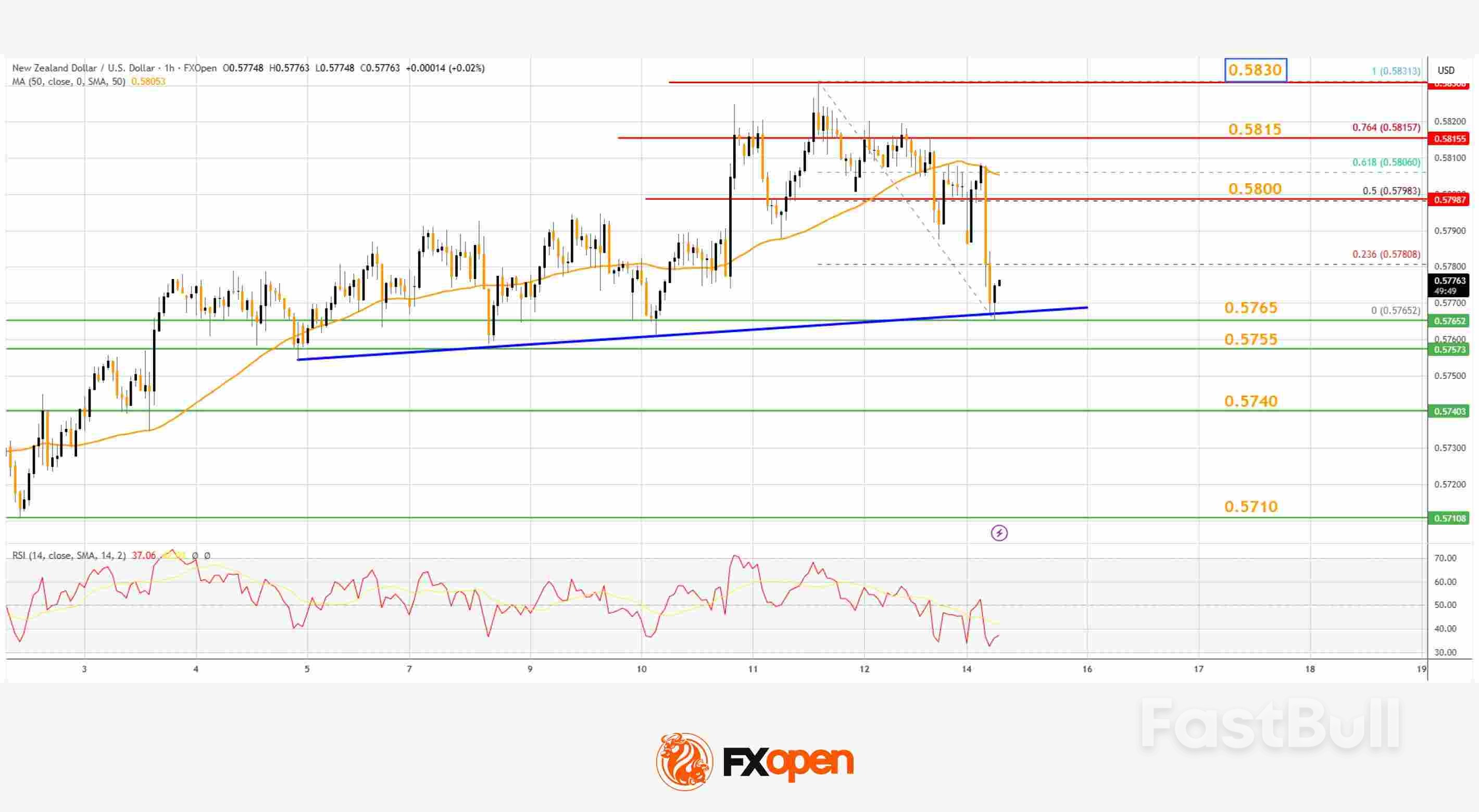
          The NZD/USD chart suggests that the RSI is below 40, signaling a short-term negative bias. On the upside, the pair is facing resistance near the 50% Fib retracement level at 0.5800.

          The next major hurdle for buyers could be 0.5815. A clear move above 0.5815 might even push the pair toward 0.5830. Any more gains might clear the path for a move toward the 0.5880 pivot zone in the coming sessions.

          On the downside, there is support forming near the 0.5765 zone and a bullish trend line. If there is a downside break below 0.5765, the pair might slide toward 0.5740. Any more losses could lead NZD/USD into a bearish zone to 0.5710.

          Source: FXOpen

          To stay updated on all economic events of today, please check out our Economic calendar
          Risk Warnings and Disclaimers
          You understand and acknowledge that there is a high degree of risk involved in trading. Following any strategies or investment methods may lead to potential losses. The content on the site is provided by our contributors and analysts for information purposes only. You are solely responsible for determining whether any trading assets, securities, strategy, or any other product is suitable for investing based on your own investment objectives and financial situation.
          Add to Favorites
          Share

          Market Quick Take - 15 December 2025

          SAXO

          Forex

          Cryptocurrency

          Stocks

          Commodity

          Market drivers and catalysts

          · Equities: Wall Street slides on artificial intelligence margin worries, Europe slips with tech drag, while Asia firms on China fiscal support hopes
          · Volatility: VIX mid-teens, event-heavy week, macro and central banks in focus
          · Digital assets: BTC/ETH stable, ETHA weaker, UK crypto regulation, MSTR pressure
          · Fixed Income: US yield curve steepens to new 2025 extreme as long dated US treasuries under pressure.
          · Currencies: Yen firms Monday ahead of Friday's key Bank of Japan meeting. The US dollar quiet.
          · Commodities: Metals rebound after equity-led correction; oil steadies above key support
          · Macro events: US Dec Empire Manufacturing & NAHB Housing Market Index

          Macro headlines

          · Confidence among Japan's large manufacturers hit a four-year high, with the BOJ's quarterly Tankan business survey index rising to 15 from 14 in September, while large non-manufacturers held at 34, near early-1990s highs. A result that strengnthens the case for the BOJ to raise interest rates this week.
          · The four-year downturn in China's home prices, which has weighed on consumer sentiment and become a hurdle for economic growth, continued in November, with new-home sales and resale home values both falling. Officials are considering measures including mortgage subsidies and tax rebates to address the crisis. Retail sales and industrial production, also for November, both rose by less than expected, up 1.3% and 4.8% YoY versus expectations of 2.9% and 5%.
          · Trump stated he is leaning towards Kevin Warsh or Kevin Hassett to lead the Fed and believes the next Fed Chair should consult him on interest rates.
          · Fed comments on recent rate change: Goolsbee dissented from last week's cut, preferring to await more inflation data despite expecting 2026 cuts, while Paulson was more dovish, prioritising labour market risks and seeing inflation easing next year. Cleveland Fed's Hammack meanwhile said policy is around neutral, but she would prefer a slightly more restrictive stance to keep pressure on inflation, which remains above target and has been stuck near 3%. San Francisco Fed's Daly ultimately backed this week's rate cut despite calling it a difficult decision.

          Equities

          · USA: The S&P 500 fell 1.1% to 6,827.41, the Dow slipped 0.5% to 48,458.05, and the Nasdaq dropped 1.7% to 23,195.17. Tech led losses as investors worried that the artificial intelligence (AI) build-out is starting to squeeze margins, rather than lift them. Broadcom sank 11.4% after warning that more AI system sales mean thinner margins, while Oracle slid 4.6% on fresh concerns about data center timing and heavy spending. Nvidia fell 3.3% in the chip selloff, while Lululemon jumped 9.6% on upbeat guidance and a CEO transition; next up is the delayed run of U.S. data, including retail sales on 16 December.
          · Europe: The STOXX 600 fell 0.5% to 578.24 and the Euro STOXX 50 eased 0.6% to 5,720.71, while the FTSE 100 slipped 0.6% to 9,649.03. Morning gains faded as U.S. tech weakness revived artificial intelligence valuation worries. ASML dropped 1.7% and Schneider Electric fell 1.6%, while UBS rose 2.5% on hopes Swiss capital rules may be softened and Lufthansa climbed 4.8% after a broker upgrade. Attention now turns to this week's European Central Bank and Bank of England decisions later this week.
          · Asia: Asia finished mostly higher on Friday: Japan's Nikkei 225 rose 1.4% to 50,836.55, Hong Kong's Hang Seng gained 1.8% to 25,976.79, and China's CSI 300 added 0.6% to 4,580.95. Sentiment improved after Beijing signalled a more proactive fiscal stance for 2026 and markets digested last week's Fed rate cut. Alibaba climbed 2.3% and Xiaomi rose 1.9% as internet and consumer tech rebounded, while China Life Insurance jumped 5.5% as financials outperformed. This week's key watchpoints are fresh China data and the Bank of Japan meeting on 18–19 December.

          Volatility

          · Volatility picked up slightly as investors prepare for a packed macro week. The VIX rose 5.99% to 15.74, while short-term fear gauges like VIX1D (+16.07%) and VIX9D (+8.19%) jumped more noticeably, hinting at near-term nerves. Despite the SPX dropping -1.07% to 6,827, options positioning suggests no panic, just preparation.
          · This week's SPX expected move into the 19 Dec expiry is ±96.5 points (~1.41%), based on straddle pricing around the 6,825 strike. Skew check: the options chain remains moderately inverted, with calls near the money trading richer than puts, a possible signal of interest in upside hedges, or call overwriting.
          · Macro triggers include U.S. CPI (Thursday), core PCE (Friday), and four central bank rate decisions (BoE, ECB, BoJ, Fed follow-through). With liquidity drying into year-end, even modest surprises may spark disproportionate moves. Watch central bank tone and inflation surprises for volatility spikes.

          Digital Assets

          · Bitcoin held ground near $89.6k (+1.63%), while ether rebounded to $3,123 (+1.97%), showing resilience despite a broader pullback in crypto equities. Solana outperformed at +2.05%, while XRP was more muted at +0.93%. The move came as politics increasingly dominates the crypto narrative, with UK regulators setting a timeline to integrate crypto into mainstream finance by 2027.
          · ETF sentiment diverged. IBIT fell 1.73%, while ETHA dropped 4.55%, despite recent net inflows (latest reported +$51m IBIT, +$23m ETHA on 12 Dec). This points to rotation, not capitulation. Crypto treasury names like MSTR (-3.74%) and CIFR (-9.69%) underperformed, echoing ETF weakness. Concerns persist over MSTR's continued inclusion in the Nasdaq 100 amid its high BTC beta.
          · Politics, liquidity, and regulation, not just halving cycles, are setting the tone heading into 2026.

          Fixed Income

          · The focus in US treasuries is on the steepening yield curve as further Fed rate cuts are seen next year and the 2-year benchmark treasury yield remains anchored near 3.50% while the 10-year benchmark rose a few basis points again on Friday despite heavy selling in risky assets, suggesting that US treasuries are failing to serve as a safe haven. The 10-year dipped back to 4.17% in the Asian session on Monday after closing above 4.18% on Friday, near the three-month highs just above 4.20% The 2-10 yield spread closed north of 66 basis points for the first time in 2025 on Friday, the steepest the yield curve has been since early 2022.
          · Japanese government bonds were rangebound to start the week, with the key focus of late on the 10-year benchmark yield, which traded slightly higher near 1.96% in Tokyo late Monday as the high since 1999 just above the 2.00% level has been eyed in its recent surge.

          Commodities

          · Oil trades higher with Brent holding above key support in the USD 60-61 area following Friday's broad risk-off session. Today's modest rebound is supported by signs of robust Chinese demand in November and ongoing geopolitical supply risks. However, expectations of a growing surplus as OPEC+ and other producers lift output amid sluggish consumption growth continue to weigh on sentiment and may, for now, cap the upside in the absence of a material disruption, notably from Russia or Venezuela.
          · Silver suffered a sharp 6% peak-to-trough pullback on Friday from a fresh record high near USD 64.5 as a sell-off in overvalued AI-related equities dragged broader risk sentiment lower. Despite this setback, silver still ended the week up a solid 5% before bouncing during the Asian session to trade around USD 63.2. Just like platinum which trades at a fresh 14-year high above USD 1,800, silver is being underpinned by continued demand for hard assets and a tight, price-supportive supply outlook,
          · Gold trades less than 1% below its October record high at USD 4,380 after Friday's dip once again attracted fresh buying interest. While Wednesday's rate cut sparked dissent and renewed debate over the rate trajectory into 2026, gold continues to find support from sustained buying by non-western central banks—not as a hedge against the dollar, but increasingly as a replacement for it.

          Currencies

          · The US dollar traded in a tight range to start the week as the focus on Monday was on the more volatile Japanese yen. Friday saw a muted session for the US dollar as well as there was no additional momentum lower for the greenback after what was seen as a dovish Fed last Wednesday.
          · Looking ahead, the focus this week will be intense on sterling on Thursday as the market anticipates another rate cut from the Bank of England, but it unsure how committed the bank is to further easing. But the greatest anticipation is likely how the Bank of Japan guides for future policy moves after the profound recent yen weakness as it is seen finally hiking its policy rate this Friday for the first time since January.
          · The JPY found support overnight on the strong Tankan business sentiment surveys and as unnamed sources cited by Bloomberg suggest that the Bank of Japan would begin selling its ETFs soon in what could prove a multi-decade unwinding process. USDJPY pushed just below the 155.00 at its lowest in the Asian session on Monday after closing Friday at 155.80, while EURJPY traded near 182.00 after closing Friday just below 183.00.

          Source: SAXO

          Risk Warnings and Disclaimers
          You understand and acknowledge that there is a high degree of risk involved in trading. Following any strategies or investment methods may lead to potential losses. The content on the site is provided by our contributors and analysts for information purposes only. You are solely responsible for determining whether any trading assets, securities, strategy, or any other product is suitable for investing based on your own investment objectives and financial situation.
          Add to Favorites
          Share

          Key Central Bank Meetings Take The Spotlight

          Danske Bank

          Forex

          Economic

          Central Bank

          In focus this week

          Today is expected to be somewhat quiet on the data front, although we highlight speeches from New York Fed President John Williams and Fed Governor Stephen Miran in the evening. Markets will be looking for comments on US monetary policy.

          The rest of the week will offer many interesting figures ahead of key central bank meetings on Thursday. Important for the euro area, flash PMIs will be released on Tuesday, the final inflation print for November on Wednesday and the ECB growth forecast on Thursday.

          Across the Atlantic, the delayed US nonfarm payrolls and full November Jobs Report are set for release on Tuesday along with October retail sales data and December flash PMIs. On Thursday, the November CPI is due for release in the afternoon.

          All eyes will be on the Thursday central bank meetings from the ECB, Riksbank, Norges Bank and Bank of England (BoE). Market consensus expects the ECB to leave the deposit rate unchanged on the back of data coming in stronger than expected by the ECB staff. We also expect the Riksbank and Norges bank to keep interest rates steady in line with market pricing. The BoE is expected to cut the bank rate, but the labour market report on Tuesday and November CPI figures on Wednesday may play a role in the final outcome.

          Rounding off the week, the Bank of Japan (BoJ) will hold its meeting. Markets have increasingly expected the BoJ to hike the interest rate in recent weeks as Governor Ueda said he will "consider pros and cons".

          Economic and market news

          What happened overnight

          In China, the monthly batch of data showed retail sales growth declining to 1.3% in November from 2.9% in October. Industrial output growth slowed marginally to 4.8% y/y in November from 4.9% y/y in October. The figures were below expectations of 2.8% and 5.0% respectively. The housing market continued to weaken, with home prices declining 0.4% m/m and 2.4% y/y in November. As expected, China continues to be a two-speed economy with strong exports and tech development but weak domestic demand.

          In Japan, the quarterly Tankan business survey showed manufacturing sentiment rising to +17 in December from the already high level of +15 in September. Sentiment improved in manufacturing to +11 from +7, while the non-manufacturing sentiment stayed at +21. The overall sentiment was +24, +21 and +11 for Large-, Medium- and Small Enterprises respectively. The business sentiment remained fairly strong, however the forecast for next quarter expects sentiment to take a smaller decline as businesses eye a BoJ hike this week.

          What happened over the weekend

          In the US, we had the first comments following the FOMC December meeting, however they did not provide any clear new signals. Goolsbee was not "hawkish" on interest rates next year, but felt optimistic that they could fall this year, although he felt uncomfortable front loading looser monetary policy. Hammock commented on the labour market gradually cooling but also pointed at inflation remaining above target.

          In Sweden, the labour force survey (LFS) for November showed encouraging employment growth of 0.6% m/m. The unemployment rate remained at high levels but edged down to 9.1% SA from 9.3%. The Riksbank will likely continue to express concerns about the labour market during their meeting on Thursday. SPES unemployment declined for the fourth consecutive month in November to 6.7%.

          In Germany, the final inflation data for November confirmed the flash estimates. CPI held steady at 2.3% y/y with electricity prices declining 1.5% y/y and food inflation remaining at low levels of 1.2% y/y. The large upside surprise in the HICP index was also confirmed, which rose to 2.6% y/y. HICP services inflation was the culprit behind the surprise as it rose to 4.2% y/y from 3.6% y/y.

          Equities: Global equities had a rough end to the week, as renewed concerns around lofty tech valuations weighed on risk sentiment and pushed major indices lower. The S&P 500 ended Friday down 1.1%, resulting in a negative week overall. Friday's session showed a clear defensive tilt, with cyclicals underperforming by almost 1 percentage point. The Nasdaq ended the day 1.7% lower, while the Russell 2000 declined by around the same magnitude. Over the week as a whole, the MSCI World index ended the week down only around 0.2%.

          FI and FX: We have a busy week ahead of us with plenty of central bank meetings and with very different outcomes. We have Norges Bank and the Riksbank meeting on Thursday together with the ECB and Bank of England and finally, Bank of Japan on Friday. The Bank of England is expected to cut rates, while BoJ is expected to hike rates – both by 25bp. ECB, Norges Bank and the Riksbank are all on hold, although Norges Bank is expected to signal a cut in March and the ECB is expected to signal they are on hold and possibly reverse some of the repricing we have seen lately.

          Source: Danske Bank

          To stay updated on all economic events of today, please check out our Economic calendar
          Risk Warnings and Disclaimers
          You understand and acknowledge that there is a high degree of risk involved in trading. Following any strategies or investment methods may lead to potential losses. The content on the site is provided by our contributors and analysts for information purposes only. You are solely responsible for determining whether any trading assets, securities, strategy, or any other product is suitable for investing based on your own investment objectives and financial situation.
          Add to Favorites
          Share

          Tech Disappetite

          Swissquote

          Stocks

          Central Bank

          Political

          Last week ended on a mixed note for equities. Looking at global index performance, the message was fairly clear: investor appetite is waning for AI-related technology stocks, while non-tech and more value-oriented pockets of the market are benefiting from the latest Federal Reserve (Fed) rate cut.

          In the US, the Dow Jones briefly hit a fresh all-time high on Friday before retreating, while the tech-heavy Nasdaq fell 1.9%, sliding into its 50-day moving average. Earnings from Oracle and Broadcom were not strong enough to reignite enthusiasm, with investors instead focusing on high leverage, elevated debt levels and cloudy revenue visibility.

          To rub salt in the wound, Oracle said it is pushing back the completion dates of some data centres developed for Nvidia from 2027 to 2028, citing labour and material shortages. That announcement proved to be the final blow: Oracle shares fell another 4.5% on Friday, after plunging more than 10% the day before following its Q3 results. Stress is also visible across related assets: Oracle's new investment-grade bonds are trading at distressed levels, while its five-year CDS spiked to the highest level since 2009.

          When the market's AI risk barometer struggles, the sector's kingpin is unlikely to remain unscathed. Nvidia shares fell more than 3%, despite reports that Chinese demand for its H200 chips exceeds current production capacity. Nvidia is now allowed to sell these chips to China provided a 25% cut of revenues is paid to the US government. The issue, however, is that there is no guarantee Beijing will allow Chinese firms to purchase them freely, given its determination to build domestic chip capacity. China, therefore, may not provide the safety net investors are hoping for.

          More broadly, while Nvidia's revenues continue to grow thanks to massive investment in AI infrastructure, investors increasingly want to see monetisation through AI-enabled end products, not just spending. That matters because investors ultimately finance this capex cycle through equity and bond markets. If their support fades, spending will need to be trimmed — and Nvidia would inevitably feel the impact.

          Against this backdrop, Bitcoin — often seen as a bellwether of tech and risk appetite — remained under pressure over the weekend. While slightly firmer this morning, it is still trading below $90'000. Asian tech stocks also opened the week on the back foot, with SoftBank down more than 6%. If the global tech sell-off deepens, Bitcoin could retest — and potentially break — the key $80'000 support level.

          Looking ahead, Micron's earnings this week could add to the gloom for the tech sector. A deeper tech correction would likely accelerate rotation into non-tech and non-US assets. In the US, the Dow Jones could continue to attract flows, while in Europe the Stoxx 600 and FTSE 100 may benefit from their value tilt. For the UK market, a potential Bank of England (BoE) rate cut on Thursday could provide additional support. The BoE is expected to lower rates by 25bp, as it continues to support a weakening economy. Recent UK growth data were particularly poor, and upcoming budget measures are unlikely to improve the outlook in the near term.

          China is also struggling. Recent growth, retail sales and industrial production data disappointed sharply, underscoring how reliant Chinese markets have become on tech optimism. The silver lining is that Beijing is likely to respond with further stimulus, which typically resonates well with investors.

          Elsewhere, both the European Central Bank (ECB) and the Bank of Japan (BoJ) will deliver their final policy decisions of the year. The ECB is expected to stay on hold, arguing that policy is close to equilibrium while remaining data-dependent. In contrast, the BoJ is widely expected to hike rates. That move appears largely priced in, with Japanese yields rising sharply: the 10-year has pushed above 1.95%, while the 30-year is flirting with 3.40%, narrowing the gap with US yields. This raises the risk of Japanese investors repatriating capital from US Treasuries.

          But, Keep Calm! The Federal Reserve has begun buying roughly $40bn per month of short-term Treasury bills to support bank reserves and stabilise short-term funding markets after years of quantitative tightening weighed on liquidity. Officials stress this is not QE, but a "reserve management" operation aimed at ensuring sufficient reserves to keep policy rates under control.

          Better news: According to the New York Fed's operational schedule, total transactions could exceed $54bn over the next month, including reserve-management purchases and reinvestments. And frankly, regardless of the label, $40bn of central-bank Treasury buying is still $40bn of liquidity entering the system — liquidity that tends to find its way into stocks, bonds and metals.

          The final test this week will be US CPI and non-farm payrolls. Investors want soft labour data to justify further rate cuts — but not numbers too weak to signal a sharp earnings slowdown. And everyone wants inflation to continue easing toward the Fed's 2% target. Lower inflation remains the key ingredient for sustaining risk appetite.

          Source: Swissquote Bank SA

          Risk Warnings and Disclaimers
          You understand and acknowledge that there is a high degree of risk involved in trading. Following any strategies or investment methods may lead to potential losses. The content on the site is provided by our contributors and analysts for information purposes only. You are solely responsible for determining whether any trading assets, securities, strategy, or any other product is suitable for investing based on your own investment objectives and financial situation.
          Add to Favorites
          Share

          AI-Driven Momentum and Undervalued Appeal Fuel Rally in European Banks

          Gerik

          Economic

          AI Efficiency Gains and Solid Earnings Power Europe’s Bank Rally

          European banks, long viewed as part of the old economy, are experiencing a remarkable resurgence as investors increasingly see them as primary beneficiaries of the AI boom. In 2025 alone, major banks like Societe Generale and Commerzbank have posted triple-digit stock gains, with sector-wide indices rising more than 60%, far outpacing the broader European market. This momentum is not solely based on short-term earnings performance but is also driven by strategic transformations tied to artificial intelligence.
          According to BlackRock, banks are not just participating in the AI revolution through revenue growth but also stand out as “cost winners.” Operational efficiency improvements and the potential to reduce headcount are key reasons why institutional investors are revising their expectations upward. UBS reinforces this by pointing to AI’s capacity to improve near-term bank valuations and drive longer-term profitability through expense reductions.

          Shifting Economic Backdrop Reduces Headwinds

          What sets the current rally apart is its resilience in the face of macroeconomic uncertainties. Earlier in the year, concerns about an impending recession and aggressive interest rate cuts by the European Central Bank weighed heavily on the sector. However, as those fears have diminished, confidence has returned. Credit growth in the eurozone remains robust, with corporate lending up 2.9% year-on-year in October and household loan growth reaching a 2.5-year high of 2.8%, indicating strong underlying demand.
          Goldman Sachs projects a mere 1% annualized growth in bank operating costs from 2025 to 2027. At the same time, banks’ cost-to-income ratios are expected to improve by 130 basis points annually, implying that AI implementation is already yielding measurable efficiency benefits.

          AI’s Role in Long-Term Valuation Upside

          McKinsey estimates that artificial intelligence could deliver up to $340 billion annually in value for global banks, largely through 20% reductions in operational costs. Even if these savings emerge gradually, the long-term valuation implications are significant. UBS notes that the transformational impact of AI, particularly in reducing fraud, streamlining operations, and automating services, will continue to improve bank fundamentals.
          The current price-to-book ratio of European banks stands at just 1.17, which is still 40% below their 2007 peak and significantly below US counterparts at 1.7. This undervaluation presents a compelling opportunity for investors seeking both upside potential and comparative value.

          Earnings Momentum and Investor Revisions Add Support

          Earnings expectations have been significantly revised upward in recent weeks. IBES data reveals that 12-month forward earnings growth forecasts have reached their highest levels since 2023. This is backed by recent analyst actions, which reflect increasing confidence in banks’ performance amid improving macroeconomic signals and technological transformation.
          BlackRock’s Helen Jewell anticipates that European banks could return as much as 20–25% of their market value to shareholders over the next three years through dividends and share buybacks. These projections make the sector particularly attractive for income-focused investors, especially in a low-growth environment.

          Risks and Structural Concerns Remain

          Despite the optimism, the sector is not without risks. The ECB has warned of “unprecedentedly high” exposure to global shocks, ranging from geopolitical instability to climate crises and currency volatility. Furthermore, excessive enthusiasm surrounding AI has sparked concerns of a speculative bubble, reminiscent of the early 2000s dot-com bust. The IMF and the Bank of England have both urged caution about overpricing future gains.
          Nevertheless, investors appear willing to look beyond these uncertainties, especially as merger activity and strategic consolidation reshape the landscape. The acquisition of Mediobanca by Monte dei Paschi di Siena is seen as a transformative deal for Italy’s banking sector, with expectations for similar consolidations across Europe.
          The convergence of undervaluation, AI-driven transformation, and stable economic conditions is rewriting the investment narrative for European banks. While structural challenges and external risks remain, the sector’s strong fundamentals, rising earnings, and efficient cost structures are fueling renewed investor confidence. As 2026 approaches, European banks are not just participating in the technological evolution, they are being revalued through it, with many now considered key players in the next wave of financially sound, tech-enabled growth.

          Source: Reuters

          To stay updated on all economic events of today, please check out our Economic calendar
          Risk Warnings and Disclaimers
          You understand and acknowledge that there is a high degree of risk involved in trading. Following any strategies or investment methods may lead to potential losses. The content on the site is provided by our contributors and analysts for information purposes only. You are solely responsible for determining whether any trading assets, securities, strategy, or any other product is suitable for investing based on your own investment objectives and financial situation.
          Add to Favorites
          Share

          Xpeng Taps Malaysian Assembler For EV Production As Import Tax Break Ends

          Justin

          Stocks

          Economic

          Chinese electric vehicle maker Xpeng said Monday it will start producing vehicles in Malaysia in 2026 in partnership with EP Manufacturing Berhad (EPMB), shifting from an export-led model to a focus on localized production.

          Based on the semi-knocked down (SKD) production model, the Guangzhou-headquartered EV maker's partially assembled vehicles will be completed at EPMB's facility in Malacca, about 110 kilometers south of Kuala Lumpur.

          The company did not disclose the specific timing for the production, nor did it announce any manufacturing targets.

          The partnership marks Xpeng's third localization push abroad, following its collaborations with Magna Steyr in Austria and Handal Indonesia Motor in Indonesia, both also using the SKD model.

          "Establishing a local production project in Malaysia is a significant milestone in Xpeng's global strategy and underscores our long-term commitment to the ASEAN region," said James Wu, vice president at Xpeng.

          Xpeng said the Malaysian venture reflects its shift from vehicle exports to localized production, and will also help serve the region's right-hand drive market. The company's cars are currently imported and distributed by Bermaz Auto, a key shareholder of EPMB.

          Besides Malaysia, Southeast Asian countries with right-hand drive vehicles include Brunei, Indonesia, Thailand and Singapore.

          Chinese automakers, including Xpeng, have been reshaping the EV landscape in Southeast Asia, leveraging their price competitiveness, advanced in-car features and strategic partnerships to accelerate localization. Chinese brands now account for more than half of the ASEAN EV market, particularly in Thailand and Indonesia, through names such as BYD, Chery and MG.

          Backed by various incentives offered by local governments transitioning to clean energy, their presence has eroded the longstanding dominance of Japanese automakers, whose cautious approach to electrification has left gaps in the market.

          See also

          Auto assembler Handal rides China's EV expansion into Indonesia

          Xpeng's partnership strategy in Malaysia appears aimed at capitalizing on the country's excise-duty exemption for locally assembled EVs, as the tax break for fully imported EVs will be scrapped by the end of 2025. Local production will also help optimize supply-chain costs and improve operational efficiency, the company said, allowing it to tap its local partner's "mature manufacturing experience and market insights."

          "Together, we are committed to delivering high-quality, intelligent EVs to Malaysian consumers and supporting the nation's sustainable industrial ambitions," said Hamidon Abdullah, founder and executive chairman of EPMB, an original equipment manufacturer.

          Malaysia, which aims for EVs to account for 20% of total industry volume by 2030, topped unit sales in Southeast Asia in the first 10 months of the year with 655,328 vehicles, according to automotive research firm MarkLines.

          Prior to its partnership with Xpeng, EPMB had struck similar deals with Chinese state-owned automakers SAIC Motor and BAIC Motor, as well as Great Wall Motor. The Kuala Lumpur-listed company also supplies parts to other Malaysia-based automakers, including Proton, Perodua, Honda and Mazda.

          In a stock market filing on Monday, EPMB said it will begin assembling the Xpeng G6, a sedan, by March 31, and the X9, a multipurpose vehicle, by May 25.

          Xpeng, which currently offers four types of premium vehicles, delivered 391,937 vehicles in the first 11 months of the year, up 156% from the same period in 2024. Over the same time frame, its overseas deliveries reached 39,800 vehicles, a 95% increase from a year earlier, supported by a sales and service network that spans 52 countries and regions.

          Source: Asia_Nikkei

          To stay updated on all economic events of today, please check out our Economic calendar
          Risk Warnings and Disclaimers
          You understand and acknowledge that there is a high degree of risk involved in trading. Following any strategies or investment methods may lead to potential losses. The content on the site is provided by our contributors and analysts for information purposes only. You are solely responsible for determining whether any trading assets, securities, strategy, or any other product is suitable for investing based on your own investment objectives and financial situation.
          Add to Favorites
          Share

          Markets Brief: Economic Data Returns, But Investors Should Tread Carefully

          Winkelmann

          Stocks

          Heading into 2025's last full trading week, the focus will likely be the incoming government data on the economy, which had been delayed by the federal shutdown.

          While investors and Federal Reserve officials are hungry for an update, the shutdown did more than delay the reports; it muddied the actual data collection. Fed Chair Jerome Powell cautioned against reading too much into the reports, saying "we're going to get data, but we're going to have to look at it carefully and with a somewhat skeptical eye" until the year-end data comes out in January. Still, the jobs report will likely provide a sense of direction, and as Sarah Hansen writes, the news isn't likely to be good for the economy.

          Just two days after the jobs report, we'll get the November Consumer Price Index, and that data is also not likely to be friendly. Forecasts call for inflation to tick higher above 3%, both overall and excluding food and energy. That's well above the Fed's 2% target. Also due are reports on retail sales and the Fed's favored inflation indicator, the Personal Consumption Expenditures Price Index. Our weekly economic calendar can be found here.

          All this is happening while divisions grow at the Fed. For now at least, only one interest rate cut is penciled in for 2026. But expectations can (and likely will) change as the economic picture becomes clearer.

          A Bad Week for AI Trade Leaders

          Last week brought losses for artificial-intelligence-related stocks after shoddy earnings, as well as a slight boost in small-cap names. Two of the stocks that had been leaders in the AI tech rally—Oracle ORCL and Broadcomm AVGO—got battered after their latest earnings reports.

          In mid-September, Oracle looked unstoppable, having nearly doubled in 2025. This included a 36% one-day jump on news that the firm had added $317 billion in performance obligations (revenue from contracts that have been signed but not yet fulfilled). Things soured when it was revealed that $300 billion of that came from a deal with ChatGPT creator OpenAI, which is reported to generate less than $20 billion in revenue per year. By the time Oracle reported earnings last Wednesday, its stock had lost a third of its value since Sept. 10. It had become a poster child for investor concerns about overinvestment and unsustainable borrowing to fund AI spending.

          The company's earnings report only made things worse, as reported revenue and operating income fell short of expectations, while management said it would be spending more on its data center buildout. Oracle lost another 10% on Thursday and 6% on Friday, wiping out more than its entire September rally. Morningstar equity analyst Luke Yang lowered the stock's fair value estimate to $286 from $340, and he now thinks it is undervalued.

          Investors also found Broadcom's earnings lacking. Even as the company posted record revenues, the focus appeared to be on its commentary that its now-booming AI-chip business has lower margins than non-AI products. The stock, which had weathered the slump suffered elsewhere in the tech sector in recent weeks, tumbled 11% on Friday. Morningstar senior equity analyst William Kerwin urges investors to buy the dip: "Broadcom's AI chip business is accelerating, and we see even greater astronomic growth ahead ... investors now have a terrific opportunity to buy into an AI winner."

          Small-Cap Value Stocks Spring to Life, for Now

          While tech stocks took losses last week, the on-again/off-again rotation to small caps was back on. Small-cap value stocks rose nearly 2.0%, and mid value stocks were up 1.7%. Commentators attributed some of the bounce to market expectations of more interest rate cuts next year, which is challenging to square with conflicting guidance from the Fed. But with large-cap stocks up 20% this year, ahead of the 15% gain on small-company stocks, it's possible it's just a reflection of repositioning more than anything fundamental.

          Source: Morningstar

          Risk Warnings and Disclaimers
          You understand and acknowledge that there is a high degree of risk involved in trading. Following any strategies or investment methods may lead to potential losses. The content on the site is provided by our contributors and analysts for information purposes only. You are solely responsible for determining whether any trading assets, securities, strategy, or any other product is suitable for investing based on your own investment objectives and financial situation.
          Add to Favorites
          Share
          FastBull
          Copyright © 2025 FastBull Ltd

          728 RM B 7/F GEE LOK IND BLDG NO 34 HUNG TO RD KWUN TONG KLN HONG KONG

          TelegramInstagramTwitterfacebooklinkedin
          App Store Google Play Google Play
          Products
          Charts

          Chats

          Q&A with Experts
          Screeners
          Economic Calendar
          Data
          Tools
          Membership
          Features
          Function
          Markets
          Copy Trading
          Latest Signals
          Contests
          News
          Analysis
          24/7
          Columns
          Education
          Company
          Careers
          About Us
          Contact Us
          Advertising
          Help Center
          Feedback
          User Agreement
          Privacy Policy
          Business

          White Label

          Data API

          Web Plug-ins

          Poster Maker

          Affiliate Program

          Risk Disclosure

          The risk of loss in trading financial instruments such as stocks, FX, commodities, futures, bonds, ETFs and crypto can be substantial. You may sustain a total loss of the funds that you deposit with your broker. Therefore, you should carefully consider whether such trading is suitable for you in light of your circumstances and financial resources.

          No decision to invest should be made without thoroughly conducting due diligence by yourself or consulting with your financial advisors. Our web content might not suit you since we don't know your financial conditions and investment needs. Our financial information might have latency or contain inaccuracy, so you should be fully responsible for any of your trading and investment decisions. The company will not be responsible for your capital loss.

          Without getting permission from the website, you are not allowed to copy the website's graphics, texts, or trademarks. Intellectual property rights in the content or data incorporated into this website belong to its providers and exchange merchants.

          Not Logged In

          Log in to access more features

          FastBull Membership

          Not yet

          Purchase

          Become a signal provider
          Help Center
          Customer Service
          Dark Mode
          Price Up/Down Colors

          Log In

          Sign Up

          Position
          Layout
          Fullscreen
          Default to Chart
          The chart page opens by default when you visit fastbull.com
