• Trade
  • Markets
  • Copy
  • Contests
  • News
  • 24/7
  • Calendar
  • Q&A
  • Chats
Trending
Screeners
SYMBOL
LAST
BID
ASK
HIGH
LOW
NET CHG.
%CHG.
SPREAD
SPX
S&P 500 Index
6866.31
6866.31
6866.31
6878.28
6861.22
-4.09
-0.06%
--
DJI
Dow Jones Industrial Average
47920.48
47920.48
47920.48
47971.51
47771.72
-34.50
-0.07%
--
IXIC
NASDAQ Composite Index
23594.11
23594.11
23594.11
23698.93
23579.88
+15.99
+ 0.07%
--
USDX
US Dollar Index
98.980
99.060
98.980
99.020
98.730
+0.030
+ 0.03%
--
EURUSD
Euro / US Dollar
1.16415
1.16423
1.16415
1.16717
1.16341
-0.00011
-0.01%
--
GBPUSD
Pound Sterling / US Dollar
1.33265
1.33275
1.33265
1.33462
1.33136
-0.00047
-0.04%
--
XAUUSD
Gold / US Dollar
4196.68
4197.09
4196.68
4218.85
4190.61
-1.23
-0.03%
--
WTI
Light Sweet Crude Oil
59.116
59.146
59.116
60.084
58.892
-0.693
-1.16%
--

Community Accounts

Signal Accounts
--
Profit Accounts
--
Loss Accounts
--
View More

Become a signal provider

Sell trading signals to earn additional income

View More

Guide to Copy Trading

Get started with ease and confidence

View More

Signal Accounts for Members

All Signal Accounts

Best Return
  • Best Return
  • Best P/L
  • Best MDD
Past 1W
  • Past 1W
  • Past 1M
  • Past 1Y

All Contests

  • All
  • Trump Updates
  • Recommend
  • Stocks
  • Cryptocurrencies
  • Central Banks
  • Featured News
Top News Only
Share

The S&P 500 Opened 4.80 Points Higher, Or 0.07%, At 6875.20; The Dow Jones Industrial Average Opened 16.52 Points Higher, Or 0.03%, At 47971.51; And The Nasdaq Composite Opened 60.09 Points Higher, Or 0.25%, At 23638.22

Share

Reuters Poll - Swiss National Bank Policy Rate To Be 0.00% At End-2026, Said 21 Of 25 Economists, Four Said It Would Be Cut To -0.25%

Share

USGS - Magnitude 7.6 Earthquake Strikes Misawa, Japan

Share

Reuters Poll - Swiss National Bank To Hold Policy Rate At 0.00% On December 11, Said 38 Of 40 Economists, Two Said Cut To -0.25%

Share

Traders Believe There Is A 20% Chance That The European Central Bank Will Raise Interest Rates Before The End Of 2026

Share

Toronto Stock Index .GSPTSE Rises 11.99 Points, Or 0.04 Percent, To 31323.40 At Open

Share

Japan Meteorological Agency: A Tsunami With A Maximum Height Of Three Meters Is Expected Following The Earthquake In Japan

Share

Japan Meteorological Agency: A 7.2-magnitude Earthquake Struck Off The Coast Of Northern Japan, And A Tsunami Warning Has Been Issued

Share

Japan Finance Minister Katayama: G7 Expected To Hold Another Meeting By The End Of This Year

Share

The Japan Meteorological Agency Reported That An Earthquake Occurred In The Sea Near Aomori

Share

Japan Finance Minister Katayama: The G7 Finance Ministers' Meeting Discussed The Critical Mineral Supply Chain And Support For Ukraine

Share

Japan Finance Minister Katayama: Held Onlinemeeting With G7 Finance Ministers

Share

Fed Data - USA Effective Federal Funds Rate At 3.89 Percent On 05 December On $88 Billion In Trades Versus 3.89 Percent On $87 Billion On 04 December

Share

Chinese Foreign Minister Wang Yi: One-China Principle Is An Important Political Foundation For China-Germany Relations, And There Is No Room For Ambiguity

Share

Chinese Foreign Minister Wang Yi: Hopes Germany To Understand, Support China's Position Regarding Japan Prime Minister's Remark On Taiwan

Share

Chinese Foreign Minister Wang Yi: Hopes Germany Will View China More Objectively And Rationally, Adhere To The Positioning Of China-Germany Partnership

Share

China Foreign Ministry: China's Foreign Minister Wang Yi Meets German Counterpart

Share

Israeli Government Spokesperson: Netanyahu Will Meet Trump On December 29

Share

Stc Did Not Ask Internationally-Government To Leave Aden - Senior Stc Official To Reuters

Share

Members Of Internationally-Recognised Government, Opposed To Northern Houthis, Have Left Aden - Senior Stc Official To Reuters

TIME
ACT
FCST
PREV
France Trade Balance (SA) (Oct)

A:--

F: --

P: --
Euro Zone Employment YoY (SA) (Q3)

A:--

F: --

P: --
Canada Part-Time Employment (SA) (Nov)

A:--

F: --

P: --

Canada Unemployment Rate (SA) (Nov)

A:--

F: --

P: --

Canada Full-time Employment (SA) (Nov)

A:--

F: --

P: --

Canada Labor Force Participation Rate (SA) (Nov)

A:--

F: --

P: --

Canada Employment (SA) (Nov)

A:--

F: --

P: --

U.S. PCE Price Index MoM (Sept)

A:--

F: --

P: --

U.S. Personal Income MoM (Sept)

A:--

F: --

P: --

U.S. Core PCE Price Index MoM (Sept)

A:--

F: --

P: --

U.S. PCE Price Index YoY (SA) (Sept)

A:--

F: --

P: --

U.S. Core PCE Price Index YoY (Sept)

A:--

F: --

P: --

U.S. Personal Outlays MoM (SA) (Sept)

A:--

F: --

P: --
U.S. 5-10 Year-Ahead Inflation Expectations (Dec)

A:--

F: --

P: --

U.S. Real Personal Consumption Expenditures MoM (Sept)

A:--

F: --

P: --
U.S. Weekly Total Rig Count

A:--

F: --

P: --

U.S. Weekly Total Oil Rig Count

A:--

F: --

P: --

U.S. Consumer Credit (SA) (Oct)

A:--

F: --

P: --
China, Mainland Foreign Exchange Reserves (Nov)

A:--

F: --

P: --

Japan Trade Balance (Oct)

A:--

F: --

P: --

Japan Nominal GDP Revised QoQ (Q3)

A:--

F: --

P: --

China, Mainland Imports YoY (CNH) (Nov)

A:--

F: --

P: --

China, Mainland Exports (Nov)

A:--

F: --

P: --

China, Mainland Imports (CNH) (Nov)

A:--

F: --

P: --

China, Mainland Trade Balance (CNH) (Nov)

A:--

F: --

P: --

China, Mainland Exports YoY (USD) (Nov)

A:--

F: --

P: --

China, Mainland Imports YoY (USD) (Nov)

A:--

F: --

P: --

Germany Industrial Output MoM (SA) (Oct)

A:--

F: --

P: --
Euro Zone Sentix Investor Confidence Index (Dec)

A:--

F: --

P: --

Canada National Economic Confidence Index

A:--

F: --

P: --

U.K. BRC Like-For-Like Retail Sales YoY (Nov)

--

F: --

P: --

U.K. BRC Overall Retail Sales YoY (Nov)

--

F: --

P: --

Australia Overnight (Borrowing) Key Rate

--

F: --

P: --

RBA Rate Statement
RBA Press Conference
Germany Exports MoM (SA) (Oct)

--

F: --

P: --

U.S. NFIB Small Business Optimism Index (SA) (Nov)

--

F: --

P: --

Mexico 12-Month Inflation (CPI) (Nov)

--

F: --

P: --

Mexico Core CPI YoY (Nov)

--

F: --

P: --

Mexico PPI YoY (Nov)

--

F: --

P: --

U.S. Weekly Redbook Index YoY

--

F: --

P: --

U.S. JOLTS Job Openings (SA) (Oct)

--

F: --

P: --

China, Mainland M1 Money Supply YoY (Nov)

--

F: --

P: --

China, Mainland M0 Money Supply YoY (Nov)

--

F: --

P: --

China, Mainland M2 Money Supply YoY (Nov)

--

F: --

P: --

U.S. EIA Short-Term Crude Production Forecast For The Year (Dec)

--

F: --

P: --

U.S. EIA Natural Gas Production Forecast For The Next Year (Dec)

--

F: --

P: --

U.S. EIA Short-Term Crude Production Forecast For The Next Year (Dec)

--

F: --

P: --

EIA Monthly Short-Term Energy Outlook
U.S. API Weekly Gasoline Stocks

--

F: --

P: --

U.S. API Weekly Cushing Crude Oil Stocks

--

F: --

P: --

U.S. API Weekly Crude Oil Stocks

--

F: --

P: --

U.S. API Weekly Refined Oil Stocks

--

F: --

P: --

South Korea Unemployment Rate (SA) (Nov)

--

F: --

P: --

Japan Reuters Tankan Non-Manufacturers Index (Dec)

--

F: --

P: --

Japan Reuters Tankan Manufacturers Index (Dec)

--

F: --

P: --

Japan Domestic Enterprise Commodity Price Index MoM (Nov)

--

F: --

P: --

Japan Domestic Enterprise Commodity Price Index YoY (Nov)

--

F: --

P: --

China, Mainland PPI YoY (Nov)

--

F: --

P: --

China, Mainland CPI MoM (Nov)

--

F: --

P: --

Q&A with Experts
    • All
    • Chatrooms
    • Groups
    • Friends
    Connecting
    .
    .
    .
    Type here...
    Add Symbol or Code

      No matching data

      All
      Trump Updates
      Recommend
      Stocks
      Cryptocurrencies
      Central Banks
      Featured News
      • All
      • Russia-Ukraine Conflict
      • Middle East Flashpoint
      • All
      • Russia-Ukraine Conflict
      • Middle East Flashpoint

      Search
      Products

      Charts Free Forever

      Chats Q&A with Experts
      Screeners Economic Calendar Data Tools
      Membership Features
      Data Warehouse Market Trends Institutional Data Policy Rates Macro

      Market Trends

      Market Sentiment Order Book Forex Correlations

      Top Indicators

      Charts Free Forever
      Markets

      News

      News Analysis 24/7 Columns Education
      From Institutions From Analysts
      Topics Columnists

      Latest Views

      Latest Views

      Trending Topics

      Top Columnists

      Latest Update

      Signals

      Copy Rankings Latest Signals Become a signal provider AI Rating
      Contests
      Brokers

      Overview Brokers Assessment Rankings Regulators News Claims
      Broker listing Forex Brokers Comparison Tool Live Spread Comparison Scam
      Q&A Complaint Scam Alert Videos Tips to Detect Scam
      More

      Business
      Events
      Careers About Us Advertising Help Center

      White Label

      Data API

      Web Plug-ins

      Affiliate Program

      Awards Institution Evaluation IB Seminar Salon Event Exhibition
      Vietnam Thailand Singapore Dubai
      Fans Party Investment Sharing Session
      FastBull Summit BrokersView Expo
      Recent Searches
        Top Searches
          Markets
          News
          Analysis
          User
          24/7
          Economic Calendar
          Education
          Data
          • Names
          • Latest
          • Prev

          View All

          No data

          Scan to Download

          Faster Charts, Chat Faster!

          Download App
          English
          • English
          • Español
          • العربية
          • Bahasa Indonesia
          • Bahasa Melayu
          • Tiếng Việt
          • ภาษาไทย
          • Français
          • Italiano
          • Türkçe
          • Русский язык
          • 简中
          • 繁中
          Open Account
          Search
          Products
          Charts Free Forever
          Markets
          News
          Signals

          Copy Rankings Latest Signals Become a signal provider AI Rating
          Contests
          Brokers

          Overview Brokers Assessment Rankings Regulators News Claims
          Broker listing Forex Brokers Comparison Tool Live Spread Comparison Scam
          Q&A Complaint Scam Alert Videos Tips to Detect Scam
          More

          Business
          Events
          Careers About Us Advertising Help Center

          White Label

          Data API

          Web Plug-ins

          Affiliate Program

          Awards Institution Evaluation IB Seminar Salon Event Exhibition
          Vietnam Thailand Singapore Dubai
          Fans Party Investment Sharing Session
          FastBull Summit BrokersView Expo

          Canada: Sluggish Growth, Slowing Inflation, Softer Currency

          WELLS FARGO

          Economic

          Forex

          Summary:

          Incoming data continues to point to increasing challenges and slower growth for the Canadian economy ahead. Past monetary tightening has led to a significant rise in the household debt servicing burden, while forward-looking surveys point to a softening business outlook.

          Canadian Growth Challenges Accumulating

          While Canada's economy has shown pockets of strength in recent months, incoming data continues to point to increasing challenges and slower growth for the Canadian economy ahead. The main bright spot for Canada has been the labor market, which added a combined 103,700 jobs in July and August, while hourly wage growth for permanent employees remains elevated at 5.3% year-over-year. Even so, the employment gains are perhaps not as strong as they might appear at first glance. A 48,000 gain in full-time jobs accounted for less than half of the increase, whereas for the outstanding level of employment, full-time jobs make up 82% of total employment. Moreover, the July-August period saw a decline in private sector employees, with the jobs increase instead driven by a rise in public sector employees and self-employment. Other areas of the economy are noticeably less robust. Despite the employment gains, higher interest rates and cost-of-living issues appear to be contributing to consumer caution, with real retail sales having declined for three months in a row through August. More broadly, Canada's Q2 GDP growth contracted at a 0.2% quarter-over-quarter annualized rate and, based on available data for July and preliminary data for August, is at best on track for only very modest positive growth in Q3.Canada: Sluggish Growth, Slowing Inflation, Softer Currency_1
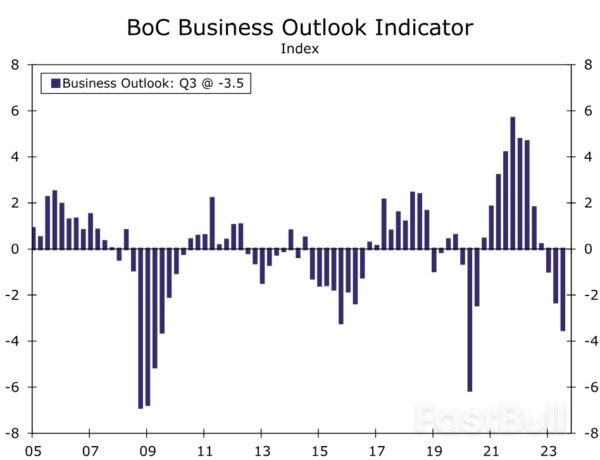
          Canada: Sluggish Growth, Slowing Inflation, Softer Currency_2Moreover, economic fundamentals and forward-looking indicators do not point to an improvement in Canada's growth prospects any time soon. From a consumer perspective, the outlook is mixed. Growth in real household disposable income has returned to positive territory and the household saving rate of 5.1% remains slightly above pre-pandemic levels. However, the Bank of Canada's monetary tightening has led to a rising interest and debt servicing burden for Canadian households. In Q2, interest costs were 9.0% of disposable income, while total debt servicing costs (that is, principal and interest) were 14.8% of disposable income. Those metrics are elevated by historical standards, and suggest continued consumer restraint going forward. The outlook for businesses is similarly subdued. Declining corporate profit growth has led to a drop in business fixed investment through mid-2023, and the central bank's Q3 Business Outlook Survey suggests the outlook may have worsened further since. The Bank of Canada's (BoC) Business Outlook Indicator fell further to -3.5, the weakest reading since the depths of the pandemic. In addition, the Indicators of Future Sales balance, which takes into account factors such as order books, advance bookings, sales inquiries and so on, fell to zero in Q3, also the weakest reading since Q3-2020. Finally, more than half of firms surveyed by the BoC believe that the effects of past monetary tightening on their businesses are far from over. To the extent that more cautious businesses scale back hiring plans, that could add to headwinds for Canadian households and consumers. Against this backdrop we have pared our growth forecast for Canada, and now anticipate GDP growth of 1.1% in 2023 (previously 1.2%) and 0.7% in 2024 (previously 1.0%).
          Canada: Sluggish Growth, Slowing Inflation, Softer Currency_3Canada: Sluggish Growth, Slowing Inflation, Softer Currency_4Canadian Inflation: High, But Heading In The Right Direction

          While recent news on Canadian growth has been disappointing, news on the inflation front has been slightly more hopeful. The message from actual inflation data as well as forward-looking indicators are the same—inflation remains too high for now, but is gradually heading in the right direction. With respect to the September CPI, both headline and core inflation surprised to the downside. The headline CPI slowed to 3.8% year-over-year, while the average core CPI similarly eased to 3.8% year-over-year. Importantly, the average core CPI rose at a 3.67% three-month annualized pace through September. That is less than the increase seen in August, even if the recent trend of underlying inflation remains above the central bank's 2% target and the underlying pace of disinflation remains frustratingly slow.
          Canada: Sluggish Growth, Slowing Inflation, Softer Currency_5Survey data also point to elevated inflation trends that are nonetheless moving in a more favorable direction. The BoC's Business Outlook Survey showed more firms expecting slower input and output price inflation over the next 12 months. For example, the net balance for input price inflation fell to -63 in Q3 from -53 in Q2 (that is, more respondents seeing slower input price inflation), while the net balance for output price inflation fell to -43 in Q3 from -33 in Q2 (more seeing slower output price inflation). In terms of firms' CPI inflation expectations over the next two years, 53% saw inflation above 3% during that period, still high but less than the 64% in Q2 and 79% in Q1. Finally, in a separate survey of consumers during Q3, one-year ahead and two-year ahead inflation expectations were still elevated at 5.03% and 4.04% respectively. Nonetheless, that same survey said consumers who expect more adverse effects from rate hikes are less likely to plan major purchases such as cars or appliances, and more likely to spend on discretionary items like vacations and concerts—a hint perhaps that higher interest rates are having some impact on consumer expectations.

          Bank of Canada's Interest Rate Pause Will Be An Interest Rate Peak

          Against this backdrop of slowing growth and gradually slowing inflation, the Bank of Canada once again held its policy interest rate steady at 5.00% at its October monetary policy announcement. In its accompanying statement, the BoC acknowledged softer economic activity, saying:
          • There is growing evidence that past interest rate increases are dampening economic activity and relieving price pressures.
          • Consumption has been subdued, and weaker demand and higher borrowing costs are weighing on business investment.
          • A range of indicators suggest that supply and demand in the economy are now approaching balance.
          • Economic growth is expected to be weak for the next year before increasing in late 2024 and through 2025.
          The softer outlook is also reflected in the central bank's updated projections, which forecast GDP growth of 1.2% in 2023 (compared to 1.8% in July) and 0.9% in 2024 (compared to 1.2% in July).
          At the same time, the BOC kept the option of further tightening on the table, saying it is "prepared to raise the policy rate further if needed." The central bank clearly remains somewhat wary about the inflation outlook, saying it "is concerned that progress towards price stability is slow and inflationary risks have increased." Those inflation concerns are also reflected in the BoC's updated inflation forecasts, which see CPI inflation at 3.0% for 2024 (previously 2.5%) and 2.2% for 2025 (previously 2.1%).
          Canada: Sluggish Growth, Slowing Inflation, Softer Currency_6Although BoC maintained a moderate rate hike bias, we continue to believe that further tightening remains a possibility rather than a probability. We expect Canadian economic growth to slow more quickly than the central bank's forecast, and as a result, we see slightly slower CPI inflation next year than does the central bank. We believe the Bank of Canada will hold its policy rate steady at 5.00% for an extended period. That said, as growth remains subdued and underlying inflation measures move a bit closer to the central bank's 2% target, we still forecast Bank of Canada rate cuts beginning in Q2-2024, and a cumulative 150 bps of easing to 3.50% by the end of next year. As Canadian growth remains subdued and in the absence of further BoC tightening, we also see potential for further Canadian dollar weakness. The USD/CAD exchange rate has already reached our medium-term target of CAD1.3700, but a further move closer to CAD1.4000 over the next several months cannot be ruled out. We will provide a full assessment and updated currency forecasts in our International Economic Outlook, due for publication later this week.
          To stay updated on all economic events of today, please check out our Economic calendar
          Risk Warnings and Disclaimers
          You understand and acknowledge that there is a high degree of risk involved in trading. Following any strategies or investment methods may lead to potential losses. The content on the site is provided by our contributors and analysts for information purposes only. You are solely responsible for determining whether any trading assets, securities, strategy, or any other product is suitable for investing based on your own investment objectives and financial situation.
          Comments
          Add to Favorites
          Share

          NASDAQ 100: Four Factors Influencing the Index in Q4 2023

          IG

          Economic

          Stocks

          Bond

          The NASDAQ 100 index — comprising the 100 of the largest non-financial NASDAQ-listed stocks by market capitalization — has risen by circa 36% year-to-date. However, the index hit a 2023 peak of 15,841 points in mid-July and has now fallen by over 1,000 points to just 14,745.
          To put this performance into context: 2022 saw the tech-heavy index lose 32.4% of its value compared to the S&P 500's 18.1% fall and the FTSE 100's slight rise. As earnings season continues amid rising geopolitical tensions, here are four interlinked factors to consider for the index's future performance:

          NASDAQ 100: four factors to watch

          Israel-Hamas war
          NASDAQ investors have good reason to worry that the war between Israel and Hamas could escalate into a regional war involving Saudi Arabia, Iran, and Lebanon.
          Most recently, UN Secretary General Antonio Guterres — while calling the attacks by Hamas 'appalling' — has come under fire from Israel for saying that they did not happen 'in a vacuum' as there had been '56 years of suffocating occupation.'
          Meanwhile, fuel is close to running out in Gaza as Israel is preventing imports — though Israel also argues that Hamas is stockpiling hundreds of thousands of litres. Brent Crude remains elevated at circa $90 per barrel, reflecting fears that US sanctions on Iranian oil exports, or a closure of what the EIA calls the world's most important oil chokepoint, the Strait of Hormuz, may occur.
          As a general rule, higher oil prices can have a negative effect on NASDAQ tech stocks.
          US Treasuries
          10 year US Treasury yields are now at 5% and this completely risk-free return is causing some alarm. To start with, US inflation may not be cooling — while the CPI rate may be at 3.7%, this is above the 3% reading of June and nearly double the official 2% target. Meanwhile US federal debt (the deficit) now stands at a whopping $33 trillion, up by $1.6 billion since the political showdown to increase the debt ceiling earlier this year.
          The US will need to sell more Treasuries to fund its current debt and finance even more at worse rates over the next few years.
          These risks could be weighing heavily on the NASDAQ 100.
          Interest rates
          Tied into the Treasuries debate, the federal funds rate is currently at 5.25% to 5.50%. The markets are currently pricing in a 'higher for longer' scenario and also at least one more hike.
          Of course, with inflation already proving to be stickier than expected, this may be an optimistic outlook — and any escalation in the Middle East that sends oil higher could see rates rise further than the market expects at present.
          The pandemic era of ultraloose monetary policy saw NASDAQ 100 stocks hit record highs, but the headache of tightening policy was also responsible for the bear market of 2022. Further rate hikes could well send NASDAQ 100 shares lower.
          The AI bubble
          The so-called 'magnificent seven' are responsible for much of the NASDAQ's gains in 2023 — Microsoft, Alphabet, Meta, Amazon, Apple and Nvidia. These companies are arguably riding a wave of AI euphoria caused by generative AI disruptors such as ChatGPT.
          With the index becoming perhaps too one-sided, July saw a special rebalance where some of the weight assigned to the largest tech stocks was reassigned to smaller growth companies. Nvidia and Microsoft were most affected, each losing about three percentage points in terms of weighting.
          There is now evidence that some of the AI positivity is falling. Yesterday, Alphabet reported that Q3 revenue rose by 11.6% year-over-year to $76.69 billion, above analyst predictions of $75.9 billion — yet shares in the behemoth have fallen by 9.3% since.
          The company may be facing a landmark antitrust lawsuit from the US government amid a headcount reduction, but the bigger problem is potentially that the Cloud division only managed to generate $8.41 billion compared to expectations for $8.64 billion. For context, the division only started turning a profit in Q1 and has been running since 2008.
          With more upsets perhaps to follow, the NASDAQ 100 may have further to fall through Q4.
          To stay updated on all economic events of today, please check out our Economic calendar
          Risk Warnings and Disclaimers
          You understand and acknowledge that there is a high degree of risk involved in trading. Following any strategies or investment methods may lead to potential losses. The content on the site is provided by our contributors and analysts for information purposes only. You are solely responsible for determining whether any trading assets, securities, strategy, or any other product is suitable for investing based on your own investment objectives and financial situation.
          Comments
          Add to Favorites
          Share

          October 26th Financial News

          FastBull Featured

          Daily News

          [Quick Facts]

          1. Security Council fails to adopt two draft Palestinian-Israeli resolutions.
          2. U.S. House finally elects a new speaker after three weeks.
          3. The yen again hits a year-low as the U.S. and Japan yield gap widens.
          4. Lagarde says the fight against inflation isn't over yet.
          5. Oil prices rally to near $85 on fears of Middle East conflict expansion.
          6. U.S. crude oil exports fall slightly due to a variety of factors.
          7. BOC is open for further rate hikes as progress on core inflation stalls.

          [News Details]

          Security Council fails to adopt two draft Palestinian-Israeli resolutions
          The UN Security Council has voted on two draft resolutions on the Palestinian-Israeli conflict. Russia's draft resolution failed to get enough votes to pass, with China voting in favor of it. Earlier, the U.S. draft resolution was vetoed by permanent members Russia and China and failed to pass. The U.S. draft gained 10 votes in favor, three against, and two abstentions.
          U.S. House finally elects a new speaker after three weeks
          Mike Johnson from Louisiana, vice chairman of the House Republican Conference, won more than half of the votes in the U.S. House Speaker election on the afternoon of Oct. 25th, local time, and became the new House speaker. He was the fourth speaker nominee the House Republicans elected in three weeks.
          The yen again hits a year-low as the U.S. and Japan yield gap widens
          The dollar hit its highest level against the yen today since October last year as the huge yield gap between the two countries continues to weigh on the yen. This increases the risk of Japanese authorities intervening in the currency market. Japanese authorities have repeatedly said that they will take any measures to curb excessive volatility in the currency market. The yen's decline will bring pressure on the Bank of Japan to adjust monetary policy, and speculation that a possible escalation of conflict in the Middle East will boost safe-haven demand. Traders remain cautious.
          Lagarde says the fight against inflation isn't over yet
          The fight against inflation isn't over yet, but I have confidence that inflation can return to 2%, said European Central Bank President Christine Lagarde on Oct. 25. Central bank officials must "carefully monitor" risks, including the Middle East conflict possibly leading to higher oil prices. "We need to look at prices and wages and profit units and all that to see where the risks are. But for the moment, I'm confident that we are on a journey to bring inflation back to 2%," said Lagarde.
          Oil prices rally to near $85 on fears of Middle East conflict expansion
          Oil prices rose as Israel is ready to launch a ground attack on Gaza and the U.S. prepares to deploy air defenses in the region. Israeli Prime Minister Benjamin Netanyahu said in a televised address that Israel is in a battle for its very existence. Earlier, crude oil prices fluctuated sharply on a Wall Street Journal report that Israel had delayed a ground offensive as the U.S. readied its air defenses to protect U.S. troops in the Middle East.
          Markets are trying to price in the possibility of multiple Middle Eastern countries becoming involved in the conflict. Traders are nervous and they may react quickly before understanding the full implications of what is happening.
          U.S. crude oil exports fall slightly due to a variety of factors
          U.S. crude oil exports fell slightly, which was in line with many traders' expectations. Oil shipments spiked above 5 million barrels per day last week and are now close to 4.8 million barrels per day. Strong exports have been a key reason for the reduction in U.S. inventories, but with global refining margins plummeting and freight charges spiking, the export economy is suffering and the crude spot delivery trade is now becoming unstable.
          BOC is open for further rate hikes as progress on core inflation stalls
          The Bank of Canada's (BOC) policy statement released yesterday showed growing evidence that past rate hikes are dampening economic activity and easing price pressures. A range of indicators suggest that supply and demand in the Canadian economy are nearly balanced. While policymakers expect economic growth to slow, they also believe inflation will move higher in the near term. No progress has yet been achieved on core inflation. In addition, the central bank has been candid in recognizing the lagged impact of previous policy initiatives in dampening economic activity and moderating price pressures. This is the main reason why the BOC continues to be open for further rate hikes. Officials now expect inflation to average 3% in 2024, up from the 2.5% forecast in July. The Board of Directors is concerned about the slow progress in price stabilization and increased inflation risks. They reiterated their readiness to raise rates further if necessary.

          [Focus of the Day]

          UTC+8 20:15 The European Central Bank announces its interest rate decision
          UTC+8 20:30 U.S. Durable Goods Order MoM (Sept)
          UTC+8 20:30 U.S. GDP (Q3)
          UTC+8 20:30 U.S. PCE (Q3)
          UTC+8 20:45 European Central Bank President Christine Lagarde speaks
          UTC+8 00:45 Next Day: Bank of England Deputy Governor Cunliffe speaks
          Risk Warnings and Disclaimers
          You understand and acknowledge that there is a high degree of risk involved in trading. Following any strategies or investment methods may lead to potential losses. The content on the site is provided by our contributors and analysts for information purposes only. You are solely responsible for determining whether any trading assets, securities, strategy, or any other product is suitable for investing based on your own investment objectives and financial situation.
          Comments
          Add to Favorites
          Share

          We Have Seen Enough for RBA's Next Move to be an Increase

          Westpac

          Economic

          Central Bank

          Last week we noted that the RBA would leave rates unchanged so long as they saw inflation coming down as they had expected. But if the data flow showed inflation declining slower than that, they would raise rates. This message was reinforced in the Governor's first speech, on Tuesday, where she said "The Board will not hesitate to raise the cash rate further if there is a material upward revision to the outlook for inflation." The September quarter CPI release was always going to be crucial.
          Has the RBA seen enough to move? At 1.2% in the quarter, both headline and trimmed mean inflation was a little higher than the Westpac team expected (see Westpac Senior Economist Justin Smirk's note). We assessed that it would take a significant upside surprise to induce the RBA Board to raise rates at the November meeting. A 0.1% difference might not seem like a lot, but the underlying detail was sobering.
          So yes, I've seen enough to make my first-ever rate call to be a prediction of a hike.
          In August, the RBA expected that the trimmed mean rate of inflation would reach 3.9% over 2023. That seems a long way out of reach now: the December quarterly result would have to print at 0.5% for this to happen. The higher result also cannot be attributed solely to volatile components that will reverse out soon. Fuel inflation was stronger in the quarter, but so were vehicle price inflation, homebuilding cost inflation and inflation in a range of services components such as meals out and takeaway, dental fees and transport fares. Recreational services more broadly were also strong. And a significant fraction of the index saw quarterly changes moderating by less than expected.
          Looking at some of the risks we called out last week, it is noteworthy that some traded goods prices are still holding up, even as similar prices decline in other economies; see the graph in Justin Smirk's inflation note for more detail. The cumulative difference in price movements is too large to explain as an exchange rate effect. A sequence of above average inflation outcomes is also evident in the related services series, which includes things like streaming services. Along with strong services inflation more broadly, these outcomes suggest that domestic demand pressures are still driving domestic inflation, even though consumer spending growth more broadly is very weak. Strong population growth is a factor here, and recent arrivals data suggest it will remain so.
          Another risk that will remain front of the Board's mind is that housing prices continue to rise. Related to this, the material in the Financial Stability Review and the Governor's speech this week highlighted that the household sector has been resilient to the tightening in monetary policy so far. So although the household sector is currently facing a squeeze on real incomes, and household spending is weak, the Board could conclude that the risk that domestic demand remains stronger than expected has increased. The recent resurgence in US retail sales is a salutary example of what can happen, though it should be emphasised that the US consumer sector is in a very different position to Australia's.
          That said, we do not think that a decision to increase rates at the November meeting is entirely clear cut. There is an argument that bygones are bygones, and the upside surprise on the September quarter data will not carry through to subsequent quarters. If the RBA did not want to raise rates this month, it could upgrade its 2023 forecast for inflation but not the forecast for 2024 and beyond. It could then argue that there had been no material upward revision to the outlook for inflation, only to the history.
          As an aside, we do not take any signal from the Governor's parliamentary testimony this morning on the interpretation of the CPI data. Having spelled out so clearly that a material surprise to the outlook would warrant a rate increase, she simply had to be equivocal to avoid front-running the Board's decision, which is still more than a week away.
          The Board could point to the reduced risk of a price-wage spiral and the turning in the labour market as evidence in support of a decision to keep rates on hold. The Board might also want to reference the current uncertainty generated by the conflict in the Middle East and the tightening in global financial conditions. Some of the near-term strength in services inflation could be a passing through of award wage increases that probably won't be repeated, as well as non-standard timing of increases in health insurance. Business services have been showing cost pressures easing, and growth in the real economy is relatively weak.
          But this seems like a hard case to make. It is going to be a finely balanced decision and a decision to hold still can't be ruled out entirely. An increase this month won't be the outcome the RBA had hoped for. But given the strength of their rhetoric around upside surprises, I don't think they will try to craft a rates-on-hold story. Nor will they wait until the following month. There is not enough in the way of new data between the November and December meetings, and waiting would be inconsistent with the clear language from the Governor's speech this week about not hesitating if the outlook changes.
          To stay updated on all economic events of today, please check out our Economic calendar
          Risk Warnings and Disclaimers
          You understand and acknowledge that there is a high degree of risk involved in trading. Following any strategies or investment methods may lead to potential losses. The content on the site is provided by our contributors and analysts for information purposes only. You are solely responsible for determining whether any trading assets, securities, strategy, or any other product is suitable for investing based on your own investment objectives and financial situation.
          Comments
          Add to Favorites
          Share

          Rate Hike Wagers Take Hold in Southeast Asia After Indonesia's Surprise

          Damon

          Economic

          Central Bank

          Investors are betting Southeast Asia's central banks will turn more hawkish after Bank Indonesia unexpectedly hiked its key rate last week, with the Philippines seeing the biggest impact to expectations.
          The spread between the Philippine two-year bond yield and Bangko Sentral ng Pilipinas key rate widened after BI's decision, indicating traders are anticipating a greater chance of a rate hike, according to data compiled by Bloomberg. BSP Governor Eli Remolona also flagged the possibility of an increase as soon as Thursday.
          The chance of a rate hike in Malaysia, where the ringgit remains near the weakest level since 1998, has also increased, as per the data.
          "Each central bank has its own playbook," said Frances Cheung, a rates strategist at Oversea-Chinese Banking Corp. "That said, BI's policy action precisely reflects the pressure from higher US dollar rates on the monetary decision making in Asia."
          A tighter monetary policy may be one way to support currencies that have slumped to multiyear lows this week, as it would help bridge their interest-rate gap with the US, where bets on higher-for-longer rates have pushed up yields. However, headwinds from China's slowdown would remain as exports continue to suffer and limit the amount of dollars in those markets.
          Rate hike bets are also gaining traction in Southeast Asia as other measures by the region's central banks fail to lure foreign funds. BI sought to tighten liquidity by selling bills before its shock quarter-point hike last week, and economists aren't ruling out more increases as the rupiah stays near the lowest since 2020.
          Traders are also pricing a roughly one in five chance Bank Negara Malaysia will hike interest rates, which is marginally higher than expectations prior to the BI meeting, due to the political sensitivity of a weak ringgit and falling reserves, said Philip McNicholas, Asia sovereign strategist at Robeco Group in Singapore.
          The case for a rate hike to defend the currency is growing in the Philippines after the nation's forex reserves dropped to US$98.7 billion (RM471.8 billion) last month, the lowest since December, as authorities intervened to stop the peso from weakening past 57 per dollar. The move may also help ease rising inflation.
          "If the data says inflation will go up very significantly and there's a risk of affecting inflationary expectations, then we may go for an off-cycle hike as early as Thursday," BSP's Remolona said. The central bank earlier flagged risks of missing its 2%-4% inflation goal for a third year in 2024 amid food supply constraints and higher power and transport costs.
          "All the central banks are likely to be watching food prices closely given the potential adverse impact of El Nino on crop production, hence they'll likely continue to flag upside risks," Robeco's McNicholas said.

          Source: Bloomberg

          To stay updated on all economic events of today, please check out our Economic calendar
          Risk Warnings and Disclaimers
          You understand and acknowledge that there is a high degree of risk involved in trading. Following any strategies or investment methods may lead to potential losses. The content on the site is provided by our contributors and analysts for information purposes only. You are solely responsible for determining whether any trading assets, securities, strategy, or any other product is suitable for investing based on your own investment objectives and financial situation.
          Comments
          Add to Favorites
          Share

          Bank of Canada Hangs on to Hawkish Bias

          Justin

          Central Bank

          Forex

          BoC still worried about inflation

          The Bank of Canada left the overnight rate at 5% as widely expected in the wake of a surprise contraction in economic growth in the second quarter, a lacklustre performance since then and inflation coming in softer than anticipated in September. But with the jobs market remaining tight and the sense that this could mean inflation remains sticky, the BoC have left the door ajar for further rate hikes if required.
          With progress towards price stability being regarded as “slow” the BoC aren’t expecting inflation to return to 2% until 2025. They will need to see “downward momentum in core inflation” and softening in inflation expectations, wage growth and corporate pricing behaviour before they can relax.

          Bank of Canada October forecasts

          Bank of Canada Hangs on to Hawkish Bias_1

          We don’t expect more hikes

          We don’t think additional rate hikes will happen though. As the BoC admits, employment growth is rising more slowly than the labour force and job vacancies are slowing. This should ease wage concerns and contribute to more labour market slack.
          Meanwhile, the structure of the residential mortgage market means that with most people facing an adjustment to their borrowing rate on a three-to-five-year basis (rather than 30 years in the US), more households will be increasingly exposed to the lagged effects of BoC rate rises. This should all help to weigh on activity and dampen price pressures, potentially opening the door for rate cuts in mid-2024.
          In the Monetary Policy Report released today, the BoC reported how the rate-sensitive categories are experiencing the greatest slowdown in consumption due to the effect of tighter monetary policy (chart below).

          Higher interest rates dampening consumption in Canada

          Bank of Canada Hangs on to Hawkish Bias_2

          Market reaction: growth in focus

          Markets were pricing in around 10bp of tightening by March ahead of the BoC announcement, and were fully focused on the new economic projections to gauge the likelihood of further moves. It is clear from the statement that the Governing Council wanted to reiterate its hawkish bias, as it stressed how the improvements on the disinflation side are insufficient and flagged fresh upside risks for prices.
          However, the downward revisions in the growth forecasts – paired with the evidence included in the MPR that higher rates are effectively slowing inflation – are reasonably doubtful the BoC will actually raise rates further from this point.
          USD/CAD rallied briefly after the release, in our view due to the fact that a hawkish hold was expected but the growth downward revisions may have exceed some expectations. Still, as Governor Tiff Macklem is in the middle of his press conference, USD/CAD is back slightly below 1.3800. We continue to see upside risks for the pair in the very near term mostly on the back of USD strength, while targeting 1.36 for year-end.

          Source:ING

          Risk Warnings and Disclaimers
          You understand and acknowledge that there is a high degree of risk involved in trading. Following any strategies or investment methods may lead to potential losses. The content on the site is provided by our contributors and analysts for information purposes only. You are solely responsible for determining whether any trading assets, securities, strategy, or any other product is suitable for investing based on your own investment objectives and financial situation.
          Comments
          Add to Favorites
          Share

          Politics Is a Family Business in Indonesia - Again

          Thomas

          Political

          Indonesia's President Joko Widodo is expanding his family dynasty, son by son. The announcement that his eldest child Gibran Rakabuming Raka has been picked as Defence Minister Prabowo Subianto's running mate in next year's presidential election is just the latest in a series of political manoeuvres that have cemented his image as a Javanese kingmaker. It will also allow him to pull the strings behind the scenes long after he relinquishes power.
          This is deeply disappointing for the nation's nascent democracy, the world's third largest, and many Indonesians had hoped it wouldn't happen. Mr Subianto will register his candidacy on Wednesday (Oct 25).
          To understand what a huge departure this is from the man he used to be, it's worth reflecting on how much Jokowi, as he is known, has changed during the course of his presidency.
          I first met him more than a decade ago, when he was governor of Jakarta. At the time, chatting to him in a leafy green park in his white crisp linen shirt and sandals, I was struck by his sincerity and disruptor mentality. As an outsider, he could see the obvious issues that needed to be fixed within the political establishment and there appeared to be a genuine desire on his part to change things.
          But that optimism and enthusiasm were pushed aside for the practicalities of doing politics in Indonesia. This included the weakening of the anti-corruption agency, and a drift toward authoritarian politics. Millions of people elected him as the leader of the world's most populous Muslim nation in 2014, believing he would be different from the cast of characters in the Suharto era.
          Jokowi's victory was rightly heralded as a milestone, a coming of age for the country's democracy - a sign that if a furniture maker from Solo could beat the odds, as one voter told me at the time, any outsider could do the same.
          Practicalities Of Doing Politics in Indonesia
          How things have changed. If you want to do well in politics in Indonesia, it certainly helps to be related to Jokowi.
          Take a look at the family tree. Not only is 36-year-old Mr Raka campaigning for the vice-presidential spot, in 2020 he was elected mayor of his home city of Solo. The young politician won by a landslide in large part thanks to Jokowi's popularity and social capital.
          Then there's the younger son, 28-year-old Kaesang Pangarep, better known for his YouTuber appeal than his political experience, who last month became chief of the Indonesia Solidarity Party (PSI), catering to younger voters.
          And finally, son-in-law Bobby Nasution, voted in as mayor of Medan in 2020. His campaign drew heavily on family connections, building a perception that he would get special attention from the central government because of his privileged position.
          Jokowi has batted away any suggestion that his family benefits because he is the head of state. If Indonesians want to vote them in, he told me in an interview in 2020, I can't stop them. It is the public's decision.
          But even the charismatic leader, with his consistently solid approval ratings, won't be immune to the public's displeasure with what appears to be dynastic politics re-emerging in the archipelago.
          “A vote for Gibran as vice-president will ensure that Jokowi will be able to continue having behind-the-scenes influence during the Prabowo administration,” Alexander Arifianto, senior fellow at the Institute for Defence and Strategic Studies in Singapore told me. “Political dynasties in Indonesia are not unusual, but not particularly effective. They also invite public backlash once declared openly.”
          The People Have Seen This Movie Before
          That backlash is already beginning. Last week's ruling by the constitutional court to lower the minimum age for presidential and vice-presidential candidates with legislative or regional leadership experience, was widely viewed as a way to clear legal obstacles for Mr Raka's vice-presidential bid. The response has been largely negative, partly due to the fact that presiding over the proceedings was Chief Justice Anwar Usman - the Indonesian leader's brother-in-law.
          The transformation of Jokowi the man of the people, to Jokowi the pragmatic politician and now potential dynasty builder has been slow and gradual. Like many other Asian leaders, his priority has been economic development and infrastructure reform rather than a focus on fixing democratic institutions, often at the expense of weakening them. If his economic ambitions collided with anti-corruption agendas, he prioritised the former, notes Burhanuddin Muhtadi, of Syarif Hidayatullah State Islamic University in Jakarta.
          Zeroing in on development is straight out of dictator and former president Suharto's playbook. A fellow Javanese, he ruled Indonesia for over three decades and died in 2008. He left behind six children who, at one point, were among the wealthiest people in the country, with extensive business interests granted by their father when he was in power.
          Now it is Suharto's former son-in-law, Mr Subianto, who is tying up with Jokowi's son to lead the country next year. None of this will be lost on Indonesians. They've seen this movie before and will be wondering whether keeping it all in the family is what's best for their future.

          Source: Bloomberg

          Risk Warnings and Disclaimers
          You understand and acknowledge that there is a high degree of risk involved in trading. Following any strategies or investment methods may lead to potential losses. The content on the site is provided by our contributors and analysts for information purposes only. You are solely responsible for determining whether any trading assets, securities, strategy, or any other product is suitable for investing based on your own investment objectives and financial situation.
          Comments
          Add to Favorites
          Share
          FastBull
          Copyright © 2025 FastBull Ltd

          728 RM B 7/F GEE LOK IND BLDG NO 34 HUNG TO RD KWUN TONG KLN HONG KONG

          TelegramInstagramTwitterfacebooklinkedin
          App Store Google Play Google Play
          Products
          Charts

          Chats

          Q&A with Experts
          Screeners
          Economic Calendar
          Data
          Tools
          Membership
          Features
          Function
          Markets
          Copy Trading
          Latest Signals
          Contests
          News
          Analysis
          24/7
          Columns
          Education
          Company
          Careers
          About Us
          Contact Us
          Advertising
          Help Center
          Feedback
          User Agreement
          Privacy Policy
          Business

          White Label

          Data API

          Web Plug-ins

          Poster Maker

          Affiliate Program

          Risk Disclosure

          The risk of loss in trading financial instruments such as stocks, FX, commodities, futures, bonds, ETFs and crypto can be substantial. You may sustain a total loss of the funds that you deposit with your broker. Therefore, you should carefully consider whether such trading is suitable for you in light of your circumstances and financial resources.

          No decision to invest should be made without thoroughly conducting due diligence by yourself or consulting with your financial advisors. Our web content might not suit you since we don't know your financial conditions and investment needs. Our financial information might have latency or contain inaccuracy, so you should be fully responsible for any of your trading and investment decisions. The company will not be responsible for your capital loss.

          Without getting permission from the website, you are not allowed to copy the website's graphics, texts, or trademarks. Intellectual property rights in the content or data incorporated into this website belong to its providers and exchange merchants.

          Not Logged In

          Log in to access more features

          FastBull Membership

          Not yet

          Purchase

          Become a signal provider
          Help Center
          Customer Service
          Dark Mode
          Price Up/Down Colors

          Log In

          Sign Up

          Position
          Layout
          Fullscreen
          Default to Chart
          The chart page opens by default when you visit fastbull.com