• Trade
  • Markets
  • Copy
  • Contests
  • News
  • 24/7
  • Calendar
  • Q&A
  • Chats
Trending
Screeners
SYMBOL
LAST
BID
ASK
HIGH
LOW
NET CHG.
%CHG.
SPREAD
SPX
S&P 500 Index
6827.42
6827.42
6827.42
6899.86
6801.80
-73.58
-1.07%
--
DJI
Dow Jones Industrial Average
48458.04
48458.04
48458.04
48886.86
48334.10
-245.98
-0.51%
--
IXIC
NASDAQ Composite Index
23195.16
23195.16
23195.16
23554.89
23094.51
-398.69
-1.69%
--
USDX
US Dollar Index
97.980
98.060
97.980
98.070
97.920
+0.030
+ 0.03%
--
EURUSD
Euro / US Dollar
1.17310
1.17318
1.17310
1.17447
1.17283
-0.00084
-0.07%
--
GBPUSD
Pound Sterling / US Dollar
1.33582
1.33592
1.33582
1.33740
1.33546
-0.00125
-0.09%
--
XAUUSD
Gold / US Dollar
4339.77
4340.18
4339.77
4345.46
4294.68
+40.38
+ 0.94%
--
WTI
Light Sweet Crude Oil
57.467
57.504
57.467
57.601
57.194
+0.234
+ 0.41%
--

Community Accounts

Signal Accounts
--
Profit Accounts
--
Loss Accounts
--
View More

Become a signal provider

Sell trading signals to earn additional income

View More

Guide to Copy Trading

Get started with ease and confidence

View More

Signal Accounts for Members

All Signal Accounts

Best Return
  • Best Return
  • Best P/L
  • Best MDD
Past 1W
  • Past 1W
  • Past 1M
  • Past 1Y

All Contests

  • All
  • Trump Updates
  • Recommend
  • Stocks
  • Cryptocurrencies
  • Central Banks
  • Featured News
Top News Only
Share

India's November Soyoil Imports At 370661 Tonnes Versus 454619 Tonnes In October

Share

India's November Sunflower Oil Imports At 142953 Tonnes Versus 260548 Tonnes In October

Share

India's November Palm Oil Imports At 632341 Tonnes Versus 602381 Tonnes In October

Share

India's November Vegetable Oil Imports At 1183,832 Tonnes Versus 1332,173 Million Tonnes In October

Share

Reuters Poll - Bank Indonesia To Keep 7-Day Reverse Repo Rate Unchanged At 4.75% On December 17, Say 18 Of 31 Economists

Share

Statistics Finland - Finland Nov CPI -0.1% Year-On-Year

Share

Saudi Nov CPI 0.1% Month-On-Month

Share

Saudi Nov CPI 1.9% Year-On-Year

Share

South Korea Petrochemical Exports To Fall 6.1% In 2026 - Kcci

Share

U.S. Stock Futures Rose Slightly, With S&P 500 Futures And Dow Jones Futures Up 0.3% And NASDAQ 100 Futures Up Nearly 0.3%

Share

Spot Gold Rose $9 To $4,338.5 Per Ounce In The Short Term; New York Gold Futures Rose 1.00% On The Day, Currently Trading At $4,371.60 Per Ounce

Share

Dollar/Yen Extends Fall, Down 0.47% To 155.10

Share

Bank Of Japan: Two Branches Expect Higher Pay Rises In Fiscal Year 2026, While Two Other Branches Expect Wage Growth To Slow

Share

Bloomberg News: Bank Of Japan To Start Selling ETF Holdings As Early As January

Share

Malaysia Says Special ASEAN Foreign Ministers Meeting Scheduled For Dec 16 Delayed To Dec 22 At Thailand's Request

Share

Bank Of Japan: Wages Of Part-Time Employees Are Being Raised Reflecting Relatively High Minimum Wage Growth In Fiscal 2025

Share

Bank Of Japan: Firms' Wage Growth Outlook Due To Need For Retaining Staff Amid Persistent, Severe Labour Shortages

Share

Bank Of Japan - While Large And Medium-Sized Firms Were Likely To Be Able To Raise As Much Wages In FY 2026 As They Did In FY 2025, It Would Be Difficult For Small Firms To Raise As Much Wages In FY 2026 As In FY 2025

Share

Bank Of Japan: Most Companies Seem To Believe That Wage Increases In Fiscal Year 2026 Should Be The Same As Or Similar To Those In Fiscal Year 2025

Share

Bank Of Japan: Number Of Firms Expecting A Clear Improvement In Their Profits Is Not Large

TIME
ACT
FCST
PREV
U.K. Trade Balance Non-EU (SA) (Oct)

A:--

F: --

P: --

France HICP Final MoM (Nov)

A:--

F: --

P: --

China, Mainland Outstanding Loans Growth YoY (Nov)

A:--

F: --

P: --

China, Mainland M2 Money Supply YoY (Nov)

A:--

F: --

P: --

China, Mainland M0 Money Supply YoY (Nov)

A:--

F: --

P: --

China, Mainland M1 Money Supply YoY (Nov)

A:--

F: --

P: --

India CPI YoY (Nov)

A:--

F: --

P: --

India Deposit Gowth YoY

A:--

F: --

P: --

Brazil Services Growth YoY (Oct)

A:--

F: --

P: --

Mexico Industrial Output YoY (Oct)

A:--

F: --

P: --

Russia Trade Balance (Oct)

A:--

F: --

P: --

Philadelphia Fed President Henry Paulson delivers a speech
Canada Building Permits MoM (SA) (Oct)

A:--

F: --

P: --

Canada Wholesale Sales YoY (Oct)

A:--

F: --

P: --

Canada Wholesale Inventory MoM (Oct)

A:--

F: --

P: --

Canada Wholesale Inventory YoY (Oct)

A:--

F: --

P: --

Canada Wholesale Sales MoM (SA) (Oct)

A:--

F: --

P: --

Germany Current Account (Not SA) (Oct)

A:--

F: --

P: --

U.S. Weekly Total Rig Count

A:--

F: --

P: --

U.S. Weekly Total Oil Rig Count

A:--

F: --

P: --

Japan Tankan Small Manufacturing Outlook Index (Q4)

A:--

F: --

P: --

Japan Tankan Large Non-Manufacturing Diffusion Index (Q4)

A:--

F: --

P: --

Japan Tankan Large Non-Manufacturing Outlook Index (Q4)

A:--

F: --

P: --

Japan Tankan Large Manufacturing Outlook Index (Q4)

A:--

F: --

P: --

Japan Tankan Small Manufacturing Diffusion Index (Q4)

A:--

F: --

P: --

Japan Tankan Large Manufacturing Diffusion Index (Q4)

A:--

F: --

P: --

Japan Tankan Large-Enterprise Capital Expenditure YoY (Q4)

A:--

F: --

P: --

U.K. Rightmove House Price Index YoY (Dec)

A:--

F: --

P: --

China, Mainland Industrial Output YoY (YTD) (Nov)

A:--

F: --

P: --

China, Mainland Urban Area Unemployment Rate (Nov)

A:--

F: --

P: --

Saudi Arabia CPI YoY (Nov)

A:--

F: --

P: --

Euro Zone Industrial Output YoY (Oct)

--

F: --

P: --

Euro Zone Industrial Output MoM (Oct)

--

F: --

P: --

Canada Existing Home Sales MoM (Nov)

--

F: --

P: --

Euro Zone Total Reserve Assets (Nov)

--

F: --

P: --

U.K. Inflation Rate Expectations

--

F: --

P: --

Canada National Economic Confidence Index

--

F: --

P: --

Canada New Housing Starts (Nov)

--

F: --

P: --

U.S. NY Fed Manufacturing Employment Index (Dec)

--

F: --

P: --

U.S. NY Fed Manufacturing Index (Dec)

--

F: --

P: --

Canada Core CPI YoY (Nov)

--

F: --

P: --

Canada Manufacturing Unfilled Orders MoM (Oct)

--

F: --

P: --

U.S. NY Fed Manufacturing Prices Received Index (Dec)

--

F: --

P: --

U.S. NY Fed Manufacturing New Orders Index (Dec)

--

F: --

P: --

Canada Manufacturing New Orders MoM (Oct)

--

F: --

P: --

Canada Core CPI MoM (Nov)

--

F: --

P: --

Canada Trimmed CPI YoY (SA) (Nov)

--

F: --

P: --

Canada Manufacturing Inventory MoM (Oct)

--

F: --

P: --

Canada CPI YoY (Nov)

--

F: --

P: --

Canada CPI MoM (Nov)

--

F: --

P: --

Canada CPI YoY (SA) (Nov)

--

F: --

P: --

Canada Core CPI MoM (SA) (Nov)

--

F: --

P: --

Canada CPI MoM (SA) (Nov)

--

F: --

P: --

Federal Reserve Board Governor Milan delivered a speech
U.S. NAHB Housing Market Index (Dec)

--

F: --

P: --

Australia Composite PMI Prelim (Dec)

--

F: --

P: --

Australia Services PMI Prelim (Dec)

--

F: --

P: --

Australia Manufacturing PMI Prelim (Dec)

--

F: --

P: --

Japan Manufacturing PMI Prelim (SA) (Dec)

--

F: --

P: --

U.K. Unemployment Claimant Count (Nov)

--

F: --

P: --

U.K. Unemployment Rate (Nov)

--

F: --

P: --

Q&A with Experts
    • All
    • Chatrooms
    • Groups
    • Friends
    Connecting
    .
    .
    .
    Type here...
    Add Symbol or Code

      No matching data

      All
      Trump Updates
      Recommend
      Stocks
      Cryptocurrencies
      Central Banks
      Featured News
      • All
      • Russia-Ukraine Conflict
      • Middle East Flashpoint
      • All
      • Russia-Ukraine Conflict
      • Middle East Flashpoint
      Search
      Products

      Charts Free Forever

      Chats Q&A with Experts
      Screeners Economic Calendar Data Tools
      Membership Features
      Data Warehouse Market Trends Institutional Data Policy Rates Macro

      Market Trends

      Market Sentiment Order Book Forex Correlations

      Top Indicators

      Charts Free Forever
      Markets

      News

      News Analysis 24/7 Columns Education
      From Institutions From Analysts
      Topics Columnists

      Latest Views

      Latest Views

      Trending Topics

      Top Columnists

      Latest Update

      Signals

      Copy Rankings Latest Signals Become a signal provider AI Rating
      Contests
      Brokers

      Overview Brokers Assessment Rankings Regulators News Claims
      Broker listing Forex Brokers Comparison Tool Live Spread Comparison Scam
      Q&A Complaint Scam Alert Videos Tips to Detect Scam
      More

      Business
      Events
      Careers About Us Advertising Help Center

      White Label

      Data API

      Web Plug-ins

      Affiliate Program

      Awards Institution Evaluation IB Seminar Salon Event Exhibition
      Vietnam Thailand Singapore Dubai
      Fans Party Investment Sharing Session
      FastBull Summit BrokersView Expo
      Recent Searches
        Top Searches
          Markets
          News
          Analysis
          User
          24/7
          Economic Calendar
          Education
          Data
          • Names
          • Latest
          • Prev

          View All

          No data

          Scan to Download

          Faster Charts, Chat Faster!

          Download App
          English
          • English
          • Español
          • العربية
          • Bahasa Indonesia
          • Bahasa Melayu
          • Tiếng Việt
          • ภาษาไทย
          • Français
          • Italiano
          • Türkçe
          • Русский язык
          • 简中
          • 繁中
          Open Account
          Search
          Products
          Charts Free Forever
          Markets
          News
          Signals

          Copy Rankings Latest Signals Become a signal provider AI Rating
          Contests
          Brokers

          Overview Brokers Assessment Rankings Regulators News Claims
          Broker listing Forex Brokers Comparison Tool Live Spread Comparison Scam
          Q&A Complaint Scam Alert Videos Tips to Detect Scam
          More

          Business
          Events
          Careers About Us Advertising Help Center

          White Label

          Data API

          Web Plug-ins

          Affiliate Program

          Awards Institution Evaluation IB Seminar Salon Event Exhibition
          Vietnam Thailand Singapore Dubai
          Fans Party Investment Sharing Session
          FastBull Summit BrokersView Expo

          Will Gold Retrace Before Heading Towards Previous High?

          Zi Cheng

          Traders' Opinions

          Commodity

          Summary:

          Bullish momentum propelled gold to surpass its previous high for 2024.
          Fundamental Analysis

          On Tuesday, the price of gold, XAU/USD, continued its upward trend for the fifth consecutive day, reaching a fresh three-month peak, hovering around the $2,120 mark during the first half of the European trading session. However, further upward movement appears uncertain as traders await clearer signals regarding the Federal Reserve's potential rate-cutting trajectory. Consequently, all eyes are on Federal Reserve Chair Jerome Powell's two-day congressional testimony scheduled to commence on Wednesday.
          Additionally, market participants are closely monitoring key US macroeconomic data releases, particularly the highly anticipated Nonfarm Payrolls report due on Friday, which could significantly impact the US Dollar and consequently provide fresh impetus to gold prices.
          The prevailing sentiment that the Fed may commence rate cuts in June has subdued the strength of the USD, lending support to the non-yielding gold price. Furthermore, persistent geopolitical tensions and concerns about a slowdown in China have dampened investor appetite for riskier assets, contributing to a generally weaker tone in equity markets. This, in turn, has bolstered demand for safe-haven assets like gold.
          Amidst this backdrop, traders are closely monitoring the US ISM Services PMI for potential short-term trading opportunities. However, given the fundamental landscape described above, the prevailing bias suggests that the path of least resistance for gold prices remains to the upside, with any corrective dips likely to be met with buying interest.

          Will Gold Retrace Before Heading Towards Previous High?_1Technical Analysis

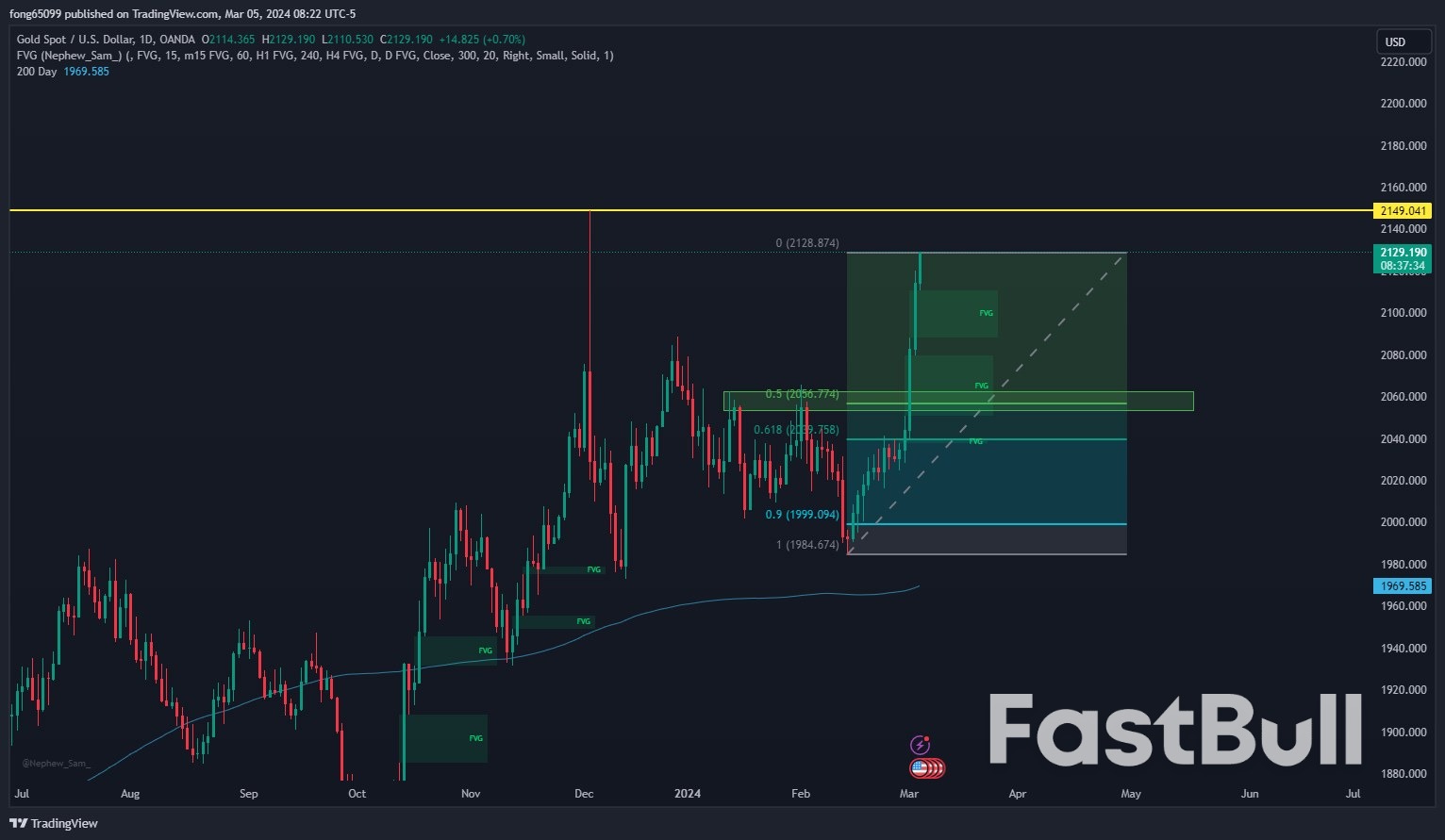
          Gold has been pushing for new prices and forming strong bold bullish candlesticks for the fourth day in a row without any retracements. It is advisable to stay out of the market and not to chase highs as the price is very high currently, and no retracement has happened yet. For those traders who plan to look for sells just because retracements has not happened, it is also not advisable. Reason is because you will be going against the trend which decreases the probability of your trade winning.
          Gold's all time high is priced at about 2149, Gold touched it but got rejected very quickly the last time. It seems like we might be able to see new highs this year judging from the current bullish momentum. However, I am not interested for buys now, I am only interested if the price does come down to retrace at least the 50% level as we have support confluence and FVG as confluence as well which acts like a strong key level to support the price from going lower.
          Will Gold Retrace Before Heading Towards Previous High?_2
          Risk Warnings and Disclaimers
          You understand and acknowledge that there is a high degree of risk involved in trading. Following any strategies or investment methods may lead to potential losses. The content on the site is provided by our contributors and analysts for information purposes only. You are solely responsible for determining whether any trading assets, securities, strategy, or any other product is suitable for investing based on your own investment objectives and financial situation.
          Add to Favorites
          Share

          More Headwinds For Green Stocks As High Interest Rates Continue To Bite

          SAXO

          Stocks

          This year was supposed to have been the comeback year for green stocks

          Ever since commodities rallied post the Covid vaccines and inflation subsequently rose to the highest levels since the 1970s green stocks have been under pressure. This year should have been the rebound year as the market in the beginning of the year was aggressively pricing in multiple rate cuts (seven at its peak). However, with sticky inflation and a robust economy the market has changed its mind pricing only 3-4 rate cuts and this change of narrative has been negative for greens stocks. A galloping fever in crypto, semiconductors and AI, defence, and cyber security has not helped either.
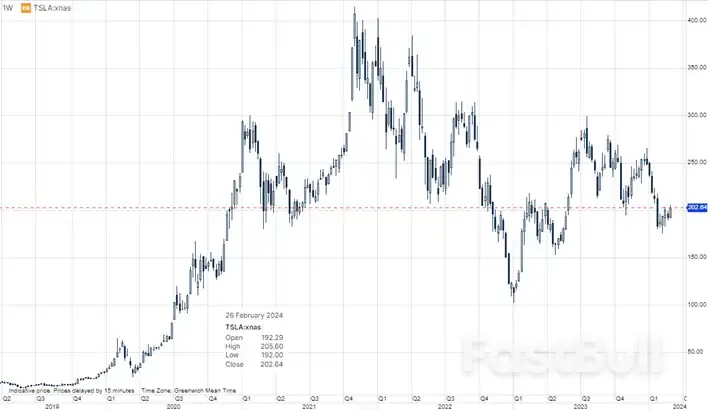
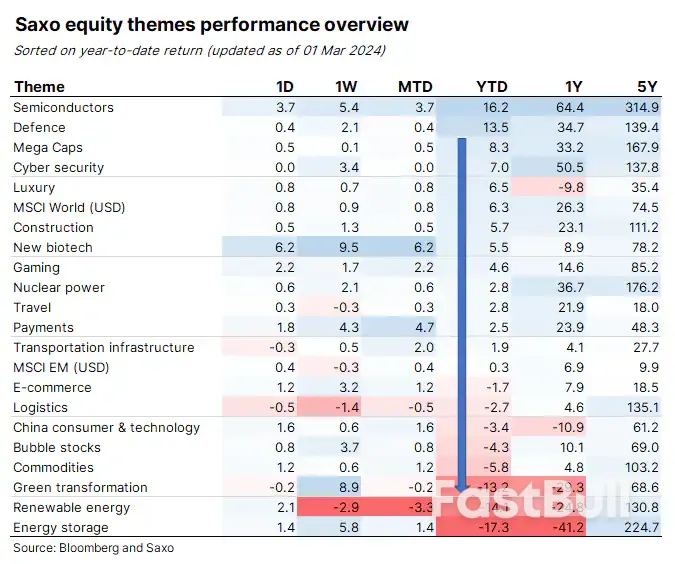
          Our three green equity theme baskets green transformation, renewable energy, and energy storage are all down more than 13% year-to-date compared to semiconductors and defence baskets up 16% and 14% in the same period. Tesla shares are down 18% year-to-date. No wonder that Elon Musk is dreaming about AI and robotics as he has come to the conclusion that EVs will become a red ocean. To make things even worse for the green segments in the equity market, the global energy sector (which is dominated by oil and gas companies) has increased 2% year-to-date.
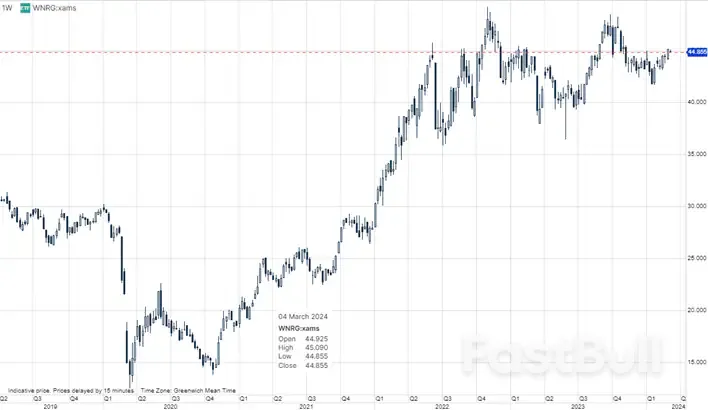
          The main driver of this bad performance is high interest rates and lower prices on natural gas. The green transition is one of the most capital intensive sectors of the economy and high interest rates make many green projects less profitable. While the green transition will still get prioritized, the defence agenda, especially in Europe, has taken the lead position in terms of political attention and with strong momentum in defence stocks the market is showing more interest in Rheinmetall (German military manufacturer) than Orsted (offshore wind developer).More Headwinds For Green Stocks As High Interest Rates Continue To Bite_1More Headwinds For Green Stocks As High Interest Rates Continue To Bite_2More Headwinds For Green Stocks As High Interest Rates Continue To Bite_3

          EV growth is slowing but still hit 37% YoY in Q4

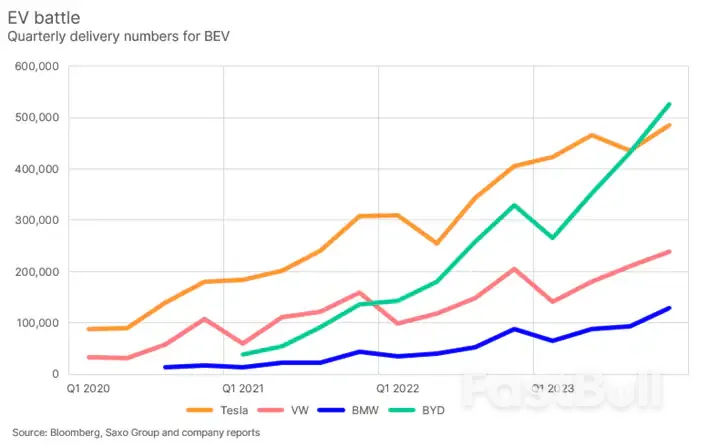
          One of the key industries in the green transition is the electric vehicles (EV) industry. We are closely monitoring 16 carmakers that are publishing in a transparent way their battery electric vehicles sales (sometimes also called all-electric). These 16 EV makers delivered 2mn BEVs in Q4 2023 up 37% YoY taken the cumulative BEV deliveries among these EV makers to 14.6mn since Q1 2020. The largest BEV maker is now BYD that overtook Tesla for the first time ever and Volkswagen is still maintaining its third position with Li Auto and BMW in a close fight for the fourth spot.
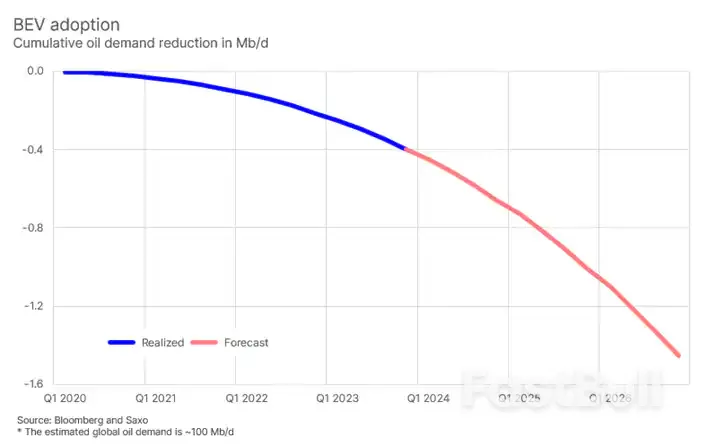
          These 14.5mn BEVs have reduced oil demand by 0.4 Mb/d (million barrels per day) which would otherwise have been here today. Compared to a global oil demand of around 100 Mb/d it is still small numbers, but we expect this cumulative oil demand reduction to 1 Mb/d by Q4 2025. By Q4 2026 the EV industry will hit an additional annual oil reduction of 0.5 Mb/d. With Wright’s Law at place and also economics of scale production costs will continue to fall for EVs and in a few years from now it will not make sense for consumers in developed countries to buy a gasoline car over BEV unless there are specific needs to consider. Wright’s Law alone estimates that by Q4 2026 the production costs of a new BEV will have fallen by 36%. However, with the lithium-ion battery being a big part of the overall costs and lithium carbonate prices still being volatile the estimated cost reduction including the battery costs come with a high uncertainty.
          As with the green transition stocks in energy, the EV industry has experienced a demand slowdown from higher interest rates and the intense competition from Chinese EV makers that have finally made it in the car industry due to less complexity of assembling an EV over a traditional combustion engine car. Fisker, an EV upstart, has recently said that it could run out of money and is pursuing a partnership with Nissan. NIO, a Chinese EV maker, has also warned that it will need more capital to push ahead. The car industry, whether its run on gasoline or batteries, is still the same old capital intensive and low margin business it has always been.More Headwinds For Green Stocks As High Interest Rates Continue To Bite_4

          More Headwinds For Green Stocks As High Interest Rates Continue To Bite_5

          NIO earnings: Focus on operating losses and lack of new EV models

          NIO is expected to deliver Q4 earnings tomorrow before the US market open. Analysts expect revenue of CNY 16.8bn up 5% YoY and adjusted EPS of -2.70 improving from -3.61 a year ago. NIO delivered 50,045 BEVs in Q4 2023 falling behind other Chinese EV makers such as XPeng and Li Auto at 60,158 and 131,805 delivered in Q4 2023 respectively.
          NIO kept its price steady in Q4 while many others including Tesla and BYD lowered its prices which was likely contributing to the 10% QoQ reduction in deliveres in Q4. Gross margin is expected to improve as battery costs are coming down and the 10% reduction in its workforce should lead to better operating metrics although the EV maker is still losing money. Analysts covering the stock is also nervous about the lack of new EV models and as such the outlook and the company’s view on its capital position will be scrutinized.
          Risk Warnings and Disclaimers
          You understand and acknowledge that there is a high degree of risk involved in trading. Following any strategies or investment methods may lead to potential losses. The content on the site is provided by our contributors and analysts for information purposes only. You are solely responsible for determining whether any trading assets, securities, strategy, or any other product is suitable for investing based on your own investment objectives and financial situation.
          Add to Favorites
          Share

          United Kingdom Services PMI Fail To Meet Expectations

          Zi Cheng

          Traders' Opinions

          Economic

          In February, UK service providers witnessed continued growth in business activity, supported by a stronger influx of new orders and a modest uptick in employment figures. While the overall pace of output expansion slightly softened compared to January's eight-month high, projections for output growth for the upcoming year were the most positive since February 2022.
          United Kingdom Services PMI Fail To Meet Expectations_1
          However, input price inflation accelerated during February, reaching its highest level in five months, largely due to increased wage pressures and rising shipping costs. This pressure on margins led to service providers implementing the second-fastest rise in prices charged in seven months, surpassed only by the figures seen in December.
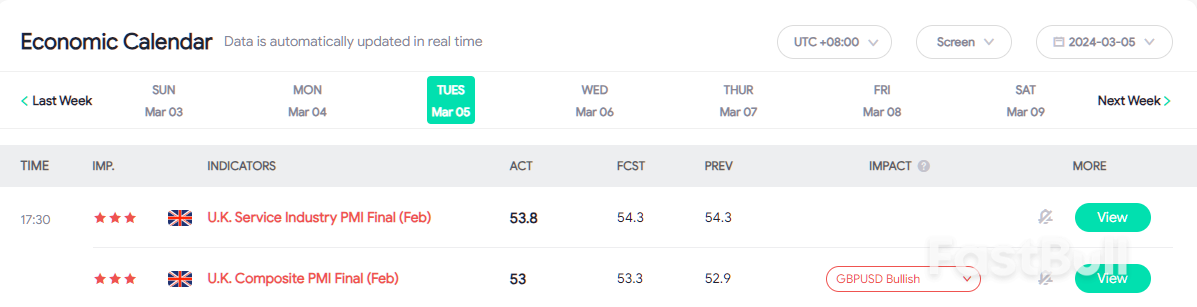
          The final seasonally adjusted S&P Global UK Services PMI Business Activity Index for February stood at 53.8, slightly down from January's 54.3 and below the initial 'flash' reading. Nevertheless, it remained higher than any point in the second half of 2023, indicating a sustained rebound in business activity following the downturn last autumn.
          This increase in business activity was fueled by a significant rise in new order volumes, marking the sharpest growth since May 2023. Service providers attributed this to increased spending by both businesses and consumers, supported by more favorable economic conditions and the anticipation of lower interest rates stimulating customer demand.
          Additionally, improved export sales contributed to enhanced total order books in February, with new work from overseas clients expanding for the fifth consecutive month, reaching its strongest level since June 2023. Survey respondents often cited increased demand from the US and Asia, alongside a tentative recovery in European export orders.
          Although there was a modest increase in staffing levels across the service sector in February, it was the fastest recorded since July 2023. This additional recruitment was driven by long-term business expansion plans and the need to increase operational capacity. However, some firms reported constraints on hiring due to significant wage pressures. Despite this, the sustained increase in the total workforce helped to reduce backlogs of work for the ninth consecutive month.
          Regarding inflation, the most recent data showed the most substantial increase in input costs across the UK private sector since August 2023. Inflationary pressures heightened in both the manufacturing and service sectors in February, with the service sector experiencing a notably quicker overall surge in business expenses. Likewise, there was a significant uptick in prices charged by service providers, contrasting with only a slight increase in factory gate prices within the manufacturing sector.
          To stay updated on all economic events of today, please check out our Economic calendar
          Risk Warnings and Disclaimers
          You understand and acknowledge that there is a high degree of risk involved in trading. Following any strategies or investment methods may lead to potential losses. The content on the site is provided by our contributors and analysts for information purposes only. You are solely responsible for determining whether any trading assets, securities, strategy, or any other product is suitable for investing based on your own investment objectives and financial situation.
          Add to Favorites
          Share

          February Sees UK Retail Sales Growth at Its Lowest Since 2022

          Zi Cheng

          Traders' Opinions

          Economic

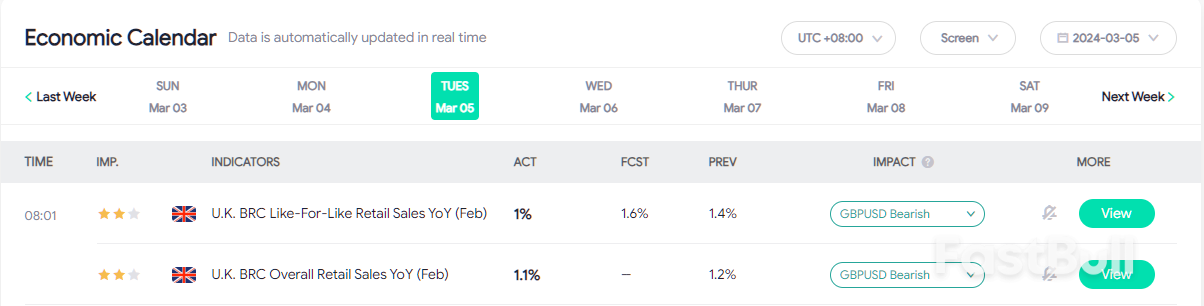
          According to the BRC-KPMG Retail Sales Monitor report released on Tuesday, total retail sales for the four weeks ending on February 24 saw a 1.1% year-on-year increase. This contrasts with the 1.2% growth recorded in the preceding month and the three-month average of 1.4%. In February last year, annual growth stood at 5.2%.
          February Sees UK Retail Sales Growth at Its Lowest Since 2022_1
          Food sales remained the primary driver of growth, posting a 6.0% year-on-year increase over the three-month period ending in February, compared to an 8.3% growth rate from the previous year. However, nonfood sales experienced a decline of 2.5% year-on-year over the same three-month period, compared to a growth rate of 3.2% from the previous year.
          Chief Executive of the British Retail Consortium, Helen Dickinson, attributed the dampened consumer demand to the exceptionally wet February weather. She noted that despite Valentine's Day, traditionally buoyant products like jewelry and watches failed to stimulate sales. On a brighter note, rainy weather boosted sales of toys as parents sought indoor activities for their children.
          Looking forward, Linda Ellett, Head of Consumer Markets, Leisure, and Retail at KPMG U.K., anticipates ongoing challenges for retailers in the coming months, despite signs of slowing inflation and anticipated improvements in household finances.
          According to the payments company, spending on non-essential items saw a modest year-on-year increase of only 1.7% last month, marking the slowest rate of growth since September 2022.
          In contrast, spending on "in-speriences" like takeaways or film rentals showed a stronger annual growth rate of 6.5%, indicating that households opted to stay indoors to evade the effects of record rainfall. The report from Barclays also pointed to a deceleration in sales, particularly for food items, which was attributed to a decrease in inflation.
          Amidst the tumultuous landscape of the UK retail sector, attention shifts towards devising recovery plans aimed at reinforcing consumer trust and expenditure. The forthcoming budget announcement is eagerly awaited, with hopes pinned on measures geared towards bolstering both businesses and consumers. With projections of a slowdown in inflation and potential enhancements in household finances, there exists a cautious optimism regarding a resurgence in retail sales. Nonetheless, the sector remains vigilant, acknowledging the myriad uncertainties that lie along the path to recovery.
          Reflecting on the recent tribulations encountered by the UK retail sector, it becomes evident that resilience and adaptability will serve as indispensable assets in surmounting the challenges posed by adverse weather conditions and the escalating cost of living crisis.
          To stay updated on all economic events of today, please check out our Economic calendar
          Risk Warnings and Disclaimers
          You understand and acknowledge that there is a high degree of risk involved in trading. Following any strategies or investment methods may lead to potential losses. The content on the site is provided by our contributors and analysts for information purposes only. You are solely responsible for determining whether any trading assets, securities, strategy, or any other product is suitable for investing based on your own investment objectives and financial situation.
          Add to Favorites
          Share

          Dollar Awaits ISM Services PMI, China Sets Dubious Targets

          Cohen

          Economic

          Forex

          Dollar rebounds ahead of key data and events

          The US dollar rebounded somewhat against most of its major peers on Monday, although the fact that it lost decent ground against the euro and the pound kept the dollar index (DXY) lower. Today, the greenback is trading higher or unchanged.
          Following Friday’s disappointing ISM manufacturing PMI for February, the dollar came under some selling interest as investors slightly brought forward their Fed rate cut bets. However, today, the market’s implied path is back near the levels observed before the ISM release. Market participants are assigning an 80% chance for the Fed to deliver its first 25bps cut in June, while the total number of basis points expected to be cut by the end of the year is at 85, slightly more than the Fed’s own projections of 75.
          This suggests that there is still some room for the dollar and Treasury yields to further recover should incoming data and events corroborate the Fed’s ‘higher for longer’ mantra. The highlights for dollar traders this week may be Fed Chair Powell’s testimony before Congress on Wednesday and Thursday, as well as Friday’s nonfarm payrolls.
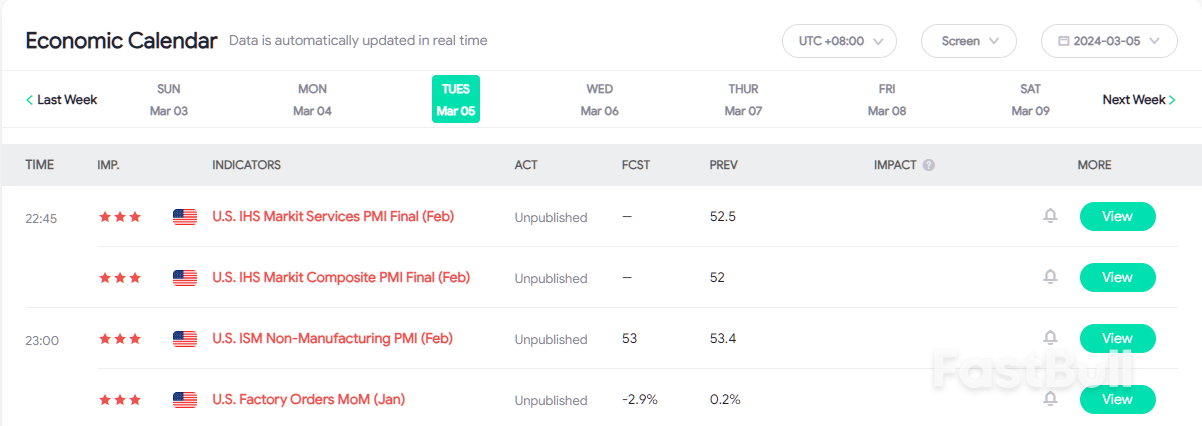
          Nonetheless, that doesn’t mean that today’s ISM non-manufacturing PMI for February will pass unnoticed. On the contrary, following the disappointment in the manufacturing index and given that the services sector accounts for around 70% of US GDP, the non-manufacturing PMI may impact Fed bets even more. Expectations are for the index to have declined somewhat to 53.0 from 53.4, but investors may pay special attention to the prices and employment subindices, to get an updated idea of how the labor market and inflation are faring.

          Yen stabilizes after Tokyo CPIs, China sets GDP and budget targets

          The yen stabilized somewhat today, keeping dollar/yen below the key resistance zone of 150.80. Perhaps yen sellers covered some of their short positions after the Tokyo CPIs revealed a strong acceleration in inflation during February.
          However, with the majority of BoJ policymakers holding the view that even if a hike is delivered just after the spring wage negotiations, the pace of subsequent hikes in Japan will be very gradual, the yen is unlikely to stage a strong comeback anytime soon.
          The Australian and New Zealand dollars are the main losers today, perhaps as China’s target for economic growth in 2024 was announced at around 5%, the same as in 2023, but with a budget deficit targeted at 3%, lower than the 3.8% aimed last year. This likely translates as wanting to achieve the same growth with less stimulus, which seems to be a hard task considering that the world’s second largest economy faces a deepening property crisis.
          Apart from news coming from China, aussie traders will also have to evaluate Australia’s GDP data for Q4 during the Asian session Wednesday. Expectations are for a mild acceleration, which may allow the RBA to maintain its tightening bias for a while longer.

          Wall Street pulls back, gold and bitcoin climb higher

          US stock indices closed slightly in the red yesterday, but that was after the S&P 500 hit another record high during the day. Perhaps equity investors adopted a more cautious stance towards the end of the trading session as several key events are on the agenda for the rest of the week.
          Despite the dollar’s recovery, gold continued marching north, closing the distance from its record high to less than 1%. This confirms the notion that the precious metal is not only driven by the dollar and Treasury yields, but also by other factors like geopolitics and central bank buying. After all, even when the dollar was staging a strong recovery due to the repricing of expectations surrounding the Fed, gold held relatively steady, suggesting that there were still participants interested in buying it.
          In the crypto space, Bitcoin extended its rally to a more than two-year high, surpassing the psychological barrier of $65.000. It seems that the crypto king continues to benefit from flows into the new spot ETFs, but also from speculation ahead of April’s halving event that could slow the supply growth.

          Source:Investing

          To stay updated on all economic events of today, please check out our Economic calendar
          Risk Warnings and Disclaimers
          You understand and acknowledge that there is a high degree of risk involved in trading. Following any strategies or investment methods may lead to potential losses. The content on the site is provided by our contributors and analysts for information purposes only. You are solely responsible for determining whether any trading assets, securities, strategy, or any other product is suitable for investing based on your own investment objectives and financial situation.
          Add to Favorites
          Share

          For Fed Tightening, There's More To Think About Than Just Tapering

          Samantha Luan

          Economic

          Bond

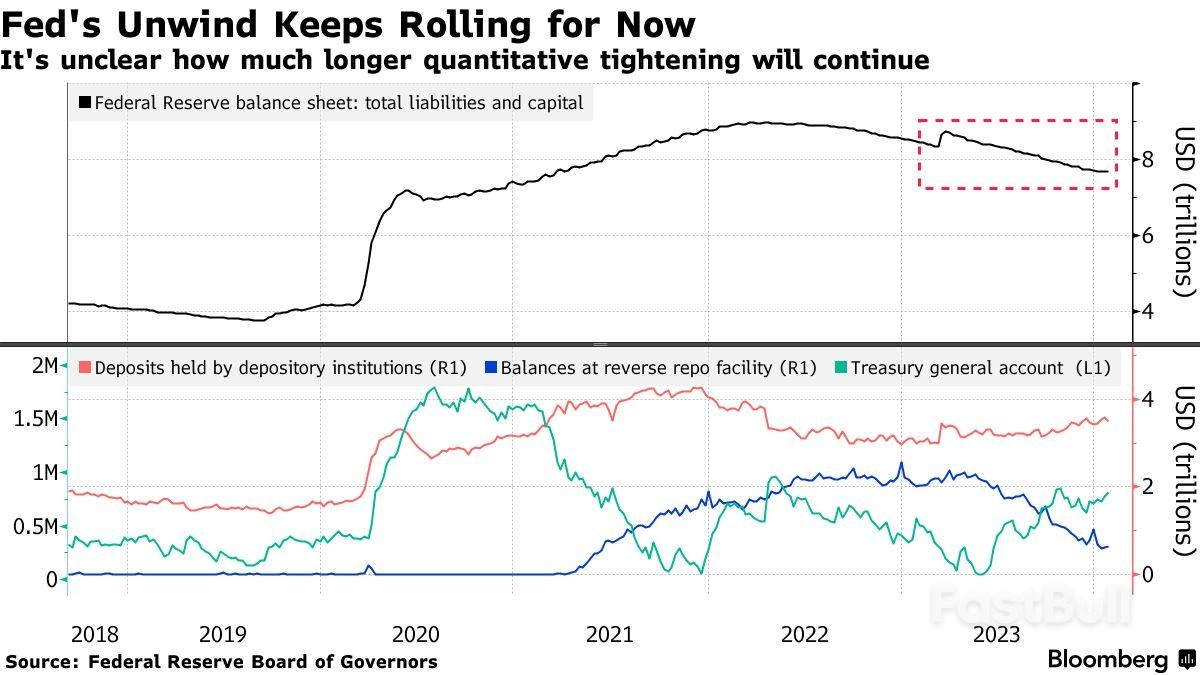
          Market participants have been so focused on determining when and how much the Federal Reserve will slow its balance-sheet unwind that they haven’t even started to consider another wrinkle: the composition of the US central bank’s assets.
          Officials are preparing for an in-depth discussion of the Fed’s asset reduction, a process known as quantitative tightening, or QT, which began in June 2022. Fed Governor Christopher Waller on Friday said he’d like to see a shift in Treasury holdings toward a larger share of short-dated Treasury securities to give the central bank more flexibility the next time it needs to use its balance sheet.
          “One of the benefits from such a move would be to allow for future asset purchases without needing to expand the balance sheet,” BMO Capital Markets strategists Ian Lyngen and Ben Jeffery wrote in a note to clients Monday. “Of course, planning for the next operation twist while still actively engaged in QT isn’t necessarily an inspiring development, even if it does resonate in the context of medium-term risks.”

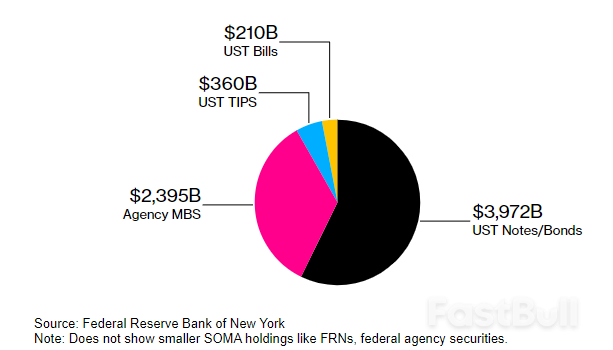
          Treasury Bills Presently Account for 3% of Total SOMA Assets

          System Open Market Account holds assets obtained via open market operationsFor Fed Tightening, There's More To Think About Than Just Tapering_1
          For the moment, the market is focused on when the Fed will announce it is tapering QT and when it will actually stop, so as to avoid causing ructions in the overnight funding markets like it did in September 2019. Wall Street estimates for the beginning of the QT taper range from April to September 2024, with the expectation that the pace will slow as the overnight reverse repo facility is nearly empty.
          The last time the central bank underwent QT, Treasury bills weren’t part of its holdings. The Fed purchased them after rates on overnight repurchase agreements spiked to 10% in September 2019 to shore up reserve balances. Before policymakers announced the recent round of balance sheet reductions, strategists contemplated how officials planned on treating its portfolio of T-bills, at $326 billion.
          At the time, Wall Street strategists thought it would have been prudent for the Fed to sell the T-bills because demand for short-term government debt was outstripping supply, spurring eligible counterparties to park trillions of dollars at the RRP facility. Instead, policymakers opted to gradually reduce the pile, redeeming the securities only when payments of coupon-bearing debt were below the Fed’s suggested monthly reinvestment cap for Treasuries, which currently stands at $60 billion.
          That means the central bank now has about $210 billion of bills remaining, or about 3% of its securities holdings, compared to about one-third before the financial crisis, according to Fed data.For Fed Tightening, There's More To Think About Than Just Tapering_2
          Yet Wrightson ICAP senior economist Lou Crandall sees another advantage to a Fed balance sheet comprised of short maturities. A smaller mismatch between the central bank’s assets and liabilities also would reduce the volatility of its earnings and losses.
          “Large reported losses can be a public relations headache,” Crandall wrote in a note to clients on Monday. “Greater rate sensitivity on the asset side might be attractive to the FOMC members heading into the next cycle.”
          Ultimately, moving away from the Fed’s holdings of mortgage-backed securities is a long-dated policy goal for officials and one that’s less pressing than the immediate need to slow and eventually stop QT.
          It remains to be seen if the monetary authority will achieve that goal. “I don’t think the Fed will ever be able to reach a Treasury-only balance sheet, but that won’t stop them from trying,” said Gennadiy Goldberg, head of US interest rates strategy at TD Securities. “I view it as a goal, but fairly low on the priority list all else considered.”

          Source:Bloomberg

          To stay updated on all economic events of today, please check out our Economic calendar
          Risk Warnings and Disclaimers
          You understand and acknowledge that there is a high degree of risk involved in trading. Following any strategies or investment methods may lead to potential losses. The content on the site is provided by our contributors and analysts for information purposes only. You are solely responsible for determining whether any trading assets, securities, strategy, or any other product is suitable for investing based on your own investment objectives and financial situation.
          Add to Favorites
          Share

          Euro Area And Nordic Countries To Gradually Move Out Of Their Current Stagnation

          Danske Bank

          Economic

          We expect the euro area and the Nordic countries to gradually move out of their current stagnation or mild recession (in Denmark’s case, stagnation outside pharmaceuticals). The US economy is stronger than expected, while China continues to muddle through. Interest rates can be gradually cut during 2024 and 2025, with central banks likely to move cautiously.
          In the US, Super Tuesday kicks off today when 15 states and one US territory are voting on their preferred candidate for the US presidential election in November. Focus will be on the Republican primaries where former president Trump is up against his former UN ambassador Nikki Haley. Trump is expected to win the most delegates, placing him on the doorstep of formally securing the Republican nomination.
          Later today we get the ISM non-manufacturing PMI in the US.
          In Sweden we get February service PMI numbers. We expect the numbers to show a third consecutive month above the 50-threshold, as well as come out above last month’s reading of 51.8. Deputy governor Bunge from the Riksbank is also due to speak.

          Economic and market news

          What happened overnight

          In China, the growth target for 2024 together with a bunch of other goals were revealed in the Government’s Work Report released at the opening of the annual National People’s Congress. The growth target was set at 5% as widely expected, the same as in 2023. It is a more ambitious target this year, though, as the base effects are less favourable this year. The inflation target was unchanged at 3%, but in practice means little as inflation is currently far below the target at -0.8% y/y. A market focus in the report was the signal on stimulus and here it disappointed a bit as the budget deficit target was unchanged from 2023 at 3%, and the off-balance special bond issuance did not pose any upward surprises. Overall, the report did not provide much new information compared to previous statements from the government whereas the markets had been hoping for more. Offshore stocks are down around 2% this morning while the CNY is broadly unchanged.
          The Chinese service sector disappointed and displayed slightly slower growth signals as the Caixin services PMI came in at 52.5 compared to 52.7 last month and a consensus of 52.9. The official non-manufacturing PMI by the National Bureau of Statistics stood at 51.4 in February.
          In Japan, Tokyo CPI numbers for February were released. The numbers show that seasonally adjusted CPI excluding fresh food and energy stands at 0.09% m/m down from last month’s 0.19% m/m. We still look out for the first indications from the wage spring negotiations due later this month as these will be key for the Bank of Japan’s monetary policy going forward.

          What happened yesterday

          In the US, the Supreme Court awarded former president Donald Trump a victory by deciding states cannot bar him from running for federal office citing insurrection regarding the 6 January 2021 attack on the US Capitol. With the unanimous decision Trump will once again be able to appear on the Colorado ballot, where he had otherwise been barred from appearing back in December.
          In the euro area, the Sentix Indicator measuring investor confidence rose to -10.5 from -12.9 in line with expectations. The reading marks an 11-month high for the indicator, albeit it remains well below its long-term average.
          Equities: Global equities were marginally lower yesterday in an uneventful session. Defensive value outperformed not least due to communication services and consumer discretionary was lower. We would not be surprised to see a couple of wait-and-see days ahead of the ECB meeting on Thursday and Non-Farm Payrolls on Friday. In the US yesterday, Dow -0.3%, S&P 500 -0.1%, Nasdaq -0.4% and Russell 2000 -0.1%. Asian markets are lower this morning with China leading the declines following the speech from Xi Jinping at the annual people’s congress. Futures are lower in both Europe and US this morning.
          FI: The first trading session of the week was a muted one in terms of macro or monetary policy news. Long-end EGB yields extended last week’s rally with peripherals such as Italy outperforming the core. Hawkish comments from Atlanta Fed’s Bostic provided renewed headwinds to US Treasuries, reversing some of the decline seen on Friday following the weak ISM figures for February. 10Y Bund yields ended down by 2bp, while 10Y UST yields were up 4bp throughout the day.
          FX: EUR/USD is starting this week close to the upper end of the 1.0800-1-0850 range. Meanwhile, USD/JPY is comfortably above the 150-mark for now, whereas EUR/JPY at 163.30 still has its eyes on the 26 February 163.70 high. The small kneejerk drop in EUR/CHF immediately after the Swiss inflation data was soon erased and the cross trades above 0.96 for the first time since late November. Both SEK and NOK are on the defensive, with EUR/SEK at 11.26 back into our preferred range of 11.20-11.40 and where EUR/NOK is closing in on 11.50 again.
          To stay updated on all economic events of today, please check out our Economic calendar
          Risk Warnings and Disclaimers
          You understand and acknowledge that there is a high degree of risk involved in trading. Following any strategies or investment methods may lead to potential losses. The content on the site is provided by our contributors and analysts for information purposes only. You are solely responsible for determining whether any trading assets, securities, strategy, or any other product is suitable for investing based on your own investment objectives and financial situation.
          Add to Favorites
          Share
          FastBull
          Copyright © 2025 FastBull Ltd

          728 RM B 7/F GEE LOK IND BLDG NO 34 HUNG TO RD KWUN TONG KLN HONG KONG

          TelegramInstagramTwitterfacebooklinkedin
          App Store Google Play Google Play
          Products
          Charts

          Chats

          Q&A with Experts
          Screeners
          Economic Calendar
          Data
          Tools
          Membership
          Features
          Function
          Markets
          Copy Trading
          Latest Signals
          Contests
          News
          Analysis
          24/7
          Columns
          Education
          Company
          Careers
          About Us
          Contact Us
          Advertising
          Help Center
          Feedback
          User Agreement
          Privacy Policy
          Business

          White Label

          Data API

          Web Plug-ins

          Poster Maker

          Affiliate Program

          Risk Disclosure

          The risk of loss in trading financial instruments such as stocks, FX, commodities, futures, bonds, ETFs and crypto can be substantial. You may sustain a total loss of the funds that you deposit with your broker. Therefore, you should carefully consider whether such trading is suitable for you in light of your circumstances and financial resources.

          No decision to invest should be made without thoroughly conducting due diligence by yourself or consulting with your financial advisors. Our web content might not suit you since we don't know your financial conditions and investment needs. Our financial information might have latency or contain inaccuracy, so you should be fully responsible for any of your trading and investment decisions. The company will not be responsible for your capital loss.

          Without getting permission from the website, you are not allowed to copy the website's graphics, texts, or trademarks. Intellectual property rights in the content or data incorporated into this website belong to its providers and exchange merchants.

          Not Logged In

          Log in to access more features

          FastBull Membership

          Not yet

          Purchase

          Become a signal provider
          Help Center
          Customer Service
          Dark Mode
          Price Up/Down Colors

          Log In

          Sign Up

          Position
          Layout
          Fullscreen
          Default to Chart
          The chart page opens by default when you visit fastbull.com