• Trade
  • Markets
  • Copy
  • Contests
  • News
  • 24/7
  • Calendar
  • Q&A
  • Chats
Trending
Screeners
SYMBOL
LAST
BID
ASK
HIGH
LOW
NET CHG.
%CHG.
SPREAD
SPX
S&P 500 Index
6827.42
6827.42
6827.42
6899.86
6801.80
-73.58
-1.07%
--
DJI
Dow Jones Industrial Average
48458.04
48458.04
48458.04
48886.86
48334.10
-245.98
-0.51%
--
IXIC
NASDAQ Composite Index
23195.16
23195.16
23195.16
23554.89
23094.51
-398.69
-1.69%
--
USDX
US Dollar Index
97.950
98.030
97.950
98.500
97.950
-0.370
-0.38%
--
EURUSD
Euro / US Dollar
1.17394
1.17409
1.17394
1.17496
1.17192
+0.00011
+ 0.01%
--
GBPUSD
Pound Sterling / US Dollar
1.33707
1.33732
1.33707
1.33997
1.33419
-0.00148
-0.11%
--
XAUUSD
Gold / US Dollar
4299.39
4299.39
4299.39
4353.41
4257.10
+20.10
+ 0.47%
--
WTI
Light Sweet Crude Oil
57.233
57.485
57.233
58.011
56.969
-0.408
-0.71%
--

Community Accounts

Signal Accounts
--
Profit Accounts
--
Loss Accounts
--
View More

Become a signal provider

Sell trading signals to earn additional income

View More

Guide to Copy Trading

Get started with ease and confidence

View More

Signal Accounts for Members

All Signal Accounts

Best Return
  • Best Return
  • Best P/L
  • Best MDD
Past 1W
  • Past 1W
  • Past 1M
  • Past 1Y

All Contests

  • All
  • Trump Updates
  • Recommend
  • Stocks
  • Cryptocurrencies
  • Central Banks
  • Featured News
Top News Only
Share

USA Embassy In Lithuania: Maria Kalesnikava Is Not Going To Vilnius

Share

USA Embassy In Lithuania: Other Prisoners Are Being Sent From Belarus To Ukraine

Share

Ukraine President Zelenskiy: Five Ukrainians Released By Belarus In US-Brokered Deal

Share

USA Vilnius Embassy: USA Stands Ready For "Additional Engagement With Belarus That Advances USA Interests"

Share

USA Vilnius Embassy: Belarus, USA, Other Citizens Among The Prisoners Released Into Lithuania

Share

USA Vilnius Embassy: USA Will Continue Diplomatic Efforts To Free The Remaining Political Prisoners In Belarus

Share

USA Vilnius Embassy: Belarus Releases 123 Prisoners Following Meeting Of President Trump's Envoy Coale And Belarus President Lukashenko

Share

USA Vilnius Embassy: Masatoshi Nakanishi, Aliaksandr Syrytsa Are Among The Prisoners Released By Belarus

Share

USA Vilnius Embassy: Maria Kalesnikava And Viktor Babaryka Are Among The Prisoners Released By Belarus

Share

USA Vilnius Embassy: Nobel Peace Prize Laureate Ales Bialiatski Is Among The Prisoners Released By Belarus

Share

Belarusian Presidential Administration Telegram Channel: Lukashenko Has Pardoned 123 Prisoners As Part Of Deal With US

Share

Two Local Syrian Officials: Joint US-Syrian Military Patrol In Central Syria Came Under Fire From Unknown Assailants

Share

Israeli Military Says It Targeted 'Key Hamas Terrorist' In Gaza City

Share

Rwanda's Actions In Eastern Drc Are A Clear Violation Of Washington Accords Signed By President Trump - Secretary Of State Rubio

Share

Israeli Military Issues Evacuation Warning In Southern Lebanon Village Ahead Of Strike - Spokesperson On X

Share

Belarusian State Media Cites US Envoy Coale As Saying He Discussed Ukraine And Venezuela With Lukashenko

Share

Belarusian State Media Cites US Envoy Coale As Saying That US Removes Sanctions On Belarusian Potassium

Share

Thai Prime Minister: No Ceasefire Agreement With Cambodia

Share

US, Ukraine To Discuss Ceasefire In Berlin Ahead Of European Summit

Share

Incoming Czech Prime Minister Babis: Czech Republic Will Not Take On Guarantees For Ukraine Financing, European Commission Must Find Alternatives

TIME
ACT
FCST
PREV
U.K. Trade Balance Non-EU (SA) (Oct)

A:--

F: --

P: --

U.K. Trade Balance (Oct)

A:--

F: --

P: --

U.K. Services Index MoM

A:--

F: --

P: --

U.K. Construction Output MoM (SA) (Oct)

A:--

F: --

P: --

U.K. Industrial Output YoY (Oct)

A:--

F: --

P: --

U.K. Trade Balance (SA) (Oct)

A:--

F: --

P: --

U.K. Trade Balance EU (SA) (Oct)

A:--

F: --

P: --

U.K. Manufacturing Output YoY (Oct)

A:--

F: --

P: --

U.K. GDP MoM (Oct)

A:--

F: --

P: --

U.K. GDP YoY (SA) (Oct)

A:--

F: --

P: --

U.K. Industrial Output MoM (Oct)

A:--

F: --

P: --

U.K. Construction Output YoY (Oct)

A:--

F: --

P: --

France HICP Final MoM (Nov)

A:--

F: --

P: --

China, Mainland Outstanding Loans Growth YoY (Nov)

A:--

F: --

P: --

China, Mainland M2 Money Supply YoY (Nov)

A:--

F: --

P: --

China, Mainland M0 Money Supply YoY (Nov)

A:--

F: --

P: --

China, Mainland M1 Money Supply YoY (Nov)

A:--

F: --

P: --

India CPI YoY (Nov)

A:--

F: --

P: --

India Deposit Gowth YoY

A:--

F: --

P: --

Brazil Services Growth YoY (Oct)

A:--

F: --

P: --

Mexico Industrial Output YoY (Oct)

A:--

F: --

P: --

Russia Trade Balance (Oct)

A:--

F: --

P: --

Philadelphia Fed President Henry Paulson delivers a speech
Canada Building Permits MoM (SA) (Oct)

A:--

F: --

P: --

Canada Wholesale Sales YoY (Oct)

A:--

F: --

P: --

Canada Wholesale Inventory MoM (Oct)

A:--

F: --

P: --

Canada Wholesale Inventory YoY (Oct)

A:--

F: --

P: --

Canada Wholesale Sales MoM (SA) (Oct)

A:--

F: --

P: --

Germany Current Account (Not SA) (Oct)

A:--

F: --

P: --

U.S. Weekly Total Rig Count

A:--

F: --

P: --

U.S. Weekly Total Oil Rig Count

A:--

F: --

P: --

Japan Tankan Large Non-Manufacturing Diffusion Index (Q4)

--

F: --

P: --

Japan Tankan Small Manufacturing Outlook Index (Q4)

--

F: --

P: --

Japan Tankan Large Non-Manufacturing Outlook Index (Q4)

--

F: --

P: --

Japan Tankan Large Manufacturing Outlook Index (Q4)

--

F: --

P: --

Japan Tankan Small Manufacturing Diffusion Index (Q4)

--

F: --

P: --

Japan Tankan Large Manufacturing Diffusion Index (Q4)

--

F: --

P: --

Japan Tankan Large-Enterprise Capital Expenditure YoY (Q4)

--

F: --

P: --

U.K. Rightmove House Price Index YoY (Dec)

--

F: --

P: --

China, Mainland Industrial Output YoY (YTD) (Nov)

--

F: --

P: --

China, Mainland Urban Area Unemployment Rate (Nov)

--

F: --

P: --

Saudi Arabia CPI YoY (Nov)

--

F: --

P: --

Euro Zone Industrial Output YoY (Oct)

--

F: --

P: --

Euro Zone Industrial Output MoM (Oct)

--

F: --

P: --

Canada Existing Home Sales MoM (Nov)

--

F: --

P: --

Euro Zone Total Reserve Assets (Nov)

--

F: --

P: --

U.K. Inflation Rate Expectations

--

F: --

P: --

Canada National Economic Confidence Index

--

F: --

P: --

Canada New Housing Starts (Nov)

--

F: --

P: --

U.S. NY Fed Manufacturing Employment Index (Dec)

--

F: --

P: --

U.S. NY Fed Manufacturing Index (Dec)

--

F: --

P: --

Canada Core CPI YoY (Nov)

--

F: --

P: --

Canada Manufacturing Unfilled Orders MoM (Oct)

--

F: --

P: --

Canada Manufacturing New Orders MoM (Oct)

--

F: --

P: --

Canada Core CPI MoM (Nov)

--

F: --

P: --

Canada Manufacturing Inventory MoM (Oct)

--

F: --

P: --

Canada CPI YoY (Nov)

--

F: --

P: --

Canada CPI MoM (Nov)

--

F: --

P: --

Canada CPI YoY (SA) (Nov)

--

F: --

P: --

Canada Core CPI MoM (SA) (Nov)

--

F: --

P: --

Q&A with Experts
    • All
    • Chatrooms
    • Groups
    • Friends
    Connecting
    .
    .
    .
    Type here...
    Add Symbol or Code

      No matching data

      All
      Trump Updates
      Recommend
      Stocks
      Cryptocurrencies
      Central Banks
      Featured News
      • All
      • Russia-Ukraine Conflict
      • Middle East Flashpoint
      • All
      • Russia-Ukraine Conflict
      • Middle East Flashpoint
      Search
      Products

      Charts Free Forever

      Chats Q&A with Experts
      Screeners Economic Calendar Data Tools
      Membership Features
      Data Warehouse Market Trends Institutional Data Policy Rates Macro

      Market Trends

      Market Sentiment Order Book Forex Correlations

      Top Indicators

      Charts Free Forever
      Markets

      News

      News Analysis 24/7 Columns Education
      From Institutions From Analysts
      Topics Columnists

      Latest Views

      Latest Views

      Trending Topics

      Top Columnists

      Latest Update

      Signals

      Copy Rankings Latest Signals Become a signal provider AI Rating
      Contests
      Brokers

      Overview Brokers Assessment Rankings Regulators News Claims
      Broker listing Forex Brokers Comparison Tool Live Spread Comparison Scam
      Q&A Complaint Scam Alert Videos Tips to Detect Scam
      More

      Business
      Events
      Careers About Us Advertising Help Center

      White Label

      Data API

      Web Plug-ins

      Affiliate Program

      Awards Institution Evaluation IB Seminar Salon Event Exhibition
      Vietnam Thailand Singapore Dubai
      Fans Party Investment Sharing Session
      FastBull Summit BrokersView Expo
      Recent Searches
        Top Searches
          Markets
          News
          Analysis
          User
          24/7
          Economic Calendar
          Education
          Data
          • Names
          • Latest
          • Prev

          View All

          No data

          Scan to Download

          Faster Charts, Chat Faster!

          Download App
          English
          • English
          • Español
          • العربية
          • Bahasa Indonesia
          • Bahasa Melayu
          • Tiếng Việt
          • ภาษาไทย
          • Français
          • Italiano
          • Türkçe
          • Русский язык
          • 简中
          • 繁中
          Open Account
          Search
          Products
          Charts Free Forever
          Markets
          News
          Signals

          Copy Rankings Latest Signals Become a signal provider AI Rating
          Contests
          Brokers

          Overview Brokers Assessment Rankings Regulators News Claims
          Broker listing Forex Brokers Comparison Tool Live Spread Comparison Scam
          Q&A Complaint Scam Alert Videos Tips to Detect Scam
          More

          Business
          Events
          Careers About Us Advertising Help Center

          White Label

          Data API

          Web Plug-ins

          Affiliate Program

          Awards Institution Evaluation IB Seminar Salon Event Exhibition
          Vietnam Thailand Singapore Dubai
          Fans Party Investment Sharing Session
          FastBull Summit BrokersView Expo

          October 3th Financial News

          FastBull Featured

          Daily News

          Summary:

          Powell: The Fed is committed to preserving the labor market; Mann: Inflation volatility indicates that interest rates will rise; U.S. Treasury yields continue to rise...

          [Quick Facts]
          1. Powell: The Fed is committed to preserving the labor market.
          2. U.S. Republican infighting intensifies, with some Republican Congressmen launching efforts to bring down McCarthy.
          3. Guindos: Current interest rate to help achieve inflation target.
          4. Mann: Inflation volatility indicates that interest rates will rise.
          5. U.S. Treasury yields continue to rise.
          6. Bowman: It is likely to raise interest rates further.
          7. Barr: Interest rates are at a sufficiently restrictive level.
          [News Details]
          Powell: The Fed is committed to preserving the labor market
          On Monday, Fed President Powell noted at a roundtable that the central bank remains committed to maintaining a robust labor market.
          According to the recent non-farm payrolls report, although the U.S. labor force participation rate in August has rebounded from the low in 2020, it is still lagging behind before the epidemic. In addition, job openings in medical, social work, and local government departments are increasing, which also reflects the inequality in the distribution of medical resources in the U.S.
          Powell emphasized that the government is taking measures to encourage more people to re-enter the labor market. He believed that a continued good labor market would not only drive wage growth but would also bring other benefits. He pointed out that as the economy continues to grow, wages for low-income groups will also increase. But to achieve this goal, the key is to maintain price stability.
          U.S. Republican infighting intensifies, with some Republican Congressmen launching efforts to bring down McCarthy
          The Republican infighting is intensifying after Congress passed a temporary funding bill to avoid a government shutdown. Republican Representative Matt Gaetz has vowed to introduce a motion this week to remove House Speaker McCarthy, an initiative that could shake the balance of power in Congress.
          McCarthy said Monday that Gaetz opposed his move based on personality and a private matter, not policy. He said: "Don't judge the Republican by Gaetz, but judge by our enemies." It is reported that if Gaetz can persuade four Republican hardliners to join, plus the Democratic Party, his opposition is likely to succeed. But Democrats could also lend McCarthy a helping hand by voting against the motion or choosing not to vote at all.
          Guindos: Current interest rate to help achieve inflation target
          ECB Vice President Guindos said in a speech on Monday that interest rates at current levels will help bring eurozone inflation back to the 2% target. Data showed both headline and core inflation slowed in September, a trend expected to continue in the coming months.
          Mann: Inflation volatility indicates that interest rates will rise
          Mann, a Bank of England official, said in a speech on Monday that when it comes to interest rate policy, I am a hawk. My forecast is at the upper end of the fan chart. Domestic demand is more resilient. The Bank of England's forecast is very different from what I think.
          Real interest rates recently turned positive, and monetary policy became tighter. Market surveys suggest the interest rate is higher, and the Bank of England has overestimated the scales and effects of the monetary policy in the past.
          We underestimated the consumer response to inflation, which has an upward bias, and inflation volatility suggests that interest rates will rise.
          U.S. Treasury yields continue to rise
          The U.S. government has temporarily avoided a shutdown, saving the U.S. economy from potential damage. U.S. Treasuries fell on the first trading day since the U.S. government averted a shutdown after Congress passed a temporary funding bill to keep the government operating until November 17.
          This pushed the market to revise its bets on the Fed raising interest rates this year and further reduce its bets on a rate cut next year. The bond market kicked off the final quarter of the year in a new round of selling, with 10-year and 30-year U.S. Treasury yields hitting multi-year highs on Monday. The benchmark 10-year Treasury yield hit 4.7%, a new high since 2007, and the 30-year Treasury yield rose above 4.81%, a new high since 2010. U.S. Treasury yields from 5 to 30-year rose by more than 10 bps on the day.
          Bowman: It is likely to raise interest rates further
          "I remain willing to support raising the federal funds rate at a future meeting if the incoming data indicates that progress on inflation has stalled or is too slow to bring inflation to 2% in a timely way." Fed Governor Bowman said Monday in prepared remarks to a banking conference. Although considerable progress has been made, inflation remains too high, and I expect the Fed may need to raise interest rates further and keep them at a restrictive level for some time.
          Barr: Interest rates are at a sufficiently restrictive level
          Speaking at a separate event in New York on Monday, Barr, the Fed Vice Chair for Supervision, said he believes rates are now "at or very near" a sufficiently restrictive level. In my opinion, the most important question at this moment is not whether an additional rate increase is needed this year or not, but rather how long we need to keep rates at a sufficiently restrictive level to achieve our goals, and I expect it will take some time.
          [Focus of the Day]
          UTC+8 11:00 The Reserve Bank of Australia Announces its Interest Rate Decision
          UTC+8 14:00 ECB Governing Council Member Simkus Delivers a Speech
          UTC+8 14:10 ECB Chief Economist Lane Delivers a Speech
          UTC+8 14:30 Swiss CPI (Sep)
          UTC+8 20:30 Atlanta Fed President Bostic Delivers a Speech on the 2024 Economic Outlook
          UTC+8 20:45 ECB Governing Councilor Villeroy Delivers a Speech.
          UTC+8 22:00 U.S. JOLTS Job Openings (SA) (Aug)
          Risk Warnings and Disclaimers
          You understand and acknowledge that there is a high degree of risk involved in trading. Following any strategies or investment methods may lead to potential losses. The content on the site is provided by our contributors and analysts for information purposes only. You are solely responsible for determining whether any trading assets, securities, strategy, or any other product is suitable for investing based on your own investment objectives and financial situation.
          Comments
          Add to Favorites
          Share

          US Production Boosts Case for 4% GDP Growth

          Justin

          Economic

          Manufacturing is stabilising after 11 months of contraction

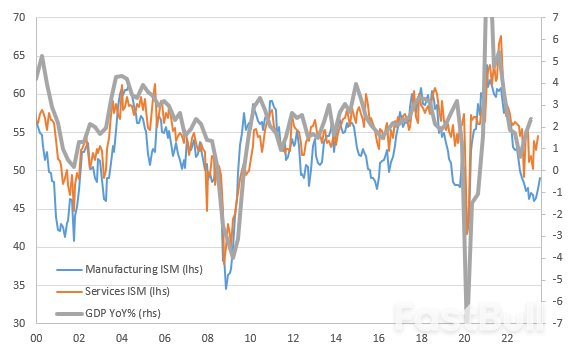
          The US ISM manufacturing index has improved to 49.0 from 47.6 (consensus 47.9), although we have to remember it remains below 50, thereby indicating the sector continues to contract, albeit at a slower pace than last month. Furthermore, we have to remember that this is the 11th consecutive sub 50 reading so looking at it cumulatively we are at pretty weak levels of activity. Nonetheless, there are areas of very positive news with the details showing production actually broke above 50 to stand at 52.5, which is the best reading since July 2022 while employment also posted positive growth with an index level of 51.2 – the highest print since May. New orders improved to 49.2 from 46.8 with export orders at 47.4 versus 46.5 previously – but again as these are below 50 it merely signals the rate of contraction is moderating.

          ISM indices & GDP growth

          US Production Boosts Case for 4% GDP Growth_1
          There is more positive news on the inflation front with prices paid slipping to 43.8 from 48.4. We had feared that rising energy costs would lead to a spike in this metric, but it appears that there is enough moderation in costs elsewhere to offset it. Consequently we see a story that points to stabilising activity in the manufacturing sector with limited price pressures, which is encouraging for the Federal Reserve’s soft landing thesis.

          Construction continues to see robust increases in spending

          At the same time we have August construction data which shows spending rose 0.5% month-on-month, as expected, with a 0.6% gain in residential activity and a 0.4% increase in non-residential construction spending. It is worth noting that construction activity tied to manufacturing is up 65.5% year-on-year with the CHIPS Act and FABS Act to stimulate semi-conductor production in the US gaining particular traction. So, with consumer spending looking strong in the third quarter, construction making robust gains and manufacturing showing signs of stabilisation, it all seems to tally with the prospect of a very healthy 3.7% annualised growth rate for third quarter GDP as we are forecasting. However, the risks appear skewed to the upside and a 4% figure is entirely possible.

          Source: ING

          To stay updated on all economic events of today, please check out our Economic calendar
          Risk Warnings and Disclaimers
          You understand and acknowledge that there is a high degree of risk involved in trading. Following any strategies or investment methods may lead to potential losses. The content on the site is provided by our contributors and analysts for information purposes only. You are solely responsible for determining whether any trading assets, securities, strategy, or any other product is suitable for investing based on your own investment objectives and financial situation.
          Comments
          Add to Favorites
          Share

          Bridging the Climate-Development Gap

          Kevin Du

          Economic

          Low-income countries are in the throes of a liquidity crunch that is not only undermining their economic development but also deepening the global climate crisis. In 2020 and 2021, net financial transfers to Africa were close to zero – their lowest level in a decade – despite record transfers from multilateral development banks (MDBs). That drop-off was due to a reduction in loans from the private sector and China, and now the situation has deteriorated further, with all low- and lower-middle-income countries (LMICs) having lost access to the bond market. Meanwhile, higher food and fuel bills, and falling export receipts, have made matters even worse.
          To be sure, only a handful of LMICs have defaulted on their external debts, and many others still hope to weather the storm and re-enter the market when it reopens. But with their debt-service obligations having grown vastly larger than the official support they can secure, their fiscal space is being squeezed, leading to a silent development crisis.
          At the same time, global development and climate financing needs are estimated to have risen to $1 trillion per year. The gap between the international community's aspirations for poorer economies and the sad reality of their finances has never been so large, nor so corrosive to the legitimacy of the global financial system.
          A series of international gatherings – culminating with the recent G20 declaration – has sought to reform the global financial and development architecture, placing special emphasis on scaling up MDB support. But if MDB funding rises before the current debt crisis is resolved, much of that additional money will go not toward investments in LMICs but to other creditors, as is currently the case.
          During the pandemic, many observers foresaw that massive insolvencies loomed on the horizon. While promising proposals were made for wholesale debt relief, world leaders failed to agree on ambitious solutions. Since then, the grinding difficulties of reaching debt deals selectively have demoralized the international community.
          Much of the opposition to debt relief came from China, the largest bilateral donor. It argues that LMICs' external debts remain relatively low, averaging only 40% of GDP, compared to 100% just before the Highly Indebted Poor Countries (HIPC) Initiative was launched in 1996. China therefore has pushed for debt rescheduling, as happened earlier this year with the long-awaited Zambia deal.
          Private lenders have also resisted deep debt relief, even as they remain unwilling to provide liquidity. During the Latin American debt crisis of the 1980s, when liquidity rather than insolvency was seen as the problem, the few banks involved at least could agree on coordinated rescheduling. But now, the wholesale closure of the bond market reflects a collective-action problem that is all too characteristic of fragmented bondholding.
          While debt reduction is, understandably, a harrowing process, it should be much easier for countries that are only illiquid to build a bridge to a more financially sustainable future. The good news, here, is that just a handful of countries are currently insolvent. Recent estimates show that 25 LMICs, of which 17 are in Africa, remain below the International Monetary Fund's insolvency threshold, but exceed its liquidity threshold (with debt-servicing costs in the range of 12-15% of revenues).
          But the situation will worsen if these countries cannot refinance the principal on their outstanding debt when it reaches maturity. Consider Kenya. It has embarked on an ambitious program of stabilization and reforms, backed by a large fiscal stabilization effort equal to 4% of GDP, and generously supported by the IMF and MDBs. But it has $2 billion in bonds maturing in 2024. If global capital markets do not allow for refinancing by then, repayment will require an additional fiscal outlay equal to 1.8% of GDP, and that will increase the risk of popular unrest, as happened recently in response to tax hikes and higher costs of living.
          The alternative – defaulting – is equally unattractive, considering that Kenya's external debt stands at only 38% of gross national income. To overcome this dilemma, the African Union's Nairobi Declaration on Climate Change proposes that countries be allowed to reschedule debts coming due to create fiscal space for new “green growth” policies and reforms, financed by MDBs.
          Our own proposal for a “bridging compact” operationalizes this idea. Led jointly by the United Nations, the World Bank, and the IMF, it would support not just insolvent countries in need of debt haircuts, but also illiquid countries in need of rescheduling. Countries that have experienced negative net transfers with important creditors could choose to enter an adjustment program that postpones their debt obligations in exchange for a commitment to reforms. The goal is to create value through coordination, with the presumption that a country can grow out of debt if it is provided with liquidity, and if it pursues policies to achieve sustainable growth.
          To be effective, this bridging compact must be anchored in a national renewal program that includes measures to constrain budgets and reforms to move onto a new growth path. That will require more funding from both the IMF and the World Bank, with conditionalities extending beyond the typical three-year IMF program. Countries that avail themselves of this option should be the first to benefit from a scaling-up of IMF and MDB funding, which in turn would help to prevent a systemic debt crisis that would hurt everyone.
          To avoid leakages to other creditors, some debts would have to be rescheduled during the program period. The interest rate used should be no higher than the growth rate envisioned under the renewal program, so as not to exacerbate the debt situation. The approach should be accepted ex-ante by all creditor groups, but the obligation to reschedule loans that can't be refinanced would have to be enforced by an IMF threat to lend into arrears.
          Finally, at the end of the program, if external debt appears unsustainable, a debt reduction program would need to be devised – as under the HIPC Initiative. This possibility reduces the need to provide debt reduction to marginally insolvent countries up front, and at a time of high global economic uncertainty.
          The world desperately needs to make progress toward a more sustainable future. Our proposed approach would help bridge the great divide between our aspirations and our realities, by allowing the world's many illiquid countries to get in shape for the challenges that lie ahead. In the absence of such an initiative, the goal of mobilizing trillions of dollars for climate-friendly development will remain a pipe dream.

          Source: ZAWYA

          To stay updated on all economic events of today, please check out our Economic calendar
          Risk Warnings and Disclaimers
          You understand and acknowledge that there is a high degree of risk involved in trading. Following any strategies or investment methods may lead to potential losses. The content on the site is provided by our contributors and analysts for information purposes only. You are solely responsible for determining whether any trading assets, securities, strategy, or any other product is suitable for investing based on your own investment objectives and financial situation.
          Comments
          Add to Favorites
          Share

          Turkey and Iraq Need to Work Together on Oil Policy

          Owen Li

          Energy

          Economic

          The relationship between Turkey and Iraq is in need of a major reset. A recent arbitral award relating to the use of a pipeline that runs from Iraq to Turkey illustrates how relations between both countries have been beset by what appear to be uncoordinated policies and a failure to capitalise on mutual interests. Conversely, recent developments also demonstrate how much work would be required to achieve a reset, which is why it is so important for both sides to reflect internally on how to engage with each other.
          Commentators have long argued that there are obvious synergies between Turkey and Iraq that should be capitalised upon. Turkey is a major importer of oil and gas, both of which are plentiful in Iraq. Conversely, Iraq is famously vulnerable to climate change. Its main sources of water originate in Turkey, which has constructed a large number of upstream dams. Much of its farmland is being damaged and abandoned as a result. In addition, much of Iraq's water infrastructure is antiquated, while Turkey has significant expertise that it can share.
          Instead of capitalising on these synergies, Iraq has been unable to build its own joint strategy towards Turkey, while Turkey has sought to benefit from Iraq's weakness since 1991. As a result of these dynamics, in 2013, Turkey negotiated an agreement with the Kurdistan Regional Government (KRG), which controls the autonomous Kurdistan region of Iraq, to allow the KRG to pump oil into the (pre-existing) Iraq-Turkey Pipeline and then load it onto vessels in the Turkish port of Ceyhan for export without involving the Ministry of Oil in Baghdad.
          Baghdad protested that use of the pipeline was governed by an agreement between Iraq and Turkey which stipulated that the export of all oil that flowed through the pipeline should be controlled by the Ministry. It brought two separate claims before the International Chamber of Commerce. The first related to oil that was exported through the pipeline in 2014-2018 and the second relating to 2018-2022.
          In March 2023, an arbitral tribunal finally issued an award in the first dispute in Iraq's favour. The tribunal also ordered Turkey to pay Iraq approximately $2 billion in damages, and also ordered Iraq to pay around $500 million in damages to Turkey for a variety of costs and expenses. The second dispute for the period 2018-2022 is expected to lead to a similar financial award in Iraq's favour, without any corresponding amount in Turkey's favour.
          The arbitral award was an opportunity for both parties to re-engage with each other constructively. The award should have encouraged both parties to turn the page, to re-evaluate what they had achieved through their respective strategies and build on the synergies set out above.
          However, instead of reengaging with each other positively, both parties adopted unconstructive positions that complicated matters further. Surprisingly, the parties' actions were also incoherent, which suggests internal incoherence in both Turkey and Iraq. Elements in both countries have also taken actions that undermine their own respective positions.
          As soon as the award was issued, Turkey immediately moved to close the pipeline, something that was not required by the tribunal. When Iraq asked for Turkey to allow for the flow of exports to resume, Turkey responded that the closure was to ensure the pipeline's structural integrity following the February 2023 earthquake, a concern that it had not raised before.
          As if that wasn't peculiar enough, Turkey also stated behind the scenes that it would not reopen the pipeline until a number of conditions were met, including that Iraq abandon its second claim for 2018-2022. The closure means that Iraq has lost approximately $6bn in lost profit, an amount that it is probably entitled to recover from Turkey under the ITP Agreement. At the time of writing, the pipeline remains closed.
          More recently, Turkey has argued that due to interest calculations, on balance Iraq owed it a payment of $950m and not the other way around. However, Turkey has also argued in the French courts that the award should be set aside, which strongly suggests that Turkey may not be so convinced by its interest calculations after all.
          For its part, Iraq publicly stated that it was keen to reach an agreement with Turkey on this matter. At the same time, however, immediately after the award was issued, in a needlessly aggressive move that was possibly motivated by overeager legal counsel, Iraq moved with lightning speed to have it enforced in the US courts without reaching out to Turkey first. Turkish officials have since stated that they felt slighted by Baghdad's action.
          This history of counterproductive actions and never-ending escalations should give officials in both countries pause. Both countries should engage in some serious introspection on how they have managed their bilateral ties and how to do better in the future. For states such as Turkey and Iraq to resolve their differences through the courts and threats of further action is a travesty – particularly given the synergies mentioned above.
          In addition, both sides should examine the means through which they have been communicating with each other on these issues: currently, communication is often through ad hoc meetings, as well as uncoordinated statements and legal actions by a variety of different government departments. Instead, both countries should explore ways to centralise strategy and decision making, and to create a permanent forum of exchange and negotiation (for example, through the formation of a permanent strategic committee).
          Turkey and Iraq are natural allies that have much to offer each other. But to improve their own positions, both sides will have to engage in significant introspection and offer concessions. Were they to do so, it is hard to overstate how much could be achieved.

          Source: The National News

          To stay updated on all economic events of today, please check out our Economic calendar
          Risk Warnings and Disclaimers
          You understand and acknowledge that there is a high degree of risk involved in trading. Following any strategies or investment methods may lead to potential losses. The content on the site is provided by our contributors and analysts for information purposes only. You are solely responsible for determining whether any trading assets, securities, strategy, or any other product is suitable for investing based on your own investment objectives and financial situation.
          Comments
          Add to Favorites
          Share

          Ageing Palm Trees Show a Crisis Looms for The World's Everything Oil

          Thomas

          Economic

          Energy

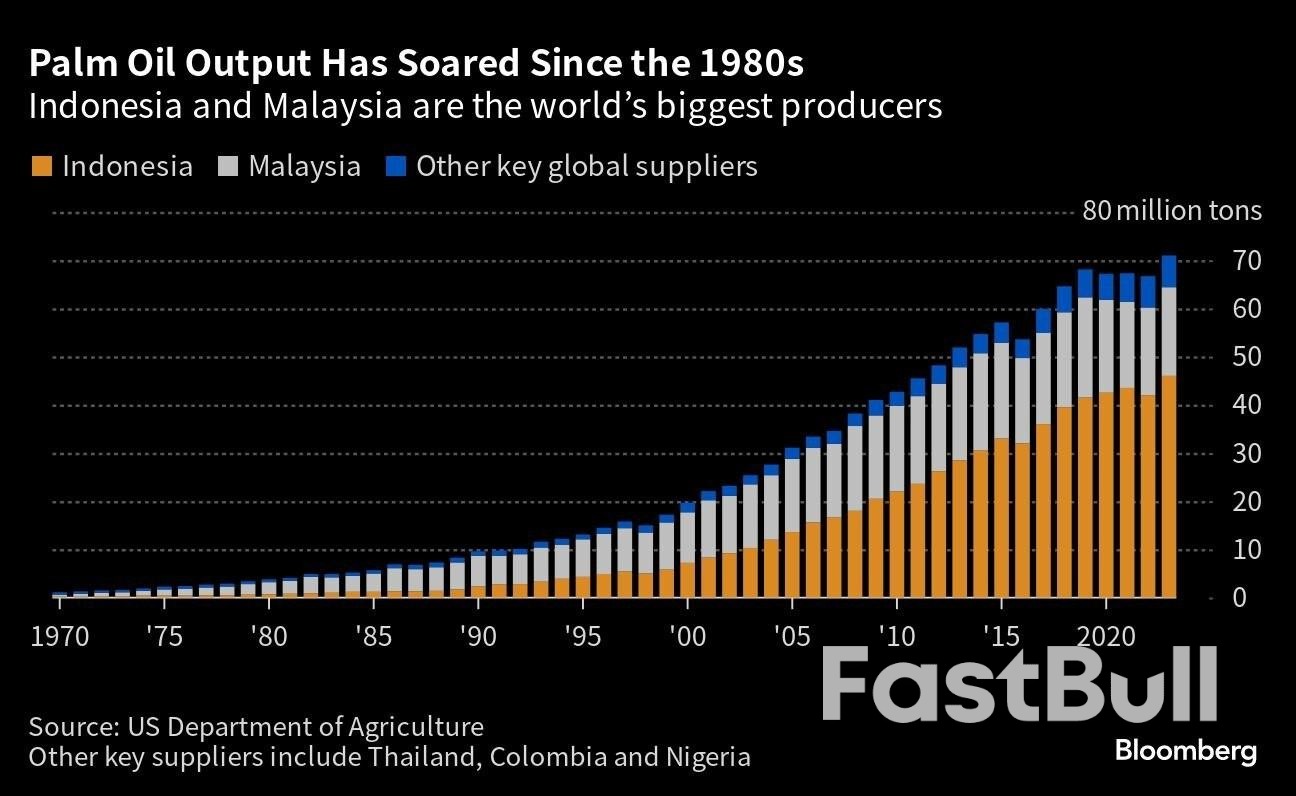
          Across swathes of Southeast Asia, maturing palm oil trees, some as tall as a 12-storey building, are turning into a multi-billion dollar headache for local farmers, regional governments and consumers everywhere.
          As oil palms approach their commercial lifespan of a quarter-century, they provide less of the versatile edible oil, used in everything from ice cream to cosmetics and fuel. Some plants become too ungainly to tackle for laborers, who rely on hand-held sickles attached to long poles. New palms, however, take several years to yield fruit in commercial quantities.
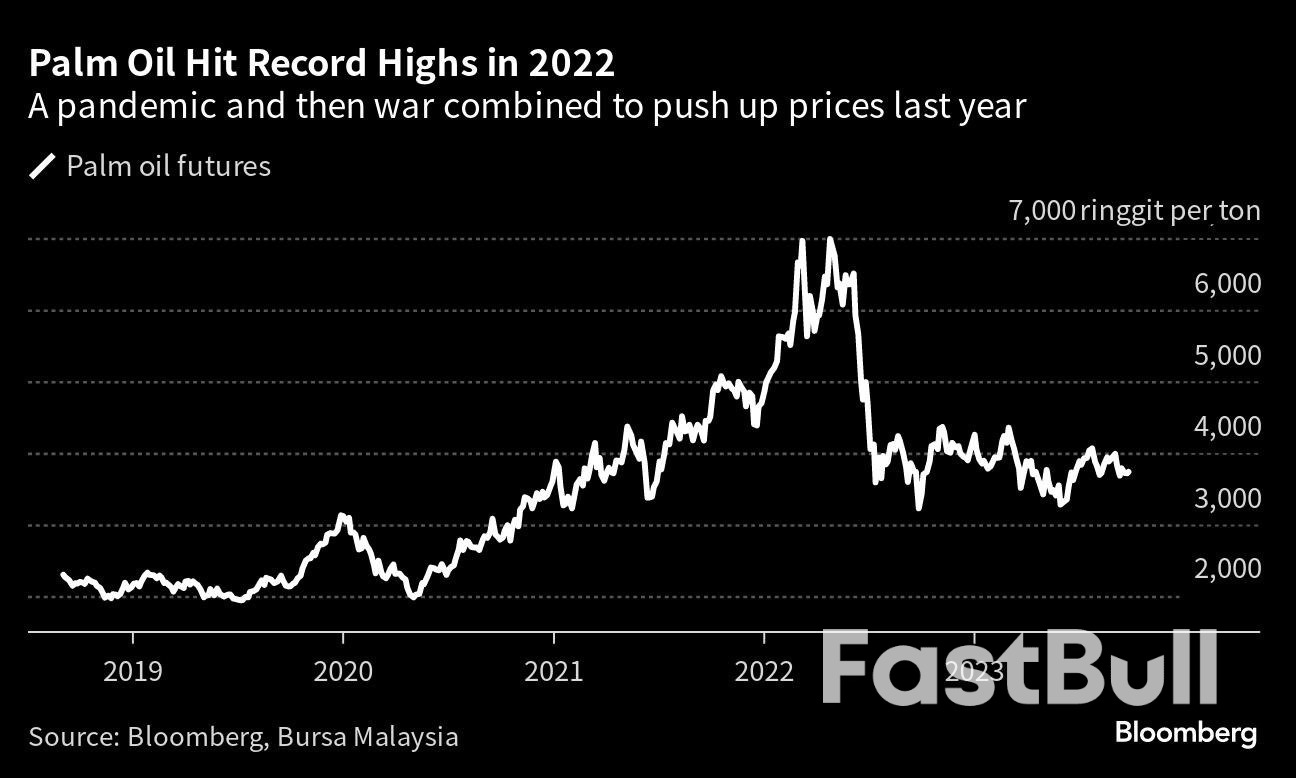
          In palm-producing regions of Malaysia and Indonesia, where the pandemic led to a critical shortage of the manual labour on which the industry depends, an army of farmers has been postponing the inevitable. Squeezed by high costs and falling yields, many smallholders argue they can't replant — and have no choice but to keep going.
          The result is a significant delay to plantation renewal that will dent harvests in coming years, constraining exports from two countries that account for 85% of global production, which in turn may reduce profits for cultivators while pushing up global prices.
          Oil World, a market researcher, warned last month of the consequences of an "alarming decline" in average yields due to slow replanting. Annual output growth may fall to 1.8 million tons or less in the 10 years to 2030, from an average of 2.9 million tonnes in the decade to 2020, the Hamburg-based outfit estimated. The El Nino weather phenomenon won't help, and in the year ending September 2024, the annual output increase could be the smallest amount in four years.
          Ageing Palm Trees Show a Crisis Looms for The World's Everything Oil_1"The concern is that the cost of production will become uncompetitive," said Ivy Ng, head of plantations research at CIMB Investment Bank Bhd in Kuala Lumpur. "The cost is going up, labour cost is going up, everything is going up — and yet your yield is falling because you didn't replant."
          Higher prices could also mean demand destruction, nudging large commercial buyers and households toward what are normally more expensive alternatives, like soybeans and rapeseed, especially in price-sensitive markets like India.
          "In the past, palm was growing very fast and the advantage was the low cost," Ng said. "But now, you're no longer low cost and then you're still selling to the same market. So the question here is will the buyers be able to afford it? Can you pass on the cost?"
          For governments, it may well add up to a multi-billion financial aid bill. Small farmers underpin the industry, accounting for roughly two-fifths of the planted area in Malaysia and Indonesia, and they form an important voting bloc. Malaysia's top growers' group is already seeking tax breaks and grants in order to accelerate replanting — going well beyond an existing loan scheme — and the country's Minister of Plantation and Commodities Fadillah Yusof said on Monday (Oct 2) that the government would seek support for cultivators in this month's budget.
          "We have bid for certain funding for replanting, in particular for the smallholders," he said on the sidelines of a conference in Kuala Lumpur. "At the same time, we're talking about initiatives for the big players for replanting, because now costs of doing business for palm oil and other agricultural commodities are increasing."
          Ageing Palm Trees Show a Crisis Looms for The World's Everything Oil_2Oil palms start bearing fruit at three years old, with yields increasing annually and peaking between nine to 18 years. After that, the volume of fruit starts to decline, and by around 25 years, trees are typically uprooted and replaced. But the pandemic's labour upheaval and temptingly high palm prices last year — touching a record — have thrown off that schedule.
          The Malaysian Palm Oil Association estimates 664,000 hectares (1.6 million acres), or about 12% of the nation's planted area, consists of trees aged 25 years and above. It has warned that over a third of the planted area could be classified as old by 2027. The average cost to replace them is about RM20,000 (US$4,265) per hectare, or almost US$3 billion, according to chief executive Joseph Tek.
          Indonesia's smaller farmers, meanwhile, can get 30 million rupiah (US$1,937) per hectare for replanting, but the nation's palm oil association says the actual cost can be as high as 70 million rupiah. Based on the current level of assistance, Jakarta may need to provide at least US$5 billion to help with the replanting costs.
          Among those caught in the dilemma is Jamari, who like many in Indonesia only uses one name. Having switched from rice to palm oil two decades ago, the planter owns two hectares in the Riau islands. But some of his trees are now 19 and 18 metres high, and the harvest is shrinking.
          "There are fewer trees that still produce palm fruit," he said, adding that where farmers once had 132 to 143 producing trees in one hectare, some now have only 20. He estimated his crop at only 400 kilogrammes a month of fresh fruit bunches, a sharp drop from the estate's prime.
          The issue is not just financial, but raises structural questions. Environmental pressure on an industry that has often expanded at the expense of virgin jungle and forest has increased dramatically. Even if replanting does not involve fresh clearing, that means quicker — and ecologically devastating — options leaned on in the past, like clearing more land to boost production, are no longer available.
          Then there's the reality of plantation work. Sunflowers or rapeseed are waist-high row crops grown on flat fields that are suitable for tractors. In palm oil, by contrast, it takes teams of workers to cut down tightly packed bunches of fruit wedged between thorny fronds, each weighing between 16 to 35 kilogrammes. Even clearing planted land is more meticulous than long-used methods of slashing and burning, with cutting and chipping needed to avoid attracting pests.
          "When prices are good, replanting is deferred. When prices suddenly fall, the pockets are empty and replanting is deferred," said Carl Bek-Nielsen, the chief executive director of United Plantations Bhd. "It's a vicious spiral."
          Founded in 1906, United Plantations is a top 10 producer in Malaysia with the highest yields among its peers. Bek-Nielsen says the company replants about 5% of its trees each year to maintain a "healthy age profile". He says projections that put around 35% of Malaysia's oil palm at 19 years or above by 2027 are worrisome, pointing out that labour costs have climbed by at least 25 to 30%, along with spare parts and fuel.
          Large producers are taking action. At Astra Agro Lestari Tbk's unit in Central Kalimantan in Indonesia, in a vast plantation of neat rows of palms, the company works with seeds that can yield harvests by the age of 25 months after planting, much earlier that the average variety, which takes three to four years. They are also researching varieties that could keep trunks to 10 to 15 metres, even as trees age.
          Individual cultivators are moving less swiftly. In mid-2019, Indonesia's Agriculture Ministry said 2.78 million hectares owned by smaller owners needed to be replanted because trees were older than 25 years, and the aim was to renew 540,000 hectares over three years.
          As of August, according to Heru Tri Widarto, secretary general for the directorate general of estate crops at the ministry, only about 216,000 hectares had been replanted.
          "The real danger is when vegetable oil prices come down," said Bek-Nielsen. "In such a situation, we will see that companies with the lowest yields and oldest age profile are the ones who will be taken to the cleaners first."

          Source: Bloomberg

          To stay updated on all economic events of today, please check out our Economic calendar
          Risk Warnings and Disclaimers
          You understand and acknowledge that there is a high degree of risk involved in trading. Following any strategies or investment methods may lead to potential losses. The content on the site is provided by our contributors and analysts for information purposes only. You are solely responsible for determining whether any trading assets, securities, strategy, or any other product is suitable for investing based on your own investment objectives and financial situation.
          Comments
          Add to Favorites
          Share

          GBP/USD Struggles While EUR/GBP Eyes Increase

          FXOpen

          Forex

          Economic

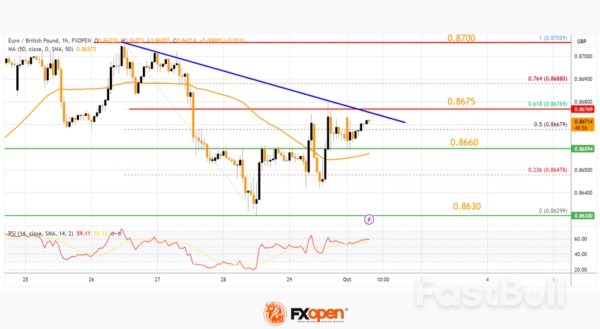
          GBP/USD is struggling below the 1.2235 resistance zone. EUR/GBP is rising and might climb above the 0.8675 resistance.
          Important Takeaways for GBP/USD and EUR/GBP Analysis Today
          The British Pound is showing bearish signs below 1.2235 and 1.2270.
          There is a key bullish trend line forming with support near 1.2160 on the hourly chart of GBP/USD at FXOpen.
          EUR/GBP is rising and trading above the 0.8660 zone.
          There is a major bearish trend line forming with resistance near 0.8675 on the hourly chart at FXOpen.
          GBP/USD Technical Analysis
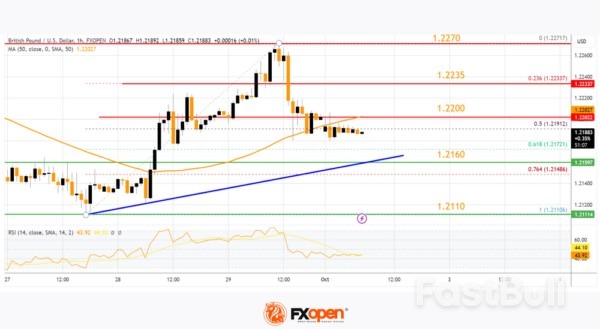
          On the hourly chart of GBP/USD at FXOpen, the pair attempted a fresh increase above 1.2235. However, the British Pound failed above 1.2270 and started a fresh decline against the US Dollar.
          There was a clear move below the 1.2235 support and the 50-hour simple moving average. The pair even traded below the 50% Fib retracement level of the upward move from the 1.2110 swing low to the 1.2271 high.GBP/USD Struggles While EUR/GBP Eyes Increase_1
          The pair is now showing bearish signs below 1.2200. On the downside, there is a key support forming near 1.2160 or the 76.4% Fib retracement level of the upward move from the 1.2110 swing low to the 1.2271 high.
          There is also a key bullish trend line forming with support near 1.2160. If there is a downside break below the 1.2160 support, the pair could accelerate lower.
          The next major support is near the 1.2110 zone, below which the pair could test 1.2050. Any more losses could lead the pair toward the 1.2000 support. On the upside, the GBP/USD chart indicates that the pair is facing resistance near the 50-hour simple moving average at 1.2200.
          The next major resistance is near 1.2235. A close above the 1.2235 resistance zone could open the doors for a move toward 1.2270. Any more gains might send GBP/USD toward 1.2350.
          EUR/GBP Technical Analysis
          On the hourly chart of EUR/GBP at FXOpen, the pair started a steady increase from the 0.8630 zone. The Euro traded above the 0.8660 pivot level to enter a positive zone against the British Pound.
          The EUR/GBP chart suggests that the pair settled above the 50-hour simple moving average and the 50% Fib retracement level of the last main decline from the 0.8705 swing high to the 0.8629 low. It is now eyeing more upsides.
          GBP/USD Struggles While EUR/GBP Eyes Increase_2Immediate resistance is near a major bearish trend line at 0.8675. It coincides with the 61.8% Fib retracement level of the last main decline from the 0.8705 swing high to the 0.8629 low.
          The next major resistance could be 0.8700. A close above the 0.8700 level might accelerate gains. In the stated case, the bulls may perhaps aim for a test of 0.8750. Any more gains might send the pair toward the 0.8800 level.
          Immediate support sits near the 50-hour simple moving average at 0.8660. The next major support is near 0.8630. A downside break below the 0.8630 support might call for more downsides. In the stated case, the pair could drop toward the 0.8600 support level.
          This article represents the opinion of the Companies operating under the FXOpen brand only. It is not to be construed as an offer, solicitation, or recommendation with respect to products and services provided by the Companies operating under the FXOpen brand, nor is it to be considered financial advice.
          To stay updated on all economic events of today, please check out our Economic calendar
          Risk Warnings and Disclaimers
          You understand and acknowledge that there is a high degree of risk involved in trading. Following any strategies or investment methods may lead to potential losses. The content on the site is provided by our contributors and analysts for information purposes only. You are solely responsible for determining whether any trading assets, securities, strategy, or any other product is suitable for investing based on your own investment objectives and financial situation.
          Comments
          Add to Favorites
          Share

          U.S. 500 Cash Index Trades a Tad Above a 2-Month Low

          XM

          Stocks

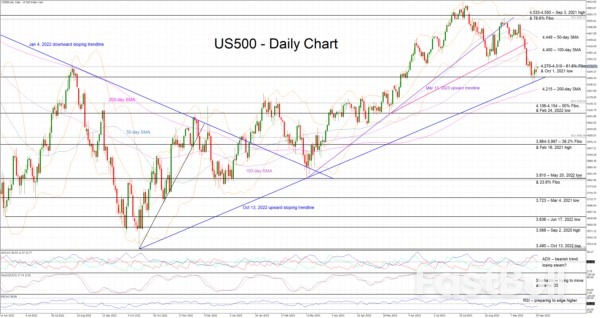
          The U.S. 500 cash index is trading sideways today, hovering around the busy 4,270-4,310 area. The current downleg stopped at the long-term October 13, 2022 upward sloping trendline, allowing the bulls to temporarily gain some breathing space. However, the current bearish series of lower lows and lower highs remains intact.
          In the meantime, the momentum indicators are showing increasing signs that a reversal could be on the cards soon. The Average Directional Movement Index (ADX) appears to have peaked, and it is potentially ready to start a downward move. Similarly, the RSI is gradually moving towards its midpoint after trading at its lowest level since September 2022. More importantly, the stochastic oscillator has edged above its moving average and now looks determined to move aggressively above its oversold territory.
          Should the bears remain confident, they would aim to push the U.S. 500 index below the 4,270-4,310 area, which is populated by the 61.8% Fibonacci retracement level of the January 4, 2022 – October 12, 2022 downtrend and the October 1, 2021 low. They could then come up against the key October 13, 2022 trendline, a tad above the 200-day simple moving average (SMA) at 4,215. Even lower, strong support is expected at the 4,106-4,154 region.
          On the flip side, the bulls are keen on stopping the current correction. Should they successfully defend the 4,270-4,310 region, they could try to push the U.S. 500 index above both the 100- and 50-day SMAs at 4,400 and 4,449 levels respectively. Higher, they could retest the 4,533-4,550 range that is defined by the 78.6% Fibonacci retracement level and the September 3, 2021 high.
          To conclude, after a sizeable move the U.S. 500 cash index bears’ dominance could be under threat, especially if the momentum indicators show further signs of a bullish reversal.U.S. 500 Cash Index Trades a Tad Above a 2-Month Low_1
          Risk Warnings and Disclaimers
          You understand and acknowledge that there is a high degree of risk involved in trading. Following any strategies or investment methods may lead to potential losses. The content on the site is provided by our contributors and analysts for information purposes only. You are solely responsible for determining whether any trading assets, securities, strategy, or any other product is suitable for investing based on your own investment objectives and financial situation.
          Comments
          Add to Favorites
          Share
          FastBull
          Copyright © 2025 FastBull Ltd

          728 RM B 7/F GEE LOK IND BLDG NO 34 HUNG TO RD KWUN TONG KLN HONG KONG

          TelegramInstagramTwitterfacebooklinkedin
          App Store Google Play Google Play
          Products
          Charts

          Chats

          Q&A with Experts
          Screeners
          Economic Calendar
          Data
          Tools
          Membership
          Features
          Function
          Markets
          Copy Trading
          Latest Signals
          Contests
          News
          Analysis
          24/7
          Columns
          Education
          Company
          Careers
          About Us
          Contact Us
          Advertising
          Help Center
          Feedback
          User Agreement
          Privacy Policy
          Business

          White Label

          Data API

          Web Plug-ins

          Poster Maker

          Affiliate Program

          Risk Disclosure

          The risk of loss in trading financial instruments such as stocks, FX, commodities, futures, bonds, ETFs and crypto can be substantial. You may sustain a total loss of the funds that you deposit with your broker. Therefore, you should carefully consider whether such trading is suitable for you in light of your circumstances and financial resources.

          No decision to invest should be made without thoroughly conducting due diligence by yourself or consulting with your financial advisors. Our web content might not suit you since we don't know your financial conditions and investment needs. Our financial information might have latency or contain inaccuracy, so you should be fully responsible for any of your trading and investment decisions. The company will not be responsible for your capital loss.

          Without getting permission from the website, you are not allowed to copy the website's graphics, texts, or trademarks. Intellectual property rights in the content or data incorporated into this website belong to its providers and exchange merchants.

          Not Logged In

          Log in to access more features

          FastBull Membership

          Not yet

          Purchase

          Become a signal provider
          Help Center
          Customer Service
          Dark Mode
          Price Up/Down Colors

          Log In

          Sign Up

          Position
          Layout
          Fullscreen
          Default to Chart
          The chart page opens by default when you visit fastbull.com