• Trade
  • Markets
  • Copy
  • Contests
  • News
  • 24/7
  • Calendar
  • Q&A
  • Chats
Screeners
SYMBOL
LAST
ASK
BID
HIGH
LOW
NET CHG.
%CHG.
SPREAD
SPX
S&P 500 Index
6917.82
6917.82
6917.82
6993.09
6862.05
-58.62
-0.84%
--
DJI
Dow Jones Industrial Average
49240.98
49240.98
49240.98
49653.13
48832.78
-166.67
-0.34%
--
IXIC
NASDAQ Composite Index
23255.18
23255.18
23255.18
23691.60
23027.21
-336.92
-1.43%
--
USDX
US Dollar Index
97.220
97.300
97.220
97.300
97.140
+0.020
+ 0.02%
--
EURUSD
Euro / US Dollar
1.18267
1.18276
1.18267
1.18377
1.18075
+0.00092
+ 0.08%
--
GBPUSD
Pound Sterling / US Dollar
1.37234
1.37247
1.37234
1.37328
1.36821
+0.00270
+ 0.20%
--
XAUUSD
Gold / US Dollar
5062.20
5062.61
5062.20
5091.84
4910.07
+115.95
+ 2.34%
--
WTI
Light Sweet Crude Oil
62.895
62.925
62.895
63.865
62.685
-0.739
-1.16%
--

Community Accounts

Signal Accounts
--
Profit Accounts
--
Loss Accounts
--
View More

Become a signal provider

Sell trading signals to earn additional income

View More

Guide to Copy Trading

Get started with ease and confidence

View More

Signal Accounts for Members

All Signal Accounts

Best Return
  • Best Return
  • Best P/L
  • Best MDD
Past 1W
  • Past 1W
  • Past 1M
  • Past 1Y

All Contests

  • All
  • Trump Updates
  • Recommend
  • Stocks
  • Cryptocurrencies
  • Central Banks
  • Featured News
Top News Only
Share

Fitch Sees Poland's Deficit At Around 7% Of GDP In 2026

Share

Santander BP CEO Says Bank Is Reviewing Its Strategy But Does Not Expect Major Changes

Share

Venezuela Top Economic Advisor Ortega: Want Venezuela To Be Known As A Country With One Of The Highest Oil Production Levels

Share

Russian Finance Ministry To Cut Forex Sales To 11.9 Billion Roubles A Day From February 6

Share

South Korea Parliament To Finalise Bill On US Investment Fund By March 9

Share

USA S&P 500 E-Mini Futures Up 0.05%, NASDAQ 100 Futures Down 0.11%, Dow Futures Up 0.17%

Share

Palestinian Officials: Israeli Strikes Kill 18 In Gaza, Patient Crossings At Rafah Halted

Share

Cores - Spain December Crude Oil Imports Falls 4.9% Year-On-Year To 5.3 Million Tonnes

Share

Economic Affairs Secretary: India To Ensure Its Record Borrowing Plan Doesn't Disturb Markets

Share

China Finance Ministry: To Issue 14 Billion Yuan Of Treasury Bonds In Hong Kong On Feb 11

Share

Swedish Central Bank Governor Thedeen:-, My Assessment Is That The Likelihoodof Very Restrictive Trade Barriers Is Nevertheless Limited

Share

Swedish Central Bank Governor Thedeen:-The Greenland Crisis Hascreated Renewed Uncertainty Regarding The Rules That Will Apply To Our Economicexchanges With The United States

Share

Swedish Central Bank's Seim: I Assess That The Increased Uncertainty Reduces The Risk Of Demand Driven Inflation In Sweden Somewhat

Share

Swedish Central Bank's Deputy Governor Bunge: Will Probably Have To Monitor Both Whether The Strengthening Of The Krona Continues And Its Impact On Prices

Share

Iceland's Central Bank: Further Decisions To Lower Interest Rates Will Depend On Clear Evidence That Inflation Is Falling Back To Bank's 2½% Inflation Target

Share

Swedish Central Bank Governor Thedeen:-At Present I Assess That Monetarypolicy Is Following A Stable And Reasonable Course

Share

Icelandic Central Bank Key Interest Rate Unchanged At 7.25 Percent

Share

Regional Official: Regional Invitees To Istanbul Talks Were Discussed With Iran During Planning Process

Share

Regional Official: Iran Has Said From The Start That It Will Only Discuss With US Its Nuclear Programme, Americans Wanted Other Issues On Agenda

Share

French Otc Day-Ahead Baseload Power Price Down 8% At 80.50 EUR/Mwh -Lseg Data

TIME
ACT
FCST
PREV
Australia Overnight (Borrowing) Key Rate

A:--

F: --

P: --

RBA Rate Statement
Japan 10-Year Note Auction Yield

A:--

F: --

P: --

The U.S. House of Representatives voted on a short-term spending bill to end the partial government shutdown.
Saudi Arabia IHS Markit Composite PMI (Jan)

A:--

F: --

P: --

RBA Press Conference
Turkey PPI YoY (Jan)

A:--

F: --

P: --

Turkey CPI YoY (Jan)

A:--

F: --

P: --

Turkey CPI YoY (Excl. Energy, Food, Beverage, Tobacco & Gold) (Jan)

A:--

F: --

P: --

U.K. 10-Year Note Auction Yield

A:--

F: --

P: --

Richmond Federal Reserve President Barkin delivered a speech.
U.S. Weekly Redbook Index YoY

A:--

F: --

P: --

Mexico Manufacturing PMI (Jan)

A:--

F: --

P: --

U.S. API Weekly Refined Oil Stocks

A:--

F: --

P: --

U.S. API Weekly Gasoline Stocks

A:--

F: --

P: --

U.S. API Weekly Cushing Crude Oil Stocks

A:--

F: --

P: --

U.S. API Weekly Crude Oil Stocks

A:--

F: --

P: --

Japan IHS Markit Services PMI (Jan)

A:--

F: --

P: --

Japan IHS Markit Composite PMI (Jan)

A:--

F: --

P: --

China, Mainland Caixin Services PMI (Jan)

A:--

F: --

P: --

China, Mainland Caixin Composite PMI (Jan)

A:--

F: --

P: --

India HSBC Services PMI Final (Jan)

A:--

F: --

P: --

India IHS Markit Composite PMI (Jan)

A:--

F: --

P: --

Russia IHS Markit Services PMI (Jan)

A:--

F: --

P: --

South Africa IHS Markit Composite PMI (SA) (Jan)

A:--

F: --

P: --

Italy Services PMI (SA) (Jan)

A:--

F: --

P: --

Italy Composite PMI (Jan)

A:--

F: --

P: --

Germany Composite PMI Final (SA) (Jan)

A:--

F: --

P: --

Euro Zone Composite PMI Final (Jan)

A:--

F: --

P: --

Euro Zone Services PMI Final (Jan)

A:--

F: --

P: --

U.K. Composite PMI Final (Jan)

--

F: --

P: --

U.K. Total Reserve Assets (Jan)

--

F: --

P: --

U.K. Services PMI Final (Jan)

--

F: --

P: --

U.K. Official Reserves Changes (Jan)

--

F: --

P: --

Euro Zone Core CPI Prelim YoY (Jan)

--

F: --

P: --

Euro Zone Core HICP Prelim YoY (Jan)

--

F: --

P: --

Euro Zone PPI MoM (Dec)

--

F: --

P: --

Euro Zone HICP Prelim YoY (Jan)

--

F: --

P: --

Euro Zone Core HICP Prelim MoM (Jan)

--

F: --

P: --

Italy HICP Prelim YoY (Jan)

--

F: --

P: --

Euro Zone Core CPI Prelim MoM (Jan)

--

F: --

P: --

Euro Zone PPI YoY (Dec)

--

F: --

P: --

U.S. MBA Mortgage Application Activity Index WoW

--

F: --

P: --

Brazil IHS Markit Composite PMI (Jan)

--

F: --

P: --

Brazil IHS Markit Services PMI (Jan)

--

F: --

P: --

U.S. ADP Employment (Jan)

--

F: --

P: --

The U.S. Treasury Department released its quarterly refinancing statement.
U.S. IHS Markit Composite PMI Final (Jan)

--

F: --

P: --

U.S. IHS Markit Services PMI Final (Jan)

--

F: --

P: --

U.S. ISM Non-Manufacturing Price Index (Jan)

--

F: --

P: --

U.S. ISM Non-Manufacturing Employment Index (Jan)

--

F: --

P: --

U.S. ISM Non-Manufacturing New Orders Index (Jan)

--

F: --

P: --

U.S. ISM Non-Manufacturing PMI (Jan)

--

F: --

P: --

U.S. ISM Non-Manufacturing Inventories Index (Jan)

--

F: --

P: --

U.S. EIA Weekly Crude Oil Imports Changes

--

F: --

P: --

U.S. EIA Weekly Crude Demand Projected by Production

--

F: --

P: --

U.S. EIA Weekly Heating Oil Stock Changes

--

F: --

P: --

U.S. EIA Weekly Gasoline Stocks Change

--

F: --

P: --

U.S. EIA Weekly Crude Stocks Change

--

F: --

P: --

U.S. EIA Weekly Cushing, Oklahoma Crude Oil Stocks Change

--

F: --

P: --

Australia Trade Balance (SA) (Dec)

--

F: --

P: --

Q&A with Experts
    • All
    • Chatrooms
    • Groups
    • Friends
    SlowBear ⛅ flag
    @Sarkar
    📈 (#XAUUSD) BUY NOW 5075/5073 First Round TAKE PROFIT 5080 TAKE PROFIT 5085 TAKE PROFIT 5090 ❌ STOP LOSS 5065 USE IT GYUS  BEST SIGNAL FOR NOW
    @@SarkarAlright i have seen many buy call son Gold today bro
    7W65JD58RM flag
    It's so hard to break through 5100!
    Visxa Benfica flag
    7W65JD58RM
    It's so hard to break through 5100!
    @7W65JD58RMI think it will be difficult because the market seems to be moving sideways today
    Visxa Benfica flag
    Are you waiting for 5100 to sell?
    Size flag
    Visxa Benfica flag
    @7W65JD58RMI only enter trades when there's a clear setup; I avoid trading based on emotions
    Visxa Benfica flag
    How about you?
    Size flag
    Size
    Probably will be adding a buy at 88.869..
    SlowBear ⛅ flag
    7W65JD58RM
    It's so hard to break through 5100!
    @7W65JD58RMOh yesm 5100 is going to show some stremght but it will possbly get broken later
    Size flag
    7W65JD58RM
    It's so hard to break through 5100!
    @7W65JD58RM5100 is a heavy liquidity and decision zone
    Size flag
    When price struggles there, it usually means big players are still absorbing orders@7W65JD58RM
    McOkanz flag
    Tomasodoma flag
    just got stumbed out at 5600
    EuroTrader flag
    7W65JD58RM
    It's so hard to break through 5100!
    @7W65JD58RMthat's a psychological level so it's normal for price to find a hard time breaking above
    Visxa Benfica flag
    McOkanz
    @McOkanzI'm getting goosebumps just looking at the chart
    Visxa Benfica flag
    Silver just swept the old low and then pumped back up to 93.9 within a few candles man
    SlowBear ⛅ flag
    McOkanz
    @McOkanzWell you just joining silver brother?
    SlowBear ⛅ flag
    Tomasodoma
    just got stumbed out at 5600
    @Tomasodoma 5600 on gold? is it there already? or you are hoping?
    Visxa Benfica flag
    Tomasodoma
    just got stumbed out at 5600
    @Tomasodoma5600 sounds like an old target or some distant resistance level from the past
    EuroTrader flag
    7W65JD58RM
    It's so hard to break through 5100!
    @7W65JD58RMbut when it finally breaks above trust me it's headed for 5400 without stopping
    Type here...
    Add Symbol or Code

      No matching data

      All
      Trump Updates
      Recommend
      Stocks
      Cryptocurrencies
      Central Banks
      Featured News
      • All
      • Russia-Ukraine Conflict
      • Middle East Flashpoint
      • All
      • Russia-Ukraine Conflict
      • Middle East Flashpoint
      Search
      Products

      Charts Free Forever

      Chats Q&A with Experts
      Screeners Economic Calendar Data Tools
      Membership Features
      Data Warehouse Market Trends Institutional Data Policy Rates Macro

      Market Trends

      Market Sentiment Order Book Forex Correlations

      Top Indicators

      Charts Free Forever
      Markets

      News

      News Analysis 24/7 Columns Education
      From Institutions From Analysts
      Topics Columnists

      Latest Views

      Latest Views

      Trending Topics

      Top Columnists

      Latest Update

      Signals

      Copy Rankings Latest Signals Become a signal provider AI Rating
      Contests
      Brokers

      Overview Brokers Assessment Rankings Regulators News Claims
      Broker listing Forex Brokers Comparison Tool Live Spread Comparison Scam
      Q&A Complaint Scam Alert Videos Tips to Detect Scam
      More

      Business
      Events
      Careers About Us Advertising Help Center

      White Label

      Broker API

      Data API

      Web Plug-ins

      Affiliate Program

      Awards Institution Evaluation IB Seminar Salon Event Exhibition
      Vietnam Thailand Singapore Dubai
      Fans Party Investment Sharing Session
      FastBull Summit BrokersView Expo
      Recent Searches
        Top Searches
          Markets
          News
          Analysis
          User
          24/7
          Economic Calendar
          Education
          Data
          • Names
          • Latest
          • Prev

          View All

          No data

          Scan to Download

          Faster Charts, Chat Faster!

          Download App
          English
          • English
          • Español
          • العربية
          • Bahasa Indonesia
          • Bahasa Melayu
          • Tiếng Việt
          • ภาษาไทย
          • Français
          • Italiano
          • Türkçe
          • Русский язык
          • 简中
          • 繁中
          Open Account
          Search
          Products
          Charts Free Forever
          Markets
          News
          Signals

          Copy Rankings Latest Signals Become a signal provider AI Rating
          Contests
          Brokers

          Overview Brokers Assessment Rankings Regulators News Claims
          Broker listing Forex Brokers Comparison Tool Live Spread Comparison Scam
          Q&A Complaint Scam Alert Videos Tips to Detect Scam
          More

          Business
          Events
          Careers About Us Advertising Help Center

          White Label

          Broker API

          Data API

          Web Plug-ins

          Affiliate Program

          Awards Institution Evaluation IB Seminar Salon Event Exhibition
          Vietnam Thailand Singapore Dubai
          Fans Party Investment Sharing Session
          FastBull Summit BrokersView Expo

          Yen Slides Again As Election Bets Build

          Samantha Luan

          Forex

          Economic

          Summary:

          Yen selloff returned to focus in Asian trading today as investors positioned ahead of Japan's snap election this weekend.

          Yen selloff returned to focus in Asian trading today as investors positioned ahead of Japan's snap election this weekend. continues to enjoy solid public support. Although recent polls show a modest dip in approval, her standing remains strong enough to anchor expectations of electoral success.

          More importantly for markets, her ruling Liberal Democratic Party appears on track to comfortably exceed the 233-seat threshold needed for a single-party majority in the House of Representatives. A new survey by Asahi Shimbun, conducted between January 31 and February 1, suggests that with coalition partner Nippon Ishin, the ruling bloc could secure more than 300 of the 465 seats at stake in a landslide outcome.

          Voting on February 8 will determine the next lower house, but markets are already pricing in the implications of a decisive LDP victory rather than waiting for confirmation. A commanding victory would strengthen Takaichi's hand in pursuing fiscal stimulus. Investors fear that expanded spending plans would worsen Japan's already heavy debt load, pressuring government bonds and undermining Yen.

          In the US, attention briefly shifted away from shutdown risk after President Donald Trump signed a spending deal into law on Tuesday, ending a partial government shutdown. The legislation ensures full-year federal funding through September, with the exception of the Department of Homeland Security, which receives only a two-week extension as lawmakers debate immigration enforcement measures. The deal passed the Senate with broad bipartisan backing and scraped through the House by a narrow margin, removing a near-term tail risk for markets.

          Elsewhere, oil prices rebounded as geopolitical risks intensified. Markets reacted after the US military said it had shot down an Iranian drone that approached the Abraham Lincoln in the Arabian Sea. The incident has raised concerns that efforts to de-escalate US–Iran tensions could falter. Oil markets are rapidly repricing geopolitical risk as the perceived probability of direct US action increases.

          For the week so far, Yen sits firmly at the bottom of the FX performance table, followed by Swiss Franc and Euro. Aussie remains the strongest performer, trailed by Kiwi and Sterling. Dollar and Loonie trade in the middle of the pack.

          In Asia, at the time of writing, Nikkei is down -0.92%. Hong Kong HSI is down -0.21%. China Shanghai SSE is up 0.12%. Singapore Strait Times is up 0.10%. Japan 10-year JGB yield is down -0.009 at 2.251. Overnight, DOW fell -0.34%. S&P 500 fell -0.84%. NASDAQ fell -1.43%. 10-year yield fell -0.001 to 4.274.

          New Zealand jobs grow 0.5% in Q4, unemployment ticks to decade-high

          New Zealand's labor market delivered mixed signals in Q4. Employment rose 0.5% qoq, beating expectations for a 0.3% gain, pointing to continued job creation. Employment rate edged up to 66.7% from 66.6%, reinforcing the view that labor demand remains resilient.

          At the same time, unemployment rate climbed to 5.4% from 5.3%, above expectations and the highest since the September 2015 quarter. The rise was accompanied by an increase in the labor force participation rate to 70.5% from 70.3%, suggesting that more people are entering or re-entering the job market, which is adding to slack even as hiring continues.

          Wage pressures remained contained. The labor cost index rose 2.0% yoy, with private sector wages up 2.0% and public sector wages up 2.2%. The combination of steady employment growth, rising participation, and moderate wage inflation points to a labor market that is still cooling gradually.

          NZD/USD in range awaits upside breakout, as RBNZ outlook holds after job data

          NZD/USD is trading steadily in range after New Zealand's Q4 employment data delivered few surprises for policy expectations. The mixed report offered early hints of stabilization but stopped well short of forcing a rethink at the RBNZ. Interest rate is expected to remain on hold at 2.25% for most of the year.

          The next policy move is still expected to be a hike rather than another cut, but timing remains highly uncertain. Whether that comes late in 2026 or slips into early 2027 will depend on how growth, inflation, and labor market slack evolve. For now, it is too early to draw firm conclusions.

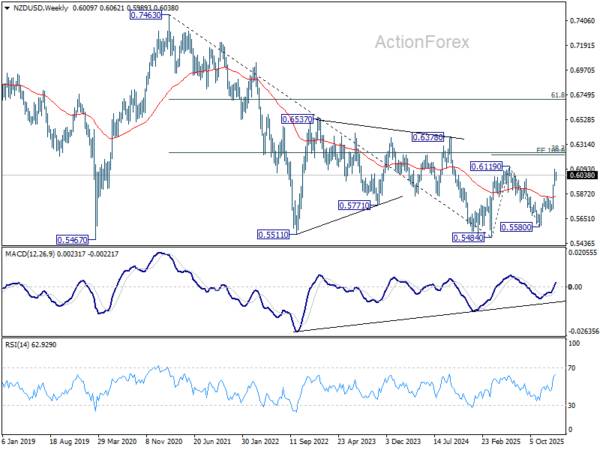
          Technically, NZD/USD continues to consolidate below the 0.6092 short-term top. While a deeper pullback cannot be ruled out, downside should be contained well above 0.5852 resistance turned support. Current rise from 0.5580 is seen as the third leg of the pattern from 0.5484 (2025 low). Above 0.6092 should send NZD/USD through 0.6119 (2025 high) to 100% projection of 0.5484 to 0.6119 from 0.5580 at 0.6215.
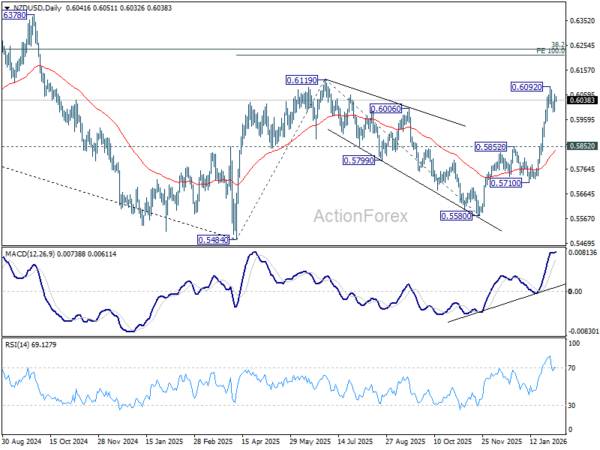
          Longer term, the 0.62 resistance area is decisive. Sitting near 38.2% retracement of 0.7463 (2021) to 0.5484 at 0.6240, it will define whether the recovery from 0.5484 evolves into a broader bullish trend reversal or stalls as a corrective rally within a dominant downtrend.
          Japan PMI composite finalized at 53.1, broadening growth at start of 2026

          Japan's PMI Services was finalized at 53.7 in January, up from December's 51.6. PMI Composite rose to 53.1 from 51.1. The data point to a clear acceleration in private-sector activity at the start of 2026, with growth firmly back above expansionary levels.

          According to Annabel Fiddes of S&P Global Market Intelligence, business activity rebounded at the fastest pace since May 2023. Services remained the primary growth engine, posting the strongest rise in activity in nearly a year, while manufacturing output also returned to growth for the first time since last June.

          The surveys suggest the recovery is becoming more broad-based. Demand improved across both manufacturing and services simultaneously for the first time in more than two-and-a-half years, a notable shift after a prolonged period of uneven momentum. Employment was another bright spot, with firms adding staff across both sectors to expand capacity in response to stronger demand.

          Cost pressures eased at the start of the year, with input prices rising at their slowest pace in almost two years. However, companies raised selling prices more aggressively, indicating efforts to rebuild margins.

          GBP/JPY Daily Outlook

          Daily Pivots: (S1) 211.69; (P) 212.29; (R1) 213.28;

          Immediate focus is back on 214.83 as GBP/JPY's rebound accelerates higher. Firm break there will resume larger up trend to 220.90 projection level next. Rejection by 214.83 will bring more consolidations first. But in case of another dip, downside should be contained by 55 D EMA (now at 209.70) to bring rally resumption.
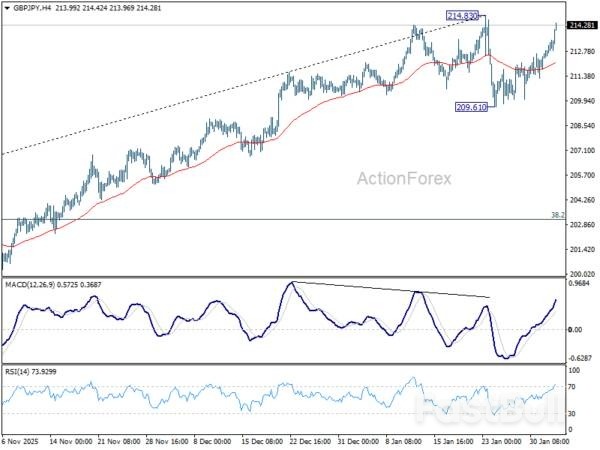
          In the bigger picture, up trend from 123.94 (2020 low) is in progress. Next target is 61.8% projection of 148.93 (2022 low) to 208.09 (2024 high) from 184.35 at 220.90. On the downside, break of 205.30 resistance turned support is needed to indicate medium term topping. Otherwise, outlook will stay bullish even in case of deep pullback.

          Source: ACTIONFOREX

          To stay updated on all economic events of today, please check out our Economic calendar
          Risk Warnings and Disclaimers
          You understand and acknowledge that there is a high degree of risk involved in trading. Following any strategies or investment methods may lead to potential losses. The content on the site is provided by our contributors and analysts for information purposes only. You are solely responsible for determining whether any trading assets, securities, strategy, or any other product is suitable for investing based on your own investment objectives and financial situation.
          Add to Favorites
          Share

          Eurozone Bond Spreads Hit 15-Year Lows: Can It Last?

          Ukadike Micheal

          Traders' Opinions

          Data Interpretation

          Economic

          Central Bank

          Political

          Bond

          The gap in borrowing costs between Southern European governments and Germany has shrunk to its narrowest point since the 2008 Lehman Brothers collapse. This rally, driven by expectations of European Central Bank interest rate cuts, has compressed yield spreads to levels not seen in over a decade.

          However, investors and analysts are questioning how much further this trend can run. Without deeper institutional reforms and with new geopolitical pressures forcing a rethink on spending, the era of easy gains may be coming to an end.

          The Great Compression: Why Spreads Are Shrinking

          Since late 2023, the yield premium that countries like Italy, Spain, and Portugal pay over ultra-safe German Bunds has steadily declined. The catalyst was the growing certainty that the ECB was preparing to lower interest rates.

          This has brought spreads to historically tight levels:

          • Italy: around 53 basis points (bps)

          • Spain: around 37 bps

          • Portugal: around 24 bps

          • Greece: around 43 bps

          While impressive, these levels are still wider than in 2007, before the global financial crisis when debt loads were much smaller. Back then, Italy's spread was about 22 bps, while Spain and Portugal were near 5 bps.

          Figure 1: Yield spreads for Italy, Spain, and Portugal over German Bunds have compressed dramatically since the 2011-2012 sovereign debt crisis, recently hitting their lowest points since before 2008.

          Roadblocks to a Unified Bond Market

          Market participants believe there's limited room for spreads to fall further toward a unified point. Such a convergence would be a critical step in creating a deeper, more liquid European bond market and strengthening the euro's global role.

          Konstantin Veit, a portfolio manager at PIMCO, notes that the pre-crisis optimism was fueled by a different dynamic. "It wasn't always about fundamentals," he said, explaining that spreads were near zero "because there was a hope that over time, the monetary union would evolve into a fully-fledged fiscal and political union."

          That hope remains unfulfilled. "We remain constructive on peripheral spreads, but compression potential might be limited without improvements on the institutional side," Veit added. Key reforms include completing the banking and capital markets unions, establishing a shared fiscal capacity, and enabling common debt issuance—steps ECB President Christine Lagarde has identified as essential for the euro.

          Geopolitics and Defense Spending Complicate the Picture

          The strategic landscape is also shifting. The United States, under President Donald Trump, has become a less predictable partner on trade and security, insisting that Europe must shoulder more of its own defense costs.

          In response, Eurozone governments, led by Germany, are planning significant increases in borrowing to fund military spending. This new fiscal pressure adds another layer of complexity to the bond market outlook. Even short-lived political tremors, like Trump's brief threat in January to take over Greenland, caused spreads to temporarily widen before tightening again.

          Will Policy and Politics Sustain the Rally?

          ECB Easing and Joint Debt Hopes

          Analysts widely expect the ECB to deliver another rate cut this year, a move that should help keep yield spreads stable.

          Figure 2: The ESTR forward curve shows market pricing for future ECB interest rates, with traders seeing less than a 50% probability of a rate cut by 2026.

          Furthermore, the EU’s pandemic-era Next Generation fund, combined with the push for higher military spending, has fueled expectations for more joint debt issuance. This prospect has supported the bonds of Southern European nations, an effect analysts believe could last through 2027.

          The Hurdle to Deeper Integration

          Despite these tailwinds, many economists are skeptical about greater joint issuance, primarily due to Germany's opposition.

          "I think more integration will only come in a stress scenario, and we're not yet in a stress scenario," said Carsten Brzeski, global head of macro research at ING. He warned that debt-to-GDP ratios in Southern Europe could rise if the economy slows. "We can enjoy the good place, but we should be cautious in deriving any longer-term conclusions from the current state."

          Italy's Shifting Role and Future Risks

          The political calculus has also changed. Italy, long considered a source of instability, has become one of Europe's more politically stable countries. Meanwhile, German politics has grown more volatile, partly due to the rise of far-right, eurosceptic parties like Alternative für Deutschland.

          "Politics in Italy or other Southern European countries is the part I'm least concerned about," said Rohan Khanna, head of euro rates strategy at Barclays. "What I'm more concerned about is how the market thinks about Italy in a post-NGEU world."

          Barclays anticipates that spreads will trade in a tight range, concluding that there is less room for Italian spreads to fall compared to those of other Southern European countries.

          Figure 3: The Italian-German yield spread and the STOXX 600 index have often moved in tandem, reflecting how tightening credit risk can align with broader market optimism.

          To stay updated on all economic events of today, please check out our Economic calendar
          Risk Warnings and Disclaimers
          You understand and acknowledge that there is a high degree of risk involved in trading. Following any strategies or investment methods may lead to potential losses. The content on the site is provided by our contributors and analysts for information purposes only. You are solely responsible for determining whether any trading assets, securities, strategy, or any other product is suitable for investing based on your own investment objectives and financial situation.
          Add to Favorites
          Share

          Poland's Rate Decision: A Split Call After Strong GDP

          Isaac Bennett

          Remarks of Officials

          Data Interpretation

          Economic

          Central Bank

          Daily News

          Poland's central bank faces a difficult interest rate decision this week, as stronger-than-expected economic growth has left economists sharply divided on the next policy move.

          A Bloomberg survey reveals the split: while a majority of 19 out of 32 economists expect the Monetary Policy Council (MPC) to hold its key rate at 4% for a second consecutive month, 13 are betting on a quarter-point cut. This represents the largest minority calling for a rate reduction since the current easing cycle began last May.

          Surprise GDP Data Complicates Rate Cuts

          The primary factor fueling the uncertainty is recent economic data. A report last week showed that Poland's gross domestic product expanded by 3.6% in 2025, surpassing forecasts. This robust performance could give policymakers a reason to delay further rate cuts.

          Compounding the difficulty, the central bank will make its decision without the latest consumer price figures. Publication of the data has been postponed due to annual updates to the inflation basket.

          "The MPC may prefer to wait for the March macroeconomic projection, particularly given that recently published GDP data confirmed a strong finish last year," noted Cezary Chrapek, an economist at Bank Millennium SA.

          Roman Ziruk, an analyst at Ebury Technology Ltd., described the upcoming decision as "one of the hardest to call in recent months," citing the short three-week interval since the January meeting and the absence of fresh inflation numbers.

          Central Bank Officials Also Divided

          The division isn't limited to external analysts; members of the rate-setting committee have also sent conflicting signals.

          After cutting rates by a total of 175 basis points in 2025, the path forward is unclear.

          • MPC member Ludwik Kotecki suggested that the bank could resume rate cuts this month.

          • In contrast, newly appointed policymaker Marcin Zarzecki indicated that further easing is not guaranteed and might only happen later.

          Central bank Governor Adam Glapinski, who leads the 10-member panel, did not rule out a rate cut in February. However, he also stated there was little room left for more monetary easing throughout 2026.

          The central bank is expected to announce its decision on Wednesday afternoon, with Governor Glapinski scheduled to hold a press conference at 3 p.m. in Warsaw on Thursday.

          To stay updated on all economic events of today, please check out our Economic calendar
          Risk Warnings and Disclaimers
          You understand and acknowledge that there is a high degree of risk involved in trading. Following any strategies or investment methods may lead to potential losses. The content on the site is provided by our contributors and analysts for information purposes only. You are solely responsible for determining whether any trading assets, securities, strategy, or any other product is suitable for investing based on your own investment objectives and financial situation.
          Add to Favorites
          Share

          Japan's Bond Market Teeters, But BOJ Won't Intervene

          Michael Ross

          Remarks of Officials

          Economic

          Central Bank

          Forex

          Daily News

          Political

          Bond

          Fiscal Fears Trigger a "Truss Shock" in JGBs

          Japan’s government bond (JGB) market was thrown into turmoil last month, triggering a selloff that echoed across global debt markets. The catalyst was a snap election call by Prime Minister Sanae Takaichi, who pledged to suspend a food levy for two years.

          This move immediately stoked fears of increased fiscal spending, which would add to Japan's already enormous national debt. In a rout reminiscent of the 2022 "Truss" shock in the UK, when unfunded tax cuts caused a collapse in British gilts, yields on super-long JGBs surged to record highs.

          With Takaichi's party poised for a potential landslide victory this Sunday, bond investors remain on high alert. A win would give her a mandate for an expansionary fiscal policy, intensifying concerns over the country's deteriorating finances.

          Bank of Japan Remains on the Sidelines

          While the market volatility has alarmed the Bank of Japan (BOJ), the central bank is unwilling to step in, according to three sources familiar with its thinking. At this stage, the risks associated with market intervention are seen as outweighing any potential rewards.

          Japanese policymakers are caught in a difficult bind. They need to prevent a chaotic spike in bond yields while also trying to support a weak yen through threats of currency intervention. Any attempt by the BOJ to suppress long-term interest rates would directly conflict with its strategy of gradual rate hikes, a policy intended to tame inflation driven by the weak currency.

          The tension was evident at the BOJ's policy meeting on January 22-23. A summary of opinions showed one board member calling for vigilance against a "one-sided steepening" of the yield curve, while another warned of high volatility in super-long JGBs.

          BOJ Governor Kazuo Ueda also escalated his warnings, describing the recent pace of yield increases as "quite fast" and reiterating the bank's readiness to act only under exceptional circumstances.

          A High Bar for Bond Market Intervention

          Despite a temporary calm returning to markets, investors are focused on whether the BOJ will intervene if another rout occurs after the election. However, the sources confirmed that recent market moves do not meet the central bank's very high threshold for action.

          The BOJ has several tools it could deploy, including:

          • Conducting unscheduled, emergency bond-buying operations.

          • Adjusting the mix of bonds it purchases under its quarterly plan.

          • Suspending or overhauling its bond taper program, which began in 2024.

          Intervention would only be considered during a panic selloff driven by speculation or a destabilizing event that forces the central bank to act as the market maker of last resort. Sources say neither of these scenarios has yet materialized. Any action would also be temporary, designed to avoid signaling a new price target for bonds.

          "If bonds are being sold on speculative trading, the BOJ could see scope to intervene. But it's clear the recent rise in yields reflects market concern over Japan's fiscal policy," said Takahide Kiuchi, a former BOJ board member. "It's the government's job, not the BOJ's, to deal with the consequences of market distrust over fiscal policy."

          Governor Ueda has echoed this sentiment, stating that the BOJ and the government must each play their designated roles, placing the responsibility for managing fiscal-policy-induced yield rises squarely on the government.

          The High Costs of Stepping In

          The BOJ's reluctance is rooted in the significant costs of intervention. Ramping up bond purchases would undo its efforts since 2024 to gradually shrink its massive balance sheet.

          More critically, intervening in the bond market would risk dragging the BOJ back toward the yield-curve-control policy it abandoned in 2024. Analysts warn this could trigger a fresh wave of yen selling, as markets would interpret it as a return to monetary easing. A weak yen is already a major headache for policymakers because it drives up the cost of imports and fuels inflation.

          "Trying to push down bond yields would send a conflicting message to markets at a time the BOJ is raising its short-term policy rate," said Mari Iwashita, an executive rates strategist at Nomura Securities. She added that it would also risk the BOJ's credibility by stoking fears it is directly financing government debt.

          Some analysts believe the current market calm could be temporary. With investor concern over Japan's fiscal health unlikely to fade, the JGB market remains vulnerable to sudden and sharp selloffs. Domestic life insurers, historically stable buyers of super-long JGBs, are now pulling back and may even become sellers before the fiscal year ends in March.

          "I'm sure policymakers are extremely nervous about the bond market now," said former BOJ official Nobuyasu Atago. "The BOJ would need to act if markets go into a free fall, but stepping in at the wrong moment could amplify panic and make things worse. Either way, it would be an extremely hard decision."

          To stay updated on all economic events of today, please check out our Economic calendar
          Risk Warnings and Disclaimers
          You understand and acknowledge that there is a high degree of risk involved in trading. Following any strategies or investment methods may lead to potential losses. The content on the site is provided by our contributors and analysts for information purposes only. You are solely responsible for determining whether any trading assets, securities, strategy, or any other product is suitable for investing based on your own investment objectives and financial situation.
          Add to Favorites
          Share

          How the US and India Pulled Back From a Trade War

          Michael Ross

          Energy

          Remarks of Officials

          Economic

          Daily News

          Political

          A surprise trade agreement announced by President Donald Trump has capped months of tense, behind-the-scenes diplomacy aimed at repairing a strained relationship between the United States and India. The deal, which Trump claimed would significantly lower tariffs, came after a period of public acrimony that saw both nations on a collision course.

          On Monday, Trump announced that he and Indian Prime Minister Narendra Modi had reached an agreement to reduce tariffs on Indian goods to 18%. The deal also reportedly scraps a punitive 25% US duty imposed on India for purchasing Russian oil. In exchange, Trump stated that India agreed to buy $500 billion in American goods, shift its oil purchases to Venezuela, and cut tariffs on US imports to zero.

          However, Modi's government has not yet confirmed these specifics, and official documentation codifying the agreement has not been released by either side. The announcement caught many officials in New Delhi by surprise, with senior bureaucrats in the commerce and foreign ministries unaware that a call between the leaders was even scheduled.

          A Diplomatic Thaw Behind Closed Doors

          The breakthrough follows a period of concerted effort by India to de-escalate tensions. In early September, shortly after meeting with Vladimir Putin and Xi Jinping, Modi sent his national security adviser, Ajit Doval, to Washington.

          According to officials in New Delhi familiar with the private discussions, Doval met with Secretary of State Marco Rubio to deliver a clear message: India wanted to move past the recent friction and resume trade negotiations.

          Doval reportedly conveyed that while India would not be bullied by the Trump administration and was prepared to wait out his term, New Delhi needed the public criticism to stop so that relations could be reset. At the time, India was reacting to Trump's public insults and the 50% tariffs he had imposed on its goods in August. The US president had described India as a "dead" economy and criticized its purchases of Russian oil.

          The first sign of a thaw appeared not long after Doval's previously unreported meeting. On September 16, Trump called Modi on his birthday, praising his leadership. The two leaders spoke four more times by phone before the end of the year, steadily working toward a deal.

          India's Long-Term Bet on a US Partnership

          Behind India's diplomatic push was a strategic calculation that it could not afford a long-term breakdown in relations with the United States. The prevailing view in New Delhi is that American capital, technology, and military cooperation are essential to counter China and achieve Modi's ambitious goal of making India a developed economy by 2047.

          Indian officials see the Trump presidency as a temporary challenge within a much longer strategic timeline. "New Delhi was never going to sever relations with Washington," noted Chietigj Bajpaee, a senior research fellow at Chatham House, pointing to the deep institutional and personal ties between the countries. However, he added that "the irrational exuberance that marked New Delhi's earlier assessments of the bilateral relationship have faded."

          This approach was a response to a sharp downturn in relations. Tensions flared in May after Trump claimed credit for resolving a border clash between India and Pakistan, a claim Modi strongly rejected. In June, Modi declined an invitation to the White House, and in October, he skipped a summit in Malaysia to avoid a potentially difficult meeting with Trump.

          Mending Fences After a Year of Acrimony

          The arrival of new US Ambassador Sergio Gor in New Delhi in December marked a turning point. Gor, a former White House official and member of Trump's inner circle, immediately began working to restore stability. In his first public speech, he characterized the tensions as disagreements among "real friends" and announced that India would be invited to join Pax Silica, a US-led supply chain alliance.

          Last week, a meeting between Gor and External Affairs Minister Subrahmanyam Jaishankar signaled further progress. Gor posted on social media that they discussed "everything from defense, trade, critical minerals, and working toward our common interests."

          Alexander Slater, former head of the US-India Business Council, said the agreement "appears to conclude a difficult six-month period for US-India relations" and "removes a key impediment to what had been India's gradual but steady alignment with the West."

          Balancing US Ties with Strategic Autonomy

          Despite the rapprochement, India continues to assert its strategic independence. Modi's high-profile appearance with Xi and Putin was widely seen as a message to Washington that India has other powerful partners. In December, Modi gave a warm welcome to Putin, reaffirming ties with a nation that has been a key supplier of weapons since the Cold War.

          India has also been diversifying its trade relationships. Last week, it secured a free trade pact with the European Union after nearly two decades of negotiations. This followed a recent trade deal with the UK, moves intended to show that India was not solely dependent on a resolution with the US. Later this month, Modi is set to host leaders Mark Carney of Canada and Luiz Inacio Lula da Silva of Brazil, further strengthening ties with other global middle powers.

          The Unbreakable Economic Ties Driving the Deal

          Ultimately, the powerful economic logic of the US-India partnership continues to drive both sides toward cooperation. The United States remains a critical market, receiving about a fifth of India's total exports, including a large volume of mobile phones and electronics vital to Modi's manufacturing goals.

          Furthermore, US investment in India is surging. Recent months have seen major commitments, including:

          • A combined $52 billion pledge from Amazon.com Inc. and Microsoft Corp. in December.

          • A $15 billion investment in data centers announced by Alphabet Inc.'s Google in October.

          "The larger geopolitical factors or strategic factors that bind Indian and the US together are still in place," said Milan Vaishnav of the Carnegie Endowment for International Peace. "India requires a great amount of capital of investment of technology transfer... So the US is critical."

          To stay updated on all economic events of today, please check out our Economic calendar
          Risk Warnings and Disclaimers
          You understand and acknowledge that there is a high degree of risk involved in trading. Following any strategies or investment methods may lead to potential losses. The content on the site is provided by our contributors and analysts for information purposes only. You are solely responsible for determining whether any trading assets, securities, strategy, or any other product is suitable for investing based on your own investment objectives and financial situation.
          Add to Favorites
          Share

          New START On The Brink And The Global Risks Of A World Without Nuclear Limits

          Gerik

          Political

          The End Of The Last Nuclear Constraint

          The New Strategic Arms Reduction Treaty, widely known as New START, is set to expire on February 5, marking a potentially historic rupture in global nuclear governance. If no last-minute intervention occurs, this will be the first time in decades that there is no legally binding framework limiting the strategic nuclear arsenals of the United States and Russia, the two countries that together possess roughly 90 percent of the world’s nuclear warheads.
          New START was signed in 2010 and caps each side at 1,550 deployed strategic nuclear warheads, alongside strict limits on intercontinental ballistic missiles, submarine-launched ballistic missiles, and heavy bombers. Beyond numerical ceilings, the treaty has functioned as a cornerstone of strategic transparency, enabling hundreds of on-site inspections and tens of thousands of data exchanges over more than a decade. These mechanisms have reduced uncertainty and lowered the risk of miscalculation, even during periods of political tension.

          A Treaty Hollowed Out Before Its Expiry

          Although New START technically remains in force until early February, its practical effectiveness has already been eroded. Inspection mechanisms have been suspended since 2023, weakening mutual confidence and verification. Donald Trump has recently signaled a willingness to let the treaty lapse, while Moscow has stated that it is prepared for a new strategic reality in which no formal limits exist on nuclear forces.
          From Russia’s perspective, the lack of response from Washington to proposals for maintaining warhead ceilings is interpreted as a clear political signal. The result is a transition not caused by a single decision, but by a gradual breakdown of trust and compliance that now culminates in formal expiration.

          China’s Role In Shaping US Calculations

          While New START is a bilateral treaty, analysts argue that China has become the central factor shaping US reluctance to preserve it. Washington’s concern increasingly lies not with Russia’s existing arsenal, but with the rapid expansion of China’s nuclear forces and the strategic flexibility this creates for Beijing.
          China has rejected calls for trilateral nuclear arms control talks, arguing that the disparity between its arsenal and those of the US and Russia makes such a framework inherently unfair. On February 3, Beijing urged Washington to respond constructively to Russia’s proposal to maintain limits on deployed warheads, while reiterating that it would not join three-party negotiations.
          Data from the Stockholm International Peace Research Institute indicates that China currently possesses at least 600 nuclear warheads and has been adding roughly 100 warheads per year since 2023, the fastest expansion rate globally. By comparison, the United States holds around 3,700 warheads in its military stockpile, while Russia has more than 4,300.

          Strategic Shifts In Beijing

          China’s longer-term trajectory reinforces these concerns. Recommendations linked to its 15th Five-Year Plan for the 2026–2030 period emphasize strengthening strategic deterrence, signaling continued modernization and expansion of nuclear forces. While detailed targets are expected to be clarified when the plan is formally approved in March 2026, the direction suggests an intent to narrow the gap with the two established nuclear superpowers.
          This evolution reflects correlation rather than direct causation between China’s buildup and the collapse of New START, yet the interaction between these dynamics is clear. US policymakers want to retain room to adjust their own deployed warhead numbers, a flexibility constrained under the treaty’s current limits.

          The Risk Of A Three-Way Arms Race

          Analysts warn that the collapse of New START could trigger a chain reaction of strategic escalation. The United States could increase the number of warheads mounted on existing missile systems, while Russia may accelerate development of unconventional nuclear delivery platforms, including nuclear-powered cruise missiles or long-range nuclear torpedoes. These systems carry heightened environmental and security risks and further complicate deterrence calculations.
          China’s limited transparency regarding its nuclear program adds another layer of uncertainty. This opacity feeds suspicion in Washington, prompting defensive responses that Beijing then interprets as additional threats. The resulting feedback loop risks entrenching a three-sided arms race without the stabilizing guardrails that characterized much of the Cold War era.
          Experts in Australia and Europe caution that such a race would be inherently more unstable than past US–Soviet competition, precisely because it would lack robust mechanisms for verification, communication, and crisis management.

          A Breakdown Of A Long-Standing Architecture

          From the SALT agreements of the 1970s to the START framework that followed the Cold War, US–Russian nuclear arms control has underpinned global strategic stability for decades. However, key pillars of this architecture have already fallen. The ABM and INF treaties collapsed in the past two decades, leaving New START as the final major restraint.
          Its expiration would therefore represent not just the end of a single treaty, but the dismantling of an entire system of nuclear risk management. In a world already marked by multiple geopolitical flashpoints and intensifying great-power competition, the absence of any legal limits on nuclear arsenals is widely viewed as a significant setback for global security.

          An Uneasy Global Outlook

          Without New START, the risk of nuclear proliferation increases, and so does the danger of miscalculation during crises. The loss of transparency and predictability raises the probability that worst-case assumptions will drive decision-making. While no actor openly seeks such an outcome, the convergence of strategic rivalry, declining trust, and expanding arsenals creates conditions in which stability becomes harder to sustain.
          As New START approaches its expiration, the world stands at the edge of a new nuclear era defined less by negotiated restraint and more by strategic ambiguity, a shift that carries profound implications for international security.
          Risk Warnings and Disclaimers
          You understand and acknowledge that there is a high degree of risk involved in trading. Following any strategies or investment methods may lead to potential losses. The content on the site is provided by our contributors and analysts for information purposes only. You are solely responsible for determining whether any trading assets, securities, strategy, or any other product is suitable for investing based on your own investment objectives and financial situation.
          Add to Favorites
          Share

          China’s Economy Stumbles At The Start Of 2026 As PMI Data Signals Broad-Based Weakness

          Gerik

          Economic

          A Weak Start Revealed By Official PMI Data

          China’s economy has begun 2026 on a fragile footing, with new official data pointing to a sharper-than-expected slowdown in activity. According to figures released by the National Bureau of Statistics of China, the official manufacturing purchasing managers’ index fell to 49.3 in January from 50.1 in December, undershooting economists’ consensus forecast of 50.1. A reading below 50 indicates contraction, signaling that factory activity has slipped back into decline.
          This data release marks the first official snapshot of China’s economic health this year and follows a deceleration in fourth-quarter growth in 2025 to its weakest pace since the post-Covid reopening period. The January PMI print suggests that momentum has not stabilized and that the industrial sector remains under pressure despite last year’s strong export performance.

          Non-Manufacturing Sectors Also Lose Momentum

          More concerning for policymakers and investors alike is that the slowdown is not confined to manufacturing. The non-manufacturing PMI, which covers construction and services, dropped to 49.4 from 50.2 in December. This was not only below market expectations of 50.3 but also marked the lowest reading since December 2022.
          The decline in services and construction activity indicates that weakness is spreading across multiple pillars of the economy. Rather than reflecting a narrow industrial adjustment, the data points to a broader cooling in domestic demand, reinforcing fears that consumption and investment have yet to recover in a meaningful and sustained way.

          Beyond Seasonal Factors

          Economists caution that the sharp deterioration in January cannot be fully explained by seasonal distortions linked to the Lunar New Year. While holiday-related disruptions often affect activity data at the start of the year, the magnitude and breadth of the decline suggest a more fundamental imbalance between supply and demand.
          Business confidence has weakened noticeably, amplifying downside risks. Analysts interpret this as a clear signal that policy support may need to be strengthened to stabilize expectations and prevent further erosion in corporate sentiment. The relationship here reflects correlation rather than simple causation, as falling confidence both influences and responds to softer economic conditions.

          Exports Carry The Load As Domestic Demand Falters

          China managed to meet its official growth target of around 5 percent in 2025, largely thanks to a record trade surplus that offset declines in private consumption and investment. However, this export-led support has also intensified global trade frictions and left the economy more exposed to external shocks.
          As domestic demand remains weak, manufacturing prospects are becoming increasingly dependent on overseas markets. This reliance creates vulnerabilities at a time when protectionist pressures are rising and trade relations remain strained, limiting the reliability of exports as a long-term growth engine.

          Shifting Growth Priorities In Beijing

          Looking ahead, expectations for 2026 have turned more cautious. Policymakers in Beijing are widely believed to be considering a more flexible stance on growth, with speculation that China could lower its national growth target for the first time in four years.
          Xi Jinping has recently signaled greater tolerance for slower growth in certain regions while emphasizing the need to rein in what he described as “reckless” projects. This messaging reflects a clearer prioritization of growth quality over speed, suggesting a strategic recalibration rather than an abrupt policy pivot.
          At the regional level, more than a dozen provinces, including Guangdong, China’s largest manufacturing and technology hub, have already lowered their growth targets for 2026. Economists surveyed now expect China’s GDP to expand by around 4.5 percent this year, down from last year’s pace.

          Policy Expectations And Lingering Constraints

          In monetary policy, markets anticipate that the People's Bank of China may cut banks’ reserve requirement ratio by about 25 basis points in the first quarter. This would be a more modest move than previously expected, reflecting the central bank’s continued preference for targeted easing rather than broad-based stimulus.
          However, without large-scale fiscal or monetary support, analysts warn that China may struggle to break out of an uneven growth pattern. Structural challenges persist, including local government debt risks and mounting trade protectionism from global partners, extending beyond advanced economies to include emerging markets such as South Africa.
          Taken together, January’s PMI data paints a sobering picture of China’s economic trajectory at the start of the year. The unexpected contraction across both manufacturing and services underscores how fragile the recovery remains. While policymakers appear willing to accept slower growth in pursuit of longer-term stability, the absence of stronger stimulus measures could leave the economy vulnerable to further downside risks as 2026 unfolds.
          To stay updated on all economic events of today, please check out our Economic calendar
          Risk Warnings and Disclaimers
          You understand and acknowledge that there is a high degree of risk involved in trading. Following any strategies or investment methods may lead to potential losses. The content on the site is provided by our contributors and analysts for information purposes only. You are solely responsible for determining whether any trading assets, securities, strategy, or any other product is suitable for investing based on your own investment objectives and financial situation.
          Add to Favorites
          Share
          FastBull
          Copyright © 2026 FastBull Ltd

          728 RM B 7/F GEE LOK IND BLDG NO 34 HUNG TO RD KWUN TONG KLN HONG KONG

          TelegramInstagramTwitterfacebooklinkedin
          App Store Google Play Google Play
          Products
          Charts

          Chats

          Q&A with Experts
          Screeners
          Economic Calendar
          Data
          Tools
          Membership
          Features
          Function
          Markets
          Copy Trading
          Latest Signals
          Contests
          News
          Analysis
          24/7
          Columns
          Education
          Company
          Careers
          About Us
          Contact Us
          Advertising
          Help Center
          Feedback
          User Agreement
          Privacy Policy
          Personal Information Protection Statement
          Business

          White Label

          Broker API

          Data API

          Web Plug-ins

          Poster Maker

          Affiliate Program

          Risk Disclosure

          The risk of loss in trading financial instruments such as stocks, FX, commodities, futures, bonds, ETFs and crypto can be substantial. You may sustain a total loss of the funds that you deposit with your broker. Therefore, you should carefully consider whether such trading is suitable for you in light of your circumstances and financial resources.

          No decision to invest should be made without thoroughly conducting due diligence by yourself or consulting with your financial advisors. Our web content might not suit you since we don't know your financial conditions and investment needs. Our financial information might have latency or contain inaccuracy, so you should be fully responsible for any of your trading and investment decisions. The company will not be responsible for your capital loss.

          Without getting permission from the website, you are not allowed to copy the website's graphics, texts, or trademarks. Intellectual property rights in the content or data incorporated into this website belong to its providers and exchange merchants.

          Not Logged In

          Log in to access more features

          Connect Broker
          Become a signal provider
          Help Center
          Customer Service
          Dark Mode
          Price Up/Down Colors

          Log In

          Sign Up

          Position
          Layout
          Fullscreen
          Default to Chart
          The chart page opens by default when you visit fastbull.com