• Trade
  • Markets
  • Copy
  • Contests
  • News
  • 24/7
  • Calendar
  • Q&A
  • Chats
Trending
Screeners
SYMBOL
LAST
BID
ASK
HIGH
LOW
NET CHG.
%CHG.
SPREAD
SPX
S&P 500 Index
6846.50
6846.50
6846.50
6878.28
6827.18
-23.90
-0.35%
--
DJI
Dow Jones Industrial Average
47739.31
47739.31
47739.31
47971.51
47611.93
-215.67
-0.45%
--
IXIC
NASDAQ Composite Index
23545.89
23545.89
23545.89
23698.93
23455.05
-32.22
-0.14%
--
USDX
US Dollar Index
99.000
99.080
99.000
99.000
99.000
+0.050
+ 0.05%
--
EURUSD
Euro / US Dollar
1.16389
1.16398
1.16389
1.16389
1.16322
+0.00025
+ 0.02%
--
GBPUSD
Pound Sterling / US Dollar
1.33237
1.33248
1.33237
1.33237
1.33140
+0.00032
+ 0.02%
--
XAUUSD
Gold / US Dollar
4193.04
4193.48
4193.04
4193.80
4189.64
+3.34
+ 0.08%
--
WTI
Light Sweet Crude Oil
58.650
58.692
58.650
58.676
58.543
+0.095
+ 0.16%
--

Community Accounts

Signal Accounts
--
Profit Accounts
--
Loss Accounts
--
View More

Become a signal provider

Sell trading signals to earn additional income

View More

Guide to Copy Trading

Get started with ease and confidence

View More

Signal Accounts for Members

All Signal Accounts

Best Return
  • Best Return
  • Best P/L
  • Best MDD
Past 1W
  • Past 1W
  • Past 1M
  • Past 1Y

All Contests

  • All
  • Trump Updates
  • Recommend
  • Stocks
  • Cryptocurrencies
  • Central Banks
  • Featured News
Top News Only
Share

KCNA: North Korea's Supreme Leader Kim Jong UN Sends Condolences To Russian Embassy For Ambassador's Death

Share

Japan Prime Minister Takaichi: 30 Injuries Reported So Far From Monday Earthquake

Share

USA Senate Committee Votes To Advance Nomination Of Jared Isaacman To Head Nasa

Share

Singapore Post - New Rate For Standard Regular Mail & Standard Large Mail Will Be S$0.62 And S$0.90 Respectively

Share

Australia's S&P/ASX 200 Index Down 0.27% At 8601.10 Points In Early Trade

Share

Trump: The USA Needs Mexico To Release 200000 Acre-Feet Of Water Before December 31St, And The Rest Must Come Soon After

Share

Trump: I Have Authorized Documentation To Impose A 5% Tariff On Mexico If This Water Isn't Released

Share

Brazil's Sao Paulo State Governor Tarcisio De Freitas Says Flavio Bolsonaro Will Have His Support - Cnn Brasil

Share

Ukraine's Security Must Be Guaranteed, In The Long Term, As A First Line Of Defence For Our Union, Says European Commission President

Share

Ukraine's Sovereignty Must Be Respected, Says European Commission President

Share

The Goal Is A Strong Ukraine, On The Battlefield And At The Negotiating Table, Says European Commission President

Share

As Peace Talks Are Ongoing, The EU Remains Ironclad In Its Support For Ukraine, Says European Commission President

Share

Pepsico: Asking USA-Based Pepna Employees As Well As Pbus Division Offices And Pfus Region Offices To Work Remotely This Week

Share

A U.S. Judge Ruled That President Trump’s Ban On Several Wind Power Projects Was Illegal

Share

Senior USA Administration Official: We Continue To Monitor Drc-Rwanda Situation Closely, Continue To Work With All Sides To Ensure Commitments Are Honored

Share

Israeli Military Says It Has Struck Infrastructure Belonging To Hezbollah In Several Areas In Southern Lebanon

Share

SPDR Gold Holdings Down 0.11%, Or 1.14 Tonnes

Share

On Monday (December 8), In Late New York Trading, S&P 500 Futures Fell 0.21%, Dow Jones Futures Fell 0.43%, NASDAQ 100 Futures Fell 0.08%, And Russell 2000 Futures Fell 0.04%

Share

Morgan Stanley: Data Center ABS Spreads Are Expected To Widen In 2026

Share

(US Stocks) The Philadelphia Gold And Silver Index Closed Down 2.34% At 311.01 Points. (Global Session) The NYSE Arca Gold Miners Index Closed Down 2.17%, Hitting A Daily Low Of 2235.45 Points; US Stocks Remained Slightly Down Before The Opening Bell—holding Steady Around 2280 Points—before Briefly Rising Slightly

TIME
ACT
FCST
PREV
France Trade Balance (SA) (Oct)

A:--

F: --

P: --
Euro Zone Employment YoY (SA) (Q3)

A:--

F: --

P: --
Canada Part-Time Employment (SA) (Nov)

A:--

F: --

P: --

Canada Unemployment Rate (SA) (Nov)

A:--

F: --

P: --

Canada Full-time Employment (SA) (Nov)

A:--

F: --

P: --

Canada Labor Force Participation Rate (SA) (Nov)

A:--

F: --

P: --

Canada Employment (SA) (Nov)

A:--

F: --

P: --

U.S. PCE Price Index MoM (Sept)

A:--

F: --

P: --

U.S. Personal Income MoM (Sept)

A:--

F: --

P: --

U.S. Core PCE Price Index MoM (Sept)

A:--

F: --

P: --

U.S. PCE Price Index YoY (SA) (Sept)

A:--

F: --

P: --

U.S. Core PCE Price Index YoY (Sept)

A:--

F: --

P: --

U.S. Personal Outlays MoM (SA) (Sept)

A:--

F: --

P: --
U.S. 5-10 Year-Ahead Inflation Expectations (Dec)

A:--

F: --

P: --

U.S. Real Personal Consumption Expenditures MoM (Sept)

A:--

F: --

P: --
U.S. Weekly Total Rig Count

A:--

F: --

P: --

U.S. Weekly Total Oil Rig Count

A:--

F: --

P: --

U.S. Consumer Credit (SA) (Oct)

A:--

F: --

P: --
China, Mainland Foreign Exchange Reserves (Nov)

A:--

F: --

P: --

Japan Trade Balance (Oct)

A:--

F: --

P: --

Japan Nominal GDP Revised QoQ (Q3)

A:--

F: --

P: --

China, Mainland Imports YoY (CNH) (Nov)

A:--

F: --

P: --

China, Mainland Exports (Nov)

A:--

F: --

P: --

China, Mainland Imports (CNH) (Nov)

A:--

F: --

P: --

China, Mainland Trade Balance (CNH) (Nov)

A:--

F: --

P: --

China, Mainland Exports YoY (USD) (Nov)

A:--

F: --

P: --

China, Mainland Imports YoY (USD) (Nov)

A:--

F: --

P: --

Germany Industrial Output MoM (SA) (Oct)

A:--

F: --

P: --
Euro Zone Sentix Investor Confidence Index (Dec)

A:--

F: --

P: --

Canada National Economic Confidence Index

A:--

F: --

P: --

U.K. BRC Like-For-Like Retail Sales YoY (Nov)

--

F: --

P: --

U.K. BRC Overall Retail Sales YoY (Nov)

--

F: --

P: --

Australia Overnight (Borrowing) Key Rate

--

F: --

P: --

RBA Rate Statement
RBA Press Conference
Germany Exports MoM (SA) (Oct)

--

F: --

P: --

U.S. NFIB Small Business Optimism Index (SA) (Nov)

--

F: --

P: --

Mexico 12-Month Inflation (CPI) (Nov)

--

F: --

P: --

Mexico Core CPI YoY (Nov)

--

F: --

P: --

Mexico PPI YoY (Nov)

--

F: --

P: --

U.S. Weekly Redbook Index YoY

--

F: --

P: --

U.S. JOLTS Job Openings (SA) (Oct)

--

F: --

P: --

China, Mainland M1 Money Supply YoY (Nov)

--

F: --

P: --

China, Mainland M0 Money Supply YoY (Nov)

--

F: --

P: --

China, Mainland M2 Money Supply YoY (Nov)

--

F: --

P: --

U.S. EIA Short-Term Crude Production Forecast For The Year (Dec)

--

F: --

P: --

U.S. EIA Natural Gas Production Forecast For The Next Year (Dec)

--

F: --

P: --

U.S. EIA Short-Term Crude Production Forecast For The Next Year (Dec)

--

F: --

P: --

EIA Monthly Short-Term Energy Outlook
U.S. API Weekly Gasoline Stocks

--

F: --

P: --

U.S. API Weekly Cushing Crude Oil Stocks

--

F: --

P: --

U.S. API Weekly Crude Oil Stocks

--

F: --

P: --

U.S. API Weekly Refined Oil Stocks

--

F: --

P: --

South Korea Unemployment Rate (SA) (Nov)

--

F: --

P: --

Japan Reuters Tankan Non-Manufacturers Index (Dec)

--

F: --

P: --

Japan Reuters Tankan Manufacturers Index (Dec)

--

F: --

P: --

Japan Domestic Enterprise Commodity Price Index MoM (Nov)

--

F: --

P: --

Japan Domestic Enterprise Commodity Price Index YoY (Nov)

--

F: --

P: --

China, Mainland PPI YoY (Nov)

--

F: --

P: --

China, Mainland CPI MoM (Nov)

--

F: --

P: --

Italy Industrial Output YoY (SA) (Oct)

--

F: --

P: --

Q&A with Experts
    • All
    • Chatrooms
    • Groups
    • Friends
    Connecting
    .
    .
    .
    Type here...
    Add Symbol or Code

      No matching data

      All
      Trump Updates
      Recommend
      Stocks
      Cryptocurrencies
      Central Banks
      Featured News
      • All
      • Russia-Ukraine Conflict
      • Middle East Flashpoint
      • All
      • Russia-Ukraine Conflict
      • Middle East Flashpoint
      Search
      Products

      Charts Free Forever

      Chats Q&A with Experts
      Screeners Economic Calendar Data Tools
      Membership Features
      Data Warehouse Market Trends Institutional Data Policy Rates Macro

      Market Trends

      Market Sentiment Order Book Forex Correlations

      Top Indicators

      Charts Free Forever
      Markets

      News

      News Analysis 24/7 Columns Education
      From Institutions From Analysts
      Topics Columnists

      Latest Views

      Latest Views

      Trending Topics

      Top Columnists

      Latest Update

      Signals

      Copy Rankings Latest Signals Become a signal provider AI Rating
      Contests
      Brokers

      Overview Brokers Assessment Rankings Regulators News Claims
      Broker listing Forex Brokers Comparison Tool Live Spread Comparison Scam
      Q&A Complaint Scam Alert Videos Tips to Detect Scam
      More

      Business
      Events
      Careers About Us Advertising Help Center

      White Label

      Data API

      Web Plug-ins

      Affiliate Program

      Awards Institution Evaluation IB Seminar Salon Event Exhibition
      Vietnam Thailand Singapore Dubai
      Fans Party Investment Sharing Session
      FastBull Summit BrokersView Expo
      Recent Searches
        Top Searches
          Markets
          News
          Analysis
          User
          24/7
          Economic Calendar
          Education
          Data
          • Names
          • Latest
          • Prev

          View All

          No data

          Scan to Download

          Faster Charts, Chat Faster!

          Download App
          English
          • English
          • Español
          • العربية
          • Bahasa Indonesia
          • Bahasa Melayu
          • Tiếng Việt
          • ภาษาไทย
          • Français
          • Italiano
          • Türkçe
          • Русский язык
          • 简中
          • 繁中
          Open Account
          Search
          Products
          Charts Free Forever
          Markets
          News
          Signals

          Copy Rankings Latest Signals Become a signal provider AI Rating
          Contests
          Brokers

          Overview Brokers Assessment Rankings Regulators News Claims
          Broker listing Forex Brokers Comparison Tool Live Spread Comparison Scam
          Q&A Complaint Scam Alert Videos Tips to Detect Scam
          More

          Business
          Events
          Careers About Us Advertising Help Center

          White Label

          Data API

          Web Plug-ins

          Affiliate Program

          Awards Institution Evaluation IB Seminar Salon Event Exhibition
          Vietnam Thailand Singapore Dubai
          Fans Party Investment Sharing Session
          FastBull Summit BrokersView Expo

          Why Russia Wants a Brics Grain Exchange – And What It Means for the World

          Thomas

          Commodity

          Political

          Economic

          Summary:

          It would boost Russia’s influence as a vital grain supplier, provide greater food security for Brics states and potentially change the dynamics of the global agricultural market, hitting Western exporters from the US to Australia.

          In a move that could shake up the global agricultural market, Russia is pushing to establish a Brics grain exchange. Russian President Vladimir Putin has endorsed the initiative, which seeks to rival the Western-dominated grain pricing system and challenge the US dollar as the world’s main trading currency.
          Despite its conflict with Ukraine and the sanctions imposed by Western countries, Russia remains a major agricultural player, supplying nearly a quarter of the world grain market, according to Russian data. It exported at least US$43.5 billion of agricultural exports last year and plans to export up to 65 million tonnes of grain this year.
          A Brics grain exchange would bring together some of the world’s biggest grain buyers and exporters. Last year, members of Brics (Brazil, Russia, India, China and South Africa) accounted for an estimated 42 per cent of global grain production at nearly 1.2 million tonnes, and 40 per cent of global consumption, according to Russia’s agricultural ministry.
          With the inclusion of Saudi Arabia, Egypt, the United Arab Emirates, Iran and Ethiopia this year, the bloc’s estimated grain output now surpasses 1.24 billion tonnes, with consumption at 1.23 billion tonnes.
          There are implications for the West too. A Brics grain exchange could bolster Moscow’s geo-economic influence over the participating nations. It would reinforce Russia’s role as a vital supplier of grain and fertiliser to these countries, enhancing their economic reliance and maintaining the Putin government’s considerable economic and diplomatic leverage.
          The weaponisation of food supplies is seen as key in Russia’s war strategy in its conflict with Ukraine. Moscow has declared its intention to replace Ukraine as a supplier of food grain to low- and lower-middle-income countries, as it seeks to establish control over a substantial part of the global grain and fertiliser trade. This approach enables Russia to project power while exerting influence over global food trade dynamics, including supply and availability, access and prices.
          For Brics members, such a grain exchange could reduce uncertainty by helping to ensure a stable supply of grain amid global supply chain disruptions and escalating food insecurity concerns.
          Many Brics members are resource-rich countries and their top exports include crude petroleum oil (such as from Iran and the UAE), iron ore, soybeans and sugar (from Brazil), fertilisers (from Russia and China), and coffee and oilseeds (from Ethiopia). Given this abundance, a grain exchange among them could pave the way for stronger inter-regional trade or even a broader Brics commodities exchange.
          Stronger cooperation among Brics nations may pave the way for stronger infrastructure development (such as storage facilities) and connectivity. Interest in such initiatives is likely to be reciprocated, as wheat-hungry Egypt’s proposal of hosting a global grain storage centre shows.
          In this light, a Brics grain exchange could strengthen geopolitical and geostrategic alignment between participating nations through stronger agricultural and trade ties with Russia, potentially leading to shifts in the global power dynamics.
          Concurrently, those who are not part of the Brics bloc may face challenges in competing with the collective strength of the group.
          For traditional grain and fertiliser-exporting countries, such as the United States, Canada and Australia, a Brics grain exchange may result in increased competition in agricultural diplomacy and competing efforts to secure alternative markets for their products. Exporters might face challenges in maintaining their market share and negotiating for favourable trade terms, while facing competition from cheaper Russian grain.
          Russia, for instance, is expected to export a post-Soviet era record of 56 per cent of its 2023-24 wheat crop, while the US is set to export only 39 per cent of its wheat crop this year, down from an average of 50 per cent. Meanwhile, Australian wheat exports are projected to decrease by 45 per cent this year to 17.5 million tonnes, though this is in part due to reduced supply.
          To address these concerns and the changing trade dynamics, Australia and other major Western grain exporters may need to reassess their agricultural policies in the face of growing competition from Brics nations.
          With Australia, for instance, whose wheat has a generally higher protein content, this could involve investments in research and development, adopting more efficient technology, and better sustainability practices to maintain a competitive edge in the global grain market.
          Australia could also go beyond collaborative efforts with other Western nations facing similar challenges due to the proposed Brics grain exchange, and seek to diversify its trading partners and search for alternative markets.
          As part of this, Canberra may seek stronger ties with Southeast Asia, a direction that the Albanese government is already exploring as part of its latest strategy, “Invested: Australia’s Southeast Asia Economic Strategy to 2040”. A growing emphasis on agricultural cooperation through Australia’s participation in bilateral and multilateral initiatives may also be encouraged.
          To this end, policymakers and businesses may develop and implement risk management strategies such as scenario planning and hedging strategies to address potential geopolitical uncertainties and mitigate potential economic risks.
          Russia’s proposal of a Brics grain exchange has significant implications for global agricultural dynamics, ranging from geopolitical and geo-economic realignments to increased competition in agricultural trade. For traditional exporters such as Australia and the US, it is a call to reassess their national policies and strategies to navigate the evolving landscape of international trade to maintain competitiveness.

          Source: SCMP

          To stay updated on all economic events of today, please check out our Economic calendar
          Risk Warnings and Disclaimers
          You understand and acknowledge that there is a high degree of risk involved in trading. Following any strategies or investment methods may lead to potential losses. The content on the site is provided by our contributors and analysts for information purposes only. You are solely responsible for determining whether any trading assets, securities, strategy, or any other product is suitable for investing based on your own investment objectives and financial situation.
          Add to Favorites
          Share

          DAX Sustains Upward Momentum, Continuing Positive Trend in Trading

          Chandan Gupta

          Traders' Opinions

          Stocks

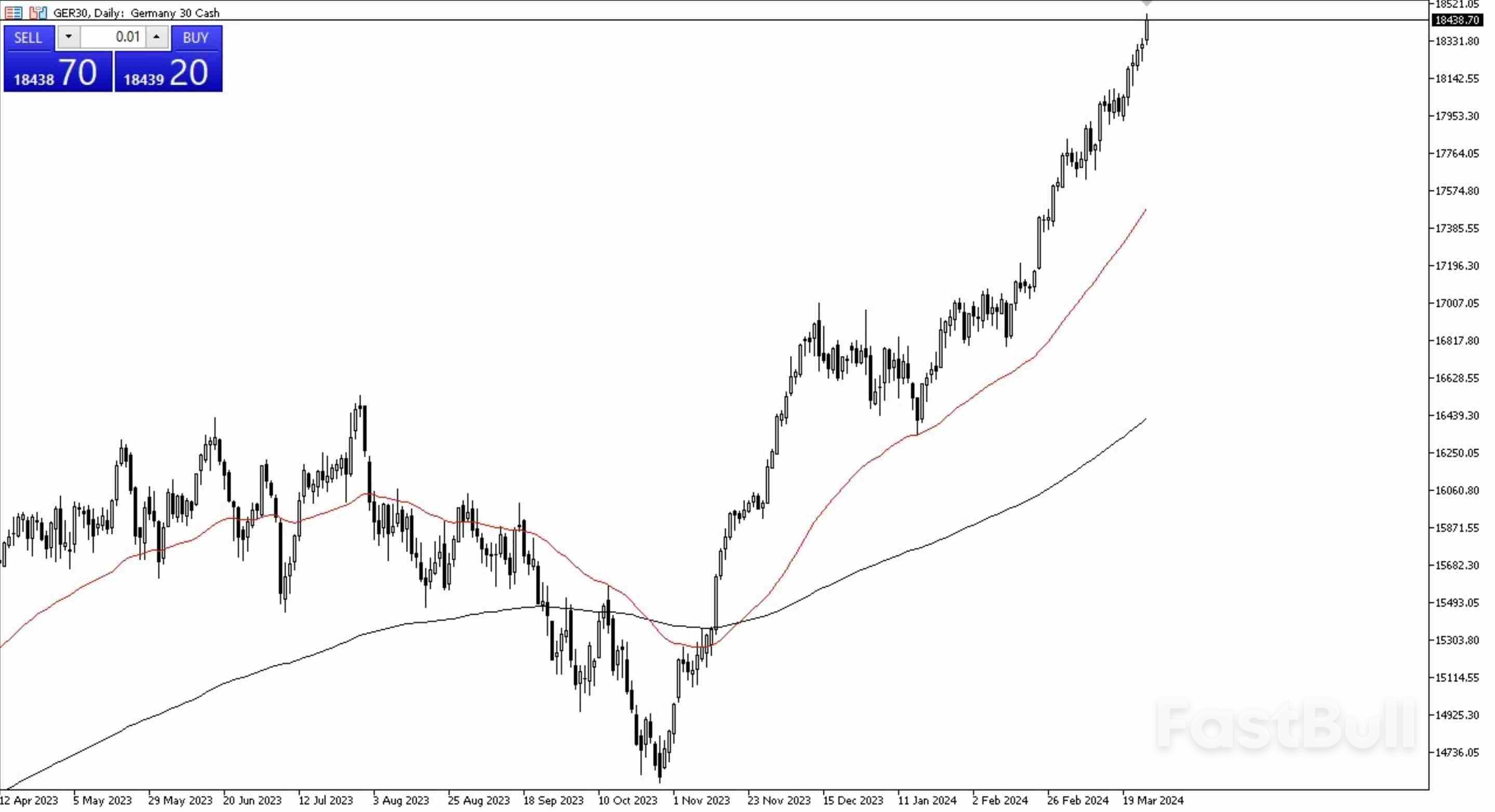
          In Wednesday's trading session, the German DAX Index continued its impressive upward trajectory, pushing past the €18,400 mark with gusto. Now eyeing the €18,500 milestone and beyond, the DAX's ascent signals a robust market sentiment worth monitoring closely.DAX Sustains Upward Momentum, Continuing Positive Trend in Trading_1
          As the premier "blue-chip index" in the European Union, the DAX commands attention from investors worldwide. Its performance often serves as a barometer for broader market trends, making it a valuable indicator for gauging sentiment across European indices like the MIB, CAC, and AMX.
          Germany's leading role in shaping the European economic landscape further underscores the significance of the DAX's movements. Even for those not directly trading this index, keeping a keen eye on its performance can offer valuable insights into potential trends in other European markets.
          Much like its counterparts in the US, the DAX finds itself propelled by strong momentum, attracting a flurry of "hot money" eager to ride the wave of bullish sentiment. This trend is likely to persist as long as the market maintains its current upward trajectory.
          Looking ahead, the European Central Bank (ECB) may find itself compelled to inject liquidity into the markets, providing traders with the ammunition to further drive prices upward. The prospect of Germany facing a recession could further incentivize traders to anticipate ECB monetary policy decisions, amplifying the bullish sentiment in the stock market.
          Beneath the surface, substantial support levels lie near the €18,000 mark, signaling a resilient foundation for the DAX's upward momentum. Additionally, the €17,950 level presents another crucial support zone, reinforcing the "buy on the dips" strategy favored by many investors.
          Shorting the DAX remains unattractive in the current market climate, at least until a breach below the €17,500 level, where the 50-Day EMA converges. Until then, the DAX's bullish trajectory appears firmly intact, offering investors ample opportunities for capitalizing on market strength.DAX Sustains Upward Momentum, Continuing Positive Trend in Trading_2
          In conclusion, the German DAX Index's relentless climb embodies the buoyant market sentiment pervading European equities. As investors navigate these bullish waters, staying attuned to the DAX's movements can provide valuable insights and opportunities for capitalizing on emerging trends. With momentum firmly on its side, the DAX charts a course of optimism and potential for continued gains in the foreseeable future.
          Risk Warnings and Disclaimers
          You understand and acknowledge that there is a high degree of risk involved in trading. Following any strategies or investment methods may lead to potential losses. The content on the site is provided by our contributors and analysts for information purposes only. You are solely responsible for determining whether any trading assets, securities, strategy, or any other product is suitable for investing based on your own investment objectives and financial situation.
          Add to Favorites
          Share

          Russia Faces Challenges in Oil Payment Collection as China, UAE, and Turkey Intensify Banking Scrutiny

          Ukadike Micheal

          Commodity

          Economic

          Russian oil firms are facing significant delays in receiving payments for crude and fuel due to heightened scrutiny from banks in China, Turkey, and the UAE regarding U.S. secondary sanctions concerns. These delays, stretching up to several months, not only reduce revenue to the Kremlin but also contribute to erratic payment patterns, aligning with Washington's dual policy sanction goals of disrupting funds to Russia while ensuring minimal disruption to global energy flows.
          Banks in China, Turkey, and the UAE have intensified their sanctions compliance requirements in recent weeks, leading to delays or even rejections of money transfers to Moscow. This includes requests for written guarantees from clients that no person or entity from the U.S. Special Designated Nationals (SDN) list is involved in deals or payment beneficiaries. These compliance measures reflect banks' efforts to mitigate risks associated with potential U.S. secondary sanctions.
          In response to these developments, some banks in the UAE, including First Abu Dhabi Bank (FAB) and Dubai Islamic Bank (DIB), have suspended several accounts linked to the trading of Russian goods. While certain banks, such as Mashreq bank in the UAE and Ziraat and Vakifbank in Turkey, as well as ICBC and Bank of China in China, are still processing payments, they are experiencing delays ranging from weeks to months.
          Kremlin spokesperson Dmitry Peskov acknowledged the payment challenges, attributing them to the unprecedented pressure from the United States and the European Union on China. Despite these hurdles, Peskov emphasized the importance of maintaining trade and economic relations with China.
          The root of these payment disruptions lies in a U.S. Treasury executive order issued on December 22, 2023, which warned of potential sanctions for the evasion of Western-imposed price caps on Russian oil. This order signaled the possibility of secondary sanctions on Russia, prompting banks working with Russia to enhance compliance measures and scrutiny of transactions.
          As a result, banks have increased checks, requested additional documentation, and trained staff to ensure compliance with price caps. This includes providing details on the ownership of companies involved in deals and personal data of individuals controlling these entities. Such measures aim to minimize the risk of exposure to the U.S. SDN list and potential sanctions.
          The impact of these payment delays extends beyond financial transactions, affecting the stability and predictability of global energy markets. As delays persist and compliance requirements tighten, market participants face challenges in navigating the evolving regulatory landscape and maintaining smooth operations. Adapting to these changes will require collaboration between governments, financial institutions, and industry stakeholders to ensure the continued stability and resilience of energy supply chains.
          The delays in payment processing for Russian oil underscore the complexities and challenges inherent in navigating geopolitical tensions and regulatory frameworks. As banks intensify compliance measures in response to U.S. sanctions concerns, the ripple effects are felt across global energy markets, highlighting the interconnectedness of financial systems and energy supply chains. Moving forward, proactive collaboration and adaptation will be crucial in addressing these challenges and safeguarding the stability of the energy sector.

          Source: Reuters

          To stay updated on all economic events of today, please check out our Economic calendar
          Risk Warnings and Disclaimers
          You understand and acknowledge that there is a high degree of risk involved in trading. Following any strategies or investment methods may lead to potential losses. The content on the site is provided by our contributors and analysts for information purposes only. You are solely responsible for determining whether any trading assets, securities, strategy, or any other product is suitable for investing based on your own investment objectives and financial situation.
          Add to Favorites
          Share

          North Sea Oil Rigs Threatened with Shutdown Unless They Start Running on Green Electricity

          Devin

          Economic

          Commodity

          Energy

          Currently, more than 280 platforms extracting oil and gas from UK waters produce 3pc of the country’s total emissions, the equivalent of about 17 million tonnes of CO2 a year.
          However, UK oil and gas fields also account for half of the country’s energy needs.
          Despite this, the North Sea Transition Authority (NSTA), which regulates the offshore sector, has told oil and producers that they must convert platforms to run on green electricity or low-carbon fuels.
          This means all new developments before 2030 must be designed to run on electricity, while all those after that must be fully electrified from the start.
          Critics say the new demands will deliver a fatal blow to many of the older platforms operating around British shores.
          Some date back to the 1970s or 1980s and would be hugely expensive to decarbonise.
          For many, it would mean running power cables from the shore or building a wind farm close to each platform.
          Stuart Payne, NSTA chief executive, said closing some low-producing, high-polluting installations earlier could be necessary to allow higher-producing and cleaner new assets to come online.
          He said: “Energy production, reducing emissions and accelerating the energy transition are at the heart of everything we do.”
          A key element of the NSTA plan is to put an end to flaring where offshore operators burn off or vent methane gas.
          It follows revelations in The Telegraph last December that UK offshore operators flared a total of 651 million cubic metres of methane gas in 2022, according to NSTA data.
          Flaring is regarded as unacceptable because it releases CO2 and unburned methane. Both are greenhouse gases but methane is about 80 times more potent than CO2.
          UK policy aims to phase out the practice.
          French-owned TotalEnergies burned 81 million cubic metres of gas in 2022, while Abu Dhabi-based Taqa burned 67 million.
          The China National Offshore Oil Corporation (CNOOC), which operates the giant Buzzard oil field and three others, flared another 65 million cubic metres.
          The NSTA said all flaring must end by 2030: “While progress has been made, with industry flaring volumes having decreased by around 50pc since 2018, and some flaring is unavoidable for safety and operational reasons, the NSTA has been clear that more must be done to prevent the wasteful flaring of gas and expects the reductions to continue.”
          It added: “This plan places electrification and low carbon power at the heart of emissions reduction.
          “It makes it clear that where the NSTA considers electrification reasonable, but it has not been done, there should be no expectation that the NSTA will approve field development plans that give access to future hydrocarbon resources in that asset,” it said.
          The NSTA said it would “apply the plan in a reasonable manner” and try to avoid unintended consequences.
          Mark Wilson, operations director of Offshore Energies UK, said: “The UK offshore energy sector is committed to meeting the decarbonisation targets and has made great progress already by reducing emissions 24pc since 2018 with a 45pc reduction in methane from flaring and venting in the same time period. It recognises the importance of continued investment to deliver future decarbonisation.”

          Source: The Telegraph

          To stay updated on all economic events of today, please check out our Economic calendar
          Risk Warnings and Disclaimers
          You understand and acknowledge that there is a high degree of risk involved in trading. Following any strategies or investment methods may lead to potential losses. The content on the site is provided by our contributors and analysts for information purposes only. You are solely responsible for determining whether any trading assets, securities, strategy, or any other product is suitable for investing based on your own investment objectives and financial situation.
          Add to Favorites
          Share

          AUD Recovers Amid Stronger USD, Awaits Aussie Retail Sales Data

          Chandan Gupta

          Traders' Opinions

          Forex

          The Australian Dollar (AUD) continues its downward trajectory for the second consecutive session on Wednesday, reflecting concerns spurred by softer-than-expected Aussie consumer prices. The AUD/USD pair is experiencing losses, potentially prompting the Reserve Bank of Australia (RBA) to consider adopting a dovish stance on interest rate adjustments. This anticipation of a dovish stance from the RBA is placing downward pressure on the Australian Dollar.
          Australia's Monthly Consumer Price Index (YoY) for February rose by 3.4%, maintaining consistency with previous levels but falling slightly below the anticipated 3.5%. Despite this, the latest reading indicates the lowest level since November 2021. The AUD has faced downward pressure following the release of the Westpac Consumer Confidence Index on Tuesday. The index dipped 1.8% to 84.4 in March 2024 from February's 86.0, easing from its 20-month highs.
          The US Dollar Index (DXY) notched its second straight day of growth amidst risk aversion, buoyed by anticipation of Friday's US Personal Consumption Expenditures (PCE) release. Despite this, a downturn in US Treasury yields suggests market expectations of potential rate cuts by the US Federal Reserve (Fed), possibly curbing the greenback's gains. The sentiment surrounding the Fed's stance on interest rates could cap the US Dollar's upward momentum, as investors weigh the possibility of monetary policy adjustments. Market participants are closely monitoring economic data and central bank communications for insights into future currency movements.
          The US Dollar Index (DXY) notched its second straight day of growth amidst risk aversion, buoyed by anticipation of Friday's US Personal Consumption Expenditures (PCE) release. Despite this, a downturn in US Treasury yields suggests market expectations of potential rate cuts by the US Federal Reserve (Fed), possibly curbing the greenback's gains. The sentiment surrounding the Fed's stance on interest rates could cap the US Dollar's upward momentum, as investors weigh the possibility of monetary policy adjustments. Market participants are closely monitoring economic data and central bank communications for insights into future currency movements.AUD Recovers Amid Stronger USD, Awaits Aussie Retail Sales Data_1

          Australian Dollar Slides Amid Weaker Consumer Prices: Daily Market Digest

          1. Australia's Westpac Leading Index (MoM) shows a 0.1% increase in February, contrasting with the previous 0.09% decline.
          2. Australia pledges to support a minimum wage increase in line with inflation to assist low-income families facing rising living costs.
          3. Bloomberg survey suggests the People's Bank of China (PBoC) may implement two additional Reserve Requirement Ratio (RRR) cuts in 2024, totaling a 50 basis points reduction.
          4. Chinese President Xi Jinping schedules a meeting with US business leaders, following his November dinner with US investors in San Francisco.
          5. Atlanta Fed President Raphael Bostic expects only one rate cut this year, warning against premature rate reductions that could cause disruption.
          6. Chicago Fed President Austan Goolsbee anticipates three cuts, pending further evidence of inflation decrease before proceeding.
          7. US Durable Goods Orders rise by 1.4% in February, surpassing the expected 1.3% increase despite the previous 6.9% decline.US Durable Goods Orders ex Defense increase by 2.2% in February, exceeding the anticipated 1.1% rise following a 7.9% decline.
          8. US Housing Price Index (MoM) records a 0.1% decrease in January, contrasting with December's 0.1% increase.

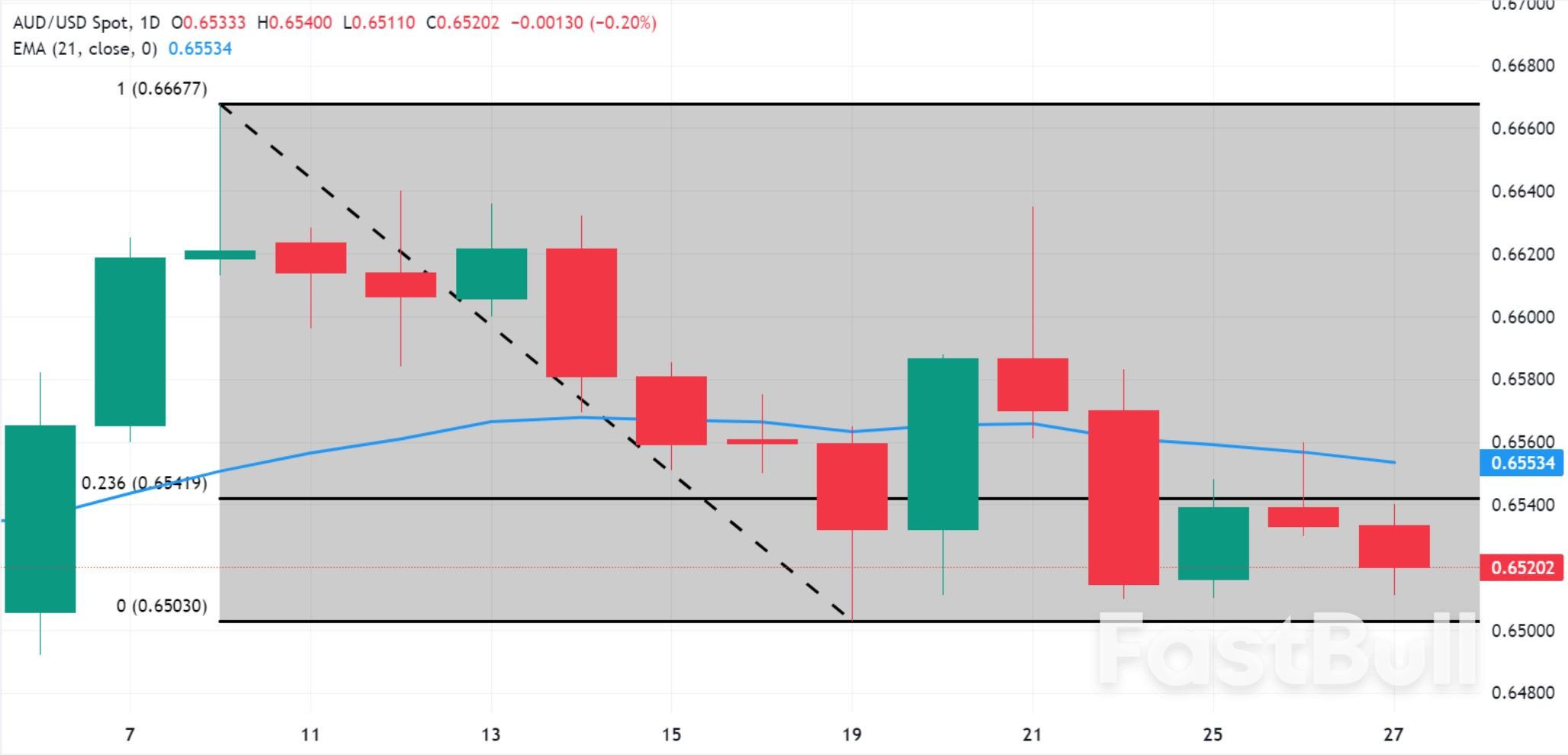
          Australian Dollar falls to near 0.6520, next support at March’s low

          AUD Recovers Amid Stronger USD, Awaits Aussie Retail Sales Data_2The Australian Dollar trades near 0.6520 on Wednesday. A notable support level is positioned at the psychological mark of 0.6500, followed by March’s low at 0.6477. If the AUD/USD pair breaks below this level, it could test the major support of the 0.6450 level. On the upside, immediate resistance may be encountered around the 23.6% Fibonacci retracement level of 0.6541. This area is aligned with the major barrier of 0.6550 and the 21-day Exponential Moving Average (EMA) at 0.6553.
          Risk Warnings and Disclaimers
          You understand and acknowledge that there is a high degree of risk involved in trading. Following any strategies or investment methods may lead to potential losses. The content on the site is provided by our contributors and analysts for information purposes only. You are solely responsible for determining whether any trading assets, securities, strategy, or any other product is suitable for investing based on your own investment objectives and financial situation.
          Add to Favorites
          Share

          US Futures Signal Rise Following 3-Day Decline in S&P 500

          Ukadike Micheal

          Stocks

          Economic

          US stock futures indicated a rebound on Wednesday morning, marking a shift from several days of declines that deviated from the bullish trend observed at the start of 2024. Futures linked to major indices such as the S&P 500, the Dow Jones Industrial Average, and the Nasdaq Composite all demonstrated gains of approximately 0.4% prior to the market opening.
          The potential uptick follows a notable three-day losing streak for the benchmark S&P 500, which, despite this recent downturn, had already achieved a record closing high on 20 occasions within the current year alone. Moreover, the index appears poised to maintain its upward momentum, with indications pointing toward a fifth consecutive monthly gain, a trend that suggests sustained market optimism and potential for further growth.
          Investor attention is currently focused on several key factors, including an upcoming speech from Fed Governor Christopher Waller and the imminent release of the Personal Consumption Expenditures (PCE) price index. The PCE index, particularly its "core" inflation measure favored by the Federal Reserve, is closely monitored by investors as it provides crucial insights into the state of inflationary pressures within the economy.
          Furthermore, market observers are closely monitoring the resurgence of meme stocks, particularly those influenced by social media trends. Notably, Reddit, a platform known for fueling frenzies around certain stocks, witnessed its stock price double from its IPO level, albeit experiencing a slight decline during premarket trading.
          Meanwhile, notable movements in specific stocks have garnered attention, such as the surge in shares of Trump Media and Technology Group following its Nasdaq debut, and the subsequent decline in GameStop shares after the company reported lower fourth-quarter revenue and announced job cuts.
          Looking ahead, investors are anticipating the release of crucial economic data, including the final fourth-quarter GDP print, the University of Michigan's consumer sentiment reading, and weekly jobless claims data. These data points will offer valuable insights into the broader economic landscape and could potentially influence market sentiment and investment decisions.
          Overall, amidst market fluctuations and uncertainties, investors continue to navigate the evolving landscape with caution, weighing various factors that could impact stock performance in the near term. As they remain vigilant and adapt their strategies in response to changing market conditions, informed decision-making remains essential in navigating the dynamic nature of financial markets and capitalizing on investment opportunities.

          Source: Yahoo Finance

          To stay updated on all economic events of today, please check out our Economic calendar
          Risk Warnings and Disclaimers
          You understand and acknowledge that there is a high degree of risk involved in trading. Following any strategies or investment methods may lead to potential losses. The content on the site is provided by our contributors and analysts for information purposes only. You are solely responsible for determining whether any trading assets, securities, strategy, or any other product is suitable for investing based on your own investment objectives and financial situation.
          Add to Favorites
          Share

          Stable EUR/USD Above 1.0800 Amid Cautious Market Conditions

          Chandan Gupta

          Traders' Opinions

          The foreign exchange market, particularly the EUR/USD pair, has witnessed notable movements recently, reflecting shifts in market sentiment, economic data releases, and technical indicators. This comprehensive analysis delves into the recent performance of EUR/USD, exploring key factors influencing its movements and offering insights into potential future trends.

          Overview of Recent EUR/USD Movement:

          EUR/USD recently dipped below the 200-period Simple Moving Average (SMA) on the 4-hour chart, indicating a potential shift in sentiment towards the pair. Additionally, the Relative Strength Index (RSI) declined towards 40, signaling a lack of buyer interest in the market. Despite briefly rising above 1.0850, the pair struggled to maintain its upward momentum, ultimately erasing its daily gains.

          Factors Influencing EUR/USD Movement:

          Technical Indicators:

          The breach below the 200-period SMA suggests a weakening bullish trend.RSI declining towards 40 reflects diminishing buying pressure.Key support levels at 1.0800 (Fibonacci 61.8% retracement) and 1.0760 (Fibonacci 78.6% retracement).Resistance levels at 1.0840 (200-period SMA), 1.0860 (Fibonacci 38.2% retracement), and 1.0885 (100-period SMA) pose barriers to further upside movement.

          Market Sentiment:

          Investor sentiment remains cautious, with a lack of clear directional momentum in early trading sessions.Modest improvements in risk sentiment initially dampened demand for the safe-haven US Dollar.However, a reversal in Wall Street's main indexes led to a resurgence in USD demand, limiting EUR/USD's upward potential.Market participants continue to search for fresh catalysts to drive significant movements in the pair.Stable EUR/USD Above 1.0800 Amid Cautious Market Conditions_1

          Economic Data Releases:

          US Durable Goods Orders rose 1.4% in February, surpassing market expectations and providing support to the USD.The European Commission's release of business and consumer sentiment data for March is unlikely to significantly impact market dynamics.Absence of high-tier data releases from the US later in the day may contribute to subdued trading conditions.

          Market Outlook:

          US stock index futures trade modestly higher, indicating a potential improvement in market sentiment during American trading hours.If risk appetite strengthens, the USD could face challenges in gaining strength, potentially allowing EUR/USD to extend its gains.

          Conclusion:

          The recent performance of EUR/USD reflects a complex interplay of technical indicators, market sentiment, and economic data releases. While the pair faces resistance at key levels, including the 200-period SMA, support levels and improved risk sentiment could provide opportunities for further upside movement. Traders are advised to closely monitor market developments and remain vigilant for potential catalysts driving EUR/USD movement in the coming sessions.
          Risk Warnings and Disclaimers
          You understand and acknowledge that there is a high degree of risk involved in trading. Following any strategies or investment methods may lead to potential losses. The content on the site is provided by our contributors and analysts for information purposes only. You are solely responsible for determining whether any trading assets, securities, strategy, or any other product is suitable for investing based on your own investment objectives and financial situation.
          Add to Favorites
          Share
          FastBull
          Copyright © 2025 FastBull Ltd

          728 RM B 7/F GEE LOK IND BLDG NO 34 HUNG TO RD KWUN TONG KLN HONG KONG

          TelegramInstagramTwitterfacebooklinkedin
          App Store Google Play Google Play
          Products
          Charts

          Chats

          Q&A with Experts
          Screeners
          Economic Calendar
          Data
          Tools
          Membership
          Features
          Function
          Markets
          Copy Trading
          Latest Signals
          Contests
          News
          Analysis
          24/7
          Columns
          Education
          Company
          Careers
          About Us
          Contact Us
          Advertising
          Help Center
          Feedback
          User Agreement
          Privacy Policy
          Business

          White Label

          Data API

          Web Plug-ins

          Poster Maker

          Affiliate Program

          Risk Disclosure

          The risk of loss in trading financial instruments such as stocks, FX, commodities, futures, bonds, ETFs and crypto can be substantial. You may sustain a total loss of the funds that you deposit with your broker. Therefore, you should carefully consider whether such trading is suitable for you in light of your circumstances and financial resources.

          No decision to invest should be made without thoroughly conducting due diligence by yourself or consulting with your financial advisors. Our web content might not suit you since we don't know your financial conditions and investment needs. Our financial information might have latency or contain inaccuracy, so you should be fully responsible for any of your trading and investment decisions. The company will not be responsible for your capital loss.

          Without getting permission from the website, you are not allowed to copy the website's graphics, texts, or trademarks. Intellectual property rights in the content or data incorporated into this website belong to its providers and exchange merchants.

          Not Logged In

          Log in to access more features

          FastBull Membership

          Not yet

          Purchase

          Become a signal provider
          Help Center
          Customer Service
          Dark Mode
          Price Up/Down Colors

          Log In

          Sign Up

          Position
          Layout
          Fullscreen
          Default to Chart
          The chart page opens by default when you visit fastbull.com