• Trade
  • Markets
  • Copy
  • Contests
  • News
  • 24/7
  • Calendar
  • Q&A
  • Chats
Trending
Screeners
SYMBOL
LAST
BID
ASK
HIGH
LOW
NET CHG.
%CHG.
SPREAD
SPX
S&P 500 Index
6827.42
6827.42
6827.42
6899.86
6801.80
-73.58
-1.07%
--
DJI
Dow Jones Industrial Average
48458.04
48458.04
48458.04
48886.86
48334.10
-245.98
-0.51%
--
IXIC
NASDAQ Composite Index
23195.16
23195.16
23195.16
23554.89
23094.51
-398.69
-1.69%
--
USDX
US Dollar Index
97.970
98.050
97.970
98.070
97.920
+0.020
+ 0.02%
--
EURUSD
Euro / US Dollar
1.17318
1.17326
1.17318
1.17447
1.17283
-0.00076
-0.06%
--
GBPUSD
Pound Sterling / US Dollar
1.33595
1.33602
1.33595
1.33740
1.33546
-0.00112
-0.08%
--
XAUUSD
Gold / US Dollar
4340.31
4340.65
4340.31
4345.46
4294.68
+40.92
+ 0.95%
--
WTI
Light Sweet Crude Oil
57.472
57.509
57.472
57.601
57.194
+0.239
+ 0.42%
--

Community Accounts

Signal Accounts
--
Profit Accounts
--
Loss Accounts
--
View More

Become a signal provider

Sell trading signals to earn additional income

View More

Guide to Copy Trading

Get started with ease and confidence

View More

Signal Accounts for Members

All Signal Accounts

Best Return
  • Best Return
  • Best P/L
  • Best MDD
Past 1W
  • Past 1W
  • Past 1M
  • Past 1Y

All Contests

  • All
  • Trump Updates
  • Recommend
  • Stocks
  • Cryptocurrencies
  • Central Banks
  • Featured News
Top News Only
Share

India's November Soyoil Imports At 370661 Tonnes Versus 454619 Tonnes In October

Share

India's November Sunflower Oil Imports At 142953 Tonnes Versus 260548 Tonnes In October

Share

India's November Palm Oil Imports At 632341 Tonnes Versus 602381 Tonnes In October

Share

India's November Vegetable Oil Imports At 1183,832 Tonnes Versus 1332,173 Million Tonnes In October

Share

Reuters Poll - Bank Indonesia To Keep 7-Day Reverse Repo Rate Unchanged At 4.75% On December 17, Say 18 Of 31 Economists

Share

Statistics Finland - Finland Nov CPI -0.1% Year-On-Year

Share

Saudi Nov CPI 0.1% Month-On-Month

Share

Saudi Nov CPI 1.9% Year-On-Year

Share

South Korea Petrochemical Exports To Fall 6.1% In 2026 - Kcci

Share

U.S. Stock Futures Rose Slightly, With S&P 500 Futures And Dow Jones Futures Up 0.3% And NASDAQ 100 Futures Up Nearly 0.3%

Share

Spot Gold Rose $9 To $4,338.5 Per Ounce In The Short Term; New York Gold Futures Rose 1.00% On The Day, Currently Trading At $4,371.60 Per Ounce

Share

Dollar/Yen Extends Fall, Down 0.47% To 155.10

Share

Bank Of Japan: Two Branches Expect Higher Pay Rises In Fiscal Year 2026, While Two Other Branches Expect Wage Growth To Slow

Share

Bloomberg News: Bank Of Japan To Start Selling ETF Holdings As Early As January

Share

Malaysia Says Special ASEAN Foreign Ministers Meeting Scheduled For Dec 16 Delayed To Dec 22 At Thailand's Request

Share

Bank Of Japan: Wages Of Part-Time Employees Are Being Raised Reflecting Relatively High Minimum Wage Growth In Fiscal 2025

Share

Bank Of Japan: Firms' Wage Growth Outlook Due To Need For Retaining Staff Amid Persistent, Severe Labour Shortages

Share

Bank Of Japan - While Large And Medium-Sized Firms Were Likely To Be Able To Raise As Much Wages In FY 2026 As They Did In FY 2025, It Would Be Difficult For Small Firms To Raise As Much Wages In FY 2026 As In FY 2025

Share

Bank Of Japan: Most Companies Seem To Believe That Wage Increases In Fiscal Year 2026 Should Be The Same As Or Similar To Those In Fiscal Year 2025

Share

Bank Of Japan: Number Of Firms Expecting A Clear Improvement In Their Profits Is Not Large

TIME
ACT
FCST
PREV
U.K. Trade Balance Non-EU (SA) (Oct)

A:--

F: --

P: --

France HICP Final MoM (Nov)

A:--

F: --

P: --

China, Mainland Outstanding Loans Growth YoY (Nov)

A:--

F: --

P: --

China, Mainland M2 Money Supply YoY (Nov)

A:--

F: --

P: --

China, Mainland M0 Money Supply YoY (Nov)

A:--

F: --

P: --

China, Mainland M1 Money Supply YoY (Nov)

A:--

F: --

P: --

India CPI YoY (Nov)

A:--

F: --

P: --

India Deposit Gowth YoY

A:--

F: --

P: --

Brazil Services Growth YoY (Oct)

A:--

F: --

P: --

Mexico Industrial Output YoY (Oct)

A:--

F: --

P: --

Russia Trade Balance (Oct)

A:--

F: --

P: --

Philadelphia Fed President Henry Paulson delivers a speech
Canada Building Permits MoM (SA) (Oct)

A:--

F: --

P: --

Canada Wholesale Sales YoY (Oct)

A:--

F: --

P: --

Canada Wholesale Inventory MoM (Oct)

A:--

F: --

P: --

Canada Wholesale Inventory YoY (Oct)

A:--

F: --

P: --

Canada Wholesale Sales MoM (SA) (Oct)

A:--

F: --

P: --

Germany Current Account (Not SA) (Oct)

A:--

F: --

P: --

U.S. Weekly Total Rig Count

A:--

F: --

P: --

U.S. Weekly Total Oil Rig Count

A:--

F: --

P: --

Japan Tankan Small Manufacturing Outlook Index (Q4)

A:--

F: --

P: --

Japan Tankan Large Non-Manufacturing Diffusion Index (Q4)

A:--

F: --

P: --

Japan Tankan Large Non-Manufacturing Outlook Index (Q4)

A:--

F: --

P: --

Japan Tankan Large Manufacturing Outlook Index (Q4)

A:--

F: --

P: --

Japan Tankan Small Manufacturing Diffusion Index (Q4)

A:--

F: --

P: --

Japan Tankan Large Manufacturing Diffusion Index (Q4)

A:--

F: --

P: --

Japan Tankan Large-Enterprise Capital Expenditure YoY (Q4)

A:--

F: --

P: --

U.K. Rightmove House Price Index YoY (Dec)

A:--

F: --

P: --

China, Mainland Industrial Output YoY (YTD) (Nov)

A:--

F: --

P: --

China, Mainland Urban Area Unemployment Rate (Nov)

A:--

F: --

P: --

Saudi Arabia CPI YoY (Nov)

A:--

F: --

P: --

Euro Zone Industrial Output YoY (Oct)

--

F: --

P: --

Euro Zone Industrial Output MoM (Oct)

--

F: --

P: --

Canada Existing Home Sales MoM (Nov)

--

F: --

P: --

Euro Zone Total Reserve Assets (Nov)

--

F: --

P: --

U.K. Inflation Rate Expectations

--

F: --

P: --

Canada National Economic Confidence Index

--

F: --

P: --

Canada New Housing Starts (Nov)

--

F: --

P: --

U.S. NY Fed Manufacturing Employment Index (Dec)

--

F: --

P: --

U.S. NY Fed Manufacturing Index (Dec)

--

F: --

P: --

Canada Core CPI YoY (Nov)

--

F: --

P: --

Canada Manufacturing Unfilled Orders MoM (Oct)

--

F: --

P: --

U.S. NY Fed Manufacturing Prices Received Index (Dec)

--

F: --

P: --

U.S. NY Fed Manufacturing New Orders Index (Dec)

--

F: --

P: --

Canada Manufacturing New Orders MoM (Oct)

--

F: --

P: --

Canada Core CPI MoM (Nov)

--

F: --

P: --

Canada Trimmed CPI YoY (SA) (Nov)

--

F: --

P: --

Canada Manufacturing Inventory MoM (Oct)

--

F: --

P: --

Canada CPI YoY (Nov)

--

F: --

P: --

Canada CPI MoM (Nov)

--

F: --

P: --

Canada CPI YoY (SA) (Nov)

--

F: --

P: --

Canada Core CPI MoM (SA) (Nov)

--

F: --

P: --

Canada CPI MoM (SA) (Nov)

--

F: --

P: --

Federal Reserve Board Governor Milan delivered a speech
U.S. NAHB Housing Market Index (Dec)

--

F: --

P: --

Australia Composite PMI Prelim (Dec)

--

F: --

P: --

Australia Services PMI Prelim (Dec)

--

F: --

P: --

Australia Manufacturing PMI Prelim (Dec)

--

F: --

P: --

Japan Manufacturing PMI Prelim (SA) (Dec)

--

F: --

P: --

U.K. Unemployment Claimant Count (Nov)

--

F: --

P: --

U.K. Unemployment Rate (Nov)

--

F: --

P: --

Q&A with Experts
    • All
    • Chatrooms
    • Groups
    • Friends
    Connecting
    .
    .
    .
    Type here...
    Add Symbol or Code

      No matching data

      All
      Trump Updates
      Recommend
      Stocks
      Cryptocurrencies
      Central Banks
      Featured News
      • All
      • Russia-Ukraine Conflict
      • Middle East Flashpoint
      • All
      • Russia-Ukraine Conflict
      • Middle East Flashpoint
      Search
      Products

      Charts Free Forever

      Chats Q&A with Experts
      Screeners Economic Calendar Data Tools
      Membership Features
      Data Warehouse Market Trends Institutional Data Policy Rates Macro

      Market Trends

      Market Sentiment Order Book Forex Correlations

      Top Indicators

      Charts Free Forever
      Markets

      News

      News Analysis 24/7 Columns Education
      From Institutions From Analysts
      Topics Columnists

      Latest Views

      Latest Views

      Trending Topics

      Top Columnists

      Latest Update

      Signals

      Copy Rankings Latest Signals Become a signal provider AI Rating
      Contests
      Brokers

      Overview Brokers Assessment Rankings Regulators News Claims
      Broker listing Forex Brokers Comparison Tool Live Spread Comparison Scam
      Q&A Complaint Scam Alert Videos Tips to Detect Scam
      More

      Business
      Events
      Careers About Us Advertising Help Center

      White Label

      Data API

      Web Plug-ins

      Affiliate Program

      Awards Institution Evaluation IB Seminar Salon Event Exhibition
      Vietnam Thailand Singapore Dubai
      Fans Party Investment Sharing Session
      FastBull Summit BrokersView Expo
      Recent Searches
        Top Searches
          Markets
          News
          Analysis
          User
          24/7
          Economic Calendar
          Education
          Data
          • Names
          • Latest
          • Prev

          View All

          No data

          Scan to Download

          Faster Charts, Chat Faster!

          Download App
          English
          • English
          • Español
          • العربية
          • Bahasa Indonesia
          • Bahasa Melayu
          • Tiếng Việt
          • ภาษาไทย
          • Français
          • Italiano
          • Türkçe
          • Русский язык
          • 简中
          • 繁中
          Open Account
          Search
          Products
          Charts Free Forever
          Markets
          News
          Signals

          Copy Rankings Latest Signals Become a signal provider AI Rating
          Contests
          Brokers

          Overview Brokers Assessment Rankings Regulators News Claims
          Broker listing Forex Brokers Comparison Tool Live Spread Comparison Scam
          Q&A Complaint Scam Alert Videos Tips to Detect Scam
          More

          Business
          Events
          Careers About Us Advertising Help Center

          White Label

          Data API

          Web Plug-ins

          Affiliate Program

          Awards Institution Evaluation IB Seminar Salon Event Exhibition
          Vietnam Thailand Singapore Dubai
          Fans Party Investment Sharing Session
          FastBull Summit BrokersView Expo

          Why is Bitcoin Price Down Today?

          Warren Takunda

          Cryptocurrency

          Summary:

          Bitcoin price is down today as on-chain data shows BTC accumulation lagging behind the asset’s issuance and outflows from the spot BTC ETF.

          Bitcoin price is down 23% from its March 14 all-time high of $73,835 reached on March 14 and recently fell to a two-month low of $56,500 on May 1.
          Data from Cointelegraph Markets Pro and TradingView showed that the pioneer cryptocurrency has been sealed in a downtrend for almost 60 days, signaling a potential shift in market sentiment as more traders continue to book profits.Why is Bitcoin Price Down Today?  _1

          BTC/USD daily price chart. Source: TradingView

          Let’s look at the reasons why the Bitcoin price is down today.

          Bitcoin holders are accumulating less

          BTC price has been in a bit of a lull since the initial post-halving correction, which presented “prime buy zones” for late investors.
          However, data from Glassnode shows Bitcoin accumulation has failed to keep up with the BTC issuance rate. The chart below shows that all investor cohorts have accumulated just over 10,000 BTC over the last 30 days, against 19,000 BTC issued over the same timeframe.Why is Bitcoin Price Down Today?  _2

          Bitcoin holdings all cohorts vs. Issuance. Source: Glassnode

          Commenting on this phenomenon, James Van Straten, lead analyst at CryptoSlate, said this was happening for the “second time in the past few months.”
          The other time was in March, which was followed by a 17% BTC correction between March 14 and March 19.
          The accumulation trend score cohort is a metric that assesses the quantity of BTC accumulated by different investor cohorts over the past 15 days. It employs a slightly different moving average that bolsters a similar narrative.
          Following the intense accumulation until March, which propelled BTC to its all-time high, all cohorts began selling off their assets shortly after. The severe distribution has persisted since, with the latest data from March showing no signs of change.Why is Bitcoin Price Down Today?  _3

          BTC trend accumulation score by cohort. Source: Glassnode.

          As shown in the IOMAP chart below, more than 47.42 million Bitcoin addresses are in profit at current prices. This means sell-side pressure will continue to mount amid profit-taking, lowering the BTC price.Why is Bitcoin Price Down Today?  _4

          Bitcoin IOMAP chart. Source: IntoTheBlock

          Bitcoin ETF flows turn negative again

          Investors’ de-risking behavior was also visible across the spot Bitcoin exchange-traded funds (ETFs), where traders have resumed withdrawing their capital.
          After recording positive net flows for two consecutive days, data from Farside Investors shows U.S.-based spot Bitcoin ETFs recorded outflows totaling $15.7 million on May 7.Why is Bitcoin Price Down Today?  _5

          Bitcoin ETF flow table. Source: Farside Investors

          Grayscale’s GBTC fund, which witnessed its first netflows after 78 days on May 3, was the primary driver behind May 7 ETF withdrawals with a total of $15.7 million outflows.
          At the same time, inflows into other Bitcoin ETFs continued to slow down. Flows into BlackRock's iShares Bitcoin Trust (IBIT) have been at a standstill since April 24, only seeing inflows on May 3 and May 6.
          “Yesterday’s ETF Flows came in at -$15.7M,” noted independent market analyst Daan Crypto Trades, adding that flows were “mostly flat on the day, which was also clear in the #Bitcoin price action.”

          Source: Cointelegraph

          Risk Warnings and Disclaimers
          You understand and acknowledge that there is a high degree of risk involved in trading. Following any strategies or investment methods may lead to potential losses. The content on the site is provided by our contributors and analysts for information purposes only. You are solely responsible for determining whether any trading assets, securities, strategy, or any other product is suitable for investing based on your own investment objectives and financial situation.
          Add to Favorites
          Share

          Tax Rises Will Follow UK Election Unless Fiscal Rules Are Ripped Up, Says Thinktank

          Thomas

          Economic

          The next government will be forced to hit voters with post-election tax rises and delay net zero investment unless it is prepared to rip up Treasury rules for managing the state finances, a leading thinktank has said.
          The National Institute for Economic and Social Research (Niesr) called for a radical overhaul of the self-imposed constraints imposed on government borrowing and debt as it warned that persistently weak growth and lower inflation would make hitting the rules more difficult.
          In its quarterly health check, the thinktank said the economy had emerged from recession but the “not-fit-for-purpose” fiscal rules meant there was no scope for Jeremy Hunt to offer fresh tax cuts before polling day.
          After the general election, Niesr said a future chancellor would be faced with a choice: raise taxes to maintain the existing provision of public services or rewrite the rules so that they served the UK's medium- and long-term needs and objectives – including raising the growth rate, levelling up the regions and greening the economy.
          Official growth figures are due out on Friday and Niesr said it expected output to have risen by 0.4% in the first three months of 2024. For 2024 as a whole, it is pencilling in growth of 0.8%, down slightly on the 0.9% it predicted three months ago.
          Although it believes the annual inflation rate will fall below the government's 2% target over the next few months, the thinktank said the Bank of England would delay cutting interest rates until August this year, and would only reduce borrowing costs once more in 2024. The Bank is widely expected to hold rates at 5.25% when it meets on Thursday.
          Prof Stephen Millard, Niesr's deputy director for macroeconomics, modelling and forecasting, said: “Despite the welcome fall in inflation, UK growth remains anaemic. This will make it difficult for any incoming government to carry out the much-needed investment in infrastructure and the green transition, as well as increase spending on public services and defence, without either raising taxes or rewriting the fiscal rules.
          “This makes clear the need to reform the fiscal framework to enable the government to do what is needed for the economy in a fiscally sustainable way.”
          The current fiscal rules state that the debt-to-GDP ratio – which is now just below 100% – should be falling within a five-year horizon and the annual deficit-to-GDP ratio should be below 3% by the end of the same period.
          Niesr said debt would still be rising as a percentage of national income in five years' time, and the government would still be borrowing more than 5% of GDP to balance its books. Its forecasts do not include the additional £75bn over the next six years needed to increase the defence budget to 2.5% of GDP by 2030.
          The thinktank said there was essentially no scope for pre-election tax giveaways, as the government's spending plans did not meet the fiscal rules. Any future tax cuts or increases in public investment would require a revision to the current fiscal rules.
          Niesr said: “The existing framework is not fit for purpose and inadvertently creates an incentive structure which arbitrarily constrains sound government borrowing plans. Instead, a revised set of fiscal rules would better serve the United Kingdom by incorporating medium- to long-term economic objectives. For example, the United Kingdom is legally obligated to reach net zero by 2050. This target will only be met if supported through well-judged public investment in green infrastructure.”
          The thinktank's quarterly outlook said there were few signs of levelling up and that there was some evidence of widening regional disparities.
          After the squeeze caused by the cost of living crisis, living standards are expected to rise by 6% on average in 2024-2025 relative to 2023-4 but with differences between poor and well-off households.
          Above-inflation rent increases would mean those in the bottom income decile would see a 2% drop in their living standards, while those on middle and higher incomes would enjoy a 7-8% rise.

          Source: The Guardian

          To stay updated on all economic events of today, please check out our Economic calendar
          Risk Warnings and Disclaimers
          You understand and acknowledge that there is a high degree of risk involved in trading. Following any strategies or investment methods may lead to potential losses. The content on the site is provided by our contributors and analysts for information purposes only. You are solely responsible for determining whether any trading assets, securities, strategy, or any other product is suitable for investing based on your own investment objectives and financial situation.
          Add to Favorites
          Share

          [NY Fed] Perli: Final Size of the Balance Sheet Remains Uncertain

          FastBull Featured

          Remarks of Officials

          Roberto Perli, Manager of the System Open Market Account (SOMA), delivered a speech on the balance sheet reduction issue at the Annual Primary Dealer Meeting of the Federal Reserve Bank of New York on May 8, Eastern Time. While the position of SOMA manager does not determine the Fed's policy stance, Perli plays a crucial role in implementing monetary policy. He oversees SOMA's $6.7 trillion securities portfolio and leads monetary policy implementation as directed by the FOMC. Therefore, his considerations regarding balance sheet reduction are highly significant, and the specifics of the reduction will be greatly influenced by him (his predecessor is the current Dallas Fed President Lorie Logan).
          The key points of the speech are as follows.
          Since last October, the balance sheet reduction plan has progressed as expected. Despite another $520 billion reduction in our holdings, including $412 billion of Treasury securities and $108 billion of agency mortgage-backed securities (MBS), control over short-term interest rates has continued to be strong. The effective federal funds rate (EFFR) has remained remarkably stable since the FOMC last raised the target range in July of last year. There has been no usage of the Standing Repo Facility (SRF) outside of test transactions, which means that there has been no need as yet to rely on this facility to keep the federal funds rate within the target range.
          Our overnight reverse repo (ON RRP) facility has also remained a primary focus in recent months.
          The over $1.7 trillion decline in ON RRP balances since the debt limit suspension last June is entirely consistent with how that facility was designed. In fact, the ON RRP has absorbed virtually the entirety of balance sheet runoff, on net, which is primarily why reserves have not declined since the runoff process started. I can confidently say that the ON RRP has supported the efficient implementation and transmission of monetary policy so far.
          As specified in the May 1, 2024 FOMC statement and implementation note, effective next month, the redemption cap for Treasury securities will be lowered to $25 billion per month, while the redemption cap for agency debt and MBS will be left unchanged at $35 billion. In the unlikely event that agency debt or MBS paydowns exceed this amount, they will be reinvested in Treasury securities to roughly match the maturity composition of Treasury securities outstanding. In other words, the Committee did not shift its stance on monetary policy last week.
          Similarly, at some point in the future, when the FOMC judges that reserve balances are somewhat above the level consistent with ample reserves, it will instruct the Open Market Trading Desk at the New York Fed (the Desk) to stop reducing the size of the balance sheet. When the Committee judges that reserve balances are at an ample level, it will manage securities holdings to maintain an ample level of reserves over time. All of this means that, over the long run, the balance sheet is likely to expand to accommodate trend growth for the Federal Reserve's liabilities.
          Slowing runoff provides more time and opportunity for the FOMC to evaluate changes in market conditions. It also provides more time for individual institutions to adjust to a lower supply of reserves. Ultimately, I expect that this approach will allow money markets to continue to function smoothly with a lower level of reserve supply than would have been the case had runoff been allowed to proceed at its current pace for much longer.
          With SOMA runoff set to slow, an obvious question is where the balance sheet may go from here. Over time, survey responses suggest expectations around the end size of the SOMA portfolio have consolidated somewhat. Among other factors, this probably reflects updated views around demand for Federal Reserve liabilities as well as evolving risks to the economic outlook.
          Therefore, it is necessary to monitor factors such as the domestic bank activity in federal funds, the timing of interbank payments, the amount of daylight overdrafts, and the share of repo volume trading at or above the IORB.

          Perli's Speech

          Risk Warnings and Disclaimers
          You understand and acknowledge that there is a high degree of risk involved in trading. Following any strategies or investment methods may lead to potential losses. The content on the site is provided by our contributors and analysts for information purposes only. You are solely responsible for determining whether any trading assets, securities, strategy, or any other product is suitable for investing based on your own investment objectives and financial situation.
          Add to Favorites
          Share

          [BOJ] Kazuo Ueda: Exchange Rate Moves Could Have a Major Impact on Inflation

          FastBull Featured

          Remarks of Officials

          In a speech delivered on May 8, BOJ Governor Kazuo Ueda said:
          Japan's economy is expected to continue to grow steadily as overseas economies grow moderately, despite weakness in some sectors.
          In terms of private consumption, the consumption of non-durable goods such as food has been impacted by the decrease in real income. However, recent indicators of household sentiment have shown significant improvement due to expectations of wage growth. Therefore, despite some temporary weakness in both corporate and household sectors, wages and prices continue to maintain a virtuous cycle. Furthermore, against the backdrop of increasing corporate profits and a tightening labor market, this year's wage growth rate is likely to exceed that of last year
          Due to the continuing weakening impact of past cost increases on inflation, commodity prices continue to decline. Benefiting from a virtuous cycle of wages and prices, service inflation is rising moderately. Core CPI is expected to decline to 1.9% this year and next, rising to 2.1% in 2026. The BOJ currently assesses that the benchmark level for underlying inflation is below the 2% target; all indicators are on an uptrend, indicating that inflation is also on the rise.
          Looking ahead, considering that the labor market is expected to remain tight, the virtuous circle of wages and prices is expected to gradually become the norm.
          However, the inflation outlook remains at high risk. Higher crude oil prices and the depreciation of the JPY could increase the cost of imports and thus exert upward pressure on inflation.
          If upside risks to the inflation outlook increase, the BOJ may raise rates earlier. Conversely, it could maintain its low interest rate policy for a longer period. In addition, if the economy and prices are subject to significant downside risks, the BOJ will consider all necessary measures.

          Speech of Kazuo Ueda

          Risk Warnings and Disclaimers
          You understand and acknowledge that there is a high degree of risk involved in trading. Following any strategies or investment methods may lead to potential losses. The content on the site is provided by our contributors and analysts for information purposes only. You are solely responsible for determining whether any trading assets, securities, strategy, or any other product is suitable for investing based on your own investment objectives and financial situation.
          Add to Favorites
          Share

          Pound to Dollar Rate: 3 Bank of England Scenarios

          Warren Takunda

          Forex

          Economic

          The Bank of England won't cut interest rates until September say some economists, which means a 'hawkish' repricing in interest rate expectations must follow today's decision.
          This would surprise markets that have increased odds of a mid-year rate cut, in turn supporting the Pound.
          Markets are now positioned at 50/50 odds for the first rate hike to take place in June, and we note a high risk that the Bank's Monetary Policy Committee verifies these bets by saying it is confident inflation will continue to fall.
          But economists at Commonwealth Bank say the first interest rate cut is still some way off, in September, because wages growth and services inflation are "still very strong".
          "If we are correct, the BoE may not be perceived as dovish enough today to justify market pricing of an August cut, supporting GBP," says Carol Kong, a strategist at Commonwealth Bank.
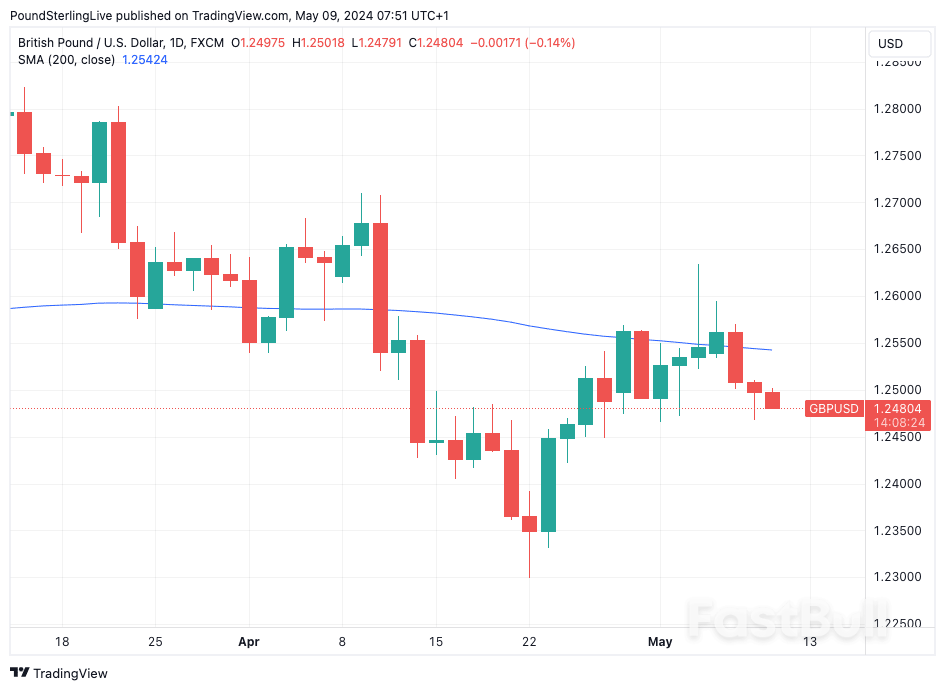
          The Pound to Dollar exchange rate has lost ground in the days leading up to today's decision, falling from 1.2539 on Monday to 1.2483 today.
          The exchange rate will recover recent losses and can potentially push beyond the 200-day moving average at 1.2542 if the Bank is unwilling to clearly commit to a June rate cut and ultimately leaves rates unchanged until September.
          The Bank's MPC members are divided, with some (Dave Ramsden) leaning into a nearer-term rate cut, while others like Huw Pill are still keen to watch incoming data for clear proof inflation is falling. Others such as Catherine Mann and Jonathan Haskell have indicated in recent speeches they remain unready to vote for imminent rate cuts.
          FX strategists at TD Securities say that in a 'hawkish' scenario Pound-Dollar could rise 0.45%. This would involve the Bank acknowledging recent upside surprises on services inflation support a slightly higher persistence of underlying domestic price pressures.
          "In turn, while the statement is largely copy-paste, it puts a bit more emphasis on the potential for high for longer policy moving forward," says James Rossiter, a strategist at TD Securities.
          Rossiter's base-case scenario heading into Thursday's MPC (55% odds) sees the MPC delivering another 8-1 vote to hold rates. Here, the statement is left largely unchanged, with the MPC reiterating that "the Committee will keep under review for how long Bank Rate should be maintained at its current level".
          Under this scenario, Pound-Dollar can recover by approximately 0.15%, according to TD Securities.
          Pound to Dollar Rate: 3 Bank of England Scenarios_1

          Above: GBP/USD at daily intervals.

          A downside scenario (25%) would see the Bank turn decidedly more 'dovish'. "The statement is tweaked slightly to indicate that policymakers are becoming more confident that persistent inflationary pressures are fading. In turn, the Committee's inflation forecasts are lower, in part due to a further step down in the assumption for inflation persistence," says Rossiter.
          Here, the Pound could fall 0.35% against the Dollar.
          "Our base case remains for an 8-1 vote today, with risk of 7-2, should Dave Ramsden join Swati Dhingra in voting for a rate cut. A 6-3 vote would surely be a big dovish surprise today and hit sterling," says Chris Turner, an analyst at ING.
          At some point this summer, ING expects sterling to sell off, as the market accepts the Bank of England will follow the ECB/euro cycle rather than the Fed/dollar. "The question is whether BoE communication today triggers that adjustment or the adjustment happens in June," says Turner.
          "We do not expect the recent data flow to prevent the BoE from delivering a more dovish policy signal this week indicating they are moving closer to cutting rates," says Derek Halpenny, Head of FX Research at MUFG Bank Ltd. "A more dovish BoE policy update poses downside risks for the pound in the week ahead."
          However, Hardman says improving cyclical momentum for the UK economy and still supportive conditions for higher-yielding carry currencies should prevent a sharper sell-off for the GBP.
          Shreyas Gopal, a strategist at Deutsche Bank, says a recent dovish repricing of the UK shorter-term bond yields over the past few sessions has left a cut by June half-priced.
          Once the cut is fully priced, the selling can ease and we would not be surprised to see a "buy the fact" reaction by the Pound in the coming days.

          Source: Poundsterlinglive

          To stay updated on all economic events of today, please check out our Economic calendar
          Risk Warnings and Disclaimers
          You understand and acknowledge that there is a high degree of risk involved in trading. Following any strategies or investment methods may lead to potential losses. The content on the site is provided by our contributors and analysts for information purposes only. You are solely responsible for determining whether any trading assets, securities, strategy, or any other product is suitable for investing based on your own investment objectives and financial situation.
          Add to Favorites
          Share

          Decoding Australia's Economic Conundrum: A Deep Dive into RBA's Rate Decision and Market Turbulence

          Samantha Luan

          Economic

          Central Bank

          As I sit down to discuss the recent events affecting Australia, I can't help but feel a sense of urgency and concern. The situation unfolding in our country demands our attention, and it's far from amusing. From economic instability to uncertain forecasts, there's a lot to unpack. So, let's delve into it together and shed some light on what's really going on Down Under.
          Now, let's address the elephant in the room: the recent RBA rate decision. As anticipated, the rates were left unchanged, but what followed was nothing short of a disaster. The RBA's statements regarding inflation left much to be desired, with targets seeming more like wishful thinking than actionable goals. As someone deeply entrenched in the market, I can't help but feel alarmed by the lack of clarity and direction.
          Inflation, a key economic indicator, remains stubbornly high, despite reassurances from the RBA. Their repeated claims of inflation decreasing ring hollow when real-world data tells a different story. It's like watching a horror movie unfold before our eyes, with uncertainty looming over every economic move.
          One of the glaring issues is the disconnect between the RBA's actions and the reality on the ground. While they preach about blunting aggregate demand with higher rates, the evidence suggests otherwise. Excess demand persists, alongside skyrocketing domestic cost pressures, painting a bleak picture of our economic landscape.
          And let's not even get started on the labor market. While the RBA talks about sustaining full employment, the reality is far from rosy. Uncertainty reigns supreme, with no clear path forward in sight. It's a game of economic roulette, and we're all holding our breath, waiting for the inevitable.
          But amidst the chaos, there's a glimmer of hope. Despite the uncertainty, forecasts indicate a return to the target inflation range by the second half of 2025. While this may seem like a distant light at the end of a dark tunnel, it's something to hold onto amidst the storm.
          So, where do we go from here? The answer isn't simple, but one thing is clear: we need decisive action. It's time for the RBA to step up and provide real solutions to real problems. We can't afford to continue down this path of uncertainty and ambiguity.
          As I wrap up, I urge you to form your own opinions based on the information presented here. The Australian economy is at a crossroads, and your insights matter now more than ever.

          Source: ACY

          To stay updated on all economic events of today, please check out our Economic calendar
          Risk Warnings and Disclaimers
          You understand and acknowledge that there is a high degree of risk involved in trading. Following any strategies or investment methods may lead to potential losses. The content on the site is provided by our contributors and analysts for information purposes only. You are solely responsible for determining whether any trading assets, securities, strategy, or any other product is suitable for investing based on your own investment objectives and financial situation.
          Add to Favorites
          Share

          Pound Tacks Lower Amidst pre-Bank of England Jitters

          Owen Li

          Economic

          Similar weakness has been seen in the days leading up to previous Bank of England decisions and speaks of investor nervousness of a Bank that has a tendency to err on the 'dovish' side. By this, we mean the Bank has often proven hesitant to raise interest rates when it needs to but is keen to cut rates at the first opportunity.
          That first opportunity is coming closer, with the Bank of England's Governor and Deputy Governor recently giving speeches that raise the odds of a June interest rate cut.
          "We still expect the European Central Bank and the Bank of England to lower rates in June," says Ben May, Director of Global Macro Research at Oxford Economics.
          Although the market is fully priced for a June cut from the ECB, it only sees 50/50 odds of a similar move from the Bank of England; the Pound's recent weakness is a result of investors raising bets of such an eventuality.
          Expect more losses tomorrow if market pricing moves more convincingly to the June start date, as a full repricing will demand a weaker Pound.
          George Vessey, Senior FX Strategist at Convera says one-month euro-sterling risk reversals reached a fresh 6-month high amid bearish bets on the UK currency. "This means more traders are hedging against the risk of the pound depreciating against the euro as opposed to appreciating," he explains.
          "We do not expect the recent data flow to prevent the BoE from delivering a more dovish policy signal this week indicating they are moving closer to cutting rates," says Derek Halpenny, Head of FX Research at MUFG Bank Ltd. "A more dovish BoE policy update poses downside risks for the pound in the week ahead."
          The Pound to Euro exchange rate fell a third of a per cent on Tuesday as investors prepare for such a dovish shift from the Bank that will include another member of the Monetary Policy Committee voting for a cut, while inflation forecasts will be lowered in the Monetary Policy Report.
          The statement will also potentially hint that risks are now balanced to downside surprises in inflation and there could also be a clear reference to the next move being a cut.
          Paul Spirgel, a Reuters market analyst, says the Thursday announcement "may upset the applecart for sterling bulls." Though Reuters polling indicates traders expect interest rates kept on hold, nine out of 29 analysts polled project a second vote on the MPC to cut rates.
          "Should the BoE vote be interpreted as a dovish hold... the April 22 low is back in focus," says Spirgel.
          However, MUFG's Hardman says improving cyclical momentum for the UK economy and still supportive conditions for higher-yielding carry currencies should prevent a sharper sell-off for the GBP.
          Shreyas Gopal, a strategist at Deutsche Bank, says a recent dovish repricing of the UK shorter-term bond yields over the past few sessions has left a cut by June half-priced.
          Once the cut is fully priced, the selling can ease and we would not be surprised to see a "buy the fact" reaction by the Pound in the coming days.
          Weakness against the Euro is likely to be limited as the European Central Bank is fully expected to cut interest rates in June, with further cuts likely in the coming months. With the two central banks likely to follow a similar path any outsized moves in Pound-Euro can be faded.

          Source: Pound Sterling

          To stay updated on all economic events of today, please check out our Economic calendar
          Risk Warnings and Disclaimers
          You understand and acknowledge that there is a high degree of risk involved in trading. Following any strategies or investment methods may lead to potential losses. The content on the site is provided by our contributors and analysts for information purposes only. You are solely responsible for determining whether any trading assets, securities, strategy, or any other product is suitable for investing based on your own investment objectives and financial situation.
          Add to Favorites
          Share
          FastBull
          Copyright © 2025 FastBull Ltd

          728 RM B 7/F GEE LOK IND BLDG NO 34 HUNG TO RD KWUN TONG KLN HONG KONG

          TelegramInstagramTwitterfacebooklinkedin
          App Store Google Play Google Play
          Products
          Charts

          Chats

          Q&A with Experts
          Screeners
          Economic Calendar
          Data
          Tools
          Membership
          Features
          Function
          Markets
          Copy Trading
          Latest Signals
          Contests
          News
          Analysis
          24/7
          Columns
          Education
          Company
          Careers
          About Us
          Contact Us
          Advertising
          Help Center
          Feedback
          User Agreement
          Privacy Policy
          Business

          White Label

          Data API

          Web Plug-ins

          Poster Maker

          Affiliate Program

          Risk Disclosure

          The risk of loss in trading financial instruments such as stocks, FX, commodities, futures, bonds, ETFs and crypto can be substantial. You may sustain a total loss of the funds that you deposit with your broker. Therefore, you should carefully consider whether such trading is suitable for you in light of your circumstances and financial resources.

          No decision to invest should be made without thoroughly conducting due diligence by yourself or consulting with your financial advisors. Our web content might not suit you since we don't know your financial conditions and investment needs. Our financial information might have latency or contain inaccuracy, so you should be fully responsible for any of your trading and investment decisions. The company will not be responsible for your capital loss.

          Without getting permission from the website, you are not allowed to copy the website's graphics, texts, or trademarks. Intellectual property rights in the content or data incorporated into this website belong to its providers and exchange merchants.

          Not Logged In

          Log in to access more features

          FastBull Membership

          Not yet

          Purchase

          Become a signal provider
          Help Center
          Customer Service
          Dark Mode
          Price Up/Down Colors

          Log In

          Sign Up

          Position
          Layout
          Fullscreen
          Default to Chart
          The chart page opens by default when you visit fastbull.com