• Trade
  • Markets
  • Copy
  • Contests
  • News
  • 24/7
  • Calendar
  • Q&A
  • Chats
Trending
Screeners
SYMBOL
LAST
BID
ASK
HIGH
LOW
NET CHG.
%CHG.
SPREAD
SPX
S&P 500 Index
6827.42
6827.42
6827.42
6899.86
6801.80
-73.58
-1.07%
--
DJI
Dow Jones Industrial Average
48458.04
48458.04
48458.04
48886.86
48334.10
-245.98
-0.51%
--
IXIC
NASDAQ Composite Index
23195.16
23195.16
23195.16
23554.89
23094.51
-398.69
-1.69%
--
USDX
US Dollar Index
97.900
97.980
97.900
98.070
97.890
-0.050
-0.05%
--
EURUSD
Euro / US Dollar
1.17416
1.17424
1.17416
1.17447
1.17262
+0.00022
+ 0.02%
--
GBPUSD
Pound Sterling / US Dollar
1.33813
1.33822
1.33813
1.33821
1.33546
+0.00106
+ 0.08%
--
XAUUSD
Gold / US Dollar
4349.38
4349.72
4349.38
4349.39
4294.68
+49.99
+ 1.16%
--
WTI
Light Sweet Crude Oil
57.448
57.478
57.448
57.601
57.194
+0.215
+ 0.38%
--

Community Accounts

Signal Accounts
--
Profit Accounts
--
Loss Accounts
--
View More

Become a signal provider

Sell trading signals to earn additional income

View More

Guide to Copy Trading

Get started with ease and confidence

View More

Signal Accounts for Members

All Signal Accounts

Best Return
  • Best Return
  • Best P/L
  • Best MDD
Past 1W
  • Past 1W
  • Past 1M
  • Past 1Y

All Contests

  • All
  • Trump Updates
  • Recommend
  • Stocks
  • Cryptocurrencies
  • Central Banks
  • Featured News
Top News Only
Share

Ivory Coast 2025/26 Cocoa Arrivals Reached 894000 T By December 14 Versus 895000 T Year Ago - Exporters' Estimate

Share

Ishares MSCI Chile ETF Up 3.9% Premarket After Jose Antonio Kast Wins Chile's Presidential Election On Sunday

Share

Spain's Debt-To-GDP Ratio Falls To 103.2% In Third Quarter 2025

Share

China's Central Bank: Authorises DBS Bank As Yuan Clearing Bank In Singapore

Share

Bank Of Korea - South Korea Central Bank, Nps Agree To Extend Currency Swap Agreement For Another Year

Share

Poland's CPI At 0.1% Month-On-Month In November Versus 0.1% Released Earlier

Share

London Metal Exchange (LME): Copper Inventories Decreased By 25 Tons, Aluminum Inventories Decreased By 50 Tons, Nickel Inventories Increased By 360 Tons, Zinc Inventories Increased By 2,550 Tons, Lead Inventories Increased By 17,725 Tons, And Tin Inventories Increased By 125 Tons

Share

Polish Inflation At 2.5% Year-On-Year In November

Share

Poland's January-October Import Up 5.4% To 309.3 Billion Euros

Share

Poland's January-October Trade Balance At -5.1 Billion Euros

Share

Poland's January-October Export Up 2.8% To 304.3 Billion Euros

Share

Ceasefire Negotiations Between Ukraine And US Representatives In Berlin To Continue Monday Morning - German Source Familiar With The Schedule

Share

Spain's IBEX Hits Fresh Record High, Up Over 1%

Share

Spot Silver Rises Nearly 3% To $63.82/Oz

Share

France's Foreign Minister Says He Suggesd To EU's Kallas That US Representatives Brief EU Foreign Ministers On Gaza Peace Plan During Their Meeting

Share

India Trade Secretary: Prime Facie Don't See A Case Of Rice Dumping To USA And There Is No Active Investigation On That

Share

India Trade Secretary: India's Rice Exported To USA Largely Limited To Basmati And At Price Higher Than General Price Of Rice

Share

India Trade Secretary: India Can Raise Shipments To Russia In Sectors Like Automobiles And Pharmaceuticals

Share

India Trade Secretary:India-Oman Trade Deal Completed And Will Be Signed Soon

Share

Burberry Shares Top FTSE Gainer, Up 3.5% In Positive European Luxury Sector

TIME
ACT
FCST
PREV
France HICP Final MoM (Nov)

A:--

F: --

P: --

China, Mainland Outstanding Loans Growth YoY (Nov)

A:--

F: --

P: --

China, Mainland M2 Money Supply YoY (Nov)

A:--

F: --

P: --

China, Mainland M0 Money Supply YoY (Nov)

A:--

F: --

P: --

China, Mainland M1 Money Supply YoY (Nov)

A:--

F: --

P: --

India CPI YoY (Nov)

A:--

F: --

P: --

India Deposit Gowth YoY

A:--

F: --

P: --

Brazil Services Growth YoY (Oct)

A:--

F: --

P: --

Mexico Industrial Output YoY (Oct)

A:--

F: --

P: --

Russia Trade Balance (Oct)

A:--

F: --

P: --

Philadelphia Fed President Henry Paulson delivers a speech
Canada Building Permits MoM (SA) (Oct)

A:--

F: --

P: --

Canada Wholesale Sales YoY (Oct)

A:--

F: --

P: --

Canada Wholesale Inventory MoM (Oct)

A:--

F: --

P: --

Canada Wholesale Inventory YoY (Oct)

A:--

F: --

P: --

Canada Wholesale Sales MoM (SA) (Oct)

A:--

F: --

P: --

Germany Current Account (Not SA) (Oct)

A:--

F: --

P: --

U.S. Weekly Total Rig Count

A:--

F: --

P: --

U.S. Weekly Total Oil Rig Count

A:--

F: --

P: --

Japan Tankan Small Manufacturing Outlook Index (Q4)

A:--

F: --

P: --

Japan Tankan Large Non-Manufacturing Diffusion Index (Q4)

A:--

F: --

P: --

Japan Tankan Large Non-Manufacturing Outlook Index (Q4)

A:--

F: --

P: --

Japan Tankan Large Manufacturing Outlook Index (Q4)

A:--

F: --

P: --

Japan Tankan Small Manufacturing Diffusion Index (Q4)

A:--

F: --

P: --

Japan Tankan Large Manufacturing Diffusion Index (Q4)

A:--

F: --

P: --

Japan Tankan Large-Enterprise Capital Expenditure YoY (Q4)

A:--

F: --

P: --

U.K. Rightmove House Price Index YoY (Dec)

A:--

F: --

P: --

China, Mainland Industrial Output YoY (YTD) (Nov)

A:--

F: --

P: --

China, Mainland Urban Area Unemployment Rate (Nov)

A:--

F: --

P: --

Saudi Arabia CPI YoY (Nov)

A:--

F: --

P: --

Euro Zone Industrial Output YoY (Oct)

--

F: --

P: --

Euro Zone Industrial Output MoM (Oct)

--

F: --

P: --

Canada Existing Home Sales MoM (Nov)

--

F: --

P: --

Euro Zone Total Reserve Assets (Nov)

--

F: --

P: --

U.K. Inflation Rate Expectations

--

F: --

P: --

Canada National Economic Confidence Index

--

F: --

P: --

Canada New Housing Starts (Nov)

--

F: --

P: --

U.S. NY Fed Manufacturing Employment Index (Dec)

--

F: --

P: --

U.S. NY Fed Manufacturing Index (Dec)

--

F: --

P: --

Canada Core CPI YoY (Nov)

--

F: --

P: --

Canada Manufacturing Unfilled Orders MoM (Oct)

--

F: --

P: --

U.S. NY Fed Manufacturing Prices Received Index (Dec)

--

F: --

P: --

U.S. NY Fed Manufacturing New Orders Index (Dec)

--

F: --

P: --

Canada Manufacturing New Orders MoM (Oct)

--

F: --

P: --

Canada Core CPI MoM (Nov)

--

F: --

P: --

Canada Trimmed CPI YoY (SA) (Nov)

--

F: --

P: --

Canada Manufacturing Inventory MoM (Oct)

--

F: --

P: --

Canada CPI YoY (Nov)

--

F: --

P: --

Canada CPI MoM (Nov)

--

F: --

P: --

Canada CPI YoY (SA) (Nov)

--

F: --

P: --

Canada Core CPI MoM (SA) (Nov)

--

F: --

P: --

Canada CPI MoM (SA) (Nov)

--

F: --

P: --

Federal Reserve Board Governor Milan delivered a speech
U.S. NAHB Housing Market Index (Dec)

--

F: --

P: --

Australia Composite PMI Prelim (Dec)

--

F: --

P: --

Australia Services PMI Prelim (Dec)

--

F: --

P: --

Australia Manufacturing PMI Prelim (Dec)

--

F: --

P: --

Japan Manufacturing PMI Prelim (SA) (Dec)

--

F: --

P: --

U.K. Unemployment Claimant Count (Nov)

--

F: --

P: --

U.K. Unemployment Rate (Nov)

--

F: --

P: --

U.K. 3-Month ILO Unemployment Rate (Oct)

--

F: --

P: --

Q&A with Experts
    • All
    • Chatrooms
    • Groups
    • Friends
    Connecting
    .
    .
    .
    Type here...
    Add Symbol or Code

      No matching data

      All
      Trump Updates
      Recommend
      Stocks
      Cryptocurrencies
      Central Banks
      Featured News
      • All
      • Russia-Ukraine Conflict
      • Middle East Flashpoint
      • All
      • Russia-Ukraine Conflict
      • Middle East Flashpoint
      Search
      Products

      Charts Free Forever

      Chats Q&A with Experts
      Screeners Economic Calendar Data Tools
      Membership Features
      Data Warehouse Market Trends Institutional Data Policy Rates Macro

      Market Trends

      Market Sentiment Order Book Forex Correlations

      Top Indicators

      Charts Free Forever
      Markets

      News

      News Analysis 24/7 Columns Education
      From Institutions From Analysts
      Topics Columnists

      Latest Views

      Latest Views

      Trending Topics

      Top Columnists

      Latest Update

      Signals

      Copy Rankings Latest Signals Become a signal provider AI Rating
      Contests
      Brokers

      Overview Brokers Assessment Rankings Regulators News Claims
      Broker listing Forex Brokers Comparison Tool Live Spread Comparison Scam
      Q&A Complaint Scam Alert Videos Tips to Detect Scam
      More

      Business
      Events
      Careers About Us Advertising Help Center

      White Label

      Data API

      Web Plug-ins

      Affiliate Program

      Awards Institution Evaluation IB Seminar Salon Event Exhibition
      Vietnam Thailand Singapore Dubai
      Fans Party Investment Sharing Session
      FastBull Summit BrokersView Expo
      Recent Searches
        Top Searches
          Markets
          News
          Analysis
          User
          24/7
          Economic Calendar
          Education
          Data
          • Names
          • Latest
          • Prev

          View All

          No data

          Scan to Download

          Faster Charts, Chat Faster!

          Download App
          English
          • English
          • Español
          • العربية
          • Bahasa Indonesia
          • Bahasa Melayu
          • Tiếng Việt
          • ภาษาไทย
          • Français
          • Italiano
          • Türkçe
          • Русский язык
          • 简中
          • 繁中
          Open Account
          Search
          Products
          Charts Free Forever
          Markets
          News
          Signals

          Copy Rankings Latest Signals Become a signal provider AI Rating
          Contests
          Brokers

          Overview Brokers Assessment Rankings Regulators News Claims
          Broker listing Forex Brokers Comparison Tool Live Spread Comparison Scam
          Q&A Complaint Scam Alert Videos Tips to Detect Scam
          More

          Business
          Events
          Careers About Us Advertising Help Center

          White Label

          Data API

          Web Plug-ins

          Affiliate Program

          Awards Institution Evaluation IB Seminar Salon Event Exhibition
          Vietnam Thailand Singapore Dubai
          Fans Party Investment Sharing Session
          FastBull Summit BrokersView Expo

          Why A Rout in Government Bonds Is Worrying

          Damon

          Bond

          Economic

          Summary:

          The world's biggest bond markets are in the throes of another rout as a new era of higher for longer interest rates takes hold.
          The world's biggest bond markets are in the throes of another rout as a new era of higher for longer interest rates takes hold.
          In the U.S. Treasury market, the bedrock of the global financial system, 10-year bond yields have shot up to 16-year highs. In Germany, they touched their highest since the 2011-euro zone debt crisis. Even in Japan, where official rates are still below 0 per cent, bond yields are back at levels seen in 2013.
          Because government borrowing costs influence everything from mortgage rates for homeowners to loan rates for corporates, there's plenty of reason for angst.
          Here's a look at why the bond rout matters.
          Why are global bond yields rising?
          Markets are increasingly reckoning with interest rates staying high.
          With inflation excluding food and energy prices elevated and the U.S. economy resilient, central banks are pushing back against rate cut bets.
          Traders now see the Fed cutting rates to only 4.7 per cent from 5.25 per cent-5.50 per cent currently, up from the 4.3 per cent they anticipated in late August.
          That's compounding worries about the fiscal outlook following August's Fitch U.S. rating downgrade citing high deficit levels. Highly-indebted Italy raised its deficit target last week.
          Higher deficits mean more bond sales just as central banks offload their vast holdings, so longer-dated yields are rising as investors demand more compensation.
          Many investors were also betting bond yields would drop, so are extra sensitive to moves in the opposite direction, analysts say.
          How far could the selloff go?
          U.S. data remains resilient with Monday's upbeat manufacturing survey pushing Treasury yields up again.
          That is no surprise, and analysts do not rule out a rise in 10-year Treasury yields to 5 per cent, from 4.7 per cent now.
          When a bond yield rises, its price falls.
          But Europe's economy has deteriorated, so selling should be more limited there, as bonds typically do better when an economy weakens, and most big central banks have signalled they are done with rate increases.
          Germany's 10-year yield, at 2.9 per cent, could soon hit 3 per cent - another milestone considering yields were below 0 per cent in early 2022.
          Why does it matter and should we worry?
          U.S. 10-year Treasury yields have risen to their 230-year average for the first time since 2007, Deutsche Bank data shows, highlighting the challenge of adjusting to higher rates.
          Bond yields determine governments' funding costs, so the longer they stay high, the more they feed into the interest costs countries pay.
          That's bad news as government funding needs remain high. In Europe, slowing economies will limit how much governments can unwind fiscal support.
          But higher yields are welcome to central bankers, doing some of their work for them by raising market borrowing costs.
          U.S. financial conditions are at their most restrictive in nearly a year, a closely-watched Goldman Sachs index shows.
          What does it mean for global markets?
          The ripple effects are broad.
          First, rising yields set the stage for a third straight year of losses on global government bonds, hurting investors long betting on a turnaround.
          As for equities, the bond yield surge is starting to suck money away from buoyant markets. The S&P 500 is down roughly 7.5 per cent from more than one-year peaks hit in July.
          Focus could turn back to banks, big holders of government bonds sitting on unrealised losses, a risk put on the radar by Silicon Valley Bank's March collapse.
          "(The bond selloff) will have a strong impact on banks that hold long end Treasuries," said Mahmood Pradhan, head of macro at Amundi Investment Institute. "The longer it persists the more sectors it will hit."
          Higher U.S. yields also mean an ever stronger dollar, piling pressure on other currencies, especially Japan's yen.
          Should emerging markets be worried?
          Yes. Rising global yields have ramped up the pressure on emerging markets, especially higher-yielding riskier economies.
          The additional yield junk-rated governments pay on their hard-currency debt on top of safe-haven U.S. Treasuries has risen to over 800 basis points, according to JPMorgan, more than 70 bps higher from their Aug. 1 trough. "The intensification of the higher-for-longer narrative, along with the rise in oil prices, has also been the primary driver of broad U.S. dollar strength," said Andrea Kiguel, head of FX and EM macro strategy, Americas at Barclays.
          "The speed of the move has lead to weaker currencies within the region, a violent sell-off in local rates and wider EM credit spreads."

          Source: Reuters

          To stay updated on all economic events of today, please check out our Economic calendar
          Risk Warnings and Disclaimers
          You understand and acknowledge that there is a high degree of risk involved in trading. Following any strategies or investment methods may lead to potential losses. The content on the site is provided by our contributors and analysts for information purposes only. You are solely responsible for determining whether any trading assets, securities, strategy, or any other product is suitable for investing based on your own investment objectives and financial situation.
          Comments
          Add to Favorites
          Share

          As US Yields Surge, How High Can They Go?

          XM

          Economic

          Bond

          Yields heeding the higher for longer message
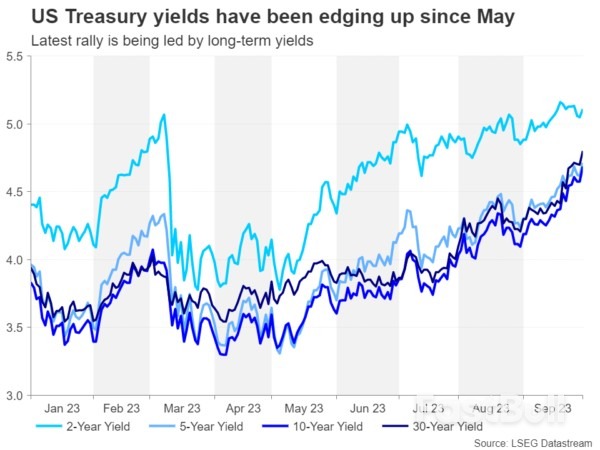
          Yields on government bonds are flying again as central banks are all singing from the same hymn sheet lately, flagging that interest rates will stay high for a longer period of time. This isn't exactly a new revelation for investors but more recently, the message has started to sink in deeper as the combination of persistent price pressures and resilient economies has taken everyone by surprise.
          As US Yields Surge, How High Can They Go?_1With rates potentially yet to peak in the United States and elsewhere, government bond yields have been rallying since May when the U.S. banking turmoil began to dissipate. However, this latest leg of the rally isn't so much driven by expectations of where interest rates will peak but more about how long they will stay at elevated levels.
          There may be more tightening to come
          The Federal Reserve and even the European Central Bank may yet have to tighten further, but it's unlikely this would involve anything more than a 25-basis-point hike. What's gotten markets so jittery is the prospect of rates staying near current levels for an extended duration. That is why long-dated government bonds have borne the brunt of the latest selloff, pushing 10-year yields to more-than-decade highs.
          The last time the 10-year Treasury yield was above 4.8% was at the onset of the global financial crisis in the summer of 2007. Not long after that, rock-bottom rates became the norm. This highlights just how markedly the inflation picture has altered since the pandemic, with the supply and energy shocks irreversibly lifting prices.
          Job not done yet on inflation
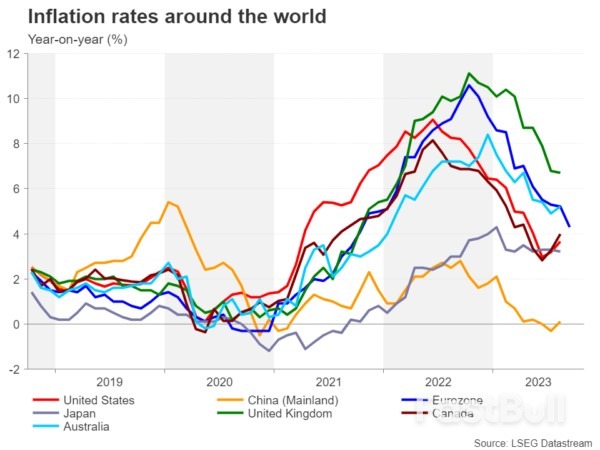
          However, falling inflation has been the big story of 2023 – so why are the Fed and other central banks still thinking about hiking further? The problem is that despite good progress, inflation in most places has some distance to cover before reaching the 2% target. In the U.S., the core PCE measure of inflation stood at 3.9% in August – almost double the Fed's objective.
          As US Yields Surge, How High Can They Go?_2Inflation may have come down sharply over the past year as the energy crisis subsided, but the next phase may take a lot longer. There are several factors that could prevent inflation from dropping all the way down to 2% in a quick manner and they vary in each country. In America, it is the tight labour market and robust consumer spending.
          The elusive soft landing
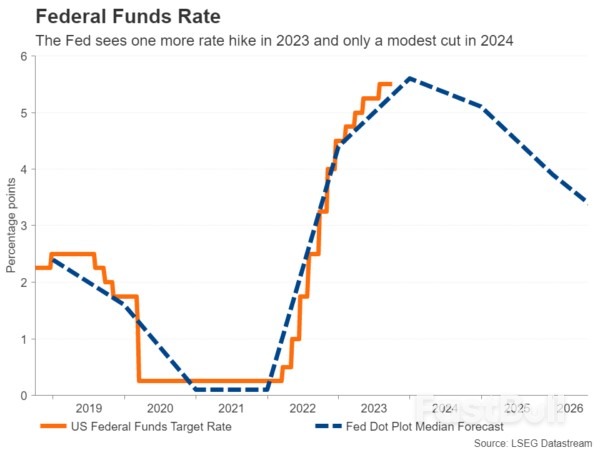
          The Fed is in a tricky spot at the moment when it comes to correctly gauging how restrictive policy has become. It risks tightening more than it has to should it act solely on the actual data, or doing too little should its caution on the basis that there are transmission lags in monetary policy prove to be a miscalculation. With various measures of inflation expectations converging slightly above 2% and hiring slowing down lately, the Fed seems to be taking its chances with the latter option.
          But this is not the entire explanation. The Fed is desperate to engineer a soft landing for the economy, which comes at a price as it would necessitate taking a more patient approach to hitting the 2% target in a sustainable manner. Policymakers are thus effectively making a conscious decision to let inflation run above target for longer so as not to choke off economic growth.
          What this means for monetary policy, however, is that whilst rates would peak somewhat lower, they're less likely to be cut sooner. For the U.S. where the economy continues to display remarkable resilience, this is even more significant as any cut would risk fuelling renewed inflationary pressures.
          Is the only way up for yields?
          The recent gains in Treasury yields may be a reflection of this realisation by investors. The question now is, can yields rise further, and if so, at what point will higher yields inflict some serious damage on the economy?
          For the moment, neither consumption nor the labour market are showing any major signs of cracks. Should this still be the case by December, the Fed may well end the year with another rate increase. Not only that, but the Fed might also lift its projected rate path again, spurring another rally in long-term yields.
          As US Yields Surge, How High Can They Go?_3Assuming that the outlook in Europe and elsewhere doesn't improve, the U.S. dollar would be in a position to appreciate further, while there could be more pain in store for U.S. equities. So far though, the upside surprises in the economic data, the artificial intelligence (AI) mania as well as the defensive nature of many tech stocks have all contributed to driving Wall Street indices higher even as financial conditions have tightened.
          Small cracks are appearing in the economy
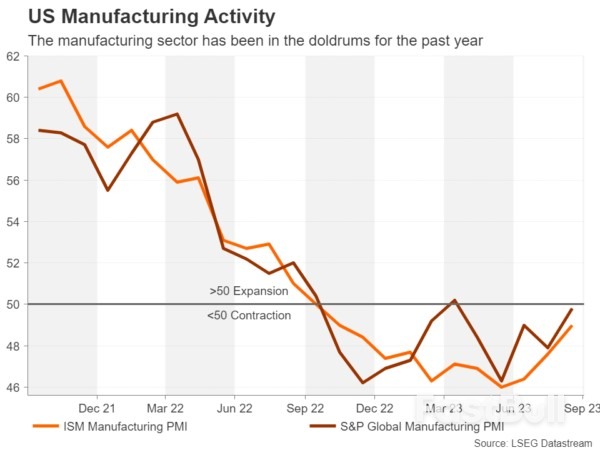
          But it's hard to see this picture lasting once the 10-year yield nears the 5.0% level. Looking under the hood, there are several signs of trouble brewing. The manufacturing sector is contracting, and banks are lending less, hitting struggling businesses and new investment. Households have almost drawn down on their excess savings and this coincides with an increase in the number of households unable to pay their credit card debts. In addition, Americans will soon have to start repaying their student loans as the pandemic support expires.
          As US Yields Surge, How High Can They Go?_4Resurgent oil prices are another worry as they threaten to push up costs again just as the pain was easing. Not to forget the slowdown in Europe and China that's bound to affect the earnings for U.S. multinationals, all this could yet kill any momentum in the economy, if not tip it into recession.
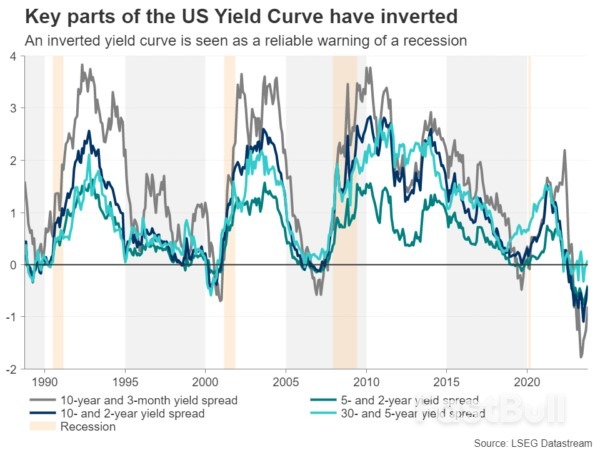
          Is a recession only delayed, not cancelled?
          For now, the expectation of a soft landing is maintaining the upward pressure on yields, while the deluge of new debt issuance by the Treasury Department is worsening the rout in the bond market. Unless there's a sharp deterioration in the outlook, it is difficult to envisage bond yields retreating substantially in the near future.
          As US Yields Surge, How High Can They Go?_5The danger is that the risk of a recession may not be as low as policymakers and investors would like to believe. The inverted yield curve continues to flash red even though the gap between long- and short-term yields has narrowed over the last few months. The other cause of concern is that in the past, calls for a soft landing have often tended to precede recessions and what may be happening now is simply the timing of one being pushed further and further back.
          Yields vs stocks
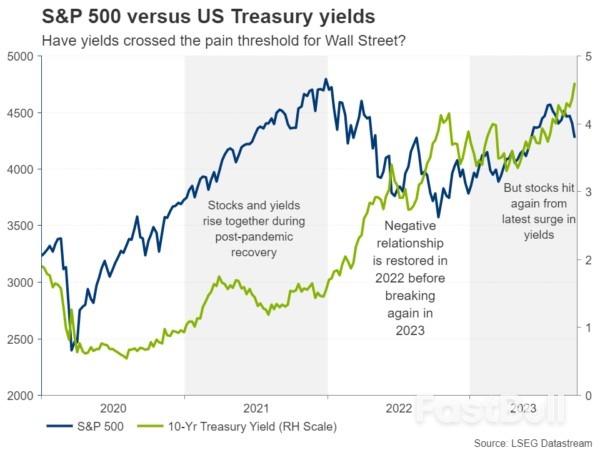
          Adding to the confusion is the broken negative relationship between Treasury yields and the stock market. When yields reach a cycle peak, stocks traditionally enter a bear market. However, during the post-pandemic recovery, the S&P 500 and the 10-year yield rallied in tandem.As US Yields Surge, How High Can They Go?_6
          The negative relationship corrected itself last year when Wall Street declined and yields kept rising, but it broke again in the first half of 2023. Since September, however, yields and stocks have gone their opposite ways once more, in a possible sign that yields may have already reached the pain threshold for Wall Street. Does this hold true for the economy as well?
          To stay updated on all economic events of today, please check out our Economic calendar
          Risk Warnings and Disclaimers
          You understand and acknowledge that there is a high degree of risk involved in trading. Following any strategies or investment methods may lead to potential losses. The content on the site is provided by our contributors and analysts for information purposes only. You are solely responsible for determining whether any trading assets, securities, strategy, or any other product is suitable for investing based on your own investment objectives and financial situation.
          Comments
          Add to Favorites
          Share

          Global Bond Rout Upending Markets Shows No Signs of Abating

          Thomas

          Economic

          Bond

          A sell-off in global bond markets gathered pace, driving yields to the highest level in more than a decade, as traders braced for an extended period of tight monetary policy.
          The yield on 30-year U.S. Treasuries hit 5% for the first time since 2007 on Wednesday, while the German 10-year benchmark rate climbed to 3% — a level unseen since 2011. In Japan, the 10-year overnight-indexed swaps jumped to 1% for the first time since January.
          Investors are demanding ever higher compensation to hold long-dated debt after major central banks made clear they were unlikely to ease policy any time soon. Concerns about increased Treasury issuance to fund swelling budget deficits have also weighed on longer securities.
          "U.S. yields at highs for the year are starting to look disruptive for other regions and sectors in global fixed income," HSBC Holdings plc strategist Steven Major wrote in a note to clients.
          The volatility has also spilled over into equities and is spreading to corporate notes, with at least two borrowers standing down from issuing on Tuesday, as blue-chip yields reached a 2023 high of 6.15%. The largest speculative-grade bond exchange traded fund was hit by the biggest two-day slump this year.
          "These moves are starting to cause worries across all asset classes," said James Wilson, a money manager at Jamieson Coote Bonds Pty in Melbourne. "There's a buyer's strike at the moment, and no one wants to step in front of rising yields, despite getting to quite oversold levels."
          Bond losses accelerated on Tuesday after an unexpected jump in job openings reinforced speculation that the U.S. Federal Reserve isn't done raising interest rates. The term premium on 10-year U.S. notes turned positive for the first time since June 2021.
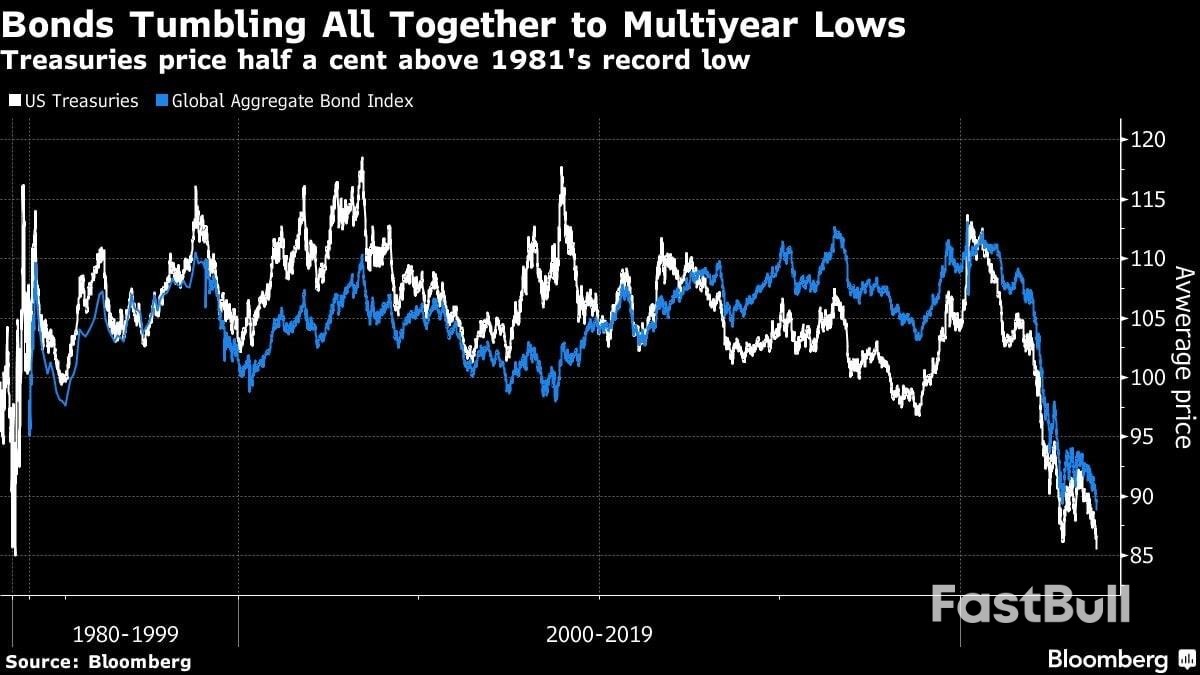
          Global bonds are now down 3.5% in 2023, while ICE's BofA MOVE Index for Treasuries volatility jumped to the highest since May on Tuesday. The average price of bonds in the Bloomberg U.S. Treasury Index has tumbled to 85.5 cents on the dollar, half a cent above the record low in 1981.
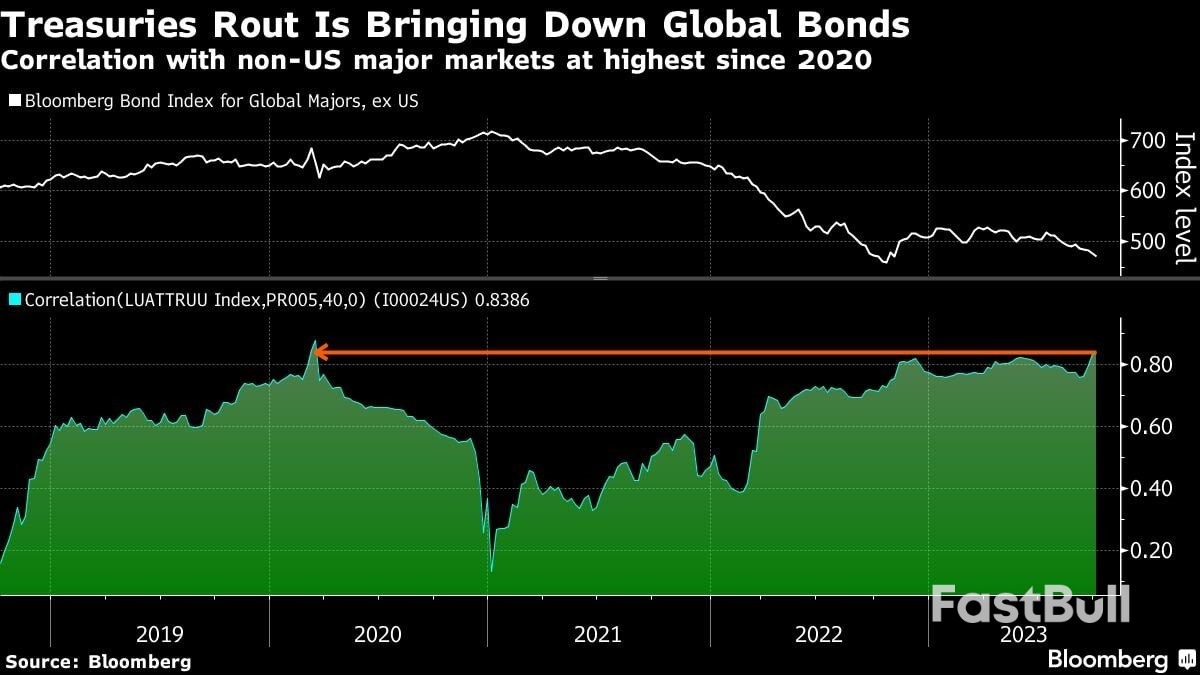
          Global Bond Rout Upending Markets Shows No Signs of Abating_1European yields followed their U.S. counterparts higher, with the correlation between Bloomberg's gauge of global securities and an index of Treasuries reaching the highest since March 2020.
          "U.S. treasury and European sovereigns are correlated," says Althea Spinozzi, a senior fixed income strategist at Saxo Bank. "A move higher in U.S. yields will push higher European sovereign yields as well, despite Europe's recession deepening."
          Yields on some of Asia's emerging-market bonds were also dragged higher. The Indonesian benchmark climbed to levels last seen in November.
          "Long emerging-market durations are a pain trade for most real money investors," analysts including Min Dai, the head of Asia macro strategy at Morgan Stanley, wrote in a note. Such positioning "increases the vulnerability of the market, especially if U.S. Treasury rates continue to march higher".
          Global Bond Rout Upending Markets Shows No Signs of Abating_2But the very shortest end of the Treasury market still looks attractive to some. An enlarged 52-week bill sale on Tuesday attracted record demand from non-dealers, as investors locked in a yield above 5% for the next year.
          Current yield levels will "suck capital away from the more risky asset classes, as investors do not need to move along the risk spectrum to generate attractive returns", Wilson from Jamieson Coote said.
          "Ultimately, we believe in the path higher, but it's unlikely to be linear," said Scott Solomon, a money manager at T Rowe Price, who last week flagged the potential for 10-year yields to test 5.5%. "There's a bit of a back and forth between some traditional bond buyers who have been forced into a bit of a buyers' strike when it comes to duration versus those who view the yield levels as a good long-term opportunity."
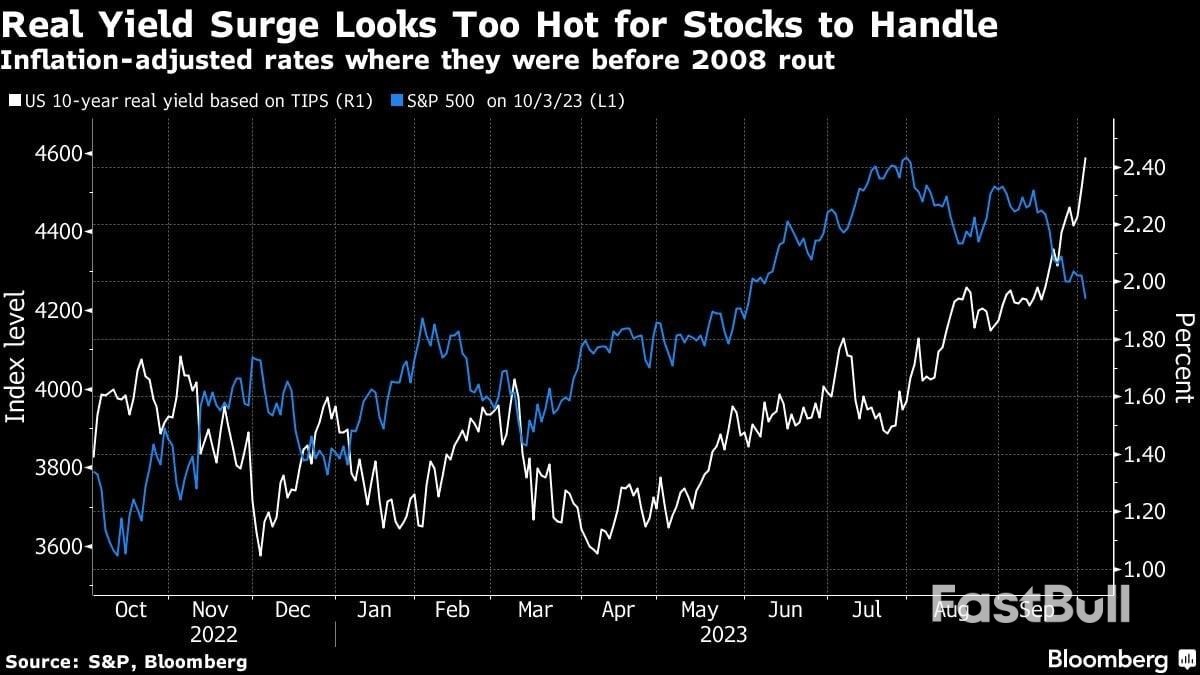
          Global Bond Rout Upending Markets Shows No Signs of Abating_3The rout has also sent so-called real yields to multi-year highs, with the 10-year U.S. inflation-adjusted rate climbing above 2.4% to the sort of levels reached in 2007 just before U.S. equities topped out.
          "Sharp moves upwards in real yields always lead to deratings of the equity market," said Amy Xie Patrick, the head of income strategies at Pendal Group in Sydney. Cash is the best place to seek protection, she said.

          Source: Bloomberg

          To stay updated on all economic events of today, please check out our Economic calendar
          Risk Warnings and Disclaimers
          You understand and acknowledge that there is a high degree of risk involved in trading. Following any strategies or investment methods may lead to potential losses. The content on the site is provided by our contributors and analysts for information purposes only. You are solely responsible for determining whether any trading assets, securities, strategy, or any other product is suitable for investing based on your own investment objectives and financial situation.
          Comments
          Add to Favorites
          Share

          Technical Outlook and Review

          IC Markets

          Forex

          Stocks

          Cryptocurrency

          DXYTechnical Outlook and Review_1
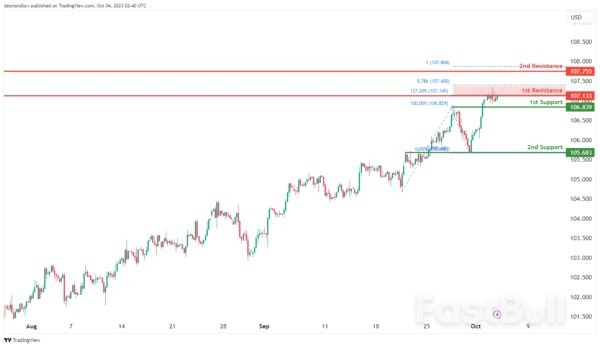
          The DXY chart currently has a bearish overall momentum. There's a potential scenario of price fluctuating between the 1st resistance and 1st support levels.
          The 1st support at 106.83 is considered a pullback support, while the 2nd support at 105.68 is an overlap support.
          On the resistance side, the 1st resistance at 107.13 is marked as a multi-swing high resistance with the presence of the 127.20% Fibonacci Extension and 78.60% Fibonacci Projection, suggesting Fibonacci confluence. Additionally, the 2nd resistance at 107.75 is a swing high resistance with the 100% Fibonacci Projection.
          EUR/USDTechnical Outlook and Review_2
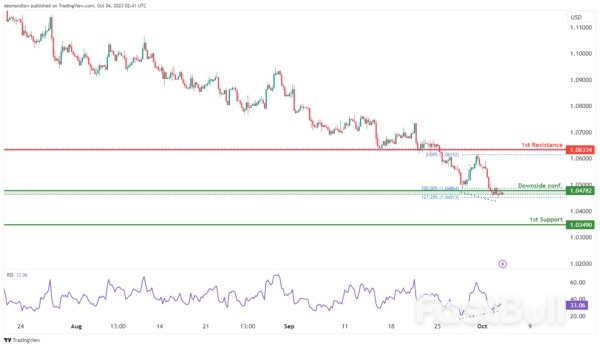
          The EUR/USD chart currently shows a bearish momentum, and there is a potential scenario of a bearish continuation towards the 1st support level at 1.0349. This support level is significant as it aligns with the 127.20% Fibonacci Extension, indicating potential support.
          Additionally, the 2nd support at 1.0478 is identified as a swing low support, further reinforcing its importance as a potential support level.
          On the resistance side, the 1st resistance level at 1.0633 is categorized as an overlap resistance, which could act as a barrier to upward movements.
          Moreover, the RSI is displaying bullish divergence versus price, suggesting the possibility of a bounce in the near future. This indicates that despite the bearish momentum, there might be a temporary reversal or retracement.
          EUR/JPYTechnical Outlook and Review_3
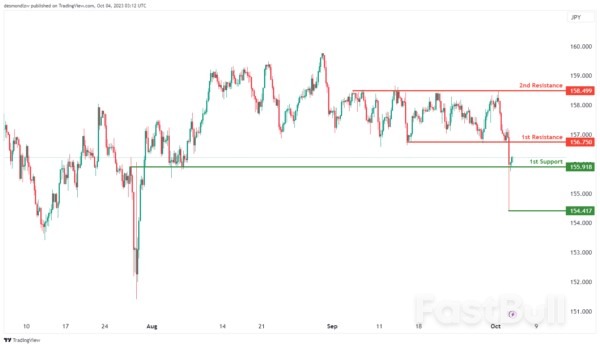
          The EUR/JPY chart currently demonstrates bullish momentum, indicating the potential for a bullish bounce off the 1st support level towards the 1st resistance. The 1st support at 155.91 is considered significant, marked as an overlap support. Additionally, the 2nd support at 154.41 serves as a swing low support, further emphasizing its importance as a potential price support level.
          On the resistance side, the 1st resistance at 156.75 is characterized as a pullback resistance, potentially limiting further upward movements. The 2nd resistance at 158.49 is identified as a multi-swing high resistance, suggesting it may act as a significant barrier to bullish price movements.
          EUR/GBPTechnical Outlook and Review_4
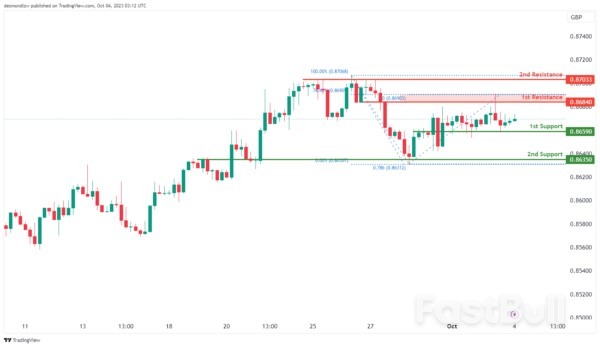
          The EUR/GBP chart is currently showing neutral momentum, suggesting a potential scenario where the price could fluctuate between the 1st support and 1st resistance levels. The 1st support at 0.8659 is considered significant as it's identified as an overlap support, making it a crucial level for potential price support. Similarly, the 2nd support at 0.8635 is also categorized as an overlap support, reinforcing its importance as a potential support zone.
          On the resistance side, the 1st resistance level at 0.8684 is recognized as an overlap resistance and is associated with the 78.60% Fibonacci Retracement, suggesting it may act as a barrier to price increases. The 2nd resistance at 0.8703 is identified as a multi-swing high resistance, emphasizing its significance in potential price reversals.
          GBP/USDTechnical Outlook and Review_5
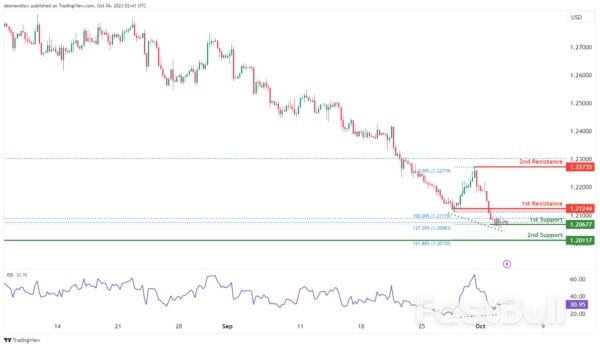
          The GBP/USD chart currently exhibits a bullish momentum, and there is a potential scenario of a bullish bounce off the 1st support level at 1.2067. This support level is considered significant as it aligns with the 127.20% Fibonacci Extension. Furthermore, the 2nd support at 1.2011 is identified as a swing low support and coincides with the 161.80% Fibonacci Extension, reinforcing its importance.
          On the resistance side, the 1st resistance at 1.2124 is characterized as an overlap resistance, suggesting it may act as a barrier to bullish movements. Beyond this, the 2nd resistance at 1.2273 is recognized as a swing high resistance, indicating its significance in potential price reversals.
          Additionally, the RSI is displaying bullish divergence versus price, implying the possibility of a forthcoming bounce.
          GBP/JPYTechnical Outlook and Review_6
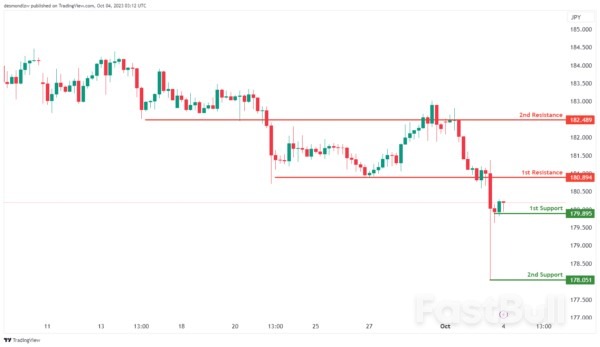
          The GBP/JPY chart currently has a bullish momentum, indicating a potential scenario where the price could experience a bullish bounce off the 1st support and move towards the 1st resistance level. The 1st support at 179.89 is considered significant as it aligns with a swing low support level. Additionally, the 2nd support at 178.05 is another swing low support, further reinforcing its importance as a potential area of price support.
          On the resistance side, the 1st resistance level at 180.89 is identified as a pullback resistance, potentially limiting upward movements. Beyond this, the 2nd resistance at 182.48 is categorized as an overlap resistance, suggesting it may act as a barrier to further bullish movements.
          USD/CHFTechnical Outlook and Review_7
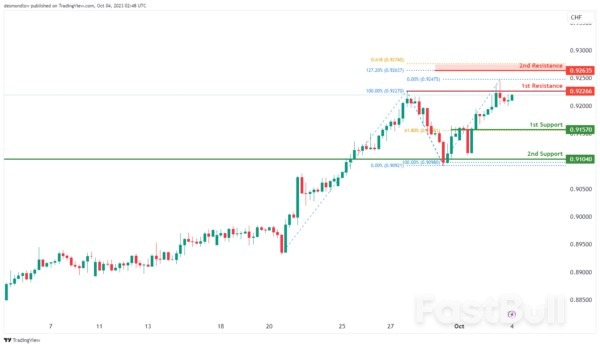
          The USD/CHF chart currently has a bearish momentum, and there is a potential scenario of a bearish reaction off the 1st resistance level at 0.9226, which is supported by the presence of the 50% Fibonacci retracement. This resistance level could lead to a drop towards the 1st support at 0.9157, which is considered significant due to its alignment with the 61.80% Fibonacci retracement.
          Additionally, the 2nd support at 0.9104 is identified as an overlap support, reinforcing its importance as a potential zone for price support. On the other hand, the 2nd resistance at 0.9263 is noteworthy as it exhibits Fibonacci confluence, with both the 161.80% Fibonacci Extension and 61.80% Fibonacci retracement indicating its significance in potential price reversals.
          USD/JPYTechnical Outlook and Review_8
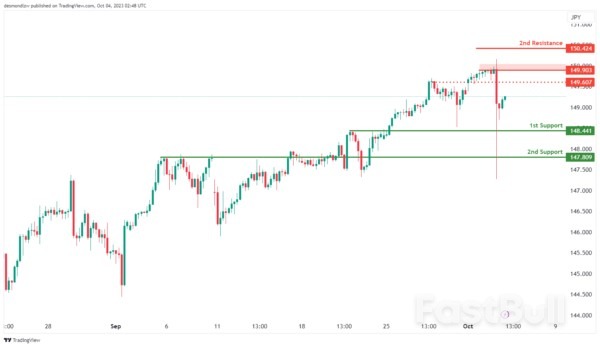
          The USD/JPY chart currently exhibits a bullish momentum, and there is a potential scenario of a bullish continuation towards the 1st resistance level at 149.90, which is considered significant as it's marked as a swing high resistance. This resistance level may act as a barrier to further upward movements.
          On the support side, the 1st support at 148.44 is categorized as a pullback support, potentially providing necessary support in case of pullbacks. Additionally, the 2nd support at 147.80 is also identified as a pullback support, indicating its importance for potential price reversals. Furthermore, there is an intermediate resistance at 149.60, which is marked as a pullback resistance, contributing to potential price movements.
          USD/CADTechnical Outlook and Review_9
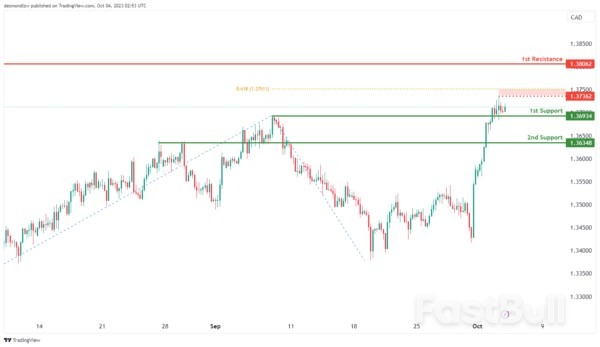
          The USD/CAD chart is currently showing bullish momentum, and it suggests the possibility of a bullish continuation towards the 1st resistance level. The 1st support at 1.3693 is considered a significant level of potential price support, characterized as an overlap support. Additionally, the 2nd support at 1.3634 acts as a pullback support, further reinforcing its importance.
          On the resistance side, the 1st resistance at 1.3806 is a swing high resistance, which may hinder further upward movement. Intermediate resistance at 1.3736 holds significance due to its alignment with the 61.80% Fibonacci Projection, indicating its potential role in price reversals.
          AUD/USDTechnical Outlook and Review_10
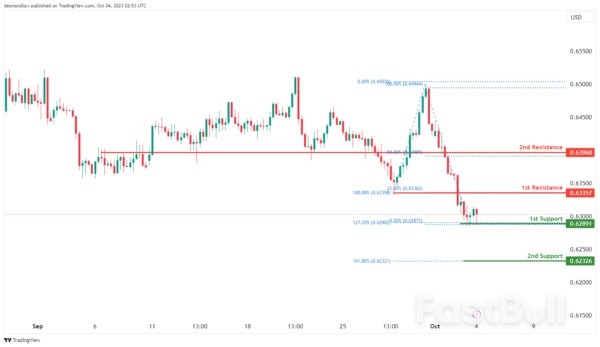
          The AUD/USD chart currently has a bullish momentum, and there is a potential scenario for a bullish bounce off the 1st support level at 0.6289. This support level is considered significant as it aligns with a multi-swing low support and the 127.20% Fibonacci Extension, indicating it could provide strong support for price movements.
          Additionally, the 2nd support at 0.6291 is also noteworthy, as it coincides with the 161.80% Fibonacci Extension, reinforcing its importance as a potential support level.
          On the resistance side, the 1st resistance level at 0.6335 is categorized as a pullback resistance, which could potentially limit further upward movements. Beyond this, the 2nd resistance at 0.6396 is marked as a pullback resistance and aligns with the 50% Fibonacci Retracement, further emphasizing its significance in potential price reversals.
          NZD/USDTechnical Outlook and Review_11
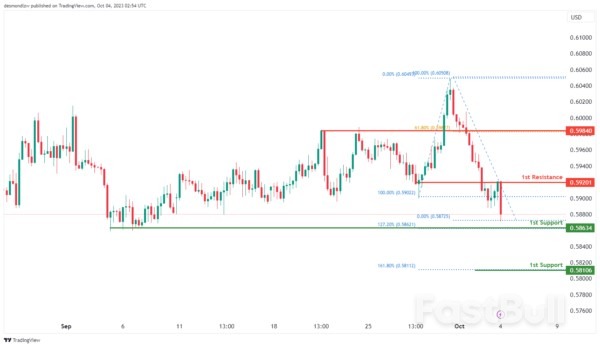
          The NZD/USD chart currently exhibits a bearish momentum, with a potential scenario of a bearish continuation towards the 1st support level at 0.5863. This support level is significant as it aligns with a multi-swing low support and the 127.20% Fibonacci Extension, suggesting it could act as a strong support zone.
          Furthermore, the 2nd support at 0.5810 is also noteworthy, as it is identified as a multi-swing low support and coincides with the 161.80% Fibonacci Extension, reinforcing its importance as a potential price support level.
          On the resistance side, the 1st resistance level at 0.9520 is categorized as an overlap resistance, which could potentially hinder bullish movements. Additionally, the 2nd resistance at 0.5984 is marked as a pullback resistance and aligns with the 61.80% Fibonacci Retracement, further emphasizing its significance in potential price reversals.
          DJ30Technical Outlook and Review_12
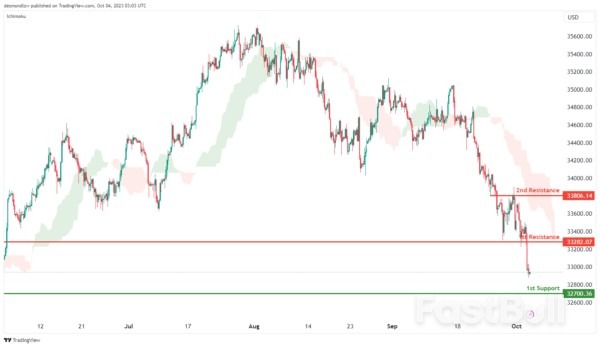
          The DJ30 (Dow Jones 30) chart currently exhibits a bearish momentum, driven by its position below the bearish Ichimoku cloud. There is a potential scenario of a bearish continuation towards the 1st support level at 32700.36, which is identified as a swing low support, making it a significant level for potential price support.
          On the resistance side, the 1st resistance at 33282.07 is considered a pullback resistance, indicating its potential to limit upward movements. Beyond this, the 2nd resistance at 33806.14 is categorized as an overlap resistance, suggesting it may act as a barrier to further bullish movements.
          GER40Technical Outlook and Review_13
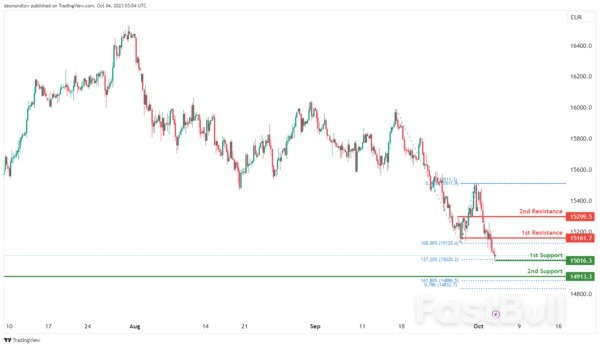
          The GER40 (Germany 40) chart currently maintains a bullish momentum. There is a potential scenario where the price could experience a bullish bounce off the 1st support level at 15016.30, which is noted for its 127.20% Fibonacci Extension, highlighting its significance as a potential reversal point. Additionally, the 2nd support at 14913.30 is identified as a swing low support and aligns with the 161.80% Fibonacci Extension and the 78.60% Fibonacci Projection, further emphasizing its importance as a potential support level.
          On the resistance side, the 1st resistance level at 15161.70 is characterized as a pullback resistance, indicating its potential role as a barrier to further upward movements. Beyond this, the 2nd resistance at 15299.50 is also identified as a pullback resistance, potentially adding further resistance to the price's upward movement.
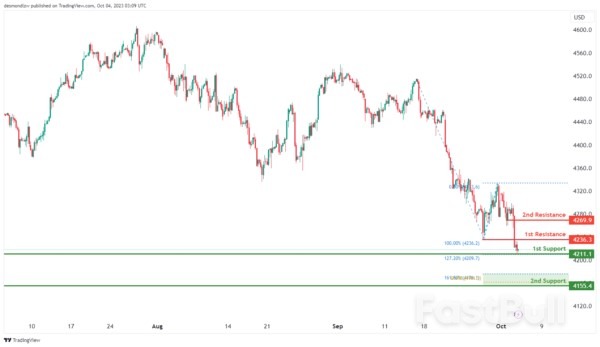
          US500Technical Outlook and Review_14
          The US500 (S&P 500) chart currently exhibits a bearish momentum, and there is a potential scenario where the price may fluctuate between the 1st resistance and 1st support levels.
          The 1st support level at 4211.1 is considered significant due to its designation as a swing low support and the presence of the 127.20% Fibonacci Extension, suggesting it could act as a crucial level for potential price support. Additionally, the 2nd support at 4155.4 is identified as a swing low support and aligns with the 161.80% Fibonacci Extension as well as the 61.80% Fibonacci Projection, further reinforcing its importance as a potential support zone.
          On the resistance side, the 1st resistance level at 4236.3 is recognized as an overlap resistance, indicating it may act as a barrier to further upward movements. Beyond this, the 2nd resistance at 4269.9 is categorized as a pullback resistance, potentially providing additional resistance to the price's upward movement.
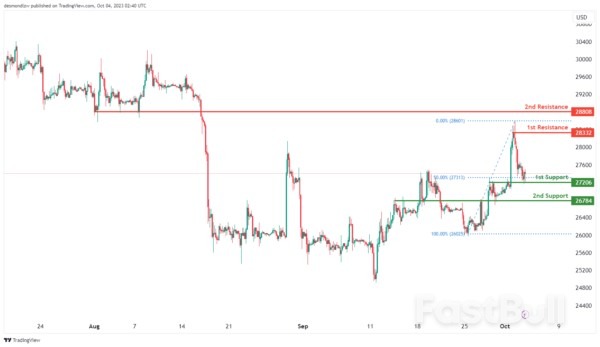
          BTC/USDTechnical Outlook and Review_15
          The BTC/USD chart currently maintains a bullish momentum, with a potential scenario of a bullish bounce off the 1st support level at 27206, which is supported by its designation as an overlap support and the presence of the 50% Fibonacci Retracement.
          Additionally, the 2nd support at 26784 is also categorized as an overlap support, reinforcing its importance as a potential zone where the price may find support.
          On the resistance side, the 1st resistance level at 28332 is marked as a swing high resistance, potentially limiting further upward movements. Beyond this, the 2nd resistance at 28808 is identified as a pullback resistance, indicating it may provide additional resistance to the price's upward movement.
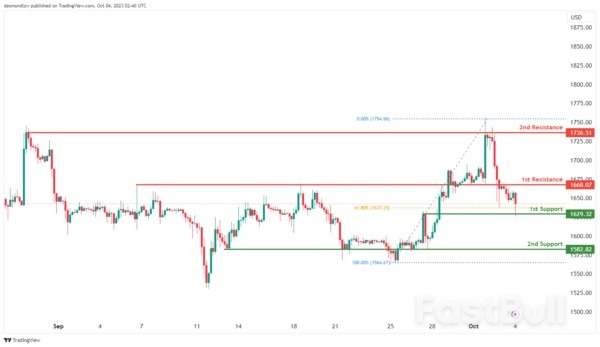
          ETH/USDTechnical Outlook and Review_16
          The ETH/USD chart currently maintains a neutral momentum, with a potential scenario of price fluctuation between the 1st support level at 1629.32 and the 1st resistance level at 1668.07.
          The 1st support is considered significant as it's identified as an overlap support, making it a crucial level for potential price support. Additionally, the 2nd support at 1582.82 is also categorized as an overlap support, reinforcing its importance as a potential zone where the price may find support.
          On the resistance side, the 1st resistance level at 1668.07 is recognized as an overlap resistance, suggesting it may act as a barrier to price increases. Beyond this, the 2nd resistance at 1736.51 is identified as a multi-swing high resistance, emphasizing its significance in potential price reversals.
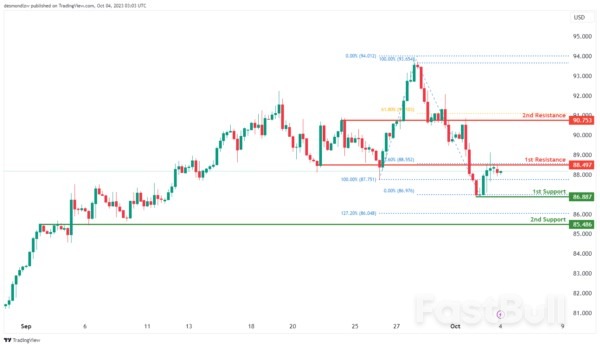
          WTI/USDTechnical Outlook and Review_17
          The WTI chart currently shows a bearish momentum, and there is a potential scenario of a bearish reaction off the 1st resistance level at 88.49, which is identified as an overlap resistance and is reinforced by the presence of the 23.60% Fibonacci Retracement.
          On the support side, the 1st support at 86.88 is considered a swing low support, and the 2nd support at 85.48 is categorized as an overlap support, highlighting their significance as potential zones for price support.
          XAU/USD (GOLD)
          Technical Outlook and Review_18
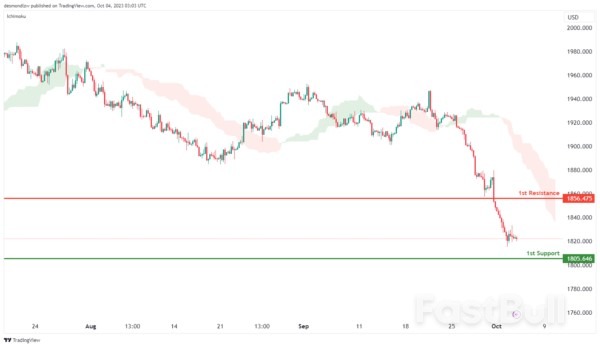
          The XAUUSD chart currently has a bearish momentum, and there is a potential scenario of a bearish continuation towards the 1st support level at 1805.64, which is identified as an overlap support, indicating its significance as a potential zone for price support.
          On the resistance side, the 1st resistance level at 1856.47 is marked as a pullback resistance, potentially limiting upward movements.
          Risk Warnings and Disclaimers
          You understand and acknowledge that there is a high degree of risk involved in trading. Following any strategies or investment methods may lead to potential losses. The content on the site is provided by our contributors and analysts for information purposes only. You are solely responsible for determining whether any trading assets, securities, strategy, or any other product is suitable for investing based on your own investment objectives and financial situation.
          Comments
          Add to Favorites
          Share

          The Fear of Strong Jobs

          Swissquote

          Economic

          Forex

          This is why the stronger than expected job openings data from the U.S. spurred panic across the global financial markets yesterday. Although hirings and firings remained stable, the financial world was unhappy to see so many job opportunities offered to Americans as the data hinted that the U.S. jobs market could be going back toward tightening, and not toward loosening. And that means that Americans will keep their jobs, find new ones, asked better pays, and keep spending. That spending will keep U.S. growth above average and continue pushing inflation higher, and the Federal Reserve (Fed) will not only keep interest rates higher for longer but eventually be obliged to hike them more. Alas, a catastrophic scenario for the global financial markets where the rising U.S. yields threaten to destroy value everywhere. PS. JOLTS data is volatile, and one data point is insufficient to point at changing trend. We still believe that the U.S. jobs market will continue to loosen.
          But the market reaction to yesterday's JOLTS data was sharp and clear. The U.S. 2-year yield spiked above 5.15% after the stronger than expected JOLTS data, the 10-year yield went through the roof and hit the 4.85% mark. News that the U.S. House Speaker McCarthy lost his position after last week's deal to keep the U.S. government open certainly didn't help attract investors into the U.S. sovereign space. The U.S. blue-chip bond yields on the other hand have advanced to the highest levels since 2009, and the spike in real yields hardly justify buying stocks if earnings expectations remain weak. The S&P500 is now headed towards its 200-DMA, which stands near the 4200 level. The more rate sensitive Nasdaq still has ways to go before reaching its own 200-DMA and critical Fibonacci levels, but the selloff could become harder in technology stocks if things got uglier.
          In the FX, the U.S. dollar extended gains across the board. The Reserve Bank of New Zealand (RBNZ) kept the interest rate steady at 5.5% as expected. Due today, the ADP report is expected to show a significant slowdown in U.S. private job additions last month; the expectation is a meagre 153'000 new private job additions in September. Any weakness would be extremely welcome for the rest of the world, while a strong looking data, an – God forbid – a figure above 200K could boost the Federal Reserve (Fed) hawks and bring the discussion of a potential rate hike in November seriously on the table.
          The EUR/USD consolidates below the 1.05 level, the USD/JPY spiked shortly above the 150 mark, and suddenly fell 2% in a matter of minutes, in a move that was thought to be an unconfirmed FX intervention. Gold extended losses to $1815 per ounce as the rising U.S. yields increase the opportunity cost of holding the non-interest-bearing gold.
          The barrel of American crude remains under pressure below the $90pb level. U.S. shale producers say that they will keep drilling under wraps even if oil prices surge to $100pb, pointing at Joe Biden's war against fossil fuel. A tighter oil supply is the main market driver for now, but recession fears will likely keep the upside limited, and September high could be a peak.
          To stay updated on all economic events of today, please check out our Economic calendar
          Risk Warnings and Disclaimers
          You understand and acknowledge that there is a high degree of risk involved in trading. Following any strategies or investment methods may lead to potential losses. The content on the site is provided by our contributors and analysts for information purposes only. You are solely responsible for determining whether any trading assets, securities, strategy, or any other product is suitable for investing based on your own investment objectives and financial situation.
          Comments
          Add to Favorites
          Share

          Turning Into a Rout

          Damon

          Economic

          Too far, too fast?
          It's messy out there. It's not often you get a 10bp uplift in the 10-year yield in one day. We had one yesterday. And we've had over a 50bp upmove in the past three weeks. It's now at 4.8%, and looking like it's gone too far too fast. But if we don't look down, that 5% level could be with us quite quickly. It's clear also that Treasuries are a dominant driver out there. It's pulling other yields higher, is hurting equities, and is pretty immune to influence from risk off.
          Typically, a severe enough risk-off event would put some counterflows back into Treasuries. And there have been some. Right through the rise in yields in the past couple of months there have, in fact, been net inflows into Treasuries. But this has not been enough to dominate price action. In fact, prices have moved first, not so much in reaction to flows, but in anticipation of them. And of course, in reaction to data that continues to show the U.S. economy continuing to defy recession worries.
          The JOLTS data are a case in point. This measure of "job openings" had been coming off the pandemic sugar high which saw them peak out in the 12 million area. A huge level. It compares with a long-run average in the 2.5 million area. It had been falling since mid-2022, and got to below nine million last month. But the latest month shows a pop back up towards 10 million (9.6m). That's a remarkable move in light of the inflation/rates/sentiment headwinds that arguably should be impacting the economy more.
          And the curve continues to pull steeper (dis-inversion). As we ended the summer, the 2/10yr was in the -75bp area. It's now half that, and just 35bp away from breaking back above zero into positive territory. It's been pulled there by higher longer tenor real rates. The 10-year real yield is now knocking on the door of 2.5%, having been below 2% only a few weeks back. And importantly, inflation expectations are broadly steady. This angst mode has been driven entirely by higher real rates, and signs of underlying macro strength.
          Note, however, that higher real yields are also more painful than ones driven by higher inflation. The latter can be passed on through higher prices at the corporate level. But higher real rates are more difficult to "pass on". They are essentially a tax on the borrower that must be paid to get any type of re-funding done. That is arguably where the next vulnerability lies. Risk assets are reacting to this, but there is the potential for more pain here ahead, especially in the guise of wider credit spreads.
          Turning Into a Rout_1Longer EUR real yields also at highs, Italian spreads resume widening
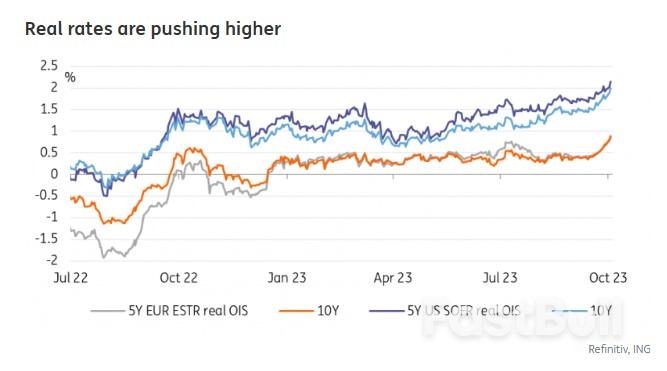
          As U.S. Treasury yields surged for another day Bund yields got pulled higher, ending just below 2.97% and thus still a sliver below last week's high. What we noted at the start of the week still held yesterday – inflation swaps are edging lower. This means that the rise in real yields is more severe.
          2-year real ESTR OIS rates are above 1% but have not quite taken out the July peak yet. 5-year real rates have passed the peak with the start of this week surging to 0.8%, while the 10-year at 0.83% already broke above previous highs last week. The European Central Bank hawks, such as Isabel Schnabel who typically has an eye on this indicator as a measure of effective financing conditions, may see this as necessary tightening to counter inflationary pressure.
          In Italy, the sale of the BTP Valore bonds extends into its third day. Days one and two saw strong demand with orders accumulating to €9.3bn, and this is on track for a final volume in the ballpark of €15bn by the end of the week. Nonetheless, the widening of Italian government bond spreads resumed. The key 10-year spread versus Bunds topped 190bp again and thus more than offset Monday's recovery.
          The directional nature of the spread certainly made it tough to withstand the rise in outright rates, but we also got more hawkish ECB talk on potentially ending the reinvestment of the Pandemic Emergency Purchase Programme portfolio sooner. We would note that even the likes of Austria's Robert Holzmann acknowledge that the flexibility of reinvestments is an important backstop to spreads. He suggested that the staff would look into how to maintain that flexibility even when reinvestments are slowed.
          Today's events and market view
          There seems little in the way to stop yields from rising further. Data only accelerated the sell-off over the past few sessions but could turn out to be a bit more of a headwind today, that is, if expectations about the ISM services are right. That index is seen easing back somewhat, although still staying in expansionary territory. The other data point to watch is the ADP payrolls estimate, though it has a patchy track record of predicting the official numbers two days later.
          Over in Europe, the main releases are the producer prices, retail sales and final services PMIs, including some first readings for individual countries such as Spain and Italy. Attention will also fall again on ECB speakers, this time including President Christine Lagarde, Vice President Luis de Guindos and from the very dovish end Fabio Panetta.
          In sovereign supply, we will see the continuation of Italy's BTP Valore sale. Germany will tap 7-year Bunds for €3bn while the UK sells 2-year gilts for £4.25bn. In SSAs, the EFSF mandated banks for a new 5-year bond and a 10-year tap, which should be today's business - and the EFSF's final issuance for the year.

          Source: ING

          To stay updated on all economic events of today, please check out our Economic calendar
          Risk Warnings and Disclaimers
          You understand and acknowledge that there is a high degree of risk involved in trading. Following any strategies or investment methods may lead to potential losses. The content on the site is provided by our contributors and analysts for information purposes only. You are solely responsible for determining whether any trading assets, securities, strategy, or any other product is suitable for investing based on your own investment objectives and financial situation.
          Comments
          Add to Favorites
          Share

          Escalating Risk Aversion Meets Yen Intervention

          Samantha Luan

          Forex

          Economic

          Dollar is finding strength amidst an atmosphere of palpable anxiety in the financial markets, stemming from a continuation of the risk-off mood from U.S. into Asian session. This prevailing anxiety in the markets has been heightened by the pronounced drop in U.S. stocks overnight, coupled with a surge in long-end treasury yields. Adding to the complexity, there's been a quick normalization in the yield curve accompanied by a notable spike in the VIX fear index. As investors brace themselves, the focus now pivots towards the forthcoming U.S. ADP employment and ISM Services data. However, the market is caught in a conundrum, trying to decipher if positive data will quell or exacerbate the prevailing anxiety.
          At the same time, Yen has made significant strides, an strong bounce that could be attributed to Japan's unconfirmed intervention in the currency markets. However, this edge was short-lived, with USD/JPY experiencing a swift rebound. Current behavior suggests that speculators might have been gearing up to capitalize on Yen sales, rather than aligning with Japan's presumed objective of buying the currency. With the financial climate teetering on unease and impending significant data releases like Friday's U.S. NFP, we can expect substantial fluctuations in USD/JPY in the immediate future.
          Following RBNZ's decision to keep interest rates steady, New Zealand Dollar is currently languishing near the bottom of the currency chart. Aussie, too, is underperforming, particularly after RBA's parallel decision yesterday. For the time being, European majors display a mixed performance, though the Swiss Franc is exhibiting a slight advantage. Yet, when considering their performances against each other, Euro, Sterling, and Swiss Franc are trading within their usual bounds.
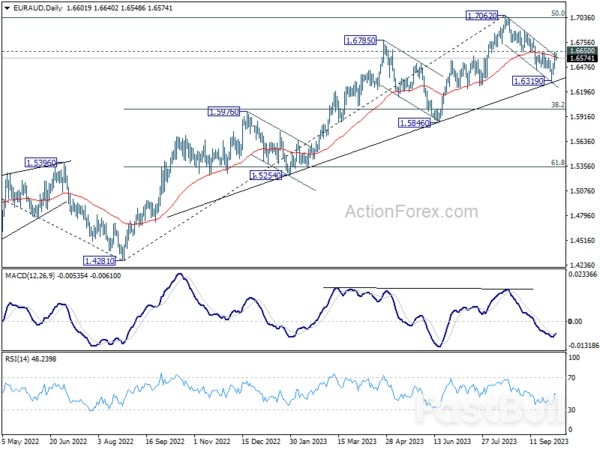
          Technically, EUR/AUD is now pressing 1.6650 resistance after this week's bounce. Firm break there will argue that correction from 1.7062 has completed after drawing support from medium term rising trend line. Stronger rally would be seen back to retest 1.7062 high next. If realized, that would be a signal of more broad based selloff in Aussie, as probably intensification of risk aversion too.Escalating Risk Aversion Meets Yen Intervention_1
          In Asia, at the time of writing, Nikkei is down -1.87%. Hong Kong HSI is down -0.99%. Singapore Strait Times is down -1.50%. Japan 10-year JGB yield is up 0.033 at 0.797, just shy of 0.8 handle. Overnight, DOW dropped -1.29%. S&P 500 dropped -1.37%. NASDAQ dropped -1.87%. 10-year yield rose 0.119 to 4.802.
          Japan's top brass remains mum on intervention claims
          Market watchers were in a frenzy after Japanese Yen surged from 150 to the 147 zone against Dollar overnight , fuelling speculation that Japan's government may have stealthily intervened to push up the struggling currency. While evidence of a Yen-buying, Dollar-selling maneuver abounds, top officials in Japan remained tight-lipped today.
          Finance Minister Shunichi Suzuki, when confronted by reporters, chose the path of silence over confirmation. He held back from validating the swirl of speculations about intervention. Suzuki reiterated a standard narrative, emphasizing the desirability of market-driven, stable currency movements that mirror economic fundamentals.
          "Currency rates ought to move stably driven by markets, reflecting fundamentals. Sharp moves are undesirable," Suzuki noted. "The government is monitoring market developments very carefully with a sense of urgency. We will take appropriate steps against excessive volatility without excluding any options."
          Masato Kanda, the top currency diplomat, provided insights into the government's assessment mechanism for currency movements. "If currencies move too much on a single day or, say, a week, that's judged as excess volatility," Kanda explained.
          The implied volatility stands as a critical metric, among others, shaping the official perspective on whether Yen's moves are reaching alarming amplitudes.
          Kanda further outlined that even in the absence of abrupt shifts, a gradual yet one-sided build-up of significant currency movements over time is also classified as excessive volatility. However, he too refrained from offering a direct commentary on the overnight upswing of Yen.
          RBNZ holds rates, hints at longer duration of restrictive policy
          RBNZ has opted to keep the Official Cash Rate stable at 5.50%, aligning with broad market anticipations. The minutes of the meeting revealed a consensus among committee members that restrictive interest rate environment might be needed "for a more sustained period of time".
          In the short term, RBNZ is looking at a scenario where domestic demand could exhibit "greater resilience", spurred by migration. This situation could "slow the pace of expected disinflation". A related concern is wage inflation, which could take a longer time to ease than initially expected. Recent rise in oil prices could also risk "headline inflation being higher than expected".
          Looking at the medium term, the minuted noted concerns about greater slowdown in global growth. Such a downturn could lead to further reductions in non-oil import prices. Moreover, weakened global demand, with a particular emphasis on China, could exert additional pressure on commodity prices, subsequently affecting New Zealand's export revenues.
          Anxiety grips Wall Street: DOW plummets, VIX jumps, Yields soar
          Economic storm clouds appear to be gathering on the horizon. With DOW experiencing its most significant drop since March and key Treasury yields touching multi-year highs, whispers of a potential recession are becoming more audible. This is further exacerbated by the behavior of VIX, often dubbed the "fear index", which indicates heightened market apprehensions.
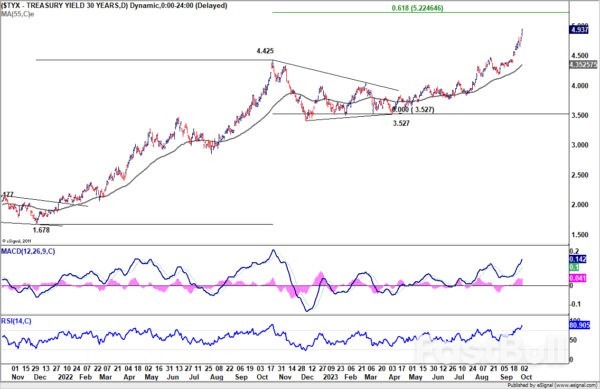
          DOW plummeted by -430.97 points, or -1.29%, nudging it into negative territory for the year, now lagging by -0.4%. This downturn wasn't isolated to stocks. The 10-year yield reached a staggering 4.8%, a pinnacle not seen in 16 years. Similarly, 30-year yield hit a peak of 4.925%, levels of which we haven't seen since 2007.
          Escalating Risk Aversion Meets Yen Intervention_2The narrowing gap between the 2-year and 10-year Treasury yields, contracting to a mere 35 basis points from over 100 basis points a few months earlier, is especially concerning. This normalization, or "de-inverting", of a vital part of the yield curve is often viewed as a precursor to economic downturns, igniting debates on the imminence of a recession.
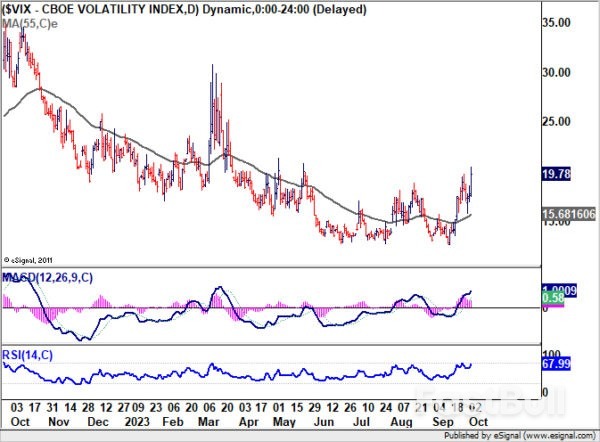
          Adding to the market's jitters, VIX has climbed for three consecutive sessions, momentarily crossing the critical 20 level and finishing at a six-month high. Values below 20 on the VIX generally signify market stability, but as it surpasses this threshold, it denotes an environment fraught with investor unease and skittishness.
          Escalating Risk Aversion Meets Yen Intervention_3Back to DOW, it's now pressing and important near fibonacci support at 38.2% retracement of 28660.94 to 35679.13 at 32998.17. Sustained break of this level will strengthen the case that fall from 35679.13 is reversing whole rise from 28660.94. This decline could be viewed as the third leg of the long term pattern from 36952.65 high. Deeper fall would be seen to 31.429.82 support, which is close to 61.8% retracement at 31341.88.
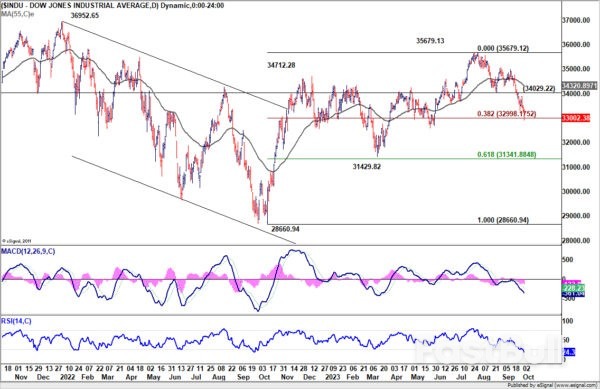
          In any case, near term outlook will stay bearish as long as 34029.22 support turned resistance holds. The rest of the week, with ISM services today and non-farm payrolls release on Friday, will be crucial.

          Escalating Risk Aversion Meets Yen Intervention_4Looking ahead

          Eurozone PMI services final, PPI and retail sales will be released in European session. UK will also release PMI services final. Later in the day, U.S. ADP employment ISM services and factory orderes will take center stage.

          USD/JPY Daily Outlook

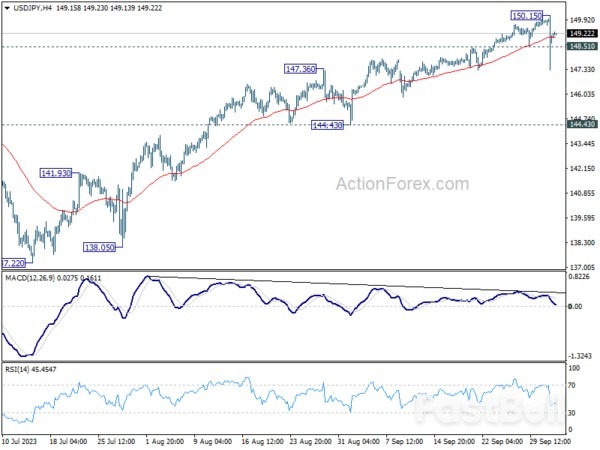
          USD/JPY spiked lower to 147.28 overnight, on alleged intervention by Japan, but recovered quickly since then. As short term top should be in place at 150.15, on bearish divergence condition in 4H MACD. Intraday bias is turned neutral first and more corrective could be seen. But there is no confirmation of bearish trend reversal before firm break of 144.43 support. Another rally remains mildly in favor through 150.15 to retest 151.93 high.Escalating Risk Aversion Meets Yen Intervention_5
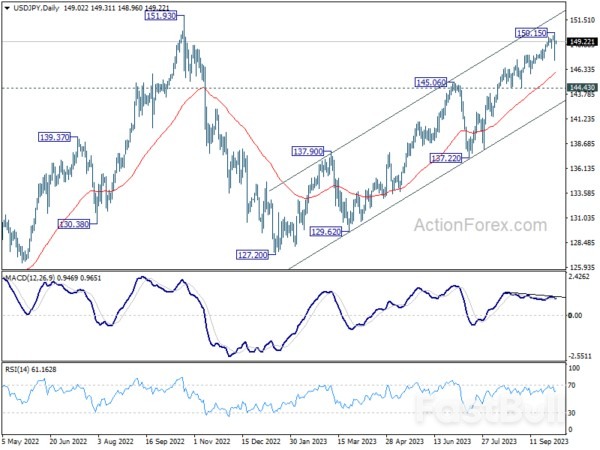
          In the bigger picture, while rise from 127.20 is strong, it could still be seen as the second leg of the corrective pattern from 151.93 (2022 high). Rejection by 151.93, followed by sustained break of 145.06 resistance turned support will be the first sign that the third leg of the pattern has started. However, sustained break of 151.93 will confirm resumption of long term up trend.Escalating Risk Aversion Meets Yen Intervention_6

          Source: ActionForex

          To stay updated on all economic events of today, please check out our Economic calendar
          Risk Warnings and Disclaimers
          You understand and acknowledge that there is a high degree of risk involved in trading. Following any strategies or investment methods may lead to potential losses. The content on the site is provided by our contributors and analysts for information purposes only. You are solely responsible for determining whether any trading assets, securities, strategy, or any other product is suitable for investing based on your own investment objectives and financial situation.
          Comments
          Add to Favorites
          Share
          FastBull
          Copyright © 2025 FastBull Ltd

          728 RM B 7/F GEE LOK IND BLDG NO 34 HUNG TO RD KWUN TONG KLN HONG KONG

          TelegramInstagramTwitterfacebooklinkedin
          App Store Google Play Google Play
          Products
          Charts

          Chats

          Q&A with Experts
          Screeners
          Economic Calendar
          Data
          Tools
          Membership
          Features
          Function
          Markets
          Copy Trading
          Latest Signals
          Contests
          News
          Analysis
          24/7
          Columns
          Education
          Company
          Careers
          About Us
          Contact Us
          Advertising
          Help Center
          Feedback
          User Agreement
          Privacy Policy
          Business

          White Label

          Data API

          Web Plug-ins

          Poster Maker

          Affiliate Program

          Risk Disclosure

          The risk of loss in trading financial instruments such as stocks, FX, commodities, futures, bonds, ETFs and crypto can be substantial. You may sustain a total loss of the funds that you deposit with your broker. Therefore, you should carefully consider whether such trading is suitable for you in light of your circumstances and financial resources.

          No decision to invest should be made without thoroughly conducting due diligence by yourself or consulting with your financial advisors. Our web content might not suit you since we don't know your financial conditions and investment needs. Our financial information might have latency or contain inaccuracy, so you should be fully responsible for any of your trading and investment decisions. The company will not be responsible for your capital loss.

          Without getting permission from the website, you are not allowed to copy the website's graphics, texts, or trademarks. Intellectual property rights in the content or data incorporated into this website belong to its providers and exchange merchants.

          Not Logged In

          Log in to access more features

          FastBull Membership

          Not yet

          Purchase

          Become a signal provider
          Help Center
          Customer Service
          Dark Mode
          Price Up/Down Colors

          Log In

          Sign Up

          Position
          Layout
          Fullscreen
          Default to Chart
          The chart page opens by default when you visit fastbull.com