• Trade
  • Markets
  • Copy
  • Contests
  • News
  • 24/7
  • Calendar
  • Q&A
  • Chats
Trending
Screeners
SYMBOL
LAST
BID
ASK
HIGH
LOW
NET CHG.
%CHG.
SPREAD
SPX
S&P 500 Index
6849.57
6849.57
6849.57
6878.28
6841.15
-20.83
-0.30%
--
DJI
Dow Jones Industrial Average
47806.44
47806.44
47806.44
47971.51
47709.38
-148.54
-0.31%
--
IXIC
NASDAQ Composite Index
23536.39
23536.39
23536.39
23698.93
23505.52
-41.73
-0.18%
--
USDX
US Dollar Index
99.150
99.230
99.150
99.160
98.730
+0.200
+ 0.20%
--
EURUSD
Euro / US Dollar
1.16176
1.16183
1.16176
1.16717
1.16162
-0.00250
-0.21%
--
GBPUSD
Pound Sterling / US Dollar
1.33129
1.33137
1.33129
1.33462
1.33053
-0.00183
-0.14%
--
XAUUSD
Gold / US Dollar
4192.44
4192.87
4192.44
4218.85
4175.92
-5.47
-0.13%
--
WTI
Light Sweet Crude Oil
58.912
58.942
58.912
60.084
58.837
-0.897
-1.50%
--

Community Accounts

Signal Accounts
--
Profit Accounts
--
Loss Accounts
--
View More

Become a signal provider

Sell trading signals to earn additional income

View More

Guide to Copy Trading

Get started with ease and confidence

View More

Signal Accounts for Members

All Signal Accounts

Best Return
  • Best Return
  • Best P/L
  • Best MDD
Past 1W
  • Past 1W
  • Past 1M
  • Past 1Y

All Contests

  • All
  • Trump Updates
  • Recommend
  • Stocks
  • Cryptocurrencies
  • Central Banks
  • Featured News
Top News Only
Share

Israeli Prime Minister Netanyahu: Hamas Has Violated The Ceasefire Agreement, And We Will Never Allow Its Members To Re-arm Themselves And Threaten US

Share

Israeli Prime Minister Netanyahu: We Are Working To Return The Body Of Another Detainee From The Gaza Strip

Share

Iraq's West Qurna 2 Oil Field Will Increase Oil Production Beyond Normal Levels To Compensate For The Production Stoppage Caused By The Trump Administration's Sanctions Against Russia

Share

Israeli Prime Minister Netanyahu: We Are Close To Completing The First Phase Of Trump’s Plan And Will Now Focus On Disarming Gaza And Seizing Hamas Weapons

Share

Moody's Affirmed Burberry's Long-term Rating Of Baa3 And Revised Its Outlook (from Negative) To Stable

Share

The Trump Administration Supports Iraq's Plan To Transfer Russian Oil Company Lukoil Pjsc's Assets In The West Qurna 2 Oil Field To An American Company

Share

JMA: Tsunami Of 70 Centimetres Observed In Japan's Kuji Port In Iwate Prefecture

Share

The U.S. Bureau Of Labor Statistics Plans To Release A Press Release On January 15, 2026, For November 2025, Along With Data For October

Share

Tiger Global Has Established A New Fund, Aiming To Raise $2 Billion To $3 Billion

Share

The U.S. Bureau Of Labor Statistics Announced That It Will Not Release A Press Release Regarding The U.S. Import And Export Price Index (MXP) For October 2025

Share

The U.S. Bureau Of Labor Statistics (BLS) Will Not Release U.S. October CPI Data

Share

Government Negotiator: Dutch Political Center And Center Right Parties D66,  Cda And Vvd Advised To Start Talks On Possible Government

Share

New York Fed: November Home Price Rise Expectation Steady At 3%

Share

New York Fed: US Households' Personal Finance Worries Grew In November

Share

New York Fed: November Five-Year-Ahead Expected Inflation Rate Unchanged At 3%

Share

New York Fed: Households More Pessimistic On Current, Future Financial Situations In November

Share

New York Fed Report: USA Households' Year-Ahead Expected Inflation Rate Unchanged At 3.2% In November

Share

New York Fed: November Year-Ahead Expected Rise In Medical Costs Highest Since January 2014

Share

New York Fed: Labor Market Expectations Improved In November

Share

New York Fed: November Three-Year-Ahead Expected Inflation Rate Unchanged At 3%

TIME
ACT
FCST
PREV
France Trade Balance (SA) (Oct)

A:--

F: --

P: --
Euro Zone Employment YoY (SA) (Q3)

A:--

F: --

P: --
Canada Part-Time Employment (SA) (Nov)

A:--

F: --

P: --

Canada Unemployment Rate (SA) (Nov)

A:--

F: --

P: --

Canada Full-time Employment (SA) (Nov)

A:--

F: --

P: --

Canada Labor Force Participation Rate (SA) (Nov)

A:--

F: --

P: --

Canada Employment (SA) (Nov)

A:--

F: --

P: --

U.S. PCE Price Index MoM (Sept)

A:--

F: --

P: --

U.S. Personal Income MoM (Sept)

A:--

F: --

P: --

U.S. Core PCE Price Index MoM (Sept)

A:--

F: --

P: --

U.S. PCE Price Index YoY (SA) (Sept)

A:--

F: --

P: --

U.S. Core PCE Price Index YoY (Sept)

A:--

F: --

P: --

U.S. Personal Outlays MoM (SA) (Sept)

A:--

F: --

P: --
U.S. 5-10 Year-Ahead Inflation Expectations (Dec)

A:--

F: --

P: --

U.S. Real Personal Consumption Expenditures MoM (Sept)

A:--

F: --

P: --
U.S. Weekly Total Rig Count

A:--

F: --

P: --

U.S. Weekly Total Oil Rig Count

A:--

F: --

P: --

U.S. Consumer Credit (SA) (Oct)

A:--

F: --

P: --
China, Mainland Foreign Exchange Reserves (Nov)

A:--

F: --

P: --

Japan Trade Balance (Oct)

A:--

F: --

P: --

Japan Nominal GDP Revised QoQ (Q3)

A:--

F: --

P: --

China, Mainland Imports YoY (CNH) (Nov)

A:--

F: --

P: --

China, Mainland Exports (Nov)

A:--

F: --

P: --

China, Mainland Imports (CNH) (Nov)

A:--

F: --

P: --

China, Mainland Trade Balance (CNH) (Nov)

A:--

F: --

P: --

China, Mainland Exports YoY (USD) (Nov)

A:--

F: --

P: --

China, Mainland Imports YoY (USD) (Nov)

A:--

F: --

P: --

Germany Industrial Output MoM (SA) (Oct)

A:--

F: --

P: --
Euro Zone Sentix Investor Confidence Index (Dec)

A:--

F: --

P: --

Canada National Economic Confidence Index

A:--

F: --

P: --

U.K. BRC Like-For-Like Retail Sales YoY (Nov)

--

F: --

P: --

U.K. BRC Overall Retail Sales YoY (Nov)

--

F: --

P: --

Australia Overnight (Borrowing) Key Rate

--

F: --

P: --

RBA Rate Statement
RBA Press Conference
Germany Exports MoM (SA) (Oct)

--

F: --

P: --

U.S. NFIB Small Business Optimism Index (SA) (Nov)

--

F: --

P: --

Mexico 12-Month Inflation (CPI) (Nov)

--

F: --

P: --

Mexico Core CPI YoY (Nov)

--

F: --

P: --

Mexico PPI YoY (Nov)

--

F: --

P: --

U.S. Weekly Redbook Index YoY

--

F: --

P: --

U.S. JOLTS Job Openings (SA) (Oct)

--

F: --

P: --

China, Mainland M1 Money Supply YoY (Nov)

--

F: --

P: --

China, Mainland M0 Money Supply YoY (Nov)

--

F: --

P: --

China, Mainland M2 Money Supply YoY (Nov)

--

F: --

P: --

U.S. EIA Short-Term Crude Production Forecast For The Year (Dec)

--

F: --

P: --

U.S. EIA Natural Gas Production Forecast For The Next Year (Dec)

--

F: --

P: --

U.S. EIA Short-Term Crude Production Forecast For The Next Year (Dec)

--

F: --

P: --

EIA Monthly Short-Term Energy Outlook
U.S. API Weekly Gasoline Stocks

--

F: --

P: --

U.S. API Weekly Cushing Crude Oil Stocks

--

F: --

P: --

U.S. API Weekly Crude Oil Stocks

--

F: --

P: --

U.S. API Weekly Refined Oil Stocks

--

F: --

P: --

South Korea Unemployment Rate (SA) (Nov)

--

F: --

P: --

Japan Reuters Tankan Non-Manufacturers Index (Dec)

--

F: --

P: --

Japan Reuters Tankan Manufacturers Index (Dec)

--

F: --

P: --

Japan Domestic Enterprise Commodity Price Index MoM (Nov)

--

F: --

P: --

Japan Domestic Enterprise Commodity Price Index YoY (Nov)

--

F: --

P: --

China, Mainland PPI YoY (Nov)

--

F: --

P: --

China, Mainland CPI MoM (Nov)

--

F: --

P: --

Q&A with Experts
    • All
    • Chatrooms
    • Groups
    • Friends
    Connecting
    .
    .
    .
    Type here...
    Add Symbol or Code

      No matching data

      All
      Trump Updates
      Recommend
      Stocks
      Cryptocurrencies
      Central Banks
      Featured News
      • All
      • Russia-Ukraine Conflict
      • Middle East Flashpoint
      • All
      • Russia-Ukraine Conflict
      • Middle East Flashpoint
      Search
      Products

      Charts Free Forever

      Chats Q&A with Experts
      Screeners Economic Calendar Data Tools
      Membership Features
      Data Warehouse Market Trends Institutional Data Policy Rates Macro

      Market Trends

      Market Sentiment Order Book Forex Correlations

      Top Indicators

      Charts Free Forever
      Markets

      News

      News Analysis 24/7 Columns Education
      From Institutions From Analysts
      Topics Columnists

      Latest Views

      Latest Views

      Trending Topics

      Top Columnists

      Latest Update

      Signals

      Copy Rankings Latest Signals Become a signal provider AI Rating
      Contests
      Brokers

      Overview Brokers Assessment Rankings Regulators News Claims
      Broker listing Forex Brokers Comparison Tool Live Spread Comparison Scam
      Q&A Complaint Scam Alert Videos Tips to Detect Scam
      More

      Business
      Events
      Careers About Us Advertising Help Center

      White Label

      Data API

      Web Plug-ins

      Affiliate Program

      Awards Institution Evaluation IB Seminar Salon Event Exhibition
      Vietnam Thailand Singapore Dubai
      Fans Party Investment Sharing Session
      FastBull Summit BrokersView Expo
      Recent Searches
        Top Searches
          Markets
          News
          Analysis
          User
          24/7
          Economic Calendar
          Education
          Data
          • Names
          • Latest
          • Prev

          View All

          No data

          Scan to Download

          Faster Charts, Chat Faster!

          Download App
          English
          • English
          • Español
          • العربية
          • Bahasa Indonesia
          • Bahasa Melayu
          • Tiếng Việt
          • ภาษาไทย
          • Français
          • Italiano
          • Türkçe
          • Русский язык
          • 简中
          • 繁中
          Open Account
          Search
          Products
          Charts Free Forever
          Markets
          News
          Signals

          Copy Rankings Latest Signals Become a signal provider AI Rating
          Contests
          Brokers

          Overview Brokers Assessment Rankings Regulators News Claims
          Broker listing Forex Brokers Comparison Tool Live Spread Comparison Scam
          Q&A Complaint Scam Alert Videos Tips to Detect Scam
          More

          Business
          Events
          Careers About Us Advertising Help Center

          White Label

          Data API

          Web Plug-ins

          Affiliate Program

          Awards Institution Evaluation IB Seminar Salon Event Exhibition
          Vietnam Thailand Singapore Dubai
          Fans Party Investment Sharing Session
          FastBull Summit BrokersView Expo

          Who Will Cut Interest Rates First: The Fed Or The ECB?

          Alex

          Central Bank

          Summary:

          Expectations for reductions have significantly cooled, but capital markets project the European Central Bank to act first and more aggressively throughout the year.

          A shift in the economic cycle is expected in 2024 that will lead central banks to embark on a program of interest rate cuts. The high expectations of capital markets were dampened by stubbornly persistent U.S. inflation data in January, and the Federal Reserve is not expected to make its first interest rate cut until June. But the European Central Bank (ECB) may beat the Fed to the punch with a rate cut in April, as it faces tighter constraints than the Fed. ECB President Christine Lagarde’s room for maneuvering is limited by time and the Eurozone’s economic fragility.
          The slowing inflation towards the end of 2023 raised expectations that central banks might halt interest rate hikes and set the stage for a series of cuts. The new year began with the Fed leading investors to speculate about rate cuts as early as March, which would signal the ECB to follow. Inflation had decreased more in the eurozone, and high interest rates threatened to push European economies into a recession.
          Amid investor excitement over a swift decline in interest rates this year, central banks worked to temper expectations, emphasizing the need to remain vigilant against inflation. But after last week’s U.S. inflation data for January revealed a greater-than-anticipated rise in prices, particularly in core inflation, investors resigned themselves to no Fed or ECB rate cuts in March. But the ECB doesn’t seem to want to wait on the sidelines for the Fed to act, and might proactively consider an initial rate cut as early as April.
          “There is little evidence that the ECB will wait for the Fed,” said David Alexander Meier, an economist with Julius Baer. “Current economic data indicates increasing divergence, with U.S. data indicating delayed Fed rate cuts and eurozone data pressuring the ECB for earlier rate reductions.” In the U.S., prices grew in January by 3.1% annually and core inflation by 3.9%, while in the eurozone, inflation for the first month of the year stands at 2.8%. Regarding economic growth, the U.S. GDP increased by 3.3% in the fourth quarter of 2023 on an annualized basis, compared to the eurozone’s 0.1% annual growth, barely avoiding a technical recession.
          The U.S. economy may not require an immediate rate cut, which is reflected in the futures market. Market expectations have shifted from anticipating six or seven rate cuts by the Fed in 2024, to now projecting only three or four. The total expected interest rate decrease for this year and next has dropped from 235 basis points a month ago to the current estimate of 165 basis points.
          European futures now project an 83% chance of an ECB rate cut in June and 40.7% in April, down from 110% and 52% a month earlier. The Fed will likely be more conservative, so markets project a 65% chance of a cut in June and 31% in May. A month ago, there was an 80% likelihood of Powell cutting rates in May and 95% in June.
          According to Alex Rohner of J. Safra Sarasin, “Eurozone data has slightly improved but still falls short of the recent strength shown by the U.S. economy. Inflation is declining faster in the eurozone than in the U.S., possibly enabling the eurozone to cut interest rates before the Fed.” ECB rate cuts could also be more aggressive than the Fed’s in 2024, noted Orla Garvey of Federated Hermes. “The ECB is expected to make more cuts this year than the Federal Reserve, with the Fed catching up in 2025.” Gilles Moëc, Chief Economist at Axa IM, shares this view. “The Fed has valid reasons for being cautious in its rate-cutting timeline. Market expectations indicate the ECB will cut rates more than the Fed by the end of 2024, reflecting the increasing divergence between the real [non-financial] economies of U.S. and the eurozone.”
          The Fed has often acted before the ECB in the past. During the dot-com crash in 2000, it reduced rates five months before the ECB. In 2007, just before the 2008 financial crisis, the Fed cut rates over a year earlier than its European counterpart. The Fed also acted ahead of the ECB in March 2022, starting rate hikes to tackle post-pandemic inflation. This time, factors like lower inflation and Germany’s economic slowdown support those who believe the ECB may cut rates sooner and more aggressively than the Fed. Bank of America warned that if the ECB “postpones rate reductions, it could lead to expensive ramifications that may be hard to rectify through swifter reductions at a later time.”

          Source:ELPAIS

          Risk Warnings and Disclaimers
          You understand and acknowledge that there is a high degree of risk involved in trading. Following any strategies or investment methods may lead to potential losses. The content on the site is provided by our contributors and analysts for information purposes only. You are solely responsible for determining whether any trading assets, securities, strategy, or any other product is suitable for investing based on your own investment objectives and financial situation.
          Comments
          Add to Favorites
          Share

          The Fed Wants To Drive QT As Far As Possible Without Blowing Stuff Up, And It’s Working on a Plan

          Samantha Luan

          Economic

          Central Bank

          This has been in the works for a while and has come out in bits and pieces, but today the Fed made it official in the FOMC meeting minutes: It doesn’t know how far it can take QT without blowing up stuff, but it wants to reduce its balance sheet as far as possible without blowing up stuff. QT has already reduced the Fed’s balance sheet by $1.34 trillion. And so far, nothing has blown up. But last time it did QT, the repo market blew up.
          The issue with withdrawing liquidity from the market via Quantitative Tightening is that this liquidity is taken out through a couple of drains that are close together – the Fed’s roll-off of Treasury securities and MBS – but liquidity has to flow there from all directions, and it may drain out faster in one corner, and that corner then runs out of liquidity and blows up, while there is still excess liquidity in other corners.
          Yields solve that problem normally. The corner that is running out of liquidity will be willing to pay higher yields to attract liquidity from the corner that has excess, but the process is not instant; it can take too much time, and then something runs out of liquidity and blows up while at the other side of the markets, there is too much liquidity.
          This hasn’t happened yet in QT-2, which is still running “smoothly,” as the FOMC minutes said today.
          But it happened with QT-1 in September 2019, when the repo market blew out because banks were running low on excess liquidity and refused to lend to the repo market, and a repo-market panic ensued and threatened with contagion, and so the Fed stepped into the repo market and helter-skelter doused it with nearly $400 billion in liquidity, which raised its balance sheet again, thereby undoing a big part of QT-1. And that is to be avoided this time.

          So the Fed’s solution seems to be two-fold, that’s what we see:

          1. Withdrawing the liquidity slowly enough so it has time to flow to where it’s needed with minimal disruption, allowing QT to drain liquidity evenly until the balance sheet reaches the lowest comfortable level without blowing anything up. If something blows up, it would put a premature end to QT.
          This topic was first broached in early January by Dallas Fed president Lorie Logan and dealt with at the time here in our illustrious comments. Slowing QT would reduce “the likelihood that we’d have to stop prematurely,” she’s said. And today, it was officially put on the table via the FOMC minutes.
          2. A Standing Repo Facility that everyone knows will be there; and its mere presence, even if inactive, will tamp down on a panic. The Fed had an SRF through 2008, that was its classic measure to deal with market issues before QE, including during 9/11 when markets froze and were shut down.
          Repos mature within a day or within a week or two weeks, or some relatively short term, and if they’re not rolled over, they then vanish from the balance sheet automatically. They don’t cling to the balance sheet for years or decades like QE assets.
          But in 2009, the Fed skuttled its SRF because it wasn’t needed with the huge amount of QE the Fed was doing at the time. But it didn’t revive it when QT started, and in September 2019, after nearly two years of QT, with no SRF on standby, it had to scramble and improvise as the repo market was already blowing up.
          So this time around, in July 2021, a year before QT started, the Fed revived its classic SRF in preparation for QT. So that’s done.

          The minutes make the beginnings of a plan official.

          Logan is just one FOMC member and didn’t officially speak for the group in her long detailed speech. “As always, the views I express are mine and not necessarily those of my colleagues on the Federal Open Market Committee (FOMC),” she said at the beginning. Today, the minutes showed that the Fed’s institutional thinking is with Logan on this.

          The minutes made five important points about the future of QT:

          1.So far, so good, everything is cool with QT. No hurry to change anything.
          2.QT is an important part of getting inflation down.
          3.The Fed doesn’t know how low the balance sheet can go without blowing up stuff.
          4.Slowing QT would allow the Fed to reduce its balance sheet further than if it kept going at the current speed, as it would lower the risk of something blowing up, which would force the Fed to end QT prematurely (see QT-1).
          5.Even after the Fed starts cutting rates, QT can continue “for some time.”

          In the words of the minutes:

          “Participants observed that the continuing process of reducing the size of the Federal Reserve’s balance sheet was an important part of the Committee’s overall approach to achieving its macroeconomic objectives and that balance sheet runoff had so far proceeded smoothly,” the minutes said,
          “In light of ongoing reductions in usage of the ON RRP facility, many participants suggested that it would be appropriate to begin in-depth discussions of balance sheet issues at the Committee’s next meeting [mid-March] to guide an eventual decision to slow the pace of runoff,” the minutes said.
          “Some participants remarked that, given the uncertainty surrounding estimates of the ample level of reserves, slowing the pace of runoff could help smooth the transition to that level of reserves or could allow the Committee to continue balance sheet runoff for longer,” the minutes said.
          “In addition, a few participants noted that the process of balance sheet runoff could continue for some time even after the Committee begins to reduce the target range for the federal funds rate,” the minutes said.

          What this tells us…

          There will be more color on this topic at the next FOMC meeting (March 19-20), and we’re looking forward to the inane, manipulative questions the reporters will hammer Powell with at the press conference.
          What this tells us is that the Fed did learn a lesson from the repo market blowout that ended up reversing part of QT-1. And it proceeded methodically to implement those lessons by re-establishing the classic SRF before QT-2 even started, and then by trying to avoid the kind of blowout it was hit in the face with in 2019, so that it won’t have to end QT prematurely.

          Source:wolfstreet

          To stay updated on all economic events of today, please check out our Economic calendar
          Risk Warnings and Disclaimers
          You understand and acknowledge that there is a high degree of risk involved in trading. Following any strategies or investment methods may lead to potential losses. The content on the site is provided by our contributors and analysts for information purposes only. You are solely responsible for determining whether any trading assets, securities, strategy, or any other product is suitable for investing based on your own investment objectives and financial situation.
          Comments
          Add to Favorites
          Share

          Bank of Canada's Policy Shift Not Yet Complete

          Damon

          Economic

          Canadian Economy Softening

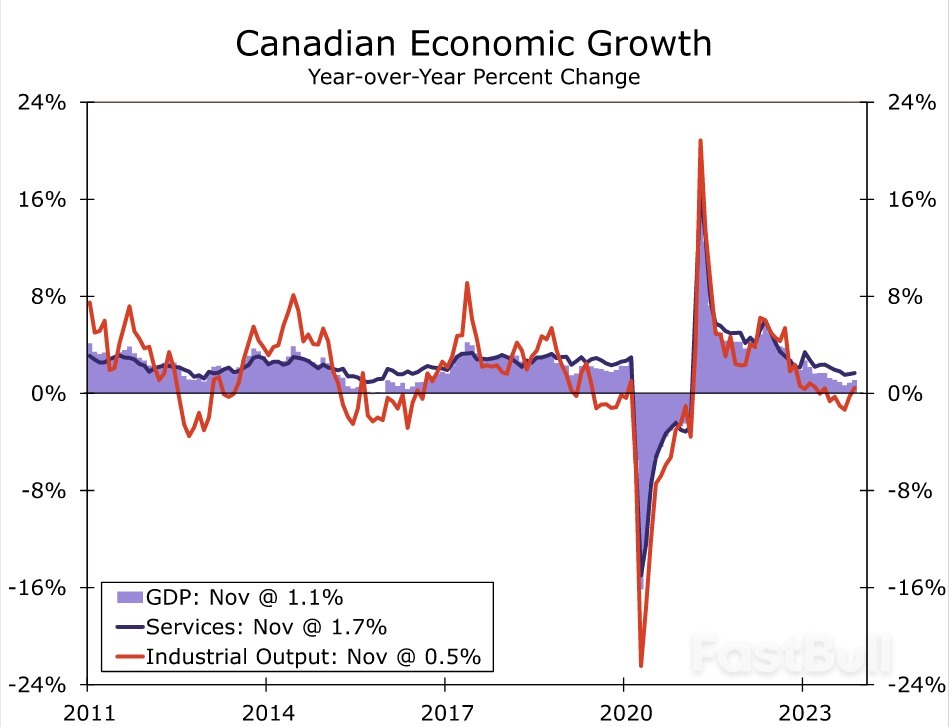
          Over the past few months, economic data in Canada has been mixed, but overall showing signs of softness. Canada's GDP contracted in the third quarter of last year and saw a slight rebound in the fourth quarter. GDP grew by 0.2% month-on-month in November, with Statistics Canada predicting a further 0.3% growth in December. If achieved, the fourth-quarter GDP annualized growth would be 1.2%, essentially reversing the downward trend seen in the third quarter.
          Bank of Canada's Policy Shift Not Yet Complete_1
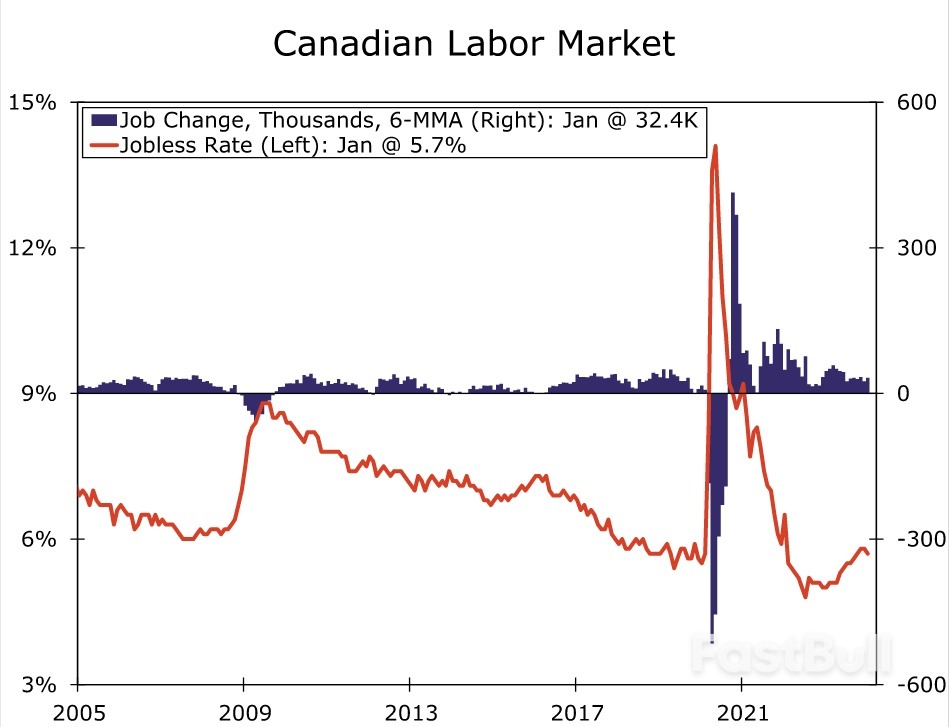
          However, the rebound in GDP growth in the fourth quarter may just be a "blip" in an economic downturn. Currently, the labor market seems to be gradually weakening. The latest employment report for January showed an increase of 37,300 jobs, but this growth was mainly driven by part-time and public sector employment. In January, full-time employment actually decreased by 11,600, marking the second consecutive month of decline, while private sector employees increased modestly by 7,400. The unemployment rate slightly declined to 5.7%, but it remains higher than the mid-2022 low of 4.9%. Overall, the January report aligns with the trend of a gradually weakening labor market.
          Bank of Canada's Policy Shift Not Yet Complete_2
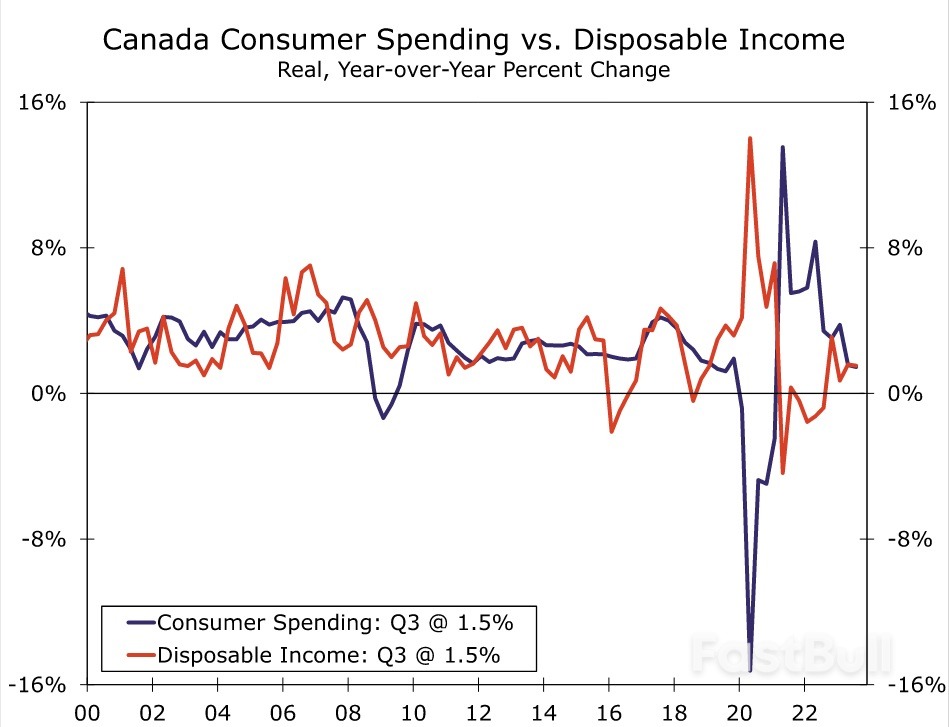
          The fundamentals of household finances also align with moderate growth in consumer spending. With inflation easing, the growth of real disposable income has returned to positive territory. However, despite a 1.5% year-on-year growth in real income in the third quarter of 2023, the growth in real income is only comparable to consumer spending growth over the past four quarters. Additionally, the sharp increase in household debt costs poses a potential downside risk to consumer spending. By the third quarter of 2023, the proportion of interest costs to disposable income had risen to 9.3%, while total debt costs had risen to 15.2%, both reaching new highs in years. In summary, there is no data to support the claim of "strong consumer spending growth in the coming quarters."
          Bank of Canada's Policy Shift Not Yet Complete_3
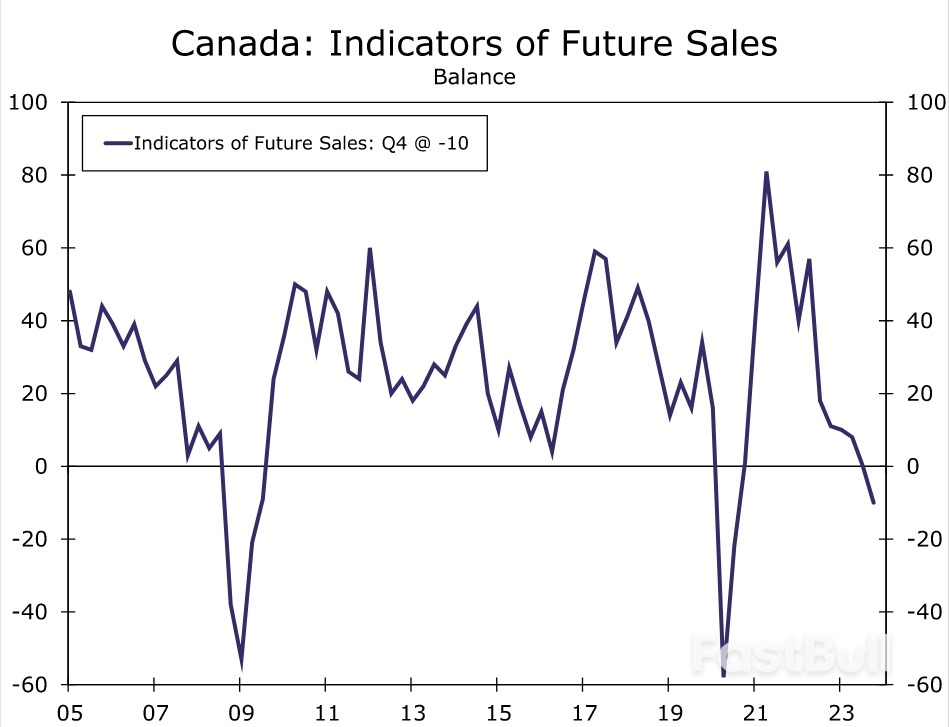
          Meanwhile, the outlook for businesses continues to cool down. In the Bank of Canada's (BOC) fourth-quarter Business Outlook Survey, the overall business sentiment index improved slightly but remained at low levels. The future sales indicator further weakened to -10, the lowest level since 2009, excluding the pandemic period. In other aspects, overall profit growth for businesses is slowing, and industrial capacity utilization has fallen below 80%, all of which could inhibit future investment spending. Considering the consumer and business backdrop, even against the backdrop of a soft landing in the US economy, Canada's GDP is expected to further slow to 0.9% in 2024.
          Bank of Canada's Policy Shift Not Yet Complete_4

          Monetary Policy Shifting

          As the Canadian economy slows, the monetary policy of the BoC is shifting from assessing whether rates are restrictive enough to how long they need to stay at current levels. The BoC perceives that with the economy's growth subdued, supply has caught up with demand, and the economy appears to be operating under mild supply excess. While labor market conditions have eased somewhat, wage growth remains elevated.
          The BoC's assessment of inflation is less optimistic, with housing costs remaining the biggest factor driving inflation above target. Despite normalization in corporate pricing behavior, core inflation indicators have not shown sustained declines. The BoC stated that concerns persist about the inflation outlook, particularly the sustainability of potential inflation, and the BoC would like to see further slowing in core inflation.
          There has been a significant shift in policy guidance, with the BoC dropping its tightening bias at its January meeting, removing the wording "further rate hikes may be required." BoC Governor Tiff Macklem indicated a shift in focus from discussing the restrictiveness of policy rates to how long they need to be maintained at current levels. In other words, the BoC's focus has shifted from how "high" policy rates need to go to how "long" they need to stay at elevated levels.
          Bank of Canada's Policy Shift Not Yet Complete_5
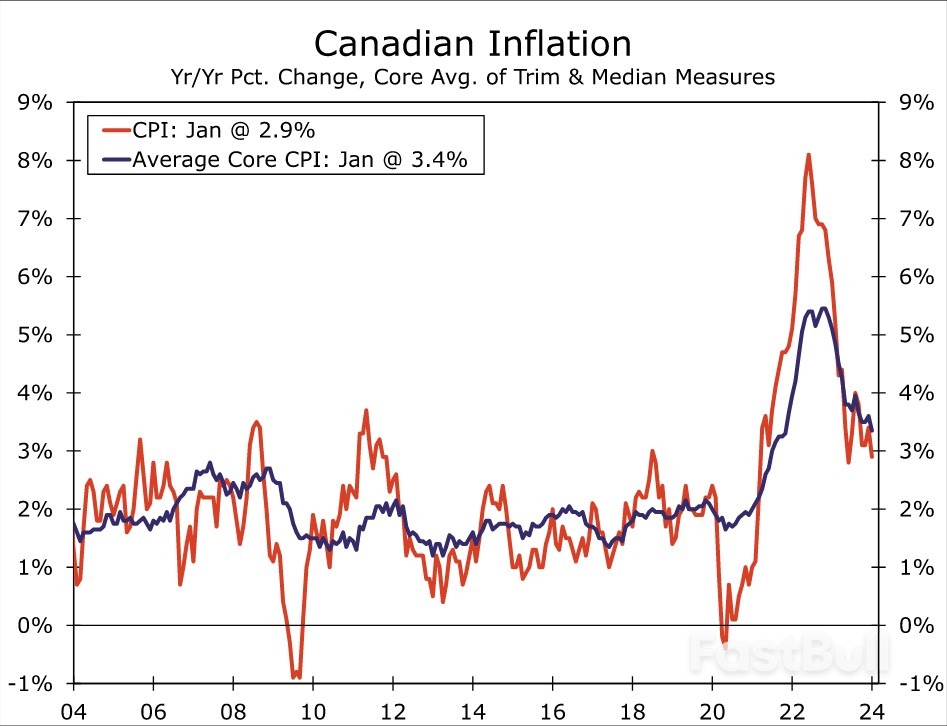
          As the BoC's monetary policy shifts, the latest inflation data is also encouraging. January CPI slowed to 2.9% year-on-year, and average core CPI also slowed to 3.4%, both exceeding expectations, suggesting increased likelihood of rate cuts in the coming months. However, housing costs and service sector inflation exhibit some stubbornness and resilience. Additionally, the three-month annualized growth rate of average core CPI (a key indicator closely monitored by the BoC) remains at 3.2%, well above the 2% inflation target. The BoC's rate cuts will depend mainly on sustained soft economic growth and the labor market beginning to more significantly impact wages and prices. If core inflation trends remain in the range of 2.5-3% and wage growth slows to around 4%, the BoC's willingness to cut rates will become stronger.
          Given these factors, it is premature for the BoC to cut rates, and it is expected to keep rates unchanged in March and April, with no rate cuts before June. Additionally, Canada's economic growth is expected to slow but not to the point of recession.
          To stay updated on all economic events of today, please check out our Economic calendar
          Risk Warnings and Disclaimers
          You understand and acknowledge that there is a high degree of risk involved in trading. Following any strategies or investment methods may lead to potential losses. The content on the site is provided by our contributors and analysts for information purposes only. You are solely responsible for determining whether any trading assets, securities, strategy, or any other product is suitable for investing based on your own investment objectives and financial situation.
          Comments
          Add to Favorites
          Share

          European Stocks Achieve Record High, Following Wall Street's Lead

          Ukadike Micheal

          Economic

          Stocks

          European stocks surged to a record high, echoing the momentum of their Wall Street counterparts, driven by optimism about economic growth and potential monetary policy easing. The Stoxx Europe 600 Index marked a 0.9% gain, reaching 495.71 points, surpassing its previous peak in January 2022. The rally was fueled by robust performances from tech stocks, notably Nvidia Corp., which delivered an impressive sales forecast.
          In a pattern reminiscent of the US market, concentration of returns has been a prevailing theme in Europe, with four key stocks - ASML Holding NV, Novo Nordisk A/S, SAP SE, and LVMH - contributing to 65% of gains in the benchmark since the year's onset. These companies, spanning chip equipment manufacturing, pharmaceuticals, software, and luxury goods, have all experienced double-digit growth in 2024.
          Amid the sector-specific successes, indications of a resilient global economy are bolstering investor confidence. Anticipation of global central banks initiating interest rate cuts later in the year is further propelling equity markets, mirroring the trajectory that led the US benchmark S&P 500 Index to achieve a record high. Despite potential disappointments in eurozone growth, European stocks appear unfazed.
          While concerns about high valuations have arisen, particularly among top-performing stocks, market observers argue that these valuations are justified by superior earnings growth, strong balance sheets, and sustainable competitive advantages. Luxury stocks, exemplified by LVMH's robust sales, are regaining investor favor, contributing to broader market gains.
          However, challenges persist, with China's selective stimulus measures leading to underperformance in the basic resource sector. Retail, particularly weighed down by Hennes & Mauritz AB, has also lagged. Some strategists caution that the prevailing bullish sentiment may be approaching excessive levels, emphasizing the need for vigilance in the face of potential market corrections.
          On the flip side, proponents of European equities argue that the recent rally has predominantly favored US and technology-related stocks, leaving room for a broader market upswing. Emmanuel Cau, a strategist at Barclays Plc, suggests there is potential for the rally to expand, highlighting the under-owned status of European equities in the current market landscape.
          As European stocks ride the wave of optimism and record highs, the nuanced dynamics within individual sectors and the broader market underscore the complexities and opportunities in the evolving landscape. Investors are closely monitoring how these factors play out in the coming months, navigating potential challenges while seeking new avenues for growth in the European equity market.

          Source: Financial Times

          To stay updated on all economic events of today, please check out our Economic calendar
          Risk Warnings and Disclaimers
          You understand and acknowledge that there is a high degree of risk involved in trading. Following any strategies or investment methods may lead to potential losses. The content on the site is provided by our contributors and analysts for information purposes only. You are solely responsible for determining whether any trading assets, securities, strategy, or any other product is suitable for investing based on your own investment objectives and financial situation.
          Comments
          Add to Favorites
          Share

          UK Economy Puts Recession Behind It But Inflation Pressures Rise-PMI

          Samantha Luan

          Economic

          Adding to signs that Britain's shallow recession of last year is likely to be short-lived, the preliminary February S&P Global/CIPS UK Composite Purchasing Managers' Index (PMI), which spans services and manufacturing firms, rose to 53.3, the highest in nine months, from January's 52.9.
          Economists polled by Reuters had forecast no change from January's reading.
          But there were potential areas for concern for the BoE in the survey including strong growth in wages among services firms and Red Sea tensions hitting factory supplies, pushing a measure of price increases by businesses to its highest since July.
          Chris Williamson, S&P Global Market Intelligence's Chief Business Economist, said the survey pointed to the economy growing by 0.2% or 0.3% in the first three months of 2024 after contracting in the third and fourth quarters of last year.
          That is likely to be a relief for Prime Minister Rishi Sunak who has had to endure taunts of "Rishi's recession" from the opposition Labour Party which is riding high in opinion polls ahead of a national election expected later this year. Williamson said the pick-up was being led by demand for financial services amid expectations of imminent rate cuts while manufacturing activity continued to contract and consumer-facing services firms were still battling cost-of-living pressures.
          "With growth accelerating and prices on the rise again, February's data mean policymakers are increasingly likely to err on the side of caution when considering the appropriateness of cutting interest rates," he said.
          Williamson said there was a risk inflation gets stuck at its most recent level of 4% rather than fall to the BoE's 2% target soon, as widely expected.
          The central bank this month signalled that the time might be approaching for cuts to its benchmark lending rate which is at its highest since 2008. But most policymakers are still looking for evidence that inflation pressures will not persist.
          Thursday's survey showed average cost burdens increased in February at the fastest pace for six months, pushed up by higher labour costs as well as rising freight costs for manufacturers which were linked to the Red Sea crisis.
          Among services firms, the PMI's headline measure held at 54.3. Manufacturing remained below the no-growth threshold of 50.0 but edged up to 47.1 from 47.0 in January.
          Overall, new business increased at the fastest pace since May last year but companies were cautious about hiring due to the strong increases in pay.

          Source:Reuters

          To stay updated on all economic events of today, please check out our Economic calendar
          Risk Warnings and Disclaimers
          You understand and acknowledge that there is a high degree of risk involved in trading. Following any strategies or investment methods may lead to potential losses. The content on the site is provided by our contributors and analysts for information purposes only. You are solely responsible for determining whether any trading assets, securities, strategy, or any other product is suitable for investing based on your own investment objectives and financial situation.
          Comments
          Add to Favorites
          Share

          The Commodities Feed: US Crude Oil Inventories Exceed Expectations

          ING

          Commodity

          Energy: Brent time spreads strengthen

          The oil market managed to move higher in the morning trading session amid indications of a tightening crude market. ICE Brent traded above US$83/bbl while the prompt spread also managed to see its backwardation widen to US$0.95/bbl, hovering near three-month highs. However, the API numbers remained largely bearish for the oil market, reporting a large build over the last week.
          US oil inventory numbers overnight from the API show that crude inventories increased significantly by 7.2MMbbls last week, compared to the average market expectations for a build of around 4MMbbls/d. Similarly, Cushing crude oil stocks are reported to have increased by 0.7MMbbls. However, product inventories remained mixed, with gasoline stocks growing by 0.42MMbbls, while distillate stocks fell by 2.9MMbbls over the week ending 16 February. The more widely followed EIA inventory report will be released later today.

          Metals: Zinc ends 2023 in surplus

          The recent data from the International Lead and Zinc Study Group (ILZSG) show that the global zinc market ended 2023 with a supply surplus of 205kt compared to a deficit of 73kt a year earlier. Total refined production rose by 3.8% year-on-year to 13.9mt (driven by higher Chinese output), while total consumption increased 1.7% year-on-year to 13.7mt in 2023. As for lead, total production reported gains of 2.8% YoY to 12.85mt, while consumption rose by 1% YoY to 12.76mt last year. The lead market was estimated to have seen a supply surplus of 92kt in 2023, compared to a supply deficit of 134kt during the same time in the previous year.
          Meanwhile, Vale said that the operating license for its Sossego mine (its second largest copper mine) located in Para, Brazil has been suspended by the State of Para's environmental secretary. The company didn’t mention the reason for the suspension and said that it complies with conditions and socio-environmental controls of its activity. Vale produced around 66.8kt of copper in the Sossego mine last year.

          Agriculture: Ghana lowers cocoa production estimates

          Recent estimates from the Ghana Cocoa Board show that cocoa production in the country is likely to fall to around 650kt-700kt in 2023/24, lower than the previous estimates of 850kt. This would be the lowest annual output in 14 years. The revision in the estimates is mainly due to unfavourable weather conditions and smuggling. Cocoa prices jumped over 4% yesterday to settle at the highest level on record amid expectations for global supply shortages.
          In its latest report, the Rosario Board of Trade revised down the Argentina’s soybean production estimates to 49.5mt for the 2023/24 season, lower than the 52mt estimated in January. The downward revision in the estimates was majorly due to continuous heat waves in the Pampas crop belt. Similarly, corn production estimates were also revised lower by 3.4% MoM to 57mt for the period.
          Risk Warnings and Disclaimers
          You understand and acknowledge that there is a high degree of risk involved in trading. Following any strategies or investment methods may lead to potential losses. The content on the site is provided by our contributors and analysts for information purposes only. You are solely responsible for determining whether any trading assets, securities, strategy, or any other product is suitable for investing based on your own investment objectives and financial situation.
          Comments
          Add to Favorites
          Share

          France February Flash Services PMI 48.0 Vs 45.6 Expected

          Samantha Luan

          Economic

          France February Flash Services PMI 48.0 Vs 45.6 Expected_1Those are strong beats across the board and the euro is up to fresh highs on the day now. This diminishes the odds of an April rate cut, now seen at ~43%. Going back to the readings, the services print is a 8-month high while the manufacturing print is a 11-month high. Both are seen rebounding amid tentative signs of improvement in demand conditions while new orders also fell at its softest rate since last May.

          HCOB notes that:

          “France's economy is in recovery mode. Even if the economy continues to shrink, this is happening at a much slower pace, as the composite PMI has improved by more than three points. This is mainly due to demand, which is no longer declining at a rapid pace. The pace of output price growth has also slowed considerably. Our HCOB Nowcast, which incorporates the latest PMI figures, has improved as a result.“
          “The French service sector is edging closer to growth. Exporters are partly responsible for this glimmer of hope, and one possible explanation for this would be an improvement in demand for tourism. It is crucial for the French economy that the service sector returns to growth as quickly as possible in order for the second-largest euro area economy to recover. After all, the sector accounts for almost 80 % of total output.”
          “France's manufacturing industry is gradually making a comeback. The new orders index has risen by more than seven points, which has significantly curbed the slump in production. Whether this is just a one-off or the start of a trend is still to be seen, especially as manufacturers’ expectations for future business activity remain pessimistic and well below their long-term average.“
          “These HCOB PMIs for prices will certainly please the ECB. Services inflation is currently acting as the main driver of consumer price inflation in France and our survey shows a further significant slowdown in February. Output price inflation in the services sector has reached its lowest in almost three years. It is possible that the index will soon fall below the expansion threshold of 50, as has been the case in the manufacturing sector since the middle of last year.”

          Source:forexlive

          To stay updated on all economic events of today, please check out our Economic calendar
          Risk Warnings and Disclaimers
          You understand and acknowledge that there is a high degree of risk involved in trading. Following any strategies or investment methods may lead to potential losses. The content on the site is provided by our contributors and analysts for information purposes only. You are solely responsible for determining whether any trading assets, securities, strategy, or any other product is suitable for investing based on your own investment objectives and financial situation.
          Comments
          Add to Favorites
          Share
          FastBull
          Copyright © 2025 FastBull Ltd

          728 RM B 7/F GEE LOK IND BLDG NO 34 HUNG TO RD KWUN TONG KLN HONG KONG

          TelegramInstagramTwitterfacebooklinkedin
          App Store Google Play Google Play
          Products
          Charts

          Chats

          Q&A with Experts
          Screeners
          Economic Calendar
          Data
          Tools
          Membership
          Features
          Function
          Markets
          Copy Trading
          Latest Signals
          Contests
          News
          Analysis
          24/7
          Columns
          Education
          Company
          Careers
          About Us
          Contact Us
          Advertising
          Help Center
          Feedback
          User Agreement
          Privacy Policy
          Business

          White Label

          Data API

          Web Plug-ins

          Poster Maker

          Affiliate Program

          Risk Disclosure

          The risk of loss in trading financial instruments such as stocks, FX, commodities, futures, bonds, ETFs and crypto can be substantial. You may sustain a total loss of the funds that you deposit with your broker. Therefore, you should carefully consider whether such trading is suitable for you in light of your circumstances and financial resources.

          No decision to invest should be made without thoroughly conducting due diligence by yourself or consulting with your financial advisors. Our web content might not suit you since we don't know your financial conditions and investment needs. Our financial information might have latency or contain inaccuracy, so you should be fully responsible for any of your trading and investment decisions. The company will not be responsible for your capital loss.

          Without getting permission from the website, you are not allowed to copy the website's graphics, texts, or trademarks. Intellectual property rights in the content or data incorporated into this website belong to its providers and exchange merchants.

          Not Logged In

          Log in to access more features

          FastBull Membership

          Not yet

          Purchase

          Become a signal provider
          Help Center
          Customer Service
          Dark Mode
          Price Up/Down Colors

          Log In

          Sign Up

          Position
          Layout
          Fullscreen
          Default to Chart
          The chart page opens by default when you visit fastbull.com