• Trade
  • Markets
  • Copy
  • Contests
  • News
  • 24/7
  • Calendar
  • Q&A
  • Chats
Trending
Screeners
SYMBOL
LAST
BID
ASK
HIGH
LOW
NET CHG.
%CHG.
SPREAD
SPX
S&P 500 Index
6858.76
6858.76
6858.76
6878.28
6858.25
-11.64
-0.17%
--
DJI
Dow Jones Industrial Average
47858.45
47858.45
47858.45
47971.51
47771.72
-96.53
-0.20%
--
IXIC
NASDAQ Composite Index
23568.43
23568.43
23568.43
23698.93
23565.41
-9.69
-0.04%
--
USDX
US Dollar Index
99.070
99.150
99.070
99.110
98.730
+0.120
+ 0.12%
--
EURUSD
Euro / US Dollar
1.16291
1.16299
1.16291
1.16717
1.16245
-0.00135
-0.12%
--
GBPUSD
Pound Sterling / US Dollar
1.33177
1.33187
1.33177
1.33462
1.33087
-0.00135
-0.10%
--
XAUUSD
Gold / US Dollar
4192.48
4192.89
4192.48
4218.85
4175.92
-5.43
-0.13%
--
WTI
Light Sweet Crude Oil
59.008
59.038
59.008
60.084
58.892
-0.801
-1.34%
--

Community Accounts

Signal Accounts
--
Profit Accounts
--
Loss Accounts
--
View More

Become a signal provider

Sell trading signals to earn additional income

View More

Guide to Copy Trading

Get started with ease and confidence

View More

Signal Accounts for Members

All Signal Accounts

Best Return
  • Best Return
  • Best P/L
  • Best MDD
Past 1W
  • Past 1W
  • Past 1M
  • Past 1Y

All Contests

  • All
  • Trump Updates
  • Recommend
  • Stocks
  • Cryptocurrencies
  • Central Banks
  • Featured News
Top News Only
Share

The S&P 500 Opened 4.80 Points Higher, Or 0.07%, At 6875.20; The Dow Jones Industrial Average Opened 16.52 Points Higher, Or 0.03%, At 47971.51; And The Nasdaq Composite Opened 60.09 Points Higher, Or 0.25%, At 23638.22

Share

Reuters Poll - Swiss National Bank Policy Rate To Be 0.00% At End-2026, Said 21 Of 25 Economists, Four Said It Would Be Cut To -0.25%

Share

USGS - Magnitude 7.6 Earthquake Strikes Misawa, Japan

Share

Reuters Poll - Swiss National Bank To Hold Policy Rate At 0.00% On December 11, Said 38 Of 40 Economists, Two Said Cut To -0.25%

Share

Traders Believe There Is A 20% Chance That The European Central Bank Will Raise Interest Rates Before The End Of 2026

Share

Toronto Stock Index .GSPTSE Rises 11.99 Points, Or 0.04 Percent, To 31323.40 At Open

Share

Japan Meteorological Agency: A Tsunami With A Maximum Height Of Three Meters Is Expected Following The Earthquake In Japan

Share

Japan Meteorological Agency: A 7.2-magnitude Earthquake Struck Off The Coast Of Northern Japan, And A Tsunami Warning Has Been Issued

Share

Japan Finance Minister Katayama: G7 Expected To Hold Another Meeting By The End Of This Year

Share

The Japan Meteorological Agency Reported That An Earthquake Occurred In The Sea Near Aomori

Share

Japan Finance Minister Katayama: The G7 Finance Ministers' Meeting Discussed The Critical Mineral Supply Chain And Support For Ukraine

Share

Japan Finance Minister Katayama: Held Onlinemeeting With G7 Finance Ministers

Share

Fed Data - USA Effective Federal Funds Rate At 3.89 Percent On 05 December On $88 Billion In Trades Versus 3.89 Percent On $87 Billion On 04 December

Share

Chinese Foreign Minister Wang Yi: One-China Principle Is An Important Political Foundation For China-Germany Relations, And There Is No Room For Ambiguity

Share

Chinese Foreign Minister Wang Yi: Hopes Germany To Understand, Support China's Position Regarding Japan Prime Minister's Remark On Taiwan

Share

Chinese Foreign Minister Wang Yi: Hopes Germany Will View China More Objectively And Rationally, Adhere To The Positioning Of China-Germany Partnership

Share

China Foreign Ministry: China's Foreign Minister Wang Yi Meets German Counterpart

Share

Israeli Government Spokesperson: Netanyahu Will Meet Trump On December 29

Share

Stc Did Not Ask Internationally-Government To Leave Aden - Senior Stc Official To Reuters

Share

Members Of Internationally-Recognised Government, Opposed To Northern Houthis, Have Left Aden - Senior Stc Official To Reuters

TIME
ACT
FCST
PREV
France Trade Balance (SA) (Oct)

A:--

F: --

P: --
Euro Zone Employment YoY (SA) (Q3)

A:--

F: --

P: --
Canada Part-Time Employment (SA) (Nov)

A:--

F: --

P: --

Canada Unemployment Rate (SA) (Nov)

A:--

F: --

P: --

Canada Full-time Employment (SA) (Nov)

A:--

F: --

P: --

Canada Labor Force Participation Rate (SA) (Nov)

A:--

F: --

P: --

Canada Employment (SA) (Nov)

A:--

F: --

P: --

U.S. PCE Price Index MoM (Sept)

A:--

F: --

P: --

U.S. Personal Income MoM (Sept)

A:--

F: --

P: --

U.S. Core PCE Price Index MoM (Sept)

A:--

F: --

P: --

U.S. PCE Price Index YoY (SA) (Sept)

A:--

F: --

P: --

U.S. Core PCE Price Index YoY (Sept)

A:--

F: --

P: --

U.S. Personal Outlays MoM (SA) (Sept)

A:--

F: --

P: --
U.S. 5-10 Year-Ahead Inflation Expectations (Dec)

A:--

F: --

P: --

U.S. Real Personal Consumption Expenditures MoM (Sept)

A:--

F: --

P: --
U.S. Weekly Total Rig Count

A:--

F: --

P: --

U.S. Weekly Total Oil Rig Count

A:--

F: --

P: --

U.S. Consumer Credit (SA) (Oct)

A:--

F: --

P: --
China, Mainland Foreign Exchange Reserves (Nov)

A:--

F: --

P: --

Japan Trade Balance (Oct)

A:--

F: --

P: --

Japan Nominal GDP Revised QoQ (Q3)

A:--

F: --

P: --

China, Mainland Imports YoY (CNH) (Nov)

A:--

F: --

P: --

China, Mainland Exports (Nov)

A:--

F: --

P: --

China, Mainland Imports (CNH) (Nov)

A:--

F: --

P: --

China, Mainland Trade Balance (CNH) (Nov)

A:--

F: --

P: --

China, Mainland Exports YoY (USD) (Nov)

A:--

F: --

P: --

China, Mainland Imports YoY (USD) (Nov)

A:--

F: --

P: --

Germany Industrial Output MoM (SA) (Oct)

A:--

F: --

P: --
Euro Zone Sentix Investor Confidence Index (Dec)

A:--

F: --

P: --

Canada National Economic Confidence Index

A:--

F: --

P: --

U.K. BRC Like-For-Like Retail Sales YoY (Nov)

--

F: --

P: --

U.K. BRC Overall Retail Sales YoY (Nov)

--

F: --

P: --

Australia Overnight (Borrowing) Key Rate

--

F: --

P: --

RBA Rate Statement
RBA Press Conference
Germany Exports MoM (SA) (Oct)

--

F: --

P: --

U.S. NFIB Small Business Optimism Index (SA) (Nov)

--

F: --

P: --

Mexico 12-Month Inflation (CPI) (Nov)

--

F: --

P: --

Mexico Core CPI YoY (Nov)

--

F: --

P: --

Mexico PPI YoY (Nov)

--

F: --

P: --

U.S. Weekly Redbook Index YoY

--

F: --

P: --

U.S. JOLTS Job Openings (SA) (Oct)

--

F: --

P: --

China, Mainland M1 Money Supply YoY (Nov)

--

F: --

P: --

China, Mainland M0 Money Supply YoY (Nov)

--

F: --

P: --

China, Mainland M2 Money Supply YoY (Nov)

--

F: --

P: --

U.S. EIA Short-Term Crude Production Forecast For The Year (Dec)

--

F: --

P: --

U.S. EIA Natural Gas Production Forecast For The Next Year (Dec)

--

F: --

P: --

U.S. EIA Short-Term Crude Production Forecast For The Next Year (Dec)

--

F: --

P: --

EIA Monthly Short-Term Energy Outlook
U.S. API Weekly Gasoline Stocks

--

F: --

P: --

U.S. API Weekly Cushing Crude Oil Stocks

--

F: --

P: --

U.S. API Weekly Crude Oil Stocks

--

F: --

P: --

U.S. API Weekly Refined Oil Stocks

--

F: --

P: --

South Korea Unemployment Rate (SA) (Nov)

--

F: --

P: --

Japan Reuters Tankan Non-Manufacturers Index (Dec)

--

F: --

P: --

Japan Reuters Tankan Manufacturers Index (Dec)

--

F: --

P: --

Japan Domestic Enterprise Commodity Price Index MoM (Nov)

--

F: --

P: --

Japan Domestic Enterprise Commodity Price Index YoY (Nov)

--

F: --

P: --

China, Mainland PPI YoY (Nov)

--

F: --

P: --

China, Mainland CPI MoM (Nov)

--

F: --

P: --

Q&A with Experts
    • All
    • Chatrooms
    • Groups
    • Friends
    Connecting
    .
    .
    .
    Type here...
    Add Symbol or Code

      No matching data

      All
      Trump Updates
      Recommend
      Stocks
      Cryptocurrencies
      Central Banks
      Featured News
      • All
      • Russia-Ukraine Conflict
      • Middle East Flashpoint
      • All
      • Russia-Ukraine Conflict
      • Middle East Flashpoint
      Search
      Products

      Charts Free Forever

      Chats Q&A with Experts
      Screeners Economic Calendar Data Tools
      Membership Features
      Data Warehouse Market Trends Institutional Data Policy Rates Macro

      Market Trends

      Market Sentiment Order Book Forex Correlations

      Top Indicators

      Charts Free Forever
      Markets

      News

      News Analysis 24/7 Columns Education
      From Institutions From Analysts
      Topics Columnists

      Latest Views

      Latest Views

      Trending Topics

      Top Columnists

      Latest Update

      Signals

      Copy Rankings Latest Signals Become a signal provider AI Rating
      Contests
      Brokers

      Overview Brokers Assessment Rankings Regulators News Claims
      Broker listing Forex Brokers Comparison Tool Live Spread Comparison Scam
      Q&A Complaint Scam Alert Videos Tips to Detect Scam
      More

      Business
      Events
      Careers About Us Advertising Help Center

      White Label

      Data API

      Web Plug-ins

      Affiliate Program

      Awards Institution Evaluation IB Seminar Salon Event Exhibition
      Vietnam Thailand Singapore Dubai
      Fans Party Investment Sharing Session
      FastBull Summit BrokersView Expo
      Recent Searches
        Top Searches
          Markets
          News
          Analysis
          User
          24/7
          Economic Calendar
          Education
          Data
          • Names
          • Latest
          • Prev

          View All

          No data

          Scan to Download

          Faster Charts, Chat Faster!

          Download App
          English
          • English
          • Español
          • العربية
          • Bahasa Indonesia
          • Bahasa Melayu
          • Tiếng Việt
          • ภาษาไทย
          • Français
          • Italiano
          • Türkçe
          • Русский язык
          • 简中
          • 繁中
          Open Account
          Search
          Products
          Charts Free Forever
          Markets
          News
          Signals

          Copy Rankings Latest Signals Become a signal provider AI Rating
          Contests
          Brokers

          Overview Brokers Assessment Rankings Regulators News Claims
          Broker listing Forex Brokers Comparison Tool Live Spread Comparison Scam
          Q&A Complaint Scam Alert Videos Tips to Detect Scam
          More

          Business
          Events
          Careers About Us Advertising Help Center

          White Label

          Data API

          Web Plug-ins

          Affiliate Program

          Awards Institution Evaluation IB Seminar Salon Event Exhibition
          Vietnam Thailand Singapore Dubai
          Fans Party Investment Sharing Session
          FastBull Summit BrokersView Expo

          What is the Red Sea Crisis, and What Does It Mean for Global Trade?

          Cohen

          Economic

          Summary:

          Attacks by Houthi rebels along the trade route have led to firms pausing shipments, raising the possibility of a shock to the world economy.

          The world's largest shipping firms are continuing to pause shipments through the Red Sea after attacks by Houthi rebels along the crucial international trade route.
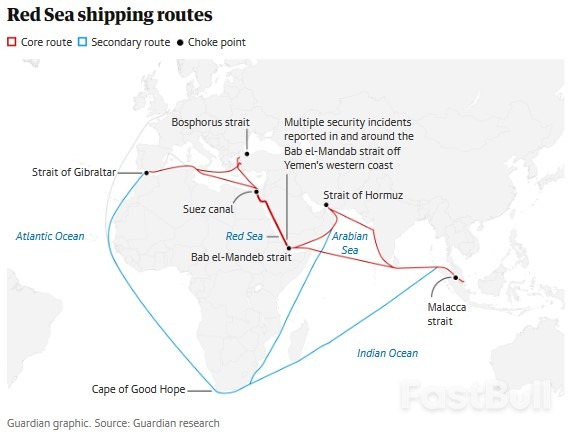
          As container ships are diverted around the Cape of Good Hope on the southern tip of Africa, adding thousands of miles to journeys, the disruption is driving up the cost of shipments from Asia to Europe, raising the prospect of a renewed inflation shock for the world economy.
          What is happening in the Red Sea?
          Iran-backed Houthi rebels in Yemen have significantly stepped up a campaign of attacks against commercial vessels in the Bab-el-Mandeb strait between the Arabian Peninsula and the Horn of Africa since late November.
          Launched in response to Israel's bombardment of Gaza, the attacks have escalated in the past week. Helicopters launched from US navy warships were used to repel an attack by militants on a ship owned by Maersk over the weekend, leading the Danish shipping line to continue to pause all cargo movement through the area until further notice.
          What is the Red Sea Crisis, and What Does It Mean for Global Trade?_1Germany's Hapag-Lloyd has also said its container ships would continue to avoid the route, which is a central artery for global trade on the passage from Asia to Europe via the Suez canal and the Mediterranean.
          How significant is the Red Sea trade route?
          The Suez canal handles about 12% of global trade and is accessed by vessels travelling from Asia via the 30km wide Bab-el-Mandeb strait. About half of freight shipped through the canal is made up of containerised goods. The route also provides a vital passage for shipments of oil from the Persian Gulf to Europe and North America.
          Rerouting shipments around the Cape of Good Hope adds about 3,000-3,500 nautical miles (6,000km) to journeys connecting Europe with Asia, adding about 10 days to the duration of the trip, according to the Dutch bank ING.
          With the prospect of lengthier shipping times, there could be a knock-on impact for turnaround times at ports in the UK and large European hubs such as Rotterdam, Antwerp and Hamburg.
          Could it drive up inflation?
          Redirecting ships is expected to cost up to $1m in extra fuel for every round trip between Asia and Europe, while insurance costs are also rising, adding to the overall cost of shipments.
          Tankers transporting diesel and jet fuel from the Middle East and Asia are being diverted, while container shipments of consumer goods, commodities, clothing and food are also likely to be delayed.
          Global oil prices rose on Wednesday as concerns over delays in the Red Sea were compounded by reports of disruption to Libya's biggest oilfield. However, crude prices have remained relatively stable and are still significantly lower than in recent months, having fallen by almost $20 a barrel since the autumn.What is the Red Sea Crisis, and What Does It Mean for Global Trade?_2
          Shipping costs can have a big inflationary impact. During the Covid pandemic, the International Monetary Fund estimated that global supply chain bottlenecks added about 1 percentage point to inflation. During normal times, freight costs contribute about 7% of the costs of long-haul imports. This jumped as high as 25% during the Covid disruption.
          Rhys Davies, a former government trade adviser who now advises clients at the consultancy firm Flint Global, said freight costs had clearly been affected by tensions in the Red Sea, but that the impact on inflation would probably be limited.
          "The effect feeds into the economy pretty slowly, taking about 12 months after the spike [in shipping costs," he said. "So if the disruption is time-limited, as we would expect, it will probably be drowned by wider disinflationary impacts."
          How much does context matter?
          Unlike when the Suez canal was blocked by the Ever Given container ship in 2021, triggering mass problems for world trade, the economic backdrop to the current Red Sea disruption is markedly different.
          Two years ago global supply chains were creaking under the pressure of red-hot demand for manufactured goods from consumers who were blocked from spending on services by lockdown restrictions, while factory output and global freight were unable to keep pace.
          What is the Red Sea Crisis, and What Does It Mean for Global Trade?_3Today, inflation is cooling as the world's leading central banks use higher interest rates to crush demand. With households and businesses under pressure, world trade volumes and economic growth have slowed, raising the prospect of recessions in the US, UK and EU nations.
          Although global freight costs have risen sharply in recent days thanks to the Red Sea disruption, they remain significantly lower than two years ago. The Shanghai Containerized Freight Index, the most widely used index for sea freight rates for imports from China worldwide, is down by more than half.
          James Smith, an economist at ING, said: "It brings back memories of the pandemic when supply chains were obviously messed up, and there was the Suez canal blockage as well. The circumstances, at least for now, are quite different."

          Source: The Guardian

          To stay updated on all economic events of today, please check out our Economic calendar
          Risk Warnings and Disclaimers
          You understand and acknowledge that there is a high degree of risk involved in trading. Following any strategies or investment methods may lead to potential losses. The content on the site is provided by our contributors and analysts for information purposes only. You are solely responsible for determining whether any trading assets, securities, strategy, or any other product is suitable for investing based on your own investment objectives and financial situation.
          Comments
          Add to Favorites
          Share

          Indonesia's Foreign Policy After The 2024 Presidential Elections

          Thomas

          Political

          On February 14, Indonesia – the world's fourth-most populous nation, third-largest democracy, biggest Muslim-majority country and a leading voice in Southeast Asia and the Global South – will hold a momentous election.
          The winner of a three-candidate race will replace President Joko “Jokowi” Widodo, the popular 10-year incumbent, whose second and last possible term ends this year. The winner will shape foreign policy for the archipelagic nation of over 270 million people. Since Jokowi's tenure began in 2014, he has advanced a domestic-centered, economy-first foreign policy to develop Indonesia into one of the world's top five economies by 2045. Now the nation ranks solidly in the top 20 – usually in 16th place – with a nominal gross domestic product of $1.3 trillion in 2022, according to the World Bank.
          President's foreign policy advances economic goals
          To accomplish this ambitious goal, he has strengthened the country's economic diplomacy, reinforced its status as a commodity giant through onshoring production within the nation and kickstarted big-ticket infrastructure projects. The largest of them is a multi-decade plan to build the new capital city of Nusantara, which would entail moving key functions away from the current capital of Jakarta.
          Additionally, though Jokowi has shown little interest in geopolitics, his administration has continued to advance longtime foreign policy priorities in line with his vision, such as better managing the country's maritime boundaries, enhancing its Indo-Pacific engagement and expanding its role as a global middle power. This was spotlighted during Indonesia's chairmanship of the G20 in 2022 and the Association of Southeast Asian Nations (ASEAN) in 2023.
          Jokowi has advanced his foreign policy agenda amid consistently sky-high popularity ratings across his two terms. Yet that agenda has not been without its limits. Indonesia has begun to see the risks from some of its big-ticket infrastructure projects, be it environmental abuses linked to Chinese nickel plants or the lack of foreign investment for the new capital city.
          Rising geopolitical headwinds – including Covid-19, intensifying U.S.-China competition and Russia's invasion of Ukraine – have also made it more challenging for Indonesia to achieve the high-growth rates that Jokowi sought when he entered office. More generally, his narrower foreign policy focus has led to a sense of drift in Indonesia's traditional leadership role within ASEAN relative to that of his predecessor, Susilo Bambang Yudhoyono, who was more active on the global stage.
          As Indonesia heads into its presidential elections, the focus is shifting to what the country's foreign policy will look like after Jokowi. The question here is less whether a stark departure will take place from Jokowi's popular approach, and more about the extent of change we might see under the next administration.
          Continuity and change in Indonesian foreign policy
          Indonesian foreign policy to date has revolved around a mix of general continuity with some change. It treasures its ability to play a “free and active” role in world affairs, its identity as an archipelagic, maritime nation and its status as a leader in Southeast Asia. While foreign policy may not decide Indonesian elections, individual issues – be it the country's maritime priorities or its approach to China – have featured in the campaign and brought out differences among the candidates.
          Jokowi, for his part, has also been trying to minimize the extent of change by repeatedly and publicly urging his successor to continue his key policies, including the development of the new capital city. The exact mix of continuity and change is far from clear as of now.
          The three candidates to replace Jokowi
          The 2024 election is a three-way race among ex-special forces commander and Jokowi's two-time election opponent-turned-Defense Minister Prabowo Subianto; former Central Java Governor Ganjar Pranowo and former Jakarta Governor Anies Baswedan.
          Of the three, Mr. Prabowo's views on foreign policy are the best known given his past positions on areas like boosting Indonesia's military capabilities and asserting its sovereignty against external enemies. Yet Mr. Prabowo has also been known to adapt his views, and his recent warming to Jokowi and selection of Jokowi's eldest son, Gibran, as his running mate suggests that a focus on past positions alone may tell us little about his future actions.
          Less is known about Messrs. Anies and Ganjar on this front. Both emphasized select areas in their manifestos submitted during campaign registration, including preventing domination from external powers and increasing weapons purchases. While this may point to areas of debate during the campaign, much of how foreign policy plays out during a new president's term will depend on factors such as how they structure decision-making within their administration and the extent to which they take a personal role in this realm or delegate it to close advisors and relevant ministries.

          Source: GIS

          Risk Warnings and Disclaimers
          You understand and acknowledge that there is a high degree of risk involved in trading. Following any strategies or investment methods may lead to potential losses. The content on the site is provided by our contributors and analysts for information purposes only. You are solely responsible for determining whether any trading assets, securities, strategy, or any other product is suitable for investing based on your own investment objectives and financial situation.
          Comments
          Add to Favorites
          Share

          Emerging Markets Brace for Wave of Elections with Fiscal Discipline at Stake

          Alex

          Economic

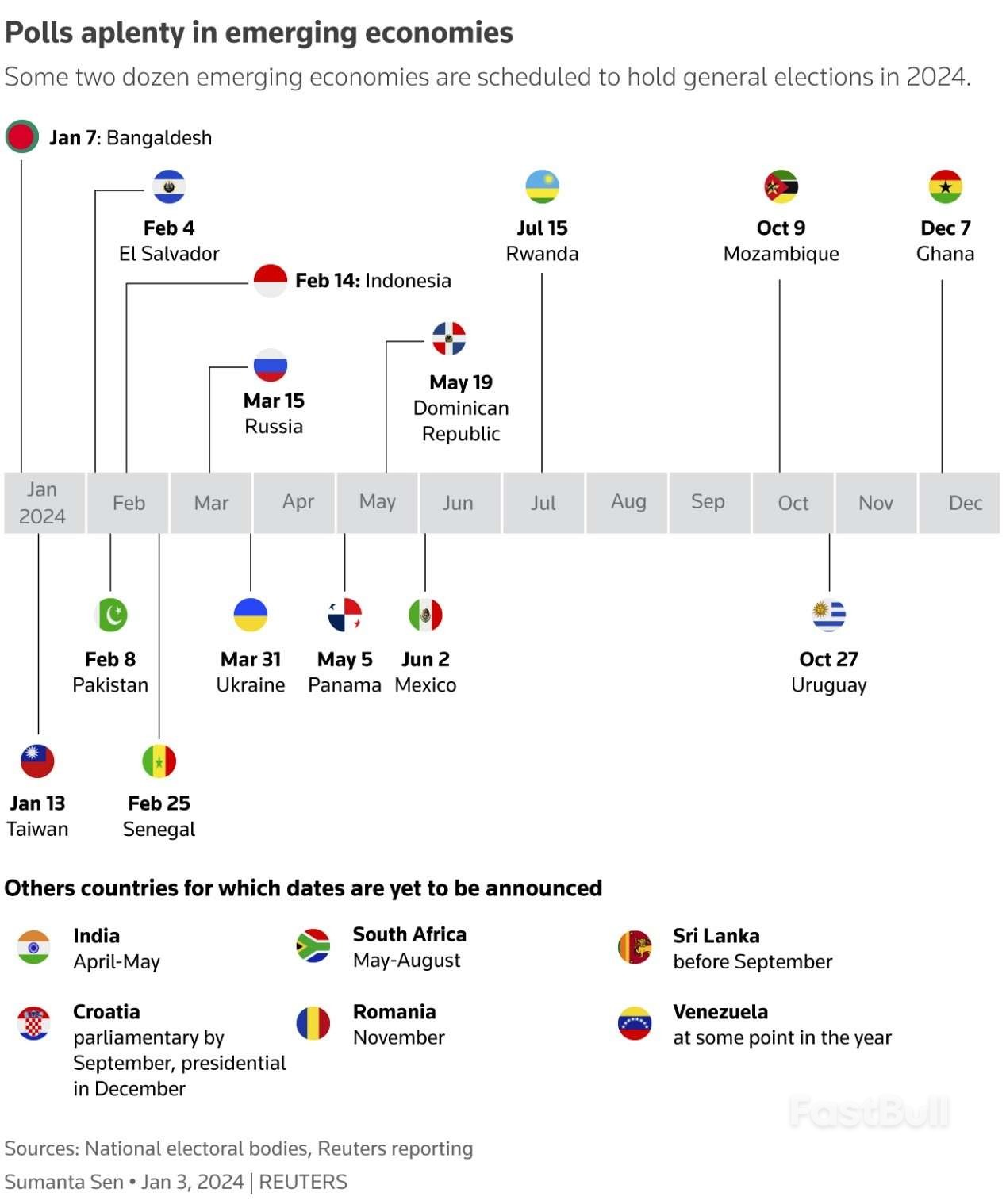
          Emerging markets are gearing up for their biggest election year in decades, with investors focused on fiscal discipline and populist shifts that could stir markets and blur the outlook for some key economies.
          Countries home to more than half the world's population and accounting for more than 60% of global economic output go to the polls in 2024.
          The calendar is bookended by votes in Taiwan in January - a high-stakes geopolitical event - and in sovereign defaulter Ghana in December, as the country strives to emerge from a debt crunch.
          "This is an election year like we have never seen before. It really is an extraordinary year," said David Lubin, associate fellow at think tank Chatham House and Citi's former head of emerging market economics.
          "Recent elections in Argentina and Poland have reminded us that elections do produce surprises," Lubin added.
          The elections frenzy comes against a backdrop of sharply higher global borrowing rates - piling pressure on more fragile economies even though the prospect of interest rate cuts from the world's big central banks is firmly on the horizon.
          For investors, elections divide into three categories: Those where the outcome is rather obvious, such as Russia or Venezuela; those where it seems clear but the ballot is contested, for example India, Mexico or Indonesia; and those where there is genuine uncertainty, like in South Africa.
          The 2023 polls in Argentina and Poland also served as reminders that governments due to face their electorates are more often than not prone to loosening the purse strings - a trend that can leave those who take over struggling to roll back the handouts.
          Even when Argentina's previous government ramped up spending between the first and second round of their vote, radical Javier Milei swept to power and embarked on a radical reform programme. In Poland, the surprise election win of the liberal, pro-EU Donald Tusk got the thumbs up from investors.
          Emerging Markets Brace for Wave of Elections with Fiscal Discipline at Stake_1Open Wallets
          Fiscal discipline is seen as key, especially following a series of external shocks ranging from COVID-19 to Russia's war in Ukraine and a rise in global yields that has highlighted the need for countries to keep spending tightly controlled, said Yvette Babb, a portfolio manager at asset manager William Blair.
          "There is very limited margin for populist - often times meaning 'expensive' - policy stances across emerging markets," said Babb. "In many of our markets, elections victories have historically been tied to fiscal stances and populist policy. For this to continue it would be very controversial."
          Morgan Stanley flagged fiscal risks from pre-election spending as a key driver this year for South Africa, Romania, Russia, El Salvador, Dominican Republic and Uruguay.
          The ramifications could be felt well beyond this year. The Institute of International Finance (IIF) said the "tsunami" of 2024 elections could add to an already record glut of global debt estimated to have hit $310 trillion by the end of 2023.
          "A sudden increase in government spending during these global elections cycle could further elevate interest (payments) for many countries," warned Emre Tiftik, Director of Sustainable Research at the IIF, adding that this could create further volatility in markets.
          Some fear this could spur a resurgence of so-called bond vigilantes, investors who punish profligate governments by selling their bonds, driving yields higher.
          Currency Shivers
          Analysts at Citi, who also warn that the looming emerging markets election cycle might see "less policy discipline than investors would like" - have studied the short-term effects markets might have to contend with.
          While some votes are bound to generate more volatility than others, currency markets are often the first to feel election nerves, especially in Latin America, according to Citi strategist Dirk Willer.
          He points to a reliable pattern for Mexico's peso that sees the currency weakening in the lead-up to the vote only to strengthen on the emergence of some kind of certainty once the election result seems reasonably established. Latin America's second-largest economy is scheduled to hold elections on June 2 with the incumbent party's candidate enjoying a healthy lead in opinion polls.
          Evidence of the heavy election cycle shaping investment flows to equities already emerged in 2023, said Karim Chedid, head of EMEA iShares investment strategy at BlackRock.
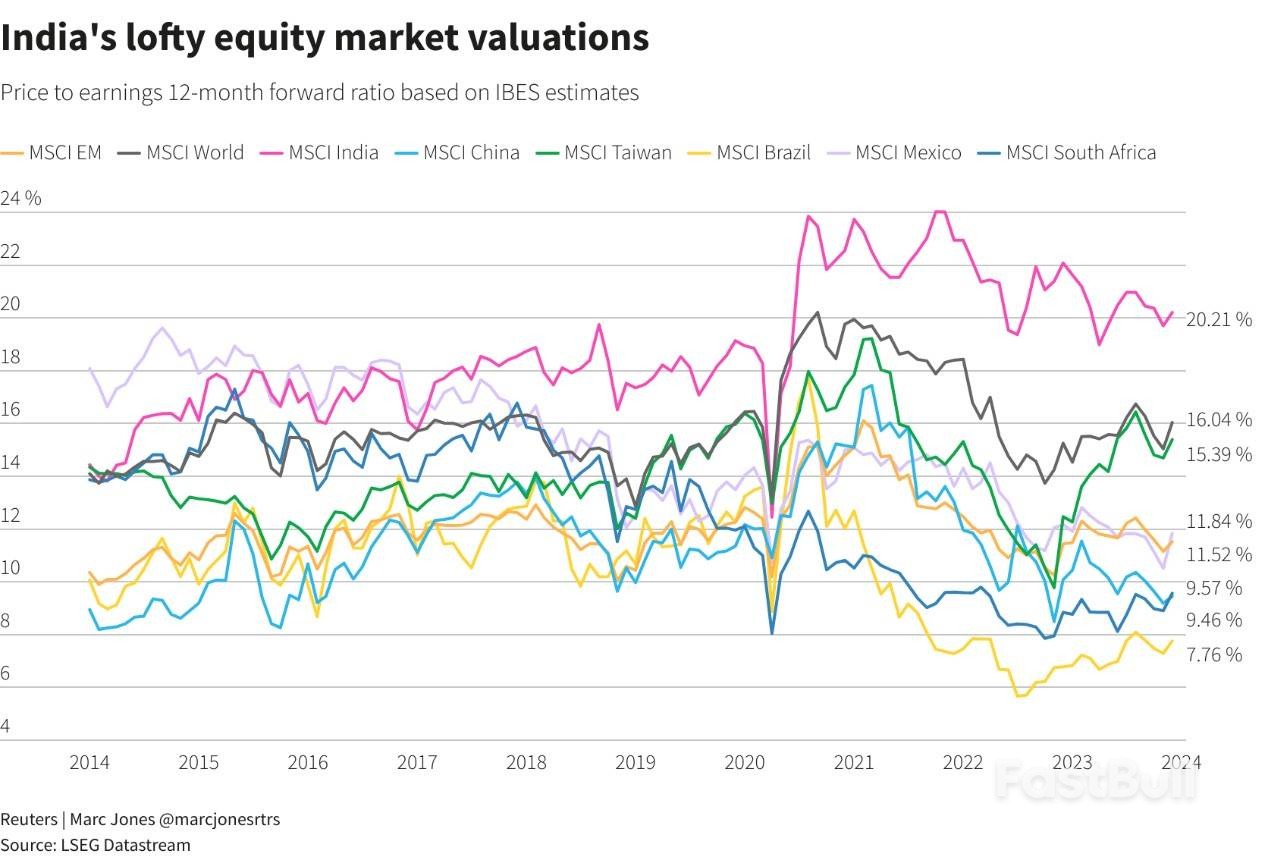
          "We are seeing an evolution of the EM trade from broad to more granular which I am keeping on my radar in 2024 because of the heavy election calendar," said Chedid, singling out Mexico but also India.
          The world's most populous country is set to hold elections in April or May, with self-styled strong man Narendra Modi expected to win a third term as prime minister.Emerging Markets Brace for Wave of Elections with Fiscal Discipline at Stake_2

          Source: Reuters

          To stay updated on all economic events of today, please check out our Economic calendar
          Risk Warnings and Disclaimers
          You understand and acknowledge that there is a high degree of risk involved in trading. Following any strategies or investment methods may lead to potential losses. The content on the site is provided by our contributors and analysts for information purposes only. You are solely responsible for determining whether any trading assets, securities, strategy, or any other product is suitable for investing based on your own investment objectives and financial situation.
          Comments
          Add to Favorites
          Share

          Weekly Economic & Financial Commentary

          WELLS FARGO

          Economic

          U.S. Review

          The Great Divergence

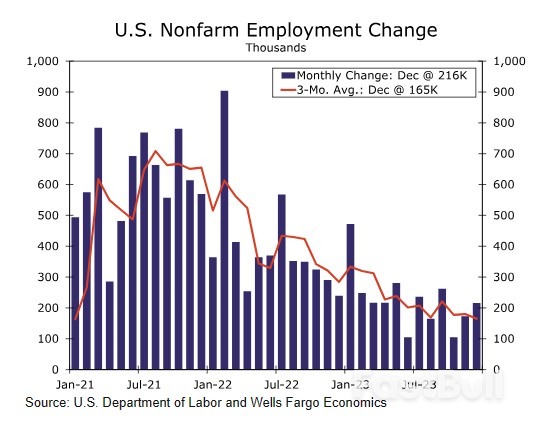
          Incoming economic data continue to shed light on how tighter monetary policy is placing unequal pressure across economic sectors. Interest rate sensitive segments remain under disproportionate strain, while the labor market appears to be only slowly moderating. This morning, we learned that the U.S. economy added 216,000 jobs in December. Although this print beat market expectations for a 175,000 gain, previous data were again revised lower. Job gains remain robust but continue to temper off of their post-pandemic swell on a three-month average basis. Furthermore, the majority of new payrolls continue to be concentrated in government, healthcare and leisure & hospitality, even as the number of industries adding payrolls registered an encouraging increase in December.
          Looking beyond nonfarm payrolls reveals softer labor market fundamentals. The Household Survey indicated a dip in both employment and labor supply alongside a slight increase in the number of unemployed. As a result, the labor force participation rate fell to its lowest reading since February. Although we believe there is more scope for labor supply to grow, any gains to participation ahead are likely to proceed at a slower pace. The unemployment rate remained unchanged at 3.7% in December, while average hourly earnings ticked up a bit faster than expected at 0.4% over the month, suggesting there may be some upside risk to inflationary pressures stemming from the labor market.
          November's JOLTS report was directionally worse. Job openings continued to decline on trend, reflecting a normalization in labor demand, although they remained above pre-pandemic levels. Perhaps more telling, the rate of hiring fell to its lowest level since 2014 outside the pandemic era. These pressures caused the quit rate to sink below its pre-pandemic level for the first time as job seekers begin to meet resistance finding new employment. The uptick in continuing jobless claims over the past year seems to reinforce this notion, suggesting that it is taking longer for laid-off workers to find new jobs even as the overall level of layoffs remains muted.
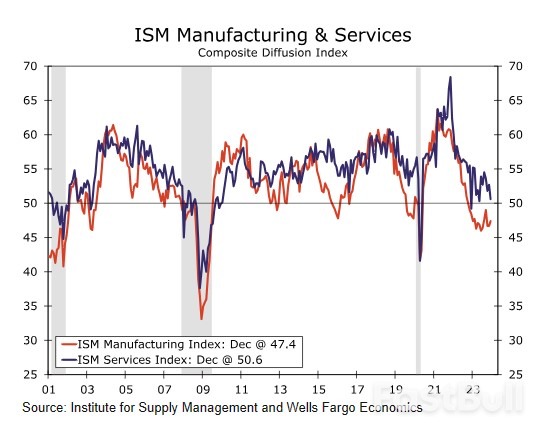
          Weekly Economic & Financial Commentary_1Weekly Economic & Financial Commentary_2Elsewhere, there remains a stark divergence between the manufacturing and services sectors. December marked the 14th straight month of waning manufacturing activity, according to the ISM Manufacturing Index. Its services sector counterpart continued to expand, albeit at a scant pace. According to survey responses, manufacturers continue to be weighed down by weak demand for new orders, the unfavorable financing environment and grim prospects for manufacturing employment. In contrast, survey responses among service providers were generally positive despite December's dip in activity. Hard data on personal consumption expenditures echo these themes. Economy-wide spending on durable goods has declined in five of the past 10 months, while services spending has only dipped once in the past 40. Sentiment in these sectors will likely converge somewhat as weaker growth takes hold over the coming year. Although we expect manufacturing to remain under pressure, manufacturers surveyed by ISM seem to be growing more optimistic as inflation pressures abate and expectations mount for Federal Reserve rate cuts in 2024. We also look for some moderation in services demand in the coming year, especially if earnings growth continues to come off the boil.
          Deviating trends are also taking hold within the construction sector. Overall construction outlays posted a solid 0.4% uptick in November, the latest in an 11-month string of positive prints. Yet momentum is increasingly concentrated in a few key segments. Residential outlays in November were almost entirely fueled by a surge in single-family spending, reflecting the relative attractiveness of new construction amid scarce supply and rising prices in the resale market. On the nonresidential side, robust manufacturing spending continues to be a driving force behind construction, although not quite enough to prevent a dip in nonresidential outlays in November. These green shoots hide the broader challenges facing the construction industry. Notably, multifamily spending has lost considerable momentum over the past few months as builders think twice about starting new multifamily projects amid growing vacancy rates. Nonresidential projects that have not been subject to the same level of public support as manufacturing also remain acutely challenged by elevated financing costs and restrictive lending conditions, especially in highly interest rate sensitive commercial segments.Weekly Economic & Financial Commentary_3

          NFIB Small Business Optimism • Tuesday

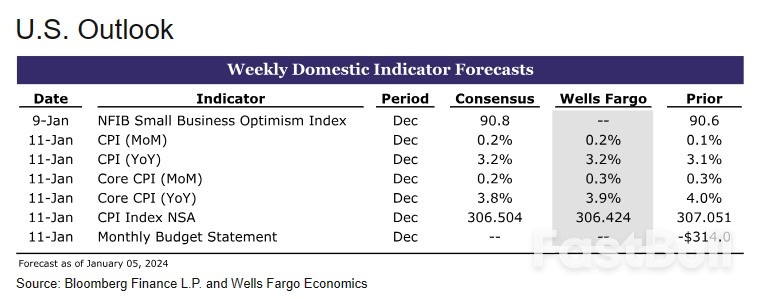
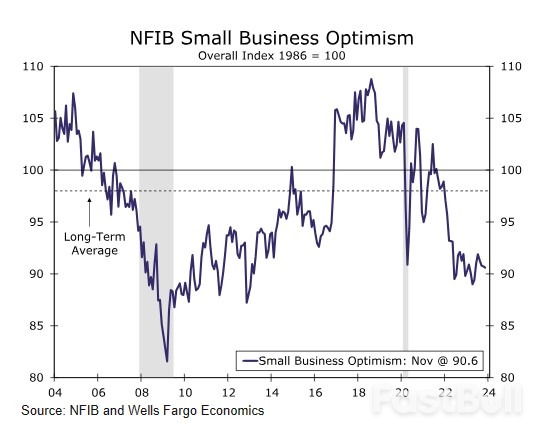
          The National Federation of Independent Business Small Business Optimism Index was largely listless in 2023, hovering well below the levels that prevailed before the pandemic. That said, the NFIB Index was not a great guide to economic and financial market outcomes last year. Real GDP growth appears to have been at or above potential, unemployment remained low and equity markets posted solid gains for the year.
          Even so, the subcomponents of the index have still provided useful insights. In the most recent reading, a net 25% of small businesses reported higher selling prices compared to three months ago, tied for its lowest reading since early 2021 and consistent with other indicators that have shown slowing inflation. High interest rates and tighter credit standards also appear to be weighing on businesses' access to credit. The net percent of small businesses expecting credit conditions to improve over the next few months fell to -11%, the lowest reading since 2012. We will be looking to these components as well as others, such as the share of firms expecting to expand payrolls, for clues to the outlook in the months ahead.Weekly Economic & Financial Commentary_4

          CPI • Thursday

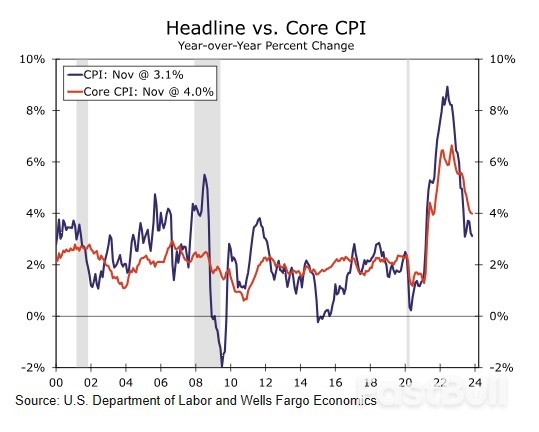
          Headline inflation as measured by the Consumer Price Index (CPI) was tame in October and November, the two most recent data points. The CPI was unchanged in October and increased just 0.1% in November. Significant declines in energy commodity prices, such as gasoline, helped to keep headline inflation in check. Excluding food and energy prices, the core CPI has been increasing at a 0.2%-0.3% monthly pace for the past several months, a slowdown from its pace earlier in the year and in 2022.
          On balance, we look for next week's CPI report to show that inflation continues to slow on trend in a way that positions the FOMC to start cutting rates in June. We expect a 0.2% increase in headline CPI and a 0.3% increase in the core. Energy prices were more stable last month and are unlikely to repeat the major declines that occurred in October and November. We expect the disinflation in core goods to continue amid demand normalization, healthier supply chains and the fall in commodity prices from their peak. Core services inflation should also slow modestly relative to November, led by softer price increases for primary shelter.Weekly Economic & Financial Commentary_5

          Monthly Treasury Statement • Thursday

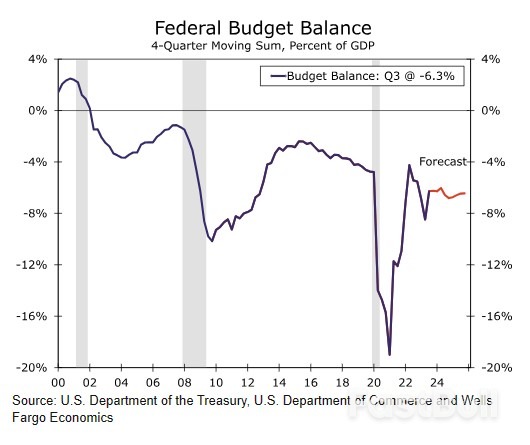
          On Thursday, the U.S. Treasury will release monthly data on its revenues and outlays for December. Federal fiscal year 2024, which began on Oct. 1, will be one quarter complete. Thus far, the monthly budget deficit data generally have been tracking our expectations for an annual deficit of $1.85 trillion. The good news is that this would be about the same as the FY 2023 budget deficit, in sharp contrast to a year ago when the deficit increased significantly relative to FY 2022.
          The bad news is that the federal budget deficit remains large relative to history. If our forecast comes to pass, this year's deficit would be roughly 6.5% of GDP, two percentage points wider than the deficit that prevailed in FY 2019 before the pandemic. Furthermore, this additional red ink would be occurring at a time of relatively low unemployment and solid economic growth.Weekly Economic & Financial Commentary_6

          International Review

          Ebbing Eurozone Inflation Suggests European Central Bank Edging Closer to Easing

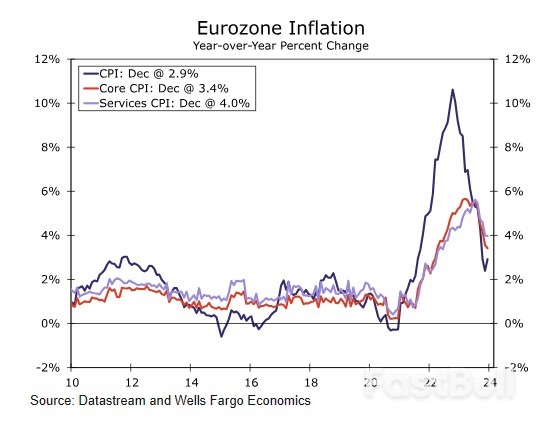
          There was some mixed news from the Eurozone December CPI released this week, although in our view the inflation report is still consistent with the European Central Bank (ECB) beginning a rate cut cycle as early as its April 2024 meeting. Headline inflation quickened, albeit by less than expected, to 2.9% year-over-year. The acceleration was due to energy-related base effects. Although energy prices fell 6.7% year-over-year, that drop was much smaller than the November decline. Underlying price pressure continued to show some gradual deceleration however, and over the past three months the Eurozone CPI excluding food and energy (which approximates the core CPI) has risen at a 1.2% annualized pace, a pace compatible with the ECB achieving its inflation target. With Eurozone GDP falling slightly in Q3-2023 and sentiment surveys still at contractionary levels in Q4, as long as Eurozone inflation continues to advance at a subdued pace in the months ahead, we believe the ingredients will be in place for an ECB policy interest rate cut by the April meeting.
          In Canada, the December labor market report showed essentially unchanged jobs and some acceleration in wage inflation. December employment rose by just 100, below the consensus forecast for a 15,000 gain and less than the 24,900 increase in November. Full-time employment actually fell by 23,500, while part-time employment rose by 23,600, and the unemployment rate was steady at 5.8%. From an inflation flighting perspective, the acceleration in the hourly wage rate for permanent employees to 5.7% year-over-year perhaps offered a note of concern. Still, given subdued Canadian economic growth trends and the progress on reducing inflation to date, for now we still lean toward an initial BoC rate cut coming at the April monetary policy meeting. That said, if wage pressures were to remain persistent, that initial rate cut could get pushed back until June.
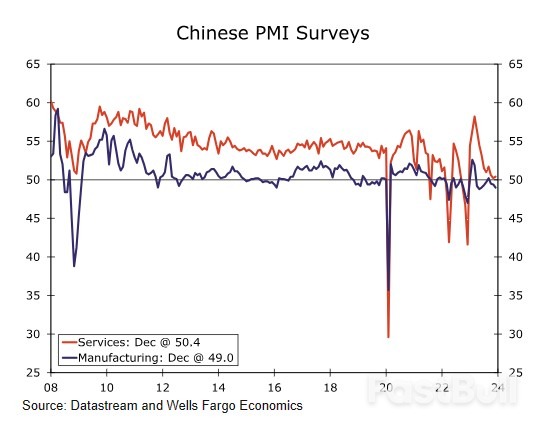
          Weekly Economic & Financial Commentary_7Weekly Economic & Financial Commentary_8This week's news from emerging economies was mixed. China's official PMI surveys for December saw the manufacturing PMI unexpectedly fall to 49.0 and the services PMI rise less than expected to 50.4. Within the manufacturing survey, the new orders component fell to 48.7, while the employment component also fell slightly. For the official services PMI, the new orders and employment components both rose. Elsewhere, China's December Caixin manufacturing PMI edged up to 50.8, while the Caixin services PMI rose to 52.9.
          Singapore's economy, often seen as a global bellwether given its large export exposure, finished 2023 on a solid note. Q4 GDP rose 1.7% quarter-over-quarter, comfortably beating the consensus forecast for a 0.7% gain, while growth also firmed to 2.8% year-over-year. On a sequential basis, manufacturing activity jumped 9.0% quarter-over-quarter and construction activity rose 4.3%, although services activity was unchanged in Q4. Finally, the Bank of Israel began 2024 with a 25 bps policy rate cut, to 4.50%. The Bank of Israel repeated that its focus is on "stabilizing the markets and reducing uncertainty, alongside price stability and supporting economic activity." That guidance is consistent with additional rate cuts in 2024 and, indeed, economic forecasts accompanying the central bank's announcement projected a policy interest rate in a 3.75%-4.00% range in the fourth quarter of 2024.Weekly Economic & Financial Commentary_9

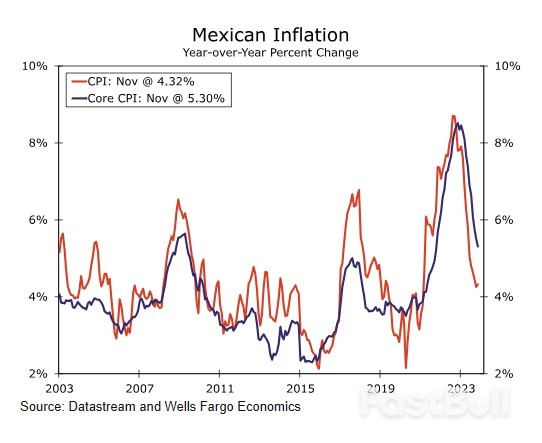
          Mexico CPI • Tuesday

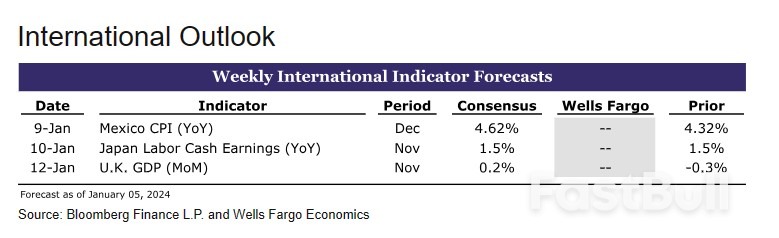
          Next week's Mexico December CPI will be closely scrutinized by market participants, with improving inflation trends fueling expectations that the Bank of Mexico is inching closer to the start of a monetary policy easing cycle. The central bank's December policy announcement did, however, hint at steady interest rates for the time being, as the Bank of Mexico repeated that it would hold its policy rate (currently at 11.25%) "for some time." Against that backdrop, we suspect it would take a significant slowing in December inflation for the central bank to cut rates as soon as its February monetary policy meeting.
          The consensus forecast, however, is for headline inflation to edge modestly higher to 4.62% year-over-year in December, driven in part by an acceleration in prices for food and energy. Core CPI inflation should slow moderately further to 5.15%, as services inflation gradually ebbs. Nonetheless, both headline and core inflation remain above the Bank of Mexico's 2%-4% inflation target range for the time being. Against that backdrop, our view remains for the central bank will hold its policy rate steady at 11.25% at its early February announcement and to deliver an initial 25 bps policy rate cut at its policy meeting in late March.Weekly Economic & Financial Commentary_10

          Japan Labor Cash Earnings • Wednesday

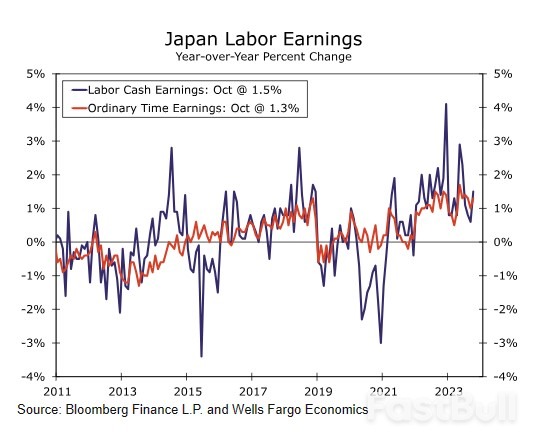
          Japan's labor earnings data for November are scheduled for release next week, economic figures that are likely to attract more than usual attention as the Bank of Japan (BoJ) contemplates an exit from its negative interest rate policy. As the BoJ considers raising its Policy Balance Rate from its current -0.10%, Governor Ueda has highlighted more robust wage growth as an important ingredient to the central bank achieving its 2% inflation target on a sustainable basis. In that context, the outcome of this year's spring wage negotiations covering unionized workers will be critically important, especially if those negotiations result in an outcome that matches (or betters) the 3.6% increase seen in 2023. That said, evidence of firmer wage growth in the interim would also strengthen the case for an eventual policy interest rate increase.
          For November, Japan's labor cash earnings are forecast to rise 1.5% year-over-year, matching the 1.5% increase seen in October. There should also be some focus on ordinary time earnings, which rose 1.3% year-over-year in October, to the extent they are viewed as offering some insight, into underlying wage growth. Although Japanese wage growth has firmed over the past couple of years, it is perhaps not strong enough yet to prompt an immediate rate hike. Instead, we expect the BoJ to increase its policy rate by 10 bps to 0.00% at its April policy announcement.Weekly Economic & Financial Commentary_11

          U.K. Monthly GDP • Friday

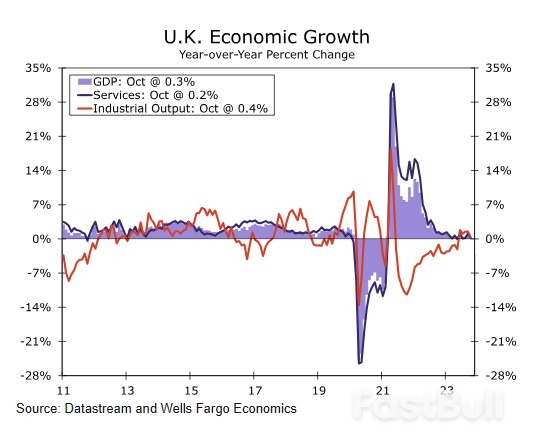
          U.K. November GDP data, due for release next week, are set to offer some up-to-date insights into the broader state of the U.K. economy as 2023 came to a close. Recent news suggested the environment remained challenging overall. Q3 GDP was revised to show a slight 0.1% quarter-over-quarter decline, from a previously reported flat outcome, as consumer spending was revised to show a larger fall. October GDP also fell 0.3% month-over-month, a larger than expected decline, as both services and industrial activity contracted, with wet weather crimping activity in some sectors. Those downbeat readings contrasted with some confidence surveys, particularly the U.K. services PMI, which suggested some improvement as the fourth quarter progressed.
          Against this backdrop, the consensus forecast is for some rebound in U.K. economic activity in November. Overall GDP is forecast to rise by 0.2%month-over-month, while within the details, services activity is seen rising 0.2% and industrial output is expected to rise by 0.1%. That said, that modest monthly increase would still leave the level of GDP for the October-November period essentially unchanged from its Q3 average. As a result, the U.K. economy still appears to have been perilously close to a technical recession (that is, two consecutive quarters of negative GDP growth) during the second half of last year.Weekly Economic & Financial Commentary_12

          Interest Rate Watch

          Wait a Minute

          It's been a confusing few week for Fed watchers. At its most recent monetary policy meeting on Dec. 13, the Federal Open Market Committee (FOMC) elected to keep interest rates unchanged and balance sheet run-off at its current pace. That decision was widely anticipated by market participants, but the rally in stocks and bonds that followed the meeting suggested otherwise, and largely comes down to the Fed's guidance. Specifically, the dot plot in the quarterly summary of economic projections showed that almost all committee participants expected rate cuts in 2024 with the median expectation signaling three cuts. Chair Powell's comments in the post-meeting press conference were also surprisingly dovish as he mentioned rate cuts and acknowledged the risk of remaining on hold for too long. Following the meeting and the swift easing in financial conditions, other Fed officials tried to walk back the idea that the Fed was actively debating imminent rate cuts.
          This week, we received the minutes from the mid-December meeting, which largely detail a committee that aims to remain restrictive, though it acknowledges it may be cutting rates this year should recent progress on inflation continue. Despite the market yearning for cuts, there wasn't much evidence of a large debate around when to start lowering rates at the December policy meeting. The clearest interpretation of the Fed's view at this point is that it is still in wait-and-see mode; the door remains ajar to further hikes if necessary, but the next move increasingly looks to be lower. The Fed is sensitive to the risks of both remaining restrictive for too long and causing unnecessary economic pain, and/or easing too soon and risking a resurgence in inflation. It appears satisfied with the progress on inflation and believes it is in a restrictive stance that must be maintained for now to keep the disinflationary trend in place.
          While the return to 2% is progressing nicely, declaring victory in the battle against inflation remains premature in our view, and it's too soon to confidently expect that the FOMC will begin cutting rates at the March policy meeting. We suspect the FOMC will keep monetary policy in a holding pattern at its next meeting later this month and look toward the Q1 labor market and inflation data to determine its next move. The FOMC will get consumer price and employment data through February ahead of its March meeting. Our base case for the first rate cut remains June 2024.

          Credit Market Insights

          Index Points to Looser-Than-Average Financial Conditions

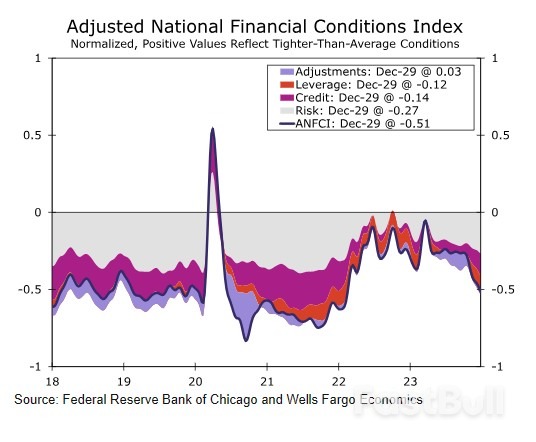
          Assessing financial conditions is important for economists, as monetary policy primarily affects the real economy through financial channels. The Federal Reserve Bank of Chicago provides a weekly update on U.S. financial conditions as a tool to help economists further evaluate the current economic climate. This tool, called the National Financial Conditions Index (NFCI), is a weighted average of 105 indicators of financial activity that provide broad coverage of money markets, debt and equity markets and traditional and "shadow" banking systems. The Chicago Fed also provides an alternative measure that adjusts for economic conditions. The Adjusted National Financial Conditions Index (ANFCI) is conditional on growth in economic activity and inflation. There are four main categories that comprise the ANFCI: leverage, credit, risk and adjustments from prevailing macroeconomic conditions. When interpreting the ANFCI, positive values denote tighter financial conditions, on average, than would be typical of current economic conditions, while negative values reflect the opposite. The magnitude of how "tight" or how "loose" financial markets are operating is expressed in standard deviations from zero.
          In the final week of 2023 (ended Dec. 29), the ANFCI dropped to -0.51. The risk, credit and leverage indicators contributed negatively to the measure (-0.27, -0.14 and -0.12, respectively), while the adjustments for prevailing macroeconomic conditions added 0.03. The ANFCI has been trending downward since March of last year, suggesting looser-than-average financial conditions. This past week, only 12 out of the 105 indicators were tighter on average, while 93 were looser.Weekly Economic & Financial Commentary_13
          Despite easing over the past few months, the ANFCI remains tighter than its measure during the expansions of the 2000s and 2010s and before the Fed began its recent tightening campaign. Nevertheless, the more recent persistent loosening of financial conditions somewhat contradicts the FOMC's efforts to dampen inflation and slow growth via rate hikes. Though the Fed has held rates steady since July, the federal funds rate remains at its highest level in over 20 years. While cracks are beginning to emerge in some sectors, the economy remains fairly resilient: healthy profit margins have allowed businesses to add payrolls, real income remains elevated and strong household balance sheets have helped to underpin growth in real PCE. However, as discussed in Interest Rate Watch, we expect the Fed to remain on hold for the next few meetings. As a result, the ANFCI may reflect somewhat tighter financial conditions in the future as the federal funds rate remains elevated, particularly if the Fed does not deliver a March rate cut as the market is currently pricing in.

          Topic of the Week

          Population Growth Returns to Pre-Pandemic Patterns in 2023

          The pandemic era brought with it significant demographic shifts in the United States. Population growth slowed to a crawl in 2021 as the number of births and deaths converged and international migration flows were stymied. Simultaneously, movement picked up across state lines with most Americans flocking to the South region. Such demographic dynamics have defined the past few years, but some of these trends appear to be reversing. That's according to the 2023 population estimates released by the Census Bureau in December. The new estimates reveal the U.S. population grew by 0.5% between July 2022 and July 2023, translating to about 1.6 million new residents, the largest annual population gain since 2018.Weekly Economic & Financial Commentary_14
          Examining the underlying components, accelerating international migration accounted for the majority of population growth last year. Since falling to a low of 376,000 in 2021, international migration has comfortably surpassed pre-pandemic levels. A total of 1.1 million new residents came from abroad in 2023, the highest count since 2001.
          Natural increase added 504,000 to population growth, more than doubling 2022's addition. At first take, this increase could be attributed to higher birth rates, but the annual count of births actually declined about 1% from 2022 to 2023. Overall births are still lagging well below pre-pandemic levels and weighing on overall growth. Rather, the natural increase came from a sharp drop in mortality, with total deaths in 2023 falling 9% over the year to 3.15 million from 3.46 million.
          Overall, lower mortality and rebounding immigration point to population growth returning to pre-pandemic patterns. On a national level, the 0.5% pace of growth in 2023 was historically low and lagged behind the roughly 0.7% year-over-year growth averaged from 2011 to 2020. That said, some states, particularly in the South and Mountain West, have bucked the trend and experienced strong population growth in 2023.

          Headin' Down South to the Land of the Pines

          Population growth appears to be more broad-based as 42 states increased their population in 2023, up from 31 states in 2022. Population gains accelerated most in the South region, which accounted for 87% of the nation's growth. The South added 1.42 million people in 2023, outshining gains of 137,000 and 126,000 in the West and Midwest, respectively. The Northeast lost 43,000 residents, the third straight annual contraction but the smallest since 2020. But these aggregate regional totals obscure significant variation on a state-by-state basis.
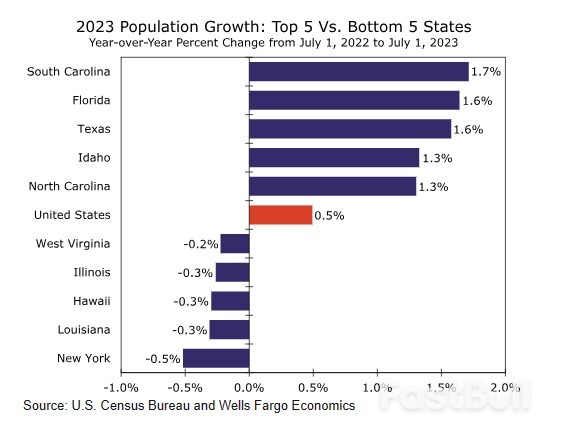
          Within the Northeast, only New York (-0.5%) and Pennsylvania's (-0.1%) populations shrank, while other states registered modest increases. Growth in the Midwest was positive nearly across the board, with only Illinois (-0.3%) experiencing shrinkage. South Dakota (1.0%) ranked in the top 10 fastest growing states for a third straight year. North Dakota (0.6%) also posted above-average growth, but the bulk of Midwestern states experienced modest gains.
          In the West region, growth was the weakest along the West Coast. Washington's population was up just 0.4% over the year, while Oregon (-0.1%) and California (-0.2%) experienced outright declines. By contrast, year-over-year growth was strongest in the Mountain West states of Idaho (1.3%), Utah (1.1%), Arizona (0.9%) and Montana (0.9%). Idaho was the fourth fastest growing state in 2023, but the top of that list is dominated by states in the South.
          Among the top five fastest growing states, four of them are in the South. South Carolina, the nation's fastest growing state, saw its population expand 1.7% over the year. Florida (1.6%), Texas (1.6%) and North Carolina (1.3%) round out the top five. The South continues to benefit from an influx of domestic migration, although some moderation is apparent. Net domestic migration to the South totaled 706,000 in 2023, down from 2022's record high of 856,000. In addition, population growth has become less concentrated in the region. Texas, Florida, North Carolina and Georgia accounted for a staggering 93% of the nation's population growth in 2022, but this figure fell to 67% in 2023 as population growth picked up across an increasing number of states. Although down from its pandemic highs, we expect for domestic migration south to be a longer-term shift that will continue to define the region in the years ahead.
          To stay updated on all economic events of today, please check out our Economic calendar
          Risk Warnings and Disclaimers
          You understand and acknowledge that there is a high degree of risk involved in trading. Following any strategies or investment methods may lead to potential losses. The content on the site is provided by our contributors and analysts for information purposes only. You are solely responsible for determining whether any trading assets, securities, strategy, or any other product is suitable for investing based on your own investment objectives and financial situation.
          Comments
          Add to Favorites
          Share

          Outlook 2024: More Commotion than Motion in Foreign Exchange Markets

          Justin

          Central Bank

          Forex

          The 2024 global economic outlook is less than stellar. Enormous growth, macroeconomic policy and geopolitical uncertainties pervade the outlook and foreign exchange markets. How this plays out is anybody’s guess.
          Global growth will be weak, if not stagnant in 2024, falling from 2023’s modest pace. Solid US growth propped up the global economy last year, but the US outlook in 2024 is considerably weaker. Most buy into the US soft landing story, though contractionary forces are present and growth will be well below potential.
          The euro area, now bordering on recession, faces stagnation. Germany’s mistaken and ill-considered return to the ‘debt brake’ will reinforce weakness.
          China may be able to reach 5% growth if authorities turn on the spigot, but a persistent lack of consumer confidence and animal spirits, in large part due to housing woes and debt – plus longer-term demographics and a broken growth model – cloud the outlook. Japan had a good 2023, but it will slow sharply.
          Outside of India and a few Asian emerging markets, the rest of the world will reflect the languishing growth picture. South America will be held back by persistently weak productivity growth and muted commodity prices.

          Inflation’s ‘last mile’

          Inflation and central banks as always will garner obsessive attention. The US and euro area are seeing faster inflation declines than expected and 2% targets may already be in sight.
          In the US, some analysts argue that wage growth and sticky services prices will make the ‘last mile’ from 3% to 2% inflation a hard and protracted slog. Others are doubtful. Normalising supply chains, slowing growth and credit, plus falling oil price and rent inflation may support the more sanguine camp.
          Market pricing is far ahead of the Federal Reserve in terms of expected 2024 rate cuts and their start date. The last dot plot pointed to a 75-basis point reduction in the Fed Funds rate, but markets are pricing in 150bp. Regardless, Fed Chair Jerome Powell seemingly turned into a cheerleader for accommodation at the last Federal Open Market Committee meeting in December. The Fed’s ‘pivot’ and sharp declines in yields since November reinforce the case for a soft landing.
          The euro area’s high 2022-23 inflation outturn mirrored a strong supply side shock emanating from Russia’s war against Ukraine and the ensuing energy price surge. That shock is largely overcome. In contrast with the US, given the euro area’s stagnant growth, it could hardly be argued that demand pull forces were jeopardising the inflation outlook, despite unconvincing efforts partly making that case. Fears that wage gains would become embedded in second round cost-push price pressures have proven overblown. Yet, to promote compromise, especially with Teutonic voices, the European Central Bank overdid its massive rate hiking campaign and may have to row back quickly.
          The Bank of Japan is surely set to end its negative deposit rate and loosen yield curve control this year, but when and how tentatively are unknowns.
          Chinese deflationary forces are another tailwind for lower global inflation. Regardless, the People’s Bank of China will continue to avoid significant policy rate action. Authorities may, however, vacillate in using credit allocation from time to time as a quasi-fiscal support.

          Geopolitical turbulence ahead

          Geopolitical unknowns cast a fog over the 2024 outlook. US presidential elections and the possible return of Donald Trump are one clear threat to what remains of the rules-based international order. But even before US elections close in on the endgame, Russia’s war against Ukraine could go through twists and turns, especially as an inept US legislative branch may shamefully block funds needed for Ukraine’s survival. Ronald Reagan must be turning in his grave at the sight of Republicans de facto backing Vladimir Putin.
          Congress may threaten to shut the US government down again, sowing more doubt on whether the US can behave responsibly and be a trustworthy global steward. Stressed US-China relations could further raise military tensions, propelling fragmentation and protectionism. Developments in the Middle East risk sending oil prices surging.
          Foreign exchange markets may be characterised by hand-wringing and more commotion than motion in 2024. My standard disclaimer applies – forecasting foreign exchange movements is a fool’s errand. In mid-2023, my outlook was for the dollar to largely range-trade with a weakening bias. That outlook looked poor amid a blistering US third quarter, but the US rate rally since November in the nick of time barely bailed that projection out, though perhaps not the ‘weakening bias’ part.
          For 2024, both the Fed and ECB will cut, but US yields may fall nominally more than those in Europe, helping the euro to remain broadly unchanged against the dollar or edge slightly higher. Minuscule Japanese withdrawal of accommodation will boost the yen. Narrowing dollar/renminbi rate differentials should bolster the renminbi, as should China’s strong manufacturing trade surplus – which could also galvanise intensified global protectionist pressures – though low confidence and capital outflow will limit renminbi gains. The Canadian dollar and Mexican peso are roughly a quarter of the dollar’s trade weighted index, and they may trade narrowly against the dollar.
          On balance, foreign exchange market participants will have much turbulence to wring their hands over, particularly a flurry of central bank rate shifts and geopolitical volatility. But through it all, the dollar’s broad trade-weighted value may not change significantly over 2024, perhaps weakening modestly.
          Amid anaemic growth, 2024 may bring many surprises and bouts of volatility.

          Source:Mark Sobel

          Risk Warnings and Disclaimers
          You understand and acknowledge that there is a high degree of risk involved in trading. Following any strategies or investment methods may lead to potential losses. The content on the site is provided by our contributors and analysts for information purposes only. You are solely responsible for determining whether any trading assets, securities, strategy, or any other product is suitable for investing based on your own investment objectives and financial situation.
          Comments
          Add to Favorites
          Share

          Bank of England Survey Bolsters Calls For 2024 Rate Cuts

          ING

          Economic

          Central Bank

          Financial markets are near-enough pricing six rate cuts from the Bank of England this year. Policymakers are highly reticent to endorse that, though the latest data from the Bank's own Decision Maker Panel survey indicates that investors are right to be thinking about a series of cuts this year. The survey of Chief Financial Officers (CFOs) continues to suggest that inflationary pressures are easing noticeably.
          Expected price growth among corporates has slipped further to 4.2%, down from a high of almost 7% in mid-2022. BoE hawks would – and have – argued that firms have been consistently revising down expected price growth but up until now, this hasn't translated into less aggressive actual price growth. In other words, firms have been saying one thing and doing another. But that seems to be changing – “realised” price growth among corporates is starting to fall rapidly. The latest reading of 5.9% is down from 7.5% in August.Bank of England Survey Bolsters Calls For 2024 Rate Cuts_1
          Another way of looking at this, CPI expectations among corporates have also continued to fall in line with actual inflation.
          So far, so good. But the issue for the BoE is that wage growth is proving stickier. Expected wage growth over the next year has stabilised above 5%, and realised is still up at 7%. Both have been roughly stable for the best part of nine months now.
          That does at least suggest that the official data on private-sector wage growth can continue to fall gradually from its current 7.3% level. And with vacancies falling quickly, and hiring difficulties having eased considerably since 2022, we think this measure of pay growth can reach the 4-5% area by summer.
          Bank of England Survey Bolsters Calls For 2024 Rate Cuts_2But for the time being, wage growth is still too high for the BoE's liking. We also think services inflation will remain sticky around 6% for the next two to three months, before falling more noticeably by the summer.
          Markets are pricing the first rate cut from the Bank of England in May, which feels a bit early. We also think when rate cuts do begin – potentially in August – they will be a little more gradual than markets are currently pricing. We expect 100 basis points of cuts this year, though much depends on how quickly services inflation and wage growth turn a corner.
          To stay updated on all economic events of today, please check out our Economic calendar
          Risk Warnings and Disclaimers
          You understand and acknowledge that there is a high degree of risk involved in trading. Following any strategies or investment methods may lead to potential losses. The content on the site is provided by our contributors and analysts for information purposes only. You are solely responsible for determining whether any trading assets, securities, strategy, or any other product is suitable for investing based on your own investment objectives and financial situation.
          Comments
          Add to Favorites
          Share

          Outlook 2024: What to Expect for the public Sector Bond Market

          Justin

          Economic

          Central Bank

          The public sector bond market is always developing. Its position as the biggest segment of the wider debt capital markets means it must, and should, always evolve. 2023 marked the return of liquidity in the European government bond markets to levels from before the Covid-19 pandemic. However, this is not the case for smaller issuers as liquidity is still front and centre of borrowers’ concerns as we have learnt through the various meetings held by OMFIF’s Sovereign Debt Institute last year.
          There are a number of other interesting developments that will shape the discourse of the public sector bond market in 2024, such as plans by multilateral development banks to issue hybrid capital, the European Union’s journey to sovereign status, efforts to make bond markets more efficient and emerging market debt restructuring talks. Here is a round-up of 10 themes to look out for this year.

          Boosting liquidity to remain a key priority

          Given that achieving liquidity for issuers is arguably the most important objective beside cost-efficiency, boosting liquidity will always be a priority. But there are innovative ways being discussed to boost liquidity, which have also been explored at meetings by the SDI. This includes adding incentives by sovereign debt management offices, allocating a bigger proportion to fast money accounts, overhauling the leverage ratio of banks, and most interestingly, adding non-banks as primary dealers. In a poll of attendees at the SDI’s European sovereign, supranational and agency forum last year, 70% said allowing non-banks to act as primary dealers was a good idea to boost liquidity in the market.

          Primary dealership mode under scrutiny (again)

          Stresses on the primary dealership are not new but reviewing and adding incentives are now more important than ever to keep this model sustainable. In the SDI’s 2023 Public sector debt outlook survey, 45% of issuers from across the world said they were looking to provide more incentives to their dealers. This is particularly important for smaller banks who do not have capacity to keep up with obligations and compete with larger ones.

          Smaller issuers to look for ways of improving price discovery

          The price discovery process became increasingly challenging for smaller public sector borrowers in 2023 with a wide divergence in calculations for fair value due to a lack of liquidity. This means issuers will need to spend more time working with banks to find solutions to this, such as increasing the use of taps of outstanding lines and issuing those taps directly into trading books and using reference points from liquid issuers such as the EU and KfW.

          MDBs will issue the first hybrid bonds via the capital markets

          There has been the growing talk of multilateral development banks issuing hybrid debt to boost their lending firepower while protecting their triple-A credit ratings. The African Development Bank has been preparing the first such deal in the capital markets for the past few months and has received a lot of interest from investors. But the sticking point has been the price for the transaction. What is the right price for a subordinated bond by a top-rated MDB? Expect MDBs to negotiate a level that works for both them and investors with the first transaction in 2024.

          Greenium may narrow further but no longer a priority

          The so-called ‘greenium’ – the premium achieved by issuers for selling green bonds – fell in 2023 and is expected to narrow further in 2024 to around the same levels as conventional bonds in some cases. The EU’s green issuance will largely dictate the greenium in the SSA market given the amount it issues in this format. But the falling greenium should not be too much of a concern given that it is no longer being considered a key priority for issuers.

          EU will make further steps towards sovereign status

          The EU wants to be unanimously accepted as a ‘sovereign’ borrower and it is continuously making progress towards achieving that status. Last year, the EU reached several milestones such as introducing quoting commitments for its primary dealers to boost secondary market liquidity and being classified under the same haircut category as government bonds. This year, the EU will make further steps such as establishing a repo facility for its dealers to get access to EU securities on a temporary basis in case of scarcity. Meanwhile, plans for a futures market will heat up as liquidity continues to improve for the EU’s bonds.

          Efforts to improve market infrastructure will gather pace…

          Progress is expected in the efforts to enhance bond market efficiency such as automating and standardisation documentation. Workflow processes were highlighted as the biggest inefficiency in the bond issuance process, according to SDI’s inaugural bond market infrastructure survey. Meanwhile, standardising legal documents and order book processes were highlighted as the ways to most improve efficiencies in pre-trade processes.

          But digital bonds will continue to take a backseat

          In spite of this, digital bonds will not take off into the mainstream due to the lack of a common standard in both the technology and the structure of these deals. Moreover, the focus of market participants is set on improving efficiencies with the current technology rather than new technology. This is evident with the results of the SDI’s market infrastructure survey, where only 29% of respondents said they were looking to adopt distributed ledger technology and/or blockchain in debt issuance.

          Will retail government bonds continue to play an important role?

          Last year, retail bonds became an important tool in the funding programmes of European government debt management offices. The issuance of these bonds served as a way to take advantage of rising yields driven by higher interest rates and less appealing options being offered to savers by banks. Belgium issued the biggest ever retail government bond in Europe with a €21.9bn one-year transaction before bringing other products with longer tenors. However, Belgium will reduce the amount it issues via retail this year while a number of other DMOs remain unconvinced on the need to have a specific retail bond strategy.

          EM debt restructuring will remain a complex affair

          Debt restructuring is never an easy task and 2023 was no exception with the number of delays and setbacks in Zambia. The G20 framework has been frequently cited as the cause for the stretched negotiations which does not inspire hope for other emerging market nations this year. There were, however, some positive news with debt-for-nature-swaps as Ecuador sealed the largest such transaction to date with a number of new features to the structure of this product.

          Source:Burhan Khadbai

          To stay updated on all economic events of today, please check out our Economic calendar
          Risk Warnings and Disclaimers
          You understand and acknowledge that there is a high degree of risk involved in trading. Following any strategies or investment methods may lead to potential losses. The content on the site is provided by our contributors and analysts for information purposes only. You are solely responsible for determining whether any trading assets, securities, strategy, or any other product is suitable for investing based on your own investment objectives and financial situation.
          Comments
          Add to Favorites
          Share
          FastBull
          Copyright © 2025 FastBull Ltd

          728 RM B 7/F GEE LOK IND BLDG NO 34 HUNG TO RD KWUN TONG KLN HONG KONG

          TelegramInstagramTwitterfacebooklinkedin
          App Store Google Play Google Play
          Products
          Charts

          Chats

          Q&A with Experts
          Screeners
          Economic Calendar
          Data
          Tools
          Membership
          Features
          Function
          Markets
          Copy Trading
          Latest Signals
          Contests
          News
          Analysis
          24/7
          Columns
          Education
          Company
          Careers
          About Us
          Contact Us
          Advertising
          Help Center
          Feedback
          User Agreement
          Privacy Policy
          Business

          White Label

          Data API

          Web Plug-ins

          Poster Maker

          Affiliate Program

          Risk Disclosure

          The risk of loss in trading financial instruments such as stocks, FX, commodities, futures, bonds, ETFs and crypto can be substantial. You may sustain a total loss of the funds that you deposit with your broker. Therefore, you should carefully consider whether such trading is suitable for you in light of your circumstances and financial resources.

          No decision to invest should be made without thoroughly conducting due diligence by yourself or consulting with your financial advisors. Our web content might not suit you since we don't know your financial conditions and investment needs. Our financial information might have latency or contain inaccuracy, so you should be fully responsible for any of your trading and investment decisions. The company will not be responsible for your capital loss.

          Without getting permission from the website, you are not allowed to copy the website's graphics, texts, or trademarks. Intellectual property rights in the content or data incorporated into this website belong to its providers and exchange merchants.

          Not Logged In

          Log in to access more features

          FastBull Membership

          Not yet

          Purchase

          Become a signal provider
          Help Center
          Customer Service
          Dark Mode
          Price Up/Down Colors

          Log In

          Sign Up

          Position
          Layout
          Fullscreen
          Default to Chart
          The chart page opens by default when you visit fastbull.com