• Trade
  • Markets
  • Copy
  • Contests
  • News
  • 24/7
  • Calendar
  • Q&A
  • Chats
Trending
Screeners
SYMBOL
LAST
BID
ASK
HIGH
LOW
NET CHG.
%CHG.
SPREAD
SPX
S&P 500 Index
6868.65
6868.65
6868.65
6878.28
6861.22
-1.75
-0.03%
--
DJI
Dow Jones Industrial Average
47918.90
47918.90
47918.90
47971.51
47771.72
-36.08
-0.08%
--
IXIC
NASDAQ Composite Index
23610.11
23610.11
23610.11
23698.93
23579.88
+31.99
+ 0.14%
--
USDX
US Dollar Index
98.990
99.070
98.990
99.020
98.730
+0.040
+ 0.04%
--
EURUSD
Euro / US Dollar
1.16399
1.16406
1.16399
1.16717
1.16341
-0.00027
-0.02%
--
GBPUSD
Pound Sterling / US Dollar
1.33216
1.33224
1.33216
1.33462
1.33136
-0.00096
-0.07%
--
XAUUSD
Gold / US Dollar
4205.78
4206.19
4205.78
4218.85
4190.61
+7.87
+ 0.19%
--
WTI
Light Sweet Crude Oil
59.173
59.203
59.173
60.084
58.892
-0.636
-1.06%
--

Community Accounts

Signal Accounts
--
Profit Accounts
--
Loss Accounts
--
View More

Become a signal provider

Sell trading signals to earn additional income

View More

Guide to Copy Trading

Get started with ease and confidence

View More

Signal Accounts for Members

All Signal Accounts

Best Return
  • Best Return
  • Best P/L
  • Best MDD
Past 1W
  • Past 1W
  • Past 1M
  • Past 1Y

All Contests

  • All
  • Trump Updates
  • Recommend
  • Stocks
  • Cryptocurrencies
  • Central Banks
  • Featured News
Top News Only
Share

The S&P 500 Opened 4.80 Points Higher, Or 0.07%, At 6875.20; The Dow Jones Industrial Average Opened 16.52 Points Higher, Or 0.03%, At 47971.51; And The Nasdaq Composite Opened 60.09 Points Higher, Or 0.25%, At 23638.22

Share

Reuters Poll - Swiss National Bank Policy Rate To Be 0.00% At End-2026, Said 21 Of 25 Economists, Four Said It Would Be Cut To -0.25%

Share

USGS - Magnitude 7.6 Earthquake Strikes Misawa, Japan

Share

Reuters Poll - Swiss National Bank To Hold Policy Rate At 0.00% On December 11, Said 38 Of 40 Economists, Two Said Cut To -0.25%

Share

Traders Believe There Is A 20% Chance That The European Central Bank Will Raise Interest Rates Before The End Of 2026

Share

Toronto Stock Index .GSPTSE Rises 11.99 Points, Or 0.04 Percent, To 31323.40 At Open

Share

Japan Meteorological Agency: A Tsunami With A Maximum Height Of Three Meters Is Expected Following The Earthquake In Japan

Share

Japan Meteorological Agency: A 7.2-magnitude Earthquake Struck Off The Coast Of Northern Japan, And A Tsunami Warning Has Been Issued

Share

Japan Finance Minister Katayama: G7 Expected To Hold Another Meeting By The End Of This Year

Share

The Japan Meteorological Agency Reported That An Earthquake Occurred In The Sea Near Aomori

Share

Japan Finance Minister Katayama: The G7 Finance Ministers' Meeting Discussed The Critical Mineral Supply Chain And Support For Ukraine

Share

Japan Finance Minister Katayama: Held Onlinemeeting With G7 Finance Ministers

Share

Fed Data - USA Effective Federal Funds Rate At 3.89 Percent On 05 December On $88 Billion In Trades Versus 3.89 Percent On $87 Billion On 04 December

Share

Chinese Foreign Minister Wang Yi: One-China Principle Is An Important Political Foundation For China-Germany Relations, And There Is No Room For Ambiguity

Share

Chinese Foreign Minister Wang Yi: Hopes Germany To Understand, Support China's Position Regarding Japan Prime Minister's Remark On Taiwan

Share

Chinese Foreign Minister Wang Yi: Hopes Germany Will View China More Objectively And Rationally, Adhere To The Positioning Of China-Germany Partnership

Share

China Foreign Ministry: China's Foreign Minister Wang Yi Meets German Counterpart

Share

Israeli Government Spokesperson: Netanyahu Will Meet Trump On December 29

Share

Stc Did Not Ask Internationally-Government To Leave Aden - Senior Stc Official To Reuters

Share

Members Of Internationally-Recognised Government, Opposed To Northern Houthis, Have Left Aden - Senior Stc Official To Reuters

TIME
ACT
FCST
PREV
France Trade Balance (SA) (Oct)

A:--

F: --

P: --
Euro Zone Employment YoY (SA) (Q3)

A:--

F: --

P: --
Canada Part-Time Employment (SA) (Nov)

A:--

F: --

P: --

Canada Unemployment Rate (SA) (Nov)

A:--

F: --

P: --

Canada Full-time Employment (SA) (Nov)

A:--

F: --

P: --

Canada Labor Force Participation Rate (SA) (Nov)

A:--

F: --

P: --

Canada Employment (SA) (Nov)

A:--

F: --

P: --

U.S. PCE Price Index MoM (Sept)

A:--

F: --

P: --

U.S. Personal Income MoM (Sept)

A:--

F: --

P: --

U.S. Core PCE Price Index MoM (Sept)

A:--

F: --

P: --

U.S. PCE Price Index YoY (SA) (Sept)

A:--

F: --

P: --

U.S. Core PCE Price Index YoY (Sept)

A:--

F: --

P: --

U.S. Personal Outlays MoM (SA) (Sept)

A:--

F: --

P: --
U.S. 5-10 Year-Ahead Inflation Expectations (Dec)

A:--

F: --

P: --

U.S. Real Personal Consumption Expenditures MoM (Sept)

A:--

F: --

P: --
U.S. Weekly Total Rig Count

A:--

F: --

P: --

U.S. Weekly Total Oil Rig Count

A:--

F: --

P: --

U.S. Consumer Credit (SA) (Oct)

A:--

F: --

P: --
China, Mainland Foreign Exchange Reserves (Nov)

A:--

F: --

P: --

Japan Trade Balance (Oct)

A:--

F: --

P: --

Japan Nominal GDP Revised QoQ (Q3)

A:--

F: --

P: --

China, Mainland Imports YoY (CNH) (Nov)

A:--

F: --

P: --

China, Mainland Exports (Nov)

A:--

F: --

P: --

China, Mainland Imports (CNH) (Nov)

A:--

F: --

P: --

China, Mainland Trade Balance (CNH) (Nov)

A:--

F: --

P: --

China, Mainland Exports YoY (USD) (Nov)

A:--

F: --

P: --

China, Mainland Imports YoY (USD) (Nov)

A:--

F: --

P: --

Germany Industrial Output MoM (SA) (Oct)

A:--

F: --

P: --
Euro Zone Sentix Investor Confidence Index (Dec)

A:--

F: --

P: --

Canada National Economic Confidence Index

A:--

F: --

P: --

U.K. BRC Like-For-Like Retail Sales YoY (Nov)

--

F: --

P: --

U.K. BRC Overall Retail Sales YoY (Nov)

--

F: --

P: --

Australia Overnight (Borrowing) Key Rate

--

F: --

P: --

RBA Rate Statement
RBA Press Conference
Germany Exports MoM (SA) (Oct)

--

F: --

P: --

U.S. NFIB Small Business Optimism Index (SA) (Nov)

--

F: --

P: --

Mexico 12-Month Inflation (CPI) (Nov)

--

F: --

P: --

Mexico Core CPI YoY (Nov)

--

F: --

P: --

Mexico PPI YoY (Nov)

--

F: --

P: --

U.S. Weekly Redbook Index YoY

--

F: --

P: --

U.S. JOLTS Job Openings (SA) (Oct)

--

F: --

P: --

China, Mainland M1 Money Supply YoY (Nov)

--

F: --

P: --

China, Mainland M0 Money Supply YoY (Nov)

--

F: --

P: --

China, Mainland M2 Money Supply YoY (Nov)

--

F: --

P: --

U.S. EIA Short-Term Crude Production Forecast For The Year (Dec)

--

F: --

P: --

U.S. EIA Natural Gas Production Forecast For The Next Year (Dec)

--

F: --

P: --

U.S. EIA Short-Term Crude Production Forecast For The Next Year (Dec)

--

F: --

P: --

EIA Monthly Short-Term Energy Outlook
U.S. API Weekly Gasoline Stocks

--

F: --

P: --

U.S. API Weekly Cushing Crude Oil Stocks

--

F: --

P: --

U.S. API Weekly Crude Oil Stocks

--

F: --

P: --

U.S. API Weekly Refined Oil Stocks

--

F: --

P: --

South Korea Unemployment Rate (SA) (Nov)

--

F: --

P: --

Japan Reuters Tankan Non-Manufacturers Index (Dec)

--

F: --

P: --

Japan Reuters Tankan Manufacturers Index (Dec)

--

F: --

P: --

Japan Domestic Enterprise Commodity Price Index MoM (Nov)

--

F: --

P: --

Japan Domestic Enterprise Commodity Price Index YoY (Nov)

--

F: --

P: --

China, Mainland PPI YoY (Nov)

--

F: --

P: --

China, Mainland CPI MoM (Nov)

--

F: --

P: --

Q&A with Experts
    • All
    • Chatrooms
    • Groups
    • Friends
    Connecting
    .
    .
    .
    Type here...
    Add Symbol or Code

      No matching data

      All
      Trump Updates
      Recommend
      Stocks
      Cryptocurrencies
      Central Banks
      Featured News
      • All
      • Russia-Ukraine Conflict
      • Middle East Flashpoint
      • All
      • Russia-Ukraine Conflict
      • Middle East Flashpoint
      Search
      Products

      Charts Free Forever

      Chats Q&A with Experts
      Screeners Economic Calendar Data Tools
      Membership Features
      Data Warehouse Market Trends Institutional Data Policy Rates Macro

      Market Trends

      Market Sentiment Order Book Forex Correlations

      Top Indicators

      Charts Free Forever
      Markets

      News

      News Analysis 24/7 Columns Education
      From Institutions From Analysts
      Topics Columnists

      Latest Views

      Latest Views

      Trending Topics

      Top Columnists

      Latest Update

      Signals

      Copy Rankings Latest Signals Become a signal provider AI Rating
      Contests
      Brokers

      Overview Brokers Assessment Rankings Regulators News Claims
      Broker listing Forex Brokers Comparison Tool Live Spread Comparison Scam
      Q&A Complaint Scam Alert Videos Tips to Detect Scam
      More

      Business
      Events
      Careers About Us Advertising Help Center

      White Label

      Data API

      Web Plug-ins

      Affiliate Program

      Awards Institution Evaluation IB Seminar Salon Event Exhibition
      Vietnam Thailand Singapore Dubai
      Fans Party Investment Sharing Session
      FastBull Summit BrokersView Expo
      Recent Searches
        Top Searches
          Markets
          News
          Analysis
          User
          24/7
          Economic Calendar
          Education
          Data
          • Names
          • Latest
          • Prev

          View All

          No data

          Scan to Download

          Faster Charts, Chat Faster!

          Download App
          English
          • English
          • Español
          • العربية
          • Bahasa Indonesia
          • Bahasa Melayu
          • Tiếng Việt
          • ภาษาไทย
          • Français
          • Italiano
          • Türkçe
          • Русский язык
          • 简中
          • 繁中
          Open Account
          Search
          Products
          Charts Free Forever
          Markets
          News
          Signals

          Copy Rankings Latest Signals Become a signal provider AI Rating
          Contests
          Brokers

          Overview Brokers Assessment Rankings Regulators News Claims
          Broker listing Forex Brokers Comparison Tool Live Spread Comparison Scam
          Q&A Complaint Scam Alert Videos Tips to Detect Scam
          More

          Business
          Events
          Careers About Us Advertising Help Center

          White Label

          Data API

          Web Plug-ins

          Affiliate Program

          Awards Institution Evaluation IB Seminar Salon Event Exhibition
          Vietnam Thailand Singapore Dubai
          Fans Party Investment Sharing Session
          FastBull Summit BrokersView Expo

          Weak Sentiment Persists; FOMC, BoE, and SNB in Focus This Week

          Devin

          Central Bank

          Summary:

          Financial markets in today's Asian session exhibit a risk-averse sentiment, despite attempts on the weekend to stabilize the situation from the recent banking crisis.
          Financial markets in today's Asian session exhibit a risk-averse sentiment, despite attempts on the weekend to stabilize the situation from the recent banking crisis. While UBS's acquisition of Credit Suisse may have provided slight support to Euro and Swiss Franc, stocks are trading in red, and commodity currencies are weaker. Yen, on the other hand, is showing strength, reflecting overall caution in the markets. However, most major currency pairs and crosses remain within Friday's range, exhibiting low volatility.
          Central bank decisions this week will be in the spotlight, particularly FOMC rate decision. Current expectations lean towards a 25bps hike, but this could change based on new developments. Fed's future trajectory is uncertain, and investors are looking for clarity from the latest economic projections and dot plots. In addition, BoE is anticipated to implement a 25bps rate hike before pausing, and SNB is likely to increase rates by 50bps due to resurgence of inflation.
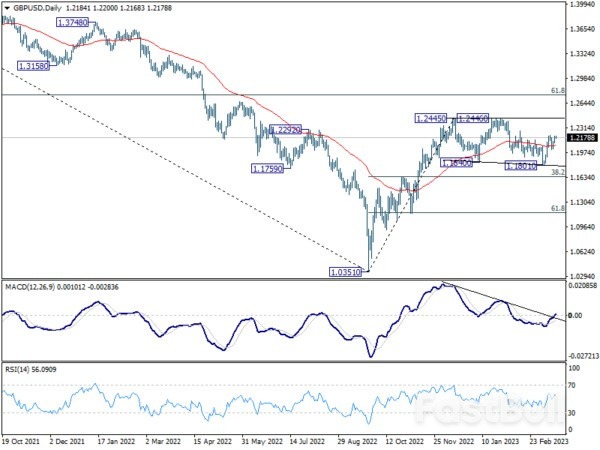
          GBP/USD will be a focus this week with Fed and BoE rate decisions featured. Technically, current outlook is that consolidation pattern from 1.2445 has completed with three waves down to 1.1801. Break of last week high at 1.2203 will bring retest of 1.2445/6 resistance zone. Decisive break there will resume larger up trend from 1.0351. Let's see how it goes.
          Weak Sentiment Persists; FOMC, BoE, and SNB in Focus This Week_1In Asia, Nikkei closed down -1.42%. Hong Kong HSI is down -3.17%. China Shanghai SSE is down -0.46%. Singapore Strait Times is down -1.22%. Japan 10-year JGB yield is down -0.035 at 0.238.

          Market sentiment remains fragile despite CS takeover and coordinated central bank actions

          Over the weekend, two significant actions were announced in an attempt to stabilize the markets amidst the ongoing banking crisis. These actions included the government-supported takeover of troubled Credit Suisse by UBS and a coordinated move by six major central banks to enhance the provision of US dollar liquidity. Despite these measures, market sentiment remains fragile, with stocks in Japan, Hong Kong, and Singapore extending declines.
          UBS's takeover of Credit Suisse was made possible with the support of the Swiss federal government, FINMA, and SNB. SNB noted that this move aims to secure financial stability and protect the Swiss economy during these exceptional circumstances. Based on the Federal Council's Emergency Ordinance, Credit Suisse and UBS can obtain a liquidity assistance loan with privileged creditor status in bankruptcy for a total amount of up to CHF 100B. Additionally, SNB can grant Credit Suisse a liquidity assistance loan of up to CHF 100B backed by a federal default guarantee.
          In a separate announcement, Fed, alongside BoC, BoE, BoJ, ECB, and SNB, revealed a coordinated action to increase the availability of liquidity via the standing US dollar liquidity swap line arrangements. To enhance the swap lines' effectiveness, the central banks will increase the frequency of 7-day maturity operations from weekly to daily, starting on March 20, 2023, and continuing at least until the end of April.
          These swap lines between central banks serve as crucial liquidity backstops to ease strains in global funding markets. By mitigating these strains, central banks aim to maintain the supply of credit to households and businesses. However, the ongoing decline in stock markets across Asia signals that further actions may be needed to restore confidence and stability in the global financial markets.
          Hong Kong HSI is trading down -2.5% at the time of writing. The decline from 22700.85 (Jan high) is still in progress with the index bounded well inside the falling channel, and capped below 55 hour EMA. Outlook will stay bearish as long as 19804.56 support turned resistance holds. Next target is 100% projection of 22700.85 to 19804.56 from 21005.66 at 18109.37.Weak Sentiment Persists; FOMC, BoE, and SNB in Focus This Week_2

          BoJ members support persistent monetary easing, discussed side effects

          In the Summary of Opinions from BoJ's March meeting, many members expressed support for continuing with the current monetary easing and yield curve control. However, there were also discussions on potential side effects and concerns related to the policy.
          One member acknowledged the side effects of the current monetary easing, such as distortions in the yield curve. They stressed the need for BoJ to examine market functioning without preconceptions while assessing the balance between positive effects and side effects. Nonetheless, this member believed that the bank should "persistently continue with large-scale monetary easing" in the current phase.
          Another member commented that it would take time to examine the effects of modifications in yield curve control on market functioning. They expect that when observed CPI inflation declines and market projections of interest rates calm down, "distortions on the yield curve are expected to be corrected".
          A member warned against hasty policy changes, stating that the risk of missing the chance to achieve the price stability target should be considered more significant than the risk of delaying policy changes, given the current improvements in the price environment.
          Another member emphasized the importance of BoJ maintaining its commitment to the 2% price stability target. They argued that starting a discussion on the target could lead to "unnecessary speculation" on monetary policy conduct, despite the growing possibility of achieving the target. Similarly, this member saw no need to revise the joint statement of the government and BoJ.

          Fed, SNB and BoE Decisions Loom: Uncertainty Remains Over Rate Hike Paths and Market Impacts"

          This week, the highly anticipated FOMC rate decision will finally take place. Market expectations have been on a roller-coaster ride, shifting from a 50bps hike following Fed Chair Jerome Powell's semi-annual testimony to a potential hold during the peak of last week's banking crisis. As of Friday's close, fed fund futures were pricing in a 62% chance of a 25bps hike to 4.75-5.00%. However, these odds may change based on upcoming developments.
          More uncertainty lies in Fed's path beyond March, with markets pricing in an 80% chance of both a pause in May and a cut in June. There's also a 65% probability that rates will fall back to 3.75-4.00% by the end of the year. The new economic projections and dot plots from the Fed should help clarify some of these uncertainties.
          Meanwhile, BoE is expected to hike by a final 25bps to 4.25% and then pause. Some economists predict that rates could remain at that level for at least a year. However, with market pricing suggesting a 25bps hike is far from certain, BoE could surprise investors. Voting patterns during the meeting will also be closely monitored.
          SNB is widely anticipated to hike by 50bps to 1.50% after February's CPI re-acceleration to 3.4%. Chair Thomas Jordan has stated that monetary policy is still too loose and further tightening cannot be ruled out.
          Other central bank activities include the BoJ Summary of Opinions from its February meeting, RBA minutes from its March meeting, and BoC meeting minutes release.
          In terms of data, CPI reports from Canada, the UK, and Japan will be significant, while PMIs from Australia, Japan, Eurozone, UK, and US will be closely watched.
          Here are some highlights for the week:
          · Monday: BoJ summary of opinions; Germany PPI; Eurozone trade balance.
          · Tuesday: New Zealand trade balance; RBA minutes; Swiss trade balance; Germany ZEW; Canada CPI, US existing home sales.
          · Wednesday: UK CPI, PPI; Eurozone current account; Canada new housing price index, BoC minutes; FOMC rate decision.
          · Thursday: SNB rate decision; BoE rate decision; US jobless claims, current account, new home sales; Eurozone consumer confidence.
          · Friday: Australia PMIs; Japan CPI, PMI manufacturing; UK Gfk consumer confidence, retail sales, PMIs; Eurozone PMIs; Canada retail sales; US durable goods orders, PMIs.

          Source: ActionForex.Com

          Risk Warnings and Disclaimers
          You understand and acknowledge that there is a high degree of risk involved in trading. Following any strategies or investment methods may lead to potential losses. The content on the site is provided by our contributors and analysts for information purposes only. You are solely responsible for determining whether any trading assets, securities, strategy, or any other product is suitable for investing based on your own investment objectives and financial situation.
          Comments
          Add to Favorites
          Share

          Credit Suisse Deal Effects Set to Ripple Through Europe

          Samantha Luan

          Forex

          Having come off the worst week for European equity markets this year, volatility looks set to continue this week now that the fate of Credit Suisse appears to have finally been sealed in a $3.2bn deal that sees its rival UBS take over the bank in an all-share deal that also includes extensive Swiss government and SNB guarantees.
          At the weekend there were reports that Credit Suisse had pushed back after it was reported that UBS was putting a price tag of up to $1bn on the embattled business, a price of CHF0.25c a share, paid in UBS stock, a number that was well below Credit Suisse closing share price of CHF1.86c on Friday.
          The weekend deal which still sees UBS pay CHF0.76c in its own stock, also sees the Swiss National Bank offer a further CHF100bn liquidity line and the Swiss government a loss guarantees of CHF9bn, in the event, UBS bears up to CHF5bn of losses on certain assets.
          With memories still fresh of how Lloyds Banking Group was forced into a shotgun marriage with HBOS back in 2008, and how ruinous that has been for long-term shareholder value, UBS was quite within its rights to assign a knockdown value on a bank where due diligence would take months to undertake. Some have suggested that UBS putting such a low-ball number on its interest means that Credit Suisse could be in more trouble than perhaps regulators are letting on, and while that might be true, it could also be UBS management being extremely cautious.
          After all, with so little time in which to do due diligence, there could be all manner of hidden nasties lurking on its balance sheet, and while the eventual $3.2bn number came in higher than the initial $1bn offer, UBS is still taking a big gamble even as it tries to ensure that its shares don’t get clobbered when they open later today.
          With Credit Suisse shareholders and some bondholders taking a huge hit, banks in Asia have taken a hit on similar concern about their AT1 bond holding values, while the weekend deal still presents the Swiss National Bank and Swiss Government with untold headaches, with the size of the newly merged bank set to dwarf the size of the Swiss economy. The phrase too big to fail really does spring to mind here, and this morning’s weakness in Asia markets serves to reinforce concerns about these types of writedowns and any spillover effects on the rest of the banking sector.
          As for Credit Suisse, it is in no position to dictate the price of any rescue package given the problems it was facing, and if its shareholders are unhappy with the price they’ve got, they should have stumped up the extra cash themselves!
          Looking ahead to this week the resultant market turmoil from last week’s events in Europe, as well as the events in the US around Silicon Valley Bank, Silvergate, and Signature Bank have brought this week’s Federal Reserve rate decision into sharp focus, prompting some to suggest that the Fed may well pause, or even cut rates this week.
          In an attempt to head off any potential problems, central banks have also increased the frequency of their US dollar swap operations to a daily occurrence until the end of April at least, to ensure financial conditions don’t tighten too much.
          With concerns over US and European banks likely to be still front of mind there is certainly a case for central banks to be cautious about the message they send about future rate rises, while financial stability is also part and parcel of their core mandate.
          Despite this, they also have to deal with concerns about sticky inflation, and unless they clamp down on rising prices, then today’s problems could become even worse in the short term.
          In a sense, the problems being caused by rising interest rates are a direct consequence of the very same central bank policies of easy money being allowed to continue for far too long, and now they are faced with having to put the genie back in the bottle.
          This means a rate cut this week is unlikely, and could even be unwise as it would suggest that the current problems are even more serious than markets currently believe.
          Last week the ECB decided to press on with a 50bps rate hike, however on this occasion very sensibly made any further rate rises very much data dependent, meaning that after this week, further rate hikes may well get deferred until things have settled down.
          Against such a difficult backdrop it's hard to imagine that only two weeks ago, further rate rises this week were a nailed-on certainty, for both the Federal Reserve, as well as the Bank of England.
          Now it seems very much an each-way bet, between a hike or a pause, despite recent economic data on both sides of the Atlantic coming in better than expected.
          Now as a result of some significant financial contagion caused by poor risk management practices at a number of small US tech lenders, and a loss of confidence in Credit Suisse after a major shareholder ruled out putting in more capital, we could well find that we’re at or close to a rate hike peak.
          That doesn’t mean rates will come down quickly however, it just means that rates could stay at highly elevated levels for a long time to come in the hope that inflation will eventually return to target over a much longer period of time.
          EUR/USD – finding decent support in the area of 1.0510/30 area, with more solid support at 1.0480. Last week’s highs at 1.0760 is a key resistance.
          GBP/USD – found support at the 1.1800 area earlier this month before rebounding back to the 1.2200 area. Currently rangebound between the recent peaks just below 1 2300, with a break below 1.1800 opening up the risk of a move towards 1.1640.
          EUR/GBP – ran out of steam at the 0.8920 area and has subsequently slipped back towards trend line support at 0.8720, from the lows last August. A break below 0.8700 could well see further losses towards 0.8620.
          USD/JPY – the failure to push above the 200-day SMA, earlier this month has seen the US dollar slide back, with the next key support at the 130.00 area. Resistance currently lies back at the 135.10/20 area.

          Source: CMC

          Risk Warnings and Disclaimers
          You understand and acknowledge that there is a high degree of risk involved in trading. Following any strategies or investment methods may lead to potential losses. The content on the site is provided by our contributors and analysts for information purposes only. You are solely responsible for determining whether any trading assets, securities, strategy, or any other product is suitable for investing based on your own investment objectives and financial situation.
          Comments
          Add to Favorites
          Share

          The Commodities Feed: Speculators Pull Back

          Cohen

          Commodity

          Energy - Specs cut their Brent net long
          Broader market concerns weighed heavily on the oil market last week, while fundamentals have clearly not been strong enough to prop up the market. ICE Brent finished the week almost 12% lower, leaving the market at its weakest level since December 2021. Volatility is likely to linger this week, with broader financial market concerns likely to remain at the forefront. In addition, we have the FOMC meeting this week, which adds further uncertainty to markets. External developments and a softer supply & demand balance have led us to cut our price forecast last week. While we still expect the market to trend higher over the course of the year, $100/bbl plus Brent is less likely.
          It shouldn't come as too much of a surprise that there was significant liquidation in oil from speculative longs over the last reporting week. The latest positioning data shows that speculators cut their net long in ICE Brent by 64,907 lots to 233,384 lots as of last Tuesday. This move was predominantly driven by longs liquidating - 49,465 lots sold - although 15,442 lots of fresh shorts were also added. Given that the sell-off in the oil market has continued since last Tuesday, current speculative positioning is likely even smaller.
          While the crude oil market has come under pressure over the last week, refined products have held up better. Refinery margins have strengthened over the week with most cracks moving higher. The scale of the sell-off in crude oil explains some of the strength in refinery margins, but continued strike action in France, which is affecting energy infrastructure, including refineries, will also be providing some support to the products market.
          The second batch of Chinese trade data released over the weekend shows that middle distillate exports over February increased further YoY. Diesel exports in February totalled 2.15mt, up about ten-fold YoY, whilst jet fuel exports came in at 1.31mt, up almost 96% YoY. These gains were not unexpected, given the increase in export quotas, and have helped to ease tightness in middle distillates. However, how these flows evolve through the year will really depend on how strong a recovery we see in domestic demand. Meanwhile, LNG imports in February came in at 5.21mt, up 8.2% YoY. This leaves LNG imports over the first two months of the year at 11.12mt, down 11.9% YoY.
          Metals – LME invalidates nickel warrants after irregularities
          The LME said it has found irregularities in the metal underpinning nine nickel contracts. The amount of the metal represents just 0.14% of live nickel inventories on the LME, it said in a statement. The exchange discovered bags of stones, Bloomberg reported, instead of the nickel that underpinned a small number of its contracts at a warehouse in Rotterdam. The issue affected nine contracts, representing 54 tonnes of nickel. The exchange said the issues were discovered after it received information that a number of physical nickel shipments, out of one specific facility of an LME-licensed warehouse operator, have been subject to irregularities.
          This will add to troubles for the LME, which has struggled to regain confidence in its global benchmark nickel contract ever since the short squeeze in March last year when fears of sanctions on Norilsk Nickel coincided with a huge short squeeze, forcing the exchange to suspend trading for a week and cancel billions of dollars' worth of nickel trades.
          The exchange also said that it will postpone a resumption of Asian trading hours for nickel by one week. It had been due to restart on Monday and was expected to provide a significant boost to liquidity.
          The news comes weeks after Trafigura said it is facing more than half a billion dollars in losses in what it believes is a systemic fraud against it involving missing nickel cargoes. The trader said the LME announcement has no connection with its fraud case and it does not own any of the nine warrants that have been invalidated by the LME.
          Agriculture – Black Sea grain deal extended
          The latest reports suggest that the deal that allowed exports of Ukrainian grain through the Black Sea was extended over the weekend (just before its expiration date). However, the agreed tenure for the deal extension still remains uncertain. There are mixed statements from the parties involved in the negotiations, Ukraine said it had been extended for 120 days while Russia said that they agreed to extend the deal only for 60 days. Despite the confusion over the duration of the extension, grain markets are still trading somewhat softer in early morning trading today.
          The latest data from the Indian Sugar Mills Association (ISMA) show that Indian sugar production fell marginally to 28.2mt so far this season through until 15 March. Cumulative output stood at 28.5mt at the same stage last year. Mills are ending operations at a quicker pace than last year with ISMA reporting that just 336 mills were crushing cane by mid-March compared to 438 mills at the same time last year. Uncertainty over where output will end this season has meant that the government is reluctant to issue further export quotas for this season.
          The Buenos Aires Grain Exchange slashed its forecast for the 2022/23 Argentine soybean crop to 25mt, which would be down from 43.3mt last season and the smallest crop since at least 2001. The extended drought combined with high temperatures continues to hurt yields across a large part of the growing region. The exchange also trimmed its corn production estimates by another 4% to 36mt for 2022/23.

          Source: ING

          Risk Warnings and Disclaimers
          You understand and acknowledge that there is a high degree of risk involved in trading. Following any strategies or investment methods may lead to potential losses. The content on the site is provided by our contributors and analysts for information purposes only. You are solely responsible for determining whether any trading assets, securities, strategy, or any other product is suitable for investing based on your own investment objectives and financial situation.
          Comments
          Add to Favorites
          Share

          Funds Face Massacre on Record Short US Rates Position

          Samantha Luan

          Stocks

          Hedge funds face huge losses on their record bet that the Fed will go full steam ahead with its aggressive interest rate-raising campaign, after some of the most abrupt and violent swings in U.S. rates and bond market pricing in living memory.
          Commodity Futures Trading Commission (CFTC) data shows that speculators held the largest ever net short position in three-month SOFR rate futures in the week ending March 7, only a few weeks after amassing a record short position in two-year Treasuries futures.
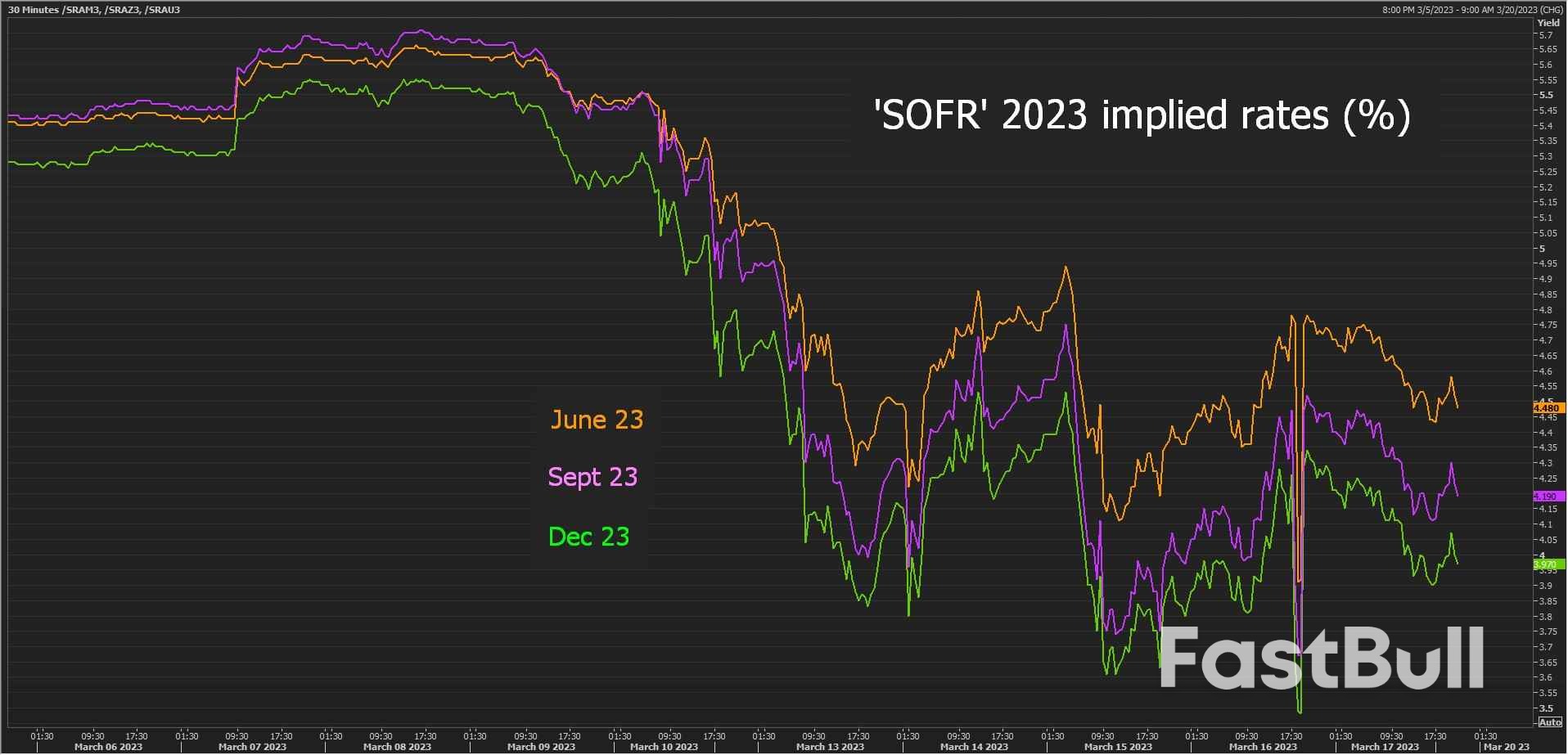
          Implied rates across the 2023 SOFR curve peaked a day later on March 8, before troubles at Silicon Valley Bank and crypto bank Silvergate emerged on March 9 and sowed the seeds of what rapidly grew into a global banking crisis.
          Funds Face Massacre on Record Short US Rates Position_1Implied rates then plunged as much as 200 basis points in a week as traders drastically redrew their Fed outlook. The two-year Treasury yield posted its biggest fall since the Black Monday crash of 1987, and U.S. bond market volatility surged the most since Lehman's collapse.
          Funds Face Massacre on Record Short US Rates Position_2Trend-following and macro funds, and Commodity Trading Advisors have been badly wrong-footed by the rates reversal, registering up to double-digit losses for the month by early last week, according to banks and traders.
          These losses are likely to have increased as rates and yields fell further, exposing leveraged funds to a huge Value at Risk shock. A VaR shock is essentially a rise in the maximum loss an investment can sustain over a period of time.
          The latest CFTC data show that funds and speculative accounts increased their net short position in three-month Secured Overnight Financing Rate futures to 1.17 million contracts from 829,000 contracts, surpassing the previous record short of 1.06 million contacts last September.
          Only six weeks before, funds held a small net long position.
          Drive My Var
          The CFTC positioning data is lagging by one week, after a cyber attack on the derivatives platform of ION Group which delayed trading firms' reporting earlier this year.
          Analysts at Goldman Sachs noted that trading at the front end of the SOFR curve last week was particularly choppy, reflecting "extremely elevated uncertainty" about the near-term path for U.S. interest rates.
          "Liquidity provision has dropped as a result, with market depth declining across the curve, and a sharp increase in the price impact of order flow," they wrote on Friday.
          "Although we continue to believe economic fundamentals warrant a lower rate vol regime, this will be hard to price until the systemic fears fade," they said, adding that the longer banking system concerns persist, rates volatility is likely to persist also.
          Analysts at Deutsche Bank say the huge disconnect between bond and rates volatility over equity volatility recently is partly down to the extreme positioning in fixed income.
          Funds Face Massacre on Record Short US Rates Position_3The damage to investors of all stripes from the recent level of volatility in short-end U.S. interest rates and bond yields cannot be overstated, and those with direct exposure will be hit especially hard.
          Media reports say Adam Levison's Graticule Asia macro hedge fund has closed after plunging more than 25% this year, mostly since the SVB crisis erupted, as bets tied to short-term rates imploded.
          A short position is essentially a wager that an asset's price will fall, and a long position is a bet it will rise. In bonds and interest rates, yields and implied rates fall when prices rise, and move up when prices fall.
          Hedge funds take positions in short-dated U.S. rates and bonds futures for hedging purposes and relative value trades, so the CFTC data is not reflective of purely directional bets. But it is a pretty good guide.

          Source: Reuters

          Risk Warnings and Disclaimers
          You understand and acknowledge that there is a high degree of risk involved in trading. Following any strategies or investment methods may lead to potential losses. The content on the site is provided by our contributors and analysts for information purposes only. You are solely responsible for determining whether any trading assets, securities, strategy, or any other product is suitable for investing based on your own investment objectives and financial situation.
          Comments
          Add to Favorites
          Share

          China Still Adding to Crude Inventories Even as Oil Refining Jumps

          Owen Li

          Commodity

          China still added more crude oil to inventories in the first two months of the year, despite lower imports and higher refinery processing rates.
          About 270,000 barrels per day (bpd) of crude was added to commercial or strategic inventories over January and February, according to calculations based on official data.
          This was down from the 1.19 million bpd in December and the 740,000 bpd for 2022 as a whole.
          The slower flow into storage tanks does support the market's bullish view for a rebound in China's oil demand in 2023 as the world's largest crude importer stimulates and reopens its economy after growth was crimped last year by the now abandoned strict zero-COVID policy.
          But the fact that China is still building inventories also sounds a note of caution as it suggests that even as they ramp up processing rates, refiners still have bulging stockpiles to draw upon should the price of imported oil rise to levels they deem too high.
          While the current oil price has been knocked lower by the two bank failures in the United States and the rapid takeover of struggling Swiss lender Credit Suisse, the market expectation is that a reinvigorated China will drive global oil demand this year, leading to higher prices.
          China doesn't disclose the volumes of crude flowing into or out of strategic and commercial stockpiles, but an estimate can be made by deducting the amount of crude processed from the total of crude available from imports and domestic output.
          The total volume of crude available from imports and domestic production in the first two months of the year was 14.63 million bpd, consisting of imports of 10.4 million bpd and local output of 4.23 million bpd.
          The National Bureau of Statistics combines data for January and February to avoid distortions from the timing of the annual Lunar New Year holiday, which fell in late January this year.
          Refinery throughput rose 3.3% year-on-year in the first two months to 14.36 million bpd, meaning the volume of crude available exceeded the amount processed by 270,000 bpd.
          Mixed Picture
          Looking deeper into the data for the first two months shows that crude imports are yet to reflect any rebound in China's demand, as they were 1.25% below the level for the same period in 2022.
          However, crude imports are a lagging indicator as it takes up to five months from when a cargo is arranged to when it is delivered and processed in a refinery.
          This means that if China's refiners shifted to a positive outlook for demand around the time in December when the zero-COVID policy was ended, it would only be from April onwards that imports would start to lift.
          The gain in refinery processing is also a positive, as it does indicate an increase in domestic fuel consumption.
          But part of the increase is because refiners were encouraged, through the granting of new quotas, to increase exports of refined products.
          Exports of refined oil products - which included diesel, gasoline, aviation fuel and marine fuel - soared 74.2% in the January-February period from a low base a year earlier to nearly 12.7 million tonnes, according to official data.
          This equates to about 1.72 million bpd of exports, using the BP conversion factor of 8 barrels of product per tonne.
          Putting all the data together gives a somewhat mixed picture, as crude oil imports are still soft, refinery processing is strong, but a larger share of what was processed was exported to take advantage of high regional fuel prices, especially for diesel.
          It's likely that China's oil demand will rise in coming months as the economy continues its uneven recovery, but the question is whether this rise in fuel consumption will be met by additional crude imports, or whether refiners will dip into inventories.

          Source: Yahoo

          Risk Warnings and Disclaimers
          You understand and acknowledge that there is a high degree of risk involved in trading. Following any strategies or investment methods may lead to potential losses. The content on the site is provided by our contributors and analysts for information purposes only. You are solely responsible for determining whether any trading assets, securities, strategy, or any other product is suitable for investing based on your own investment objectives and financial situation.
          Comments
          Add to Favorites
          Share

          March 20th Financial News

          FastBull Featured

          Daily News

          【Quick Facts】

          1. UBS agreed to buy Credit Suisse for 3 billion Swiss francs.
          2. Global central banks will boost liquidity in US dollar swap agreements.
          3. Nearly 200 U.S. banks face the risk of collapse.
          4. U.S. March consumer sentiment fell for the first time in four months.
          5. OECD raises global growth outlook.
          6. The probability of the Fed raising interest rates by 25 bps in March is 65.7%.

          【News Details】

          1. UBS agreed to buy Credit Suisse for 3 billion Swiss francs.
          Under the mediation of the Swiss government, UBS is buying Credit Suisse at a 40% discount on shares for a consideration of 3 billion Swiss francs and taking a loss of $5.4 billion; creditors holding $17 billion worth of Credit Suisse AT1 bonds will be left out of pocket. The Swiss central bank provided 100 billion Swiss francs of liquidity to the merged Credit Suisse, which was welcomed by the U.S. Treasury and the Federal Reserve, which emphasized the strong and resilient liquidity of the U.S. banking sector.
          2. Global central banks will boost liquidity in US dollar swap agreements.
          In a statement coordinated with the Bank of Canada, the Bank of England, the Bank of Japan, the European Central Bank and the Swiss Central Bank, the Fed said that in order to improve the effectiveness of the US dollar swap lines in providing US dollar liquidity, the central banks participating in the US dollar swaps will "increase the frequency of 7-day maturity operations from weekly to daily", with daily operations starting on March 20 The daily operations will begin on Monday, March 20, and will continue until at least the end of April. The central banks said the increased swaps would " boost liquidity provision" and described the arrangements as "an important liquidity backstop to ease pressure on global funding markets" and would also mitigate the impact on the availability of loans to households and businesses.
          3. Nearly 200 U.S. banks face the risk of collapse.
          According to U.S. media reports, a research report shows that a total of 186 U.S. banks have similar risks to Silicon Valley Bank, even if only half of their depositors suddenly withdrew their funds, the U.S. Federal Deposit Insurance Corporation (FDIC) will be difficult to come up with enough money, and then 300 billion U.S. dollars to obtain federal savings insurance deposits at risk. The report also revealed that the "Midsize Banks Coalition of America", which represents medium-sized banks in the United States, has called on the FDIC to provide deposit insurance for all deposits within the next two years, saying that such a measure "would immediately stop the outflow of deposits from small banks ", promote banking stability and restore confidence.
          4. U.S. March consumer sentiment fell for the first time in four months.
          U.S. consumer sentiment fell for the first time in four months in March, but households expected inflation to subside over the next year and beyond, which could offer some relief to the Federal Reserve as it confronts financial market instability. The University of Michigan's preliminary March consumer confidence index came in at 63.4, compared with an estimate of 67.0 and 67 for the previous month. One-year inflation expectations in the survey fell to 3.8% from 4.1% in February, the lowest since April 2021.
          5. OECD raises global growth outlook.
          The Organization for Economic Cooperation and Development (OECD) said the global economic outlook has improved from a few months ago as inflationary shocks ease, but rising interest rates will keep risks high. The OECD raised its growth forecasts for major economies. In its economic outlook, the OECD said the global economy is expected to grow 2.6 percent this year after growing 3.2 percent last year, higher than the 2.2 percent it expected last November, as energy and food prices fell and China eased restrictions on Covid-19.
          6. The probability of the Fed raising interest rates by 25 bps in March is 65.7%.
          According to CME "Fed Watch": The probability of the Fed keeping interest rates unchanged in March is 34.3%, and the probability of raising rates by 25 bps to the 4.75%-5.00% range is 65.7%; the probability of keeping rates unchanged by May is 26.1%, the probability of raising rates by 25 bps is 58.2%, and the probability of raising rates by 50 bps is 15.8%. The probability of 50 bps is 15.8%.

          【Focus of the Day】

          UTC+8 7:50 BOJ releases Summary of Opinions at March Monetary Policy Meeting Review
          UTC+8 9:15 China one-year and five-year LPR as of March 20th
          UTC+8 22:00 ECB President Lagarde delivers a speech
          Risk Warnings and Disclaimers
          You understand and acknowledge that there is a high degree of risk involved in trading. Following any strategies or investment methods may lead to potential losses. The content on the site is provided by our contributors and analysts for information purposes only. You are solely responsible for determining whether any trading assets, securities, strategy, or any other product is suitable for investing based on your own investment objectives and financial situation.
          Comments
          Add to Favorites
          Share

          UBS Swallows Doomed Credit Suisse, Casting Shadow Over Switzerland

          Cohen
          UBS Group emerged as Switzerland's one and only global bank with a state-backed rescue of its smaller peer Credit Suisse, a risky bet that makes the Swiss economy more dependent on a single lender.
          The unprecedented move announced late on Sunday in Zurich capped a race against time by regulators to avert a meltdown in global markets. Switzerland is pledging more than 160 billion francs ($173 billion) in loans and guarantees to underpin the new group, guarding against further risks undermining the lender.
          The transaction – the first rescue of a global bank since the financial crisis of 2008 – grants enormous clout to UBS, ridding it of its main rival. It will change the landscape of banking in Switzerland, where branches of Credit Suisse and UBS are dotted everywhere, sometimes just metres apart.
          The two lenders have been pillars of global finance for decades. The banks, two of the most systemically relevant in global finance, hold combined assets of up to 140% of Swiss gross domestic product in a country heavily dependent on finance for its economy.
          Following the 2008 financial crash, politicians pledged to never bail out banks again. The Credit Suisse rescue, orchestrated with public money, shows banks' continued vulnerability and how their problems can quickly rebound on their home country.
          But it also removes a competitor to Wall Street, with UBS planning to pare back much of Credit Suisse's investment bank.
          "Under normal circumstances, I would say it is an absolutely fantastic deal for UBS," said Johann Scholtz, equity analyst at Morningstar, covering European Banks, Amsterdam. "In the current environment, it is a bit more complicated as there is a lot of uncertainty generally in the markets."
          Reversal of Fortunes
          Soon after the announcement, central banks including the Federal Reserve, the European Central Bank and the Bank of Japan said they would enhance dollar swap lines, helping calm investors rattled by turmoil in the banking sector. The failure of two U.S. banks and a rout in Credit Suisse shares have sent shock waves through markets over the past week.
          UBS will pay $3.2 billion for 167-year-old Credit Suisse and assume at least $5.4 billion in losses from unwinding its portfolio of derivatives and other risky assets. Credit Suisse had a market value of about $8 billion at the close on Friday.
          Holders of Credit Suisse's Additional Tier 1 bonds will get wiped out and in a controversial move will come secondary to equity holders who will receive at least some UBS shares.
          It marks a radical twist of fate for the banks. During the great financial crash, it was UBS and not Credit Suisse that needed state support.
          The banks' fortunes have diverged sharply over the past year. UBS earned $7.6 billion in profit in 2022, while Credit Suisse lost $7.9 billion. Credit Suisse's shares were down 74% from a year ago, while UBS's are relatively flat.
          UBS becomes the undisputed global leader in managing money for the wealthy, with UBS's leading position in China now complemented by Credit Suisse's strength in the rest of Asia, the fastest growing region. UBS also gets to keep the jewel in Credit Suisse's crown, the domestic bank.
          "In the past, when a deal between Credit Suisse and UBS was discussed, a sticking point would be concentration, especially in the domestic market," said Morningstar's Scholtz. "It is also the most stable part of the business, that generates quite a lot of cash. If UBS is not required to do an IPO of it, it could make sense for them to keep it, there are lots of synergies."
          UBS is also taking out a big competitor in securities trading. UBS earned $7.1 billion in revenue from buying and selling stocks, currencies and bonds. Credit Suisse posted about$3.2 billion last year.
          Still Swiss
          Credit Suisse's demise has been a blow to Switzerland's reputation for banking and sent shockwaves through global finance.
          At a press conference announcing the deal, finance minister Karin Keller-Sutter defended the rescue, saying it was good for Credit Suisse account holders, including her. She said she also banked with UBS. That choice of banks will soon end.
          "This solution has risks," she conceded, playing down any concerns about the size of the new bank, arguing that any alternative to resolve Credit Suisse's problems risked "irreparable economic turmoil."
          Seated to her right, UBS Chair Colm Kelleher said the new group would be trimmed of risks, such as investment banking, to fit UBS's conservative culture.
          "A new UBS will remain rock solid," he said.
          Credit Suisse's Chair Axel Lehmann, in contrast, was downcast as his bank proved unable to bounce back from a series of scandals and losses. Late last year, speculation that the bank would go bust drove clients to pull tens of billions, sealing its fate.
          He described Sunday as a "historic, sad day."
          Employees at the headquarters in Zurich are bracing for massive job cuts, with 10,000 positions potentially on the line, sources told Reuters on Saturday.
          Still, it won't be all plain sailing for UBS.
          The bank faces risks to complete the deal, potential litigation charges while regulators may ask the lender to hold more capital in the future, said analysts at Jefferies.
          Crucially, management will be distracted by this deal for many months, maybe years, they said.
          "We will change, but we will not change that much," said UBS Chief Executive Officer Ralph Hamers, who will lead the new banking behemoth. "We will still be Swiss."
          ($1 = 0.9268 Swiss francs)

          Source: Reuters

          Risk Warnings and Disclaimers
          You understand and acknowledge that there is a high degree of risk involved in trading. Following any strategies or investment methods may lead to potential losses. The content on the site is provided by our contributors and analysts for information purposes only. You are solely responsible for determining whether any trading assets, securities, strategy, or any other product is suitable for investing based on your own investment objectives and financial situation.
          Comments
          Add to Favorites
          Share
          FastBull
          Copyright © 2025 FastBull Ltd

          728 RM B 7/F GEE LOK IND BLDG NO 34 HUNG TO RD KWUN TONG KLN HONG KONG

          TelegramInstagramTwitterfacebooklinkedin
          App Store Google Play Google Play
          Products
          Charts

          Chats

          Q&A with Experts
          Screeners
          Economic Calendar
          Data
          Tools
          Membership
          Features
          Function
          Markets
          Copy Trading
          Latest Signals
          Contests
          News
          Analysis
          24/7
          Columns
          Education
          Company
          Careers
          About Us
          Contact Us
          Advertising
          Help Center
          Feedback
          User Agreement
          Privacy Policy
          Business

          White Label

          Data API

          Web Plug-ins

          Poster Maker

          Affiliate Program

          Risk Disclosure

          The risk of loss in trading financial instruments such as stocks, FX, commodities, futures, bonds, ETFs and crypto can be substantial. You may sustain a total loss of the funds that you deposit with your broker. Therefore, you should carefully consider whether such trading is suitable for you in light of your circumstances and financial resources.

          No decision to invest should be made without thoroughly conducting due diligence by yourself or consulting with your financial advisors. Our web content might not suit you since we don't know your financial conditions and investment needs. Our financial information might have latency or contain inaccuracy, so you should be fully responsible for any of your trading and investment decisions. The company will not be responsible for your capital loss.

          Without getting permission from the website, you are not allowed to copy the website's graphics, texts, or trademarks. Intellectual property rights in the content or data incorporated into this website belong to its providers and exchange merchants.

          Not Logged In

          Log in to access more features

          FastBull Membership

          Not yet

          Purchase

          Become a signal provider
          Help Center
          Customer Service
          Dark Mode
          Price Up/Down Colors

          Log In

          Sign Up

          Position
          Layout
          Fullscreen
          Default to Chart
          The chart page opens by default when you visit fastbull.com