

Markets
News
Analysis
User
24/7
Economic Calendar
Education
Data
- Names
- Latest
- Prev



Signal Accounts for Members
All Signal Accounts
All Contests
 U.S. Total Building Permits (SA) (Oct)
--
F: --
P: --
U.S. Building Permits MoM (SA) (Oct)--
F: --
P: --
U.S. Annual New Housing Starts (SA) (Oct)--
F: --
P: --
U.S. Government Employment (Dec)--
F: --
P: --
U.S. UMich 5-Year-Ahead Inflation Expectations Prelim YoY (Jan)--
F: --
P: --
U.S. UMich Consumer Sentiment Index Prelim (Jan)--
F: --
P: --
U.S. UMich Current Economic Conditions Index Prelim (Jan)--
F: --
P: --
U.S. UMich Consumer Expectations Index Prelim (Jan)--
F: --
P: --
U.S. UMich 1-Year-Ahead Inflation Expectations Prelim (Jan)--
F: --
P: --
U.S. 5-10 Year-Ahead Inflation Expectations (Jan)--
F: --
P: --
U.S. Weekly Total Oil Rig Count--
F: --
P: --
U.S. Weekly Total Rig Count--
F: --
P: --
 Indonesia Retail Sales YoY (Nov)
A:--
F: --
P: --
 Euro Zone Sentix Investor Confidence Index (Jan)
A:--
F: --
P: --
 India CPI YoY (Dec)
A:--
F: --
P: --
 Canada National Economic Confidence Index
A:--
F: --
P: --
 Germany Current Account (Not SA) (Nov)
A:--
F: --
P: --
U.S. Conference Board Employment Trends Index (SA) (Dec)A:--
F: --
 China, Mainland M0 Money Supply YoY (Dec)
--
F: --
P: --
China, Mainland M2 Money Supply YoY (Dec)--
F: --
P: --
China, Mainland M1 Money Supply YoY (Dec)--
F: --
P: --
U.S. 3-Year Note Auction YieldA:--
F: --
P: --
Richmond Federal Reserve President Barkin delivered a speech. U.S. 10-Year Note Auction Avg. YieldA:--
F: --
P: --
New York Federal Reserve President Williams delivered a speech. Japan Trade Balance (Customs Data) (SA) (Nov)
A:--
F: --
P: --
Japan Trade Balance (Nov)A:--
F: --
P: --
 U.K. BRC Overall Retail Sales YoY (Dec)
A:--
F: --
P: --
U.K. BRC Like-For-Like Retail Sales YoY (Dec)A:--
F: --
P: --
 Turkey Retail Sales YoY (Nov)
A:--
F: --
P: --
U.S. NFIB Small Business Optimism Index (SA) (Dec)--
F: --
P: --
 Brazil Services Growth YoY (Nov)
--
F: --
P: --
Canada Building Permits MoM (SA) (Nov)--
F: --
P: --
U.S. CPI MoM (SA) (Dec)--
F: --
P: --
U.S. CPI YoY (Not SA) (Dec)--
F: --
P: --
U.S. Real Income MoM (SA) (Dec)--
F: --
P: --
U.S. CPI MoM (Not SA) (Dec)--
F: --
P: --
U.S. Core CPI (SA) (Dec)--
F: --
P: --
U.S. Core CPI YoY (Not SA) (Dec)--
F: --
P: --
U.S. Core CPI MoM (SA) (Dec)--
F: --
P: --
U.S. Weekly Redbook Index YoY--
F: --
P: --
U.S. New Home Sales Annualized MoM (Oct)--
F: --
P: --
U.S. Annual Total New Home Sales (Oct)--
F: --
P: --
U.S. Cleveland Fed CPI MoM (SA) (Dec)--
F: --
P: --
U.S. Cleveland Fed CPI MoM (Dec)--
F: --
P: --
China, Mainland Exports (Dec)--
F: --
P: --
China, Mainland Imports YoY (CNH) (Dec)--
F: --
P: --
China, Mainland Imports (CNH) (Dec)--
F: --
P: --
China, Mainland Trade Balance (CNH) (Dec)--
F: --
P: --
China, Mainland Imports YoY (USD) (Dec)--
F: --
P: --
China, Mainland Exports YoY (USD) (Dec)--
F: --
P: --
U.S. EIA Natural Gas Production Forecast For The Next Year (Jan)--
F: --
P: --
U.S. EIA Short-Term Crude Production Forecast For The Next Year (Jan)--
F: --
P: --
U.S. EIA Short-Term Crude Production Forecast For The Year (Jan)--
F: --
P: --
EIA Monthly Short-Term Energy Outlook U.S. 30-Year Bond Auction Avg. Yield--
F: --
P: --
U.S. Budget Balance (Dec)--
F: --
P: --
 Argentina 12-Month CPI (Dec)
--
F: --
P: --
Argentina National CPI YoY (Dec)--
F: --
P: --
Argentina CPI MoM (Dec)--
F: --
P: --
Richmond Federal Reserve President Barkin delivered a speech.









No matching data

Latest Views
Latest Views
Trending Topics
Top Columnists
Latest Update
White Label
Data API
Web Plug-ins
Affiliate Program
View All
No data
The US and Taiwan near a trade deal, targeting 15% tariffs, with TSMC's Arizona expansion a key point.
The United States and Taiwan are nearing a significant trade agreement, with Taipei reporting that a "broad consensus" has been reached on new tariff structures. A source close to the negotiations suggests a final announcement could be made by the end of January.

Taiwan’s primary objective in the talks is to reduce the tariff rate on its exports to the U.S. from 20% to 15%. According to a statement from Taiwan's Office of Trade Negotiations, this goal is now within reach as both parties have aligned on the key issues. It is important to note that Taiwan's crucial semiconductor exports are not currently subject to these U.S. tariffs.
The two sides are now focused on scheduling a final meeting to conclude the deal. A source familiar with the matter stated, "It's now just a matter of getting all the final details in order."
Alongside tariff reductions, technology and manufacturing commitments appear to be central to the negotiations. Taiwan, a global leader in semiconductor production, has consistently offered to help the U.S. replicate its successful model of building tech clusters around dedicated science parks.
A recent report from the New York Times indicated that the Trump administration is pushing for a commitment from chipmaking giant TSMC to construct at least five additional facilities in Arizona as part of the broader deal.
When asked about potential new investments, TSMC declined to comment beyond its previously announced pledge of $165 billion for its U.S. operations. The Office of the United States Trade Representative did not provide an immediate response when contacted for comment.
Germany is in the middle of a historic rearmament, committing over €500 billion ($586 billion) to its military by 2029. This massive investment will push its defense spending to 3.5% of GDP six years ahead of NATO's target, a move that the alliance has publicly praised.
Yet behind the official applause, a deep-seated unease is growing across Europe. The re-emergence of the Bundeswehr as a dominant continental power is stirring old anxieties, especially as Germany's far-right nationalist party climbs to record highs in opinion polls. This political shift has raised questions about whether Berlin's pro-European stance can be guaranteed in the long term.
Nowhere is this tension felt more acutely than in France, a nation that has long prided itself on having one of Europe's most capable militaries and its only independent nuclear deterrent.
The French reaction to Germany's military expansion is deeply conflicted. On one side, there is relief that Berlin is finally sharing more of the security burden. On the other, there is growing anxiety that Germany's massive spending power could sideline France's own defense industry and diminish its political influence.
Four French officials, speaking anonymously, confirmed a general sense of apprehension about Germany's rising military might and the political leverage that accompanies it.
"France is in a fragile situation, and the fact that Germany is committing with such determination will of course create a dynamic that could leave us on the side of the road," warned François-Xavier Bellamy, a French member of the European Parliament. "The domestic fragility is weakening France's geopolitical heft."
Bellamy, a member of the center-right EPP group and a vocal advocate for a "Buy European" policy in defense, acknowledges the contradiction. "France has long complained about doing the job alone," he noted.
For decades, European stability rested on an unspoken agreement: France would serve as the continent's geopolitical leader, while Germany would be its economic engine. According to Claudia Major, a senior vice president at the German Marshall Fund, this balance is now being upended.
"Germany didn't want to be a political giant," Major explained. "Now Germany is doing both, as well as making an effort to embed its new power within Europe. This puts France in a difficult position. Their anxiety says more about France itself than about Germany."
Under Chancellor Friedrich Merz, Germany effectively set aside its strict borrowing limits for military spending to fund its rearmament and counter a more aggressive Russia. While Nordic, Baltic, and Polish governments are also making significant defense investments, few can match the sheer speed and volume of Germany's spending. In contrast, historical military powers like France, Italy, and Spain have far less fiscal room to maneuver.
Despite Germany's efforts to coordinate its military buildup with allies, tensions have already surfaced. France felt pointedly excluded when former German Chancellor Olaf Scholz introduced the European Sky Shield Initiative, a project to purchase missile-defense systems. The frustration in Paris intensified when Scholz later announced a €10 billion deal to buy 35 American-made F-35 fighter jets instead of a European alternative.
While weapons purchases from the U.S. have reportedly slowed under Merz, collaboration with France remains difficult.
The Future Combat Air System (FCAS), Europe's most ambitious joint defense project, is on the brink of collapse. After years of talks, French manufacturer Dassault Aviation SA and Airbus SE, representing German interests, have failed to agree on production shares for the next-generation fighter jet.
With its growing military budget, Germany is gaining more clout within both the EU and NATO. Berlin has already proposed an expanded role for the European Defense Agency, which is currently led by a German general. Inside NATO, U.S. officials have reportedly joked that the alliance's top military position—Supreme Allied Commander Europe, always held by an American—might one day go to a German.
Germany is also best positioned to provide crucial "strategic enablers" for Europe, such as missile defense, space intelligence, and logistics—capabilities for which the continent currently depends almost entirely on the United States.
"We hope Germany will further develop strategic enablers for the alliance," said General Markus Laubenthal, a high-ranking German general in NATO. "It makes sense to work with key European allies. Together we are stronger."
Ultimately, much of the anxiety in Europe is tied to Germany's domestic politics. The far-right Alternative for Germany (AfD) party is leading in some polls and could make major gains in upcoming local elections.
While populism is on the rise across the continent, the prospect of a nationalist party holding power in a remilitarized Germany is a unique concern for its neighbors.
"There is a growing worry about what could happen to this extremely strong German fighting power if the AfD were to take over political leadership," said Jana Puglierin of the European Council on Foreign Relations.
New York Federal Reserve President John Williams has signaled that the central bank is in no hurry to lower interest rates, stating that current monetary policy is effectively steering the economy toward its goals.
Speaking in New York on January 12, 2026, Williams emphasized that there is no immediate reason for a rate cut. His comments project confidence in the Fed's strategy to manage both employment and inflation.
According to Williams, the central bank's current interest rate stance is specifically designed to achieve two primary objectives: stabilizing the labor market and bringing inflation back down to the 2% target.
"Monetary policy is well positioned to stabilize the labor market and return inflation to the 2% target," Williams noted, underscoring his belief that the existing policy framework is appropriate for the current economic climate. This position suggests the Fed sees its strategy as resilient enough to absorb potential shocks without needing immediate adjustments.
The Fed's patient approach is supported by strong underlying economic indicators. Current forecasts project that the U.S. Gross Domestic Product (GDP) will grow at a rate of 2.5% to 2.75% for 2026.
Furthermore, inflation trends are steadily aligning with the Federal Reserve's long-term targets. This combination of healthy growth and moderating inflation gives policymakers room to maintain a stable economic environment without rushing to alter interest rates.
Financial markets reacted calmly to Williams' remarks, with equity markets showing little change. This stability indicates that investors have confidence in the Federal Reserve's plan and were not anticipating a shift in policy.
Overall, the outlook communicated by Williams is one of cautious optimism. The Fed's policy remains focused on sustaining economic growth while effectively managing any potential challenges on the horizon.
Gold continues to trade at elevated levels, but the current phase is no longer about expansion — it is about acceptance and reaction.
After a strong impulsive leg higher, price has paused and begun consolidating near highs. This behavior is consistent with institutional digestion, not distribution. The market is now positioned in a premium zone, waiting for CPI to provide the next liquidity-driven catalyst.
Rather than invalidating the bullish trend, CPI is more likely to act as a trigger for a retracement into value or a continuation breakout, depending on how inflation data reshapes real yield and dollar expectations.
Inflation Expectations and Real Yield Sensitivity
Gold is acutely sensitive to inflation outcomes—not simply headline inflation, but how CPI reshapes real interest rate expectations.
Importantly, even upside CPI surprises may struggle to reverse gold's broader trend unless they signal a sustained re-acceleration of inflation that forces a materially more hawkish stance from the Fed.
CPI remains one of the Federal Reserve's most influential data points. Markets are currently positioned for a policy environment where restrictive conditions cannot be sustained indefinitely.
Gold benefits from:
Conversely, CPI-induced volatility can create short-term drawdowns, but these are increasingly viewed by market participants as tactical repositioning opportunities rather than structural reversals.
As CPI approaches, risk appetite across equities and risk-sensitive assets often becomes more cautious. This environment typically benefits gold, especially when positioning turns defensive ahead of binary macro events.
Gold's ability to hold elevated levels into major data releases is a signal of underlying strength, suggesting buyers are willing to maintain exposure despite headline risk.
Daily Structure – Trend Integrity Remains Intact
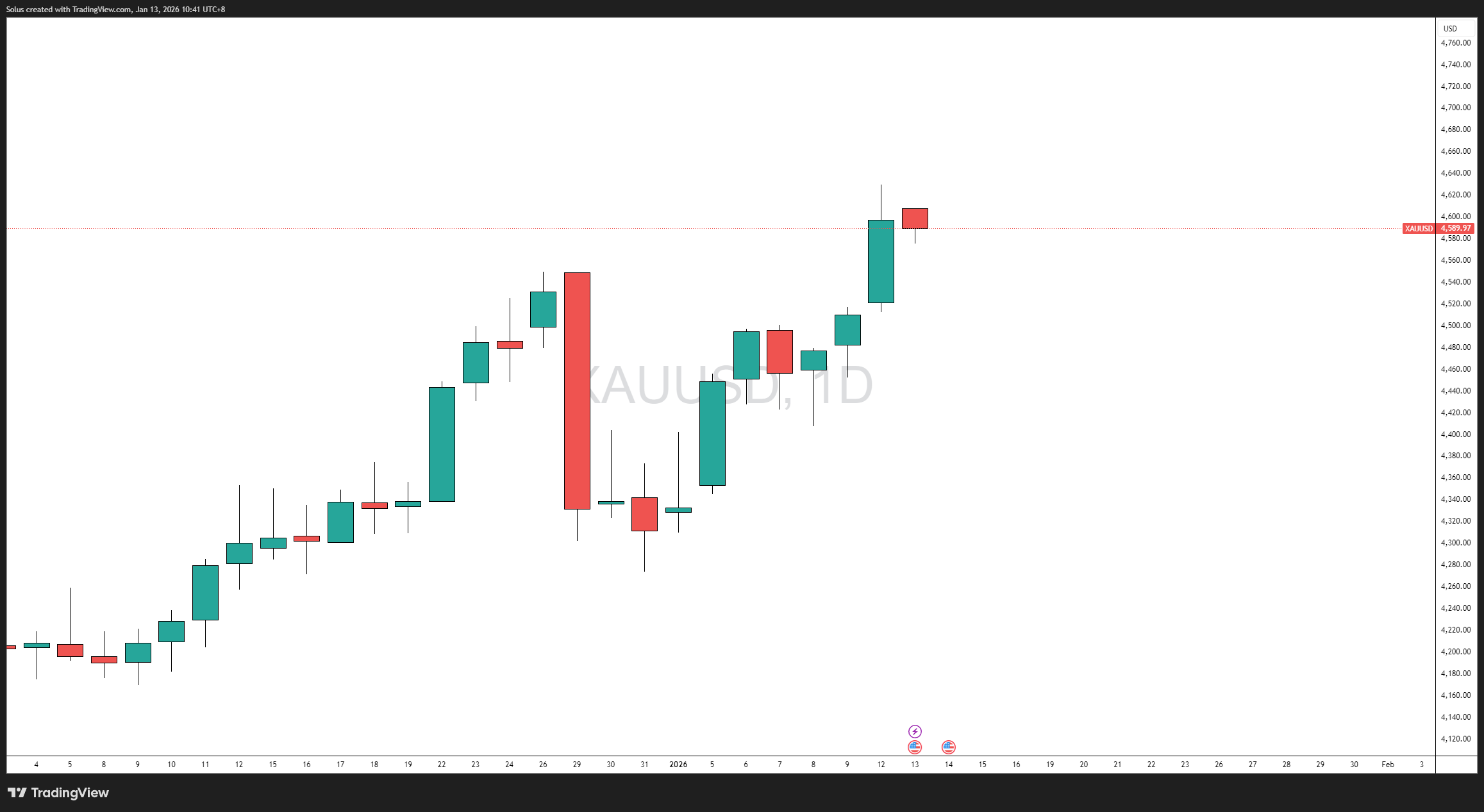
On the daily timeframe, gold continues to print higher highs and higher lows, maintaining bullish market structure despite intermittent volatility.
This reinforces the idea that sellers lack follow-through at current levels, and that downside moves are primarily liquidity-driven corrections, not trend reversals.
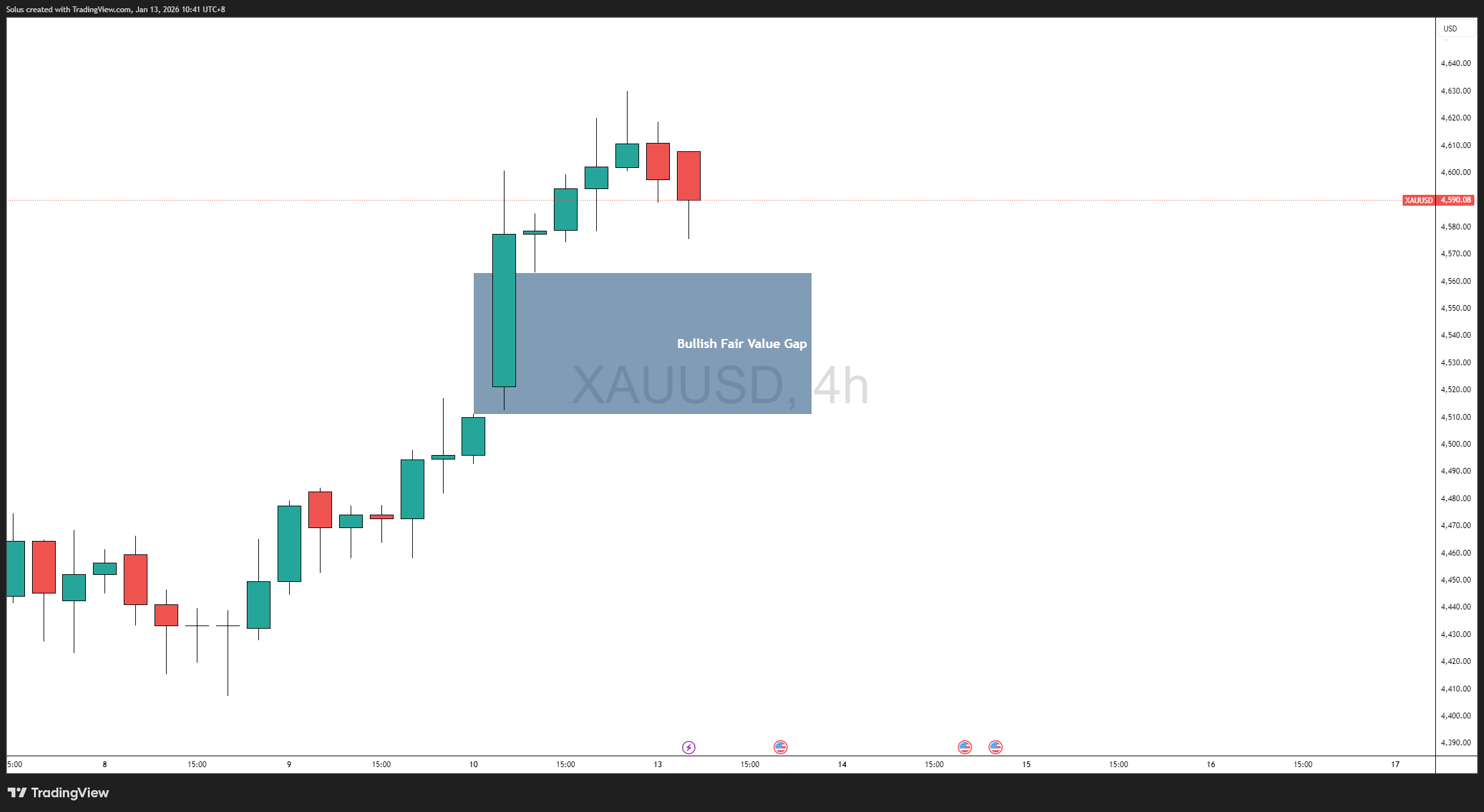
On the 4-hour chart, gold left behind a clear bullish Fair Value Gap following an aggressive displacement to the upside. Price is currently trading above this imbalance, signaling that buyers remain in control of short-term structure.
As long as price holds above or reacts cleanly within this FVG, the bullish narrative remains valid.
CPI matters not because it changes the trend — but because it determines where liquidity is taken next.
In this scenario, CPI becomes a continuation catalyst, allowing gold to resume expansion toward new highs after rebalancing inefficiencies.
This scenario does not automatically invalidate the trend. Instead, it creates a mean-reversion move into value, offering structural confirmation if buyers defend the imbalance zone.
Only a clean breakdown below the FVG with acceptance would suggest a deeper corrective phase.
Bullish Scenario: FVG Hold and Expansion
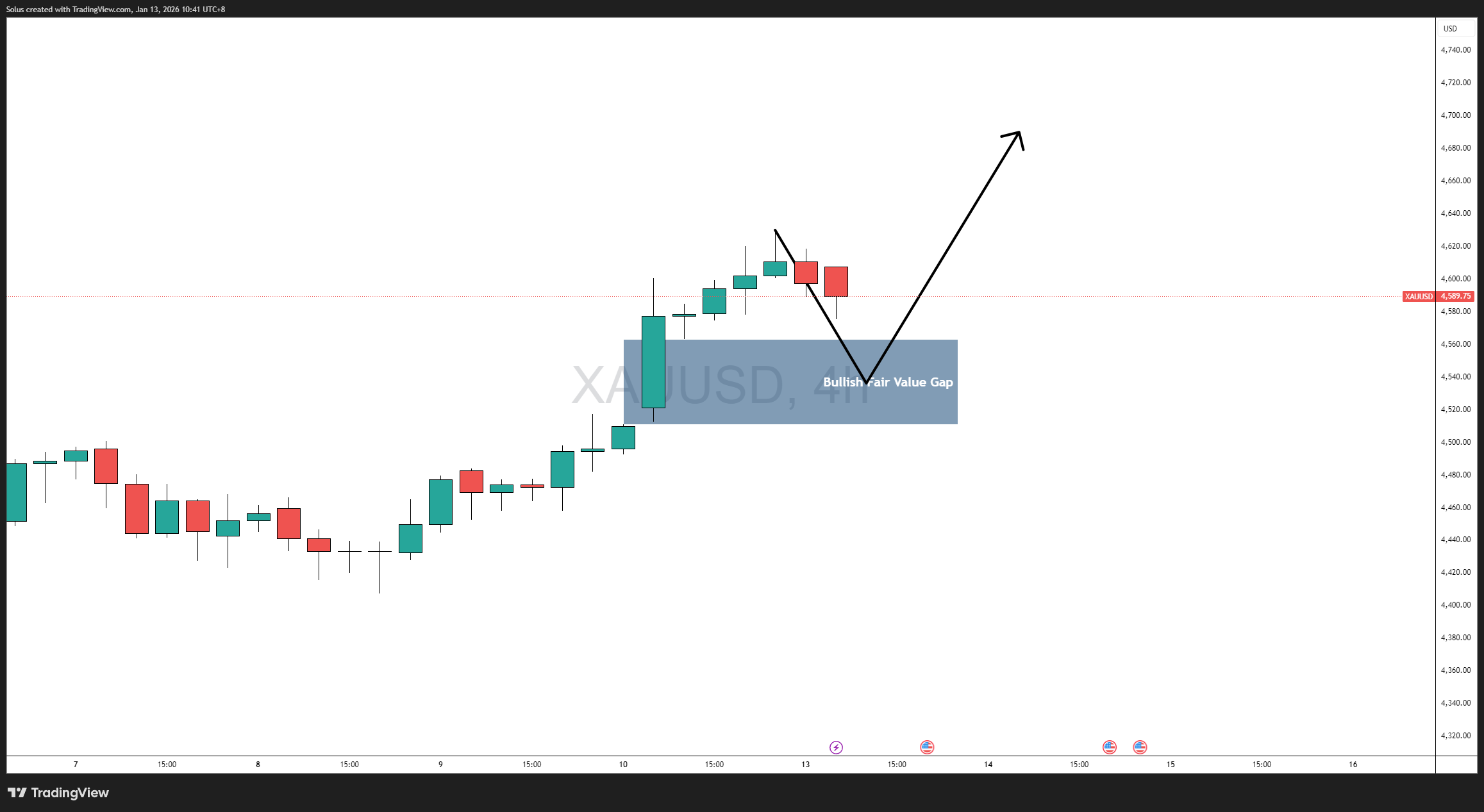
This sets the stage for continuation toward higher premium zones, driven by institutional positioning rather than retail momentum.
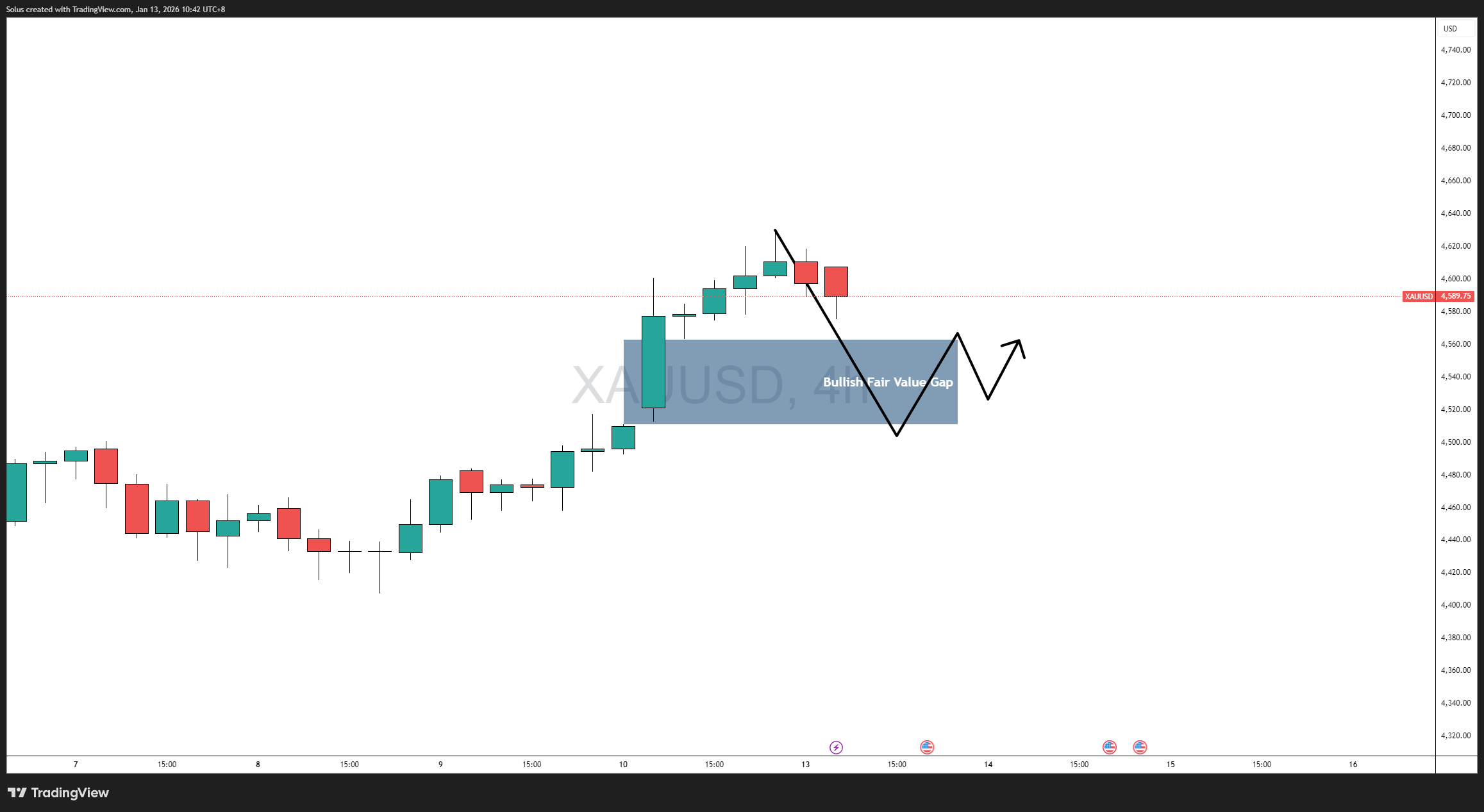
A bearish shift only materializes if:
Without these conditions, downside moves remain corrective within a broader bullish trend.
Gold is not breaking down — it is pausing at premium.
The charts show a market that has expanded aggressively, left behind inefficiencies, and is now waiting for CPI to determine how those inefficiencies are resolved. Until proven otherwise, structure favors buy-side control, with Fair Value Gaps acting as the roadmap rather than lagging indicators.
CPI will inject volatility — but structure will decide direction.
John Williams, President of the Federal Reserve Bank of New York, stated that current interest rates are appropriately positioned to support sustainable job creation and economic growth while guiding inflation back to the central bank's 2% target.
His confidence stems from the belief that the Federal Reserve has gained better control over risks to its dual mandate, particularly after the Federal Open Market Committee (FOMC) projected 75 basis points of rate cuts for 2025.
Speaking on January 12 at a Council on Foreign Relations event in New York City, Williams affirmed that monetary policy is in a strong position. He is known as a key official who favors a patient approach, preferring to wait for more data before considering further interest rate reductions.
According to the median estimate from the Fed's latest economic forecast in December, policymakers anticipate only a single quarter-point rate reduction this year.
Williams provided a specific forecast for the U.S. economy, expressing confidence in the labor market and a predictable path for inflation.
He expects the unemployment rate to hold steady this year before gradually declining over the next few years. Williams noted that key labor market indicators have returned to pre-pandemic levels, signaling a gradual and healthy normalization. "I want to stress that this has been gradual, with no signs of a sudden increase in layoffs or other quick declines," he said.
On the inflation front, Williams suggested that import tariffs implemented under the Trump administration would likely have a one-time effect on prices. He projects inflation to peak between 2.75% and 3% in the first half of the year before falling to 2.5% by year-end. He also anticipates that economic growth will continue at an above-average pace.
Despite this outlook, some policymakers have raised concerns about persistent financial strain, as inflation has remained above the Fed's 2% target for nearly five years.
The Federal Reserve is not entirely unified on its interest rate strategy. Minutes from the Fed's December meeting, released on December 30, revealed a divided committee.
The report showed that some officials who voted for a quarter-point rate cut were not fully committed, indicating they could have just as easily supported a decision to hold rates steady. "Some members who favored lowering the policy rate at this meeting mentioned that their decision was very close," the minutes stated.
The release of these minutes immediately impacted market expectations, with the probability of a rate cut at the next meeting in January dropping to approximately 15%.
Stephen Stanley, chief U.S. economist at Santander US Capital Markets, commented on the situation. He suggested that the narrow vote in favor of a rate cut highlighted the continued influence of Federal Reserve Chair Jerome Powell over the near-evenly divided committee.
728 RM B 7/F GEE LOK IND BLDG NO 34 HUNG TO RD KWUN TONG KLN HONG KONG


White Label
Data API
Web Plug-ins
Poster Maker
Affiliate Program
The risk of loss in trading financial instruments such as stocks, FX, commodities, futures, bonds, ETFs and crypto can be substantial. You may sustain a total loss of the funds that you deposit with your broker. Therefore, you should carefully consider whether such trading is suitable for you in light of your circumstances and financial resources.
No decision to invest should be made without thoroughly conducting due diligence by yourself or consulting with your financial advisors. Our web content might not suit you since we don't know your financial conditions and investment needs. Our financial information might have latency or contain inaccuracy, so you should be fully responsible for any of your trading and investment decisions. The company will not be responsible for your capital loss.
Without getting permission from the website, you are not allowed to copy the website's graphics, texts, or trademarks. Intellectual property rights in the content or data incorporated into this website belong to its providers and exchange merchants.
Not Logged In
Log in to access more features

FastBull Membership
Not yet
Purchase


Log In
Sign Up


