• Trade
  • Markets
  • Copy
  • Contests
  • News
  • 24/7
  • Calendar
  • Q&A
  • Chats
Trending
Screeners
SYMBOL
LAST
BID
ASK
HIGH
LOW
NET CHG.
%CHG.
SPREAD
SPX
S&P 500 Index
6857.13
6857.13
6857.13
6865.94
6827.13
+7.41
+ 0.11%
--
DJI
Dow Jones Industrial Average
47850.93
47850.93
47850.93
48049.72
47692.96
-31.96
-0.07%
--
IXIC
NASDAQ Composite Index
23505.13
23505.13
23505.13
23528.53
23372.33
+51.04
+ 0.22%
--
USDX
US Dollar Index
98.860
98.940
98.860
98.980
98.840
-0.120
-0.12%
--
EURUSD
Euro / US Dollar
1.16577
1.16584
1.16577
1.16589
1.16408
+0.00132
+ 0.11%
--
GBPUSD
Pound Sterling / US Dollar
1.33440
1.33450
1.33440
1.33450
1.33165
+0.00169
+ 0.13%
--
XAUUSD
Gold / US Dollar
4220.36
4220.77
4220.36
4221.12
4194.54
+13.19
+ 0.31%
--
WTI
Light Sweet Crude Oil
59.328
59.365
59.328
59.469
59.187
-0.055
-0.09%
--

Community Accounts

Signal Accounts
--
Profit Accounts
--
Loss Accounts
--
View More

Become a signal provider

Sell trading signals to earn additional income

View More

Guide to Copy Trading

Get started with ease and confidence

View More

Signal Accounts for Members

All Signal Accounts

Best Return
  • Best Return
  • Best P/L
  • Best MDD
Past 1W
  • Past 1W
  • Past 1M
  • Past 1Y

All Contests

  • All
  • Trump Updates
  • Recommend
  • Stocks
  • Cryptocurrencies
  • Central Banks
  • Featured News
Top News Only
Share

[Market Update] Spot Silver Broke Through $58/ounce, Up 1.56% On The Day

Share

Dollar/Yen Down 0.33% To 154.61

Share

Kremlin Says No Plans For Putin-Trump Call For Now

Share

Kremlin Says Moscow Is Waiting For USA Reaction After Putin-Witkoff Meeting

Share

Cctv - China, France: Say Both Sides Support All Efforts For A Ceasefire, Restore Peace According To Intl Law

Share

[Chinese Ambassador To The US Xie Feng Hopes Chinese And American Business Communities Will Focus On Three Lists] On December 4, Chinese Ambassador To The US Xie Feng Delivered A Speech At The China-US Economic And Trade Cooperation Forum Jointly Hosted By The China Council For The Promotion Of International Trade And The Meridian International Center. Xie Feng Said That In November 2026, China Will Host The APEC Leaders' Informal Meeting For The Third Time In Shenzhen, Guangdong Province. In December 2026, The United States Will Also Host The G20 Meeting. Regarding How Chinese And American Business Communities Can Seize These Opportunities, He Suggested Focusing On Three Lists: First, Continue To Expand The Dialogue List; Second, Continuously Lengthen The Cooperation List; And Third, Constantly Reduce The Problem List

Share

India's Nifty Financial Services Index Extends Gains, Last Up 0.75%

Share

Eni : Jp Morgan Cuts To Underweight From Overweight

Share

Cctv - China, France: Signed Protocol On Sanitary, Phytosanitary Requirements For Export Of French Alfalfa Grass

Share

India's NIFTY IT Index Last Up 1.3%

Share

India's Nifty 50 Index Rises 0.35%

Share

Israel Sets 2026 Defence Budget At $34 Billion

Share

Russia Says Azov Sea's Port Of Temryuk Damaged In Ukrainian Attack

Share

Israel's Defense Budget For 2026 Will Be 112 Billion Israeli Shekels - Defense Minister Office

Share

One India Rate Panel Member Ram Singh Was Of View That Stance Should Be Changed To 'Accommodative' From 'Neutral' - Monetary Policy Committee Statement

Share

Reserve Bank Of India Chief: Will Continue To Meet Productive Needs Of Economy In Proactive Manner

Share

Reserve Bank Of India Chief: System Level Financial Parameters Of Nbfcs Sound

Share

Reserve Bank Of India Chief: Dollar Rupee Swap To Be For 3 Years, To Be Conducted This Month

Share

India's Nifty Realty Index Extend Gains, Last Up 1.4%

Share

India's Nifty Psu Bank Index Rises 1%

TIME
ACT
FCST
PREV
Turkey Trade Balance

A:--

F: --

P: --

Germany Construction PMI (SA) (Nov)

A:--

F: --

P: --

Euro Zone IHS Markit Construction PMI (Nov)

A:--

F: --

P: --

Italy IHS Markit Construction PMI (Nov)

A:--

F: --

P: --

U.K. Markit/CIPS Construction PMI (Nov)

A:--

F: --

P: --

France 10-Year OAT Auction Avg. Yield

A:--

F: --

P: --

Euro Zone Retail Sales MoM (Oct)

A:--

F: --

P: --

Euro Zone Retail Sales YoY (Oct)

A:--

F: --

P: --

Brazil GDP YoY (Q3)

A:--

F: --

P: --

U.S. Challenger Job Cuts (Nov)

A:--

F: --

P: --

U.S. Challenger Job Cuts MoM (Nov)

A:--

F: --

P: --

U.S. Challenger Job Cuts YoY (Nov)

A:--

F: --

P: --

U.S. Initial Jobless Claims 4-Week Avg. (SA)

A:--

F: --

P: --

U.S. Weekly Initial Jobless Claims (SA)

A:--

F: --

P: --

U.S. Weekly Continued Jobless Claims (SA)

A:--

F: --

P: --

Canada Ivey PMI (SA) (Nov)

A:--

F: --

P: --

Canada Ivey PMI (Not SA) (Nov)

A:--

F: --

P: --

U.S. Non-Defense Capital Durable Goods Orders Revised MoM (Excl. Aircraft) (SA) (Sept)

A:--

F: --

P: --
U.S. Factory Orders MoM (Excl. Transport) (Sept)

A:--

F: --

P: --

U.S. Factory Orders MoM (Sept)

A:--

F: --

P: --

U.S. Factory Orders MoM (Excl. Defense) (Sept)

A:--

F: --

P: --

U.S. EIA Weekly Natural Gas Stocks Change

A:--

F: --

P: --

Saudi Arabia Crude Oil Production

A:--

F: --

P: --

U.S. Weekly Treasuries Held by Foreign Central Banks

A:--

F: --

P: --

Japan Foreign Exchange Reserves (Nov)

A:--

F: --

P: --

India Repo Rate

A:--

F: --

P: --

India Benchmark Interest Rate

A:--

F: --

P: --

India Reverse Repo Rate

A:--

F: --

P: --

India Cash Reserve Ratio

A:--

F: --

P: --

Japan Leading Indicators Prelim (Oct)

A:--

F: --

P: --

U.K. Halifax House Price Index YoY (SA) (Nov)

--

F: --

P: --

U.K. Halifax House Price Index MoM (SA) (Nov)

--

F: --

P: --

France Current Account (Not SA) (Oct)

--

F: --

P: --

France Trade Balance (SA) (Oct)

--

F: --

P: --

France Industrial Output MoM (SA) (Oct)

--

F: --

P: --

Italy Retail Sales MoM (SA) (Oct)

--

F: --

P: --

Euro Zone Employment YoY (SA) (Q3)

--

F: --

P: --

Euro Zone GDP Final YoY (Q3)

--

F: --

P: --

Euro Zone GDP Final QoQ (Q3)

--

F: --

P: --

Euro Zone Employment Final QoQ (SA) (Q3)

--

F: --

P: --

Euro Zone Employment Final (SA) (Q3)

--

F: --

P: --
Brazil PPI MoM (Oct)

--

F: --

P: --

Mexico Consumer Confidence Index (Nov)

--

F: --

P: --

Canada Unemployment Rate (SA) (Nov)

--

F: --

P: --

Canada Labor Force Participation Rate (SA) (Nov)

--

F: --

P: --

Canada Employment (SA) (Nov)

--

F: --

P: --

Canada Part-Time Employment (SA) (Nov)

--

F: --

P: --

Canada Full-time Employment (SA) (Nov)

--

F: --

P: --

U.S. Dallas Fed PCE Price Index YoY (Sept)

--

F: --

P: --

U.S. PCE Price Index YoY (SA) (Sept)

--

F: --

P: --

U.S. PCE Price Index MoM (Sept)

--

F: --

P: --

U.S. Personal Outlays MoM (SA) (Sept)

--

F: --

P: --

U.S. Core PCE Price Index MoM (Sept)

--

F: --

P: --

U.S. UMich 5-Year-Ahead Inflation Expectations Prelim YoY (Dec)

--

F: --

P: --

U.S. Core PCE Price Index YoY (Sept)

--

F: --

P: --

U.S. 5-10 Year-Ahead Inflation Expectations (Dec)

--

F: --

P: --

U.S. UMich Current Economic Conditions Index Prelim (Dec)

--

F: --

P: --

U.S. UMich Consumer Sentiment Index Prelim (Dec)

--

F: --

P: --

U.S. UMich 1-Year-Ahead Inflation Expectations Prelim (Dec)

--

F: --

P: --

U.S. UMich Consumer Expectations Index Prelim (Dec)

--

F: --

P: --

Q&A with Experts
    • All
    • Chatrooms
    • Groups
    • Friends
    Connecting
    .
    .
    .
    Type here...
    Add Symbol or Code

      No matching data

      All
      Trump Updates
      Recommend
      Stocks
      Cryptocurrencies
      Central Banks
      Featured News
      • All
      • Russia-Ukraine Conflict
      • Middle East Flashpoint
      • All
      • Russia-Ukraine Conflict
      • Middle East Flashpoint
      Search
      Products

      Charts Free Forever

      Chats Q&A with Experts
      Screeners Economic Calendar Data Tools
      Membership Features
      Data Warehouse Market Trends Institutional Data Policy Rates Macro

      Market Trends

      Market Sentiment Order Book Forex Correlations

      Top Indicators

      Charts Free Forever
      Markets

      News

      News Analysis 24/7 Columns Education
      From Institutions From Analysts
      Topics Columnists

      Latest Views

      Latest Views

      Trending Topics

      Top Columnists

      Latest Update

      Signals

      Copy Rankings Latest Signals Become a signal provider AI Rating
      Contests
      Brokers

      Overview Brokers Assessment Rankings Regulators News Claims
      Broker listing Forex Brokers Comparison Tool Live Spread Comparison Scam
      Q&A Complaint Scam Alert Videos Tips to Detect Scam
      More

      Business
      Events
      Careers About Us Advertising Help Center

      White Label

      Data API

      Web Plug-ins

      Affiliate Program

      Awards Institution Evaluation IB Seminar Salon Event Exhibition
      Vietnam Thailand Singapore Dubai
      Fans Party Investment Sharing Session
      FastBull Summit BrokersView Expo
      Recent Searches
        Top Searches
          Markets
          News
          Analysis
          User
          24/7
          Economic Calendar
          Education
          Data
          • Names
          • Latest
          • Prev

          View All

          No data

          Scan to Download

          Faster Charts, Chat Faster!

          Download App
          English
          • English
          • Español
          • العربية
          • Bahasa Indonesia
          • Bahasa Melayu
          • Tiếng Việt
          • ภาษาไทย
          • Français
          • Italiano
          • Türkçe
          • Русский язык
          • 简中
          • 繁中
          Open Account
          Search
          Products
          Charts Free Forever
          Markets
          News
          Signals

          Copy Rankings Latest Signals Become a signal provider AI Rating
          Contests
          Brokers

          Overview Brokers Assessment Rankings Regulators News Claims
          Broker listing Forex Brokers Comparison Tool Live Spread Comparison Scam
          Q&A Complaint Scam Alert Videos Tips to Detect Scam
          More

          Business
          Events
          Careers About Us Advertising Help Center

          White Label

          Data API

          Web Plug-ins

          Affiliate Program

          Awards Institution Evaluation IB Seminar Salon Event Exhibition
          Vietnam Thailand Singapore Dubai
          Fans Party Investment Sharing Session
          FastBull Summit BrokersView Expo

          US, Qatar To Fill Gap After EU Bans Russian LNG Imports

          Kevin Du

          Economic

          Commodity

          Summary:

          EU to ban Russian LNG imports from 2027.US, Qatar to boost LNG export capacity by then.Global LNG capacity to rise by 161 mtpa by 2027.

          The European Union will be able to fully replace Russian liquefied natural gas imports with alternative supply from 2027 without major price shocks, thanks to booming projects in the United States and Qatar, according to data and analysts.

          The EU on Thursday approved new sanctions against Russia for its war in Ukraine that ban Russian LNG imports from January 1, 2027, a year earlier than planned.

          EU energy payments to Moscow have come under renewed scrutiny after U.S. President Donald Trump demanded that Europe cease all purchases. While the EU has cut its reliance on Russian energy by 90% since 2022, it has still imported more than 11 billion euros' worth of Russian energy so far this year.

          European economies suffered from a gas price spike in 2022-2023 after Russia invaded Ukraine but the world has witnessed a boom in LNG projects since then, which analysts say will result in a global gas supply glut later this decade.

          Russia supplies the European Union with 21 million tons per year of LNG, of which 15.5 million tons come under long-term contracts, according to data from the International Group of Liquefied Natural Gas Importers.

          That is insignificant compared to the predicted jump in the global LNG export capacity by 161 million tons per annum (mtpa) by 2027, according to Rabobank estimates.

          "2027 is a key year for new LNG export capacity, especially from the US and Qatar. ... There is enough coming online to make up for a Russian shortfall, especially if Russian LNG can just flow into other markets like China," said Florence Schmit, energy strategist at Rabobank.

          The United States will add more than 50 mtpa by the end of 2027 on top of 2025 levels, cementing its position as the top exporter, Rabobank data showed.
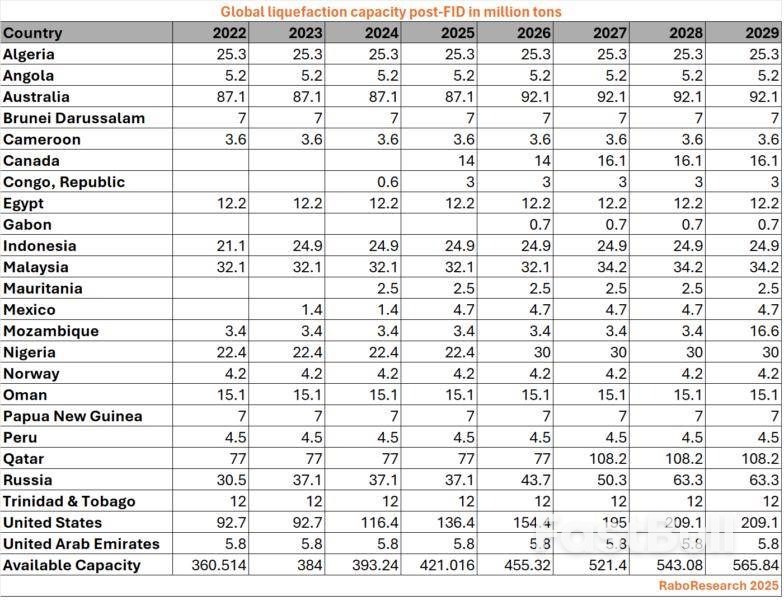
          Thomson ReutersGlobal liquefaction capacity post-FID in million tons

          The U.S. is already supplying over 50% of the EU's LNG and the share may rise to as much as 70%, according to Energy Aspects.

          Qatar is expected to add around 31 mtpa, thanks to its North Field expansion while Canada and Nigeria will also have new projects.

          "All in all, ... halting Russian LNG imports in Europe should have minimum impact on gas prices," said Anne-Sophie Corbeau, a scholar at the Columbia University Center on Global Energy Policy.

          The EU LNG ban will not reduce overall Russian supply in the market, but rather reshape global trade flows as cargoes will likely shift to Asia, said Arturo Regalado of Kpler.

          Russia is expected to add nearly 20 mtpa from its Arctic LNG 2 project to its existing capacity of nearly 33 mtpa.

          Prices in Europe and Asia could rise, though, if Russia is unable to sell significant volumes of LNG in Asia due to a combination of sanctions and unwillingness of Asian buyers to import it, Corbeau said.

          Source: TradingView

          To stay updated on all economic events of today, please check out our Economic calendar
          Risk Warnings and Disclaimers
          You understand and acknowledge that there is a high degree of risk involved in trading. Following any strategies or investment methods may lead to potential losses. The content on the site is provided by our contributors and analysts for information purposes only. You are solely responsible for determining whether any trading assets, securities, strategy, or any other product is suitable for investing based on your own investment objectives and financial situation.
          Add to Favorites
          Share

          Ethereum Triple Bottom Setup Hints At A $4K Breakout Next

          Olivia Brooks

          Cryptocurrency

          Key takeaways:

          ●Ethereum's triple bottom pattern near $3,750–$3,800 hints at a potential 10% rebound in October.

          ●Mega whales (10,000–100,000 ETH) are quietly accumulating, absorbing supply from smaller holders during the recent price decline.

          Ethereum's native token, Ether (ETH), is hinting at a textbook bearish reversal setup after dropping 6.50% so far in October.

          Triple bottom rekindles ETH's $4,000 potential

          As of Thursday, Ether's 4-hour chart shows a triple bottom, a setup that forms when prices hit the same support level three times and fail to break lower each time.

          For ETH, that support sits around $3,750–$3,800, where buyers have consistently stepped in to defend the price. Each "bottom" shows sellers losing strength, while buyers quietly build momentum.
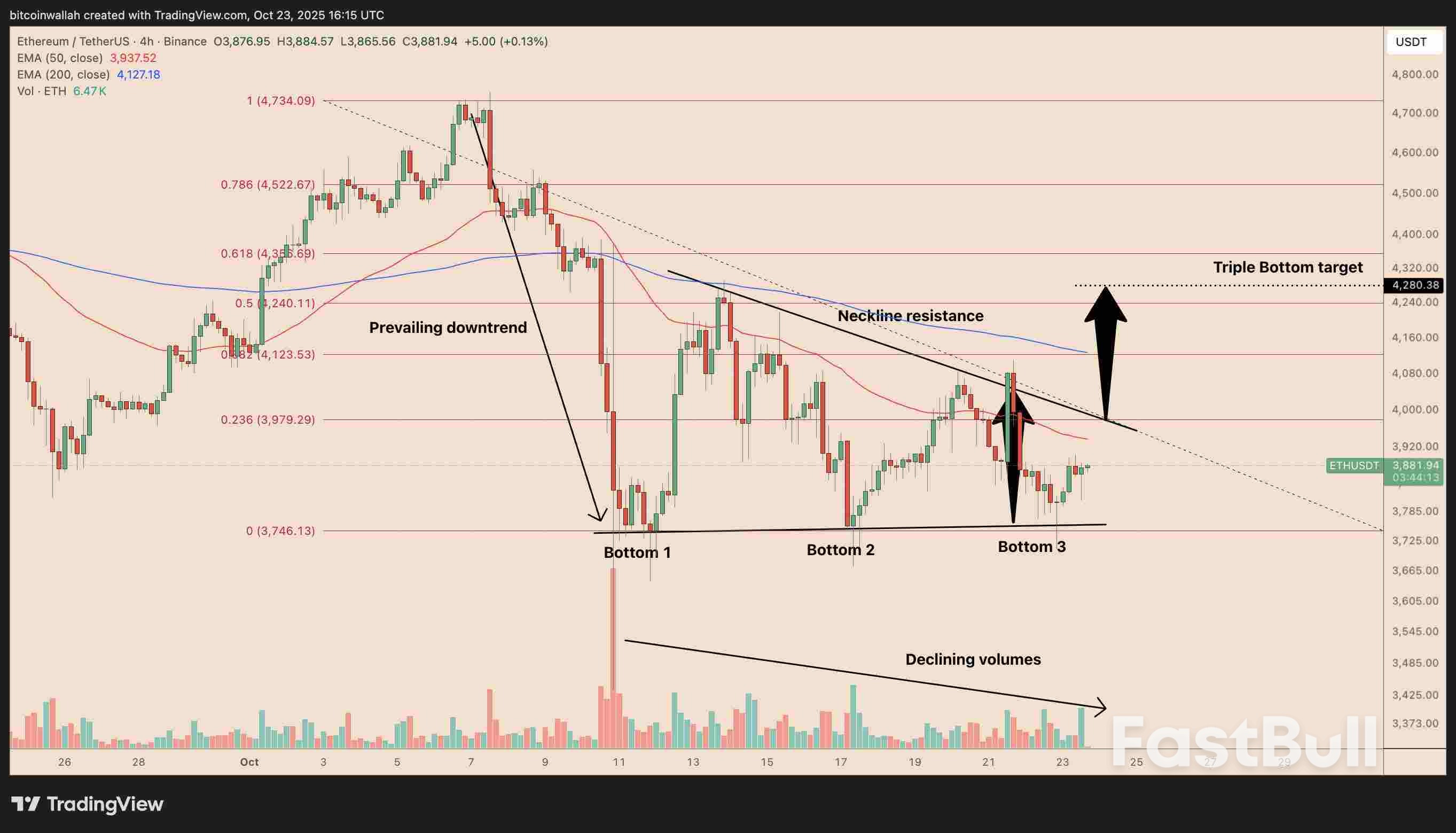
          ETH/USDT four-hour chart. Source: TradingView

          Now, Ethereum faces a key hurdle at its neckline resistance near $3,950–$4,000. This area also aligns with the 50-period exponential moving average (50-period EMA, represented by the red wave).

          The triple bottom pattern would confirm if Ethereum breaks decisively above the neckline. Doing so may enable ETH to rise toward its potential price target of around $4,280, a 10% increase from current levels, by October or early November.

          Trading volumes have been slowly declining during the pattern's formation, which is typical before a breakout. A noticeable spike in buying volume alongside the breakout will confirm the triple bottom setup.

          The bullish reversal setup aligns with trader Kamran Asghar's analysis, although he presents the $4,800-$ 5,000 area as the main resistance area.
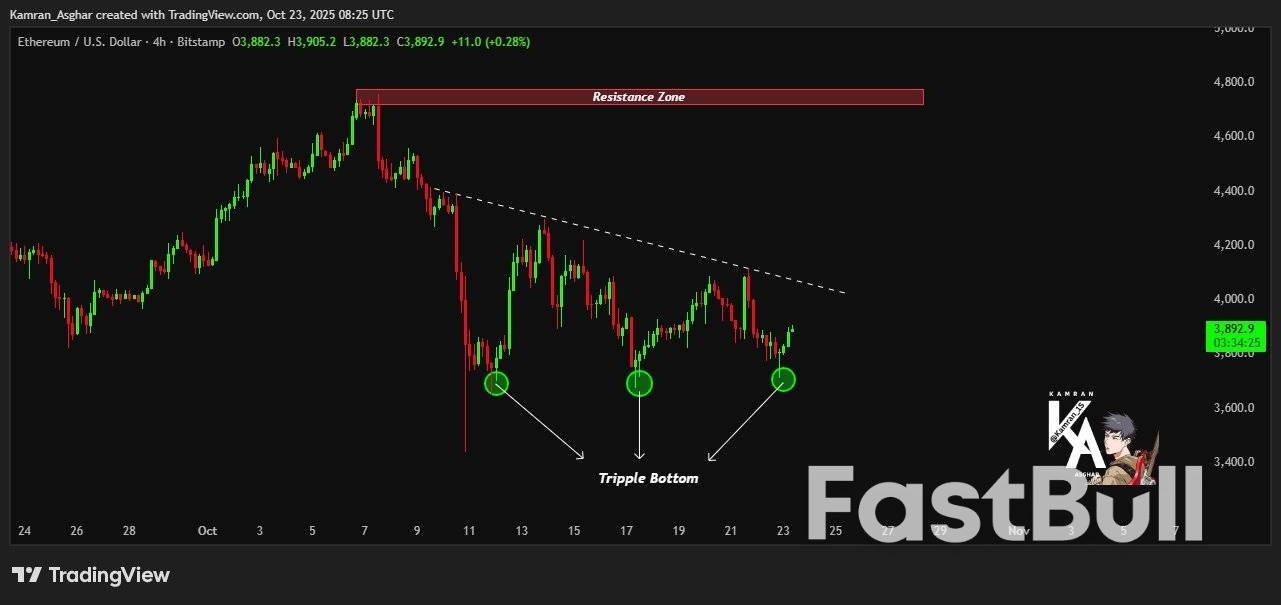
          ETH/USD four-hour chart. Source: X

          Mega-whales absorb ETH from smaller fish

          Onchain data from Glassnode shows a significant reshuffle in Ethereum's ownership during the recent price decline.

          Large wallets holding 10,000–100,000 ETH, often called "mega whales," have been quietly accumulating at the fastest pace in years, now controlling close to 28 million ETH.

          ETH supply held by addresses with 1K-100K balance. Source: Glassnode

          At the same time, smaller whales with 1,000–10,000 ETH saw their balances drop sharply, especially in the past month during Ether's price correction.

          This suggests that as prices fell, some mid-sized holders either sold into the dip, with their coins being absorbed by larger investors, or bought more ETH, pushing themselves into the bigger cohort.

          Source: COINTELEGRAPH

          Risk Warnings and Disclaimers
          You understand and acknowledge that there is a high degree of risk involved in trading. Following any strategies or investment methods may lead to potential losses. The content on the site is provided by our contributors and analysts for information purposes only. You are solely responsible for determining whether any trading assets, securities, strategy, or any other product is suitable for investing based on your own investment objectives and financial situation.
          Add to Favorites
          Share

          Trump Hopes For 'Deal On Everything' In China Talks

          Devin

          Economic

          President Donald Trump expressed optimism on Wednesday about securing deals with Chinese leader Xi Jinping on issues ranging from soybeans to rare earths and limiting nuclear weapons during scheduled talks next week in South Korea.

          "I think we'll make a deal," Trump told reporters gathered in the Oval Office for a visit by NATO Secretary General Mark Rutte.

          "We'll make a deal on, I think, everything."

          "We'll have a pretty long meeting scheduled," Trump said.

          "We can work out a lot of our questions and our doubts and our tremendous assets together. So we look forward to that."
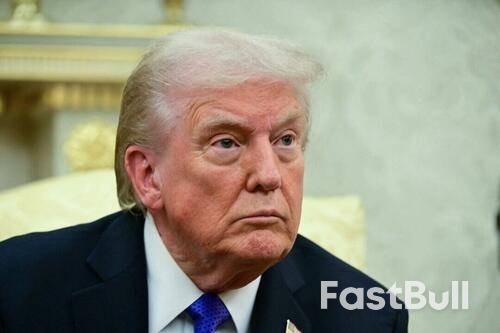
          Trump said he believes Xi now wants to end the war in Ukraine, and that the Chinese leader would be receptive to such a discussion.

          "Because of Biden and Obama, they got forced together," Trump said of China and Russia.

          "They should never have been forced together but by nature, they can't be friendly. I hope they are friendly frankly but they can't be.

          "Biden did that and Obama did that. They forced them together because of energy, because of oil," Trump said, noting that was one of the issues he planned to discuss with Xi.

          "I think I'll probably be talking about it. What I'll really be talking to him about is how do we end the war with Russia and Ukraine, whether it's through oil or energy or anything else. And I think he's going to be very receptive."

          The U.S. president also said he expected to discuss with Beijing many other issues, from China resuming U.S. soybean purchases to including China on talks with Russia to limit nuclear weapons.

          He noted that Russian President Vladimir Putin had raised the prospect of a bilateral de-escalation of nuclear weapons, and China could be added to that effort.

          On rare earths, Trump said he wasn't too concerned about China's recent announcement of export controls on nearly all rare earth, calling it "a disturbance" to which he responded with additional tariffs of 100 percent.

          Those are not due to take effect until Nov. 1 if an agreement can't be reached.

          Trump has sent conflicting messages about the Xi meeting in recent days, telling reporters on Tuesday that it might not happen. This comes amid reports of a power struggle between Xi and other factions within the Chinese Communist Party leadership structure and the Chinese military.

          Asia Tour

          U.S. Treasury Secretary Scott Bessent and U.S. Trade Representative Jamieson Greer traveled ahead of Trump on Wednesday, with their first stop in Malaysia to meet with Chinese officials over tensions regarding the rare earth export bans. Earlier in the month, Trump also responded with threats to bar "critical software" exports to China.

          "This is China versus the globe. It's not just on the U.S.," Bessent told Fox Business Network's "Kudlow" program. "This licensing regime that they've proposed is unworkable and unacceptable," he said of China's rare earth threats.

          He said the United States and its Western allies were contemplating how to respond if they were unable to negotiate a pause in Beijing's plans or some other relief, but gave no details.

          "I'm hoping that we can get this ironed out this weekend so that the leaders can enter their talks on a more positive note," he said.

          Trump is scheduled to travel to Kuala Lumpur for a meeting of the Association of Southeast Asian Nations (ASEAN) that begins on Sunday, before making a stop in Japan to meet with their new prime minister, Sanae Takaichi.

          He will then travel to South Korea ahead of a leaders' summit of the Asia-Pacific Economic Cooperation (APEC) forum that is being held Oct. 31-Nov. 1 in Gyeongju.

          Greer and Bessent have both stressed they do not want to decouple from China or escalate the situation, but insist the United States needs to rebalance trade with China after decades of very limited access to Chinese markets.

          Greer told CNBC's "Squawk Box" that China still has unfulfilled obligations to buy U.S. agricultural and manufactured goods under a trade deal signed during Trump's first term as president.

          "The U.S. has always been quite open to the Chinese, and it's really been driven by Chinese policies that exclude U.S. companies and drive overcapacity and overproduction in China. None of that works for the United States," he said. "We can't live that way anymore, so we need an alternative path."
          Source: Zero Hedge

          To stay updated on all economic events of today, please check out our Economic calendar
          Risk Warnings and Disclaimers
          You understand and acknowledge that there is a high degree of risk involved in trading. Following any strategies or investment methods may lead to potential losses. The content on the site is provided by our contributors and analysts for information purposes only. You are solely responsible for determining whether any trading assets, securities, strategy, or any other product is suitable for investing based on your own investment objectives and financial situation.
          Add to Favorites
          Share

          Europe Faces an Economic Reality Check on Its Climate Agenda

          Adam

          Economic

          Europe is at a crossroads on climate. The road to net zero still stretches ahead, but the journey is getting tougher as countries warn their economies can’t absorb the rising costs of meeting emissions targets.
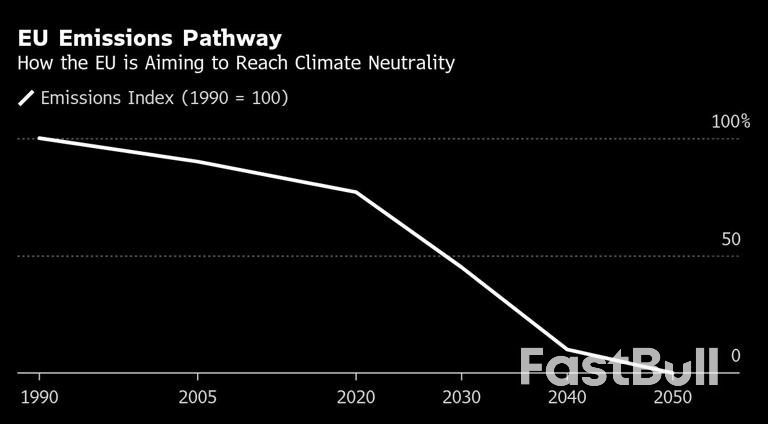
          EU leaders arrive in Brussels on Thursday divided over how fast and how far to push the green transition. A key flashpoint is the European Commission’s plan to cut emissions 90% by 2040 from 1990 levels. Leaders are unlikely to agree to a specific target at the summit, instead focusing on "enabling conditions" aimed at shielding businesses and consumers from higher bills that could spark voter backlash.
          “It all boils down to the impact of climate measures on the economy,” said Huan Chang, an analyst at BloombergNEF. “There’s a concern that the cost of emissions-reduction regulations could fuel inflation alongside high energy costs that have already been hurting the EU’s industrial competitiveness.”
          Brussels faces an uncomfortable reality: Europe’s energy transition risks undermining its economic one. With the US and China powering ahead thanks to cheaper energy and heavy state support, European industries are losing ground. The bloc’s higher costs threaten to hollow out its industrial base — even as it leads the world in climate ambition.
          Europe Faces an Economic Reality Check on Its Climate Agenda_1

          EU Emissions Pathway | How the EU is Aiming to Reach Climate Neutrality

          The challenge on Thursday will be finding common ground among countries with unequal energy resources, wealth, and industrial muscle. It’s becoming clear that climate is slipping down the list of priorities as governments seek to ramp up defense spending and avoid trade conflicts.
          Even if the EU sticks with its overall climate target, member states will want to make sure their national interests are protected.
          “It reflects that Europe is facing so many challenges on so many fronts that some are afraid if we move too far ahead on climate, if we’re too ambitious, we won’t be able to handle it economically,” said Mette Frederiksen, Prime Minister of Denmark, which holds the EU’s rotating presidency. “It’s a shame.”
          Senior EU diplomats speaking on the condition of anonymity said that conclusions drafted before the summit struck a delicate balance between ambitious countries and more skeptical nations, but cautioned that it could all unravel once leaders enter the room. The proposed wording on a revision to the EU’s emissions trading system that covers buildings and road transport is seen as particularly fragile.

          Fragmented approach

          At the heart of EU climate policy is the carbon market — the first major cap-and-trade program globally — which imposes limits on polluters that get tighter over time. The system’s remaining allowances are due to vanish over the next 15 years, raising concerns that industry won’t be ready.
          Germany, Europe’s biggest economy, has signaled it will fight for better protection of its ailing energy-intensive industry. Chancellor Friedrich Merz is set to call for a slower pace of reductions in the Emissions Trading System in the next decade, a change that would give the industry more time to decarbonize while still meeting targets.
          German firms chemical firms including BASF SE and ammonia producer SKW Stickstoffwerke Piesteritz GmbH also want additional tweaks to the carbon market to prevent a steep increase in costs. They want to continue receiving free allowances for longer.
          "We need decarbonization, but decarbonization must never mean deindustrialization,” Germany’s finance minister and Merz’s coalition partner, Lars Klingbeil said on Oct. 22. “We can only achieve decarbonization with a strong industry."
          France too is looking for more protections for its industry through trade measures. Paris wants the EU to tighten the bloc's carbon border levy, as well as shield European steel makers from competition from abroad before it will back the 2040 target. While Finland and Sweden are calling for a revision of rules on forestry.

          Energy costs and bills

          The EU is making good progress, boosting the share of renewable energy to 24.5% in 2023, a tripling from 2004 levels, according to the latest official data published in December.
          Wholesale energy prices have eased from record highs in 2022 after Russia invaded Ukraine and curbed gas supplies to Europe. But costs for industry are still much higher — last year electricity prices in the EU were more than twice those in China and the US, according to calculations by lobby group BusinessEurope.
          "We literally need to hang onto their coattails," said David King, Founder and Chair of the Climate Crisis Advisory Group, talking about how to stay competitive with China. “This is a matter of future proofing Europe along with the rest of the world."
          Thursday’s meeting will test whether leaders can find a way to ease the cost burden of the green transition for companies and consumers while keeping climate ambition intact.

          Harder From Here

          The next phase of cutting emissions is going to be more difficult as deployment of new technologies, such as carbon capture and storage or hydrogen, is costly and slow.
          “The lowest-hanging fruit has already been picked when it comes to reducing emissions and moving to cleaner energy sources,” said Linda Kalcher, executive director of the Strategic Perspective think tank. “European power generators have walked away from coal and are increasingly relying on renewables. That means that in the next decades, we will need to deploy more complex solutions.”
          The ETS2, will be a second EU carbon market, putting a price on emissions from buildings and road transport. Many politicians fear that an additional levy at the petrol pump could turn citizens against the green transition and leaders are set to clash on the planned rollout on Thursday.
          Commission President Ursula von der Leyen pledged earlier this week to adjust the cap-and-trade system to ease concerns among member states that a spike in carbon prices could spark public backlash similar to France’s Yellow Vest protests in 2018.
          The proposed tweaks — including stronger price controls — may calm some governments, but others, led by Poland, Hungary and Cyprus, are demanding more drastic steps, such as delaying ETS2’s launch, currently scheduled for 2027.
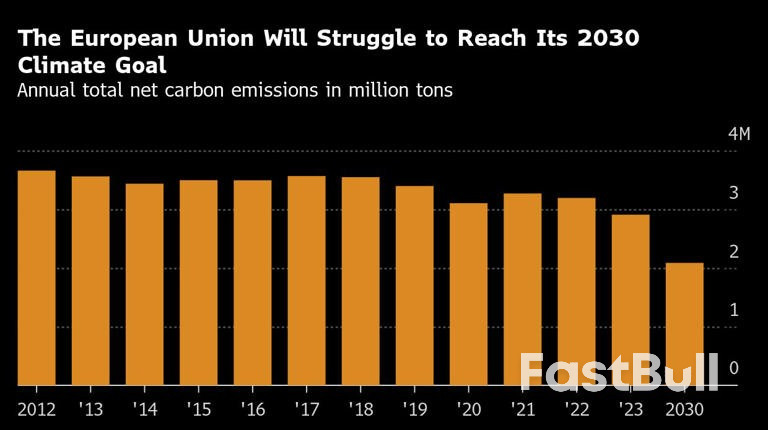
          The European Central Bank estimates that the scheme, if implemented as designed, could add as much as 0.4 percentage points to euro-area inflation in 2027. Goldman Sachs economist Katya Vashkinskaya projects a similar effect, forecasting a 0.2 percentage-point boost — the midpoint of the ECB’s range.
          Europe Faces an Economic Reality Check on Its Climate Agenda_2

          The European Union Will Struggle to Reach Its 2030 Climate Goal | Annual total net carbon emissions in million tons

          Out There Alone

          Europe’s push on climate action is being called into question. President Donald Trump’s second withdrawal from the Paris Agreement and his administration’s efforts to derail climate diplomacy — including a recent move to block a shipping emissions levy at the International Maritime Organization — have shaken faith in international cooperation.
          Climate experts are warning that it could spell trouble for the COP30 climate negotiations in Belem, Brazil next month and give opponents of Europe’s ambitious climate policies ammunition to lobby against fast emissions cuts at home.
          “The global environment is not conducive,” said Jos Delbeke, professor at the European University Institute in Florence and former top climate official at the commission. “We’re losing the US — Trump is slowing down investment in renewables at home and delaying progress internationally. And at the same time the EU needs to find an effective strategy to stave off the competition from China in clean technologies. ‘’

          What’s next

          Summit discussions among EU leaders are typically reserved for the most divisive issues, with outcomes adopted unanimously — a process that demands compromises from all sides. While leaders don’t sign off on draft laws, they set the political direction for ministers to follow on climate policy.
          The political statement from the summit is expected to clear the way for environment ministers to work toward a common position on the 2040 climate goal. Endorsing the 90% emissions-cut target would require qualified-majority support, a lower bar than unanimity.
          Still, diplomats are split on whether a deal can be reached at the extraordinary environment council in Brussels on Nov. 4. Member states remain divided over how — and how quickly — to push the green transition across sectors such as agriculture, transport and industry.
          “The goals are good ones, but we really need to assess whether we have all the tools,'' said Evika Silina, prime minister of Latvia. “We cannot afford to lose Europe's competitiveness.”

          Source: Bloomberg

          To stay updated on all economic events of today, please check out our Economic calendar
          Risk Warnings and Disclaimers
          You understand and acknowledge that there is a high degree of risk involved in trading. Following any strategies or investment methods may lead to potential losses. The content on the site is provided by our contributors and analysts for information purposes only. You are solely responsible for determining whether any trading assets, securities, strategy, or any other product is suitable for investing based on your own investment objectives and financial situation.
          Add to Favorites
          Share

          Trump Pardons Binance's Zhao: Crypto Market Reacts

          Thomas

          Cryptocurrency

          President Donald Trump issued a pardon to Changpeng Zhao, Binance's founder, signaling a pivotal change in the U.S. government's crypto leadership stance. The pardon was announced on October 2024.

          This pardon removes legal uncertainties, boosting market confidence, as shown by Binance Coin's spike, implying potential easing of regulatory constraints on the cryptocurrency industry.

          Changpeng "CZ" Zhao, founder of Binance, received a pardon from President Donald Trump. This unexpected move marks a significant shift in U.S. policy toward crypto sector leaders, signaling potential changes in industry regulations.

          Zhao, the former CEO of Binance, was pardoned for violations of the Banking Secrecy Act. Despite completing a federal sentence, he remains Binance's largest shareholder. The White House emphasized this decision as the end of hostile crypto regulations.

          Financial markets quickly reacted to the pardon, with Binance Coin (BNB) experiencing a notable price surge. Karoline Leavitt, Press Secretary, White House, "President Trump had pardoned Zhao 'using his constitutional authority.' [...] The Biden administration's war on crypto is over." Industry sentiment leaned toward positivity, anticipating improved regulatory stances and increased market activity.

          Binance and its assets, such as BNB and BTC, saw heightened trading volumes. The pardon suggests potential political support for the crypto industry, potentially encouraging broader market adoption and institutional investments.

          Market participants are optimistic about the future of crypto regulation. Bitcoin and other leading cryptocurrencies exhibited positive price movements, potentially foreseeing a favorable regulatory environment.

          Insights on future financial, regulatory, or technological outcomes are cautiously optimistic. The crypto community anticipates clarity on regulations, which could bolster further investment and technological advancement in the cryptocurrency sector. Changpeng "CZ" Zhao, Founder, Binance, "Thank you Charles. Great news if true. Minor correction, there were no 'fraud' charges. I believe they (the DOJ under the last administration) looked very hard for it, but didn't find any. I pleaded to a single violation of Banking Secrecy Act (BSA)."
          Source: CryptoSlate

          Risk Warnings and Disclaimers
          You understand and acknowledge that there is a high degree of risk involved in trading. Following any strategies or investment methods may lead to potential losses. The content on the site is provided by our contributors and analysts for information purposes only. You are solely responsible for determining whether any trading assets, securities, strategy, or any other product is suitable for investing based on your own investment objectives and financial situation.
          Add to Favorites
          Share

          Has bitcoin already peaked, or is one last surge ahead?

          Adam

          Cryptocurrency

          The price journey of bitcoin has long followed a four-year rhythm tied to its halving events. Historically, BTC starts appreciating roughly a year before each halving, driven by the anticipation that supply scarcity will boost its value. About eighteen months later, it typically reaches a new all-time high before entering a sharp six-month correction, followed by a year-long bear market. This is a broad pattern with variations, yet since bitcoin’s inception in 2009, the sequence has repeated with striking regularity.
          With the last halving taking place in April 2023, the current cycle suggests that a new peak should arrive around October–November 2025. However, an increasing number of analysts are questioning whether Bitcoin still has one last leg up — or if the previous high of $126,300 on October 6 already marked the top, setting the stage for the next downturn.

          One last push for bitcoin

          Several arguments still favor one more significant leg higher before this cycle ends.
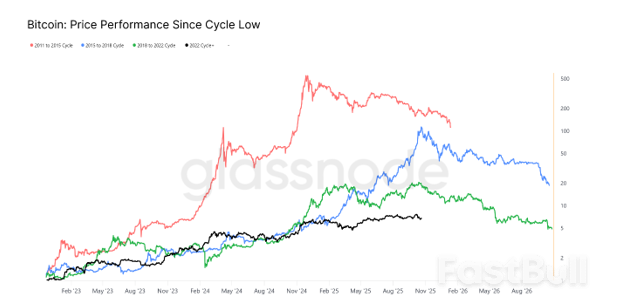
          One of the most important — at least psychologically — is Bitcoin’s underwhelming performance compared with past cycles. Since the last cycle low of $15,450 in November 2022, BTC has gained “only” 660%. At this point in previous cycles, the asset had rallied 1,980% and 9,645% respectively. The slowdown is perfectly natural for a maturing asset, yet it leaves many investors feeling that this cycle remains unfinished.
          Has bitcoin already peaked, or is one last surge ahead?_1
          Market expectations reinforce that view. Numerous analysts, consulting firms and even major banks have projected Bitcoin reaching between $180,000 and $250,000 by the end of 2025 — a target still anchored in collective memory.
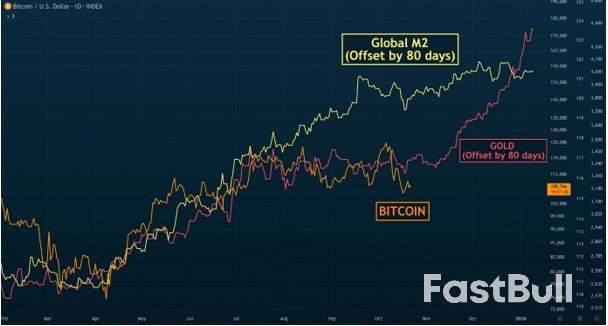
          Gold’s recent behavior also adds weight to the bullish case. As analyst Colin Talks Crypto noted, over the past months, gold has surged to catch up with global M2, while Bitcoin has lagged behind. Historically, , BTC tends to follow gold’s moves with a delay, which could indicate that it could close the gap with gold any time soon.
          Has bitcoin already peaked, or is one last surge ahead?_2
          Timing also supports the possibility of one last rally. Historically, Bitcoin bull runs often accelerate during their final months. Though this cycle’s structure may differ from previous ones, a final surge remains plausible — especially if macro conditions improve.

          Is the top already in?

          Yet there are several red flags indicating that the bull market may in fact be ending.
          Veteran trader Peter Brandt warned that Bitcoin was tracing a “broadening top” — a pattern famous for marking cycle peaks. He compared the current setup to the 1970 soybean bubble, which declined 50% after completing a similar formation.
          Fund flows are already turning negative. According to Coinshares, bitcoin ETFs recorded $946 million in outflows last week, ending a two-week inflow streak. Persistent outflows often signal fading confidence among professional investors.
          Macro risks loom larger for bitcoin, too. Famous analyst Willy Woo argues unlike previous halving-driven bear markets, the next downturn will be defined by another cycle people forget about — the business cycle. He notes: “We had two 4-year cycles superimposed. Now it’s only one: global M2 liquidity.” Woo points out that the last major business-cycle contractions — in 2001 and 2008 — occurred before Bitcoin existed. If global liquidity tightens or recession pressure builds, BTC could behave more like a high-beta risk asset than a store of value.

          A cycle in its final act

          Bitcoin’s current cycle now stands at a crossroads. Either it mounts one last rally toward higher highs before rolling over — or October’s $126,300 peak was the top, ushering in a drawn-out distribution and decline.
          The next 2–5 weeks could prove decisive. A convincing break above $116,000, renewed ETF inflows, or a macro surprise — such as a major rate cut or an easing of U.S.–China trade tensions — could spark the final thrust higher. Conversely, failure to hold $107,000, continued ETF outflows, or worsening macro sentiment could confirm that the cycle’s climax has already passed.
          Whether the bull market ends in euphoria or quiet exhaustion, this phase marks the closing act of Bitcoin’s four-year rhythm — and the opening scene of whatever comes next.

          Source: marketscreener

          Risk Warnings and Disclaimers
          You understand and acknowledge that there is a high degree of risk involved in trading. Following any strategies or investment methods may lead to potential losses. The content on the site is provided by our contributors and analysts for information purposes only. You are solely responsible for determining whether any trading assets, securities, strategy, or any other product is suitable for investing based on your own investment objectives and financial situation.
          Add to Favorites
          Share

          America's Sixth Default Is Coming - What It Means For Gold And Your Wealth

          Samantha Luan

          Forex

          Political

          Economic

          Every time the US government has faced an existential financial crisis in its history, it has chosen to change the rules rather than honor its promises in full... usually by replacing gold or silver with paper.
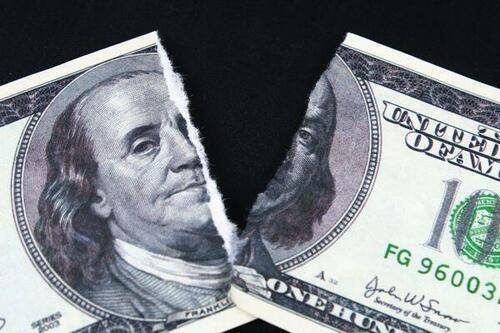
          From the War of 1812 when interest payments were missed, to the Lincoln's Greenbacks, to Roosevelt voiding gold clauses in 1933, the end of silver redemption in 1968, and Nixon closing the gold window in 1971, Washington has defaulted five times before—often by shifting the terms of payment rather than admitting outright failure.There's no doubt these episodes were defaults. To claim otherwise would be like trying to unilaterally change the terms of your dollar-denominated mortgage or credit card bill so that you could pay your liabilities with Argentine pesos or Zimbabwe dollars—and then pretending that somehow it wasn't a default.

          The US government is essentially telling its creditors the same thing Darth Vader once said: "I am altering the deal. Pray I don't alter it any further."Just like in Star Wars, the message is clear—Washington will change the rules whenever it needs to. Creditors may get paid, but not in the way they were promised, and certainly not in the way they expected.Today, the US government is once again in an existential financial bind. The national debt is unmanageable, federal spending is locked on an upward path, and interest on that debt has already surged past $1 trillion a year. At this pace, interest could soon overtake Social Security as the single largest item in the federal budget.
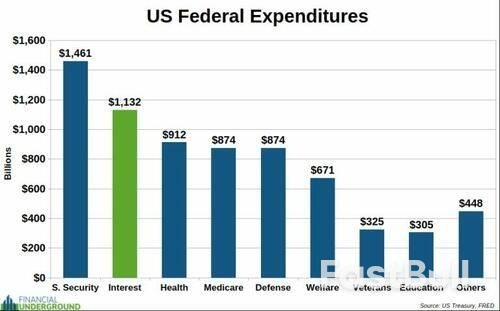
          The largest expenditures are entitlements like Social Security and Medicare. No politician will cut them—in fact, they'll keep growing. Tens of millions of Baby Boomers, nearly a quarter of the population, are moving into retirement. Cutting benefits is political suicide.Defense spending, already massive, is also off-limits. With the most precarious geopolitical environment since World War 2, military spending isn't going down—it's going up.

          Welfare programs are similarly untouchable.

          The only way to meaningfully reduce spending would be to slash entitlements, dismantle the welfare state, shut down hundreds of foreign military bases, and repay a large portion of the national debt to lower the interest cost. That would require a leader willing to restore a limited Constitutional Republic.However, that's a completely unrealistic fantasy. It would be foolish to bet on that happening.Here's the bottom line: Washington cannot even slow the spending growth rate, let alone cut it.Expenditures have nowhere to go but up—way up.

          Tax revenue won't save the day either.

          Even if tax rates went to 100%, it would not be enough to stop the debt from growing.According to Forbes, there are around 806 billionaires in the US with a combined net worth of about $5.8 trillion.Even if Washington confiscated 100% of billionaire wealth, it would barely fund a single year of spending—and it wouldn't do a thing to stop the unstoppable trajectory of debt and deficits.That means interest expense will keep exploding. It has already surpassed the defense budget and is on track to exceed Social Security soon. At that point, interest could consume most federal tax revenue.The old accounting tricks and fiat games won't hide the reality for much longer.

          In short, the skyrocketing interest bill is now an urgent threat to the US government's solvency. I have no doubt Washington will soon find itself unable to meet its obligations once again.

          So the question now is: what will the sixth default look like?

          I don't think the sixth default will be a dramatic, one-day event like in 1933 or 1971. It will be a slow-motion process: steady debasement of the dollar to cover a debt burden that cannot be serviced honestly. And just like in the past, Washington and its lackeys in the media will never admit it's a default.Unlike the past, the US no longer has obligations tied to gold or silver. Everything is denominated in fiat currency that the Federal Reserve can create without limit.The mechanics are different, but the outcome will be the same: creditors will get stiffed with money worth far less than what was promised.

          After the 1971 default, which cut the dollar's last tie to gold, the unspoken promise was that Washington would be a responsible steward of its fiat currency.At the core of that promise was the illusion that the Federal Reserve would act independently of political pressures. The idea was simple: without at least the appearance of independence, investors would see the Fed for what it is—a funding arm for spendthrift politicians—and confidence in the dollar would collapse.

          That illusion is now shattering.

          The government must issue ever-growing amounts of debt while keeping rates low to contain exploding interest costs.

          That's where the Federal Reserve comes in.

          Backed into a corner, Washington will force the Fed to slash rates, buy Treasuries, and launch wave after wave of monetary easing. These measures will debase the dollar while destroying the illusion of Fed independence.That's why I believe the collapse of the Fed's credibility as an independent institution will define the sixth default.

          One of the clearest signs is Trump's push to consolidate power over the Fed.

          Let's be clear: central banks were never "independent." They exist to siphon wealth from the public through inflation and funnel it to the politically connected. The Fed's independence was always a mirage—and now it's disappearing fast.Trump is simply doing what any leader in his position would do. No one believes China's central bank is independent of Xi. If any nation faced a similar crisis, its central bank would fall in line with government demands.I expect Trump will get his way with the Fed. The Fed will bend to his demands, debasing the dollar to keep the debt burden from spiraling out of control. He will either force Powell to get in line or replace him outright, stacking the Fed with loyalists. The result will be money printing on a scale we've never seen before.

          Trump's efforts are already starting to work. At Jackson Hole, Powell admitted that "the shifting balance of risks may warrant adjusting our policy stance," signaling that rate cuts could come soon.And that's exactly what happened. On September 17, the Fed cut rates by 25bps and indicated more to come.Further, Stephen Miran, Trump's most recent successful nominee to the Federal Reserve Board, has been pushing the idea of what he calls the Fed's "third mandate."

          Traditionally, the Fed has two mandates: price stability and maximum employment. Miran's proposed third mandate would be for the Fed to "moderate long-term interest rates."What that really means is that the Fed would openly finance the federal government by creating new dollars to buy long-term debt, keeping yields artificially low. In other words, the so-called third mandate is an explicit admission that the Fed is no longer independent. It would become a political tool used to fund government spending.

          Without this support, massive federal spending would flood the market with Treasuries, pushing interest rates much higher. But with the Fed stepping in, Washington can keep borrowing while holding rates down—at least for a while. The catch is that this comes at the cost of debasing the dollar. Eventually, that debasement will force investors to demand higher yields anyway, which only worsens the problem.I believe it's only a matter of time before the Fed fully capitulates, shattering the illusion of independence once and for all.Mike Wilson, CIO at Morgan Stanley, recently made it explicit:"The Fed does have an obligation to help the government fund itself."

          "I'd be nervous if the Fed was totally independent. The Fed needs to help us get out of this deficit problem."

          This is the essence of the sixth default.

          It won't come through missed payments or rewritten contracts. It will come through the collapse of the myth that the Fed is independent. Once monetary policy is fully political, the fallout will be enormous—for the dollar, for Treasuries, and for gold.And it's not happening in isolation. As Washington sinks deeper into debt, the rest of the world sees exactly what's coming. Central banks are moving to protect themselves. I believe they know debasement is inevitable, and they don't intend to be left holding the bag. Their response has been clear: abandon paper promises and move back toward gold.

          In short, the sixth default won't be a headline—it will be a bleed-out.

          When the dollar is quietly debased and the Fed's "independence" finally cracks, it will be too late to reposition.If you've read this far, you already sense the window is closing. Do not wait for confirmation from the evening news.The question now is not if but how this crisis will unfold, and whether you'll be on the losing end of it.

          Source: Zero Hedge

          To stay updated on all economic events of today, please check out our Economic calendar
          Risk Warnings and Disclaimers
          You understand and acknowledge that there is a high degree of risk involved in trading. Following any strategies or investment methods may lead to potential losses. The content on the site is provided by our contributors and analysts for information purposes only. You are solely responsible for determining whether any trading assets, securities, strategy, or any other product is suitable for investing based on your own investment objectives and financial situation.
          Add to Favorites
          Share
          FastBull
          Copyright © 2025 FastBull Ltd

          728 RM B 7/F GEE LOK IND BLDG NO 34 HUNG TO RD KWUN TONG KLN HONG KONG

          TelegramInstagramTwitterfacebooklinkedin
          App Store Google Play Google Play
          Products
          Charts

          Chats

          Q&A with Experts
          Screeners
          Economic Calendar
          Data
          Tools
          Membership
          Features
          Function
          Markets
          Copy Trading
          Latest Signals
          Contests
          News
          Analysis
          24/7
          Columns
          Education
          Company
          Careers
          About Us
          Contact Us
          Advertising
          Help Center
          Feedback
          User Agreement
          Privacy Policy
          Business

          White Label

          Data API

          Web Plug-ins

          Poster Maker

          Affiliate Program

          Risk Disclosure

          The risk of loss in trading financial instruments such as stocks, FX, commodities, futures, bonds, ETFs and crypto can be substantial. You may sustain a total loss of the funds that you deposit with your broker. Therefore, you should carefully consider whether such trading is suitable for you in light of your circumstances and financial resources.

          No decision to invest should be made without thoroughly conducting due diligence by yourself or consulting with your financial advisors. Our web content might not suit you since we don't know your financial conditions and investment needs. Our financial information might have latency or contain inaccuracy, so you should be fully responsible for any of your trading and investment decisions. The company will not be responsible for your capital loss.

          Without getting permission from the website, you are not allowed to copy the website's graphics, texts, or trademarks. Intellectual property rights in the content or data incorporated into this website belong to its providers and exchange merchants.

          Not Logged In

          Log in to access more features

          FastBull Membership

          Not yet

          Purchase

          Become a signal provider
          Help Center
          Customer Service
          Dark Mode
          Price Up/Down Colors

          Log In

          Sign Up

          Position
          Layout
          Fullscreen
          Default to Chart
          The chart page opens by default when you visit fastbull.com
