Markets
News
Analysis
User
24/7
Economic Calendar
Education
Data
- Names
- Latest
- Prev


Signal Accounts for Members
All Signal Accounts
All Contests


Japan Tankan Small Manufacturing Outlook Index (Q4)A:--
F: --
P: --
Japan Tankan Large Non-Manufacturing Outlook Index (Q4)A:--
F: --
P: --
Japan Tankan Large Manufacturing Outlook Index (Q4)A:--
F: --
P: --
Japan Tankan Small Manufacturing Diffusion Index (Q4)A:--
F: --
P: --
Japan Tankan Large Manufacturing Diffusion Index (Q4)A:--
F: --
P: --
Japan Tankan Large-Enterprise Capital Expenditure YoY (Q4)A:--
F: --
P: --
U.K. Rightmove House Price Index YoY (Dec)A:--
F: --
P: --
China, Mainland Industrial Output YoY (YTD) (Nov)A:--
F: --
P: --
China, Mainland Urban Area Unemployment Rate (Nov)A:--
F: --
P: --
Saudi Arabia CPI YoY (Nov)A:--
F: --
P: --
Euro Zone Industrial Output YoY (Oct)A:--
F: --
P: --
Euro Zone Industrial Output MoM (Oct)A:--
F: --
P: --
Canada Existing Home Sales MoM (Nov)A:--
F: --
P: --
Canada National Economic Confidence IndexA:--
F: --
P: --
Canada New Housing Starts (Nov)A:--
F: --
U.S. NY Fed Manufacturing Employment Index (Dec)A:--
F: --
P: --
U.S. NY Fed Manufacturing Index (Dec)A:--
F: --
P: --
Canada Core CPI YoY (Nov)A:--
F: --
P: --
Canada Manufacturing Unfilled Orders MoM (Oct)A:--
F: --
P: --
U.S. NY Fed Manufacturing Prices Received Index (Dec)A:--
F: --
P: --
U.S. NY Fed Manufacturing New Orders Index (Dec)A:--
F: --
P: --
Canada Manufacturing New Orders MoM (Oct)A:--
F: --
P: --
Canada Core CPI MoM (Nov)A:--
F: --
P: --
Canada Trimmed CPI YoY (SA) (Nov)A:--
F: --
P: --
Canada Manufacturing Inventory MoM (Oct)A:--
F: --
P: --
Canada CPI YoY (Nov)A:--
F: --
P: --
Canada CPI MoM (Nov)A:--
F: --
P: --
Canada CPI YoY (SA) (Nov)A:--
F: --
P: --
Canada Core CPI MoM (SA) (Nov)A:--
F: --
P: --
Canada CPI MoM (SA) (Nov)A:--
F: --
P: --
Federal Reserve Board Governor Milan delivered a speech
U.S. NAHB Housing Market Index (Dec)--
F: --
P: --
Australia Composite PMI Prelim (Dec)--
F: --
P: --
Australia Services PMI Prelim (Dec)--
F: --
P: --
Australia Manufacturing PMI Prelim (Dec)--
F: --
P: --
Japan Manufacturing PMI Prelim (SA) (Dec)--
F: --
P: --
U.K. 3-Month ILO Employment Change (Oct)--
F: --
P: --
U.K. Unemployment Claimant Count (Nov)--
F: --
P: --
U.K. Unemployment Rate (Nov)--
F: --
P: --
U.K. 3-Month ILO Unemployment Rate (Oct)--
F: --
P: --
U.K. Average Weekly Earnings (3-Month Average, Including Bonuses) YoY (Oct)--
F: --
P: --
U.K. Average Weekly Earnings (3-Month Average, Excluding Bonuses) YoY (Oct)--
F: --
P: --
France Services PMI Prelim (Dec)--
F: --
P: --
France Composite PMI Prelim (SA) (Dec)--
F: --
P: --
France Manufacturing PMI Prelim (Dec)--
F: --
P: --
Germany Services PMI Prelim (SA) (Dec)--
F: --
P: --
Germany Manufacturing PMI Prelim (SA) (Dec)--
F: --
P: --
Germany Composite PMI Prelim (SA) (Dec)--
F: --
P: --
Euro Zone Composite PMI Prelim (SA) (Dec)--
F: --
P: --
Euro Zone Services PMI Prelim (SA) (Dec)--
F: --
P: --
Euro Zone Manufacturing PMI Prelim (SA) (Dec)--
F: --
P: --
U.K. Services PMI Prelim (Dec)--
F: --
P: --
U.K. Manufacturing PMI Prelim (Dec)--
F: --
P: --
U.K. Composite PMI Prelim (Dec)--
F: --
P: --
Euro Zone ZEW Economic Sentiment Index (Dec)--
F: --
P: --
Germany ZEW Current Conditions Index (Dec)--
F: --
P: --
Germany ZEW Economic Sentiment Index (Dec)--
F: --
P: --
Euro Zone Trade Balance (Not SA) (Oct)--
F: --
P: --
Euro Zone ZEW Current Conditions Index (Dec)--
F: --
P: --
Euro Zone Trade Balance (SA) (Oct)--
F: --
P: --
U.S. Retail Sales MoM (Excl. Automobile) (SA) (Oct)--
F: --
P: --


No matching data
Latest Views
Latest Views
Trending Topics
Top Columnists
Latest Update
White Label
Data API
Web Plug-ins
Affiliate Program
View All

No data
The US dollar fell after Powell’s dovish Jackson Hole speech, with markets pricing an 85% chance of a September cut. Upcoming PCE, GDP, and jobs data will determine whether weakness persists or reverses.
This year’s recommendation for vacation reading is a fascinating exploration of the sources of rising political polarization in the U.S. and how it can be addressed.It is that time of year again, when summer deepens in the northern hemisphere, and many of us can take some time away from the office to recharge and hopefully pick up a good book.Such a break feels particularly important this year as market-moving headlines—from trade policy to geopolitical shocks, from growth concerns to inflation risks—have battered investors with exhausting frequency.
In past summer reading blogs, we have shared works on innovation, courage in the face of crisis, globalization, tech disruption, and reconsidering and improving thinking processes. Given the variety of issues we have contended with this year, many of our previous suggestions would be worth reading for the first time or afresh, but this time we turn to the topic of political polarization.
Underlying much of the volatility this year has been uncertainty on whether we are on the cusp of a regime shift in the role of government in society, often framed in terms of fiscal vs. monetary policy, executive vs. legislative responsibility, and the relationship of the U.S. with its key allies and partners.The heated debates around these important issues are highlighting the increasing polarization of political discourse, a challenge that stalks the U.S. as well as many countries around the world. Indeed, such is the topic’s pervasiveness, we regularly include it in our list of key risks facing market participants, right up there with de-globalization and military conflict.
In our summer reading selection, Love Your Enemies: How Decent People Can Save America from the Culture of Contempt, the Harvard University economist and former head of the American Enterprise Institute, Arthur Brooks, grapples with the sources of rising polarization in the U.S. and how it can be addressed.Driving this division is what Brooks calls the “outrage industrial complex”—cable news, social media and entertainment—which ultimately pits American against American, creating a “culture of contempt”.
Brooks begins his recommendations by explaining that we must first remove contempt from our interactions. If we become contemptuous of people with whom we disagree, we have severely limited our ability to engage in dialogue and gain understanding. He also notes that feeling contempt makes people unhappy, in general.Once we have moved past contempt, Brooks makes a radical proposal: that we aim higher than mere civility or tolerance for those with opposing viewpoints, but rather to be grateful for people who disagree with us. He asserts that engaging with competing ideas leads to the important benefit of being able to refine and deepen our own insights.
This insight echoes a key learning from our 2021 summer read, Think Again, by Adam Grant, who counsels that we should embrace “the joy of being wrong” because having the humility to do so will allow us to challenge our own thinking and make better decisions.
In reflecting on Brooks’ proposed approach, these insights can both be applied to improve political discourse as well as sharpen investment decision-making.
Brooks makes three key recommendations that can be applied here:
A final point from Love Your Enemies that resonates in the current environment is that ideas are like the climate: long-term and immutable, while politics is like the weather, unpredictable and changing all the time. If you can, therefore, try and look past the daily political weather, it should always be possible to have a constructive discussion about important ideas, particularly those impacting the world around us.This framework brought to mind another key learning, this time from our very first summer read, Tolstoy’s War and Peace, which highlighted the importance of humility and of maintaining a long-term perspective.
Humility tells investors to be wary of investment decisions based on apparent certainties, and to diversify. Maintaining a long-term view enables investors to filter out short-term noise and focus instead on the underlying trends that are truly driving markets.In today’s environment, where short-term noise has been particularly cacophonous and elevated uncertainty looks likely to continue, we believe these lessons can be particularly relevant.


U.S. President Donald Trump launched criticism at South Korea on Monday, just hours before a summit with its new President, Lee Jae Myung, as conflict over defense spending and trade tests the two countries' decades-old alliance.
The leaders were gearing up for their first talks when Trump said on social media, without evidence, that there "Seems like a Purge or Revolution" in South Korea and that "We can't have that and do business there."
The remarks cast a dark mood over what, for Lee, are high-stakes talks. He took office in June following a snap election called after his conservative predecessor, Yoon Suk Yeol, feted in Washington for his hard line on North Korea, was removed for his December attempt to impose martial law.
South Korea's economy relies heavily on the U.S., with Washington underwriting its security with troops and nuclear deterrence. Lee hopes to chart a balanced path of cooperation with the U.S., while not antagonizing top trade partner China.
The source of Trump's complaint was not immediately clear. But, for months, supporters of former President Yoon have hoped Trump would intercede in what they say is communist persecution of the impeached ex-president.
Yoon is now on trial on charges of inciting an insurrection. His wife is facing possible indictment on corruption and bribery cases.
South Korea has long come under targeted criticism from Trump, who has called it a "money machine" that takes advantage of American military protection.
South Korea's presidential office told local media they were looking into the matter. The White House did not immediately respond to emailed questions about Trump's post.
China’s financial hub of Shanghai eased home-buying rules in the latest attempt by authorities to contain the nation’s prolonged property crisis.Eligible residents, including those from outside Shanghai, can now buy an unlimited number of homes in the outer suburbs, according to a statement Monday. Non-residents who have paid pensions for three years can now purchase new homes in urban areas, instead of only being allowed to buy existing residences there.
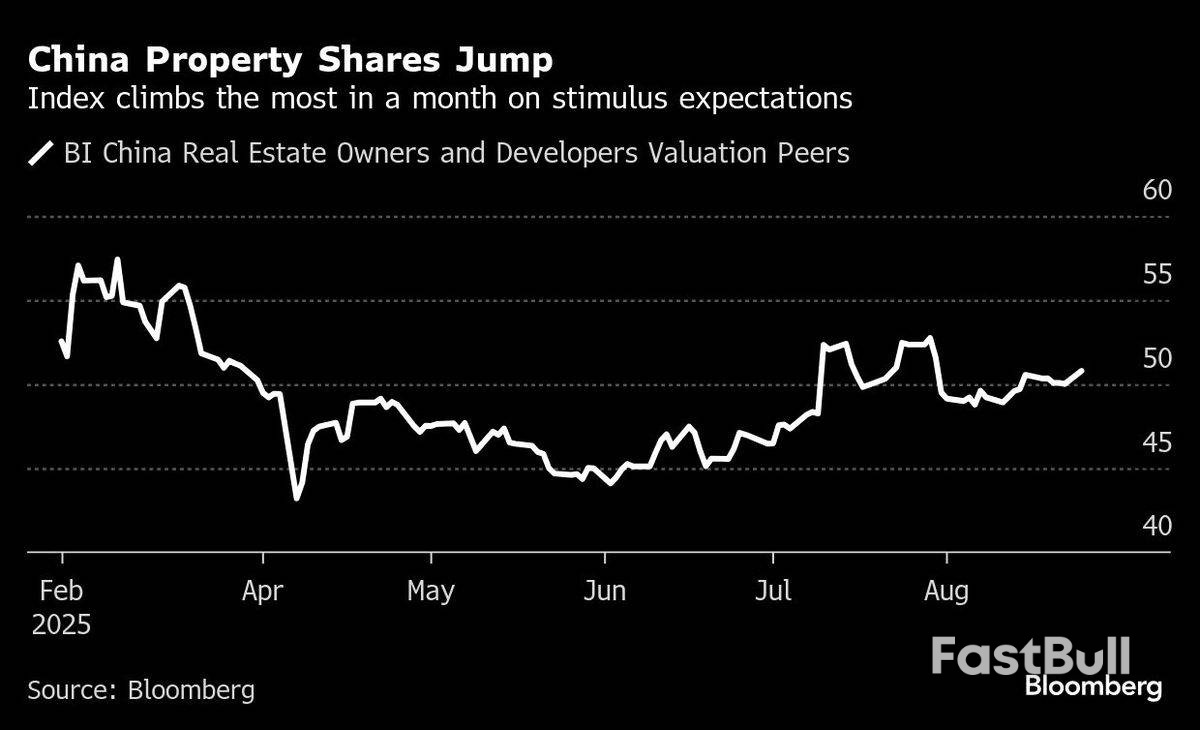
Shares of Chinese developers rallied earlier Monday on speculation that policymakers will unveil more steps to support the housing market. Stimulus measures unveiled last September have done little to arrest the four-year slump, which has dragged on growth in an economy that’s now facing fresh threats from US tariffs.“Shanghai’s easing will definitely be an incremental positive,” said Jeff Zhang, a property analyst with Morningstar Inc. “We estimate property sales in the suburban areas make up more than half of the city’s total.”
Additional measures could come as early as September, with authorities preparing to speed up urban renovation projects to bolster the property market, the Securities Daily reported, citing an industry expert.

A Bloomberg Intelligence gauge of Chinese property shares rose as much as 3%, the biggest intraday move in a month. China Vanke Co jumped as much as 16% — even after it announced a wider first-half loss last Friday. Sunac China Holdings Ltd climbed as much as 13%.Premier Li Qiang last week reiterated the need for action to stop the decline in the real estate market at a meeting of the State Council, or China’s cabinet. The central government flagged broad support during the National People’s Congress in March, when it vowed to “fully unleash” demand from buyers who need homes or seek to improve their housing conditions.
Shanghai’s move follows similar easing by the capital city Beijing in early August, which also allowed eligible residents to buy an unlimited number of homes outside the fifth ring roads, widely considered suburban areas.
The easing is a “targeted” move aimed at lowering Shanghai’s home-buying threshold and reducing inventory in suburban areas, which have about 80% of the city’s unsold homes by units, said Song Hongwei, research director at Tospur Real Estate Consulting Co.The city is also removing the distinction between first and second homes when it comes to mortgage rates, which will likely trim borrowing costs on existing homes by about 40 basis points, said Yan Yuejin, vice president of Shanghai E-house’s research arm. The rule may help to spur demand from homeowners seeking to upgrade to a better property, Yan added.
In other changes, to help lower-income households afford properties, Shanghai increased the amount that can be borrowed for mortgage loans backed by the housing provident fund, China’s government savings programme used to help people buy homes. Quotas for such mortgages, which are 45 basis points cheaper than loans for first homes, will be raised to as much as 2.16 million yuan (US$302,000 or RM1.27 million). Shanghai also allowed residents to withdraw their deposits in the scheme to fund downpayments.
Wall Street's main indexes dipped on Monday, retreating from gains made in the previous session after U.S. Federal Reserve Chair Jerome Powell hinted that an interest-rate cut could be considered at next month's central bank meeting.
Recent economic data suggesting labor market weakness has boosted investor confidence that the central bank could switch to a dovish stance in September, despite a majority of policymakers warning that U.S. tariffs could add to inflationary pressures in the coming months.
The Personal Consumption Expenditures Price index - the Fed's preferred inflation gauge - is due to be released on Friday, while official nonfarm payrolls data is expected next week. The reports will be crucial, especially after Powell said a dovish verdict was not a certainty.
"The most important report between now and September is not the inflation numbers, rather the jobs report," said Thomas Hayes, chairman at Great Hill Capital, New York.
"As long as we show continued cracks in the labor market, the cut in September will happen, barring some egregiously high inflation numbers."
Powell's comments nudged major brokerages to revise their expectations, with Barclays, BNP Paribas and Deutsche Bank currently seeing a 25-basis-point reduction in borrowing costs next month.
Traders now see a 79.6% chance of a Fed rate cut in September, according to data compiled by LSEG.
At 09:56 a.m. ET, the Dow Jones Industrial Average (.DJI), opens new tab fell 117.50 points, or 0.26%, to 45,514.24, the S&P 500 (.SPX), opens new tab lost 13.20 points, or 0.20%, to 6,453.71, and the Nasdaq Composite (.IXIC), opens new tab lost 40.29 points, or 0.18%, to 21,457.09.
Friday's optimism helped the blue-chip Dow close at a record high for the first time since December 2024 and the benchmark S&P 500 log its strongest daily gain since May.
On Monday, Jefferies became the latest brokerage to raise its year-end target for the S&P 500, at a time when companies have tempered tariff-related forecasts.
Ten of the 11 S&P 500 sub-sectors edged lower, with consumer discretionary (.SPLRCD), opens new tab leading losses with a 0.5% drop.
Traders are awaiting AI darling Nvidia's (NVDA.O), opens new tab earnings on Wednesday to see if its $4 trillion valuation is justified.
The potential impact on Nvidia's forecasts from its recent revenue-sharing deal with the U.S. government will be closely watched. The chip major's shares were flat in early trading.
In deals-related moves, beverage company Keurig Dr Pepper (KDP.O), opens new tab slid 8% after saying it would buy JDE Peet's (JDEP.AS), opens new tab for $18.4 billion in cash.
Furniture retailers RH (RH.N), opens new tab and Wayfair (W.N), opens new tab declined about 7% each after U.S. President Donald Trump said on Friday his administration would conduct a tariff investigation on furniture imports.
Intel (INTC.O), opens new tab dipped after Trump said the U.S. government was taking a stake in the chipmaker, which the company said could limit its international sales and future government grants.
Trump also said that he would make more deals similar to the one with Intel.
Remarks from New York Fed President John Williams, later in the day will be scrutinized to see if he shares Powell's policy outlook.
Declining issues outnumbered advancers by a 1.72-to-1 ratio on the NYSE and by a 1.75-to-1 ratio on the Nasdaq.
The S&P 500 posted seven new 52-week highs and no new lows, while the Nasdaq Composite recorded 59 new highs and 13 new lows.
White Label
Data API
Web Plug-ins
Poster Maker
Affiliate Program
The risk of loss in trading financial instruments such as stocks, FX, commodities, futures, bonds, ETFs and crypto can be substantial. You may sustain a total loss of the funds that you deposit with your broker. Therefore, you should carefully consider whether such trading is suitable for you in light of your circumstances and financial resources.
No decision to invest should be made without thoroughly conducting due diligence by yourself or consulting with your financial advisors. Our web content might not suit you since we don't know your financial conditions and investment needs. Our financial information might have latency or contain inaccuracy, so you should be fully responsible for any of your trading and investment decisions. The company will not be responsible for your capital loss.
Without getting permission from the website, you are not allowed to copy the website's graphics, texts, or trademarks. Intellectual property rights in the content or data incorporated into this website belong to its providers and exchange merchants.
Not Logged In
Log in to access more features

FastBull Membership
Not yet
Purchase
Log In
Sign Up