• Trade
  • Markets
  • Copy
  • Contests
  • News
  • 24/7
  • Calendar
  • Q&A
  • Chats
Trending
Screeners
SYMBOL
LAST
BID
ASK
HIGH
LOW
NET CHG.
%CHG.
SPREAD
SPX
S&P 500 Index
6774.75
6774.75
6774.75
6816.12
6758.51
+53.32
+ 0.79%
--
DJI
Dow Jones Industrial Average
47951.84
47951.84
47951.84
48365.93
47849.48
+65.88
+ 0.14%
--
IXIC
NASDAQ Composite Index
23006.35
23006.35
23006.35
23149.61
22906.23
+313.02
+ 1.38%
--
USDX
US Dollar Index
98.130
98.210
98.130
98.170
98.050
+0.070
+ 0.07%
--
EURUSD
Euro / US Dollar
1.17204
1.17212
1.17204
1.17285
1.17097
-0.00029
-0.02%
--
GBPUSD
Pound Sterling / US Dollar
1.33763
1.33772
1.33763
1.33865
1.33696
-0.00040
-0.03%
--
XAUUSD
Gold / US Dollar
4318.43
4318.88
4318.43
4336.82
4309.03
-14.23
-0.33%
--
WTI
Light Sweet Crude Oil
55.882
55.937
55.882
55.932
55.700
+0.114
+ 0.20%
--

Community Accounts

Signal Accounts
--
Profit Accounts
--
Loss Accounts
--
View More

Become a signal provider

Sell trading signals to earn additional income

View More

Guide to Copy Trading

Get started with ease and confidence

View More

Signal Accounts for Members

All Signal Accounts

Best Return
  • Best Return
  • Best P/L
  • Best MDD
Past 1W
  • Past 1W
  • Past 1M
  • Past 1Y

All Contests

  • All
  • Trump Updates
  • Recommend
  • Stocks
  • Cryptocurrencies
  • Central Banks
  • Featured News
Top News Only
Share

Trump Will Speak On The Economy At 9 P.m. Eastern Time On Friday

Share

Malaysia November Exports Rose 7% On Year, Trade Surplus Shrinks Sharply

Share

Malaysia's November Exports +7.0% Versus Reuters Poll +11.2%

Share

Malaysia's November Imports +15.8% Versus Reuters Poll +11.4%

Share

Malaysia's November Exports To China +9.3%, To USA -0.9%

Share

Malaysia's November Trade Surplus At +6.1 Billion Rgt Versus Reuters Poll +17.5 Billion Rgt

Share

India's Nifty Pharma Index Up 1.1%

Share

India's NIFTY IT Index Up 1%

Share

Goldman Sachs: Next Phase Of The Rally Will Be More Volatile. Goldman Sachs Strategists Say That With The Federal Reserve Cutting Interest Rates And Economic Growth Remaining Strong, The Global Economic Cycle May Be Prolonged, Supporting Equities And Emerging Market Assets While Providing Mild Headwinds For The Dollar. They Believe The Next Phase Of The Rally May Be Accompanied By Higher Volatility And A Double Risk: Disappointing Growth On The One Hand, And An Overheated Economy On The Other, Which Could Even Reignite Concerns About Interest Rate Hikes

Share

India's Nifty Bank Futures Up 0.21% In Pre-Open Trade

Share

India's Nifty 50 Futures Up 0.33% In Pre-Open Trade

Share

India's Nifty 50 Index Up 0.37% In Pre-Open Trade

Share

Bank Of Japan: Amendment To "Principal Terms And Conditions Of Complementary Deposit Facility"

Share

Indian Rupee Opens At 90.1325 Per USA Dollar, Up 0.1% From Previous Close

Share

Bank Of Japan: Even After The Interest Rate Change, The Monetary Environment Remains Accommodative And Supports The Economy

Share

Bank Of Japan: Must Be Vigilant To Risks Including Forex Market Developements, Overseas Developments, Corporate Wage, Price-Setting Behaviour

Share

Bank Of Japan: Consumer Inflation Likely To Fall Below 2% Towards First Half Of Next Fiscal Year, Then Rise Thereafter

Share

The USD/JPY Pair Surged Nearly 60 Points In The Short Term, Breaking Through 156, And Rose 0.28% On The Day

Share

Bank Of Japan: Likelihood Of Underlying Inflation Converging Around Bank Of Japan Target In Latter Half Of Bank Of Japan's Three-Year Projection Period Is Heightening

Share

Bank Of Japan Board Member Tamura Opposed Description Regarding The Outlook For Underlying CPI Inflation

TIME
ACT
FCST
PREV
ECB Monetary Policy Statement
Canada Average Weekly Earnings YoY (Oct)

A:--

F: --

P: --
U.S. Core CPI YoY (Not SA) (Nov)

A:--

F: --

P: --

U.S. Weekly Initial Jobless Claims (SA)

A:--

F: --

P: --
U.S. Weekly Continued Jobless Claims (SA)

A:--

F: --

P: --
U.S. CPI YoY (Not SA) (Nov)

A:--

F: --

P: --

U.S. Initial Jobless Claims 4-Week Avg. (SA)

A:--

F: --

P: --
U.S. Philadelphia Fed Business Activity Index (SA) (Dec)

A:--

F: --

P: --

U.S. Philadelphia Fed Manufacturing Employment Index (Dec)

A:--

F: --

P: --

U.S. Core CPI (SA) (Nov)

A:--

F: --

P: --

ECB Press Conference
U.S. EIA Weekly Natural Gas Stocks Change

A:--

F: --

P: --

U.S. Kansas Fed Manufacturing Production Index (Dec)

A:--

F: --

P: --

U.S. Cleveland Fed CPI MoM (Nov)

A:--

F: --

P: --

U.S. Cleveland Fed CPI MoM (SA) (Nov)

A:--

F: --

P: --

U.S. Kansas Fed Manufacturing Composite Index (Dec)

A:--

F: --

P: --

Mexico Policy Interest Rate

A:--

F: --

P: --

Argentina Trade Balance (Nov)

A:--

F: --

P: --

Argentina Unemployment Rate (Q3)

A:--

F: --

P: --

South Korea PPI MoM (Nov)

A:--

F: --

P: --

U.S. Weekly Treasuries Held by Foreign Central Banks

A:--

F: --

P: --

Japan National CPI MoM (Not SA) (Nov)

A:--

F: --

P: --

Japan CPI MoM (Nov)

A:--

F: --

P: --

Japan National Core CPI YoY (Nov)

A:--

F: --

P: --

Japan CPI YoY (Excl. Fresh Food & Energy) (Nov)

A:--

F: --

P: --

Japan National CPI MoM (Excl. Food & Energy) (Nov)

A:--

F: --

P: --

Japan National CPI YoY (Excl. Food & Energy) (Nov)

A:--

F: --

P: --

Japan National CPI YoY (Nov)

A:--

F: --

P: --

Japan National CPI MoM (Nov)

A:--

F: --

P: --

U.K. GfK Consumer Confidence Index (Dec)

A:--

F: --

P: --

Japan Benchmark Interest Rate

A:--

F: --

P: --

BOJ Monetary Policy Statement
Australia Commodity Price YoY

--

F: --

P: --

BOJ Press Conference
Turkey Consumer Confidence Index (Dec)

--

F: --

P: --

U.K. Retail Sales YoY (SA) (Nov)

--

F: --

P: --

U.K. Core Retail Sales YoY (SA) (Nov)

--

F: --

P: --

Germany PPI YoY (Nov)

--

F: --

P: --

Germany PPI MoM (Nov)

--

F: --

P: --

Germany GfK Consumer Confidence Index (SA) (Jan)

--

F: --

P: --

U.K. Retail Sales MoM (SA) (Nov)

--

F: --

P: --

France PPI MoM (Nov)

--

F: --

P: --

Euro Zone Current Account (Not SA) (Oct)

--

F: --

P: --

Euro Zone Current Account (SA) (Oct)

--

F: --

P: --

Russia Key Rate

--

F: --

P: --

U.K. CBI Distributive Trades (Dec)

--

F: --

P: --

U.K. CBI Retail Sales Expectations Index (Dec)

--

F: --

P: --

Brazil Current Account (Nov)

--

F: --

P: --

Canada Retail Sales MoM (SA) (Oct)

--

F: --

P: --

Canada New Housing Price Index MoM (Nov)

--

F: --

P: --

Canada Core Retail Sales MoM (SA) (Oct)

--

F: --

P: --

U.S. Existing Home Sales Annualized MoM (Nov)

--

F: --

P: --

U.S. UMich Consumer Sentiment Index Final (Dec)

--

F: --

P: --

U.S. Dallas Fed PCE Price Index YoY (Oct)

--

F: --

P: --

U.S. Conference Board Employment Trends Index (SA) (Nov)

--

F: --

P: --

Euro Zone Consumer Confidence Index Prelim (Dec)

--

F: --

P: --

U.S. UMich 1-Year-Ahead Inflation Expectations Final (Dec)

--

F: --

P: --

U.S. UMich Consumer Expectations Index Final (Dec)

--

F: --

P: --

U.S. UMich Current Economic Conditions Index Final (Dec)

--

F: --

P: --

U.S. Existing Home Sales Annualized Total (Nov)

--

F: --

P: --

U.S. Weekly Total Rig Count

--

F: --

P: --

Q&A with Experts
    • All
    • Chatrooms
    • Groups
    • Friends
    Connecting
    .
    .
    .
    Type here...
    Add Symbol or Code

      No matching data

      All
      Trump Updates
      Recommend
      Stocks
      Cryptocurrencies
      Central Banks
      Featured News
      • All
      • Russia-Ukraine Conflict
      • Middle East Flashpoint
      • All
      • Russia-Ukraine Conflict
      • Middle East Flashpoint
      Search
      Products

      Charts Free Forever

      Chats Q&A with Experts
      Screeners Economic Calendar Data Tools
      Membership Features
      Data Warehouse Market Trends Institutional Data Policy Rates Macro

      Market Trends

      Market Sentiment Order Book Forex Correlations

      Top Indicators

      Charts Free Forever
      Markets

      News

      News Analysis 24/7 Columns Education
      From Institutions From Analysts
      Topics Columnists

      Latest Views

      Latest Views

      Trending Topics

      Top Columnists

      Latest Update

      Signals

      Copy Rankings Latest Signals Become a signal provider AI Rating
      Contests
      Brokers

      Overview Brokers Assessment Rankings Regulators News Claims
      Broker listing Forex Brokers Comparison Tool Live Spread Comparison Scam
      Q&A Complaint Scam Alert Videos Tips to Detect Scam
      More

      Business
      Events
      Careers About Us Advertising Help Center

      White Label

      Data API

      Web Plug-ins

      Affiliate Program

      Awards Institution Evaluation IB Seminar Salon Event Exhibition
      Vietnam Thailand Singapore Dubai
      Fans Party Investment Sharing Session
      FastBull Summit BrokersView Expo
      Recent Searches
        Top Searches
          Markets
          News
          Analysis
          User
          24/7
          Economic Calendar
          Education
          Data
          • Names
          • Latest
          • Prev

          View All

          No data

          Scan to Download

          Faster Charts, Chat Faster!

          Download App
          English
          • English
          • Español
          • العربية
          • Bahasa Indonesia
          • Bahasa Melayu
          • Tiếng Việt
          • ภาษาไทย
          • Français
          • Italiano
          • Türkçe
          • Русский язык
          • 简中
          • 繁中
          Open Account
          Search
          Products
          Charts Free Forever
          Markets
          News
          Signals

          Copy Rankings Latest Signals Become a signal provider AI Rating
          Contests
          Brokers

          Overview Brokers Assessment Rankings Regulators News Claims
          Broker listing Forex Brokers Comparison Tool Live Spread Comparison Scam
          Q&A Complaint Scam Alert Videos Tips to Detect Scam
          More

          Business
          Events
          Careers About Us Advertising Help Center

          White Label

          Data API

          Web Plug-ins

          Affiliate Program

          Awards Institution Evaluation IB Seminar Salon Event Exhibition
          Vietnam Thailand Singapore Dubai
          Fans Party Investment Sharing Session
          FastBull Summit BrokersView Expo

          US crypto industry cheers 2025 wins, but party may fizzle next year

          Adam

          Cryptocurrency

          Summary:

          The U.S. crypto industry celebrated major 2025 regulatory wins under Trump, but key legislation may stall before 2026 elections, leaving firms exposed to shifting rules and uncertain long-term stability.

          After celebrating Donald Trump's second presidential term by swilling cocktails and partying to Snoop Dogg at a pre-inauguration event in January, the crypto industry went on to notch major legislative and regulatory victories this year.
          But the party may not continue into 2026.
          Among the industry's biggest wins under Trump's crypto-friendly second administration were the Securities and Exchange Commission's swift move to rescind stringent crypto accounting guidance and dismiss Biden-era lawsuits against Coinbase (COIN.O), opens new tab, Binance and others, as well as the passage of a landmark law creating federal rules for dollar-pegged crypto tokens.
          A top bank regulator also eased rules on banks' crypto dealings and conditionally approved bank licenses for crypto firms. Along with Trump's creation of a bitcoin stockpile and the SEC's approval of a raft of new crypto products, the changes together helped propel bitcoin to new peaks this year and pave the way for wider crypto adoption, sparking warnings from critics over potential investor and systemic risks.
          But crypto market structure legislation and carve-outs from SEC rules that should fix core, longstanding problems for the industry are yet to come, threatening to sap the industry's celebratory mood, according to multiple industry executives, some of whom spoke at a Reuters NEXT event earlier this month.
          "This year's been a good year for crypto ... notwithstanding that there's a lot of work left to be done," said Miller Whitehouse-Levine, CEO of the Solana Policy Institute, which advocates for policies to advance blockchain networks, speaking at Reuters NEXT.
          CRYPTO PRESIDENT
          Trump courted industry cash pledging to be a "crypto president," and his family's own crypto ventures have helped to propel the sector into the mainstream, say executives.
          Just days into his presidency, the SEC swiftly ended a years-long crackdown during which it sued dozens of crypto companies it alleged should have registered with the agency. The industry said those lawsuits were unfair because most crypto tokens more closely resemble commodities than securities.
          Aiming to get that position enshrined in law, crypto companies and executives donated more than $245 million in the 2024 election cycle to promote pro-crypto candidates including Trump, according to Federal Election Commission data.
          The industry inched closer to that goal in July when the House of Representatives passed a bill that would, among other things, define when tokens are securities, commodities or otherwise, giving the industry long-hoped-for legal clarity.
          But that has stalled in the Senate, with lawmakers divided over provisions on anti-money-laundering and requirements for decentralized finance platforms, which allow crypto users to buy and sell tokens without an intermediary, according to three sources familiar with discussions.
          "The big elephant in the room is that this industry has spent millions of dollars trying to get legislation across the line," but it is uncertain that it will score that key victory, said Sheila Warren, CEO of the tech-focused nonprofit Project Liberty Institute, who spoke at Reuters NEXT.
          With Congress already pivoting to focus on the 2026 midterm elections, in which the Democrats could take the House, that bill may not make it into law, said lobbyists.
          That would leave crypto firms to rely on regulatory guidance that could be overturned under a hostile future administration, potentially exposing companies to legal challenges or forcing them to curtail their U.S. businesses.
          Long-term, the industry cannot rely on pro-crypto administrations, said David Mercer, CEO of LMAX Group, which operates a crypto exchange. "We need the market structure bill."
          A spokesperson for Tim Scott, the chair of the Senate Banking Committee which is co-writing the Senate's version of the bill, said the committee is negotiating and "looks forward" to advancing the legislation in "early 2026."
          REGULATION FIXES
          In the meantime, crypto firms are turning their attention to regulatory fixes, especially an SEC "innovation exemption."
          Trump's SEC chair, Paul Atkins, has said the framework, which he expects to unveil next year, will allow crypto companies to immediately launch new business models, but it is unclear how broad in scope it will be.
          Mercer said that exemption could give projects, such as token issuers, "room to breathe" without fearing SEC prosecution. The SEC did not provide comment.
          Crypto companies also expect that increased coordination between the SEC and the Commodity Futures Trading Commission will streamline oversight across crypto products. That should get under way soon with Trump's CFTC chair nominee, Michael Selig, who is currently an adviser to Atkins, poised to be confirmed by the Senate.
          "It is making an impact," said Les Borsai, co-founder of Wave Digital Assets, who attended the industry's first-ever crypto pre-inauguration Washington ball in January, referring to the policy and personnel changes.
          With increasing clarity, he added, institutional investors should become "much more comfortable entering the space."

          Source: reuters

          Risk Warnings and Disclaimers
          You understand and acknowledge that there is a high degree of risk involved in trading. Following any strategies or investment methods may lead to potential losses. The content on the site is provided by our contributors and analysts for information purposes only. You are solely responsible for determining whether any trading assets, securities, strategy, or any other product is suitable for investing based on your own investment objectives and financial situation.
          Add to Favorites
          Share

          Stock Bulls Have a Worryingly Long List of 2026 Risks to Ponder

          Adam

          Stocks

          US stocks are heading into 2026 with positive momentum and a host of bullish forecasts at their backs. For the fourth year of strong gains that many predict to play out, they must still overcome plenty of potential threats.
          For a start, valuations are already rich and the group of stocks leading the gains is relatively narrow, a risky setup in itself. A lot is riding on artificial intelligence winners proving that, rather than forming a bubble, they have further to climb.
          “AI is set to transform industries and investment opportunities, but it also brings the risk of overenthusiasm,” said Kristin Lemkau, chief executive officer of JPMorgan Wealth Management.
          Much of the optimism rests on the economy maintaining a fine balance of resilience, without running hot enough to cause inflation or interest-rate shocks. And investors will be hoping that geopolitics are somehow calm enough to avoid disruptions to the supply chain.
          “Fragmentation, where the global order is dividing into competing blocs and supply chains, means that resilience and security are more important than ever,” Lemkau said.
          The long list of things that could go wrong suggests that drawdowns and volatility spikes are likely during 2026, especially given an investor base that is so determined to chase the market higher. Here’s a closer look at the challenges to the upbeat outlook.
          AI Expectations
          The AI revolution continues to be the dominant narrative underpinning faith in US and global equities.
          The risks are around timing and return on investment. If AI adoption proves slower than expected, or if pricing power among technology leaders disappoints as competition intensifies, earnings forecasts could be revised down sharply.
          Markets may also question whether capex is peaking without having delivered commensurate profits. Given the heavy weighting of AI-linked stocks in major indexes, even a partial reassessment of the theme could have broad consequences.
          And threats to the AI value chain could flare up in 2026. There are plenty of potential sources of concern, ranging from chip demand and supply to shifts in technology, as seen in the recent discussion over TPUs versus GPUs. Providing data centers with the equipment and power supply they require presents huge opportunities, but also potential pitfalls that could temper the AI hype. On top of that, AI’s impact on jobs is still a big unknown if adoption becomes a lot more widespread.
          Valuation and Concentration
          US equities are priced for near-flawless execution. The S&P 500 trades well above long-term valuation averages, while market leadership is increasingly concentrated in a small group of mega-cap technology stocks. That dynamic has amplified returns — but it also increases downside risks.
          Should profit growth slow even modestly, or if margins come under pressure from wages or financing costs, the compression of earnings multiples could be swift.
          Inflation and Rates
          Markets are still anchored to the assumption that inflation is cooling and policy rates will drift lower. But inflation may not play ball, with price pressures potentially flowing from heavy AI spending or lingering tariff effects. The upshot would be the Fed keeping rates higher for longer — or even tightening financial conditions. Bond yields would likely rise, pushing up equity discount rates and challenging investors’ tolerance for lofty valuations.
          Rate volatility itself is a risk: abrupt repricing in the front end of the curve tends to spill over into equities, particularly among growth stocks. For investors positioned for a benign rates backdrop, the asymmetry is clear — surprises skew negative.
          Geopolitics and Trade
          Geopolitical risk lurks as a latent but potent threat to equities. Tensions between the US and China, conflicts that ripple through energy markets, or disruptions to critical supply chains — including semiconductors and rare-earth minerals — could trigger abrupt risk-off moves.
          Trade policy is another wildcard, particularly if tariffs return to the political spotlight. For markets, the issue is less about forecasting outcomes than pricing uncertainty. History shows that geopolitical shocks often lead to spikes in volatility, dollar strength and equity drawdowns, even if the long-term economic impact proves manageable. In a market priced for stability, such events carry an outsized impact.
          Macroeconomic Slowdown
          The consensus is that the US economy will prove robust, while hopes for Europe revolve around a spending spree among governments. But any cracks in this narrative will be closely watched.
          Questions around how consumers are coping with cost-of-living pressures and how bank balance sheets are handling credit risk will be top of mind. A forced slowdown in fiscal spending or dips in corporate hiring could quickly translate into weaker earnings, particularly outside megacap tech companies. With expectations for earnings growth still optimistic, any downside revisions could trigger broader de-risking.
          “One thing that keeps me up a little bit at night is the macro softening,” said Helen Jewell, international chief investment officer of fundamental equities at BlackRock Inc. “My nervousness is that actually you end up in a K-shaped economy and its knock-on effect of the consumer,” she said.
          The Sideshows
          Deteriorating liquidity during drawdowns, crowded trading as well as increased flows from leveraged ETFs, systematic investors and passive strategies may not be risk events in themselves, but they make stocks more reactive under stress.
          The pace at which volatility spikes have faded have helped markets to overcome episodes of stress, but this poses a challenge for hedging and market timing. It can potentially encourage investors to execute faster, sparking episodes of sell first, ask questions later.
          Buybacks have proved a major pillar of market support, but might vanish should the economy falter. Add to the list of concerns increasing sensitivity in markets to government financing and public deficits. The same goes for regulatory and legal shocks, which are worth keeping in mind for 2026, as AI remains arguably lacking in clear rules.
          And finally there is consensus risk. When most investors agree on why markets are rising — AI productivity, the economic outlook and rate cuts — the risk isn’t being wrong eventually, but being wrong together. The vulnerability may lie in the market structure’s itself — where positioning, liquidity and sentiment interact in ways that turn small catalysts into large moves.

          Source: Bloomberg

          Risk Warnings and Disclaimers
          You understand and acknowledge that there is a high degree of risk involved in trading. Following any strategies or investment methods may lead to potential losses. The content on the site is provided by our contributors and analysts for information purposes only. You are solely responsible for determining whether any trading assets, securities, strategy, or any other product is suitable for investing based on your own investment objectives and financial situation.
          Add to Favorites
          Share

          US Annual Consumer Inflation Moderates In November Amid Missing Data

          Devin

          Central Bank

          WASHINGTON, Dec 18 (Reuters) - U.S. consumer prices increased less than expected in the year to November, but the moderation was likely technical after the 43-day government shutdown delayed data collection late into the month, when retailers offered holiday season discounts.

          The shutdown also prevented the Labor Department's Bureau of Labor Statistics from publishing month-to-month changes for November's Consumer Price Index report on Thursday, as most of the price data for October was not collected. The October CPI release was canceled because the data could not be collected retroactively. It was the first time that the BLS did not publish monthly CPI rates.

          The shutdown also prevented the statistics agency this week from publishing an unemployment rate for October for the first time since the government started tracking the series in 1948. Policymakers, investors, businesses and households will have to wait for December data for clarity on inflation and the health of the labor market.

          "The lack of detail and the absence of data collection during the shutdown introduce a degree of skepticism that's hard to ignore," said Olu Sonola, head of U.S. economic research at Fitch Ratings. "We will need to wait until next month for a clearer read on inflation."

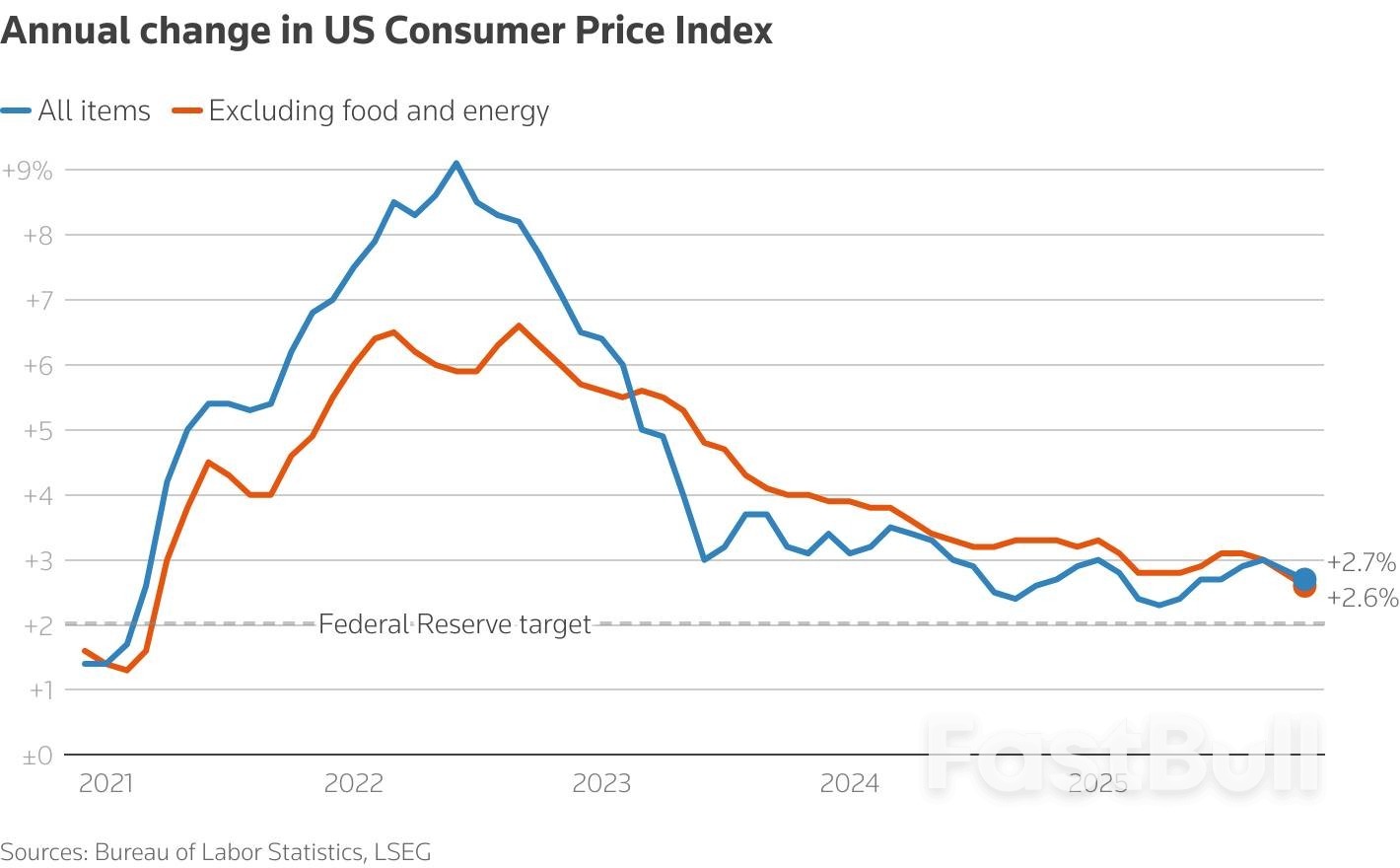
          The CPI rose 2.7% on a year-over-year basis in November after increasing 3.0% in the 12 months through September. Economists polled by Reuters had forecast the CPI would advance 3.1%. The CPI gained 0.2% over the two months ending in November. The BLS said it "cannot provide specific guidance to data users for navigating the missing October observations."

          The smaller-than-expected increase in the CPI was likely the result of data collection being delayed late into November, when retailers offered holiday season discounts. Economists expect an acceleration in December, which would increase pressure on households facing affordability challenges that have been partly blamed on import tariffs.

          Beef prices increased 15.8% on a year-over-year basis in November, while the cost of coffee surged 18.8%. Electricity prices rose 6.9%.

          Egg prices, however, decreased 13.2% and gasoline prices rose only 0.9%. New motor vehicle prices increased 0.6% on a year-over-year basis. It could take some time for consumers to see lower prices from the White House's rollback of duties on some goods including beef, bananas and coffee, economists said.

          President Donald Trump's sweeping import duties have raised prices for many goods, though the tariff pass-through has been gradual as businesses worked through inventory accumulated prior to the trade policy tightening and also absorbed some of the taxes, evident in the small rise in new motor vehicle prices.

          Samuel Tombs, chief U.S. economist at Pantheon Macroeconomics, calculated that retailers had passed on about 40% of tariffs by September, adding that "we expect that proportion to climb gradually to 70% by March and then stabilize."

          U.S. stocks were trading higher and Treasury yields were lower. The dollar slipped against a basket of currencies.

          A line chart with the title 'Annual change in US Consumer Price Index'

          TARIFFS ARE HURTING CONSUMERS

          Economists say the tariff burden is falling disproportionately on lower-income households, who have little or no savings buffer and have also experienced slower wage growth relative to other workers.

          Trump, who won the 2024 presidential election on promises to tame inflation, has in recent weeks alternated between dismissing affordability problems as a hoax, blaming former President Joe Biden, and promising that Americans will benefit from his economic policies next year.

          Excluding the volatile food and energy components, the CPI increased 2.6% on a year-over-year basis in November. The so-called core CPI rose 3.0% in September. Core CPI inflation increased 0.2% over the two months ending in November.

          The Federal Reserve tracks the Personal Consumption Expenditures Price indexes for its 2% inflation target.

          The PCE price measures are calculated from some components of the CPI and PPI baskets. The PPI report for October was canceled. The producer inflation report will now be released in mid-January. The government has yet to set a new release date for November's PCE price data. Both PCE price measures were well above target in September.

          The Fed last week cut its benchmark overnight interest rate by another 25 basis points to the 3.50%-3.75% range, but signaled borrowing costs were unlikely to fall further in the near term as the U.S. central bank awaits clarity on the direction of the labor market and inflation.

          Fed Chair Jerome Powell told reporters in a post-meeting press conference that "it's really tariffs that are causing most of the inflation overshoot."

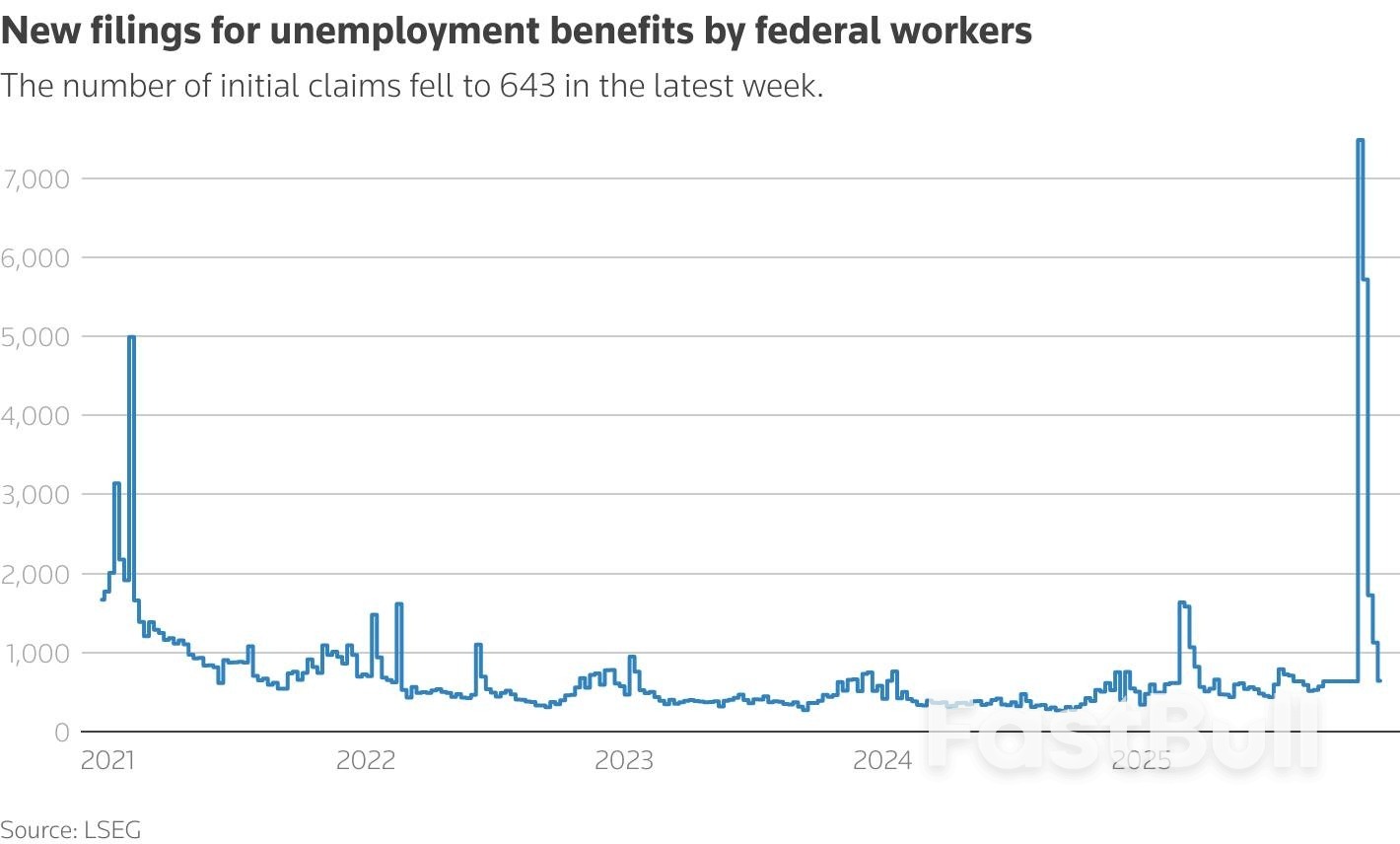
          In a separate report, the Labor Department said initial claims for state unemployment benefits dropped 13,000 to a seasonally adjusted 224,000 for the week ended December 13, reversing the prior week's surge and suggesting labor market conditions remained stable in December.

          A line chart with the title 'New filings for unemployment benefits by federal workers'

          Claims have see-sawed in recent weeks, reflecting challenges adjusting the data around the Thanksgiving holiday. The tone of the labor market has not changed much, with employers reluctant to hire more workers, but not embarking on mass layoffs either.

          Economists say Trump's tariffs have caused an unexpected shock for businesses, which have responded by pulling back on increasing head count.

          A survey of 548 chief financial officers at firms with one to more than 1,000 employees showed on Wednesday that they continued to cite tariffs as a top concern. The survey was conducted by the Richmond and Atlanta Federal Reserve banks in conjunction with Duke University's Fuqua School of Business.

          The claims data covered the period during which the government surveyed businesses for the nonfarm payrolls component of December's employment report. Nonfarm payrolls increased by 64,000 jobs in November, the BLS said on Tuesday.

          The employment report for December will be released on schedule in January. Though the unemployment rate was at 4.6% in November, the highest level since September 2021, it was distorted by technical factors related to the shutdown.

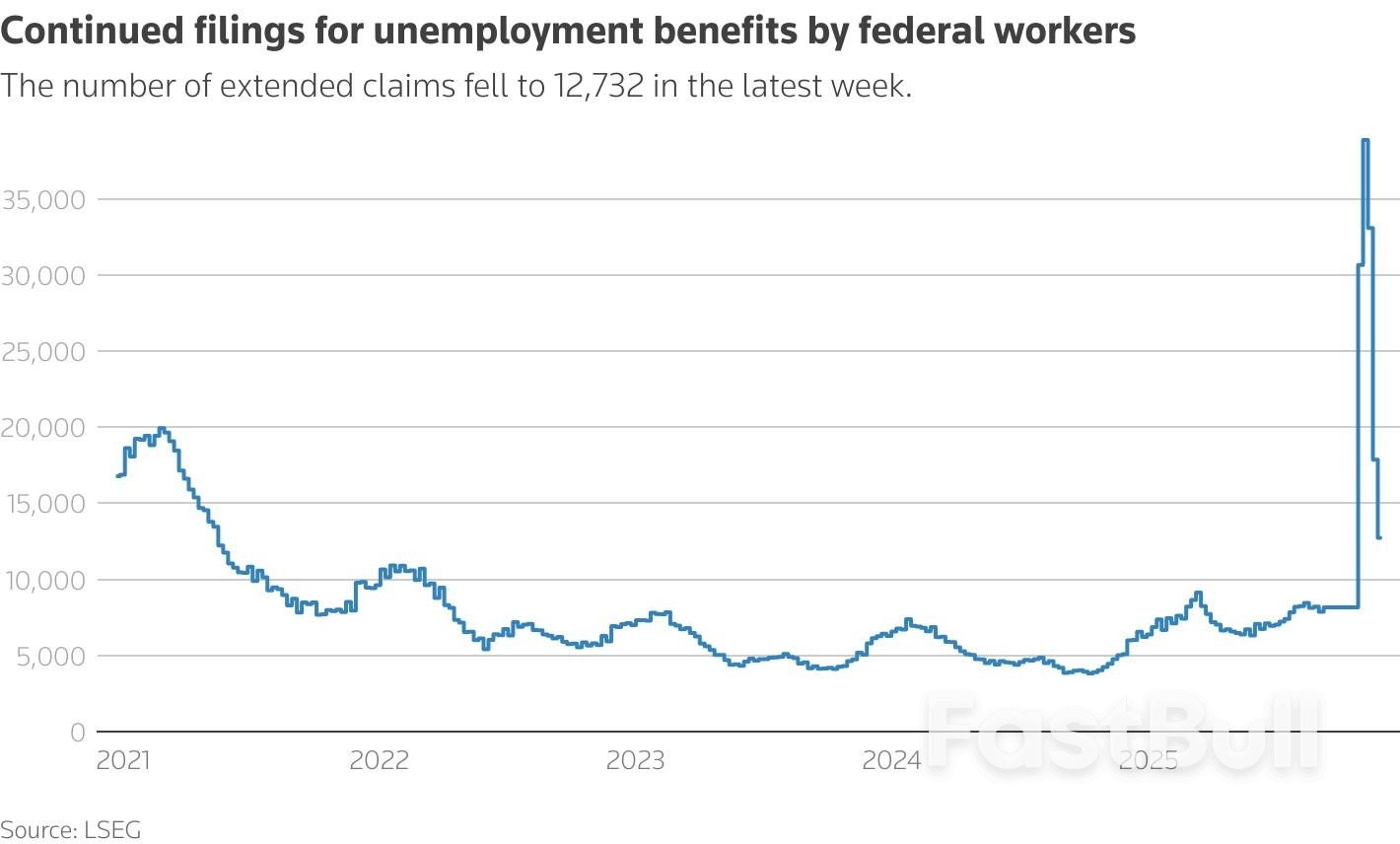
          Tepid hiring is causing long bouts of unemployment for some workers who have lost their jobs. The number of people receiving unemployment benefits after an initial week of aid, a proxy for hiring, increased 67,000 to a seasonally adjusted 1.897 million during the week ending December 6, the claims report showed.

          A line chart with the title 'Continued filings for unemployment benefits by federal workers'

          Source: Reuters

          Risk Warnings and Disclaimers
          You understand and acknowledge that there is a high degree of risk involved in trading. Following any strategies or investment methods may lead to potential losses. The content on the site is provided by our contributors and analysts for information purposes only. You are solely responsible for determining whether any trading assets, securities, strategy, or any other product is suitable for investing based on your own investment objectives and financial situation.
          Add to Favorites
          Share

          Brazil Senate Approves Bill To Reduce Bolsonaro Jail Sentence

          Justin

          Political

          Brazil's Senate approved legislation to reduce the sentence former leader Jair Bolsonaro must serve for plotting a coup after his narrow 2022 election loss, setting up a potential clash between Congress, President Luiz Inacio Lula da Silva and the country's Supreme Court.

          On Wednesday, 48 senators voted in favor of the bill and 25 against, granting final approval to a proposal the lower house of Congress passed earlier this month. It now goes to Lula, as the president is known. He was the target of the overthrow effort Bolsonaro plotted, and who will now decide whether to veto it.

          The leftist leader has suggested that he will strike down the bill that would reduce the 27-year jail sentence Bolsonaro received in September to 20 years and nine months, according to lower house calculations. The legislation also caps the time the right-wing former president would spend behind bars in a so-called "closed regime" at two years and four months, down from six-to-eight years he's currently facing.

          "I will do what I understand must be done, because he has to pay for the attempted coup, for the attempt to destroy the democracy of this country," Lula said in an interview with a local TV station last week.

          A veto would almost certainly exacerbate tensions between Lula and Congress at a time when the two sides have already battled over a Supreme Court nomination and other issues.

          Last Sunday, Lula supporters staged large demonstrations against the legislation that seeks to reduce sentences for Brazilians convicted of crimes related to the Jan. 8, 2023 insurrection attempt that followed Lula's election, including for Bolsonaro.

          It also remains unclear whether passage would pacify Bolsonaro allies, including his son Flavio, who have pushed for broad, unconditional amnesty for the former president and others involved in the insurrection attempt.

          Flavio, a senator, earlier this month said he had his father's backing to run for president next year, a decision that dented investor desires to see Sao Paulo Governor Tarcisio de Freitas challenge Lula instead.

          Flavio later said he was open to negotiating with centrist lawmakers over his candidacy, but that the price for dropping his presidential bid would be securing his father's freedom and eligibility to run in 2026.

          The bill's passage could provide a boost to sagging investor hopes that Freitas will still run, although key Bolsonaro supporters, including the leader of his party in the lower house, have said they intend to keep pushing for total amnesty.

          Regardless of Lula's decision, the case could wind up in front of the Supreme Court, which has convicted more than 800 people of crimes related to the Jan. 8 riots. If an appeal reaches the court, the justices could rule the congressional measure unconstitutional.

          Justice Alexandre de Moraes, who oversees cases related to the attempted coup, criticized the idea of reducing sentences during a trial Tuesday.

          "That would send a message to society that Brazil tolerates, or will tolerate, new flirtations with authoritarianism," he said. "The state's response must be firm, and punish those who attempted to destroy Brazil's democracy."

          Source: Bloomberg Europe

          Risk Warnings and Disclaimers
          You understand and acknowledge that there is a high degree of risk involved in trading. Following any strategies or investment methods may lead to potential losses. The content on the site is provided by our contributors and analysts for information purposes only. You are solely responsible for determining whether any trading assets, securities, strategy, or any other product is suitable for investing based on your own investment objectives and financial situation.
          Add to Favorites
          Share

          The Global Chip Cold War. How China is Changing the Rules of Technology

          Adam

          Economic

          Events with the potential to reshape the long-term fundamentals of the technology sector rarely occur on the global stage. China’s progress in developing its own EUV lithography technology belongs to this category. Although the project is still in the testing and prototype phase, its significance extends far beyond current market cycles and short-term corporate earnings.
          EUV machines, costing around 250 million USD each, are critical for producing chips below 7 nm, used by Nvidia, AMD, TSMC, Intel, and Samsung. The Western monopoly on this technology defines the so-called "technological cold war." China's success in developing its own EUV capabilities could fundamentally reshape global supply chains, reducing dependence on the West and strengthening potential in AI, military applications, and the broader economy.
          For several years, China has been pursuing a coordinated, state-led program aimed at achieving full independence from Western semiconductor technologies. The program encompasses the construction of next-generation lithography machines, the development of domestic capabilities in precision optics, design software, critical materials, and manufacturing processes. The scale of financial and institutional commitment indicates that this is not an experimental endeavor, but a key component of a long-term economic and geopolitical strategy.
          From a technological perspective, China remains a few years behind global leaders, but it could reach a level sufficient to blunt the impact of sanctions, reduce reliance on Western suppliers, and gradually build a competitive offering for third-party markets. This scenario carries significant implications for Western tech giants, which currently derive a substantial portion of their revenue from the Chinese market.
          China’s drive for self-sufficiency in high-end chip production, supported by a state-backed mega-fund, is destabilizing global supply chains. Beijing controls 90% of the gallium, germanium, and palladium markets, restricting exports and creating worldwide shortages, which in turn could raise silicon wafer prices by 20–30%. The West is responding with investments in production diversification, including the CHIPS Act and new projects in India and Europe. These measures increase production costs, delay factory start-ups, and push up consumer electronics prices, including smartphones, laptops, and AI servers, while simultaneously raising the risk of global supply chain fragmentation.
          These supply chain shifts have significant implications for the valuations of sensitive technology companies. Among the most exposed Western firms are ASML, TSMC, Nvidia, Intel, AMD, Apple, Samsung, and Microsoft, all of which face pressure from restricted access to the Chinese market, higher production costs, and component shortages. Conversely, Chinese companies such as SMIC, Huawei, and other domestic semiconductor fabs could benefit from growing self-sufficiency, state support, and the gradual reduction of dependence on Western technologies, enhancing their market position and growth potential.
          The geopolitical consequences are equally profound. Technological competition increasingly resembles a long-term systemic conflict, in which access to advanced chips determines economic, military, and strategic advantage. In this environment, the tech sector ceases to be solely a space for market-driven innovation and becomes a tool of state policy.
          For investors, this necessitates a shift in perspective. Short-term performance and current demand trends remain important, but resilience to geopolitical tensions and structural changes is becoming increasingly critical. Projects on the scale of China’s program do not need to achieve full success to influence valuations and corporate strategies. Over the long term, it is enough that they alter the rules of the game. This slow-moving process may ultimately prove the most costly for investors once fully recognized by the market.

          Source: xtb

          To stay updated on all economic events of today, please check out our Economic calendar
          Risk Warnings and Disclaimers
          You understand and acknowledge that there is a high degree of risk involved in trading. Following any strategies or investment methods may lead to potential losses. The content on the site is provided by our contributors and analysts for information purposes only. You are solely responsible for determining whether any trading assets, securities, strategy, or any other product is suitable for investing based on your own investment objectives and financial situation.
          Add to Favorites
          Share

          Three holds and a cut? Europe’s central banks make their final calls of 2025

          Adam

          Economic

          Central Bank

          Investors are gearing up for the last interest-rate decisions of 2025, with four of Europe’s central banks announcing their monetary policies and macroeconomic outlooks on Thursday.
          The European Central Bank, Bank of England, Riksbank, and Norges Bank are all meeting, but only one of them is expected to change its rate.
          This is what to expect:

          European Central Bank

          The ECB is expected to keep rates on hold, with recent economic data not pointing to an adjustment.
          But investors will be more interested in any commentary on the apparent growing tensions inside the governing council, with some members, like Isabel Schnabel, openly endorsing the market’s view that the next rate move will be a hike, while others think there is still room to cut.
          Christian Kopf, who heads the bond portfolio management of German asset manager Union Investment, told CNBC: “I don’t expect and rate change in the Euro area for the time being. If there is a change in 2026, most likely we will get a rate hike towards the end of 2026 or at the beginning of 2027.”
          The ECB is expected to hike its growth outlook for the Eurozone when publishing its new round of staff projections, its in-house economic forecasts.

          Norges Bank

          Norway’s central bank kept rates on hold at 4% on Thursday, with economists suggesting the next rate cut might not come until summer 2026. Norges Bank announced its policy decision at 10 a.m. local time, 9 a.m. London time.
          The bank said Thursday that the outlook is uncertain “but if the economy evolves broadly as currently projected, the policy rate will be reduced further in the course of the coming year.” For now, however, Norges Bank’s policymakers judged “that a restrictive monetary policy is still needed. Inflation is still too high.” It added that its current forecast “is consistent with 1-2 rate cuts next year.”
          Morten Lund, Scandinavia chief economist at JPMorgan, had commented before the rate hold that the bank’s guidance on Thursday “should be a push-back against markets’ rising expectations” that it will cut rates in March, which he said was currently seen as “a coin toss.”
          Instead, JPMorgan expects a rate cut to next take place in June, although Norges Bank was not, on Thursday, explicit about the timing of a cut.

          Riksbank

          Sweden’s central bank kept its key policy rate unchanged at 1.75% when it announced its decision at 9.30 a.m. CET, 8.30 a.m. London time.
          No change is likely in the coming quarters either, according to Franziska Fischer at UBS Investment Bank, who said that the Riksbank’s easing cycle was over.
          “The Riksbank cut the policy rate by 25 basis points in September but remained on hold in November, while signalling that the policy rate will likely remain unchanged ‘for some time to come’,” Fischer said.
          Developments since November do not warrant a change to the rate outlook, in UBS’ view, he added.

          Bank of England

          The Bank of England is the only central bank that’s expected to cut interest rates on Thursday, with a small majority of the bank’s nine-member monetary policy committee (MPC) expected to opt for a 25 basis points cut, bringing the base rate down to 3.75%.
          Expectations of a cut rose after the latest inflation data showed it fell sharply to 3.2% in November, and recent downbeat economic data in the U.K., ranging from somber growth figures to an uptick in unemployment.
          While inflation remains above the bank’s 2% target, the trend downwards gives the bank room for manoeuvre when it comes to lowering interest rates to stimulate the economy, consumption and borrowing.
          The government’s Autumn Budget last month was also seen as disinflationary, given it included measures to lower energy bills and freeze fuel duty and train fares.

          Source: cnbc

          To stay updated on all economic events of today, please check out our Economic calendar
          Risk Warnings and Disclaimers
          You understand and acknowledge that there is a high degree of risk involved in trading. Following any strategies or investment methods may lead to potential losses. The content on the site is provided by our contributors and analysts for information purposes only. You are solely responsible for determining whether any trading assets, securities, strategy, or any other product is suitable for investing based on your own investment objectives and financial situation.
          Add to Favorites
          Share

          Germany Plans To Sell Niche 20-Year Bonds That Struggled In US

          Daniel Carter

          Bond

          Economic

          The new bond will be sold for the first time in 2026, according to Tammo Diemer, co-director of the German finance agency. The aim is to increase sales by expanding the range of debt offerings after strict fiscal rules were loosened earlier this year.
          German Chancellor Friedrich Merz's government is ramping up borrowing in a bid to revive Europe's biggest economy, which has struggled to grow since the pandemic. Much of the money raised will be channeled into a €500 billion ($586 billion) infrastructure fund and the country's armed forces over the coming decade.
          The US struggled to find consistent buyers when it relaunched 20-year bonds five years ago, with a notably poor auction in May triggering a broader selloff. Steve Mnuchin, the Treasury Secretary who brought the bond back during President Donald Trump's first term, later admitted the move was "costly to the taxpayer."
          Diemer, whose agency has already launched a seven-year maturity, sees growing demand for 20-year debt, especially given expectations that an overhaul of the Dutch pension system will reduce appetite for longer-maturity bonds. Other government borrowers, including Austria and the Netherlands itself, have said they may tilt sales shorter in response to the change in demand.

          Dutch Pension Overhaul to Fuel Pivot From Long Bonds in EU

          "The 20-year segment is currently trending," Diemer said at a press conference in Frankfurt. "The trend among Dutch pension funds is very much in line with this strategy."
          Appetite for the maturity now seems to be improving in the US, with the yield on 20-year Treasuries moving below 30-year rates in July, ending an inversion of the yield curve that had been in place since 2021. Meanwhile, longer-dated bonds are underperforming globally.
          The yield premium on 30-year German bonds relative to 10-year notes has risen over 40 basis points this year. Cyril Regnat, a rates strategist at Natixis in Paris, said the German finance agency's "clear goal" is to reduce the average duration of its issuance.
          Diemer said at the launch that the weighted—average-maturity of Germany's debt from the launch will decline to 7.7 years in 2026 from 7.8 currently.
          "We have learned from the capital market performance of our colleagues in Washington, their experiences have been incorporated, and the 20-year segment is being developed to meet demand," Diemer said.

          Source: Bloomberg Europe

          To stay updated on all economic events of today, please check out our Economic calendar
          Risk Warnings and Disclaimers
          You understand and acknowledge that there is a high degree of risk involved in trading. Following any strategies or investment methods may lead to potential losses. The content on the site is provided by our contributors and analysts for information purposes only. You are solely responsible for determining whether any trading assets, securities, strategy, or any other product is suitable for investing based on your own investment objectives and financial situation.
          Add to Favorites
          Share
          FastBull
          Copyright © 2025 FastBull Ltd

          728 RM B 7/F GEE LOK IND BLDG NO 34 HUNG TO RD KWUN TONG KLN HONG KONG

          TelegramInstagramTwitterfacebooklinkedin
          App Store Google Play Google Play
          Products
          Charts

          Chats

          Q&A with Experts
          Screeners
          Economic Calendar
          Data
          Tools
          Membership
          Features
          Function
          Markets
          Copy Trading
          Latest Signals
          Contests
          News
          Analysis
          24/7
          Columns
          Education
          Company
          Careers
          About Us
          Contact Us
          Advertising
          Help Center
          Feedback
          User Agreement
          Privacy Policy
          Personal Information Protection Statement
          Business

          White Label

          Data API

          Web Plug-ins

          Poster Maker

          Affiliate Program

          Risk Disclosure

          The risk of loss in trading financial instruments such as stocks, FX, commodities, futures, bonds, ETFs and crypto can be substantial. You may sustain a total loss of the funds that you deposit with your broker. Therefore, you should carefully consider whether such trading is suitable for you in light of your circumstances and financial resources.

          No decision to invest should be made without thoroughly conducting due diligence by yourself or consulting with your financial advisors. Our web content might not suit you since we don't know your financial conditions and investment needs. Our financial information might have latency or contain inaccuracy, so you should be fully responsible for any of your trading and investment decisions. The company will not be responsible for your capital loss.

          Without getting permission from the website, you are not allowed to copy the website's graphics, texts, or trademarks. Intellectual property rights in the content or data incorporated into this website belong to its providers and exchange merchants.

          Not Logged In

          Log in to access more features

          FastBull Membership

          Not yet

          Purchase

          Become a signal provider
          Help Center
          Customer Service
          Dark Mode
          Price Up/Down Colors

          Log In

          Sign Up

          Position
          Layout
          Fullscreen
          Default to Chart
          The chart page opens by default when you visit fastbull.com