• Trade
  • Markets
  • Copy
  • Contests
  • News
  • 24/7
  • Calendar
  • Q&A
  • Chats
Trending
Screeners
SYMBOL
LAST
BID
ASK
HIGH
LOW
NET CHG.
%CHG.
SPREAD
SPX
S&P 500 Index
6827.42
6827.42
6827.42
6899.86
6801.80
-73.58
-1.07%
--
DJI
Dow Jones Industrial Average
48458.04
48458.04
48458.04
48886.86
48334.10
-245.98
-0.51%
--
IXIC
NASDAQ Composite Index
23195.16
23195.16
23195.16
23554.89
23094.51
-398.69
-1.69%
--
USDX
US Dollar Index
97.950
98.030
97.950
98.500
97.950
-0.370
-0.38%
--
EURUSD
Euro / US Dollar
1.17394
1.17409
1.17394
1.17496
1.17192
+0.00011
+ 0.01%
--
GBPUSD
Pound Sterling / US Dollar
1.33707
1.33732
1.33707
1.33997
1.33419
-0.00148
-0.11%
--
XAUUSD
Gold / US Dollar
4299.39
4299.39
4299.39
4353.41
4257.10
+20.10
+ 0.47%
--
WTI
Light Sweet Crude Oil
57.233
57.485
57.233
58.011
56.969
-0.408
-0.71%
--

Community Accounts

Signal Accounts
--
Profit Accounts
--
Loss Accounts
--
View More

Become a signal provider

Sell trading signals to earn additional income

View More

Guide to Copy Trading

Get started with ease and confidence

View More

Signal Accounts for Members

All Signal Accounts

Best Return
  • Best Return
  • Best P/L
  • Best MDD
Past 1W
  • Past 1W
  • Past 1M
  • Past 1Y

All Contests

  • All
  • Trump Updates
  • Recommend
  • Stocks
  • Cryptocurrencies
  • Central Banks
  • Featured News
Top News Only
Share

Ukraine's Navy Says Russian Drone Attack Hit Civilian Turkish Vessel Carrying Sunflower Oil To Egypt On Saturday

Share

Israeli Military Says It Put Planned Strike On South Lebanon Site On Hold After Lebanese Army Requested Access

Share

Norwegian Nobel Committee: Calls On The Belarusian Authorities To Release All Political Prisoners

Share

Norwegian Nobel Committee: His Freedom Is A Deeply Welcome And Long-Awaited Moment

Share

Ukraine Says It Received 114 Prisoners From Belarus

Share

USA Embassy In Lithuania: Maria Kalesnikava Is Not Going To Vilnius

Share

USA Embassy In Lithuania: Other Prisoners Are Being Sent From Belarus To Ukraine

Share

Ukraine President Zelenskiy: Five Ukrainians Released By Belarus In US-Brokered Deal

Share

USA Vilnius Embassy: USA Stands Ready For "Additional Engagement With Belarus That Advances USA Interests"

Share

USA Vilnius Embassy: Belarus, USA, Other Citizens Among The Prisoners Released Into Lithuania

Share

USA Vilnius Embassy: USA Will Continue Diplomatic Efforts To Free The Remaining Political Prisoners In Belarus

Share

USA Vilnius Embassy: Belarus Releases 123 Prisoners Following Meeting Of President Trump's Envoy Coale And Belarus President Lukashenko

Share

USA Vilnius Embassy: Masatoshi Nakanishi, Aliaksandr Syrytsa Are Among The Prisoners Released By Belarus

Share

USA Vilnius Embassy: Maria Kalesnikava And Viktor Babaryka Are Among The Prisoners Released By Belarus

Share

USA Vilnius Embassy: Nobel Peace Prize Laureate Ales Bialiatski Is Among The Prisoners Released By Belarus

Share

Belarusian Presidential Administration Telegram Channel: Lukashenko Has Pardoned 123 Prisoners As Part Of Deal With US

Share

Two Local Syrian Officials: Joint US-Syrian Military Patrol In Central Syria Came Under Fire From Unknown Assailants

Share

Israeli Military Says It Targeted 'Key Hamas Terrorist' In Gaza City

Share

Rwanda's Actions In Eastern Drc Are A Clear Violation Of Washington Accords Signed By President Trump - Secretary Of State Rubio

Share

Israeli Military Issues Evacuation Warning In Southern Lebanon Village Ahead Of Strike - Spokesperson On X

TIME
ACT
FCST
PREV
U.K. Trade Balance Non-EU (SA) (Oct)

A:--

F: --

P: --

U.K. Trade Balance (Oct)

A:--

F: --

P: --

U.K. Services Index MoM

A:--

F: --

P: --

U.K. Construction Output MoM (SA) (Oct)

A:--

F: --

P: --

U.K. Industrial Output YoY (Oct)

A:--

F: --

P: --

U.K. Trade Balance (SA) (Oct)

A:--

F: --

P: --

U.K. Trade Balance EU (SA) (Oct)

A:--

F: --

P: --

U.K. Manufacturing Output YoY (Oct)

A:--

F: --

P: --

U.K. GDP MoM (Oct)

A:--

F: --

P: --

U.K. GDP YoY (SA) (Oct)

A:--

F: --

P: --

U.K. Industrial Output MoM (Oct)

A:--

F: --

P: --

U.K. Construction Output YoY (Oct)

A:--

F: --

P: --

France HICP Final MoM (Nov)

A:--

F: --

P: --

China, Mainland Outstanding Loans Growth YoY (Nov)

A:--

F: --

P: --

China, Mainland M2 Money Supply YoY (Nov)

A:--

F: --

P: --

China, Mainland M0 Money Supply YoY (Nov)

A:--

F: --

P: --

China, Mainland M1 Money Supply YoY (Nov)

A:--

F: --

P: --

India CPI YoY (Nov)

A:--

F: --

P: --

India Deposit Gowth YoY

A:--

F: --

P: --

Brazil Services Growth YoY (Oct)

A:--

F: --

P: --

Mexico Industrial Output YoY (Oct)

A:--

F: --

P: --

Russia Trade Balance (Oct)

A:--

F: --

P: --

Philadelphia Fed President Henry Paulson delivers a speech
Canada Building Permits MoM (SA) (Oct)

A:--

F: --

P: --

Canada Wholesale Sales YoY (Oct)

A:--

F: --

P: --

Canada Wholesale Inventory MoM (Oct)

A:--

F: --

P: --

Canada Wholesale Inventory YoY (Oct)

A:--

F: --

P: --

Canada Wholesale Sales MoM (SA) (Oct)

A:--

F: --

P: --

Germany Current Account (Not SA) (Oct)

A:--

F: --

P: --

U.S. Weekly Total Rig Count

A:--

F: --

P: --

U.S. Weekly Total Oil Rig Count

A:--

F: --

P: --

Japan Tankan Large Non-Manufacturing Diffusion Index (Q4)

--

F: --

P: --

Japan Tankan Small Manufacturing Outlook Index (Q4)

--

F: --

P: --

Japan Tankan Large Non-Manufacturing Outlook Index (Q4)

--

F: --

P: --

Japan Tankan Large Manufacturing Outlook Index (Q4)

--

F: --

P: --

Japan Tankan Small Manufacturing Diffusion Index (Q4)

--

F: --

P: --

Japan Tankan Large Manufacturing Diffusion Index (Q4)

--

F: --

P: --

Japan Tankan Large-Enterprise Capital Expenditure YoY (Q4)

--

F: --

P: --

U.K. Rightmove House Price Index YoY (Dec)

--

F: --

P: --

China, Mainland Industrial Output YoY (YTD) (Nov)

--

F: --

P: --

China, Mainland Urban Area Unemployment Rate (Nov)

--

F: --

P: --

Saudi Arabia CPI YoY (Nov)

--

F: --

P: --

Euro Zone Industrial Output YoY (Oct)

--

F: --

P: --

Euro Zone Industrial Output MoM (Oct)

--

F: --

P: --

Canada Existing Home Sales MoM (Nov)

--

F: --

P: --

Euro Zone Total Reserve Assets (Nov)

--

F: --

P: --

U.K. Inflation Rate Expectations

--

F: --

P: --

Canada National Economic Confidence Index

--

F: --

P: --

Canada New Housing Starts (Nov)

--

F: --

P: --

U.S. NY Fed Manufacturing Employment Index (Dec)

--

F: --

P: --

U.S. NY Fed Manufacturing Index (Dec)

--

F: --

P: --

Canada Core CPI YoY (Nov)

--

F: --

P: --

Canada Manufacturing Unfilled Orders MoM (Oct)

--

F: --

P: --

Canada Manufacturing New Orders MoM (Oct)

--

F: --

P: --

Canada Core CPI MoM (Nov)

--

F: --

P: --

Canada Manufacturing Inventory MoM (Oct)

--

F: --

P: --

Canada CPI YoY (Nov)

--

F: --

P: --

Canada CPI MoM (Nov)

--

F: --

P: --

Canada CPI YoY (SA) (Nov)

--

F: --

P: --

Canada Core CPI MoM (SA) (Nov)

--

F: --

P: --

Q&A with Experts
    • All
    • Chatrooms
    • Groups
    • Friends
    Connecting
    .
    .
    .
    Type here...
    Add Symbol or Code

      No matching data

      All
      Trump Updates
      Recommend
      Stocks
      Cryptocurrencies
      Central Banks
      Featured News
      • All
      • Russia-Ukraine Conflict
      • Middle East Flashpoint
      • All
      • Russia-Ukraine Conflict
      • Middle East Flashpoint
      Search
      Products

      Charts Free Forever

      Chats Q&A with Experts
      Screeners Economic Calendar Data Tools
      Membership Features
      Data Warehouse Market Trends Institutional Data Policy Rates Macro

      Market Trends

      Market Sentiment Order Book Forex Correlations

      Top Indicators

      Charts Free Forever
      Markets

      News

      News Analysis 24/7 Columns Education
      From Institutions From Analysts
      Topics Columnists

      Latest Views

      Latest Views

      Trending Topics

      Top Columnists

      Latest Update

      Signals

      Copy Rankings Latest Signals Become a signal provider AI Rating
      Contests
      Brokers

      Overview Brokers Assessment Rankings Regulators News Claims
      Broker listing Forex Brokers Comparison Tool Live Spread Comparison Scam
      Q&A Complaint Scam Alert Videos Tips to Detect Scam
      More

      Business
      Events
      Careers About Us Advertising Help Center

      White Label

      Data API

      Web Plug-ins

      Affiliate Program

      Awards Institution Evaluation IB Seminar Salon Event Exhibition
      Vietnam Thailand Singapore Dubai
      Fans Party Investment Sharing Session
      FastBull Summit BrokersView Expo
      Recent Searches
        Top Searches
          Markets
          News
          Analysis
          User
          24/7
          Economic Calendar
          Education
          Data
          • Names
          • Latest
          • Prev

          View All

          No data

          Scan to Download

          Faster Charts, Chat Faster!

          Download App
          English
          • English
          • Español
          • العربية
          • Bahasa Indonesia
          • Bahasa Melayu
          • Tiếng Việt
          • ภาษาไทย
          • Français
          • Italiano
          • Türkçe
          • Русский язык
          • 简中
          • 繁中
          Open Account
          Search
          Products
          Charts Free Forever
          Markets
          News
          Signals

          Copy Rankings Latest Signals Become a signal provider AI Rating
          Contests
          Brokers

          Overview Brokers Assessment Rankings Regulators News Claims
          Broker listing Forex Brokers Comparison Tool Live Spread Comparison Scam
          Q&A Complaint Scam Alert Videos Tips to Detect Scam
          More

          Business
          Events
          Careers About Us Advertising Help Center

          White Label

          Data API

          Web Plug-ins

          Affiliate Program

          Awards Institution Evaluation IB Seminar Salon Event Exhibition
          Vietnam Thailand Singapore Dubai
          Fans Party Investment Sharing Session
          FastBull Summit BrokersView Expo

          UK Economic Resilience in March Signalled by Flash PMI

          Justin

          Central Bank

          Economic

          Summary:

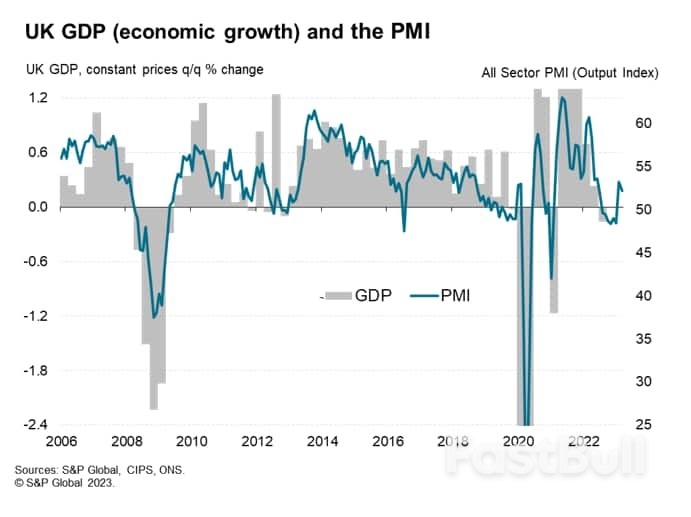
          With the flash PMI surveys signalling a second month of rising output in March, the UK economy looks to have returned to growth in the first quarter. The surveys are broadly consistent with GDP growing at only a modest quarterly rate of 0.2%, but this represents a welcome expansion compared to the lack of growth seen in the second half of last year.
          Further encouragement comes from new business growth accelerating further to the fastest since April of last year. More disappointingly, new orders growth was largely limited to the service sector and even here it seems that a lack of available staff meant this demand could not be fully met. The upshot of these constraints and labour shortages is of course more upward pressure on prices. Although the overall rate of inflation for goods and services has cooled further from the peaks seen in the spring of last year, in the immediate aftermath of the invasion of Ukraine, the rate of increase remains stubbornly higher than anything recorded by the survey in the two decades leading up to the pandemic.
          However, the bigger picture is that the improvement in order book growth adds to signs that a near-term recession has been avoided, and an upturn in companies' expectations for the year ahead indicates that business sentiment has been little affected so far by the banking sector woes and that firms are more focused on growth possibilities.

          Economy expands for second successive month

          UK business activity increased for a second successive month in March, according to the flash PMI survey data compiled by S&P Global and sponsored by CIPS, suggesting a modest growth revival after six months of continual decline prior to February. The composite PMI registered 52.2 according to the provisional data, down from 53.1 in February but nevertheless remaining above the 50.0 neutral level to indicate further expansion.
          The latest reading is consistent with GDP growing at a quarterly rate of 0.2% after a 0.3% pace had been indicated for February. Coming on the heels of a modest decline in January, the PMI readings point to an economy growing in the first quarter by just under 0.2% after having stalled in the fourth quarter of last year and having contracted in the third quarter.
          UK Economic Resilience in March Signalled by Flash PMI_1

          Service sector leads upturn but expansion constrained by staff shortages

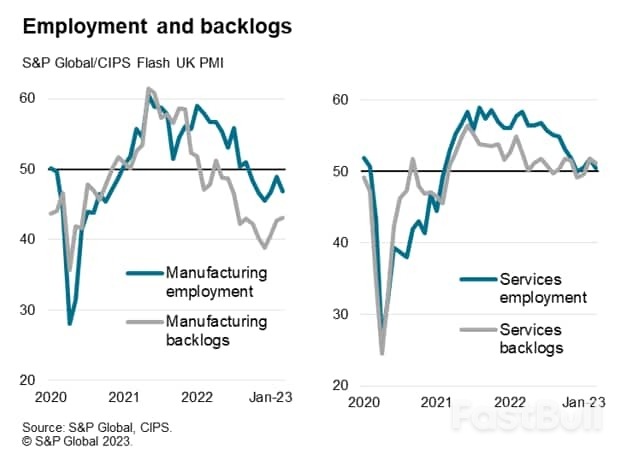
          March's upturn was led by a second consecutive monthly expansion of service sector output, albeit with the rate of increase slipping from February despite an improved rate of new orders growth. Service providers suffered a lack of staff, which held back their ability to meet demand. Although employment rose across the service sector in March, the rise was only marginal and weaker than recorded in February. Backlogs of work consequently rose in the service sector for a second month in a row, underscoring the labour market constraint on the sector's expansion.

          Manufacturing held back by paucity of demand

          In manufacturing, the principal constraint on growth was a paucity of demand rather than a lack of workers. Output fell back into decline after having briefly returned to modest growth in February, as factories reported another steep drop in their backlogs of work. New orders rose only marginally in March, albeit signalling a welcome end to nine months of decline to suggest the downturn in demand may have halted, but stronger demand growth will likely be needed in the coming months to drive production growth.
          UK Economic Resilience in March Signalled by Flash PMI_2
          UK Economic Resilience in March Signalled by Flash PMI_3

          Cost growth highest in services

          Cost divergences were also noteworthy across the sectors. Although slumping demand for raw materials and the steepest improvement in supplier delivery times since 2009 helped drive input cost inflation down in manufacturing, to the lowest since June 2020, service sector input cost inflation remained elevated, in part reflecting upward wage pressures.
          UK Economic Resilience in March Signalled by Flash PMI_4
          Although the overall rate of service sector input cost inflation eased to the lowest for 22 months, unlike manufacturing it saw the rate of inflation continue to run at one of the highest levels seen in the survey's two-decade history.
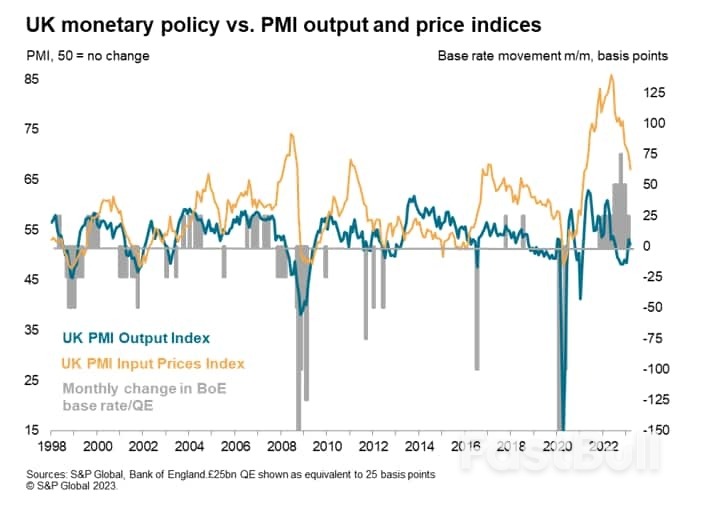
          The sustained upward pressure on costs fed through to higher prices charged for goods and services. While selling price inflation also cooled further from the peak seen in April of last year, the rate of increase remains highly elevated and indicative of consumer price inflation (CPI) running well above the Bank of England's 2% target in the near-term. However, the overall trajectory is one of slowing price increases, which should feed through to further CPI inflation moderation as the year proceeds.
          UK Economic Resilience in March Signalled by Flash PMI_5

          Resilience means more rate hikes

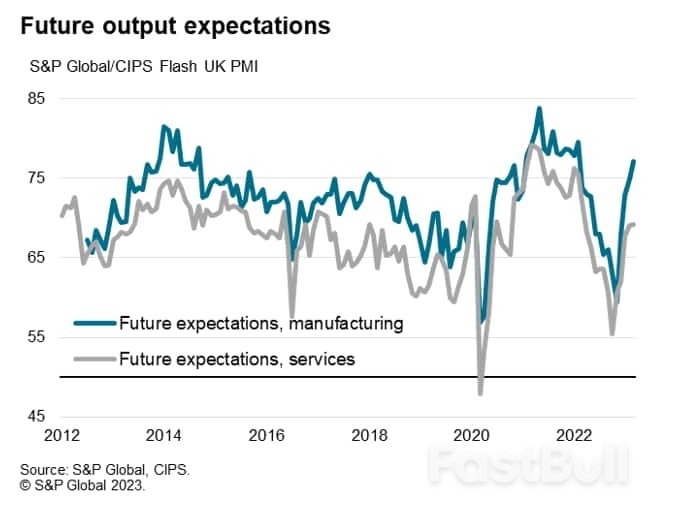
          The survey findings added to the case for the Bank of England's 25 basis point rate hike rise in March, which took the Bank Rate to 4.25%, its highest since 2008. The strength of the service sector expansion, combined with evidence of wage growth feeding through to stubbornly high service sector cost growth, likely adds to chances of further rate hikes in the coming months, especially as the survey's future output expectations indices remained resilient, and even rose further in manufacturing, despite the recent banking sector uncertainty.
          UK Economic Resilience in March Signalled by Flash PMI_6
          UK Economic Resilience in March Signalled by Flash PMI_7

          Source:S&P Global Market Intelligence

          To stay updated on all economic events of today, please check out our Economic calendar
          Risk Warnings and Disclaimers
          You understand and acknowledge that there is a high degree of risk involved in trading. Following any strategies or investment methods may lead to potential losses. The content on the site is provided by our contributors and analysts for information purposes only. You are solely responsible for determining whether any trading assets, securities, strategy, or any other product is suitable for investing based on your own investment objectives and financial situation.
          Comments
          Add to Favorites
          Share

          More Efforts Urged on Climate, Clean Energy

          Cohen

          Energy

          Experts hail Beijing's evolving role, call for US to co-lead cooperation
          Experts have said that China has been approaching the center of international clean energy cooperation over the past few decades, and its role is evolving. Also, the United States and China should and could cooperate and lead global cooperation in dealing with climate change despite rising political and economic tensions.
          The highlights of Joanna I.Lewis' new book, Cooperating for the Climate: Learning from International Partnerships in China's Clean Energy Sector, were discussed at a recent webinar titled US-China Cooperation and Leadership in Climate Change hosted by the Center for Strategic and International Studies, or CSIS.
          Lewis is a provost distinguished associate professor of energy and environment and director of the Science, Technology, and International Affairs Program at Georgetown University's Edmund A. Walsh School of Foreign Service in Washington, DC.
          According to Lewis' introduction, her book looks at how countries have been cooperating with China on clean energy and climate change over the last three decades. It created a new database that includes China's 400-plus bilateral agreements in the climate and clean energy sector with 40 countries and the European Union. The book also develops three in-depth case studies that look at three different energy research centers, providing more details about how these specific agreements play out.
          Based on the database and case studies, Lewis proposed an integrated framework combining political, economic, and technical factors to help explain the rationale behind and the structure of these cooperation mechanisms, how these different programs help cross-border clean energy research and development, and how these models are evolving.
          Tangible outcomes
          The book also provides some metrics to measure tangible outcomes from cooperation efforts, especially those with multiyear, multistakeholder investments and gave an international look at cooperation with China.
          "Because China plays such a central role in clean energy, technology, development, and dissemination, we can start to understand how these technologies are likely to evolve and the global role of innovation and cooperation in our low-carbon transition," said Lewis.
          The three case studies in the book focus on the US-China Clean Energy Research Center, or CERC, the China National Renewable Energy Center, or CNREC, with the Danish government, and the China-Brazil Center for Climate Change and Energy Technology Innovation (China-Brazil Center).
          In Lewis' analysis, the CERC is a model project of US-China cooperation in clean energy and climate change. It was built in 2009, which she described as the "banner year" for the history of US-China collaboration.
          "The US had been cooperating for decades with China, but this was really sort of the first time that this issue was elevated on the political and bilateral agenda. And there was just a record number of agreements signed that year," she said.
          "During the (Donald) Trump administration, where climate change was overall, less of a diplomatic priority, no new agreement was signed between the US and China for several years."
          The China-Brazil Center, she said, is one of the few examples of another emerging economy working with China in the clean energy space, and it is a "unique effort to bring together researchers of both countries while with a high-level diplomatic oversight".
          "We have seen this shift where the knowledge and the know-how and the technology is no longer flowing just to China, but also from China with China's really dramatic growth and experience in this sector and in many ways leading to the deployment of these technologies," Lewis noted.
          "This is shaping China's own science and technology strategy as well as sort of China's role in the world in terms of its role as a science and technology power," she added.

          Source: China Daily

          Risk Warnings and Disclaimers
          You understand and acknowledge that there is a high degree of risk involved in trading. Following any strategies or investment methods may lead to potential losses. The content on the site is provided by our contributors and analysts for information purposes only. You are solely responsible for determining whether any trading assets, securities, strategy, or any other product is suitable for investing based on your own investment objectives and financial situation.
          Comments
          Add to Favorites
          Share

          Eurozone Data Takes Centre Stage, but the Market Is on the Lookout for Banking Headlines

          Justin

          Central Bank

          Economic

          Central banks would like some quiet time

          The universe appears to have moved a few months forward in just three weeks, from the ballooning rate hike projections and the talk about a 6% Fed funds rate in the US to the current subdued rate expectations. Central bankers must have had their world turning upside down over the past weeks, but up to now they have behaved calmly and found some short-term solutions. Whether these would work in the long-term is another story, but central bankers have to remain focused on the economic situation as inflation remains a global issue, while meeting their financial stability responsibilities. A bit of quiet time is a very precious commodity from their standpoint at this juncture.
          Following on the path laid down by Lagarde et al last week, Fed chairman Powell announced a rate hike and a possible early end to the current tightening cycle. This abrupt change in the central banks’ strategy is the result of the recent banking sector woes. The collapse of three small US banking institutions and the Credit Suisse saga are expected to significantly impact the overall bank lending and borrowing appetite, potentially rendering further rate hikes unnecessary. The interesting fact from the ECB’s perspective remains that there have not been any euro area bank casualties. If the situation progresses according to the wishes of both the ECB and bank regulators, the market will have a chance next week to refocus on economic releases. At the end of the day, Lagarde laid out the revamped “data dependent” strategy and thus raised the importance of next week’s data.
          Eurozone Data Takes Centre Stage, but the Market Is on the Lookout for Banking Headlines_1

          CPI is the main dish on next week’s menu

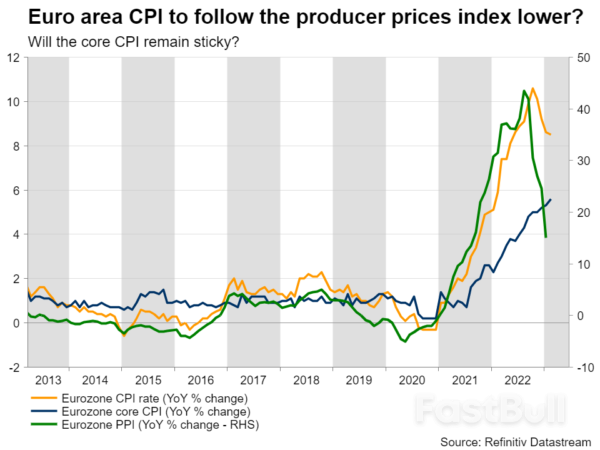
          Inflation prints produced the strongest post-announcement volatility during 2022. This appears to have abated somewhat lately, but it is expected to escalate again going forward. On Thursday, we will get a barrage of February CPI prints for the key German states and the preliminary German number, if there are no unforeseen issues like last month. On the following day, the preliminary euro area figure will be released, and the market will be focused on both the trend and the outright level of the inflation figures. The headline number has been on a gentle downward trend, pleasing the ECB, but the same cannot be said for the core component. It has been making higher highs, and a similar print on Friday could result in a plethora of comments from the ECB hawks about the appropriate response at the next rate-setting meeting, especially if it prints above 6% on Friday. On Wednesday morning, the GfK Consumer confidence survey may give us some early hints about the current consumer appetite.

          IFO survey on Monday

          Next week, though, will start on an equally high note as the German IFO survey will be published on Monday morning. The March edition of the most closely watched leading indicator for the German GDP is unlikely to escape from the March performance of both the ZEW survey and PMIs. It is worth noting that part of the IFO survey responses might have come before the Credit Suisse saga and hence Monday’s results might not be entirely representative of the troubling sentiment on the ground. Having said that, the IFO expectations component is already pointing to a weak first quarter GDP, and another print on Monday towards the 75 area would probably cement these bearish expectations.
          Eurozone Data Takes Centre Stage, but the Market Is on the Lookout for Banking Headlines_2

          Swissie remains under pressure against the euro

          Considering the recent economic developments, the market has managed to not get carried away. Stock indices have somewhat recovered from the early March low and euro/dollar remains elevated but far from the early February high of 1.1032. Gold and Bitcoin have clearly been the main beneficiaries of the recent market rout as they continue to keep their gains. This could potentially reveal increased hesitation from investors at this stage.
          The euro/swissie pair has understandably received increasing attention recently. Since October 13, 2022, this pair has actually been trading inside the 0.9706-1.0041 range. More recently, the Credit Suisse woes allowed the swissie bears to stage a quick recovery towards the busy 0.9960 level. The area extending up to 1.0096 has been a landmine for euro bulls and, at the moment, the overall technical picture is not overly supportive of their intentions. Particularly, the developing bearish divergence between the stochastic oscillator and euro/swissie could derail their plans to aim for a new 2023 high. On the other hand, the appetite by the swissie bulls will be tested at the 50- and 100-day simple moving averages.

          Source:XM

          To stay updated on all economic events of today, please check out our Economic calendar
          Risk Warnings and Disclaimers
          You understand and acknowledge that there is a high degree of risk involved in trading. Following any strategies or investment methods may lead to potential losses. The content on the site is provided by our contributors and analysts for information purposes only. You are solely responsible for determining whether any trading assets, securities, strategy, or any other product is suitable for investing based on your own investment objectives and financial situation.
          Comments
          Add to Favorites
          Share

          As India's Population Booms, Where Are Its Working Women?

          Owen Li

          Economic

          Pinky Negi, an Indian teacher with two master's degrees, loved her old job at a public school in the Himalayan foothills. But then she did what millions of Indian women do every year - gave up her career when she got married and had children.
          "The idea of not earning pinches me the most when I have to ask for the smallest of things," said Negi, who briefly tried home tutoring before the birth of her second child led her to give up work altogether.
          "Even if I have to ask my husband, it is still asking someone else," she told the Thomson Reuters Foundation in New Delhi at an office of the Self-Employed Women's Association (SEWA), a union group that helps women find work.
          Negi's experience is common in India, where women have been dropping out of the workforce even at a time of strong growth in Asia's third-biggest economy.
          The country is set to become the world's most populous as the United Nations forecasts its population to touch 1.43 billion on April 14, overtaking China on that day.
          Economists say that means India, which is home to the highest number of working-age people, must not only create more jobs to keep its world-beating growth on track, but also foster employment conditions favourable to women.
          Less than a third of Indian women are working or actively seeking work, data shows, despite progress such as better educational attainment, improved health, falling fertility rates and more women-friendly labour policies.
          There are numerous reasons for the shortfall, researchers say, from marriage, child care and domestic work to skills and education gaps, higher household incomes, safety concerns and a lack of jobs.
          Policy changes that could rectify these problems - such as improved access to education, child care or flexible work setups - could boost the number of working women and add hundreds of billions of dollars to India's gross domestic product (GDP) by 2025, a 2018 report by the McKinsey consulting firm found.
          "The absence of women from the labour market reduces productivity and leads to income inequality," said Mayurakshi Dutta, a researcher at Oxfam India, which attributed the low labour force participation of women to gender discrimination in terms of wages and opportunities in a 2022 report.
          Women's work under-reported?
          According to the World Bank's latest data, women represented 23% of India's formal and informal workforce in 2021, down from nearly 27% in 2005. That compared with about 32% in neighbouring Bangladesh and 34.5% in Sri Lanka.
          India's labour and women's ministries did not respond to requests for comment.
          Federal government data shows the female labour force participation rate (FLFPR) rose to 25.1% in 2020/21 from 18.6% in 2018/19.
          The economic survey from earlier this year said current measuring tools were inadequate for accurately gauging the FLFPR, tending to under-report the proportion of working women.
          For example, it found that data did not reflect women's unpaid work such as running a household, farming or income-saving activities such as collecting firewood, cooking and tutoring children.
          "Women have to take care of homes and we find it difficult to find full-time jobs. If I had support (at home), I would have liked to work too," said 35-year-old Beena Tomar, who does part-time home-based needlework.
          Investing in the care economy can reduce the unpaid care burden, and also create jobs in the care sectors that are major areas for women's employment, gender specialist Aya Matsuura and Peter Buwembo, a labour statistician, at the International Labour Organization (ILO) said in emailed comments.
          COVID-19 Impact
          Improving access to quality education, training programmes and skills development is vital to boosting employment opportunities for women and girls, said Oxfam's Dutta.
          Employers should also provide gender-sensitive policies such as access to social protection, child care, parental leaves, and provision of safe and accessible transport, she added.
          Last year, Prime Minister Narendra Modi asked states to use systems such as flexible working hours to retain women in the labour force, saying the country could achieve its economic goals faster if it made use of "women power".
          Researchers point to public programmes like the government's skills development scheme, which trained more than 300,000 women in 2021/22, as promising initiatives.
          But they say more needs to be done, especially for women still feeling the economic impacts of the COVID-19 pandemic.
          Most Indian women are in low-skilled work such as farm and factory labour and domestic help, sectors hard-hit by COVID.
          While the economy has rebounded since then, it has failed to restore jobs for women, who were more likely to have lost their jobs than men and less likely to return to the workforce, a report by the Centre for Sustainable Employment at Azim Premji University found.
          Bhawna Yadav is one of them. The 23-year-old was a make-up saleswoman at a Delhi mall before the first lockdown in March 2020, when she had to move in with her in-laws in northern Haryana state after she and her husband lost their jobs.
          While he moved back to Delhi after restrictions lifted, she stayed behind.
          "I had no job to go back to despite many calls to different companies ... Plus, my husband and in-laws were against it because I was pregnant," the mother-of-two said by phone from Baroli village.
          She said her in-laws dismissed her career ambitions, telling her "being a mother is a job" or "your husband is earning", and suggesting instead that she work as a farmhand.
          "It infuriates me. I'm qualified to do more ... They don't realise how much I miss my old life - the freedom, my friends, colleagues, and having my own money," she said.
          Aspirations Ignored
          Sona Mitra, principal economist at Delhi-based IWWAGE, which works to boost the FLFPR, said women's particular career ambitions are too often dismissed in a labour market that has failed to create the jobs women want.
          "They don't want to work in agriculture nor do they want to work as domestic workers. They want some other types of jobs which are going to respect them, give them dignity and recognise them for their abilities and their educational degrees ... Where are those jobs?," said Mitra.
          She said this often led to underemployment and poor earning capacity among women.
          Negi, the school teacher, who is in her 30s and has a master's in Hindi and English, said she had repeatedly been offered low-skilled, low-paid roles when she had tentatively tried to return to work.
          That left her feeling demoralised, leading to an 11-year career break that has started to strain household finances.
          Today, she is looking for teaching jobs with flexible hours in schools close to her home.
          "A woman has to handle everything - home and outside. There are no exceptions for us," said Negi.
          "But I feel my routine will get better if I get back to work ... the more you go out, the more people you meet, the fresher your mind gets."

          Source: Bdnews24

          To stay updated on all economic events of today, please check out our Economic calendar
          Risk Warnings and Disclaimers
          You understand and acknowledge that there is a high degree of risk involved in trading. Following any strategies or investment methods may lead to potential losses. The content on the site is provided by our contributors and analysts for information purposes only. You are solely responsible for determining whether any trading assets, securities, strategy, or any other product is suitable for investing based on your own investment objectives and financial situation.
          Comments
          Add to Favorites
          Share

          As AI Booms, EU Lawmakers Wrangle Over New Rules

          Kevin Du
          Rapid technological advances such as the ChatGPT generative artificial intelligence (AI) app are complicating efforts by European Union lawmakers to agree on landmark AI laws, sources with direct knowledge of the matter have told Reuters.
          The European Commission proposed the draft rules nearly two years ago in a bid to protect citizens from the dangers of the emerging technology, which has experienced a boom in investment and consumer popularity in recent months.
          The draft needs to be thrashed out between EU countries and EU lawmakers, called a trilogue, before the rules can become law.
          Several lawmakers had expected to reach a consensus on the 108-page bill last month in a meeting in Strasbourg, France and proceed to a trilogue in the next few months.
          But a 5-hour meeting on Feb 13 resulted in no resolution and lawmakers are at loggerheads over various facets of the Act, according to three sources familiar with the discussions.
          While the industry expects an agreement by the end of the year, there are concerns that the complexity and the lack of progress could delay the legislation to next year, and European elections could see MEPs with an entirely different set of priorities take office.
          "The pace at which new systems are being released makes regulation a real challenge," said Daniel Leufer, a senior policy analyst at rights group Access Now. "It's a fast-moving target, but there are measures that remain relevant despite the speed of development: transparency, quality control, and measures to assert their fundamental rights."
          Brisk Developments
          Lawmakers are working through the more than 3,000 tabled amendments, covering everything from the creation of a new AI office to the scope of the Act's rules.
          "Negotiations are quite complex because there are many different committees involved," said Brando Benifei, an Italian MEP and one of the two lawmakers leading negotiations on the bloc's much-anticipated AI Act. "The discussions can be quite long. You have to talk to some 20 MEPs every time."
          Legislators have sought to strike a balance between encouraging innovation while protecting citizens' fundamental rights.
          This led to different AI tools being classified according to their perceived risk level: from minimal through to limited, high, and unacceptable. High-risk tools won't be banned, but will require companies to be highly transparent in their operations.
          But these debates have left little room for addressing aggressively expanding generative AI technologies like ChatGPT and Stable Diffusion that have swept across the globe, courting both user fascination and controversy.
          By February, ChatGPT, made by Microsoft-backed OpenAI, set a record for the fastest growing user base of any consumer application app in history.
          Almost all of the big tech players have stakes in the sector, including Microsoft, Alphabet and Meta.
          Big Tech, Big Problems
          The EU discussions have raised concerns for companies -- from small startups to Big Tech -- on how regulations might affect their business and whether they would be at a competitive disadvantage against rivals from other continents.
          Behind the scenes, Big Tech companies, who have invested billions of dollars in the new technology, have lobbied hard to keep their innovations outside the ambit of the high-risk clarification that would mean more compliance, more costs and more accountability around their products, sources said.
          A recent survey by industry body appliedAI showed that 51% of the respondents expect a slowdown of AI development activities as a result of the AI Act.
          To address tools like ChatGPT, which have seemingly endless applications, lawmakers introduced yet another category, "General Purpose AI Systems" (GPAIS), to describe tools that can be adapted to perform a number of functions. It remains unclear if all GPAIS will be deemed high-risk.
          Representatives from tech companies have pushed back against such moves, insisting their own in-house guidelines are robust enough to ensure the technology is deployed safely, and even suggesting the Act should have an opt-in clause, under which firms can decide for themselves whether the regulations apply.
          Double-edged sword?
          Google-owned AI firm DeepMind, which is currently testing its own AI chatbot Sparrow, told Reuters the regulation of multi-purpose systems was complex.
          "We believe the creation of a governance framework around GPAIS needs to be an inclusive process, which means all affected communities and civil society should be involved," said Alexandra Belias, the firm's head of international public policy.
          She added: "The question here is: how do we make sure the risk-management framework we create today will still be adequate tomorrow?"
          Daniel Ek, chief executive of audio streaming platform Spotify – which recently launched its own "AI DJ", capable of curating personalised playlists – told Reuters the technology was "a double-edged sword".
          "There's lots of things that we have to take into account," he said. "Our team is working very actively with regulators, trying to make sure that this technology benefits as many as possible and is as safe as possible."
          MEPs say the Act will be subject to regular reviews, allowing for updates as and when new issues with AI emerge.
          But, with European elections on the horizon in 2024, they are under pressure to deliver something substantial the first time around.
          "Discussions must not be rushed, and compromises must not be made just so the file can be closed before the end of the year," said Leufer. "People's rights are at stake."

          Source: Reuters

          Risk Warnings and Disclaimers
          You understand and acknowledge that there is a high degree of risk involved in trading. Following any strategies or investment methods may lead to potential losses. The content on the site is provided by our contributors and analysts for information purposes only. You are solely responsible for determining whether any trading assets, securities, strategy, or any other product is suitable for investing based on your own investment objectives and financial situation.
          Comments
          Add to Favorites
          Share

          Does China Need More Russian Gas Via the Power-of-Siberia 2 Pipeline?

          Thomas

          Energy

          Russian President Vladimir Putin and Chinese leader Xi Jinping met in Moscow for two days of talks which ended Tuesday, during which they discussed a major new infrastructure project, Power-of-Siberia 2, to deliver gas to China via Mongolia.
          Putin said Russia, China and Mongolia had completed "all agreements" on finishing the pipeline to ship Russian gas to China, and that Russia will deliver at least 98 billion cubic meters (bcm) of gas to China by 2030, although a subsequent Russian statement said pipeline details still need to be resolved.
          Russia proposed the route years ago but the plan has gained urgency as Moscow looks to Beijing to replace Europe as its major gas customer.
          However, China is not expected to need additional gas supply until after 2030, experts say.
          What is the Power-of-Siberia 2 pipeline?
          The proposed pipeline would bring gas from the huge Yamal peninsula reserves in west Siberia to China, the world's top energy consumer and a growing gas consumer.
          The first Power-of-Siberia pipeline runs for 3,000 km (1,865 miles) through Siberia and into China's northeastern Heilongjiang province.
          The new route would cut through eastern Mongolia and into northern China, according to a map by Russia's Gazprom.
          Gazprom began a feasibility study on the project in 2020, and has aimed to start delivering gas by 2030.
          The 2,600-km pipeline could carry 50 billion cubic metres (bcm) of gas a year, slightly less than the now defunct Nord Stream 1 pipeline linking Russia to Germany under the Baltic Sea.
          What did xi and Putin say about the pipeline?
          Before Xi's visit, Putin referred to the Power-of-Siberia pipeline as "the deal of the century."
          But a joint statement after their talks said only that the parties involved "will make efforts to advance work on the study and approval" of the pipeline. However, official accounts of Xi's statements issued after the meetings do not mention the pipeline.
          "We don't really think it's finalised yet, there are still lots of finer details to be hammered out," said Wang Yuanda, China gas analyst at data intelligence firm ICIS.
          "Russia is probably more desperate to sell gas than China needs at the moment."
          What does Mongolia say?
          When Putin and Xi met in September with Mongolian President Ukhnaagiin Khurelsukh, Khurelsukh said he supports the construction of oil and gas pipelines from Russia to China via Mongolia, adding that its technical and economic justification should be studied.
          Mongolian Prime Minister Oyun-Erdene Luvsannamsrai told the Financial Times in July that he expected Russia to begin construction on the pipeline within two years, but added that the final route through Mongolia was not yet decided, according to the newspaper.
          Does China need more Russian gas?
          Gazprom already supplies gas to China through the first Power-of-Siberia pipeline under a 30-year, $400 billion deal, which was launched at end-2019.
          Expected to supply 22 bcm of gas in 2023, it will deliver increasing volumes before reaching full capacity of 38 bcm by 2027.
          In February 2022, Beijing also agreed to buy gas from Russia's Far East Island of Sakhalin, which will be transported via a new pipeline across the Japan Sea to China's Heilongjiang province, reaching up to 10 bcm a year around 2026.
          Meanwhile, China is negotiating a new pipeline - Central Asia–China Gas Pipeline D - to source 25 bcm of gas annually for 30 years from Turkmenistan via Tajikistan and Kyrgyzstan.
          Additionally, China has long-term contracts with Qatar, the United States and global oil majors for LNG supplies. It imported 63.4 million tonnes of the chilled fuel last year.
          "The original target is for China to import 38 bcm of Russia gas by 2025. Now Russia is saying this will reach 98 bcm by 2030. That is a very big jump, so it pays to be slightly cautious on that," said Wang, the analyst.
          China will also be wary of finding itself in a similar position to Europe if it becomes more reliant on Russia, he added.

          Source: Deccan Herald

          Risk Warnings and Disclaimers
          You understand and acknowledge that there is a high degree of risk involved in trading. Following any strategies or investment methods may lead to potential losses. The content on the site is provided by our contributors and analysts for information purposes only. You are solely responsible for determining whether any trading assets, securities, strategy, or any other product is suitable for investing based on your own investment objectives and financial situation.
          Comments
          Add to Favorites
          Share

          Global Energy Use and Emissions Hubs Set to Shift by 2050

          Cohen

          Energy

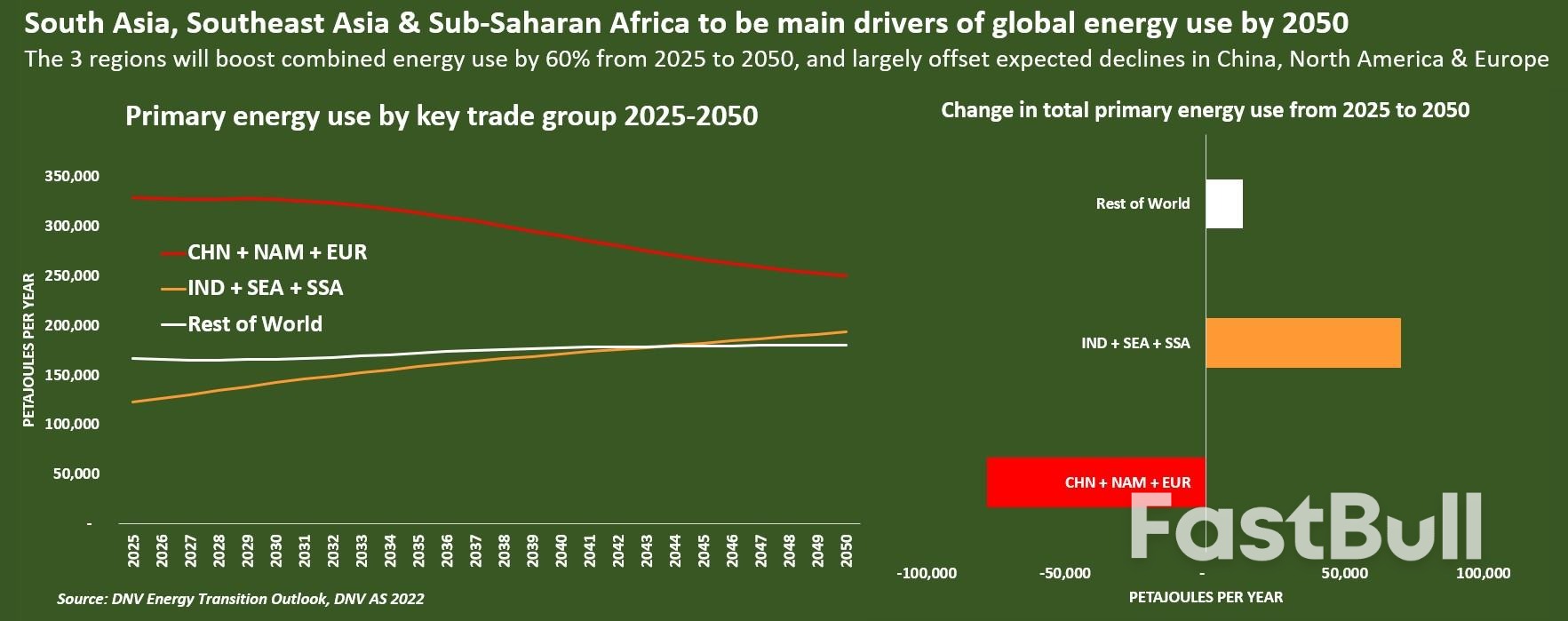
          The Indian subcontinent, Southeast Asia and Sub-Saharan Africa will overtake China, North America and Europe as the key drivers of world energy use through 2050, with implications for global emissions potential and accountability.
          China, the United States and Europe have been the main sources of economic growth and pollution for the past century, accounting for over half of all historic carbon dioxide (CO2) emissions and energy use, but also the majority of spending on renewable energy and emissions abatement.
          In contrast, the emerging markets within South Asia, Southeast Asia and Sub-Saharan Africa currently account for less than 20% of worldwide energy use and emissions, data from Norway-based risk assurance firm DNV shows, and have less funding available for energy transition efforts than larger peers.
          Global Energy Use and Emissions Hubs Set to Shift by 2050_1Even so, thanks to strong investment and demographic trends within several key countries including India, Indonesia, and Nigeria, these regions will boost their collective consumption of primary energy supplies - which includes transport fuels - by nearly 60% through 2050, according to DNV data.
          Offset
          This collective rise in energy use across emerging Asia and lower Africa will more than offset the expected contraction in energy consumption in China, Europe and North America through 2050, DNV data shows.
          Combined primary energy use in the Indian subcontinent, Southeast Asia and Sub-Saharan Africa will grow from roughly 115,000 petajoules in 2023 to nearly 194,000 petajoules by 2050, an expansion of more than 78,000 petajoules.
          Over the same period, China, Europe and North America are expected to trim their collective energy use from around 326,000 petajoules to 250,000 petajoules, or by around 76,000 petajoules.
          Global Energy Use and Emissions Hubs Set to Shift by 2050_2This means that global energy consumption will continue to grow from current levels by 2050, despite the efforts of current energy transition leaders to reduce energy use by mid-century, DNV data shows.
          Fossil Fuelled
          In addition to growing overall energy use, most Asian and African countries will remain overwhelmingly reliant on fossil fuels for at least the next decade, due to the slow roll out of green energy and underdeveloped electricity grids that will struggle to accommodate intermittent renewable energy supplies.
          This will likely result in a widening in the number of heavy emissions hubs from mainly in China and South Asia currently to parts of Southeast Asia and lower Africa, undermining efforts to cap pollution totals in all areas.
          South Asia's largest economy, India, is expected to rely on coal, natural gas and oil for more than 70% of primary energy needs through 2040, after which solar, wind and other clean energy supplies will emerge as the dominant sources of power.
          Global Energy Use and Emissions Hubs Set to Shift by 2050_3In Southeast Asia, more than 70% of primary energy is set to come from coal, natural gas and oil through 2035, while in Sub-Saharan Africa the share of fossil fuels in primary energy supplies is set to continue expanding until the mid-2040's, despite steep simultaneous advances in renewable energy supplies.
          Manufacturing Momentum
          Adjustments in manufacturing capacity are set to be a key driver of energy demand growth across Asia and Africa over the coming years.
          Downsizing of outdated or uncompetitive capacity is set to reduce Greater China's energy demand from manufacturing by 23% between 2025 and 2050, DNV data shows.
          Over the same period, Sub-Saharan Africa is set to experience a nearly 200% climb in energy demand for manufacturing as more factories and industrial plants emerge in the region in response to favourable labour market and capital investment trends.
          Strong growth rates in manufacturing energy demand are also expected in the Indian subcontinent (up 93% from 2025 to 2050), Southeast Asia (up 42.5% from 2025 to 2050) as well in as the Middle East, North Africa and Latin America.
          Global Energy Use and Emissions Hubs Set to Shift by 2050_4Currently, coal, natural gas and biomass are the primary sources of power for manufacturing in Africa and Asia, where abundant and affordable energy supplies are often more important to a manufacturers' bottom line than the emissions toll linked to its fuel source.
          However, given the widespread global support for rapid renewable energy deployment in all regions, it is likely that increased volumes of cheap green energy may displace some fossil fuels in certain markets over time.
          If so, the global energy landscape of 2050 will not just have drastically different geographic concentrations of energy use, but also a cleaner emissions profile that may support energy transition efforts.

          Source: Reuters

          Risk Warnings and Disclaimers
          You understand and acknowledge that there is a high degree of risk involved in trading. Following any strategies or investment methods may lead to potential losses. The content on the site is provided by our contributors and analysts for information purposes only. You are solely responsible for determining whether any trading assets, securities, strategy, or any other product is suitable for investing based on your own investment objectives and financial situation.
          Comments
          Add to Favorites
          Share
          FastBull
          Copyright © 2025 FastBull Ltd

          728 RM B 7/F GEE LOK IND BLDG NO 34 HUNG TO RD KWUN TONG KLN HONG KONG

          TelegramInstagramTwitterfacebooklinkedin
          App Store Google Play Google Play
          Products
          Charts

          Chats

          Q&A with Experts
          Screeners
          Economic Calendar
          Data
          Tools
          Membership
          Features
          Function
          Markets
          Copy Trading
          Latest Signals
          Contests
          News
          Analysis
          24/7
          Columns
          Education
          Company
          Careers
          About Us
          Contact Us
          Advertising
          Help Center
          Feedback
          User Agreement
          Privacy Policy
          Business

          White Label

          Data API

          Web Plug-ins

          Poster Maker

          Affiliate Program

          Risk Disclosure

          The risk of loss in trading financial instruments such as stocks, FX, commodities, futures, bonds, ETFs and crypto can be substantial. You may sustain a total loss of the funds that you deposit with your broker. Therefore, you should carefully consider whether such trading is suitable for you in light of your circumstances and financial resources.

          No decision to invest should be made without thoroughly conducting due diligence by yourself or consulting with your financial advisors. Our web content might not suit you since we don't know your financial conditions and investment needs. Our financial information might have latency or contain inaccuracy, so you should be fully responsible for any of your trading and investment decisions. The company will not be responsible for your capital loss.

          Without getting permission from the website, you are not allowed to copy the website's graphics, texts, or trademarks. Intellectual property rights in the content or data incorporated into this website belong to its providers and exchange merchants.

          Not Logged In

          Log in to access more features

          FastBull Membership

          Not yet

          Purchase

          Become a signal provider
          Help Center
          Customer Service
          Dark Mode
          Price Up/Down Colors

          Log In

          Sign Up

          Position
          Layout
          Fullscreen
          Default to Chart
          The chart page opens by default when you visit fastbull.com