

Markets
News
Analysis
User
24/7
Economic Calendar
Education
Data
- Names
- Latest
- Prev



Signal Accounts for Members
All Signal Accounts
All Contests
 Japan Tankan Small Manufacturing Outlook Index (Q4)
A:--
F: --
P: --
Japan Tankan Large Non-Manufacturing Outlook Index (Q4)A:--
F: --
P: --
Japan Tankan Large Manufacturing Outlook Index (Q4)A:--
F: --
P: --
Japan Tankan Small Manufacturing Diffusion Index (Q4)A:--
F: --
P: --
Japan Tankan Large-Enterprise Capital Expenditure YoY (Q4)A:--
F: --
P: --
 U.K. Rightmove House Price Index YoY (Dec)
A:--
F: --
P: --
 China, Mainland Industrial Output YoY (YTD) (Nov)
A:--
F: --
P: --
China, Mainland Urban Area Unemployment Rate (Nov)A:--
F: --
P: --
 Saudi Arabia CPI YoY (Nov)
A:--
F: --
P: --
 Euro Zone Industrial Output YoY (Oct)
A:--
F: --
P: --
Euro Zone Industrial Output MoM (Oct)A:--
F: --
P: --
 Canada Existing Home Sales MoM (Nov)
A:--
F: --
P: --
Canada National Economic Confidence IndexA:--
F: --
P: --
Canada New Housing Starts (Nov)A:--
F: --
 U.S. NY Fed Manufacturing Employment Index (Dec)
A:--
F: --
P: --
U.S. NY Fed Manufacturing Index (Dec)A:--
F: --
P: --
Canada Core CPI YoY (Nov)A:--
F: --
P: --
Canada Manufacturing Unfilled Orders MoM (Oct)A:--
F: --
P: --
U.S. NY Fed Manufacturing Prices Received Index (Dec)A:--
F: --
P: --
U.S. NY Fed Manufacturing New Orders Index (Dec)A:--
F: --
P: --
Canada Manufacturing New Orders MoM (Oct)A:--
F: --
P: --
Canada Core CPI MoM (Nov)A:--
F: --
P: --
Canada Trimmed CPI YoY (SA) (Nov)A:--
F: --
P: --
Canada Manufacturing Inventory MoM (Oct)A:--
F: --
P: --
Canada CPI YoY (Nov)A:--
F: --
P: --
Canada CPI MoM (Nov)A:--
F: --
P: --
Canada CPI YoY (SA) (Nov)A:--
F: --
P: --
Canada Core CPI MoM (SA) (Nov)A:--
F: --
P: --
Canada CPI MoM (SA) (Nov)A:--
F: --
P: --
Federal Reserve Board Governor Milan delivered a speech U.S. NAHB Housing Market Index (Dec)A:--
F: --
P: --
 Australia Composite PMI Prelim (Dec)
--
F: --
P: --
Australia Services PMI Prelim (Dec)--
F: --
P: --
Australia Manufacturing PMI Prelim (Dec)--
F: --
P: --
Japan Manufacturing PMI Prelim (SA) (Dec)--
F: --
P: --
U.K. 3-Month ILO Employment Change (Oct)--
F: --
P: --
U.K. Unemployment Claimant Count (Nov)--
F: --
P: --
U.K. Unemployment Rate (Nov)--
F: --
P: --
U.K. 3-Month ILO Unemployment Rate (Oct)--
F: --
P: --
U.K. Average Weekly Earnings (3-Month Average, Including Bonuses) YoY (Oct)--
F: --
P: --
U.K. Average Weekly Earnings (3-Month Average, Excluding Bonuses) YoY (Oct)--
F: --
P: --
 France Services PMI Prelim (Dec)
--
F: --
P: --
France Composite PMI Prelim (SA) (Dec)--
F: --
P: --
France Manufacturing PMI Prelim (Dec)--
F: --
P: --
 Germany Services PMI Prelim (SA) (Dec)
--
F: --
P: --
Germany Manufacturing PMI Prelim (SA) (Dec)--
F: --
P: --
Germany Composite PMI Prelim (SA) (Dec)--
F: --
P: --
Euro Zone Composite PMI Prelim (SA) (Dec)--
F: --
P: --
Euro Zone Services PMI Prelim (SA) (Dec)--
F: --
P: --
Euro Zone Manufacturing PMI Prelim (SA) (Dec)--
F: --
P: --
U.K. Services PMI Prelim (Dec)--
F: --
P: --
U.K. Manufacturing PMI Prelim (Dec)--
F: --
P: --
U.K. Composite PMI Prelim (Dec)--
F: --
P: --
Euro Zone ZEW Economic Sentiment Index (Dec)--
F: --
P: --
Germany ZEW Current Conditions Index (Dec)--
F: --
P: --
Germany ZEW Economic Sentiment Index (Dec)--
F: --
P: --
Euro Zone Trade Balance (Not SA) (Oct)--
F: --
P: --
Euro Zone ZEW Current Conditions Index (Dec)--
F: --
P: --
Euro Zone Trade Balance (SA) (Oct)--
F: --
P: --
Euro Zone Total Reserve Assets (Nov)--
F: --
P: --
U.K. Inflation Rate Expectations--
F: --
P: --


No matching data

Latest Views
Latest Views
Trending Topics
Top Columnists
Latest Update
White Label
Data API
Web Plug-ins
Affiliate Program
View All
No data
President Donald Trump on Friday said that he ordered two nuclear submarines "to be positioned in the appropriate regions" in response to warnings made to the United States by top Russian official Dmitry Medvedev earlier this week.
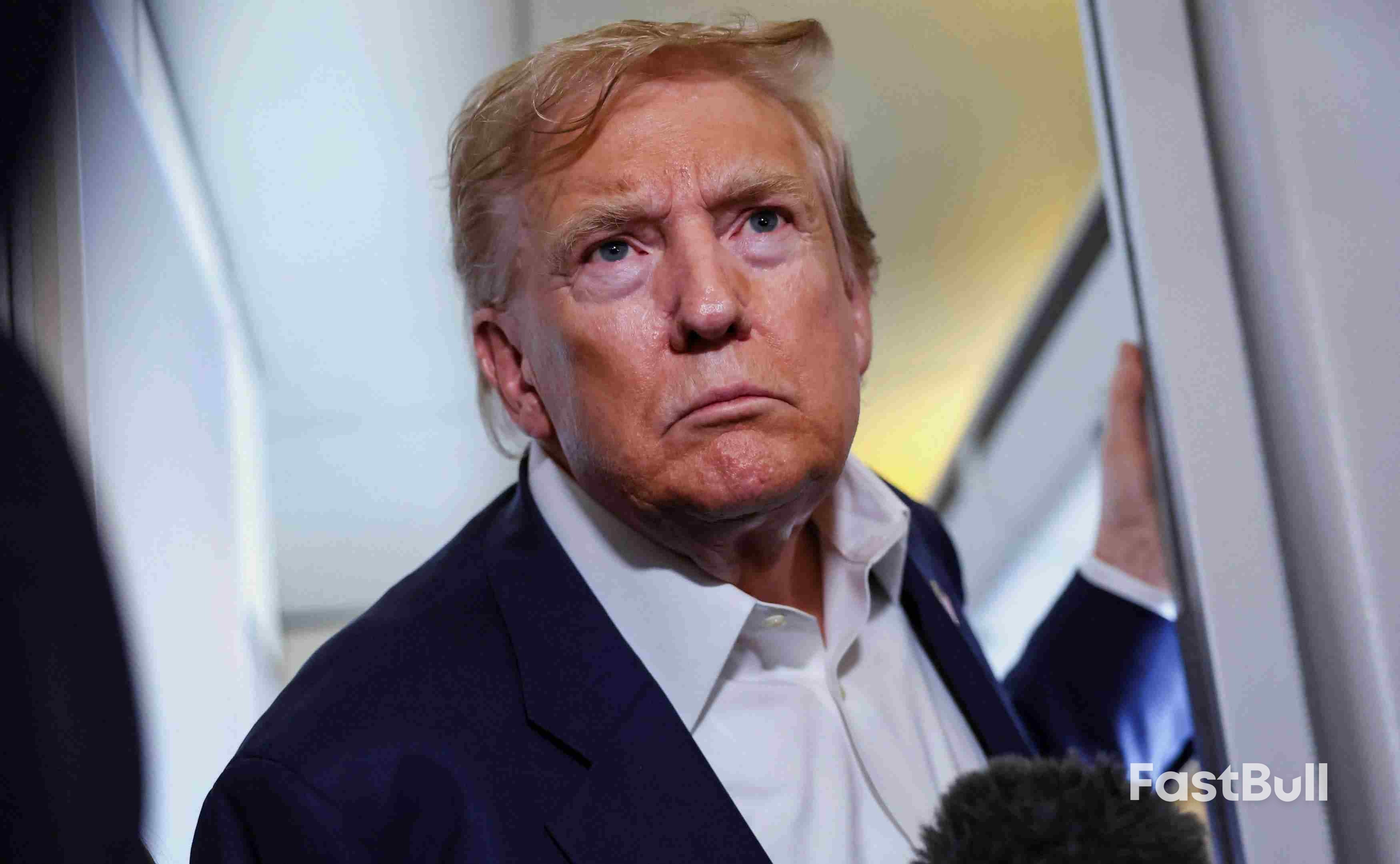
President Donald Trump on Friday said that he ordered two nuclear submarines "to be positioned in the appropriate regions" in response to warnings made to the United States by top Russian official Dmitry Medvedev earlier this week.
"Based on the highly provocative statements of the Former President of Russia, Dmitry Medvedev, who is now the Deputy Chairman of the Security Council of the Russian Federation, I have ordered two Nuclear Submarines to be positioned in the appropriate regions, just in case these foolish and inflammatory statements are more than just that," Trump said in a Truth Social post.
"Words are very important, and can often lead to unintended consequences. I hope this will not be one of those instances. Thank you for your attention to this matter!"

Medvedev, in a post on X on Monday, wrote, "Trump's playing the ultimatum game with Russia: 50 days or 10… He should remember 2 things."
"1. Russia isn't Israel or even Iran. 2. Each new ultimatum is a threat and a step towards war," Medvedev wrote.
"Not between Russia and Ukraine, but with his own country. Don't go down the Sleepy Joe road!" Medvedev added, referring to former President Joe Biden.
U.S. employment growth was weaker than expected in July while the nonfarm payrolls count for the prior two months was revised down by a massive 258,000 jobs, suggesting a sharp deterioration in labor market conditions that puts a September interest rate cut by the Federal Reserve back on the table.
The Labor Department's closely watched employment report on Friday also showed the unemployment rate rose to 4.2% last month as household employment declined. Labor market resilience has shored up the economy amid headwinds from President Donald Trump's aggressive trade and immigration policies.
Import duties are starting to boost inflation, raising the risk that the economy could experience a period of tepid growth and high prices, known as stagflation, which would put the U.S. central bank in a difficult position. Domestic demand increased at its slowest pace in 2-1/2 years in the second quarter.
"The president's unorthodox economic agenda and policies may be starting to make a dent in the labor market," said Christopher Rupkey, chief economist at FWDBONDS. "The door to a Fed rate cut in September just got opened a crack wider. The labor market is not rolling over, but it is badly wounded and may yet bring about a reversal in the U.S. economy's fortunes."
Nonfarm payrolls increased by 73,000 jobs last month after rising by a downwardly revised 14,000 in June, the fewest in nearly five years, the Labor Department's Bureau of Labor Statistics said. Economists polled by Reuters had forecast payrolls would increase by 110,000 jobs after rising by a previously reported 147,000 in June. Estimates ranged from no jobs added to an increase of 176,000 positions.
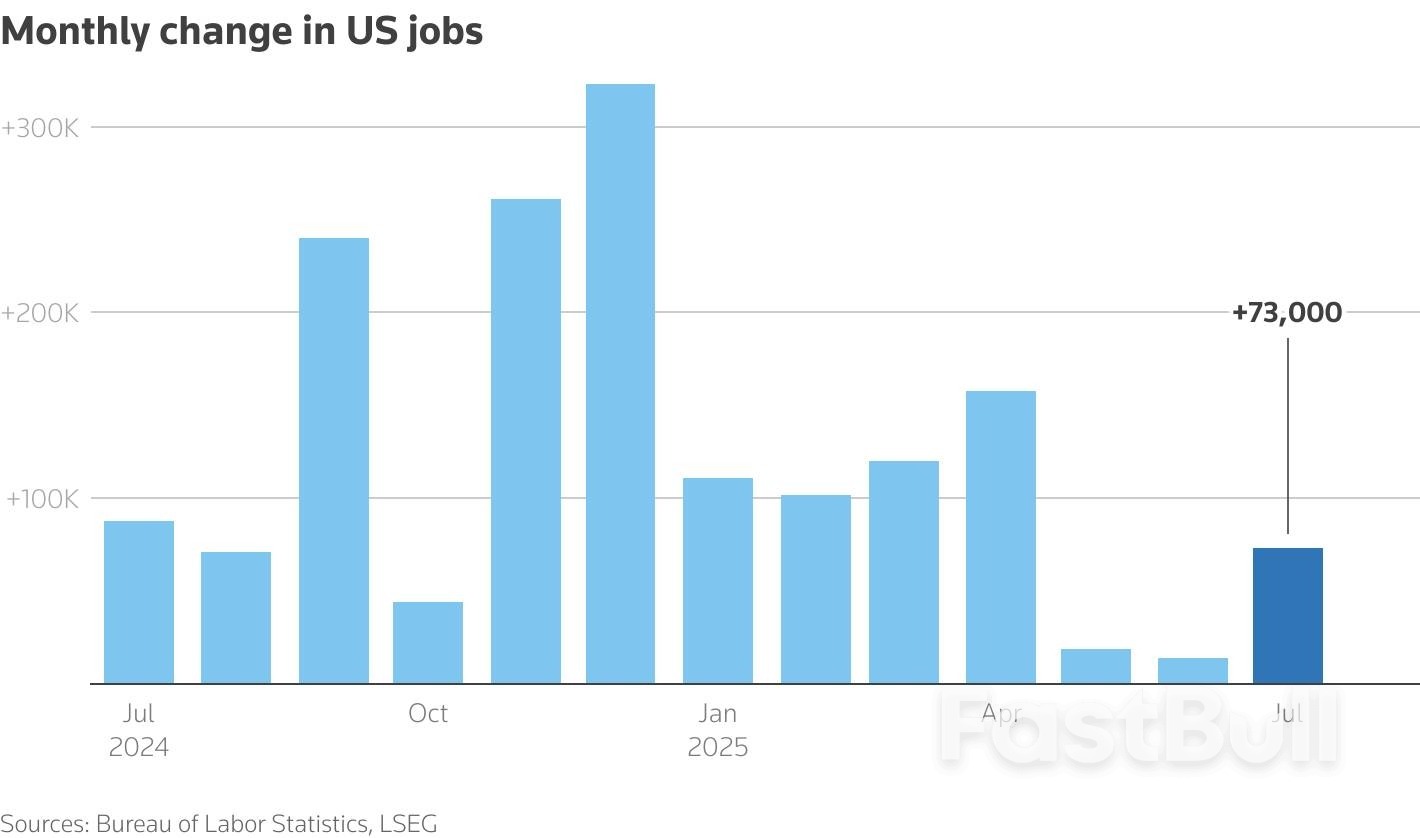
Payrolls for May were slashed by 125,000 to only a gain of 19,000 jobs. The BLS described the revisions to May and June payrolls data as "larger than normal."
It gave no reason for the revised data but noted that "monthly revisions result from additional reports received from businesses and government agencies since the last published estimates and from the recalculation of seasonal factors."
Economists have raised concerns about data quality in the wake of the Trump administration's mass firings of federal workers.
Employment gains averaged 35,000 jobs per month over the last three months compared to 123,000 a year ago. Uncertainty over where tariff levels will eventually settle has made it harder for businesses to plan long-term, economists said.
Though more clarity has emerged as the White House announced trade deals, economists said the effective tariff rate was still the highest since the 1930s. Trump on Thursday slapped dozens of trading partners with steep tariffs, including a 35% duty on many goods from Canada.
Trump, who has demanded the U.S. central bank lower borrowing costs, stepped up his insults aimed at Fed Chair Jerome Powell, posting on the Truth Social media platform, "Too Little, Too Late. Jerome "Too Late" Powell is a disaster."
The Fed on Wednesday left its benchmark interest rate in the 4.25%-4.50% range. Powell's comments after the decision undercut confidence the central bank would resume its policy easing in September as had been widely anticipated by financial markets and some economists.
Powell is focused on the unemployment rate. Financial markets now expect the Fed to resume its monetary policy easing next month after pushing back rate-cut expectations to October in the wake of Wednesday's policy decision.
The case for a September rate cut could be reinforced by the BLS' preliminary payrolls benchmark revision next month, which is expected to project a steep drop in the employment level from April 2024 through March of this year.
The Quarterly Census of Employment and Wages data, derived from reports by employers to the state unemployment insurance programs, has indicated a much slower pace of job growth between April 2024 and December 2024 than payrolls have suggested.
Stocks on Wall Street were trading lower on the data and latest round of tariffs. The dollar fell against a basket of currencies. U.S. Treasury yields dropped.
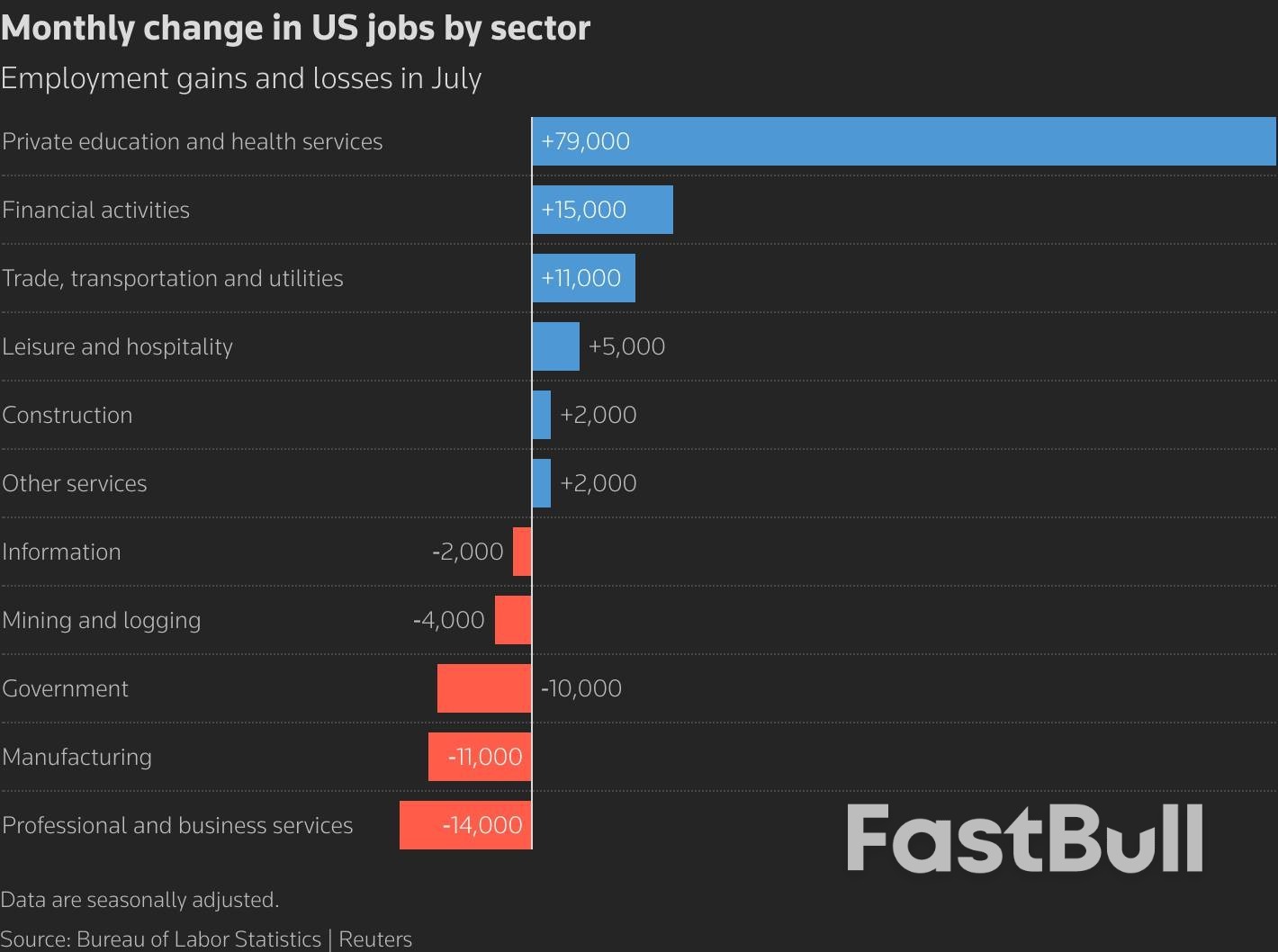
Job gains in July continued to be concentrated in the healthcare and social assistance sector, which added a combined 73,300 jobs. Retail employment increased by 15,700 jobs and financial activities payrolls rose by 15,000.
There were small job gains in the construction and leisure and hospitality industries, which economists attributed to ongoing immigration raids. Several industries, including manufacturing, professional services and wholesale trade shed jobs.
The share of industries reporting job growth, however, rose to 51.2% from 47.2% in June. Federal government employment dropped by another 12,000 positions and is down 84,000 since peaking in January. More job losses are likely after the Supreme Court gave the White House the green light for mass firings as Trump seeks to slash spending and headcount. But the administration has also said several agencies were not planning to proceed with layoffs.
The unemployment rate increased to 4.248% before rounding last month. It declined to 4.1% in June also as people dropped out of the labor force, and remains in the narrow 4.0%-4.2% range that has prevailed since May 2024.
The government's immigration crackdown has reduced labor supply, as has an acceleration of baby boomer retirements. Economists estimated the economy now needs to create less than 100,000 jobs per month to keep up with growth in the working-age population.
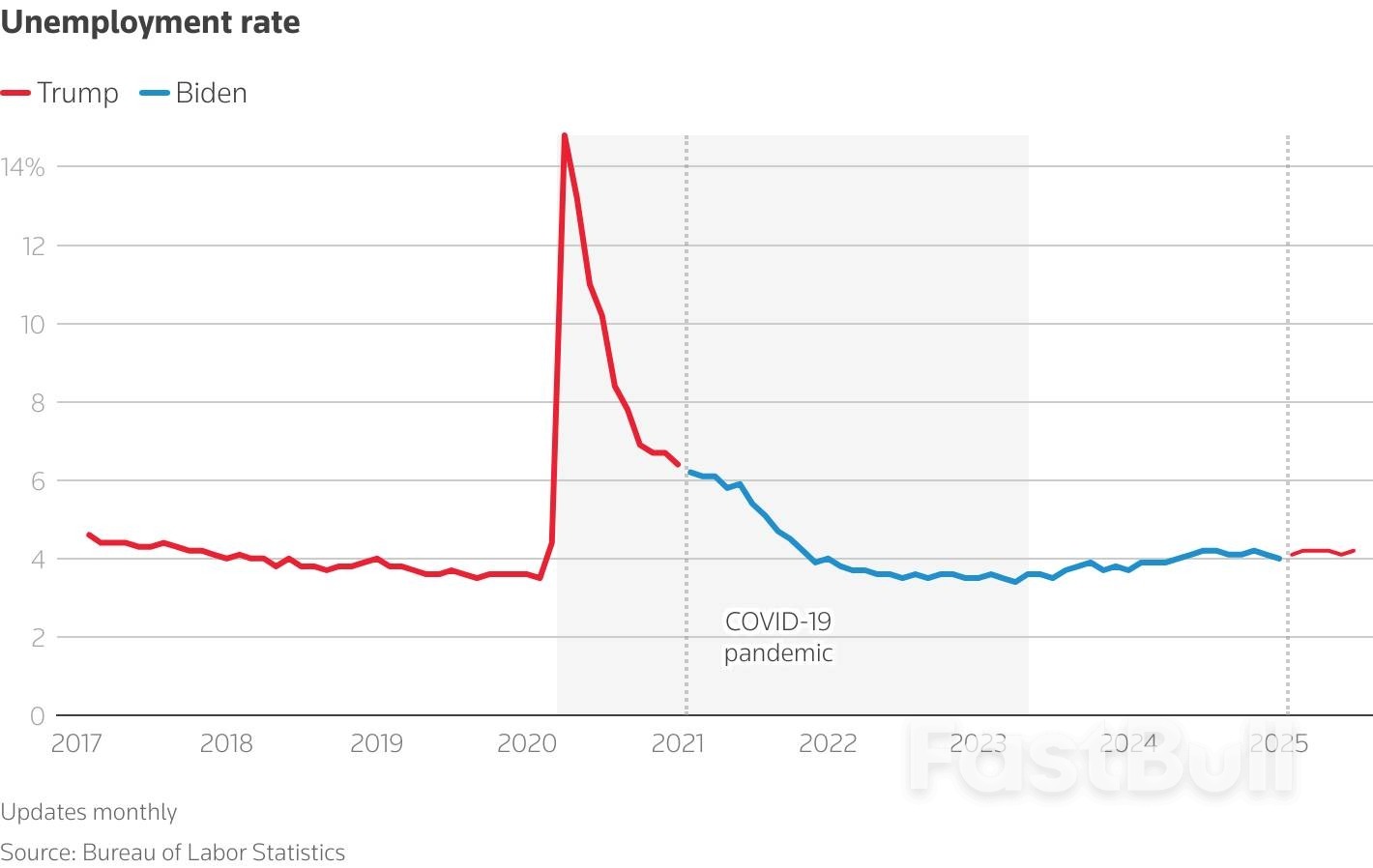
About 38,000 people left the labor force, which was offset by a drop of 260,000 in household employment. The labor force participation rate fell to 62.2% from 62.3% in June, now down for three straight months and capping the rise in the jobless rate.
"Without the participation rate decline, the unemployment rate would have added another tenth to a solid 4.3%," said Michael Gapen, chief U.S. economist at Morgan Stanley. "Immigration restrictions have and will continue to have a chilling effect on participation and will continue to add to downward pressure on the unemployment rate."
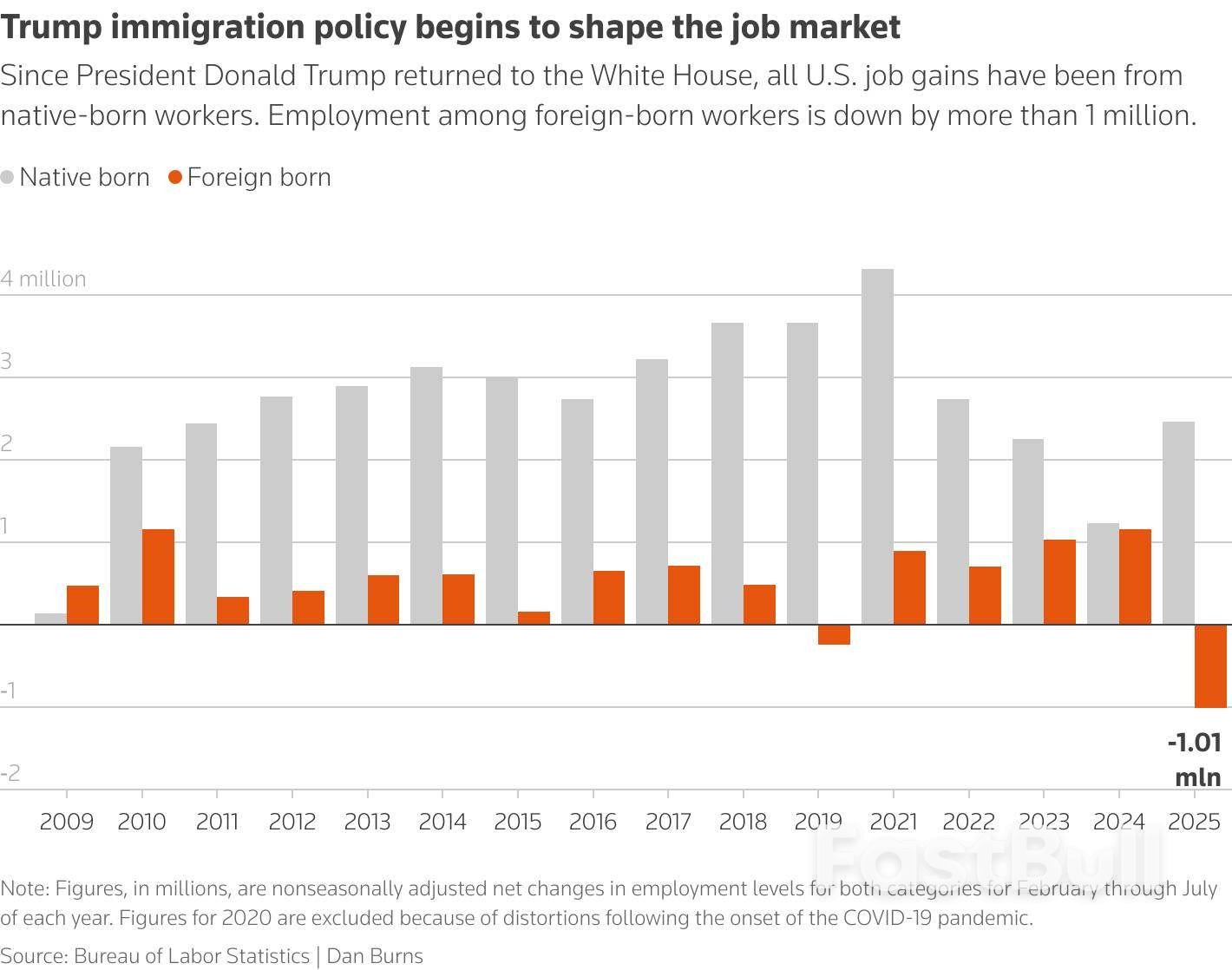
The number of foreign-born workers fell by 341,000. Economists said this decline along with the drop in the labor force kept annual wage growth at a lofty 3.9%. There were more part-time workers and a jump in the number of people experiencing long bouts of unemployment. The median duration of unemployment increased to 10.2 weeks from 10.1 weeks in June.
"One gets the sense that due to trade and immigration policy the domestic economy and labor market are paying a price," said Joseph Brusuelas, chief economist at RSM US. "Stagflation is the best description of the domestic economy as we enter the second half of the year."
For months, Wall Street brushed off Donald Trump’s trade war and the Federal Reserve’s higher-for-longer stance — confident a resilient economy would keep propping up US markets.
This week, that confidence began to unravel. Weak job growth and Trump’s latest volley of tariffs rattled investors, intensifying pressure on Fed Chair Jerome Powell to lower interest rates and exposing a new unease with the White House’s protectionist push.
A three-month stretch of nearly unbroken market calm was shattered on Friday after a US report showed a sharp slowdown in the labor market. Traders rushed into the safety of government bonds — pushing down yields on two-year notes to 3.71% in the biggest drop since last August — while ramping up bets for a rate cut as soon as next month. The dollar fell and the S&P 500 Index retreated from an all-time high, poised for the worst week since May.
Volatility whipped up across markets as traders re-assessed the economic reality after $15 trillion was added to equity values since April. The Cboe Volatility Index, a gauge of options cost, jumped to approach the widely watched level of 20 for the first time since April’s tariff-induced rout. Similar measures on high-yield and investment-grade bonds also climbed.
“Lots of folks have their eyes on the exit door. Some frothy signs are appearing,” said Joe Saluzzi, co-head of equity trading at Themis Trading. “Weak job numbers should solidify the rate cut story for September, but there is some worry that the Fed is waiting too long.”
Friday’s market action marked a sharp reversal from July, when the dollar rallied, haven trades were abandoned and US equities outpaced their international peers, buoyed by stronger‑than‑expected earnings and a still‑healthy economic growth.
That narrative took a hit at the end of the week. Trump’s new tariffs — lifting the average US levy on global imports to 15%, the steepest since the 1930s — landed just as data showed job growth cooling more than expected. The prospect for a slowdown caused traders to ratchet up the likelihood for a rate cut in September to 88%, up from 40% earlier this week.
The specter of lower rates sent the dollar down as much as 1%, the worst intraday drop since April. Economically sensitive companies led the retreat in the S&P 500 amid growth angst. The Russell 2000 Index of small-caps extended declines for a fifth day, poised for the worst week in four months.
“Investors may have gotten too complacent while waiting for the impacts of slower economic activity resulting from tariffs and higher interest rates,” said Charlie Ripley, senior investment strategist for Allianz Investment Management. “The economic cooling associated to tariffs is beginning to take hold. Softer labor conditions should raise eyebrows at the Fed and knowing they have been a reactionary organization in recent years, we should expect a higher chance of Fed action in the coming months.”
The duo retreat in the US dollar and equities highlights July’s fragility of the resurgence in American exceptionalism. Betting against the dollar — voted as the “most crowded trade” for the first time on record in Bank of America Corp.’s survey of money managers — turned out to be one of the biggest blunders as the greenback posed its first monthly gain since Trump took office. US skeptics, who continued to dominate in BofA’s survey, also had a setback in stocks as the S&P 500 outperformed the rest of the world for a fourth straight month.
The renewed weakness likely marked a welcome development to those who stuck to a preference in non-US assets of late. Rich Weiss, chief investment officer for multi-asset strategies at American Century Investment Management, has continued to be underweight US equities, citing stretched valuations.
“There are significant potential negatives out there with the deficit, tariffs and inflation,” he said. “The overall volatility, which President Trump himself deduces into the whole equation, indicates we still should remain somewhat cautious.”
Gold prices rose almost 2%, hitting a one-week high, on Friday after weaker-than-expected U.S. payrolls data boosted Federal Reserve rate cut expectations and fresh tariff announcements spurred safe-haven demand.
Spot gold climbed 1.9% to $3,351.61 per ounce, as of 0931 a.m. ET (13:31 GMT), reaching its highest level since July 25. Bullion was up 0.3% so far this week.U.S. gold futures rose 1.7% to $3,405.20."Payrolls numbers came in at below expectations, but a little higher than the market was printing. So, this gives a better probability that the Federal Reserve will cut (rates) later in the year," said Bart Melek, head of commodity strategies at TD Securities.
"We've got a situation where we have inflationary pressures continuing from tariffs and wages, yet job numbers are disappointing. So in that situation, if the Fed cuts (rates), that's going to have material impact on gold in a positive way."
Gold, a non-yielding asset, tends to perform well in a low-interest-rate environment.
U.S. job growth slowed more than expected in July, with nonfarm payrolls increasing by 73,000 jobs last month, after rising by a downwardly revised 14,000 in June, the Labor Department's Bureau of Labor Statistics said.
Market participants are now anticipating two rate cuts by year-end, beginning in September.
Earlier this week, the U.S. central bank left interest rates unchanged in 4.25%-4.50% range, with Fed Chair Jerome Powell saying it's too soon to say whether the central bank will cut its interest rate target in September.
On the trade front, Trump's latest wave of tariffs on exports from dozens of trading partners, including Canada, Brazil, India and Taiwan, sent global markets tumbling as countries pushed for talks to clinch better deals.
Safe-haven gold thrives during economic and geopolitical turmoil.
Spot silver was up 1.1% to $37.14 per ounce, platinum added 0.6% to $1,296.58 and palladium gained 2.3% at $1,217.91.
Thailand's army sent home two Cambodian soldiers from a group of 20 on Friday, ahead of a key meeting in Malaysia next week where defence ministers and military commanders will hold talks aimed at maintaining a ceasefire along their disputed border.Long-simmering tensions on the Thai-Cambodian border exploded into clashes last week, including exchanges of artillery fire and jet fighter sorties, the worst fighting between the Southeast Asian neighbours in over a decade.
The clashes claimed at least 43 lives and left over 300,000 people displaced.A truce was achieved on Monday, following a push by Malaysia and phone calls from U.S President Trump who threatened to hold off tariff negotiations with both countries until fighting stopped.Thailand and Cambodia previously faced tariffs of 36% for sending goods to the U.S., their largest export markets. Following further negotiations, they will now pay a 19% tariff, the White House announced on Friday.
In Bangkok, Thai government spokesperson Jirayu Houngsub told reporters on Friday that two Cambodian soldiers had been sent back, and the remaining 18 were being processed for violating immigration law."The Cambodian soldiers intruded on Thai territory and the army took them into custody, treating them based on humanitarian principles," he said.
In a statement, the Cambodian defence ministry asked Thailand to return all the detained soldiers."Cambodia is actively engaging in negotiations to secure their release, and reiterates its firm call for their immediate and unconditional release in accordance with the international humanitarian law," a ministry spokesperson said.Defence ministers and military leaders from both sides, who were previously scheduled to meet in the Cambodian capital next week, will now hold talks in Malaysia, after Thailand sought a neutral venue for the meeting.
The General Border Committee, which coordinates on border security, ceasefires, and troop deployments, will meet between August 4-7, Thai Acting Defence Minister Nattaphon Narkphanit told reporters."Defence attachés from other ASEAN countries will be invited as well as the defence attachés from the U.S. and China," a Malaysian government spokesperson told reporters, referring to the Southeast Asian regional bloc that the country currently chairs.Thailand and Cambodia have for decades claimed jurisdiction over undemarcated points along their 817-km (508-mile) land border, with ownership of several ancient temples at the centre of disputes.
In May, a Cambodian soldier was killed in a skirmish, leading to a troop build-up and a diplomatic crisis, which eventually snowballed into five-days of intense fighting in late July.
728 RM B 7/F GEE LOK IND BLDG NO 34 HUNG TO RD KWUN TONG KLN HONG KONG


White Label
Data API
Web Plug-ins
Poster Maker
Affiliate Program
The risk of loss in trading financial instruments such as stocks, FX, commodities, futures, bonds, ETFs and crypto can be substantial. You may sustain a total loss of the funds that you deposit with your broker. Therefore, you should carefully consider whether such trading is suitable for you in light of your circumstances and financial resources.
No decision to invest should be made without thoroughly conducting due diligence by yourself or consulting with your financial advisors. Our web content might not suit you since we don't know your financial conditions and investment needs. Our financial information might have latency or contain inaccuracy, so you should be fully responsible for any of your trading and investment decisions. The company will not be responsible for your capital loss.
Without getting permission from the website, you are not allowed to copy the website's graphics, texts, or trademarks. Intellectual property rights in the content or data incorporated into this website belong to its providers and exchange merchants.
Not Logged In
Log in to access more features

FastBull Membership
Not yet
Purchase


Log In
Sign Up


