• Trade
  • Markets
  • Copy
  • Contests
  • News
  • 24/7
  • Calendar
  • Q&A
  • Chats
Screeners
SYMBOL
LAST
ASK
BID
HIGH
LOW
NET CHG.
%CHG.
SPREAD
SPX
S&P 500 Index
6939.02
6939.02
6939.02
6964.08
6893.47
-29.99
-0.43%
--
DJI
Dow Jones Industrial Average
48892.46
48892.46
48892.46
49047.68
48459.88
-179.09
-0.36%
--
IXIC
NASDAQ Composite Index
23461.81
23461.81
23461.81
23662.25
23351.55
-223.30
-0.94%
--
USDX
US Dollar Index
96.970
97.050
96.970
97.140
96.840
-0.020
-0.02%
--
EURUSD
Euro / US Dollar
1.18577
1.18585
1.18577
1.18745
1.18393
+0.00086
+ 0.07%
--
GBPUSD
Pound Sterling / US Dollar
1.36819
1.36831
1.36819
1.37053
1.36600
-0.00016
-0.01%
--
XAUUSD
Gold / US Dollar
4573.64
4574.05
4573.64
4884.47
4402.03
-320.85
-6.56%
--
WTI
Light Sweet Crude Oil
61.599
61.629
61.599
63.933
61.209
-3.828
-5.85%
--

Community Accounts

Signal Accounts
--
Profit Accounts
--
Loss Accounts
--
View More

Become a signal provider

Sell trading signals to earn additional income

View More

Guide to Copy Trading

Get started with ease and confidence

View More

Signal Accounts for Members

All Signal Accounts

Best Return
  • Best Return
  • Best P/L
  • Best MDD
Past 1W
  • Past 1W
  • Past 1M
  • Past 1Y

All Contests

  • All
  • Trump Updates
  • Recommend
  • Stocks
  • Cryptocurrencies
  • Central Banks
  • Featured News
Top News Only
Share

India's Nifty 50 Index Last Up 0.5%

Share

Swedish Manufacturing PMI 56.0 Points In Jan - Silf/Swedbank

Share

Stats Office - Swiss December Retail Sales +2.9% Year-On-Year Versus Revised +1.7% In Previous Month

Share

Iran's Foreign Ministry Spokesperson Baghaei Says Tehran Is Examining Details Of Various Diplomatic Processes, Hopes For Results In Coming Days

Share

Israel Expected To Reopen Gaza's Rafah Border Crossing To Egypt, With Limits

Share

FAA Head Says Concerned Other Countries Aren't Putting Enough Resources Into Certifying USA Aircraft

Share

European Benchmark Gas Contract Falls 10.5% To 35.50 EUR/Mwh - Lseg Data

Share

Statistics Bureau - Kazakhstan's January CPI At 1.0% Month-On-Month

Share

S&P Global: Kazakhstan January Manufacturing PMI At 49.8%

Share

German Dec Retail Sales +1.5 Percent Year-On-Year (Versus Reuters Consensus Forecast For +1.1 Percent)

Share

Russian Security Committee's Vice Chairman Medvedev: Russia Will Not Accept NATO-Member Forces In Ukraine

Share

Russian Security Committee's Vice Chairman Medvedev: Nuclear Arms Control For Past 60 Years Helped Verify Intentions And Build Trust

Share

Russian Security Committee's Vice Chairman Medvedev: The Territorial Issue In Ukraine Talks Is Most Complicated

Share

Russian Security Committee's Vice Chairman Medvedev: If New Start Expires It Does Not Necessarily Mean A Catastrophe But It Should Alarm Everyone

Share

Russian Security Committee's Vice Chairman Medvedev: Our Proposal To USA On Extending The Limits Of New Start Remains On The Table

Share

USA Dollar Jumps 1% Against Norwegian Crown To 9.7062

Share

Turkey's Main BIST 100 Index Down 1.7% At Early Trading

Share

India's Nifty 50 Index Last Up 0.4%

Share

Kazakhstan's Central Bank Says It Sold Foreign Currency Worth 350 Billion Tenge In January To Mirror Gold Purchases, Will Sell Foreign Currency Worth 350 Billion In February

Share

Spot Gold Extends Losses, Last Down Over 9% At $4403,29.Oz

TIME
ACT
FCST
PREV
U.S. Core PPI YoY (Dec)

A:--

F: --

P: --
U.S. Core PPI MoM (SA) (Dec)

A:--

F: --

P: --

U.S. PPI YoY (Dec)

A:--

F: --

P: --

U.S. PPI MoM (SA) (Dec)

A:--

F: --

P: --

Canada GDP MoM (SA) (Nov)

A:--

F: --

P: --

Canada GDP YoY (Nov)

A:--

F: --

P: --

U.S. PPI MoM Final (Excl. Food, Energy and Trade) (SA) (Dec)

A:--

F: --

P: --

U.S. PPI YoY (Excl. Food, Energy & Trade) (Dec)

A:--

F: --

P: --

U.S. Chicago PMI (Jan)

A:--

F: --

P: --
Canada Federal Government Budget Balance (Nov)

A:--

F: --

P: --

U.S. Weekly Total Oil Rig Count

A:--

F: --

P: --

U.S. Weekly Total Rig Count

A:--

F: --

P: --

China, Mainland NBS Manufacturing PMI (Jan)

A:--

F: --

P: --

China, Mainland NBS Non-manufacturing PMI (Jan)

A:--

F: --

P: --

China, Mainland Composite PMI (Jan)

A:--

F: --

P: --

South Korea Trade Balance Prelim (Jan)

A:--

F: --

P: --
Japan Manufacturing PMI Final (Jan)

A:--

F: --

P: --

South Korea IHS Markit Manufacturing PMI (SA) (Jan)

A:--

F: --

P: --

Indonesia IHS Markit Manufacturing PMI (Jan)

A:--

F: --

P: --

China, Mainland Caixin Manufacturing PMI (SA) (Jan)

A:--

F: --

P: --

Indonesia Trade Balance (Dec)

A:--

F: --

P: --

Indonesia Inflation Rate YoY (Jan)

A:--

F: --

P: --

Indonesia Core Inflation YoY (Jan)

A:--

F: --

P: --

India HSBC Manufacturing PMI Final (Jan)

A:--

F: --

P: --

Australia Commodity Price YoY (Jan)

A:--

F: --

P: --

Russia IHS Markit Manufacturing PMI (Jan)

A:--

F: --

P: --

Turkey Manufacturing PMI (Jan)

A:--

F: --

P: --

U.K. Nationwide House Price Index MoM (Jan)

A:--

F: --

P: --

U.K. Nationwide House Price Index YoY (Jan)

A:--

F: --

P: --

Germany Actual Retail Sales MoM (Dec)

A:--

F: --

P: --
Italy Manufacturing PMI (SA) (Jan)

--

F: --

P: --

South Africa Manufacturing PMI (Jan)

--

F: --

P: --

Euro Zone Manufacturing PMI Final (Jan)

--

F: --

P: --

U.K. Manufacturing PMI Final (Jan)

--

F: --

P: --

Brazil IHS Markit Manufacturing PMI (Jan)

--

F: --

P: --

Canada National Economic Confidence Index

--

F: --

P: --

Canada Manufacturing PMI (SA) (Jan)

--

F: --

P: --

U.S. IHS Markit Manufacturing PMI Final (Jan)

--

F: --

P: --

U.S. ISM Output Index (Jan)

--

F: --

P: --

U.S. ISM Inventories Index (Jan)

--

F: --

P: --

U.S. ISM Manufacturing Employment Index (Jan)

--

F: --

P: --

U.S. ISM Manufacturing New Orders Index (Jan)

--

F: --

P: --

U.S. ISM Manufacturing PMI (Jan)

--

F: --

P: --

South Korea CPI YoY (Jan)

--

F: --

P: --

Japan Monetary Base YoY (SA) (Jan)

--

F: --

P: --

Australia Building Approval Total YoY (Dec)

--

F: --

P: --

Australia Building Permits MoM (SA) (Dec)

--

F: --

P: --

Australia Building Permits YoY (SA) (Dec)

--

F: --

P: --

Australia Private Building Permits MoM (SA) (Dec)

--

F: --

P: --

Australia Overnight (Borrowing) Key Rate

--

F: --

P: --

RBA Rate Statement
Japan 10-Year Note Auction Yield

--

F: --

P: --

Saudi Arabia IHS Markit Composite PMI (Jan)

--

F: --

P: --

RBA Press Conference
Turkey PPI YoY (Jan)

--

F: --

P: --

Turkey CPI YoY (Jan)

--

F: --

P: --

Turkey CPI YoY (Excl. Energy, Food, Beverage, Tobacco & Gold) (Jan)

--

F: --

P: --

Q&A with Experts
    • All
    • Chatrooms
    • Groups
    • Friends
    SlowBear ⛅ flag
    Ikeh Sunday
    @Ikeh Sunday yes i agree, yoi sure know how to piik those trade but this is the first time seeing you go below 4h
    SlowBear ⛅ flag
    Ikeh Sunday
    @Ikeh Sundayalso, you are trading Gold today and not silver
    Ikeh Sunday flag
    am looking at 70.200 in silver sell signal
    Ikeh Sunday flag
    SlowBear ⛅
    @SlowBear ⛅no silver only as usual
    Kung Fu flag
    Ikeh Sunday
    am looking at 70.200 in silver sell signal
    @Ikeh Sundayis this for intraday or for swing
    SlowBear ⛅ flag
    Ikeh Sunday
    am looking at 70.200 in silver sell signal
    @Ikeh Sunday Well i will say that it is feasible, a s the current market price is at 75.01
    SlowBear ⛅ flag
    Ikeh Sunday
    @Ikeh SundayReally? cos the chart i saw earlier wa sthat of XAUUSD and not XAGUSD
    Ikeh Sunday flag
    SlowBear ⛅
    @SlowBear ⛅am on one month on silver chart. it was gold i show 15m view
    Ikeh Sunday flag
    SlowBear ⛅
    @SlowBear ⛅the one with entry is silver not gold
    SlowBear ⛅ flag
    Ikeh Sunday
    @Ikeh Sunday Oh got it now, thanks for that clarification
    Ikeh Sunday flag
    SlowBear ⛅
    @SlowBear ⛅ur well come
    SlowBear ⛅ flag
    Ikeh Sunday
    @Ikeh Sunday Cool that is clear now, so you are selling and targeting 70.20 on Silver not bad i will look into it myself
    SlowBear ⛅ flag
    Ikeh Sunday
    @Ikeh Sunday Wow, you are one discipline trader bro, you are very loyal to silver
    Ikeh Sunday flag
    SlowBear ⛅
    @SlowBear ⛅am use to it and besides it's the only instrument that moves in volume . we just have to get it right or get wiped
    SlowBear ⛅ flag
    Ikeh Sunday
    @Ikeh Sunday I completely understands you bro, experience mixed with sustainability - Silver provides both!
    Kung Fu flag
    Ikeh Sunday
    @Ikeh SundayI'd rather target a sellside when or if silver drops to $70.
    SlowBear ⛅ flag
    Ikeh Sunday
    @Ikeh SundayAnd getting it right comes in slow but once mastered that is all you need to buy a mansion in Johanesburg!
    Kung Fu flag
    I'd look for more sellside just below $70, precisely at $69.50. That's a breakout to the downside @Ikeh Sunday
    Kung Fu flag
    @Ikeh Sunday$65 will be, in that case, my very first target.
    JOSHUA flag
    Seems gold is picking up
    Type here...
    Add Symbol or Code

      No matching data

      All
      Trump Updates
      Recommend
      Stocks
      Cryptocurrencies
      Central Banks
      Featured News
      • All
      • Russia-Ukraine Conflict
      • Middle East Flashpoint
      • All
      • Russia-Ukraine Conflict
      • Middle East Flashpoint

      Search
      Products

      Charts Free Forever

      Chats Q&A with Experts
      Screeners Economic Calendar Data Tools
      Membership Features
      Data Warehouse Market Trends Institutional Data Policy Rates Macro

      Market Trends

      Market Sentiment Order Book Forex Correlations

      Top Indicators

      Charts Free Forever
      Markets

      News

      News Analysis 24/7 Columns Education
      From Institutions From Analysts
      Topics Columnists

      Latest Views

      Latest Views

      Trending Topics

      Top Columnists

      Latest Update

      Signals

      Copy Rankings Latest Signals Become a signal provider AI Rating
      Contests
      Brokers

      Overview Brokers Assessment Rankings Regulators News Claims
      Broker listing Forex Brokers Comparison Tool Live Spread Comparison Scam
      Q&A Complaint Scam Alert Videos Tips to Detect Scam
      More

      Business
      Events
      Careers About Us Advertising Help Center

      White Label

      Data API

      Web Plug-ins

      Affiliate Program

      Awards Institution Evaluation IB Seminar Salon Event Exhibition
      Vietnam Thailand Singapore Dubai
      Fans Party Investment Sharing Session
      FastBull Summit BrokersView Expo
      Recent Searches
        Top Searches
          Markets
          News
          Analysis
          User
          24/7
          Economic Calendar
          Education
          Data
          • Names
          • Latest
          • Prev

          View All

          No data

          Scan to Download

          Faster Charts, Chat Faster!

          Download App
          English
          • English
          • Español
          • العربية
          • Bahasa Indonesia
          • Bahasa Melayu
          • Tiếng Việt
          • ภาษาไทย
          • Français
          • Italiano
          • Türkçe
          • Русский язык
          • 简中
          • 繁中
          Open Account
          Search
          Products
          Charts Free Forever
          Markets
          News
          Signals

          Copy Rankings Latest Signals Become a signal provider AI Rating
          Contests
          Brokers

          Overview Brokers Assessment Rankings Regulators News Claims
          Broker listing Forex Brokers Comparison Tool Live Spread Comparison Scam
          Q&A Complaint Scam Alert Videos Tips to Detect Scam
          More

          Business
          Events
          Careers About Us Advertising Help Center

          White Label

          Data API

          Web Plug-ins

          Affiliate Program

          Awards Institution Evaluation IB Seminar Salon Event Exhibition
          Vietnam Thailand Singapore Dubai
          Fans Party Investment Sharing Session
          FastBull Summit BrokersView Expo

          Trading In The Week Ahead: Silver Volatility, US Nonfarm Payrolls & Global Market Risks

          Pepperstone

          Commodity

          Forex

          Summary:

          Last week will not be forgotten for some time. Those with exposure to ultra-crowded markets will be acutely aware that trading any financial instrument with a 10-day realised volatility of 186%, as seen in silver, demands both an open mind as to where the collective may push price and a disciplined approach to position sizing.

          Extreme Volatility and Position Sizing Remain the Core Risk

          Last week will not be forgotten for some time. Those with exposure to ultra-crowded markets will be acutely aware that trading any financial instrument with a 10-day realised volatility of 186%, as seen in silver, demands both an open mind as to where the collective may push price and a disciplined approach to position sizing. Correctly sizing exposure relative to such extreme levels of volatility is absolutely essential. As the new trading week begins and markets attempt to re-establish fair value and some form of balance, the eruptions seen in several more dysfunctional markets may yet prove to be aftershocks. Carrying risk when one cannot immediately react remains the primary consideration.

          Market Flows, Liquidity and Event Risk Drive Price Action

          Markets ultimately respond to flows, while liquidity conditions go a long way in explaining the magnitude of price movements. For risk managers, the event risks ahead must also be carefully assessed. Traders are right to ask whether an upcoming event is likely to generate an outsized move or a volatility shock that could materially impact existing exposures. Given the range of possible outcomes, it is also worth questioning whether there is any clear directional skew that provides a genuine trading edge.

          US Nonfarm Payrolls the Marquee Scheduled Event Risk This Week
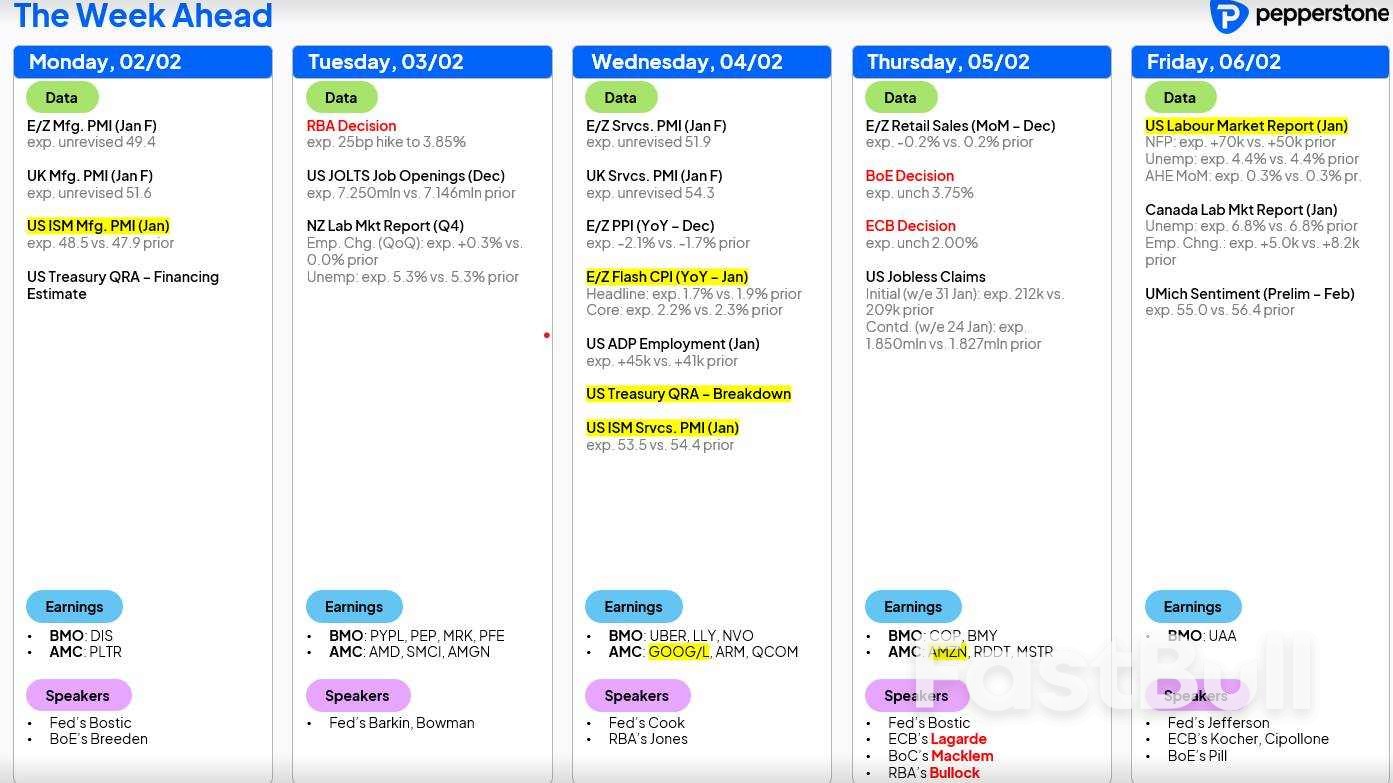
          With that framework in mind, it is fitting that the economic calendar is particularly full in the week ahead. The Friday release of US nonfarm payrolls stands out as the marquee risk event. Markets are currently modelling a central estimate of 68,000 net new jobs created in January, with the unemployment rate expected to hold at 4.4%. If realised, this outcome would likely be viewed as supportive for risk assets such as equities, offering enough job creation to limit renewed concerns about the US labour market, but not so strong as to materially reduce expectations for Fed rate cuts in June or July, or the pricing of two 25 basis point cuts by December.

          JOLTS and ISM Surveys Still Capable of Moving Risk

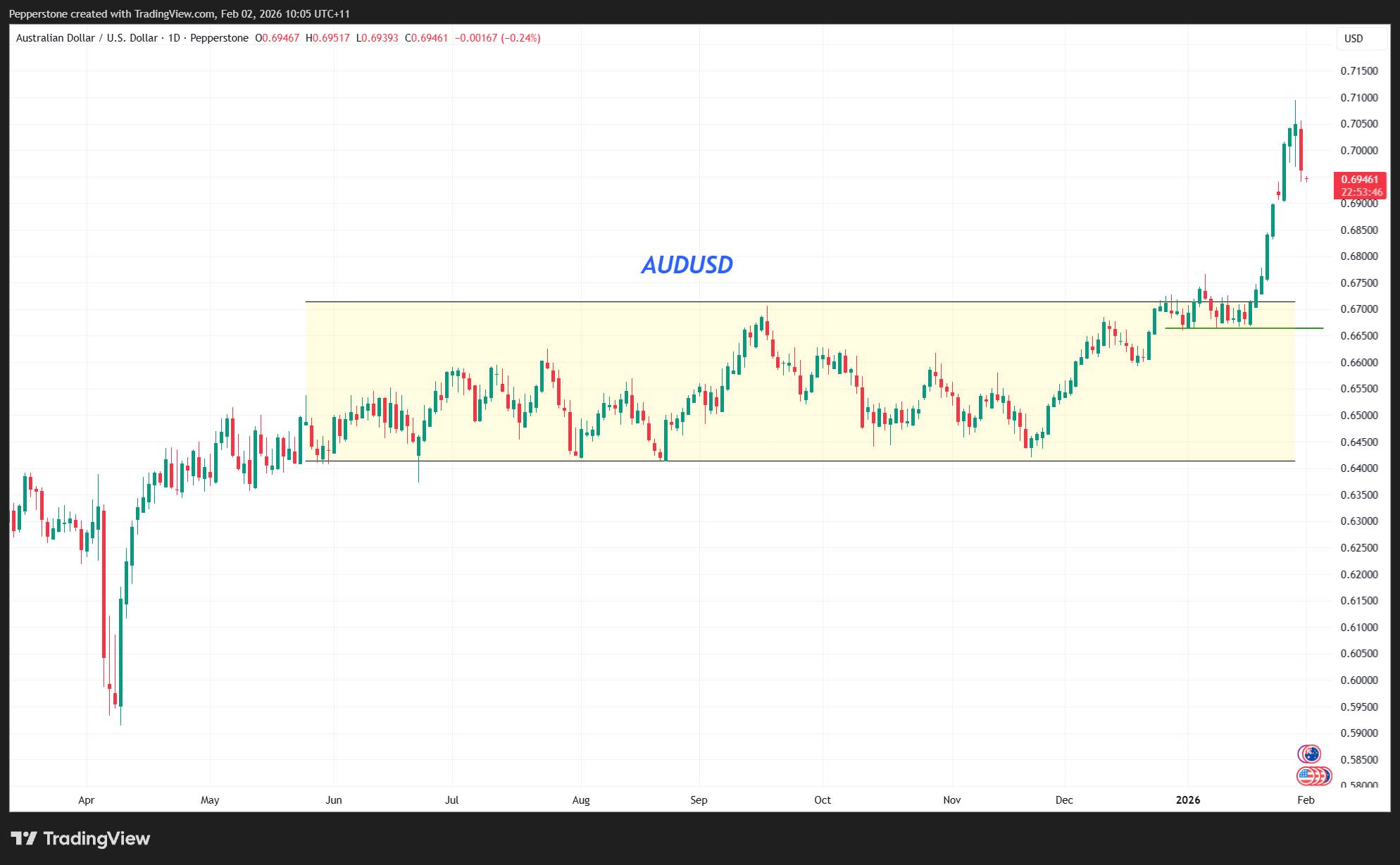
          Elsewhere in the US, and while likely secondary to nonfarm payrolls, JOLTS job openings and the ISM manufacturing and services surveys still have the capacity to move markets if outcomes prove to be meaningful outliers relative to expectations. RBA Meeting Poses Near Term Risk for AUD Traders Outside the US, the RBA meeting on Tuesday presents a near-term risk for AUD exposures. Interest rate swaps price around 15 basis points of tightening for this meeting, implying a 71% probability of a 25 basis point hike. That said, even if the RBA does raise rates, any AUD reaction may fade quickly unless the accompanying statement is interpreted as sufficiently hawkish to lift expectations for further tightening at future meetings.
          ECB and BoE Meetings Likely to Generate Only Short Lived Volatility

          The ECB and BoE meetings are not expected to result in changes to policy rates. While there may be some review of ECB guidance and the potential for brief volatility in EUR and GBP pairs, any market reaction should be contained and short-lived.

          US Earnings Season Accelerates with Major Tech in Focus

          US equity indices will also command attention, with just under 30% of S&P 500 market capitalisation reporting earnings and guidance this week. Alphabet and Amazon are the major heavyweight releases, while trader favourites such as Palantir, AMD, Qualcomm, Iren, Reddit and Barrick are also on the radar.

          European Earnings and Index Consolidation Continue

          It is a similarly busy earnings week in Europe, with around 30% of Euro Stoxx market capitalisation due to report. European equity indices are consolidating after a modest pullback from recent all-time highs. Conviction around a clear directional move in the DAX or Euro Stoxx 50 remains low, and the indices likely require further work to attract meaningful flows in either direction.
          Silver Volatility Highlights Structural Stress in Precious Metals Markets

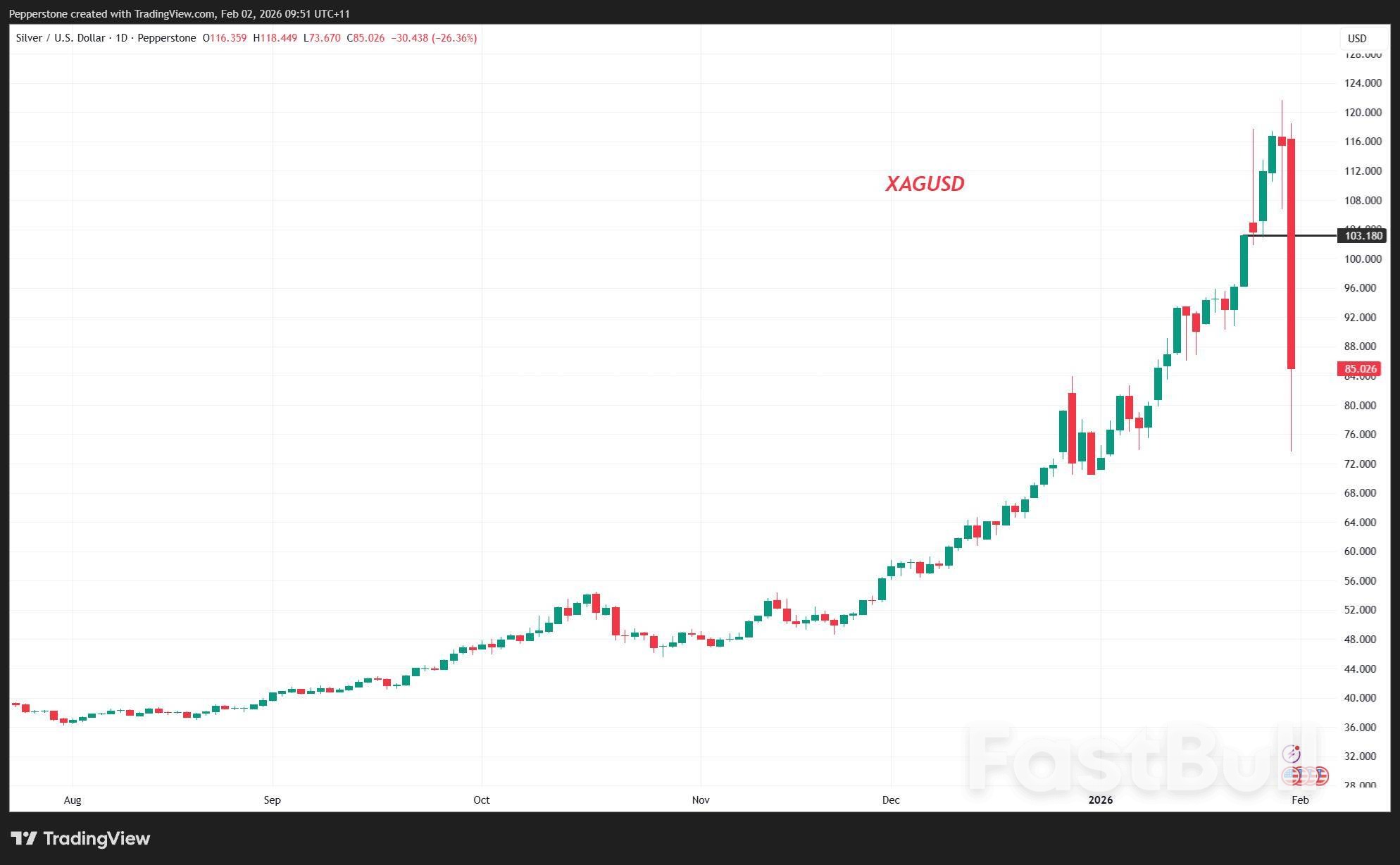
          Attention also naturally remains on silver, gold and the US dollar. Silver, and XAGUSD in particular, has become a case study in trading within a dysfunctional market, with products that typically move in close alignment becoming fractured and misaligned. XAG is trading with a 10-day realised volatility of 186%, equating to daily realised moves of nearly 12%, which is extraordinary. The CME's shift to percentage-based margining and successive increases in margin requirements have clearly contributed, alongside elevated positioning.

          China Liquidity and SHFE Selling Triggered the Latest Silver Liquidation

          China remains central to the silver narrative and appears to have provided the trigger for Friday's generational moves. Many traders outside China are now familiar with the UBS SDIC silver futures fund (161226), which had become the primary vehicle for Chinese retail investors to gain exposure to silver. When the Shenzhen Stock Exchange halted trading in the fund on Friday, investors were effectively locked in and forced to seek alternative ways to reduce exposure. That exit occurred through SHFE silver futures, with the resulting selling pressure rippling into COMEX futures and triggering a significant liquidation of positions.

          Is Silver Near a Bottom or Are Further Aftershocks Ahead

          Whether silver has reached a durable bottom is difficult to say. Another round of selling cannot be ruled out as Shanghai futures markets reopen, particularly given the residual stress across leveraged positions and market structure.

          Good luck to all.

          Source: Pepperstone

          Risk Warnings and Disclaimers
          You understand and acknowledge that there is a high degree of risk involved in trading. Following any strategies or investment methods may lead to potential losses. The content on the site is provided by our contributors and analysts for information purposes only. You are solely responsible for determining whether any trading assets, securities, strategy, or any other product is suitable for investing based on your own investment objectives and financial situation.
          Add to Favorites
          Share

          SE Asia's US Trade Surplus Soars Despite Trump Tariffs

          Devin

          Traders' Opinions

          Remarks of Officials

          Data Interpretation

          Economic

          Daily News

          China–U.S. Trade War

          Southeast Asia's export-driven economies saw their trade surpluses with the United States climb sharply in 2025, a surprising outcome that defied the Trump administration's efforts to rebalance trade through new tariffs.

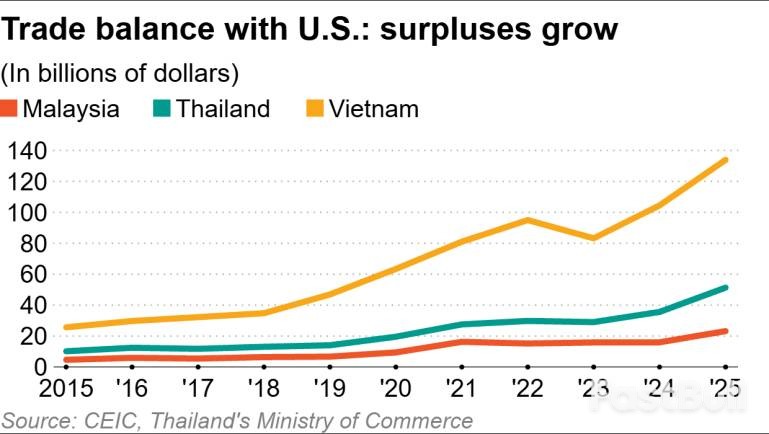
          Official data shows that Malaysia, Thailand, and Vietnam—three of the region's primary manufacturing and export centers—posted significant gains. Their trade surpluses with the U.S. expanded by 45%, 44%, and 28%, respectively, providing a major boost to their overall trade performance.

          A Surge in Exports to the U.S.

          According to Malaysia's Ministry of Investment, Trade and Industry, exports to the U.S. "remained resilient," with value expanding by 17.2%. The ministry credited this growth to "robust demand for [electronics and electric] products, machinery, equipment and parts, processed food as well as manufactures of metal."

          The numbers reveal a clear trend across the region:

          • Malaysia: The trade surplus with the U.S. jumped to $23.2 billion in 2025 from $15.9 billion the previous year, according to CEIC Data. This figure is more than ten times larger than it was a decade ago.

          • Vietnam: The country recorded the largest surplus with the U.S. among Southeast Asian nations, reaching a record $133.8 billion in 2025, a 28% year-on-year increase.

          • Thailand: The trade surplus climbed to $51.3 billion in 2025, up from $35.6 billion a year earlier, driven largely by electronics exports.

          Figure 1: Trade surpluses with the U.S. for Malaysia, Thailand, and Vietnam showed a steep upward trajectory through 2025, with Vietnam leading the expansion.

          Navigating Trump's Tariff Strategy

          The export boom occurred despite President Trump's announcement of "reciprocal" tariffs in April, which were designed to shrink America's trade deficit. Some Southeast Asian countries were initially hit with duties exceeding 40% before the tariffs took effect in August after bilateral negotiations led to reductions.

          Businesses responded by front-loading shipments, accelerating exports to get ahead of the deadlines. Meanwhile, governments continued to negotiate with Washington to soften the blow.

          In October, the U.S. lowered its tariff on most Malaysian goods from 25% to 19%. A list of 1,711 items, mainly in semiconductors, aerospace, and pharmaceuticals, now face zero tariffs. In exchange, Malaysia promised not to impose export bans or quotas on rare earth elements and critical minerals destined for the U.S.

          "ASEAN will seek to secure preferential rates to limit the downside impact," noted DBS Bank senior economist Chua Han Teng in a report. "Notably, Malaysia is actively negotiating with the U.S. to maintain exemptions for its semiconductor exports from fresh tariffs."

          The China Connection: Widening Deficits

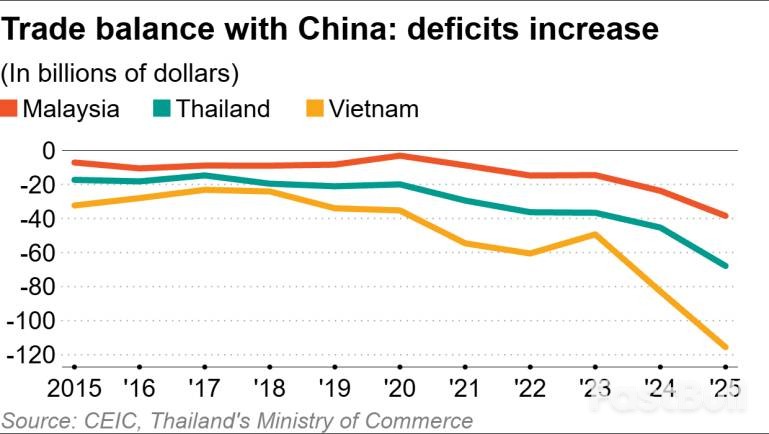
          While trade surpluses with the U.S. grew, the three nations' trade deficits with China widened considerably. This suggests an influx of goods from Asia's largest economy, which is also contending with high U.S. tariffs.

          In 2025, Malaysia's trade deficit with China widened by 62% to $38.4 billion. Thailand's deficit grew 50% to $67.8 billion, and Vietnam's expanded by 40% to $115 billion.

          "China exports cheap goods, and now with EV imports, [Malaysia's] trade deficit with China in future could be wider," commented Vaseehar Hassan Abdul Razack, executive vice chairman at KSI Strategic Institute for Asia Pacific.

          Figure 2: While exports to the U.S. boomed, trade deficits with China deepened significantly for all three nations, particularly Vietnam.

          Some analysts believe Chinese companies may be routing goods through neighboring countries like Vietnam before shipping them to the U.S. to bypass American tariffs. Jaideep Singh, an analyst at the Institute of Strategic & International Studies Malaysia, noted that Malaysia's share of domestic exports fell to 77%, its lowest level in at least seven years.

          "This means that while most of Malaysia's exports are still manufactured and processed domestically, re-exports of goods produced elsewhere are rising," he said.

          An Uncertain Outlook for 2026

          Uncertainty over U.S. trade policy is set to continue into 2026. This month, President Trump announced an increase in tariffs on South Korean automobiles from 15% to 25%. He also threatened, but later retracted, a 10% tariff on European nations that opposed his efforts to acquire Greenland.

          Analysts and governments in Southeast Asia warn that export growth could slow this year as the full-year impact of the tariffs takes hold.

          Thailand's Commerce Ministry stated on January 23 that its 2026 export outlook is "expected to moderate, reflecting the clearer impact of U.S. tariff measures."

          The DBS report echoed this sentiment, noting that Malaysia's goods exports are "likely to be negatively impacted by external headwinds from US tariffs." Chua also pointed out that the tariffs "will pose a major challenge to Vietnam's export-oriented manufacturing sector and its economy in 2026."

          Archanun Kohpaiboon, a visiting senior fellow at the ISEAS-Yusof Ishak Institute, believes last year's trend is unlikely to continue. "The [U.S.] trade deal with many countries would be in effect," he said. "Hence, these economies tend to import more from the U.S. and the trade surplus would reduce. This would, of course, pose risk to the ASEAN economy in 2026."

          To stay updated on all economic events of today, please check out our Economic calendar
          Risk Warnings and Disclaimers
          You understand and acknowledge that there is a high degree of risk involved in trading. Following any strategies or investment methods may lead to potential losses. The content on the site is provided by our contributors and analysts for information purposes only. You are solely responsible for determining whether any trading assets, securities, strategy, or any other product is suitable for investing based on your own investment objectives and financial situation.
          Add to Favorites
          Share

          Oil News: Iran Tensions Lift Crude Oil—Can Geopolitics Override Surplus Fears?

          Samantha Luan

          Commodity

          Key Points:

          · WTI futures surge 6.78% to $65.21 on Iran tensions and U.S. inventory draws—sixth consecutive weekly gain for crude oil.
          · Persian Gulf supply risk escalates as Iran announces military drills near Strait of Hormuz—20% of global oil flows threatened.
          · Analysts forecast Brent at $62 and WTI at $58.72 for 2026—global oversupply of 0.75-3.5M bpd threatens current rally momentum.

          WTI Surges on Iran Tensions — But Oversupply Threatens the Rally

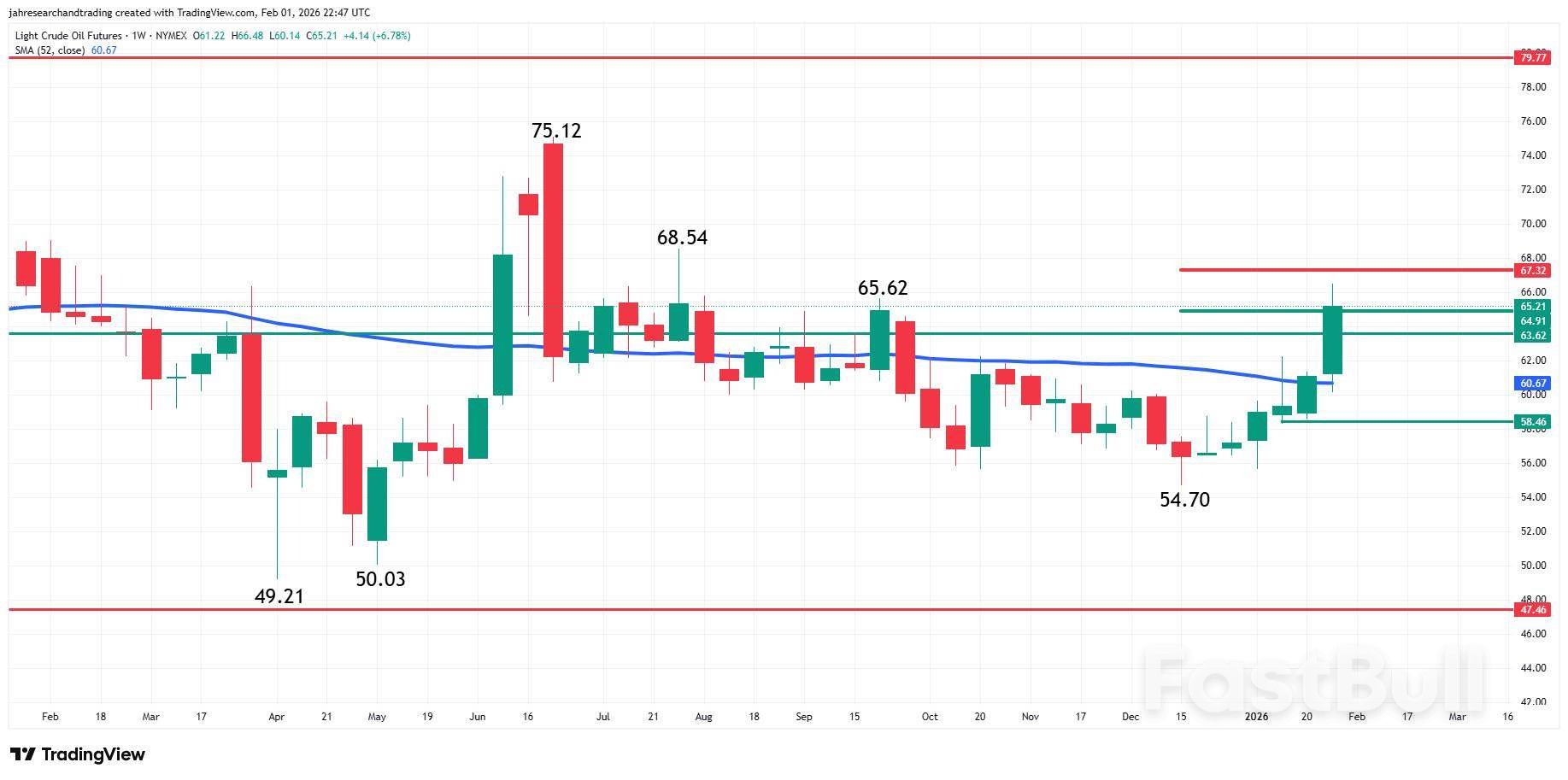
          Nearby WTI futures settled at $65.21 last week, up $4.14 or 6.78%—marking the sixth straight weekly gain. Traders are feeding off escalating U.S.-Iran tensions and tighter U.S. inventories, pushing both WTI and Brent to multi-month highs. But analyst consensus is screaming oversupply.

          War Premium Is Real — Persian Gulf Risk Is Pricing In

          The biggest catalyst? Geopolitics. President Trump warned Tehran it faces military action unless it accepts a new nuclear deal. The U.S. deployed additional naval assets to the Persian Gulf, and Iran just announced live-fire military drills in the Strait of Hormuz next week. Roughly 20% of global seaborne oil flows through that chokepoint.

          Traders are pricing in disruption risk even without actual barrel losses. Stack that with drone strikes on Russian tankers in the Black Sea and tightening U.S. sanctions on Russian fuel exports to Asia, and you've got a risk premium that's hard to ignore.

          U.S. Inventories Are Tightening — For Now

          The latest EIA report showed a 2.3-million-barrel draw in commercial crude stocks. At 423.8 million barrels, U.S. inventories are sitting about 3% below the five-year seasonal average. That shift from earlier January builds is giving buyers confidence that near-term demand is absorbing supply.

          But the Oversupply Math Isn't Going Away

          Here's where bulls need to be careful. A recent Reuters poll of 31 economists and analysts forecasts Brent averaging just $62.02 per barrel in 2026, with WTI projected at $58.72—both well below current levels. Global oil markets face a structural surplus ranging from 0.75 to 3.5 million barrels per day this year.

          OPEC+ paused production hikes for Q1 2026 after raising output targets by 2.9 million barrels daily last year. Analysts expect the group will watch consumption patterns closely before making any big moves.

          What Traders Should Watch Next Week

          Geopolitical risk premiums could extend if Iranian tensions escalate or we see actual supply disruptions—potentially pushing prices into the low-to-mid $70s. On the flip side, any clear de-escalation signals or a surprisingly bearish inventory report could trigger profit-taking back toward consensus forecast levels near $60. For now, the war premium is underpinning the rally, but the fundamental backdrop of excess supply capacity says don't get too comfortable chasing this move.

          Weekly Light Crude Oil Futures

          Technically, both the weekly swing chart and the 52-week moving average are signaling an uptrend, but the market is facing headwinds inside a key retracement zone. Traders will also be monitoring a long-term pivot for direction.

          The breakout over the 52-week moving average at $60.64 triggered the huge rally. This is understandable since it had been capping gains since late September. This is the support.

          The next surge was fueled by a recovery of the long-term pivot at $63.62. This indicator will determine the strength of the trend.

          The intermediate range is $75.12 to $54.70. Its retracement zone at $64.91 to $67.31 is potential resistance. Buyers tested this zone last week before stopping at $66.48.

          For longer-term traders, the 52-week moving average has to continue to hold as support. Short-term traders need to see a support base built over the pivot at $63.62. Enough momentum then has to build to trigger a breakout over the top of the retracement zone at $67.32.

          If enough buyers don't show up to overcome the retracement zone then we're likely to become rangebound with the 52-week moving average the floor and the zone the ceiling.

          Source: FX Empire

          Risk Warnings and Disclaimers
          You understand and acknowledge that there is a high degree of risk involved in trading. Following any strategies or investment methods may lead to potential losses. The content on the site is provided by our contributors and analysts for information purposes only. You are solely responsible for determining whether any trading assets, securities, strategy, or any other product is suitable for investing based on your own investment objectives and financial situation.
          Add to Favorites
          Share

          Washington Signals Openness to Cuba Talks Amid Escalating Sanctions Pressure

          Gerik

          Economic

          Trump Signals Willingness to Engage Havana

          On January 31, US President Donald Trump announced that the United States has begun negotiations with Cuban leaders, voicing confidence that the two sides could eventually reach an agreement. While the president did not disclose details regarding the scope or timing of the talks, his remarks marked a notable rhetorical opening after years of strained bilateral relations.
          The statement suggests a tentative diplomatic overture, though its practical substance remains unclear. By withholding specifics, the administration appears to be testing political reactions while retaining flexibility over the direction and pace of engagement.

          Negotiations Overshadowed by New Economic Measures

          Trump’s comments came just two days after he signed an executive order imposing higher tariffs on countries that supply oil to Cuba. This move effectively tightened economic pressure on the Caribbean nation and reinforced Washington’s leverage at the outset of any potential dialogue.
          The sequencing of these actions points to a strategic pattern rather than coincidence. The initiation of talks coinciding with punitive economic measures indicates a bargaining posture in which sanctions function as leverage rather than as instruments of isolation alone.

          Cuba Condemns What It Calls Aggressive Policy

          Cuban Foreign Minister Bruno Rodríguez sharply criticized the new US executive order, characterizing it as an aggressive act against both the Cuban government and its population. He emphasized that the measures come on top of nearly 65 years of US economic sanctions, which Havana describes as the longest and most severe embargo imposed on any country.
          From the Cuban perspective, the renewed pressure reinforces a historical narrative of economic coercion rather than constructive diplomacy. This framing complicates prospects for trust building, even if negotiations formally proceed.

          Energy Dependence and the Venezuela Factor

          Since the imposition of US sanctions in 1962, Cuba has relied heavily on imported oil, primarily from Venezuela. However, recent US military action against Venezuela earlier this year, coupled with the arrest and transfer of Venezuelan President Nicolás Maduro and his spouse to the United States for trial, has significantly disrupted Caracas’s operations.
          President Trump has previously stated that oil shipments from Venezuela to Cuba would be suspended until a separate agreement is reached. The combination of sanctions enforcement and regional instability has therefore altered Cuba’s energy supply dynamics, leaving the island increasingly exposed.

          Fuel Shortages and Domestic Impact in Cuba

          The tightening of sanctions and the blockage of oil flows have intensified Cuba’s fuel shortages, with visible consequences for its national electricity system. Power generation has been severely affected, leading to frequent outages and compounding economic and social pressures on the population.
          In this context, Washington’s optimism about a potential deal contrasts sharply with the immediate humanitarian and infrastructural challenges facing Cuba. The relationship between sanctions and negotiations is therefore not merely rhetorical but materially linked, as energy constraints heighten Havana’s vulnerability.

          A Narrow Diplomatic Window

          Taken together, the developments suggest that while the United States is signaling openness to dialogue, negotiations are unfolding under asymmetric conditions shaped by economic pressure. Whether this approach leads to compromise or entrenches confrontation will depend on how both sides interpret the balance between coercion and engagement.
          For now, Trump’s optimism points to a possible diplomatic opening, but the broader trajectory of US–Cuba relations remains uncertain, constrained by longstanding mistrust, regional instability, and the immediate realities of Cuba’s deepening energy crisis.
          To stay updated on all economic events of today, please check out our Economic calendar
          Risk Warnings and Disclaimers
          You understand and acknowledge that there is a high degree of risk involved in trading. Following any strategies or investment methods may lead to potential losses. The content on the site is provided by our contributors and analysts for information purposes only. You are solely responsible for determining whether any trading assets, securities, strategy, or any other product is suitable for investing based on your own investment objectives and financial situation.
          Add to Favorites
          Share

          A Fragile Outlook for Russia’s Push to Revive the RIC Mechanism

          Gerik

          Economic

          Political

          Russia’s Strategic Rationale Behind Reviving RIC

          According to the South China Morning Post, Russia has renewed its call to reactivate the trilateral Russia–India–China mechanism, commonly known as RIC. In early January 2026, Russian Foreign Minister Sergey Lavrov emphasized Moscow’s close bilateral ties with both New Delhi and Beijing, framing RIC as a historical pillar of emerging multipolarity and an intellectual precursor to BRICS.
          The idea of RIC was originally proposed in 1998 by former Russian prime minister Yevgeny Primakov as a framework to balance Western dominance and encourage Eurasian coordination. Despite its longevity as a concept, the mechanism has never evolved into a substantive platform, largely because of deep seated geopolitical divergences, most notably between India and China.
          At a Russian diplomatic briefing on January 20, Lavrov reiterated that a multipolar world order is inevitable, describing Russia–India relations as uniquely strategic and Russia–China ties as unprecedented in depth and policy alignment. From Moscow’s perspective, reviving RIC would help preserve diplomatic flexibility and reduce isolation under ongoing sanctions pressure.

          India’s Reluctance Rooted in Structural Mistrust

          Analysts widely agree that India assigns RIC only marginal importance. Persistent mistrust between India and China remains the central obstacle. Since the deadly 2020 clashes in the Galwan Valley, tensions along the Line of Actual Control have not been fully resolved. Although limited disengagement has taken place, friction continues in areas such as Depsang Plains and Demchok, while ongoing troop deployments and infrastructure expansion continue to erode strategic confidence.
          This unresolved security environment shapes India’s assessment of trilateral cooperation. Without a minimum threshold of trust, any attempt to expand RIC beyond symbolic dialogue encounters structural limits. As a result, New Delhi views the mechanism as a diplomatic channel rather than a framework capable of producing binding outcomes.

          The Pakistan Factor and Compounding Security Concerns

          The outlook for RIC has further dimmed following reports regarding China’s alleged role during India’s Sindoor military operation, which New Delhi framed as a response to attacks linked to Pakistan backed militant groups. According to Indian and US sources, Beijing reportedly supplied advanced weapons, intelligence support, and information operations to Pakistan, actions that India perceives as directly undermining its security posture.
          Whether interpreted as causation or correlation, these developments reinforce Indian skepticism toward Beijing’s strategic intentions. The closer China–Pakistan alignment becomes in security matters, the narrower India’s political space to engage in a trilateral structure that includes China.

          Avoiding the Perception of a Western Counterweight

          From a strategic positioning perspective, India continues to pursue a pragmatic, non committal approach to RIC. Analysts at the Takshashila Institution argue that New Delhi does not wish to be seen as part of an arrangement implicitly positioned against the United States and its allies, even while rhetorically supporting multipolarity.
          This reflects India’s long standing emphasis on strategic autonomy. Rather than anchoring itself within a fixed bloc, New Delhi seeks flexibility across partnerships, especially as its economic, technological, and defense cooperation with Western countries deepens.

          Economic Corridors and Overlapping Strategic Interests

          Divergent economic priorities also constrain RIC’s development. Facing potential US sanctions risks, India may scale back its role at Iran’s Chabahar Port while prioritizing the International North-South Transport Corridor with Russia. However, this corridor overlaps geographically and logistically with China’s Belt and Road Initiative, particularly in Russia and Central Asia.
          These intersections create both coordination opportunities and latent competition. While technical cooperation is possible, conflicting interests over routes, standards, and influence limit the scope for deeper alignment under a trilateral framework.

          Energy Trade, Sanctions Pressure, and US Leverage

          India’s continued imports of discounted Russian oil remain another sensitive issue. The United States has criticized these purchases, arguing they indirectly fund Russia’s war in Ukraine, and has imposed 50 percent tariffs on certain Indian goods. New Delhi counters that affordable energy imports are essential for economic stability and growth.
          This situation illustrates a clear strategic trade off. Reducing Russian oil imports could ease US trade pressure but risk higher energy costs, while maintaining them sustains diplomatic friction. Some analysts suggest that if India curtails oil purchases to secure concessions from Washington, Russia–China ties may tighten further, leaving Moscow with stronger incentives to promote RIC as a sanctions mitigation tool.

          Payment Systems and Divergent Monetary Agendas

          Another frequently cited area of potential cooperation involves linking financial messaging and payment systems among Russia, China, and India. Yet analysts caution that India does not actively support de dollarization, whereas China is pushing for greater internationalization of the renminbi. These differing monetary objectives limit the strategic depth of any financial integration under RIC, confining cooperation to narrowly defined transactional use rather than systemic transformation.
          India is also closely monitoring the stance of US President Donald Trump before making any strategic commitments related to RIC. According to research from the University of Oxford, any visible expansion of Russia–India cooperation could trigger renewed pressure from Washington.
          At the same time, India has strengthened ties with the European Union, including finalizing a bilateral trade agreement that European Commission President Ursula von der Leyen described as the “mother of all deals.” This deepening engagement with Europe further constrains India’s willingness to elevate RIC into a central foreign policy pillar.
          Taken together, India’s cautious stance reflects a consistent priority to safeguard core interests while preserving strategic autonomy. RIC may continue to exist as a dialogue channel useful for signaling and managing perceptions, but the absence of trust between India and China, combined with competing geopolitical and economic incentives, makes it unlikely to evolve into a substantive strategic framework. In an era of intensifying great power rivalry, RIC’s revival appears more symbolic than transformative.
          To stay updated on all economic events of today, please check out our Economic calendar
          Risk Warnings and Disclaimers
          You understand and acknowledge that there is a high degree of risk involved in trading. Following any strategies or investment methods may lead to potential losses. The content on the site is provided by our contributors and analysts for information purposes only. You are solely responsible for determining whether any trading assets, securities, strategy, or any other product is suitable for investing based on your own investment objectives and financial situation.
          Add to Favorites
          Share

          US-Iran Standoff: What's Next for Oil Prices?

          Edward Lawson

          Commodity

          Energy

          Remarks of Officials

          Economic

          Middle East Situation

          Political

          Geopolitical uncertainty is rattling global energy markets as the US administration's unpredictable stance on Iran leaves both Tehran and traders guessing. With a US armada positioned off the Iranian coast, the lack of a clear strategy has injected significant volatility into oil and gas prices.

          Oil prices climbed above $70 per barrel on Thursday, reaching a high not seen since last July. While this surge is partly fueled by fears of a US-Iran conflict, it's also propped up by temporary supply disruptions. Recent winter storms have interrupted US output, and fires at Kazakhstan's key Tengiz field have caused a sharp drop in its supply.

          This tension extends to the natural gas market. European prices rose sharply last month due to a prolonged cold spell that depleted storage reserves. The freeze in the US has further complicated the situation, forcing Europe to confront its potential over-reliance on American liquefied natural gas (LNG) just as it sought to reduce its dependence on Russian pipelines.

          A High-Stakes Game of Threats and Diplomacy

          The war of words has escalated, amplifying market jitters. President Donald Trump issued a warning, posting, "The next attack will be far worse! Don't make that happen again," as the USS Abraham Lincoln carrier group remains near Iran.

          In response, Ali Larijani, secretary of Iran's national security council, stated from Moscow that "structural arrangements for negotiations are progressing," dismissing the tension as a "contrived media war." Simultaneously, Tehran announced plans for a live-fire military exercise in the Strait of Hormuz, while attributing several domestic explosions to gas leaks.

          Meanwhile, regional powers including the UAE, Saudi Arabia, and Qatar have consistently advocated for a diplomatic solution over military conflict.

          Mapping the Potential Conflict Scenarios

          The current standoff could unfold in several ways, ranging from a quiet de-escalation to a major regional conflict.

          • Limited Strikes: The confrontation could end with minor US military strikes on Iranian missile or nuclear facilities, leaving the country's energy sector untouched, similar to the brief conflict last June.

          • Targeting Energy Infrastructure: The US and/or Israel could attack Iran's domestic energy grid, focusing on gas, electricity, and fuel distribution systems.

          • Regime-Change Campaign: Following Iran's suppression of recent protests, Washington might launch a prolonged military campaign or an oil export blockade designed to destabilize or topple the regime.

          • Iranian Retaliation: Tehran could strike back by targeting regional energy assets, as it did last year when it damaged a refinery in Haifa, Israel. Other potential targets include Israeli offshore gas platforms that supply Egypt and Jordan.

          • A Negotiated Deal: In the face of an attack, Iran might be pushed to the negotiating table, possibly after a change in leadership.

          This wide spectrum of outcomes makes it difficult for energy markets to price in the risk accurately. The situation is far more complex than the one-way bet on Venezuelan oil at the start of the year, where exports had little direction to go but up.

          The Real Impact on Global Oil and Gas Supply

          Iran's role in the global oil market means any disruption would have a significant impact. The country currently exports between 1.5 million and 1.7 million barrels per day (bpd) of crude oil and condensate, along with 0.5 million bpd of refined products. A sudden halt to these exports could drive oil prices higher by about $15 per barrel.

          However, several factors could cushion the blow. OPEC's spare capacity, held primarily by Saudi Arabia and the UAE, is more than sufficient to cover the shortfall. Furthermore, China—Iran's largest customer—could slow the filling of its strategic petroleum reserves or purchase more discounted Russian oil.

          While Iran is the world's third-largest natural gas producer, it is not a major exporter. Its main customer, Turkey, has other options, including increasing LNG purchases or buying more gas from Russia.

          Beyond the "Close Hormuz" Threat

          The most severe risk—though one with low probability—is an interruption of energy transit through the Gulf. The often-repeated threat from Tehran to "close Hormuz" is largely seen as a last resort, as such an act would be almost suicidal for the regime.

          A more plausible scenario involves asymmetric warfare. Houthi forces in Yemen have demonstrated how a campaign of missile, drone, and mine attacks can effectively disrupt shipping in a critical waterway. A similar strategy in the Gulf would not stop oil and LNG transit entirely, but it would severely limit it and cause shipping and insurance premiums to skyrocket.

          What a Diplomatic Breakthrough Would Mean

          If diplomacy prevails, the market dynamics would shift dramatically. The geopolitical risk premium would evaporate from oil prices. An easing or suspension of sanctions could allow Iran to boost its exports by 300,000 to 500,000 bpd, bringing its total output to around 3.8 million bpd.

          A deal would also be a financial windfall for Tehran. By gaining access to customers beyond China, Iran could end its reliance on a "shadow fleet" of tankers and stop offering deep discounts, saving an estimated $8 to $10 per barrel.

          Iran's Long-Term Production Challenges

          Even if a political agreement is reached, a surge in Iranian oil production is unlikely. International oil companies have historically found Tehran a difficult place to operate, and the country's aging fields require massive investment just to offset natural decline rates.

          Iran also lacks sufficient natural gas to inject into its fields for crucial enhanced oil recovery projects. Under the most favorable conditions, a realistic production target is 4.5 million bpd by 2030—a moderate increase, but not a game-changer for global supply.

          For now, the balance of risk points toward higher oil and gas prices. While a peaceful resolution would loosen the market, it wouldn't fundamentally reshape it. The key players have yet to reveal their next move, leaving the world's energy markets waiting in suspense.

          To stay updated on all economic events of today, please check out our Economic calendar
          Risk Warnings and Disclaimers
          You understand and acknowledge that there is a high degree of risk involved in trading. Following any strategies or investment methods may lead to potential losses. The content on the site is provided by our contributors and analysts for information purposes only. You are solely responsible for determining whether any trading assets, securities, strategy, or any other product is suitable for investing based on your own investment objectives and financial situation.
          Add to Favorites
          Share

          China’s Kling AI Sparks a Global Wave as AI Video Creation Enters a New Phase

          Gerik

          Economic

          From Experimental Tool To Global Creative Infrastructure

          AI powered video generation has evolved at remarkable speed, moving beyond novelty and experimentation to become a practical production tool for professional creators, marketers, and media organizations. In this increasingly competitive landscape, Kling has emerged as one of the most closely watched new entrants, positioning itself alongside Google Veo and OpenAI Sora in the global race for AI driven video technology.
          Launched in June 2024, Kling has quickly become a strategic growth engine for Kuaishou, a firm that has long competed in the shadow of ByteDance in China’s short video market. The speed at which Kling has scaled suggests that AI video generation is no longer a peripheral experiment but a core pillar of future content ecosystems.

          User Adoption Signals A Structural Shift

          Within just a few months of launch, Kling attracted approximately 12 million monthly active users. This rapid uptake reflects a broader transformation in how generative AI is being consumed. AI created videos, once viewed as technical demos or curiosity driven content, are now deeply embedded in everyday digital consumption across social media platforms.
          Animated animals, cinematic science fiction scenes, and AI generated virtual presenters have become familiar to online audiences. While concerns persist about low quality AI content flooding digital spaces, Kling’s growth indicates that demand is increasingly shaped by usefulness and creative control rather than novelty alone.

          Why Kling Stands Out In A Crowded AI Market

          The breakout success of Kling raises an important question for the broader AI industry: why has this platform gained traction while many similar tools struggle to reach scale. The answer appears to lie in Kling’s alignment with real world creative workflows. Instead of positioning itself purely as a technological showcase, Kling integrates generative capabilities with practical needs such as speed, stylistic flexibility, and commercial usability.
          This approach suggests a causal relationship between product design and adoption. Platforms that successfully translate AI complexity into intuitive creative outputs are more likely to achieve sustained engagement, rather than experiencing short lived viral attention.

          Commercial Performance Reinforces Market Credibility

          Kling’s financial performance further strengthens its position. Company disclosures and market estimates indicate that the platform generated more than 20 million USD in revenue in December alone, contributing to an annual total of roughly 140 million USD. This figure exceeded Kuaishou’s internal target of 60 million USD for early 2025 by more than double, underscoring how quickly monetization has accelerated.
          Looking ahead, growth momentum has carried into the new year. In January, Kling’s average daily revenue rose by around 30 percent compared with the previous month. This trend points to increasing willingness among users to pay for AI video services, especially as output quality and reliability improve.

          Implications For The Global AI Video Race

          Kling’s rise highlights a broader recalibration in the global AI landscape. Innovation is no longer concentrated exclusively in Western technology hubs, and Chinese platforms are increasingly capable of competing at the highest technological and commercial levels. While comparisons with Google Veo and OpenAI Sora often focus on model sophistication, Kling’s advantage lies in execution speed and market integration.
          Rather than signaling a short term surge, Kling’s performance suggests that AI video generation is entering a more mature phase. In this phase, success depends not only on model capability but on the ability to convert technological breakthroughs into scalable, revenue generating creative infrastructure.
          As AI generated video continues to reshape digital storytelling, Kling’s trajectory indicates that the next chapter of global AI competition will be defined as much by adoption and monetization as by raw technical power.
          To stay updated on all economic events of today, please check out our Economic calendar
          Risk Warnings and Disclaimers
          You understand and acknowledge that there is a high degree of risk involved in trading. Following any strategies or investment methods may lead to potential losses. The content on the site is provided by our contributors and analysts for information purposes only. You are solely responsible for determining whether any trading assets, securities, strategy, or any other product is suitable for investing based on your own investment objectives and financial situation.
          Add to Favorites
          Share
          FastBull
          Copyright © 2026 FastBull Ltd

          728 RM B 7/F GEE LOK IND BLDG NO 34 HUNG TO RD KWUN TONG KLN HONG KONG

          TelegramInstagramTwitterfacebooklinkedin
          App Store Google Play Google Play
          Products
          Charts

          Chats

          Q&A with Experts
          Screeners
          Economic Calendar
          Data
          Tools
          Membership
          Features
          Function
          Markets
          Copy Trading
          Latest Signals
          Contests
          News
          Analysis
          24/7
          Columns
          Education
          Company
          Careers
          About Us
          Contact Us
          Advertising
          Help Center
          Feedback
          User Agreement
          Privacy Policy
          Personal Information Protection Statement
          Business

          White Label

          Data API

          Web Plug-ins

          Poster Maker

          Affiliate Program

          Risk Disclosure

          The risk of loss in trading financial instruments such as stocks, FX, commodities, futures, bonds, ETFs and crypto can be substantial. You may sustain a total loss of the funds that you deposit with your broker. Therefore, you should carefully consider whether such trading is suitable for you in light of your circumstances and financial resources.

          No decision to invest should be made without thoroughly conducting due diligence by yourself or consulting with your financial advisors. Our web content might not suit you since we don't know your financial conditions and investment needs. Our financial information might have latency or contain inaccuracy, so you should be fully responsible for any of your trading and investment decisions. The company will not be responsible for your capital loss.

          Without getting permission from the website, you are not allowed to copy the website's graphics, texts, or trademarks. Intellectual property rights in the content or data incorporated into this website belong to its providers and exchange merchants.

          Not Logged In

          Log in to access more features

          Connect Broker
          Become a signal provider
          Help Center
          Customer Service
          Dark Mode
          Price Up/Down Colors

          Log In

          Sign Up

          Position
          Layout
          Fullscreen
          Default to Chart
          The chart page opens by default when you visit fastbull.com